BELIEVE ME, IT IS
WHY DEBATE?
WHY, INDEED?
1. Academically beneficial
2. Career preparation
3. Self-actualization
ACADEMICALLY BENEFICIAL
Papers and essay writing
Recitations
Extra-curricular
activities
CAREER PREPARATION
Communication skills
Interpersonal/social skills
Resume/
CV content
SELF-ACTUALIZATION
Confidence
Critical thinking
WHO YOU COULD BE :D
PATRICIA EVANGELISTA
 UP Diliman
 Debater
 TV show
  host, columnist, segment
  producer, product
  endorser and leader
 first Filipina to win the
  Best Speaker award in
  the International Public
  Speaking Competition
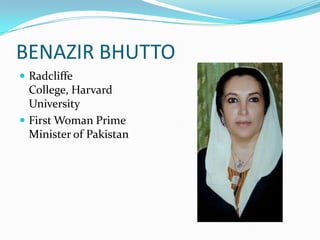
BENAZIR BHUTTO
 Radcliffe
  College, Harvard
  University
 First Woman Prime
  Minister of Pakistan
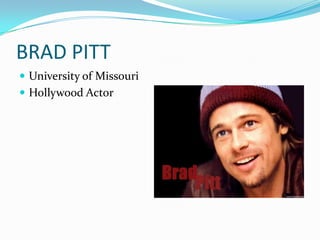
BRAD PITT
 University of Missouri
 Hollywood Actor
HOW IT WORKS
Things that you should know by heart :D
DEFINITION
 a form of formalised argument where the winner is
  the team that most effectively persuades the
  adjudicator
 a verbal judo: martial arts for the mind
 a team sport; debate is won by team, not by
  individuals
 not : personal abuse, irrational attacks, or purely
  emotional appeal
MOTION
 Topic of the debate; what you are debating upon
Example: THBT the Reproductive Health Bill should be
  adopted
 Common acronyms:
TH-This House
THBT-This House Believes That
THW-This House Will
THR-This House Regrets
THC-This House Celebrates
TYPES
Open
Semi-closed/Semi-open
Closed
OPEN MOTIONS
 Very vague motions
 Highly open to different interpretations
 Presents no clear issue to discuss, thus, requires a good
  and clear definition
 Rarely given out in debates; unfair for the
  opposition/negative side
 Example: THBT the carrot is better than the stick
SEMI-CLOSED/SEMI-OPEN
 Relatively more clear, more specific
 Presents a specific issue and provides a
  few details of what is to be debated
  upon
 Example: THBT the act of ignoring a
  “cry for help” should be criminally
  liable
CLOSED MOTIONS
 Highly specific motions, very clear as to
  what it wants you to debate about
 Leaves no room for doubt as to what is to be
  discussed during the debate
 Example: THW allow developed nations to
  use the effectiveness of population control
  mechanisms of a developing country as a
  basis for giving foreign aid
Because two is better than one
TWO SIDES
Government/Affirmative/Pro
 position
Opposition/Negative
GOVERNMENT
 support the motion
 Meaning: defining the motion
      :constructing a positive case in favour of the
      motion
      :providing substantive materials and arguments in
      support of the case
      :responding to any challenges made to that case
      by the Opposition
OPPOSITION
 negate the motion
 Meaning: responding to the Government's definition
      :constructing a case in opposition to the motion
      :providing substantive materials and arguments in
      support of the case
      :responding to the arguments delivered by the
      Government.
TYPES
POLICY DEBATE
VALUE-JUDGMENT
DEBATE
POLICY DEBATE
 solution to a problem via a policy
 goal: prove whether the proposed policy solves the
  problem or not
 THW motions are usually policy debates
 Elements of a policy:

            -what                         -how
            -who                       -safety net
           -when                        -sanction
           -where
POLICY DEBATE
Example: THW legalize prostitution
POLICY: pass a housebill recognizing prostitution as a
  legal form of employment and business opportunity
Who: government agencies such as the DOLE and
  DOH, in cooperation with concerned business
  establishments
When: 2 years of implementation
Where: to all existing red light districts
POLICY DEBATE
Safety net: regular check-ups, provision of
  contraceptives, better working conditions, continuous
  monitoring
Sanction: imprisonment, sequester business and
  payment of fees, depending on gravity of offense
VALUE-JUDGMENT DEBATE
 assessment of ideas


*NOTE: Policy and value-judgment debates are not
  mutually-exclusive.
Yes, it differs from the debate types.
FORMAT
BRITISH PARLIAMENTARY
 DEBATE
ASIAN PARLIAMENTARY
 DEBATE
BRITISH PARLIAMENTARY
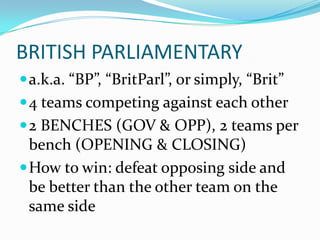
 a.k.a. “BP”, “BritParl”, or simply, “Brit”
 4 teams competing against each other
 2 BENCHES (GOV & OPP), 2 teams per
  bench (OPENING & CLOSING)
 How to win: defeat opposing side and
  be better than the other team on the
  same side
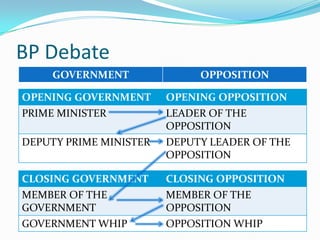
BP Debate
     GOVERNMENT              OPPOSITION

OPENING GOVERNMENT      OPENING OPPOSITION
PRIME MINISTER          LEADER OF THE
                        OPPOSITION
DEPUTY PRIME MINISTER   DEPUTY LEADER OF THE
                        OPPOSITION

CLOSING GOVERNMENT      CLOSING OPPOSITION
MEMBER OF THE           MEMBER OF THE
GOVERNMENT              OPPOSITION
GOVERNMENT WHIP         OPPOSITION WHIP
ASIAN PARLIAMENTARY
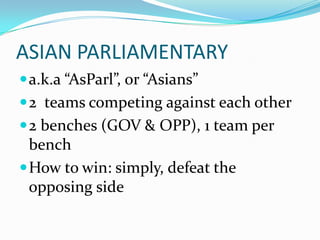
 a.k.a “AsParl”, or “Asians”
 2 teams competing against each other
 2 benches (GOV & OPP), 1 team per
  bench
 How to win: simply, defeat the
  opposing side
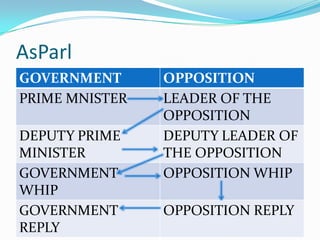
AsParl
GOVERNMENT      OPPOSITION
PRIME MNISTER   LEADER OF THE
                OPPOSITION
DEPUTY PRIME    DEPUTY LEADER OF
MINISTER        THE OPPOSITION
GOVERNMENT      OPPOSITION WHIP
WHIP
GOVERNMENT      OPPOSITION REPLY
REPLY
The 7 minutes that count.
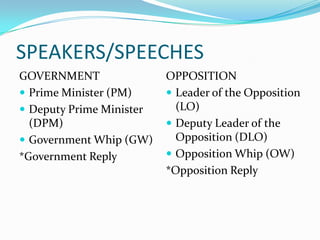
SPEAKERS/SPEECHES
GOVERNMENT                OPPOSITION
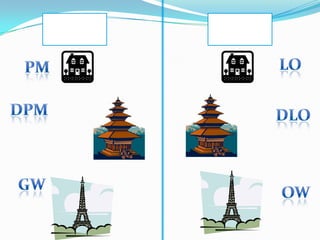
 Prime Minister (PM)      Leader of the Opposition
 Deputy Prime Minister     (LO)
  (DPM)                    Deputy Leader of the
 Government Whip (GW)      Opposition (DLO)
*Government Reply          Opposition Whip (OW)
                          *Opposition Reply
PM/LO
Role of first speakers: Establish the grounds on which the
 debate will be fought
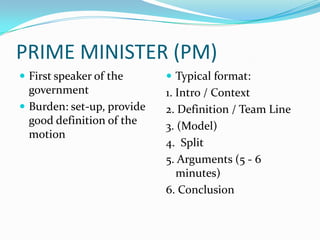
PRIME MINISTER (PM)
 First speaker of the       Typical format:
  government                1. Intro / Context
 Burden: set-up, provide   2. Definition / Team Line
  good definition of the    3. (Model)
  motion
                            4. Split
                            5. Arguments (5 - 6
                               minutes)
                            6. Conclusion
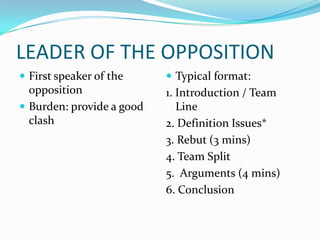
LEADER OF THE OPPOSITION
 First speaker of the      Typical format:
  opposition               1. Introduction / Team
 Burden: provide a good      Line
  clash                    2. Definition Issues*
                           3. Rebut (3 mins)
                           4. Team Split
                           5. Arguments (4 mins)
                           6. Conclusion
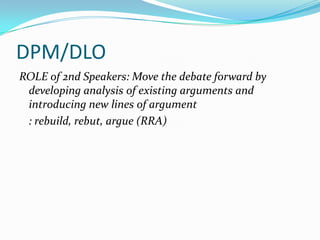
DPM/DLO
ROLE of 2nd Speakers: Move the debate forward by
 developing analysis of existing arguments and
 introducing new lines of argument
 : rebuild, rebut, argue (RRA)
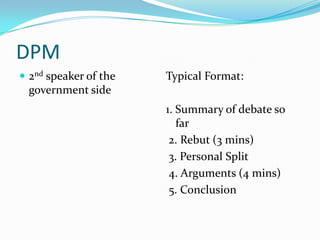
DPM
 2nd speaker of the   Typical Format:
 government side
                       1. Summary of debate so
                          far
                        2. Rebut (3 mins)
                        3. Personal Split
                        4. Arguments (4 mins)
                        5. Conclusion
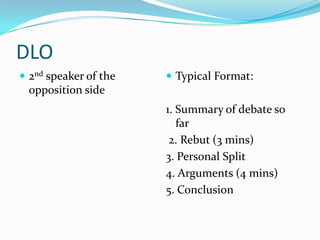
DLO
 2nd speaker of the    Typical Format:
 opposition side
                       1. Summary of debate so
                          far
                        2. Rebut (3 mins)
                       3. Personal Split
                       4. Arguments (4 mins)
                       5. Conclusion
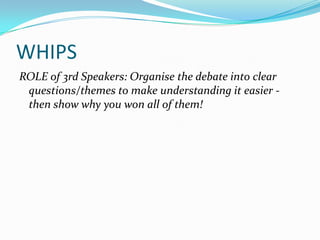
WHIPS
ROLE of 3rd Speakers: Organise the debate into clear
 questions/themes to make understanding it easier -
 then show why you won all of them!
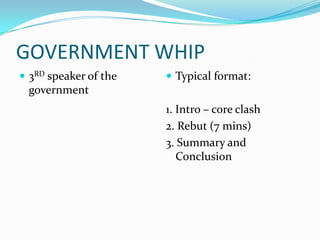
GOVERNMENT WHIP
 3RD speaker of the    Typical format:
 government
                       1. Intro – core clash
                       2. Rebut (7 mins)
                       3. Summary and
                          Conclusion
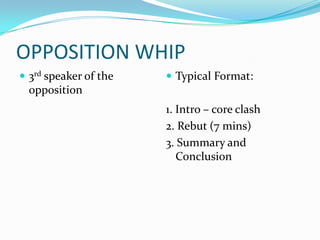
OPPOSITION WHIP
 3rd speaker of the    Typical Format:
  opposition
                       1. Intro – core clash
                       2. Rebut (7 mins)
                       3. Summary and
                          Conclusion
REPLY SPEAKERS
So as to avoid nosebleeds ...somehow
JARGONS
WORD/PHRASE       MEANING
From the get-go   From the start or beginning
Flipside
MOTION (demo debate)
THW force religious
 schools to teach sex
 education including
 contraceptives
Debate Basics
  • 1.
  • 2.
  • 3.
    WHY, INDEED? 1. Academicallybeneficial 2. Career preparation 3. Self-actualization
  • 4.
    ACADEMICALLY BENEFICIAL Papers andessay writing Recitations Extra-curricular activities
  • 5.
  • 6.
  • 7.
  • 8.
    PATRICIA EVANGELISTA  UPDiliman  Debater  TV show host, columnist, segment producer, product endorser and leader  first Filipina to win the Best Speaker award in the International Public Speaking Competition
  • 9.
    BENAZIR BHUTTO  Radcliffe College, Harvard University  First Woman Prime Minister of Pakistan
  • 10.
    BRAD PITT  Universityof Missouri  Hollywood Actor
  • 11.
  • 12.
    Things that youshould know by heart :D
  • 13.
    DEFINITION  a formof formalised argument where the winner is the team that most effectively persuades the adjudicator  a verbal judo: martial arts for the mind  a team sport; debate is won by team, not by individuals  not : personal abuse, irrational attacks, or purely emotional appeal
  • 15.
    MOTION  Topic ofthe debate; what you are debating upon Example: THBT the Reproductive Health Bill should be adopted  Common acronyms: TH-This House THBT-This House Believes That THW-This House Will THR-This House Regrets THC-This House Celebrates
  • 16.
  • 17.
    OPEN MOTIONS  Veryvague motions  Highly open to different interpretations  Presents no clear issue to discuss, thus, requires a good and clear definition  Rarely given out in debates; unfair for the opposition/negative side  Example: THBT the carrot is better than the stick
  • 18.
    SEMI-CLOSED/SEMI-OPEN  Relatively moreclear, more specific  Presents a specific issue and provides a few details of what is to be debated upon  Example: THBT the act of ignoring a “cry for help” should be criminally liable
  • 19.
    CLOSED MOTIONS  Highlyspecific motions, very clear as to what it wants you to debate about  Leaves no room for doubt as to what is to be discussed during the debate  Example: THW allow developed nations to use the effectiveness of population control mechanisms of a developing country as a basis for giving foreign aid
  • 20.
    Because two isbetter than one
  • 21.
  • 22.
    GOVERNMENT  support themotion  Meaning: defining the motion :constructing a positive case in favour of the motion :providing substantive materials and arguments in support of the case :responding to any challenges made to that case by the Opposition
  • 23.
    OPPOSITION  negate themotion  Meaning: responding to the Government's definition :constructing a case in opposition to the motion :providing substantive materials and arguments in support of the case :responding to the arguments delivered by the Government.
  • 25.
  • 26.
    POLICY DEBATE  solutionto a problem via a policy  goal: prove whether the proposed policy solves the problem or not  THW motions are usually policy debates  Elements of a policy: -what -how -who -safety net -when -sanction -where
  • 27.
    POLICY DEBATE Example: THWlegalize prostitution POLICY: pass a housebill recognizing prostitution as a legal form of employment and business opportunity Who: government agencies such as the DOLE and DOH, in cooperation with concerned business establishments When: 2 years of implementation Where: to all existing red light districts
  • 28.
    POLICY DEBATE Safety net:regular check-ups, provision of contraceptives, better working conditions, continuous monitoring Sanction: imprisonment, sequester business and payment of fees, depending on gravity of offense
  • 29.
    VALUE-JUDGMENT DEBATE  assessmentof ideas *NOTE: Policy and value-judgment debates are not mutually-exclusive.
  • 30.
    Yes, it differsfrom the debate types.
  • 31.
  • 32.
    BRITISH PARLIAMENTARY  a.k.a.“BP”, “BritParl”, or simply, “Brit”  4 teams competing against each other  2 BENCHES (GOV & OPP), 2 teams per bench (OPENING & CLOSING)  How to win: defeat opposing side and be better than the other team on the same side
  • 33.
    BP Debate GOVERNMENT OPPOSITION OPENING GOVERNMENT OPENING OPPOSITION PRIME MINISTER LEADER OF THE OPPOSITION DEPUTY PRIME MINISTER DEPUTY LEADER OF THE OPPOSITION CLOSING GOVERNMENT CLOSING OPPOSITION MEMBER OF THE MEMBER OF THE GOVERNMENT OPPOSITION GOVERNMENT WHIP OPPOSITION WHIP
  • 34.
    ASIAN PARLIAMENTARY  a.k.a“AsParl”, or “Asians”  2 teams competing against each other  2 benches (GOV & OPP), 1 team per bench  How to win: simply, defeat the opposing side
  • 35.
    AsParl GOVERNMENT OPPOSITION PRIME MNISTER LEADER OF THE OPPOSITION DEPUTY PRIME DEPUTY LEADER OF MINISTER THE OPPOSITION GOVERNMENT OPPOSITION WHIP WHIP GOVERNMENT OPPOSITION REPLY REPLY
  • 36.
    The 7 minutesthat count.
  • 37.
    SPEAKERS/SPEECHES GOVERNMENT OPPOSITION  Prime Minister (PM)  Leader of the Opposition  Deputy Prime Minister (LO) (DPM)  Deputy Leader of the  Government Whip (GW) Opposition (DLO) *Government Reply  Opposition Whip (OW) *Opposition Reply
  • 38.
    PM/LO Role of firstspeakers: Establish the grounds on which the debate will be fought
  • 39.
    PRIME MINISTER (PM) First speaker of the  Typical format: government 1. Intro / Context  Burden: set-up, provide 2. Definition / Team Line good definition of the 3. (Model) motion 4. Split 5. Arguments (5 - 6 minutes) 6. Conclusion
  • 40.
    LEADER OF THEOPPOSITION  First speaker of the  Typical format: opposition 1. Introduction / Team  Burden: provide a good Line clash 2. Definition Issues* 3. Rebut (3 mins) 4. Team Split 5. Arguments (4 mins) 6. Conclusion
  • 41.
    DPM/DLO ROLE of 2ndSpeakers: Move the debate forward by developing analysis of existing arguments and introducing new lines of argument : rebuild, rebut, argue (RRA)
  • 42.
    DPM  2nd speakerof the Typical Format: government side 1. Summary of debate so far 2. Rebut (3 mins) 3. Personal Split 4. Arguments (4 mins) 5. Conclusion
  • 43.
    DLO  2nd speakerof the  Typical Format: opposition side 1. Summary of debate so far 2. Rebut (3 mins) 3. Personal Split 4. Arguments (4 mins) 5. Conclusion
  • 44.
    WHIPS ROLE of 3rdSpeakers: Organise the debate into clear questions/themes to make understanding it easier - then show why you won all of them!
  • 45.
    GOVERNMENT WHIP  3RDspeaker of the  Typical format: government 1. Intro – core clash 2. Rebut (7 mins) 3. Summary and Conclusion
  • 46.
    OPPOSITION WHIP  3rdspeaker of the  Typical Format: opposition 1. Intro – core clash 2. Rebut (7 mins) 3. Summary and Conclusion
  • 48.
  • 49.
    So as toavoid nosebleeds ...somehow
  • 50.
    JARGONS WORD/PHRASE MEANING From the get-go From the start or beginning Flipside
  • 51.
    MOTION (demo debate) THWforce religious schools to teach sex education including contraceptives