MICROCEPHALY
AND OTHER CONGENITAL ABNORMALITIES OF SKULL
- Dr. Anusha Kattula, DNB(paediatrics),
St.Philomena’s hospital, Bangalore
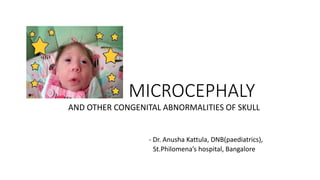
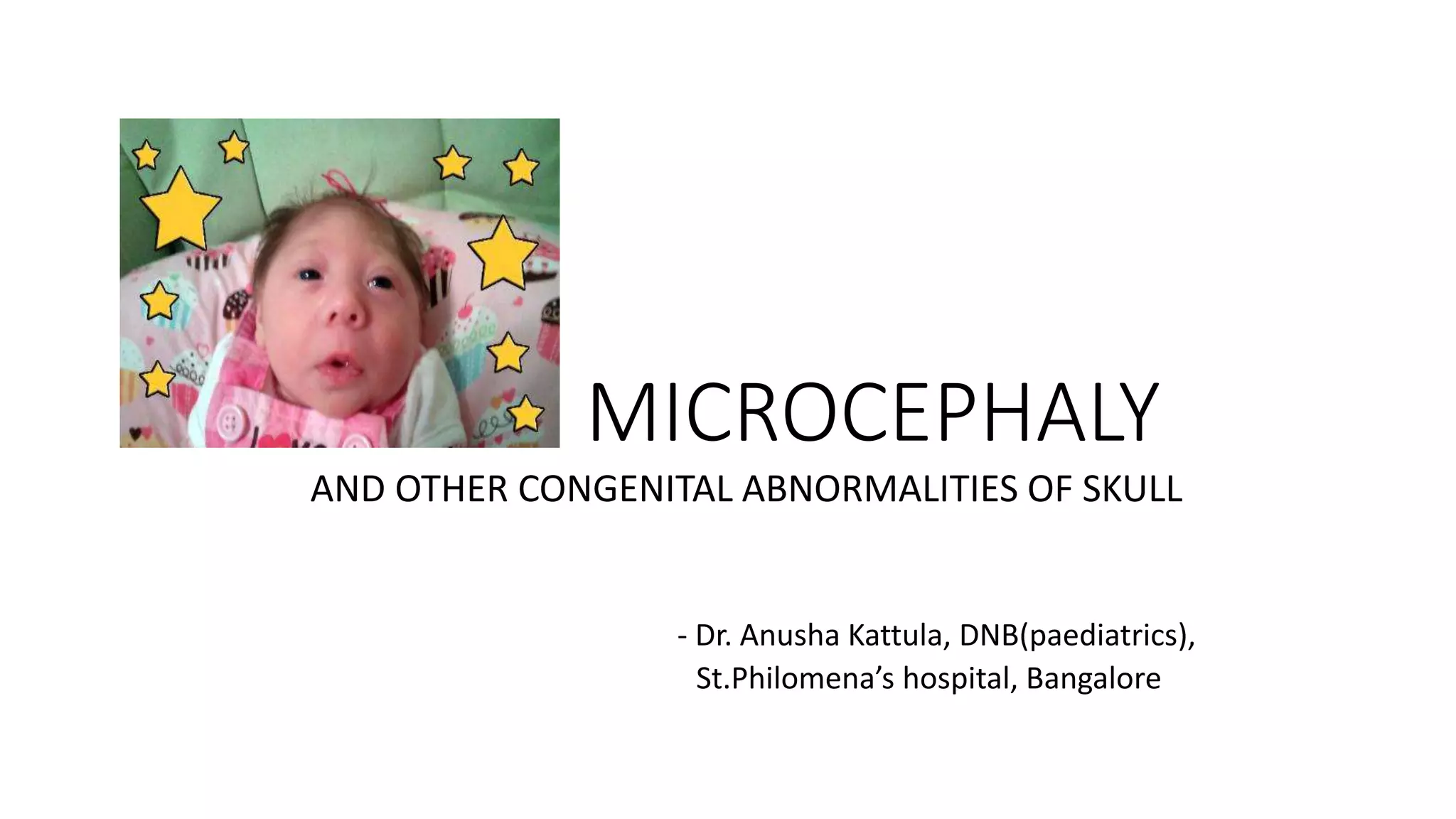
What is microcephaly?
• Definition- head circumference more than 3 standard deviations
below the mean for age and sex (Nelson)
• Classified as
• 1)PRIMARY/ GENETIC
• 2)SECONDARY/ NON GENETIC
• PRIMARY MICROCEPHALY
• Genetic
• Defective cellular migration
• Defective neurolation
• Defective prosencephalisation
• Syndromes
SECONDARY MICROCEPHALY
PRENATAL
• Maternal intake of drugs
• Maternal illnesses-
toxemia, diabetes,CRF,
phenyl ketonuria
• Intrauterine infections-
CMV,rubella, toxoplasma
• Radiation
• Migrational defects
POSTNATAL
• Perinatal insults(e.g. birth asphyxia)
• Inborn errors of metabolism- phenyl
ketonuria
• CNS insults- encephalitis, meningitis,HSV
• HIV infection, malnutrition
• Rett syndrome
• Trauma
• Endocrine-hypothyroid and
hypopituitarism
• Metabolic-hypoglycemia,PKU
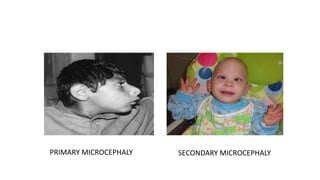
PRIMARY MICROCEPHALY
• Low crown, receeding
forehead.occipital
flattening,wrinkling of skin
• Present since birth
SECONDARY MICROCEPHALY
• Small head
• May be present at birth/evident
later
PRIMARY MICROCEPHALY SECONDARY MICROCEPHALY
• GENETIC- MICROCEPHALY VERA
• Familial and autosomal dominant are most common
• 1) Autosomal recessive( familial)-
incidence-1/40000
slanted forehead, prominent nose and ears
severe MR(non progressive), prominent seizures
Brain is small with small cerebral cortex
AUTOSOMAL DOMINANT
• Rare
non distinctive facies- upslanting palpebral fissures, hypertelorism
slanting forehead(mild),prominent ears,
short stature, receeding forehead,
• Mild intellectual impairment
• Neurosonogram- normal
• MRI- abnormal development of brain, small cerebellar and cerebral
hemispheres and pachygyria
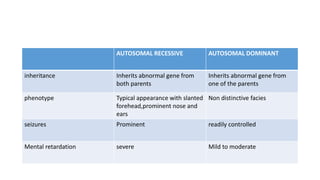
AUTOSOMAL RECESSIVE AUTOSOMAL DOMINANT
inheritance Inherits abnormal gene from
both parents
Inherits abnormal gene from
one of the parents
phenotype Typical appearance with slanted
forehead,prominent nose and
ears
Non distinctive facies
seizures Prominent readily controlled
Mental retardation severe Mild to moderate
2) Syndromes
• Downs syndrome
• Edwards syndrome
• Cri-du-chat syndrome
• Cornelia de lange syndrome
• Rubinstein taybi syndrome
• Smith-lemli-optiz syndrome
How to approach?
• An 18 month old boy is brought to OPD. Parents are concerned that
the boy’s head is small. They also note that he is not walking as well
as his older brother did at this age.
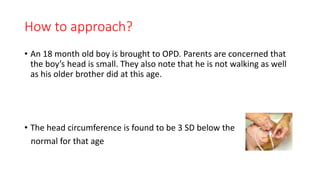
• The head circumference is found to be 3 SD below the
normal for that age
• Family history- to r/o primary
• h/o prenatal,perinatal and postnatal insults
• Exposure of radiation during pregnancy
• Maternal drug history
• Infections/DM/PKU
• Difficult delivery/MSAF/low apgars
• Significant fever in neonatal period
• h/o high-pitched cry/ poor feeding/ seizures/ increased movement
of the arms and legs (spasticity)
• EXAMINATION
• HC of the parents and siblings
• Serial HC records
• Look for dysmorphic features
• Child’s posture & symmetry of the movements
• Inspect the skin for neurocutaneous stigmata
• Overall growth( height and weight centiles)
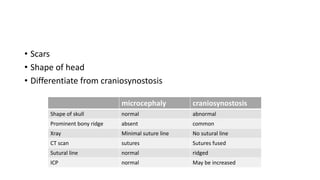
• Scars
• Shape of head
• Differentiate from craniosynostosis
microcephaly craniosynostosis
Shape of skull normal abnormal
Prominent bony ridge absent common
Xray Minimal suture line No sutural line
CT scan sutures Sutures fused
Sutural line normal ridged
ICP normal May be increased
• Detailed neurological evaluation including fundus
• Developmental examination- evidence of delay or regression
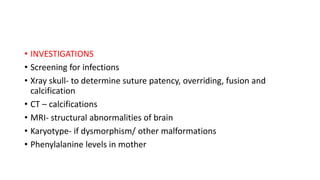
• INVESTIGATIONS
• Screening for infections
• Xray skull- to determine suture patency, overriding, fusion and
calcification
• CT – calcifications
• MRI- structural abnormalities of brain
• Karyotype- if dysmorphism/ other malformations
• Phenylalanine levels in mother
• Urine and blood aminoacid levels
• Thyroid screening tests
• TREATMENT
• Specific treatable causes- treated
• Nutritional supplements
• Drugs to control seizures, hyperactivity and other neuromuscular
symptoms
• Genetic counselling
• PREVENTION
• Preventing child birth after 35 years
• Screening for TORCH
• Thyroid screening in newborn
• Adequate nutrition
• Health education
• Genetic counselling
• RECURRENCE RISK
• Familial microcephaly- on inheritance pattern(25-50%)
• If no cause identified-empirical risk-6%
• Maternal USG serially starting in early pregnancy
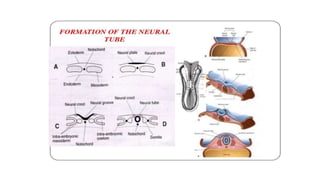
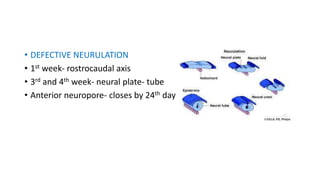
• DEFECTIVE NEURULATION
• 1st week- rostrocaudal axis
• 3rd and 4th week- neural plate- tube
• Anterior neuropore- closes by 24th day
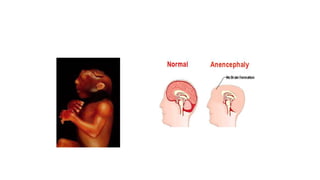
• ANENCEPHALY-
• Defective closure of anterior neuropore
• Defect in calvarium, meninges and scalp
• Rudimentary brain- hind brain, diencephalon
• a/w folding of ears, cleft palate, CHD
• 1/1000
• Recurrence 4%, 10% if 2 previous affected
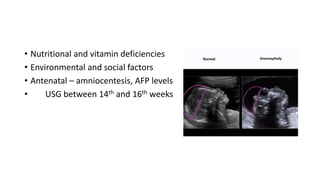
• Nutritional and vitamin deficiencies
• Environmental and social factors
• Antenatal – amniocentesis, AFP levels
• USG between 14th and 16th weeks
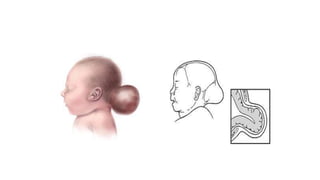
• ENCEPHALOCELE
• Protrusion of cortex and meninges through cranium bifidum
• Midline occipital – most common
• Hydrocephalus
• Sessile base- cerebral tissue
• Transillumination
• Xray skull and cervical spine
• USG
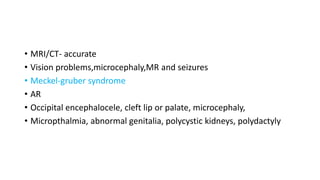
• MRI/CT- accurate
• Vision problems,microcephaly,MR and seizures
• Meckel-gruber syndrome
• AR
• Occipital encephalocele, cleft lip or palate, microcephaly,
• Micropthalmia, abnormal genitalia, polycystic kidneys, polydactyly
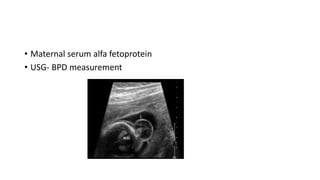
• Maternal serum alfa fetoprotein
• USG- BPD measurement
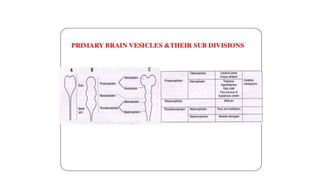
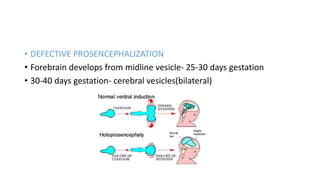
• DEFECTIVE PROSENCEPHALIZATION
• Forebrain develops from midline vesicle- 25-30 days gestation
• 30-40 days gestation- cerebral vesicles(bilateral)
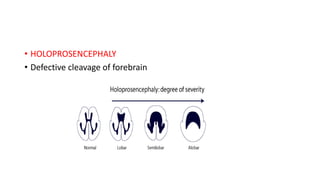
• HOLOPROSENCEPHALY
• Defective cleavage of forebrain
• 4th type- middle interhemispheric fusion(MIHF)/ syntelencephaly
• segmental area of non cleavage
• non separation of posterior frontal and parietal lobes
• Autosomal dominant-7p36.2 locus
• Abnormalities of chr 13
• Trisomy 13 and 18
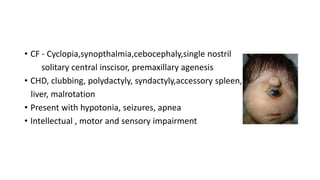
• CF - Cyclopia,synopthalmia,cebocephaly,single nostril
solitary central inscisor, premaxillary agenesis
• CHD, clubbing, polydactyly, syndactyly,accessory spleen,
liver, malrotation
• Present with hypotonia, seizures, apnea
• Intellectual , motor and sensory impairment
• Diagnosis- 1/5000-1/16000
• MRI
• molecular genetics
• Prenatal diagnosis- by USG after 10th week
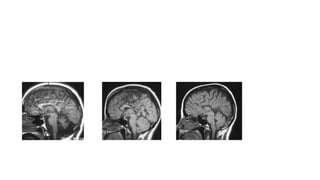
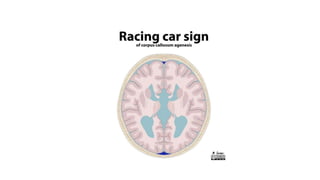
• AGENESIS OF CORPUS CALLOSUM
• Develops from commissural plate
• Direct insult/disruption of genetic signaling
• When a/w cell migration defects- mental retardation,
microcephaly,hemiparesis, diplegia and seizures
• XR/AD/AR trait
• a/w trisomy 8 and 18 and metabolic disorders
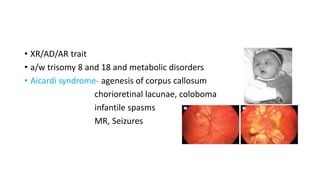
• Aicardi syndrome- agenesis of corpus callosum
chorioretinal lacunae, coloboma
infantile spasms
MR, Seizures
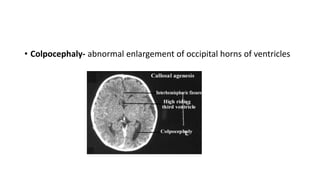
• Colpocephaly- abnormal enlargement of occipital horns of ventricles
• DEFECTIVE CELLULAR MIGRATION
• Radial glial fibre system
• Lissencephaly- defective neuroblast migration
• agyria, heterotopia,enlarged lateral ventricles
• Type 1- complete absence of gyri
• Corpus gangliothalamicus pathway not involved
• Hypoplasia of optic nerve, micropthalmia
• Type 2- disorganized cluster of neurons with haphazard orientation
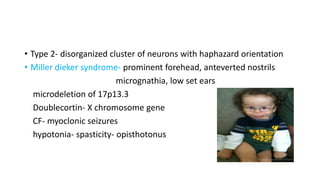
• Miller dieker syndrome- prominent forehead, anteverted nostrils
micrognathia, low set ears
microdeletion of 17p13.3
Doublecortin- X chromosome gene
CF- myoclonic seizures
hypotonia- spasticity- opisthotonus
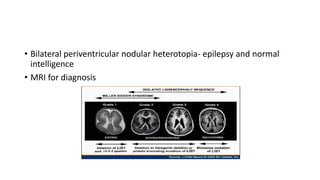
• Bilateral periventricular nodular heterotopia- epilepsy and normal
intelligence
• MRI for diagnosis
IDENTIFY THE SYNDROMES
1
• Abnormal rounding of occipital and frontal lobes
• Small cerebellum
• Narrow superior temporal gyrus
• Propensity for alzheimers
• Abnormalities of cerebral cortex
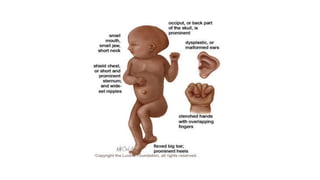
DOWNS SYNDROME
Incidence= 1/800
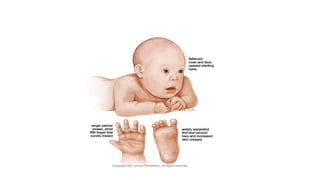
2
• Microstomia
• Micrognathia
• Low set malformed ears
• Prominent occiput
• Rocker bottom foot
• Congenital heart disease
• Increased gyri
• Heterotopia of neurons
EDWARD SYNDROME
incidence-1/6500
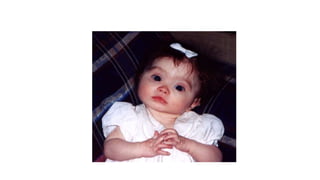
3
• Round facies
• Prominent epicanthal folds
• Low set ears
• Hypertelorism
• Characteristic cry
CRI DU CHAT SYNDROME(5p-)
incidence-1/50000
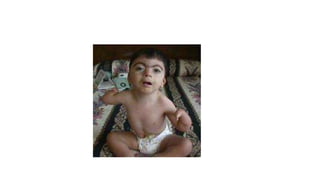
4
• Prenatal and postnatal growth delay
• Synoprhys
• Thin down turning upper lip
• Proximally placed thumb
Cornelia de lange syndrome
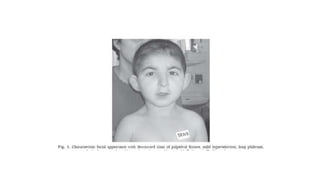
5
• Beaked nose
• Downward slanting of palpebral fissures
• Epicanthic folds
• Short stature
• Broad thumbs and toes
Rubinstein taybi syndrome
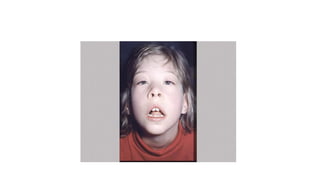
6
• Ptosis
• Scapocephaly
• Inner epicanthic folds
• Anteverted nostrils
• Low birth weight
• Marked feeding problems
Smith-lemli-opitz syndrome
IDENTIFY THE INFECTION
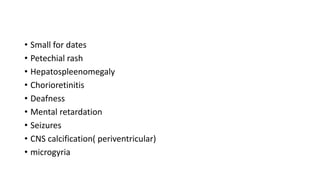
• Small for dates
• Petechial rash
• Hepatospleenomegaly
• Chorioretinitis
• Deafness
• Mental retardation
• Seizures
• CNS calcification( periventricular)
• microgyria
cytomegalo virus
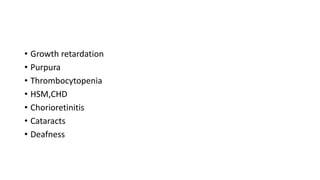
• Growth retardation
• Purpura
• Thrombocytopenia
• HSM,CHD
• Chorioretinitis
• Cataracts
• Deafness
Rubella
• Purpura
• HSM
• Jaundice
• Convulsions
• Hydrocephalus
• Chorioretinitis
• Cerebral calcifications
Toxoplasmosis
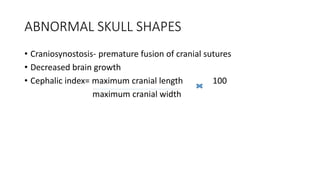
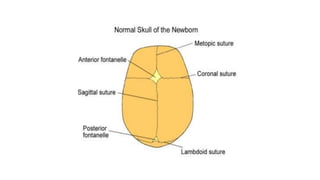
ABNORMAL SKULL SHAPES
• Craniosynostosis- premature fusion of cranial sutures
• Decreased brain growth
• Cephalic index= maximum cranial length 100
maximum cranial width
IDENTIFY THE SKULL ABNORMALITIES
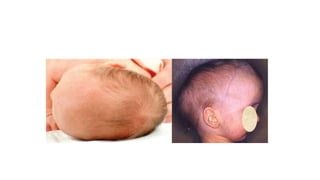
• DOLICHOCEPHALY- A-P length more than width
boat shaped skull
premature fusion of saggital suture
prominent occiput, broad forehead
small or absent anterior fontanelle
• BRACHYCEPHALY- coronal suture fuses prematurely
-broad skull, flat forehead, decreased A-P diameter
*aperts syndrome
*carpenters syndrome
*crouzons syndrome
*downs syndrome
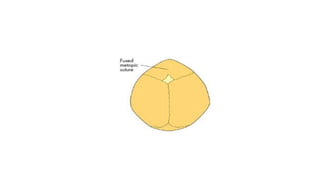
TRIGONOCEPHALY-metopic suture fuses prematurely
narrow anteriorly, wide posteriorly
keel shaped forehead and hypotelorism
• ACROCEPHALY/TURRICEPHALY-premature fusion of coronal and
lambdoid sutures
-skull is abnormally high and conical in
shape
- a/w syndactyly
- in Crouzons disease and Pfeiffers
syndrome
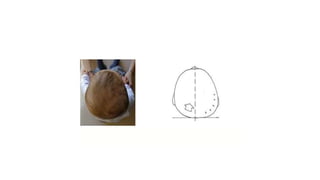
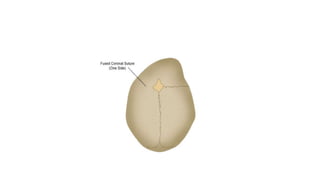
• PLAGIOCEPHALY- irregular asymmetric fusion of sutures
-Chotzens syndrome
A) Frontal - unilateral flattening of forehead,elevation of ipsilateral
orbit and eyebrow, prominent ear
- premature fusion of unilateral coronal and sphenofrontal
sutures
B) occipital- occipital flattening and bulging of ipsilateral frontal bone
-faulty positioning during infancy
• KLEEBLATTSCHADEL DEFORMITY- trilobed skull( clover leaf)
-premature fusion of multiple sutures
-carpenters, crouzons, aperts and pfeiffers
syndromes
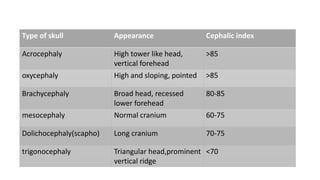
Type of skull Appearance Cephalic index
Acrocephaly High tower like head,
vertical forehead
>85
oxycephaly High and sloping, pointed >85
Brachycephaly Broad head, recessed
lower forehead
80-85
mesocephaly Normal cranium 60-75
Dolichocephaly(scapho) Long cranium 70-75
trigonocephaly Triangular head,prominent
vertical ridge
<70
Microcephaly

Microcephaly

  • 1.
    MICROCEPHALY AND OTHER CONGENITALABNORMALITIES OF SKULL - Dr. Anusha Kattula, DNB(paediatrics), St.Philomena’s hospital, Bangalore
  • 2.
    What is microcephaly? •Definition- head circumference more than 3 standard deviations below the mean for age and sex (Nelson) • Classified as • 1)PRIMARY/ GENETIC • 2)SECONDARY/ NON GENETIC
  • 8.
    • PRIMARY MICROCEPHALY •Genetic • Defective cellular migration • Defective neurolation • Defective prosencephalisation • Syndromes
  • 9.
    SECONDARY MICROCEPHALY PRENATAL • Maternalintake of drugs • Maternal illnesses- toxemia, diabetes,CRF, phenyl ketonuria • Intrauterine infections- CMV,rubella, toxoplasma • Radiation • Migrational defects POSTNATAL • Perinatal insults(e.g. birth asphyxia) • Inborn errors of metabolism- phenyl ketonuria • CNS insults- encephalitis, meningitis,HSV • HIV infection, malnutrition • Rett syndrome • Trauma • Endocrine-hypothyroid and hypopituitarism • Metabolic-hypoglycemia,PKU
  • 10.
    PRIMARY MICROCEPHALY • Lowcrown, receeding forehead.occipital flattening,wrinkling of skin • Present since birth SECONDARY MICROCEPHALY • Small head • May be present at birth/evident later
  • 11.
  • 12.
    • GENETIC- MICROCEPHALYVERA • Familial and autosomal dominant are most common • 1) Autosomal recessive( familial)- incidence-1/40000 slanted forehead, prominent nose and ears severe MR(non progressive), prominent seizures Brain is small with small cerebral cortex
  • 13.
    AUTOSOMAL DOMINANT • Rare nondistinctive facies- upslanting palpebral fissures, hypertelorism slanting forehead(mild),prominent ears, short stature, receeding forehead,
  • 14.
    • Mild intellectualimpairment • Neurosonogram- normal • MRI- abnormal development of brain, small cerebellar and cerebral hemispheres and pachygyria
  • 15.
    AUTOSOMAL RECESSIVE AUTOSOMALDOMINANT inheritance Inherits abnormal gene from both parents Inherits abnormal gene from one of the parents phenotype Typical appearance with slanted forehead,prominent nose and ears Non distinctive facies seizures Prominent readily controlled Mental retardation severe Mild to moderate
  • 16.
    2) Syndromes • Downssyndrome • Edwards syndrome • Cri-du-chat syndrome • Cornelia de lange syndrome • Rubinstein taybi syndrome • Smith-lemli-optiz syndrome
  • 17.
    How to approach? •An 18 month old boy is brought to OPD. Parents are concerned that the boy’s head is small. They also note that he is not walking as well as his older brother did at this age. • The head circumference is found to be 3 SD below the normal for that age
  • 18.
    • Family history-to r/o primary • h/o prenatal,perinatal and postnatal insults • Exposure of radiation during pregnancy • Maternal drug history • Infections/DM/PKU • Difficult delivery/MSAF/low apgars • Significant fever in neonatal period • h/o high-pitched cry/ poor feeding/ seizures/ increased movement of the arms and legs (spasticity)
  • 19.
    • EXAMINATION • HCof the parents and siblings • Serial HC records • Look for dysmorphic features • Child’s posture & symmetry of the movements • Inspect the skin for neurocutaneous stigmata • Overall growth( height and weight centiles)
  • 20.
    • Scars • Shapeof head • Differentiate from craniosynostosis microcephaly craniosynostosis Shape of skull normal abnormal Prominent bony ridge absent common Xray Minimal suture line No sutural line CT scan sutures Sutures fused Sutural line normal ridged ICP normal May be increased
  • 21.
    • Detailed neurologicalevaluation including fundus • Developmental examination- evidence of delay or regression
  • 22.
    • INVESTIGATIONS • Screeningfor infections • Xray skull- to determine suture patency, overriding, fusion and calcification • CT – calcifications • MRI- structural abnormalities of brain • Karyotype- if dysmorphism/ other malformations • Phenylalanine levels in mother
  • 23.
    • Urine andblood aminoacid levels • Thyroid screening tests
  • 24.
    • TREATMENT • Specifictreatable causes- treated • Nutritional supplements • Drugs to control seizures, hyperactivity and other neuromuscular symptoms • Genetic counselling
  • 25.
    • PREVENTION • Preventingchild birth after 35 years • Screening for TORCH • Thyroid screening in newborn • Adequate nutrition • Health education • Genetic counselling
  • 26.
    • RECURRENCE RISK •Familial microcephaly- on inheritance pattern(25-50%) • If no cause identified-empirical risk-6% • Maternal USG serially starting in early pregnancy
  • 27.
    • DEFECTIVE NEURULATION •1st week- rostrocaudal axis • 3rd and 4th week- neural plate- tube • Anterior neuropore- closes by 24th day
  • 28.
    • ANENCEPHALY- • Defectiveclosure of anterior neuropore • Defect in calvarium, meninges and scalp • Rudimentary brain- hind brain, diencephalon • a/w folding of ears, cleft palate, CHD • 1/1000 • Recurrence 4%, 10% if 2 previous affected
  • 29.
    • Nutritional andvitamin deficiencies • Environmental and social factors • Antenatal – amniocentesis, AFP levels • USG between 14th and 16th weeks
  • 31.
    • ENCEPHALOCELE • Protrusionof cortex and meninges through cranium bifidum • Midline occipital – most common • Hydrocephalus • Sessile base- cerebral tissue • Transillumination • Xray skull and cervical spine • USG
  • 32.
    • MRI/CT- accurate •Vision problems,microcephaly,MR and seizures • Meckel-gruber syndrome • AR • Occipital encephalocele, cleft lip or palate, microcephaly, • Micropthalmia, abnormal genitalia, polycystic kidneys, polydactyly
  • 33.
    • Maternal serumalfa fetoprotein • USG- BPD measurement
  • 35.
    • DEFECTIVE PROSENCEPHALIZATION •Forebrain develops from midline vesicle- 25-30 days gestation • 30-40 days gestation- cerebral vesicles(bilateral)
  • 36.
  • 37.
    • 4th type-middle interhemispheric fusion(MIHF)/ syntelencephaly • segmental area of non cleavage • non separation of posterior frontal and parietal lobes • Autosomal dominant-7p36.2 locus • Abnormalities of chr 13 • Trisomy 13 and 18
  • 38.
    • CF -Cyclopia,synopthalmia,cebocephaly,single nostril solitary central inscisor, premaxillary agenesis • CHD, clubbing, polydactyly, syndactyly,accessory spleen, liver, malrotation • Present with hypotonia, seizures, apnea • Intellectual , motor and sensory impairment
  • 39.
    • Diagnosis- 1/5000-1/16000 •MRI • molecular genetics • Prenatal diagnosis- by USG after 10th week
  • 40.
    • AGENESIS OFCORPUS CALLOSUM • Develops from commissural plate • Direct insult/disruption of genetic signaling • When a/w cell migration defects- mental retardation, microcephaly,hemiparesis, diplegia and seizures
  • 43.
    • XR/AD/AR trait •a/w trisomy 8 and 18 and metabolic disorders • Aicardi syndrome- agenesis of corpus callosum chorioretinal lacunae, coloboma infantile spasms MR, Seizures
  • 44.
    • Colpocephaly- abnormalenlargement of occipital horns of ventricles
  • 45.
    • DEFECTIVE CELLULARMIGRATION • Radial glial fibre system • Lissencephaly- defective neuroblast migration • agyria, heterotopia,enlarged lateral ventricles • Type 1- complete absence of gyri • Corpus gangliothalamicus pathway not involved • Hypoplasia of optic nerve, micropthalmia
  • 46.
    • Type 2-disorganized cluster of neurons with haphazard orientation • Miller dieker syndrome- prominent forehead, anteverted nostrils micrognathia, low set ears microdeletion of 17p13.3 Doublecortin- X chromosome gene CF- myoclonic seizures hypotonia- spasticity- opisthotonus
  • 47.
    • Bilateral periventricularnodular heterotopia- epilepsy and normal intelligence • MRI for diagnosis
  • 48.
  • 49.
    1 • Abnormal roundingof occipital and frontal lobes • Small cerebellum • Narrow superior temporal gyrus • Propensity for alzheimers • Abnormalities of cerebral cortex
  • 51.
  • 52.
    2 • Microstomia • Micrognathia •Low set malformed ears • Prominent occiput • Rocker bottom foot • Congenital heart disease • Increased gyri • Heterotopia of neurons
  • 54.
  • 55.
    3 • Round facies •Prominent epicanthal folds • Low set ears • Hypertelorism • Characteristic cry
  • 57.
    CRI DU CHATSYNDROME(5p-) incidence-1/50000
  • 58.
    4 • Prenatal andpostnatal growth delay • Synoprhys • Thin down turning upper lip • Proximally placed thumb
  • 60.
  • 61.
    5 • Beaked nose •Downward slanting of palpebral fissures • Epicanthic folds • Short stature • Broad thumbs and toes
  • 63.
  • 64.
    6 • Ptosis • Scapocephaly •Inner epicanthic folds • Anteverted nostrils • Low birth weight • Marked feeding problems
  • 66.
  • 67.
  • 68.
    • Small fordates • Petechial rash • Hepatospleenomegaly • Chorioretinitis • Deafness • Mental retardation • Seizures • CNS calcification( periventricular) • microgyria
  • 69.
  • 70.
    • Growth retardation •Purpura • Thrombocytopenia • HSM,CHD • Chorioretinitis • Cataracts • Deafness
  • 71.
  • 72.
    • Purpura • HSM •Jaundice • Convulsions • Hydrocephalus • Chorioretinitis • Cerebral calcifications
  • 73.
  • 74.
    ABNORMAL SKULL SHAPES •Craniosynostosis- premature fusion of cranial sutures • Decreased brain growth • Cephalic index= maximum cranial length 100 maximum cranial width
  • 76.
    IDENTIFY THE SKULLABNORMALITIES
  • 78.
    • DOLICHOCEPHALY- A-Plength more than width boat shaped skull premature fusion of saggital suture prominent occiput, broad forehead small or absent anterior fontanelle
  • 80.
    • BRACHYCEPHALY- coronalsuture fuses prematurely -broad skull, flat forehead, decreased A-P diameter *aperts syndrome *carpenters syndrome *crouzons syndrome *downs syndrome
  • 82.
    TRIGONOCEPHALY-metopic suture fusesprematurely narrow anteriorly, wide posteriorly keel shaped forehead and hypotelorism
  • 84.
    • ACROCEPHALY/TURRICEPHALY-premature fusionof coronal and lambdoid sutures -skull is abnormally high and conical in shape - a/w syndactyly - in Crouzons disease and Pfeiffers syndrome
  • 86.
    • PLAGIOCEPHALY- irregularasymmetric fusion of sutures -Chotzens syndrome A) Frontal - unilateral flattening of forehead,elevation of ipsilateral orbit and eyebrow, prominent ear - premature fusion of unilateral coronal and sphenofrontal sutures B) occipital- occipital flattening and bulging of ipsilateral frontal bone -faulty positioning during infancy
  • 88.
    • KLEEBLATTSCHADEL DEFORMITY-trilobed skull( clover leaf) -premature fusion of multiple sutures -carpenters, crouzons, aperts and pfeiffers syndromes
  • 89.
    Type of skullAppearance Cephalic index Acrocephaly High tower like head, vertical forehead >85 oxycephaly High and sloping, pointed >85 Brachycephaly Broad head, recessed lower forehead 80-85 mesocephaly Normal cranium 60-75 Dolichocephaly(scapho) Long cranium 70-75 trigonocephaly Triangular head,prominent vertical ridge <70