Presented To: Presented By:
S.O.S. in Microbiology Anurag Gupta
Jiwaji University, Gwalior M.sc 1St Semester
1
Content
1. Introduction
2. Components
3. Structure of DNA
4. Types of DNA
5. Bibliography
2
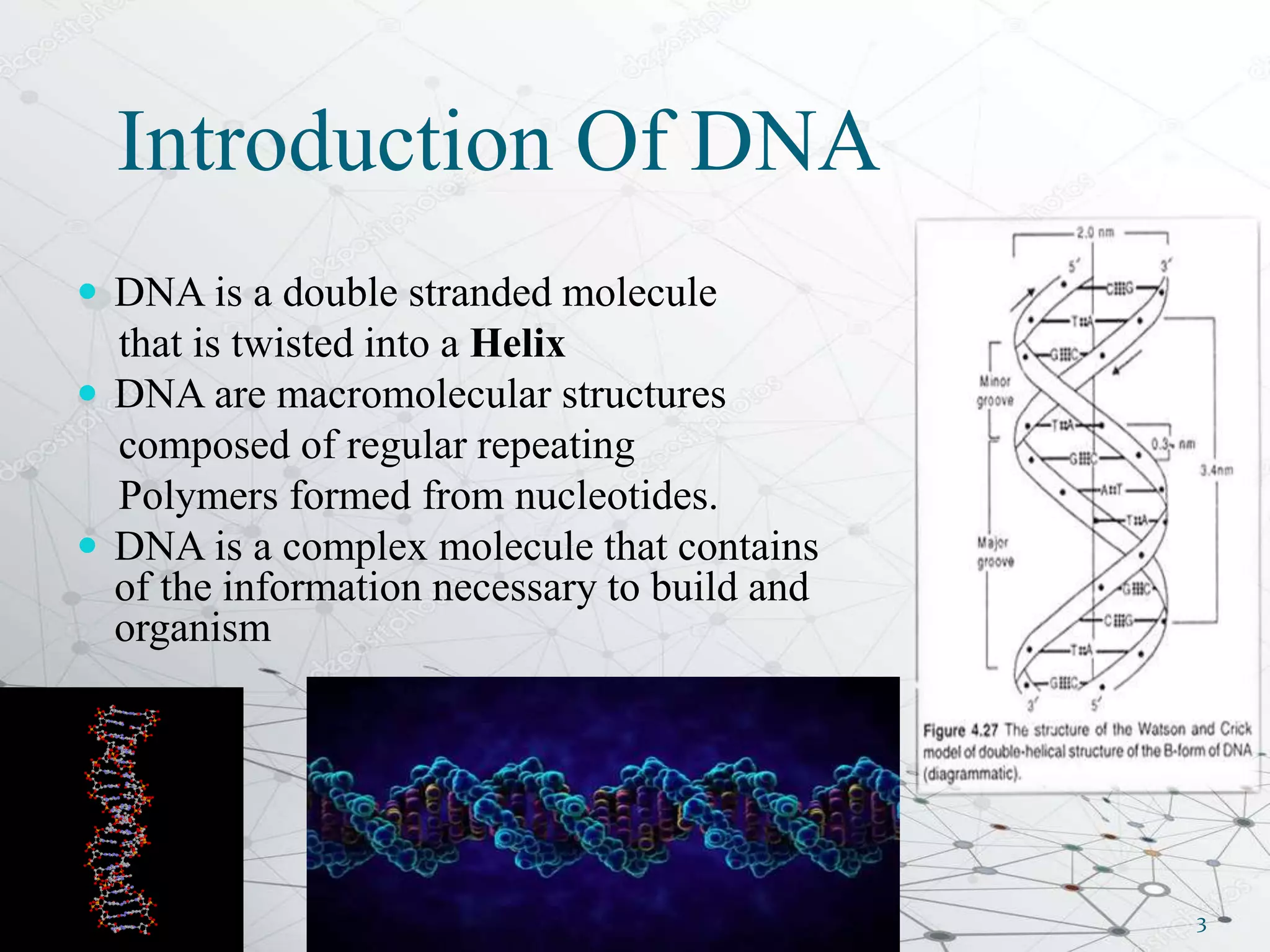
Introduction Of DNA
 DNA is a double stranded molecule
that is twisted into a Helix
 DNA are macromolecular structures
composed of regular repeating
Polymers formed from nucleotides.
 DNA is a complex molecule that contains all
of the information necessary to build and maintain an
organism
3
Components of a nucleotide
•
•
•
5
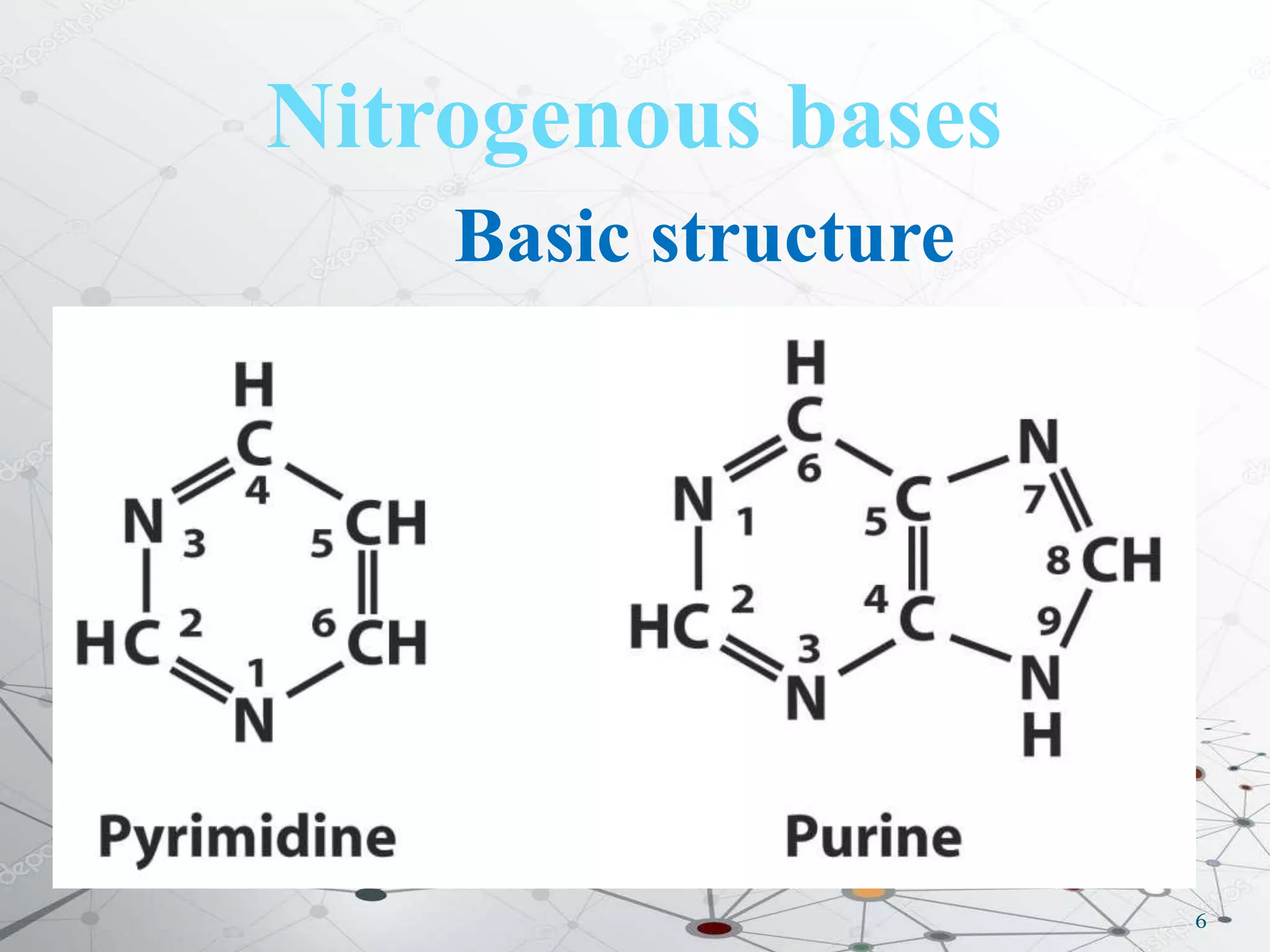
Nitrogenous bases
6
Basic structure
Pyrimidines
7
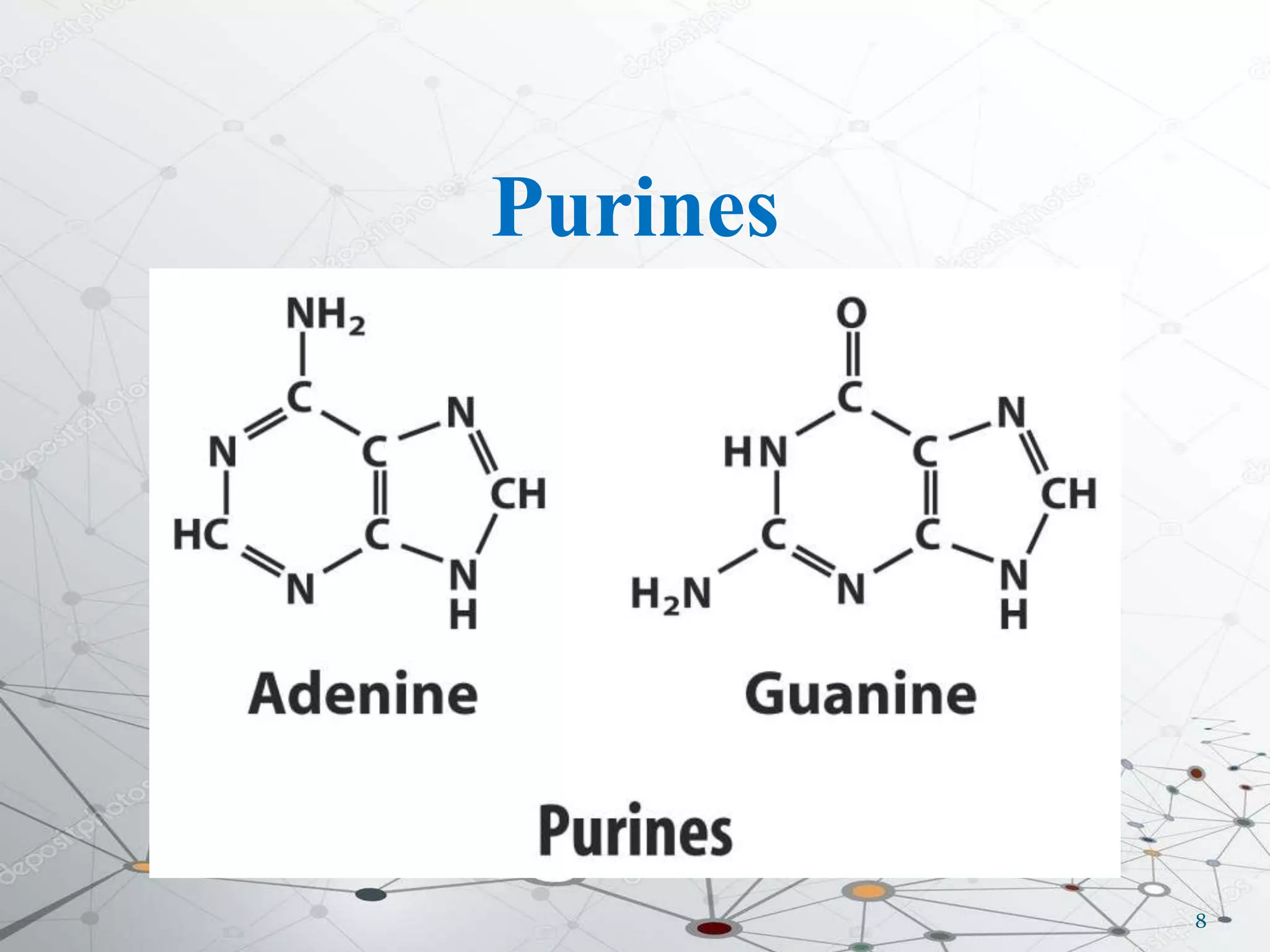
Purines
8
Sugar
Deoxyribose sugar
 The sugars found in nucleic acids are pentose sugars; a
pentose sugar has five carbon atoms.
 Deoxyribose, found in DNA, is a modified sugar, lacking
one oxygen atom (hence the name "deoxy").
9
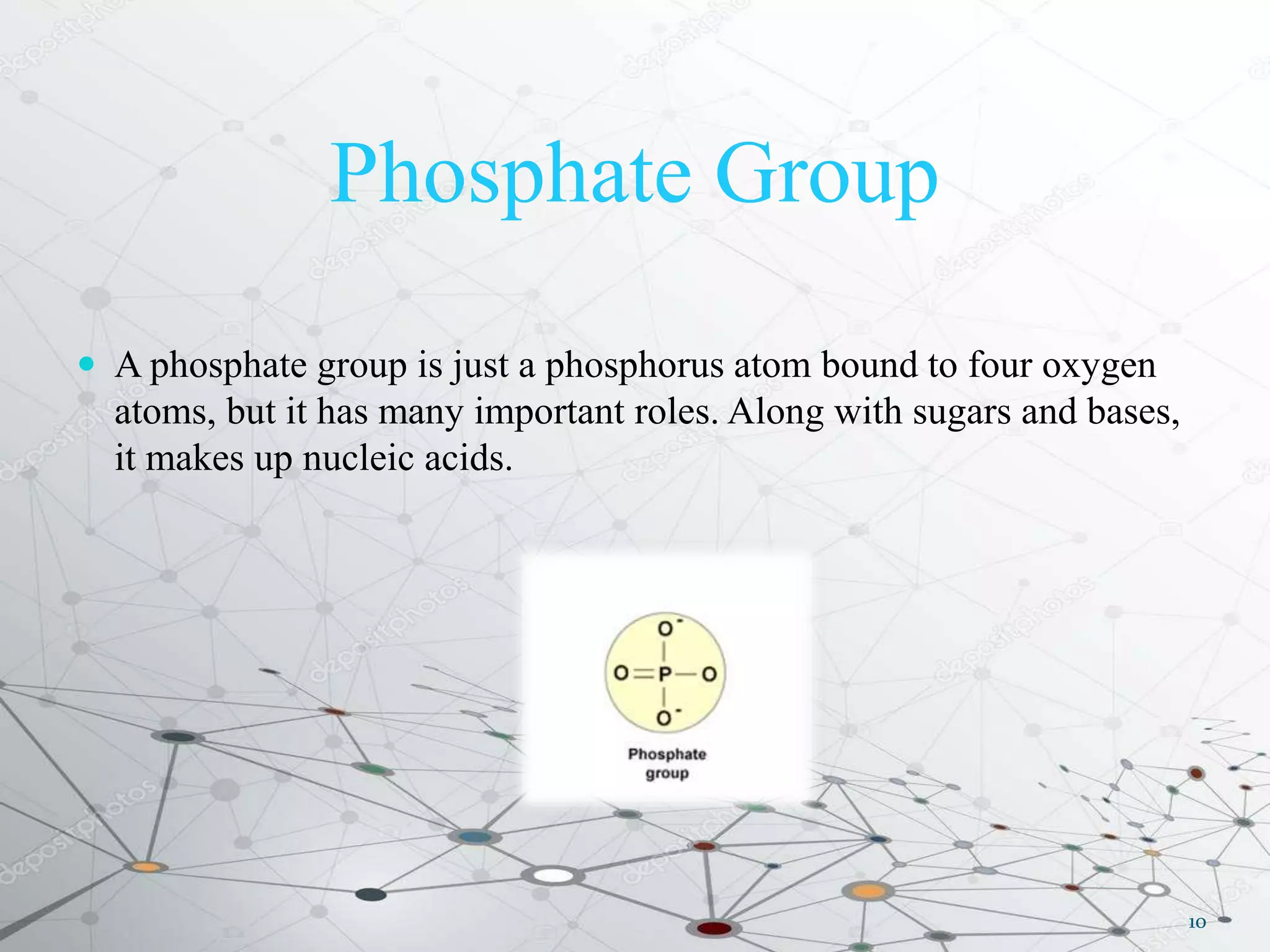
Phosphate Group
 A phosphate group is just a phosphorus atom bound to four oxygen
atoms, but it has many important roles. Along with sugars and bases,
it makes up nucleic acids.
10
11
Phosphate
Sugar
Base
Nucleotide
Nucleoside
X=H: DNA
X=OH: RNA
Nomenclature of Nucleic Acid
Components
 Purines
 Pyrimidines
12
Base Nucleoside Nucleotide
Adenine Deoxyadenosine Deoxyadenylate
Guanine Deoxy guanosine Deoxyguanylate
Base Nucleoside Nucleotide
Cytosine Deoxycytidine Deoxycytidylate
Thymine deoxythymidine deoxythymidylate
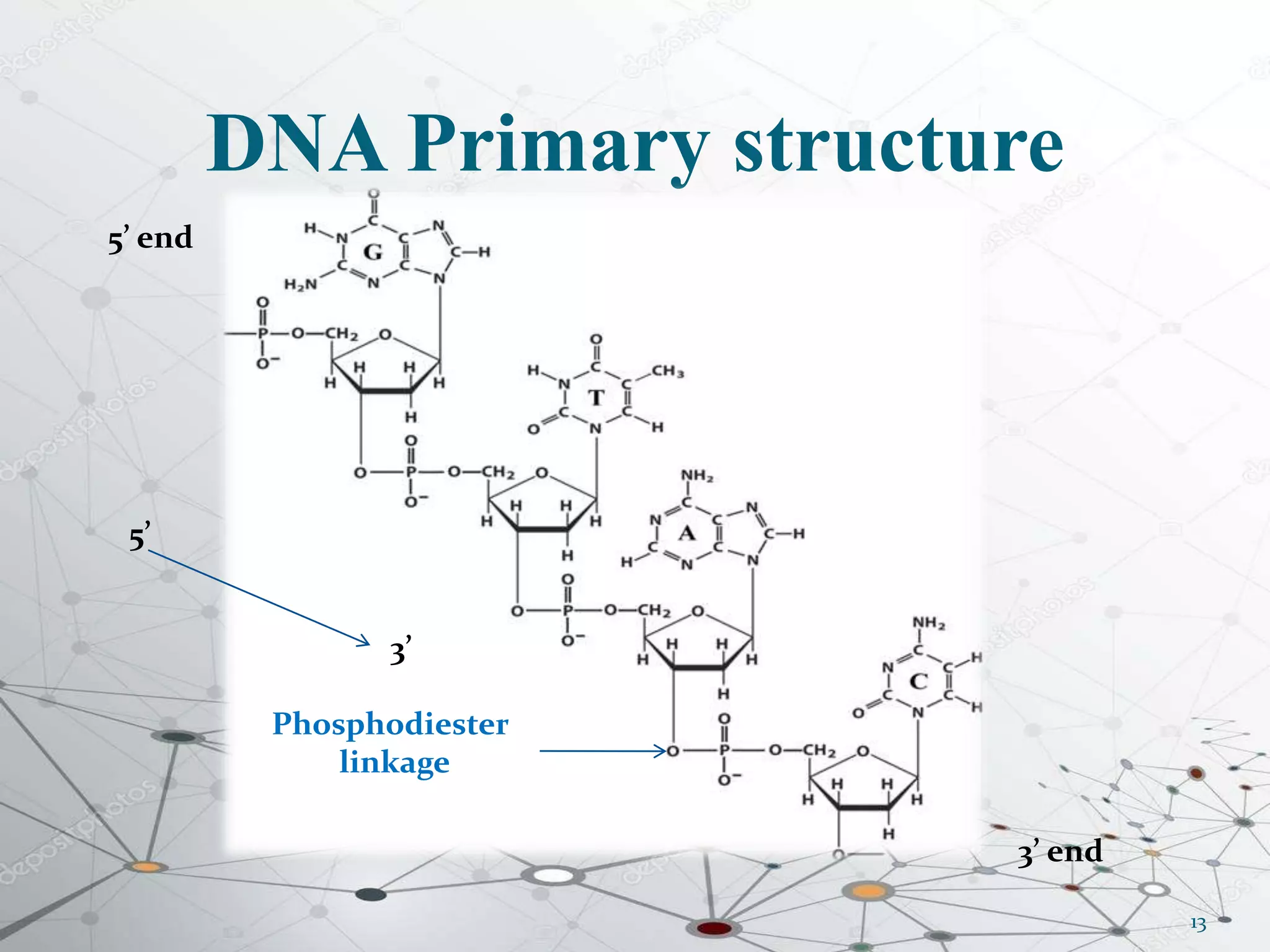
DNA Primary structure
13
3’ end
5’ end
5’
3’
Phosphodiester
linkage
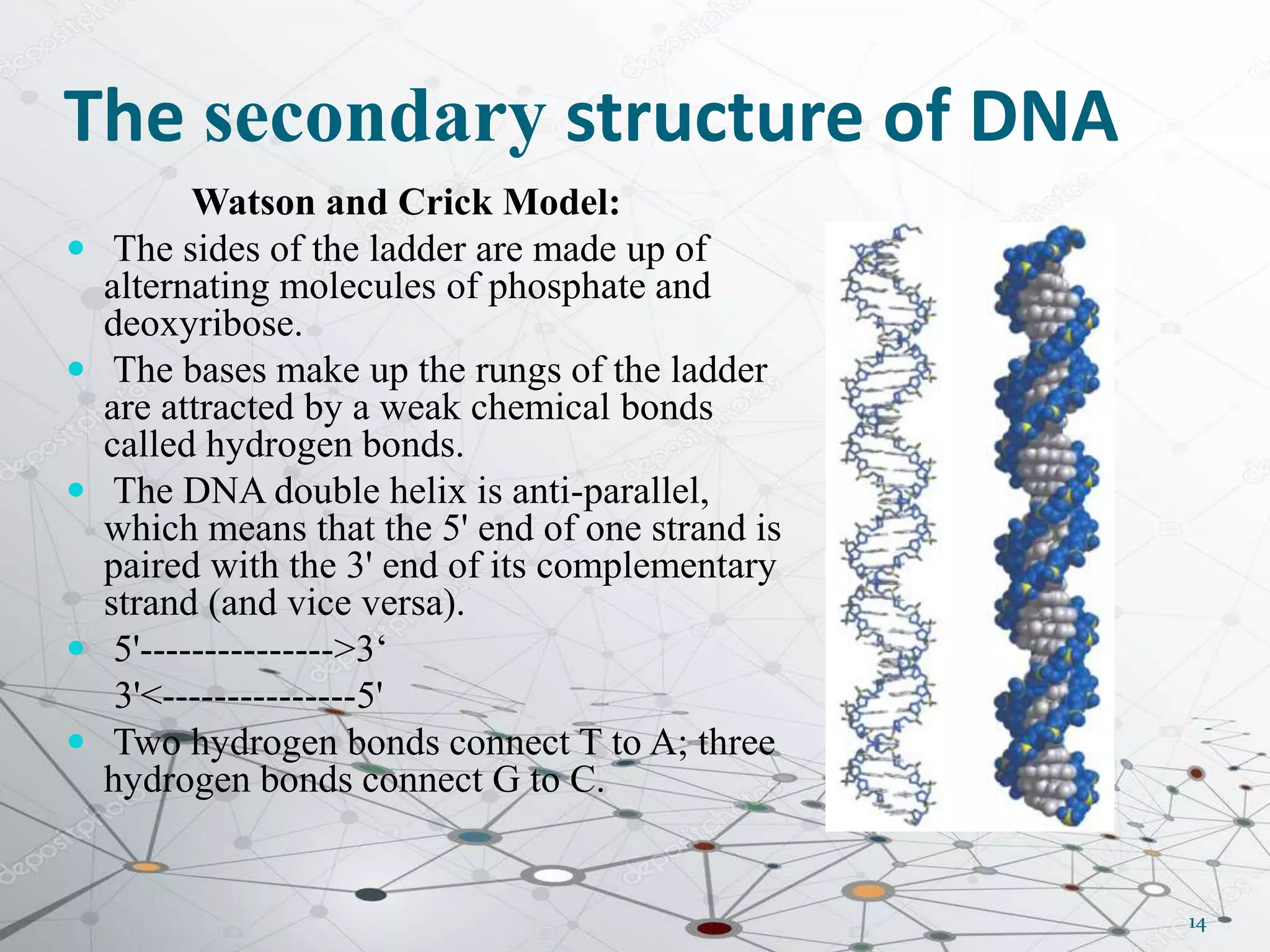
The secondary structure of DNA
Watson and Crick Model:
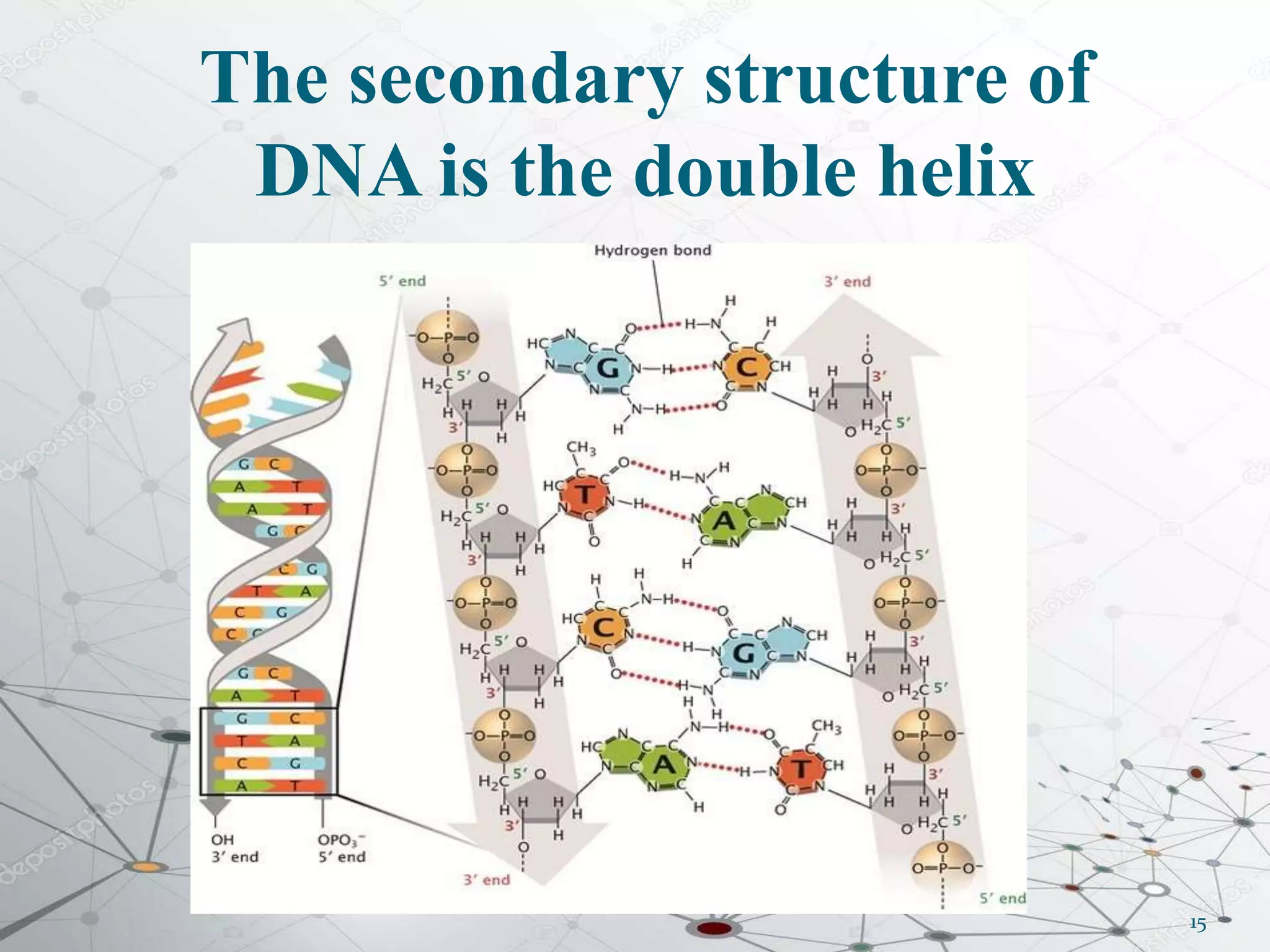
 The sides of the ladder are made up of
alternating molecules of phosphate and
deoxyribose.
 The bases make up the rungs of the ladder
are attracted by a weak chemical bonds
called hydrogen bonds.
 The DNA double helix is anti-parallel,
which means that the 5' end of one strand is
paired with the 3' end of its complementary
strand (and vice versa).
 5'--------------->3‘
3'<---------------5'
 Two hydrogen bonds connect T to A; three
hydrogen bonds connect G to C.
14
The secondary structure of
DNA is the double helix
15
Types of DNA
 A DNA
 B DNA
 Z DNA
16
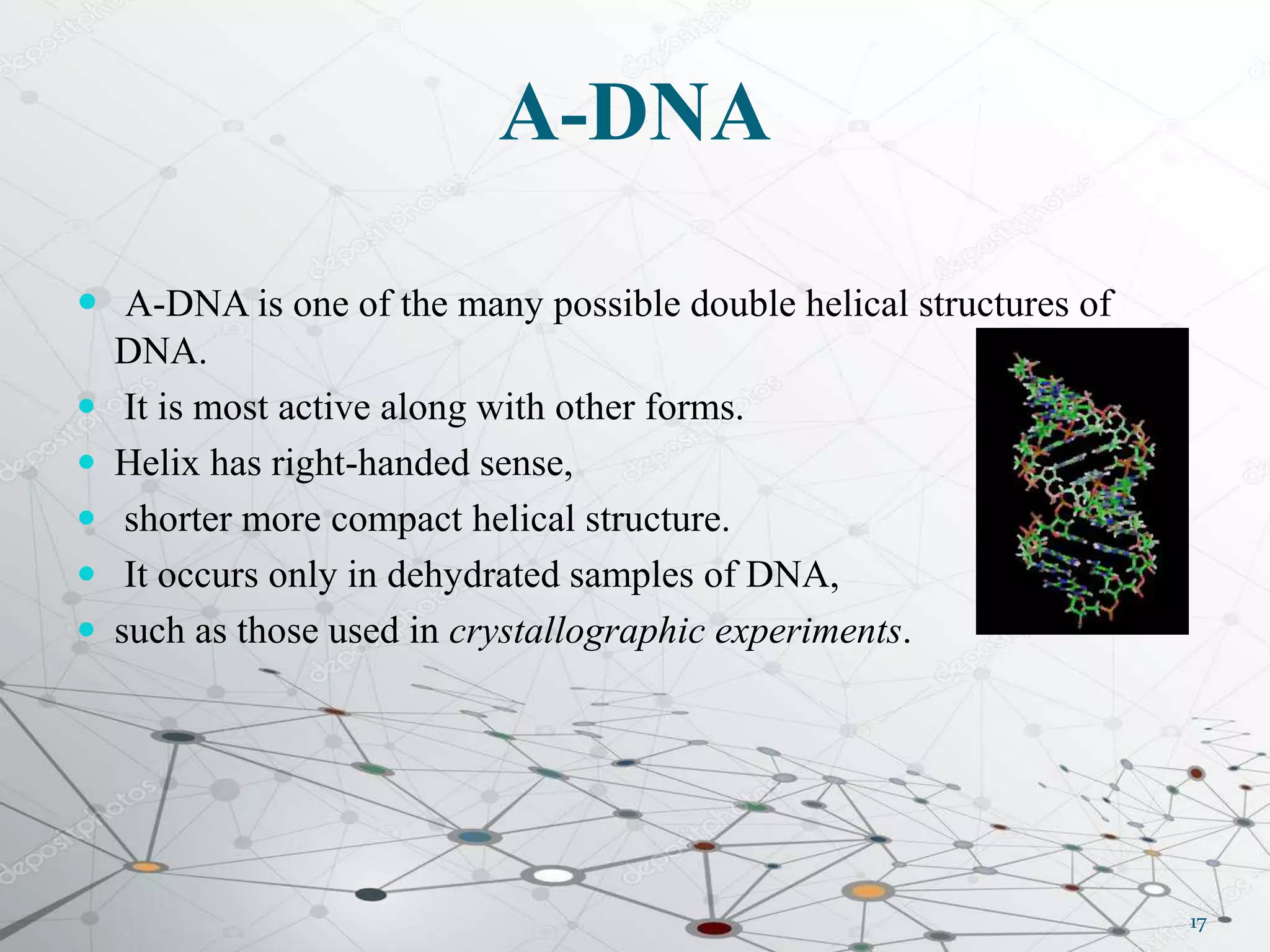
A-DNA
 A-DNA is one of the many possible double helical structures of
DNA.
 It is most active along with other forms.
 Helix has right-handed sense,
 shorter more compact helical structure.
 It occurs only in dehydrated samples of DNA,
 such as those used in crystallographic experiments.
17
B- DNA
 Helical sense: right handed.
 Base pairs :almost perpendicular
to the, helix axis; 3.4 Å apart.
 One turn of the helix: 36 Å;
~10.4 base pairs.
 Minor groove: 12 Å across.
 Major groove: 22 Å across.
18
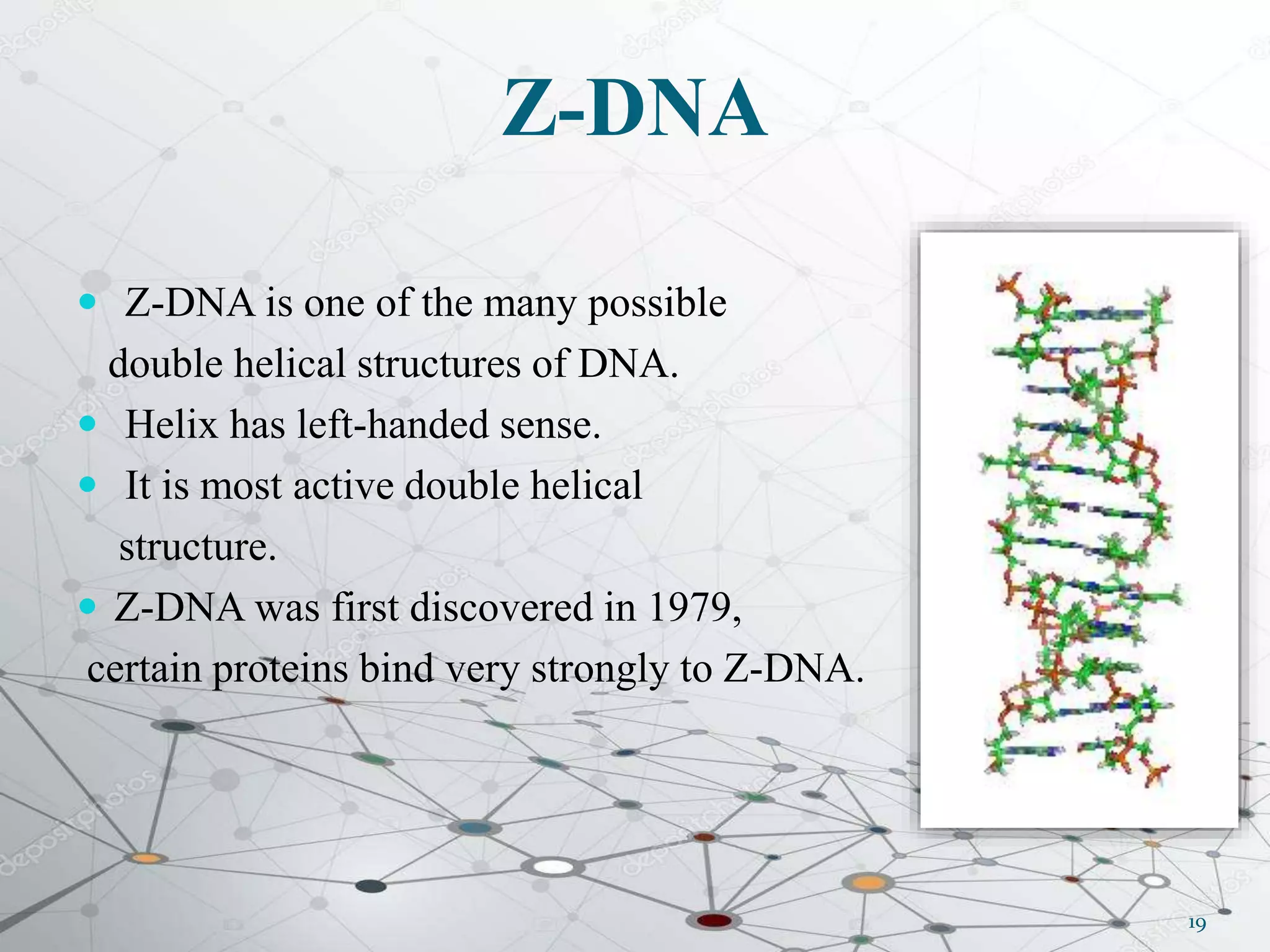
Z-DNA
 Z-DNA is one of the many possible
double helical structures of DNA.
 Helix has left-handed sense.
 It is most active double helical
structure.
 Z-DNA was first discovered in 1979,
certain proteins bind very strongly to Z-DNA.
19
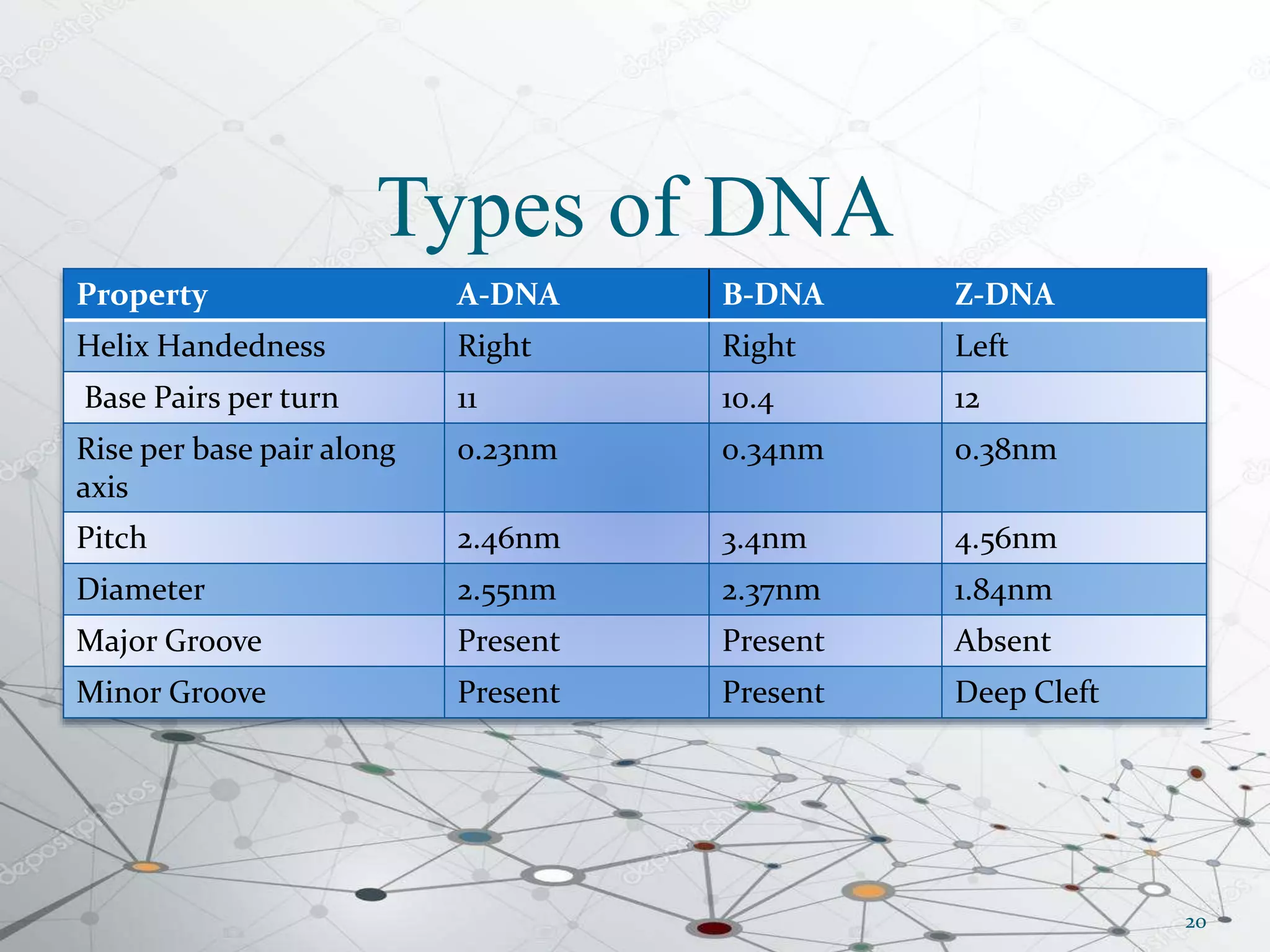
Types of DNA
Property A-DNA B-DNA Z-DNA
Helix Handedness Right Right Left
Base Pairs per turn 11 10.4 12
Rise per base pair along
axis
0.23nm 0.34nm 0.38nm
Pitch 2.46nm 3.4nm 4.56nm
Diameter 2.55nm 2.37nm 1.84nm
Major Groove Present Present Absent
Minor Groove Present Present Deep Cleft
20
Function of DNA
 Scientists have since discovered that certain proteins
bind very strongly to Z-DNA, suggesting that Z-DNA
plays an important biological role in protection against
viral disease.
 The main role of DNA in the cell is the long-term storage of
information

21
Recent work
 The transformation of the DNA template in
RNA polymerase II transcription: James T.
Kadonaga on 22-08-2019
22
Bibliography
 Principals and techniques of biochemistry and molecular
biology 7th edition-Wilson & walker(page no 139)
 Principle of Biochemistry –David .L . Nelson &
Michael .M. Cox(Chapter 8.Nucleotides)
 https://www.nature.com/scitable/topicpage/introduction-
what-is-dna-6579978/
23
24

DNA structure and types

  • 1.
    Presented To: PresentedBy: S.O.S. in Microbiology Anurag Gupta Jiwaji University, Gwalior M.sc 1St Semester 1
  • 2.
    Content 1. Introduction 2. Components 3.Structure of DNA 4. Types of DNA 5. Bibliography 2
  • 3.
    Introduction Of DNA DNA is a double stranded molecule that is twisted into a Helix  DNA are macromolecular structures composed of regular repeating Polymers formed from nucleotides.  DNA is a complex molecule that contains all of the information necessary to build and maintain an organism 3
  • 5.
    Components of anucleotide • • • 5
  • 6.
  • 7.
  • 8.
  • 9.
    Sugar Deoxyribose sugar  Thesugars found in nucleic acids are pentose sugars; a pentose sugar has five carbon atoms.  Deoxyribose, found in DNA, is a modified sugar, lacking one oxygen atom (hence the name "deoxy"). 9
  • 10.
    Phosphate Group  Aphosphate group is just a phosphorus atom bound to four oxygen atoms, but it has many important roles. Along with sugars and bases, it makes up nucleic acids. 10
  • 11.
  • 12.
    Nomenclature of NucleicAcid Components  Purines  Pyrimidines 12 Base Nucleoside Nucleotide Adenine Deoxyadenosine Deoxyadenylate Guanine Deoxy guanosine Deoxyguanylate Base Nucleoside Nucleotide Cytosine Deoxycytidine Deoxycytidylate Thymine deoxythymidine deoxythymidylate
  • 13.
    DNA Primary structure 13 3’end 5’ end 5’ 3’ Phosphodiester linkage
  • 14.
    The secondary structureof DNA Watson and Crick Model:  The sides of the ladder are made up of alternating molecules of phosphate and deoxyribose.  The bases make up the rungs of the ladder are attracted by a weak chemical bonds called hydrogen bonds.  The DNA double helix is anti-parallel, which means that the 5' end of one strand is paired with the 3' end of its complementary strand (and vice versa).  5'--------------->3‘ 3'<---------------5'  Two hydrogen bonds connect T to A; three hydrogen bonds connect G to C. 14
  • 15.
    The secondary structureof DNA is the double helix 15
  • 16.
    Types of DNA A DNA  B DNA  Z DNA 16
  • 17.
    A-DNA  A-DNA isone of the many possible double helical structures of DNA.  It is most active along with other forms.  Helix has right-handed sense,  shorter more compact helical structure.  It occurs only in dehydrated samples of DNA,  such as those used in crystallographic experiments. 17
  • 18.
    B- DNA  Helicalsense: right handed.  Base pairs :almost perpendicular to the, helix axis; 3.4 Å apart.  One turn of the helix: 36 Å; ~10.4 base pairs.  Minor groove: 12 Å across.  Major groove: 22 Å across. 18
  • 19.
    Z-DNA  Z-DNA isone of the many possible double helical structures of DNA.  Helix has left-handed sense.  It is most active double helical structure.  Z-DNA was first discovered in 1979, certain proteins bind very strongly to Z-DNA. 19
  • 20.
    Types of DNA PropertyA-DNA B-DNA Z-DNA Helix Handedness Right Right Left Base Pairs per turn 11 10.4 12 Rise per base pair along axis 0.23nm 0.34nm 0.38nm Pitch 2.46nm 3.4nm 4.56nm Diameter 2.55nm 2.37nm 1.84nm Major Groove Present Present Absent Minor Groove Present Present Deep Cleft 20
  • 21.
    Function of DNA Scientists have since discovered that certain proteins bind very strongly to Z-DNA, suggesting that Z-DNA plays an important biological role in protection against viral disease.  The main role of DNA in the cell is the long-term storage of information  21
  • 22.
    Recent work  Thetransformation of the DNA template in RNA polymerase II transcription: James T. Kadonaga on 22-08-2019 22
  • 23.
    Bibliography  Principals andtechniques of biochemistry and molecular biology 7th edition-Wilson & walker(page no 139)  Principle of Biochemistry –David .L . Nelson & Michael .M. Cox(Chapter 8.Nucleotides)  https://www.nature.com/scitable/topicpage/introduction- what-is-dna-6579978/ 23
  • 24.