1
Introduction Of DNA
all
maintain an
DNA is a double stranded molecule
that is twisted into a Helix
DNA are macromolecular structures
composed of regular repeating
Polymers formed from nucleotides.
DNA is a complex molecule that contains
of the information necessary to build and
organism
2
Components of a nucleotide
•
•
•
3
Nitrogenous bases
Basic structure
4
Pyrimidines
5
Purines
6
Sugar
Deoxyribose sugar
The sugars found in nucleic acids are pentose sugars; a
pentose sugar has five carbon atoms.
Deoxyribose, found in DNA, is a modified sugar, lacking
one oxygen atom (hence the name "deoxy").
7
Phosphate Group
A phosphate group is just a phosphorus atom bound to four oxygen
atoms, but it has many important roles. Along with sugars and bases,
it makes up nucleic acids.
8
Phosphate
Sugar
Base
Nucleoside
Nucleotide
9
X=H: DNA
X=OH: RNA
Types of DNA
10
ADNA
B DNA
Z DNA
A-DNA
A-DNA is one of the many possible double helical structures of
DNA.
It is most active along with other forms.
Helix has right-handed sense,
shorter more compact helical structure.
It occurs only in dehydrated samples of DNA,
such as those used in crystallographic experiments.
11
B- DNA
12
Helical sense: right handed.
Base pairs :almost perpendicular
to the, helix axis; 3.4 Å apart.
One turn of the helix: 36 Å;
~10.4 base pairs.
Minor groove: 12 Å across.
Major groove: 22 Å across.
Z-DNA
13
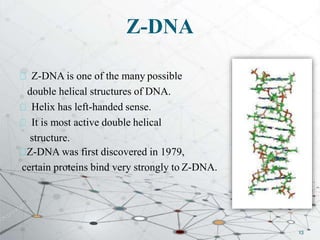
Z-DNA is one of the many possible
double helical structures of DNA.
Helix has left-handed sense.
It is most active double helical
structure.
Z-DNA was first discovered in 1979,
certain proteins bind very strongly to Z-DNA.
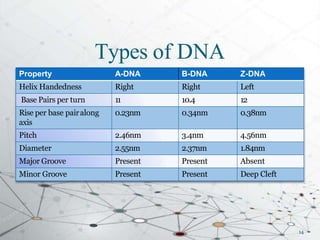
Types of DNA
Property A-DNA B-DNA Z-DNA
Helix Handedness Right Right Left
Base Pairs per turn 11 10.4 12
Rise per base pairalong
axis
0.23nm 0.34nm 0.38nm
Pitch 2.46nm 3.4nm 4.56nm
Diameter 2.55nm 2.37nm 1.84nm
Major Groove Present Present Absent
Minor Groove Present Present Deep Cleft
14
DNA Primary structure
3’end
5’end
5’
3’
Phosphodiester
linkage
15
The secondary structure of
DNA
Watson and Crick Model:
The sides of the ladder are made up of
alternating molecules of phosphate and
deoxyribose.
The bases make up the rungs of the ladder
are attracted by a weak chemical bonds
called hydrogen bonds.
The DNA double helix is anti-parallel,
which means that the 5' end of one strand is
paired with the 3' end of its complementary
strand (and vice versa).
5' >3‘
3'< 5'
Two hydrogen bonds connect T to A; three
hydrogen bonds connect G to C.
16
The secondary structure of
DNA is the double helix
17
THANK YOU

Different Types and Structure.pptx

  • 1.
  • 2.
    Introduction Of DNA all maintainan DNA is a double stranded molecule that is twisted into a Helix DNA are macromolecular structures composed of regular repeating Polymers formed from nucleotides. DNA is a complex molecule that contains of the information necessary to build and organism 2
  • 3.
    Components of anucleotide • • • 3
  • 4.
  • 5.
  • 6.
  • 7.
    Sugar Deoxyribose sugar The sugarsfound in nucleic acids are pentose sugars; a pentose sugar has five carbon atoms. Deoxyribose, found in DNA, is a modified sugar, lacking one oxygen atom (hence the name "deoxy"). 7
  • 8.
    Phosphate Group A phosphategroup is just a phosphorus atom bound to four oxygen atoms, but it has many important roles. Along with sugars and bases, it makes up nucleic acids. 8
  • 9.
  • 10.
  • 11.
    A-DNA A-DNA is oneof the many possible double helical structures of DNA. It is most active along with other forms. Helix has right-handed sense, shorter more compact helical structure. It occurs only in dehydrated samples of DNA, such as those used in crystallographic experiments. 11
  • 12.
    B- DNA 12 Helical sense:right handed. Base pairs :almost perpendicular to the, helix axis; 3.4 Å apart. One turn of the helix: 36 Å; ~10.4 base pairs. Minor groove: 12 Å across. Major groove: 22 Å across.
  • 13.
    Z-DNA 13 Z-DNA is oneof the many possible double helical structures of DNA. Helix has left-handed sense. It is most active double helical structure. Z-DNA was first discovered in 1979, certain proteins bind very strongly to Z-DNA.
  • 14.
    Types of DNA PropertyA-DNA B-DNA Z-DNA Helix Handedness Right Right Left Base Pairs per turn 11 10.4 12 Rise per base pairalong axis 0.23nm 0.34nm 0.38nm Pitch 2.46nm 3.4nm 4.56nm Diameter 2.55nm 2.37nm 1.84nm Major Groove Present Present Absent Minor Groove Present Present Deep Cleft 14
  • 15.
  • 16.
    The secondary structureof DNA Watson and Crick Model: The sides of the ladder are made up of alternating molecules of phosphate and deoxyribose. The bases make up the rungs of the ladder are attracted by a weak chemical bonds called hydrogen bonds. The DNA double helix is anti-parallel, which means that the 5' end of one strand is paired with the 3' end of its complementary strand (and vice versa). 5' >3‘ 3'< 5' Two hydrogen bonds connect T to A; three hydrogen bonds connect G to C. 16
  • 17.
    The secondary structureof DNA is the double helix 17
  • 18.