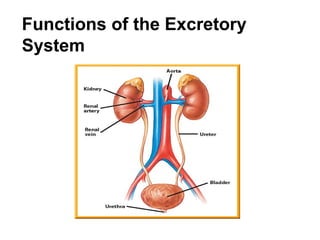

Functions of the Excretory
System
• Your body must eliminate wastes to
  remain healthy.
• These systems function together as parts
  of your excretory system.
The Urinary System
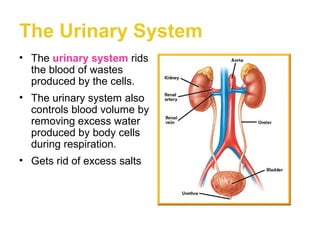
• The urinary system rids
  the blood of wastes
  produced by the cells.
• The urinary system also
  controls blood volume by
  removing excess water
  produced by body cells
  during respiration.
• Gets rid of excess salts
Regulating Fluid Levels
• The hypothalamus (hi poh THA luh mus),
  constantly monitors the amount of water in the
  blood.
• When the brain detects too much water in the
  blood, the hypothalamus releases a lesser
  amount of a specific hormone
• This signals the kidneys to return less water to
  the blood and increase the amount of
  wastewater, called urine, that is excreted.
Organs of the Urinary System
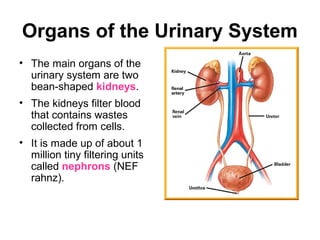
• The main organs of the
  urinary system are two
  bean-shaped kidneys.
• The kidneys filter blood
  that contains wastes
  collected from cells.
• It is made up of about 1
  million tiny filtering units
  called nephrons (NEF
  rahnz).
Filtration in the Kidney

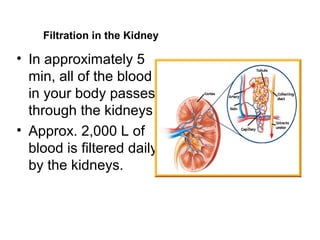
• In approximately 5
  min, all of the blood
  in your body passes
  through the kidneys
• Approx. 2,000 L of
  blood is filtered daily
  by the kidneys.
Filtration in the Kidney
• Blood enters the kidneys through the renal artery.
• Blood enters the nephrons.
• Water,sugar,salt and wastes in the blood enter a cuplike
  structure in nephron.
• Capillaries reabsorb most of the water,sugar, and salt.
• The renal vein returns purified blood to be circulated.
• Urine drains from each collecting tubule into funnel
  shaped areas of the kidney
• Urine flows from ureters to the urinary bladder
• Urine flows from the bladder through the urethra and out
  of the body.
Urinary Diseases and Disorders
• Waste products that are not removed build
  up and act as poisons in body cells.
• Water that normally is removed from body
  tissues accumulates and causes swelling
  of the ankles and feet.
• Without excretion, an imbalance of salts
  occurs. If the balance isn’t restored, the
  kidneys and other organs can be
  damaged.
Urinary Diseases and Disorders
• Infections caused by microorganisms can
  affect the urinary system.
• Usually, the infection begins in the
  bladder. However, it can spread and
  involve the kidneys.
Detecting Urinary Diseases
• Urine can be tested for any signs of a
  urinary tract disease
• A change in the urine’s color can suggest
  kidney or liver problems.
• Increased amounts of a protein called
  albumin (al BYOO mun) indicate kidney
  disease or heart failure.
Dialysis

• A person who has only one kidney still can
  live normally.
• The remaining kidney increases in size
  and works harder to make up for the loss
  of the other kidney.
• If both kidneys fail, the person will need to
  have his or her flood filtered by an artificial
  kidney machine in a process called
  dialysis (di AH luh sus).

Excretory notes

  • 1.
    Functions of theExcretory System
  • 2.
    • Your bodymust eliminate wastes to remain healthy. • These systems function together as parts of your excretory system.
  • 3.
    The Urinary System •The urinary system rids the blood of wastes produced by the cells. • The urinary system also controls blood volume by removing excess water produced by body cells during respiration. • Gets rid of excess salts
  • 4.
    Regulating Fluid Levels •The hypothalamus (hi poh THA luh mus), constantly monitors the amount of water in the blood. • When the brain detects too much water in the blood, the hypothalamus releases a lesser amount of a specific hormone • This signals the kidneys to return less water to the blood and increase the amount of wastewater, called urine, that is excreted.
  • 5.
    Organs of theUrinary System • The main organs of the urinary system are two bean-shaped kidneys. • The kidneys filter blood that contains wastes collected from cells. • It is made up of about 1 million tiny filtering units called nephrons (NEF rahnz).
  • 6.
    Filtration in theKidney • In approximately 5 min, all of the blood in your body passes through the kidneys • Approx. 2,000 L of blood is filtered daily by the kidneys.
  • 7.
    Filtration in theKidney • Blood enters the kidneys through the renal artery. • Blood enters the nephrons. • Water,sugar,salt and wastes in the blood enter a cuplike structure in nephron. • Capillaries reabsorb most of the water,sugar, and salt. • The renal vein returns purified blood to be circulated. • Urine drains from each collecting tubule into funnel shaped areas of the kidney • Urine flows from ureters to the urinary bladder • Urine flows from the bladder through the urethra and out of the body.
  • 8.
    Urinary Diseases andDisorders • Waste products that are not removed build up and act as poisons in body cells. • Water that normally is removed from body tissues accumulates and causes swelling of the ankles and feet. • Without excretion, an imbalance of salts occurs. If the balance isn’t restored, the kidneys and other organs can be damaged.
  • 9.
    Urinary Diseases andDisorders • Infections caused by microorganisms can affect the urinary system. • Usually, the infection begins in the bladder. However, it can spread and involve the kidneys.
  • 10.
    Detecting Urinary Diseases •Urine can be tested for any signs of a urinary tract disease • A change in the urine’s color can suggest kidney or liver problems. • Increased amounts of a protein called albumin (al BYOO mun) indicate kidney disease or heart failure.
  • 11.
    Dialysis • A personwho has only one kidney still can live normally. • The remaining kidney increases in size and works harder to make up for the loss of the other kidney. • If both kidneys fail, the person will need to have his or her flood filtered by an artificial kidney machine in a process called dialysis (di AH luh sus).