Sample Assignment For Reference Only
Tutorial 1
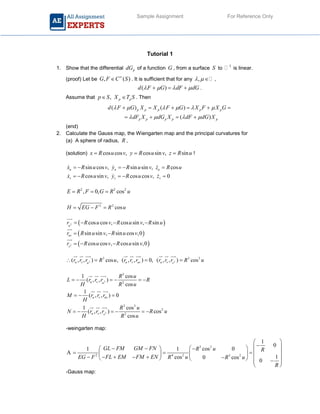
1. Show that the differential pdG of a function G , from a surface S to 3
 is linear.
(proof) Let be , ( )G F C S
 . It is sufficient that for any ,   ,
( )d F G dF dG      .
Assume that , p pp S X T S  . Then
( ) ( )
( )
p p p p p
p p p p p
d F G X X F G X F X G
dF X dG X dF dG X
     
   
     
   
(end)
2. Calculate the Gauss map, the Wiengarten map and the principal curvatures for
(a) A sphere of radius, R ,
(solution) cos cos , cos sin , sinx R u v y R u v z R u   !
sin cos , sin sin , cos
cos sin , cos cos , 0
u u u
v v v
x R u v y R u v z R u
x R u v y R u v z
    
    
  
  
2 2 2
, 0, cosE R F G R u  
2 2
cosH EG F R u  
 
 
 
2
2
cos cos , cos sin , sin
sin sin , sin cos ,0
cos cos , cos sin ,0
u
uv
v
r R u v R u v R u
r R u v R u v
r R u v R u v
   
 
  



2 2
3 3 3
( , , ) cos , ( , , ) 0, ( , , ) cosu v u v uv u vu v
r r r R u r r r r r r R u   
        
2
2
3
2
3 3
2
2
1 cos
( , , )
cos
1
( , , ) 0
1 cos
( , , ) cos
cos
u v u
u v uv
u v v
R u
L r r r R
H R u
M r r r
H
R u
N r r r R u
H R u
     
  
     
  
  
  
-weingarten map:
3 2
2 4 2 3 2
1
0
cos 01 1
1cos 0 cos
0
GL FM GM FN R u R
FL EM FM ENEG F R u R u
R
 
     
      
           
 
A
-Gauss map:
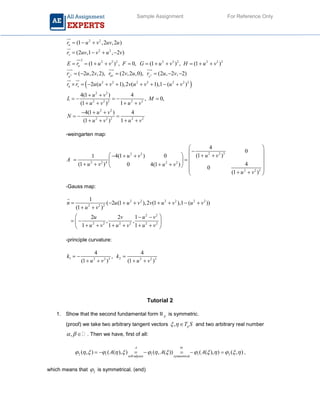
Sample Assignment For Reference Only
2 2 2
2
2 2
2
(cos cos ,cos sin ,sin cos ),
(cos cos ,cos sin ,sin cos )
cos
u v
u v
u u
r r R u v u v u v
r r R
n u v u v u v
R ur r
  
 
 

 
 

 
-principle curvature:
1 2
1
k k
R
   .
(b) A surface of revolution given by the curve ( )x f z rotated about the z axis, and
(solution)
( )cos
( )sin
x f z
y f z
z z





 
( ( )cos , ( )sin , )r f z f z z 

2
2
2 2
2 2 2 2
( ( )cos , ( )sin ,1)
( ( )sin , ( )cos ,0)
( ) 1, 0, ( ) , ( ) ( ) 1
( ( )cos , ( )sin ,0)
( ( )sin , ( )cos ,0)
( (
z
z
z
z
r f z f z
r f z f z
E r f z F G r f z H EG F f z f z
r f z f z
r f z f z
r f z




 
 
 
 
  
  
                 
   
 
  
 


 



)cos , ( )sin ,0)f z 
2 2
2
( , , ) ( ) ( ), ( , , ) 0, ( , , ) ( )z z z zz
r r r f z f z r r r r r r f z    
   
        
2 2
2
2 2 2
( ) ( ) ( )
,
( ) ( ) 1 ( ) 1
0 ( ) ( )
0,
( ) ( ) 1 ( ) ( ) 1 ( ) 1
f z f z f z
L
f z f z f z
f z f z
M N
f z f z f z f z f z
 
    
  
      
    
-weingarten map:
2
2
2 2
2
2
2 3/ 2
2 1/ 2
( )
( ) 0
( ) 11
( )( )( ( ) 1)
0 ( ( ) 1)
( ) 1
( )
0
( ( ) 1)
0 ( ( ) 1) ( )
f z
f z
f z
f zf z f z
f z
f z
f z
f z
f z f z
 
  
     
   
   
 
  
 
    
A
-Gauss map:
Sample Assignment For Reference Only
 2
1
( )cos , ( )sin , ( ) 9 )
( ) ( ) 1
n f z f z f z f z
f z f z
    
 

-principle curvature:
1 22 3/ 2
( )
, ( ) ( ) 1
( ( ) 1)
f z
k k f z f z
f z

     
 
(c) The surface of revolution about the z  axis of a circle in the xz  plane with center
( ,0,0)d with radius r d .
(solution)
 
 
2 22 2 2
( cos )cos
( cos )sin
sin
sin cos , sin sin , cos
( cos )sin ,( cos )cos ,0
, 0, ( cos ) , ( cos )
( cos )cos cos , ( cos
u
v
u v
u v
x d r u v
y d r u v
z r u
r r u v r u v r u
r d r u v d r u v
E r r F G r d r u H EG F r d r u
r r r d r u u v r d r
 

 
 
  
   
         
     


 
 
 
2
2
2
)cos sin , ( cos )sin
( cos cos , cos sin , sin )
( sin sin , sin cos ,0)
( ( cos )cos , ( cos )sin ,0)
( cos ) ( cos )cos
, 0, cos
( cos ) ( cos )
u
uv
v
u u v r d r u u
r r u v r u v r u
r r u v r u v
r d r u v d r u v
r d r u r d r u u
L r M N u
r d r u r d r u
 
   
 
    
 
        
 



-weingarten map:
2
2 2 2
2
1
0
( cos ) ( ) 01
cos( cos ) 0 cos 0
( cos )
d r u r r
ur d r u r u
d r u
 
   
   
       
A
-Gauss map:
(cos sin ,cos sin ,sin )n u v u v u 

-principle curvature:
1 2 2
1 cos
,
( cos )
u
k k
r d r u
 

(d) The surface parametrized by
 3 2 3 2 2 2
( , ) /3 , /3 ,r u v u u uv v v vu u v      .
(solution)
Sample Assignment For Reference Only
 
2 2
2 2
2 2
2 2 2 2 2 2 2 2 2 2
2 2 2 2 2 2 2
2
(1 ,2 ,2 )
(2 ,1 , 2 )
(1 ) , 0, (1 ) , (1 )
( 2 ,2 ,2), (2 ,2 ,0), (2 , 2 , 2)
2 ( 1),2 ( 1),1 ( )
4(1
u
v
u
uvu v
u v
r u v uv u
r uv v u v
E r u v F G u v H u v
r u v r v u r u v
r r u u v v u v u v
u v
L
  
   
          
     
        
 
 



  
 
2
2 2 2 2 2
2 2
2 2 2 2 2
) 4
, 0,
(1 ) 1
4(1 ) 4
(1 ) 1
M
u v u v
u v
N
u v u v
  
   
  
  
   
-weingarten map:
2 2 32 2
2 2 4 2 2
2 2 3
4
0
(1 )4(1 ) 01
4(1 ) 0 4(1 )
0
(1 )
u vu v
u v u v
u v
 
          
     
   
A
-Gauss map:
2 2 2 2 2 2
2 2 2
2 2
2 2 2 2 2 2
1
( 2 (1 ),2 (1 ),1 ( ))
(1 )
2 2 1
, ,
1 1 1
n u u v v u v u v
u v
u v u v
u v u v u v
       
 
  
  
      

-principle curvature:
1 22 2 3 2 2 3
4 4
,
(1 ) (1 )
k k
u v u v
  
   
Tutorial 2
1. Show that the second fundamental form II p is symmetric.
(proof) we take two arbitrary tangent vectors , pT S   and two arbitrary real number
,   . Then we have, first of all:
1
2 1 1 1 2
self-adjoint symmetrical
( , ) ( ( ), ) ( , ( )) ( ( ), ) ( , )
A
A A A

                     ,
which means that 2 is symmetrical. (end)
Sample Assignment For Reference Only
2. Show that the elementary symmetric functions 1 1( , , )i nS k k  are the coefficient of
i
x in
the expansion of 1 1(1 ) (1 )nk x k x  .
(proof) When 2n  ,
2 2
1 2 1 2 1 2 1 2(1 )(1 ) 1 ( ) 1k x k x k k x k k x S x S x         .
Therefor 0 1 1 2 1 2 2 1 2 1 21, ( , ) , ( , )S S k k k k S k k k k    .
When 3n  ,
1 2 3 1 2 3
2 3
1 2 2 3 1 3 1 2 3
(1 )(1 )(1 ) 1 ( )
( )
k x k x k x k k k x
k k k k k k x k k k x
       
   
So 0 1 1 2 3 2 1 2 2 3 1 3 3 1 2 31, , ,S S k k k S k k k k k k S k k k        .
…
1 2
1 2
2
1 2
1
1 2
(1 )(1 ) (1 ) 1
n
n i i i
i i i
n
n
k x k x k x x k x k k
x k k k
 
      
 
 
 
so 1 2
1 2
0 1 2 1 1
1
1, , , ,
n
i i i n n
i i i
S S k S k k S k k
 
       .
3. Calculate the frames for the sphere based on
(a) the standard parameterization
(solution)
(cos cos , cos sin , sin )
( sin cos , sin sin , cos )
( cos sin , cos cos , 0)
u
v
r u v u v u
r u v u v u
r u v u v

  
 



(b) stereographic projection
4. Calculate frames for
(a) The torus
(solution) the equation
( cos )cos
( cos )sin
sin
x a b u v
y a b u v
z b u
  

  
 
.
( , , ) ( sin cos , sin sin , cos )
( , , ) ( ( cos )sin ,( cos )cos ,0)
u u u u
v v v v
r x y z b u v b u v b u
r x y z a b u v a b u v


   
    

  

  
(b) The catenoid
Sample Assignment For Reference Only
cosh cos , cosh sin ,
sinh cos ,sinh sin ,1
cosh sin , cosh cos ,0
u
v
u u
x a v y a v z u
a a
u u
r v v
a a
u u
r a v a v
a a
  
 
  
 
 
  
 


Tutorial 3
1. Calculate the first fundamental form for
(a) The sphere of radius, R ,
(solution) ( cos cos , cos sin , sin )r R u v R u v R u

,

 
 
sin cos , sin sin , cos
cos sin , cos cos ,0
u
v
r
r R u v R u v R u
u
r
r R u v R u v
v

   


   





2 22 2 2
11 12 22, 0, cosu u v vg r R g r r g r R u     
  
.
Therefor the first fundamental form is the following:
2 2 2 2 2
cosR du R udv .
(b) The torus with inner radius, r and outer radius, R
(solution) the equation
( cos )cos
( cos )sin
sin
x a b u v
y a b u v
z b u
  

  
 
Where ,
2 2
R r R r
a b
 
  . Therefor
cos cos
2 2
cos sin
2 2
sin
2
R r R r
x u v
R r R r
y u v
R r
z u
  
   
  
   
   
  

 

.
i.e.
Sample Assignment For Reference Only
sin cos , sin sin , cos
2 2 2
cos sin , cos cos , 0
2 2 2 2
u u u
v v v
r R r R R r
x u v y u v z u
R r R r R r R r
x u v y u v z
  
  
      
        
   
  
  
2
2 2 2
11 22 12
( ) 1
, [( ) ( )cos ], 0
4 4
u u u
R r
g x y z g R r R r u g

           
Therefor the first fundamental form is  2 2 2 21
( ) [( ) ( )cos ]
4
R r du R r R r u dv     .
2. Use your answers to the previous question to find the length of
(a) A curve from the north pole of the sphere that winds twice around the sphere before
ending up at the south pole
(b) A curve that winds three times around the small randius for each time around the
major radius
3. In lectures we calculated 1E and shows that for the inertial frame
1 1 2
1 2 2 1 2
1 2
( , )
( , ) ( , )
( , )
x r x x
X x x x s x x
q x x
 
 
  
 
 
then 11(0,0) 0r  . By calculating 2 1 2 1, , ,E F F G , and 2G , show that all the second
derivatives of r and s are zero at (0,0).
4. Show that 2
12 22 11 11 22 12
1 1
2 2
F F G q q q    .
Tutorial 4
1. Construct an atlas for
(a) The torus
(b) the cylinder
from the charts for the circle from the lectures.
(solution) (a) Let
1
S be the circumference and
1 1
M S S  .
1 1
,U S V S 
: [ 1,1] ( , )U U  
: [ 1,1] ( , )V V  
Sample Assignment For Reference Only
 the atlas is {( , )}U V    .
(b) Let
1
S be the circumference and I be the open interval,
1 1
M S S  .
1
,
: [ 1,1]
: ( , )
U S V I
U
V a b


 
 

{( , )}U V    
2. Show that the function on the sphere that outputs the z  coordinate of the point is
differentiable.
(proof) the spherical co-ordinates
cos cos
cos sin
sin
x a u v
y a u v
z a u
 

 
 
cos
dz
a u
du
 . Therefor the function is differentiable.
3. Show that function on the real projective plane given by the angle the line makes with the
xy  plane is differentiable.
(proof)
2 2 2
:( , , ) arcsin ( 0)
a
f x y z xyz
x y z
 
 
2 2 2 2 2
2 2 2 2 2
2 2
2 2 2
( )
( )
f xz
x x y x y z
f yz
y x y x y z
x yf
z x y z

 
   

 
   

 
  
Because 0xyz  , the function is differentiable.
Tutorial 5
1. Write the coordinate vector-fields for cartesian coordinates on 2
 ,
x


and
y


in terms of the polar coordinate vector fields
Sample Assignment For Reference Only
r


and



(solution) 2 2( , ) cos
, , , tan , arctan
( , ) sin
x x r x r y y
r x y
y y r y r x x
 
 
 
  
    
  
2 2
cos
cos , sin
sin cos
,
r x r r
x r yx y
x r y r

 
   
 
   
 
 
  
 
Therefor
sin
cos
cos
sin
r
x x r x r r
r
y y r y r r
 

 
 

 
      
      
      
      
      
      
2. Calculate the vector-field transformation between stereographic coordinates and the
angular coordinates on the sphere,
2
S
Tutorial 6
Let , ,A y z B x z C x y
z y z x y x
     
     
     
.
1. Calculate the Lie derivative of B with respect to A.
(solution)
Sample Assignment For Reference Only
2 2 2 2
2
2
[ , ]AL B A B AB BA
y z x z x z y z
z y z x z x z y
y x z z x z
z z x y z x
x y z z y z
z z y x z y
z
yx y yz zx z
z z x z x y z
  
             
           
             
        
       
        
        
      
        
     
     
       
2 2 2 2
2
2
y x
z
xy x xz zy z
z z y z y x z x y
y x
x y


     
     
        
 
 
 
2. Show Af Bf Cf  for
2 2 2
( , , )f x y z x y z   .
(proof)
2 2 2
( , , )f x y z x y z  
2 2 2
2 2 2
2 2 2
( ) ( 2 ) 2 0
( ) ( 2 ) 2 0
( ) 2 2 0
Af y z x y z y z z y
z y
Bf x z x y z x z z x
z x
Cf x y x y z x y y x
y x
  
         
  
  
         
  
  
         
  
3. Use that fact to sketch the curves of the one parameter groups associated with ,A B , and
C .
(solution) curve C :
( )
( )
x x z
y y z
 

 
(where z is auxiliary variable)
The one parameter groups are 1 2: , :f z y f y x  .
1 2 1 1 2( ), ( ( )) ( )y f z x f f z f f z   
2 2 2
( , , ) ( ) ( )f x y z x z y z z  
( 2 ) 2 0
f f dy
Af y z y z z y
z y dz
 
       
 
…………………………………..(1)
( 2 ) 2 0
dx
Bf x z z x
dz
      …………………………………..(2)
2 2 0
dy dx
Cf x y y x
dz dz
      …………………………………..(3)
Sample Assignment For Reference Only
From (3),
dy dx
dx dz
 .
(1), (2) 1
dy dx
dx dy dz
dz dz
     
The tangent vector of the curve
( )
( )
x t
y y
z t





 
, (1,1,1) 

1
2
1
1
dy
y z c
dz
dx
x z c
dz
   
   
1
2
x t c
y t c
z t
 

  
 
When 1 2 0c c  , the curve C is the line parallel to 

and passing (0,0,0).
In general, the curve C is the line parallel to 

and passing 1 2( , ,0)c c .
Tutorial 7
Let M be a two-dimensional manifold with coordinates 1x and 2x . The Christoffel symbols for a
connection  are identically zero except for
1 1 2
12 21 2 11 2 2tan , cos sinx x x      
1. Calculate XY for
1 2 1
1
,
cos
X Y
x x x
 
 
 
.
(solution) j i
X i j
Y Y x
x

  

1 2 1 2
2
1
1, 0, , 0
cos
X X Y Y
x
   
j
j j k
i iki
Y
Y Y
x

   

Sample Assignment For Reference Only
1
1 1 1 1 2
1 11 12 21
2
2 2 1 2 2
1 11 12 2 2 21
2
1
1 1 1 1 2
2 21 22 22 2
2 2
2
2 2 1 2 2
2 21 222
0 0 tan 0 0
1
0 cos sin 0 sin
cos
1 1
( tan ) 0 0
cos cos
0 0 0 0
Y
Y Y Y x
x
Y
Y Y Y x x x
x x
Y
Y Y Y x
x x x x
Y
Y Y Y
x

          


          

  
            
   

         

1 2
1 2 22 2 2
1 sin sini j
X i j
Y X Y X Y x x
x x x x
   
       
   
.
2. Write down the equations for parallel transport for this connection.
(solution) for parallel transport, 2 2
0 sin 0X Y x
x

   

Assume that the vector field ( )Y t parallel transport according to the curve r .
:r 1 1
2 2
( )
( )
x x t
x x t
 

 
!
2 2
2
2 22
1 11
2
sin
0
( )cos
( )
sin 0
x dx
x t cx dt
x t cdx
x
dt

    
 
 

3. Combine them into a single equation and write down the solution.
(solution)
4. Pick a starting point and vector and solve for the coefficients in the solution.
5. Calculate the torsion of this connection.
(solution) k k k
ij ij jiT     : torsion tensor
0k
ij  . torsion=0
Tutorial 8
1. Write the standard metric for the sphere in terms of the coordinates  and  .
(solution)
cos cos
cos sin
sin
x
y
z
 
 

 

 
 
the standard metric:
( sin cos , sin sin ,cos )
( cos sin ,cos cos ,0)
r
r


    
   
  
 


2 2 2 2 2
11 12 221, 0, cos , cosg g g dS d d       
2. Write the standard metric for the torus in terms of the toroidal and poloidal angles.
Sample Assignment For Reference Only
(solution)
2 2 2
11 12 22
2 2 2 2 2 2
( cos )cos
( cos )sin
sin
(sinh cos ,sinh sin ,1)
( cosh sin , cosh cos ,0)
sinh 1, 0, cosh
(sinh 1) ( cosh )
u
v
x a b u v
y a b u v
z b u
u u
r u v
a a
u u
r a u a v
a a
u u
g g g a
a a
u u
dS du a dv
a a
  

  
 

 
   
  


3. Consider the metric
3 2 2
g dw dt dz   and the coordinate transformations
( , ) cosh( )cos( )
( , ) cosh( )sin( )
( , ) sinh( )
z x y x y
t x y x y
w x y x
 
 




(a) Calculate
2 2 2
z t w 
(b) Express g in the new coordinates
(solution)
cosh( )sin( )sinh( )cos( )
sinh( )sin( ) , cosh( )cos( )
cosh( ) 0
yx
x y
x y
z x yz x y
t x y t x y
w x w
    
     
 
    

   
     
(a)
2 2 2
cosh(2 )z t w x   
(b)
x y
x y
x y
dz z dx z dy
dw w dx w dy
dt t dx t dy
   

   
   
2 2 2
2 2 2 22 2 2 2
2 22 2
2 2 2 2 2 22 2
2 2 2 2
2 ( 2 )
( 2 )
( ) 2( ) ( )
(cosh ( ) sinh ( ))
x x y y x x y y
x x y y
x x x x y x y x y y y y
g dw dt dz
w dx w w dxdy w dy t dx t t dxdy t dy
z dx z z dxdy z dy
w t z dx w w t t z z dxdy w t z dy
x x dx  
   
            
      
                    
  
 
2 2 2
2 2 2 2 2 2
cosh ( )
[cosh ( ) sinh ( )] cosh ( )
x dy
x x dx x dy
 
   

  
4. Express the metric for Minkowski space
2 2 2 2
0 0 0 0g cdt dx dy dz    in terms of new
coordinates
Sample Assignment For Reference Only
0
0
0
cos( )
sin( )
t t
x r t
y r t
z z
 
 

 
 

(solution)
2 2 2 2
0 0 0 0g cdt dx dy dz   
0 00
00 0
0 0 0
0 00
0 10
sin( )0 sin( )
, ,
0 cos( ) cos( )
1 00
tz
z t
z t
z t
t tt
x r tx x r t
y y r t y r t
z zz




    
    
    
           
  
        
      
0 0 0
0 0 0 0
0 0 0 0
0 0 0 0
sin( ) sin( ) sin( )( )
cos( ) cos( ) cos( )( )
t z
t z
t z
t z
dt t d t dt t dz dt
dx x d x dt x dz r t d r t dt r t d dt
dy y d y dt y dz r t d r t dt r t d dt
dz z d z dt z dz dz





          
          

     
             
           
     
2 2 2 2
0 0 0 0
2 2 2 2 2 2 2 2 2 2 2 2
2 2 2 2 2 2
2 2 2 2 2 2 2
sin ( )( 2 ) cos ( )( 2 )
( 2 )
( ) 2
g cdt dx dy dz
cdt r t d d dt dt r t d d dt dt dz
cdt r d d dt dt dz
c r dt r d r d dt dz
           
   
   
    
         
    
    

Mathematics sample assignment

  • 1.
    Sample Assignment ForReference Only Tutorial 1 1. Show that the differential pdG of a function G , from a surface S to 3  is linear. (proof) Let be , ( )G F C S  . It is sufficient that for any ,   , ( )d F G dF dG      . Assume that , p pp S X T S  . Then ( ) ( ) ( ) p p p p p p p p p p d F G X X F G X F X G dF X dG X dF dG X                     (end) 2. Calculate the Gauss map, the Wiengarten map and the principal curvatures for (a) A sphere of radius, R , (solution) cos cos , cos sin , sinx R u v y R u v z R u   ! sin cos , sin sin , cos cos sin , cos cos , 0 u u u v v v x R u v y R u v z R u x R u v y R u v z                 2 2 2 , 0, cosE R F G R u   2 2 cosH EG F R u         2 2 cos cos , cos sin , sin sin sin , sin cos ,0 cos cos , cos sin ,0 u uv v r R u v R u v R u r R u v R u v r R u v R u v             2 2 3 3 3 ( , , ) cos , ( , , ) 0, ( , , ) cosu v u v uv u vu v r r r R u r r r r r r R u             2 2 3 2 3 3 2 2 1 cos ( , , ) cos 1 ( , , ) 0 1 cos ( , , ) cos cos u v u u v uv u v v R u L r r r R H R u M r r r H R u N r r r R u H R u                         -weingarten map: 3 2 2 4 2 3 2 1 0 cos 01 1 1cos 0 cos 0 GL FM GM FN R u R FL EM FM ENEG F R u R u R                              A -Gauss map:
  • 2.
    Sample Assignment ForReference Only 2 2 2 2 2 2 2 (cos cos ,cos sin ,sin cos ), (cos cos ,cos sin ,sin cos ) cos u v u v u u r r R u v u v u v r r R n u v u v u v R ur r                -principle curvature: 1 2 1 k k R    . (b) A surface of revolution given by the curve ( )x f z rotated about the z axis, and (solution) ( )cos ( )sin x f z y f z z z        ( ( )cos , ( )sin , )r f z f z z   2 2 2 2 2 2 2 2 ( ( )cos , ( )sin ,1) ( ( )sin , ( )cos ,0) ( ) 1, 0, ( ) , ( ) ( ) 1 ( ( )cos , ( )sin ,0) ( ( )sin , ( )cos ,0) ( ( z z z z r f z f z r f z f z E r f z F G r f z H EG F f z f z r f z f z r f z f z r f z                                                       )cos , ( )sin ,0)f z  2 2 2 ( , , ) ( ) ( ), ( , , ) 0, ( , , ) ( )z z z zz r r r f z f z r r r r r r f z                  2 2 2 2 2 2 ( ) ( ) ( ) , ( ) ( ) 1 ( ) 1 0 ( ) ( ) 0, ( ) ( ) 1 ( ) ( ) 1 ( ) 1 f z f z f z L f z f z f z f z f z M N f z f z f z f z f z                       -weingarten map: 2 2 2 2 2 2 2 3/ 2 2 1/ 2 ( ) ( ) 0 ( ) 11 ( )( )( ( ) 1) 0 ( ( ) 1) ( ) 1 ( ) 0 ( ( ) 1) 0 ( ( ) 1) ( ) f z f z f z f zf z f z f z f z f z f z f z f z                                A -Gauss map:
  • 3.
    Sample Assignment ForReference Only  2 1 ( )cos , ( )sin , ( ) 9 ) ( ) ( ) 1 n f z f z f z f z f z f z         -principle curvature: 1 22 3/ 2 ( ) , ( ) ( ) 1 ( ( ) 1) f z k k f z f z f z          (c) The surface of revolution about the z  axis of a circle in the xz  plane with center ( ,0,0)d with radius r d . (solution)     2 22 2 2 ( cos )cos ( cos )sin sin sin cos , sin sin , cos ( cos )sin ,( cos )cos ,0 , 0, ( cos ) , ( cos ) ( cos )cos cos , ( cos u v u v u v x d r u v y d r u v z r u r r u v r u v r u r d r u v d r u v E r r F G r d r u H EG F r d r u r r r d r u u v r d r                                       2 2 2 )cos sin , ( cos )sin ( cos cos , cos sin , sin ) ( sin sin , sin cos ,0) ( ( cos )cos , ( cos )sin ,0) ( cos ) ( cos )cos , 0, cos ( cos ) ( cos ) u uv v u u v r d r u u r r u v r u v r u r r u v r u v r d r u v d r u v r d r u r d r u u L r M N u r d r u r d r u                              -weingarten map: 2 2 2 2 2 1 0 ( cos ) ( ) 01 cos( cos ) 0 cos 0 ( cos ) d r u r r ur d r u r u d r u                   A -Gauss map: (cos sin ,cos sin ,sin )n u v u v u   -principle curvature: 1 2 2 1 cos , ( cos ) u k k r d r u    (d) The surface parametrized by  3 2 3 2 2 2 ( , ) /3 , /3 ,r u v u u uv v v vu u v      . (solution)
  • 4.
    Sample Assignment ForReference Only   2 2 2 2 2 2 2 2 2 2 2 2 2 2 2 2 2 2 2 2 2 2 2 2 (1 ,2 ,2 ) (2 ,1 , 2 ) (1 ) , 0, (1 ) , (1 ) ( 2 ,2 ,2), (2 ,2 ,0), (2 , 2 , 2) 2 ( 1),2 ( 1),1 ( ) 4(1 u v u uvu v u v r u v uv u r uv v u v E r u v F G u v H u v r u v r v u r u v r r u u v v u v u v u v L                                              2 2 2 2 2 2 2 2 2 2 2 2 2 ) 4 , 0, (1 ) 1 4(1 ) 4 (1 ) 1 M u v u v u v N u v u v                  -weingarten map: 2 2 32 2 2 2 4 2 2 2 2 3 4 0 (1 )4(1 ) 01 4(1 ) 0 4(1 ) 0 (1 ) u vu v u v u v u v                        A -Gauss map: 2 2 2 2 2 2 2 2 2 2 2 2 2 2 2 2 2 1 ( 2 (1 ),2 (1 ),1 ( )) (1 ) 2 2 1 , , 1 1 1 n u u v v u v u v u v u v u v u v u v u v                         -principle curvature: 1 22 2 3 2 2 3 4 4 , (1 ) (1 ) k k u v u v        Tutorial 2 1. Show that the second fundamental form II p is symmetric. (proof) we take two arbitrary tangent vectors , pT S   and two arbitrary real number ,   . Then we have, first of all: 1 2 1 1 1 2 self-adjoint symmetrical ( , ) ( ( ), ) ( , ( )) ( ( ), ) ( , ) A A A A                       , which means that 2 is symmetrical. (end)
  • 5.
    Sample Assignment ForReference Only 2. Show that the elementary symmetric functions 1 1( , , )i nS k k  are the coefficient of i x in the expansion of 1 1(1 ) (1 )nk x k x  . (proof) When 2n  , 2 2 1 2 1 2 1 2 1 2(1 )(1 ) 1 ( ) 1k x k x k k x k k x S x S x         . Therefor 0 1 1 2 1 2 2 1 2 1 21, ( , ) , ( , )S S k k k k S k k k k    . When 3n  , 1 2 3 1 2 3 2 3 1 2 2 3 1 3 1 2 3 (1 )(1 )(1 ) 1 ( ) ( ) k x k x k x k k k x k k k k k k x k k k x             So 0 1 1 2 3 2 1 2 2 3 1 3 3 1 2 31, , ,S S k k k S k k k k k k S k k k        . … 1 2 1 2 2 1 2 1 1 2 (1 )(1 ) (1 ) 1 n n i i i i i i n n k x k x k x x k x k k x k k k                so 1 2 1 2 0 1 2 1 1 1 1, , , , n i i i n n i i i S S k S k k S k k          . 3. Calculate the frames for the sphere based on (a) the standard parameterization (solution) (cos cos , cos sin , sin ) ( sin cos , sin sin , cos ) ( cos sin , cos cos , 0) u v r u v u v u r u v u v u r u v u v          (b) stereographic projection 4. Calculate frames for (a) The torus (solution) the equation ( cos )cos ( cos )sin sin x a b u v y a b u v z b u          . ( , , ) ( sin cos , sin sin , cos ) ( , , ) ( ( cos )sin ,( cos )cos ,0) u u u u v v v v r x y z b u v b u v b u r x y z a b u v a b u v                    (b) The catenoid
  • 6.
    Sample Assignment ForReference Only cosh cos , cosh sin , sinh cos ,sinh sin ,1 cosh sin , cosh cos ,0 u v u u x a v y a v z u a a u u r v v a a u u r a v a v a a                    Tutorial 3 1. Calculate the first fundamental form for (a) The sphere of radius, R , (solution) ( cos cos , cos sin , sin )r R u v R u v R u  ,      sin cos , sin sin , cos cos sin , cos cos ,0 u v r r R u v R u v R u u r r R u v R u v v                 2 22 2 2 11 12 22, 0, cosu u v vg r R g r r g r R u         . Therefor the first fundamental form is the following: 2 2 2 2 2 cosR du R udv . (b) The torus with inner radius, r and outer radius, R (solution) the equation ( cos )cos ( cos )sin sin x a b u v y a b u v z b u          Where , 2 2 R r R r a b     . Therefor cos cos 2 2 cos sin 2 2 sin 2 R r R r x u v R r R r y u v R r z u                          . i.e.
  • 7.
    Sample Assignment ForReference Only sin cos , sin sin , cos 2 2 2 cos sin , cos cos , 0 2 2 2 2 u u u v v v r R r R R r x u v y u v z u R r R r R r R r x u v y u v z                                 2 2 2 2 11 22 12 ( ) 1 , [( ) ( )cos ], 0 4 4 u u u R r g x y z g R r R r u g              Therefor the first fundamental form is  2 2 2 21 ( ) [( ) ( )cos ] 4 R r du R r R r u dv     . 2. Use your answers to the previous question to find the length of (a) A curve from the north pole of the sphere that winds twice around the sphere before ending up at the south pole (b) A curve that winds three times around the small randius for each time around the major radius 3. In lectures we calculated 1E and shows that for the inertial frame 1 1 2 1 2 2 1 2 1 2 ( , ) ( , ) ( , ) ( , ) x r x x X x x x s x x q x x            then 11(0,0) 0r  . By calculating 2 1 2 1, , ,E F F G , and 2G , show that all the second derivatives of r and s are zero at (0,0). 4. Show that 2 12 22 11 11 22 12 1 1 2 2 F F G q q q    . Tutorial 4 1. Construct an atlas for (a) The torus (b) the cylinder from the charts for the circle from the lectures. (solution) (a) Let 1 S be the circumference and 1 1 M S S  . 1 1 ,U S V S  : [ 1,1] ( , )U U   : [ 1,1] ( , )V V  
  • 8.
    Sample Assignment ForReference Only  the atlas is {( , )}U V    . (b) Let 1 S be the circumference and I be the open interval, 1 1 M S S  . 1 , : [ 1,1] : ( , ) U S V I U V a b        {( , )}U V     2. Show that the function on the sphere that outputs the z  coordinate of the point is differentiable. (proof) the spherical co-ordinates cos cos cos sin sin x a u v y a u v z a u        cos dz a u du  . Therefor the function is differentiable. 3. Show that function on the real projective plane given by the angle the line makes with the xy  plane is differentiable. (proof) 2 2 2 :( , , ) arcsin ( 0) a f x y z xyz x y z     2 2 2 2 2 2 2 2 2 2 2 2 2 2 2 ( ) ( ) f xz x x y x y z f yz y x y x y z x yf z x y z                     Because 0xyz  , the function is differentiable. Tutorial 5 1. Write the coordinate vector-fields for cartesian coordinates on 2  , x   and y   in terms of the polar coordinate vector fields
  • 9.
    Sample Assignment ForReference Only r   and    (solution) 2 2( , ) cos , , , tan , arctan ( , ) sin x x r x r y y r x y y y r y r x x                  2 2 cos cos , sin sin cos , r x r r x r yx y x r y r                       Therefor sin cos cos sin r x x r x r r r y y r y r r                                                     2. Calculate the vector-field transformation between stereographic coordinates and the angular coordinates on the sphere, 2 S Tutorial 6 Let , ,A y z B x z C x y z y z x y x                   . 1. Calculate the Lie derivative of B with respect to A. (solution)
  • 10.
    Sample Assignment ForReference Only 2 2 2 2 2 2 [ , ]AL B A B AB BA y z x z x z y z z y z x z x z y y x z z x z z z x y z x x y z z y z z z y x z y z yx y yz zx z z z x z x y z                                                                                                                   2 2 2 2 2 2 y x z xy x xz zy z z z y z y x z x y y x x y                              2. Show Af Bf Cf  for 2 2 2 ( , , )f x y z x y z   . (proof) 2 2 2 ( , , )f x y z x y z   2 2 2 2 2 2 2 2 2 ( ) ( 2 ) 2 0 ( ) ( 2 ) 2 0 ( ) 2 2 0 Af y z x y z y z z y z y Bf x z x y z x z z x z x Cf x y x y z x y y x y x                                                 3. Use that fact to sketch the curves of the one parameter groups associated with ,A B , and C . (solution) curve C : ( ) ( ) x x z y y z      (where z is auxiliary variable) The one parameter groups are 1 2: , :f z y f y x  . 1 2 1 1 2( ), ( ( )) ( )y f z x f f z f f z    2 2 2 ( , , ) ( ) ( )f x y z x z y z z   ( 2 ) 2 0 f f dy Af y z y z z y z y dz             …………………………………..(1) ( 2 ) 2 0 dx Bf x z z x dz       …………………………………..(2) 2 2 0 dy dx Cf x y y x dz dz       …………………………………..(3)
  • 11.
    Sample Assignment ForReference Only From (3), dy dx dx dz  . (1), (2) 1 dy dx dx dy dz dz dz       The tangent vector of the curve ( ) ( ) x t y y z t        , (1,1,1)   1 2 1 1 dy y z c dz dx x z c dz         1 2 x t c y t c z t         When 1 2 0c c  , the curve C is the line parallel to   and passing (0,0,0). In general, the curve C is the line parallel to   and passing 1 2( , ,0)c c . Tutorial 7 Let M be a two-dimensional manifold with coordinates 1x and 2x . The Christoffel symbols for a connection  are identically zero except for 1 1 2 12 21 2 11 2 2tan , cos sinx x x       1. Calculate XY for 1 2 1 1 , cos X Y x x x       . (solution) j i X i j Y Y x x      1 2 1 2 2 1 1, 0, , 0 cos X X Y Y x     j j j k i iki Y Y Y x      
  • 12.
    Sample Assignment ForReference Only 1 1 1 1 1 2 1 11 12 21 2 2 2 1 2 2 1 11 12 2 2 21 2 1 1 1 1 1 2 2 21 22 22 2 2 2 2 2 2 1 2 2 2 21 222 0 0 tan 0 0 1 0 cos sin 0 sin cos 1 1 ( tan ) 0 0 cos cos 0 0 0 0 Y Y Y Y x x Y Y Y Y x x x x x Y Y Y Y x x x x x Y Y Y Y x                                                           1 2 1 2 22 2 2 1 sin sini j X i j Y X Y X Y x x x x x x                 . 2. Write down the equations for parallel transport for this connection. (solution) for parallel transport, 2 2 0 sin 0X Y x x       Assume that the vector field ( )Y t parallel transport according to the curve r . :r 1 1 2 2 ( ) ( ) x x t x x t      ! 2 2 2 2 22 1 11 2 sin 0 ( )cos ( ) sin 0 x dx x t cx dt x t cdx x dt            3. Combine them into a single equation and write down the solution. (solution) 4. Pick a starting point and vector and solve for the coefficients in the solution. 5. Calculate the torsion of this connection. (solution) k k k ij ij jiT     : torsion tensor 0k ij  . torsion=0 Tutorial 8 1. Write the standard metric for the sphere in terms of the coordinates  and  . (solution) cos cos cos sin sin x y z             the standard metric: ( sin cos , sin sin ,cos ) ( cos sin ,cos cos ,0) r r                   2 2 2 2 2 11 12 221, 0, cos , cosg g g dS d d        2. Write the standard metric for the torus in terms of the toroidal and poloidal angles.
  • 13.
    Sample Assignment ForReference Only (solution) 2 2 2 11 12 22 2 2 2 2 2 2 ( cos )cos ( cos )sin sin (sinh cos ,sinh sin ,1) ( cosh sin , cosh cos ,0) sinh 1, 0, cosh (sinh 1) ( cosh ) u v x a b u v y a b u v z b u u u r u v a a u u r a u a v a a u u g g g a a a u u dS du a dv a a                      3. Consider the metric 3 2 2 g dw dt dz   and the coordinate transformations ( , ) cosh( )cos( ) ( , ) cosh( )sin( ) ( , ) sinh( ) z x y x y t x y x y w x y x         (a) Calculate 2 2 2 z t w  (b) Express g in the new coordinates (solution) cosh( )sin( )sinh( )cos( ) sinh( )sin( ) , cosh( )cos( ) cosh( ) 0 yx x y x y z x yz x y t x y t x y w x w                              (a) 2 2 2 cosh(2 )z t w x    (b) x y x y x y dz z dx z dy dw w dx w dy dt t dx t dy              2 2 2 2 2 2 22 2 2 2 2 22 2 2 2 2 2 2 22 2 2 2 2 2 2 ( 2 ) ( 2 ) ( ) 2( ) ( ) (cosh ( ) sinh ( )) x x y y x x y y x x y y x x x x y x y x y y y y g dw dt dz w dx w w dxdy w dy t dx t t dxdy t dy z dx z z dxdy z dy w t z dx w w t t z z dxdy w t z dy x x dx                                                     2 2 2 2 2 2 2 2 2 cosh ( ) [cosh ( ) sinh ( )] cosh ( ) x dy x x dx x dy           4. Express the metric for Minkowski space 2 2 2 2 0 0 0 0g cdt dx dy dz    in terms of new coordinates
  • 14.
    Sample Assignment ForReference Only 0 0 0 cos( ) sin( ) t t x r t y r t z z           (solution) 2 2 2 2 0 0 0 0g cdt dx dy dz    0 00 00 0 0 0 0 0 00 0 10 sin( )0 sin( ) , , 0 cos( ) cos( ) 1 00 tz z t z t z t t tt x r tx x r t y y r t y r t z zz                                                   0 0 0 0 0 0 0 0 0 0 0 0 0 0 0 sin( ) sin( ) sin( )( ) cos( ) cos( ) cos( )( ) t z t z t z t z dt t d t dt t dz dt dx x d x dt x dz r t d r t dt r t d dt dy y d y dt y dz r t d r t dt r t d dt dz z d z dt z dz dz                                                                   2 2 2 2 0 0 0 0 2 2 2 2 2 2 2 2 2 2 2 2 2 2 2 2 2 2 2 2 2 2 2 2 2 sin ( )( 2 ) cos ( )( 2 ) ( 2 ) ( ) 2 g cdt dx dy dz cdt r t d d dt dt r t d d dt dt dz cdt r d d dt dt dz c r dt r d r d dt dz                                             