Sample Assignment For Reference Only
Question 1:
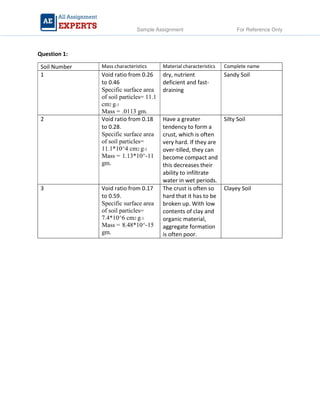
Soil Number Mass characteristics Material characteristics Complete name
1 Void ratio from 0.26
to 0.46
Specific surface area
of soil particles= 11.1
cm2 g-1
Mass = .0113 gm.
dry, nutrient
deficient and fast-
draining
Sandy Soil
2 Void ratio from 0.18
to 0.28.
Specific surface area
of soil particles=
11.1*10^4 cm2 g-1
Mass = 1.13*10^-11
gm.
Have a greater
tendency to form a
crust, which is often
very hard. If they are
over-tilled, they can
become compact and
this decreases their
ability to infiltrate
water in wet periods.
Silty Soil
3 Void ratio from 0.17
to 0.59.
Specific surface area
of soil particles=
7.4*10^6 cm2 g-1
Mass = 8.48*10^-15
gm.
The crust is often so
hard that it has to be
broken up. With low
contents of clay and
organic material,
aggregate formation
is often poor.
Clayey Soil
Sample Assignment For Reference Only
Question 2:
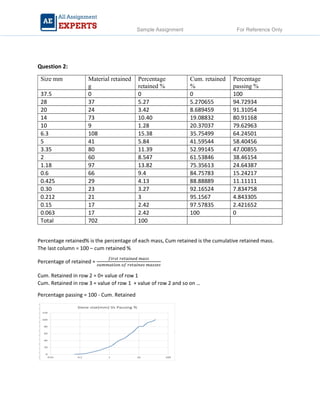
Size mm Material retained
g
Percentage
retained %
Cum. retained
%
Percentage
passing %
37.5 0 0 0 100
28 37 5.27 5.270655 94.72934
20 24 3.42 8.689459 91.31054
14 73 10.40 19.08832 80.91168
10 9 1.28 20.37037 79.62963
6.3 108 15.38 35.75499 64.24501
5 41 5.84 41.59544 58.40456
3.35 80 11.39 52.99145 47.00855
2 60 8.547 61.53846 38.46154
1.18 97 13.82 75.35613 24.64387
0.6 66 9.4 84.75783 15.24217
0.425 29 4.13 88.88889 11.11111
0.30 23 3.27 92.16524 7.834758
0.212 21 3 95.1567 4.843305
0.15 17 2.42 97.57835 2.421652
0.063 17 2.42 100 0
Total 702 100
Percentage retained% is the percentage of each mass, Cum retained is the cumulative retained mass.
The last column = 100 – cum retained %
Percentage of retained =
Cum. Retained in row 2 = 0+ value of row 1
Cum. Retained in row 3 = value of row 1 + value of row 2 and so on …
Percentage passing = 100 - Cum. Retained
Sample Assignment For Reference Only
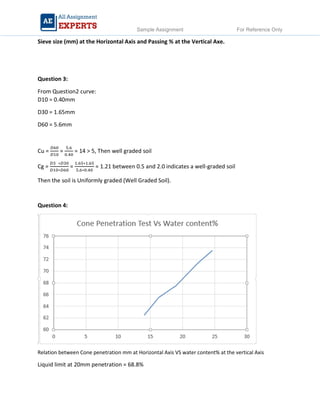
Sieve size (mm) at the Horizontal Axis and Passing % at the Vertical Axe.
Question 3:
From Question2 curve:
D10 = 0.40mm
D30 = 1.65mm
D60 = 5.6mm
Cu = =
.
.
= 14 > 5, Then well graded soil
Cg =
∗
∗
=
. ∗ .
. ∗ .
= 1.21 between 0.5 and 2.0 indicates a well-graded soil
Then the soil is Uniformly graded (Well Graded Soil).
Question 4:
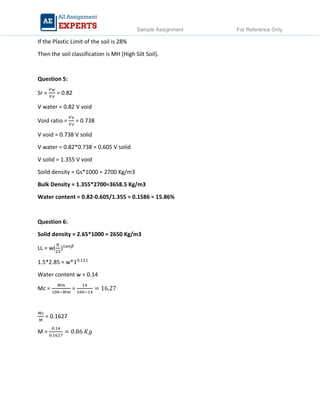
Relation between Cone penetration mm at Horizontal Axis VS water content% at the vertical Axis
Liquid limit at 20mm penetration = 68.8%
Sample Assignment For Reference Only
If the Plastic Limit of the soil is 28%
Then the soil classification is MH (High Silt Soil).
Question 5:
Sr = = 0.82
V water = 0.82 V void
Void ratio = = 0.738
V void = 0.738 V solid
V water = 0.82*0.738 = 0.605 V solid
V solid = 1.355 V void
Soild density = Gs*1000 = 2700 Kg/m3
Bulk Density = 1.355*2700=3658.5 Kg/m3
Water content = 0.82-0.605/1.355 = 0.1586 = 15.86%
Question 6:
Solid density = 2.65*1000 = 2650 Kg/m3
LL = w(
1.5*2.85 = w*1 .
Water content w = 0.14
Mc = = 16.27
= 0.1627
M =
.
.
0.86
Sample Assignment For Reference Only
Question 7:
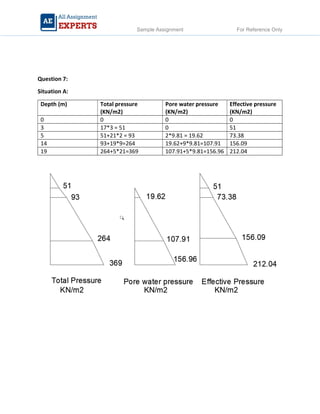
Situation A:
Depth (m) Total pressure
(KN/m2)
Pore water pressure
(KN/m2)
Effective pressure
(KN/m2)
0 0 0 0
3 17*3 = 51 0 51
5 51+21*2 = 93 2*9.81 = 19.62 73.38
14 93+19*9=264 19.62+9*9.81=107.91 156.09
19 264+5*21=369 107.91+5*9.81=156.96 212.04
Sample Assignment For Reference Only
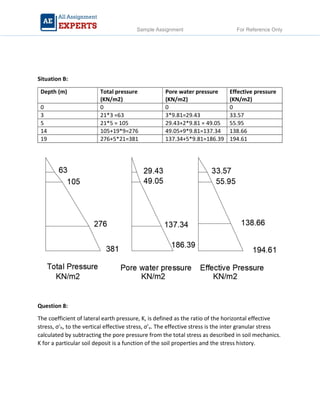
Situation B:
Depth (m) Total pressure
(KN/m2)
Pore water pressure
(KN/m2)
Effective pressure
(KN/m2)
0 0 0 0
3 21*3 =63 3*9.81=29.43 33.57
5 21*5 = 105 29.43+2*9.81 = 49.05 55.95
14 105+19*9=276 49.05+9*9.81=137.34 138.66
19 276+5*21=381 137.34+5*9.81=186.39 194.61
Question 8:
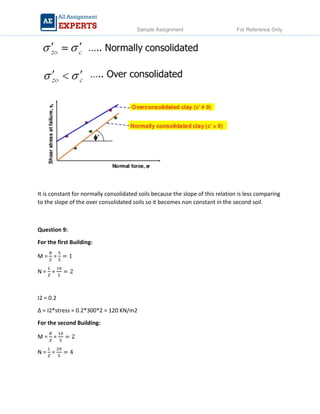
The coefficient of lateral earth pressure, K, is defined as the ratio of the horizontal effective
stress, σ’h, to the vertical effective stress, σ’v. The effective stress is the inter granular stress
calculated by subtracting the pore pressure from the total stress as described in soil mechanics.
K for a particular soil deposit is a function of the soil properties and the stress history.
Sample Assignment For Reference Only
It is constant for normally consolidated soils because the slope of this relation is less comparing
to the slope of the over consolidated soils so it becomes non constant in the second soil.
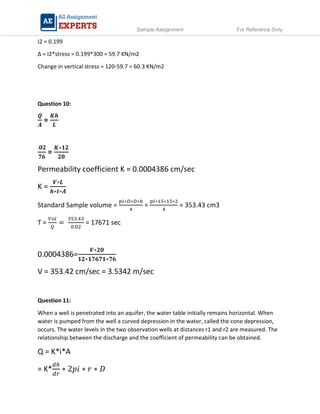
Question 9:
For the first Building:
M = = 1
N = = 2
I2 = 0.2
Δ = I2*stress = 0.2*300*2 = 120 KN/m2
For the second Building:
M = = 2
N = = 4
Sample Assignment For Reference Only
I2 = 0.199
Δ = I2*stress = 0.199*300 = 59.7 KN/m2
Change in vertical stress = 120-59.7 = 60.3 KN/m2
Question 10:
=
.
=
∗
Permeability coefficient K = 0.0004386 cm/sec
K =
∗
∗ ∗
Standard Sample volume =
∗ ∗ ∗
=
∗ ∗ ∗
= 353.43 cm3
T =
.
.
= 17671 sec
0.0004386=
∗
∗ ∗
V = 353.42 cm/sec = 3.5342 m/sec
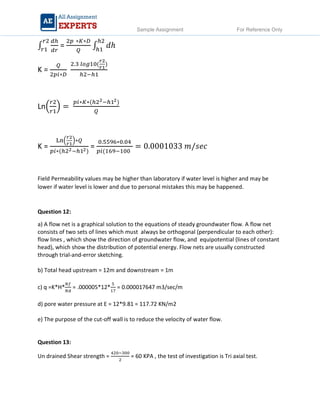
Question 11:
When a well is penetrated into an aquifer, the water table initially remains horizontal. When
water is pumped from the well a curved depression in the water, called the cone depression,
occurs. The water levels in the two observation wells at distances r1 and r2 are measured. The
relationship between the discharge and the coefficient of permeability can be obtained.
Q = K*i*A
= K* ∗ 2 ∗ ∗
Sample Assignment For Reference Only
=
∗ ∗
K =
∗
.
Ln
∗ ∗
K =
∗
∗
=
. ∗ .
0.0001033 /
Field Permeability values may be higher than laboratory if water level is higher and may be
lower if water level is lower and due to personal mistakes this may be happened.
Question 12:
a) A flow net is a graphical solution to the equations of steady groundwater flow. A flow net
consists of two sets of lines which must always be orthogonal (perpendicular to each other):
flow lines , which show the direction of groundwater flow, and equipotential (lines of constant
head), which show the distribution of potential energy. Flow nets are usually constructed
through trial-and-error sketching.
b) Total head upstream = 12m and downstream = 1m
c) q =K*H* = .000005*12* = 0.000017647 m3/sec/m
d) pore water pressure at E = 12*9.81 = 117.72 KN/m2
e) The purpose of the cut-off wall is to reduce the velocity of water flow.
Question 13:
Un drained Shear strength = = 60 KPA , the test of investigation is Tri axial test.
Sample Assignment For Reference Only
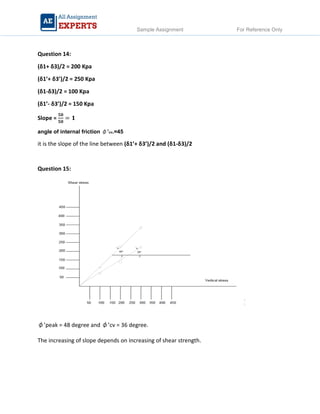
Question 14:
(δ1+ δ3)/2 = 200 Kpa
(δ1’+ δ3’)/2 = 250 Kpa
(δ1-δ3)/2 = 100 Kpa
(δ1’- δ3’)/2 = 150 Kpa
Slope =
angle of internal friction φ’cv.=45
it is the slope of the line between (δ1’+ δ3’)/2 and (δ1-δ3)/2
Question 15:
φ’peak = 48 degree and φ’cv = 36 degree.
The increasing of slope depends on increasing of shear strength.
Sample Assignment For Reference Only
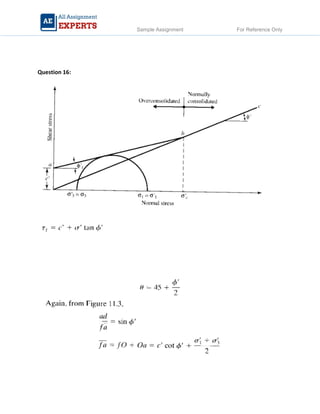
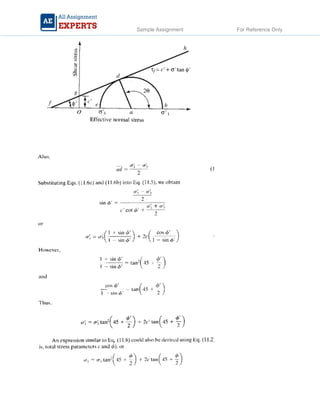
Question 16:
Sample Assignment For Reference Only
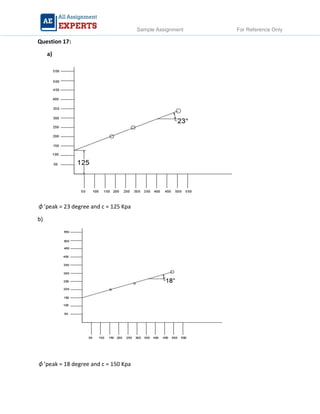
Question 17:
a)
φ’peak = 23 degree and c = 125 Kpa
b)
φ’peak = 18 degree and c = 150 Kpa
Sample Assignment For Reference Only
c) Pore water pressure at the first case = 125 Kpa and in the second case = 150 Kpa
we notice that in the second case is higher because the slope of stress values is higher.
d) The parameters will be pore water pressure, vertical stress and shear stress.

Civil Engineering Sample Assignment Solution

  • 1.
    Sample Assignment ForReference Only Question 1: Soil Number Mass characteristics Material characteristics Complete name 1 Void ratio from 0.26 to 0.46 Specific surface area of soil particles= 11.1 cm2 g-1 Mass = .0113 gm. dry, nutrient deficient and fast- draining Sandy Soil 2 Void ratio from 0.18 to 0.28. Specific surface area of soil particles= 11.1*10^4 cm2 g-1 Mass = 1.13*10^-11 gm. Have a greater tendency to form a crust, which is often very hard. If they are over-tilled, they can become compact and this decreases their ability to infiltrate water in wet periods. Silty Soil 3 Void ratio from 0.17 to 0.59. Specific surface area of soil particles= 7.4*10^6 cm2 g-1 Mass = 8.48*10^-15 gm. The crust is often so hard that it has to be broken up. With low contents of clay and organic material, aggregate formation is often poor. Clayey Soil
  • 2.
    Sample Assignment ForReference Only Question 2: Size mm Material retained g Percentage retained % Cum. retained % Percentage passing % 37.5 0 0 0 100 28 37 5.27 5.270655 94.72934 20 24 3.42 8.689459 91.31054 14 73 10.40 19.08832 80.91168 10 9 1.28 20.37037 79.62963 6.3 108 15.38 35.75499 64.24501 5 41 5.84 41.59544 58.40456 3.35 80 11.39 52.99145 47.00855 2 60 8.547 61.53846 38.46154 1.18 97 13.82 75.35613 24.64387 0.6 66 9.4 84.75783 15.24217 0.425 29 4.13 88.88889 11.11111 0.30 23 3.27 92.16524 7.834758 0.212 21 3 95.1567 4.843305 0.15 17 2.42 97.57835 2.421652 0.063 17 2.42 100 0 Total 702 100 Percentage retained% is the percentage of each mass, Cum retained is the cumulative retained mass. The last column = 100 – cum retained % Percentage of retained = Cum. Retained in row 2 = 0+ value of row 1 Cum. Retained in row 3 = value of row 1 + value of row 2 and so on … Percentage passing = 100 - Cum. Retained
  • 3.
    Sample Assignment ForReference Only Sieve size (mm) at the Horizontal Axis and Passing % at the Vertical Axe. Question 3: From Question2 curve: D10 = 0.40mm D30 = 1.65mm D60 = 5.6mm Cu = = . . = 14 > 5, Then well graded soil Cg = ∗ ∗ = . ∗ . . ∗ . = 1.21 between 0.5 and 2.0 indicates a well-graded soil Then the soil is Uniformly graded (Well Graded Soil). Question 4: Relation between Cone penetration mm at Horizontal Axis VS water content% at the vertical Axis Liquid limit at 20mm penetration = 68.8%
  • 4.
    Sample Assignment ForReference Only If the Plastic Limit of the soil is 28% Then the soil classification is MH (High Silt Soil). Question 5: Sr = = 0.82 V water = 0.82 V void Void ratio = = 0.738 V void = 0.738 V solid V water = 0.82*0.738 = 0.605 V solid V solid = 1.355 V void Soild density = Gs*1000 = 2700 Kg/m3 Bulk Density = 1.355*2700=3658.5 Kg/m3 Water content = 0.82-0.605/1.355 = 0.1586 = 15.86% Question 6: Solid density = 2.65*1000 = 2650 Kg/m3 LL = w( 1.5*2.85 = w*1 . Water content w = 0.14 Mc = = 16.27 = 0.1627 M = . . 0.86
  • 5.
    Sample Assignment ForReference Only Question 7: Situation A: Depth (m) Total pressure (KN/m2) Pore water pressure (KN/m2) Effective pressure (KN/m2) 0 0 0 0 3 17*3 = 51 0 51 5 51+21*2 = 93 2*9.81 = 19.62 73.38 14 93+19*9=264 19.62+9*9.81=107.91 156.09 19 264+5*21=369 107.91+5*9.81=156.96 212.04
  • 6.
    Sample Assignment ForReference Only Situation B: Depth (m) Total pressure (KN/m2) Pore water pressure (KN/m2) Effective pressure (KN/m2) 0 0 0 0 3 21*3 =63 3*9.81=29.43 33.57 5 21*5 = 105 29.43+2*9.81 = 49.05 55.95 14 105+19*9=276 49.05+9*9.81=137.34 138.66 19 276+5*21=381 137.34+5*9.81=186.39 194.61 Question 8: The coefficient of lateral earth pressure, K, is defined as the ratio of the horizontal effective stress, σ’h, to the vertical effective stress, σ’v. The effective stress is the inter granular stress calculated by subtracting the pore pressure from the total stress as described in soil mechanics. K for a particular soil deposit is a function of the soil properties and the stress history.
  • 7.
    Sample Assignment ForReference Only It is constant for normally consolidated soils because the slope of this relation is less comparing to the slope of the over consolidated soils so it becomes non constant in the second soil. Question 9: For the first Building: M = = 1 N = = 2 I2 = 0.2 Δ = I2*stress = 0.2*300*2 = 120 KN/m2 For the second Building: M = = 2 N = = 4
  • 8.
    Sample Assignment ForReference Only I2 = 0.199 Δ = I2*stress = 0.199*300 = 59.7 KN/m2 Change in vertical stress = 120-59.7 = 60.3 KN/m2 Question 10: = . = ∗ Permeability coefficient K = 0.0004386 cm/sec K = ∗ ∗ ∗ Standard Sample volume = ∗ ∗ ∗ = ∗ ∗ ∗ = 353.43 cm3 T = . . = 17671 sec 0.0004386= ∗ ∗ ∗ V = 353.42 cm/sec = 3.5342 m/sec Question 11: When a well is penetrated into an aquifer, the water table initially remains horizontal. When water is pumped from the well a curved depression in the water, called the cone depression, occurs. The water levels in the two observation wells at distances r1 and r2 are measured. The relationship between the discharge and the coefficient of permeability can be obtained. Q = K*i*A = K* ∗ 2 ∗ ∗
  • 9.
    Sample Assignment ForReference Only = ∗ ∗ K = ∗ . Ln ∗ ∗ K = ∗ ∗ = . ∗ . 0.0001033 / Field Permeability values may be higher than laboratory if water level is higher and may be lower if water level is lower and due to personal mistakes this may be happened. Question 12: a) A flow net is a graphical solution to the equations of steady groundwater flow. A flow net consists of two sets of lines which must always be orthogonal (perpendicular to each other): flow lines , which show the direction of groundwater flow, and equipotential (lines of constant head), which show the distribution of potential energy. Flow nets are usually constructed through trial-and-error sketching. b) Total head upstream = 12m and downstream = 1m c) q =K*H* = .000005*12* = 0.000017647 m3/sec/m d) pore water pressure at E = 12*9.81 = 117.72 KN/m2 e) The purpose of the cut-off wall is to reduce the velocity of water flow. Question 13: Un drained Shear strength = = 60 KPA , the test of investigation is Tri axial test.
  • 10.
    Sample Assignment ForReference Only Question 14: (δ1+ δ3)/2 = 200 Kpa (δ1’+ δ3’)/2 = 250 Kpa (δ1-δ3)/2 = 100 Kpa (δ1’- δ3’)/2 = 150 Kpa Slope = angle of internal friction φ’cv.=45 it is the slope of the line between (δ1’+ δ3’)/2 and (δ1-δ3)/2 Question 15: φ’peak = 48 degree and φ’cv = 36 degree. The increasing of slope depends on increasing of shear strength.
  • 11.
    Sample Assignment ForReference Only Question 16:
  • 12.
    Sample Assignment ForReference Only
  • 13.
    Sample Assignment ForReference Only Question 17: a) φ’peak = 23 degree and c = 125 Kpa b) φ’peak = 18 degree and c = 150 Kpa
  • 14.
    Sample Assignment ForReference Only c) Pore water pressure at the first case = 125 Kpa and in the second case = 150 Kpa we notice that in the second case is higher because the slope of stress values is higher. d) The parameters will be pore water pressure, vertical stress and shear stress.