Properties of Materials -
Hardness
By
Akhtar Husain
22 Aug 2017
• Introduction
• Definition and Importance
• Why and How to Determine Hardness
• History of Hardness Tests
• Mhos Scale
• Brinell Hardness Test
• Rockwell Hardness Test
• Vickers Hardness Test
• Knoop Hardness Test
• Comparison of Different Hardness Scales
• Some Typical Hardness Values
• Lab Exercise-Brinell Hardness Test
Properties of Materials – Hardness
Sequence
Engineering
The application of science and mathematics by which
the properties of matter and the sources of energy in
nature are made useful to people. Merriam-Webster
Properties of Materials – Hardness
Introduction
Engineering
The application of science and mathematics by which
the properties of matter and the sources of energy in
nature are made useful to people. Merriam-Webster
Properties of Materials – Hardness
Introduction
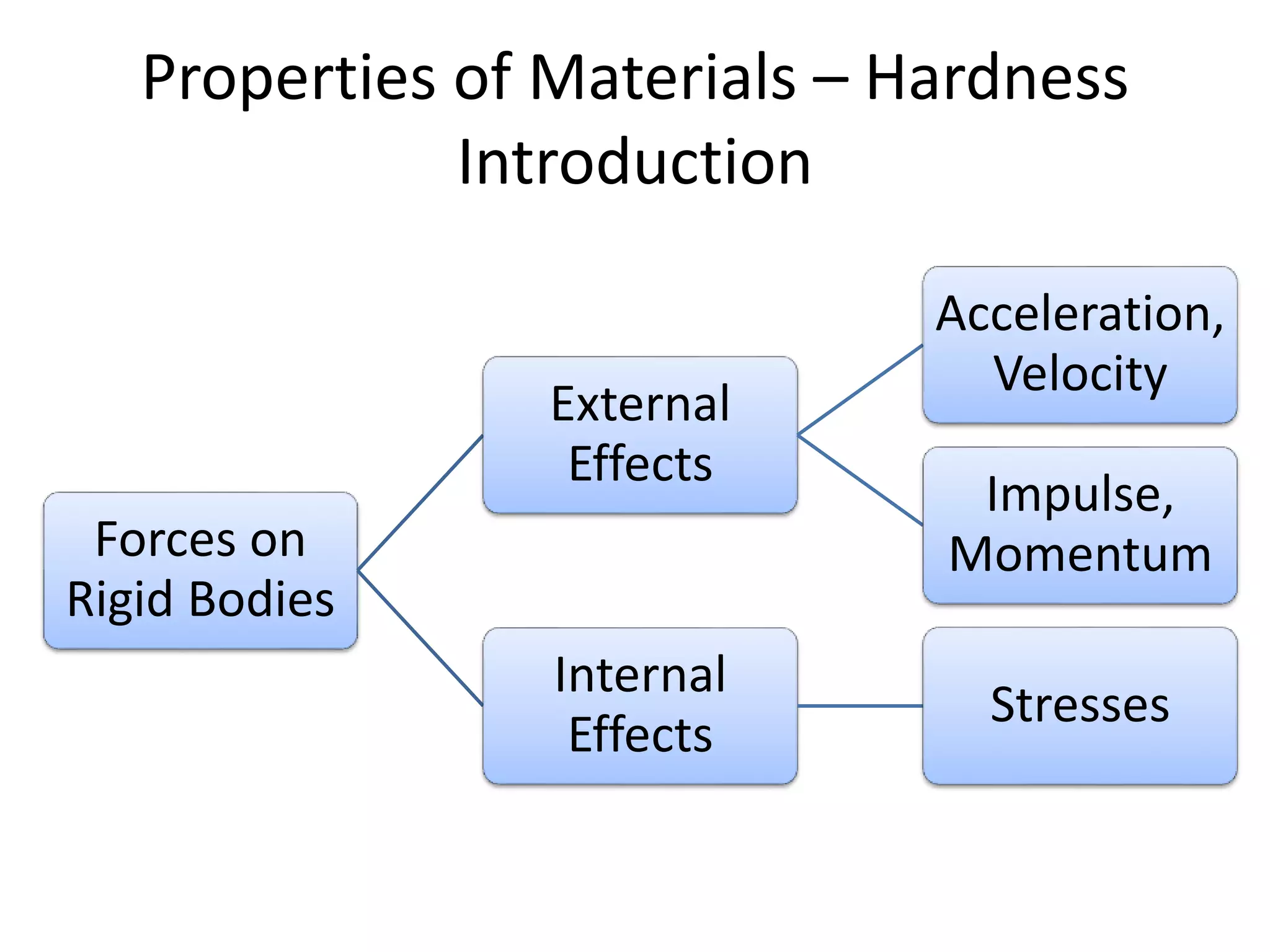
Forces on
Rigid Bodies
External
Effects
Acceleration,
Velocity
Impulse,
Momentum
Internal
Effects
Stresses
Properties of Materials – Hardness
Introduction
Forces on
Rigid Bodies
External
Effects
Acceleration,
Velocity
Impulse,
Momentum
Internal
Effects
Stresses
Properties of Materials – Hardness
Introduction
Properties of Materials – Hardness
Introduction
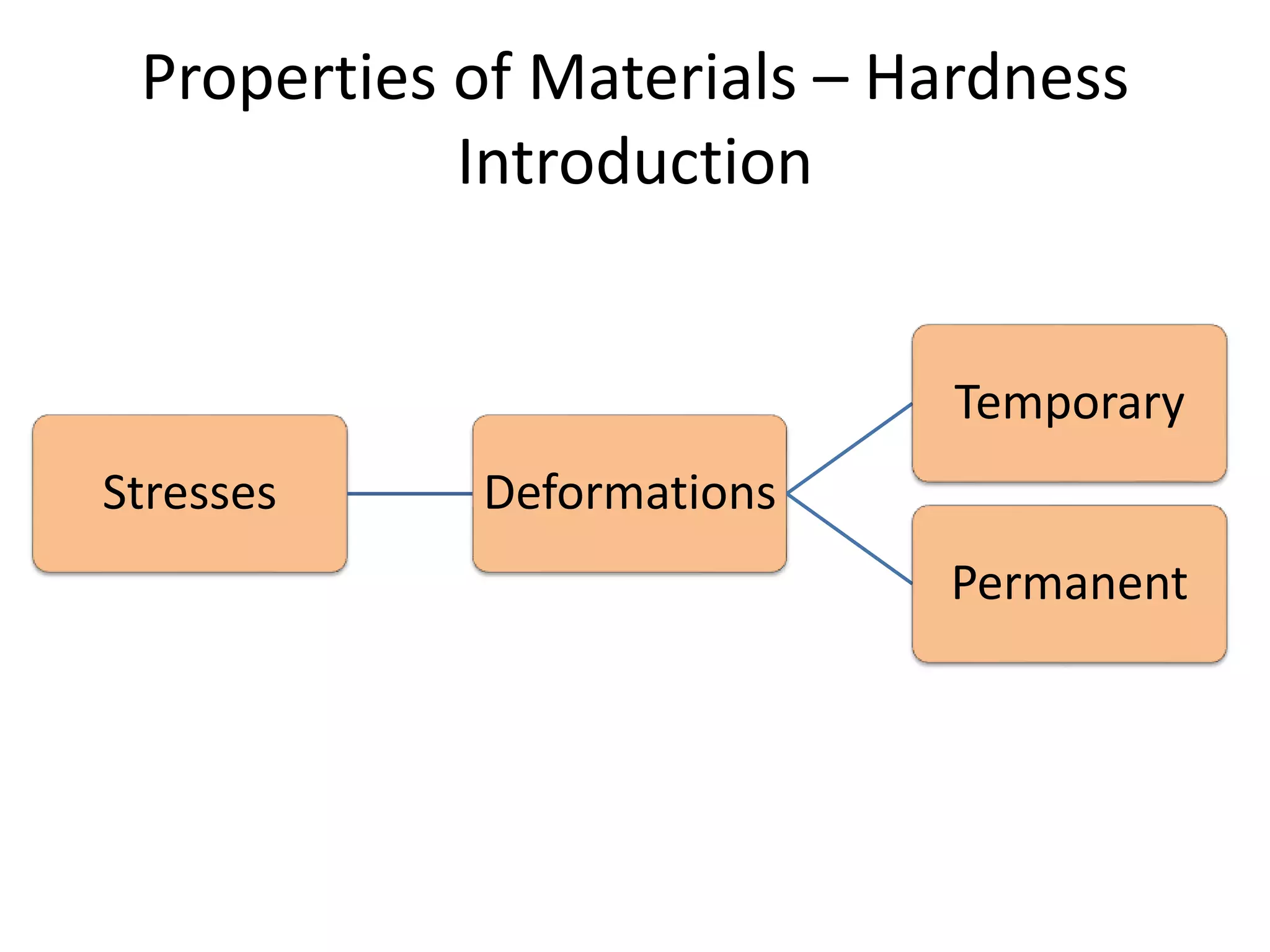
Stresses Deformations
Temporary
Permanent
• Introduction
Properties of Materials - Hardness
Properties
Strength
Hardness
Ductility
Toughness
Other
• Introduction
Properties of Materials - Hardness
Properties
Strength
Hardness
Ductility
Toughness
Many More
• Definition
– Resistance to plastic deformation, usually by
indentation. However, the term may also refer to
resistance to scratching, abrasion, or cutting.
• Importance
– We need to ascertain the hardness for two main
reasons:-
• To confirm material characteristics
• To ensure part functionality
Properties of Materials - Hardness
• Hardness can be used to estimate tensile
strength of most steels.
• Hardness value is good indication of
effectiveness of heat treatment.
• Being a non-destructive test, it can be
accomplished on finished parts.
• It is relatively simple.
Properties of Materials – Hardness
Why Check Hardness
Scientist and engineers were aware of the importance
of hardness for centuries; different techniques were
employed to determine hardness. The main techniques
have been:-
• Performing scratch test
• Size of impression produced on the surface by
pressing an indenter against it by a known force
• Depth of indentation produced on the surface by
pressing an indenter against it by a known force
Properties of Materials – Hardness
How to Determine Hardness
• 1822: Friedrich Mohs (Ger) - A ten-point scratch hardness Mohs
scale.
• 1900: J. A. Brinell (Swe) - A ball indentation / dent dia size Brinell
Hardness.
• 1920: S. R. Rockwell (US) – Minor, major load / dent depth Rockwell
Hardness.
• 1925: R. Smith and G. Sandland (Eng) – Diamond pyramid indenter /
dent diagonal size , allows microhardness tests to be carried out,
Vickers (Micro) Hardness.
• 1939: F. Knoop, C. G. Peters and W. B. E. Emerson (US) - Elongated
diamond indenter, allow hardness tests on glass and ceramics also,
Knoop Hardness.
Properties of Materials – Hardness
History of Hardness Tests
Properties of Materials – Hardness
Mhos Scale
Principle :
By Scratching
Properties of Materials – Hardness
Brinell Hardness Test
Where
F= Applied Force in kgf
D= Indenter Dia in mm
Di=Indentation Dia in mm
Properties of Materials – Hardness
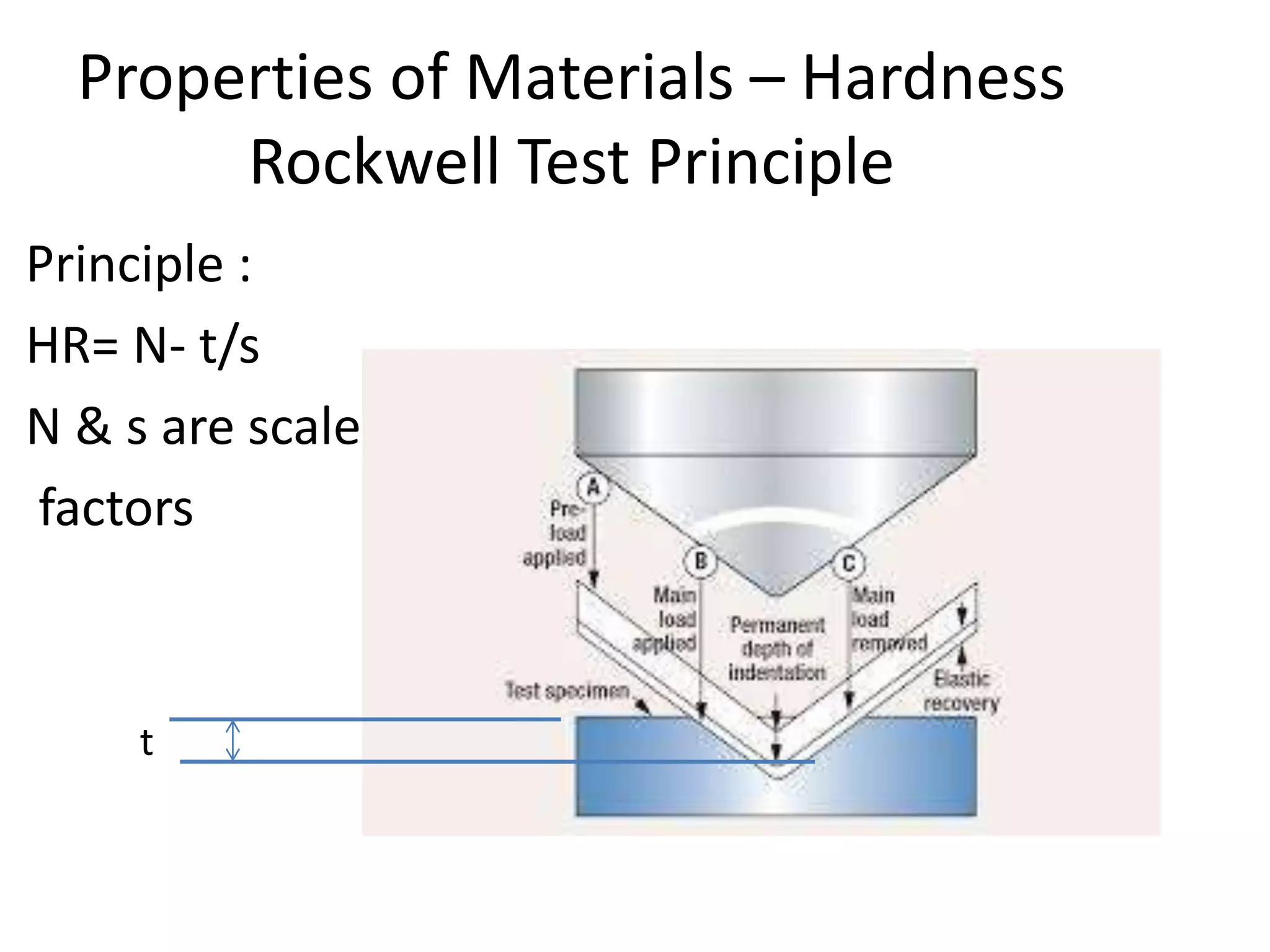
Rockwell Test Principle
Principle :
HR= N- t/s
N & s are scale
factors
t
Properties of Materials – Hardness
Rockwell Test Principle
Properties of Materials – Hardness
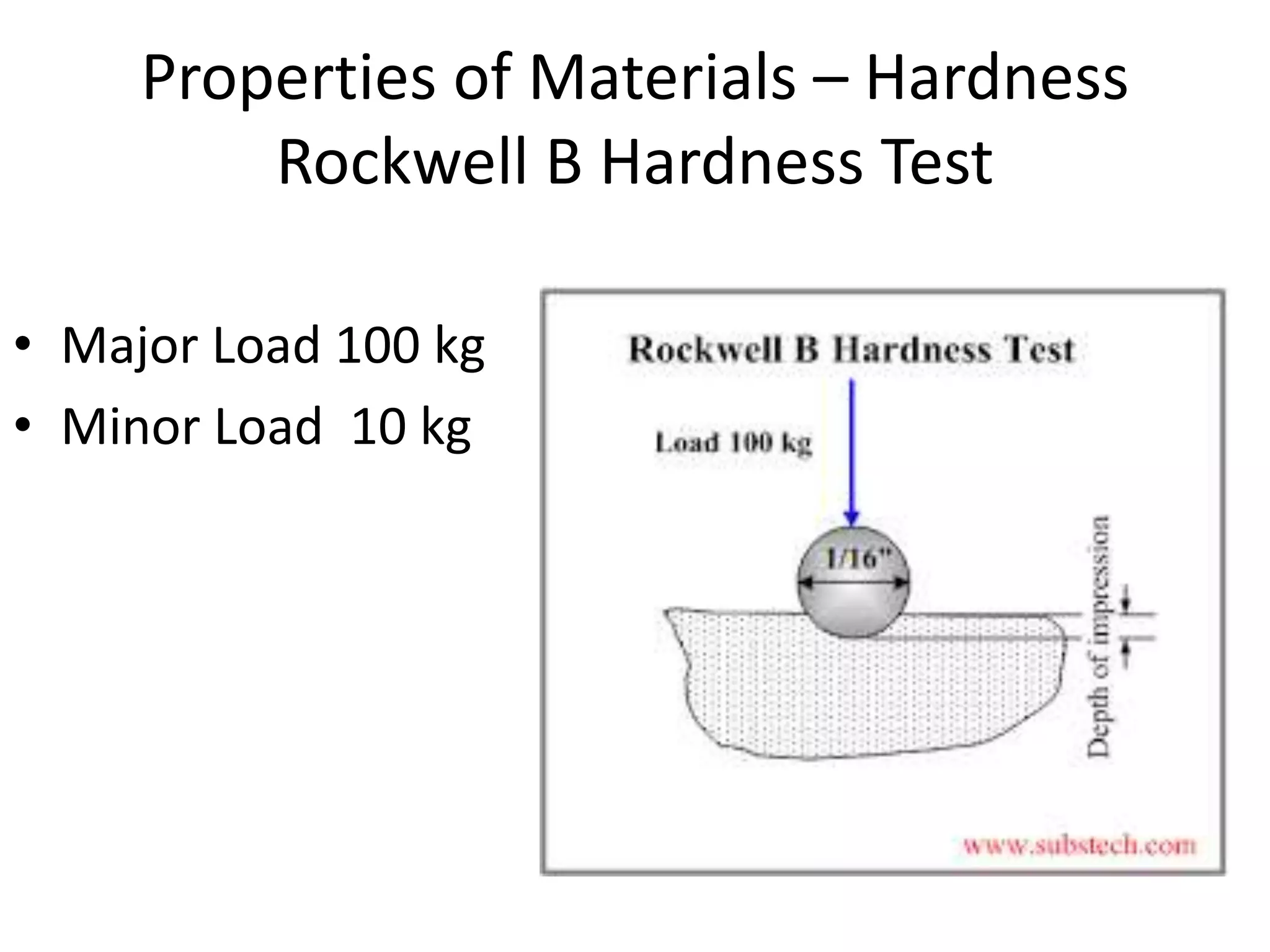
Rockwell B Hardness Test
• Major Load 100 kg
• Minor Load 10 kg
Properties of Materials – Hardness
Rockwell C Hardness Test
• Major Load 150 kg
• Minor Load 10 kg
Properties of Materials – Hardness
Vickers Hardness Test
HV = 1.854(F/D2)
Properties of Materials – Hardness
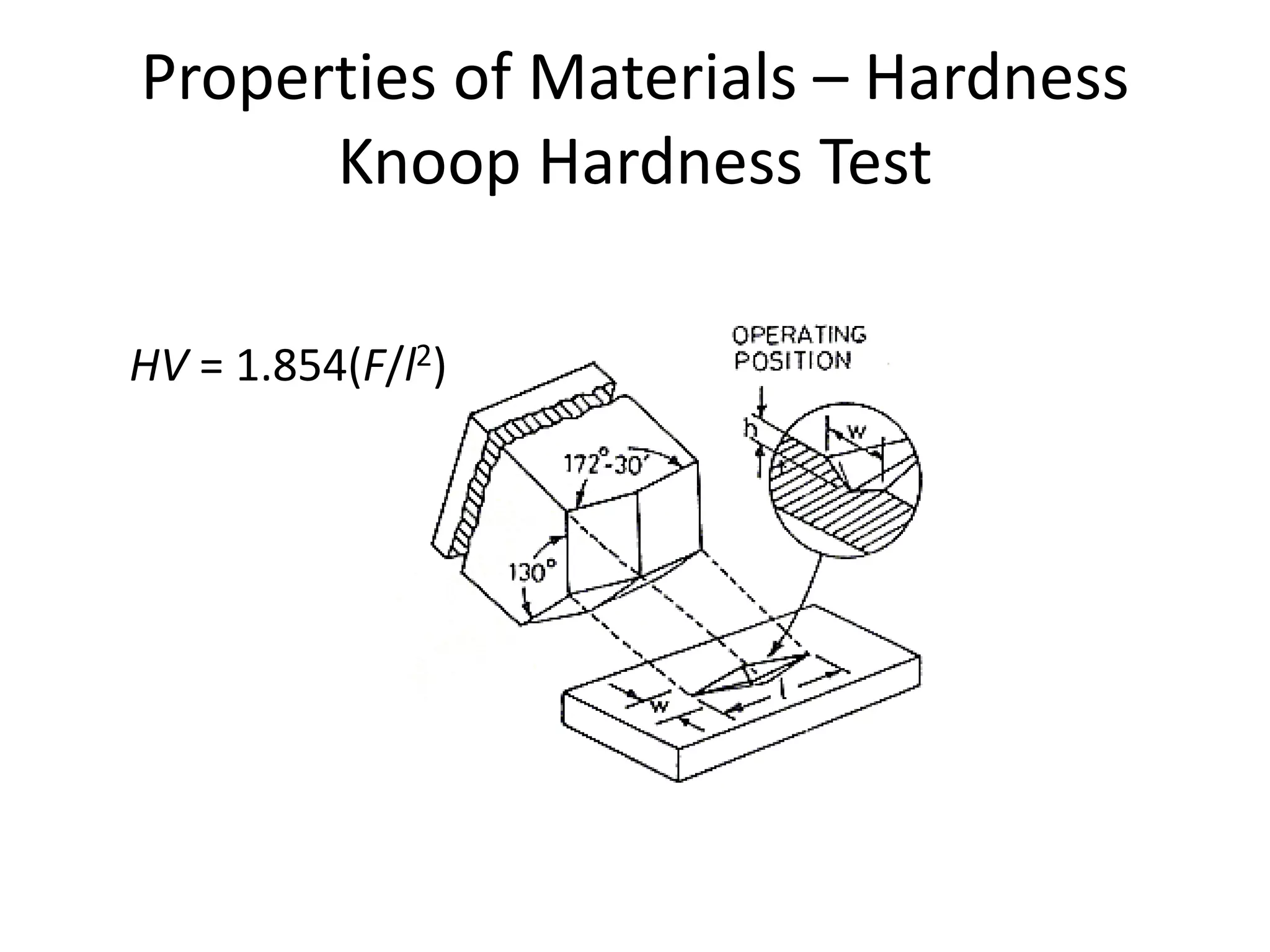
Knoop Hardness Test
HV = 1.854(F/l2)
Properties of Materials – Hardness
Hardness Test Machine
Properties of Materials – Hardness
Comparison of Different Hardness Scales
Properties of Materials – Hardness
Comparison of Different Hardness Scales
Properties of Materials – Hardness
Comparison of Different Hardness Scales
Sut = (3.5 BHN) MPa
Properties of Materials – Hardness
Typical Hardness Values
Material Hardness
Soft wood (e.g. pine) 1.6 HBS 10/100
Hard wood 2.6 to 7.0 HBS 1.6 10/100
Aluminium 15 HB
Copper 35 HB
Mild steel 120 HB
18-8 (304) stainless steel 250 HB
Cold Drawn Steel
Glass
325 HB
550 HB
Hardened tool steel 650 - 700 HB
Properties of Materials – Hardness
Lab Exercise-Brinell Hardness Test
We will measure the hardness of an aluminum
plate. The diameter of the spherical indenter
in will be 2.5 mm, the imposed load will be 30
kgf, the time of loading will be 30 s. We will
measure the indent size with the aid of optical
microscope, its division is 1/10 mm.
Properties of Materials – Hardness
Lab Exercise-Brinell Hardness Test
Caution : The Hardness test machines can only be operated
under the supervision of Lab Engineer
1. Select a location for the test Remove oil or dirt, but the surface does
not need to be polished
2. Make sure the part can be held securely.
3. Raise the spherical indenter according to the red mark on the scale.
4. Apply the 30 kgf load and wait 30 seconds
5. Remove the load
6. Measure the indent size with the aid of the optical microscope.
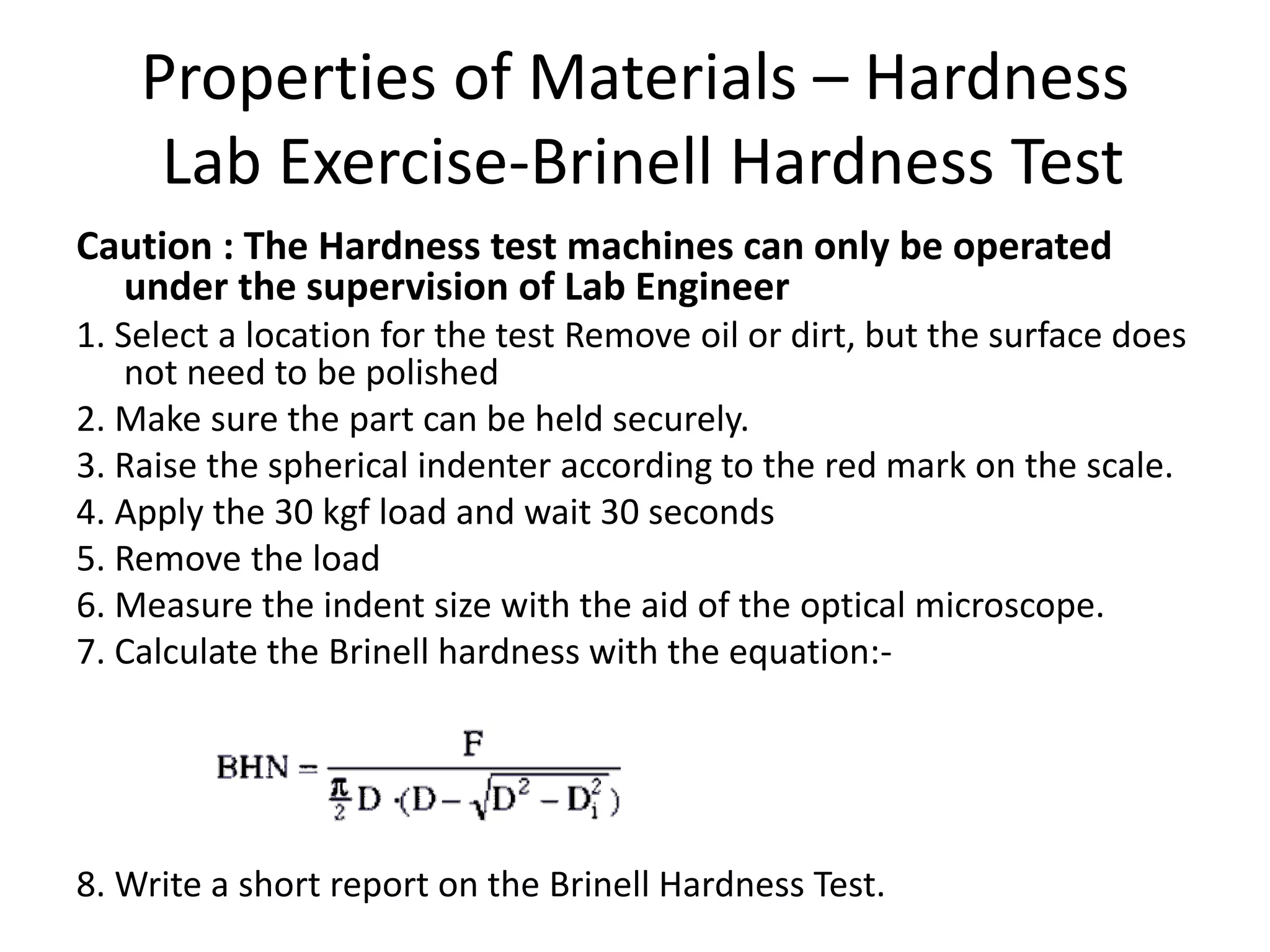
7. Calculate the Brinell hardness with the equation:-
8. Write a short report on the Brinell Hardness Test.
Thank You

Hardness

  • 1.
    Properties of Materials- Hardness By Akhtar Husain 22 Aug 2017
  • 2.
    • Introduction • Definitionand Importance • Why and How to Determine Hardness • History of Hardness Tests • Mhos Scale • Brinell Hardness Test • Rockwell Hardness Test • Vickers Hardness Test • Knoop Hardness Test • Comparison of Different Hardness Scales • Some Typical Hardness Values • Lab Exercise-Brinell Hardness Test Properties of Materials – Hardness Sequence
  • 3.
    Engineering The application ofscience and mathematics by which the properties of matter and the sources of energy in nature are made useful to people. Merriam-Webster Properties of Materials – Hardness Introduction
  • 4.
    Engineering The application ofscience and mathematics by which the properties of matter and the sources of energy in nature are made useful to people. Merriam-Webster Properties of Materials – Hardness Introduction
  • 5.
  • 6.
  • 7.
    Properties of Materials– Hardness Introduction Stresses Deformations Temporary Permanent
  • 8.
    • Introduction Properties ofMaterials - Hardness Properties Strength Hardness Ductility Toughness Other
  • 9.
    • Introduction Properties ofMaterials - Hardness Properties Strength Hardness Ductility Toughness Many More
  • 10.
    • Definition – Resistanceto plastic deformation, usually by indentation. However, the term may also refer to resistance to scratching, abrasion, or cutting. • Importance – We need to ascertain the hardness for two main reasons:- • To confirm material characteristics • To ensure part functionality Properties of Materials - Hardness
  • 11.
    • Hardness canbe used to estimate tensile strength of most steels. • Hardness value is good indication of effectiveness of heat treatment. • Being a non-destructive test, it can be accomplished on finished parts. • It is relatively simple. Properties of Materials – Hardness Why Check Hardness
  • 12.
    Scientist and engineerswere aware of the importance of hardness for centuries; different techniques were employed to determine hardness. The main techniques have been:- • Performing scratch test • Size of impression produced on the surface by pressing an indenter against it by a known force • Depth of indentation produced on the surface by pressing an indenter against it by a known force Properties of Materials – Hardness How to Determine Hardness
  • 13.
    • 1822: FriedrichMohs (Ger) - A ten-point scratch hardness Mohs scale. • 1900: J. A. Brinell (Swe) - A ball indentation / dent dia size Brinell Hardness. • 1920: S. R. Rockwell (US) – Minor, major load / dent depth Rockwell Hardness. • 1925: R. Smith and G. Sandland (Eng) – Diamond pyramid indenter / dent diagonal size , allows microhardness tests to be carried out, Vickers (Micro) Hardness. • 1939: F. Knoop, C. G. Peters and W. B. E. Emerson (US) - Elongated diamond indenter, allow hardness tests on glass and ceramics also, Knoop Hardness. Properties of Materials – Hardness History of Hardness Tests
  • 14.
    Properties of Materials– Hardness Mhos Scale Principle : By Scratching
  • 15.
    Properties of Materials– Hardness Brinell Hardness Test Where F= Applied Force in kgf D= Indenter Dia in mm Di=Indentation Dia in mm
  • 16.
    Properties of Materials– Hardness Rockwell Test Principle Principle : HR= N- t/s N & s are scale factors t
  • 17.
    Properties of Materials– Hardness Rockwell Test Principle
  • 18.
    Properties of Materials– Hardness Rockwell B Hardness Test • Major Load 100 kg • Minor Load 10 kg
  • 19.
    Properties of Materials– Hardness Rockwell C Hardness Test • Major Load 150 kg • Minor Load 10 kg
  • 20.
    Properties of Materials– Hardness Vickers Hardness Test HV = 1.854(F/D2)
  • 21.
    Properties of Materials– Hardness Knoop Hardness Test HV = 1.854(F/l2)
  • 22.
    Properties of Materials– Hardness Hardness Test Machine
  • 23.
    Properties of Materials– Hardness Comparison of Different Hardness Scales
  • 24.
    Properties of Materials– Hardness Comparison of Different Hardness Scales
  • 25.
    Properties of Materials– Hardness Comparison of Different Hardness Scales Sut = (3.5 BHN) MPa
  • 26.
    Properties of Materials– Hardness Typical Hardness Values Material Hardness Soft wood (e.g. pine) 1.6 HBS 10/100 Hard wood 2.6 to 7.0 HBS 1.6 10/100 Aluminium 15 HB Copper 35 HB Mild steel 120 HB 18-8 (304) stainless steel 250 HB Cold Drawn Steel Glass 325 HB 550 HB Hardened tool steel 650 - 700 HB
  • 27.
    Properties of Materials– Hardness Lab Exercise-Brinell Hardness Test We will measure the hardness of an aluminum plate. The diameter of the spherical indenter in will be 2.5 mm, the imposed load will be 30 kgf, the time of loading will be 30 s. We will measure the indent size with the aid of optical microscope, its division is 1/10 mm.
  • 28.
    Properties of Materials– Hardness Lab Exercise-Brinell Hardness Test Caution : The Hardness test machines can only be operated under the supervision of Lab Engineer 1. Select a location for the test Remove oil or dirt, but the surface does not need to be polished 2. Make sure the part can be held securely. 3. Raise the spherical indenter according to the red mark on the scale. 4. Apply the 30 kgf load and wait 30 seconds 5. Remove the load 6. Measure the indent size with the aid of the optical microscope. 7. Calculate the Brinell hardness with the equation:- 8. Write a short report on the Brinell Hardness Test.
  • 29.