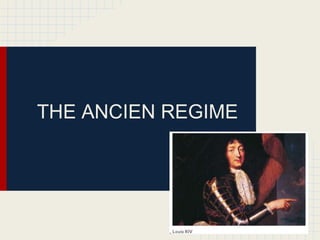
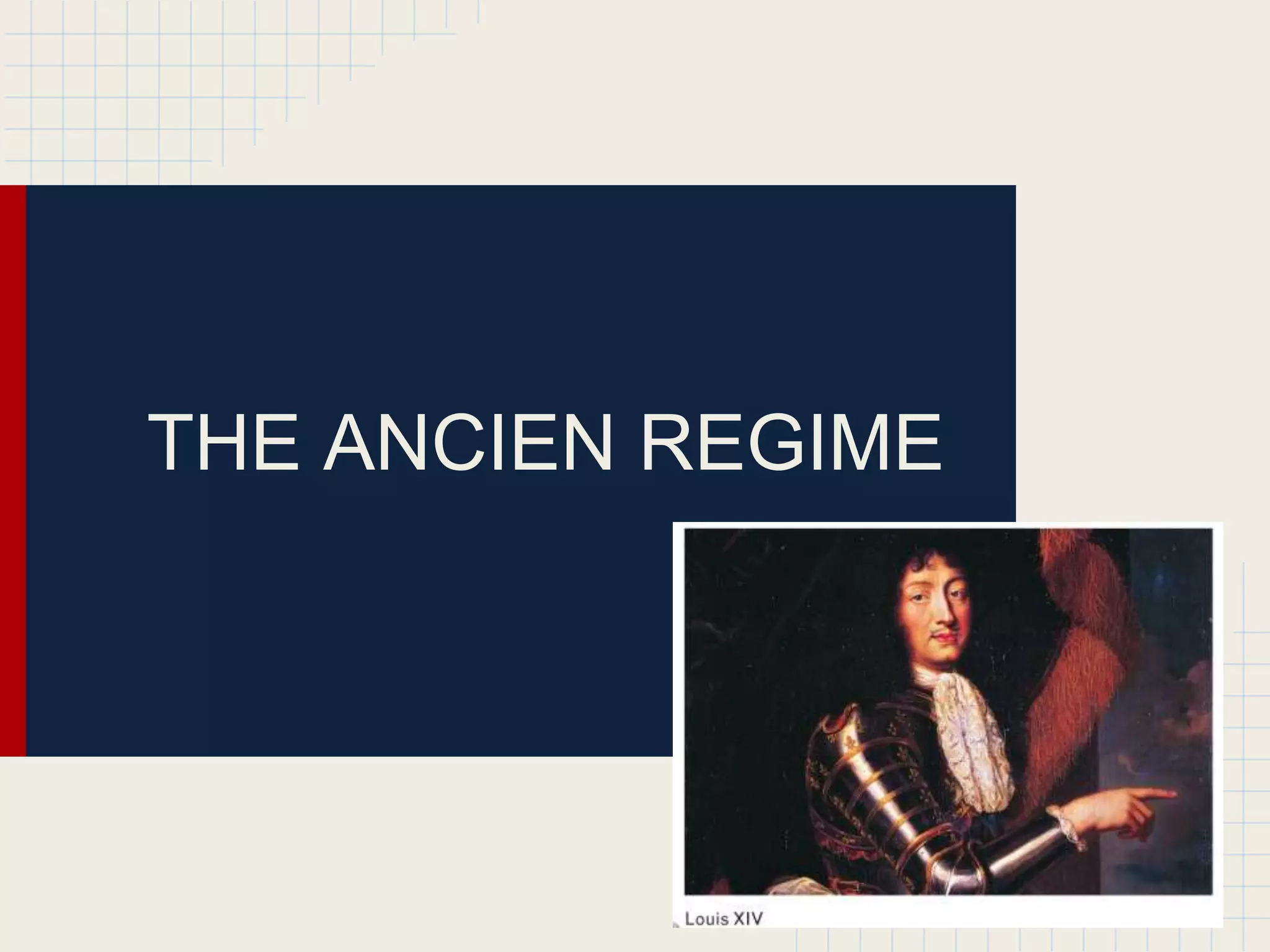
THE ANCIEN REGIME
What is the Ancien
Regime?
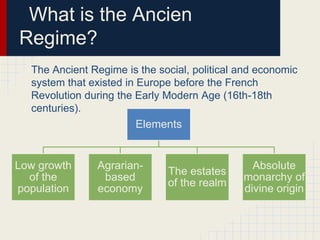
The Ancient Regime is the social, political and economic
system that existed in Europe before the French
Revolution during the Early Modern Age (16th-18th
centuries).

Elements

Low growth
of the
population

Agrarianbased
economy

The estates
of the realm

Absolute
monarchy of
divine origin
Low growth of the
population
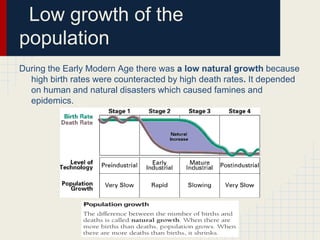
During the Early Modern Age there was a low natural growth because
high birth rates were counteracted by high death rates. It depended
on human and natural disasters which caused famines and
epidemics.
Agrarian-based economy
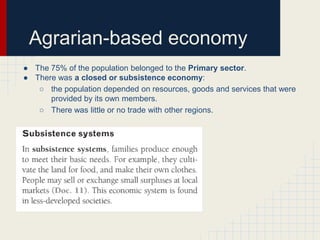
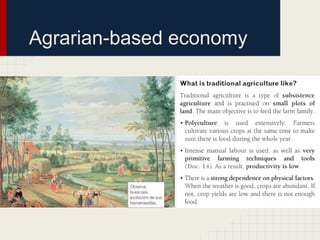
● The 75% of the population belonged to the Primary sector.
● There was a closed or subsistence economy:
○ the population depended on resources, goods and services that were
provided by its own members.
○ There was little or no trade with other regions.
Agrarian-based economy
Survival of the Feudal system
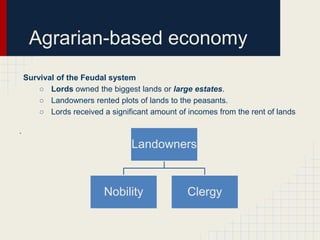
○ Lords owned the biggest lands or large estates.
○ Landowners rented plots of lands to the peasants.
○ Lords received a significant amount of incomes from the rent of lands
.

Landowners

Nobility

Clergy
Craft-industry
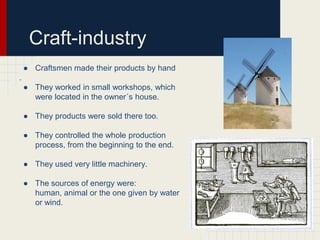
● Craftsmen made their products by hand
.
● They worked in small workshops, which
were located in the owner´s house.
● They products were sold there too.
● They controlled the whole production
process, from the beginning to the end.
● They used very little machinery.
● The sources of energy were:
human, animal or the one given by water
or wind.
Trade
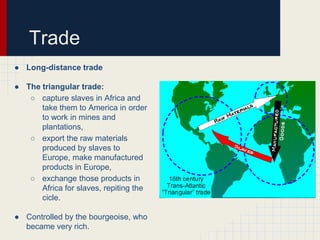
● Long-distance trade
● The triangular trade:
○ capture slaves in Africa and
take them to America in order
to work in mines and
plantations,
○ export the raw materials
produced by slaves to
Europe, make manufactured
products in Europe,
○ exchange those products in
Africa for slaves, repiting the
cicle.
● Controlled by the bourgeoise, who
became very rich.
Economic system
After the discovery of America, two economic systems developed:

Commercial capitalism

Mercantilism

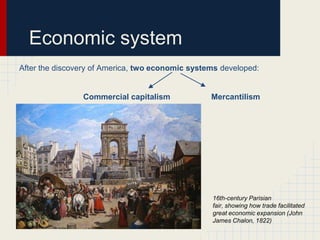
16th-century Parisian
fair, showing how trade facilitated
great economic expansion (John
James Chalon, 1822)
Economic System
THE 16TH CENTURY: COMMERCIAL CAPITALISM
● Thanks to the discovery of the New World there was a significant
economic growth in Europe.
● The New World became an important new market for European
exports.

● Commercial capitalism developed:
○ A new system that enabled private businesses to accumulate
profits, especially through trade.
○ Factors:
■ The emergence of new forms of craft production in workshops
and through the domestic system.
■ The establishment of banks (commercial operations)
■ New commercial and financial practices (bills of
exchange, loans)
Economic System
THE 17TH CENTURY: MERCANTILISM
● There was a serious economic crisis, caused mostly by the enormous
amounts of gold and silver that arrived in Europe from America.
● An excess of these precious metals caused their value to fall, while prices
increased.
● Mercantilism
○ imposed by Europe´s absolute monarchs
○ Based on the idea that a country´s wealth depended on how much
gold and silver it possessed.
○ In order to accumulate more of these precious metals, monarchs
implemented protectionist policies to limit imports and encourage
exports.
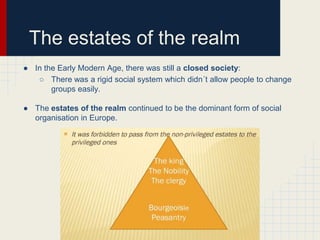
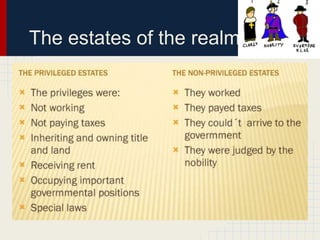
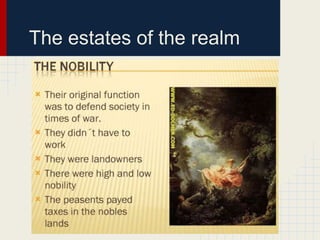
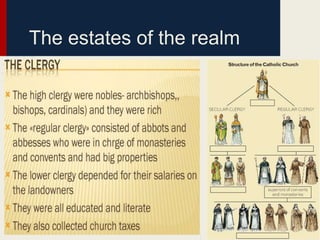
The estates of the realm
● In the Early Modern Age, there was still a closed society:
○ There was a rigid social system which didn´t allow people to change
groups easily.
● The estates of the realm continued to be the dominant form of social
organisation in Europe.
The estates of the realm
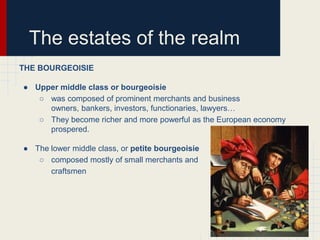
THE BOURGEOISIE
● Upper middle class or bourgeoisie
○ was composed of prominent merchants and business
owners, bankers, investors, functionaries, lawyers…
○ They become richer and more powerful as the European economy
prospered.

● The lower middle class, or petite bourgeoisie
○ composed mostly of small merchants and
craftsmen
The estates of the realm
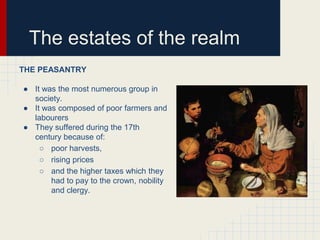
THE PEASANTRY
● It was the most numerous group in
society.
● It was composed of poor farmers and
labourers
● They suffered during the 17th
century because of:
○ poor harvests,
○ rising prices
○ and the higher taxes which they
had to pay to the crown, nobility
and clergy.
Political system
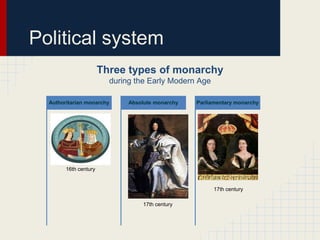
Three types of monarchy
during the Early Modern Age
Authoritarian monarchy

Absolute monarchy

Parliamentary monarchy

16th century

17th century
17th century
Political system
Authoritatian monarchy
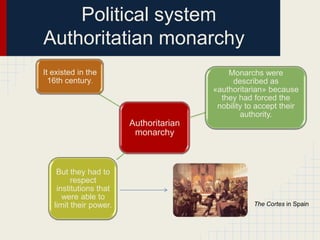
It existed in the
16th century.

Monarchs were
described as
«authoritarian» because
they had forced the
nobility to accept their
authority.

Authoritarian
monarchy

But they had to
respect
institutions that
were able to
limit their power.

The Cortes in Spain
Political system
Authoritatian monarchy
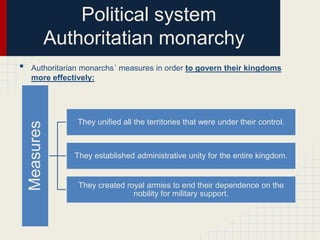
Authoritarian monarchs´ measures in order to govern their kingdoms
more effectively:

Measures

•

They unified all the territories that were under their control.

They established administrative unity for the entire kingdom.

They created royal armies to end their dependence on the
nobility for military support.
Political system
Authoritatian monarchy
•

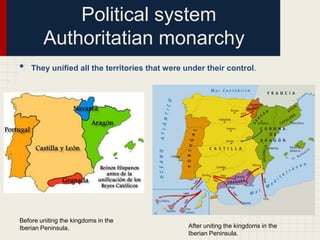
They unified all the territories that were under their control.

Before uniting the kingdoms in the
Iberian Peninsula.

After uniting the kingdoms in the
Iberian Peninsula.
Political system
Authoritatian monarchy
•

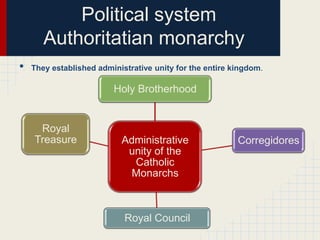
They established administrative unity for the entire kingdom.

Holy Brotherhood

Royal
Treasure

Administrative
unity of the
Catholic
Monarchs

Royal Council

Corregidores
Political system
Authoritatian monarchy
•

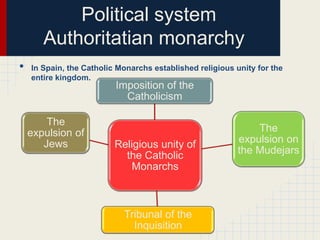
In Spain, the Catholic Monarchs established religious unity for the
entire kingdom.

Imposition of the
Catholicism

The
expulsion of
Jews

Religious unity of
the Catholic
Monarchs

Tribunal of the
Inquisition

The
expulsion on
the Mudejars
Political system
Authoritatian monarchy
•

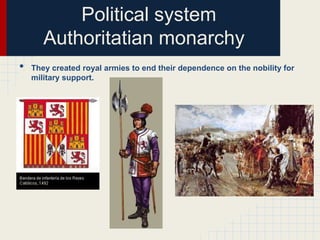
They created royal armies to end their dependence on the nobility for
military support.
Political system
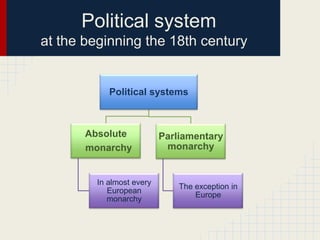
at the beginning the 18th century

Political systems

Absolute
monarchy

In almost every
European
monarchy

Parliamentary
monarchy

The exception in
Europe
Political system
Absolute monarchy
•

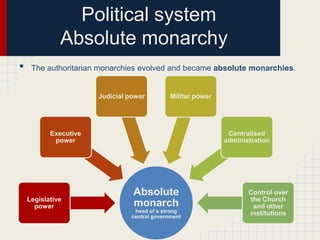
The authoritarian monarchies evolved and became absolute monarchies.

Judicial power

Militar power

Executive
power

Legislative
power

Centralised
administration

Absolute
monarch
head of a strong
central government

Control over
the Church
and other
institutions
Political system
Absolute monarchy
•

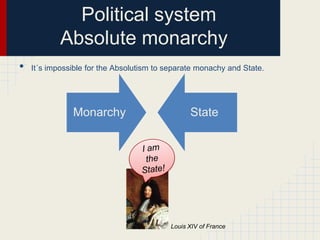
It´s impossible for the Absolutism to separate monachy and State.

Monarchy

State

Louis XIV of France
Political system
Absolute monarchy
•
•

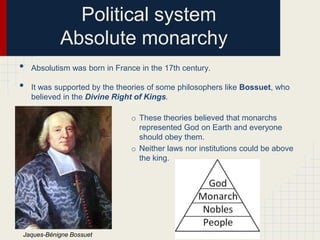
Absolutism was born in France in the 17th century.
It was supported by the theories of some philosophers like Bossuet, who
believed in the Divine Right of Kings.
o These theories believed that monarchs
represented God on Earth and everyone
should obey them.
o Neither laws nor institutions could be above
the king.

Jaques-Bénigne Bossuet
Political system
Absolute monarchy
•
•
•
•
•
•
•
•
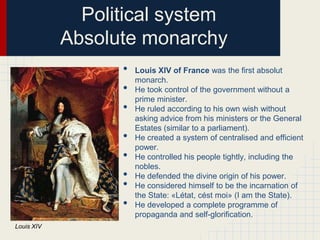
Louis XIV

Louis XIV of France was the first absolut
monarch.
He took control of the government without a
prime minister.
He ruled according to his own wish without
asking advice from his ministers or the General
Estates (similar to a parliament).
He created a system of centralised and efficient
power.
He controlled his people tightly, including the
nobles.
He defended the divine origin of his power.
He considered himself to be the incarnation of
the State: «Létat, cést moi» (I am the State).
He developed a complete programme of
propaganda and self-glorification.
Political system
Parliamentary monarchy
•
•

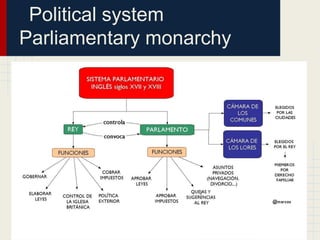
English parliamentary monarchy was the exception in the absolutist Europe.
English monarchs´ power was limited by the parliament.

•

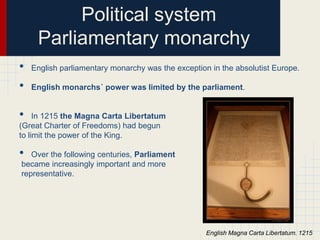
In 1215 the Magna Carta Libertatum
(Great Charter of Freedoms) had begun
to limit the power of the King.

•

Over the following centuries, Parliament
became increasingly important and more
representative.

English Magna Carta Libertatum. 1215
Political system
Parliamentary monarchy
•
•

•
•

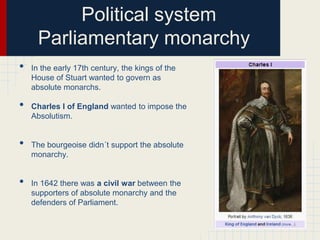
In the early 17th century, the kings of the
House of Stuart wanted to govern as
absolute monarchs.
Charles I of England wanted to impose the
Absolutism.

The bourgeoise didn´t support the absolute
monarchy.

In 1642 there was a civil war between the
supporters of absolute monarchy and the
defenders of Parliament.
Political system
Parliamentary monarchy
•
•
•
•

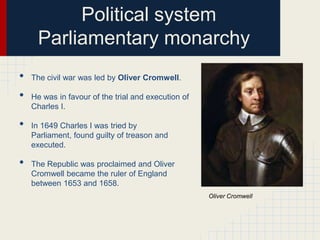
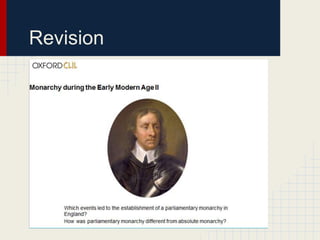
The civil war was led by Oliver Cromwell.

He was in favour of the trial and execution of
Charles I.
In 1649 Charles I was tried by
Parliament, found guilty of treason and
executed.
The Republic was proclaimed and Oliver
Cromwell became the ruler of England
between 1653 and 1658.
Oliver Cromwell
Political system
Parliamentary monarchy
•

•

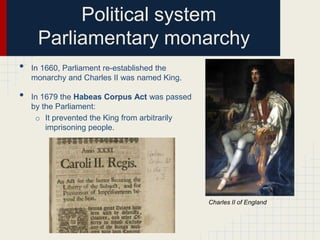
In 1660, Parliament re-established the
monarchy and Charles II was named King.

In 1679 the Habeas Corpus Act was passed
by the Parliament:
o It prevented the King from arbitrarily
imprisoning people.

Charles II of England
Political system
Parliamentary monarchy
•

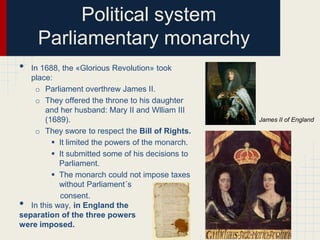
In 1688, the «Glorious Revolution» took
place:
o Parliament overthrew James II.
o They offered the throne to his daughter
and her husband: Mary II and Wlliam III
(1689).
o They swore to respect the Bill of Rights.
 It limited the powers of the monarch.
 It submitted some of his decisions to
Parliament.
 The monarch could not impose taxes
without Parliament´s
consent.
In this way, in England the
separation of the three powers
were imposed.

•

James II of England
Political system
Parliamentary monarchy
Political system
THE IMPORTANCE OF THE ENGLISH MODEL
OF PARLIAMENTARY MONARCHY

•

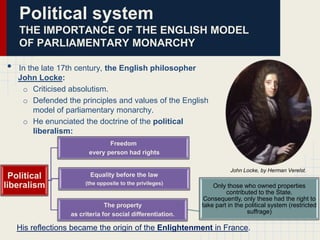
In the late 17th century, the English philosopher
John Locke:
o Criticised absolutism.
o Defended the principles and values of the English
model of parliamentary monarchy.
o He enunciated the doctrine of the political
liberalism:
Freedom
every person had rights

Political
liberalism

Equality before the law
(the opposite to the privileges)

The property
as criteria for social differentiation.

John Locke, by Herman Verelst.

Only those who owned properties
contributed to the State.
Consequently, only these had the right to
take part in the political system (restricted
suffrage)

His reflections became the origin of the Enlightenment in France.
Political system
THE IMPORTANCE OF THE ENGLISH MODEL
OF PARLIAMENTARY MONARCHY
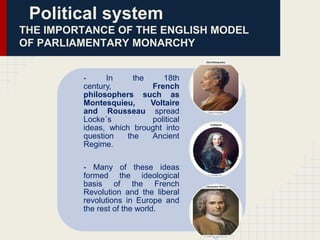
In
the
18th
century,
French
philosophers such as
Montesquieu,
Voltaire
and Rousseau spread
Locke´s
political
ideas, which brought into
question
the
Ancient
Regime.
- Many of these ideas
formed the ideological
basis of the French
Revolution and the liberal
revolutions in Europe and
the rest of the world.
Revision
•

Elaborated by Prof. Mª Isabel Aguña Aguerri
Social Science bilingual teacher

Ancien regime i

  • 1.
  • 2.
    What is theAncien Regime? The Ancient Regime is the social, political and economic system that existed in Europe before the French Revolution during the Early Modern Age (16th-18th centuries). Elements Low growth of the population Agrarianbased economy The estates of the realm Absolute monarchy of divine origin
  • 3.
    Low growth ofthe population During the Early Modern Age there was a low natural growth because high birth rates were counteracted by high death rates. It depended on human and natural disasters which caused famines and epidemics.
  • 4.
    Agrarian-based economy ● The75% of the population belonged to the Primary sector. ● There was a closed or subsistence economy: ○ the population depended on resources, goods and services that were provided by its own members. ○ There was little or no trade with other regions.
  • 5.
  • 6.
    Agrarian-based economy Survival ofthe Feudal system ○ Lords owned the biggest lands or large estates. ○ Landowners rented plots of lands to the peasants. ○ Lords received a significant amount of incomes from the rent of lands . Landowners Nobility Clergy
  • 7.
    Craft-industry ● Craftsmen madetheir products by hand . ● They worked in small workshops, which were located in the owner´s house. ● They products were sold there too. ● They controlled the whole production process, from the beginning to the end. ● They used very little machinery. ● The sources of energy were: human, animal or the one given by water or wind.
  • 8.
    Trade ● Long-distance trade ●The triangular trade: ○ capture slaves in Africa and take them to America in order to work in mines and plantations, ○ export the raw materials produced by slaves to Europe, make manufactured products in Europe, ○ exchange those products in Africa for slaves, repiting the cicle. ● Controlled by the bourgeoise, who became very rich.
  • 9.
    Economic system After thediscovery of America, two economic systems developed: Commercial capitalism Mercantilism 16th-century Parisian fair, showing how trade facilitated great economic expansion (John James Chalon, 1822)
  • 10.
    Economic System THE 16THCENTURY: COMMERCIAL CAPITALISM ● Thanks to the discovery of the New World there was a significant economic growth in Europe. ● The New World became an important new market for European exports. ● Commercial capitalism developed: ○ A new system that enabled private businesses to accumulate profits, especially through trade. ○ Factors: ■ The emergence of new forms of craft production in workshops and through the domestic system. ■ The establishment of banks (commercial operations) ■ New commercial and financial practices (bills of exchange, loans)
  • 11.
    Economic System THE 17THCENTURY: MERCANTILISM ● There was a serious economic crisis, caused mostly by the enormous amounts of gold and silver that arrived in Europe from America. ● An excess of these precious metals caused their value to fall, while prices increased. ● Mercantilism ○ imposed by Europe´s absolute monarchs ○ Based on the idea that a country´s wealth depended on how much gold and silver it possessed. ○ In order to accumulate more of these precious metals, monarchs implemented protectionist policies to limit imports and encourage exports.
  • 12.
    The estates ofthe realm ● In the Early Modern Age, there was still a closed society: ○ There was a rigid social system which didn´t allow people to change groups easily. ● The estates of the realm continued to be the dominant form of social organisation in Europe.
  • 13.
    The estates ofthe realm
  • 14.
    The estates ofthe realm
  • 15.
    The estates ofthe realm
  • 16.
    The estates ofthe realm THE BOURGEOISIE ● Upper middle class or bourgeoisie ○ was composed of prominent merchants and business owners, bankers, investors, functionaries, lawyers… ○ They become richer and more powerful as the European economy prospered. ● The lower middle class, or petite bourgeoisie ○ composed mostly of small merchants and craftsmen
  • 17.
    The estates ofthe realm THE PEASANTRY ● It was the most numerous group in society. ● It was composed of poor farmers and labourers ● They suffered during the 17th century because of: ○ poor harvests, ○ rising prices ○ and the higher taxes which they had to pay to the crown, nobility and clergy.
  • 18.
    Political system Three typesof monarchy during the Early Modern Age Authoritarian monarchy Absolute monarchy Parliamentary monarchy 16th century 17th century 17th century
  • 19.
    Political system Authoritatian monarchy Itexisted in the 16th century. Monarchs were described as «authoritarian» because they had forced the nobility to accept their authority. Authoritarian monarchy But they had to respect institutions that were able to limit their power. The Cortes in Spain
  • 20.
    Political system Authoritatian monarchy Authoritarianmonarchs´ measures in order to govern their kingdoms more effectively: Measures • They unified all the territories that were under their control. They established administrative unity for the entire kingdom. They created royal armies to end their dependence on the nobility for military support.
  • 21.
    Political system Authoritatian monarchy • Theyunified all the territories that were under their control. Before uniting the kingdoms in the Iberian Peninsula. After uniting the kingdoms in the Iberian Peninsula.
  • 22.
    Political system Authoritatian monarchy • Theyestablished administrative unity for the entire kingdom. Holy Brotherhood Royal Treasure Administrative unity of the Catholic Monarchs Royal Council Corregidores
  • 23.
    Political system Authoritatian monarchy • InSpain, the Catholic Monarchs established religious unity for the entire kingdom. Imposition of the Catholicism The expulsion of Jews Religious unity of the Catholic Monarchs Tribunal of the Inquisition The expulsion on the Mudejars
  • 24.
    Political system Authoritatian monarchy • Theycreated royal armies to end their dependence on the nobility for military support.
  • 25.
    Political system at thebeginning the 18th century Political systems Absolute monarchy In almost every European monarchy Parliamentary monarchy The exception in Europe
  • 26.
    Political system Absolute monarchy • Theauthoritarian monarchies evolved and became absolute monarchies. Judicial power Militar power Executive power Legislative power Centralised administration Absolute monarch head of a strong central government Control over the Church and other institutions
  • 27.
    Political system Absolute monarchy • It´simpossible for the Absolutism to separate monachy and State. Monarchy State Louis XIV of France
  • 28.
    Political system Absolute monarchy • • Absolutismwas born in France in the 17th century. It was supported by the theories of some philosophers like Bossuet, who believed in the Divine Right of Kings. o These theories believed that monarchs represented God on Earth and everyone should obey them. o Neither laws nor institutions could be above the king. Jaques-Bénigne Bossuet
  • 29.
    Political system Absolute monarchy • • • • • • • • LouisXIV Louis XIV of France was the first absolut monarch. He took control of the government without a prime minister. He ruled according to his own wish without asking advice from his ministers or the General Estates (similar to a parliament). He created a system of centralised and efficient power. He controlled his people tightly, including the nobles. He defended the divine origin of his power. He considered himself to be the incarnation of the State: «Létat, cést moi» (I am the State). He developed a complete programme of propaganda and self-glorification.
  • 30.
    Political system Parliamentary monarchy • • Englishparliamentary monarchy was the exception in the absolutist Europe. English monarchs´ power was limited by the parliament. • In 1215 the Magna Carta Libertatum (Great Charter of Freedoms) had begun to limit the power of the King. • Over the following centuries, Parliament became increasingly important and more representative. English Magna Carta Libertatum. 1215
  • 31.
    Political system Parliamentary monarchy • • • • Inthe early 17th century, the kings of the House of Stuart wanted to govern as absolute monarchs. Charles I of England wanted to impose the Absolutism. The bourgeoise didn´t support the absolute monarchy. In 1642 there was a civil war between the supporters of absolute monarchy and the defenders of Parliament.
  • 32.
    Political system Parliamentary monarchy • • • • Thecivil war was led by Oliver Cromwell. He was in favour of the trial and execution of Charles I. In 1649 Charles I was tried by Parliament, found guilty of treason and executed. The Republic was proclaimed and Oliver Cromwell became the ruler of England between 1653 and 1658. Oliver Cromwell
  • 33.
    Political system Parliamentary monarchy • • In1660, Parliament re-established the monarchy and Charles II was named King. In 1679 the Habeas Corpus Act was passed by the Parliament: o It prevented the King from arbitrarily imprisoning people. Charles II of England
  • 34.
    Political system Parliamentary monarchy • In1688, the «Glorious Revolution» took place: o Parliament overthrew James II. o They offered the throne to his daughter and her husband: Mary II and Wlliam III (1689). o They swore to respect the Bill of Rights.  It limited the powers of the monarch.  It submitted some of his decisions to Parliament.  The monarch could not impose taxes without Parliament´s consent. In this way, in England the separation of the three powers were imposed. • James II of England
  • 35.
  • 36.
    Political system THE IMPORTANCEOF THE ENGLISH MODEL OF PARLIAMENTARY MONARCHY • In the late 17th century, the English philosopher John Locke: o Criticised absolutism. o Defended the principles and values of the English model of parliamentary monarchy. o He enunciated the doctrine of the political liberalism: Freedom every person had rights Political liberalism Equality before the law (the opposite to the privileges) The property as criteria for social differentiation. John Locke, by Herman Verelst. Only those who owned properties contributed to the State. Consequently, only these had the right to take part in the political system (restricted suffrage) His reflections became the origin of the Enlightenment in France.
  • 37.
    Political system THE IMPORTANCEOF THE ENGLISH MODEL OF PARLIAMENTARY MONARCHY In the 18th century, French philosophers such as Montesquieu, Voltaire and Rousseau spread Locke´s political ideas, which brought into question the Ancient Regime. - Many of these ideas formed the ideological basis of the French Revolution and the liberal revolutions in Europe and the rest of the world.
  • 38.
  • 39.
    • Elaborated by Prof.Mª Isabel Aguña Aguerri Social Science bilingual teacher