THE 17TH
CENTURY:
ABSOLUTE MONARCHY AND THE
DECLINE OF THE HISPANIC EMPIRE
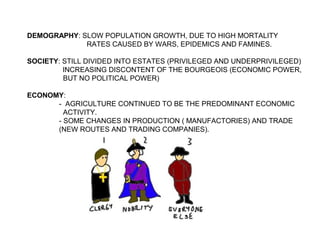
DEMOGRAPHY: SLOW POPULATION GROWTH, DUE TO HIGH MORTALITY
RATES CAUSED BY WARS, EPIDEMICS AND FAMINES.
SOCIETY: STILL DIVIDED INTO ESTATES (PRIVILEGED AND UNDERPRIVILEGED)
INCREASING DISCONTENT OF THE BOURGEOIS (ECONOMIC POWER,
BUT NO POLITICAL POWER)
ECONOMY:
- AGRICULTURE CONTINUED TO BE THE PREDOMINANT ECONOMIC
ACTIVITY.
- SOME CHANGES IN PRODUCTION ( MANUFACTORIES) AND TRADE
(NEW ROUTES AND TRADING COMPANIES).
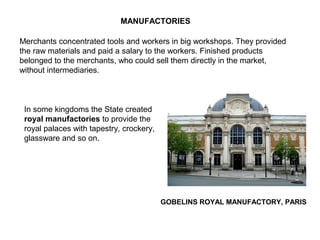
GOBELINS ROYAL MANUFACTORY, PARIS
MANUFACTORIES
Merchants concentrated tools and workers in big workshops. They provided
the raw materials and paid a salary to the workers. Finished products
belonged to the merchants, who could sell them directly in the market,
without intermediaries.
In some kingdoms the State created
royal manufactories to provide the
royal palaces with tapestry, crockery,
glassware and so on.
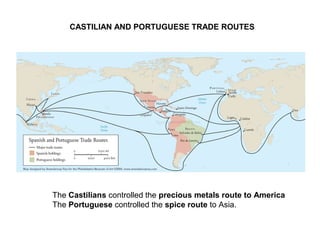
CASTILIAN AND PORTUGUESE TRADE ROUTES
The Castilians controlled the precious metals route to America
The Portuguese controlled the spice route to Asia.
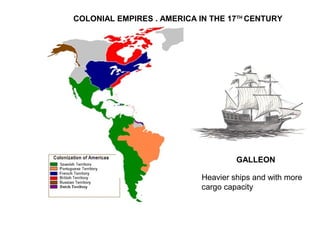
COLONIAL EMPIRES . AMERICA IN THE 17TH
CENTURY
GALLEON
Heavier ships and with more
cargo capacity
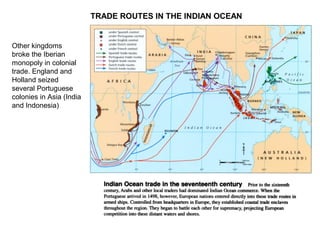
TRADE ROUTES IN THE INDIAN OCEAN
Other kingdoms
broke the Iberian
monopoly in colonial
trade. England and
Holland seized
several Portuguese
colonies in Asia (India
and Indonesia)
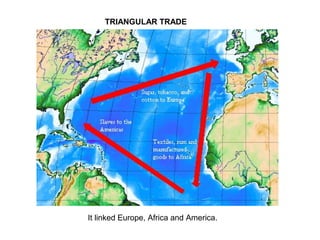
TRIANGULAR TRADE
It linked Europe, Africa and America.
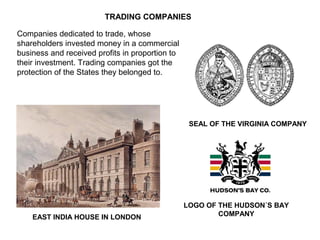
EAST INDIA HOUSE IN LONDON
TRADING COMPANIES
SEAL OF THE VIRGINIA COMPANY
LOGO OF THE HUDSON´S BAY
COMPANY
Companies dedicated to trade, whose
shareholders invested money in a commercial
business and received profits in proportion to
their investment. Trading companies got the
protection of the States they belonged to.
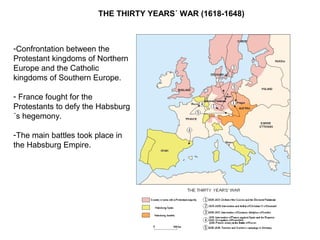
THE THIRTY YEARS´ WAR (1618-1648)
-Confrontation between the
Protestant kingdoms of Northern
Europe and the Catholic
kingdoms of Southern Europe.
- France fought for the
Protestants to defy the Habsburg
´s hegemony.
-The main battles took place in
the Habsburg Empire.
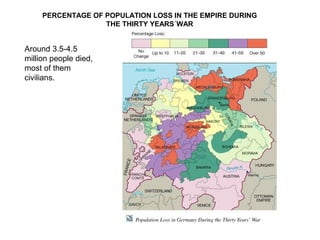
PERCENTAGE OF POPULATION LOSS IN THE EMPIRE DURING
THE THIRTY YEARS´WAR
Around 3.5-4.5
million people died,
most of them
civilians.
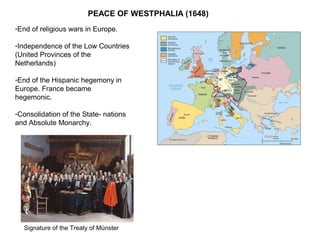
PEACE OF WESTPHALIA (1648)
-End of religious wars in Europe.
-Independence of the Low Countries
(United Provinces of the
Netherlands)
-End of the Hispanic hegemony in
Europe. France became
hegemonic.
-Consolidation of the State- nations
and Absolute Monarchy.
Signature of the Treaty of Münster
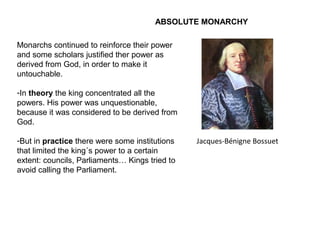
ABSOLUTE MONARCHY
Monarchs continued to reinforce their power
and some scholars justified ther power as
derived from God, in order to make it
untouchable.
-In theory the king concentrated all the
powers. His power was unquestionable,
because it was considered to be derived from
God.
-But in practice there were some institutions
that limited the king´s power to a certain
extent: councils, Parliaments… Kings tried to
avoid calling the Parliament.
Jacques-Bénigne Bossuet
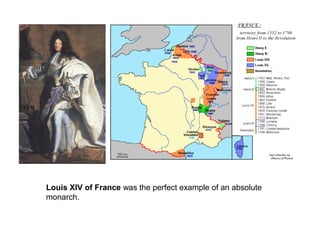
Louis XIV of France was the perfect example of an absolute
monarch.
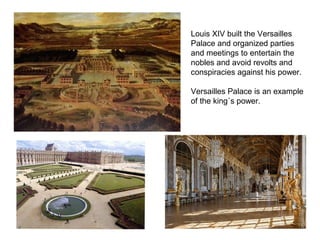
Louis XIV built the Versailles
Palace and organized parties
and meetings to entertain the
nobles and avoid revolts and
conspiracies against his power.
Versailles Palace is an example
of the king´s power.
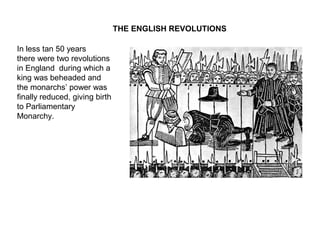
THE ENGLISH REVOLUTIONS
In less than 50 years
there were two revolutions
in England during which a
king was beheaded and
the monarchs’ power was
finally reduced, giving birth
to Parliamentary
Monarchy.
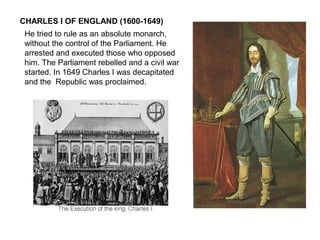
CHARLES I OF ENGLAND (1600-1649)
He tried to rule as an absolute monarch,
without the control of the Parliament. He
arrested and executed those who opposed
him. The Parliament rebelled and a civil war
started. In 1649 Charles I was decapitated
and the Republic was proclaimed.
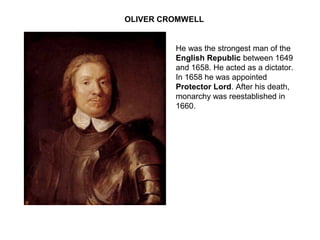
OLIVER CROMWELL
He was the strongest man of the
English Republic between 1649
and 1658. He acted as a dictator.
In 1658 he was appointed
Protector Lord. After his death,
monarchy was reestablished in
1660.
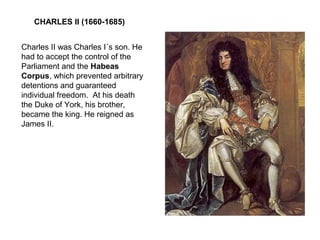
CHARLES II (1660-1685)
Charles II was Charles I´s son. He
had to accept the control of the
Parliament and the Habeas
Corpus, which prevented arbitrary
detentions and guaranteed
individual freedom. At his death
the Duke of York, his brother,
became the king. He reigned as
James II.
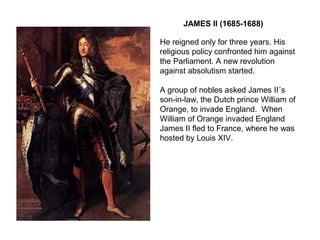
JAMES II (1685-1688)
He reigned only for three years. His
religious policy confronted him against
the Parliament. A new revolution
against absolutism started.
A group of nobles asked James II´s
son-in-law, the Dutch prince William of
Orange, to invade England. When
William of Orange invaded England
James II fled to France, where he was
hosted by Louis XIV.
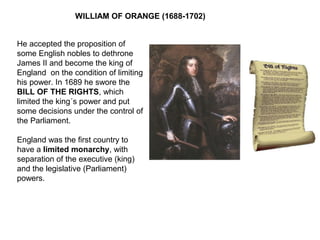
WILLIAM OF ORANGE (1688-1702)
He accepted the proposition of
some English nobles to dethrone
James II and become the king of
England on the condition of limiting
his power. In 1689 he swore the
BILL OF THE RIGHTS, which
limited the king´s power and put
some decisions under the control of
the Parliament.
England was the first country to
have a limited monarchy, with
separation of the executive (king)
and the legislative (Parliament)
powers.
CULTURE: THE SCIENTIFIC REVOLUTION
Science and thinking made big progress
with the development of Empiricism and
Rationalism. This is why the 17th
century
is known as the Scientific Revolution
century.
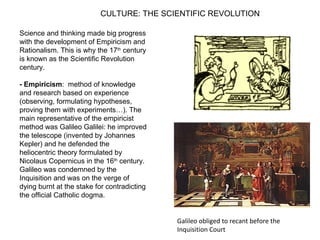
- Empiricism: method of knowledge
and research based on experience
(observing, formulating hypotheses,
proving them with experiments…). The
main representative of the empiricist
method was Galileo Galilei: he improved
the telescope (invented by Johannes
Kepler) and he defended the
heliocentric theory formulated by
Nicolaus Copernicus in the 16th
century.
Galileo was condemned by the
Inquisition and was on the verge of
dying burnt at the stake for contradicting
the official Catholic dogma.
Galileo obliged to recant before the
Inquisition Court
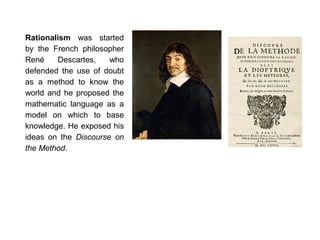
Rationalism was started
by the French philosopher
René Descartes, who
defended the use of doubt
as a method to know the
world and he proposed the
mathematic language as a
model on which to base
knowledge. He exposed his
ideas on the Discourse on
the Method.
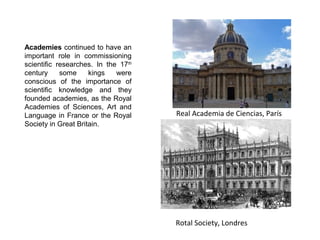
Royal Academy of Sciences, París
Royal Society, Londres
Academies continued to have an
important role in commissioning
scientific researches. In the 17th
century some kings were
conscious of the importance of
scientific knowledge and they
founded academies, as the Royal
Academies of Sciences, Art and
Language in France or the Royal
Society in Great Britain.
THE DECLINE OF THE HISPANIC EMPIRE
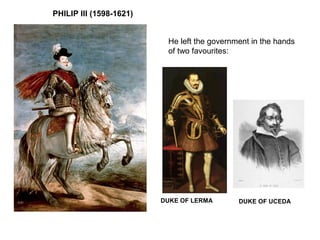
PHILIP III (1598-1621)
DUKE OF LERMA DUKE OF UCEDA
He left the government in the hands
of two favourites:
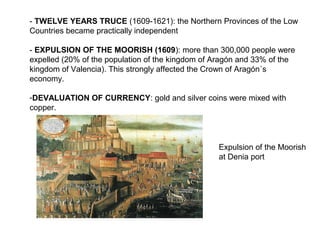
- TWELVE YEARS TRUCE (1609-1621): the Northern Provinces of the Low
Countries became practically independent
- EXPULSION OF THE MOORISH (1609): more than 300,000 people were
expelled (20% of the population of the kingdom of Aragón and 33% of the
kingdom of Valencia). This strongly affected the Crown of Aragón´s
economy.
-DEVALUATION OF CURRENCY: gold and silver coins were mixed with
copper.
Expulsion of the Moorish
at Denia port
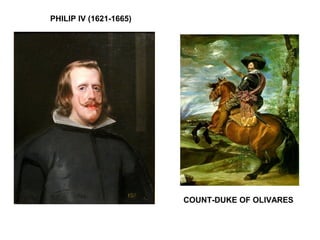
PHILIP IV (1621-1665)
COUNT-DUKE OF OLIVARES
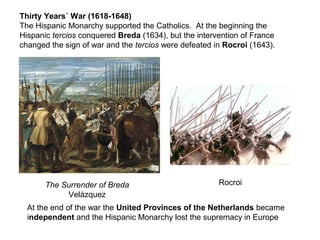
Thirty Years´ War (1618-1648)
The Hispanic Monarchy supported the Catholics. At the beginning the
Hispanic tercios conquered Breda (1634), but the intervention of France
changed the sign of war and the tercios were defeated in Rocroi (1643).
The Surrender of Breda
Velázquez
Rocroi
At the end of the war the United Provinces of the Netherlands became
independent and the Hispanic Monarchy lost the supremacy in Europe
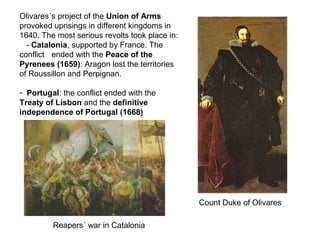
Olivares´s project of the Union of Arms
provoked uprisings in different kingdoms in
1640. The most serious revolts took place in:
- Catalonia, supported by France. The
conflict ended with the Peace of the
Pyrenees (1659): Aragon lost the territories
of Roussillon and Perpignan.
- Portugal: the conflict ended with the
Treaty of Lisbon and the definitive
independence of Portugal (1668)
Count Duke of Olivares
Reapers´ war in Catalonia
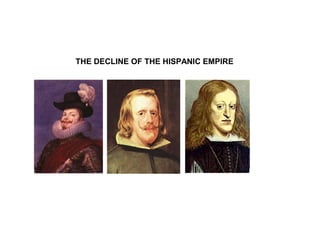
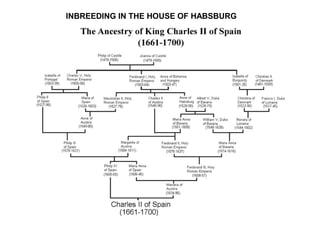
INBREEDING IN THE HOUSE OF HABSBURG
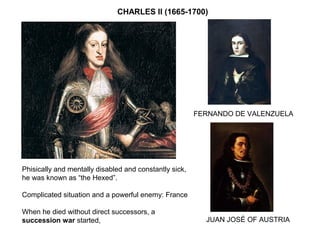
CHARLES II (1665-1700)
Phisically and mentally disabled and constantly sick,
he was known as “the Hexed”.
Complicated situation and a powerful enemy: France
When he died without direct successors, a
succession war started, JUAN JOSÉ OF AUSTRIA
FERNANDO DE VALENZUELA
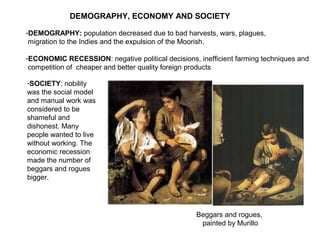
Beggars and rogues,
painted by Murillo
DEMOGRAPHY, ECONOMY AND SOCIETY
-DEMOGRAPHY: population decreased due to bad harvests, wars, plagues,
migration to the Indies and the expulsion of the Moorish.
-ECONOMIC RECESSION: negative political decisions, inefficient farming techniques and
competition of cheaper and better quality foreign products
-SOCIETY: nobility
was the social model
and manual work was
considered to be
shameful and
dishonest. Many
people wanted to live
without working. The
economic recession
made the number of
beggars and rogues
bigger.
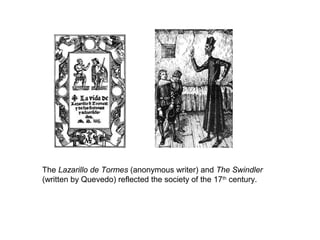
The Lazarillo de Tormes (anonymous writer) and The Swindler
(written by Quevedo) reflected the society of the 17th
century.
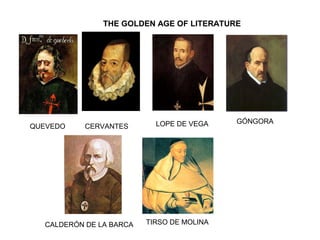
THE GOLDEN AGE OF LITERATURE
QUEVEDO CERVANTES LOPE DE VEGA GÓNGORA
CALDERÓN DE LA BARCA TIRSO DE MOLINA

17thcentury

  • 1.
    THE 17TH CENTURY: ABSOLUTE MONARCHYAND THE DECLINE OF THE HISPANIC EMPIRE
  • 2.
    DEMOGRAPHY: SLOW POPULATIONGROWTH, DUE TO HIGH MORTALITY RATES CAUSED BY WARS, EPIDEMICS AND FAMINES. SOCIETY: STILL DIVIDED INTO ESTATES (PRIVILEGED AND UNDERPRIVILEGED) INCREASING DISCONTENT OF THE BOURGEOIS (ECONOMIC POWER, BUT NO POLITICAL POWER) ECONOMY: - AGRICULTURE CONTINUED TO BE THE PREDOMINANT ECONOMIC ACTIVITY. - SOME CHANGES IN PRODUCTION ( MANUFACTORIES) AND TRADE (NEW ROUTES AND TRADING COMPANIES).
  • 3.
    GOBELINS ROYAL MANUFACTORY,PARIS MANUFACTORIES Merchants concentrated tools and workers in big workshops. They provided the raw materials and paid a salary to the workers. Finished products belonged to the merchants, who could sell them directly in the market, without intermediaries. In some kingdoms the State created royal manufactories to provide the royal palaces with tapestry, crockery, glassware and so on.
  • 4.
    CASTILIAN AND PORTUGUESETRADE ROUTES The Castilians controlled the precious metals route to America The Portuguese controlled the spice route to Asia.
  • 5.
    COLONIAL EMPIRES .AMERICA IN THE 17TH CENTURY GALLEON Heavier ships and with more cargo capacity
  • 6.
    TRADE ROUTES INTHE INDIAN OCEAN Other kingdoms broke the Iberian monopoly in colonial trade. England and Holland seized several Portuguese colonies in Asia (India and Indonesia)
  • 7.
    TRIANGULAR TRADE It linkedEurope, Africa and America.
  • 8.
    EAST INDIA HOUSEIN LONDON TRADING COMPANIES SEAL OF THE VIRGINIA COMPANY LOGO OF THE HUDSON´S BAY COMPANY Companies dedicated to trade, whose shareholders invested money in a commercial business and received profits in proportion to their investment. Trading companies got the protection of the States they belonged to.
  • 9.
    THE THIRTY YEARS´WAR (1618-1648) -Confrontation between the Protestant kingdoms of Northern Europe and the Catholic kingdoms of Southern Europe. - France fought for the Protestants to defy the Habsburg ´s hegemony. -The main battles took place in the Habsburg Empire.
  • 10.
    PERCENTAGE OF POPULATIONLOSS IN THE EMPIRE DURING THE THIRTY YEARS´WAR Around 3.5-4.5 million people died, most of them civilians.
  • 11.
    PEACE OF WESTPHALIA(1648) -End of religious wars in Europe. -Independence of the Low Countries (United Provinces of the Netherlands) -End of the Hispanic hegemony in Europe. France became hegemonic. -Consolidation of the State- nations and Absolute Monarchy. Signature of the Treaty of Münster
  • 12.
    ABSOLUTE MONARCHY Monarchs continuedto reinforce their power and some scholars justified ther power as derived from God, in order to make it untouchable. -In theory the king concentrated all the powers. His power was unquestionable, because it was considered to be derived from God. -But in practice there were some institutions that limited the king´s power to a certain extent: councils, Parliaments… Kings tried to avoid calling the Parliament. Jacques-Bénigne Bossuet
  • 13.
    Louis XIV ofFrance was the perfect example of an absolute monarch.
  • 14.
    Louis XIV builtthe Versailles Palace and organized parties and meetings to entertain the nobles and avoid revolts and conspiracies against his power. Versailles Palace is an example of the king´s power.
  • 15.
    THE ENGLISH REVOLUTIONS Inless than 50 years there were two revolutions in England during which a king was beheaded and the monarchs’ power was finally reduced, giving birth to Parliamentary Monarchy.
  • 16.
    CHARLES I OFENGLAND (1600-1649) He tried to rule as an absolute monarch, without the control of the Parliament. He arrested and executed those who opposed him. The Parliament rebelled and a civil war started. In 1649 Charles I was decapitated and the Republic was proclaimed.
  • 17.
    OLIVER CROMWELL He wasthe strongest man of the English Republic between 1649 and 1658. He acted as a dictator. In 1658 he was appointed Protector Lord. After his death, monarchy was reestablished in 1660.
  • 18.
    CHARLES II (1660-1685) CharlesII was Charles I´s son. He had to accept the control of the Parliament and the Habeas Corpus, which prevented arbitrary detentions and guaranteed individual freedom. At his death the Duke of York, his brother, became the king. He reigned as James II.
  • 19.
    JAMES II (1685-1688) Hereigned only for three years. His religious policy confronted him against the Parliament. A new revolution against absolutism started. A group of nobles asked James II´s son-in-law, the Dutch prince William of Orange, to invade England. When William of Orange invaded England James II fled to France, where he was hosted by Louis XIV.
  • 20.
    WILLIAM OF ORANGE(1688-1702) He accepted the proposition of some English nobles to dethrone James II and become the king of England on the condition of limiting his power. In 1689 he swore the BILL OF THE RIGHTS, which limited the king´s power and put some decisions under the control of the Parliament. England was the first country to have a limited monarchy, with separation of the executive (king) and the legislative (Parliament) powers.
  • 21.
    CULTURE: THE SCIENTIFICREVOLUTION Science and thinking made big progress with the development of Empiricism and Rationalism. This is why the 17th century is known as the Scientific Revolution century. - Empiricism: method of knowledge and research based on experience (observing, formulating hypotheses, proving them with experiments…). The main representative of the empiricist method was Galileo Galilei: he improved the telescope (invented by Johannes Kepler) and he defended the heliocentric theory formulated by Nicolaus Copernicus in the 16th century. Galileo was condemned by the Inquisition and was on the verge of dying burnt at the stake for contradicting the official Catholic dogma. Galileo obliged to recant before the Inquisition Court
  • 22.
    Rationalism was started bythe French philosopher René Descartes, who defended the use of doubt as a method to know the world and he proposed the mathematic language as a model on which to base knowledge. He exposed his ideas on the Discourse on the Method.
  • 23.
    Royal Academy ofSciences, París Royal Society, Londres Academies continued to have an important role in commissioning scientific researches. In the 17th century some kings were conscious of the importance of scientific knowledge and they founded academies, as the Royal Academies of Sciences, Art and Language in France or the Royal Society in Great Britain.
  • 24.
    THE DECLINE OFTHE HISPANIC EMPIRE
  • 25.
    PHILIP III (1598-1621) DUKEOF LERMA DUKE OF UCEDA He left the government in the hands of two favourites:
  • 26.
    - TWELVE YEARSTRUCE (1609-1621): the Northern Provinces of the Low Countries became practically independent - EXPULSION OF THE MOORISH (1609): more than 300,000 people were expelled (20% of the population of the kingdom of Aragón and 33% of the kingdom of Valencia). This strongly affected the Crown of Aragón´s economy. -DEVALUATION OF CURRENCY: gold and silver coins were mixed with copper. Expulsion of the Moorish at Denia port
  • 27.
  • 28.
    Thirty Years´ War(1618-1648) The Hispanic Monarchy supported the Catholics. At the beginning the Hispanic tercios conquered Breda (1634), but the intervention of France changed the sign of war and the tercios were defeated in Rocroi (1643). The Surrender of Breda Velázquez Rocroi At the end of the war the United Provinces of the Netherlands became independent and the Hispanic Monarchy lost the supremacy in Europe
  • 29.
    Olivares´s project ofthe Union of Arms provoked uprisings in different kingdoms in 1640. The most serious revolts took place in: - Catalonia, supported by France. The conflict ended with the Peace of the Pyrenees (1659): Aragon lost the territories of Roussillon and Perpignan. - Portugal: the conflict ended with the Treaty of Lisbon and the definitive independence of Portugal (1668) Count Duke of Olivares Reapers´ war in Catalonia
  • 30.
    INBREEDING IN THEHOUSE OF HABSBURG
  • 31.
    CHARLES II (1665-1700) Phisicallyand mentally disabled and constantly sick, he was known as “the Hexed”. Complicated situation and a powerful enemy: France When he died without direct successors, a succession war started, JUAN JOSÉ OF AUSTRIA FERNANDO DE VALENZUELA
  • 32.
    Beggars and rogues, paintedby Murillo DEMOGRAPHY, ECONOMY AND SOCIETY -DEMOGRAPHY: population decreased due to bad harvests, wars, plagues, migration to the Indies and the expulsion of the Moorish. -ECONOMIC RECESSION: negative political decisions, inefficient farming techniques and competition of cheaper and better quality foreign products -SOCIETY: nobility was the social model and manual work was considered to be shameful and dishonest. Many people wanted to live without working. The economic recession made the number of beggars and rogues bigger.
  • 33.
    The Lazarillo deTormes (anonymous writer) and The Swindler (written by Quevedo) reflected the society of the 17th century.
  • 34.
    THE GOLDEN AGEOF LITERATURE QUEVEDO CERVANTES LOPE DE VEGA GÓNGORA CALDERÓN DE LA BARCA TIRSO DE MOLINA