18th Century: The Ancien
Régime in crisis
The development of the
enlightenment ideals.
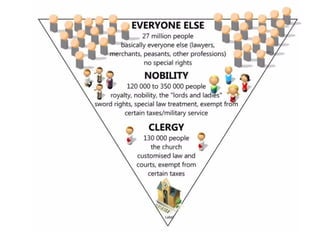
What’s Ancien Regime?
• An economic, social and political
system in Europe in the 18th Century,
with an absolute monarchy as a form of
government, a stratified society based
on privileges of nobles and rural
peasants as a majority of the
population.
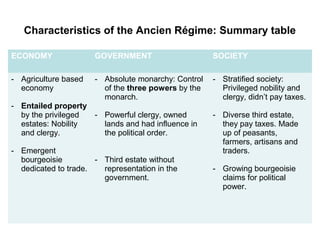
Characteristics of the Ancien Régime: Summary table
ECONOMY GOVERNMENT SOCIETY
- Agriculture based
economy
- Entailed property
by the privileged
estates: Nobility
and clergy.
- Emergent
bourgeoisie
dedicated to trade.
- Absolute monarchy: Control
of the three powers by the
monarch.
- Powerful clergy, owned
lands and had influence in
the political order.
- Third estate without
representation in the
government.
- Stratified society:
Privileged nobility and
clergy, didn’t pay taxes.
- Diverse third estate,
they pay taxes. Made
up of peasants,
farmers, artisans and
traders.
- Growing bourgeoisie
claims for political
power.
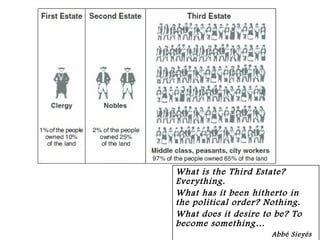
What is the Third Estate?
Everything.
What has it been hitherto in
the political order? Nothing.
What does it desire to be? To
become something…
Abbé Sieyés
Factors for change
• Economic growth and aspirations of the
bourgeoisie, were the main forces of change in
the 18th
century.
– Bourgeoisie: criticised privileges of nobles and clergy.
– Peasants: Opposed the manorial system.
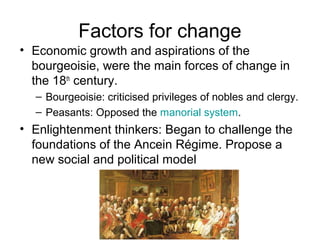
• Enlightenment thinkers: Began to challenge the
foundations of the Ancein Régime. Propose a
new social and political model
Growth of economy
• Population growth: Greater agricultural
production + fewer major epidemics +
economic growth.
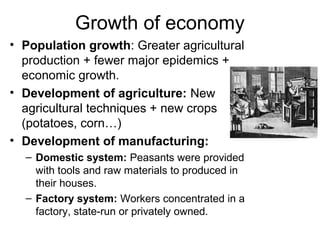
• Development of agriculture: New
agricultural techniques + new crops
(potatoes, corn…)
• Development of manufacturing:
– Domestic system: Peasants were provided
with tools and raw materials to produced in
their houses.
– Factory system: Workers concentrated in a
factory, state-run or privately owned.
Triangular trade
• Colonial trade expanded considerably in the 18th
century.
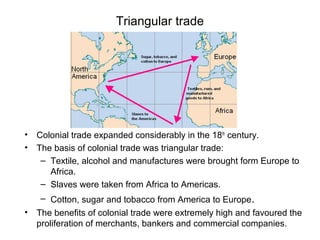
• The basis of colonial trade was triangular trade:
– Textile, alcohol and manufactures were brought form Europe to
Africa.
– Slaves were taken from Africa to Americas.
– Cotton, sugar and tobacco from America to Europe.
• The benefits of colonial trade were extremely high and favoured the
proliferation of merchants, bankers and commercial companies.
The first parliamentary systems: Britain
and the United States
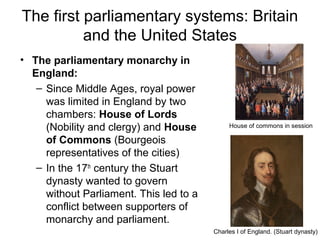
• The parliamentary monarchy in
England:
– Since Middle Ages, royal power
was limited in England by two
chambers: House of Lords
(Nobility and clergy) and House
of Commons (Bourgeois
representatives of the cities)
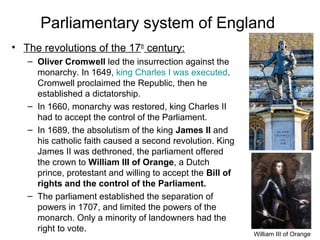
– In the 17th
century the Stuart
dynasty wanted to govern
without Parliament. This led to a
conflict between supporters of
monarchy and parliament.
House of commons in session
Charles I of England. (Stuart dynasty)
Parliamentary system of England
• The revolutions of the 17th
century:
– Oliver Cromwell led the insurrection against the
monarchy. In 1649, king Charles I was executed.
Cromwell proclaimed the Republic, then he
established a dictatorship.
– In 1660, monarchy was restored, king Charles II
had to accept the control of the Parliament.
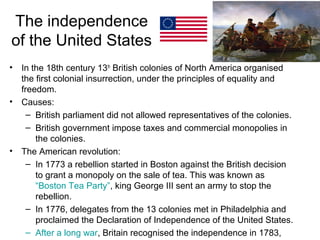
– In 1689, the absolutism of the king James II and
his catholic faith caused a second revolution. King
James II was dethroned, the parliament offered
the crown to William III of Orange, a Dutch
prince, protestant and willing to accept the Bill of
rights and the control of the Parliament.
– The parliament established the separation of
powers in 1707, and limited the powers of the
monarch. Only a minority of landowners had the
right to vote.
William III of Orange
The independence
of the United States
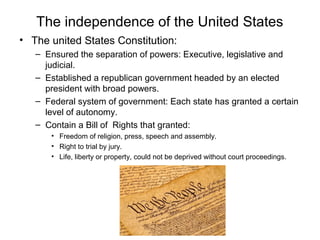
• In the 18th century 13th
British colonies of North America organised
the first colonial insurrection, under the principles of equality and
freedom.
• Causes:
– British parliament did not allowed representatives of the colonies.
– British government impose taxes and commercial monopolies in
the colonies.
• The American revolution:
– In 1773 a rebellion started in Boston against the British decision
to grant a monopoly on the sale of tea. This was known as
“Boston Tea Party”, king George III sent an army to stop the
rebellion.
– In 1776, delegates from the 13 colonies met in Philadelphia and
proclaimed the Declaration of Independence of the United States.
– After a long war, Britain recognised the independence in 1783,
The independence of the United States
• The united States Constitution:
– Ensured the separation of powers: Executive, legislative and
judicial.
– Established a republican government headed by an elected
president with broad powers.
– Federal system of government: Each state has granted a certain
level of autonomy.
– Contain a Bill of Rights that granted:
• Freedom of religion, press, speech and assembly.
• Right to trial by jury.
• Life, liberty or property, could not be deprived without court proceedings.
The enlightenment
• Intellectual movement of the 18th
century,
that believed in reason, science and
knowledge. Proposed a more liberal way
of organising society.
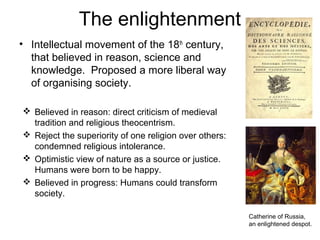
Catherine of Russia,
an enlightened despot.
 Believed in reason: direct criticism of medieval
tradition and religious theocentrism.
 Reject the superiority of one religion over others:
condemned religious intolerance.
 Optimistic view of nature as a source or justice.
Humans were born to be happy.
 Believed in progress: Humans could transform
society.
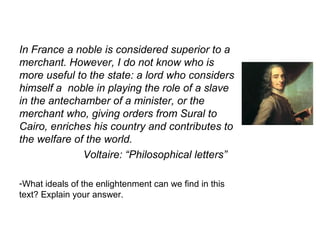
In France a noble is considered superior to a
merchant. However, I do not know who is
more useful to the state: a lord who considers
himself a noble in playing the role of a slave
in the antechamber of a minister, or the
merchant who, giving orders from Sural to
Cairo, enriches his country and contributes to
the welfare of the world.
Voltaire: “Philosophical letters”
-What ideals of the enlightenment can we find in this
text? Explain your answer.
Enlightened despotism
• “All for the people, nothing by the people”
• Absolut monarchs influenced by the ideals of the Enlightenment.
• Promote the rationalisation of administration, education reforms,
modernisation of economy, promotion of industry and knowledge…
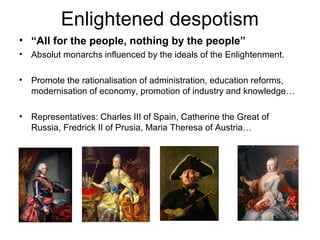
• Representatives: Charles III of Spain, Catherine the Great of
Russia, Fredrick II of Prusia, Maria Theresa of Austria…
Enlightenment thinkers and their proposals
• Social Changes:
– Opposed stratified society
– Defend social mobility,
equality of origin and
personal merit
• Economic changes:
– Opposed mercantilism, based
on the accumulation of
precious metals.
– Defended agriculture and
productive work (Physiocracy)
– Opposed state regulations and
defend free trade.
Political changes:
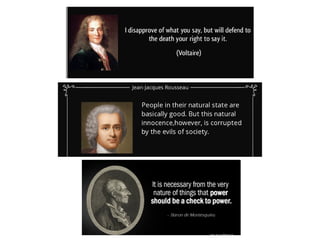
-Montesquieu: Proposed separation
of powers, with emphasis on the
independence of judges.
-Rousseau: Idea of Social contract
between the ruler and individuals
(constitution). Also the idea of
popular sovereignty, the power
comes from the free consent of all
citizens trough voting.
-Voltaire: defended the need for a
parliament that limits the power of the
monarch.
4ºESO Unit 1: 18th century

4ºESO Unit 1: 18th century

  • 1.
    18th Century: TheAncien Régime in crisis The development of the enlightenment ideals.
  • 2.
    What’s Ancien Regime? •An economic, social and political system in Europe in the 18th Century, with an absolute monarchy as a form of government, a stratified society based on privileges of nobles and rural peasants as a majority of the population.
  • 4.
    Characteristics of theAncien Régime: Summary table ECONOMY GOVERNMENT SOCIETY - Agriculture based economy - Entailed property by the privileged estates: Nobility and clergy. - Emergent bourgeoisie dedicated to trade. - Absolute monarchy: Control of the three powers by the monarch. - Powerful clergy, owned lands and had influence in the political order. - Third estate without representation in the government. - Stratified society: Privileged nobility and clergy, didn’t pay taxes. - Diverse third estate, they pay taxes. Made up of peasants, farmers, artisans and traders. - Growing bourgeoisie claims for political power.
  • 5.
    What is theThird Estate? Everything. What has it been hitherto in the political order? Nothing. What does it desire to be? To become something… Abbé Sieyés
  • 6.
    Factors for change •Economic growth and aspirations of the bourgeoisie, were the main forces of change in the 18th century. – Bourgeoisie: criticised privileges of nobles and clergy. – Peasants: Opposed the manorial system. • Enlightenment thinkers: Began to challenge the foundations of the Ancein Régime. Propose a new social and political model
  • 7.
    Growth of economy •Population growth: Greater agricultural production + fewer major epidemics + economic growth. • Development of agriculture: New agricultural techniques + new crops (potatoes, corn…) • Development of manufacturing: – Domestic system: Peasants were provided with tools and raw materials to produced in their houses. – Factory system: Workers concentrated in a factory, state-run or privately owned.
  • 8.
    Triangular trade • Colonialtrade expanded considerably in the 18th century. • The basis of colonial trade was triangular trade: – Textile, alcohol and manufactures were brought form Europe to Africa. – Slaves were taken from Africa to Americas. – Cotton, sugar and tobacco from America to Europe. • The benefits of colonial trade were extremely high and favoured the proliferation of merchants, bankers and commercial companies.
  • 9.
    The first parliamentarysystems: Britain and the United States • The parliamentary monarchy in England: – Since Middle Ages, royal power was limited in England by two chambers: House of Lords (Nobility and clergy) and House of Commons (Bourgeois representatives of the cities) – In the 17th century the Stuart dynasty wanted to govern without Parliament. This led to a conflict between supporters of monarchy and parliament. House of commons in session Charles I of England. (Stuart dynasty)
  • 10.
    Parliamentary system ofEngland • The revolutions of the 17th century: – Oliver Cromwell led the insurrection against the monarchy. In 1649, king Charles I was executed. Cromwell proclaimed the Republic, then he established a dictatorship. – In 1660, monarchy was restored, king Charles II had to accept the control of the Parliament. – In 1689, the absolutism of the king James II and his catholic faith caused a second revolution. King James II was dethroned, the parliament offered the crown to William III of Orange, a Dutch prince, protestant and willing to accept the Bill of rights and the control of the Parliament. – The parliament established the separation of powers in 1707, and limited the powers of the monarch. Only a minority of landowners had the right to vote. William III of Orange
  • 11.
    The independence of theUnited States • In the 18th century 13th British colonies of North America organised the first colonial insurrection, under the principles of equality and freedom. • Causes: – British parliament did not allowed representatives of the colonies. – British government impose taxes and commercial monopolies in the colonies. • The American revolution: – In 1773 a rebellion started in Boston against the British decision to grant a monopoly on the sale of tea. This was known as “Boston Tea Party”, king George III sent an army to stop the rebellion. – In 1776, delegates from the 13 colonies met in Philadelphia and proclaimed the Declaration of Independence of the United States. – After a long war, Britain recognised the independence in 1783,
  • 12.
    The independence ofthe United States • The united States Constitution: – Ensured the separation of powers: Executive, legislative and judicial. – Established a republican government headed by an elected president with broad powers. – Federal system of government: Each state has granted a certain level of autonomy. – Contain a Bill of Rights that granted: • Freedom of religion, press, speech and assembly. • Right to trial by jury. • Life, liberty or property, could not be deprived without court proceedings.
  • 13.
    The enlightenment • Intellectualmovement of the 18th century, that believed in reason, science and knowledge. Proposed a more liberal way of organising society. Catherine of Russia, an enlightened despot.  Believed in reason: direct criticism of medieval tradition and religious theocentrism.  Reject the superiority of one religion over others: condemned religious intolerance.  Optimistic view of nature as a source or justice. Humans were born to be happy.  Believed in progress: Humans could transform society.
  • 14.
    In France anoble is considered superior to a merchant. However, I do not know who is more useful to the state: a lord who considers himself a noble in playing the role of a slave in the antechamber of a minister, or the merchant who, giving orders from Sural to Cairo, enriches his country and contributes to the welfare of the world. Voltaire: “Philosophical letters” -What ideals of the enlightenment can we find in this text? Explain your answer.
  • 15.
    Enlightened despotism • “Allfor the people, nothing by the people” • Absolut monarchs influenced by the ideals of the Enlightenment. • Promote the rationalisation of administration, education reforms, modernisation of economy, promotion of industry and knowledge… • Representatives: Charles III of Spain, Catherine the Great of Russia, Fredrick II of Prusia, Maria Theresa of Austria…
  • 16.
    Enlightenment thinkers andtheir proposals • Social Changes: – Opposed stratified society – Defend social mobility, equality of origin and personal merit • Economic changes: – Opposed mercantilism, based on the accumulation of precious metals. – Defended agriculture and productive work (Physiocracy) – Opposed state regulations and defend free trade. Political changes: -Montesquieu: Proposed separation of powers, with emphasis on the independence of judges. -Rousseau: Idea of Social contract between the ruler and individuals (constitution). Also the idea of popular sovereignty, the power comes from the free consent of all citizens trough voting. -Voltaire: defended the need for a parliament that limits the power of the monarch.