MEMRISTOR
INTRODUCTION
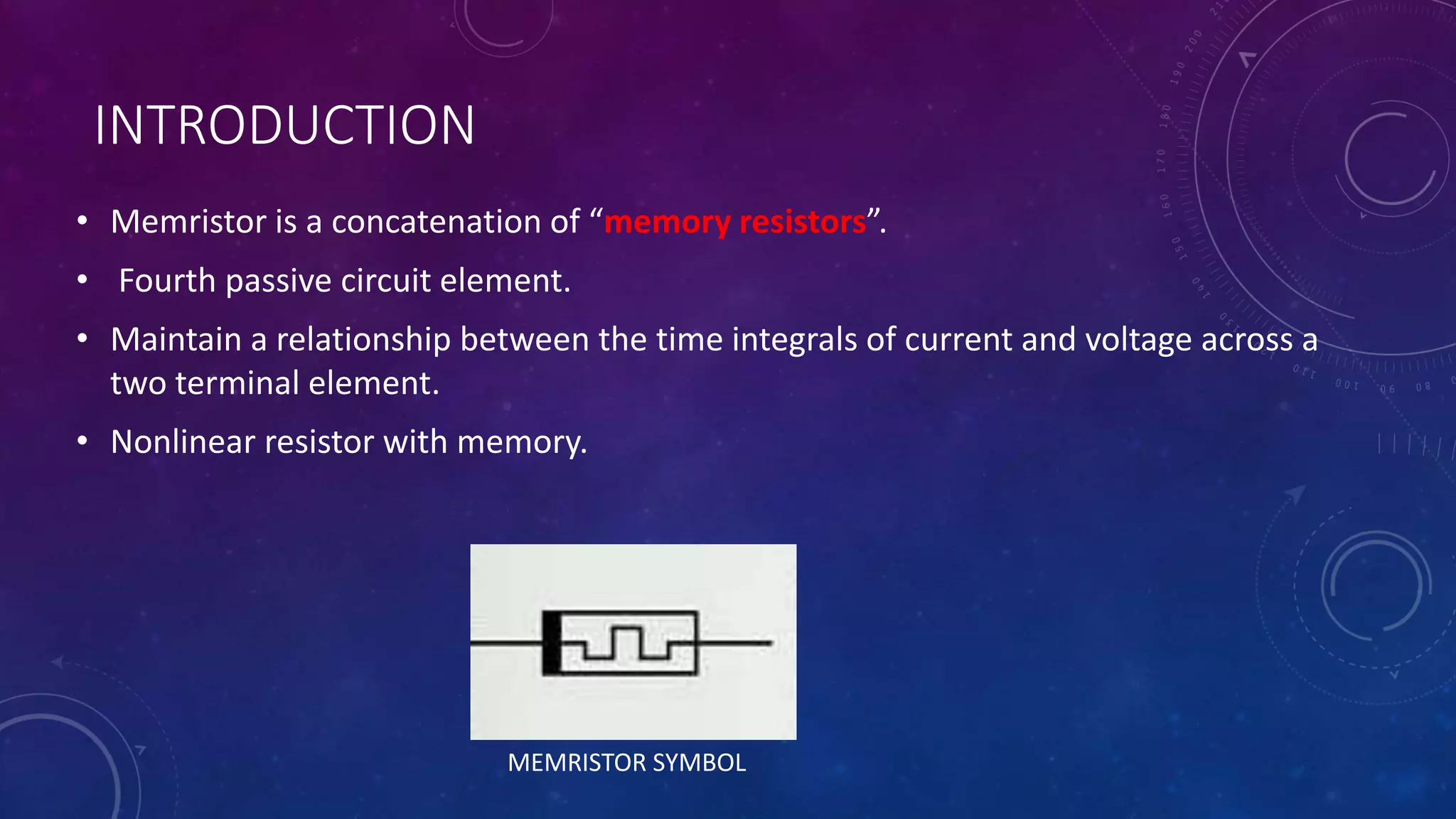
• Memristor is a concatenation of “memory resistors”.
• Fourth passive circuit element.
• Maintain a relationship between the time integrals of current and voltage across a
two terminal element.
• Nonlinear resistor with memory.
MEMRISTOR SYMBOL
HISTORY
• Theory was developed in 1971 by Professor Leon Chua at University of
California, Berkeley.
• In 2008, a team at HP Labs under R.Stanley Williams claimed to have found
Chua's missing memristor based on an analysis of a thin film of titanium
dioxide.
• In March 2012, a team of researchers from HRL Laboratories and the
University of Michigan announced the first functioning memristor array built
on a CMOS chip.
MEMRISTOR
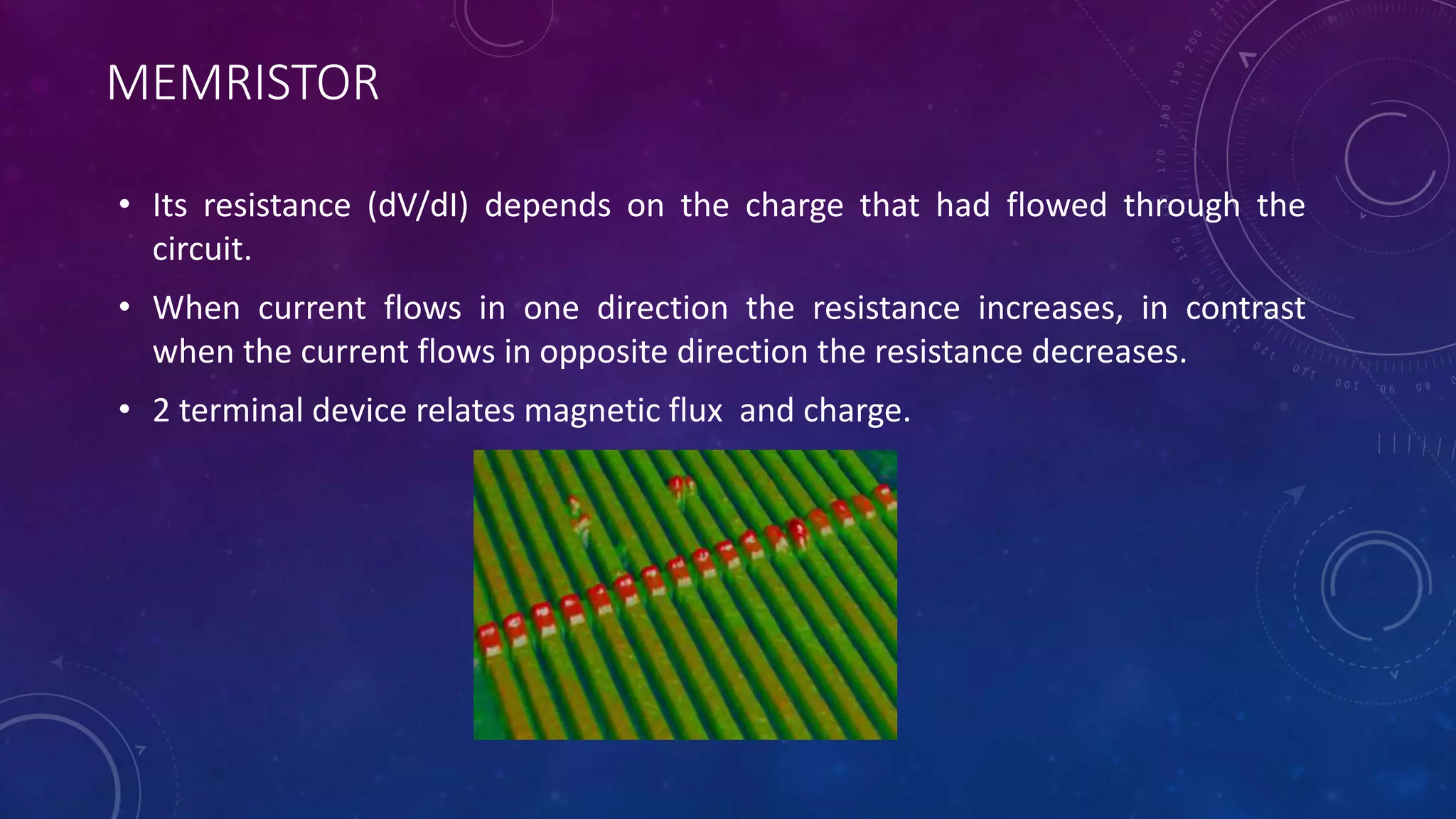
• Its resistance (dV/dI) depends on the charge that had flowed through the
circuit.
• When current flows in one direction the resistance increases, in contrast
when the current flows in opposite direction the resistance decreases.
• 2 terminal device relates magnetic flux and charge.
CONSTRUCTION
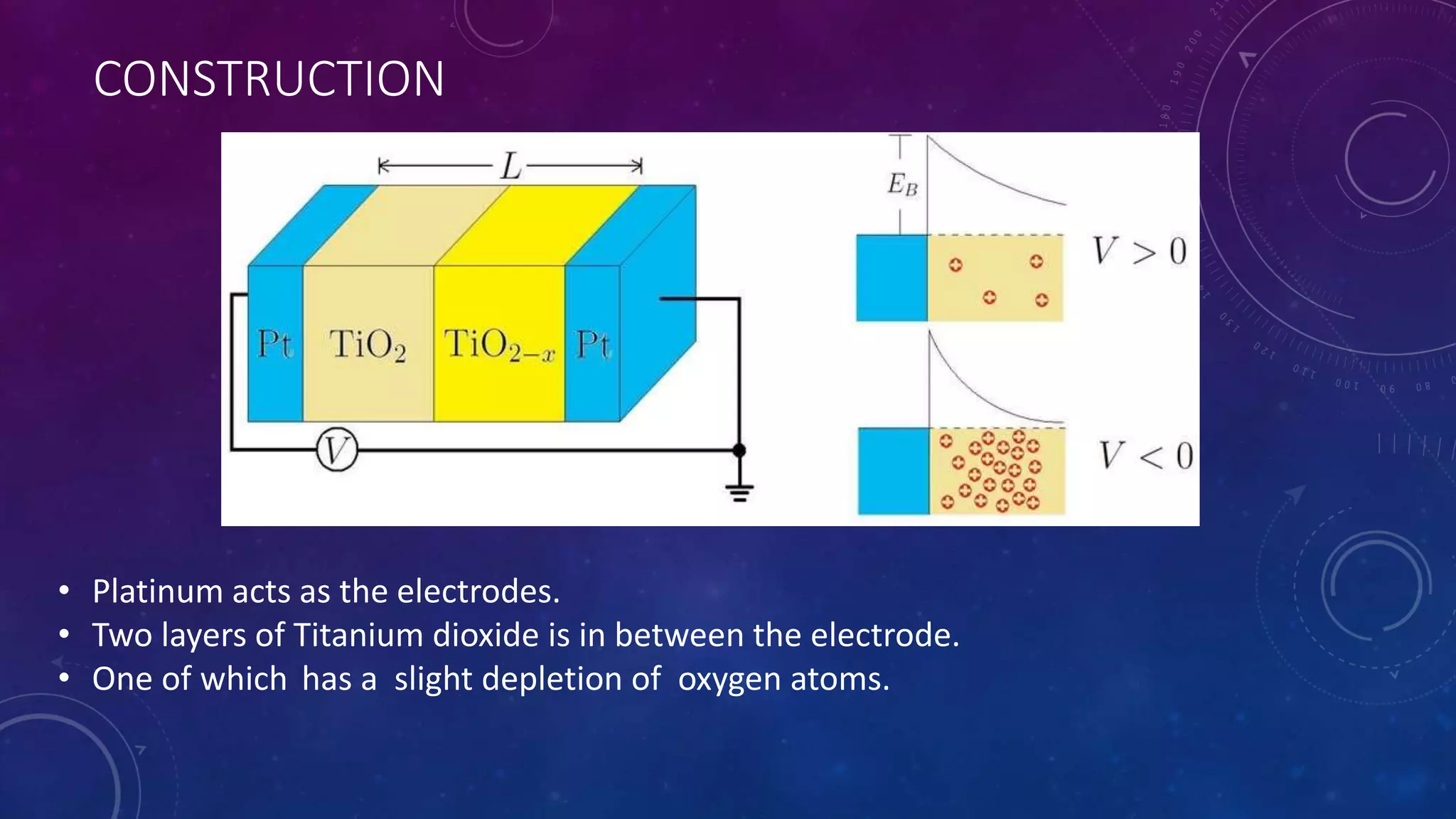
• Platinum acts as the electrodes.
• Two layers of Titanium dioxide is in between the electrode.
• One of which has a slight depletion of oxygen atoms.
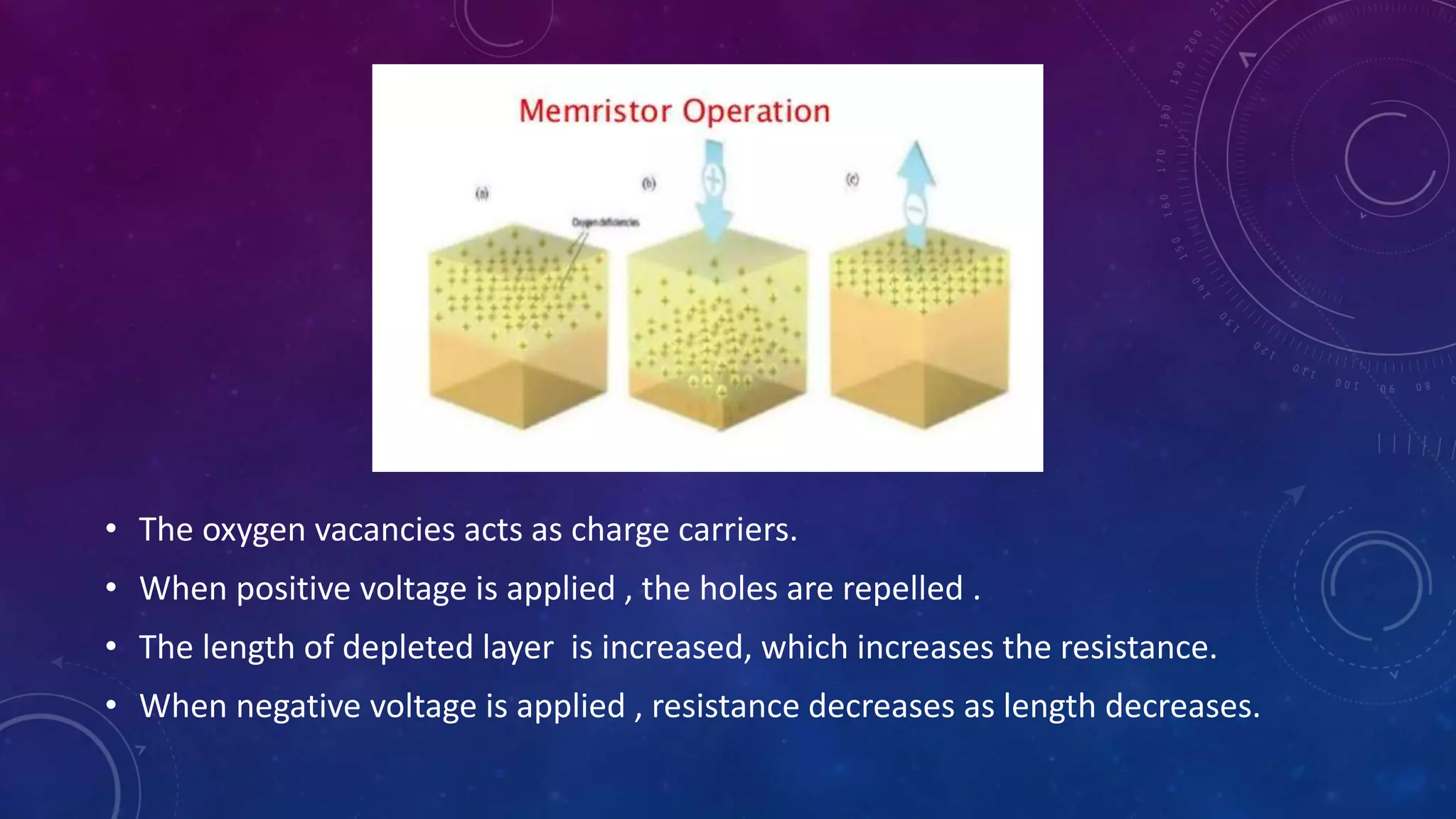
• The oxygen vacancies acts as charge carriers.
• When positive voltage is applied , the holes are repelled .
• The length of depleted layer is increased, which increases the resistance.
• When negative voltage is applied , resistance decreases as length decreases.
PROPERTY
• Retain its resistance level even after the power supply is turned off or shut
down.
• Remembers or recalls the last resistance value that it had , before shut down.
• When the current is stopped the resistance retains the value that it had earlier.
• It means memristor “REMEMBERS” the current that had last flowed through it.
THEORY
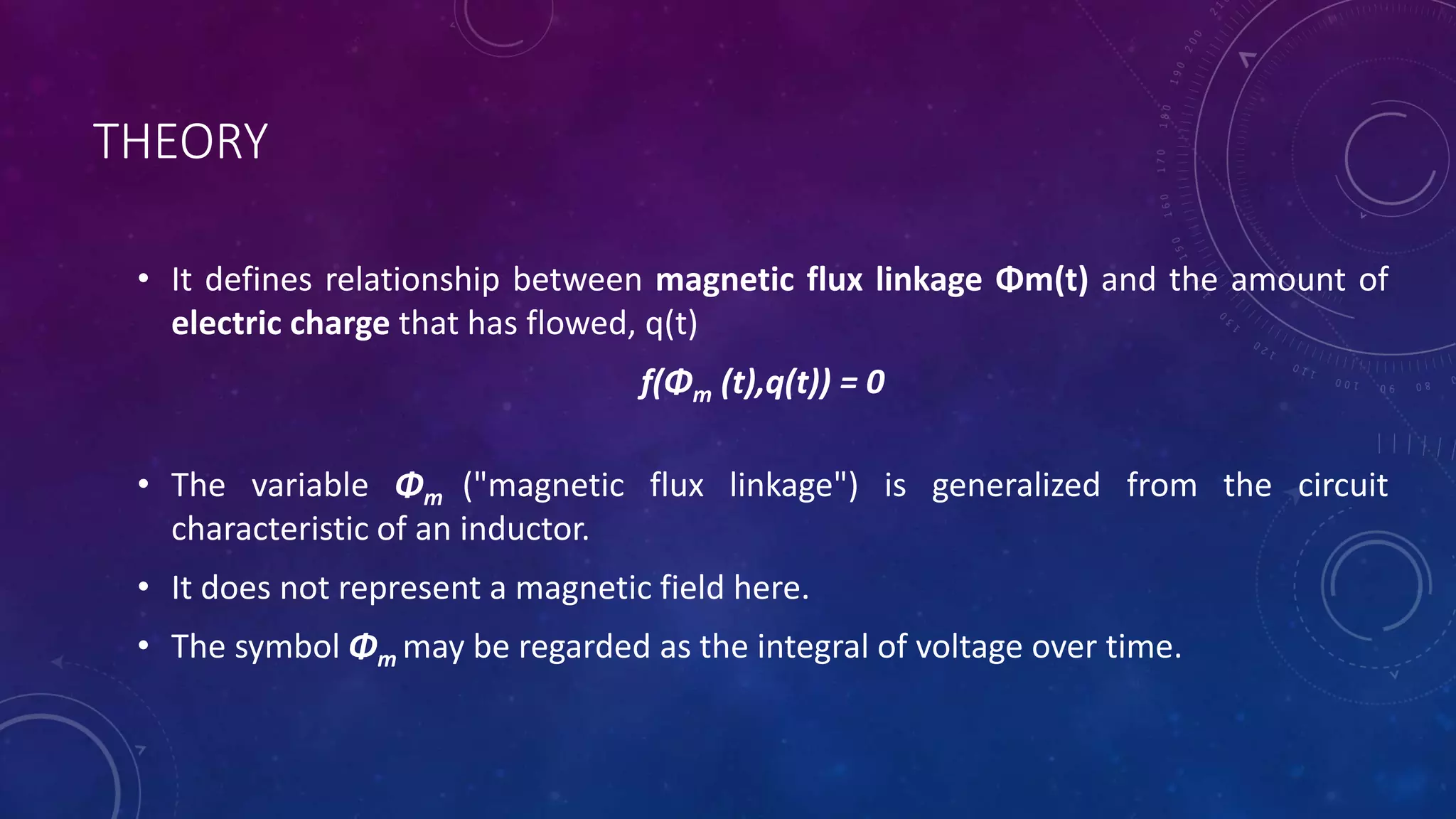
• It defines relationship between magnetic flux linkage Φm(t) and the amount of
electric charge that has flowed, q(t)
f(Φm (t),q(t)) = 0
• The variable Φm ("magnetic flux linkage") is generalized from the circuit
characteristic of an inductor.
• It does not represent a magnetic field here.
• The symbol Φm may be regarded as the integral of voltage over time.
MEMRISTANCE
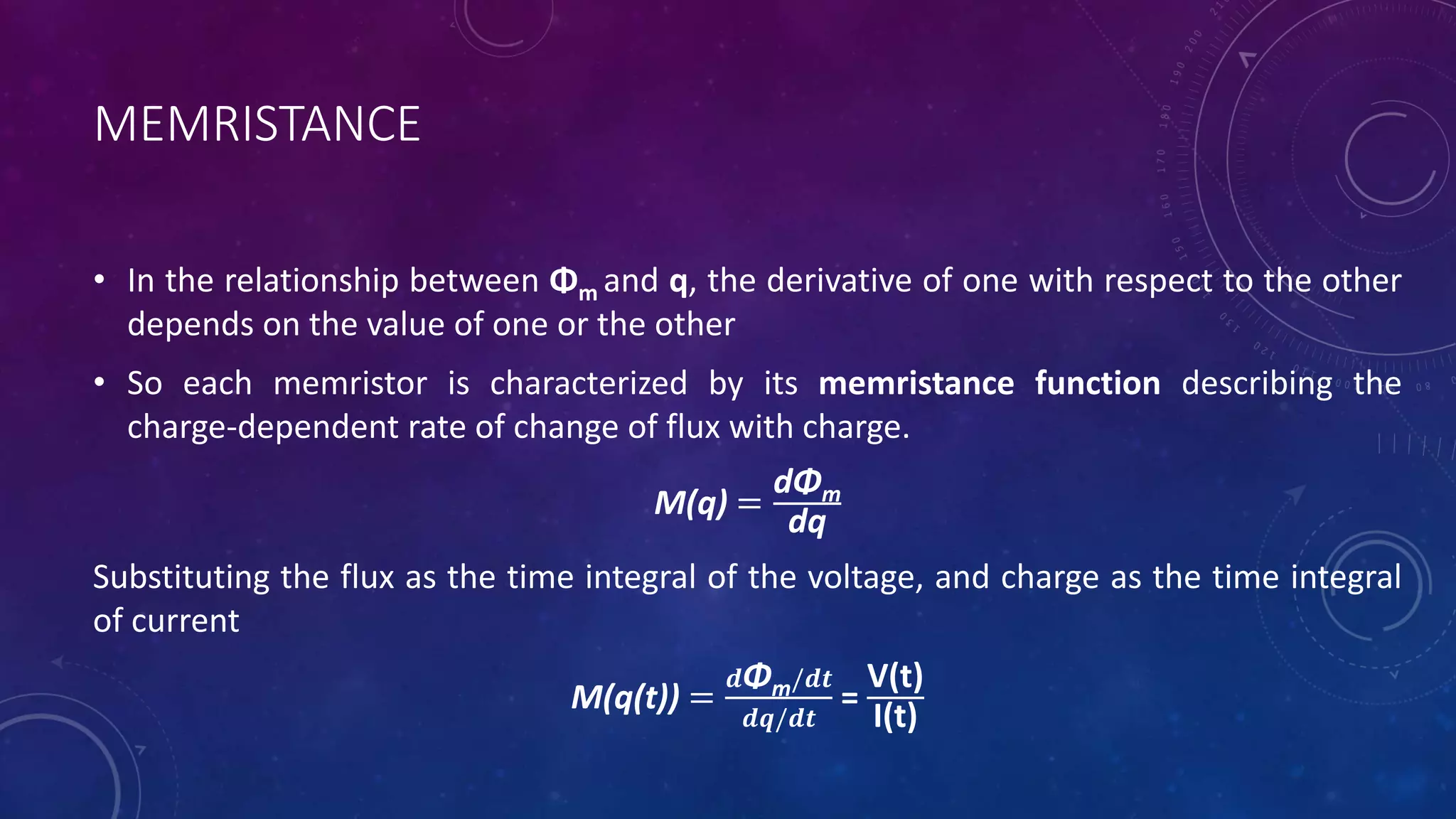
• In the relationship between Φm and q, the derivative of one with respect to the other
depends on the value of one or the other
• So each memristor is characterized by its memristance function describing the
charge-dependent rate of change of flux with charge.
M(q) =
dΦm
dq
Substituting the flux as the time integral of the voltage, and charge as the time integral
of current
M(q(t)) =
𝒅Φm/𝒅𝒕
𝒅𝒒/𝒅𝒕
=
V(t)
I(t)
APPLICATIONS
• Used in digital memory, logic circuits, biological and neuromorphic systems.
• Used in computer technology as well as digital memory
• Used in neural networks as well as analog electronics.
• These are applicable for analogic filter applications
• Remote sensing & Low-power applications.
• Used in Programmable Logic & Signal Processing.
• They have their own ability for storing analog
and digital data in an easy as well as power efficient
method
ADVANTAGES OF MEMRISTOR
• Has properties which can not be duplicated by the other circuit elements
(resistors, capacitors, and inductors)
• Capable of replacing both DRAM and hard drives
• Smaller than transistors while generating less heat
• Works better as it gets smaller which is the opposite of transistors
• Devices storing 100 gigabytes in a square centimeter have been created using
memristors.
• Requires less voltage (and thus less overall power required)
DISADVANTAGES OF MEMRISTOR
• Not currently commercially available
• Current versions only at 1/10th the speed of DRAM
• Could be learned but can also learn the wrong patterns in the beginning.
• Suspected by some that the performance and speed will never match DRAM
and transistors.
THANK YOU

Basics of memristor

  • 1.
  • 2.
    INTRODUCTION • Memristor isa concatenation of “memory resistors”. • Fourth passive circuit element. • Maintain a relationship between the time integrals of current and voltage across a two terminal element. • Nonlinear resistor with memory. MEMRISTOR SYMBOL
  • 3.
    HISTORY • Theory wasdeveloped in 1971 by Professor Leon Chua at University of California, Berkeley. • In 2008, a team at HP Labs under R.Stanley Williams claimed to have found Chua's missing memristor based on an analysis of a thin film of titanium dioxide. • In March 2012, a team of researchers from HRL Laboratories and the University of Michigan announced the first functioning memristor array built on a CMOS chip.
  • 4.
    MEMRISTOR • Its resistance(dV/dI) depends on the charge that had flowed through the circuit. • When current flows in one direction the resistance increases, in contrast when the current flows in opposite direction the resistance decreases. • 2 terminal device relates magnetic flux and charge.
  • 5.
    CONSTRUCTION • Platinum actsas the electrodes. • Two layers of Titanium dioxide is in between the electrode. • One of which has a slight depletion of oxygen atoms.
  • 6.
    • The oxygenvacancies acts as charge carriers. • When positive voltage is applied , the holes are repelled . • The length of depleted layer is increased, which increases the resistance. • When negative voltage is applied , resistance decreases as length decreases.
  • 7.
    PROPERTY • Retain itsresistance level even after the power supply is turned off or shut down. • Remembers or recalls the last resistance value that it had , before shut down. • When the current is stopped the resistance retains the value that it had earlier. • It means memristor “REMEMBERS” the current that had last flowed through it.
  • 8.
    THEORY • It definesrelationship between magnetic flux linkage Φm(t) and the amount of electric charge that has flowed, q(t) f(Φm (t),q(t)) = 0 • The variable Φm ("magnetic flux linkage") is generalized from the circuit characteristic of an inductor. • It does not represent a magnetic field here. • The symbol Φm may be regarded as the integral of voltage over time.
  • 9.
    MEMRISTANCE • In therelationship between Φm and q, the derivative of one with respect to the other depends on the value of one or the other • So each memristor is characterized by its memristance function describing the charge-dependent rate of change of flux with charge. M(q) = dΦm dq Substituting the flux as the time integral of the voltage, and charge as the time integral of current M(q(t)) = 𝒅Φm/𝒅𝒕 𝒅𝒒/𝒅𝒕 = V(t) I(t)
  • 10.
    APPLICATIONS • Used indigital memory, logic circuits, biological and neuromorphic systems. • Used in computer technology as well as digital memory • Used in neural networks as well as analog electronics. • These are applicable for analogic filter applications • Remote sensing & Low-power applications. • Used in Programmable Logic & Signal Processing. • They have their own ability for storing analog and digital data in an easy as well as power efficient method
  • 11.
    ADVANTAGES OF MEMRISTOR •Has properties which can not be duplicated by the other circuit elements (resistors, capacitors, and inductors) • Capable of replacing both DRAM and hard drives • Smaller than transistors while generating less heat • Works better as it gets smaller which is the opposite of transistors • Devices storing 100 gigabytes in a square centimeter have been created using memristors. • Requires less voltage (and thus less overall power required)
  • 12.
    DISADVANTAGES OF MEMRISTOR •Not currently commercially available • Current versions only at 1/10th the speed of DRAM • Could be learned but can also learn the wrong patterns in the beginning. • Suspected by some that the performance and speed will never match DRAM and transistors.
  • 13.