This document describes a dual axis solar tracker prototype. It uses two mechanisms - a linear actuator to move the solar panel in the Y-Z plane and a worm gear setup to move it in the X-Y plane. Three light dependent resistor sensors are used to sense the light intensity and direct the panel towards the maximum intensity to maximize energy capture. A microcontroller reads the sensor outputs and controls the actuators to adjust the panel position until the light readings from the three sensors are approximately equal. This automatic adjustment allows the panel to continuously track the sun's movement for increased solar energy harvesting.
Dual Axis SolarTracker
Cairo University
Faculty of engineering
Department of Electrical Power
Introduced to:
DR / Khalid Ali El-Metwally
Prepared by:
Islam Adel Ateya SEC : 2 BN:10
21/12/20151
2.
Motivation
It is observablethat the solar power is an
important field that the whole world seeks to
make the best use of it in order to decrease
the use of fossil fuels that pollutes the
environment. But the high initial cost of solar
power has limited its wide usage for many
poor countries.
So that , the objective now is to increase the
efficiency of solar systems in order to
decrease its high initial cost.
21/12/20152
3.
Motivation
For this reasonsolar tracker system is presented
as a solution for solar systems in order to make
the best possible use of the incident solar power .
Solar tracker is an automatic control system that
directs the absorber surface directly towards the
sun .
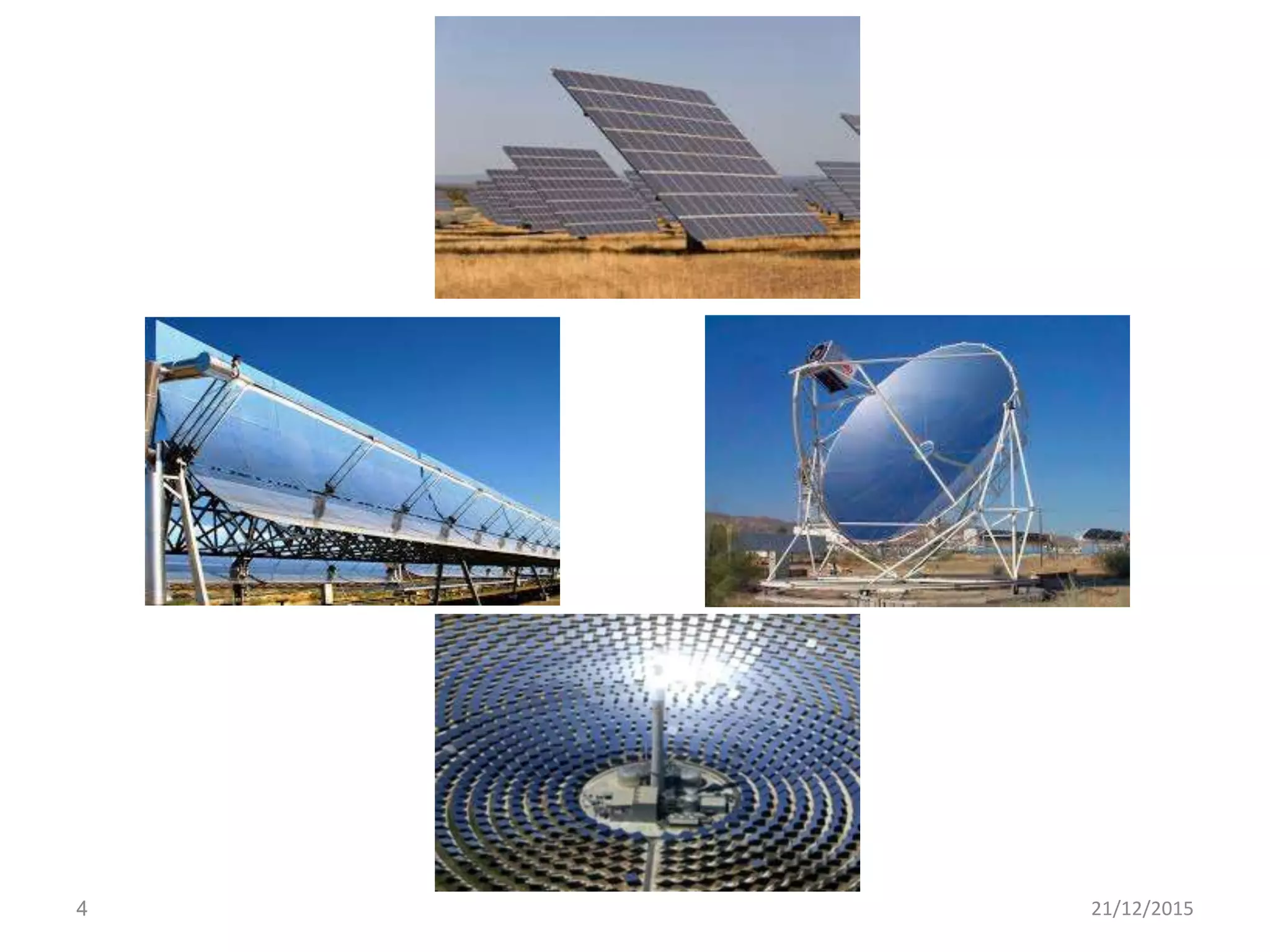
For the PV panels , solar tracker is considered a
supplementary system. But for another systems
they will be useless without solar tracking such as
parabolic trough , parabolic dish and central
receiver .
21/12/20153
There is twotypes of solar tracker:
1- Single axis : at which the absorber surface is
mounted along the north – south axis .
2- Dual axis : at which the absorber surface is
mounted towards the south direction .
In this slides a prototype of dual axis solar
used for solar panels tracker will be illustrated.
21/12/20155
Y-Z Plane Mechanism
Asshown in the mechanical schematic, the
linear actuator is responsible for moving the
panel in the Y-Z plane.
The actuator is supposed to have holding
torque to eliminate the disturbance caused by
the wind, in addition to have low speed as the
dynamic motion of the sun is slow.
It was fond that the linear actuator is a good
solution.
21/12/20157
8.
What is LinearActuator?
Linear Actuator is a simple
mechanism that converts the
rotational motion of the DC
motor into longitudinal motion.
The linear actuator is provided
with two limit switches to reset
the motor at the boundary of
the longitudinal motion not to
present the shaft of the motor
to be locked.
21/12/20158
9.
X-Y Plane Mechanism
Asprevious the X-Y actuator it is required
from the actuator to have slow response and
holding torque.
It was found that a worm gear package would
be suitable.
21/12/20159
10.
What is WormGear
As shown worm gear package consists
of two gears:
.-Worm shaft Gear
.- Worm Wheel Gear
As the worm shaft rotates in the Y-Z
Plane, The worm Wheel is forced to
rotate in the perpendicular plane X-Y
21/12/201510
11.
Sensing system
The sensingsystem consists of 3 –
light sensors mounted on a plastic
base and separated of each other.
- This base should be installed in
the same plane as the panel.
The sensors are LDR sensors that
stand for Light dependent Resistor .
21/12/201511
12.
Sensing system
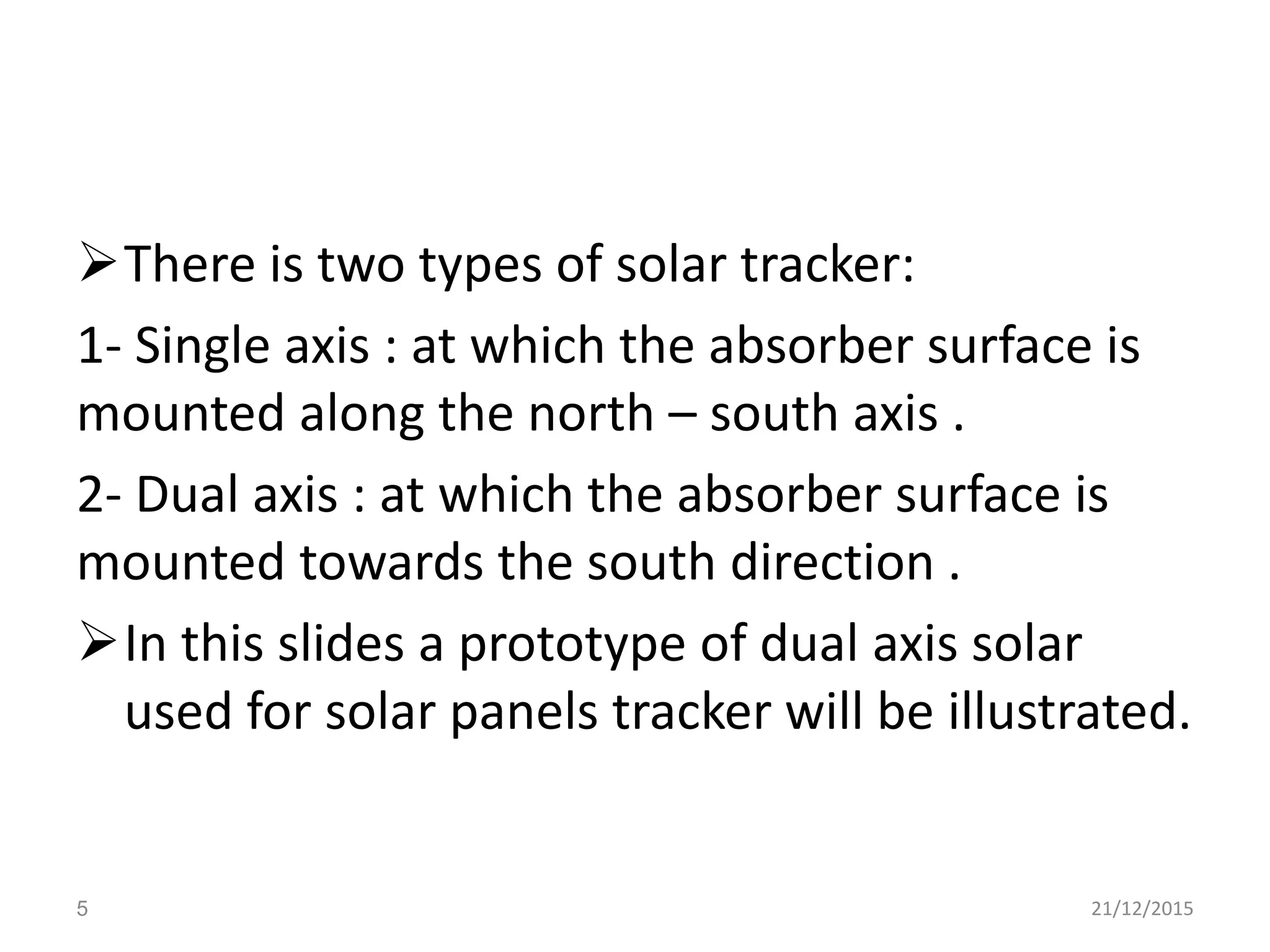
• TheLDR introduces variable
resistance according to the incident
illumination according the
characteristic graph shown .
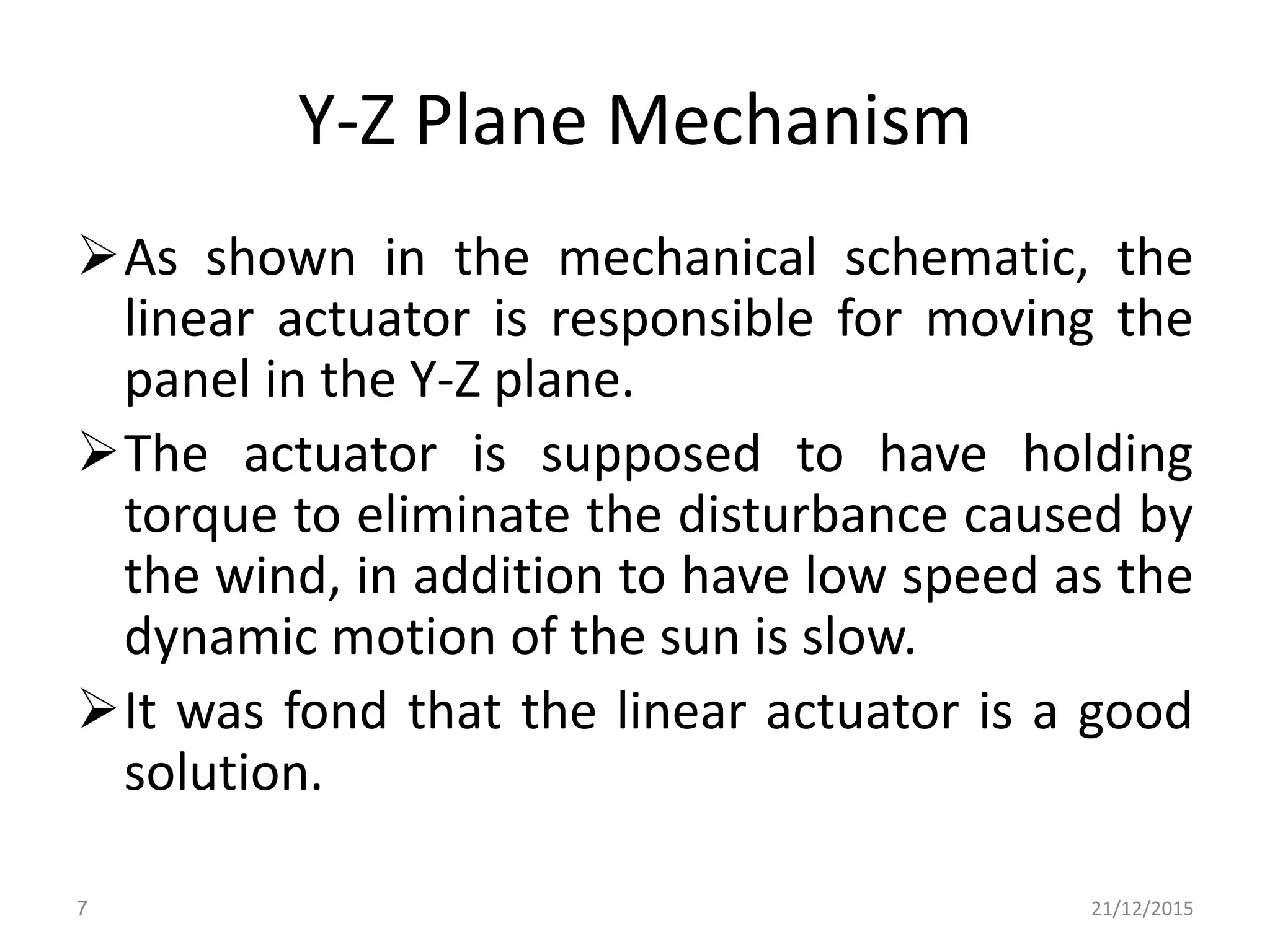
• In order to obtain variable voltage
proportional to the incident
illumination ,the connection of
voltage divider is suitable as shown in
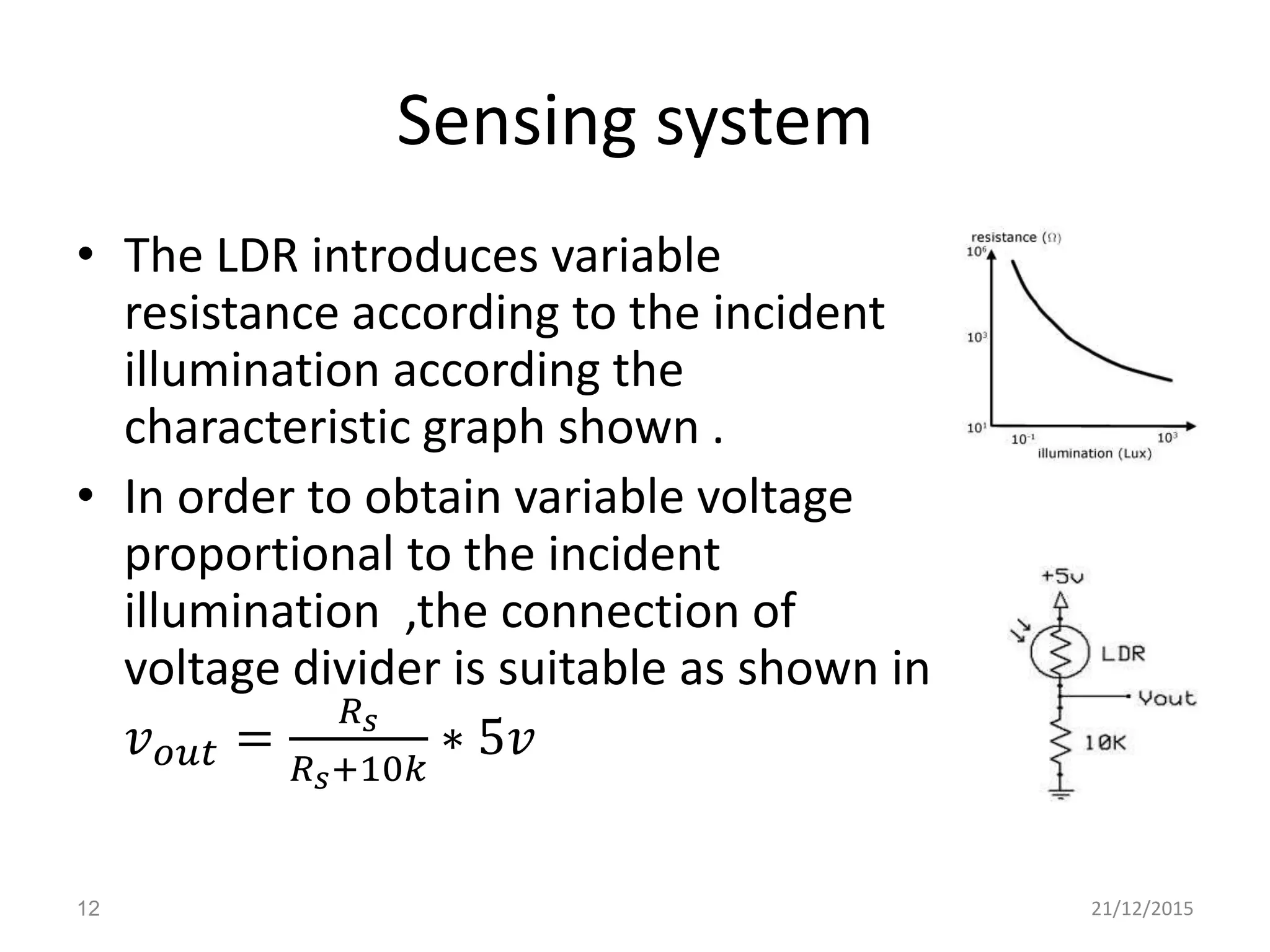
𝑣 𝑜𝑢𝑡 =
𝑅 𝑠
𝑅 𝑠+10𝑘
∗ 5𝑣
21/12/201512
13.
Sensing system
• Theoutput voltage is not linearly proportional to
sensor resistance, but it is desired to compare
the illumination of the three sensors , so that
linearity is not needed.
• The output voltages of the three sensors are
read by the microcontroller.
• The controller compares between the readings
and takes necessary control actions to set the
panel at the position at which the incident
radiation is approximately perpendicular to the
solar panel
21/12/201513
14.
Flow Chart
Read
S1 ,S2 , S3 ,.tol
s1-s2 > tol
s1-s2 <- tol
Move in x-y
direction
Move in y-x
direction
Stop x-y
plane motion
F
F
T
T
T
s1-s3 > tol
s1-s3 <- tol
𝑠1 − 𝑠3
<= 𝑡𝑜𝑙
Move in y-z
direction
Move in z-y
direction
Stop y-z
plane motion
F
F
T
T
T𝑠1 − 𝑠2
<= 𝑡𝑜𝑙
START
21/12/201514