PROJECT PRESENTATION
ON
PRESENTED BY:-
ANUJ KUMAR
ARVINDRA KUMAR
RAM SWRAOOP
8TH SEMESTER
2013-2014
SUBMITTED TO:-
Er. BINDU JI GYANESH
Er. GARIMA AGRAWAL
CONTENTS
1. Solar tracker
2. Aim of the project
3. Hardware used
4. Block diagram
5. Hardware description
6. Power supply
7. Microcontroller AT89S52
8. ULN2003
9. Advantages
10.Disadvantages
11.Application
12.References
A solar tracker is a generic term used to describe devices
that orient or align various payloads toward the sun.
Example for payloads are photovoltaic
panels, reflectors, Collectors, lenses or other optical devices.
The system focuses on the optimization of the electric energy
produced by photovoltaic cells through the development of a
sun-tracking system.
SOLAR TRACKER
AIM OF THE PROJECT
To follow the sun from dawn, throughout the day, till
evening and again from dawn next day.
The driver will have to position a photo-voltaic panel to the
best angle of exposure to sunlight for collection of maximum
solar energy.
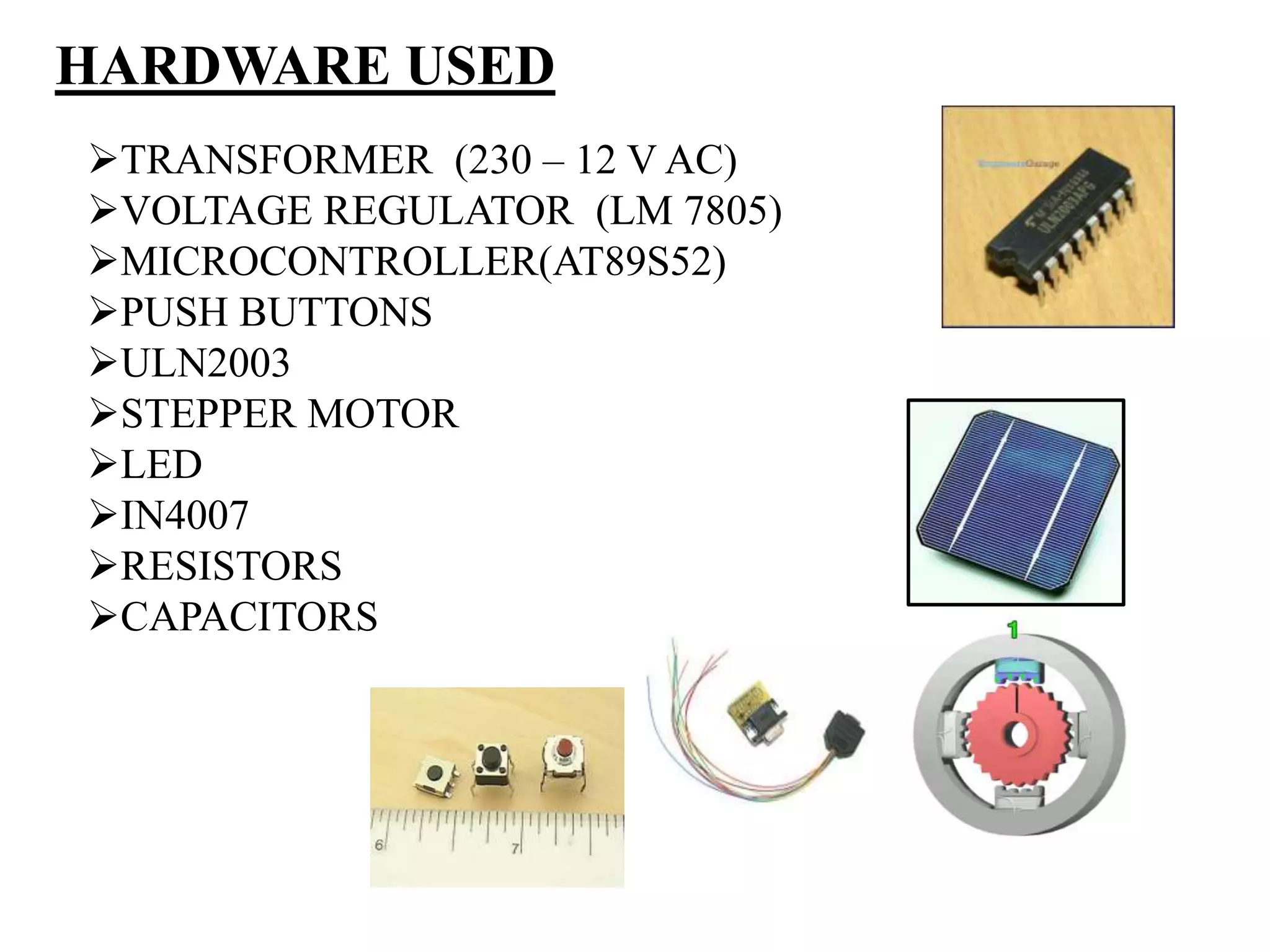
HARDWARE USED
TRANSFORMER (230 – 12 V AC)
VOLTAGE REGULATOR (LM 7805)
MICROCONTROLLER(AT89S52)
PUSH BUTTONS
ULN2003
STEPPER MOTOR
LED
IN4007
RESISTORS
CAPACITORS
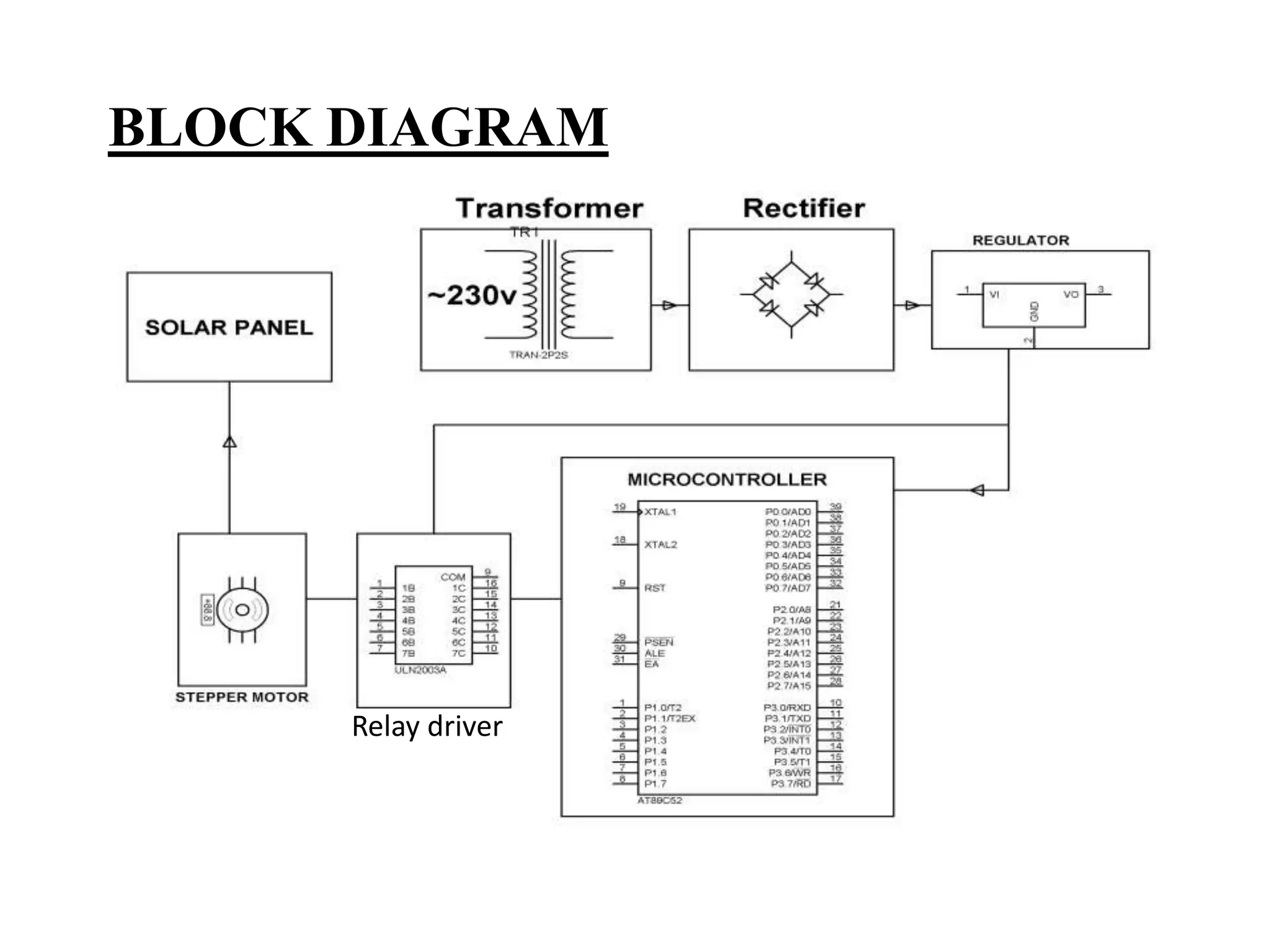
BLOCK DIAGRAM
Relay driver
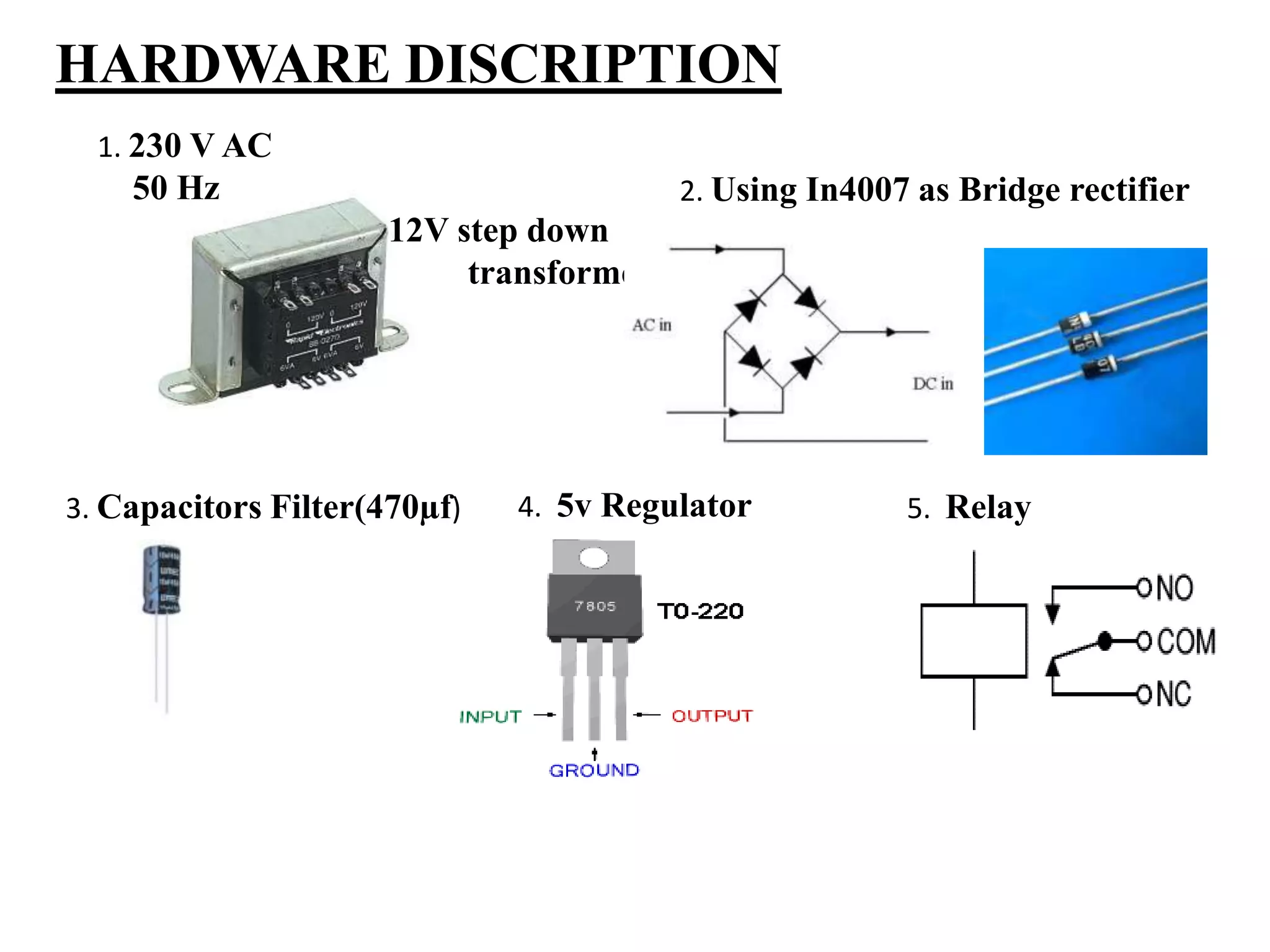
HARDWARE DISCRIPTION
1. 230 V AC
50 Hz
12V step down
transformer
2. Using In4007 as Bridge rectifier
3. Capacitors Filter(470µf) 4. 5v Regulator 5. Relay
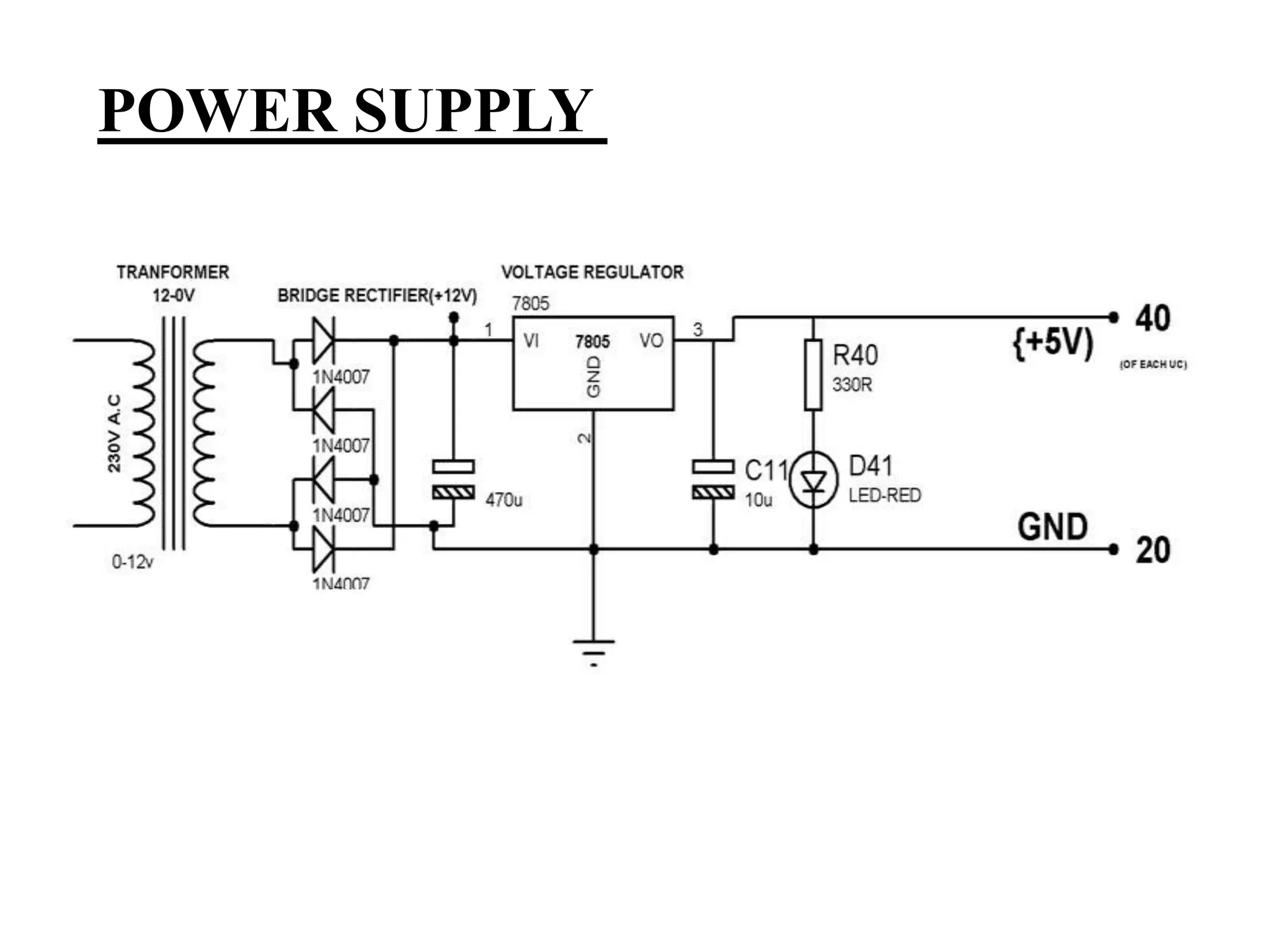
POWER SUPPLY
MICROCONTROLLER AT89S52
• 8K Bytes of In-System Programmable
(ISP) Flash Memory
• 4.0V to 5.5V Operating Range
• Fully Static Operation: 0 Hz to 33 MHz
• Three-level Program Memory Lock
• 256 x 8-bit Internal RAM
• 32 Programmable I/O Lines
• Three 16-bit Timer/Counters
• Eight Interrupt Sources
• Full Duplex UART Serial Channel
• Interrupt Recovery from Power-down
Mode
• Fast Programming Time
ULN2003
 ULN is Relay driver application.
 The ULN2003 is a high voltage and high current
Darlington transistor arrays.
 It consists of seven NPN Darlington pairs that
features high-voltage output with common-
cathode clamp diode for switching inductive
loads.
 The collector-current rating of a single
Darlington pair is 500mA.
 The Darlington pairs may be paralleled for higher
current capability.
ADVANTAGES
Solar tracking systems continually orient photovoltaic
panels towards the sun and can help maximize your
investment in your PV system.
One time investment, which provides higher efficiency &
flexibility on dependency over other sources.
Tracking systems can help reducing emissions and can
contribute against global warming.
Bulk implementations of tracking systems help reduced
consumption of power by other sources.
It enhances the clean and emission free power
production.
DISADVANTAGES
Initial investment is high on solar panels.
It’s a bit of difficult for servicing, as the tracking systems are
not quite popular regionally.
Moving parts and gears which will require regular maintenance.
May require repair or replacement of broken parts over a long
run.
APPLICATIONS
Can be used for small & medium scale power generations.
For power generation at remote places where power lines are not
accessible.
For domestic backup power systems.
REFERENCES
http://www.engineersgarage.com/electronic-
components/uln2003-datasheet
http://wiki.answers.com/Q/What_is_difference_between_microco
ntroller_8051_and_'AT89S52
http://en.wikipedia.org/wiki/ULN2003A
Automatic solar tracking system

Automatic solar tracking system

  • 1.
    PROJECT PRESENTATION ON PRESENTED BY:- ANUJKUMAR ARVINDRA KUMAR RAM SWRAOOP 8TH SEMESTER 2013-2014 SUBMITTED TO:- Er. BINDU JI GYANESH Er. GARIMA AGRAWAL
  • 2.
    CONTENTS 1. Solar tracker 2.Aim of the project 3. Hardware used 4. Block diagram 5. Hardware description 6. Power supply 7. Microcontroller AT89S52 8. ULN2003 9. Advantages 10.Disadvantages 11.Application 12.References
  • 3.
    A solar trackeris a generic term used to describe devices that orient or align various payloads toward the sun. Example for payloads are photovoltaic panels, reflectors, Collectors, lenses or other optical devices. The system focuses on the optimization of the electric energy produced by photovoltaic cells through the development of a sun-tracking system. SOLAR TRACKER
  • 4.
    AIM OF THEPROJECT To follow the sun from dawn, throughout the day, till evening and again from dawn next day. The driver will have to position a photo-voltaic panel to the best angle of exposure to sunlight for collection of maximum solar energy.
  • 5.
    HARDWARE USED TRANSFORMER (230– 12 V AC) VOLTAGE REGULATOR (LM 7805) MICROCONTROLLER(AT89S52) PUSH BUTTONS ULN2003 STEPPER MOTOR LED IN4007 RESISTORS CAPACITORS
  • 6.
  • 7.
    HARDWARE DISCRIPTION 1. 230V AC 50 Hz 12V step down transformer 2. Using In4007 as Bridge rectifier 3. Capacitors Filter(470µf) 4. 5v Regulator 5. Relay
  • 8.
  • 9.
    MICROCONTROLLER AT89S52 • 8KBytes of In-System Programmable (ISP) Flash Memory • 4.0V to 5.5V Operating Range • Fully Static Operation: 0 Hz to 33 MHz • Three-level Program Memory Lock • 256 x 8-bit Internal RAM • 32 Programmable I/O Lines • Three 16-bit Timer/Counters • Eight Interrupt Sources • Full Duplex UART Serial Channel • Interrupt Recovery from Power-down Mode • Fast Programming Time
  • 10.
    ULN2003  ULN isRelay driver application.  The ULN2003 is a high voltage and high current Darlington transistor arrays.  It consists of seven NPN Darlington pairs that features high-voltage output with common- cathode clamp diode for switching inductive loads.  The collector-current rating of a single Darlington pair is 500mA.  The Darlington pairs may be paralleled for higher current capability.
  • 11.
    ADVANTAGES Solar tracking systemscontinually orient photovoltaic panels towards the sun and can help maximize your investment in your PV system. One time investment, which provides higher efficiency & flexibility on dependency over other sources. Tracking systems can help reducing emissions and can contribute against global warming. Bulk implementations of tracking systems help reduced consumption of power by other sources. It enhances the clean and emission free power production.
  • 12.
    DISADVANTAGES Initial investment ishigh on solar panels. It’s a bit of difficult for servicing, as the tracking systems are not quite popular regionally. Moving parts and gears which will require regular maintenance. May require repair or replacement of broken parts over a long run.
  • 13.
    APPLICATIONS Can be usedfor small & medium scale power generations. For power generation at remote places where power lines are not accessible. For domestic backup power systems.
  • 14.