International Journal of Trend in Scientific Research and Development (IJTSRD)
Volume 7 Issue 3, May-June 2023 Available Online: www.ijtsrd.com e-ISSN: 2456 – 6470
@ IJTSRD | Unique Paper ID – IJTSRD57378 | Volume – 7 | Issue – 3 | May-June 2023 Page 399
Dual Axis Solar Tracking System with Weather Sensor
Mrs. Surbhi R. Shroff
V.P.M’s Polytechnic, Thane, Maharashtra, India
ABSTRACT
Energy crisis is one in every of the major problems in world
developing countries like Republic of India. There's a huge gap
between generation and demand of current. Nearly half of the
population of the country cannot get the power supply. Renewable
energy is one of the answers to solve this issue. Solar power is one in
every of the foremost effective resources of the renewable energy
that might play a big role to resolve this drawback. This analysis
presents a performance analysis of the dual axis solar tracking system
using Arduino and led & servo motors. The most objective of this
research is whether the solar tracker is better than a solar panel. This
work is split into 2 light dependent resistors (LDR) is employed to
observe the almost source of illumination from the sun. Two servo
motors put together accustomed move the electrical device to most
source of illumination location perceived by the LDRs. In the other
half, the software part is written by using C programming language
which head towards to the Arduino UNO controller. The result of the
solar tracking system has analyzed and compared with the mounted
or static solar panel found higher performance in terms of current,
power and voltage. Therefore, the solar tracking system is evidenced
additional sensible for capturing the most daylight provide for star
gathering applications. The result showed dual axis solar tracking
system made further 10.53- watt power compared with mounted
(fixed) and single axis solar tracking system. Components hardware
and computer code.
How to cite this paper: Mrs. Surbhi R.
Shroff "Dual Axis Solar Tracking
System with Weather Sensor" Published
in International
Journal of Trend in
Scientific Research
and Development
(ijtsrd), ISSN: 2456-
6470, Volume-7 |
Issue-3, June 2023,
pp.399-403, URL:
www.ijtsrd.com/papers/ijtsrd57378.pdf
Copyright © 2023 by author (s) and
International Journal of Trend in
Scientific Research and Development
Journal. This is an
Open Access article
distributed under the
terms of the Creative Commons
Attribution License (CC BY 4.0)
(http://creativecommons.org/licenses/by/4.0)
KEYWORDS: Dual Axis, Stepper
Motor, LDR Sensors, Declination
Angle
INTRODUCTION
As sun is a major source of this renewable energy, a
dual axis solar tracker which can track the radiations
from the sun in all the directions with maximum
intensity is found. This dual axis solar tracker takes
the sun radiations as the input and converts to
electrical energy this electrical energy which is
obtained fulfil majority of the country needs. Energy
absorption is maximum when the panel is
perpendicular to the sun. Hence we are using a solar
tracker to maximize the energy generation and
improve the efficiency 40% more than the fixed
panel. In general, during the day the single axis
tracker moves from east to west with one degree of
freedom. While the modem tracker tracks east west
and north south movement of the sun. In this project
we are integrating dual axis solar tracking. The
demand for reliable source of energy has been
increasing day by day. So, government improved the
usage of renewable energy sources there by curtailing
the usage of conventional source of energy. By using
photovoltaic cell we can harness solar energy and
later photovoltaic effect can be used to convert solar
energy into electrical energy and this energy can be
used in wide applications like solar thermal energy,
solar heating, photovoltaic, solar architecture etc. The
output of photovoltaic cell directly depends on the
intensity of light and sun's positions changes
continuously in a day. In general, during the day the
single axis tracker moves from east to west with one
degree of freedom. While the modern tracker tracks
east west and north south movement of the sun. In
this project we are integrating dual axis solar
tracking. The project is designed and implemented
using simple dual axis solar tracker system. In order
to maximize energy generation from sun, it is
necessary to introduce solar tracking systems into
solar power systems. A dual-axis tracker can increase
energy by tracking sun rays from switching solar
panel in various directions.
IJTSRD57378
International Journal of Trend in Scientific Research and Development @ www.ijtsrd.com eISSN: 2456-6470
@ IJTSRD | Unique Paper ID – IJTSRD57378 | Volume – 7 | Issue – 3 | May-June 2023 Page 400
OBJECTIVE
1. The ultimate objective of this project is to
investigate whether static solar panel is better
than solar tracker, or the opposite.
2. This project is divided into two stages namely,
hardware and software development. 3) A dual-
axis tracker allows your panels to move on two
axes, aligned both north-south and an east-west.
3. This type of system is designed to maximize your
solar energy collection throughout the year
4. It can track seasonal variations in the height of the
sun in addition to normal daily motion
LITERATURE REVIEW
The first solar tracker was a mechanical system by C.
Finster, invented in 1962. Though the Finster solar
tracker realized insignificant energy gains, years of
testing and research have led to improvement of the
conversion output of the PV system and consequently
the emergency of different tracking technologies and
applications (e.g. concentrator and non-concentrator).
In short, improved solar cells have been developed
and the use of solar tracking system over the use of
conventional fixed PV system has grown. In fixed
photovoltaic system the solar receiver(PV module) is
in a stationary position facing the true north.
However, with mechanical or electro-mechanical
systems, the orientation of the collector change
continually in reference to the azimuthal directions
(east-west) and also in its elevation. This is dependent
on the tracker’s geometrical capacity. Classification
of solar tracking system Mousazadeh et al, (2009)
carried a review study, which resulted in the general
categorisation of solar tracking systems (2) according
to two main typologies, namely, Energy source (i.e.
passive, active and manual), and Degree of freedom
(i.e. single or dual axis). Passive tracking systems-
designate all devices that position solar collectors for
optimum capture of energy using mechanical
potential and thermal energy principles. Passive
systems do not use of electrical energy. Some of the
typical mechanical working principles are Shape
Memory Alloy (SMA), Thermo-fluids, Mechanical
potential system (lever, weight and springs). In Shape
Memory Alloy, cylindrical actuators to change the
shape the SMA receivers through mirrors until an
optimum orientation is achieved (3) Recent
developments, among others by Kusekar et al (2015),
have seen the use of high pressure fluids to convert
the potential energy in the mechanical structure that
hold up the PV panel into kinetic energy, which is
then used to move the panel toward the sun. (4)
Active tracking systems- use electrical energy as their
source. A number of categories exist such as; Electro
optical based tracker, Auxiliary bifacial solar cell and
chronological (time and date based) tracker. At some
instances, a combination of these different systems
may be realised and the resulting system will be
referred to as Hybrid. Of all active trackers, electro-
optical based trackers are is generally more popular.
For improved photosensitivity, the sensor can be
mounted on a pyramidal structure (in the figure 2b
outlines the photo-diode mounted on pyramid) or use
of collimator tube might be vital as it prevent diffuse
irradiation from reach the sensors therefore ensuring
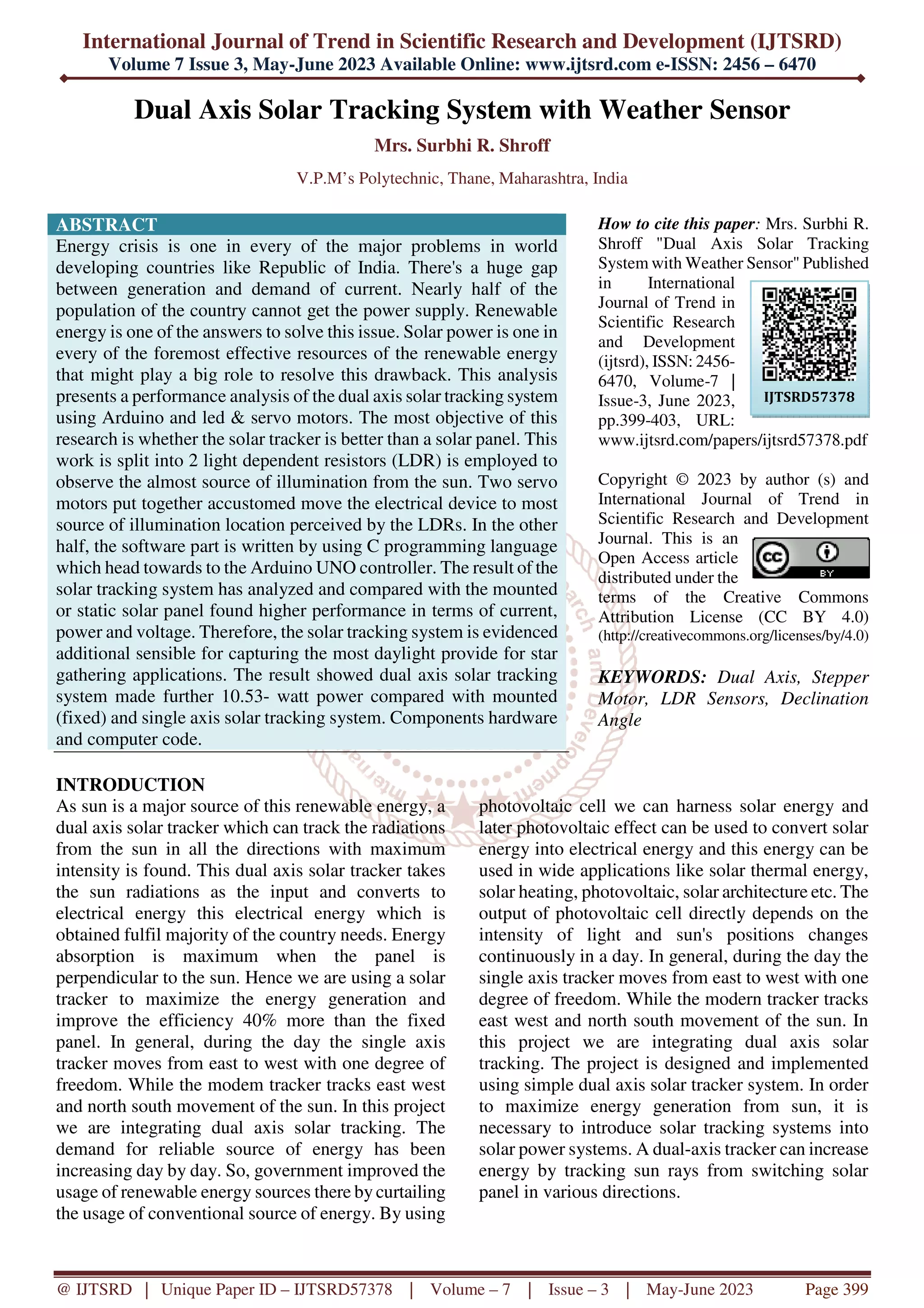
precise measurement of the position of the sun. Fig.1c
is a system made up of four mini- solar module
positioned on the North- south and east-west that
detect the light intensity, this is system also use the
Programmable Logic Controller (PLC) manipulate
the two positioning mechanism through two DC
motors (5)
Movement controlling Unit of Solar Tracker
Fig.1
International Journal of Trend in Scientific Research and Development @ www.ijtsrd.com eISSN: 2456-6470
@ IJTSRD | Unique Paper ID – IJTSRD57378 | Volume – 7 | Issue – 3 | May-June 2023 Page 401
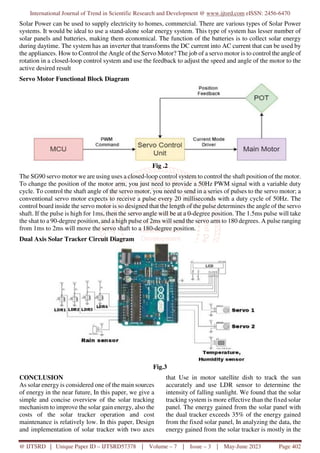
Solar power is the fastest growing means of renewable energy. The project is designed and implemented using
simple dual axis solar tracker system. In order to maximize energy generation from sun, it is necessary to
introduce solar tracking systems into solar power systems. A dual-axis tracker can increase energy by tracking
sun rays from switching solar panel in various directions. This solar panel can rotate in all directions. This dual
axis solar tracker project can also be used to sense weather, and it will be displayed on LCD. This system is
powered by Arduino, consists of servo motor, rain drop sensor, temperature and humiditysensor and LCD. Dual
Axis In solar tracking systems, solar panels are mounted on a structure which moves to track the movement of
the sun throughout the day. There are three methods of tracking viz active, passive and chronological tracking.
These methods can then be implemented either in single- axis or dual axis solar trackers. In active tracking, the
position of the sun in the sky during the day is continuously determined by sensors. The sensors will trigger the
motor or actuator to move the mounting system so that the solar panels will always face the sun throughout the
day.
A passive tracker moves in response to an imbalance in pressure between two points. The imbalance is a result
of the solar heat creating gas pressure on a low boiling point compressed gas fluid which then moves the
structure accordingly. However, this method of sun-tracking is not accurate. A chronological tracker is a timer-
based tracking system. The structure is moved at a fixed rate throughout the day. The motor or actuator is
programmed to continuously rotate at an average rate of one revolution per day (15 degrees per hour).This
method of sun-tracking is very accurate. However, the continuous rotation of the motor means more power
consumption and tracking the sun on a very cloudy day is unnecessary. A servo motor is a type of motor that is
used to control the precise movement of a device. It typically consists of a DC motor, a control circuit, and a
feedback mechanism. The feedback mechanism is used to provide information about the position of the motor
shaft to the control circuit, which then adjusts the power to the motor accordingly. This feedback loop ensures
that the motor shaft moves to its precise location specified by the control signal. Servo motors are used in a
variety of applications where precise control of positioning is required, such as in robotics, CNC machines, and
3D printers. They are also used in aircraft to control surfaces such as elevators and ailerons. WORKING The
proposed tracking system tracks sunlight more effectively by providing PV panel rotation along two different
axis. The tracker is composed of four LDR sensors, two Servo motors and microcontroller. A pair of sensors and
one motor is used to tilt the tracker in suns east-west direction And the other pair of sensors and the motor which
is fixed at the bottom of the tracker is used to tilt the tracker in the suns north-south direction. Two Servo motors
are all in use in this system. Upper panel holder stepper motor tracks the sun linearly and base stepper motor
tracks the parabolic displacement of the sun. These stepper motors and sensors are interfaced with a
microcontroller .The microcontroller gives the command to the motors on the basis of sensors input. LDR
sensors sense the light and sends signal to microcontroller. Solar Energy (Power) Solar Cell panels (Power
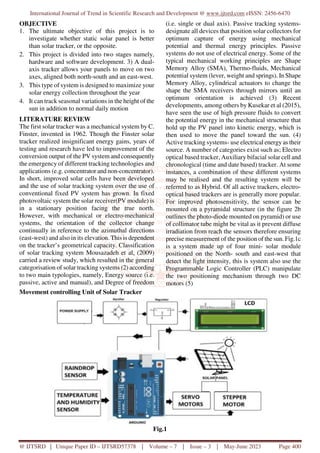
plants) convert the sun’s energy into solar electricity. The sun is the largest source of energy in the form of heat
and light energy. Solar Power has a huge potential to make a major impact on the electricity requirement in
homes and industries. That the sun supplies as much energy onto the earth in a single day that equals the annual
energy requirement is enough to judge the amount of solar energy that goes untapped
International Journal of Trend in Scientific Research and Development @ www.ijtsrd.com eISSN: 2456-6470
@ IJTSRD | Unique Paper ID – IJTSRD57378 | Volume – 7 | Issue – 3 | May-June 2023 Page 402
Solar Power can be used to supply electricity to homes, commercial. There are various types of Solar Power
systems. It would be ideal to use a stand-alone solar energy system. This type of system has lesser number of
solar panels and batteries, making them economical. The function of the batteries is to collect solar energy
during daytime. The system has an inverter that transforms the DC current into AC current that can be used by
the appliances. How to Control the Angle of the Servo Motor? The job of a servo motor is to control the angle of
rotation in a closed-loop control system and use the feedback to adjust the speed and angle of the motor to the
active desired result
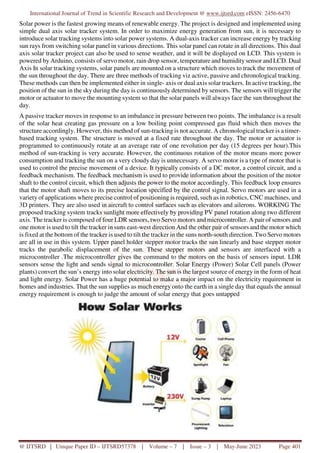
Servo Motor Functional Block Diagram
Fig .2
The SG90 servo motor we are using uses a closed-loop control system to control the shaft position of the motor.
To change the position of the motor arm, you just need to provide a 50Hz PWM signal with a variable duty
cycle. To control the shaft angle of the servo motor, you need to send in a series of pulses to the servo motor; a
conventional servo motor expects to receive a pulse every 20 milliseconds with a duty cycle of 50Hz. The
control board inside the servo motor is so designed that the length of the pulse determines the angle of the servo
shaft. If the pulse is high for 1ms, then the servo angle will be at a 0-degree position. The 1.5ms pulse will take
the shat to a 90-degree position, and a high pulse of 2ms will send the servo arm to 180 degrees. A pulse ranging
from 1ms to 2ms will move the servo shaft to a 180-degree position.
Dual Axis Solar Tracker Circuit Diagram
Fig.3
CONCLUSION
As solar energy is considered one of the main sources
of energy in the near future, In this paper, we give a
simple and concise overview of the solar tracking
mechanism to improve the solar gain energy, also the
costs of the solar tracker operation and cost
maintenance is relatively low. In this paper, Design
and implementation of solar tracker with two axes
that Use in motor satellite dish to track the sun
accurately and use LDR sensor to determine the
intensity of falling sunlight. We found that the solar
tracking system is more effective than the fixed solar
panel. The energy gained from the solar panel with
the dual tracker exceeds 35% of the energy gained
from the fixed solar panel, In analyzing the data, the
energy gained from the solar tracker is mostly in the
International Journal of Trend in Scientific Research and Development @ www.ijtsrd.com eISSN: 2456-6470
@ IJTSRD | Unique Paper ID – IJTSRD57378 | Volume – 7 | Issue – 3 | May-June 2023 Page 403
morning and in the evening because at noon time
there is little difference and this proves that the fixed
solar panel is efficient during noon time only. The
dual-axle solar tracking system is efficient as it can be
placed anywhere and ensure a high energy gain.
REFERENCES
[1] Falah I. Mustafa Sarmid Shakir; Faiz50F.
Mustafa; AthmarThamer Naiyf2018 9th
International Renewable Energy Congress
(IREC)
[2] T. Zhan, W. Lin, M. Tsai, G. Wang, "Design
and Implementation of the Dual-axis Solar
Tracking System IEEE", 37th Annual
Computer Software and Applications
Conference, pp. 276-277, 2011.
[3] M. Zolkapli, S. A. AI-Junid, Z. Othman, A.
Manut, MohdZulkifli, "IEEE", International
Conference on Technology Informatics
Management Engineering & Environment, pp.
43-47, 2013.
[4] Nabeel Abid Al-Sahib, Falah I. Mustafa, Ayad
M. Kwad, The Fourth International Renewable
Energy Congress, December 20-22, 2012.
[5] Power from the sun. (n.d.). Retrieved from
http://www. powerfromthesun.net/Book/
[6] The Sun's Position. (2013, March 28). In
Photovoltaic Education Network, from
http://pveducation.org/pvcdrom/properties-
ofsunlight/suns-position

Dual Axis Solar Tracking System with Weather Sensor

  • 1.
    International Journal ofTrend in Scientific Research and Development (IJTSRD) Volume 7 Issue 3, May-June 2023 Available Online: www.ijtsrd.com e-ISSN: 2456 – 6470 @ IJTSRD | Unique Paper ID – IJTSRD57378 | Volume – 7 | Issue – 3 | May-June 2023 Page 399 Dual Axis Solar Tracking System with Weather Sensor Mrs. Surbhi R. Shroff V.P.M’s Polytechnic, Thane, Maharashtra, India ABSTRACT Energy crisis is one in every of the major problems in world developing countries like Republic of India. There's a huge gap between generation and demand of current. Nearly half of the population of the country cannot get the power supply. Renewable energy is one of the answers to solve this issue. Solar power is one in every of the foremost effective resources of the renewable energy that might play a big role to resolve this drawback. This analysis presents a performance analysis of the dual axis solar tracking system using Arduino and led & servo motors. The most objective of this research is whether the solar tracker is better than a solar panel. This work is split into 2 light dependent resistors (LDR) is employed to observe the almost source of illumination from the sun. Two servo motors put together accustomed move the electrical device to most source of illumination location perceived by the LDRs. In the other half, the software part is written by using C programming language which head towards to the Arduino UNO controller. The result of the solar tracking system has analyzed and compared with the mounted or static solar panel found higher performance in terms of current, power and voltage. Therefore, the solar tracking system is evidenced additional sensible for capturing the most daylight provide for star gathering applications. The result showed dual axis solar tracking system made further 10.53- watt power compared with mounted (fixed) and single axis solar tracking system. Components hardware and computer code. How to cite this paper: Mrs. Surbhi R. Shroff "Dual Axis Solar Tracking System with Weather Sensor" Published in International Journal of Trend in Scientific Research and Development (ijtsrd), ISSN: 2456- 6470, Volume-7 | Issue-3, June 2023, pp.399-403, URL: www.ijtsrd.com/papers/ijtsrd57378.pdf Copyright © 2023 by author (s) and International Journal of Trend in Scientific Research and Development Journal. This is an Open Access article distributed under the terms of the Creative Commons Attribution License (CC BY 4.0) (http://creativecommons.org/licenses/by/4.0) KEYWORDS: Dual Axis, Stepper Motor, LDR Sensors, Declination Angle INTRODUCTION As sun is a major source of this renewable energy, a dual axis solar tracker which can track the radiations from the sun in all the directions with maximum intensity is found. This dual axis solar tracker takes the sun radiations as the input and converts to electrical energy this electrical energy which is obtained fulfil majority of the country needs. Energy absorption is maximum when the panel is perpendicular to the sun. Hence we are using a solar tracker to maximize the energy generation and improve the efficiency 40% more than the fixed panel. In general, during the day the single axis tracker moves from east to west with one degree of freedom. While the modem tracker tracks east west and north south movement of the sun. In this project we are integrating dual axis solar tracking. The demand for reliable source of energy has been increasing day by day. So, government improved the usage of renewable energy sources there by curtailing the usage of conventional source of energy. By using photovoltaic cell we can harness solar energy and later photovoltaic effect can be used to convert solar energy into electrical energy and this energy can be used in wide applications like solar thermal energy, solar heating, photovoltaic, solar architecture etc. The output of photovoltaic cell directly depends on the intensity of light and sun's positions changes continuously in a day. In general, during the day the single axis tracker moves from east to west with one degree of freedom. While the modern tracker tracks east west and north south movement of the sun. In this project we are integrating dual axis solar tracking. The project is designed and implemented using simple dual axis solar tracker system. In order to maximize energy generation from sun, it is necessary to introduce solar tracking systems into solar power systems. A dual-axis tracker can increase energy by tracking sun rays from switching solar panel in various directions. IJTSRD57378
  • 2.
    International Journal ofTrend in Scientific Research and Development @ www.ijtsrd.com eISSN: 2456-6470 @ IJTSRD | Unique Paper ID – IJTSRD57378 | Volume – 7 | Issue – 3 | May-June 2023 Page 400 OBJECTIVE 1. The ultimate objective of this project is to investigate whether static solar panel is better than solar tracker, or the opposite. 2. This project is divided into two stages namely, hardware and software development. 3) A dual- axis tracker allows your panels to move on two axes, aligned both north-south and an east-west. 3. This type of system is designed to maximize your solar energy collection throughout the year 4. It can track seasonal variations in the height of the sun in addition to normal daily motion LITERATURE REVIEW The first solar tracker was a mechanical system by C. Finster, invented in 1962. Though the Finster solar tracker realized insignificant energy gains, years of testing and research have led to improvement of the conversion output of the PV system and consequently the emergency of different tracking technologies and applications (e.g. concentrator and non-concentrator). In short, improved solar cells have been developed and the use of solar tracking system over the use of conventional fixed PV system has grown. In fixed photovoltaic system the solar receiver(PV module) is in a stationary position facing the true north. However, with mechanical or electro-mechanical systems, the orientation of the collector change continually in reference to the azimuthal directions (east-west) and also in its elevation. This is dependent on the tracker’s geometrical capacity. Classification of solar tracking system Mousazadeh et al, (2009) carried a review study, which resulted in the general categorisation of solar tracking systems (2) according to two main typologies, namely, Energy source (i.e. passive, active and manual), and Degree of freedom (i.e. single or dual axis). Passive tracking systems- designate all devices that position solar collectors for optimum capture of energy using mechanical potential and thermal energy principles. Passive systems do not use of electrical energy. Some of the typical mechanical working principles are Shape Memory Alloy (SMA), Thermo-fluids, Mechanical potential system (lever, weight and springs). In Shape Memory Alloy, cylindrical actuators to change the shape the SMA receivers through mirrors until an optimum orientation is achieved (3) Recent developments, among others by Kusekar et al (2015), have seen the use of high pressure fluids to convert the potential energy in the mechanical structure that hold up the PV panel into kinetic energy, which is then used to move the panel toward the sun. (4) Active tracking systems- use electrical energy as their source. A number of categories exist such as; Electro optical based tracker, Auxiliary bifacial solar cell and chronological (time and date based) tracker. At some instances, a combination of these different systems may be realised and the resulting system will be referred to as Hybrid. Of all active trackers, electro- optical based trackers are is generally more popular. For improved photosensitivity, the sensor can be mounted on a pyramidal structure (in the figure 2b outlines the photo-diode mounted on pyramid) or use of collimator tube might be vital as it prevent diffuse irradiation from reach the sensors therefore ensuring precise measurement of the position of the sun. Fig.1c is a system made up of four mini- solar module positioned on the North- south and east-west that detect the light intensity, this is system also use the Programmable Logic Controller (PLC) manipulate the two positioning mechanism through two DC motors (5) Movement controlling Unit of Solar Tracker Fig.1
  • 3.
    International Journal ofTrend in Scientific Research and Development @ www.ijtsrd.com eISSN: 2456-6470 @ IJTSRD | Unique Paper ID – IJTSRD57378 | Volume – 7 | Issue – 3 | May-June 2023 Page 401 Solar power is the fastest growing means of renewable energy. The project is designed and implemented using simple dual axis solar tracker system. In order to maximize energy generation from sun, it is necessary to introduce solar tracking systems into solar power systems. A dual-axis tracker can increase energy by tracking sun rays from switching solar panel in various directions. This solar panel can rotate in all directions. This dual axis solar tracker project can also be used to sense weather, and it will be displayed on LCD. This system is powered by Arduino, consists of servo motor, rain drop sensor, temperature and humiditysensor and LCD. Dual Axis In solar tracking systems, solar panels are mounted on a structure which moves to track the movement of the sun throughout the day. There are three methods of tracking viz active, passive and chronological tracking. These methods can then be implemented either in single- axis or dual axis solar trackers. In active tracking, the position of the sun in the sky during the day is continuously determined by sensors. The sensors will trigger the motor or actuator to move the mounting system so that the solar panels will always face the sun throughout the day. A passive tracker moves in response to an imbalance in pressure between two points. The imbalance is a result of the solar heat creating gas pressure on a low boiling point compressed gas fluid which then moves the structure accordingly. However, this method of sun-tracking is not accurate. A chronological tracker is a timer- based tracking system. The structure is moved at a fixed rate throughout the day. The motor or actuator is programmed to continuously rotate at an average rate of one revolution per day (15 degrees per hour).This method of sun-tracking is very accurate. However, the continuous rotation of the motor means more power consumption and tracking the sun on a very cloudy day is unnecessary. A servo motor is a type of motor that is used to control the precise movement of a device. It typically consists of a DC motor, a control circuit, and a feedback mechanism. The feedback mechanism is used to provide information about the position of the motor shaft to the control circuit, which then adjusts the power to the motor accordingly. This feedback loop ensures that the motor shaft moves to its precise location specified by the control signal. Servo motors are used in a variety of applications where precise control of positioning is required, such as in robotics, CNC machines, and 3D printers. They are also used in aircraft to control surfaces such as elevators and ailerons. WORKING The proposed tracking system tracks sunlight more effectively by providing PV panel rotation along two different axis. The tracker is composed of four LDR sensors, two Servo motors and microcontroller. A pair of sensors and one motor is used to tilt the tracker in suns east-west direction And the other pair of sensors and the motor which is fixed at the bottom of the tracker is used to tilt the tracker in the suns north-south direction. Two Servo motors are all in use in this system. Upper panel holder stepper motor tracks the sun linearly and base stepper motor tracks the parabolic displacement of the sun. These stepper motors and sensors are interfaced with a microcontroller .The microcontroller gives the command to the motors on the basis of sensors input. LDR sensors sense the light and sends signal to microcontroller. Solar Energy (Power) Solar Cell panels (Power plants) convert the sun’s energy into solar electricity. The sun is the largest source of energy in the form of heat and light energy. Solar Power has a huge potential to make a major impact on the electricity requirement in homes and industries. That the sun supplies as much energy onto the earth in a single day that equals the annual energy requirement is enough to judge the amount of solar energy that goes untapped
  • 4.
    International Journal ofTrend in Scientific Research and Development @ www.ijtsrd.com eISSN: 2456-6470 @ IJTSRD | Unique Paper ID – IJTSRD57378 | Volume – 7 | Issue – 3 | May-June 2023 Page 402 Solar Power can be used to supply electricity to homes, commercial. There are various types of Solar Power systems. It would be ideal to use a stand-alone solar energy system. This type of system has lesser number of solar panels and batteries, making them economical. The function of the batteries is to collect solar energy during daytime. The system has an inverter that transforms the DC current into AC current that can be used by the appliances. How to Control the Angle of the Servo Motor? The job of a servo motor is to control the angle of rotation in a closed-loop control system and use the feedback to adjust the speed and angle of the motor to the active desired result Servo Motor Functional Block Diagram Fig .2 The SG90 servo motor we are using uses a closed-loop control system to control the shaft position of the motor. To change the position of the motor arm, you just need to provide a 50Hz PWM signal with a variable duty cycle. To control the shaft angle of the servo motor, you need to send in a series of pulses to the servo motor; a conventional servo motor expects to receive a pulse every 20 milliseconds with a duty cycle of 50Hz. The control board inside the servo motor is so designed that the length of the pulse determines the angle of the servo shaft. If the pulse is high for 1ms, then the servo angle will be at a 0-degree position. The 1.5ms pulse will take the shat to a 90-degree position, and a high pulse of 2ms will send the servo arm to 180 degrees. A pulse ranging from 1ms to 2ms will move the servo shaft to a 180-degree position. Dual Axis Solar Tracker Circuit Diagram Fig.3 CONCLUSION As solar energy is considered one of the main sources of energy in the near future, In this paper, we give a simple and concise overview of the solar tracking mechanism to improve the solar gain energy, also the costs of the solar tracker operation and cost maintenance is relatively low. In this paper, Design and implementation of solar tracker with two axes that Use in motor satellite dish to track the sun accurately and use LDR sensor to determine the intensity of falling sunlight. We found that the solar tracking system is more effective than the fixed solar panel. The energy gained from the solar panel with the dual tracker exceeds 35% of the energy gained from the fixed solar panel, In analyzing the data, the energy gained from the solar tracker is mostly in the
  • 5.
    International Journal ofTrend in Scientific Research and Development @ www.ijtsrd.com eISSN: 2456-6470 @ IJTSRD | Unique Paper ID – IJTSRD57378 | Volume – 7 | Issue – 3 | May-June 2023 Page 403 morning and in the evening because at noon time there is little difference and this proves that the fixed solar panel is efficient during noon time only. The dual-axle solar tracking system is efficient as it can be placed anywhere and ensure a high energy gain. REFERENCES [1] Falah I. Mustafa Sarmid Shakir; Faiz50F. Mustafa; AthmarThamer Naiyf2018 9th International Renewable Energy Congress (IREC) [2] T. Zhan, W. Lin, M. Tsai, G. Wang, "Design and Implementation of the Dual-axis Solar Tracking System IEEE", 37th Annual Computer Software and Applications Conference, pp. 276-277, 2011. [3] M. Zolkapli, S. A. AI-Junid, Z. Othman, A. Manut, MohdZulkifli, "IEEE", International Conference on Technology Informatics Management Engineering & Environment, pp. 43-47, 2013. [4] Nabeel Abid Al-Sahib, Falah I. Mustafa, Ayad M. Kwad, The Fourth International Renewable Energy Congress, December 20-22, 2012. [5] Power from the sun. (n.d.). Retrieved from http://www. powerfromthesun.net/Book/ [6] The Sun's Position. (2013, March 28). In Photovoltaic Education Network, from http://pveducation.org/pvcdrom/properties- ofsunlight/suns-position