
Putting the forces in motion: Applying technology to foster writing through motivating online environments Lecture 3 in Writing in a Multiliterate Flat World Multiliterate approaches to writing and collaboration through social networking Vance Stevens, Petroleum Institute Abu Dhabi, United Arab Emirates XXVI Summer Courses of the University of the Basque Country San Sebastian, Spain, 11th-13th July 2007
What motivates students to write? The most critical motivators are Having an idea worth putting forth and discussing An audience for ideas A deadline.  Once motivation is there The rest is magic.  It just happens.
How Blogging motivates writing Motivates students to write by exploring their ideas in conjunction with peers Encourages better writing by passing it through the crucible of feedback from peers.  A  student in one of Paul Allison's videos said,  you can write something and think it is totally correct, but when someone else reads it they can find some aspect that the writer didn't think of. This kind of feedback, coming from another student, is much more meaningful to that student in some respects than a comment his teacher might have made.
Youth Voices Podcasts on the Worldbridges Network of Teachers Teaching Teachers  http://teachersteachingteachers.org   Youth Voices  http://youthvoices.net./elgg ,  remarkable outcomes from student bloggers whose writing has taken on a sort of cult quality, who have found audiences they, nor their teachers, could have imagined.  Paul Allison's videos on blogging at  http://www.veoh.com/series/paulallison  ...  engaging presentations of the process of writing that goes into Paul's students' blog postings –  Freewriting sentence starters bubble cartoon devices  how the students respond to one another.
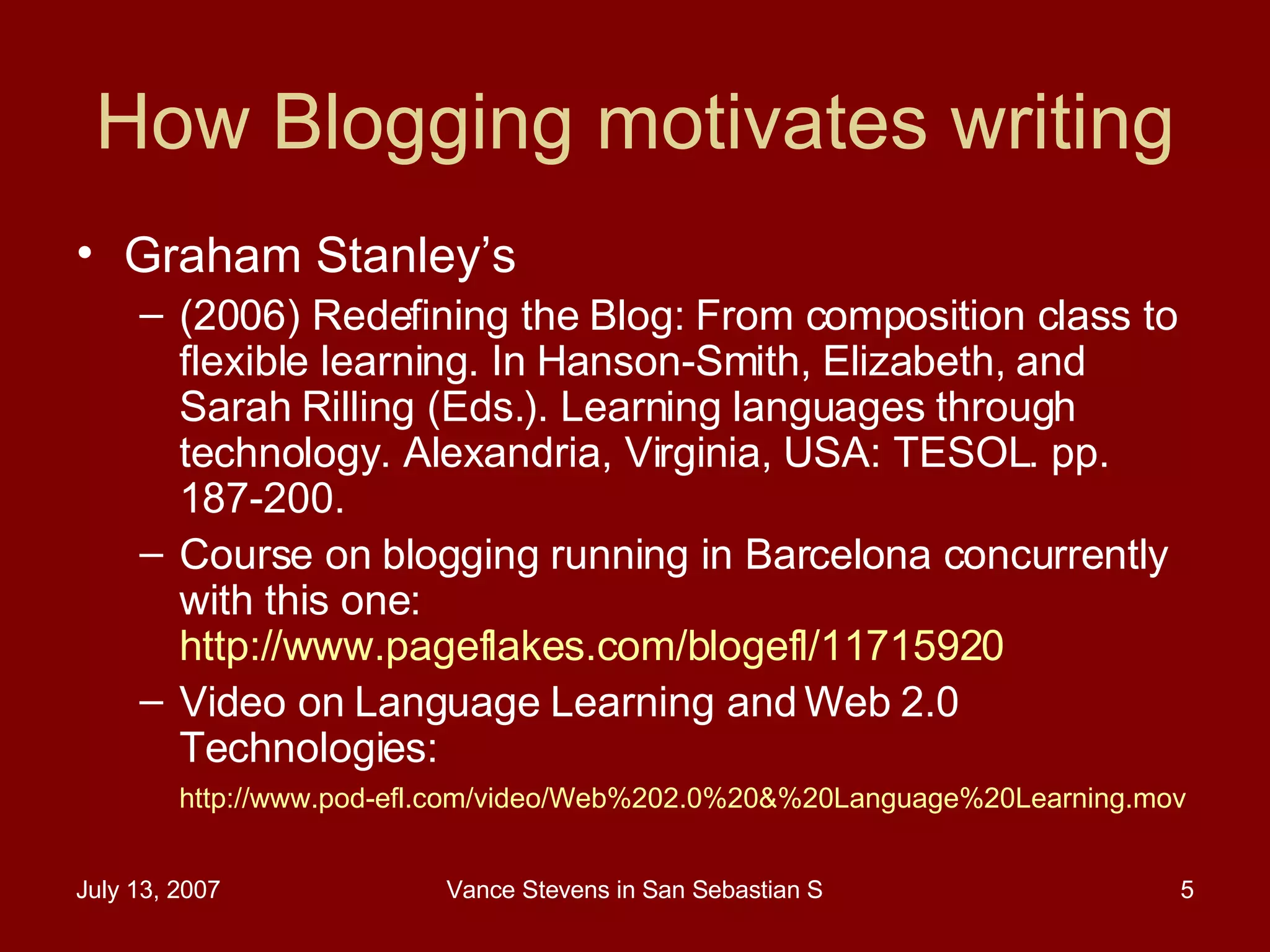
How Blogging motivates writing Graham Stanley’s  (2006) Redefining the Blog: From composition class to flexible learning. In Hanson-Smith, Elizabeth, and Sarah Rilling (Eds.). Learning languages through technology. Alexandria, Virginia, USA: TESOL. pp. 187-200.  Course on blogging running in Barcelona concurrently with this one:  http://www.pageflakes.com/blogefl/11715920   Video on Language Learning and Web 2.0 Technologies:  http ://www.pod-efl.com/video/Web%202.0%20&%20Language%20Learning.mov
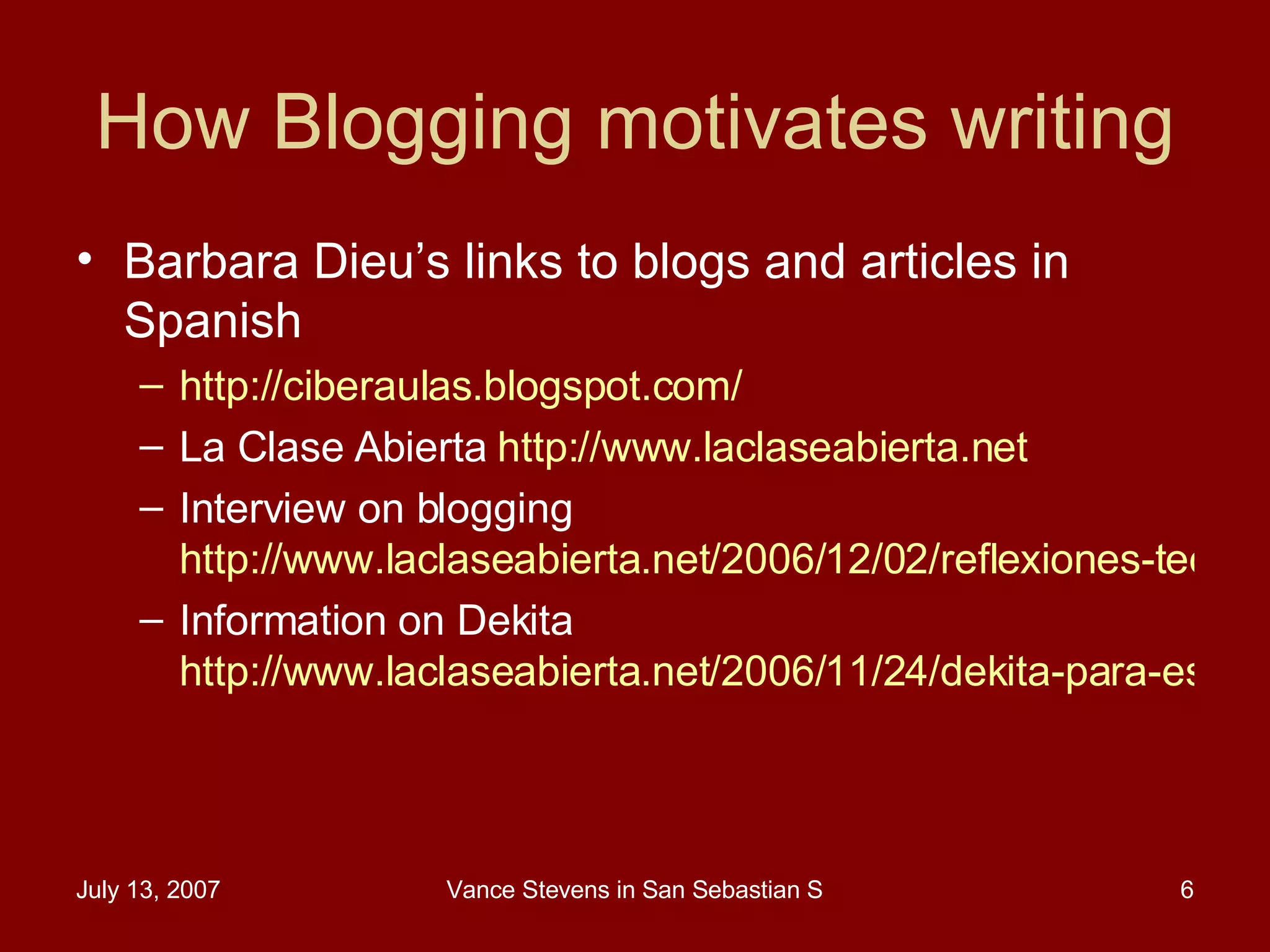
How Blogging motivates writing Barbara Dieu’s links to blogs and articles in Spanish  http://ciberaulas.blogspot.com/   La Clase Abierta  http://www.laclaseabierta.net   Interview on blogging  http://www.laclaseabierta.net/2006/12/02/reflexiones-tecnologicas-de-barbara-dieu/  Information on Dekita  http://www.laclaseabierta.net/2006/11/24/dekita-para-estudiantes-de-ingles-como-lengua-extranjera/
Other online resources for gathering information on a topic Search engines  http://www.google.com   Wikipedia Web 2.0 tools that allow Tagging Aggregation
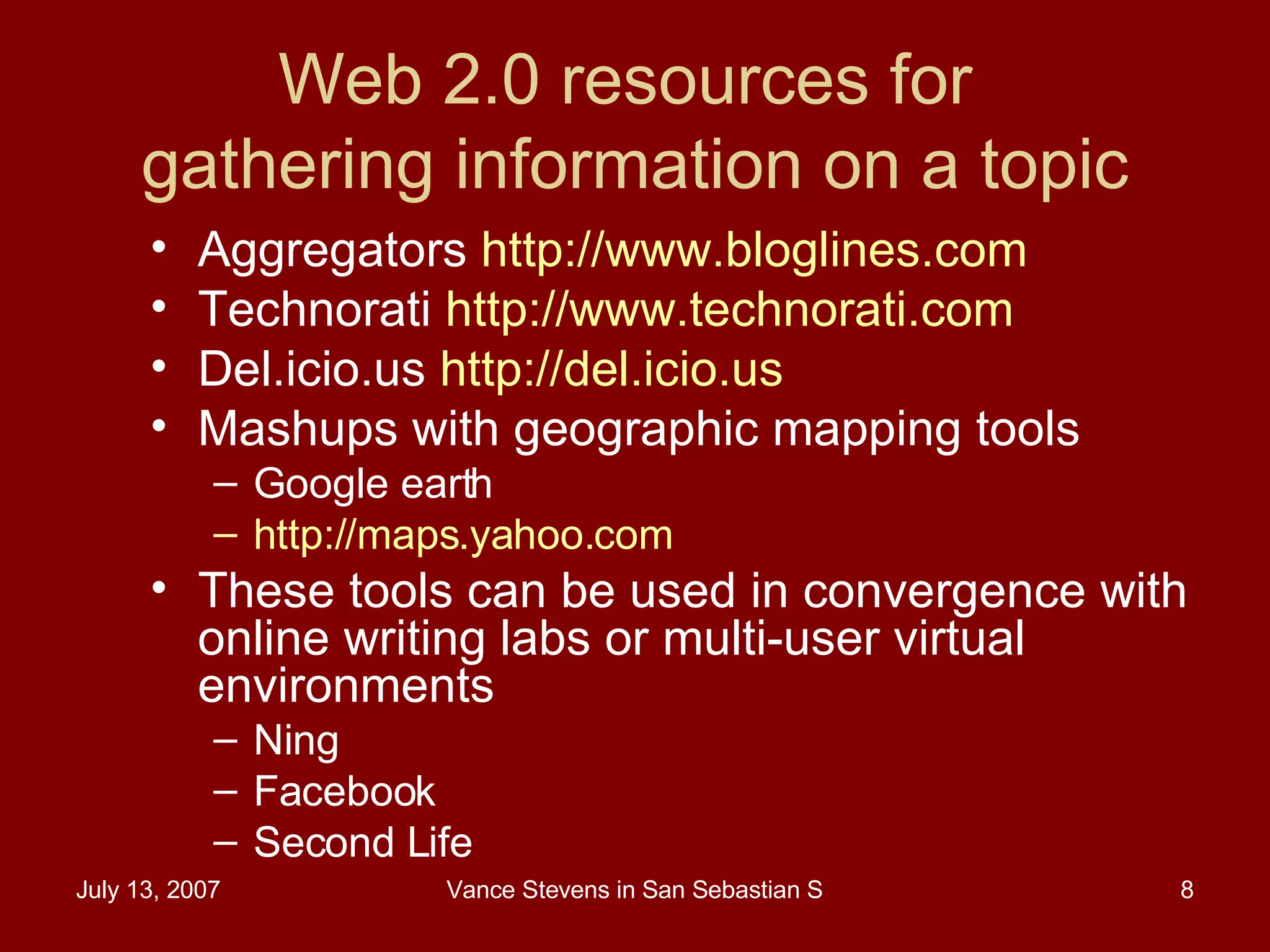
Web 2.0 resources for  gathering information on a topic Aggregators  http://www.bloglines.com   Technorati  http://www.technorati.com   Del.icio.us  http://del.icio.us   Mashups with geographic mapping tools Google earth http://maps.yahoo.com   These tools can be used in convergence with online writing labs or multi-user virtual environments Ning Facebook Second Life
Web 2.0 resources for incorporating muliliteracies Powerful free media processing tools Audacity Windows Movie Maker Blending sound and photo images Flickr Bubbleshare Sites for uploading videos that get messages across as well as help partners get to understand one another better Google Video Blip TV Operator 11 YouTube (and TeacherTube)
Convergences with other writing tools and online environments In addition to lower-level writing aids spelling software readability analysis systems automatic assisted translation text corpora, etc..
Web 2.0 resources to help students convey ideas Blogs for composition and feedback Wikis as collaborative spaces Charts in collaborative graphics tools like Gliffy Concept mapping tools  Presentation and spreadsheet in Open Office Google docs allows students to  Compose in collaboration with partners,  analyze data  collaboratively using spreadsheets numerous sites for storing slide presentations
Key concepts for utilizing Web 2.0 in motivating writing We talked about this in the last lecture the emerging read-write web is organized through folksonomies  We use tools to filter out those aspects of aggregated folksonomies that we are interested in HOW do we do this  (stay tuned … or wake up, as appropriate)
Using Technorati  in professional development Participants at international conferences are asked in advance to tag consistently with one another.  participants in Webheads in Action Online Convergence  http://wiaoc.org  tagged using wiaoc2007,  blog postings with that tag can now be aggregated (and wiaoc is also a productive tag; try it:  http://www.technorati.com/posts/tag/wiaoc ).  Future of Education conference requested participants to use a pre-assigned tag FOE2007, with content aggregated at:  http://www.pageflakes.com/ltc/10987119 ,  subscribe to the Technorati feed on that tag by copying the link shortcut to your Bloglines from the top of this page:  http://www.technorati.com/posts/tag/foe2007 .
Writing Process: Idea collaboration using tagging & social networking Writingmatrix project created in preparation for these lectures.  Students are Spanish-speakers from Argentina and Venezuela; also Slovenia Purpose: to learn how tagged learning objects are aggregated in a way that encourages collaboration which in turn elicits writing Why this topic?  Widespread use is only just emerging Requires some training in teachers and learners Participants here will likely attain a new skill
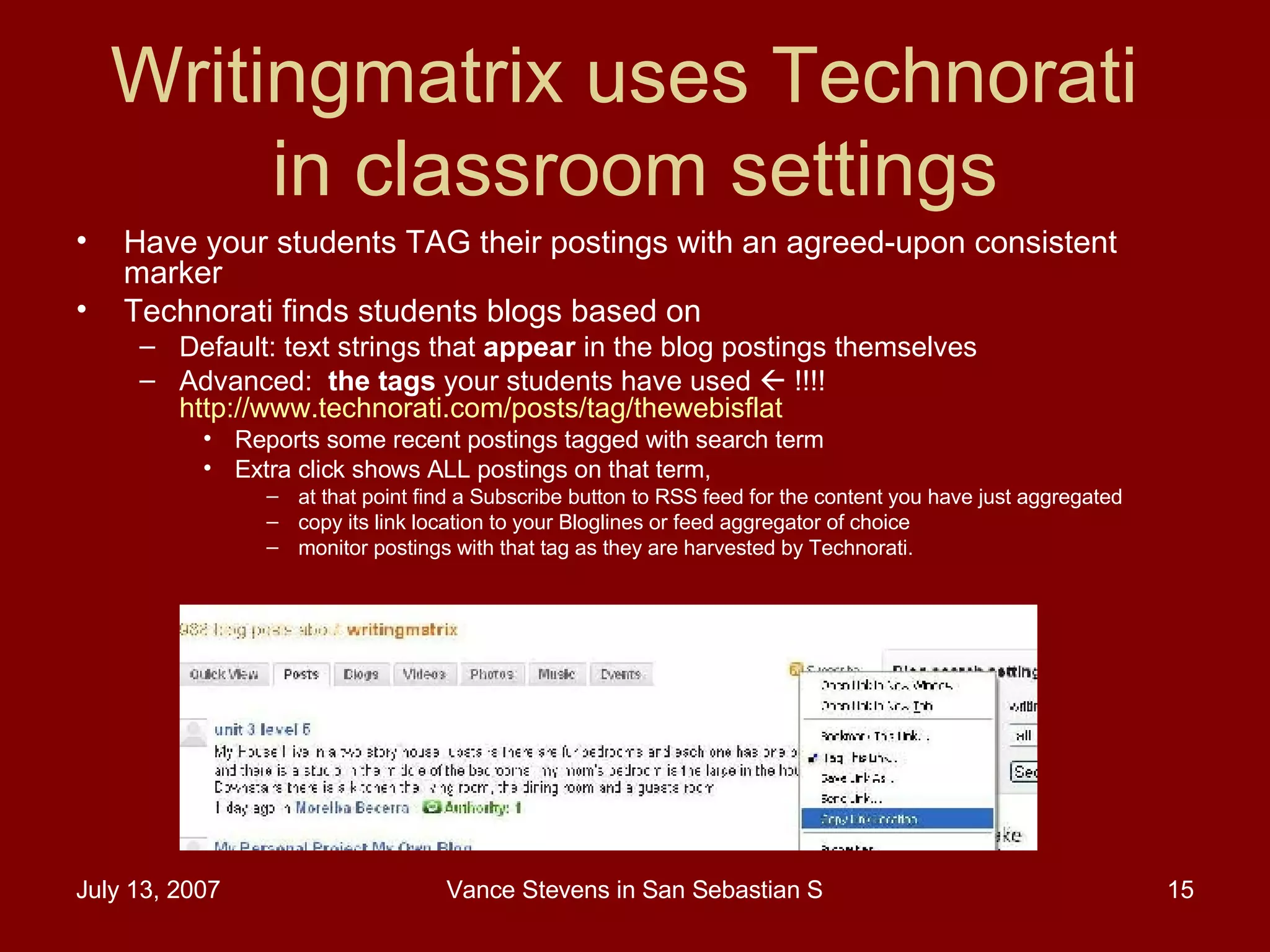
Writingmatrix uses Technorati  in classroom settings Have your students TAG their postings with an agreed-upon consistent marker Technorati finds students blogs based on  Default: text strings that  appear  in the blog postings themselves Advanced:  the tags  your students have used    !!!! http://www.technorati.com/posts/tag/thewebisflat   Reports some recent postings tagged with search term  Extra click shows ALL postings on that term, at that point find a Subscribe button to RSS feed for the content you have just aggregated  copy its link location to your Bloglines or feed aggregator of choice  monitor postings with that tag as they are harvested by Technorati.
Del.icio.us http://del.icio.us  - a highly popular social bookmarking site,  Explanations of Del.icio.us for educators John Pederson's tutorial on Using Del.icio.us in Education  http://docs.google.com/View?docid=ad62vwjv8zm_6fh3r2s   Aixa Almonte's Learning 2.0 Tip-of-the-week for 24 May 2006, a 9 min screencast on using del.icio.us to build a 'reading list' and a 'syllabus' -  http://learning2.0.ottergroup.com/blog/_archives/2006/5/24/1981354.html
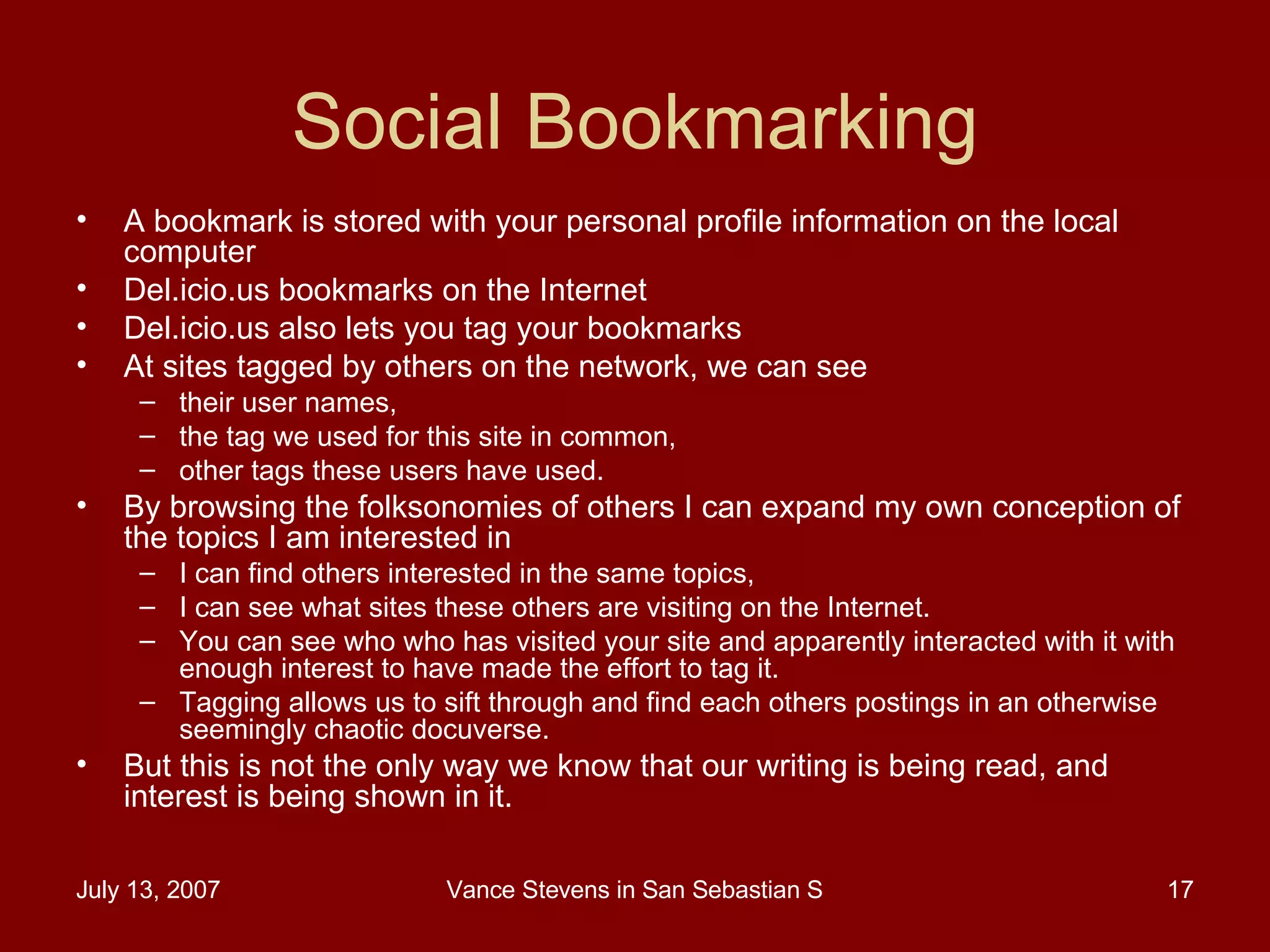
Social Bookmarking A bookmark is stored with your personal profile information on the local computer Del.icio.us bookmarks on the Internet  Del.icio.us also lets you tag your bookmarks  At sites tagged by others on the network, we can see  their user names,  the tag we used for this site in common,  other tags these users have used.  By browsing the folksonomies of others I can expand my own conception of the topics I am interested in I can find others interested in the same topics,  I can see what sites these others are visiting on the Internet. You can see who who has visited your site and apparently interacted with it with enough interest to have made the effort to tag it. Tagging allows us to sift through and find each others postings in an otherwise seemingly chaotic docuverse.  But this is not the only way we know that our writing is being read, and interest is being shown in it.
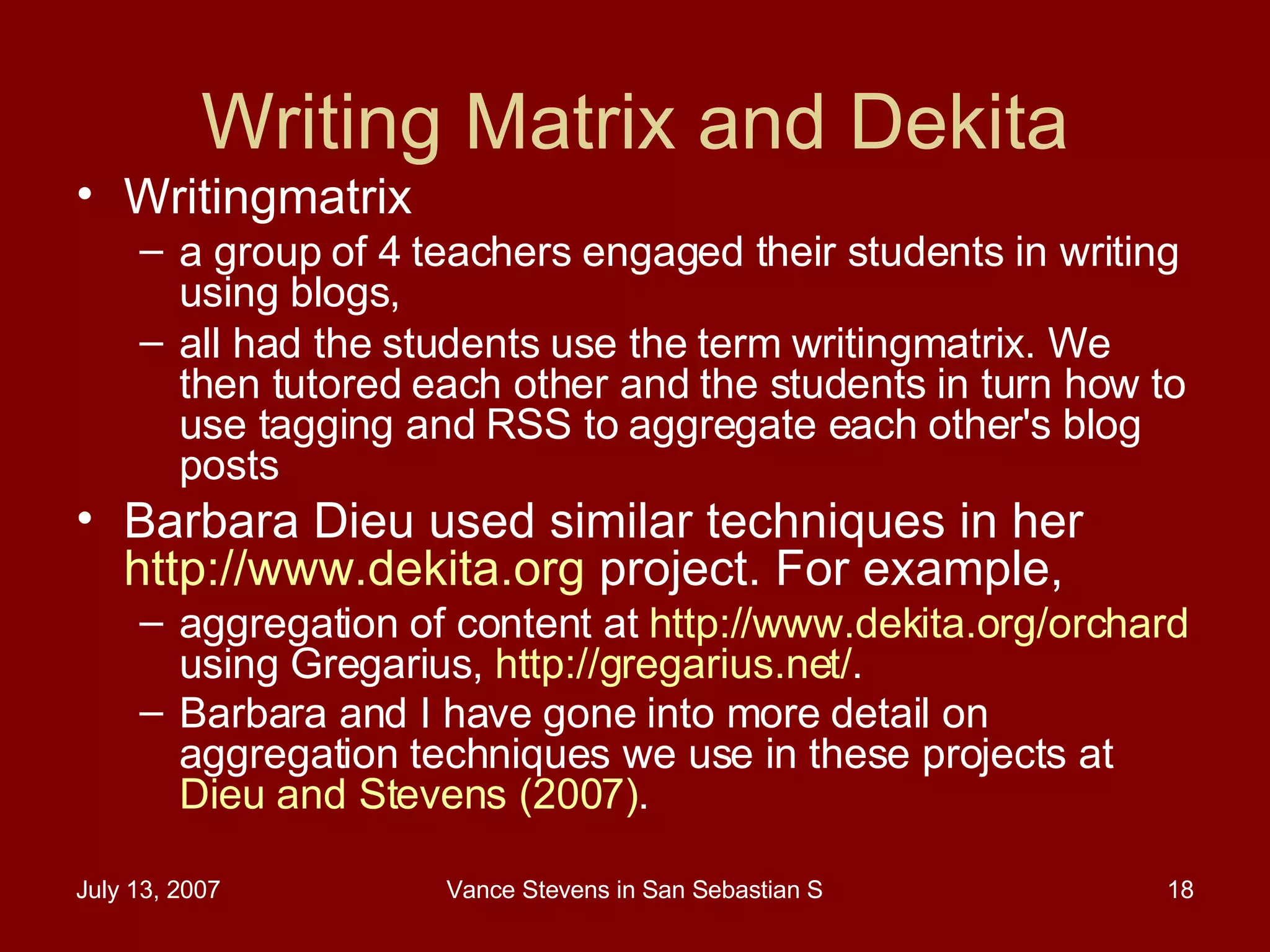
Writing Matrix and Dekita Writingmatrix  a group of 4 teachers engaged their students in writing using blogs,  all had the students use the term writingmatrix. We then tutored each other and the students in turn how to use tagging and RSS to aggregate each other's blog posts Barbara Dieu used similar techniques in her  http://www.dekita.org  project. For example,  aggregation of content at  http://www.dekita.org/orchard  using Gregarius,  http://gregarius.net/ .  Barbara and I have gone into more detail on aggregation techniques we use in these projects at  Dieu and Stevens (2007) .
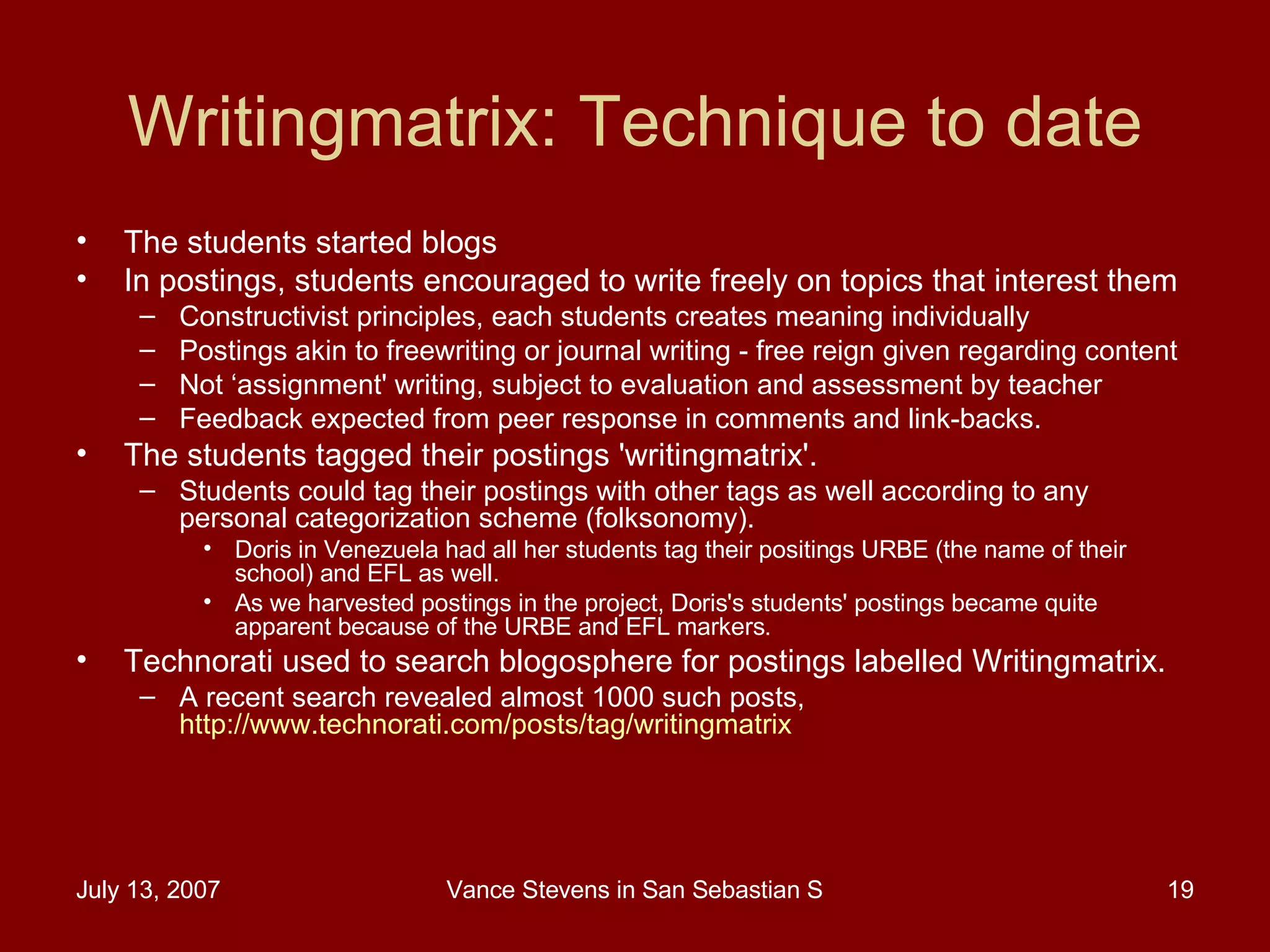
Writingmatrix: Technique to date The students started blogs In postings, students encouraged to write freely on topics that interest them  Constructivist principles, each students creates meaning individually Postings akin to freewriting or journal writing - free reign given regarding content Not ‘assignment' writing, subject to evaluation and assessment by teacher Feedback expected from peer response in comments and link-backs.  The students tagged their postings 'writingmatrix'.  Students could tag their postings with other tags as well according to any personal categorization scheme (folksonomy).  Doris in Venezuela had all her students tag their positings URBE (the name of their school) and EFL as well.  As we harvested postings in the project, Doris's students' postings became quite apparent because of the URBE and EFL markers.  Technorati used to search blogosphere for postings labelled Writingmatrix.  A recent search revealed almost 1000 such posts,  http://www.technorati.com/posts/tag/writingmatrix
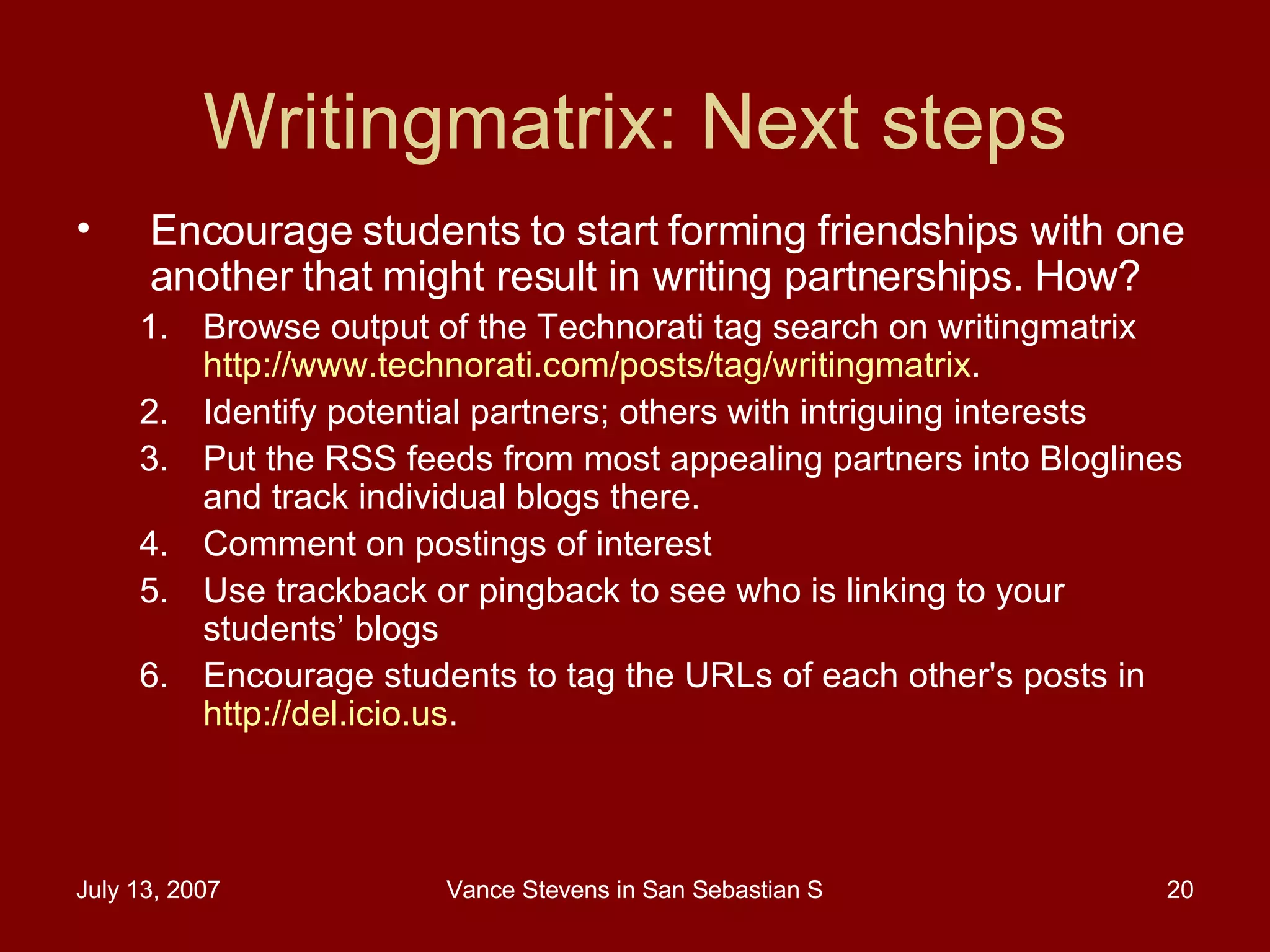
Writingmatrix: Next steps Encourage students to start forming friendships with one another that might result in writing partnerships. How? Browse output of the Technorati tag search on writingmatrix  http://www.technorati.com/posts/tag/writingmatrix .  Identify potential partners; others with intriguing interests Put the RSS feeds from most appealing partners into Bloglines and track individual blogs there.  Comment on postings of interest Use trackback or pingback to see who is linking to your students’ blogs Encourage students to tag the URLs of each other's posts in  http://del.icio.us .
Writingmatrix: Impacts on Writing Tagging each other's posts and exploring how others have tagged them through Del.icio.us can be a mind-opening experience.  Reinforcing and accordingly motivating to discover that others are tagging what you produce and place on the Internet,  Intriguing to follow the links that these others have tagged to see what  their  interests are.  Students might be motivated to make discoveries of authentic interest so that a motivation to write can be nurtured.
Writingmatrix: Evidence of Anticipated Outcomes Students are reaching each other through each other’s blog posts As evidence of interest in interaction, apprx 10 students from Venezuela and Argentina recently met in a Yahoo Messenger chat Presentations given online are watched by the students. Students thrilled when we show audiences examples of postings the tag search identified, and randomly pull up their blogs Sasha from Slovenia, has just written, though her classes have ended and she and her students are on summer holidays:  "another student of mine opened his blog and joined our project – 2 months after our classes officially ended : - ). It's really nice to remain in touch through blogging – everyone working at his own pace without any pressure” Slovenia students are well represented in Frappr map at Moodle for the current lectures
Demonstrations: How it is done If we have results from any of the students present we can look at those on Technorati. If there are blog posts tagged  thewebisflat  then they will appear here:  http://www.technorati.com/posts/tag/thewebisflat   I can show my Bloglines and how I use it to track classes of students who keep blogs for me.  I have slides explaining the technique of Newsmastering that Robin Good showed me for  http://www.mysyndicaat.com . I've placed a version of this presentation here:  http://advanceducation.blogspot.com/2007/06/preparing-to-give-series-of-lectures-in.html   I will show how Bloglines can also be used to aggregate content from feeds such as that produced by other searches  I will show how del.icio.us can be used to explore who else is reading my blog posts and what else  they  are tagging
Me.dium and Mashups http://me.dium.com  lets you see when your buddies are browsing the same site (e.g. my blog where my writing is) at the same time I happen to be there.  Interesting 'mashups' mentioned in DIY Educators Gone Wild: Where are the Instructional Mash-Ups? by Brian Lamb:  http://openconnectedsocial.learningparty.net/wiki/page/Mashups .  PageFlakes which we talked about earlier a user-created mashup of Craig's List and Google Maps that shows you exactly  where  the apartments listed  are .  Brian Lamb points out that RSS is one of the more infinitely mashable types of code.  Educators might be thinking how existing Web 2.0 scripts and programs might be made to work together, something along the lines of  http://www.dekita.org/orchard  being just one example.
Pedagogy Skills as complex as writing and language acquisition are  ineffable  (indescribable, understood only through experiences When we say teaching we really mean facilitation. Facilitation means to create the most conducive environment possible for learners, full of tools and learning objects.  Learning objects are created by the tools available in the environment. Therefore a good facilitator must be aware of   the latest and most useful tools  how to use them.  This talk has been an examination of some of the tools I think are useful to the writing process.  these particular tools are ones that educators tend to be not yet aware of  The tagging and collaboration techniques discussed here also utilize tools which educators can use, once they are aware of how they work, in the teaching of writing.
Ok, that’s all, folks!  If you want to REVIEW ALL of this you can just visit the URL below.  All the slides, all the recordings, the texts of the lectures are all there.   Maybe I’ll see you ONLINE  tomorrow. Start here:  http://webheads.info Vance Stevens http://www.vancestevens.com/writing.htm

Lecture3 - Putting the forces in motion

  • 1.
    Putting the forcesin motion: Applying technology to foster writing through motivating online environments Lecture 3 in Writing in a Multiliterate Flat World Multiliterate approaches to writing and collaboration through social networking Vance Stevens, Petroleum Institute Abu Dhabi, United Arab Emirates XXVI Summer Courses of the University of the Basque Country San Sebastian, Spain, 11th-13th July 2007
  • 2.
    What motivates studentsto write? The most critical motivators are Having an idea worth putting forth and discussing An audience for ideas A deadline. Once motivation is there The rest is magic. It just happens.
  • 3.
    How Blogging motivateswriting Motivates students to write by exploring their ideas in conjunction with peers Encourages better writing by passing it through the crucible of feedback from peers. A student in one of Paul Allison's videos said, you can write something and think it is totally correct, but when someone else reads it they can find some aspect that the writer didn't think of. This kind of feedback, coming from another student, is much more meaningful to that student in some respects than a comment his teacher might have made.
  • 4.
    Youth Voices Podcastson the Worldbridges Network of Teachers Teaching Teachers http://teachersteachingteachers.org Youth Voices http://youthvoices.net./elgg , remarkable outcomes from student bloggers whose writing has taken on a sort of cult quality, who have found audiences they, nor their teachers, could have imagined. Paul Allison's videos on blogging at http://www.veoh.com/series/paulallison ... engaging presentations of the process of writing that goes into Paul's students' blog postings – Freewriting sentence starters bubble cartoon devices how the students respond to one another.
  • 5.
    How Blogging motivateswriting Graham Stanley’s (2006) Redefining the Blog: From composition class to flexible learning. In Hanson-Smith, Elizabeth, and Sarah Rilling (Eds.). Learning languages through technology. Alexandria, Virginia, USA: TESOL. pp. 187-200. Course on blogging running in Barcelona concurrently with this one: http://www.pageflakes.com/blogefl/11715920 Video on Language Learning and Web 2.0 Technologies: http ://www.pod-efl.com/video/Web%202.0%20&%20Language%20Learning.mov
  • 6.
    How Blogging motivateswriting Barbara Dieu’s links to blogs and articles in Spanish http://ciberaulas.blogspot.com/ La Clase Abierta http://www.laclaseabierta.net Interview on blogging http://www.laclaseabierta.net/2006/12/02/reflexiones-tecnologicas-de-barbara-dieu/ Information on Dekita http://www.laclaseabierta.net/2006/11/24/dekita-para-estudiantes-de-ingles-como-lengua-extranjera/
  • 7.
    Other online resourcesfor gathering information on a topic Search engines http://www.google.com Wikipedia Web 2.0 tools that allow Tagging Aggregation
  • 8.
    Web 2.0 resourcesfor gathering information on a topic Aggregators http://www.bloglines.com Technorati http://www.technorati.com Del.icio.us http://del.icio.us Mashups with geographic mapping tools Google earth http://maps.yahoo.com These tools can be used in convergence with online writing labs or multi-user virtual environments Ning Facebook Second Life
  • 9.
    Web 2.0 resourcesfor incorporating muliliteracies Powerful free media processing tools Audacity Windows Movie Maker Blending sound and photo images Flickr Bubbleshare Sites for uploading videos that get messages across as well as help partners get to understand one another better Google Video Blip TV Operator 11 YouTube (and TeacherTube)
  • 10.
    Convergences with otherwriting tools and online environments In addition to lower-level writing aids spelling software readability analysis systems automatic assisted translation text corpora, etc..
  • 11.
    Web 2.0 resourcesto help students convey ideas Blogs for composition and feedback Wikis as collaborative spaces Charts in collaborative graphics tools like Gliffy Concept mapping tools Presentation and spreadsheet in Open Office Google docs allows students to Compose in collaboration with partners, analyze data collaboratively using spreadsheets numerous sites for storing slide presentations
  • 12.
    Key concepts forutilizing Web 2.0 in motivating writing We talked about this in the last lecture the emerging read-write web is organized through folksonomies We use tools to filter out those aspects of aggregated folksonomies that we are interested in HOW do we do this (stay tuned … or wake up, as appropriate)
  • 13.
    Using Technorati in professional development Participants at international conferences are asked in advance to tag consistently with one another. participants in Webheads in Action Online Convergence http://wiaoc.org tagged using wiaoc2007, blog postings with that tag can now be aggregated (and wiaoc is also a productive tag; try it: http://www.technorati.com/posts/tag/wiaoc ). Future of Education conference requested participants to use a pre-assigned tag FOE2007, with content aggregated at: http://www.pageflakes.com/ltc/10987119 , subscribe to the Technorati feed on that tag by copying the link shortcut to your Bloglines from the top of this page: http://www.technorati.com/posts/tag/foe2007 .
  • 14.
    Writing Process: Ideacollaboration using tagging & social networking Writingmatrix project created in preparation for these lectures. Students are Spanish-speakers from Argentina and Venezuela; also Slovenia Purpose: to learn how tagged learning objects are aggregated in a way that encourages collaboration which in turn elicits writing Why this topic? Widespread use is only just emerging Requires some training in teachers and learners Participants here will likely attain a new skill
  • 15.
    Writingmatrix uses Technorati in classroom settings Have your students TAG their postings with an agreed-upon consistent marker Technorati finds students blogs based on Default: text strings that appear in the blog postings themselves Advanced: the tags your students have used  !!!! http://www.technorati.com/posts/tag/thewebisflat Reports some recent postings tagged with search term Extra click shows ALL postings on that term, at that point find a Subscribe button to RSS feed for the content you have just aggregated copy its link location to your Bloglines or feed aggregator of choice monitor postings with that tag as they are harvested by Technorati.
  • 16.
    Del.icio.us http://del.icio.us - a highly popular social bookmarking site, Explanations of Del.icio.us for educators John Pederson's tutorial on Using Del.icio.us in Education http://docs.google.com/View?docid=ad62vwjv8zm_6fh3r2s Aixa Almonte's Learning 2.0 Tip-of-the-week for 24 May 2006, a 9 min screencast on using del.icio.us to build a 'reading list' and a 'syllabus' - http://learning2.0.ottergroup.com/blog/_archives/2006/5/24/1981354.html
  • 17.
    Social Bookmarking Abookmark is stored with your personal profile information on the local computer Del.icio.us bookmarks on the Internet Del.icio.us also lets you tag your bookmarks At sites tagged by others on the network, we can see their user names, the tag we used for this site in common, other tags these users have used. By browsing the folksonomies of others I can expand my own conception of the topics I am interested in I can find others interested in the same topics, I can see what sites these others are visiting on the Internet. You can see who who has visited your site and apparently interacted with it with enough interest to have made the effort to tag it. Tagging allows us to sift through and find each others postings in an otherwise seemingly chaotic docuverse. But this is not the only way we know that our writing is being read, and interest is being shown in it.
  • 18.
    Writing Matrix andDekita Writingmatrix a group of 4 teachers engaged their students in writing using blogs, all had the students use the term writingmatrix. We then tutored each other and the students in turn how to use tagging and RSS to aggregate each other's blog posts Barbara Dieu used similar techniques in her http://www.dekita.org project. For example, aggregation of content at http://www.dekita.org/orchard using Gregarius, http://gregarius.net/ . Barbara and I have gone into more detail on aggregation techniques we use in these projects at Dieu and Stevens (2007) .
  • 19.
    Writingmatrix: Technique todate The students started blogs In postings, students encouraged to write freely on topics that interest them Constructivist principles, each students creates meaning individually Postings akin to freewriting or journal writing - free reign given regarding content Not ‘assignment' writing, subject to evaluation and assessment by teacher Feedback expected from peer response in comments and link-backs. The students tagged their postings 'writingmatrix'. Students could tag their postings with other tags as well according to any personal categorization scheme (folksonomy). Doris in Venezuela had all her students tag their positings URBE (the name of their school) and EFL as well. As we harvested postings in the project, Doris's students' postings became quite apparent because of the URBE and EFL markers. Technorati used to search blogosphere for postings labelled Writingmatrix. A recent search revealed almost 1000 such posts, http://www.technorati.com/posts/tag/writingmatrix
  • 20.
    Writingmatrix: Next stepsEncourage students to start forming friendships with one another that might result in writing partnerships. How? Browse output of the Technorati tag search on writingmatrix http://www.technorati.com/posts/tag/writingmatrix . Identify potential partners; others with intriguing interests Put the RSS feeds from most appealing partners into Bloglines and track individual blogs there. Comment on postings of interest Use trackback or pingback to see who is linking to your students’ blogs Encourage students to tag the URLs of each other's posts in http://del.icio.us .
  • 21.
    Writingmatrix: Impacts onWriting Tagging each other's posts and exploring how others have tagged them through Del.icio.us can be a mind-opening experience. Reinforcing and accordingly motivating to discover that others are tagging what you produce and place on the Internet, Intriguing to follow the links that these others have tagged to see what their interests are. Students might be motivated to make discoveries of authentic interest so that a motivation to write can be nurtured.
  • 22.
    Writingmatrix: Evidence ofAnticipated Outcomes Students are reaching each other through each other’s blog posts As evidence of interest in interaction, apprx 10 students from Venezuela and Argentina recently met in a Yahoo Messenger chat Presentations given online are watched by the students. Students thrilled when we show audiences examples of postings the tag search identified, and randomly pull up their blogs Sasha from Slovenia, has just written, though her classes have ended and she and her students are on summer holidays: "another student of mine opened his blog and joined our project – 2 months after our classes officially ended : - ). It's really nice to remain in touch through blogging – everyone working at his own pace without any pressure” Slovenia students are well represented in Frappr map at Moodle for the current lectures
  • 23.
    Demonstrations: How itis done If we have results from any of the students present we can look at those on Technorati. If there are blog posts tagged thewebisflat then they will appear here: http://www.technorati.com/posts/tag/thewebisflat I can show my Bloglines and how I use it to track classes of students who keep blogs for me. I have slides explaining the technique of Newsmastering that Robin Good showed me for http://www.mysyndicaat.com . I've placed a version of this presentation here: http://advanceducation.blogspot.com/2007/06/preparing-to-give-series-of-lectures-in.html I will show how Bloglines can also be used to aggregate content from feeds such as that produced by other searches I will show how del.icio.us can be used to explore who else is reading my blog posts and what else they are tagging
  • 24.
    Me.dium and Mashupshttp://me.dium.com lets you see when your buddies are browsing the same site (e.g. my blog where my writing is) at the same time I happen to be there. Interesting 'mashups' mentioned in DIY Educators Gone Wild: Where are the Instructional Mash-Ups? by Brian Lamb: http://openconnectedsocial.learningparty.net/wiki/page/Mashups . PageFlakes which we talked about earlier a user-created mashup of Craig's List and Google Maps that shows you exactly where the apartments listed are . Brian Lamb points out that RSS is one of the more infinitely mashable types of code. Educators might be thinking how existing Web 2.0 scripts and programs might be made to work together, something along the lines of http://www.dekita.org/orchard being just one example.
  • 25.
    Pedagogy Skills ascomplex as writing and language acquisition are ineffable (indescribable, understood only through experiences When we say teaching we really mean facilitation. Facilitation means to create the most conducive environment possible for learners, full of tools and learning objects. Learning objects are created by the tools available in the environment. Therefore a good facilitator must be aware of the latest and most useful tools how to use them. This talk has been an examination of some of the tools I think are useful to the writing process. these particular tools are ones that educators tend to be not yet aware of The tagging and collaboration techniques discussed here also utilize tools which educators can use, once they are aware of how they work, in the teaching of writing.
  • 26.
    Ok, that’s all,folks! If you want to REVIEW ALL of this you can just visit the URL below. All the slides, all the recordings, the texts of the lectures are all there. Maybe I’ll see you ONLINE tomorrow. Start here: http://webheads.info Vance Stevens http://www.vancestevens.com/writing.htm