

What if explanation didn’t need counterfactuals? Federica Russo Philosophy, Louvain & Kent
Overview Counterfactual explanations Woodward on: Empirical generalisations Invariance Two worries About explanation About causal modelling Structural modelling-explanations Explanatory role of: Background knowledge Hypothetico-deductivism Non-counterfactual invariance
Counterfactual explanations Woodward: Causes explain because they make effects happen To explain is to show patterns of counterfactual dependence  Nomothetic statements do not explain  Invariant empirical generalisations do
Woodward on empirical generalisations Variation-relating relations show: (i) that the explanandum was to expected (ii) how the explanandum would change if initial conditions had changed What-if-things-had-been-different questions Relevant counterfactuals describe outcomes of interventions Explanatory power is tested by means of counterfactuals questions
Explanatory generalisations have to be invariant …  under a sufficiently large class of interventions or environmental changes Changes concern the variables figuring in the relation, not background conditions The test Parameters have the same value across different  hypothetical  setting-ups  Invariance is counterfactual because it is about  hypothetical  changes
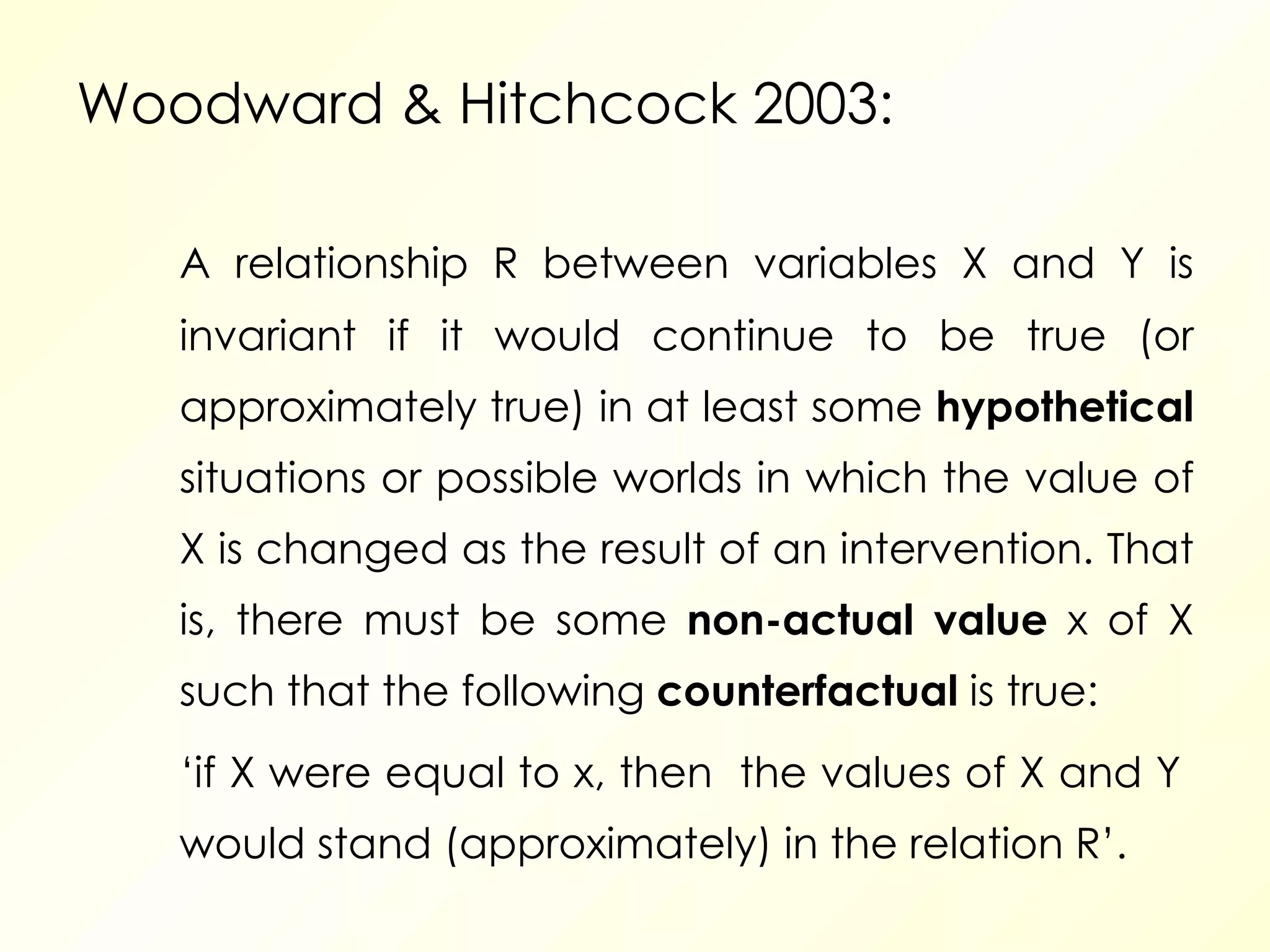
Woodward  & Hitchcock 2003: A relationship R between variables X and Y is invariant if it would continue to be true (or approximately true) in at least some  hypothetical  situations or possible worlds in which the value of X is changed as the result of an intervention. That is, there must be some  non-actual value  x of X such that the following  counterfactual  is true:  ‘ if X were equal to x, then  the values of X and Y  would stand (approximately) in the relation R’.
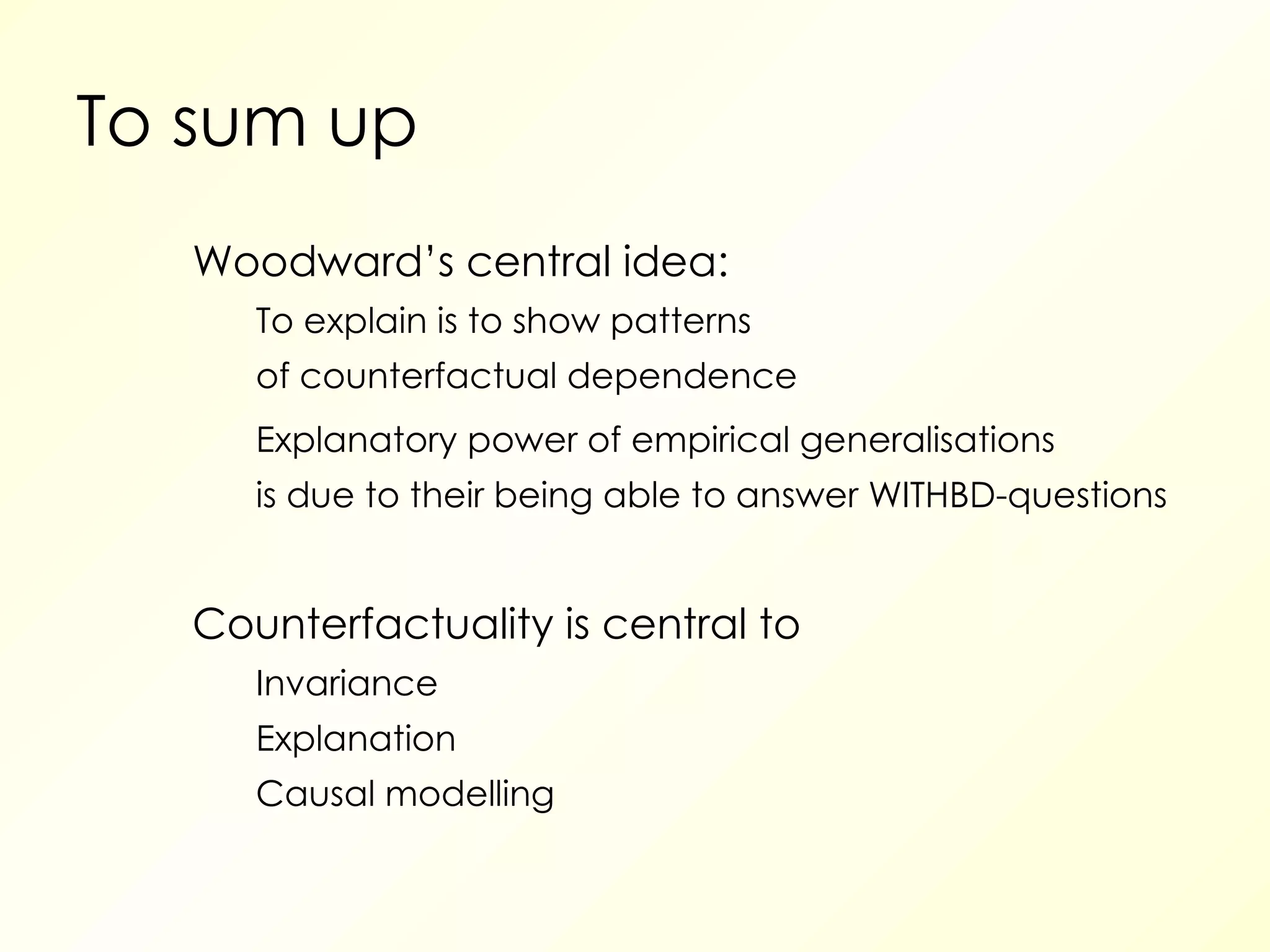
To sum up Woodward’s central idea: To explain is to show patterns of counterfactual dependence Explanatory power of empirical generalisations is due to their being able to answer WITHBD-questions Counterfactuality is central to Invariance Explanation Causal modelling
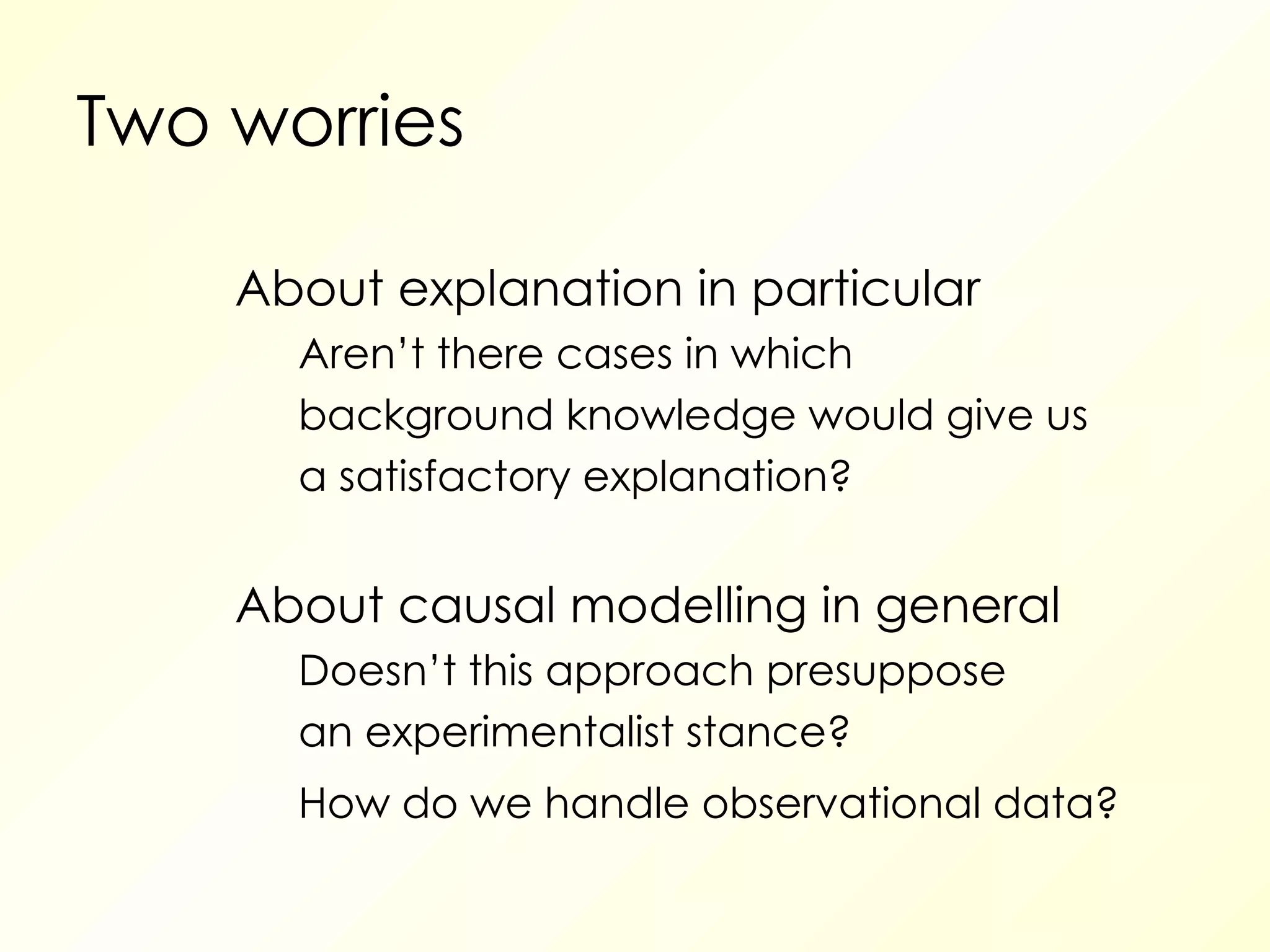
Two worries About explanation in particular Aren’t there cases in which background knowledge would give us a satisfactory explanation? About causal modelling in general Doesn’t this approach presuppose an experimentalist stance? How do we handle observational data?
Structural modelling-explanations
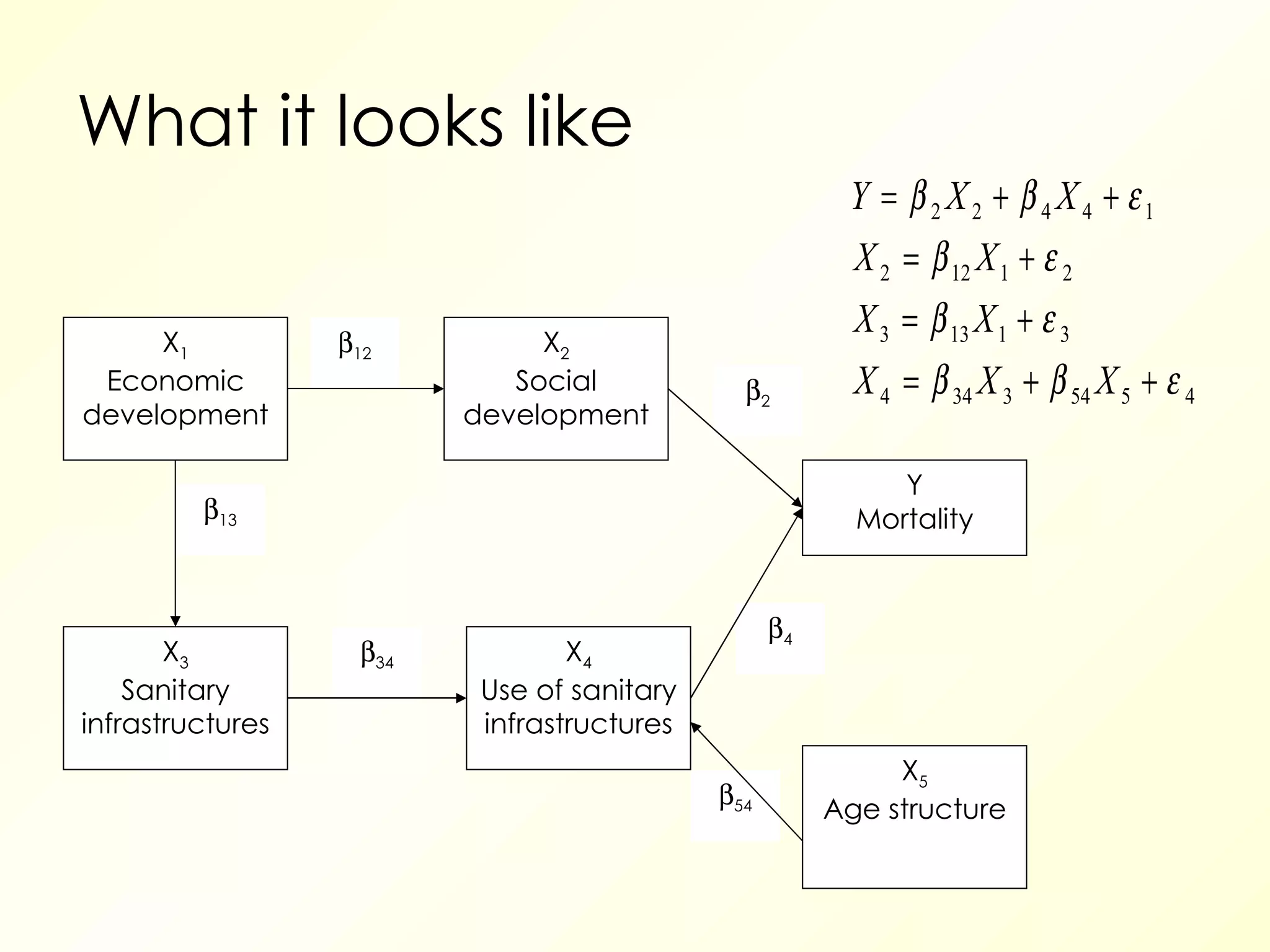
What it looks like  54  4  13  34  12  2 X 1 Economic development X 2 Social development X 3 Sanitary infrastructures X 4 Use of sanitary infrastructures X 5 Age structure Y Mortality
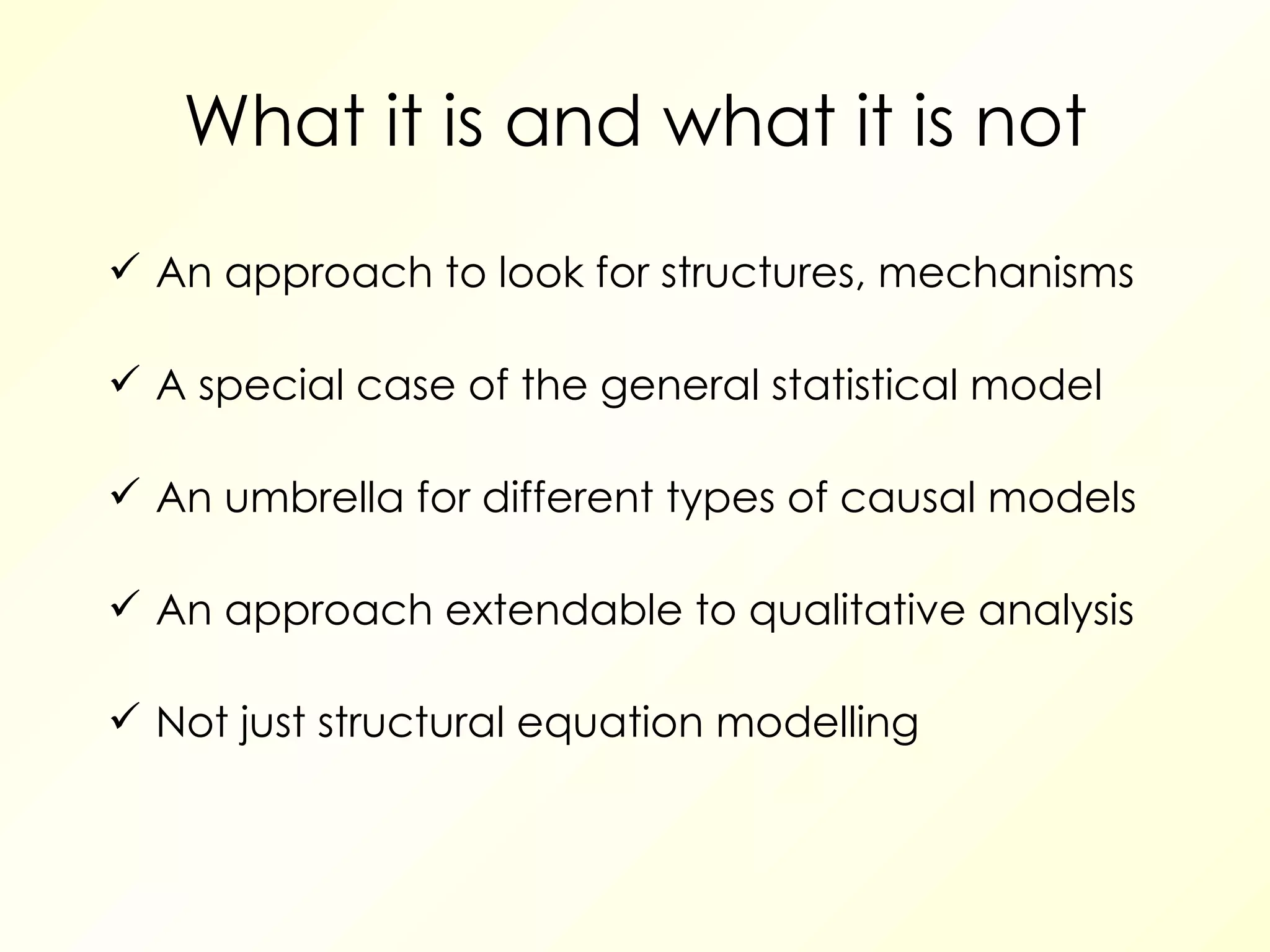
What it is and what it is not An approach to look for structures, mechanisms A special case of the general statistical model An umbrella for different types of causal models An approach extendable to qualitative analysis Not just structural equation modelling
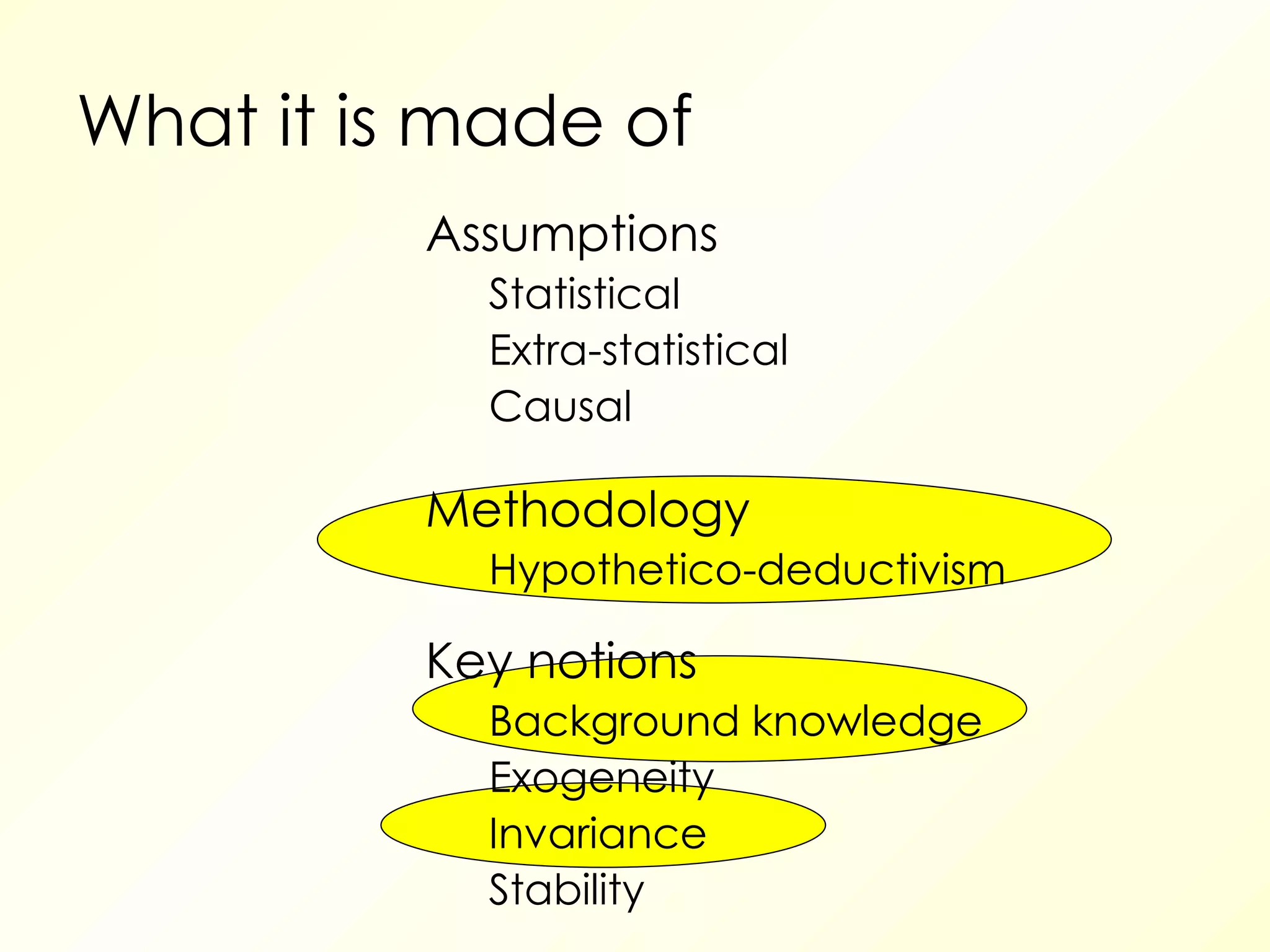
What it is made of Assumptions Statistical Extra-statistical Causal  Methodology Hypothetico-deductivism Key notions Background knowledge Exogeneity Invariance Stability
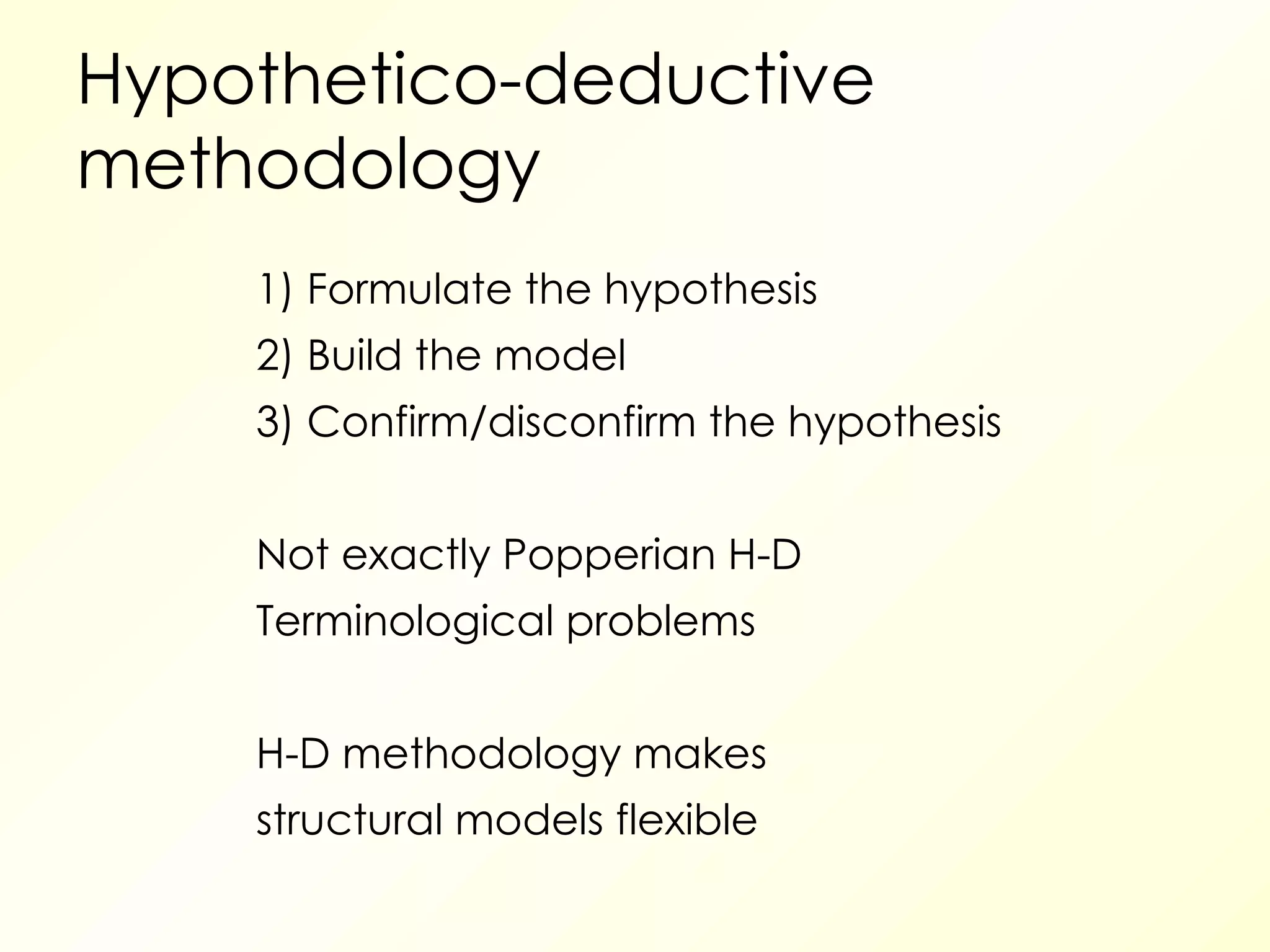
Hypothetico-deductive methodology 1) Formulate the hypothesis 2) Build the model 3) Confirm/disconfirm the hypothesis Not exactly Popperian H-D Terminological problems H-D methodology makes structural models flexible
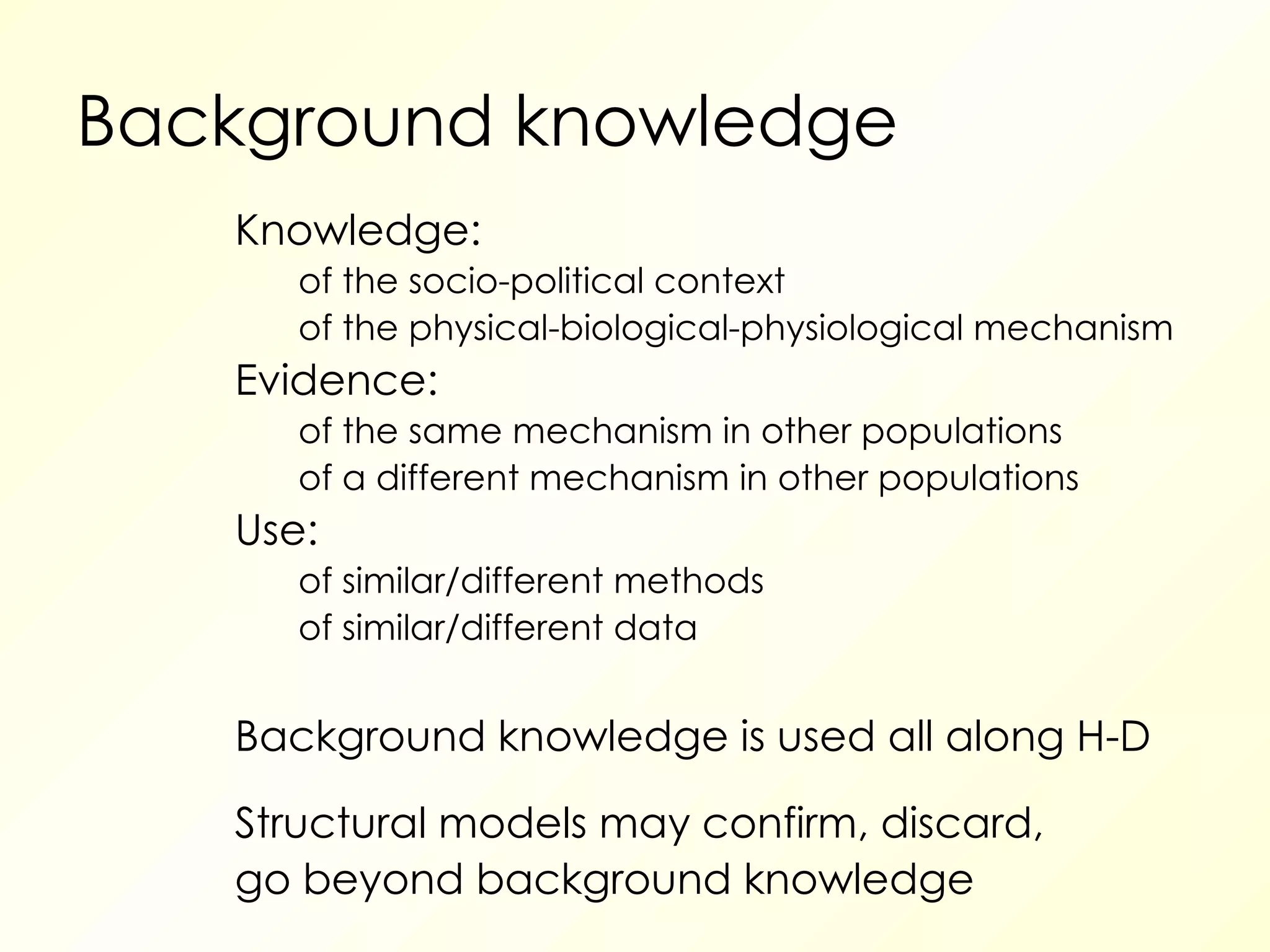
Background knowledge Knowledge: of the socio-political context of the physical-biological-physiological mechanism Evidence: of the same mechanism in other populations of a different mechanism in other populations Use:  of similar/different methods of similar/different data Background knowledge is used all along H-D Structural models may confirm, discard, go beyond background knowledge
My first worry Mr Jones takes contraceptives and doesn’t get pregnant. Why? There’s no counterfactual dependence … But doesn’t background knowledge do the job as well?
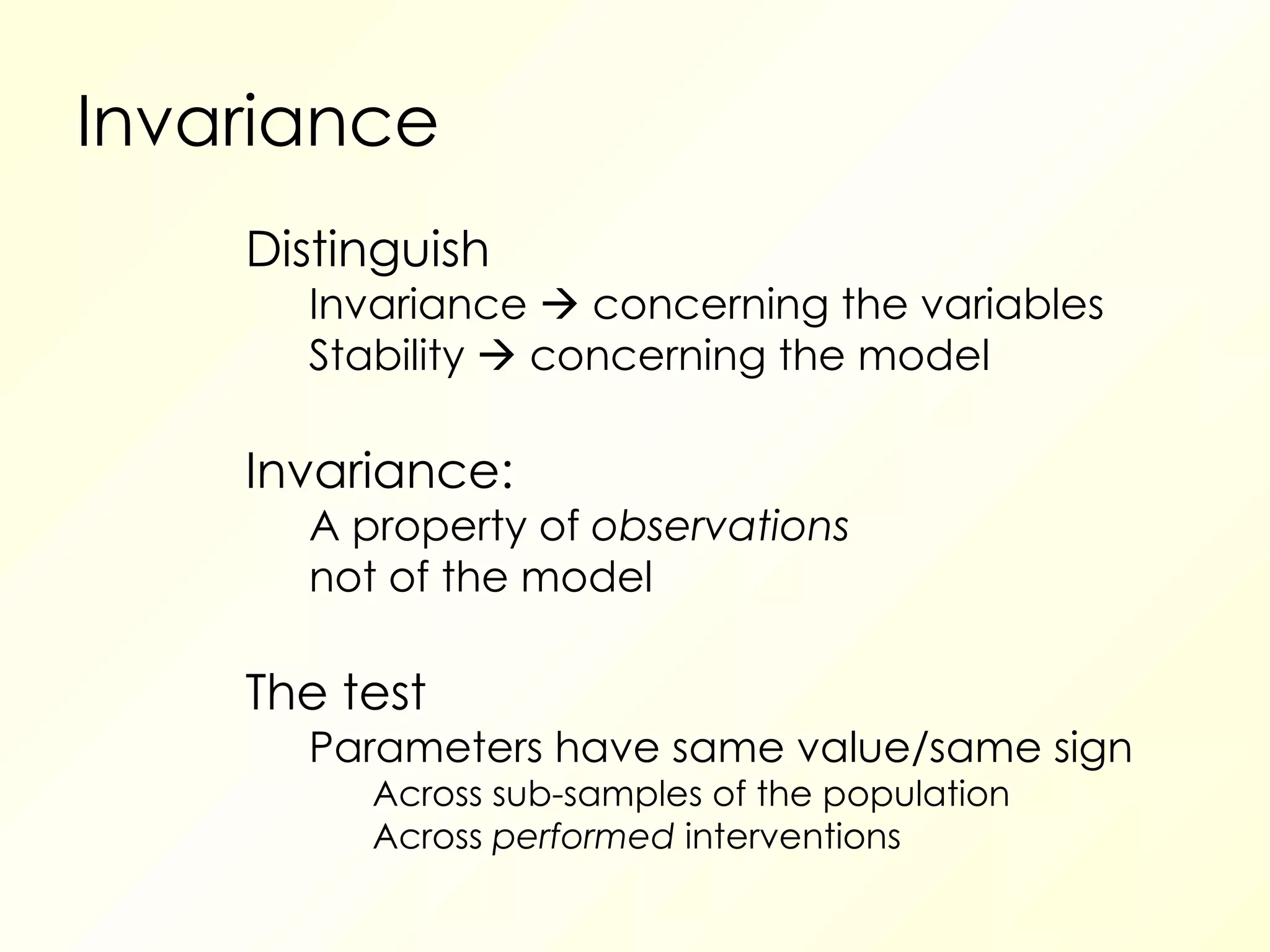
Invariance Distinguish Invariance    concerning the variables Stability    concerning the model Invariance: A property of  observations not of the model The test Parameters have same value/same sign Across sub-samples of the population Across  performed  interventions
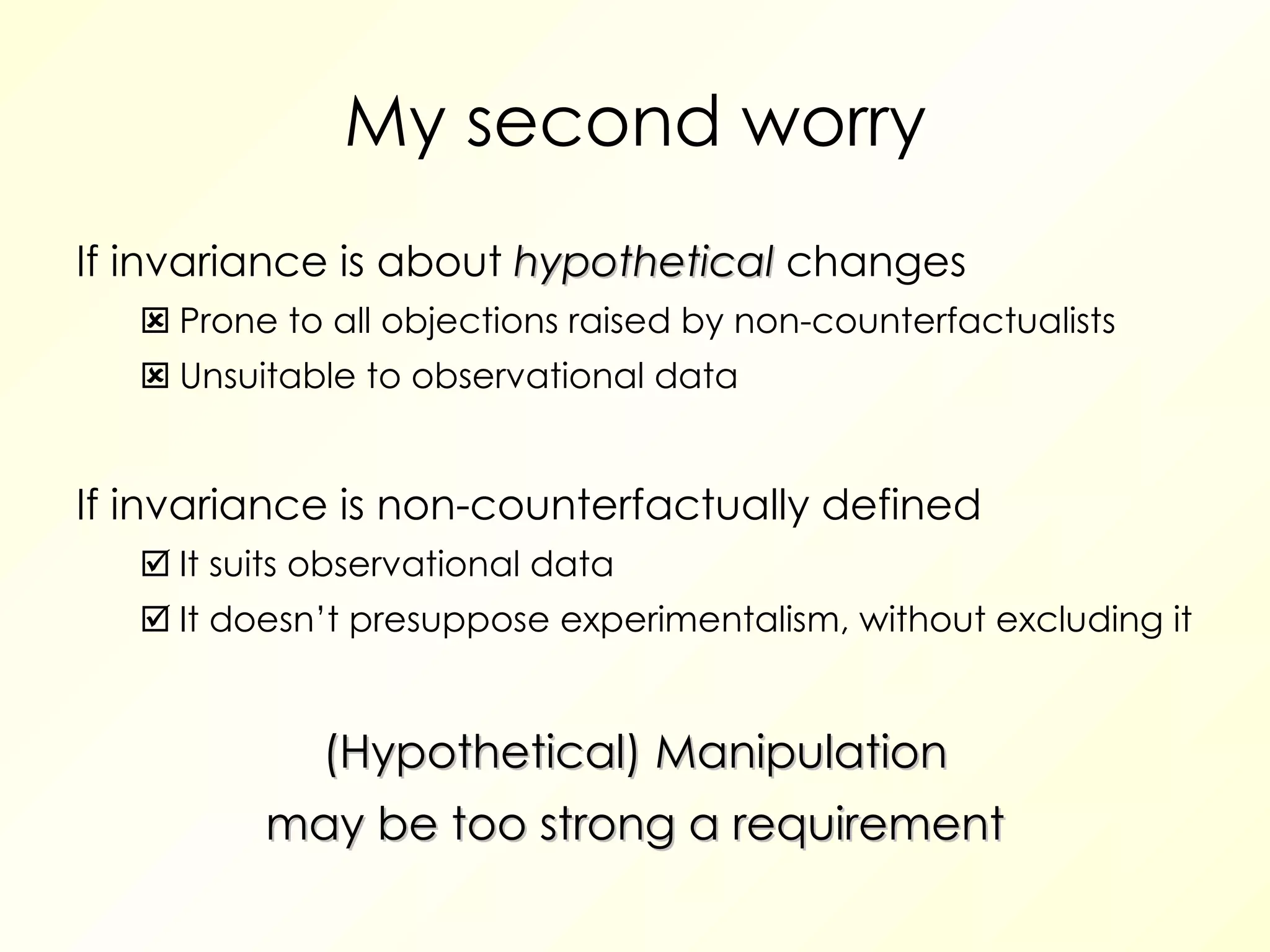
My second worry If invariance is about  hypothetical  changes  Prone to all objections raised by non-counterfactualists  Unsuitable to observational data If invariance is non-counterfactually defined  It suits observational data  It doesn’t presuppose experimentalism, without excluding it (Hypothetical) Manipulation may be too strong a requirement
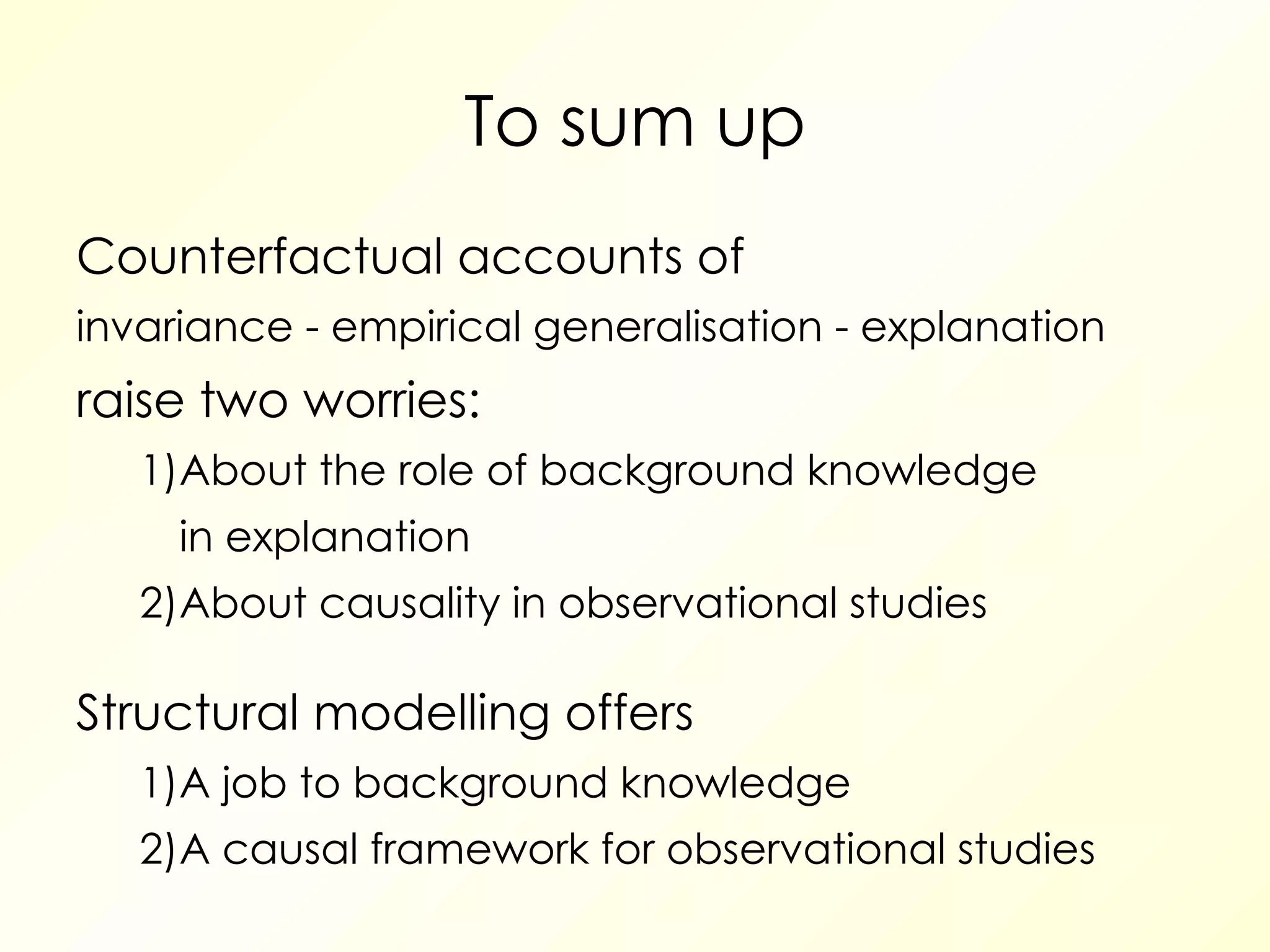
To sum up Counterfactual accounts of invariance - empirical generalisation - explanation raise two worries: 1) About the role of background knowledge in explanation 2) About causality in observational studies Structural modelling offers 1) A job to background knowledge 2) A causal framework for observational studies
To conclude We know quite well how to draw causal conclusions from experiments and manipulations The question remains: how to draw reliable causal conclusions from  observational data Structural modelling seems to way to go

Russo Whatif Presentation

  • 1.
    What if explanationdidn’t need counterfactuals? Federica Russo Philosophy, Louvain & Kent
  • 2.
    Overview Counterfactual explanationsWoodward on: Empirical generalisations Invariance Two worries About explanation About causal modelling Structural modelling-explanations Explanatory role of: Background knowledge Hypothetico-deductivism Non-counterfactual invariance
  • 3.
    Counterfactual explanations Woodward:Causes explain because they make effects happen To explain is to show patterns of counterfactual dependence  Nomothetic statements do not explain  Invariant empirical generalisations do
  • 4.
    Woodward on empiricalgeneralisations Variation-relating relations show: (i) that the explanandum was to expected (ii) how the explanandum would change if initial conditions had changed What-if-things-had-been-different questions Relevant counterfactuals describe outcomes of interventions Explanatory power is tested by means of counterfactuals questions
  • 5.
    Explanatory generalisations haveto be invariant … under a sufficiently large class of interventions or environmental changes Changes concern the variables figuring in the relation, not background conditions The test Parameters have the same value across different hypothetical setting-ups Invariance is counterfactual because it is about hypothetical changes
  • 6.
    Woodward &Hitchcock 2003: A relationship R between variables X and Y is invariant if it would continue to be true (or approximately true) in at least some hypothetical situations or possible worlds in which the value of X is changed as the result of an intervention. That is, there must be some non-actual value x of X such that the following counterfactual is true: ‘ if X were equal to x, then the values of X and Y would stand (approximately) in the relation R’.
  • 7.
    To sum upWoodward’s central idea: To explain is to show patterns of counterfactual dependence Explanatory power of empirical generalisations is due to their being able to answer WITHBD-questions Counterfactuality is central to Invariance Explanation Causal modelling
  • 8.
    Two worries Aboutexplanation in particular Aren’t there cases in which background knowledge would give us a satisfactory explanation? About causal modelling in general Doesn’t this approach presuppose an experimentalist stance? How do we handle observational data?
  • 9.
  • 10.
    What it lookslike  54  4  13  34  12  2 X 1 Economic development X 2 Social development X 3 Sanitary infrastructures X 4 Use of sanitary infrastructures X 5 Age structure Y Mortality
  • 11.
    What it isand what it is not An approach to look for structures, mechanisms A special case of the general statistical model An umbrella for different types of causal models An approach extendable to qualitative analysis Not just structural equation modelling
  • 12.
    What it ismade of Assumptions Statistical Extra-statistical Causal Methodology Hypothetico-deductivism Key notions Background knowledge Exogeneity Invariance Stability
  • 13.
    Hypothetico-deductive methodology 1)Formulate the hypothesis 2) Build the model 3) Confirm/disconfirm the hypothesis Not exactly Popperian H-D Terminological problems H-D methodology makes structural models flexible
  • 14.
    Background knowledge Knowledge:of the socio-political context of the physical-biological-physiological mechanism Evidence: of the same mechanism in other populations of a different mechanism in other populations Use: of similar/different methods of similar/different data Background knowledge is used all along H-D Structural models may confirm, discard, go beyond background knowledge
  • 15.
    My first worryMr Jones takes contraceptives and doesn’t get pregnant. Why? There’s no counterfactual dependence … But doesn’t background knowledge do the job as well?
  • 16.
    Invariance Distinguish Invariance  concerning the variables Stability  concerning the model Invariance: A property of observations not of the model The test Parameters have same value/same sign Across sub-samples of the population Across performed interventions
  • 17.
    My second worryIf invariance is about hypothetical changes  Prone to all objections raised by non-counterfactualists  Unsuitable to observational data If invariance is non-counterfactually defined  It suits observational data  It doesn’t presuppose experimentalism, without excluding it (Hypothetical) Manipulation may be too strong a requirement
  • 18.
    To sum upCounterfactual accounts of invariance - empirical generalisation - explanation raise two worries: 1) About the role of background knowledge in explanation 2) About causality in observational studies Structural modelling offers 1) A job to background knowledge 2) A causal framework for observational studies
  • 19.
    To conclude Weknow quite well how to draw causal conclusions from experiments and manipulations The question remains: how to draw reliable causal conclusions from observational data Structural modelling seems to way to go