Till Rohrmann
Flink committer
trohrmann@apache.org
@stsffap
Machine Learning
with
Apache Flink
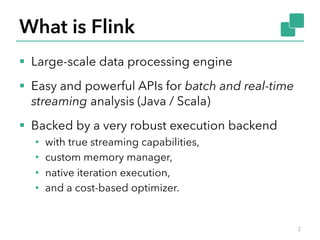
What is Flink
§  Large-scale data processing engine
§  Easy and powerful APIs for batch and real-time
streaming analysis (Java / Scala)
§  Backed by a very robust execution backend
•  with true streaming capabilities,
•  custom memory manager,
•  native iteration execution,
•  and a cost-based optimizer.
2
Technology inside Flink
§  Technology inspired by compilers +
MPP databases + distributed systems
§  For ease of use, reliable performance,
and scalability
case	
  class	
  Path	
  (from:	
  Long,	
  to:	
  Long)	
  
val	
  tc	
  =	
  edges.iterate(10)	
  {	


  paths:	
  DataSet[Path]	
  =>	


  val	
  next	
  =	
  paths	


  .join(edges)	


  .where("to")	


  .equalTo("from")	
  {	


  (path,	
  edge)	
  =>	


  Path(path.from,	
  edge.to)	


  }	


  .union(paths)	


  .distinct()	


  next	


  }	
  
Cost-based
optimizer
Type extraction
stack
Memory
manager
Out-of-core
algos
real-time
streaming
Task
scheduling
Recovery
metadata
Data
serialization
stack
Streaming
network
stack
...
Pre-flight
(client) Master
Workers
How do you use Flink?
4
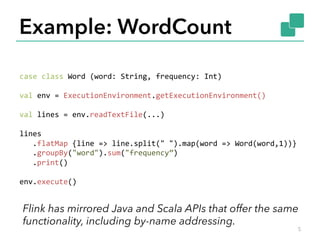
Example: WordCount
5
case	
  class	
  Word	
  (word:	
  String,	
  frequency:	
  Int)	


val	
  env	
  =	
  ExecutionEnvironment.getExecutionEnvironment()	


val	
  lines	
  =	
  env.readTextFile(...)	


lines	


  .flatMap	
  {line	
  =>	
  line.split("	
  ").map(word	
  =>	
  Word(word,1))}	


  .groupBy("word").sum("frequency”)	


  .print()	


env.execute()	


Flink has mirrored Java and Scala APIs that offer the same
functionality, including by-name addressing.
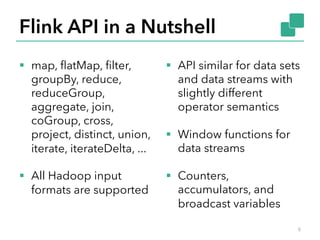
Flink API in a Nutshell
§  map, flatMap, filter,
groupBy, reduce,
reduceGroup,
aggregate, join,
coGroup, cross,
project, distinct, union,
iterate, iterateDelta, ...
§  All Hadoop input
formats are supported
§  API similar for data sets
and data streams with
slightly different
operator semantics
§  Window functions for
data streams
§  Counters,
accumulators, and
broadcast variables
6
Machine learning with Flink
7
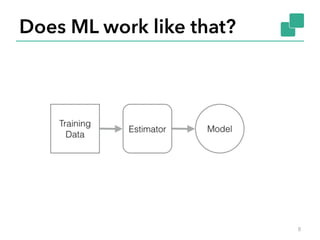
Does ML work like that?
8
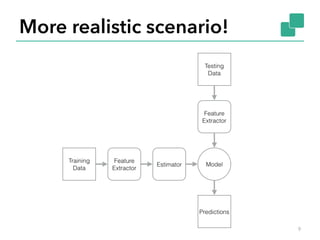
More realistic scenario!
9
Machine learning pipelines
§  Pipelining inspired by scikit-learn
§  Transformer: Modify data
§  Learner: Train a model
§  Reusable components
§  Let’s you quickly build ML pipelines
§  Model inherits pipeline of learner
10
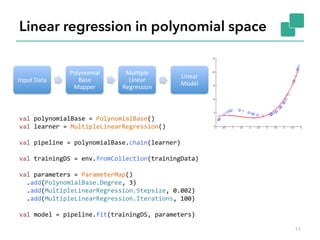
Linear regression in polynomial space
val	
  polynomialBase	
  =	
  PolynomialBase()	
  
val	
  learner	
  =	
  MultipleLinearRegression()	


val	
  pipeline	
  =	
  polynomialBase.chain(learner)	


val	
  trainingDS	
  =	
  env.fromCollection(trainingData)	


val	
  parameters	
  =	
  ParameterMap()	


  .add(PolynomialBase.Degree,	
  3)	


  .add(MultipleLinearRegression.Stepsize,	
  0.002)	


  .add(MultipleLinearRegression.Iterations,	
  100)	


val	
  model	
  =	
  pipeline.fit(trainingDS,	
  parameters)	
  
11
Input	
  Data	
  
Polynomial	
  
Base	
  
Mapper	
  
Mul4ple	
  
Linear	
  
Regression	
  
Linear	
  
Model	
  
Current state of Flink-ML
§  Existing learners
•  Multiple linear regression
•  Alternating least squares
•  Communication efficient distributed dual
coordinate ascent (PR pending)
§  Feature transformer
•  Polynomial base feature mapper
§  Tooling
12
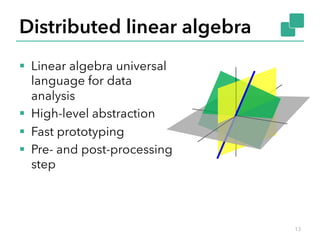
Distributed linear algebra
§  Linear algebra universal
language for data
analysis
§  High-level abstraction
§  Fast prototyping
§  Pre- and post-processing
step
13
Example: Gaussian non-negative matrix
factorization
§  Given input matrix V, find W and H such
that
§  Iterative approximation
14
Ht+1 = Ht ∗ Wt
T
V /Wt
T
Wt Ht( )
Wt+1 = Wt ∗ VHt+1
T
/Wt Ht+1Ht+1
T
( )
V ≈ WH
var	
  i	
  =	
  0	
  
var	
  H:	
  CheckpointedDrm[Int]	
  =	
  randomMatrix(k,	
  V.numCols)	
  
var	
  W:	
  CheckpointedDrm[Int]	
  =	
  randomMatrix(V.numRows,	
  k)	


while(i	
  <	
  maxIterations)	
  {	


  H	
  =	
  H	
  *	
  (W.t	
  %*%	
  V	
  /	
  W.t	
  %*%	
  W	
  %*%	
  H)	


  W	
  =	
  W	
  *	
  (V	
  %*%	
  	
  H.t	
  /	
  W	
  %*%	
  H	
  %*%	
  H.t)	


  i	
  +=	
  1	
  
}	
  
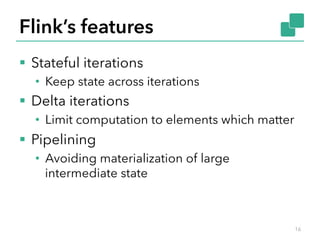
Why is Flink a good fit for ML?
15
Flink’s features
§  Stateful iterations
•  Keep state across iterations
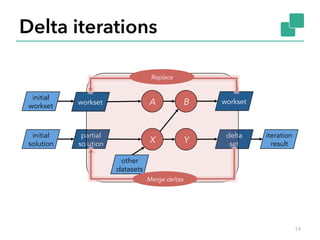
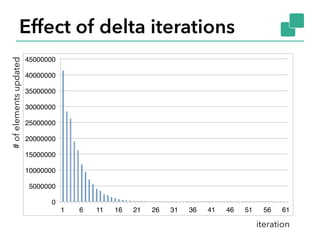
§  Delta iterations
•  Limit computation to elements which matter
§  Pipelining
•  Avoiding materialization of large
intermediate state
16
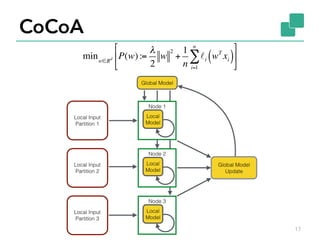
CoCoA
17
minw∈Rd P(w):=
λ
2
w
2
+
1
n
ℓi wT
xi( )
i=1
n
∑
#
$
%
&
'
(
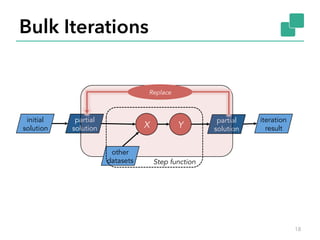
Bulk Iterations
18
partial
solution
partial
solutionX
other
datasets
Y
initial
solution
iteration
result
Replace
Step function
Delta iterations
19
partial
solution
delta
setX
other
datasets
Y
initial
solution
iteration
result
workset A B workset
Merge deltas
Replace
initial
workset
Effect of delta iterations
0
5000000
10000000
15000000
20000000
25000000
30000000
35000000
40000000
45000000
1 6 11 16 21 26 31 36 41 46 51 56 61
#ofelementsupdated
iteration
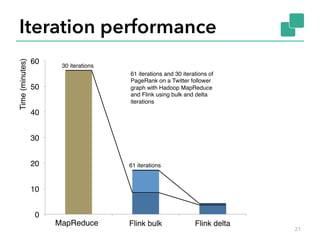
Iteration performance
21
0
10
20
30
40
50
60
Hadoop Flink bulk Flink delta
Time(minutes)
61 iterations and 30 iterations of
PageRank on a Twitter follower
graph with Hadoop MapReduce
and Flink using bulk and delta
iterations
30 iterations
61 iterations
MapReduce
How to factorize really large
matrices?
22
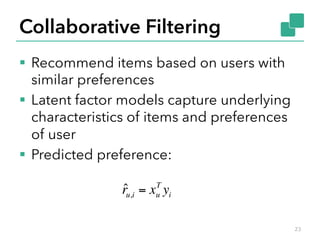
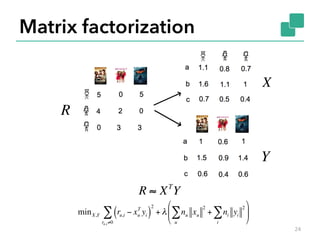
Collaborative Filtering
§  Recommend items based on users with
similar preferences
§  Latent factor models capture underlying
characteristics of items and preferences
of user
§  Predicted preference:
23
ˆru,i = xu
T
yi
Matrix factorization
24
minX,Y ru,i − xu
T
yi( )
2
+ λ nu xu
2
+ ni yi
2
i
∑
u
∑
#
$
%
&
'
(
ru,i≠0
∑
R ≈ XT
Y
R
X
Y
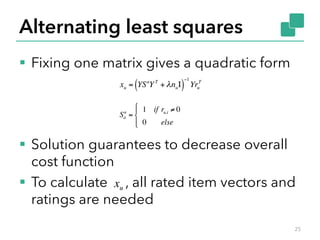
Alternating least squares
§  Fixing one matrix gives a quadratic form
§  Solution guarantees to decrease overall
cost function
§  To calculate , all rated item vectors and
ratings are needed
25
xu = YSu
YT
+ λnuΙ( )
−1
Yru
T
Sii
u
=
1 if ru,i ≠ 0
0 else
"
#
$
%$
xu
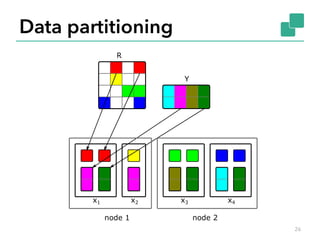
Data partitioning
26
Naïve ALS
case	
  class	
  Rating(userID:	
  Int,	
  itemID:	
  Int,	
  rating:	
  Double)	
  
case	
  class	
  ColumnVector(columnIndex:	
  Int,	
  vector:	
  Array[Double])	


val	
  items:	
  DataSet[ColumnVector]	
  =	
  _	
  
val	
  ratings:	
  DataSet[Rating]	
  =	
  _	


//	
  Generate	
  tuples	
  of	
  items	
  with	
  their	
  ratings	
  
val	
  uVA	
  =	
  items.join(ratings).where(0).equalTo(1)	
  {	


  (item,	
  ratingEntry)	
  =>	
  {	


  val	
  Rating(uID,	
  _,	
  rating)	
  =	
  ratingEntry	


  (uID,	
  rating,	
  item.vector)	


  }	
  
}	


27
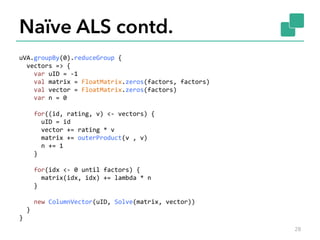
Naïve ALS contd.
uVA.groupBy(0).reduceGroup	
  {	


  vectors	
  =>	
  {	


  var	
  uID	
  =	
  -­‐1	


  val	
  matrix	
  =	
  FloatMatrix.zeros(factors,	
  factors)	


  val	
  vector	
  =	
  FloatMatrix.zeros(factors)	


  var	
  n	
  =	
  0	


  for((id,	
  rating,	
  v)	
  <-­‐	
  vectors)	
  {	


  uID	
  =	
  id	


  vector	
  +=	
  rating	
  *	
  v	


  matrix	
  +=	
  outerProduct(v	
  ,	
  v)	


  n	
  +=	
  1	


  }	


  for(idx	
  <-­‐	
  0	
  until	
  factors)	
  {	


  matrix(idx,	
  idx)	
  +=	
  lambda	
  *	
  n	


  }	


  new	
  ColumnVector(uID,	
  Solve(matrix,	
  vector))	


  }	
  
}	
  
28
Problems of naïve ALS
§  Problem:
•  Item vectors are sent redundantly à High
network load
§  Solution:
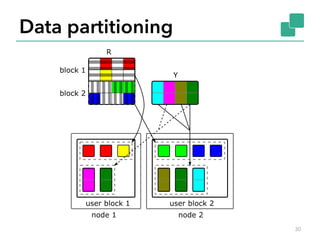
•  Blocking of user and item vectors to share
common data
•  Avoids blown up intermediate state
29
Data partitioning
30
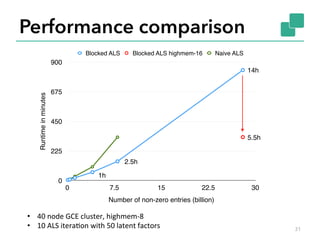
Performance comparison
31
•  40	
  node	
  GCE	
  cluster,	
  highmem-­‐8	
  
•  10	
  ALS	
  itera4on	
  with	
  50	
  latent	
  factors	
  
Runtimeinminutes
0
225
450
675
900
Number of non-zero entries (billion)
0 7.5 15 22.5 30
Blocked ALS Blocked ALS highmem-16 Naive ALS
5.5h
14h
2.5h
1h
Table 2
Entries in billion Naive Join Naive Join Broadcast Broadcast
80 0.08 201.326 3.35543333333333 190.723 3.17871666666667
Streaming machine learning
32
Why is streaming ML important?
§  Spam detection in mails
§  Patterns might change over time
§  Retraining of model necessary
§  Best solution: Online models
33
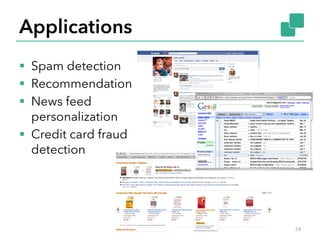
Applications
§  Spam detection
§  Recommendation
§  News feed
personalization
§  Credit card fraud
detection
34
Apache SAMOA
§  Scalable Advanced Massive Online
Analysis
§  Distributed streaming machine learning
framework
§  Incubation at the Apache Software
Foundation
§  Runs on multiple streaming processing
engines (S4, Storm, Samza)
§  Support for Flink is pending pull request
35
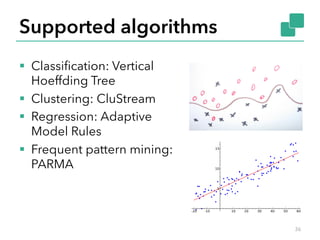
Supported algorithms
§  Classification: Vertical
Hoeffding Tree
§  Clustering: CluStream
§  Regression: Adaptive
Model Rules
§  Frequent pattern mining:
PARMA
36
Closing
37
Flink-ML Outlook
§  Support more algorithms
§  Support for distributed linear algebra
§  Integration with streaming machine learning
§  Interactive programs and Zeppelin
38
flink.apache.org
@ApacheFlink

Machine Learning with Apache Flink at Stockholm Machine Learning Group

  • 1.
  • 2.
    What is Flink § Large-scale data processing engine §  Easy and powerful APIs for batch and real-time streaming analysis (Java / Scala) §  Backed by a very robust execution backend •  with true streaming capabilities, •  custom memory manager, •  native iteration execution, •  and a cost-based optimizer. 2
  • 3.
    Technology inside Flink § Technology inspired by compilers + MPP databases + distributed systems §  For ease of use, reliable performance, and scalability case  class  Path  (from:  Long,  to:  Long)   val  tc  =  edges.iterate(10)  {        paths:  DataSet[Path]  =>          val  next  =  paths              .join(edges)              .where("to")              .equalTo("from")  {                  (path,  edge)  =>                        Path(path.from,  edge.to)              }              .union(paths)              .distinct()          next      }   Cost-based optimizer Type extraction stack Memory manager Out-of-core algos real-time streaming Task scheduling Recovery metadata Data serialization stack Streaming network stack ... Pre-flight (client) Master Workers
  • 4.
    How do youuse Flink? 4
  • 5.
    Example: WordCount 5 case  class  Word  (word:  String,  frequency:  Int)     val  env  =  ExecutionEnvironment.getExecutionEnvironment()     val  lines  =  env.readTextFile(...)     lines        .flatMap  {line  =>  line.split("  ").map(word  =>  Word(word,1))}            .groupBy("word").sum("frequency”)        .print()     env.execute()         Flink has mirrored Java and Scala APIs that offer the same functionality, including by-name addressing.
  • 6.
    Flink API ina Nutshell §  map, flatMap, filter, groupBy, reduce, reduceGroup, aggregate, join, coGroup, cross, project, distinct, union, iterate, iterateDelta, ... §  All Hadoop input formats are supported §  API similar for data sets and data streams with slightly different operator semantics §  Window functions for data streams §  Counters, accumulators, and broadcast variables 6
  • 7.
  • 8.
    Does ML worklike that? 8
  • 9.
  • 10.
    Machine learning pipelines § Pipelining inspired by scikit-learn §  Transformer: Modify data §  Learner: Train a model §  Reusable components §  Let’s you quickly build ML pipelines §  Model inherits pipeline of learner 10
  • 11.
    Linear regression inpolynomial space val  polynomialBase  =  PolynomialBase()   val  learner  =  MultipleLinearRegression()     val  pipeline  =  polynomialBase.chain(learner)     val  trainingDS  =  env.fromCollection(trainingData)     val  parameters  =  ParameterMap()      .add(PolynomialBase.Degree,  3)      .add(MultipleLinearRegression.Stepsize,  0.002)      .add(MultipleLinearRegression.Iterations,  100)     val  model  =  pipeline.fit(trainingDS,  parameters)   11 Input  Data   Polynomial   Base   Mapper   Mul4ple   Linear   Regression   Linear   Model  
  • 12.
    Current state ofFlink-ML §  Existing learners •  Multiple linear regression •  Alternating least squares •  Communication efficient distributed dual coordinate ascent (PR pending) §  Feature transformer •  Polynomial base feature mapper §  Tooling 12
  • 13.
    Distributed linear algebra § Linear algebra universal language for data analysis §  High-level abstraction §  Fast prototyping §  Pre- and post-processing step 13
  • 14.
    Example: Gaussian non-negativematrix factorization §  Given input matrix V, find W and H such that §  Iterative approximation 14 Ht+1 = Ht ∗ Wt T V /Wt T Wt Ht( ) Wt+1 = Wt ∗ VHt+1 T /Wt Ht+1Ht+1 T ( ) V ≈ WH var  i  =  0   var  H:  CheckpointedDrm[Int]  =  randomMatrix(k,  V.numCols)   var  W:  CheckpointedDrm[Int]  =  randomMatrix(V.numRows,  k)     while(i  <  maxIterations)  {      H  =  H  *  (W.t  %*%  V  /  W.t  %*%  W  %*%  H)      W  =  W  *  (V  %*%    H.t  /  W  %*%  H  %*%  H.t)      i  +=  1   }  
  • 15.
    Why is Flinka good fit for ML? 15
  • 16.
    Flink’s features §  Statefuliterations •  Keep state across iterations §  Delta iterations •  Limit computation to elements which matter §  Pipelining •  Avoiding materialization of large intermediate state 16
  • 17.
  • 18.
  • 19.
  • 20.
    Effect of deltaiterations 0 5000000 10000000 15000000 20000000 25000000 30000000 35000000 40000000 45000000 1 6 11 16 21 26 31 36 41 46 51 56 61 #ofelementsupdated iteration
  • 21.
    Iteration performance 21 0 10 20 30 40 50 60 Hadoop Flinkbulk Flink delta Time(minutes) 61 iterations and 30 iterations of PageRank on a Twitter follower graph with Hadoop MapReduce and Flink using bulk and delta iterations 30 iterations 61 iterations MapReduce
  • 22.
    How to factorizereally large matrices? 22
  • 23.
    Collaborative Filtering §  Recommenditems based on users with similar preferences §  Latent factor models capture underlying characteristics of items and preferences of user §  Predicted preference: 23 ˆru,i = xu T yi
  • 24.
    Matrix factorization 24 minX,Y ru,i− xu T yi( ) 2 + λ nu xu 2 + ni yi 2 i ∑ u ∑ # $ % & ' ( ru,i≠0 ∑ R ≈ XT Y R X Y
  • 25.
    Alternating least squares § Fixing one matrix gives a quadratic form §  Solution guarantees to decrease overall cost function §  To calculate , all rated item vectors and ratings are needed 25 xu = YSu YT + λnuΙ( ) −1 Yru T Sii u = 1 if ru,i ≠ 0 0 else " # $ %$ xu
  • 26.
  • 27.
    Naïve ALS case  class  Rating(userID:  Int,  itemID:  Int,  rating:  Double)   case  class  ColumnVector(columnIndex:  Int,  vector:  Array[Double])     val  items:  DataSet[ColumnVector]  =  _   val  ratings:  DataSet[Rating]  =  _     //  Generate  tuples  of  items  with  their  ratings   val  uVA  =  items.join(ratings).where(0).equalTo(1)  {      (item,  ratingEntry)  =>  {          val  Rating(uID,  _,  rating)  =  ratingEntry          (uID,  rating,  item.vector)      }   }       27
  • 28.
    Naïve ALS contd. uVA.groupBy(0).reduceGroup  {      vectors  =>  {          var  uID  =  -­‐1          val  matrix  =  FloatMatrix.zeros(factors,  factors)          val  vector  =  FloatMatrix.zeros(factors)          var  n  =  0            for((id,  rating,  v)  <-­‐  vectors)  {              uID  =  id              vector  +=  rating  *  v              matrix  +=  outerProduct(v  ,  v)              n  +=  1          }            for(idx  <-­‐  0  until  factors)  {              matrix(idx,  idx)  +=  lambda  *  n          }            new  ColumnVector(uID,  Solve(matrix,  vector))      }   }   28
  • 29.
    Problems of naïveALS §  Problem: •  Item vectors are sent redundantly à High network load §  Solution: •  Blocking of user and item vectors to share common data •  Avoids blown up intermediate state 29
  • 30.
  • 31.
    Performance comparison 31 •  40  node  GCE  cluster,  highmem-­‐8   •  10  ALS  itera4on  with  50  latent  factors   Runtimeinminutes 0 225 450 675 900 Number of non-zero entries (billion) 0 7.5 15 22.5 30 Blocked ALS Blocked ALS highmem-16 Naive ALS 5.5h 14h 2.5h 1h Table 2 Entries in billion Naive Join Naive Join Broadcast Broadcast 80 0.08 201.326 3.35543333333333 190.723 3.17871666666667
  • 32.
  • 33.
    Why is streamingML important? §  Spam detection in mails §  Patterns might change over time §  Retraining of model necessary §  Best solution: Online models 33
  • 34.
    Applications §  Spam detection § Recommendation §  News feed personalization §  Credit card fraud detection 34
  • 35.
    Apache SAMOA §  ScalableAdvanced Massive Online Analysis §  Distributed streaming machine learning framework §  Incubation at the Apache Software Foundation §  Runs on multiple streaming processing engines (S4, Storm, Samza) §  Support for Flink is pending pull request 35
  • 36.
    Supported algorithms §  Classification:Vertical Hoeffding Tree §  Clustering: CluStream §  Regression: Adaptive Model Rules §  Frequent pattern mining: PARMA 36
  • 37.
  • 38.
    Flink-ML Outlook §  Supportmore algorithms §  Support for distributed linear algebra §  Integration with streaming machine learning §  Interactive programs and Zeppelin 38
  • 39.