SONG Layheang
Weirs
Mobile : +855 (0) 92 79 64 66
E-mail: layheang.song@gmail.com
Department of Rural Engineering, Institute of Technology of Cambodia
PO Box 86, Bvld of Russian, Phnom Penh, Cambodia
Institute of Technology of Cambodia
PO Box 86, Bvld of Russian, Phnom Penh, Cambodia
Introduction
2
 Weirs are elevated structures in open
channels that are used to measure flow
and/or control outflow elevations from
basins and channels.
Introduction
3
 There are two types of weirs in common use:
 Sharp-crested weirs
 Broad-crested weirs
Sharp-crested weir Broad-crested weir
Sharp-crested weir
4
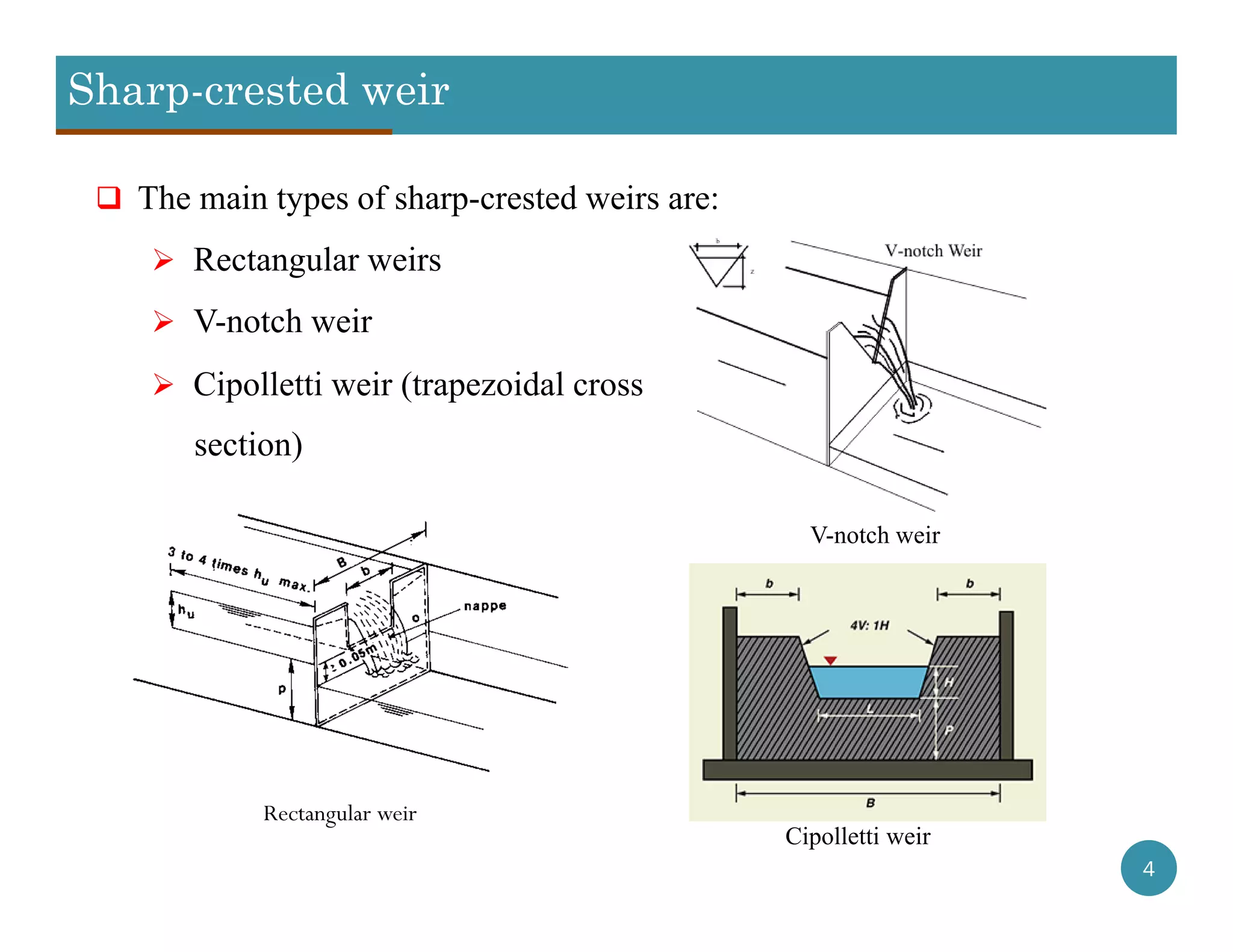
 The main types of sharp-crested weirs are:
 Rectangular weirs
 V-notch weir
 Cipolletti weir (trapezoidal cross
section)
Rectangular weir
V-notch weir
Cipolletti weir
Sharp-crested weir with rectangular cross section
5
 The type of this structure can be:
 Unsuppressed weir (contracted weir)
 Suppressed weir (uncontracted weir)
Unsuppressed weir Suppressed weir
Sharp-crested weir with rectangular cross section
6
 Formula for calculating flow rate (over the weir section, m³/s)
 : coefficient of discharge
 g : gravitational acceleration (m/s²)
 b : width of weir (m)
 H : elevation of the water surface from the top of the weir (m)
2
3
2
Sharp-crested weir with rectangular cross section
7
 Formula for calculating flow rate (continue)
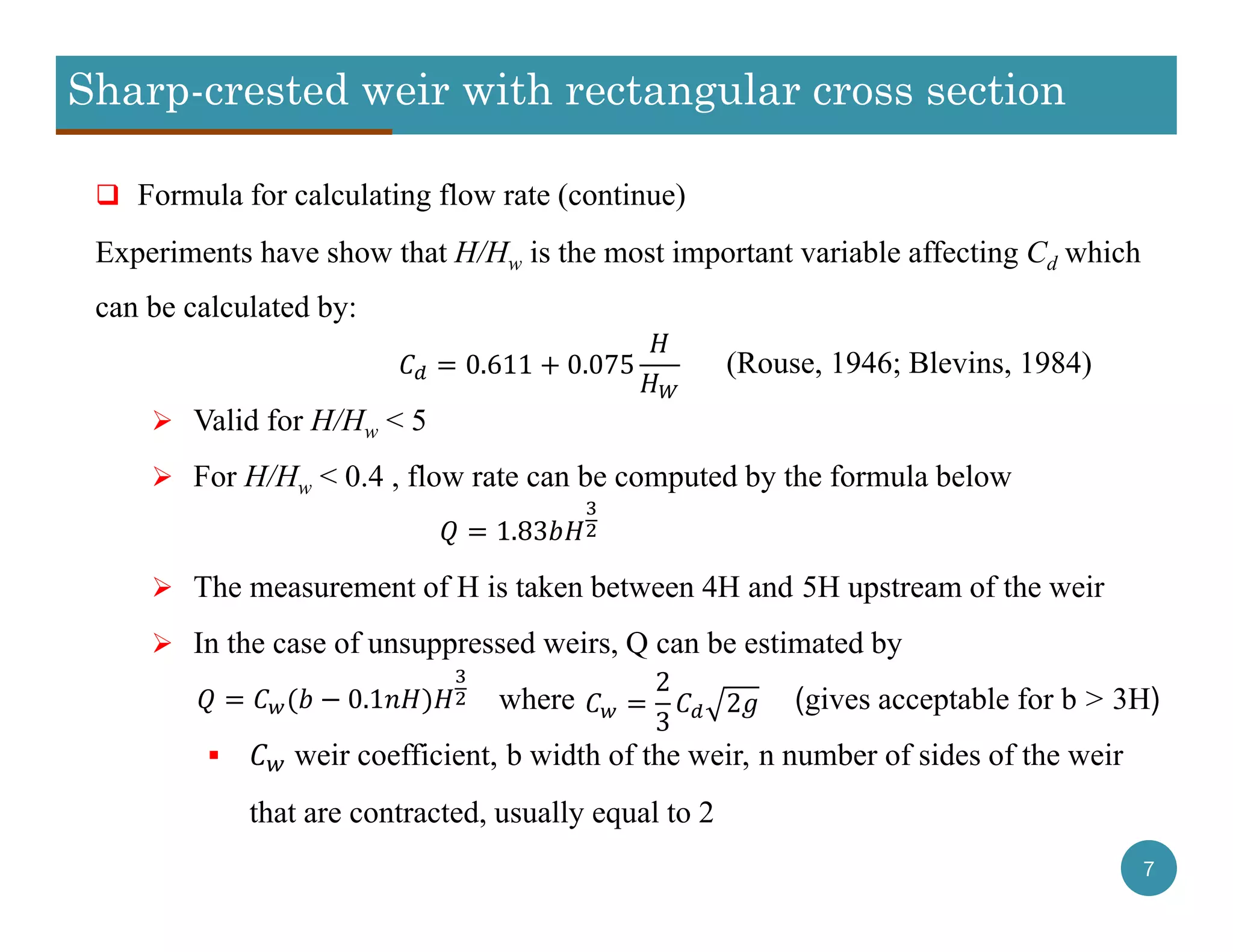
Experiments have show that H/Hw is the most important variable affecting Cd which
can be calculated by:
(Rouse, 1946; Blevins, 1984)
 Valid for H/Hw < 5
 For H/Hw < 0.4 , flow rate can be computed by the formula below
 The measurement of H is taken between 4H and 5H upstream of the weir
 In the case of unsuppressed weirs, Q can be estimated by
where (gives acceptable for b > 3H)
 weir coefficient, b width of the weir, n number of sides of the weir
that are contracted, usually equal to 2
0.611 0.075
1.83
0.1
2
3
2
Sharp-crested weir with rectangular cross section
8
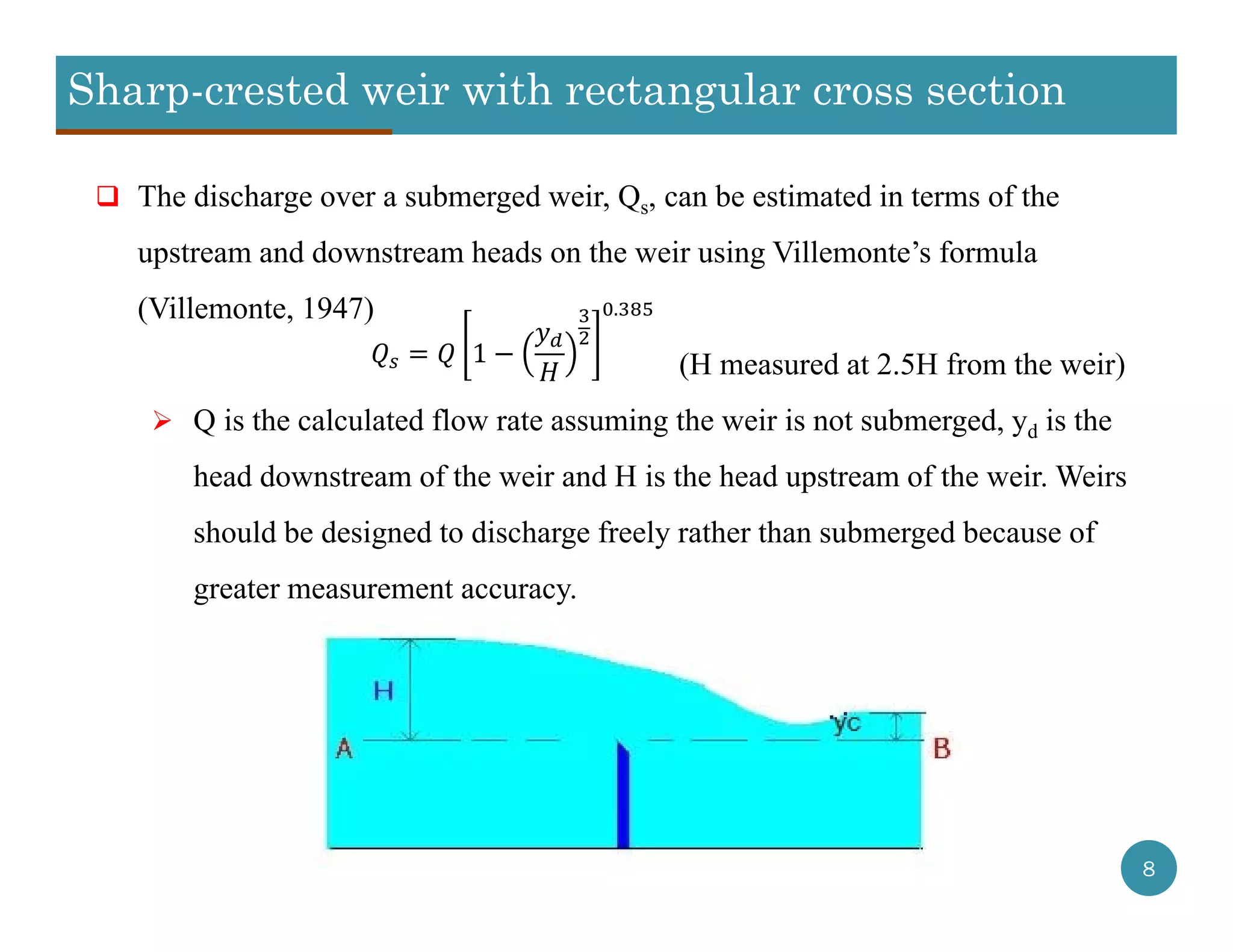
 The discharge over a submerged weir, Qs, can be estimated in terms of the
upstream and downstream heads on the weir using Villemonte’s formula
(Villemonte, 1947)
(H measured at 2.5H from the weir)
 Q is the calculated flow rate assuming the weir is not submerged, yd is the
head downstream of the weir and H is the head upstream of the weir. Weirs
should be designed to discharge freely rather than submerged because of
greater measurement accuracy.
1
.
Sharp-crested weir with rectangular cross section
9
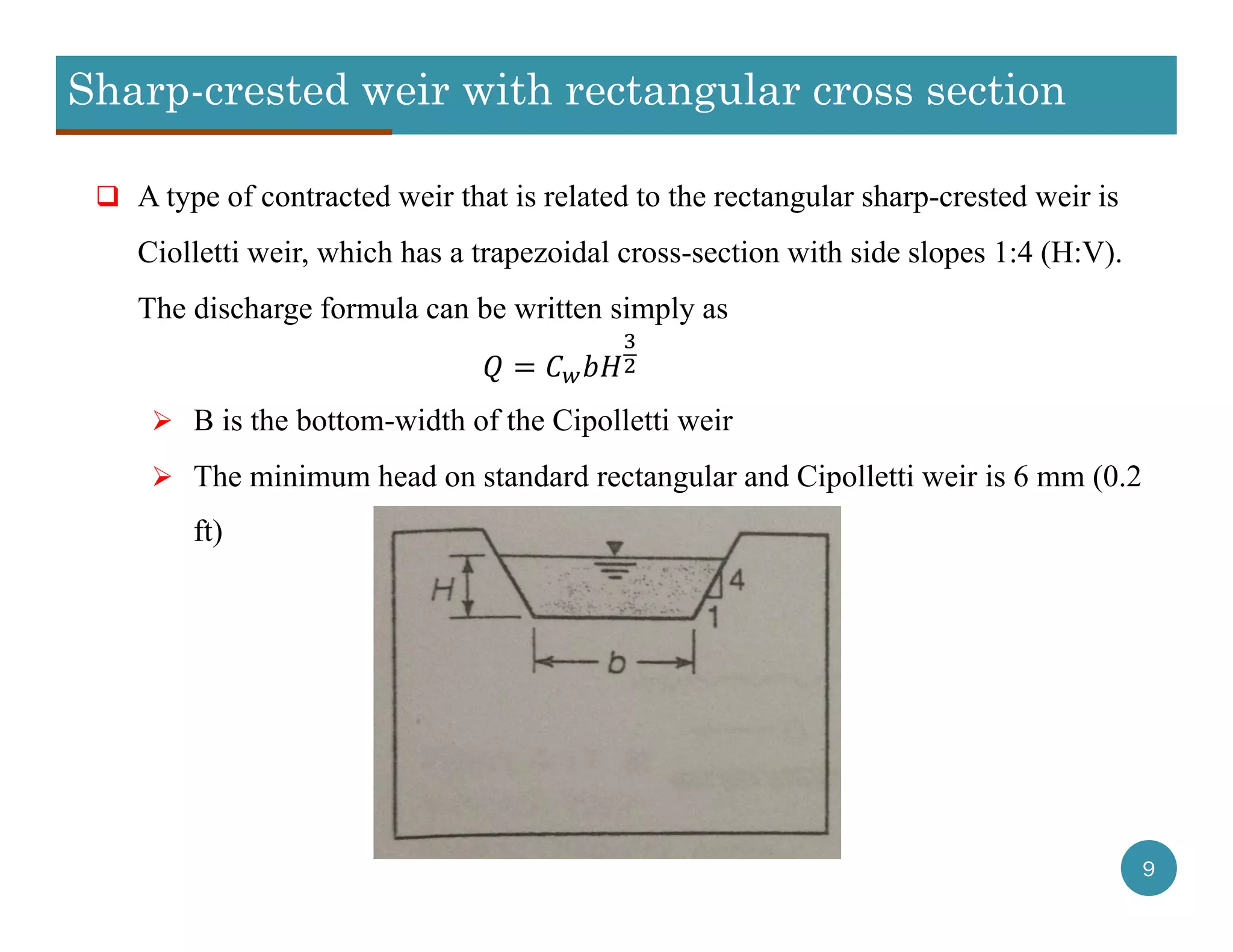
 A type of contracted weir that is related to the rectangular sharp-crested weir is
Ciolletti weir, which has a trapezoidal cross-section with side slopes 1:4 (H:V).
The discharge formula can be written simply as
 B is the bottom-width of the Cipolletti weir
 The minimum head on standard rectangular and Cipolletti weir is 6 mm (0.2
ft)
Sharp-crested weir with rectangular cross section
10
 Example: A weir is to be installed to measure flows in the range of 0.5-1.0 m3/s. If
the maximum (total) depth of water that can be accumulated at the weir is 1 m and
the width of the channel is 4 m, determine the height of a suppressed weir that
should be used to measure the flow rate.
 Solution:
The flow over the weir is illustrated in the figure below, where the height of the weir
is Hw and the flow rate is Q.
Sharp-crested weir with rectangular cross section
11
 Solution (continue)
The height of the water over the crest of the weir, H, is given by
H = 1 – Hw
Assuming that H/Hw < 0.4, then Q is related to H and can be computed by:
Q = 1.83bH3/2
Taking be = 4 m, and Q = 1 m3/s (the maximum flow rate will give the maximum
head, H), then
The height of the weir, Hw, is therefore given by
Hw = 1 - 0.265 = 0.735 m
And
.
.
0.36
The initial assumption that H/Hw < 0.4 is therefore validated, and the height of the
weir should be 0.735 m.
H
.
=
.
0.265
Sharp-crested weir with rectangular cross section
12
 Problems
10.12 Water passes over a rectangular weir of 10 ft width at a depth of 1 ft. If the weir
is replaced by an 80° V-notch, determine the depth of water over the notch.
Disregard the end contractions. Cd for notch = 0.59, Cd for rectangular weir =
0.63.
10.16 A submerged weir in a pond is 10 ft long. The crest of the weir is 9 in. below
the upstream level and 6 in. below the tailwater level. The crest height is 1 ft.
Determine the discharge.
10.17 A stream is 200 ft wide and 10 ft deep. It has a mean velocity of flow of 4
ft/sec. If a submerged weir of 8 ft height is installed, how much will the water
upstream rise? Disregard the velocity approach. [Hint: Assume Cd, determine H1
for the submerged case, calculate revised Cd from the formula, and find revised
H1.]
V-notch weir
13
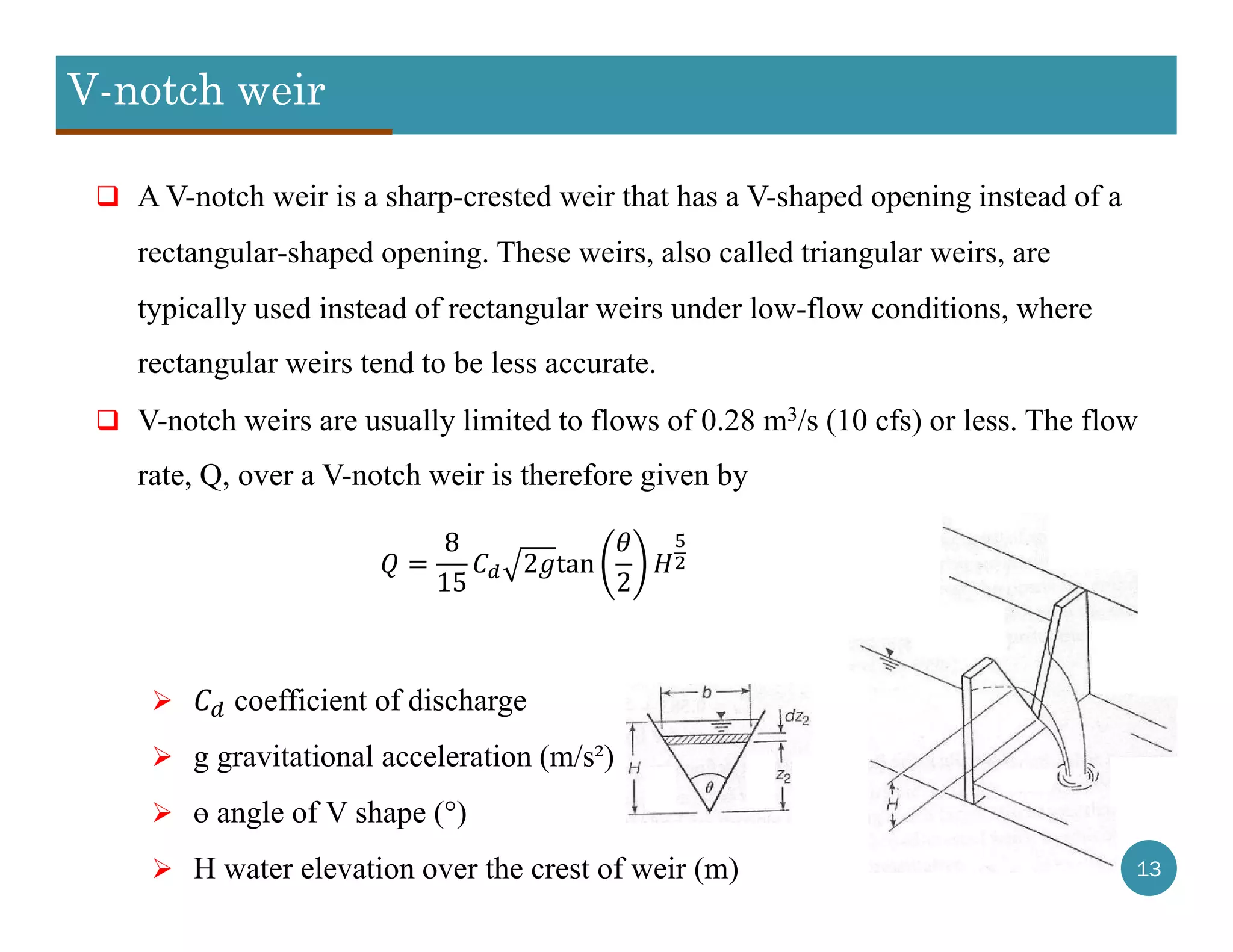
 A V-notch weir is a sharp-crested weir that has a V-shaped opening instead of a
rectangular-shaped opening. These weirs, also called triangular weirs, are
typically used instead of rectangular weirs under low-flow conditions, where
rectangular weirs tend to be less accurate.
 V-notch weirs are usually limited to flows of 0.28 m3/s (10 cfs) or less. The flow
rate, Q, over a V-notch weir is therefore given by
 coefficient of discharge
 g gravitational acceleration (m/s²)
 ɵ angle of V shape (°)
 H water elevation over the crest of weir (m)
8
15
2 tan
2
V-notch weir
14
 generally depends on Ɵ និង H
 The vertex angles Ɵ used in V-notch weirs are usually between 10° and 90°
V-notch weir
15
 Based on the figure, the minimum discharge coefficient corresponds to a notch
angle of 90°, and the minimum value of Cd for all angles is 0.581.
 According to Potter and Wiggert (1991) and White (1994), using =0.58 for
engineering calculations is acceptable, provided that 20° < Ɵ < 100° and H > 50
mm (2 in.)
 For H <50 mm, both viscous (viscosity, υ) and surface-tension effects (surface-
tension, σ) may be important and a recommended value of Cd is given by
(White, 1994)
 Re :Reynolds number defined by
 We :Weber number defined by
 For water, at 20°C : υ = 1.01 10 m²/s , σ = 0.0724 N/m
 The minimum head on a V-notch weir should be greater than 6 mm (0.2 in.)
0.583
1.19
Re
Re
V-notch weir
16
 In cases where the tailwater depth rises above the crest of the weir, the flow rate is
influenced by downstream flow conditions.
 Under this submerged condition, the discharge over the weir, Qs, can be estimated
in terms of the upstream and downstream heads on the weir using Villemonte’s
formula, with the exceptions that the exponent of yd/dH is taken as 5/2 instead of
3/2, and the unsubmerged discharge, Q, is calculated using equation for V-notch៖
1
.
V-notch weir
17
 Example: A V-notch weir is to be used to measure channel flows in the range 0.1
to 0.2 m3/s. What is the maximum head of water on the weir for a vertex angle of
45°?
 Solution: The maximum head of water results from the maximum flow, so Q = 0.2
m3/s will be used to calculate the maximum head. The relationship between the
head and flow rate is given by
The discharge coefficient as a function of H for Ɵ = 45° is given in Figure, and some
iteration is necessary to find H. These iteration are summarized in the following table:
Therefore, the maximum depth expected at the
V-notch weir is 2.16 ft = 0.66m.
H =
. .
m =
.
ft
Assumed H
(ft)
Cd (Figure)
Calculated H
(ft)
0.4 0.6 2.13
2.13 0.581 2.16
2.16 0.581 2.16
V-notch weir
18
 Problems
1. A V-notch weir is used to measure flow rate between 0.2 and 0.4 m³/s. What is
the maximum head of water over the crest of weir for a vertex angle of 90°?
2. A right vertex angle V-notch is used to measure flow rate in channel. If the head
of water over the crest is 25 cm, calculate the flow rate from the weir in litre/min.
3. A rectangular sharp-crested weir has a width of 1.5 m and a head of water 30 cm
over the crest of weir for measuring flow rate (Hw = 60 cm). For the same flow
rate as V-notch weir with a vertex angle of 90°, determine the head of water over
the V-notch.
Broad-crested weirs
19
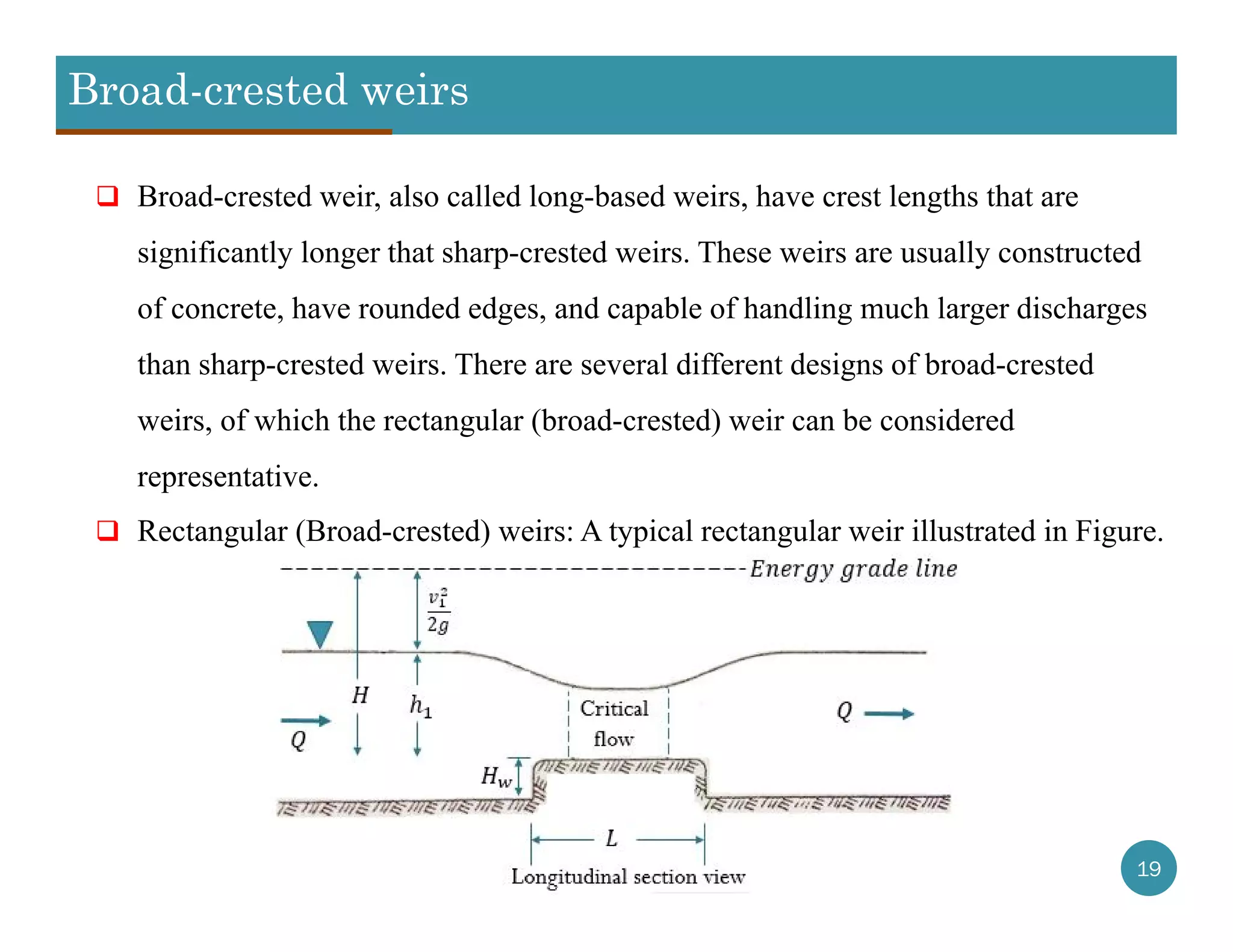
 Broad-crested weir, also called long-based weirs, have crest lengths that are
significantly longer that sharp-crested weirs. These weirs are usually constructed
of concrete, have rounded edges, and capable of handling much larger discharges
than sharp-crested weirs. There are several different designs of broad-crested
weirs, of which the rectangular (broad-crested) weir can be considered
representative.
 Rectangular (Broad-crested) weirs: A typical rectangular weir illustrated in Figure.
Broad-crested weirs
20
 These weirs operate on the theory that the elevation of the weir above the channel
bottom is sufficient to create critical flow conditions over the weir. The discharge
is given by
Q =
	
0.65
1 /
where values of Cd can be estimated using the relation (Chow, 1959)
To ensure proper operation of a broad-crested weir, flow conditions are
restricted to the operating range 0.08 < h1/L < 0.50. For h1/L < 0.08 head losses
across the weir cannot be neglected. A broad-crested weir can be assumed to
discharge freely if the tailwater level is lower than 0.8H above the crest of the
weir (Henderson, 1966).
Broad-crested weirs
21
 Example:
A 20-cm high broad-crested weir is placed in a 2-m wide channel. Estimate the
flowrate in the channel if the depth of water upstream of the weir is 50 cm.
Solution
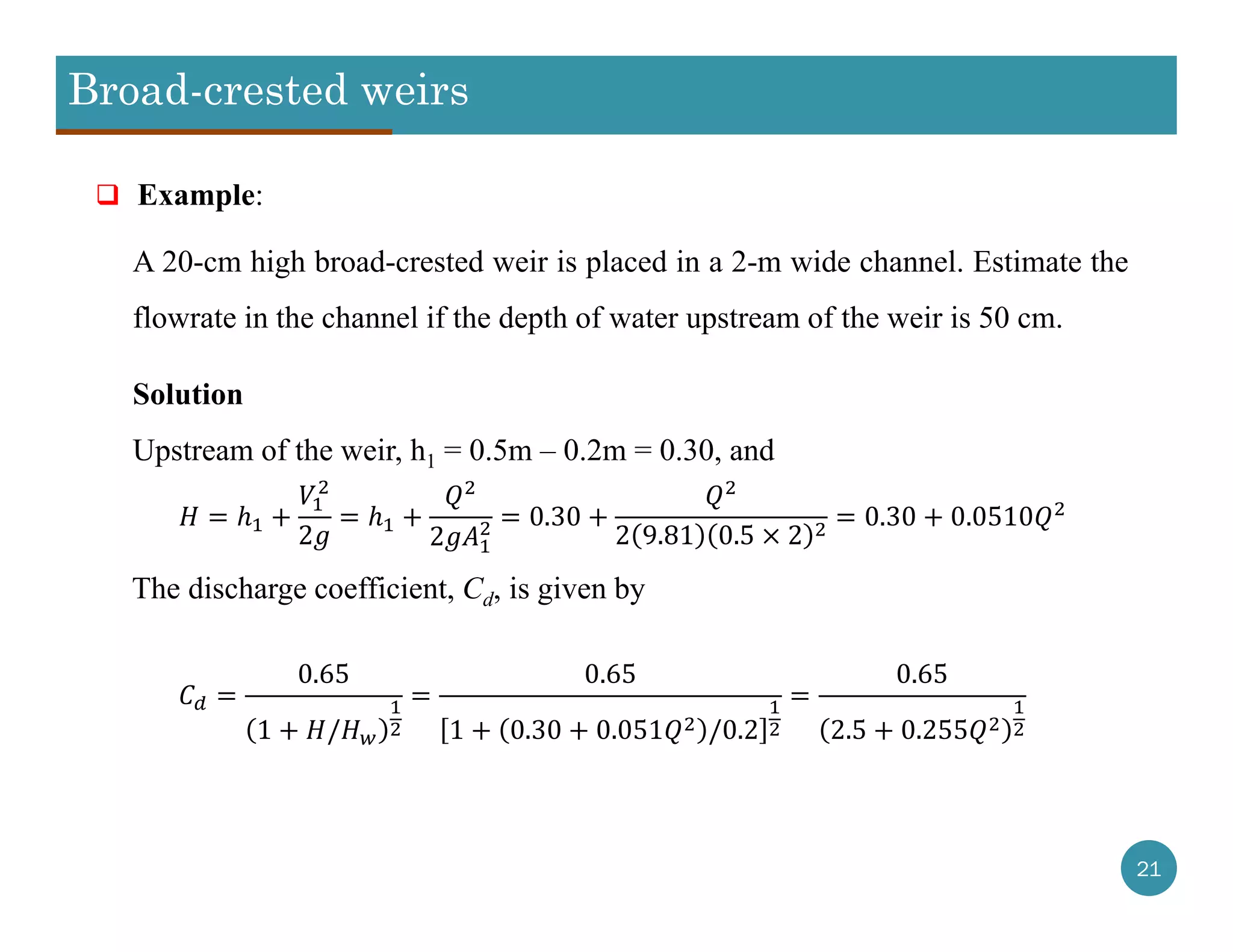
Upstream of the weir, h1 = 0.5m – 0.2m = 0.30, and
2 2
0.30
2 9.81 0.5 2
0.30 0.0510
The discharge coefficient, Cd, is given by
0.65
1 /
0.65
1 0.30 0.051 /0.2
0.65
2.5 0.255
Broad-crested weirs
22
 Solution (continued):
where Hw has been taken as 0.2 m. The discharge over the weir is therefore given
by
2
3
0.65
2.5 0.255
9.81 2
2
3
0.3 0.051
2.22
0.3 0.051
2.5 0.255
Solving iteratively give
Q = 0.23 m3/s
This solution assumes that the length of the weir is such that 0.08 < h1/L < 0.5
Broad-crested weirs
23
 Problems:
1. Determine the discharge over a broad-crested weir with a crest length of 6 ft
and a channel width of 100 ft. The upstream water level over the crest is 2 ft
and the crest has a height of 2.25 ft.
2. Determine the discharge over a broad-crested weir has a crest length of 2 m
with a rounded entrance. The measured upstream level over the crest is 0.7
m. The width of the channel is 50 m and the channel bottom is 0.6 m below
the crest. Increase the discharge by 5% for the rounded entrance.
3. A rectangular channel 14 m wide has a uniform depth of 2 m. If the channel
discharge is 10 m3/s, determine the height of a broad-crested weir, with a
crest length of 2 m, to be built across the channel at the end for free
discharge.
Broad-crested weirs
24
 Problems:
4. A 25-cm high broad-crested weir is placed in a 1.5-m wide channel. If the
maximum depth of water can be measured upstream of the weir is equal to
75 cm, what is the maximum flowrate that can be measured by the weir?
5. A broad-crested rectangular weir of length 1 m, width 1 m, and height 30 cm
is being considered to measure the flow in a canal. For what range of flows
would this weir length be adequate?
6. A broad-crested weir is to be used to measure the flow in an irrigation
channel. The design section upstream of the weir is rectangular with a width
of 3 m, and the depth of flow is 4 m at a flowrate of 5 m3/s. Design the
height and the length of the weir.
Prepared by SONG Layheang
Parshall Flume
Mobile : +855 (0) 92 79 64 66
E-mail: layheang.song@gmail.com
Department of Rural Engineering, Institute of Technology of Cambodia
PO Box 86, Bvld of Russian, Phnom Penh, Cambodia
Institute of Technology of Cambodia
PO Box 86, Bvld of Russian, Phnom Penh, Cambodia
Introduction
26
 Although weirs are the simplest structures for measuring the discharge in open
channels, the high head losses caused by weirs and the tendency for suspended
particles to accumulate behind weirs may be important limitation.
 Parshall flume (named after Ralph L. Parshall) provides a convenient alternative
to the weir for measuring flow rates in open channels where high head losses and
sediment accumulation are of concern.
 This structure is used to measure flow in waste water treatment plants and
irrigation channels.
Geometric condition of Parshall Flume
27
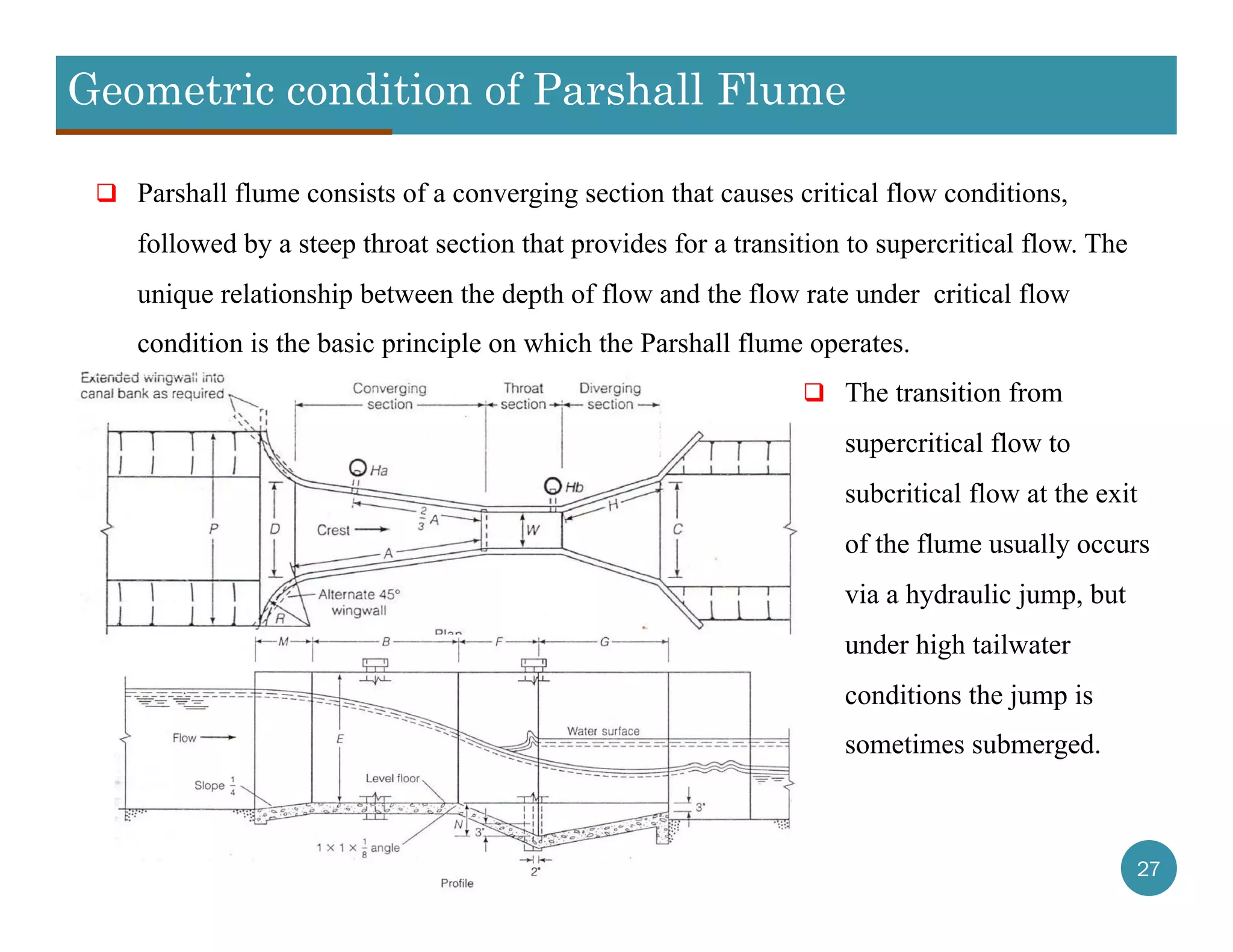
 Parshall flume consists of a converging section that causes critical flow conditions,
followed by a steep throat section that provides for a transition to supercritical flow. The
unique relationship between the depth of flow and the flow rate under critical flow
condition is the basic principle on which the Parshall flume operates.
 The transition from
supercritical flow to
subcritical flow at the exit
of the flume usually occurs
via a hydraulic jump, but
under high tailwater
conditions the jump is
sometimes submerged.
Parshall Flume
28
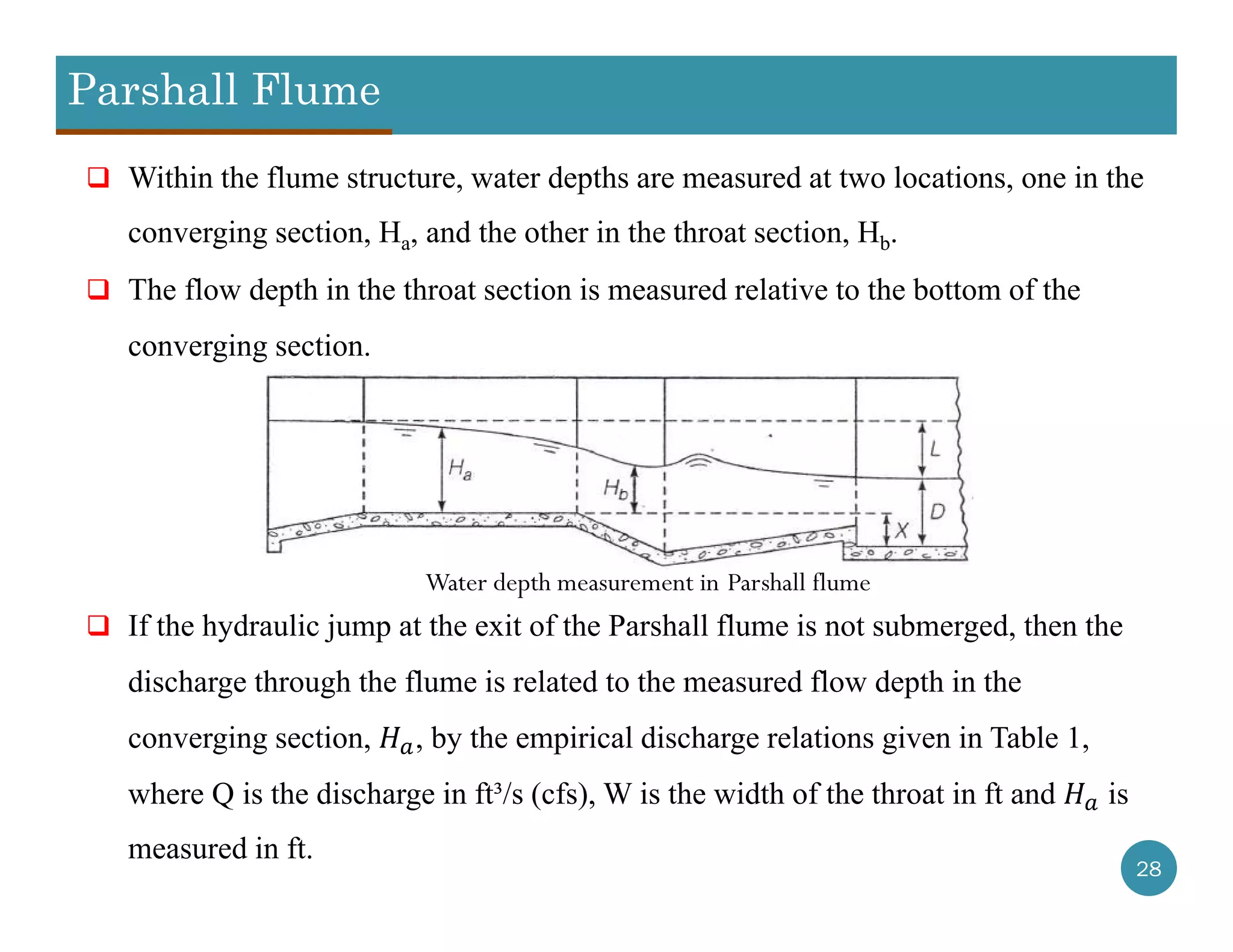
 Within the flume structure, water depths are measured at two locations, one in the
converging section, Ha, and the other in the throat section, Hb.
 The flow depth in the throat section is measured relative to the bottom of the
converging section.
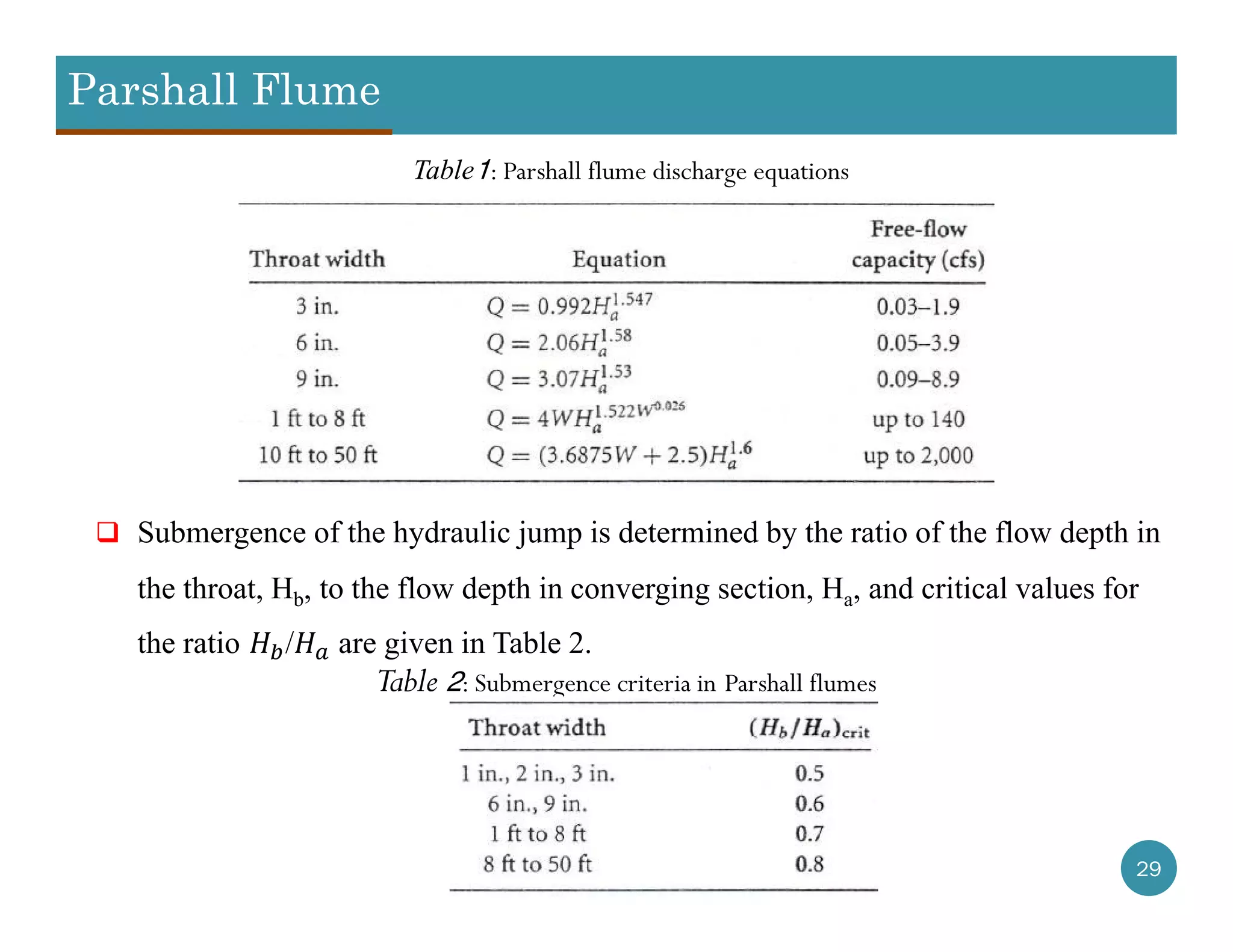
 If the hydraulic jump at the exit of the Parshall flume is not submerged, then the
discharge through the flume is related to the measured flow depth in the
converging section, , by the empirical discharge relations given in Table 1,
where Q is the discharge in ft³/s (cfs), W is the width of the throat in ft and is
measured in ft.
Water depth measurement in Parshall flume
Parshall Flume
29
 Submergence of the hydraulic jump is determined by the ratio of the flow depth in
the throat, Hb, to the flow depth in converging section, Ha, and critical values for
the ratio / are given in Table 2.
Table1: Parshall flume discharge equations
Table 2: Submergence criteria in Parshall flumes
Parshall Flume
30
 Whenever / exceeds the critical values given in Table 2, they hydraulic jump
is submerged and the discharge is reduced from the values given by the equations
in Table 1. Corrections to the theoretical flow rates as a function of and the
percentage of submergence, / , are given in figure 1 for a throat width of 1 ft
and in Figure 2 for a throat width of 10 ft
Figure 1: Parshall flume correction for submerged flow (w=1ft)
Parshall Flume
31
Figure 2: Parshall flume correction for submerged flow (w=10 ft)
Parshall Flume
32
 Flow corrections for the 1-ft flume are applied to larger flumes by multiplying the
correction for the 1-ft flume by a factor corresponding to the flume size given in
Table 3
Table 3: Correction factors for 1-ft Parshall flume
Parshall Flume
33
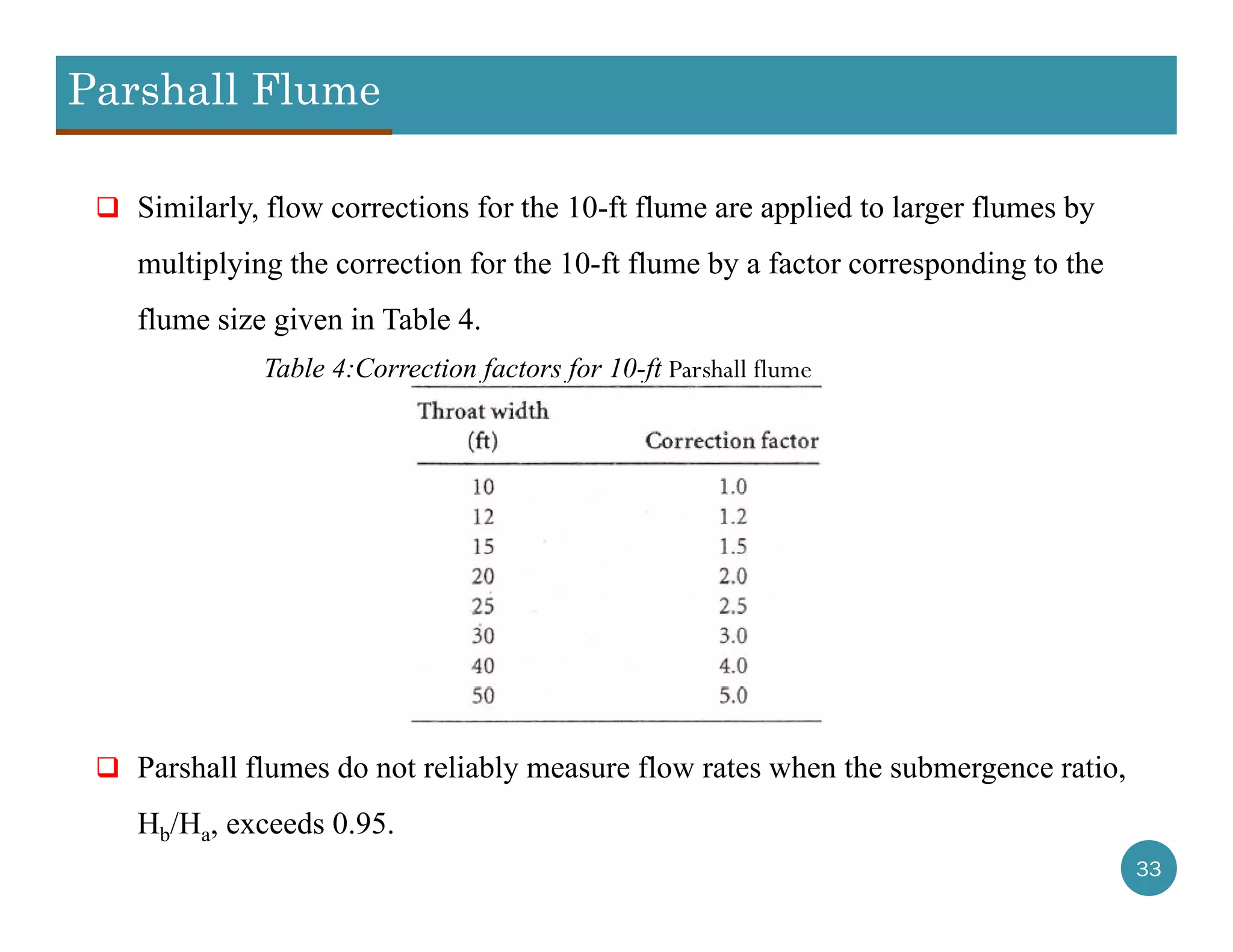
 Similarly, flow corrections for the 10-ft flume are applied to larger flumes by
multiplying the correction for the 10-ft flume by a factor corresponding to the
flume size given in Table 4.
 Parshall flumes do not reliably measure flow rates when the submergence ratio,
Hb/Ha, exceeds 0.95.
Table 4:Correction factors for 10-ft Parshall flume
Parshall Flume
34
 Example: Flow is being measured by a Parshall flume that has a throat width of 2
ft. Determine the flowrate through the flume when the water depth in the
converging section is 2 ft and the depth in the throat section is 1.7 ft.
 Solution:
From the given data: W = 2 ft, Ha = 2 ft, and Hb = 1.7 ft. According to Table 1, the
the flowrate, Q, is given by
In this case,
0.026 0.026
1.522 1.522 2
4 4(2)(2) 23.4W
aQ WH cfs
  
1.7
0.85
2
b
a
H
H
 
Parshall Flume
35
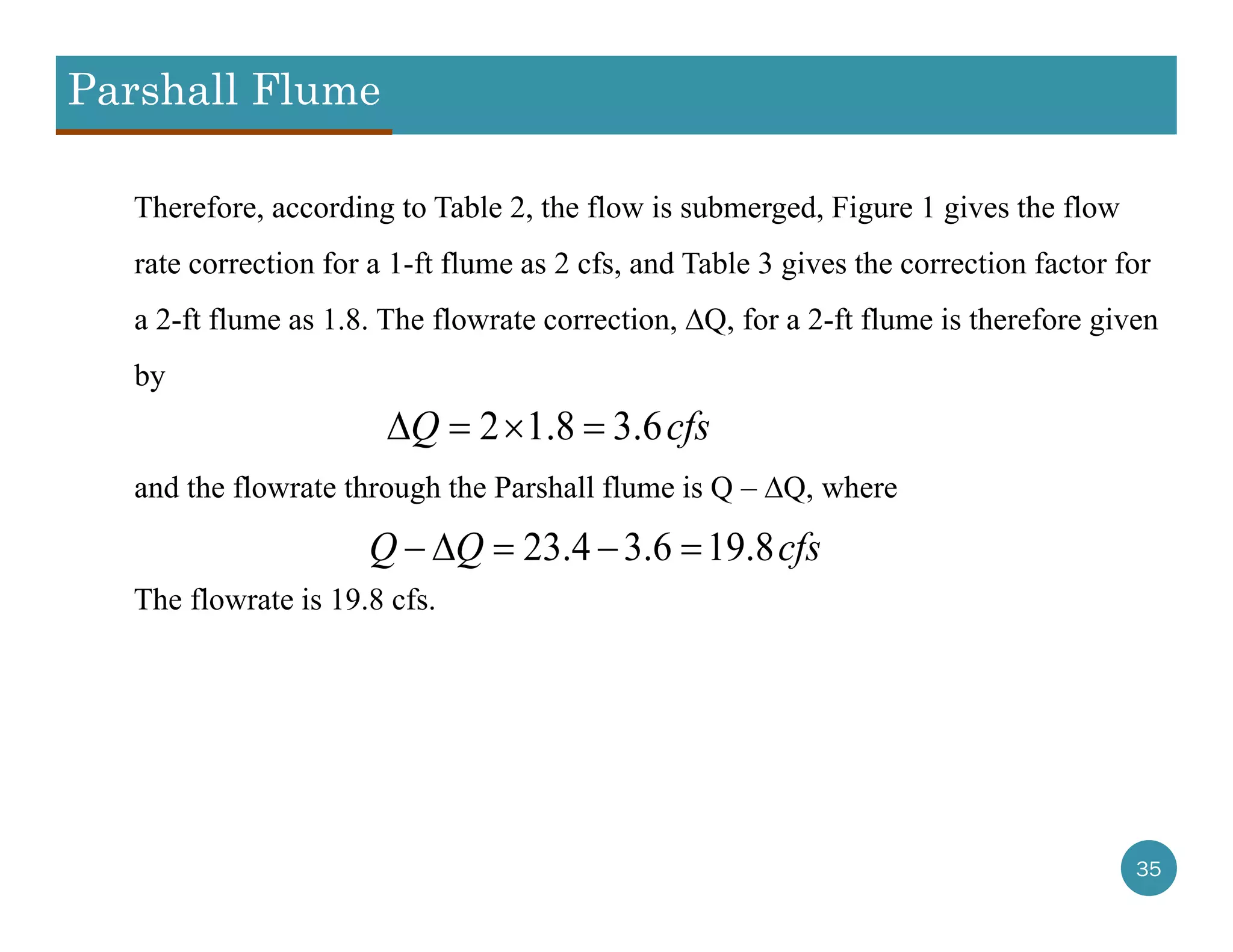
Therefore, according to Table 2, the flow is submerged, Figure 1 gives the flow
rate correction for a 1-ft flume as 2 cfs, and Table 3 gives the correction factor for
a 2-ft flume as 1.8. The flowrate correction, ∆Q, for a 2-ft flume is therefore given
by
and the flowrate through the Parshall flume is Q – ∆Q, where
The flowrate is 19.8 cfs.
2 1.8 3.6Q cfs   
23.4 3.6 19.8Q Q cfs    
Parshall Flume
36
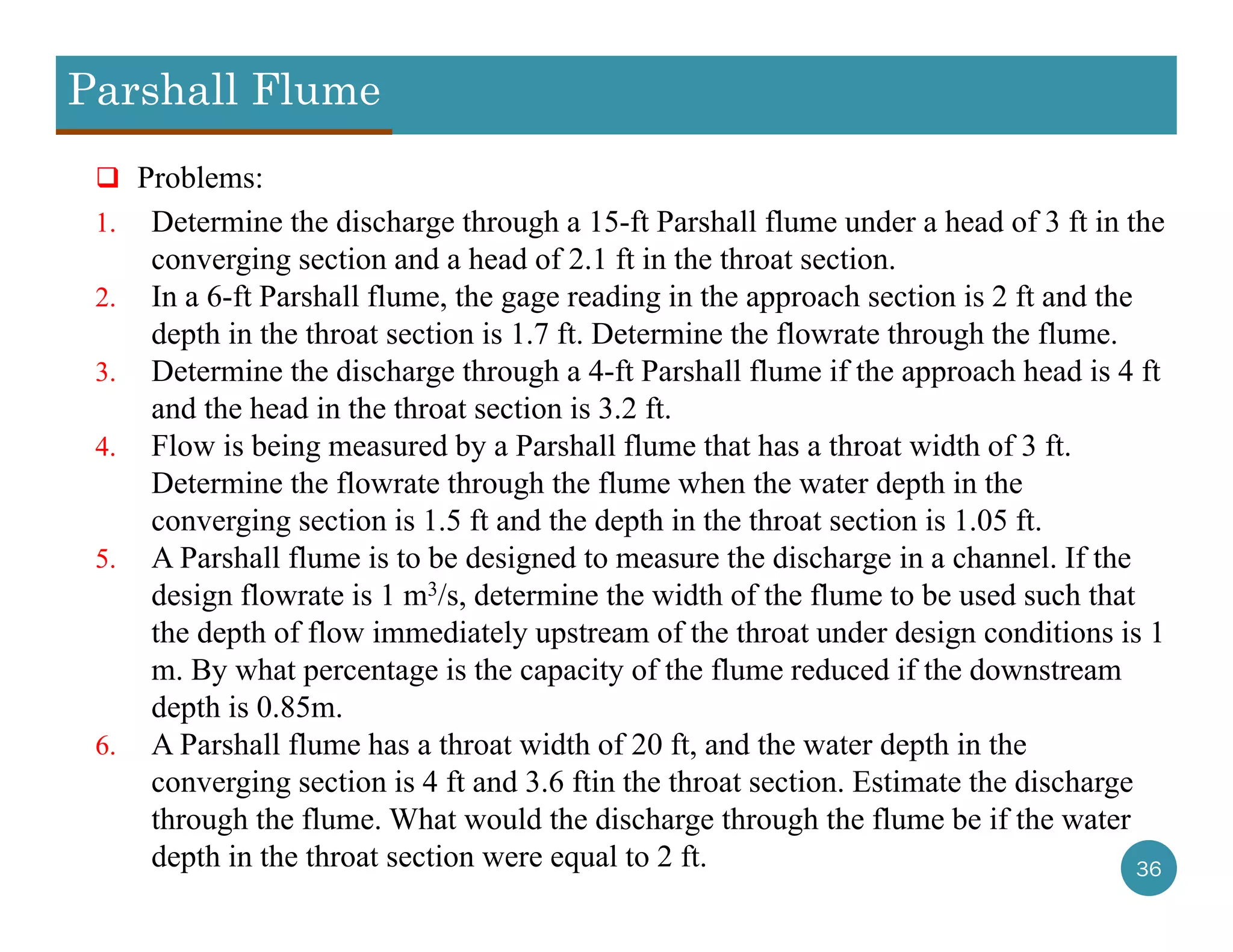
 Problems:
1. Determine the discharge through a 15-ft Parshall flume under a head of 3 ft in the
converging section and a head of 2.1 ft in the throat section.
2. In a 6-ft Parshall flume, the gage reading in the approach section is 2 ft and the
depth in the throat section is 1.7 ft. Determine the flowrate through the flume.
3. Determine the discharge through a 4-ft Parshall flume if the approach head is 4 ft
and the head in the throat section is 3.2 ft.
4. Flow is being measured by a Parshall flume that has a throat width of 3 ft.
Determine the flowrate through the flume when the water depth in the
converging section is 1.5 ft and the depth in the throat section is 1.05 ft.
5. A Parshall flume is to be designed to measure the discharge in a channel. If the
design flowrate is 1 m3/s, determine the width of the flume to be used such that
the depth of flow immediately upstream of the throat under design conditions is 1
m. By what percentage is the capacity of the flume reduced if the downstream
depth is 0.85m.
6. A Parshall flume has a throat width of 20 ft, and the water depth in the
converging section is 4 ft and 3.6 ftin the throat section. Estimate the discharge
through the flume. What would the discharge through the flume be if the water
depth in the throat section were equal to 2 ft.
37

Weirs and flumes with broad

  • 1.
    SONG Layheang Weirs Mobile :+855 (0) 92 79 64 66 E-mail: layheang.song@gmail.com Department of Rural Engineering, Institute of Technology of Cambodia PO Box 86, Bvld of Russian, Phnom Penh, Cambodia Institute of Technology of Cambodia PO Box 86, Bvld of Russian, Phnom Penh, Cambodia
  • 2.
    Introduction 2  Weirs areelevated structures in open channels that are used to measure flow and/or control outflow elevations from basins and channels.
  • 3.
    Introduction 3  There aretwo types of weirs in common use:  Sharp-crested weirs  Broad-crested weirs Sharp-crested weir Broad-crested weir
  • 4.
    Sharp-crested weir 4  Themain types of sharp-crested weirs are:  Rectangular weirs  V-notch weir  Cipolletti weir (trapezoidal cross section) Rectangular weir V-notch weir Cipolletti weir
  • 5.
    Sharp-crested weir withrectangular cross section 5  The type of this structure can be:  Unsuppressed weir (contracted weir)  Suppressed weir (uncontracted weir) Unsuppressed weir Suppressed weir
  • 6.
    Sharp-crested weir withrectangular cross section 6  Formula for calculating flow rate (over the weir section, m³/s)  : coefficient of discharge  g : gravitational acceleration (m/s²)  b : width of weir (m)  H : elevation of the water surface from the top of the weir (m) 2 3 2
  • 7.
    Sharp-crested weir withrectangular cross section 7  Formula for calculating flow rate (continue) Experiments have show that H/Hw is the most important variable affecting Cd which can be calculated by: (Rouse, 1946; Blevins, 1984)  Valid for H/Hw < 5  For H/Hw < 0.4 , flow rate can be computed by the formula below  The measurement of H is taken between 4H and 5H upstream of the weir  In the case of unsuppressed weirs, Q can be estimated by where (gives acceptable for b > 3H)  weir coefficient, b width of the weir, n number of sides of the weir that are contracted, usually equal to 2 0.611 0.075 1.83 0.1 2 3 2
  • 8.
    Sharp-crested weir withrectangular cross section 8  The discharge over a submerged weir, Qs, can be estimated in terms of the upstream and downstream heads on the weir using Villemonte’s formula (Villemonte, 1947) (H measured at 2.5H from the weir)  Q is the calculated flow rate assuming the weir is not submerged, yd is the head downstream of the weir and H is the head upstream of the weir. Weirs should be designed to discharge freely rather than submerged because of greater measurement accuracy. 1 .
  • 9.
    Sharp-crested weir withrectangular cross section 9  A type of contracted weir that is related to the rectangular sharp-crested weir is Ciolletti weir, which has a trapezoidal cross-section with side slopes 1:4 (H:V). The discharge formula can be written simply as  B is the bottom-width of the Cipolletti weir  The minimum head on standard rectangular and Cipolletti weir is 6 mm (0.2 ft)
  • 10.
    Sharp-crested weir withrectangular cross section 10  Example: A weir is to be installed to measure flows in the range of 0.5-1.0 m3/s. If the maximum (total) depth of water that can be accumulated at the weir is 1 m and the width of the channel is 4 m, determine the height of a suppressed weir that should be used to measure the flow rate.  Solution: The flow over the weir is illustrated in the figure below, where the height of the weir is Hw and the flow rate is Q.
  • 11.
    Sharp-crested weir withrectangular cross section 11  Solution (continue) The height of the water over the crest of the weir, H, is given by H = 1 – Hw Assuming that H/Hw < 0.4, then Q is related to H and can be computed by: Q = 1.83bH3/2 Taking be = 4 m, and Q = 1 m3/s (the maximum flow rate will give the maximum head, H), then The height of the weir, Hw, is therefore given by Hw = 1 - 0.265 = 0.735 m And . . 0.36 The initial assumption that H/Hw < 0.4 is therefore validated, and the height of the weir should be 0.735 m. H . = . 0.265
  • 12.
    Sharp-crested weir withrectangular cross section 12  Problems 10.12 Water passes over a rectangular weir of 10 ft width at a depth of 1 ft. If the weir is replaced by an 80° V-notch, determine the depth of water over the notch. Disregard the end contractions. Cd for notch = 0.59, Cd for rectangular weir = 0.63. 10.16 A submerged weir in a pond is 10 ft long. The crest of the weir is 9 in. below the upstream level and 6 in. below the tailwater level. The crest height is 1 ft. Determine the discharge. 10.17 A stream is 200 ft wide and 10 ft deep. It has a mean velocity of flow of 4 ft/sec. If a submerged weir of 8 ft height is installed, how much will the water upstream rise? Disregard the velocity approach. [Hint: Assume Cd, determine H1 for the submerged case, calculate revised Cd from the formula, and find revised H1.]
  • 13.
    V-notch weir 13  AV-notch weir is a sharp-crested weir that has a V-shaped opening instead of a rectangular-shaped opening. These weirs, also called triangular weirs, are typically used instead of rectangular weirs under low-flow conditions, where rectangular weirs tend to be less accurate.  V-notch weirs are usually limited to flows of 0.28 m3/s (10 cfs) or less. The flow rate, Q, over a V-notch weir is therefore given by  coefficient of discharge  g gravitational acceleration (m/s²)  ɵ angle of V shape (°)  H water elevation over the crest of weir (m) 8 15 2 tan 2
  • 14.
    V-notch weir 14  generallydepends on Ɵ និង H  The vertex angles Ɵ used in V-notch weirs are usually between 10° and 90°
  • 15.
    V-notch weir 15  Basedon the figure, the minimum discharge coefficient corresponds to a notch angle of 90°, and the minimum value of Cd for all angles is 0.581.  According to Potter and Wiggert (1991) and White (1994), using =0.58 for engineering calculations is acceptable, provided that 20° < Ɵ < 100° and H > 50 mm (2 in.)  For H <50 mm, both viscous (viscosity, υ) and surface-tension effects (surface- tension, σ) may be important and a recommended value of Cd is given by (White, 1994)  Re :Reynolds number defined by  We :Weber number defined by  For water, at 20°C : υ = 1.01 10 m²/s , σ = 0.0724 N/m  The minimum head on a V-notch weir should be greater than 6 mm (0.2 in.) 0.583 1.19 Re Re
  • 16.
    V-notch weir 16  Incases where the tailwater depth rises above the crest of the weir, the flow rate is influenced by downstream flow conditions.  Under this submerged condition, the discharge over the weir, Qs, can be estimated in terms of the upstream and downstream heads on the weir using Villemonte’s formula, with the exceptions that the exponent of yd/dH is taken as 5/2 instead of 3/2, and the unsubmerged discharge, Q, is calculated using equation for V-notch៖ 1 .
  • 17.
    V-notch weir 17  Example:A V-notch weir is to be used to measure channel flows in the range 0.1 to 0.2 m3/s. What is the maximum head of water on the weir for a vertex angle of 45°?  Solution: The maximum head of water results from the maximum flow, so Q = 0.2 m3/s will be used to calculate the maximum head. The relationship between the head and flow rate is given by The discharge coefficient as a function of H for Ɵ = 45° is given in Figure, and some iteration is necessary to find H. These iteration are summarized in the following table: Therefore, the maximum depth expected at the V-notch weir is 2.16 ft = 0.66m. H = . . m = . ft Assumed H (ft) Cd (Figure) Calculated H (ft) 0.4 0.6 2.13 2.13 0.581 2.16 2.16 0.581 2.16
  • 18.
    V-notch weir 18  Problems 1.A V-notch weir is used to measure flow rate between 0.2 and 0.4 m³/s. What is the maximum head of water over the crest of weir for a vertex angle of 90°? 2. A right vertex angle V-notch is used to measure flow rate in channel. If the head of water over the crest is 25 cm, calculate the flow rate from the weir in litre/min. 3. A rectangular sharp-crested weir has a width of 1.5 m and a head of water 30 cm over the crest of weir for measuring flow rate (Hw = 60 cm). For the same flow rate as V-notch weir with a vertex angle of 90°, determine the head of water over the V-notch.
  • 19.
    Broad-crested weirs 19  Broad-crestedweir, also called long-based weirs, have crest lengths that are significantly longer that sharp-crested weirs. These weirs are usually constructed of concrete, have rounded edges, and capable of handling much larger discharges than sharp-crested weirs. There are several different designs of broad-crested weirs, of which the rectangular (broad-crested) weir can be considered representative.  Rectangular (Broad-crested) weirs: A typical rectangular weir illustrated in Figure.
  • 20.
    Broad-crested weirs 20  Theseweirs operate on the theory that the elevation of the weir above the channel bottom is sufficient to create critical flow conditions over the weir. The discharge is given by Q = 0.65 1 / where values of Cd can be estimated using the relation (Chow, 1959) To ensure proper operation of a broad-crested weir, flow conditions are restricted to the operating range 0.08 < h1/L < 0.50. For h1/L < 0.08 head losses across the weir cannot be neglected. A broad-crested weir can be assumed to discharge freely if the tailwater level is lower than 0.8H above the crest of the weir (Henderson, 1966).
  • 21.
    Broad-crested weirs 21  Example: A20-cm high broad-crested weir is placed in a 2-m wide channel. Estimate the flowrate in the channel if the depth of water upstream of the weir is 50 cm. Solution Upstream of the weir, h1 = 0.5m – 0.2m = 0.30, and 2 2 0.30 2 9.81 0.5 2 0.30 0.0510 The discharge coefficient, Cd, is given by 0.65 1 / 0.65 1 0.30 0.051 /0.2 0.65 2.5 0.255
  • 22.
    Broad-crested weirs 22  Solution(continued): where Hw has been taken as 0.2 m. The discharge over the weir is therefore given by 2 3 0.65 2.5 0.255 9.81 2 2 3 0.3 0.051 2.22 0.3 0.051 2.5 0.255 Solving iteratively give Q = 0.23 m3/s This solution assumes that the length of the weir is such that 0.08 < h1/L < 0.5
  • 23.
    Broad-crested weirs 23  Problems: 1.Determine the discharge over a broad-crested weir with a crest length of 6 ft and a channel width of 100 ft. The upstream water level over the crest is 2 ft and the crest has a height of 2.25 ft. 2. Determine the discharge over a broad-crested weir has a crest length of 2 m with a rounded entrance. The measured upstream level over the crest is 0.7 m. The width of the channel is 50 m and the channel bottom is 0.6 m below the crest. Increase the discharge by 5% for the rounded entrance. 3. A rectangular channel 14 m wide has a uniform depth of 2 m. If the channel discharge is 10 m3/s, determine the height of a broad-crested weir, with a crest length of 2 m, to be built across the channel at the end for free discharge.
  • 24.
    Broad-crested weirs 24  Problems: 4.A 25-cm high broad-crested weir is placed in a 1.5-m wide channel. If the maximum depth of water can be measured upstream of the weir is equal to 75 cm, what is the maximum flowrate that can be measured by the weir? 5. A broad-crested rectangular weir of length 1 m, width 1 m, and height 30 cm is being considered to measure the flow in a canal. For what range of flows would this weir length be adequate? 6. A broad-crested weir is to be used to measure the flow in an irrigation channel. The design section upstream of the weir is rectangular with a width of 3 m, and the depth of flow is 4 m at a flowrate of 5 m3/s. Design the height and the length of the weir.
  • 25.
    Prepared by SONGLayheang Parshall Flume Mobile : +855 (0) 92 79 64 66 E-mail: layheang.song@gmail.com Department of Rural Engineering, Institute of Technology of Cambodia PO Box 86, Bvld of Russian, Phnom Penh, Cambodia Institute of Technology of Cambodia PO Box 86, Bvld of Russian, Phnom Penh, Cambodia
  • 26.
    Introduction 26  Although weirsare the simplest structures for measuring the discharge in open channels, the high head losses caused by weirs and the tendency for suspended particles to accumulate behind weirs may be important limitation.  Parshall flume (named after Ralph L. Parshall) provides a convenient alternative to the weir for measuring flow rates in open channels where high head losses and sediment accumulation are of concern.  This structure is used to measure flow in waste water treatment plants and irrigation channels.
  • 27.
    Geometric condition ofParshall Flume 27  Parshall flume consists of a converging section that causes critical flow conditions, followed by a steep throat section that provides for a transition to supercritical flow. The unique relationship between the depth of flow and the flow rate under critical flow condition is the basic principle on which the Parshall flume operates.  The transition from supercritical flow to subcritical flow at the exit of the flume usually occurs via a hydraulic jump, but under high tailwater conditions the jump is sometimes submerged.
  • 28.
    Parshall Flume 28  Withinthe flume structure, water depths are measured at two locations, one in the converging section, Ha, and the other in the throat section, Hb.  The flow depth in the throat section is measured relative to the bottom of the converging section.  If the hydraulic jump at the exit of the Parshall flume is not submerged, then the discharge through the flume is related to the measured flow depth in the converging section, , by the empirical discharge relations given in Table 1, where Q is the discharge in ft³/s (cfs), W is the width of the throat in ft and is measured in ft. Water depth measurement in Parshall flume
  • 29.
    Parshall Flume 29  Submergenceof the hydraulic jump is determined by the ratio of the flow depth in the throat, Hb, to the flow depth in converging section, Ha, and critical values for the ratio / are given in Table 2. Table1: Parshall flume discharge equations Table 2: Submergence criteria in Parshall flumes
  • 30.
    Parshall Flume 30  Whenever/ exceeds the critical values given in Table 2, they hydraulic jump is submerged and the discharge is reduced from the values given by the equations in Table 1. Corrections to the theoretical flow rates as a function of and the percentage of submergence, / , are given in figure 1 for a throat width of 1 ft and in Figure 2 for a throat width of 10 ft Figure 1: Parshall flume correction for submerged flow (w=1ft)
  • 31.
    Parshall Flume 31 Figure 2:Parshall flume correction for submerged flow (w=10 ft)
  • 32.
    Parshall Flume 32  Flowcorrections for the 1-ft flume are applied to larger flumes by multiplying the correction for the 1-ft flume by a factor corresponding to the flume size given in Table 3 Table 3: Correction factors for 1-ft Parshall flume
  • 33.
    Parshall Flume 33  Similarly,flow corrections for the 10-ft flume are applied to larger flumes by multiplying the correction for the 10-ft flume by a factor corresponding to the flume size given in Table 4.  Parshall flumes do not reliably measure flow rates when the submergence ratio, Hb/Ha, exceeds 0.95. Table 4:Correction factors for 10-ft Parshall flume
  • 34.
    Parshall Flume 34  Example:Flow is being measured by a Parshall flume that has a throat width of 2 ft. Determine the flowrate through the flume when the water depth in the converging section is 2 ft and the depth in the throat section is 1.7 ft.  Solution: From the given data: W = 2 ft, Ha = 2 ft, and Hb = 1.7 ft. According to Table 1, the the flowrate, Q, is given by In this case, 0.026 0.026 1.522 1.522 2 4 4(2)(2) 23.4W aQ WH cfs    1.7 0.85 2 b a H H  
  • 35.
    Parshall Flume 35 Therefore, accordingto Table 2, the flow is submerged, Figure 1 gives the flow rate correction for a 1-ft flume as 2 cfs, and Table 3 gives the correction factor for a 2-ft flume as 1.8. The flowrate correction, ∆Q, for a 2-ft flume is therefore given by and the flowrate through the Parshall flume is Q – ∆Q, where The flowrate is 19.8 cfs. 2 1.8 3.6Q cfs    23.4 3.6 19.8Q Q cfs    
  • 36.
    Parshall Flume 36  Problems: 1.Determine the discharge through a 15-ft Parshall flume under a head of 3 ft in the converging section and a head of 2.1 ft in the throat section. 2. In a 6-ft Parshall flume, the gage reading in the approach section is 2 ft and the depth in the throat section is 1.7 ft. Determine the flowrate through the flume. 3. Determine the discharge through a 4-ft Parshall flume if the approach head is 4 ft and the head in the throat section is 3.2 ft. 4. Flow is being measured by a Parshall flume that has a throat width of 3 ft. Determine the flowrate through the flume when the water depth in the converging section is 1.5 ft and the depth in the throat section is 1.05 ft. 5. A Parshall flume is to be designed to measure the discharge in a channel. If the design flowrate is 1 m3/s, determine the width of the flume to be used such that the depth of flow immediately upstream of the throat under design conditions is 1 m. By what percentage is the capacity of the flume reduced if the downstream depth is 0.85m. 6. A Parshall flume has a throat width of 20 ft, and the water depth in the converging section is 4 ft and 3.6 ftin the throat section. Estimate the discharge through the flume. What would the discharge through the flume be if the water depth in the throat section were equal to 2 ft.
  • 37.