Solving Quadratic
Equations by
Completing the Square
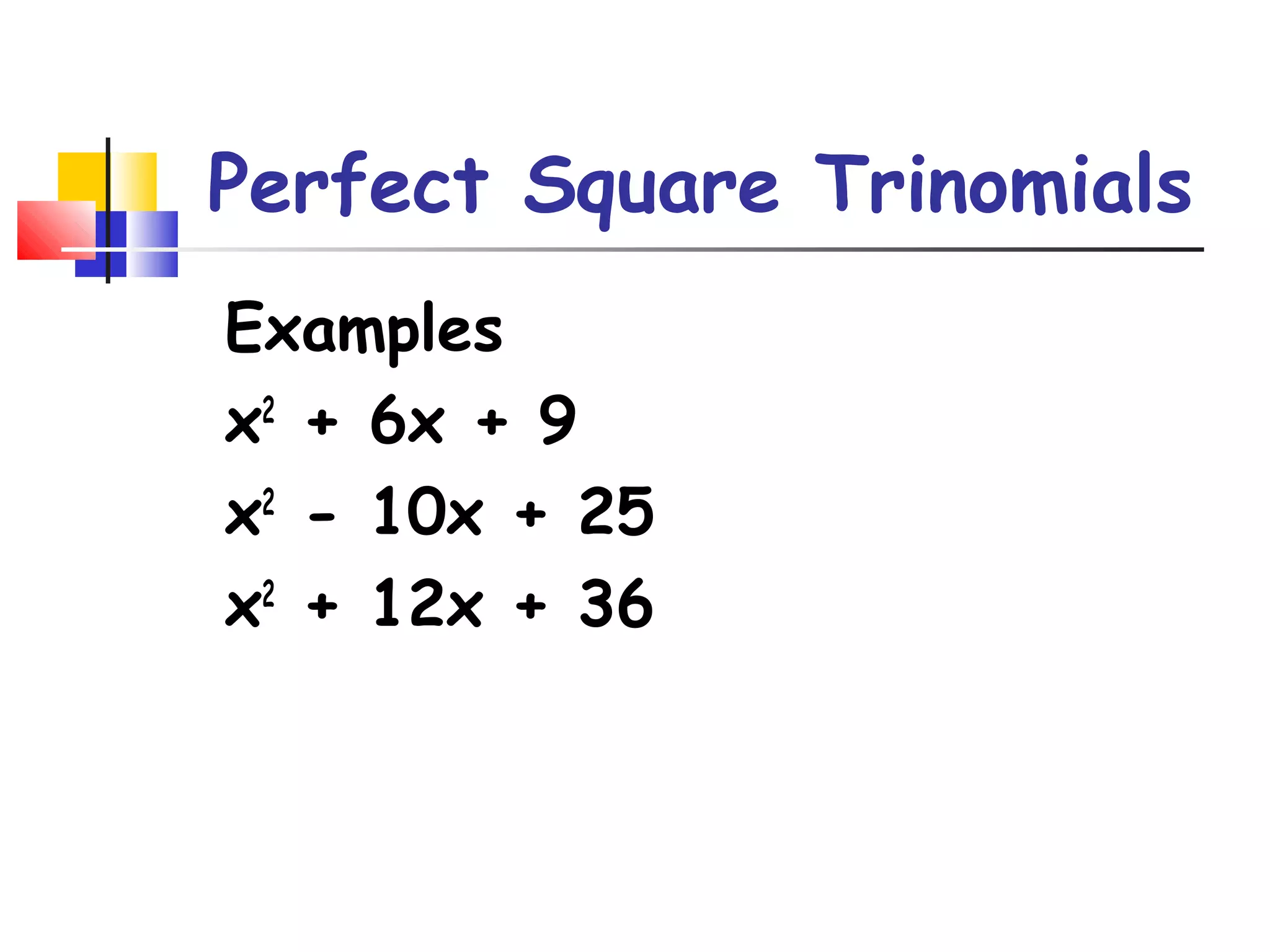
Perfect Square Trinomials
Examples
x2 + 6x + 9
x2 - 10x + 25
x2 + 12x + 36
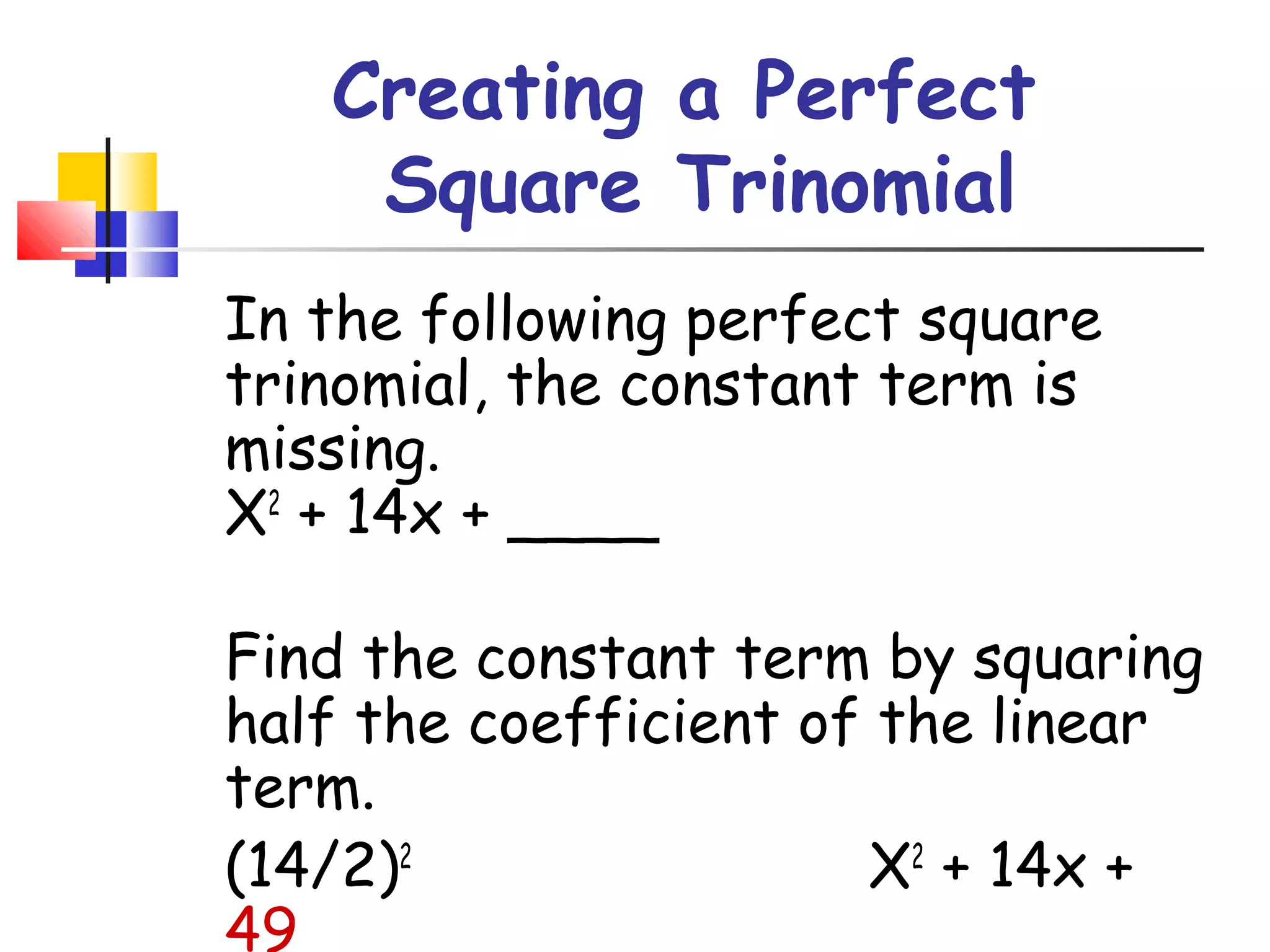
Creating a Perfect
Square Trinomial
In the following perfect square
trinomial, the constant term is
missing.
X2 + 14x + ____
Find the constant term by squaring
half the coefficient of the linear
term.
(14/2)2
X2 + 14x +
49
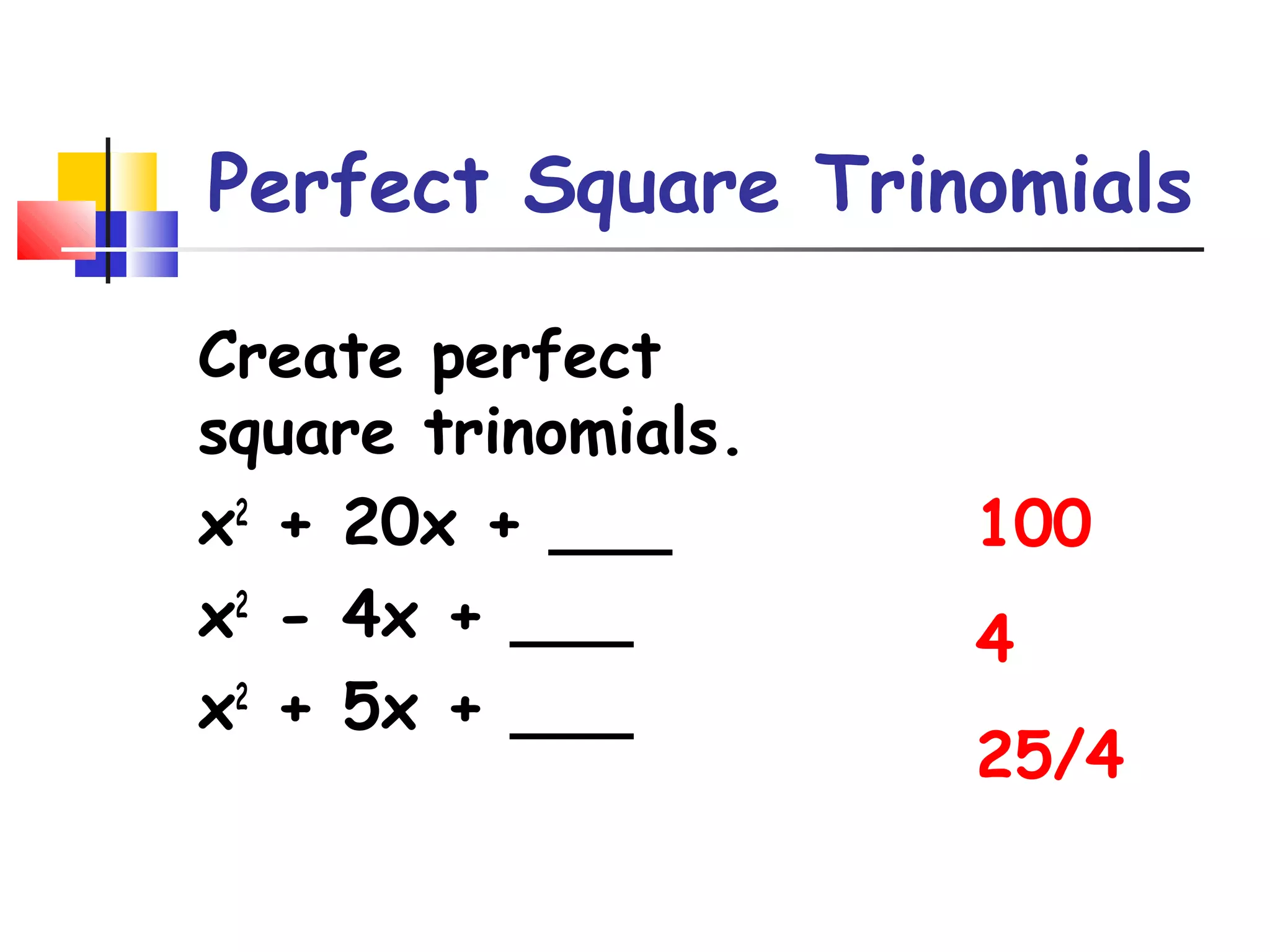
Perfect Square Trinomials
Create perfect
square trinomials.
x2 + 20x + ___
x2 - 4x + ___
x2 + 5x + ___

100
4
25/4
Solving Quadratic Equations
by Completing the Square
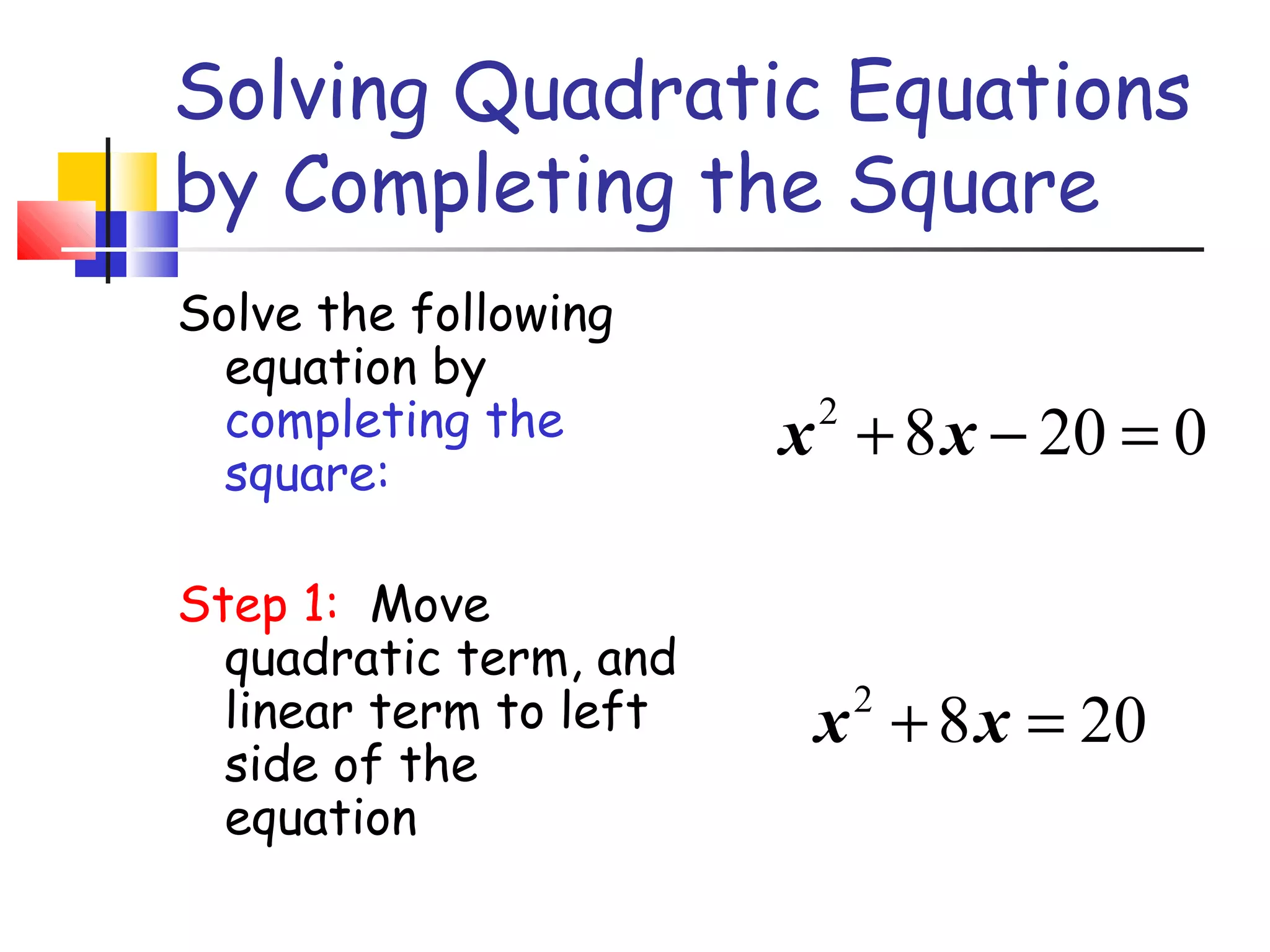
Solve the following
equation by
completing the
square:
Step 1: Move
quadratic term, and
linear term to left
side of the
equation

x + 8 x − 20 = 0
2

x + 8 x = 20
2
Solving Quadratic Equations
by Completing the Square
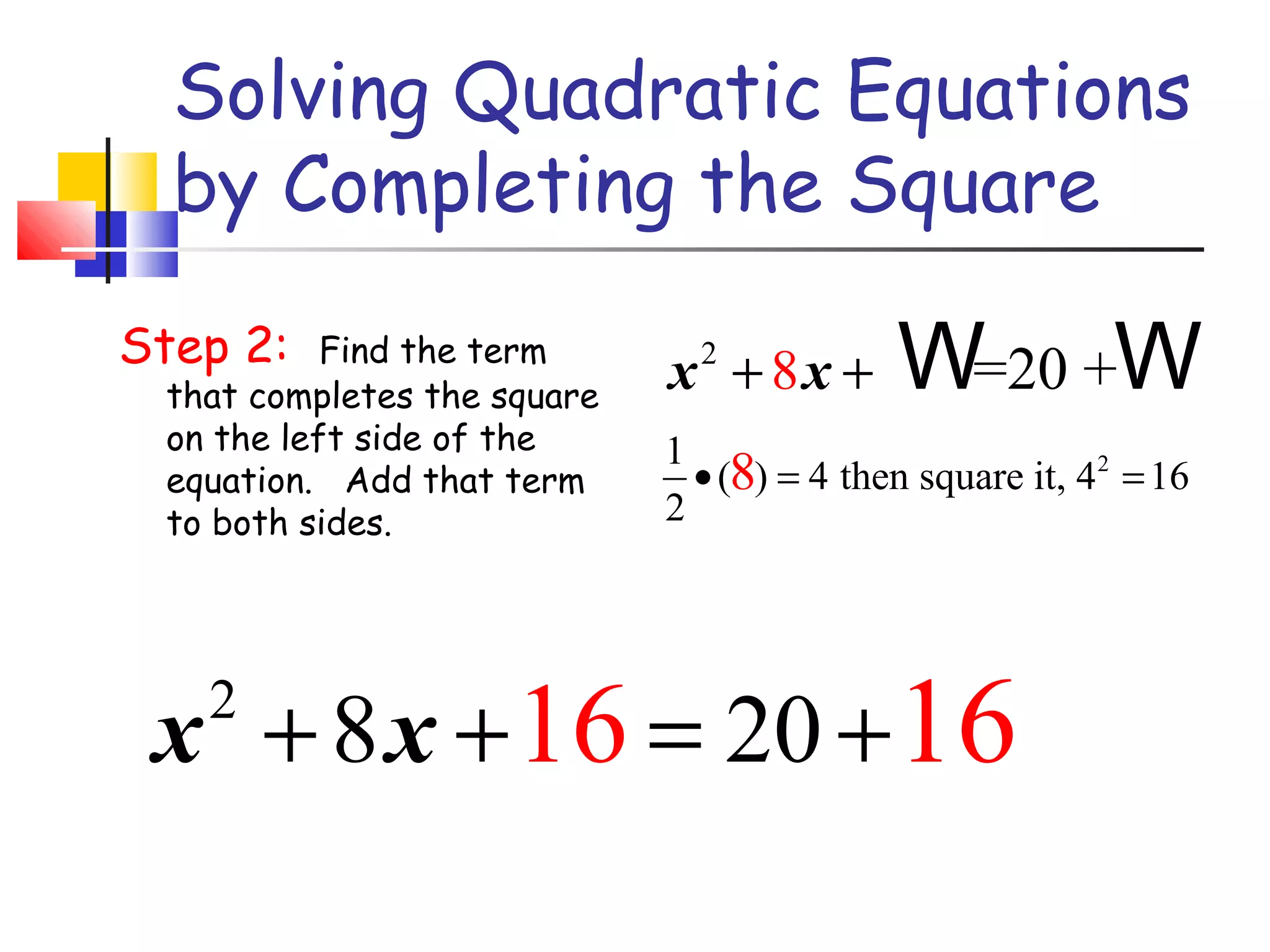
Step 2:

Find the term
that completes the square
on the left side of the
equation. Add that term
to both sides.

x + 8x +
2

W=20 +W

1
• (8) = 4 then square it, 42 = 16
2

x + 8 x + 16 = 20 + 16
2
Solving Quadratic Equations
by Completing the Square
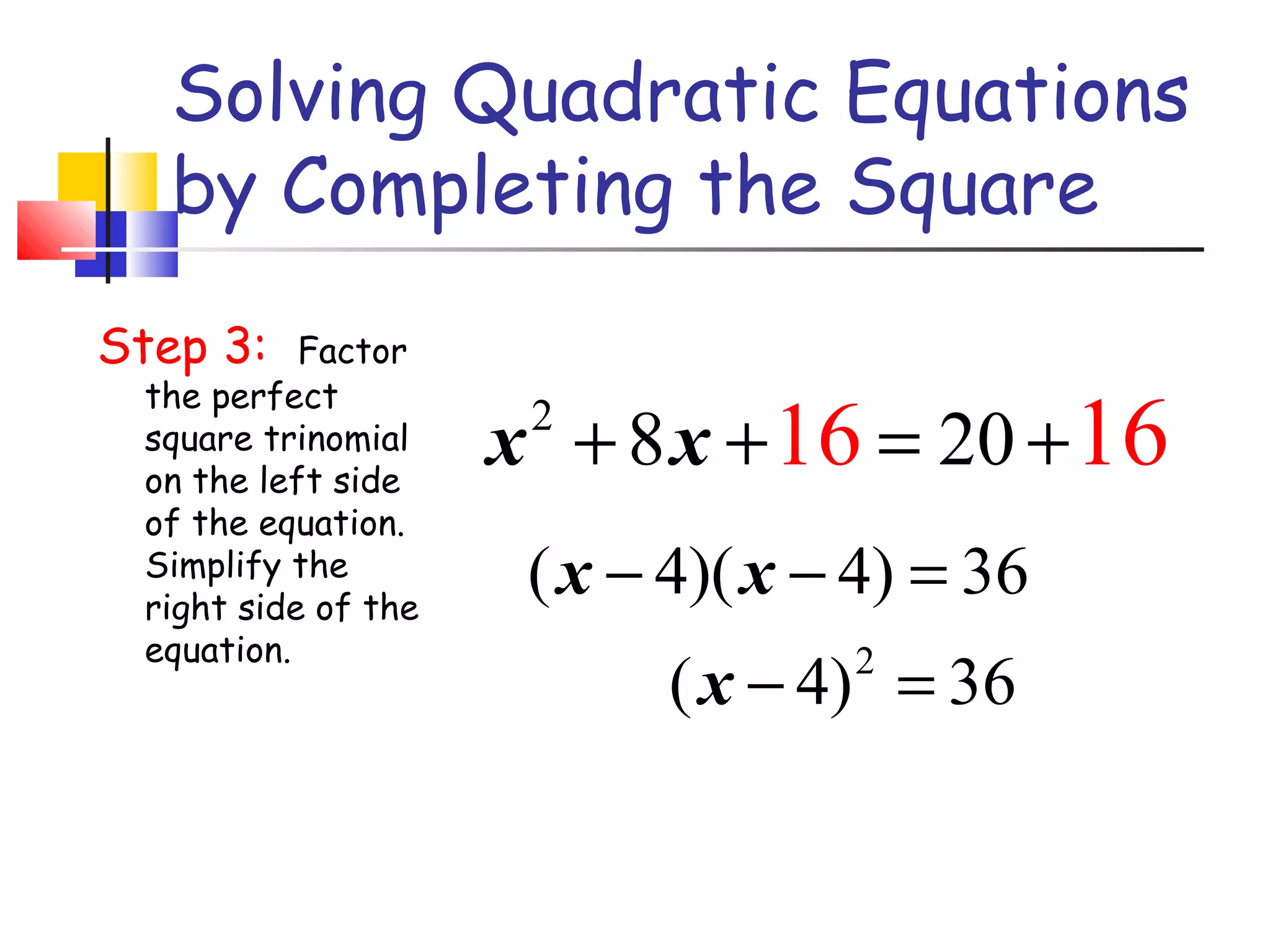
Step 3:

Factor
the perfect
square trinomial
on the left side
of the equation.
Simplify the
right side of the
equation.

x + 8 x + 16 = 20 + 16
2

( x − 4)( x − 4) = 36
( x − 4) = 36
2
Solving Quadratic Equations
by Completing the Square
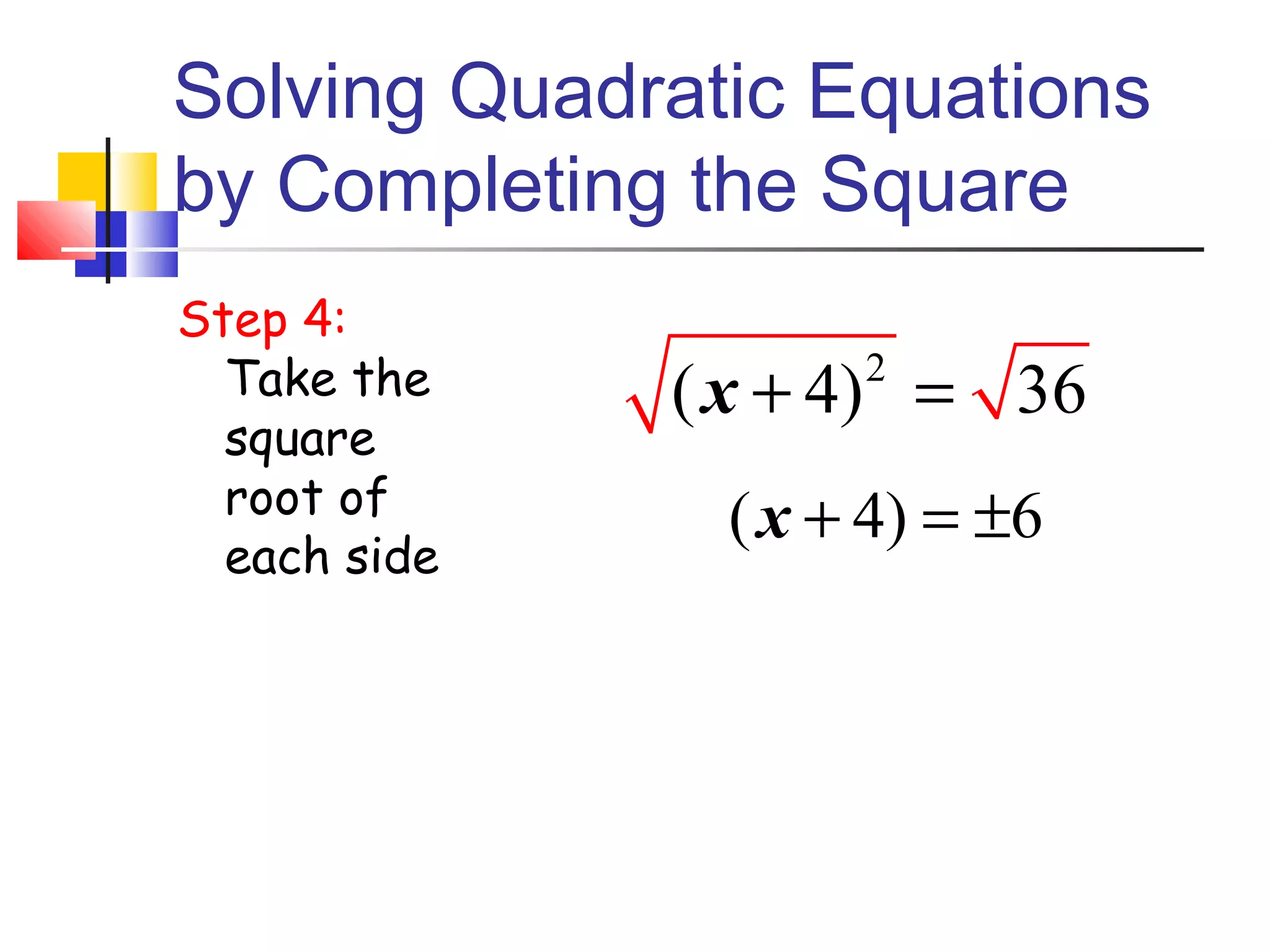
Step 4:
Take the
square
root of
each side

( x + 4) = 36
2

( x + 4) = ±6
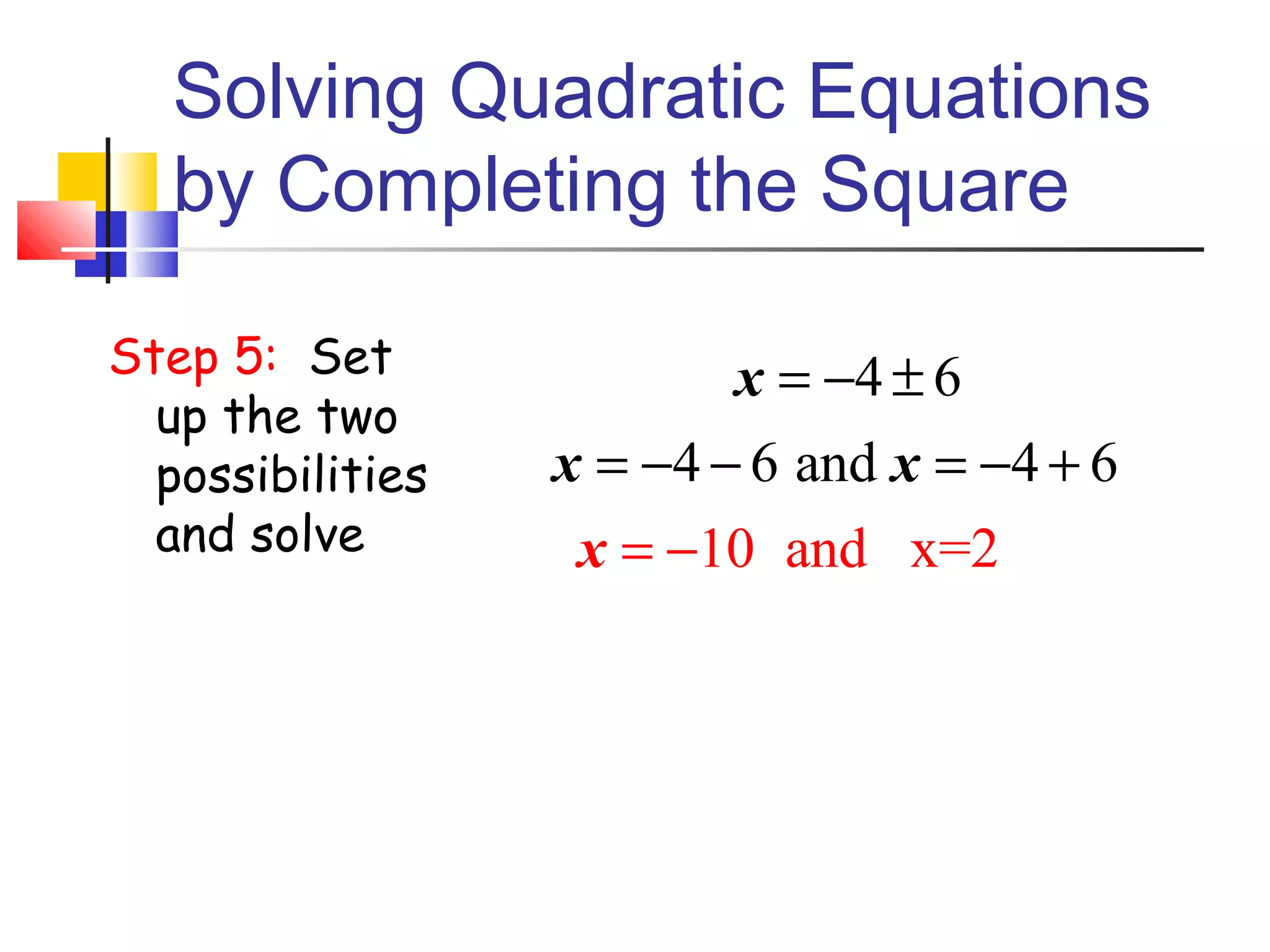
Solving Quadratic Equations
by Completing the Square
Step 5: Set
up the two
possibilities
and solve

x = −4 ± 6
x = −4 − 6 and x = −4 + 6
x = −10 and x=2
Completing the Square-Example #2
Solve the following
equation by completing
the square:
Step 1: Move quadratic
term, and linear term to
left side of the equation,
the constant to the right
side of the equation.

2 x − 7 x + 12 = 0
2

2 x − 7 x = −12
2
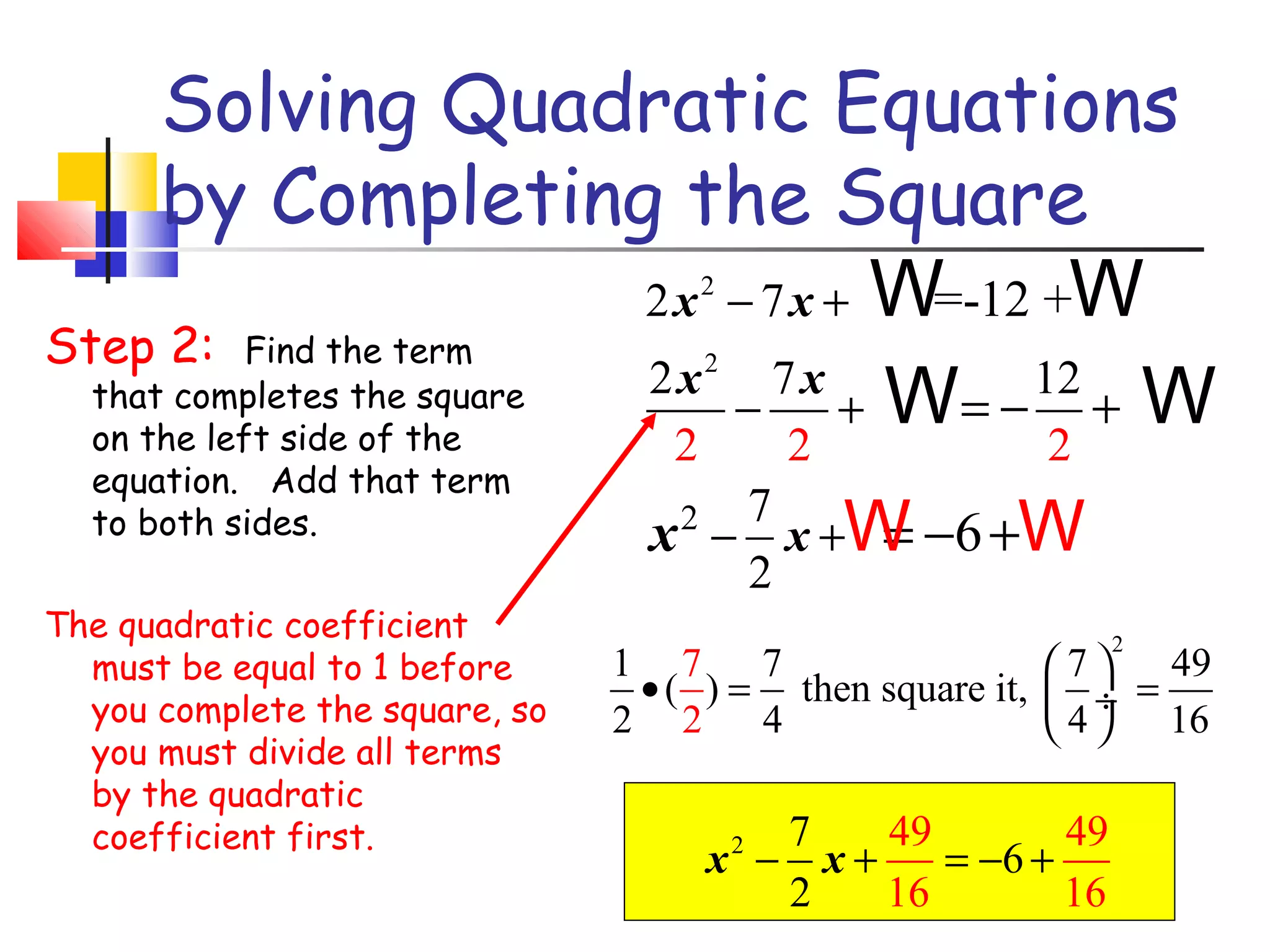
Solving Quadratic Equations
by Completing the Square
2x − 7x + W
=-12 +W
Step 2: Find the term
2x 7x
12
that completes the square
−
+ W= − + W
on the left side of the
2
2
2
2

2

equation. Add that term
to both sides.

The quadratic coefficient
must be equal to 1 before
you complete the square, so
you must divide all terms
by the quadratic
coefficient first.

7
x − x +W −6 +W
=
2
2

1 7
7
• ( ) = then square it,
2 2 4

7
49
49
x − x+
= −6 +
2
16
16
2

2

49
7
 ÷ =
 4  16
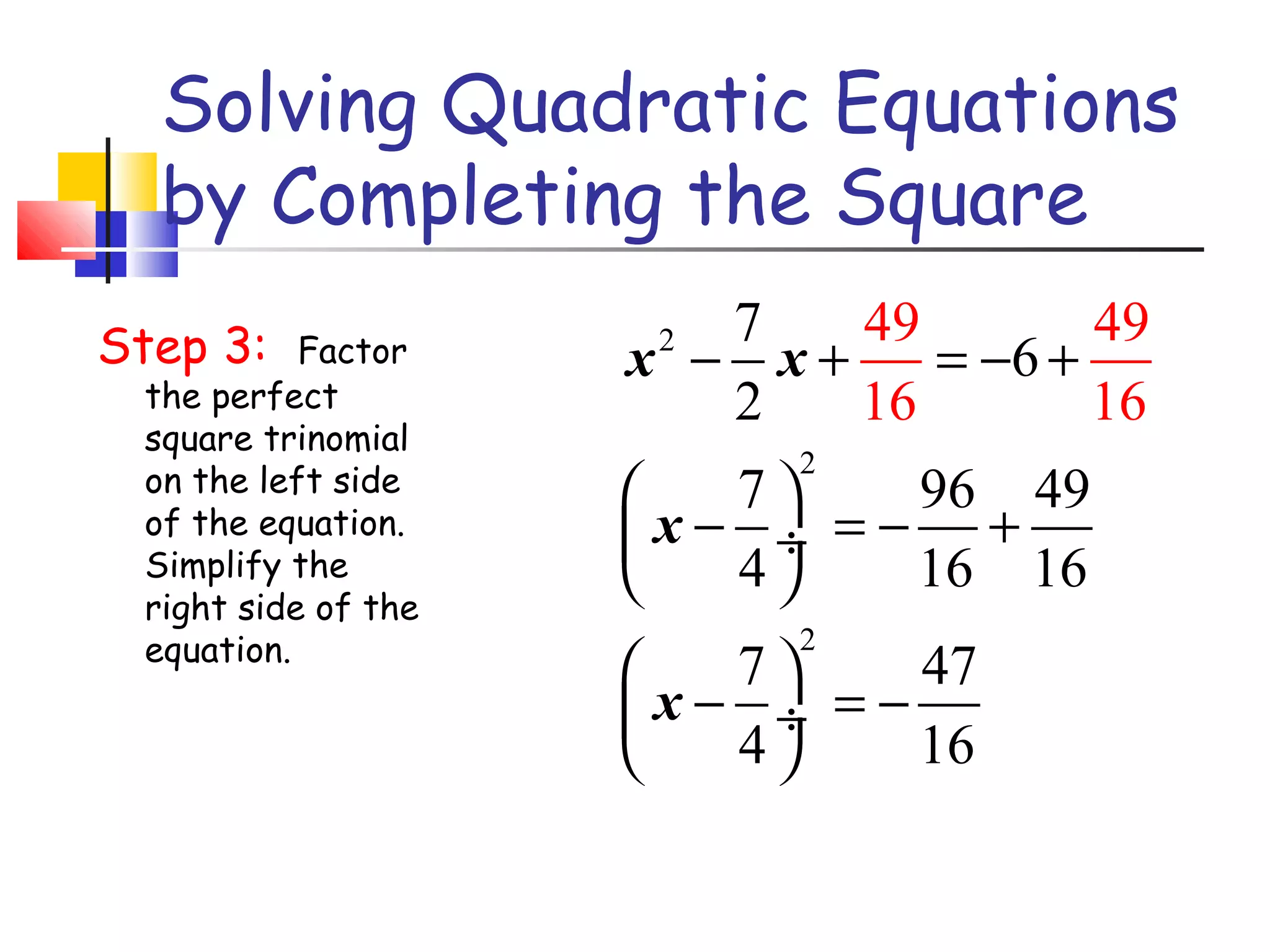
Solving Quadratic Equations
by Completing the Square
Step 3:

Factor
the perfect
square trinomial
on the left side
of the equation.
Simplify the
right side of the
equation.

7
49
49
x − x+
= −6 +
2
16
16
2

2

7
96 49

x− ÷ =− +
4
16 16

2

7
47

x− ÷ =−
4
16

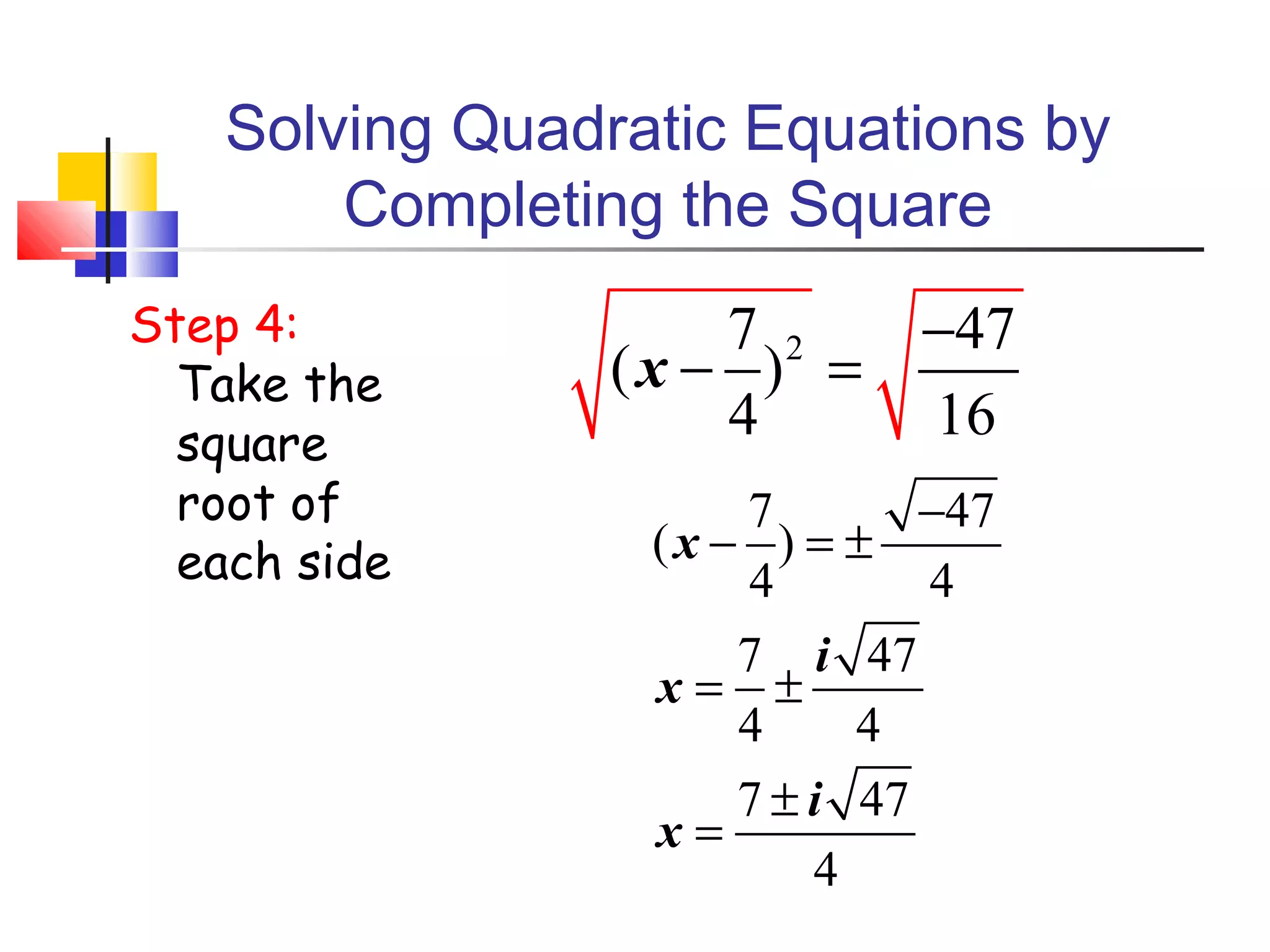
Solving Quadratic Equations by
Completing the Square
Step 4:
Take the
square
root of
each side

7 2
−47
(x − ) =
4
16
7
−47
(x − ) = ±
4
4
7 i 47
x= ±
4
4
7 ± i 47
x=
4
Solving Quadratic Equations by
Completing the Square
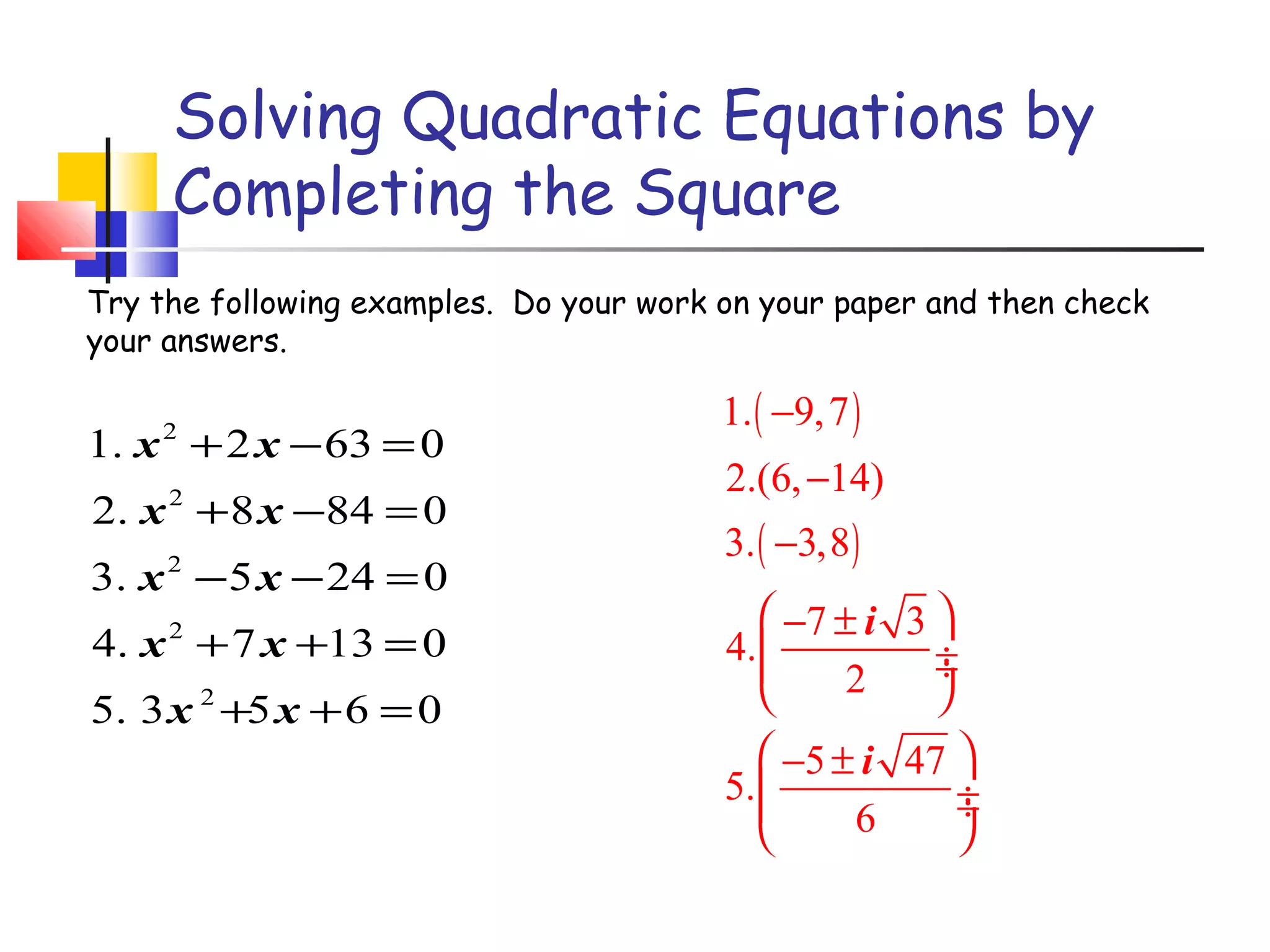
Try the following examples. Do your work on your paper and then check
your answers.

1. x + 2 x − 63 = 0
2

2. x + 8 x −84 = 0
2

3. x − 5 x − 24 = 0
2

4. x + 7 x +13 = 0
2

5. 3 x 2 +5 x + 6 = 0

1. ( −9, 7 )
2.(6, −14)
3. ( −3,8 )
 −7 ± i 3 
4. 
÷

÷
2


 −5 ± i 47 
5. 
÷

÷
6



Solving quadratics by completing the square

  • 1.
  • 2.
    Perfect Square Trinomials Examples x2+ 6x + 9 x2 - 10x + 25 x2 + 12x + 36
  • 3.
    Creating a Perfect SquareTrinomial In the following perfect square trinomial, the constant term is missing. X2 + 14x + ____ Find the constant term by squaring half the coefficient of the linear term. (14/2)2 X2 + 14x + 49
  • 4.
    Perfect Square Trinomials Createperfect square trinomials. x2 + 20x + ___ x2 - 4x + ___ x2 + 5x + ___ 100 4 25/4
  • 5.
    Solving Quadratic Equations byCompleting the Square Solve the following equation by completing the square: Step 1: Move quadratic term, and linear term to left side of the equation x + 8 x − 20 = 0 2 x + 8 x = 20 2
  • 6.
    Solving Quadratic Equations byCompleting the Square Step 2: Find the term that completes the square on the left side of the equation. Add that term to both sides. x + 8x + 2 W=20 +W 1 • (8) = 4 then square it, 42 = 16 2 x + 8 x + 16 = 20 + 16 2
  • 7.
    Solving Quadratic Equations byCompleting the Square Step 3: Factor the perfect square trinomial on the left side of the equation. Simplify the right side of the equation. x + 8 x + 16 = 20 + 16 2 ( x − 4)( x − 4) = 36 ( x − 4) = 36 2
  • 8.
    Solving Quadratic Equations byCompleting the Square Step 4: Take the square root of each side ( x + 4) = 36 2 ( x + 4) = ±6
  • 9.
    Solving Quadratic Equations byCompleting the Square Step 5: Set up the two possibilities and solve x = −4 ± 6 x = −4 − 6 and x = −4 + 6 x = −10 and x=2
  • 10.
    Completing the Square-Example#2 Solve the following equation by completing the square: Step 1: Move quadratic term, and linear term to left side of the equation, the constant to the right side of the equation. 2 x − 7 x + 12 = 0 2 2 x − 7 x = −12 2
  • 11.
    Solving Quadratic Equations byCompleting the Square 2x − 7x + W =-12 +W Step 2: Find the term 2x 7x 12 that completes the square − + W= − + W on the left side of the 2 2 2 2 2 equation. Add that term to both sides. The quadratic coefficient must be equal to 1 before you complete the square, so you must divide all terms by the quadratic coefficient first. 7 x − x +W −6 +W = 2 2 1 7 7 • ( ) = then square it, 2 2 4 7 49 49 x − x+ = −6 + 2 16 16 2 2 49 7  ÷ =  4  16
  • 12.
    Solving Quadratic Equations byCompleting the Square Step 3: Factor the perfect square trinomial on the left side of the equation. Simplify the right side of the equation. 7 49 49 x − x+ = −6 + 2 16 16 2 2 7 96 49  x− ÷ =− + 4 16 16  2 7 47  x− ÷ =− 4 16 
  • 13.
    Solving Quadratic Equationsby Completing the Square Step 4: Take the square root of each side 7 2 −47 (x − ) = 4 16 7 −47 (x − ) = ± 4 4 7 i 47 x= ± 4 4 7 ± i 47 x= 4
  • 14.
    Solving Quadratic Equationsby Completing the Square Try the following examples. Do your work on your paper and then check your answers. 1. x + 2 x − 63 = 0 2 2. x + 8 x −84 = 0 2 3. x − 5 x − 24 = 0 2 4. x + 7 x +13 = 0 2 5. 3 x 2 +5 x + 6 = 0 1. ( −9, 7 ) 2.(6, −14) 3. ( −3,8 )  −7 ± i 3  4.  ÷  ÷ 2    −5 ± i 47  5.  ÷  ÷ 6  