Solving Quadratic Equations by Completing the Square
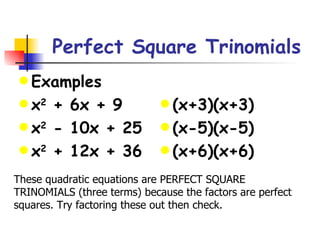
Perfect Square Trinomials Examples x 2  + 6x + 9 x 2  - 10x + 25 x 2  + 12x + 36 These quadratic equations are PERFECT SQUARE TRINOMIALS (three terms) because the factors are perfect squares. Try factoring these out then check. (x+3)(x+3) (x-5)(x-5) (x+6)(x+6)
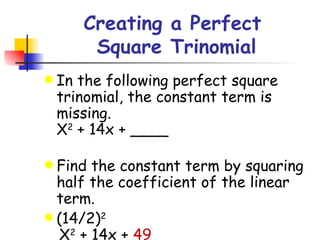
Creating a Perfect  Square Trinomial In the following perfect square trinomial, the constant term is missing.  X 2  + 14x + ____  Find the constant term by squaring half the coefficient of the linear term.  (14/2) 2  X 2  + 14x +  49
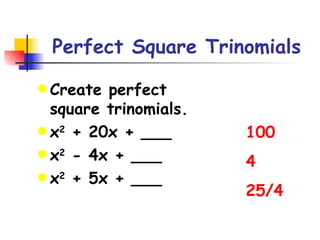
Perfect Square Trinomials Create perfect square trinomials. x 2  + 20x + ___ x 2  - 4x + ___ x 2  + 5x + ___ 100 4 25/4
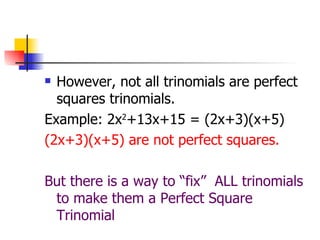
However, not all trinomials are perfect squares trinomials. Example: 2x 2 +13x+15 = (2x+3)(x+5) (2x+3)(x+5) are not perfect squares. But there is a way to “fix”  ALL trinomials to make them a Perfect Square Trinomial
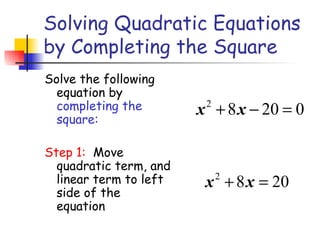
Solving Quadratic Equations by Completing the Square Solve the following equation by  completing the square: Step 1:  Move quadratic term, and linear term to left side of the equation
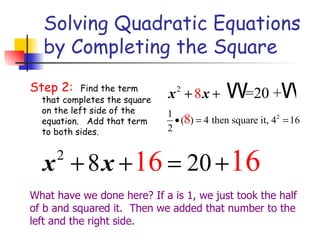
Solving Quadratic Equations by Completing the Square Step 2:  Find the term that completes the square on the left side of the equation.   Add that term to both sides. What have we done here? If a is 1, we just took the half of b and squared it.  Then we added that number to the left and the right side.
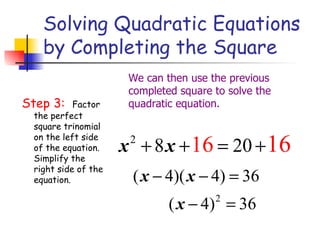
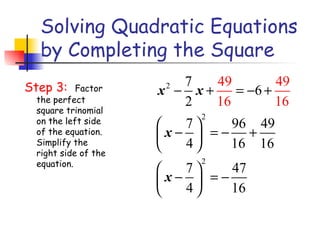
Solving Quadratic Equations by Completing the Square Step 3:  Factor the perfect square trinomial on the left side of the equation.  Simplify the right side of the equation.  We can then use the previous completed square to solve the quadratic equation.
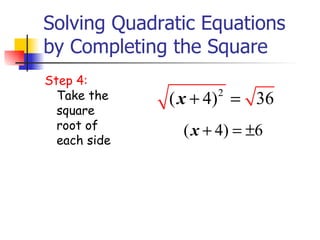
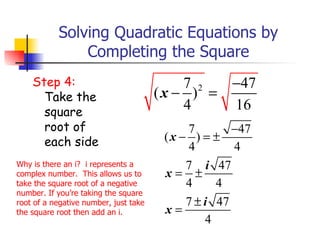
Solving Quadratic Equations by Completing the Square Step 4:   Take the square root of each side
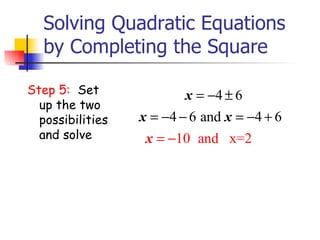
Solving Quadratic Equations by Completing the Square Step 5:   Set up the two possibilities and solve
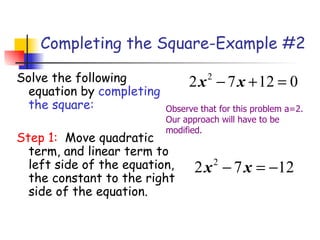
Completing the Square-Example #2 Solve the following equation by  completing the square: Step 1:  Move quadratic term, and linear term to left side of the equation, the constant to the right side of the equation. Observe that for this problem a=2.  Our approach will have to be modified.
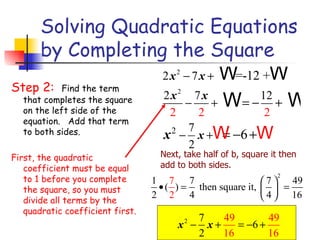
Solving Quadratic Equations by Completing the Square Step 2:  Find the term that completes the square on the left side of the equation.   Add that term to both sides. First, the quadratic coefficient must be equal to 1 before you complete the square, so you must divide all terms by the quadratic coefficient first. Next, take half of b, square it then add to both sides.
Solving Quadratic Equations by Completing the Square Step 3:  Factor the perfect square trinomial on the left side of the equation.  Simplify the right side of the equation.
Solving Quadratic Equations by Completing the Square Step 4:   Take the square root of each side Why is there an i?  i represents a complex number.  This allows us to take the square root of a negative number. If you’re taking the square root of a negative number, just take the square root then add an i.
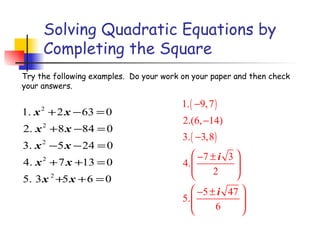
Solving Quadratic Equations by Completing the Square Try the following examples.  Do your work on your paper and then check your answers.

Completing the square (added and revised)

  • 1.
    Solving Quadratic Equationsby Completing the Square
  • 2.
    Perfect Square TrinomialsExamples x 2 + 6x + 9 x 2 - 10x + 25 x 2 + 12x + 36 These quadratic equations are PERFECT SQUARE TRINOMIALS (three terms) because the factors are perfect squares. Try factoring these out then check. (x+3)(x+3) (x-5)(x-5) (x+6)(x+6)
  • 3.
    Creating a Perfect Square Trinomial In the following perfect square trinomial, the constant term is missing. X 2 + 14x + ____ Find the constant term by squaring half the coefficient of the linear term. (14/2) 2 X 2 + 14x + 49
  • 4.
    Perfect Square TrinomialsCreate perfect square trinomials. x 2 + 20x + ___ x 2 - 4x + ___ x 2 + 5x + ___ 100 4 25/4
  • 5.
    However, not alltrinomials are perfect squares trinomials. Example: 2x 2 +13x+15 = (2x+3)(x+5) (2x+3)(x+5) are not perfect squares. But there is a way to “fix” ALL trinomials to make them a Perfect Square Trinomial
  • 6.
    Solving Quadratic Equationsby Completing the Square Solve the following equation by completing the square: Step 1: Move quadratic term, and linear term to left side of the equation
  • 7.
    Solving Quadratic Equationsby Completing the Square Step 2: Find the term that completes the square on the left side of the equation. Add that term to both sides. What have we done here? If a is 1, we just took the half of b and squared it. Then we added that number to the left and the right side.
  • 8.
    Solving Quadratic Equationsby Completing the Square Step 3: Factor the perfect square trinomial on the left side of the equation. Simplify the right side of the equation. We can then use the previous completed square to solve the quadratic equation.
  • 9.
    Solving Quadratic Equationsby Completing the Square Step 4: Take the square root of each side
  • 10.
    Solving Quadratic Equationsby Completing the Square Step 5: Set up the two possibilities and solve
  • 11.
    Completing the Square-Example#2 Solve the following equation by completing the square: Step 1: Move quadratic term, and linear term to left side of the equation, the constant to the right side of the equation. Observe that for this problem a=2. Our approach will have to be modified.
  • 12.
    Solving Quadratic Equationsby Completing the Square Step 2: Find the term that completes the square on the left side of the equation. Add that term to both sides. First, the quadratic coefficient must be equal to 1 before you complete the square, so you must divide all terms by the quadratic coefficient first. Next, take half of b, square it then add to both sides.
  • 13.
    Solving Quadratic Equationsby Completing the Square Step 3: Factor the perfect square trinomial on the left side of the equation. Simplify the right side of the equation.
  • 14.
    Solving Quadratic Equationsby Completing the Square Step 4: Take the square root of each side Why is there an i? i represents a complex number. This allows us to take the square root of a negative number. If you’re taking the square root of a negative number, just take the square root then add an i.
  • 15.
    Solving Quadratic Equationsby Completing the Square Try the following examples. Do your work on your paper and then check your answers.