Semantic Web from the 2013 Perspective
2nd MakoLab Semantic Day – Theoria and Praxis
Polish Academy of Sciences, October 3rd, 2013
Prof. Dr. Adrian Paschke
Department of Information Systems
Poznan University of Economics and Freie Universitaet Berlin
paschke@inf.fu-berlin
Prof. Dr. Witold Abramowicz
Department of Information Systems
Poznan University of Economics
http://kie.ue.poznan.pl/en
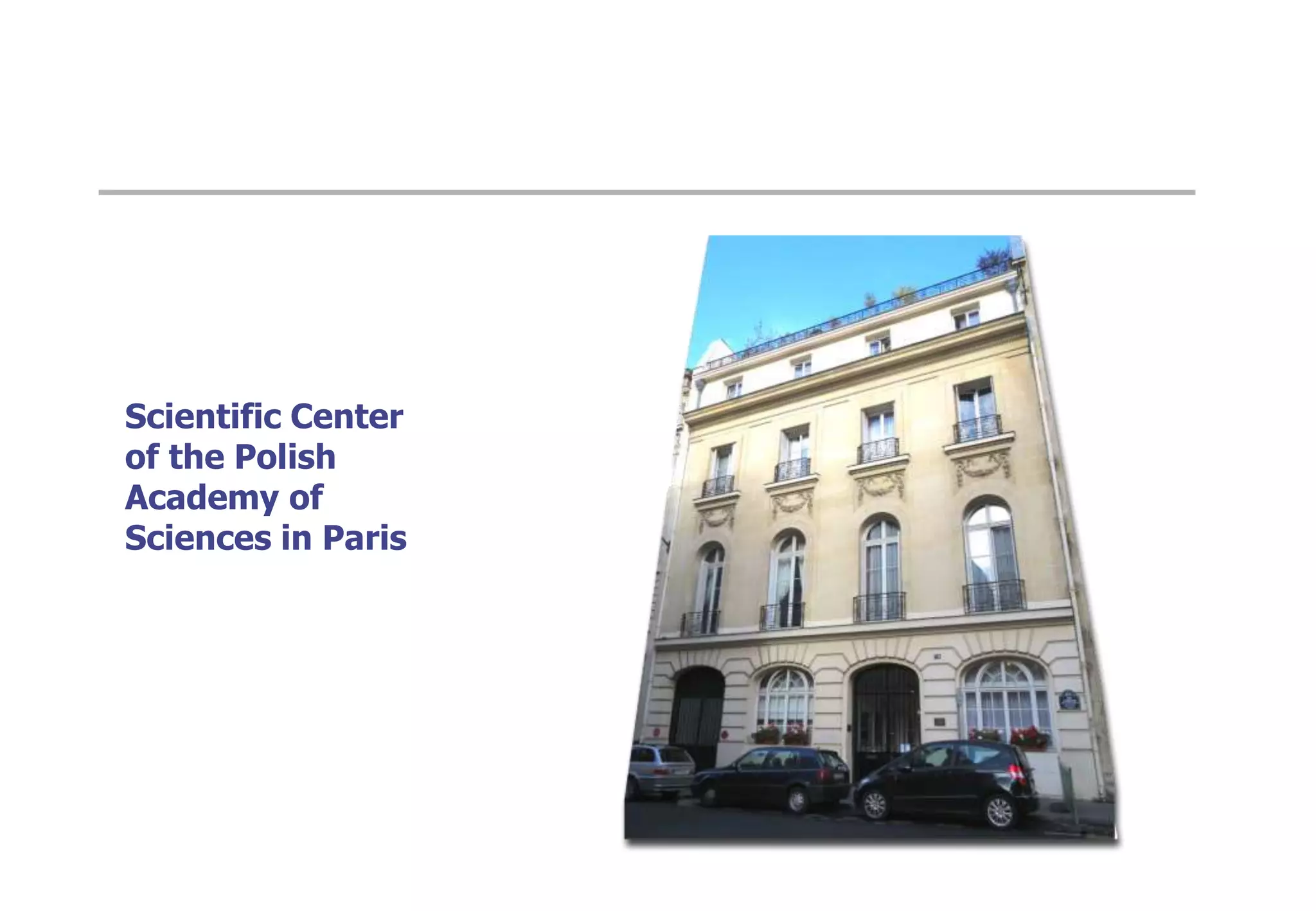
Scientific Center
of the Polish
Academy of
Sciences in Paris
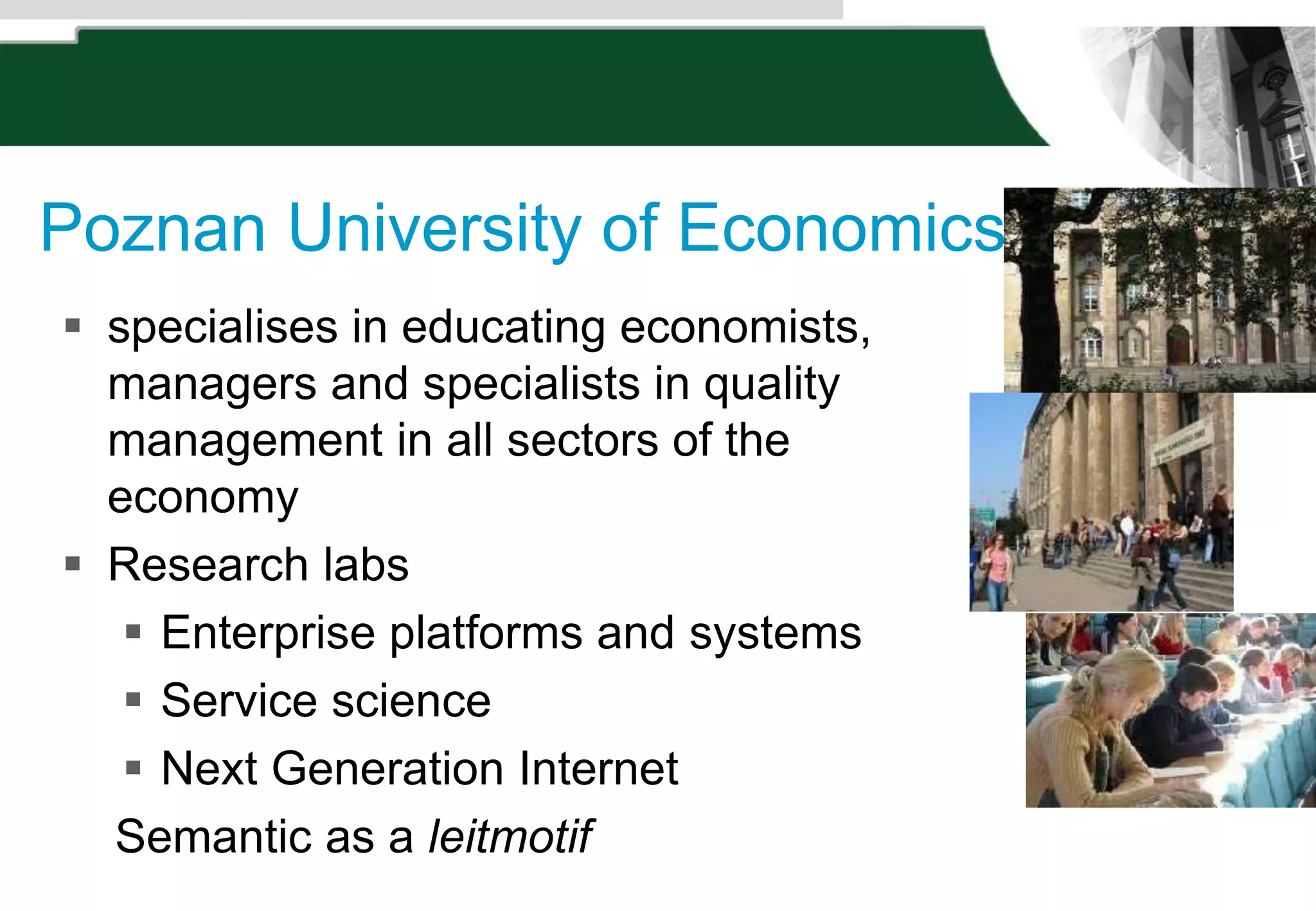
Poznan University of Economics
 specialises in educating economists,
managers and specialists in quality
management in all sectors of the
economy
 Research labs
 Enterprise platforms and systems
 Service science
 Next Generation Internet
Semantic as a leitmotif
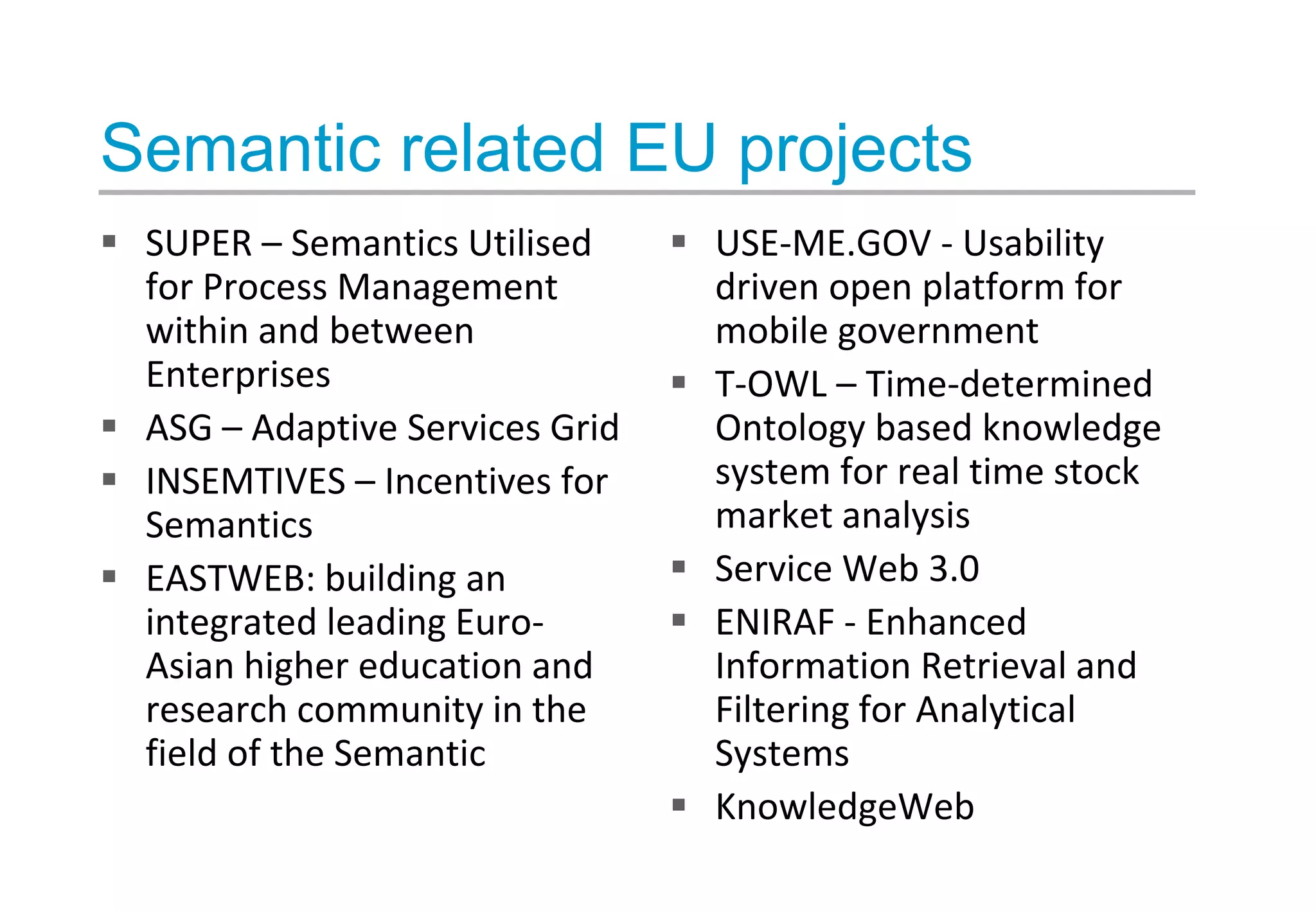
Semantic related EU projects
 SUPER – Semantics Utilised
for Process Management
within and between
Enterprises
 ASG – Adaptive Services Grid
 INSEMTIVES – Incentives for
Semantics
 EASTWEB: building an
integrated leading Euro-
Asian higher education and
research community in the
field of the Semantic
 USE-ME.GOV - Usability
driven open platform for
mobile government
 T-OWL – Time-determined
Ontology based knowledge
system for real time stock
market analysis
 Service Web 3.0
 ENIRAF - Enhanced
Information Retrieval and
Filtering for Analytical
Systems
 KnowledgeWeb
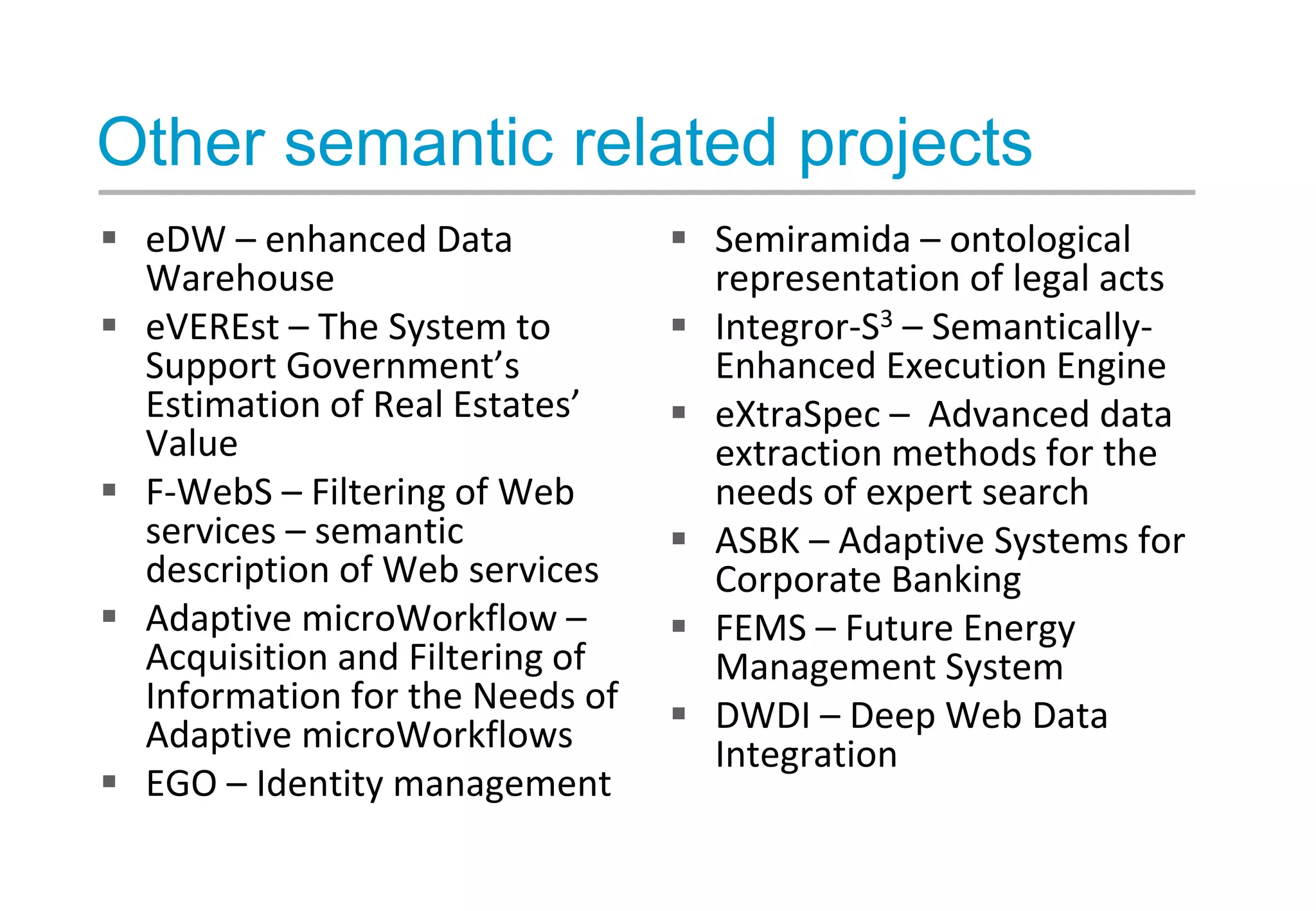
Other semantic related projects
 eDW – enhanced Data
Warehouse
 eVEREst – The System to
Support Government’s
Estimation of Real Estates’
Value
 F-WebS – Filtering of Web
services – semantic
description of Web services
 Adaptive microWorkflow –
Acquisition and Filtering of
Information for the Needs of
Adaptive microWorkflows
 EGO – Identity management
 Semiramida – ontological
representation of legal acts
 Integror-S3 – Semantically-
Enhanced Execution Engine
 eXtraSpec – Advanced data
extraction methods for the
needs of expert search
 ASBK – Adaptive Systems for
Corporate Banking
 FEMS – Future Energy
Management System
 DWDI – Deep Web Data
Integration
Agenda
 What is Semantics?
 The Semantic Web – An
Introduction
 Semantic Web and it’s Relations
 What comes next?
What is Semantics?
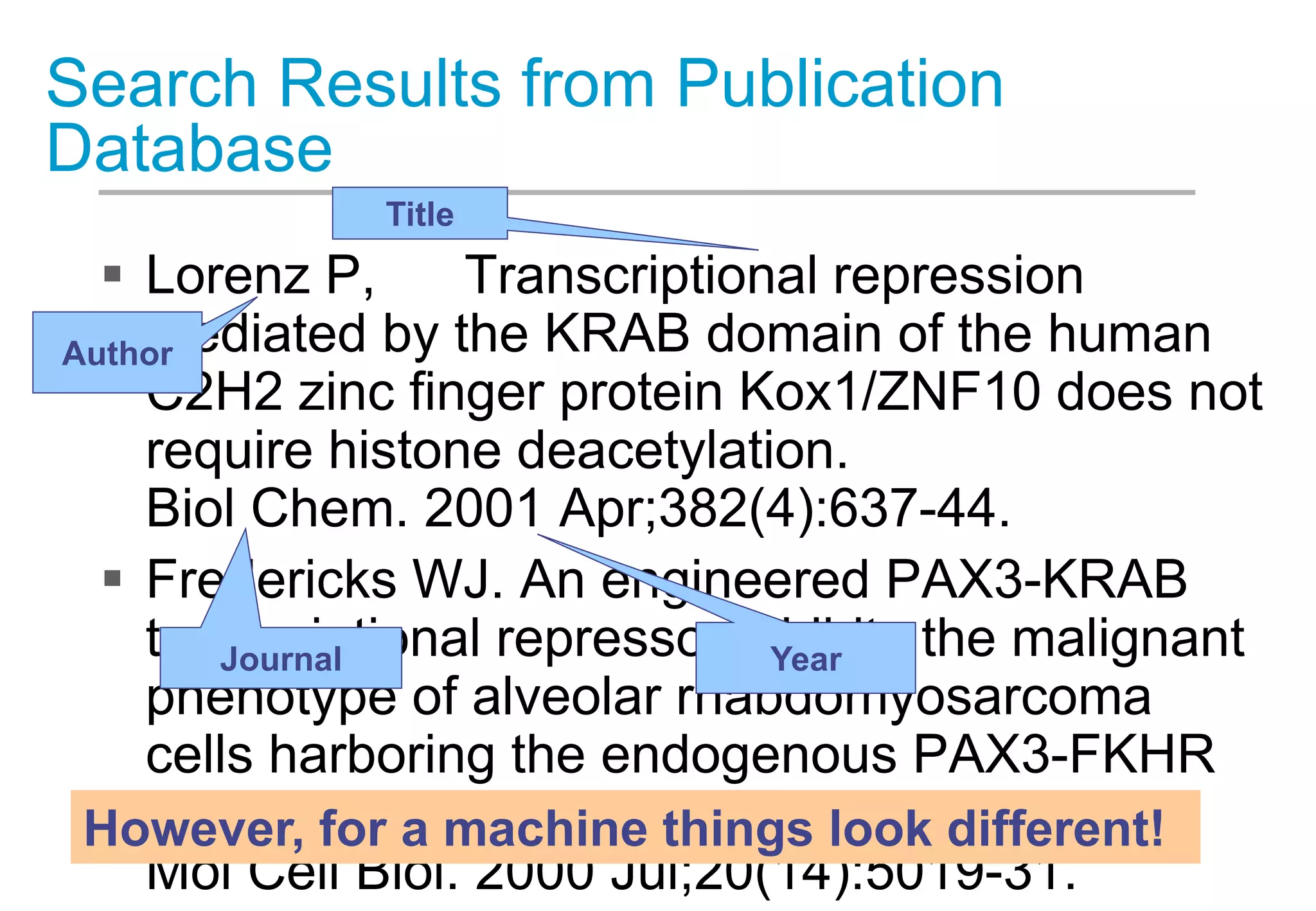
Search Results from Publication
Database
 Lorenz P, Transcriptional repression
mediated by the KRAB domain of the human
C2H2 zinc finger protein Kox1/ZNF10 does not
require histone deacetylation.
Biol Chem. 2001 Apr;382(4):637-44.
 Fredericks WJ. An engineered PAX3-KRAB
transcriptional repressor inhibits the malignant
phenotype of alveolar rhabdomyosarcoma
cells harboring the endogenous PAX3-FKHR
oncogene.
Mol Cell Biol. 2000 Jul;20(14):5019-31.
Author
Title
YearJournal
However, for a machine things look different!
Results from Publication Database
 Lorenz P, Transcriptional repression
mediated by the KRAB domain of the
human C2H2 zinc finger protein
Kox1/ZNF10 does not require histone
deacetylation.
Biol Chem. 2001 Apr;382(4):637-44.
 Fredericks WJ. An engineered PAX3-
KRAB transcriptional repressor inhibits
the malignant phenotype of alveolar
rhabdomyosarcoma cells harboring the
endogenous PAX3-FKHR oncogene.
Mol Cell Biol. 2000
Jul;20(14):5019-31.
Solution:
Tags (XML)?
Results from Publication Database
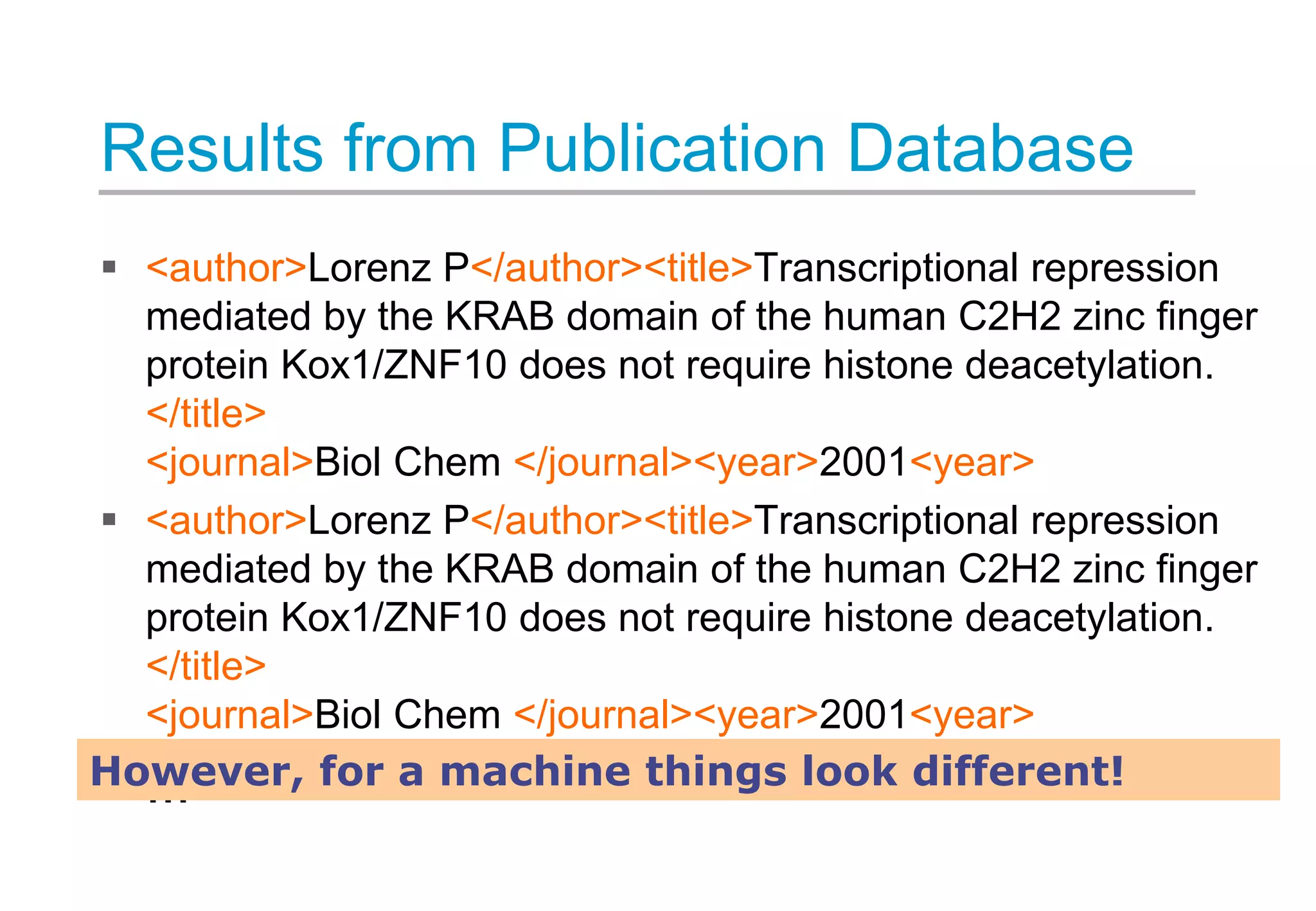
 <author>Lorenz P</author><title>Transcriptional repression
mediated by the KRAB domain of the human C2H2 zinc finger
protein Kox1/ZNF10 does not require histone deacetylation.
</title>
<journal>Biol Chem </journal><year>2001<year>
 <author>Lorenz P</author><title>Transcriptional repression
mediated by the KRAB domain of the human C2H2 zinc finger
protein Kox1/ZNF10 does not require histone deacetylation.
</title>
<journal>Biol Chem </journal><year>2001<year>
 ...However, for a machine things look different!
Results from Publication Database
 <author>Lorenz
P</author><title>Transcriptional
repression mediated by the KRAB
domain of the human C2H2 zinc finger
protein Kox1/ZNF10 does not require
histone deacetylation. </title>
<journal>Biol Chem
</journal><year>2001<year>
 <author>Lorenz
P</author><title>Transcriptional
repression mediated by the KRAB
domain of the human C2H2 zinc finger
protein Kox1/ZNF10 does not require
histone deacetylation. </title>
<journal>Biol Chem
</journal><year>2001<year>
Solution: Use Semantic
Knowledge
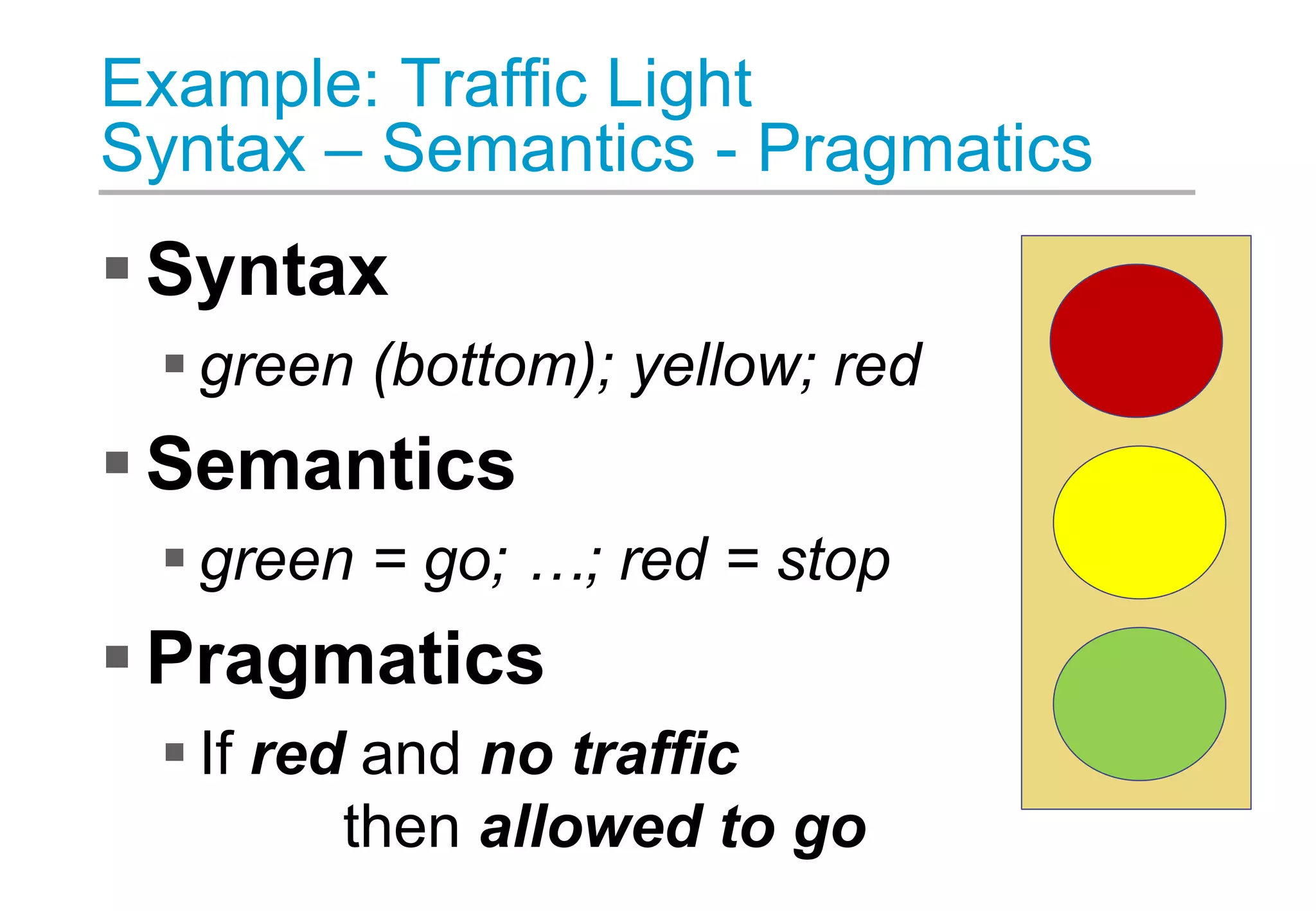
Example: Traffic Light
Syntax – Semantics - Pragmatics
 Syntax
 green (bottom); yellow; red
 Semantics
 green = go; …; red = stop
 Pragmatics
 If red and no traffic
then allowed to go
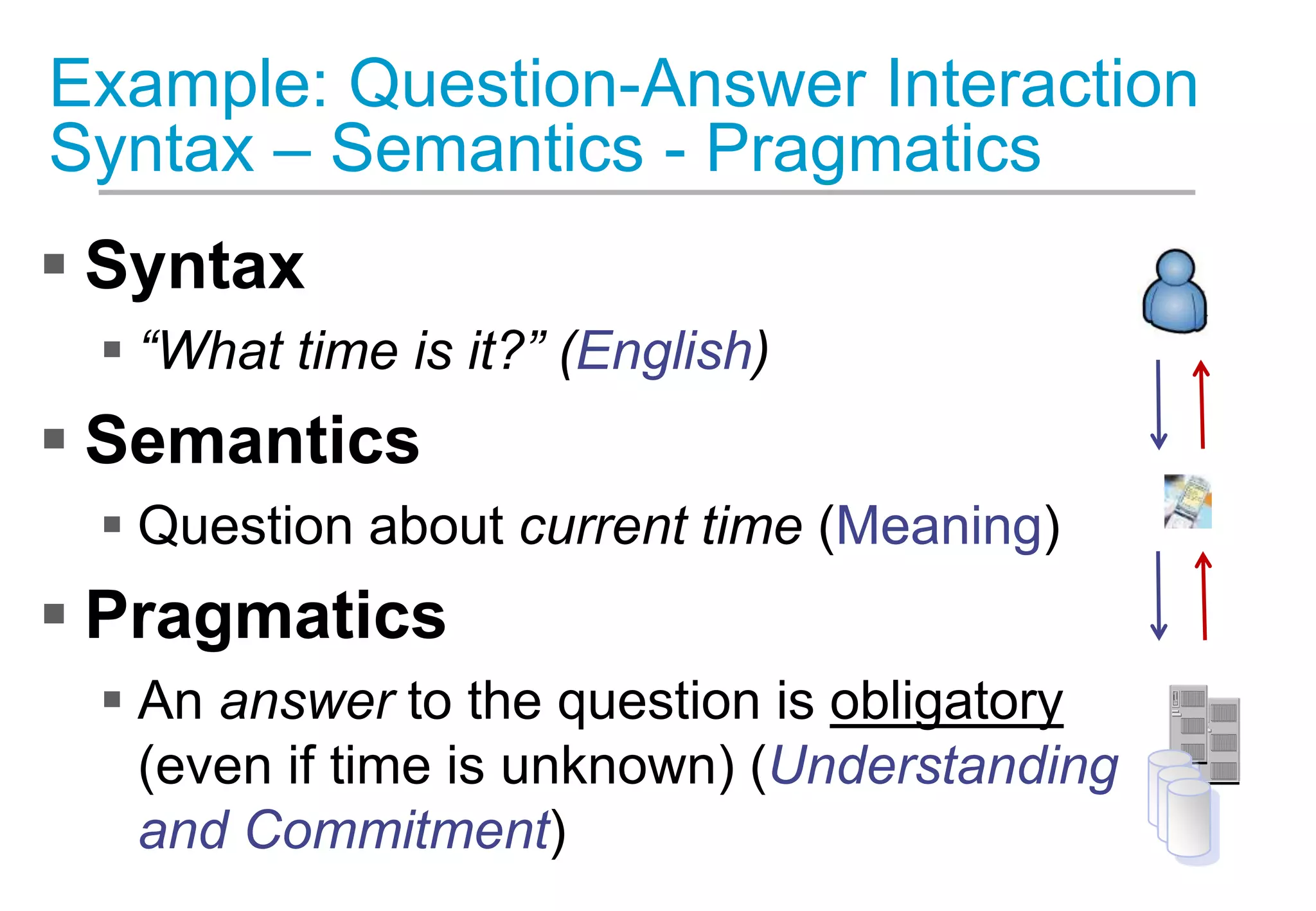
Example: Question-Answer Interaction
Syntax – Semantics - Pragmatics
 Syntax
 “What time is it?” (English)
 Semantics
 Question about current time (Meaning)
 Pragmatics
 An answer to the question is obligatory
(even if time is unknown) (Understanding
and Commitment)
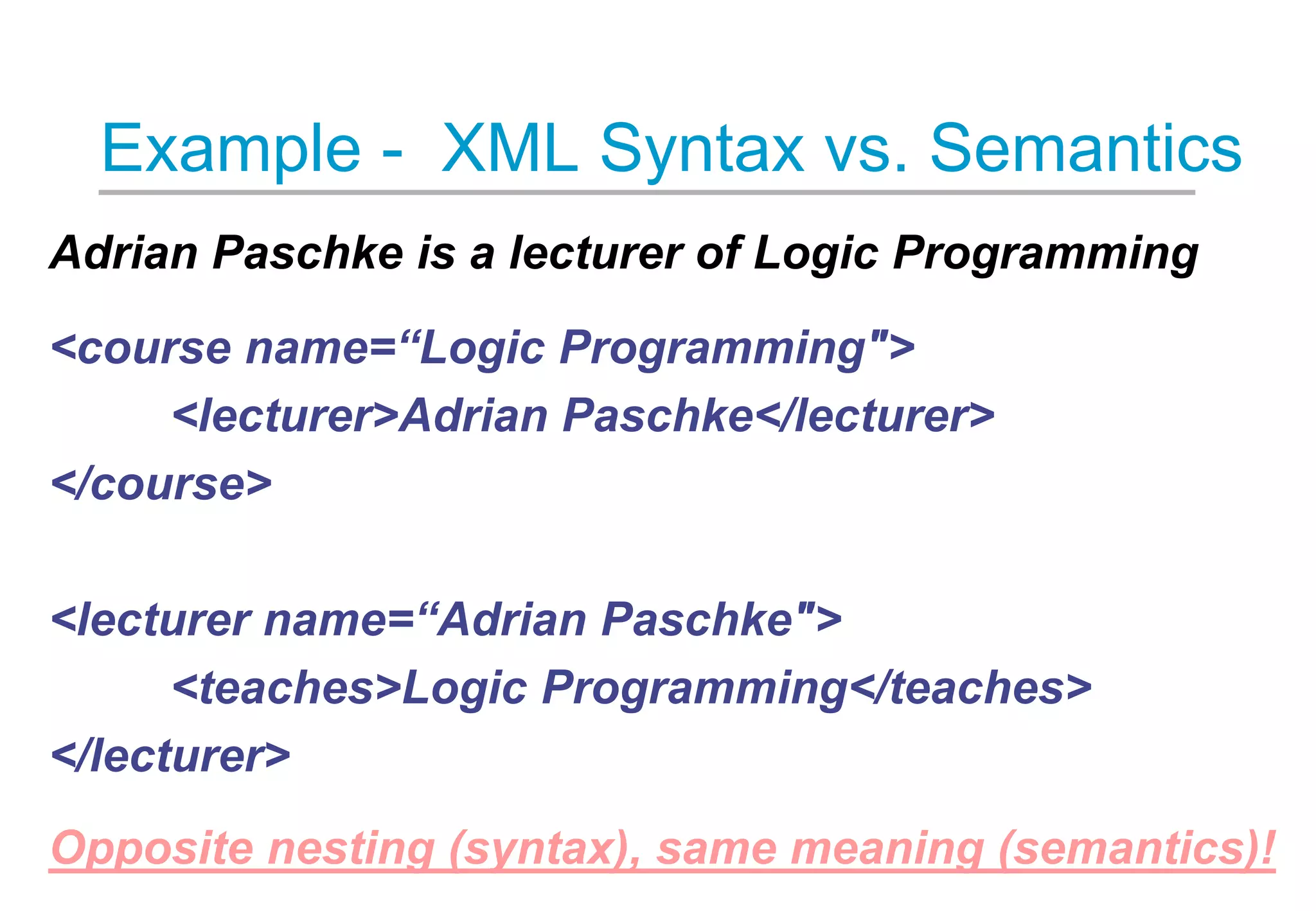
Example - XML Syntax vs. Semantics
Adrian Paschke is a lecturer of Logic Programming
<course name=“Logic Programming">
<lecturer>Adrian Paschke</lecturer>
</course>
<lecturer name=“Adrian Paschke">
<teaches>Logic Programming</teaches>
</lecturer>
Opposite nesting (syntax), same meaning (semantics)!
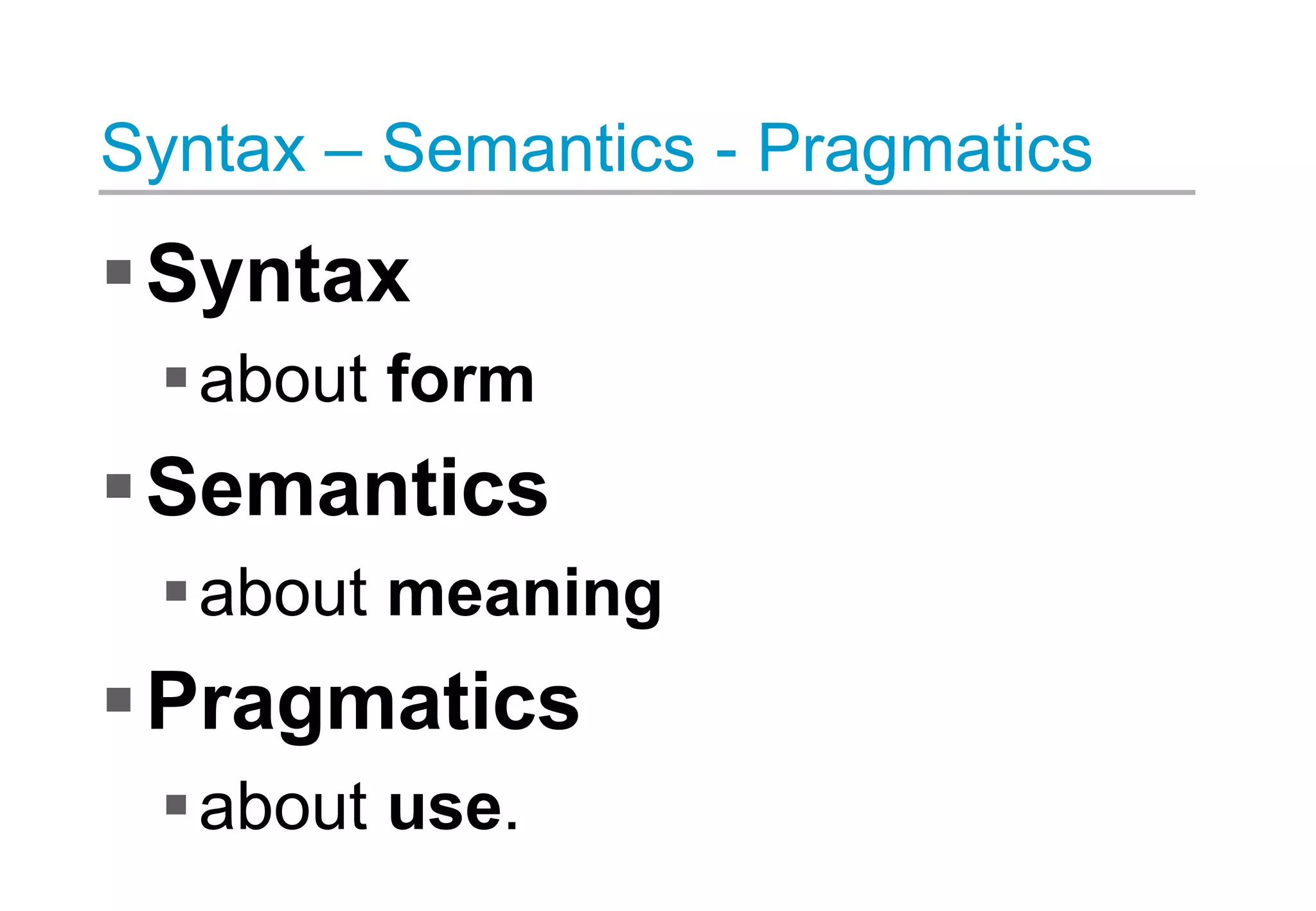
Syntax
about form
Semantics
about meaning
Pragmatics
about use.
Syntax – Semantics - Pragmatics
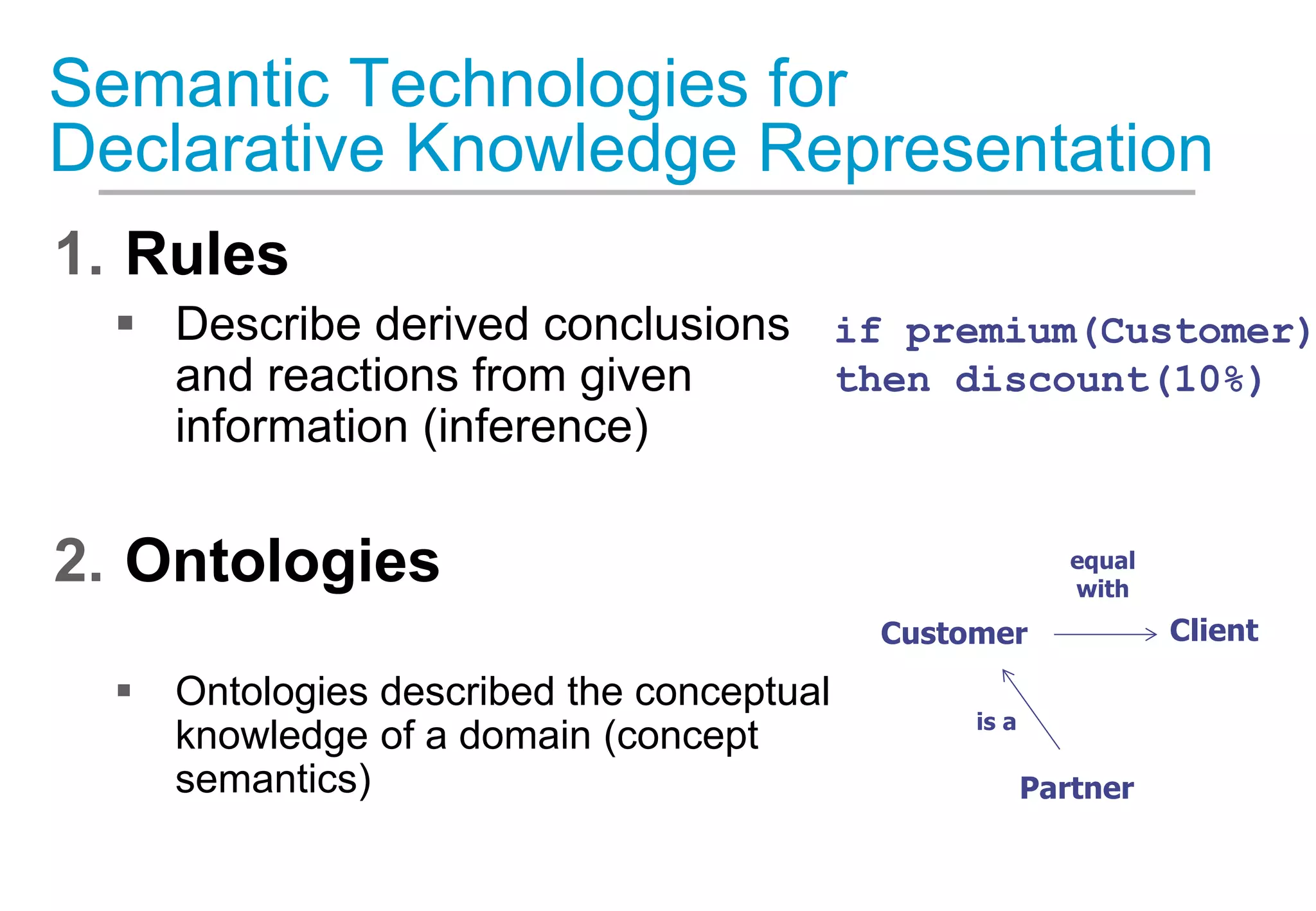
Semantic Technologies for
Declarative Knowledge Representation
1. Rules
 Describe derived conclusions
and reactions from given
information (inference)
2. Ontologies
 Ontologies described the conceptual
knowledge of a domain (concept
semantics) Partner
Customer
is a
equal
with
Client
if premium(Customer)
then discount(10%)
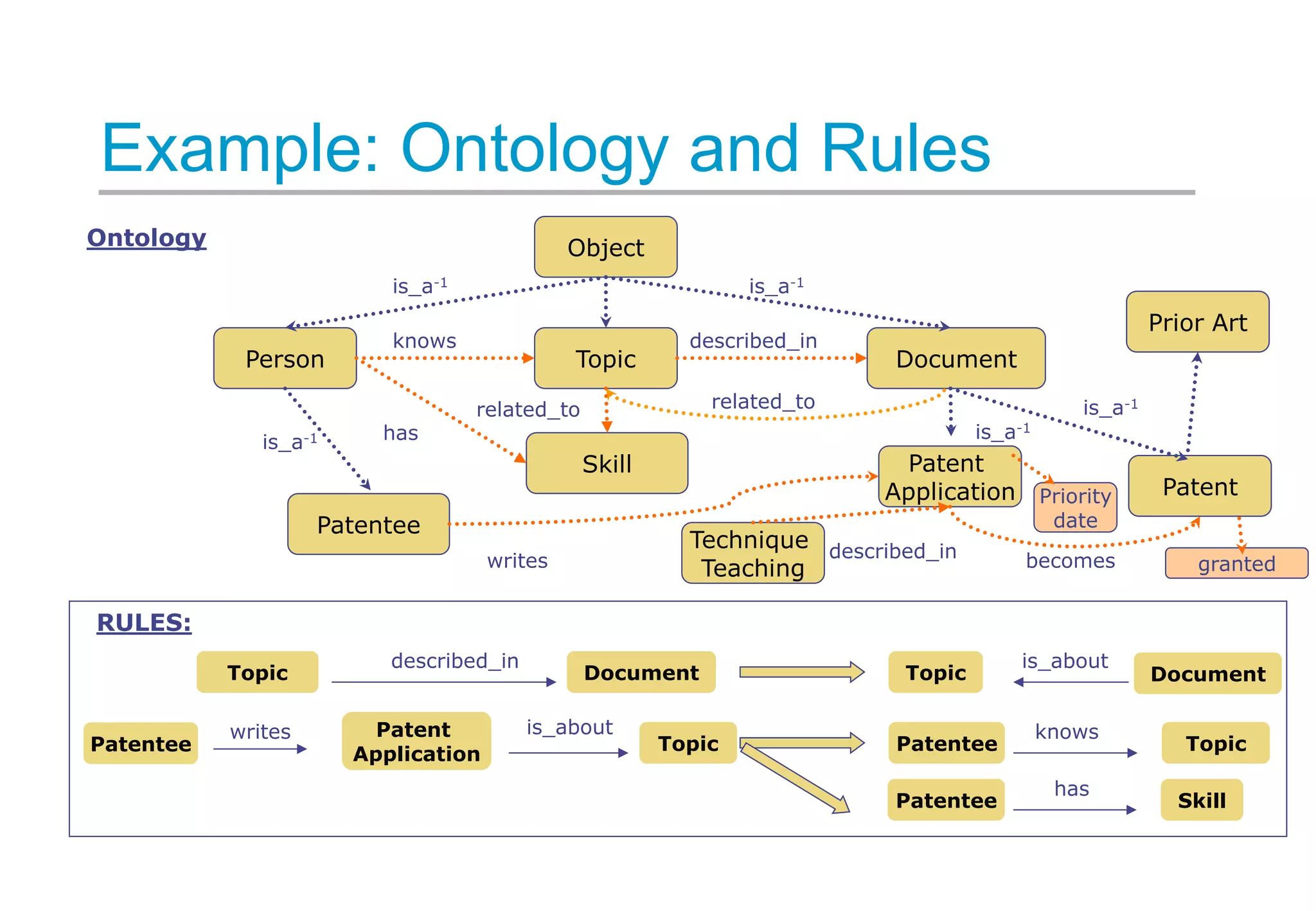
Example: Ontology and Rules
Object
Person DocumentTopic
Patentee
Patent
Application Patent
becomes
knows described_in
is_a-1
is_a-1
is_a-1
is_a-1
is_a-1
writes
related_to
Skill
has
related_to
Topic Document Topic Document
Patent
Application
Topic Patentee Topic
described_in
is_about knows
is_about
Patentee
writes
RULES:
Patentee Skill
has
granted
Technique
Teaching
described_in
Priority
date
Prior Art
Ontology
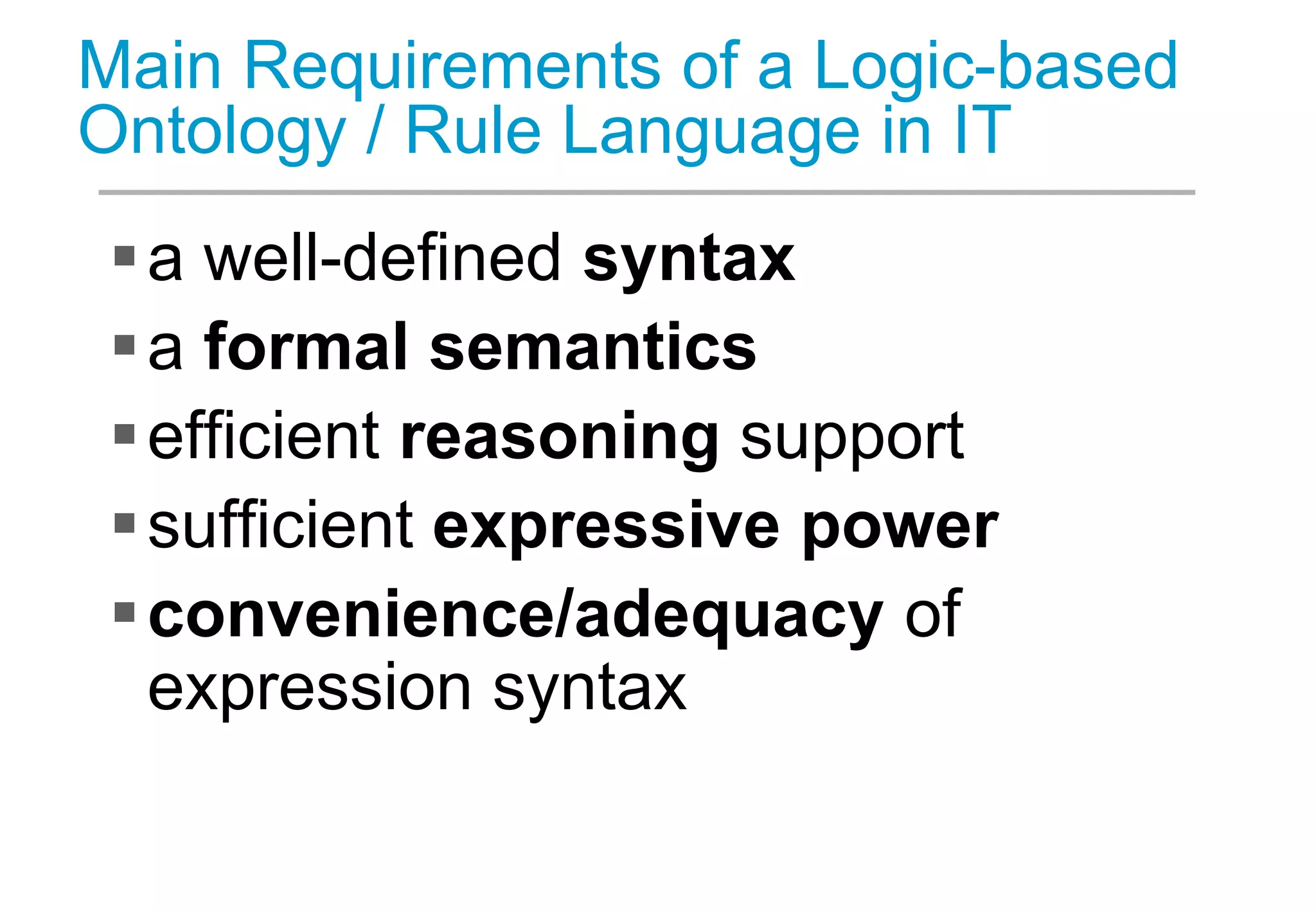
Main Requirements of a Logic-based
Ontology / Rule Language in IT
a well-defined syntax
a formal semantics
efficient reasoning support
sufficient expressive power
convenience/adequacy of
expression syntax
The Semantic Web
An Introduction
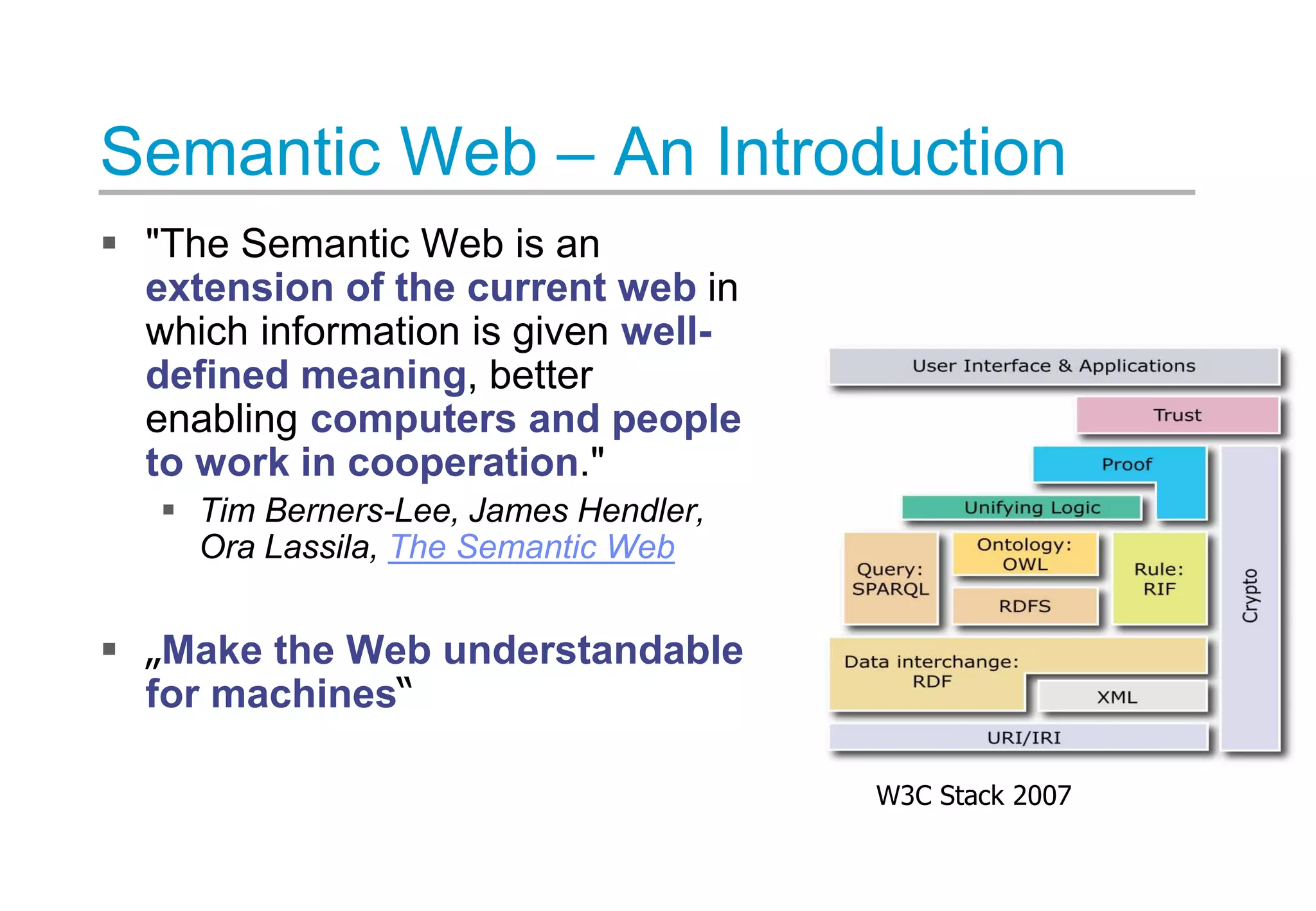
Semantic Web – An Introduction
 "The Semantic Web is an
extension of the current web in
which information is given well-
defined meaning, better
enabling computers and people
to work in cooperation."
 Tim Berners-Lee, James Hendler,
Ora Lassila, The Semantic Web
 „Make the Web understandable
for machines“
W3C Stack 2007
Main Building Blocks of the
Semantic Web
1. Explicit Metadata on the WWW
2. Ontologies
3. Rule Logic and Inference
4. Semantic Tools ,Semantic Web Services,
Software Agents
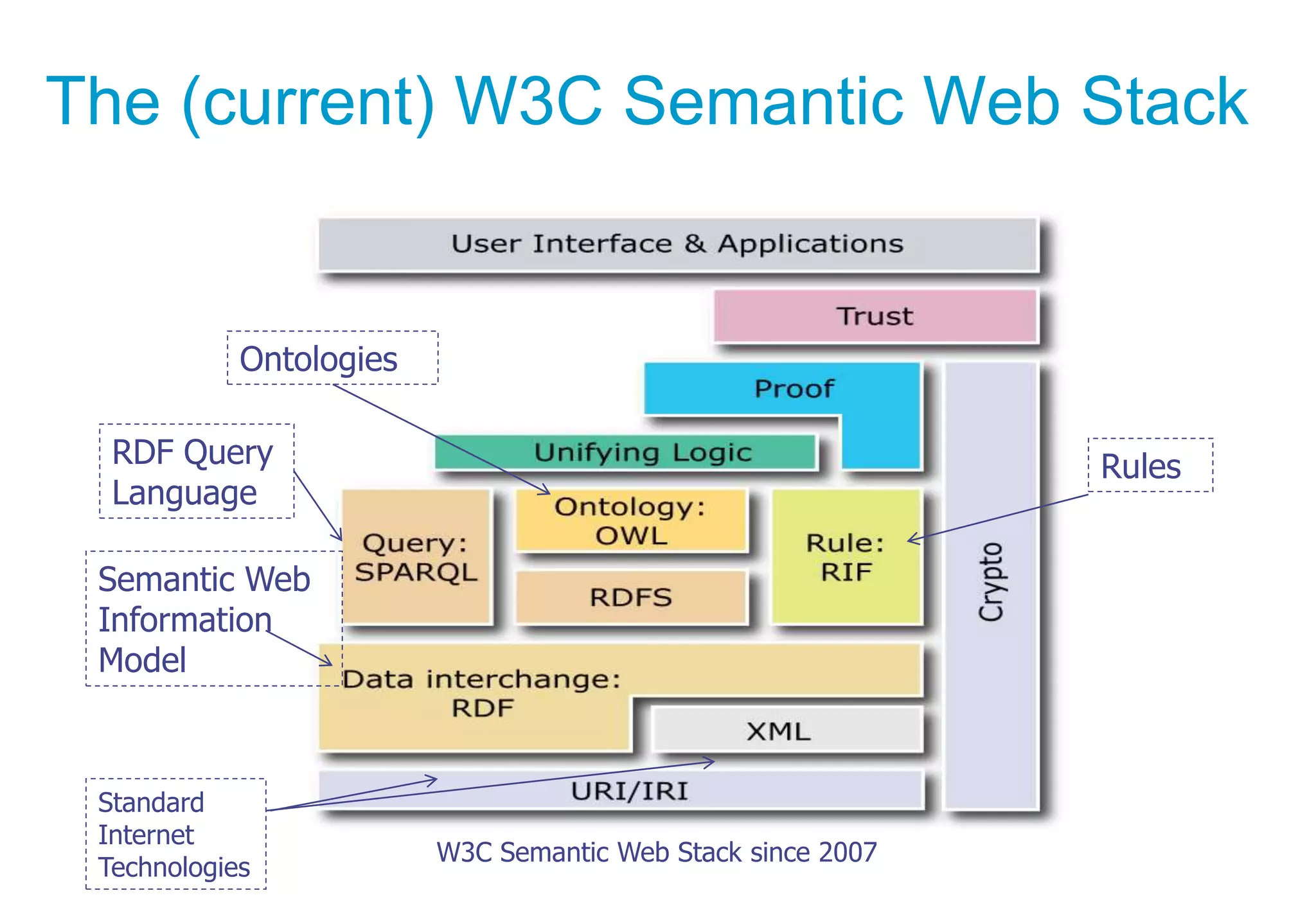
The (current) W3C Semantic Web Stack
W3C Semantic Web Stack since 2007
Ontologies
Rules
Semantic Web
Information
Model
RDF Query
Language
Standard
Internet
Technologies
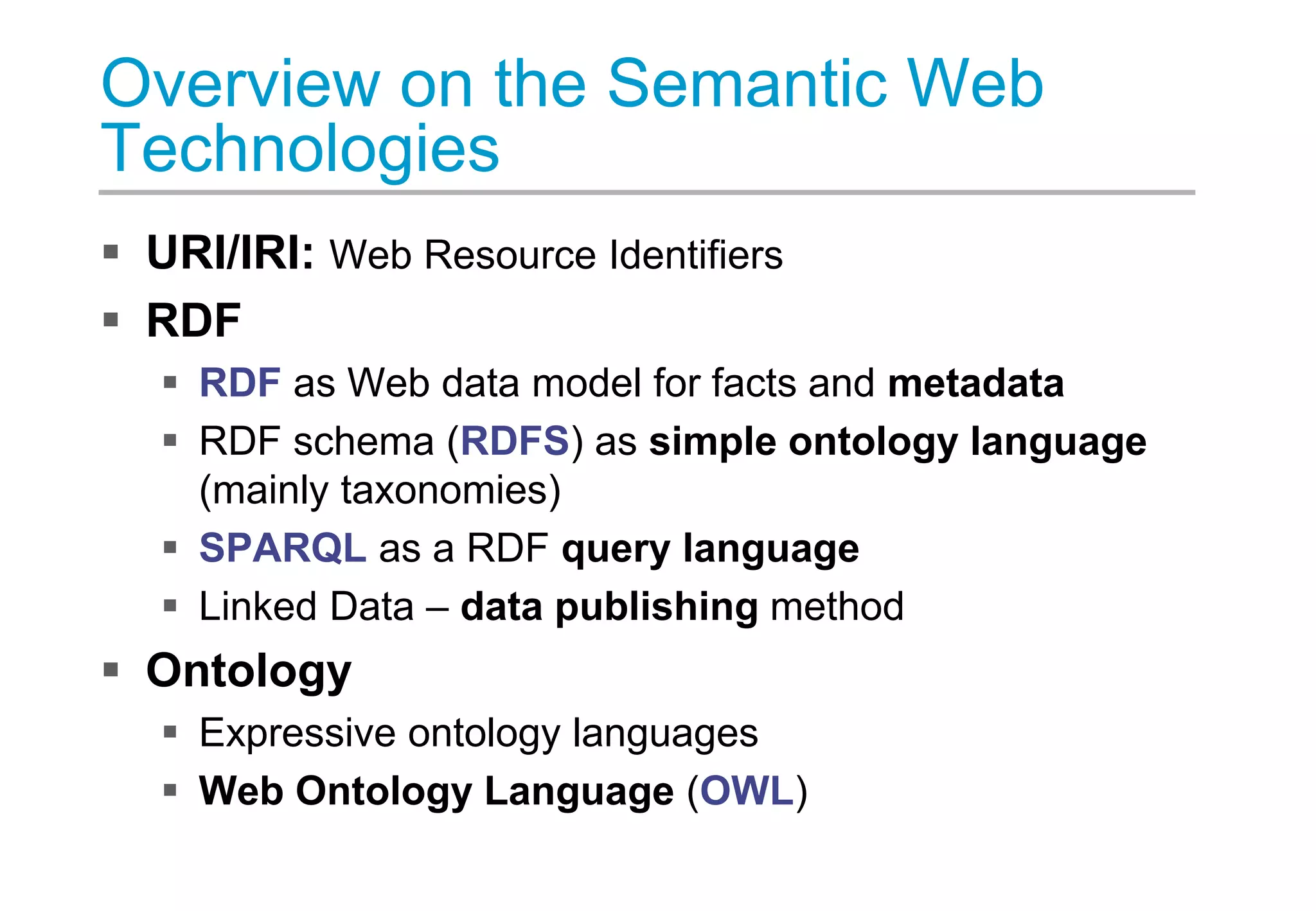
Overview on the Semantic Web
Technologies
 URI/IRI: Web Resource Identifiers
 RDF
 RDF as Web data model for facts and metadata
 RDF schema (RDFS) as simple ontology language
(mainly taxonomies)
 SPARQL as a RDF query language
 Linked Data – data publishing method
 Ontology
 Expressive ontology languages
 Web Ontology Language (OWL)
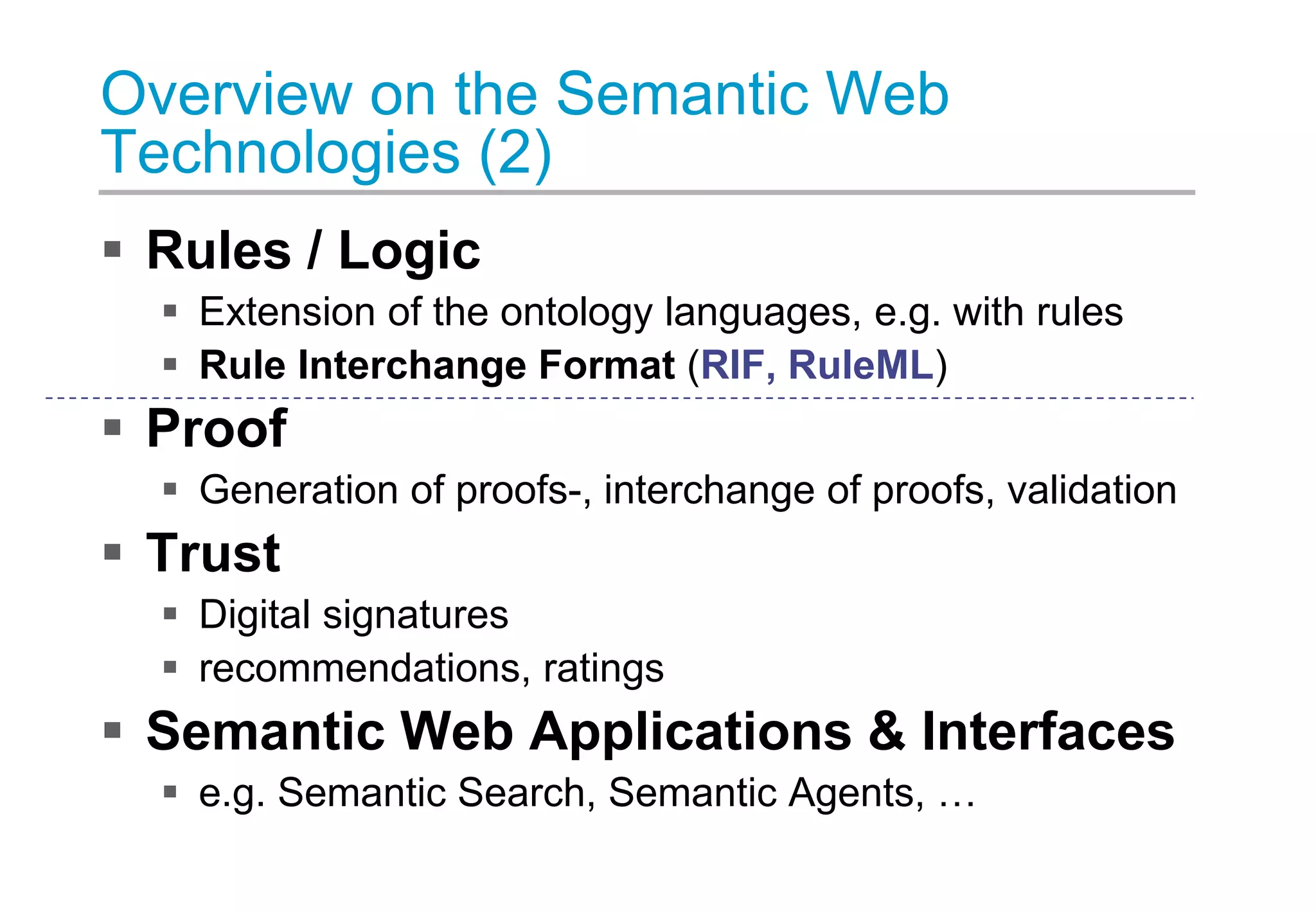
Overview on the Semantic Web
Technologies (2)
 Rules / Logic
 Extension of the ontology languages, e.g. with rules
 Rule Interchange Format (RIF, RuleML)
 Proof
 Generation of proofs-, interchange of proofs, validation
 Trust
 Digital signatures
 recommendations, ratings
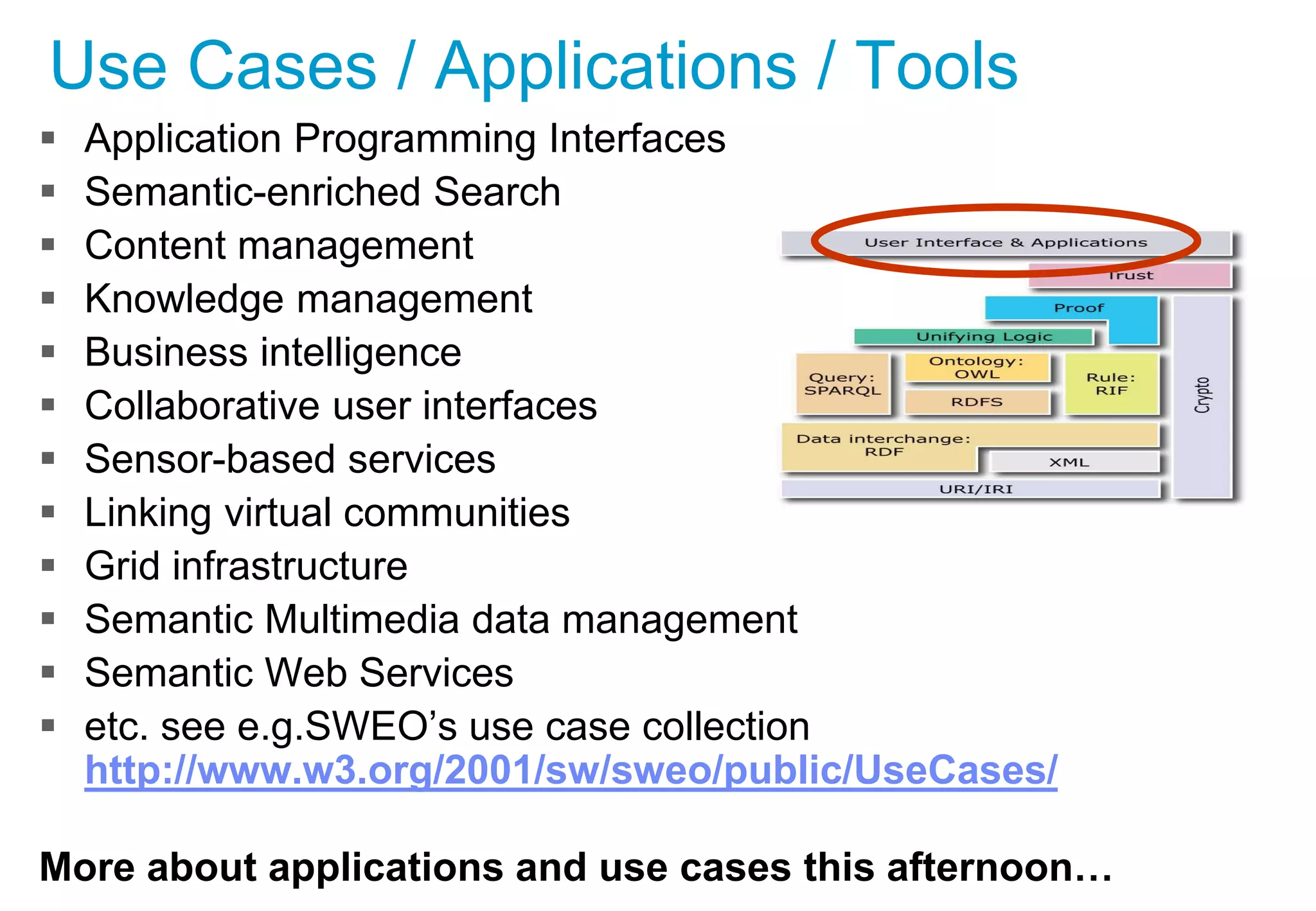
 Semantic Web Applications & Interfaces
 e.g. Semantic Search, Semantic Agents, …
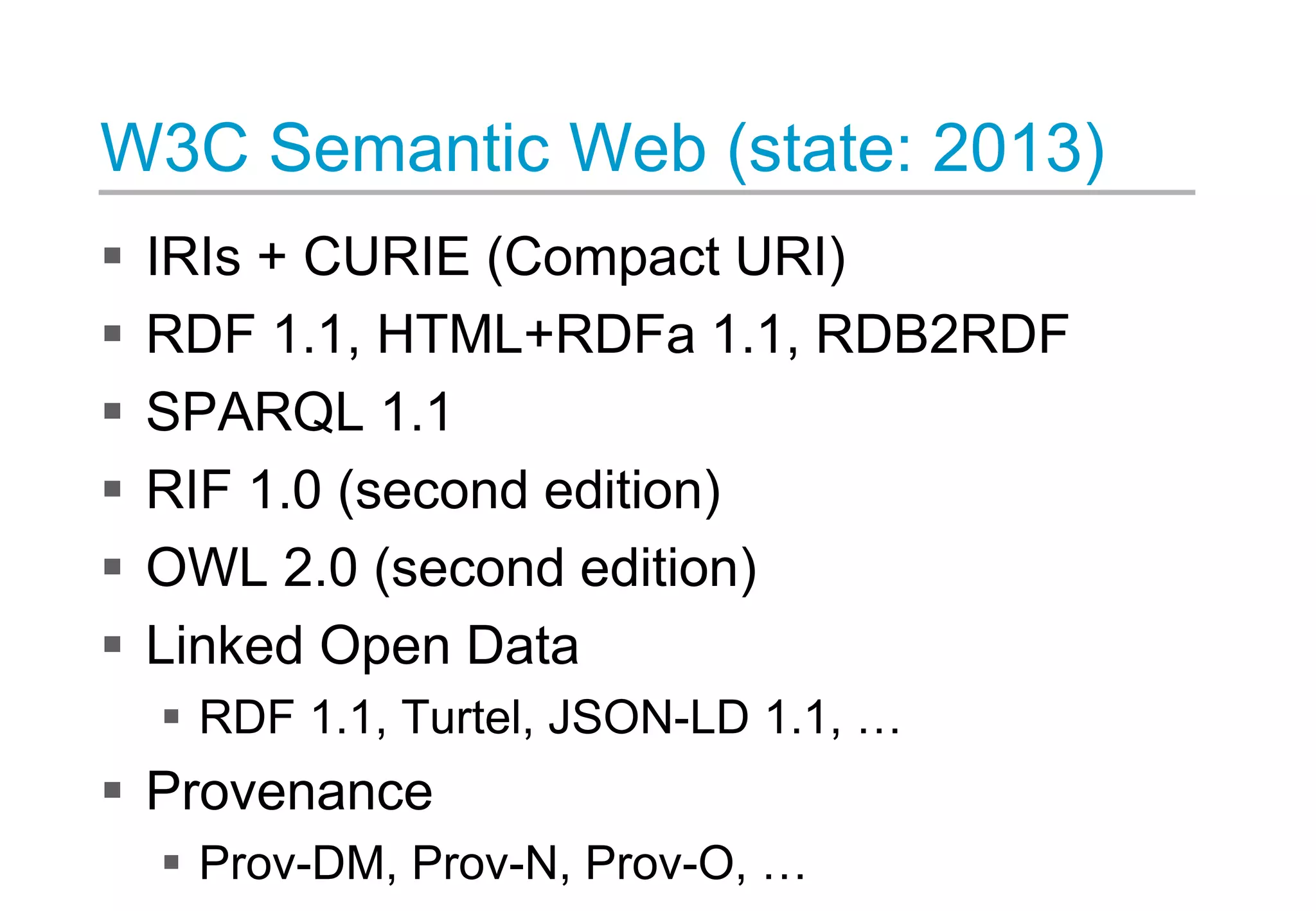
W3C Semantic Web (state: 2013)
 IRIs + CURIE (Compact URI)
 RDF 1.1, HTML+RDFa 1.1, RDB2RDF
 SPARQL 1.1
 RIF 1.0 (second edition)
 OWL 2.0 (second edition)
 Linked Open Data
 RDF 1.1, Turtel, JSON-LD 1.1, …
 Provenance
 Prov-DM, Prov-N, Prov-O, …
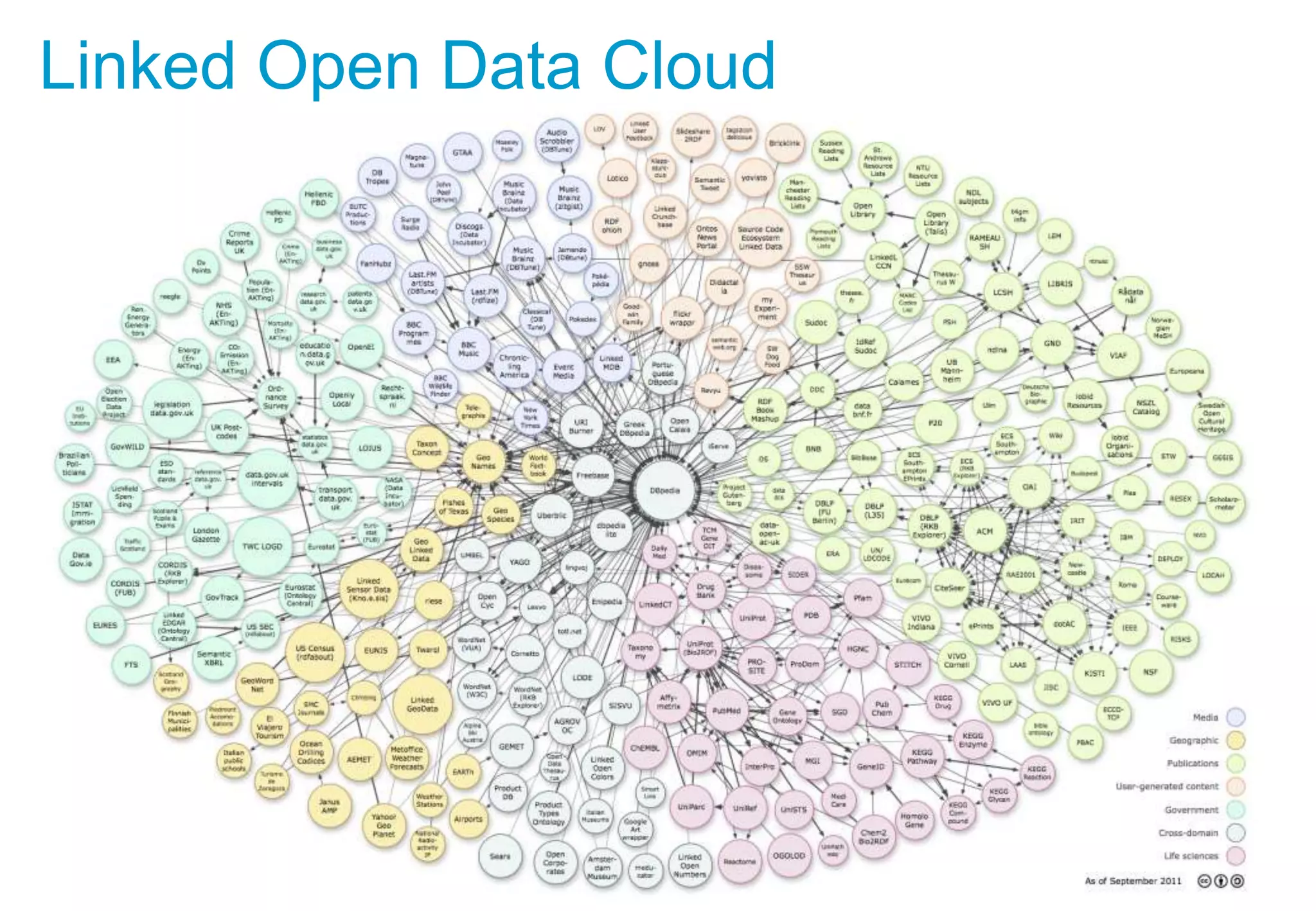
Linked Open Data Cloud
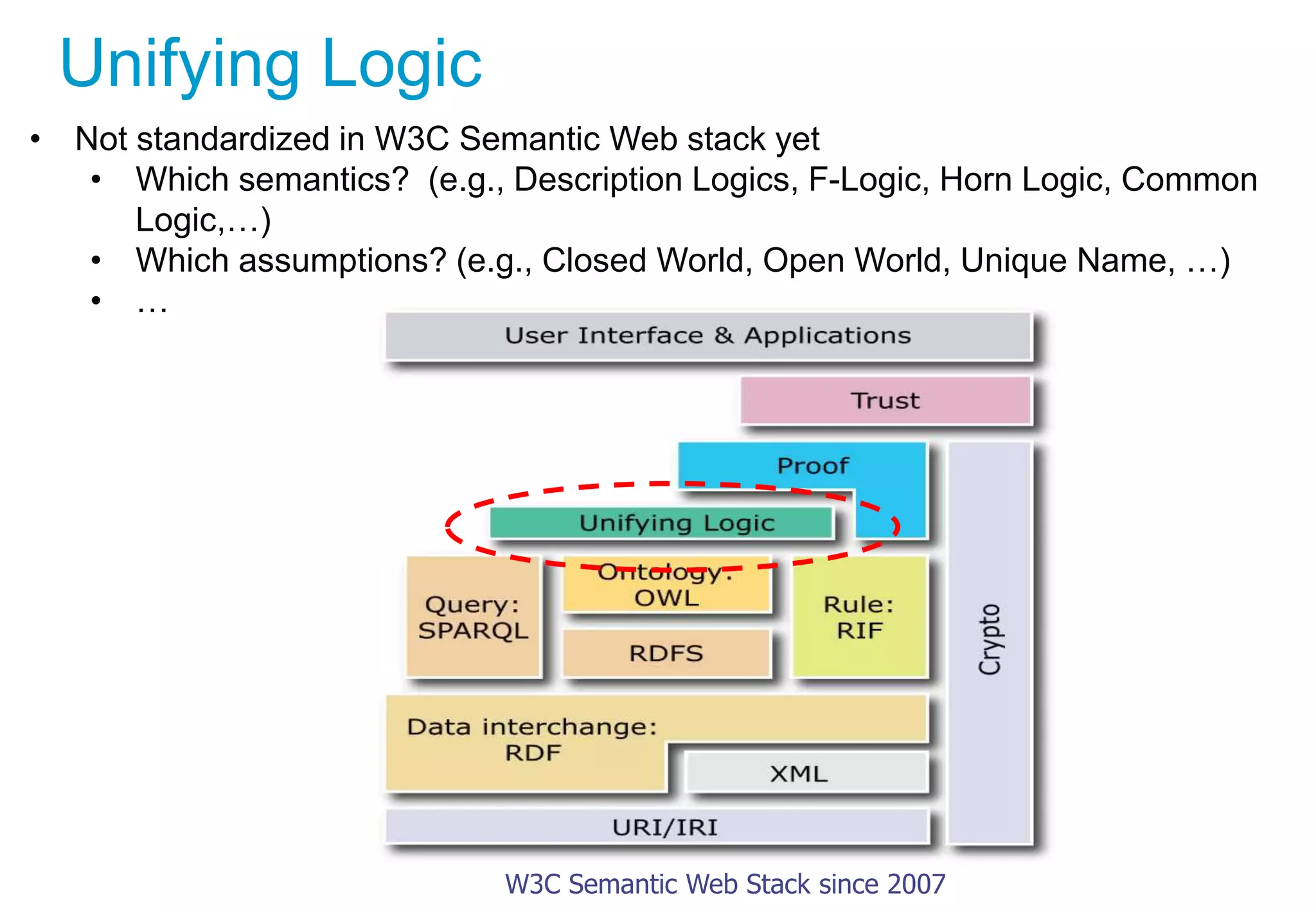
Unifying Logic
W3C Semantic Web Stack since 2007
• Not standardized in W3C Semantic Web stack yet
• Which semantics? (e.g., Description Logics, F-Logic, Horn Logic, Common
Logic,…)
• Which assumptions? (e.g., Closed World, Open World, Unique Name, …)
• …
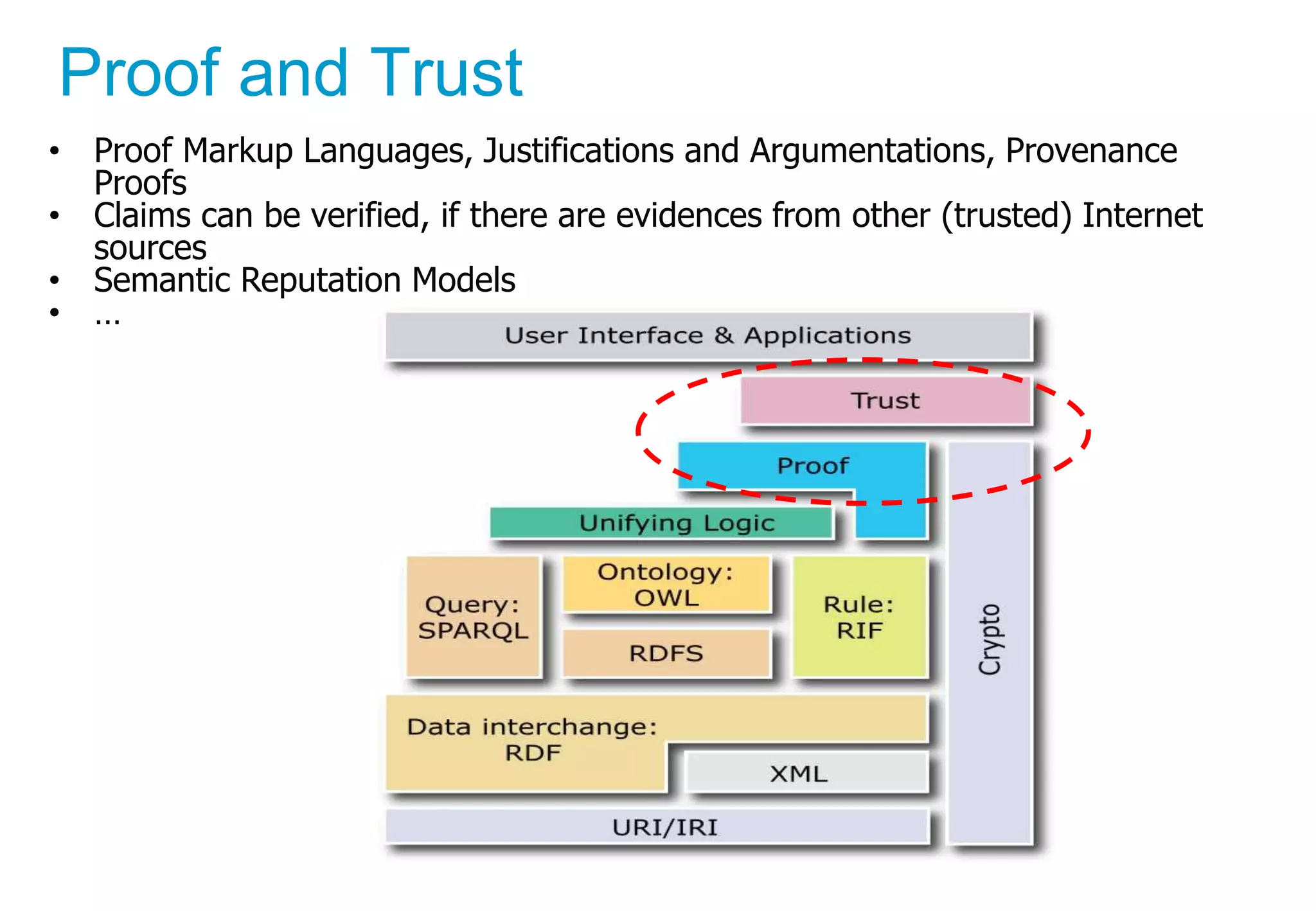
Proof and Trust
• Proof Markup Languages, Justifications and Argumentations, Provenance
Proofs
• Claims can be verified, if there are evidences from other (trusted) Internet
sources
• Semantic Reputation Models
• …
Use Cases / Applications / Tools
 Application Programming Interfaces
 Semantic-enriched Search
 Content management
 Knowledge management
 Business intelligence
 Collaborative user interfaces
 Sensor-based services
 Linking virtual communities
 Grid infrastructure
 Semantic Multimedia data management
 Semantic Web Services
 etc. see e.g.SWEO’s use case collection
http://www.w3.org/2001/sw/sweo/public/UseCases/
More about applications and use cases this afternoon…
The Semantic Web
and it‘s relations
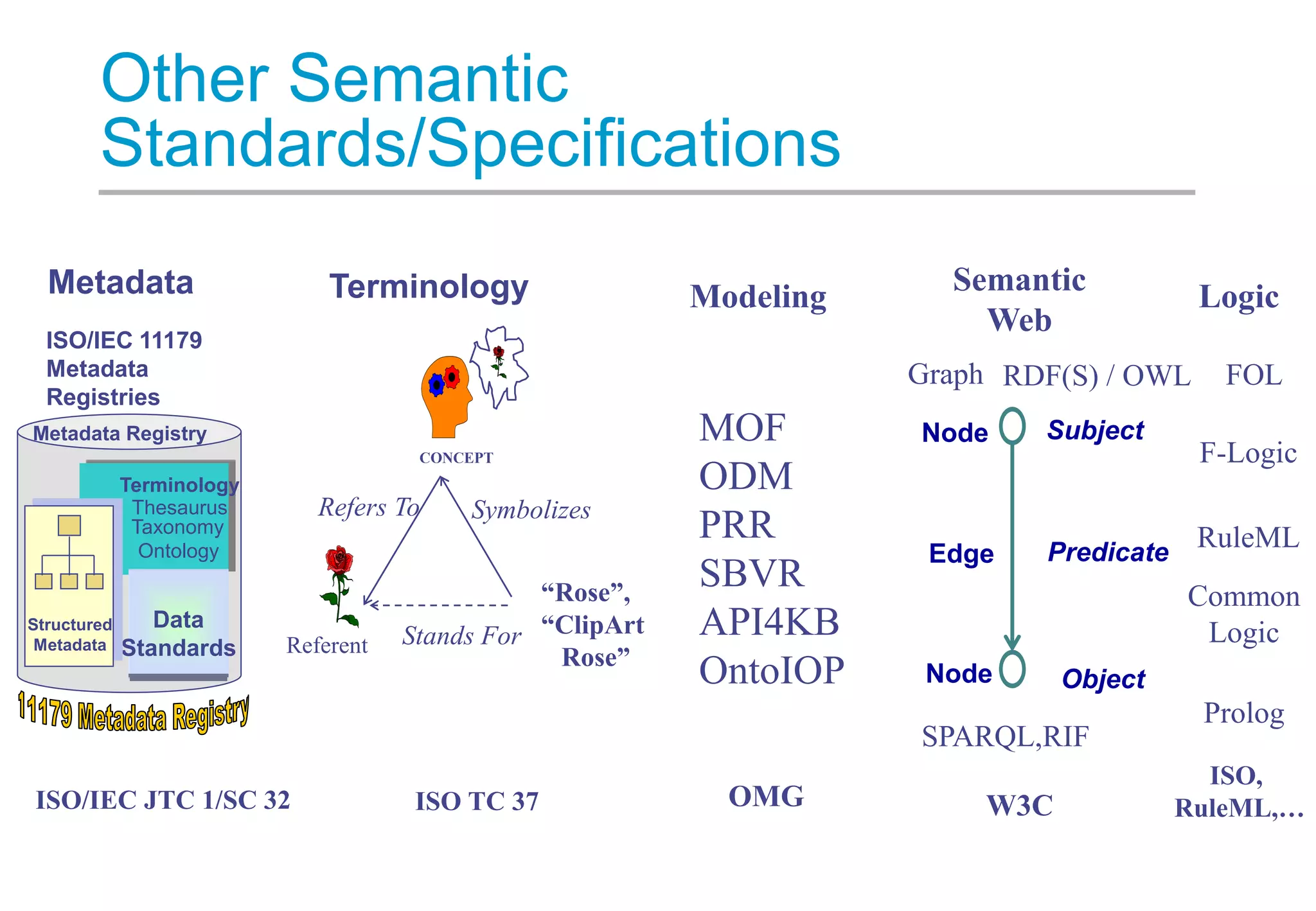
Other Semantic
Standards/Specifications
ISO/IEC JTC 1/SC 32
ISO/IEC 11179
Metadata
Registries
Metadata Registry
Terminology
Thesaurus
Taxonomy
Data
Standards
Ontology
Structured
Metadata
Terminology
CONCEPT
Referent
Refers To Symbolizes
Stands For
“Rose”,
“ClipArt
Rose”
ISO TC 37
Semantic
Web
W3C
Modeling
MOF
ODM
PRR
SBVR
API4KB
OntoIOP
OMG
Node
Node
Edge
Subject
Predicate
Object
Graph RDF(S) / OWL
SPARQL,RIF
Logic
Common
Logic
Prolog
ISO,
RuleML,…
FOL
RuleML
F-Logic
Metadata
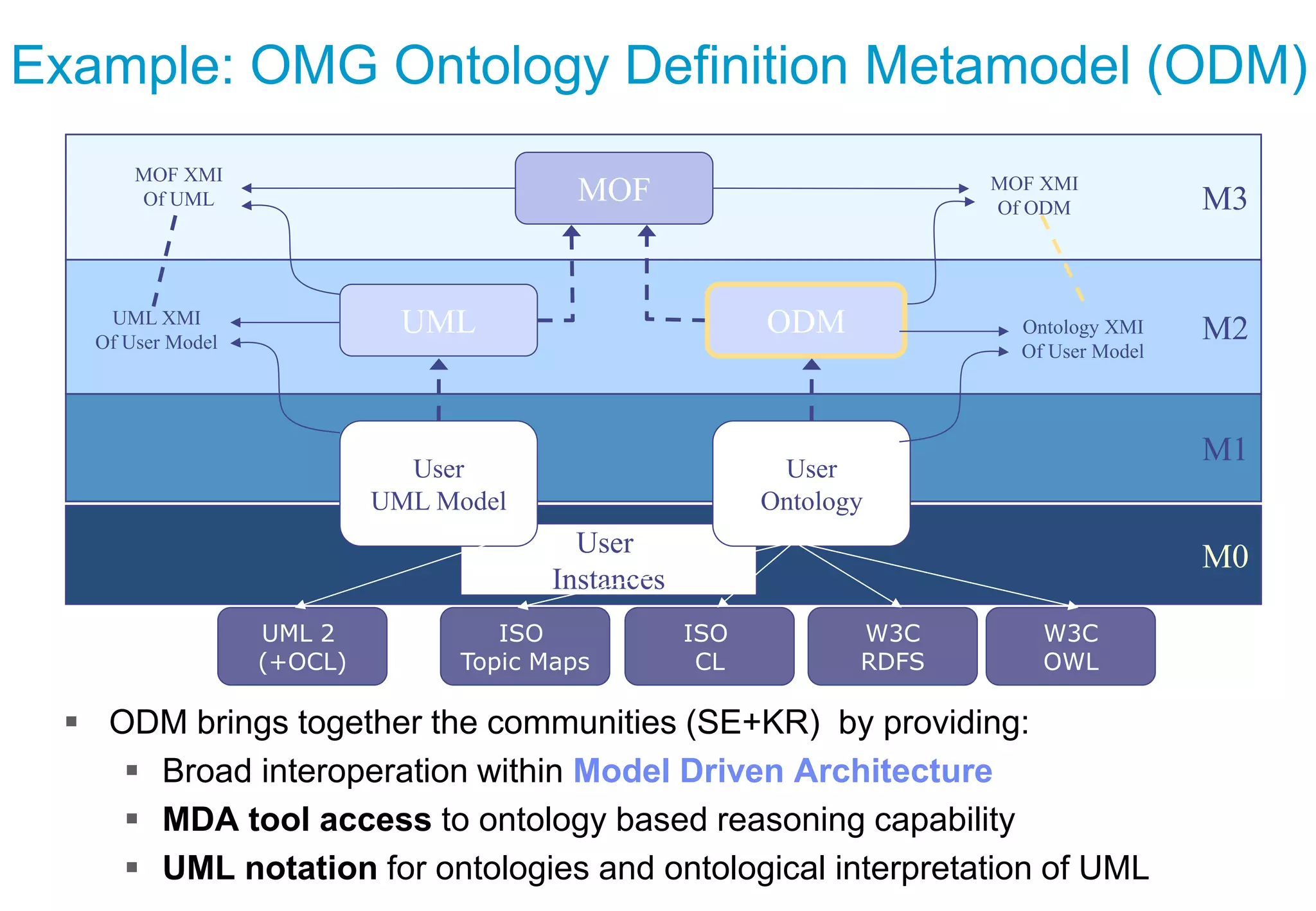
Ontology Definition Metamodel
 ODM brings together the communities (SE+KR) by providing:
 Broad interoperation within Model Driven Architecture
 MDA tool access to ontology based reasoning capability
 UML notation for ontologies and ontological interpretation of UML
M2
M1
M3
MOF XMI
Of UML
UML XMI
Of User Model
MOF
UML
M0User
Instances
User
Ontology
User
UML Model
MOF XMI
Of ODM
ODM Ontology XMI
Of User Model
ISO
Topic Maps
ISO
CL
W3C
RDFS
W3C
OWL
UML 2
(+OCL)
Example: OMG Ontology Definition Metamodel (ODM)
Example: Rule Markup Language
Standards (RuleML)
 RuleML 1.0 (Deliberation, Reaction, Defeasible, Modal, …)
 Semantic Web Rule Language (SWRL)
 Uses RuleML Version 0.89
 Semantic Web Services Language (SWSL)
 Uses RuleML Version 0.89
 W3C Rule Interchange Format (RIF)
 Uses RuleML Version 0.91 with frames and slots
 OASIS LegalRuleML
 Uses RuleML Version 1.0
 OMG Production Rules Representation (PRR)
 Input from RuleML
 OMG Application Programming Interfaces four KBs (API4KB)
 Input from Reaction RuleML 1.0
Social Semantic Web
The concept of the Social Semantic Web
subsumes developments in which social
interactions on the Web lead to the creation
of explicit and semantically rich knowledge
representations. (Wikipedia)
Corporate Semantic Web
Corporate Semantic Web (CSW) address
the applications of Semantic Web
technologies and Knowledge Management
methodologies in corporate environments
(semantic enterprises).
(www.corporate-semantic-web.de)
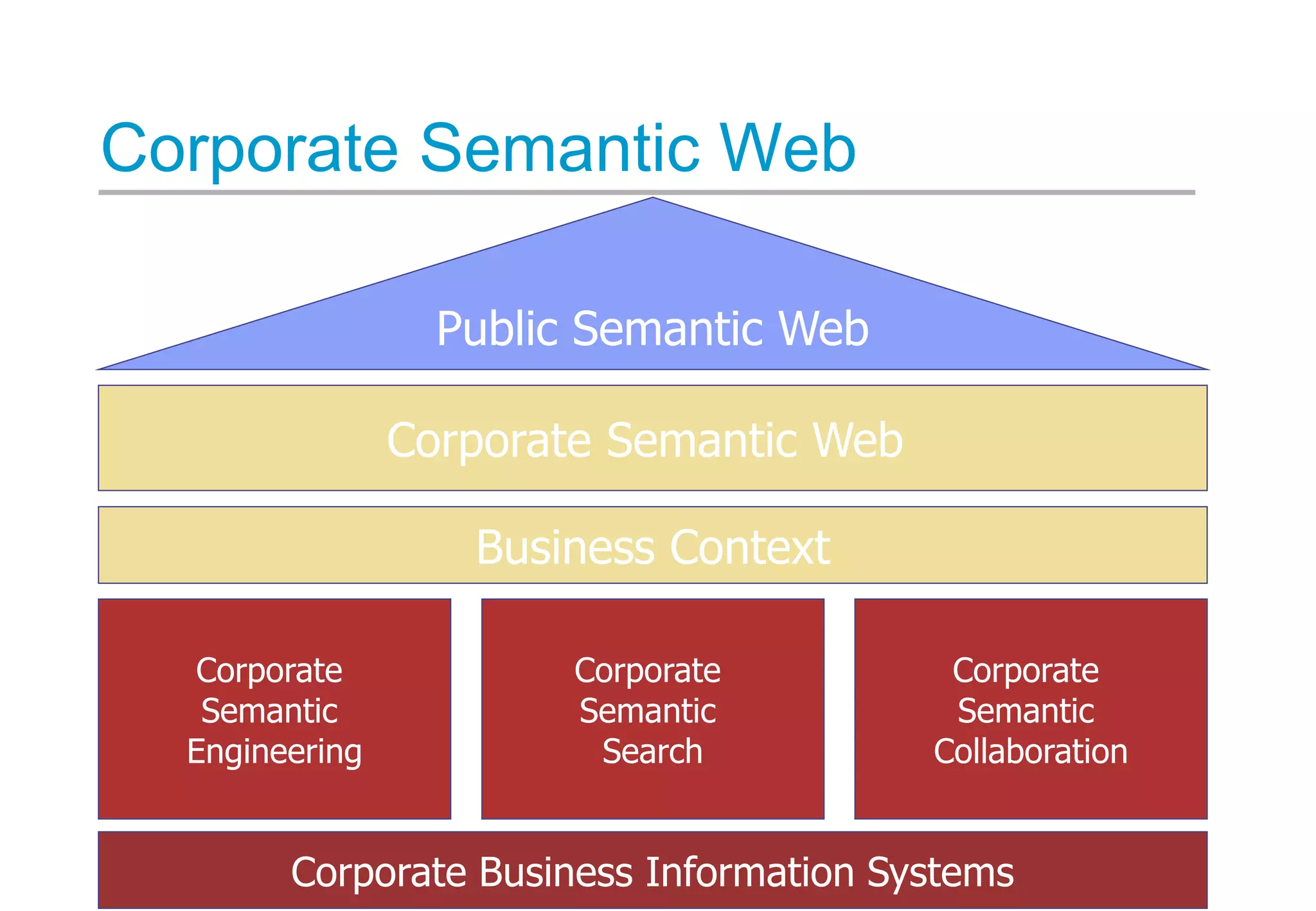
Corporate Semantic Web
Corporate
Semantic
Engineering
Corporate
Semantic
Search
Corporate
Semantic
Collaboration
Public Semantic Web
Corporate Business Information Systems
Business Context
Pragmatic Web
 The Pragmatic Web consists of the tools,
practices and theories describing why and how
people use information. In contrast to the
Syntactic Web and Semantic Web the Pragmatic
Web is not only about form or meaning of
information, but about interaction which brings
about e.g. understanding or commitments.
(www.pragmaticweb.info)
What comes next?
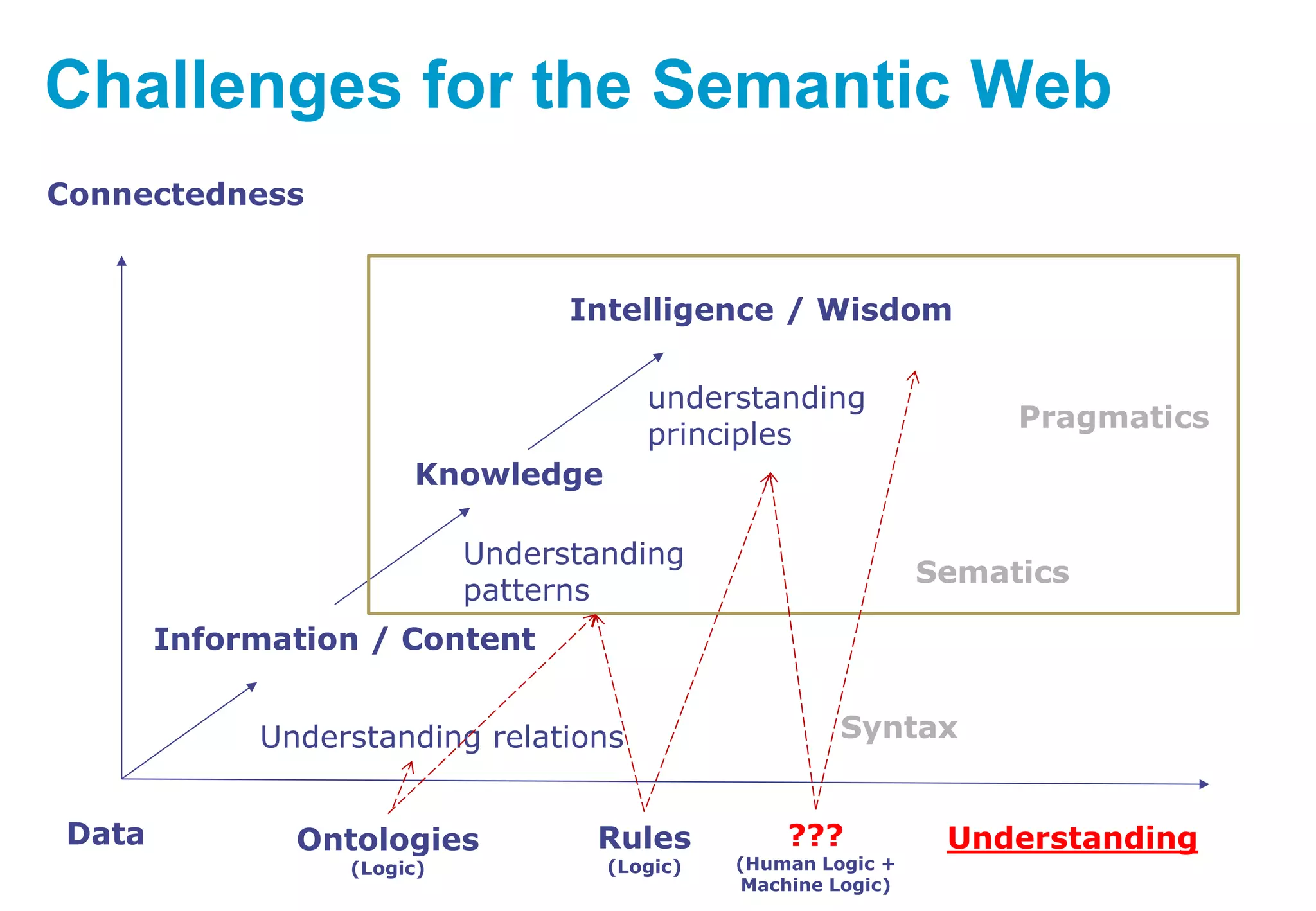
Challenges for the Semantic Web
Syntax
Sematics
Pragmatics
Data Understanding
Connectedness
Information / Content
Knowledge
Intelligence / Wisdom
Understanding relations
Understanding
patterns
understanding
principles
Ontologies
(Logic)
Rules
(Logic)
???
(Human Logic +
Machine Logic)
Pragmatic Web
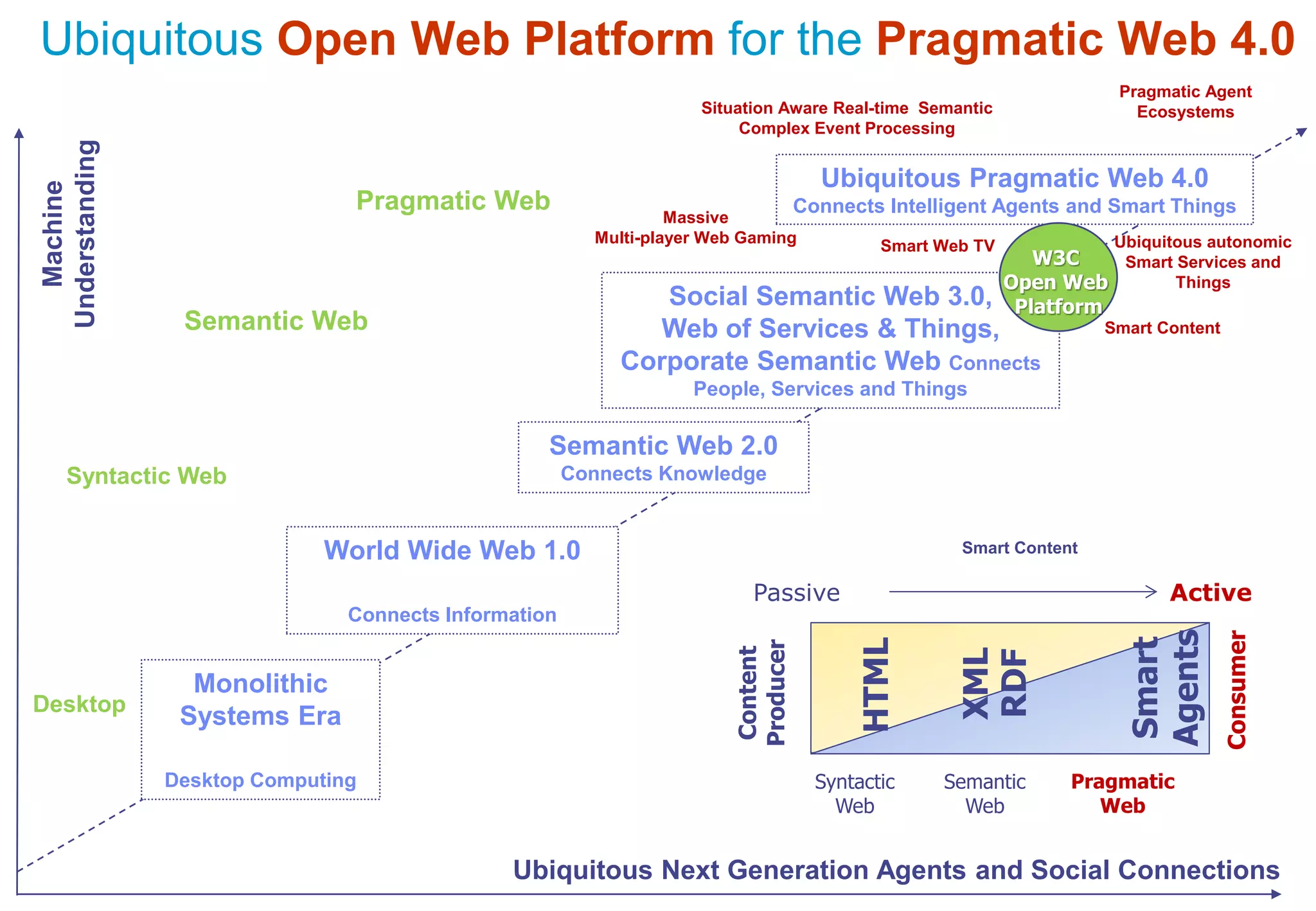
Ubiquitous Open Web Platform for the Pragmatic Web 4.0
Monolithic
Systems Era
Desktop Computing
Desktop
World Wide Web 1.0
Connects Information
Syntactic Web
Semantic Web 2.0
Connects Knowledge
Social Semantic Web 3.0,
Web of Services & Things,
Corporate Semantic Web Connects
People, Services and Things
Ubiquitous Pragmatic Web 4.0
Connects Intelligent Agents and Smart Things
Semantic Web
Ubiquitous autonomic
Smart Services and
Things
Pragmatic Agent
Ecosystems
Machine
Understanding
Ubiquitous Next Generation Agents and Social Connections
Syntactic
Web
Semantic
Web
Pragmatic
Web
HTML
XML
RDF
Smart
Agents
Content
Producer
Passive Active
Consumer
Smart Content
Smart Content
Smart Web TV
Massive
Multi-player Web Gaming
Situation Aware Real-time Semantic
Complex Event Processing
W3C
Open Web
Platform
Thank you …
Questions?
AG Corporate Semantic Web, FU Berlin
paschke@inf.fu-berlin
http://www.inf.fu-berlin/groups/ag-csw/
http://www.corporate-semantic-web.de
http://www.pragmaticweb.info

Semantic Web from the 2013 Perspective

  • 1.
    Semantic Web fromthe 2013 Perspective 2nd MakoLab Semantic Day – Theoria and Praxis Polish Academy of Sciences, October 3rd, 2013 Prof. Dr. Adrian Paschke Department of Information Systems Poznan University of Economics and Freie Universitaet Berlin paschke@inf.fu-berlin Prof. Dr. Witold Abramowicz Department of Information Systems Poznan University of Economics http://kie.ue.poznan.pl/en
  • 2.
    Scientific Center of thePolish Academy of Sciences in Paris
  • 3.
    Poznan University ofEconomics  specialises in educating economists, managers and specialists in quality management in all sectors of the economy  Research labs  Enterprise platforms and systems  Service science  Next Generation Internet Semantic as a leitmotif
  • 4.
    Semantic related EUprojects  SUPER – Semantics Utilised for Process Management within and between Enterprises  ASG – Adaptive Services Grid  INSEMTIVES – Incentives for Semantics  EASTWEB: building an integrated leading Euro- Asian higher education and research community in the field of the Semantic  USE-ME.GOV - Usability driven open platform for mobile government  T-OWL – Time-determined Ontology based knowledge system for real time stock market analysis  Service Web 3.0  ENIRAF - Enhanced Information Retrieval and Filtering for Analytical Systems  KnowledgeWeb
  • 5.
    Other semantic relatedprojects  eDW – enhanced Data Warehouse  eVEREst – The System to Support Government’s Estimation of Real Estates’ Value  F-WebS – Filtering of Web services – semantic description of Web services  Adaptive microWorkflow – Acquisition and Filtering of Information for the Needs of Adaptive microWorkflows  EGO – Identity management  Semiramida – ontological representation of legal acts  Integror-S3 – Semantically- Enhanced Execution Engine  eXtraSpec – Advanced data extraction methods for the needs of expert search  ASBK – Adaptive Systems for Corporate Banking  FEMS – Future Energy Management System  DWDI – Deep Web Data Integration
  • 6.
    Agenda  What isSemantics?  The Semantic Web – An Introduction  Semantic Web and it’s Relations  What comes next?
  • 7.
  • 8.
    Search Results fromPublication Database  Lorenz P, Transcriptional repression mediated by the KRAB domain of the human C2H2 zinc finger protein Kox1/ZNF10 does not require histone deacetylation. Biol Chem. 2001 Apr;382(4):637-44.  Fredericks WJ. An engineered PAX3-KRAB transcriptional repressor inhibits the malignant phenotype of alveolar rhabdomyosarcoma cells harboring the endogenous PAX3-FKHR oncogene. Mol Cell Biol. 2000 Jul;20(14):5019-31. Author Title YearJournal However, for a machine things look different!
  • 9.
    Results from PublicationDatabase  Lorenz P, Transcriptional repression mediated by the KRAB domain of the human C2H2 zinc finger protein Kox1/ZNF10 does not require histone deacetylation. Biol Chem. 2001 Apr;382(4):637-44.  Fredericks WJ. An engineered PAX3- KRAB transcriptional repressor inhibits the malignant phenotype of alveolar rhabdomyosarcoma cells harboring the endogenous PAX3-FKHR oncogene. Mol Cell Biol. 2000 Jul;20(14):5019-31. Solution: Tags (XML)?
  • 10.
    Results from PublicationDatabase  <author>Lorenz P</author><title>Transcriptional repression mediated by the KRAB domain of the human C2H2 zinc finger protein Kox1/ZNF10 does not require histone deacetylation. </title> <journal>Biol Chem </journal><year>2001<year>  <author>Lorenz P</author><title>Transcriptional repression mediated by the KRAB domain of the human C2H2 zinc finger protein Kox1/ZNF10 does not require histone deacetylation. </title> <journal>Biol Chem </journal><year>2001<year>  ...However, for a machine things look different!
  • 11.
    Results from PublicationDatabase  <author>Lorenz P</author><title>Transcriptional repression mediated by the KRAB domain of the human C2H2 zinc finger protein Kox1/ZNF10 does not require histone deacetylation. </title> <journal>Biol Chem </journal><year>2001<year>  <author>Lorenz P</author><title>Transcriptional repression mediated by the KRAB domain of the human C2H2 zinc finger protein Kox1/ZNF10 does not require histone deacetylation. </title> <journal>Biol Chem </journal><year>2001<year> Solution: Use Semantic Knowledge
  • 12.
    Example: Traffic Light Syntax– Semantics - Pragmatics  Syntax  green (bottom); yellow; red  Semantics  green = go; …; red = stop  Pragmatics  If red and no traffic then allowed to go
  • 13.
    Example: Question-Answer Interaction Syntax– Semantics - Pragmatics  Syntax  “What time is it?” (English)  Semantics  Question about current time (Meaning)  Pragmatics  An answer to the question is obligatory (even if time is unknown) (Understanding and Commitment)
  • 14.
    Example - XMLSyntax vs. Semantics Adrian Paschke is a lecturer of Logic Programming <course name=“Logic Programming"> <lecturer>Adrian Paschke</lecturer> </course> <lecturer name=“Adrian Paschke"> <teaches>Logic Programming</teaches> </lecturer> Opposite nesting (syntax), same meaning (semantics)!
  • 15.
  • 16.
    Semantic Technologies for DeclarativeKnowledge Representation 1. Rules  Describe derived conclusions and reactions from given information (inference) 2. Ontologies  Ontologies described the conceptual knowledge of a domain (concept semantics) Partner Customer is a equal with Client if premium(Customer) then discount(10%)
  • 17.
    Example: Ontology andRules Object Person DocumentTopic Patentee Patent Application Patent becomes knows described_in is_a-1 is_a-1 is_a-1 is_a-1 is_a-1 writes related_to Skill has related_to Topic Document Topic Document Patent Application Topic Patentee Topic described_in is_about knows is_about Patentee writes RULES: Patentee Skill has granted Technique Teaching described_in Priority date Prior Art Ontology
  • 18.
    Main Requirements ofa Logic-based Ontology / Rule Language in IT a well-defined syntax a formal semantics efficient reasoning support sufficient expressive power convenience/adequacy of expression syntax
  • 19.
    The Semantic Web AnIntroduction
  • 20.
    Semantic Web –An Introduction  "The Semantic Web is an extension of the current web in which information is given well- defined meaning, better enabling computers and people to work in cooperation."  Tim Berners-Lee, James Hendler, Ora Lassila, The Semantic Web  „Make the Web understandable for machines“ W3C Stack 2007
  • 21.
    Main Building Blocksof the Semantic Web 1. Explicit Metadata on the WWW 2. Ontologies 3. Rule Logic and Inference 4. Semantic Tools ,Semantic Web Services, Software Agents
  • 22.
    The (current) W3CSemantic Web Stack W3C Semantic Web Stack since 2007 Ontologies Rules Semantic Web Information Model RDF Query Language Standard Internet Technologies
  • 23.
    Overview on theSemantic Web Technologies  URI/IRI: Web Resource Identifiers  RDF  RDF as Web data model for facts and metadata  RDF schema (RDFS) as simple ontology language (mainly taxonomies)  SPARQL as a RDF query language  Linked Data – data publishing method  Ontology  Expressive ontology languages  Web Ontology Language (OWL)
  • 24.
    Overview on theSemantic Web Technologies (2)  Rules / Logic  Extension of the ontology languages, e.g. with rules  Rule Interchange Format (RIF, RuleML)  Proof  Generation of proofs-, interchange of proofs, validation  Trust  Digital signatures  recommendations, ratings  Semantic Web Applications & Interfaces  e.g. Semantic Search, Semantic Agents, …
  • 25.
    W3C Semantic Web(state: 2013)  IRIs + CURIE (Compact URI)  RDF 1.1, HTML+RDFa 1.1, RDB2RDF  SPARQL 1.1  RIF 1.0 (second edition)  OWL 2.0 (second edition)  Linked Open Data  RDF 1.1, Turtel, JSON-LD 1.1, …  Provenance  Prov-DM, Prov-N, Prov-O, …
  • 26.
  • 27.
    Unifying Logic W3C SemanticWeb Stack since 2007 • Not standardized in W3C Semantic Web stack yet • Which semantics? (e.g., Description Logics, F-Logic, Horn Logic, Common Logic,…) • Which assumptions? (e.g., Closed World, Open World, Unique Name, …) • …
  • 28.
    Proof and Trust •Proof Markup Languages, Justifications and Argumentations, Provenance Proofs • Claims can be verified, if there are evidences from other (trusted) Internet sources • Semantic Reputation Models • …
  • 29.
    Use Cases /Applications / Tools  Application Programming Interfaces  Semantic-enriched Search  Content management  Knowledge management  Business intelligence  Collaborative user interfaces  Sensor-based services  Linking virtual communities  Grid infrastructure  Semantic Multimedia data management  Semantic Web Services  etc. see e.g.SWEO’s use case collection http://www.w3.org/2001/sw/sweo/public/UseCases/ More about applications and use cases this afternoon…
  • 30.
    The Semantic Web andit‘s relations
  • 31.
    Other Semantic Standards/Specifications ISO/IEC JTC1/SC 32 ISO/IEC 11179 Metadata Registries Metadata Registry Terminology Thesaurus Taxonomy Data Standards Ontology Structured Metadata Terminology CONCEPT Referent Refers To Symbolizes Stands For “Rose”, “ClipArt Rose” ISO TC 37 Semantic Web W3C Modeling MOF ODM PRR SBVR API4KB OntoIOP OMG Node Node Edge Subject Predicate Object Graph RDF(S) / OWL SPARQL,RIF Logic Common Logic Prolog ISO, RuleML,… FOL RuleML F-Logic Metadata
  • 32.
    Ontology Definition Metamodel ODM brings together the communities (SE+KR) by providing:  Broad interoperation within Model Driven Architecture  MDA tool access to ontology based reasoning capability  UML notation for ontologies and ontological interpretation of UML M2 M1 M3 MOF XMI Of UML UML XMI Of User Model MOF UML M0User Instances User Ontology User UML Model MOF XMI Of ODM ODM Ontology XMI Of User Model ISO Topic Maps ISO CL W3C RDFS W3C OWL UML 2 (+OCL) Example: OMG Ontology Definition Metamodel (ODM)
  • 33.
    Example: Rule MarkupLanguage Standards (RuleML)  RuleML 1.0 (Deliberation, Reaction, Defeasible, Modal, …)  Semantic Web Rule Language (SWRL)  Uses RuleML Version 0.89  Semantic Web Services Language (SWSL)  Uses RuleML Version 0.89  W3C Rule Interchange Format (RIF)  Uses RuleML Version 0.91 with frames and slots  OASIS LegalRuleML  Uses RuleML Version 1.0  OMG Production Rules Representation (PRR)  Input from RuleML  OMG Application Programming Interfaces four KBs (API4KB)  Input from Reaction RuleML 1.0
  • 34.
    Social Semantic Web Theconcept of the Social Semantic Web subsumes developments in which social interactions on the Web lead to the creation of explicit and semantically rich knowledge representations. (Wikipedia)
  • 35.
    Corporate Semantic Web CorporateSemantic Web (CSW) address the applications of Semantic Web technologies and Knowledge Management methodologies in corporate environments (semantic enterprises). (www.corporate-semantic-web.de)
  • 36.
    Corporate Semantic Web CorporateSemantic Web Corporate Semantic Engineering Corporate Semantic Search Corporate Semantic Collaboration Public Semantic Web Corporate Business Information Systems Business Context
  • 37.
    Pragmatic Web  ThePragmatic Web consists of the tools, practices and theories describing why and how people use information. In contrast to the Syntactic Web and Semantic Web the Pragmatic Web is not only about form or meaning of information, but about interaction which brings about e.g. understanding or commitments. (www.pragmaticweb.info)
  • 38.
  • 39.
    Challenges for theSemantic Web Syntax Sematics Pragmatics Data Understanding Connectedness Information / Content Knowledge Intelligence / Wisdom Understanding relations Understanding patterns understanding principles Ontologies (Logic) Rules (Logic) ??? (Human Logic + Machine Logic)
  • 40.
    Pragmatic Web Ubiquitous OpenWeb Platform for the Pragmatic Web 4.0 Monolithic Systems Era Desktop Computing Desktop World Wide Web 1.0 Connects Information Syntactic Web Semantic Web 2.0 Connects Knowledge Social Semantic Web 3.0, Web of Services & Things, Corporate Semantic Web Connects People, Services and Things Ubiquitous Pragmatic Web 4.0 Connects Intelligent Agents and Smart Things Semantic Web Ubiquitous autonomic Smart Services and Things Pragmatic Agent Ecosystems Machine Understanding Ubiquitous Next Generation Agents and Social Connections Syntactic Web Semantic Web Pragmatic Web HTML XML RDF Smart Agents Content Producer Passive Active Consumer Smart Content Smart Content Smart Web TV Massive Multi-player Web Gaming Situation Aware Real-time Semantic Complex Event Processing W3C Open Web Platform
  • 41.
    Thank you … Questions? AGCorporate Semantic Web, FU Berlin paschke@inf.fu-berlin http://www.inf.fu-berlin/groups/ag-csw/ http://www.corporate-semantic-web.de http://www.pragmaticweb.info