Introducing the Semantic Web Professor James Hendler http://www.cs.umd.edu/~hendler Co-Director, Maryland Information and Network Dynamics Laboratory Semantic Web Agents Project http://www.mindswap.org MiND
 
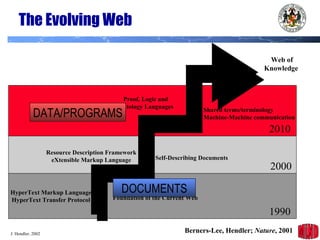
The Evolving Web DOCUMENTS DATA/PROGRAMS Web of Knowledge  HyperText Markup Language HyperText Transfer Protocol Resource Description Framework eXtensible Markup Language Self-Describing Documents Foundation of the Current Web Proof, Logic and Ontology Languages Shared terms/terminology Machine-Machine communication 1990 2000 2010 Berners-Lee, Hendler;  Nature , 2001
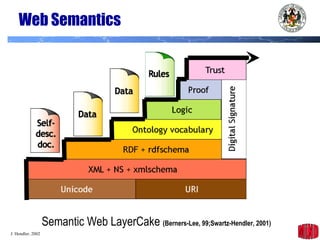
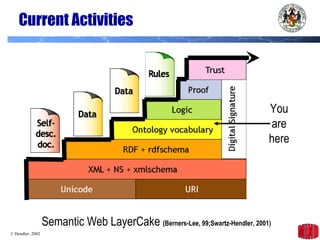
Web Semantics Semantic Web LayerCake  (Berners-Lee, 99;Swartz-Hendler, 2001)
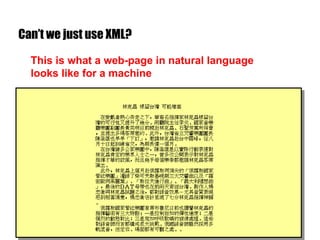
Can’t we just use XML? This is what a web-page in natural language  looks like for a machine
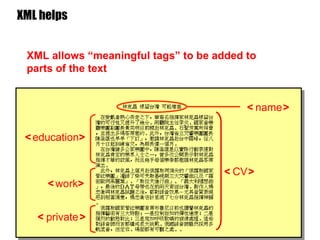
XML helps XML allows “meaningful tags” to be added to parts of the text CV name education work private <  > <  > <  > <  > <  >
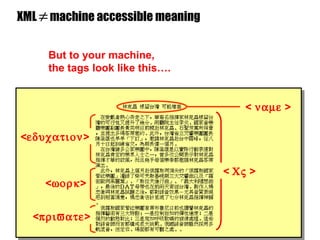
XML    machine accessible meaning But to your machine,  the tags look like this…. CV name education work private <  > <  > <  > <  > <  > <    > <   > <  > <  > <  >
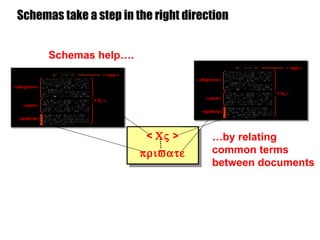
Schemas take a step in the right direction Schemas help…. <    > … by relating  common terms between documents 
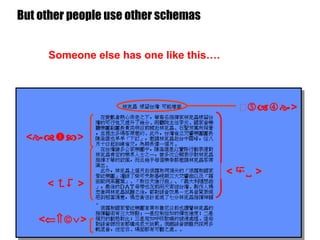
But other people use other schemas <    >   > <  >  <  > Someone else has one like this…. CV name education work private <  > <  > <  > <  > <  >
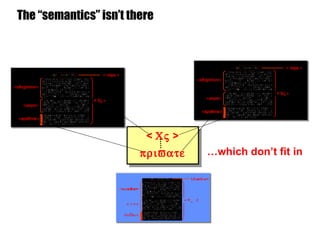
The “semantics” isn’t there <    > … which don’t fit in 
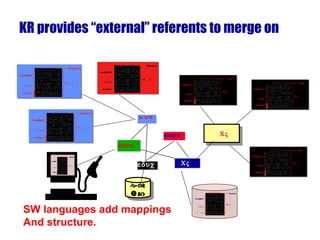
KR provides “external” referents to merge on SW languages add mappings And structure.         CV name education work private <  > <  > <  > <  > <  > <   > <  > <  >  < ‹›„⁄ >
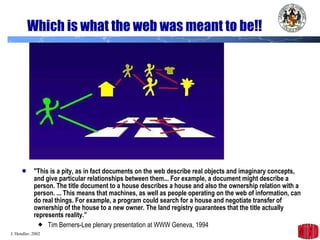
Which is what the web was meant to be!! &quot;This is a pity, as in fact documents on the web describe real objects and imaginary concepts, and give particular relationships between them... For example, a document might describe a person. The title document to a house describes a house and also the ownership relation with a person. ... This means that machines, as well as people operating on the web of information, can do real things. For example, a program could search for a house and negotiate transfer of ownership of the house to a new owner. The land registry guarantees that the title actually represents reality.” Tim Berners-Lee plenary presentation at WWW Geneva, 1994
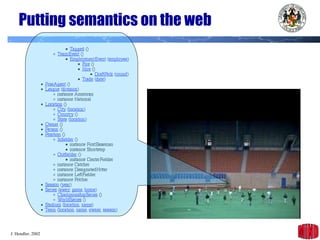
Putting semantics on the web
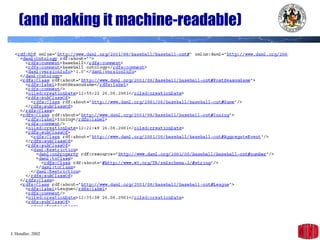
(and making it machine-readable)
 
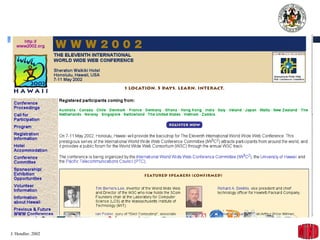
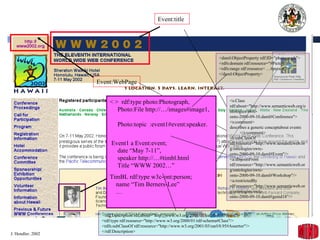
Event:title Event:WebPage < >  rdf:type photo:Photograph,   Photo:File http://…/images#image1,    Photo:topic  :event1#event:speaker.  Event1 a Event:event;   date “May 7-11”,   speaker http://…#timbl.html   Title “WWW 2002…” TimBL rdf:type w3c-ont:person;   name “Tim Berners-Lee”   …  <daml:ObjectProperty rdf:ID=&quot;photograph&quot;> <rdfs:domain rdf:resource=&quot;#Picture&quot;/> <rdfs:range rdf:resource= …#person&quot;/> </daml:ObjectProperty> <rdf:Description rdf:about=&quot;http://www.w3.org/2001/03/earl/0.95#Person&quot;> <rdf:type rdf:resource=&quot;http://www.w3.org/2000/01/rdf-schema#Class&quot;/> <rdfs:subClassOf rdf:resource=&quot;http://www.w3.org/2001/03/earl/0.95#Assertor&quot;/> </rdf:Description> <s:Class rdf:about=&quot;http://www.semanticweb.org/ontologies/swrc-onto-2000-09-10.daml#Conference&quot;> <s:comment> describes a generic conceptabout events </s:comment> <s:subClassOf rdf:resource=&quot;http://www.semanticweb.org/ontologies/swrc-onto-2000-09-10.daml#Event&quot;/> <a:disjointFrom rdf:resource=&quot;http://www.semanticweb.org/ontologies/swrc-onto-2000-09-10.daml#Workshop&quot;/> <a:restrictedBy rdf:resource=&quot;http://www.semanticweb.org/ontologies/swrc-onto-2000-09-10.daml#genid18&quot;/>
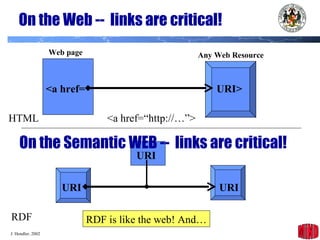
On the Web --  links are critical! <a href= URI> HTML Web page Any Web Resource <a href=“http://…”> RDF URI URI URI RDF is like the web! And… On the Semantic WEB --  links are critical!
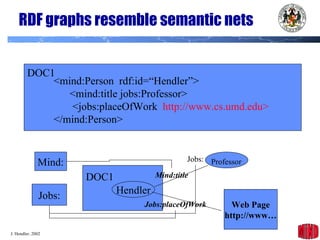
RDF graphs resemble semantic nets <mind:Person  rdf:id=“Hendler”> <mind:title jobs:Professor> <jobs:placeOfWork  http://www.cs.umd.edu> </mind:Person> DOC1 Hendler DOC1 Mind:title Jobs:placeOfWork Web Page http://www… Professor Jobs: Mind: Jobs:
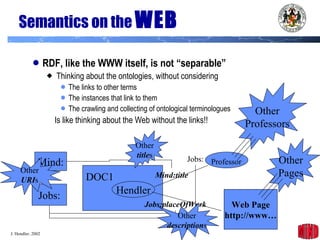
Semantics on the  WEB RDF, like the WWW itself, is not “separable” Thinking about the ontologies, without considering  The links to other terms The instances that link to them The crawling and collecting of ontological terminologues Is like thinking about the Web without the links!! Hendler DOC1 Mind:title Jobs:placeOfWork Web Page http://www… Professor Jobs: Mind: Jobs: Other Professors Other Pages Other title s Other description s Other URI s
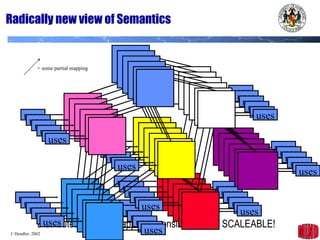
Radically new view of Semantics Distributed,partially mapped, inconsistent -- but SCALEABLE!  = some partial mapping uses uses uses uses uses uses uses uses uses uses uses uses uses uses uses uses uses uses uses uses uses uses uses uses uses uses uses uses uses uses uses uses uses uses uses uses uses uses uses uses uses uses uses uses uses uses uses uses
Real examples Examples from  http://dormouse.cs.umd.edu:8080/wiki/cmsc498wiki. wiki Students violated every rule in the KR book Extended existing  ontologies Linked instances directly to terms from  multiple  ontologies Mixed “real KR” and NL We can learn from their lessons http://dormouse.cs. umd .edu:8080/ wiki /assignment1_collected_les. wiki
Current Activities Semantic Web LayerCake  (Berners-Lee, 99;Swartz-Hendler, 2001) You are here
W3C Web Ontology Working Group Web Ontology Working Group in the  W3C Semantic Web Activity  aimed at “extending the semantic reach of current XML and RDF meta-data efforts. “  History DAML+OIL is submitted as a  joint committee  effort published as a  W3C note   . W3C WG Announcement in November 2001  -  http://lists.w3.org/Archives/Public/www- rdf -logic/2001Nov/0000.html   Weekly teleconferences started in November 2001 First  Face to Face Meeting  - New Jersey (Lucent), Jan ‘02; 2nd - Amsterdam April (W3C); 3rd - CA (Fujitsu/Stanford host) July; 4th in Bristol UK (HP Host) Oct. Four Working Drafts to date Requirements/Use cases - March 2002 3 Technical Documents - July 2002  (Language renamed  OWL )
Membership Current  Working  Group includes over 50 members from over 30 organizations.  Chairs J. Hendler, MIND Lab UMCP G. Schreiber, Univ. of Amsterdam Industry  including: Large companies -  Daimler Chrysler, IBM, HP, Intel, EDS, Fujitsu, Lucent, Motorola, Nokia, Philips Electronics, Sun, Unisys Newer/smaller companies -  IVIS Group, Network Inference, Stilo Technology, Unicorn Solutions Government and Not-For-Profits: US Defense Information Systems Agency, Interoperability Technology Association for Information Processing, Japan (INTAP) , Electricite De France ,  Mitre, NIST Universities and Research Centers: University of Bristol, University of Maryland, University of Southamptom, Stanford University DFKI (German Research Center for Artificial Intelligence), Forschungszentrum Informatik, Ontoweb Invited Experts  Well-known academics from non-W3C members (Hayes, Heflin, Stein, Borden)
But will it fly? DAML+OIL is already the most used ontology language ever!! http://www.daml.org  (3.5M statements on 25,000 web pages) Gaining acceptance by web players Semantic Web Track being offered at WWW 2002 3x more people attended WWW2002 Developer Day on SW than attended KR Significant (international) Govt Support US DARPA/NSF;  EU IST Framework 5,6 Japan, Germany, Australia considering significant investments US National Cancer Institute to publish cancer vocabulary in DAML+OIL Much New Startup activity (even in this economic climate) Many tools being developed Many of them aimed at developers, not just AI literate types
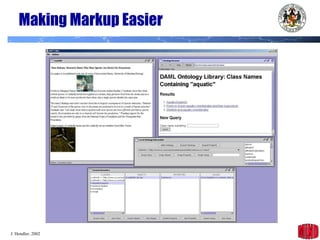
Making Markup Easier
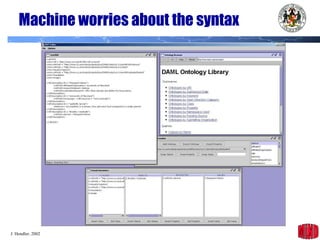
Machine worries about the syntax
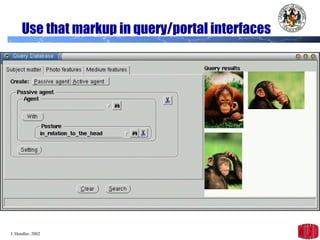
Use that markup in query/portal interfaces
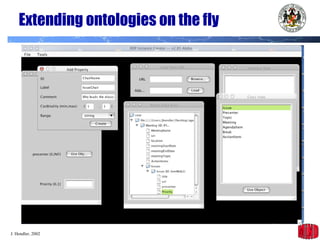
Extending ontologies on the fly
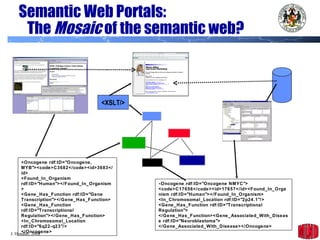
Semantic Web Portals:   The  Mosaic  of the semantic web? <Oncogene rdf:ID=&quot;Oncogene, MYB&quot;><code>C3682</code><id>3683</id> <Found_In_Organism rdf:ID=&quot;Human&quot;></Found_In_Organism> <Gene_Has_Function rdf:ID=&quot;Gene Transcription&quot;></Gene_Has_Function> <Gene_Has_Function rdf:ID=&quot;Transcriptional Regulation&quot;></Gene_Has_Function> <In_Chromosomal_Location rdf:ID=&quot;6q22-q23&quot;/> </Oncogene> < Oncogene rdf:ID=&quot;Oncogene NMYC&quot;> <code>C17656</code><id>17657</id><Found_In_Organism rdf:ID=&quot;Human&quot;></Found_In_Organism> <In_Chromosomal_Location rdf:ID=&quot;2p24.1&quot;/> <Gene_Has_Function rdf:ID=&quot;Transcriptional Regulation&quot;> </Gene_Has_Function><Gene_Associated_With_Disease rdf:ID=&quot;Neuroblastoma&quot;> </Gene_Associated_With_Disease></Oncogene> <XSLT/>
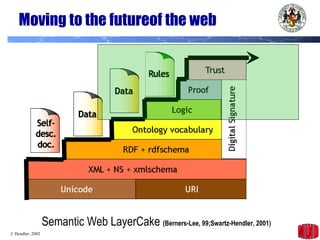
Moving to the futureof the web Semantic Web LayerCake  (Berners-Lee, 99;Swartz-Hendler, 2001)
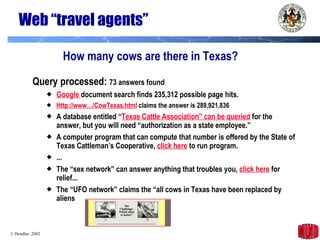
Web “travel agents” Query processed:  73 answers found Google  document search finds 235,312 possible page hits. Http://www…/CowTexas.html  claims the answer is 289,921,836 A database entitled “ Texas Cattle Association” can be queried  for the answer, but you will need “authorization as a state employee.” A computer program that can compute that number is offered by the State of Texas Cattleman’s Cooperative,  click here  to run program. ... The “sex network” can answer anything that troubles you,  click here  for relief...  The “UFO network” claims the “all cows in Texas have been replaced by aliens How many cows are there in Texas?
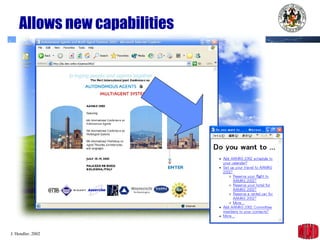
Allows new capabilities
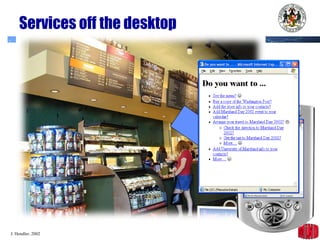
Services off the desktop
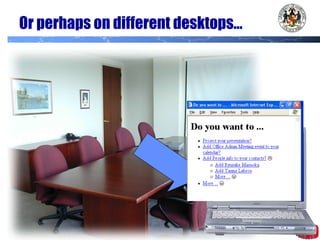
Or perhaps on different desktops…
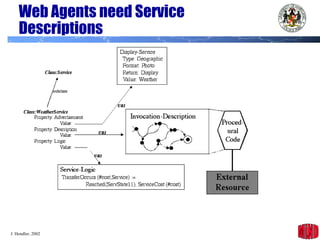
Web Agents need Service Descriptions
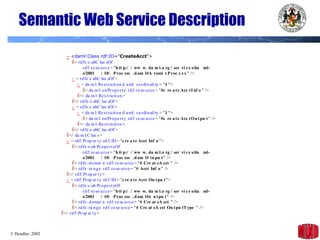
Semantic Web Service Description
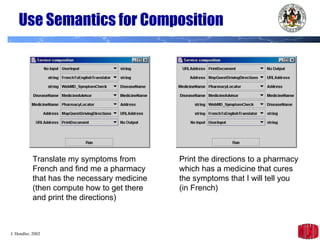
Use Semantics for Composition Translate my symptoms from French and find me a pharmacy that has the necessary medicine (then compute how to get there and print the directions) Print the directions to a pharmacy which has a medicine that cures the symptoms that I will tell you  (in French)
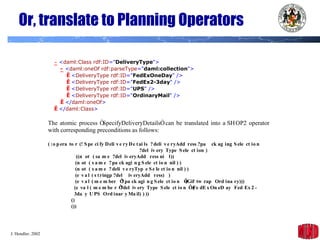
Or, translate to Planning Operators
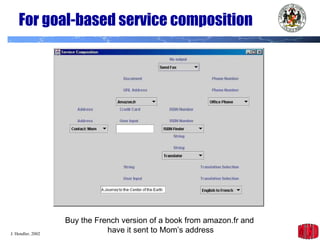
For goal-based service composition Buy the French version of a book from amazon.fr and  have it sent to Mom’s address
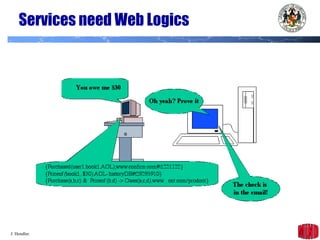
Services need Web Logics
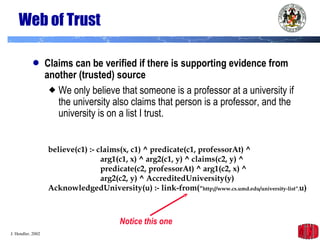
Web of Trust Claims can be verified if there is supporting evidence from another (trusted) source We only believe that someone is a professor at a university if the university also claims that person is a professor, and the university is on a list I trust. believe(c1) :- claims(x, c1) ^ predicate(c1, professorAt) ^   arg1(c1, x) ^ arg2(c1, y) ^ claims(c2, y) ^   predicate(c2, professorAt) ^ arg1(c2, x) ^   arg2(c2, y) ^ AccreditedUniversity(y) AcknowledgedUniversity(u) :- link-from( “ http://www.cs.umd.edu/university-list” , u) Notice this one
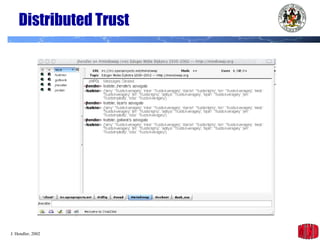
Distributed Trust
Conclusion It is no longer a question of whether the semantic web will come into being, it is already here! We’re already well past the starting gate Web ontologies, term languages, “shims” to DB and services, research in proofs/rules/trust  Standardization providing a common denominator for KR researchers as well as web developers  Small companies starting to form, Big companies starting to move The current environment is open, encouraging, moving fast, and exciting as heck Come play! http://www.daml.org http://www.semanticweb.org http://www.w3.org/2001/sw

Sweo talk

  • 1.
    Introducing the SemanticWeb Professor James Hendler http://www.cs.umd.edu/~hendler Co-Director, Maryland Information and Network Dynamics Laboratory Semantic Web Agents Project http://www.mindswap.org MiND
  • 2.
  • 3.
    The Evolving WebDOCUMENTS DATA/PROGRAMS Web of Knowledge HyperText Markup Language HyperText Transfer Protocol Resource Description Framework eXtensible Markup Language Self-Describing Documents Foundation of the Current Web Proof, Logic and Ontology Languages Shared terms/terminology Machine-Machine communication 1990 2000 2010 Berners-Lee, Hendler; Nature , 2001
  • 4.
    Web Semantics SemanticWeb LayerCake (Berners-Lee, 99;Swartz-Hendler, 2001)
  • 5.
    Can’t we justuse XML? This is what a web-page in natural language looks like for a machine
  • 6.
    XML helps XMLallows “meaningful tags” to be added to parts of the text CV name education work private < > < > < > < > < >
  • 7.
    XML  machine accessible meaning But to your machine, the tags look like this…. CV name education work private < > < > < > < > < > <  > <  > <  > <  > <  >
  • 8.
    Schemas take astep in the right direction Schemas help…. <  > … by relating common terms between documents 
  • 9.
    But other peopleuse other schemas <  >   > <  >  <  > Someone else has one like this…. CV name education work private < > < > < > < > < >
  • 10.
    The “semantics” isn’tthere <  > … which don’t fit in 
  • 11.
    KR provides “external”referents to merge on SW languages add mappings And structure.         CV name education work private < > < > < > < > < > <  > <  > <  >  < ‹›„⁄ >
  • 12.
    Which is whatthe web was meant to be!! &quot;This is a pity, as in fact documents on the web describe real objects and imaginary concepts, and give particular relationships between them... For example, a document might describe a person. The title document to a house describes a house and also the ownership relation with a person. ... This means that machines, as well as people operating on the web of information, can do real things. For example, a program could search for a house and negotiate transfer of ownership of the house to a new owner. The land registry guarantees that the title actually represents reality.” Tim Berners-Lee plenary presentation at WWW Geneva, 1994
  • 13.
  • 14.
    (and making itmachine-readable)
  • 15.
  • 16.
    Event:title Event:WebPage <> rdf:type photo:Photograph, Photo:File http://…/images#image1, Photo:topic :event1#event:speaker. Event1 a Event:event; date “May 7-11”, speaker http://…#timbl.html Title “WWW 2002…” TimBL rdf:type w3c-ont:person; name “Tim Berners-Lee” … <daml:ObjectProperty rdf:ID=&quot;photograph&quot;> <rdfs:domain rdf:resource=&quot;#Picture&quot;/> <rdfs:range rdf:resource= …#person&quot;/> </daml:ObjectProperty> <rdf:Description rdf:about=&quot;http://www.w3.org/2001/03/earl/0.95#Person&quot;> <rdf:type rdf:resource=&quot;http://www.w3.org/2000/01/rdf-schema#Class&quot;/> <rdfs:subClassOf rdf:resource=&quot;http://www.w3.org/2001/03/earl/0.95#Assertor&quot;/> </rdf:Description> <s:Class rdf:about=&quot;http://www.semanticweb.org/ontologies/swrc-onto-2000-09-10.daml#Conference&quot;> <s:comment> describes a generic conceptabout events </s:comment> <s:subClassOf rdf:resource=&quot;http://www.semanticweb.org/ontologies/swrc-onto-2000-09-10.daml#Event&quot;/> <a:disjointFrom rdf:resource=&quot;http://www.semanticweb.org/ontologies/swrc-onto-2000-09-10.daml#Workshop&quot;/> <a:restrictedBy rdf:resource=&quot;http://www.semanticweb.org/ontologies/swrc-onto-2000-09-10.daml#genid18&quot;/>
  • 17.
    On the Web-- links are critical! <a href= URI> HTML Web page Any Web Resource <a href=“http://…”> RDF URI URI URI RDF is like the web! And… On the Semantic WEB -- links are critical!
  • 18.
    RDF graphs resemblesemantic nets <mind:Person rdf:id=“Hendler”> <mind:title jobs:Professor> <jobs:placeOfWork http://www.cs.umd.edu> </mind:Person> DOC1 Hendler DOC1 Mind:title Jobs:placeOfWork Web Page http://www… Professor Jobs: Mind: Jobs:
  • 19.
    Semantics on the WEB RDF, like the WWW itself, is not “separable” Thinking about the ontologies, without considering The links to other terms The instances that link to them The crawling and collecting of ontological terminologues Is like thinking about the Web without the links!! Hendler DOC1 Mind:title Jobs:placeOfWork Web Page http://www… Professor Jobs: Mind: Jobs: Other Professors Other Pages Other title s Other description s Other URI s
  • 20.
    Radically new viewof Semantics Distributed,partially mapped, inconsistent -- but SCALEABLE! = some partial mapping uses uses uses uses uses uses uses uses uses uses uses uses uses uses uses uses uses uses uses uses uses uses uses uses uses uses uses uses uses uses uses uses uses uses uses uses uses uses uses uses uses uses uses uses uses uses uses uses
  • 21.
    Real examples Examplesfrom http://dormouse.cs.umd.edu:8080/wiki/cmsc498wiki. wiki Students violated every rule in the KR book Extended existing ontologies Linked instances directly to terms from multiple ontologies Mixed “real KR” and NL We can learn from their lessons http://dormouse.cs. umd .edu:8080/ wiki /assignment1_collected_les. wiki
  • 22.
    Current Activities SemanticWeb LayerCake (Berners-Lee, 99;Swartz-Hendler, 2001) You are here
  • 23.
    W3C Web OntologyWorking Group Web Ontology Working Group in the W3C Semantic Web Activity aimed at “extending the semantic reach of current XML and RDF meta-data efforts. “ History DAML+OIL is submitted as a joint committee effort published as a W3C note . W3C WG Announcement in November 2001 - http://lists.w3.org/Archives/Public/www- rdf -logic/2001Nov/0000.html Weekly teleconferences started in November 2001 First Face to Face Meeting - New Jersey (Lucent), Jan ‘02; 2nd - Amsterdam April (W3C); 3rd - CA (Fujitsu/Stanford host) July; 4th in Bristol UK (HP Host) Oct. Four Working Drafts to date Requirements/Use cases - March 2002 3 Technical Documents - July 2002 (Language renamed OWL )
  • 24.
    Membership Current Working Group includes over 50 members from over 30 organizations. Chairs J. Hendler, MIND Lab UMCP G. Schreiber, Univ. of Amsterdam Industry including: Large companies - Daimler Chrysler, IBM, HP, Intel, EDS, Fujitsu, Lucent, Motorola, Nokia, Philips Electronics, Sun, Unisys Newer/smaller companies - IVIS Group, Network Inference, Stilo Technology, Unicorn Solutions Government and Not-For-Profits: US Defense Information Systems Agency, Interoperability Technology Association for Information Processing, Japan (INTAP) , Electricite De France , Mitre, NIST Universities and Research Centers: University of Bristol, University of Maryland, University of Southamptom, Stanford University DFKI (German Research Center for Artificial Intelligence), Forschungszentrum Informatik, Ontoweb Invited Experts Well-known academics from non-W3C members (Hayes, Heflin, Stein, Borden)
  • 25.
    But will itfly? DAML+OIL is already the most used ontology language ever!! http://www.daml.org (3.5M statements on 25,000 web pages) Gaining acceptance by web players Semantic Web Track being offered at WWW 2002 3x more people attended WWW2002 Developer Day on SW than attended KR Significant (international) Govt Support US DARPA/NSF; EU IST Framework 5,6 Japan, Germany, Australia considering significant investments US National Cancer Institute to publish cancer vocabulary in DAML+OIL Much New Startup activity (even in this economic climate) Many tools being developed Many of them aimed at developers, not just AI literate types
  • 26.
  • 27.
  • 28.
    Use that markupin query/portal interfaces
  • 29.
  • 30.
    Semantic Web Portals: The Mosaic of the semantic web? <Oncogene rdf:ID=&quot;Oncogene, MYB&quot;><code>C3682</code><id>3683</id> <Found_In_Organism rdf:ID=&quot;Human&quot;></Found_In_Organism> <Gene_Has_Function rdf:ID=&quot;Gene Transcription&quot;></Gene_Has_Function> <Gene_Has_Function rdf:ID=&quot;Transcriptional Regulation&quot;></Gene_Has_Function> <In_Chromosomal_Location rdf:ID=&quot;6q22-q23&quot;/> </Oncogene> < Oncogene rdf:ID=&quot;Oncogene NMYC&quot;> <code>C17656</code><id>17657</id><Found_In_Organism rdf:ID=&quot;Human&quot;></Found_In_Organism> <In_Chromosomal_Location rdf:ID=&quot;2p24.1&quot;/> <Gene_Has_Function rdf:ID=&quot;Transcriptional Regulation&quot;> </Gene_Has_Function><Gene_Associated_With_Disease rdf:ID=&quot;Neuroblastoma&quot;> </Gene_Associated_With_Disease></Oncogene> <XSLT/>
  • 31.
    Moving to thefutureof the web Semantic Web LayerCake (Berners-Lee, 99;Swartz-Hendler, 2001)
  • 32.
    Web “travel agents”Query processed: 73 answers found Google document search finds 235,312 possible page hits. Http://www…/CowTexas.html claims the answer is 289,921,836 A database entitled “ Texas Cattle Association” can be queried for the answer, but you will need “authorization as a state employee.” A computer program that can compute that number is offered by the State of Texas Cattleman’s Cooperative, click here to run program. ... The “sex network” can answer anything that troubles you, click here for relief... The “UFO network” claims the “all cows in Texas have been replaced by aliens How many cows are there in Texas?
  • 33.
  • 34.
  • 35.
    Or perhaps ondifferent desktops…
  • 36.
    Web Agents needService Descriptions
  • 37.
  • 38.
    Use Semantics forComposition Translate my symptoms from French and find me a pharmacy that has the necessary medicine (then compute how to get there and print the directions) Print the directions to a pharmacy which has a medicine that cures the symptoms that I will tell you (in French)
  • 39.
    Or, translate toPlanning Operators
  • 40.
    For goal-based servicecomposition Buy the French version of a book from amazon.fr and have it sent to Mom’s address
  • 41.
  • 42.
    Web of TrustClaims can be verified if there is supporting evidence from another (trusted) source We only believe that someone is a professor at a university if the university also claims that person is a professor, and the university is on a list I trust. believe(c1) :- claims(x, c1) ^ predicate(c1, professorAt) ^ arg1(c1, x) ^ arg2(c1, y) ^ claims(c2, y) ^ predicate(c2, professorAt) ^ arg1(c2, x) ^ arg2(c2, y) ^ AccreditedUniversity(y) AcknowledgedUniversity(u) :- link-from( “ http://www.cs.umd.edu/university-list” , u) Notice this one
  • 43.
  • 44.
    Conclusion It isno longer a question of whether the semantic web will come into being, it is already here! We’re already well past the starting gate Web ontologies, term languages, “shims” to DB and services, research in proofs/rules/trust Standardization providing a common denominator for KR researchers as well as web developers Small companies starting to form, Big companies starting to move The current environment is open, encouraging, moving fast, and exciting as heck Come play! http://www.daml.org http://www.semanticweb.org http://www.w3.org/2001/sw