PRESENTED BY
SUBHRADEEP MITRA
&
DEBANJAN MUKHERJEE
ROLL NO.-3513-61-0008 & 3513-61-0021
REG. NO & SESSION-063209 & 063302OF 2008-2009
UNDER THE GUIDANCE OF
Mr.ARINDAM SAHA
DEPT.OF COMPUTER SCIENCE
SAMMILANI MAHAVIDYALAYA
Definition of Temperature Control
Temperature control is a process in which change of
temperature of a space (and objects collectively there
within) is measured or otherwise detected, and the
passage of heat energy into or out of the space is adjusted
to achieve a desired average temperature.
Aim of the Project
To control temperature
To minimize manual intervention using an intelligent
processor (such as 8085 microprocessor)
It controls the temperature of any industrial plant.
ATC using 8085 Microprocessor
An Automatic Temperature Control Unit mainly divided
into three parts-
Temperature input unit
Processing unit
Control output unit
Overview of ATC unit
 The 8085 based trainer kit forms the basic processing
unit.
 The Analog-to-Digital converter unit and temperature
sensor forms the temperature input unit.
 The switching ON/OFF of the heater / cooler controls
the heat supplied to the plant
Basic operation of the temperature
control unit
 Operationally, the system requires two set points
 Upper set point
 Lower set point
 Whenever the temperature of the plant exceeds the
upper limit or recede the lower limit heater/cooler is
turned-off, so that a temperature is maintained within
limits.
The main hardware consists of
automatic temperature control system
1) 8085 Microprcessr unit
2) ADC interface board
3) AD 590 temperature sensor
4) Amplifier (741 op-Amp)
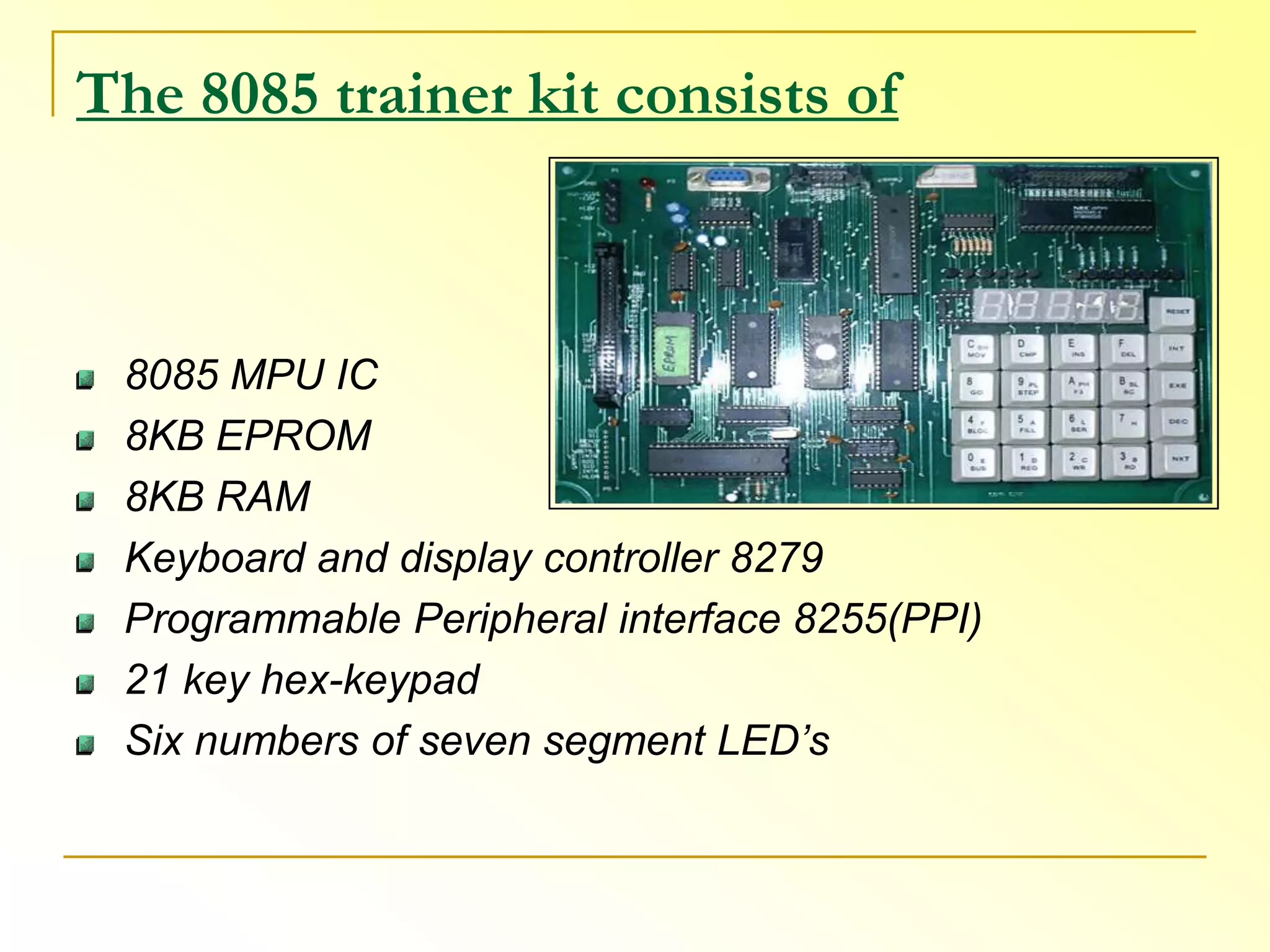
The 8085 trainer kit consists of
8085 MPU IC
8KB EPROM
8KB RAM
Keyboard and display controller 8279
Programmable Peripheral interface 8255(PPI)
21 key hex-keypad
Six numbers of seven segment LED’s
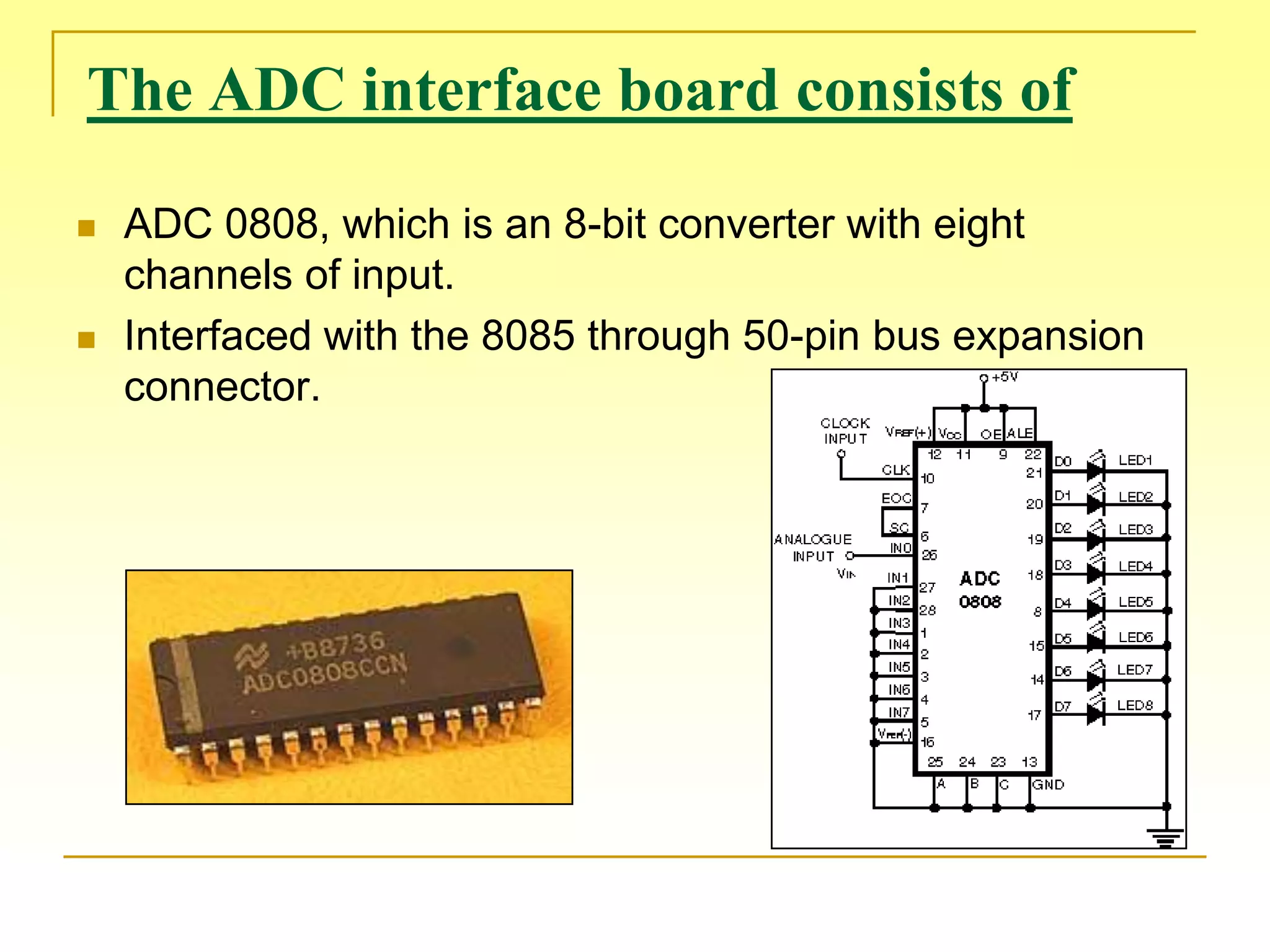
The ADC interface board consists of
 ADC 0808, which is an 8-bit converter with eight
channels of input.
 Interfaced with the 8085 through 50-pin bus expansion
connector.
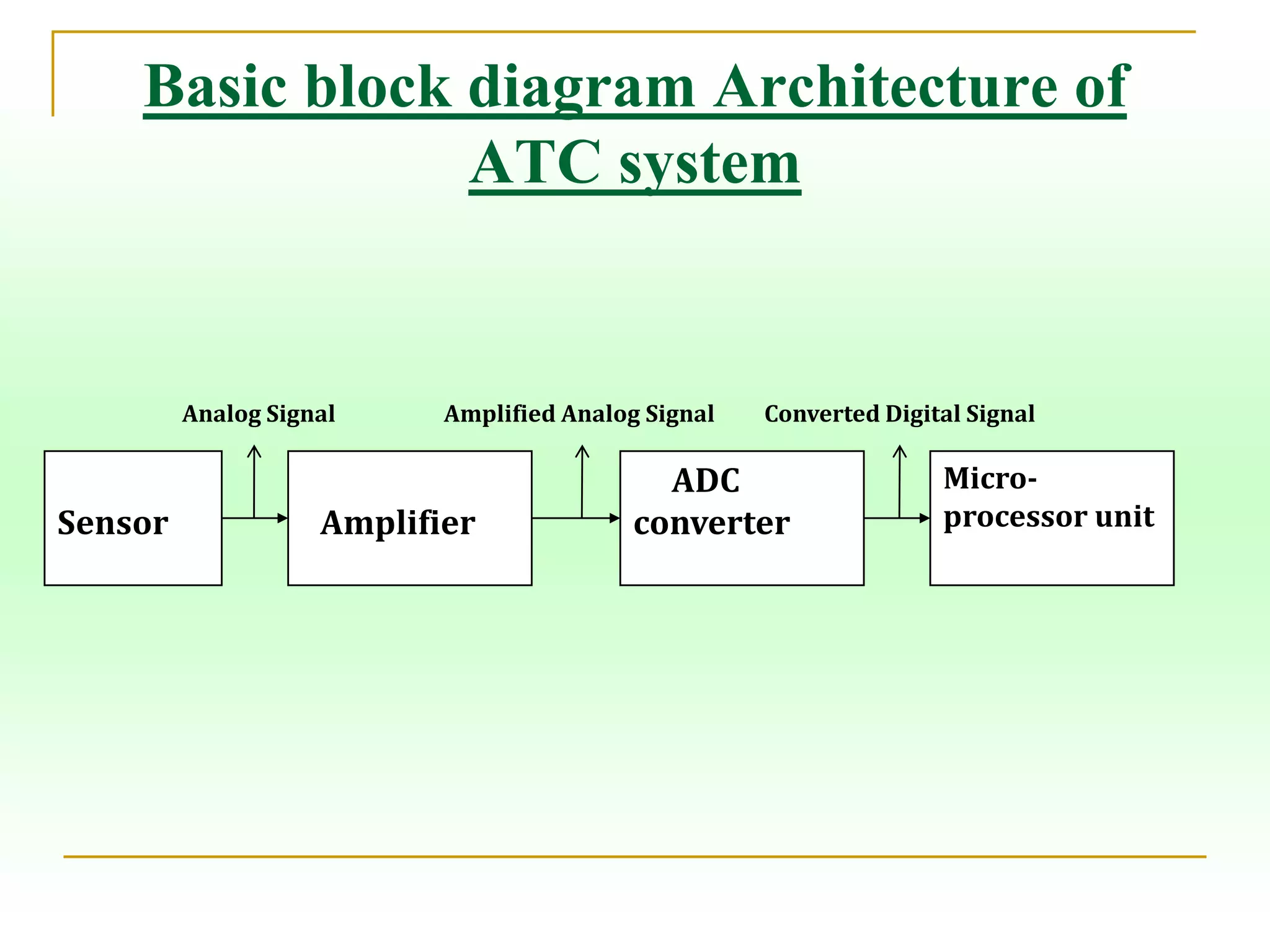
Basic block diagram Architecture of
ATC system
Sensor Amplifier
Micro-
processor unit
ADC
converter
Analog Signal Amplified Analog Signal Converted Digital Signal
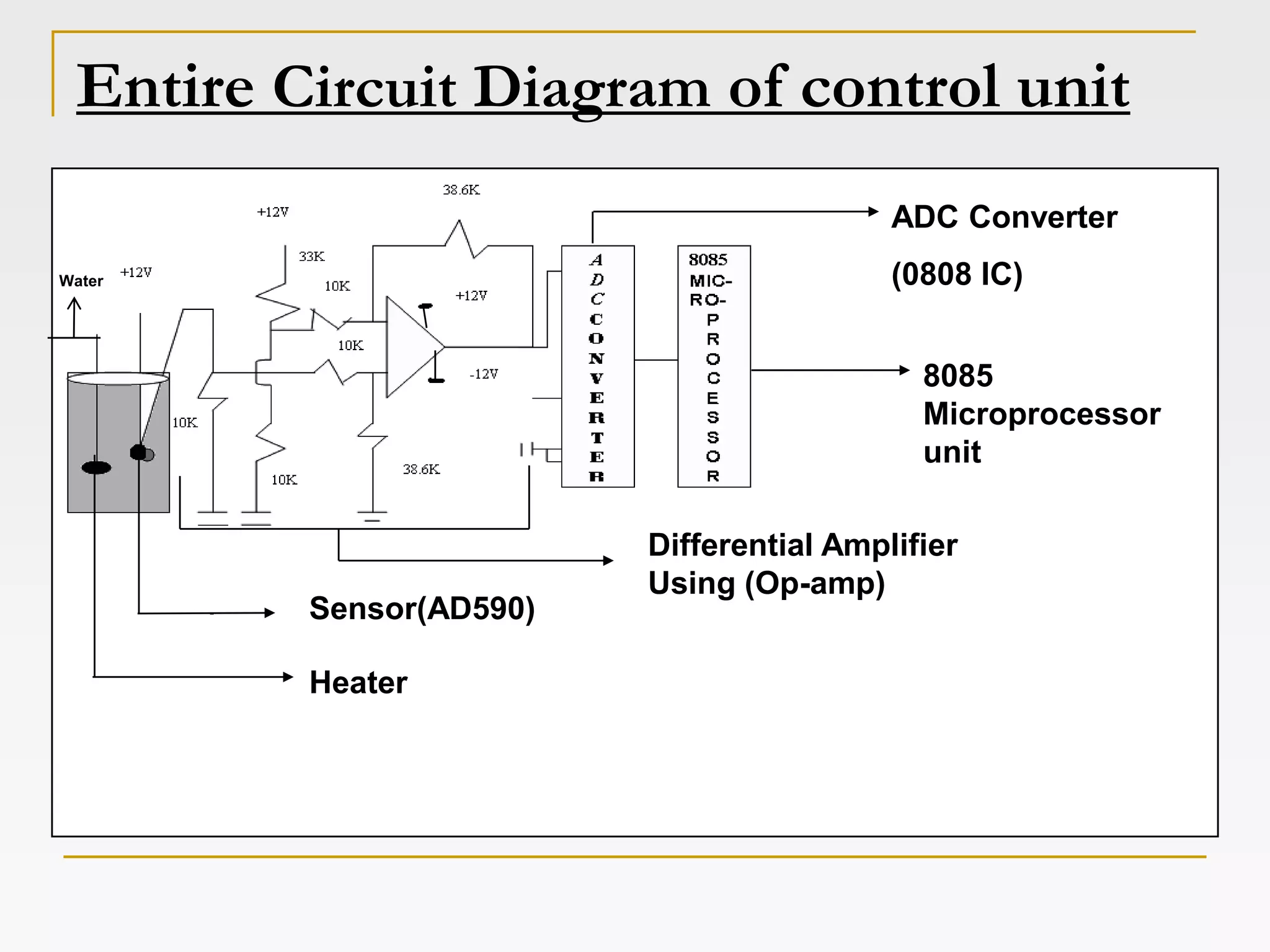
Entire Circuit Diagram of control unit
Heater
Sensor(AD590)
Differential Amplifier
Using (Op-amp)
ADC Converter
(0808 IC)
8085
Microprocessor
unit
Water
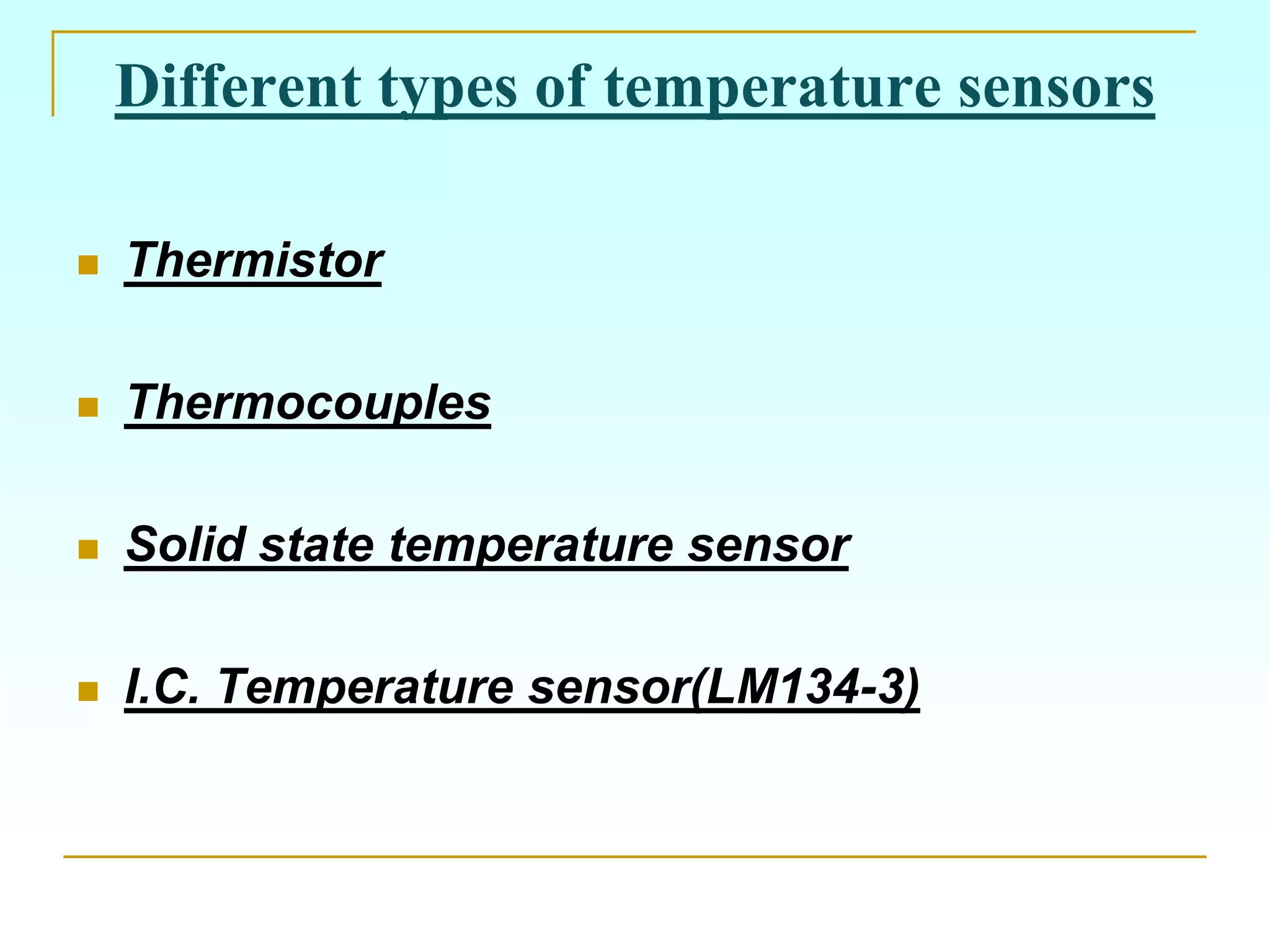
Different types of temperature sensors
 Thermistor
 Thermocouples
 Solid state temperature sensor
 I.C. Temperature sensor(LM134-3)
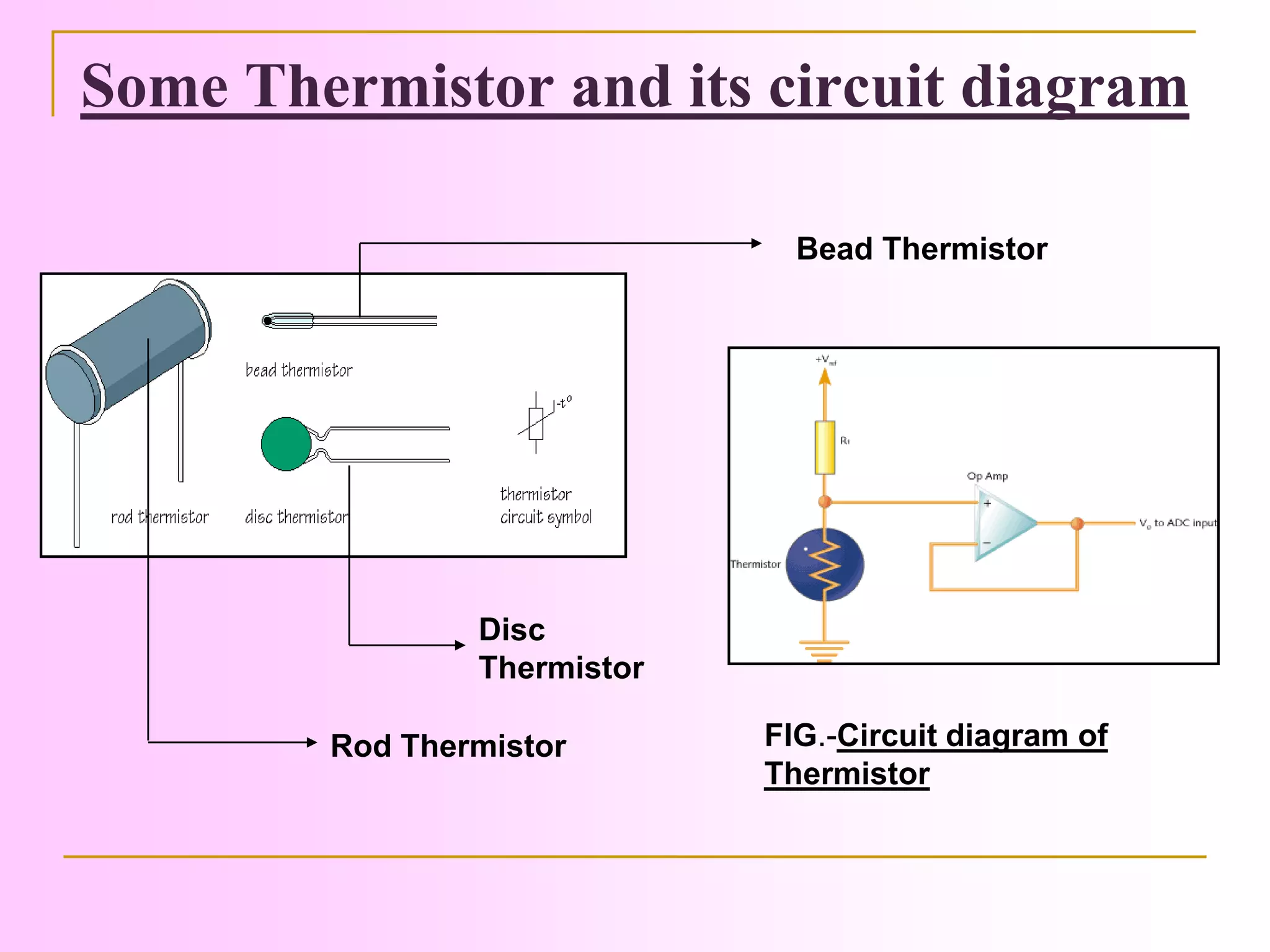
Some Thermistor and its circuit diagram
Rod Thermistor FIG.-Circuit diagram of
Thermistor
Bead Thermistor
Disc
Thermistor
Thermocouples
FIG.- K type Thermocouple
Fig.- A Typical Thermocouple
Circuit
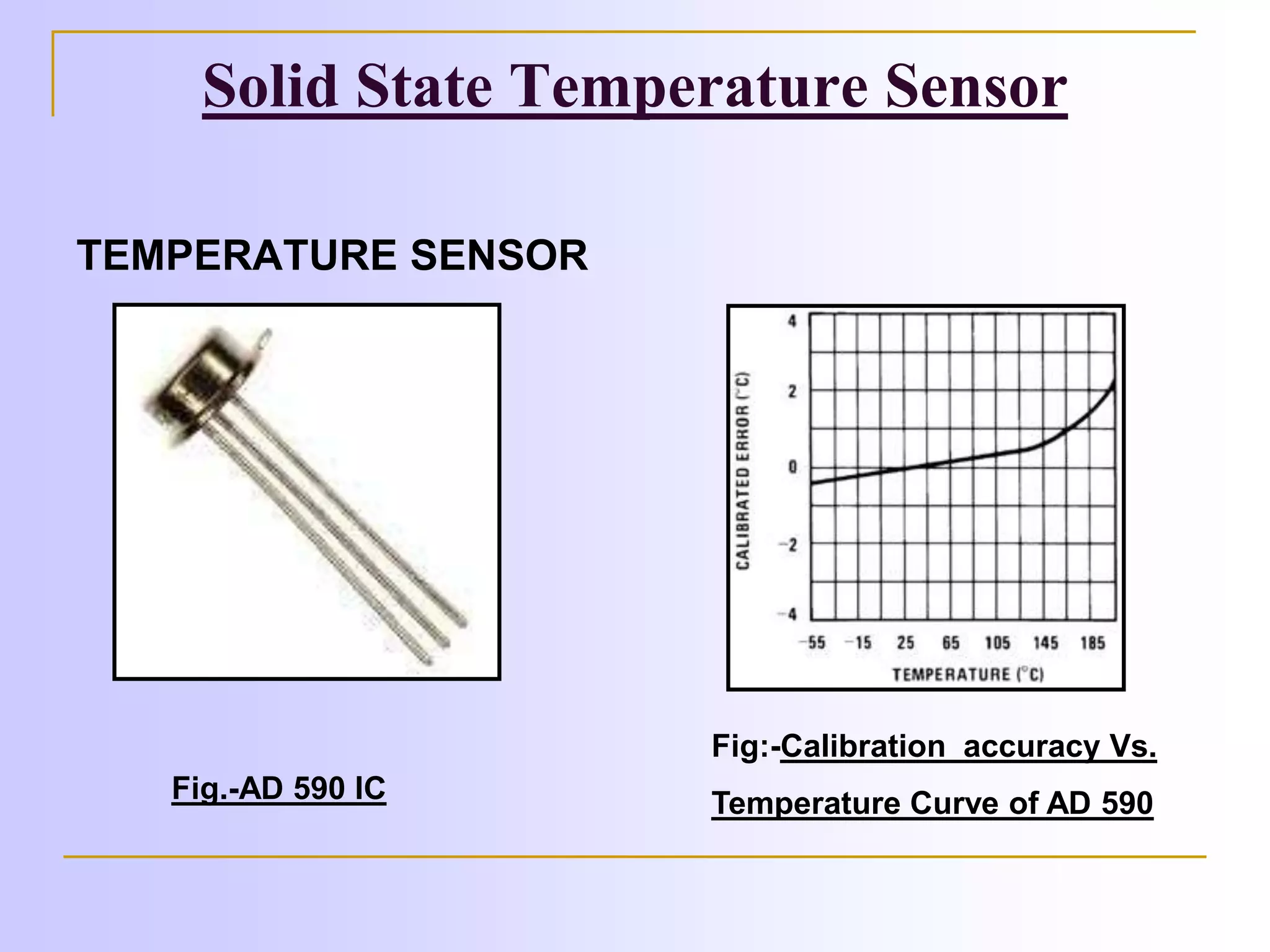
Solid State Temperature Sensor
TEMPERATURE SENSOR
Fig.-AD 590 IC
Fig:-Calibration accuracy Vs.
Temperature Curve of AD 590
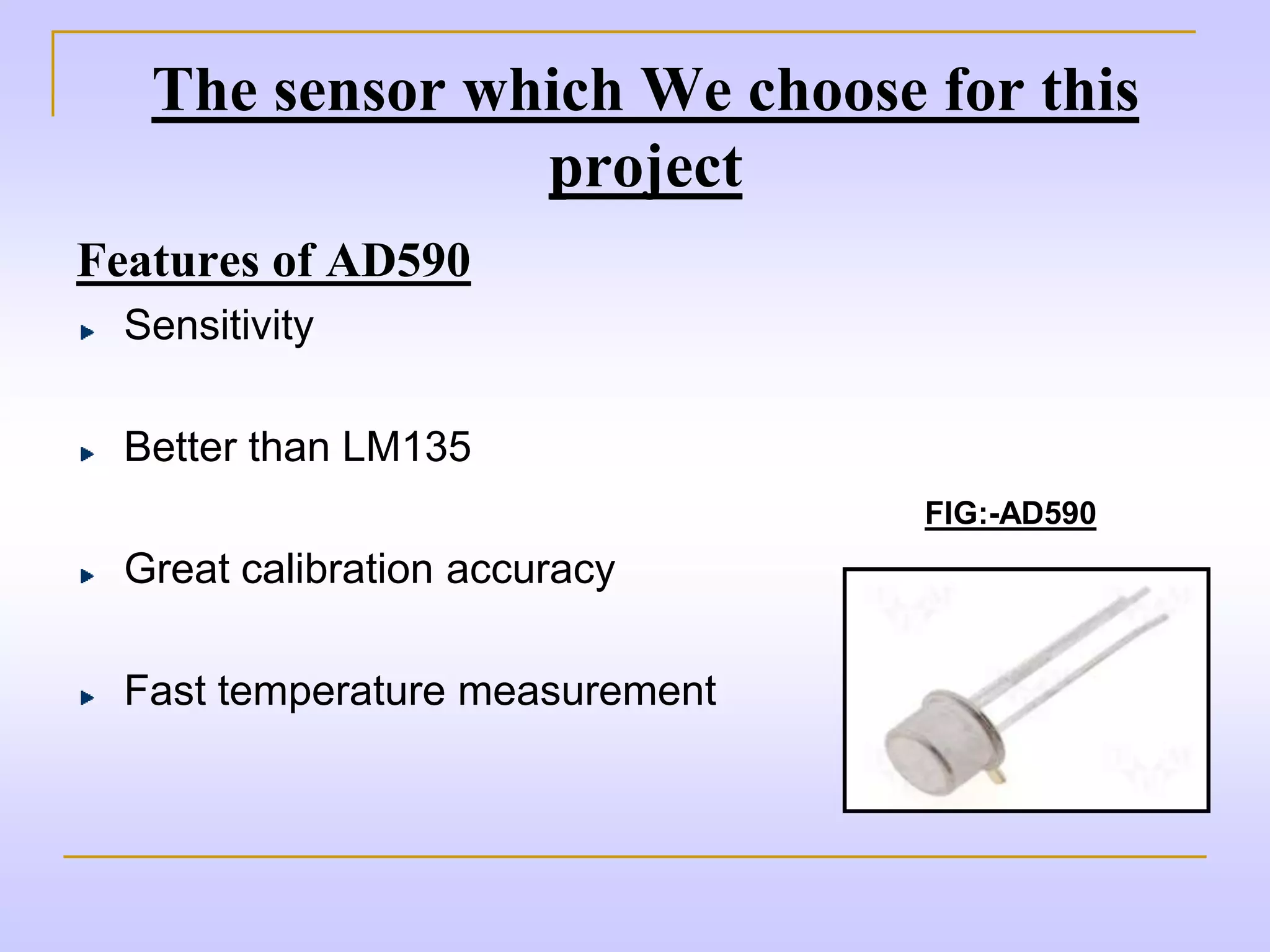
The sensor which We choose for this
project
Features of AD590
Sensitivity
Better than LM135
Great calibration accuracy
Fast temperature measurement
FIG:-AD590
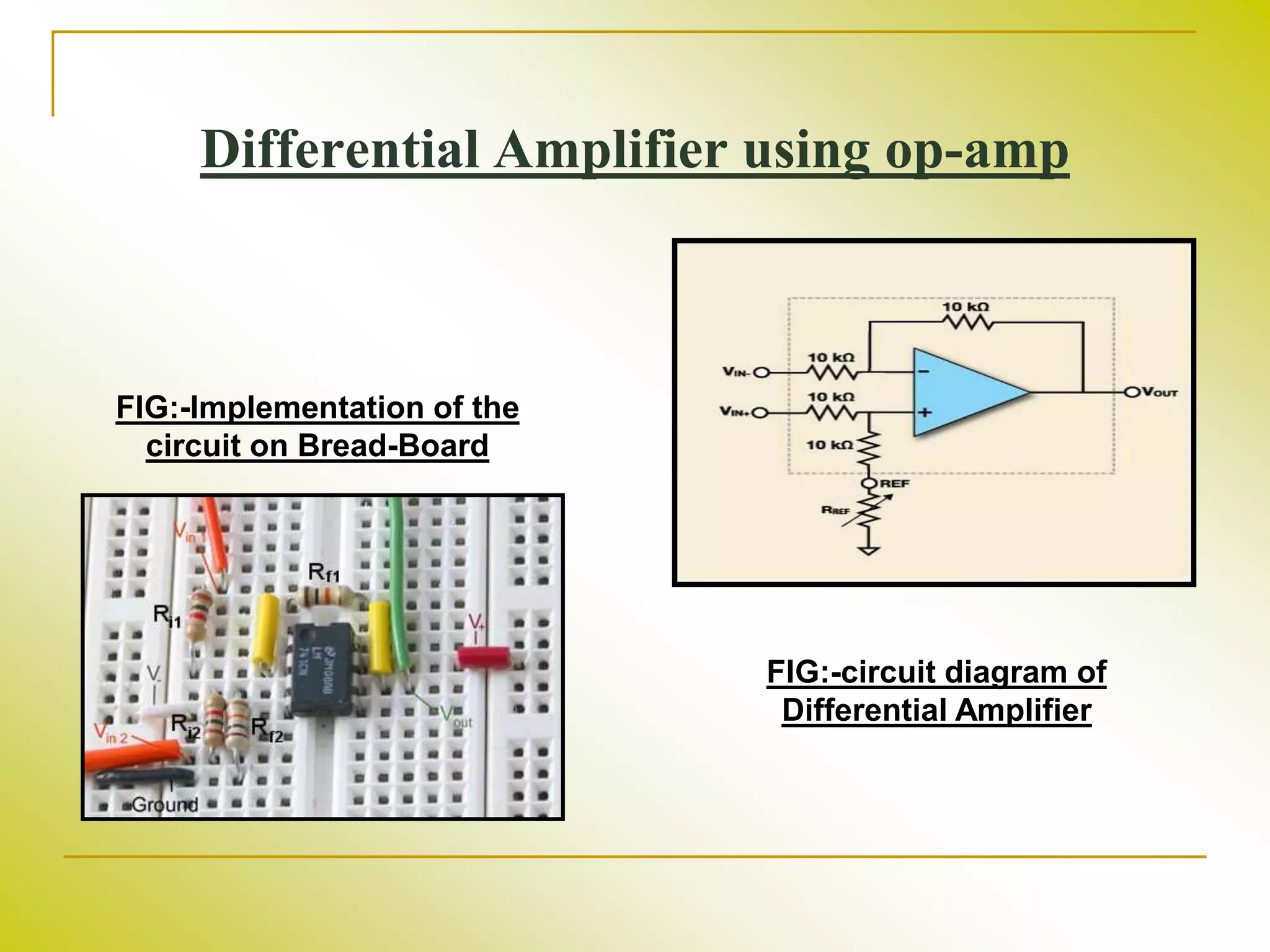
Differential Amplifier using op-amp
FIG:-Implementation of the
circuit on Bread-Board
FIG:-circuit diagram of
Differential Amplifier
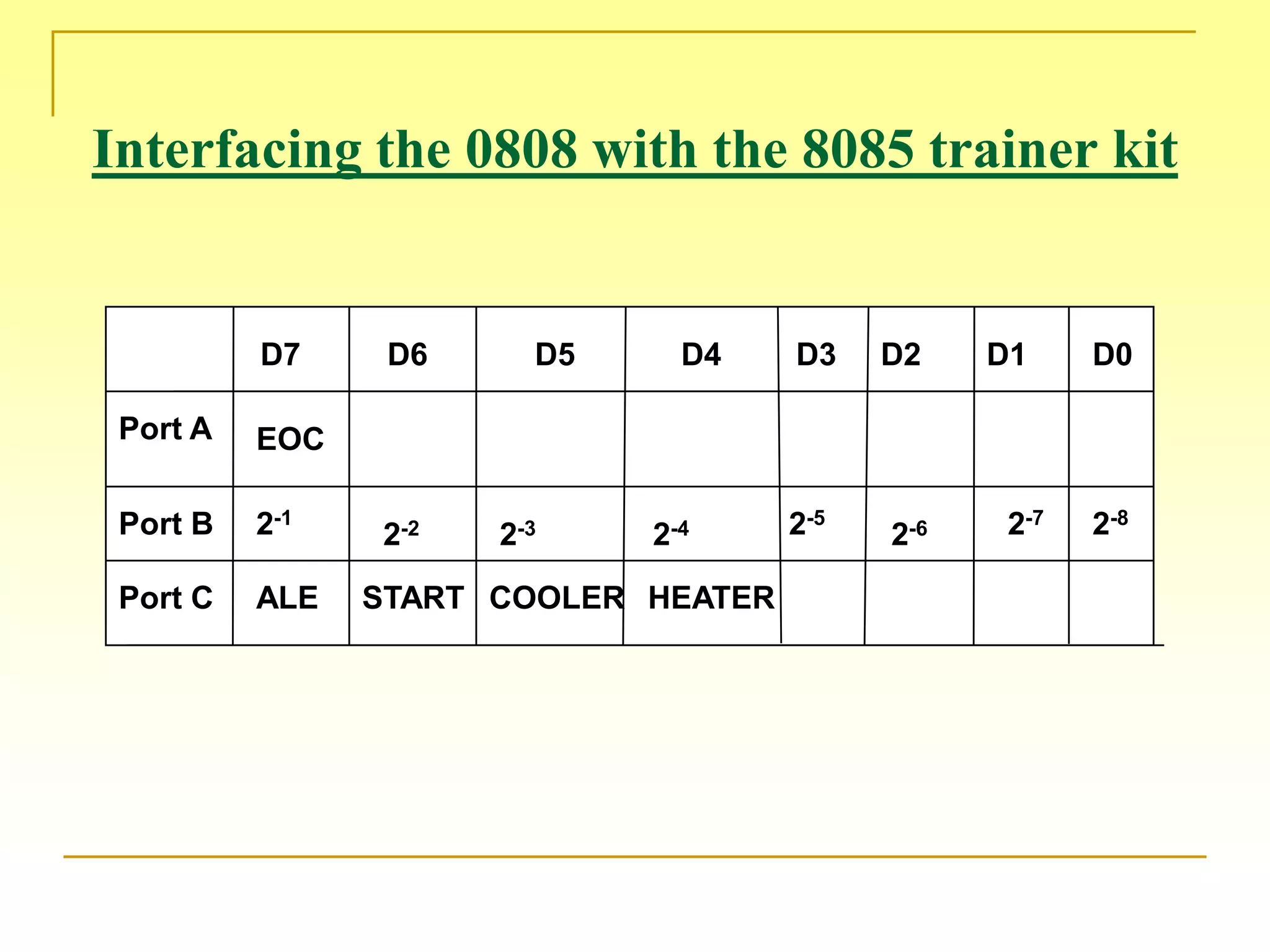
Interfacing the 0808 with the 8085 trainer kit
D7 D6 D5 D4 D3 D2 D1 D0
EOC
2-1
2-2 2-3 2-4 2-5
2-6 2-7 2-8
Port A
Port B
Port C ALE START COOLER HEATER
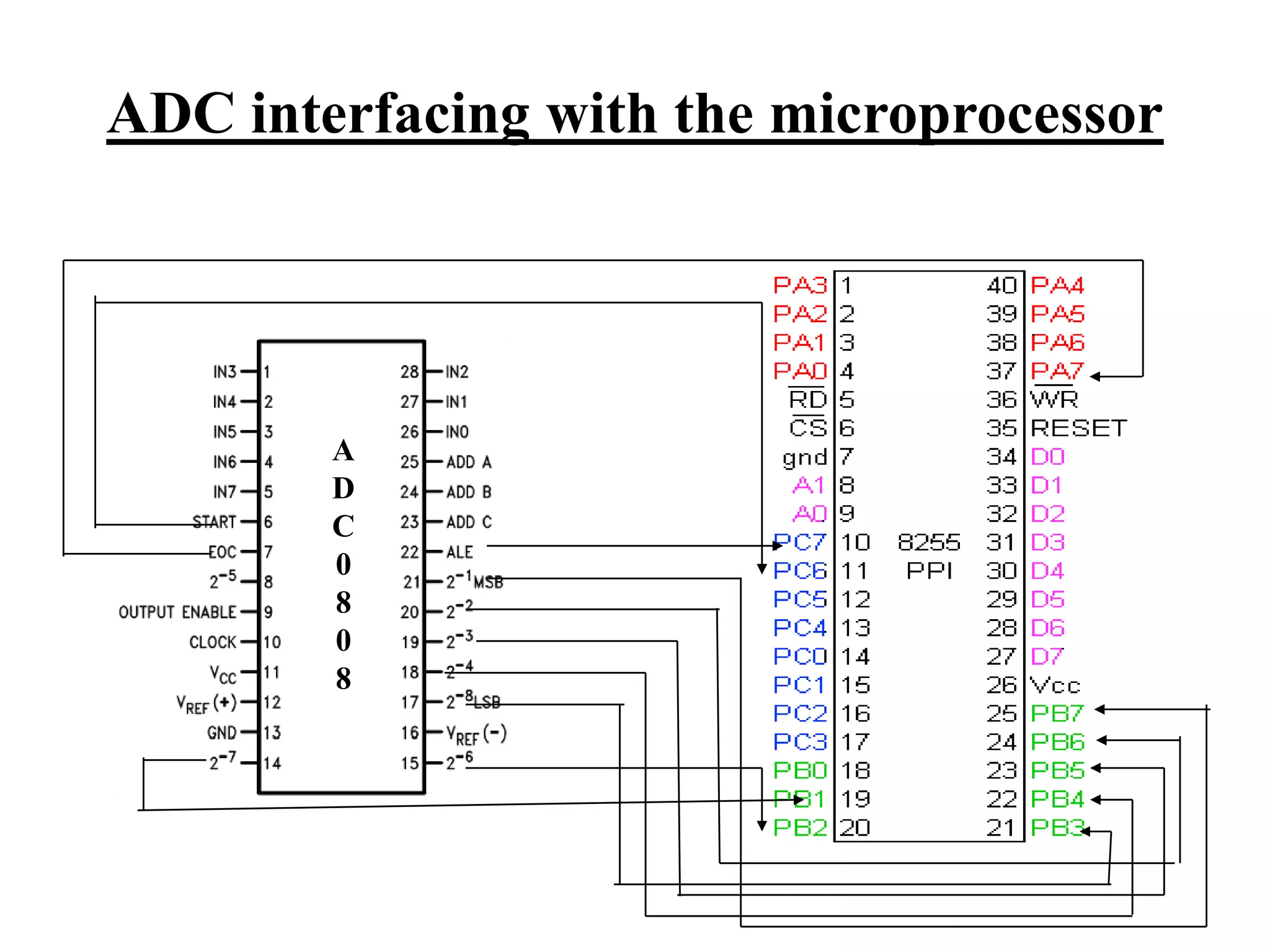
ADC interfacing with the microprocessor
A
D
C
0
8
0
8
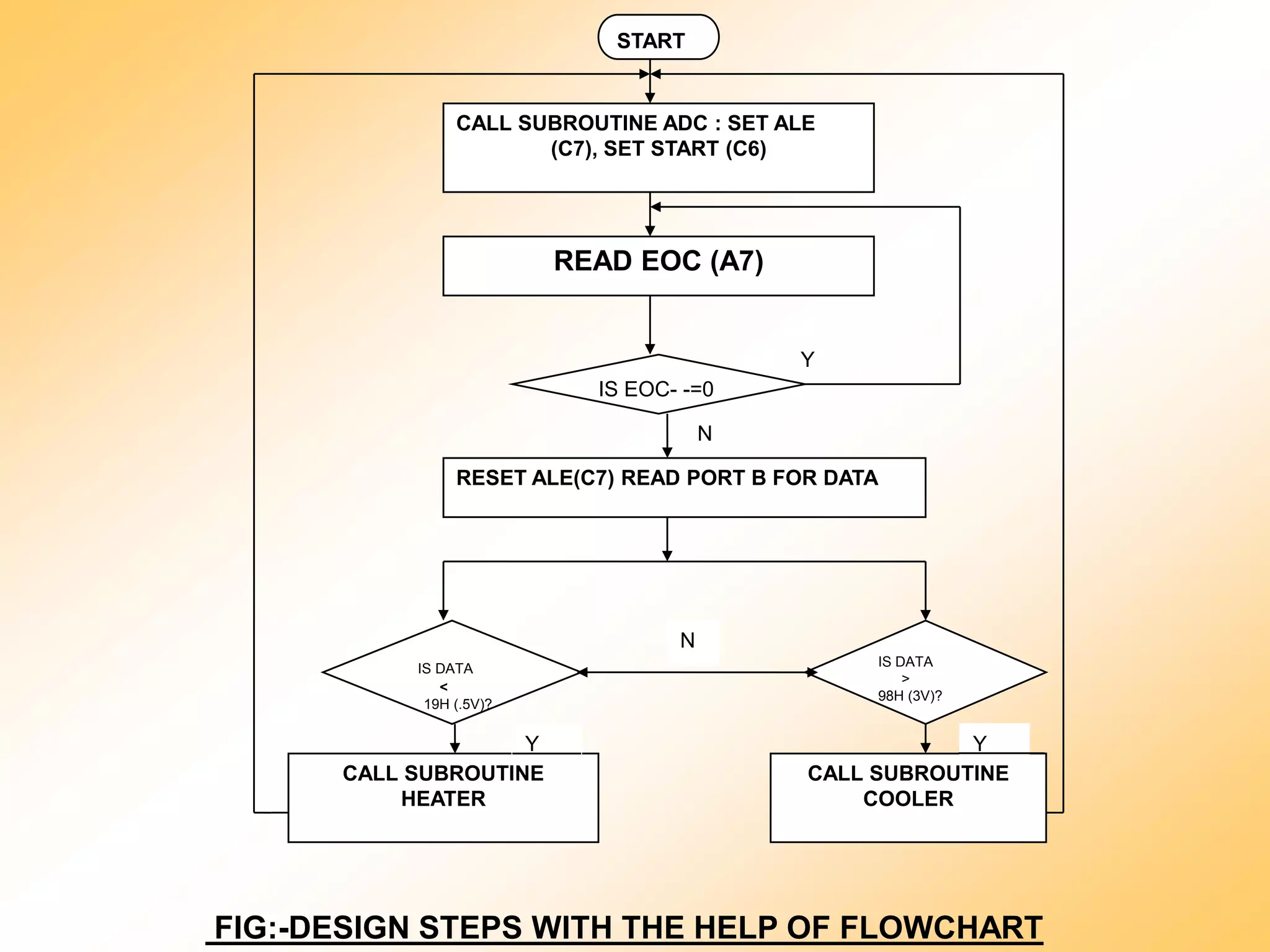
START
CALL SUBROUTINE ADC : SET ALE
(C7), SET START (C6)
READ EOC (A7)
IS EOC- -=0
Y
N
IS DATA
<
19H (.5V)?
,
33H(IV)?
IS DATA
>
98H (3V)?
RESET ALE(C7) READ PORT B FOR DATA
N
CALL SUBROUTINE
HEATER
CALL SUBROUTINE
COOLER
Y Y
FIG:-DESIGN STEPS WITH THE HELP OF FLOWCHART
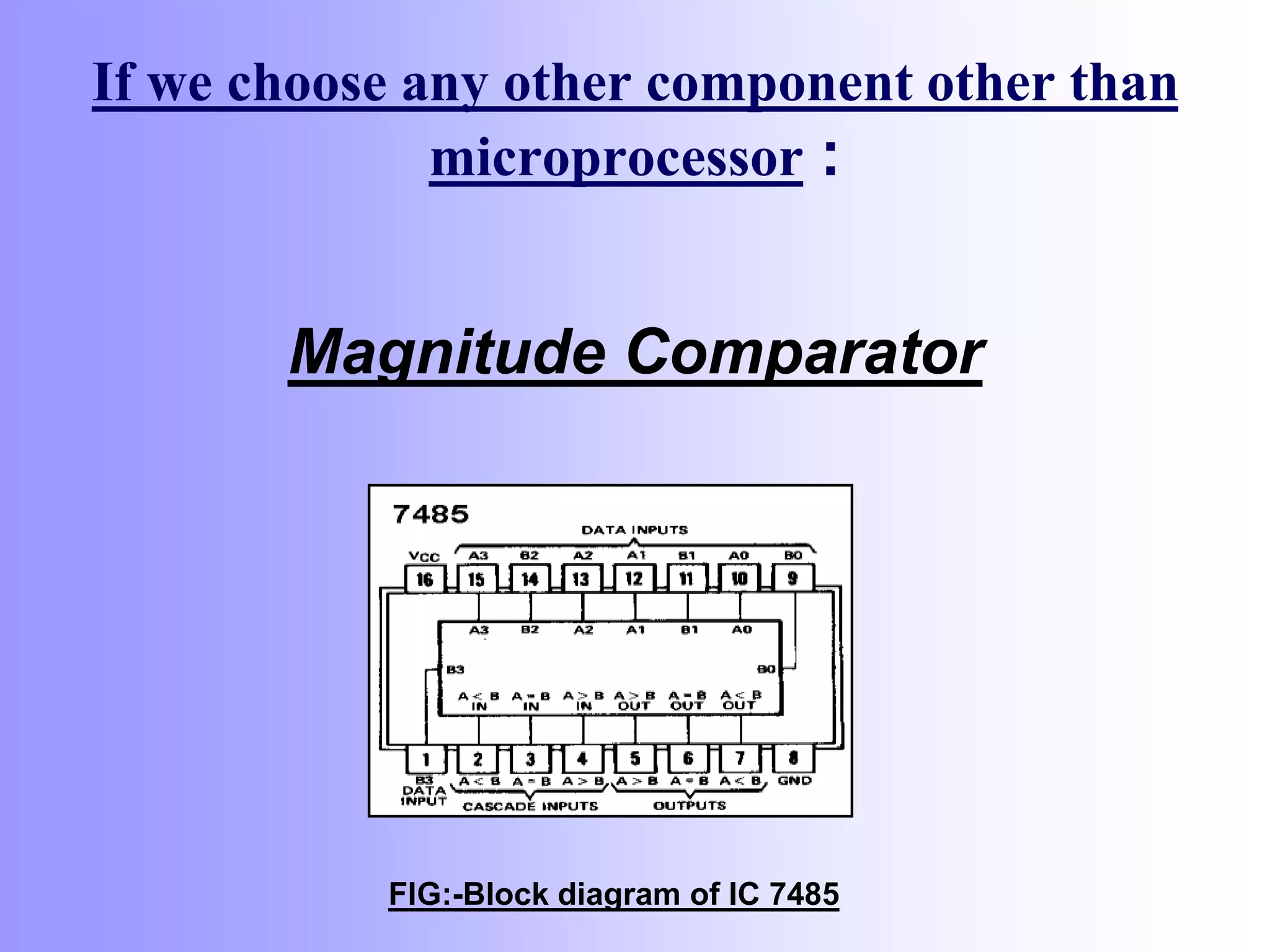
If we choose any other component other than
microprocessor :
Magnitude Comparator
FIG:-Block diagram of IC 7485
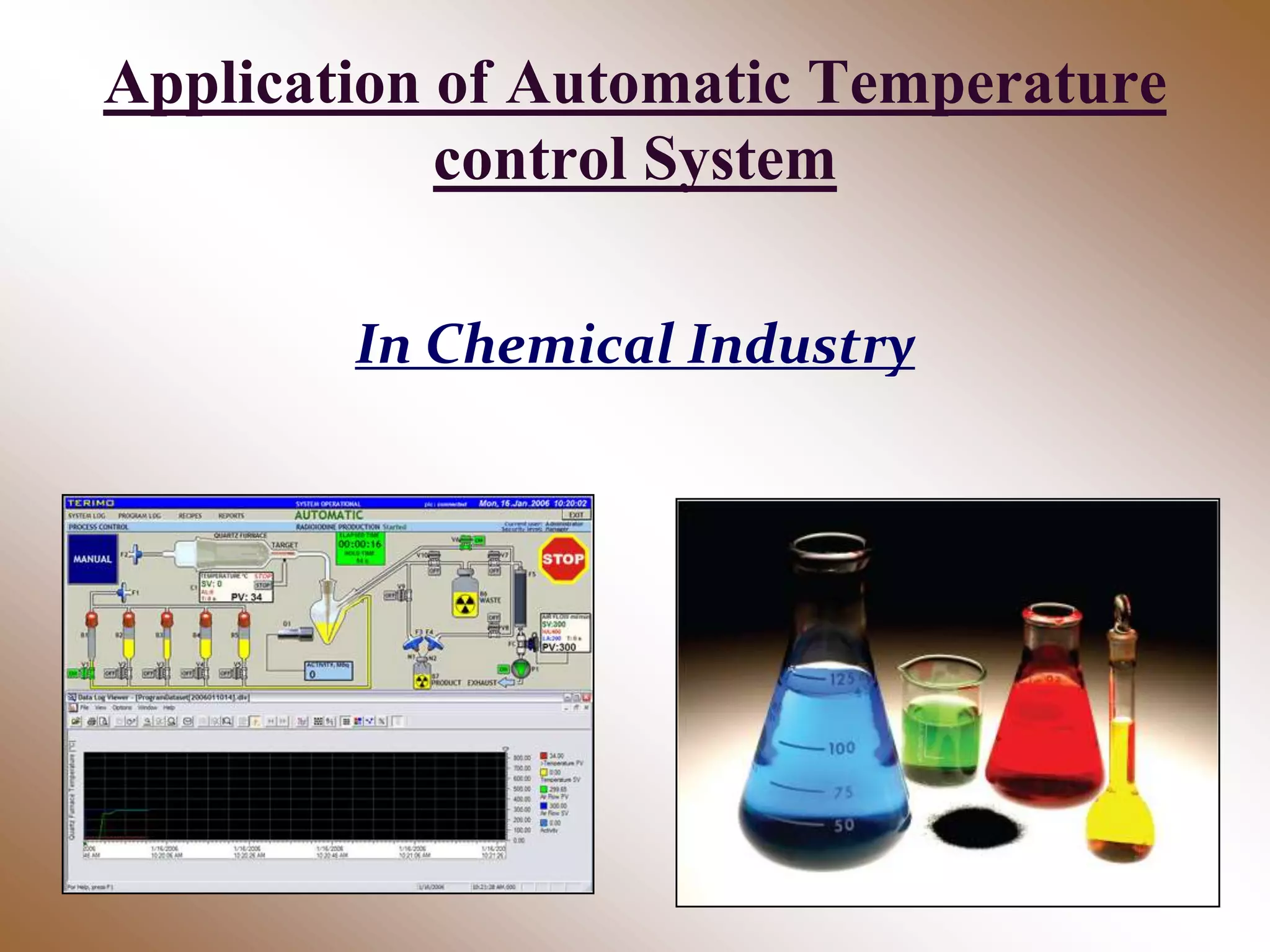
Application of Automatic Temperature
control System
In Chemical Industry
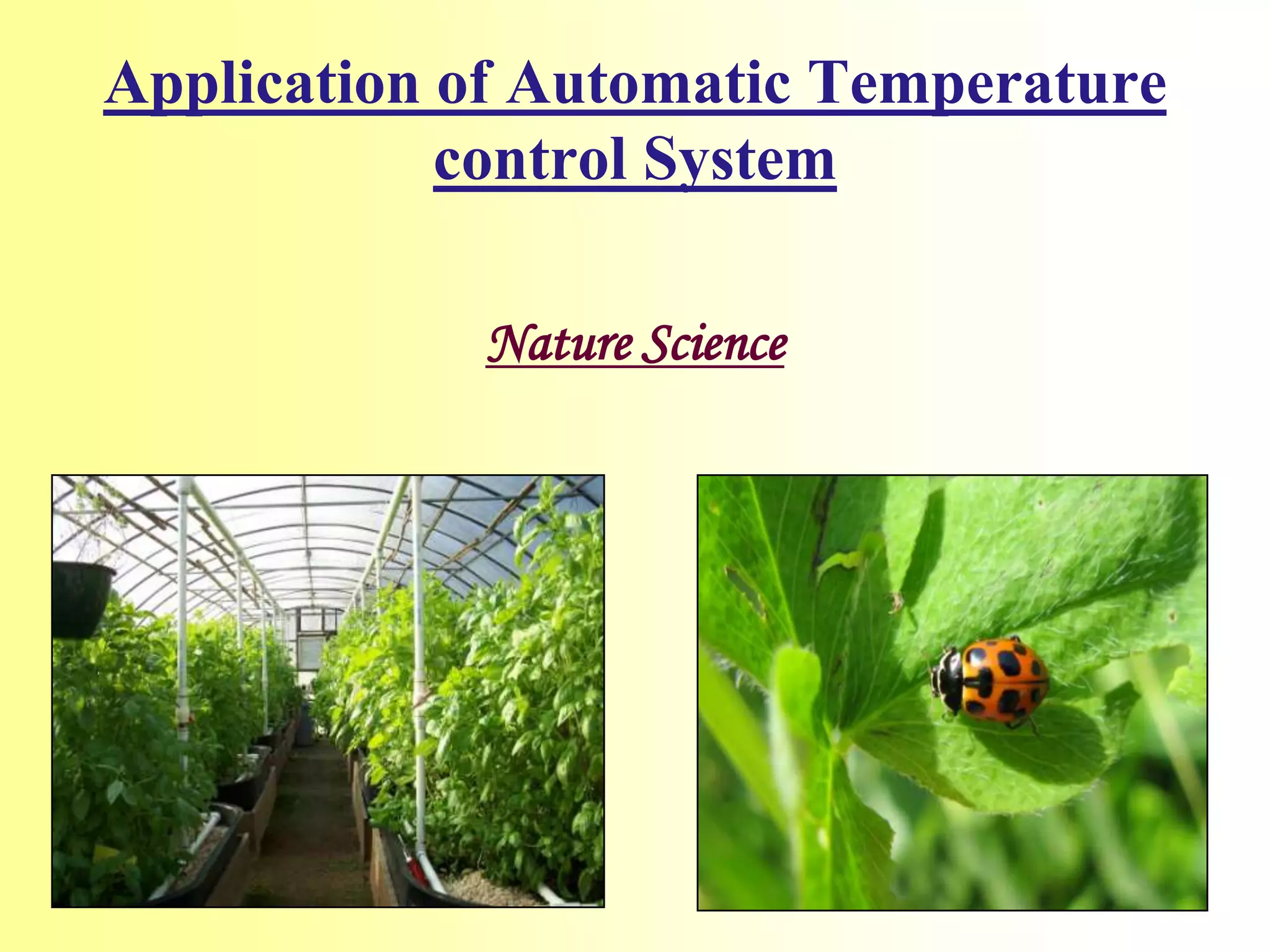
Application of Automatic Temperature
control System
Nature Science
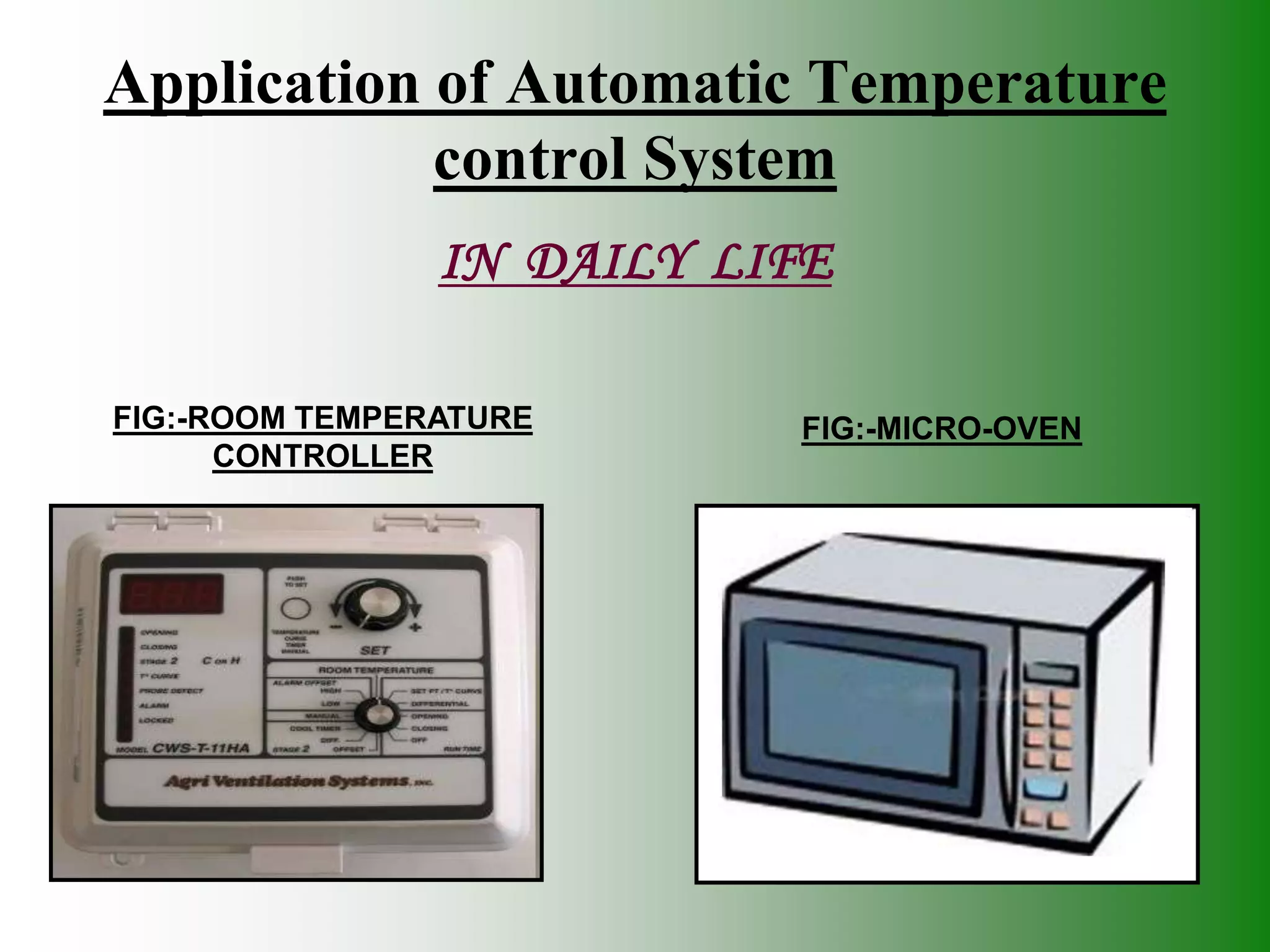
Application of Automatic Temperature
control System
IN DAILY LIFE
FIG:-MICRO-OVENFIG:-ROOM TEMPERATURE
CONTROLLER
Advantage of ATC system
ATC system using 8085 is very simple
circuit.
As 8085 microprocessor Memory used as
stack memory( when needed), we the
programmer can store already all
possible combination of data
corresponding to the temperature in the
memory stack.
It has minimum circuitry.
Limitation of the ATC System
The system is temperature bounded.
We just conceptually say that huge no. of
peripheral devices must be connected through
the two port, but at the time of implementation
of the project we are not able to connect all
possible devices with the microprocessor port.
The sensibility of the system is 0.20C,so any
change in temperature less than that can’t be
recognized by the system.
Future scope of the project
This is a very basic automation system of
temperature control.
Few changes may be needed in the control
circuit for controlling the system with the help of
Microcontroller.
It should also be able to control various
temperature.
If we use microcontroller rather than
microprocessor the cost will be minimum.
We can also use relay to control the heater and
cooler subroutine automatically.
References
 Microprocessor Architecture, Programming and
applications with 8085- By R.S. Gaonkar, Fifth Edition
(Penram international publishing).
 Microprocessor and digital systems-Douglas
V.Hall, (McGraw Hill Book co.)
 Introduction to microprocessor- A.P.Mathur,
(Tata McGraw Hill)
 MME 85S manual
 IC DATA handbook
 National semiconductors Datasheets
Links
• http://www.wisc-online.com/objects/ViewObject.aspx?ID=DIG3403
• http://www.scribd.com/doc/4616314/8085-Microprocessor
• http://www.electronic-circuits-
diagrams.com/computersimages/computersckt2.shtml
• http://www.analog.com/en/AD590/productsearch.html
• http://www.national.com/analog
• http://www.omega.com/prodinfo/thermistor.html
• http://en.wikipedia.org/wiki/Operational_amplifier_applications
Acknowledgement
We would like to acknowledge and extend our heartfelt
gratitude to the following persons who have made the
completion of this project possible:
• Mrs.Swagata Saha Sau ,Computer Sc. Department,
Sammilani Mahavidyalaya for her vital encouragement and
support.
• Mr. Arindam Saha, the faculty member of computer Sc
dept. and also our project guide, for his immense
assistance.
• All faculty members and Staff.
• Most especially to my family and friends
Questions
Automatic temperature control using 8085 microprocessor

Automatic temperature control using 8085 microprocessor

  • 1.
    PRESENTED BY SUBHRADEEP MITRA & DEBANJANMUKHERJEE ROLL NO.-3513-61-0008 & 3513-61-0021 REG. NO & SESSION-063209 & 063302OF 2008-2009 UNDER THE GUIDANCE OF Mr.ARINDAM SAHA DEPT.OF COMPUTER SCIENCE SAMMILANI MAHAVIDYALAYA
  • 2.
    Definition of TemperatureControl Temperature control is a process in which change of temperature of a space (and objects collectively there within) is measured or otherwise detected, and the passage of heat energy into or out of the space is adjusted to achieve a desired average temperature.
  • 3.
    Aim of theProject To control temperature To minimize manual intervention using an intelligent processor (such as 8085 microprocessor) It controls the temperature of any industrial plant.
  • 4.
    ATC using 8085Microprocessor An Automatic Temperature Control Unit mainly divided into three parts- Temperature input unit Processing unit Control output unit
  • 5.
    Overview of ATCunit  The 8085 based trainer kit forms the basic processing unit.  The Analog-to-Digital converter unit and temperature sensor forms the temperature input unit.  The switching ON/OFF of the heater / cooler controls the heat supplied to the plant
  • 6.
    Basic operation ofthe temperature control unit  Operationally, the system requires two set points  Upper set point  Lower set point  Whenever the temperature of the plant exceeds the upper limit or recede the lower limit heater/cooler is turned-off, so that a temperature is maintained within limits.
  • 7.
    The main hardwareconsists of automatic temperature control system 1) 8085 Microprcessr unit 2) ADC interface board 3) AD 590 temperature sensor 4) Amplifier (741 op-Amp)
  • 8.
    The 8085 trainerkit consists of 8085 MPU IC 8KB EPROM 8KB RAM Keyboard and display controller 8279 Programmable Peripheral interface 8255(PPI) 21 key hex-keypad Six numbers of seven segment LED’s
  • 9.
    The ADC interfaceboard consists of  ADC 0808, which is an 8-bit converter with eight channels of input.  Interfaced with the 8085 through 50-pin bus expansion connector.
  • 10.
    Basic block diagramArchitecture of ATC system Sensor Amplifier Micro- processor unit ADC converter Analog Signal Amplified Analog Signal Converted Digital Signal
  • 11.
    Entire Circuit Diagramof control unit Heater Sensor(AD590) Differential Amplifier Using (Op-amp) ADC Converter (0808 IC) 8085 Microprocessor unit Water
  • 12.
    Different types oftemperature sensors  Thermistor  Thermocouples  Solid state temperature sensor  I.C. Temperature sensor(LM134-3)
  • 13.
    Some Thermistor andits circuit diagram Rod Thermistor FIG.-Circuit diagram of Thermistor Bead Thermistor Disc Thermistor
  • 14.
    Thermocouples FIG.- K typeThermocouple Fig.- A Typical Thermocouple Circuit
  • 15.
    Solid State TemperatureSensor TEMPERATURE SENSOR Fig.-AD 590 IC Fig:-Calibration accuracy Vs. Temperature Curve of AD 590
  • 16.
    The sensor whichWe choose for this project Features of AD590 Sensitivity Better than LM135 Great calibration accuracy Fast temperature measurement FIG:-AD590
  • 17.
    Differential Amplifier usingop-amp FIG:-Implementation of the circuit on Bread-Board FIG:-circuit diagram of Differential Amplifier
  • 18.
    Interfacing the 0808with the 8085 trainer kit D7 D6 D5 D4 D3 D2 D1 D0 EOC 2-1 2-2 2-3 2-4 2-5 2-6 2-7 2-8 Port A Port B Port C ALE START COOLER HEATER
  • 19.
    ADC interfacing withthe microprocessor A D C 0 8 0 8
  • 20.
    START CALL SUBROUTINE ADC: SET ALE (C7), SET START (C6) READ EOC (A7) IS EOC- -=0 Y N IS DATA < 19H (.5V)? , 33H(IV)? IS DATA > 98H (3V)? RESET ALE(C7) READ PORT B FOR DATA N CALL SUBROUTINE HEATER CALL SUBROUTINE COOLER Y Y FIG:-DESIGN STEPS WITH THE HELP OF FLOWCHART
  • 21.
    If we chooseany other component other than microprocessor : Magnitude Comparator FIG:-Block diagram of IC 7485
  • 22.
    Application of AutomaticTemperature control System In Chemical Industry
  • 23.
    Application of AutomaticTemperature control System Nature Science
  • 24.
    Application of AutomaticTemperature control System IN DAILY LIFE FIG:-MICRO-OVENFIG:-ROOM TEMPERATURE CONTROLLER
  • 25.
    Advantage of ATCsystem ATC system using 8085 is very simple circuit. As 8085 microprocessor Memory used as stack memory( when needed), we the programmer can store already all possible combination of data corresponding to the temperature in the memory stack. It has minimum circuitry.
  • 26.
    Limitation of theATC System The system is temperature bounded. We just conceptually say that huge no. of peripheral devices must be connected through the two port, but at the time of implementation of the project we are not able to connect all possible devices with the microprocessor port. The sensibility of the system is 0.20C,so any change in temperature less than that can’t be recognized by the system.
  • 27.
    Future scope ofthe project This is a very basic automation system of temperature control. Few changes may be needed in the control circuit for controlling the system with the help of Microcontroller. It should also be able to control various temperature. If we use microcontroller rather than microprocessor the cost will be minimum. We can also use relay to control the heater and cooler subroutine automatically.
  • 28.
    References  Microprocessor Architecture,Programming and applications with 8085- By R.S. Gaonkar, Fifth Edition (Penram international publishing).  Microprocessor and digital systems-Douglas V.Hall, (McGraw Hill Book co.)  Introduction to microprocessor- A.P.Mathur, (Tata McGraw Hill)  MME 85S manual  IC DATA handbook  National semiconductors Datasheets
  • 29.
    Links • http://www.wisc-online.com/objects/ViewObject.aspx?ID=DIG3403 • http://www.scribd.com/doc/4616314/8085-Microprocessor •http://www.electronic-circuits- diagrams.com/computersimages/computersckt2.shtml • http://www.analog.com/en/AD590/productsearch.html • http://www.national.com/analog • http://www.omega.com/prodinfo/thermistor.html • http://en.wikipedia.org/wiki/Operational_amplifier_applications
  • 30.
    Acknowledgement We would liketo acknowledge and extend our heartfelt gratitude to the following persons who have made the completion of this project possible: • Mrs.Swagata Saha Sau ,Computer Sc. Department, Sammilani Mahavidyalaya for her vital encouragement and support. • Mr. Arindam Saha, the faculty member of computer Sc dept. and also our project guide, for his immense assistance. • All faculty members and Staff. • Most especially to my family and friends
  • 31.