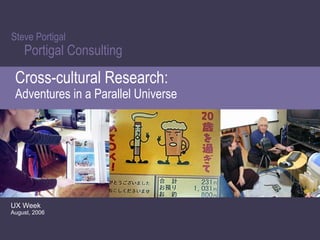
UX Week Presentation from Steve Portigal - Cross-Cultural Research

Loading...

Flash Player 9 (or above) is needed to view presentations.
We have detected that you do not have it on your computer. To install it, go here.

4 comments

Comments 1 - 4 of 4 previous next Post a comment

  • + steveportigal Steve Portigal 5 months ago
    Audio is at http://itc.conversationsnetwork.org/shows/detail1559.html
  • + tosime Tony Osime 4 years ago
    Great Presentation Steve - a lot of fun to view

    Please comment on my presentation (checklists)

    I will make a few separate comments on a few slides:


    Slide 1:

    Good use of 3 pictures in center panel.

    Good use of tone variations and parallel contrasting text

    Pictures 1 & 3 have too much distracting background, they need to be simplified.

    The center picture needs straightening.


    For other slides - there was too much text for my taste.

  • + jacob Jacob Bøtter 4 years ago
    This a great presentation Steve!
  • + jboutelle Jonathan Boutelle 4 years ago
    This is a beautiful, amazing presentation! It made me want to go travel. Or, failing that, do some user research.
Post a comment
Embed Video
Edit your comment Cancel

Notes on slide 1

Timing 60 minutes intro and interviewing 40 minutes for exercise 10 minutes for debrief 50 minutes for cultural context and case studies

31 Favorites & 2 Groups

UX Week Presentation from Steve Portigal - Cross-Cultural Research - Presentation Transcript

  1. Cross-cultural Research: Adventures in a Parallel Universe UX Week August, 2006 Steve Portigal Portigal Consulting
  2. Portigal Consulting
    • Synthesis of
      • user research
      • design
      • business strategy
    • Discover new insights about customers
      • Consumers, B2B
      • US, and global
    • Recommendations for actions in response to new insights
    • Ethnography
    • Ethnographic interviews
    • Video ethnography
    • Depth-interviews
    • Contextual research
    • Home visits
    • Experience modeling
    • Design research
    • User-centered design
    • Observational research
    • Camera studies
    • User safaris
    “User Research?”
    • Ethnography
    • Ethnographic interviews
    • Video ethnography
    • Depth-interviews
    • Contextual research
    • Home visits
    • Experience modeling
    • Design research
    • User-centered design
    • One-on-ones
    • Camera studies
    • User safaris
    “User Research?” What-ever!
    • Examine users (consumers or other) in their own context
      • What are they doing (“usage”)
      • What does it mean
    • Infer (interpret/synthesize/etc.)
      • Find the connections
      • The researcher is the “apparatus”
    • Apply to business or design problems
      • Use products, services, packaging, design to tell the right story
    User Research
  3. Three Depths of the Process Observing customers Interviewing customers Observing cultural context
    • How are people doing <something>?
    • Look for and document processes
      • What are the sequence of events and duration of a shopping trip?
      • How does a Whopper get made? Who does what, and in what order?
    • Identify what you want to know more about
      • Why ?
    Observing People
    • Who to interview?
      • People that are involved in your activity
      • People that are no longer involved in your activity
      • People that refuse to be involved in your activity
      • People that are over-the-top-involved in your activity
    • Balance of agenda and open-ended
      • Conversational (but they talk 80%)
      • Ask follow-up questions
      • Adopt their language and terminology
      • Manage flow - Let them tell the story they want to tell you – often an “irrelevant” topic will be strongly tied to the main topic in their mind
    Interviewing People
  4. Humans Beings are Judging Beings
  5. Cultural Context
    • What is normal?
      • Look at artifacts in the culture
        • Media
        • Products
        • Advertisements
        • Street culture
        • Trends and fads
    • Normal isn’t “right or wrong” – it’s the set of background rules that define much of what people choose or ignore
  6. What is Normal?
  7.  
  8.  
  9. What Happens When We Leave Our Culture? Tips. Tricks.
  10. Crossing Cultures
    • The backdrop (the stuff we normally ignore) is unfamiliar
      • Everything seems perturbed from the norm
    • We are trying to understand a cultural model – the connections between people, artifacts, and other factors
    • The artifacts are different
      • Check our assumptions
    • A visceral experience – constant synthesis
    • This will be more impactful than outsourcing the research to a “local” firm
    • See www.janchipchase.com for a steady stream of artifacts and questions from “other” cultures
    • CultureVenture provides immersive and inspirational experiences in foreign cultures to help you discover and make sense of the notable differences in your other markets.
    • We provide experiences , insight , observations , and analysis . We’re not tour guides, and we’re not experts in how the rest of the world works.
    • http://www.culture venture .net
    And now a brief commercial interruption
    • CultureVenture provides immersive and inspirational experiences in foreign cultures to help you discover and make sense of the notable differences in your other markets.
    • We provide experiences , insight , observations , and analysis . We’re not tour guides, and we’re not experts in how the rest of the world works.
    • http://www.culture venture .net
  11. Finding Participants
    • Partner with a firm in the destination country
      • They may also provide interpreters
    • Partner a local firm with connections or offices in the destination country
    • Use social networks
    • Make sure to do some basic grounding research to localize your screening criteria
      • i.e., do they have broadband widely adopted? Do people live with their parents until they are older? Do the same brands drive the market that do here?
  12. Logistics and Location
    • Allow a day in your schedule to get acclimated…
    • … and a day for “cultural loading”
    • Take advantage of your location
      • Take pictures, collect literature and other examples
        • Figure out what you’ll use it for later
      • Do as much synthesis, note-writing, report preparation as you can before you come back
    • Read a local newspaper
      • What do you notice that is different?
      • Top stories are sure to be repeated elsewhere during your visit
  13. Interviewing in Another Country
    • Foreigners, even Americans, who are genuinely interested in the country they are studying are often welcomed as visitors
    • Respondents will take on the burden of helping you understand their country – as hosts, it is their duty
      • They may be willing to “meet you halfway” in making the connection
    • You are naive, so asking dumb questions is expected
    • You can’t be “down” in a foreign country – your clothes, gait, odor, hair style, accent will typically give you away sooner or later
  14. Interpretation
    • Don’t call it translation
    • Get referrals and hang onto folks you like
    • Find those familiar with “market research”
    • Thick accents may be difficult to transcribe or follow on video
    • Brief your interpreters
      • Review the interview guide
      • Describe the process of the interview and their role
      • Communicate the project goals
    • Use them to help you avoid violating cultural rules (do or don’t accept offered drinks in the home, etc.)
      • They legitimize you when you enter a respondent’s home
      • Respondent may look to the interpreter to take a leadership role
  15. Interpretation
    • Interpretation creates a very entertaining “language soup” between interviewer(s), respondent(s), and interpreter
      • You ask a question
        • where is the eye contact, who is nodding in “understanding?”
      • Interpretation
      • Respondent answers the question
        • where is eye contact, are you nodding to words you don’t understand?
      • Interpretation
        • Simultaneous, or small to large “chunks”
        • Where is everyone’s eye contact?
        • This takes practice (for you and the respondent)
      • Follow-up question
        • where is the eye contact, who is nodding in “understanding?”
    • No tactical advice here – find what works best for all concerned – it’s a collaboration between all parties
      • This “work” to communicate is a proxy for the ethnographic process itself
    • Enjoy it
  16. Cultural Context
  17.  
  18.  
  19.  
  20.  
  21.  
  22.  
  23.  
  24. So What?
    • Each of these “mundane” observations reveal a crucial cultural need or driver or difference
      • Space
      • Customer service
      • Kawaii
      • Flavors
      • Navigation
      • Public Space
      • Advertising
      • Branding and Advertising
      • Social Gestures
    • Interesting tension between
      • People are all the same no matter where you go
      • People are completely different
    • Consider the insider/outsider model for any research in another community
      • You may not appear or act like a foreigner, but perhaps you can think like one
    • Looking outside ourselves is a provocative way to learn about ourselves
      • Sometimes the further away you look, the more you see
    Conclusion
  25. Contact Information Steve Portigal Portigal Consulting PO Box 370252 1133 Cedar St. Montara, CA 94037-0252 (650) 563-9839 [email_address] http://www.portigal.com

+ Steve PortigalSteve Portigal, 4 years ago

custom

7718 views, 31 favs, 3 embeds more stats

Effective user research requires both observation a more

More info about this document

© All Rights Reserved

Go to text version

  • Total Views 7718
    • 7702 on SlideShare
    • 16 from embeds
  • Comments 4
  • Favorites 31
  • Downloads 0
Most viewed embeds
  • 11 views on http://www.portigal.com
  • 4 views on http://manthanppt.blogspot.com
  • 1 views on http://monoukee.com

more

All embeds
  • 11 views on http://www.portigal.com
  • 4 views on http://manthanppt.blogspot.com
  • 1 views on http://monoukee.com

less

Flagged as inappropriate Flag as inappropriate
Flag as inappropriate

Select your reason for flagging this presentation as inappropriate. If needed, use the feedback form to let us know more details.

Cancel
File a copyright complaint
Having problems? Go to our helpdesk?

Categories

Groups / Events