Direct objects answer the questions "who?" or "what?" and can be replaced by direct object pronouns like "it", "him", "her", or "them". Indirect objects answer the questions "to/for whom?" and can be replaced by indirect object pronouns like "me", "you", or "them". In Spanish, direct object pronouns come before the conjugated verb while indirect object pronouns come first if both are used in the same sentence. The document provides examples of direct and indirect object pronouns in Spanish.
In this document
Powered by AI
Overview of the presentation focusing on Direct and Indirect Objects in Spanish.
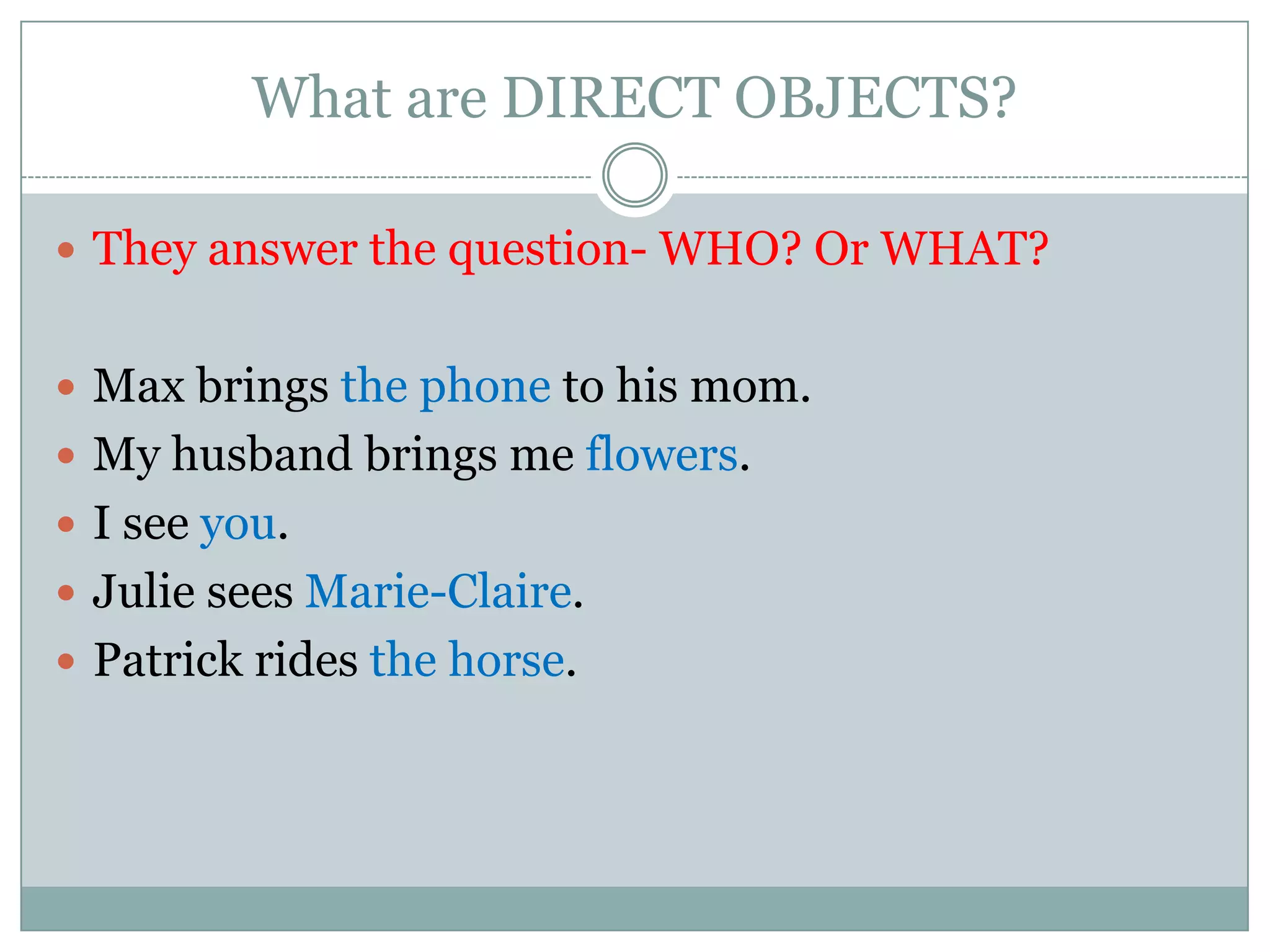
Direct objects answer WHO? or WHAT?, illustrated with examples such as Max brings the phone.
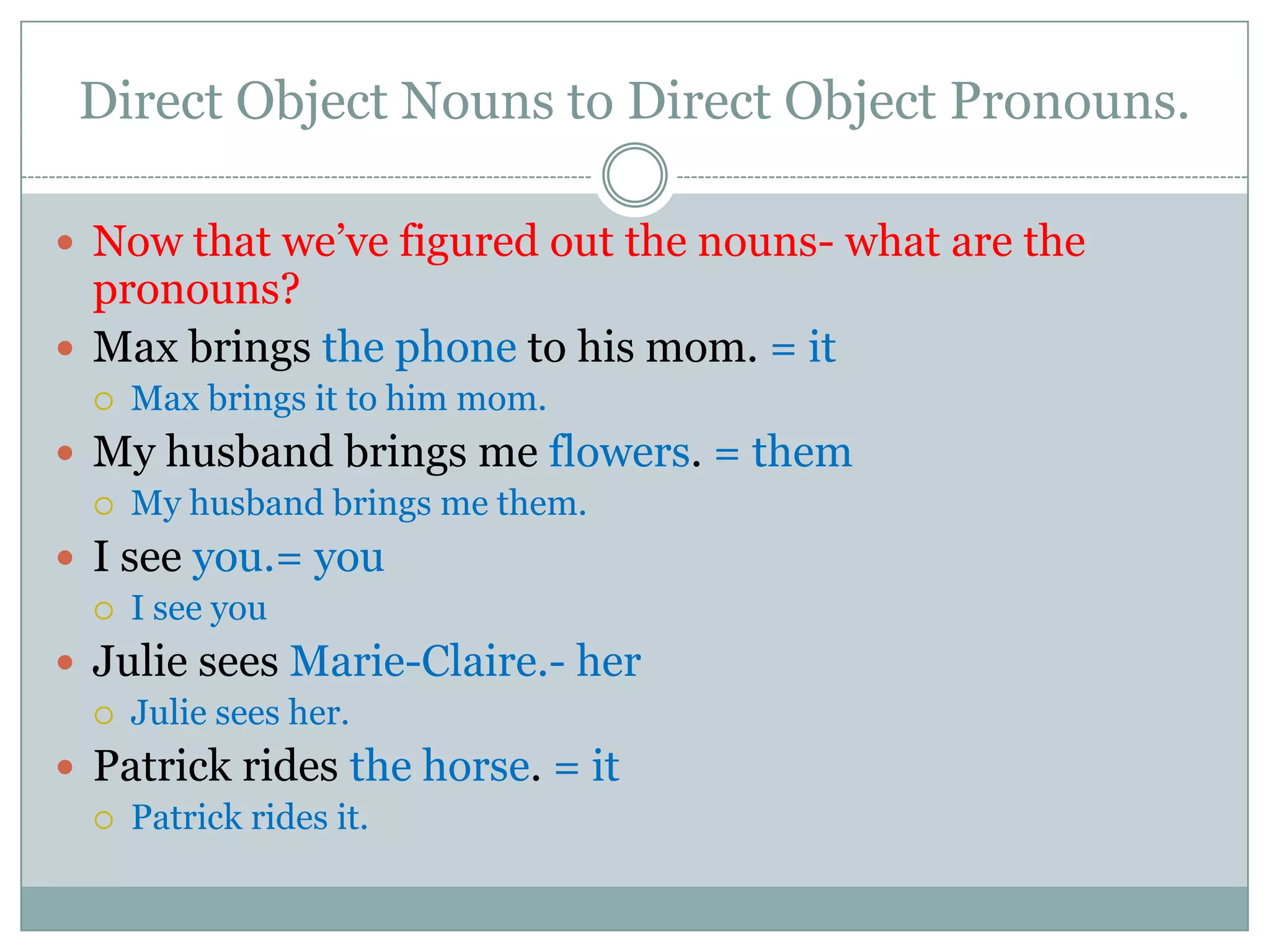
Transitioning from direct object nouns to pronouns in Spanish, like changing 'phone' to 'it'.
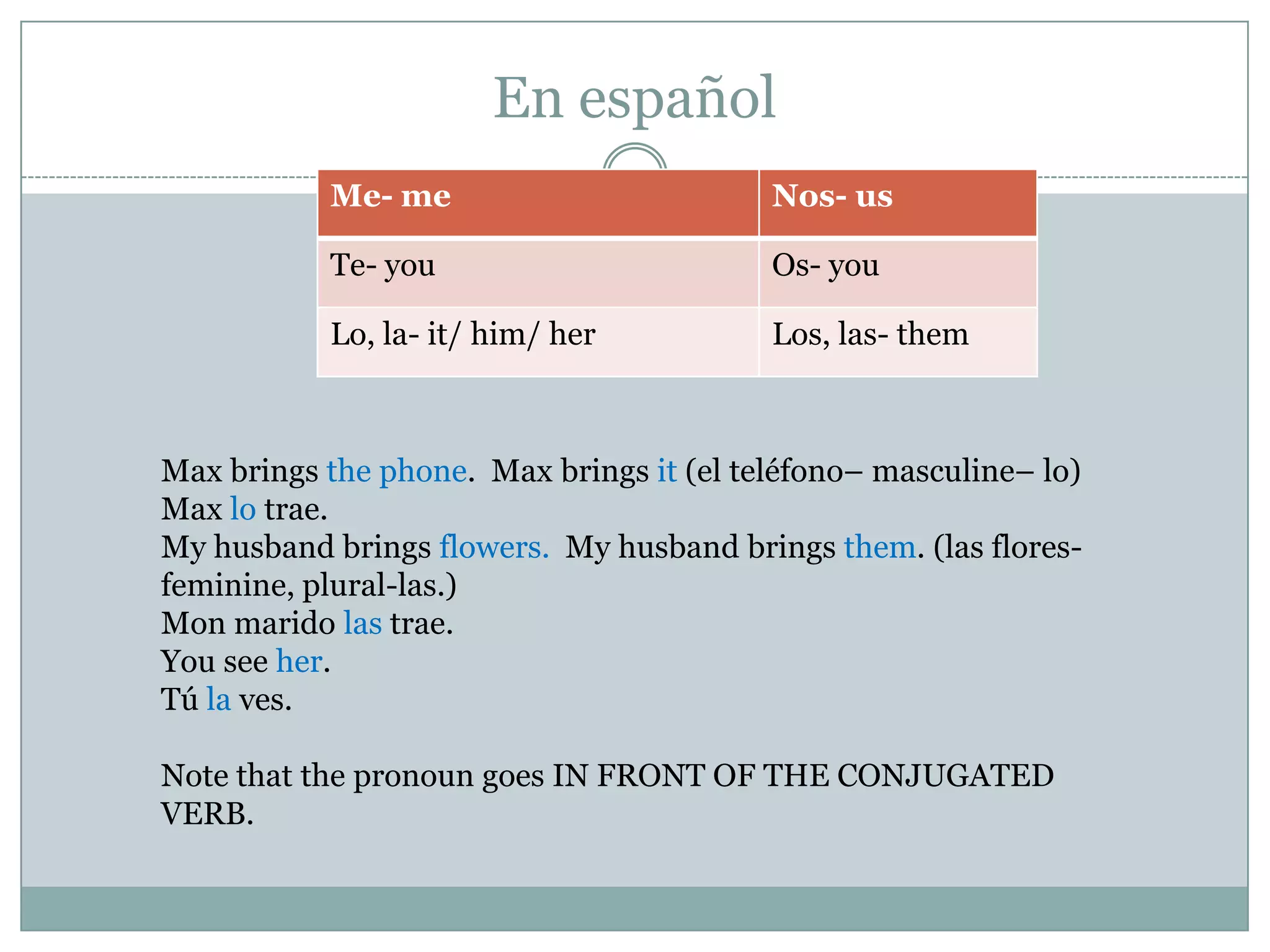
Spanish direct object pronouns explained with examples, emphasizing their placement before the verb.
Indirect objects clarify to/for whom an action is performed, with examples like flower gifting.
Spanish indirect object pronouns and their placement, illustrated with flower and gift examples.
Usage rules for combining both pronouns in sentences, emphasizing that indirect pronouns come first.
Classification of pronouns with examples in Spanish, including subject, reflexive, and object pronouns.
What are DIRECTOBJECTS?
They answer the question- WHO? Or WHAT?
Max brings the phone to his mom.
My husband brings me flowers.
I see you.
Julie sees Marie-Claire.
Patrick rides the horse.
3.
Direct Object Nounsto Direct Object Pronouns.
Now that we’ve figured out the nouns- what are the
pronouns?
Max brings the phone to his mom. = it
Max brings it to him mom.
My husband brings me flowers. = them
My husband brings me them.
I see you.= you
I see you
Julie sees Marie-Claire.- her
Julie sees her.
Patrick rides the horse. = it
Patrick rides it.
4.
En español
Me- me Nos- us
Te- you Os- you
Lo, la- it/ him/ her Los, las- them
Max brings the phone. Max brings it (el teléfono– masculine– lo)
Max lo trae.
My husband brings flowers. My husband brings them. (las flores-
feminine, plural-las.)
Mon marido las trae.
You see her.
Tú la ves.
Note that the pronoun goes IN FRONT OF THE CONJUGATED
VERB.
5.
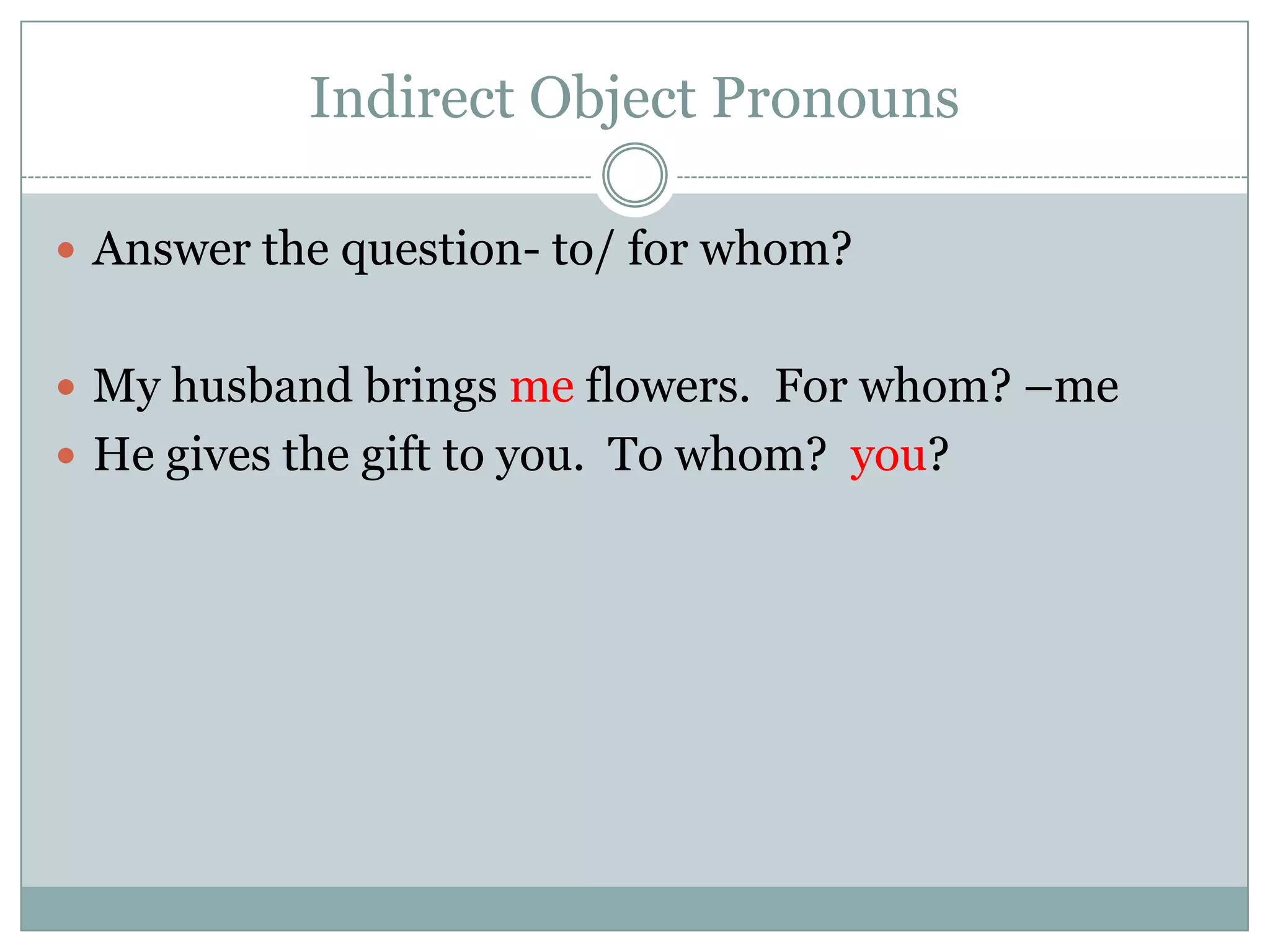
Indirect Object Pronouns
Answer the question- to/ for whom?
My husband brings me flowers. For whom? –me
He gives the gift to you. To whom? you?
6.
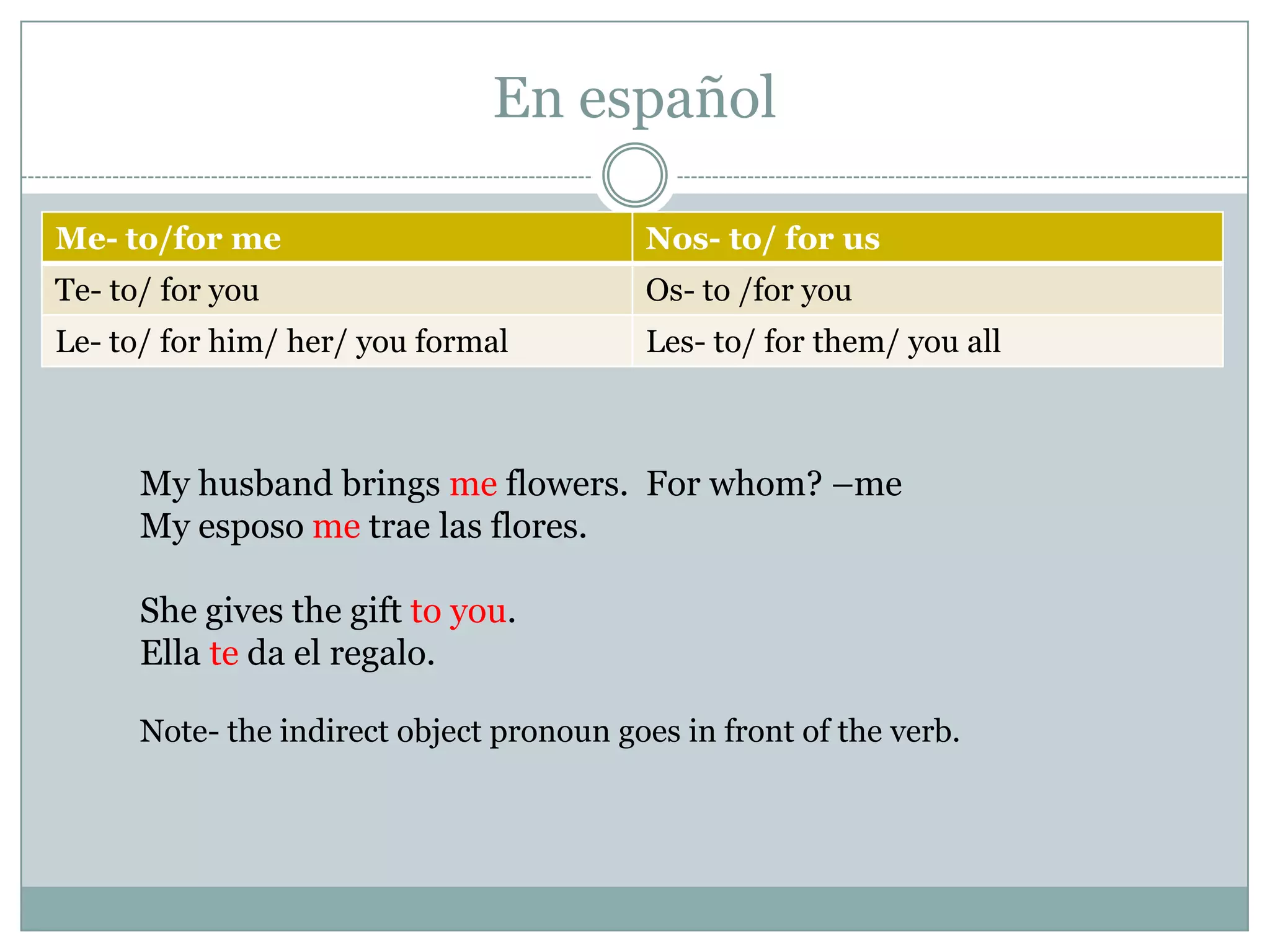
En español
Me- to/forme Nos- to/ for us
Te- to/ for you Os- to /for you
Le- to/ for him/ her/ you formal Les- to/ for them/ you all
My husband brings me flowers. For whom? –me
My esposo me trae las flores.
She gives the gift to you.
Ella te da el regalo.
Note- the indirect object pronoun goes in front of the verb.
7.
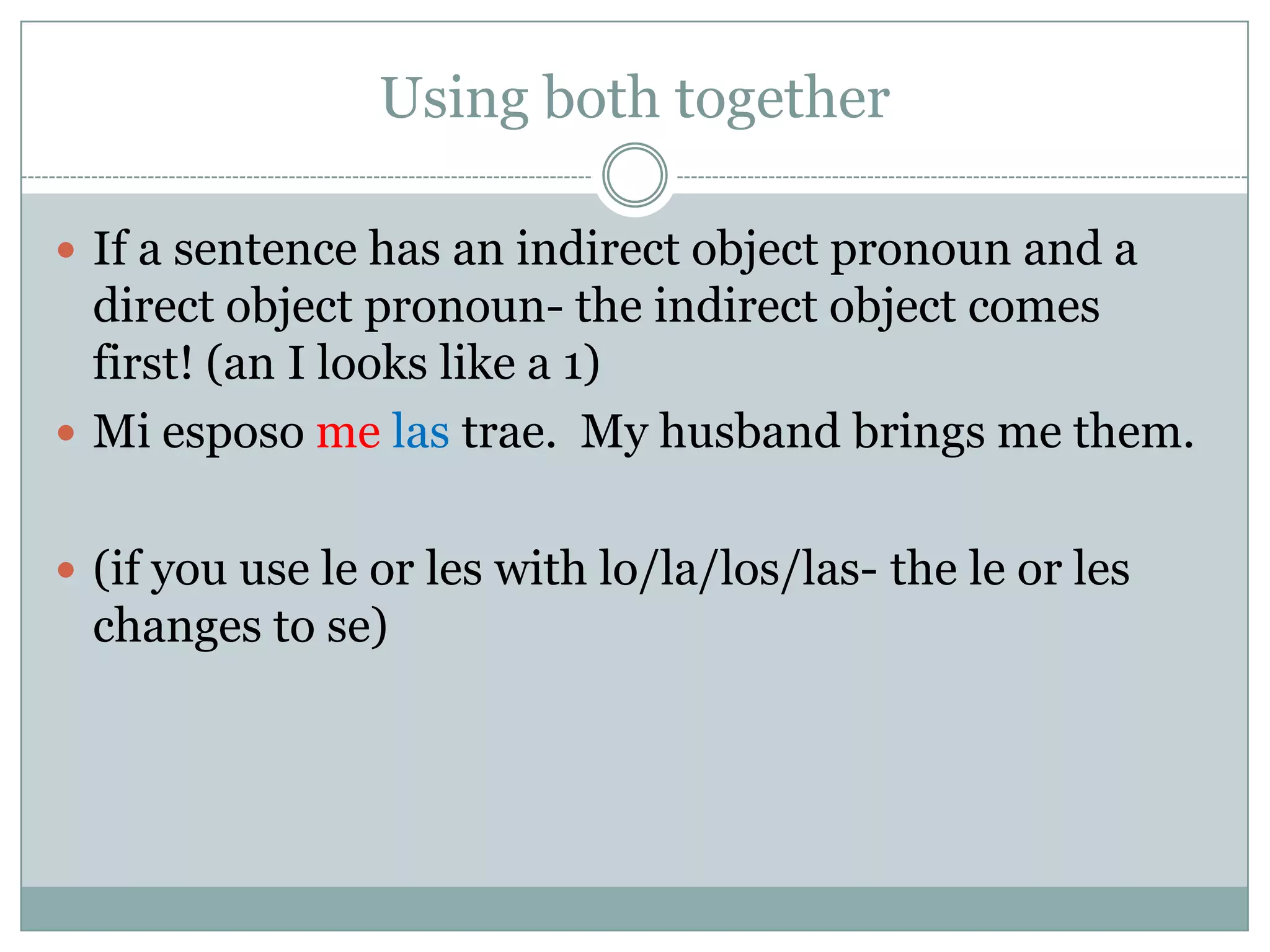
Using both together
If a sentence has an indirect object pronoun and a
direct object pronoun- the indirect object comes
first! (an I looks like a 1)
Mi esposo me las trae. My husband brings me them.
(if you use le or les with lo/la/los/las- the le or les
changes to se)
8.
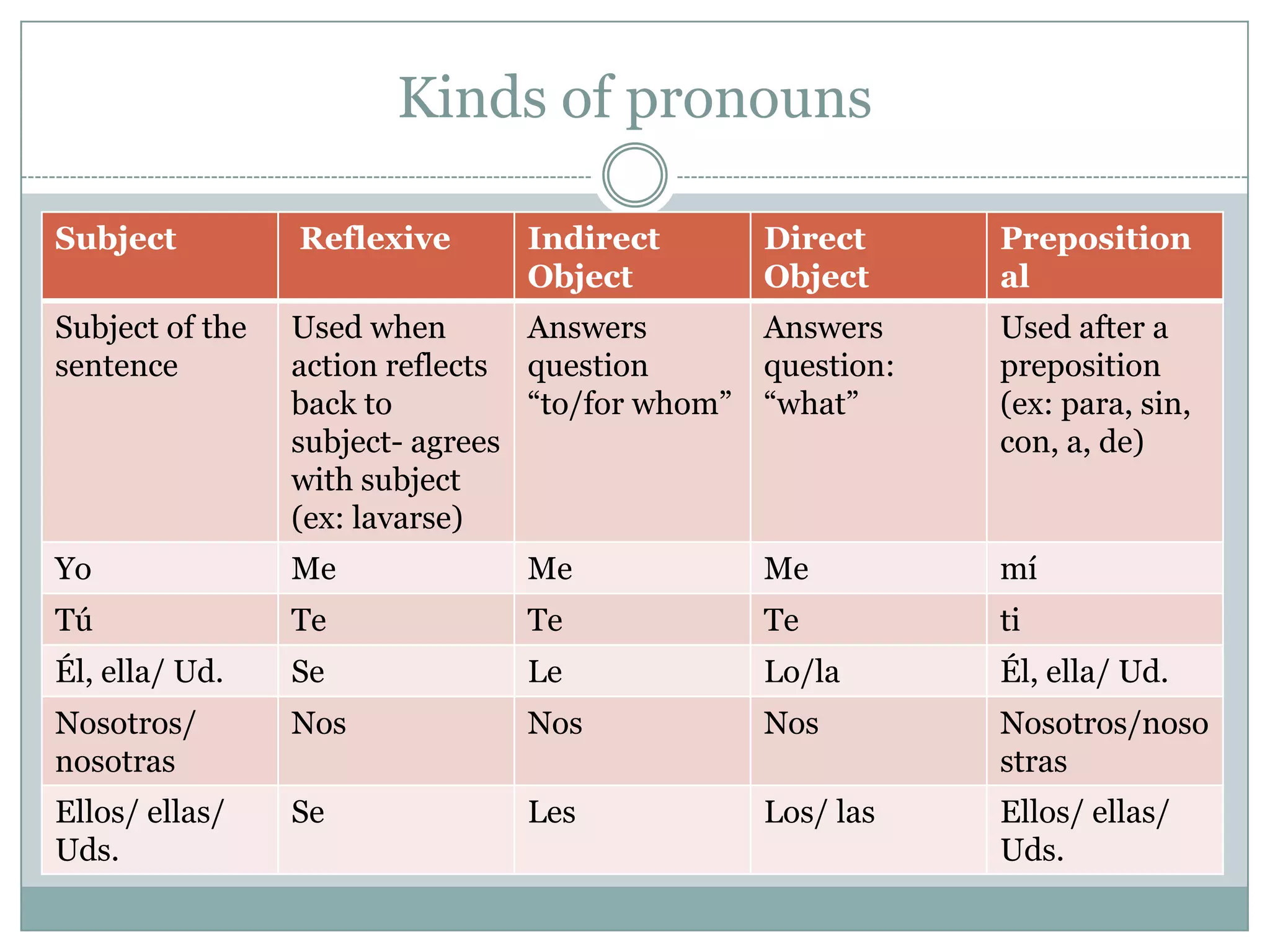
Kinds of pronouns
Subject Reflexive Indirect Direct Preposition
Object Object al
Subject of the Used when Answers Answers Used after a
sentence action reflects question question: preposition
back to “to/for whom” “what” (ex: para, sin,
subject- agrees con, a, de)
with subject
(ex: lavarse)
Yo Me Me Me mí
Tú Te Te Te ti
Él, ella/ Ud. Se Le Lo/la Él, ella/ Ud.
Nosotros/ Nos Nos Nos Nosotros/noso
nosotras stras
Ellos/ ellas/ Se Les Los/ las Ellos/ ellas/
Uds. Uds.