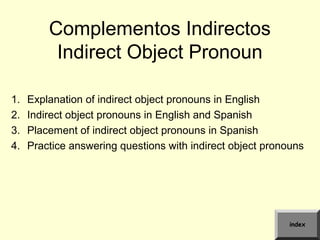
Complementos Indirectos
Indirect Object Pronoun
1. Explanation of indirect object pronouns in English
2. Indirect object pronouns in English and Spanish
3. Placement of indirect object pronouns in Spanish
4. Practice answering questions with indirect object pronouns
index
What does a indirect object pronoun
do?
An indirect object pronoun takes
the place of an indirect object. For
example:
Are you giving Ana the truck?
Yes, I am giving her the truck.
indirect object
indirect
object
pronoun
index
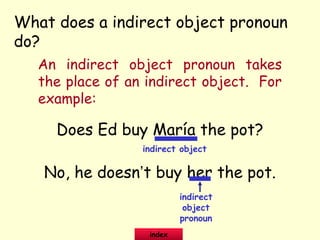
What does a indirect object pronoun
do?
An indirect object pronoun takes
the place of an indirect object. For
example:
Does Ed buy María the pot?
No, he doesn’t buy her the pot.
indirect object
indirect
object
pronoun
index
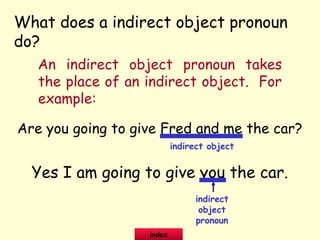
What does a indirect object pronoun
do?
An indirect object pronoun takes
the place of an indirect object. For
example:
Are you going to give Fred and me the car?
Yes I am going to give you the car.
indirect object
indirect
object
pronoun
index
The following are the indirect object pronouns in
English:
me
you (fam.)
you (form.)
him
us
you (pl.)
them (m.)
her them (f.)
The Spanish equivalents are as follows:
= me
= te
= le
= le
= le
= nos
= les
= les
= les
index
you (pl.) = os
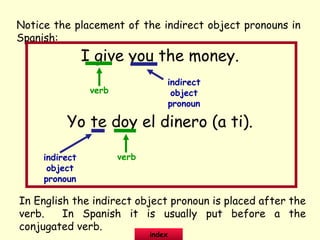
Notice the placement of the indirect object pronouns in
Spanish:
I give you the money.
indirect
object
pronoun
Yo te doy el dinero (a ti).
indirect
object
pronoun
verb
verb
In English the indirect object pronoun is placed after the
verb. In Spanish it is usually put before a the
conjugated verb.
index
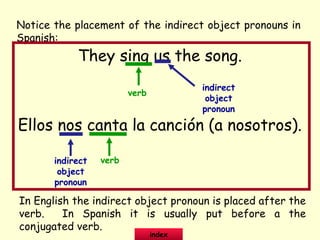
Notice the placement of the indirect object pronouns in
Spanish:
They sing us the song.
indirect
object
pronoun
Ellos nos canta la canción (a nosotros).
indirect
object
pronoun
verb
verb
In English the indirect object pronoun is placed after the
verb. In Spanish it is usually put before a the
conjugated verb.
index
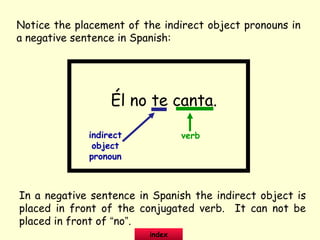
Notice the placement of the indirect object pronouns in
a negative sentence in Spanish:
Él no te canta.
indirect
object
pronoun
verb
In a negative sentence in Spanish the indirect object is
placed in front of the conjugated verb. It can not be
placed in front of “no”.
index
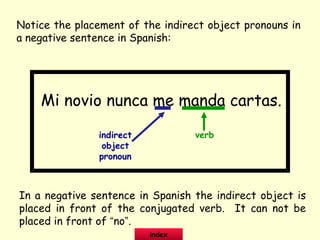
Notice the placement of the indirect object pronouns in
a negative sentence in Spanish:
Mi novio nunca me manda cartas.
indirect
object
pronoun
verb
In a negative sentence in Spanish the indirect object is
placed in front of the conjugated verb. It can not be
placed in front of “no”.
index
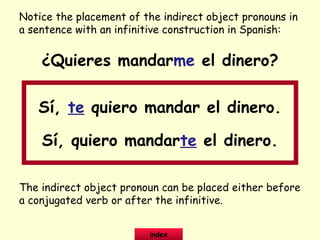
Notice the placement of the indirect object pronouns in
a sentence with an infinitive construction in Spanish:
¿Quieres mandarme el dinero?
Sí, te quiero mandar el dinero.
Sí, quiero mandarte el dinero.
The indirect object pronoun can be placed either before
a conjugated verb or after the infinitive.
index
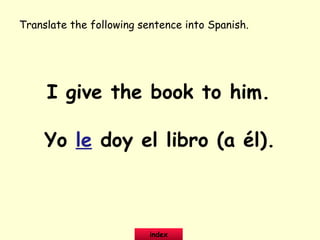
Translate the following sentence into Spanish.
I give the book to him.
Yo le doy el libro (a él).
index
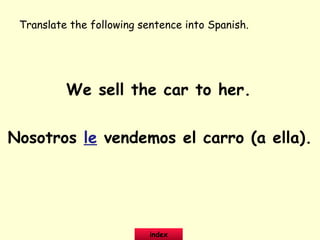
Translate the following sentence into Spanish.
We sell the car to her.
Nosotros le vendemos el carro (a ella).
index
Translate the following sentence into Spanish.
They send the letter to us.
Ellos nos mandan la carta (a nosotros).
index
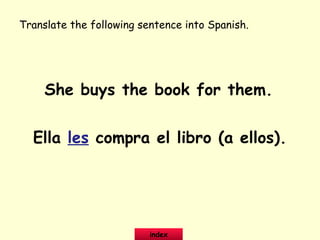
Translate the following sentence into Spanish.
She buys the book for them.
Ella les compra el libro (a ellos).
index
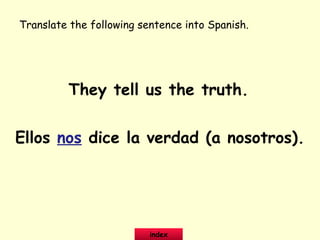
Translate the following sentence into Spanish.
They tell us the truth.
Ellos nos dice la verdad (a nosotros).
index
Translate the following sentence into Spanish.
We send them the letters.
Nosotros les mandamos las cartas (a
ellos).
index
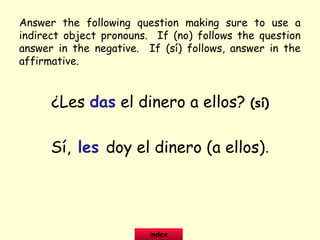
Answer the following question making sure to use a
indirect object pronouns. If (no) follows the question
answer in the negative. If (sí) follows, answer in the
affirmative.
¿Les das el dinero a ellos? (sí)
Sí, les doy el dinero (a ellos).
index
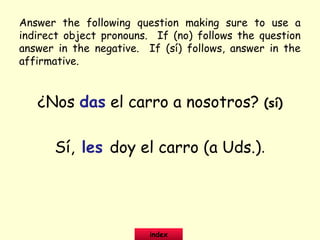
Answer the following question making sure to use a
indirect object pronouns. If (no) follows the question
answer in the negative. If (sí) follows, answer in the
affirmative.
¿Nos das el carro a nosotros? (sí)
Sí, les doy el carro (a Uds.).
index
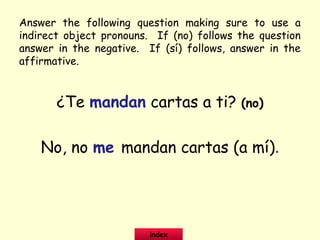
Answer the following question making sure to use a
indirect object pronouns. If (no) follows the question
answer in the negative. If (sí) follows, answer in the
affirmative.
¿Te mandan cartas a ti? (no)
No, no me mandan cartas (a mí).
index
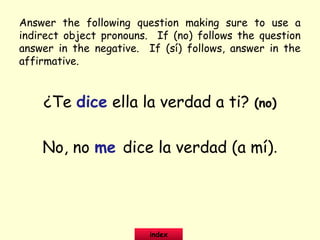
Answer the following question making sure to use a
indirect object pronouns. If (no) follows the question
answer in the negative. If (sí) follows, answer in the
affirmative.
¿Te dice ella la verdad a ti? (no)
No, no me dice la verdad (a mí).
index
Answer the following question making sure to use a
indirect object pronouns. If (no) follows the question
answer in the negative. If (sí) follows, answer in the
affirmative.
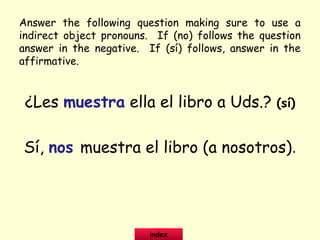
¿Les muestra ella el libro a Uds.? (sí)
Sí, nos muestra el libro (a nosotros).
index

Indirect object-pronouns-2

  • 1.
    Complementos Indirectos Indirect ObjectPronoun 1. Explanation of indirect object pronouns in English 2. Indirect object pronouns in English and Spanish 3. Placement of indirect object pronouns in Spanish 4. Practice answering questions with indirect object pronouns index
  • 2.
    What does aindirect object pronoun do? An indirect object pronoun takes the place of an indirect object. For example: Are you giving Ana the truck? Yes, I am giving her the truck. indirect object indirect object pronoun index
  • 3.
    What does aindirect object pronoun do? An indirect object pronoun takes the place of an indirect object. For example: Does Ed buy María the pot? No, he doesn’t buy her the pot. indirect object indirect object pronoun index
  • 4.
    What does aindirect object pronoun do? An indirect object pronoun takes the place of an indirect object. For example: Are you going to give Fred and me the car? Yes I am going to give you the car. indirect object indirect object pronoun index
  • 5.
    The following arethe indirect object pronouns in English: me you (fam.) you (form.) him us you (pl.) them (m.) her them (f.) The Spanish equivalents are as follows: = me = te = le = le = le = nos = les = les = les index you (pl.) = os
  • 6.
    Notice the placementof the indirect object pronouns in Spanish: I give you the money. indirect object pronoun Yo te doy el dinero (a ti). indirect object pronoun verb verb In English the indirect object pronoun is placed after the verb. In Spanish it is usually put before a the conjugated verb. index
  • 7.
    Notice the placementof the indirect object pronouns in Spanish: They sing us the song. indirect object pronoun Ellos nos canta la canción (a nosotros). indirect object pronoun verb verb In English the indirect object pronoun is placed after the verb. In Spanish it is usually put before a the conjugated verb. index
  • 8.
    Notice the placementof the indirect object pronouns in a negative sentence in Spanish: Él no te canta. indirect object pronoun verb In a negative sentence in Spanish the indirect object is placed in front of the conjugated verb. It can not be placed in front of “no”. index
  • 9.
    Notice the placementof the indirect object pronouns in a negative sentence in Spanish: Mi novio nunca me manda cartas. indirect object pronoun verb In a negative sentence in Spanish the indirect object is placed in front of the conjugated verb. It can not be placed in front of “no”. index
  • 10.
    Notice the placementof the indirect object pronouns in a sentence with an infinitive construction in Spanish: ¿Quieres mandarme el dinero? Sí, te quiero mandar el dinero. Sí, quiero mandarte el dinero. The indirect object pronoun can be placed either before a conjugated verb or after the infinitive. index
  • 11.
    Translate the followingsentence into Spanish. I give the book to him. Yo le doy el libro (a él). index
  • 12.
    Translate the followingsentence into Spanish. We sell the car to her. Nosotros le vendemos el carro (a ella). index
  • 13.
    Translate the followingsentence into Spanish. They send the letter to us. Ellos nos mandan la carta (a nosotros). index
  • 14.
    Translate the followingsentence into Spanish. She buys the book for them. Ella les compra el libro (a ellos). index
  • 15.
    Translate the followingsentence into Spanish. They tell us the truth. Ellos nos dice la verdad (a nosotros). index
  • 16.
    Translate the followingsentence into Spanish. We send them the letters. Nosotros les mandamos las cartas (a ellos). index
  • 17.
    Answer the followingquestion making sure to use a indirect object pronouns. If (no) follows the question answer in the negative. If (sí) follows, answer in the affirmative. ¿Les das el dinero a ellos? (sí) Sí, les doy el dinero (a ellos). index
  • 18.
    Answer the followingquestion making sure to use a indirect object pronouns. If (no) follows the question answer in the negative. If (sí) follows, answer in the affirmative. ¿Nos das el carro a nosotros? (sí) Sí, les doy el carro (a Uds.). index
  • 19.
    Answer the followingquestion making sure to use a indirect object pronouns. If (no) follows the question answer in the negative. If (sí) follows, answer in the affirmative. ¿Te mandan cartas a ti? (no) No, no me mandan cartas (a mí). index
  • 20.
    Answer the followingquestion making sure to use a indirect object pronouns. If (no) follows the question answer in the negative. If (sí) follows, answer in the affirmative. ¿Te dice ella la verdad a ti? (no) No, no me dice la verdad (a mí). index
  • 21.
    Answer the followingquestion making sure to use a indirect object pronouns. If (no) follows the question answer in the negative. If (sí) follows, answer in the affirmative. ¿Les muestra ella el libro a Uds.? (sí) Sí, nos muestra el libro (a nosotros). index