UNIT 4
CLOSED CLASS WORDS
HERNÁNDEZ DAHIRA
IBARRA DEYANIRA
ILLESCAS BRYAN
JIMÉNEZ ANDREA
LEÓN SALVADOR
DEFINITION
 In english gramar, closed class words refers to the category
of function words – that is, part of the speech (or word
clases) that dont accept new members. Contrast with open
class words.
CLOSS CLASS WORDS
In english, include:
• Pronouns
• Prepositions
• Determiners
• Conjuctions
• Interjections
CLOSED CLASS WORDS
• Closed class words are those belonging to the gramatical
or function classes. Function words in english include:
• Conjuctions (and, or, but, because, if)
• Articles (the, a, an)
• Demonstratives (this, that, these, those)
• Prepositions (to, from, at, between, over)
• To take one specific case, consider the word “and”
CLOSED CLASS WORDS
Closed-class words or 'function words' are limited
in number and act as markers or guides to the
structure of a sentence. The role of articles is to
signal nouns. For example:
• The dog, a test, the fruit, an egg, etc.
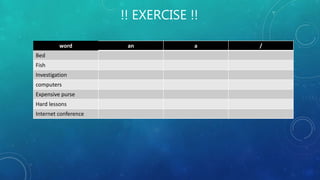
!! EXERCISE !!
word an a /
Bed
Fish
Investigation
computers
Expensive purse
Hard lessons
Internet conference
CLOSED CLASS WORDS
Prepositions mark special relationships between
persons, objects, and locations. For example:
• She is inside the house
• The man is getting into the car
• The bridge is over the river.
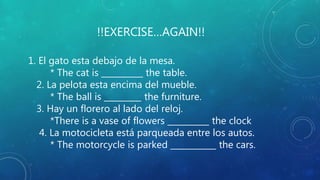
!!EXERCISE…AGAIN!!
1. El gato esta debajo de la mesa.
* The cat is __________ the table.
2. La pelota esta encima del mueble.
* The ball is _________ the furniture.
3. Hay un florero al lado del reloj.
*There is a vase of flowers __________ the clock
4. La motocicleta está parqueada entre los autos.
* The motorcycle is parked ___________ the cars.
Conjunctions are connectors that link actors or
objects, and specify relationships between
clauses in the sentence. For example:
Carolina loves to eat and sleep in class
Should I take the Japanese or French class?
I need to study more because Sylvia knows
everything
Closed Class Words
GUESS
WHAT….MORE
EXERCISES!!!
Sentences Use: Altough, or, then, so, and, where, since, but
I don't know _______ I can buy a pair of jeans.
She went to the shops _______ couldn't find
anything that could fit her needs.
Everybody likes him because he is nice ____
helpful
____ he was angry with her, he didn't utter a word.
Keep quiet ______ go out.
CLOSED CLASS WORDS
Demonstrative
words indicate out the thing referred to, for
example:
That kid (distance)
Those bananas (distance)
This notebook
These keys
A WILD EXERCISE IS APPROACHING
CLOSED CLASS WORDS
• The closed classes include pronouns (you, them), modal verbs
(could, must), determiners (a, the), prepositions (of, in), and
conjunctions (and, but).
• New members of these classes are not added to the language
very often. Instead they tend to gradually evolve from lexical
words in a process called grammaticalization.
• For example, the lexical verb go means 'to move (toward a
goal).' But its progressive form be going (to) has evolved into a
grammaticalized prospective (future) marker, as in She's going to
love her gift.
• The 'movement' meaning of go has been bleached out of the
grammaticalized version and so the going in be going to can be
considered to be a function word, rather than a content word.
CLOSED CLASS WORDS
• The closed classes represent a more restricted range of
meanings, and the meanings of closed-class words tend to
be less detailed and less referential than open-class words."
• (M. Lynne Murphy, Lexical Meaning. Cambridge University
Press, 2010)
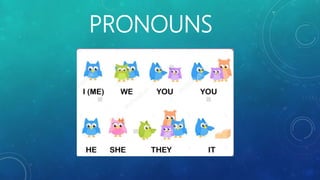
PRONOUNS
PRONOUNS
Definition
• A pronoun (I, me, he, she, herself, you, it, that, they, each, few,
many, who, whoever, whose, someone, everybody, etc.) is a word
that takes the place of a noun.
• In the sentence Joe saw Jill, and he waved at her, the pronouns he
and her take the place of Joe and Jill, respectively. There are three
types of pronouns: subject (for example, he); object (him); or
possessive (his).
PRONOUNS
- Another definition:
A pronoun is a word that refers to or takes the place
of a noun. The noun being referred to is called the
antecedent. The identity of the pronoun is made
clear by the antecedent. For example:
• The boy said that he was tired.
In this example, the pronoun “he” is referring back to the
noun (antecedent) “boy.”
PRONOUNS
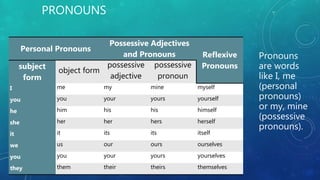
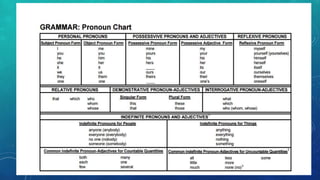
Personal Pronouns
Possessive Adjectives
and Pronouns Reflexive
Pronounssubject
form
object form
possessive
adjective
possessive
pronoun
I me my mine myself
you you your yours yourself
he him his his himself
she her her hers herself
it it its its itself
we us our ours ourselves
you you your yours yourselves
they them their theirs themselves
Pronouns
are words
like I, me
(personal
pronouns)
or my, mine
(possessive
pronouns).
PRONOUN RULES
There are a few important rules for using pronouns. As you read through these
rules and the examples in the next section, notice how the pronoun rules are
followed. Soon you’ll see that pronouns are easy to work with.
• Subject pronouns may be used to begin sentences. For example: We did a
great job.
• Subject pronouns may also be used to rename the subject. For example: It
was she who decided we should go to Hawaii.
• Indefinite pronouns don’t have antecedents. They are capable of standing on
their own. For example: No one likes the sound of fingernails on a
chalkboard.
• Object pronouns are used as direct objects, indirect objects, and objects of
prepositions. These include: you, me, him, her, us, them, and it. For example:
David talked to her about the mistake.
• Possessive pronouns show ownership. They do not need apostrophes. For
example: The cat washed its whiskers.
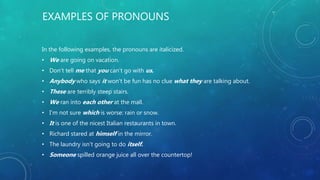
EXAMPLES OF PRONOUNS
In the following examples, the pronouns are italicized.
• We are going on vacation.
• Don’t tell me that you can’t go with us.
• Anybody who says it won’t be fun has no clue what they are talking about.
• These are terribly steep stairs.
• We ran into each other at the mall.
• I’m not sure which is worse: rain or snow.
• It is one of the nicest Italian restaurants in town.
• Richard stared at himself in the mirror.
• The laundry isn’t going to do itself.
• Someone spilled orange juice all over the countertop!
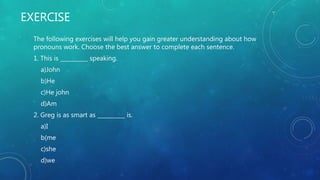
EXERCISE
The following exercises will help you gain greater understanding about how
pronouns work. Choose the best answer to complete each sentence.
1. This is __________ speaking.
a)John
b)He
c)He john
d)Am
2. Greg is as smart as __________ is.
a)I
b(me
c)she
d)we
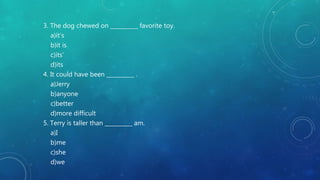
3. The dog chewed on __________ favorite toy.
a)it’s
b)it is
c)its’
d)its
4. It could have been __________ .
a)Jerry
b)anyone
c)better
d)more difficult
5. Terry is taller than __________ am.
a)I
b)me
c)she
d)we
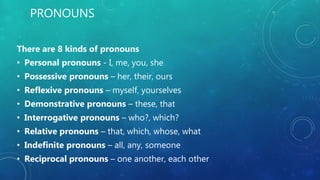
PRONOUNS
There are 8 kinds of pronouns
• Personal pronouns - I, me, you, she
• Possessive pronouns – her, their, ours
• Reflexive pronouns – myself, yourselves
• Demonstrative pronouns – these, that
• Interrogative pronouns – who?, which?
• Relative pronouns – that, which, whose, what
• Indefinite pronouns – all, any, someone
• Reciprocal pronouns – one another, each other
PERSONAL PRONOUN
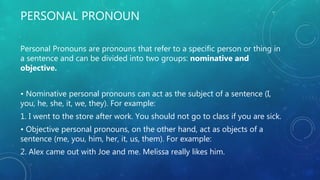
Personal Pronouns are pronouns that refer to a specific person or thing in
a sentence and can be divided into two groups: nominative and
objective.
• Nominative personal pronouns can act as the subject of a sentence (I,
you, he, she, it, we, they). For example:
1. I went to the store after work. You should not go to class if you are sick.
• Objective personal pronouns, on the other hand, act as objects of a
sentence (me, you, him, her, it, us, them). For example:
2. Alex came out with Joe and me. Melissa really likes him.
PERSONAL PRONOUN
• Personal pronouns have different forms depending
on their person (first, second or third) and, usually,
number (singular and plural). Sometimes, in the
third person singular, they take different forms
according to gender (he, she). They also take
different forms depending on whether they stand
for the subject or the object of the sentence.
PERSONAL PRONOUN
• First person pronouns are I, me, we, us. These pronouns refer
to the person doing the speaking or writing.
• The second person pronoun, whether singular or plural, is
always you, meaning the person or persons being spoken to or
addressed.
• Third person pronouns refer to those being spoken or written
about: he, him, she, her, it, they, them. (Most third person
pronouns refer to people, although they and them can refer to
things and it is sometimes used about babies and animals.
There are, as always in English, odd exceptions, such as the
customary use of she or her for a ship.) (King, p. 80)
• Academic writing generally requires the use of the third person.
PERSONAL PRONOUN
• The subject of a sentence (or clause) is the person or thing
doing something — in other words, the subject of the verb.
Subject pronouns are as follows: I, you, he, she, it, we, they,
who, whoever.
• The object of the sentence is whoever or whatever is having
something done to it; it is the object of the verb: me, you,
him, her, it, us, them, whom, whomever.
PERSONAL PRONOUNS
• Exercises
Complete with the subject personal pronoun.
1. My name is Sue. (Sue) _________ am English. And this is
my family.
2. My mum´s name is Angie. (Angie) _________ is from
Germany.
3. Bob is my dad. (My dad) _________ is a waiter.
4. On the left you can see Simon. (Simon) _________ is my
brother.
5. (Sue and Simon) _________ are twins.
6. Our dog is a girl, Judy. (Judy) _________ is two years old.
7. (Sue, Simon, Angie and Bob) _________ live in
Canterbury.
8. (Canterbury) _________ is not far from London.
9. My grandparents live in London. (My grandparents)
_________ often come and see us.
10. What can _________ tell me about your family?
POSSESIVE PRONOUN
Possessive Pronouns are pronouns that show ownership; in
other words, something belongs to someone else (my/mine,
your/yours, his, her/hers, its, our/ours, their/theirs).
For example:
1. That book is mine .
2. Their shoes are under the bed.
POSSESIVE PRONOUN
There are two main types of possessive pronouns:
• Adjectival possessive pronouns (also a kind of determiner, because
they tell us more about following nouns): my lecture notes, his jacket,
our motor car, your house, their party.
• Pronominal possessive pronouns which are used on their own: that
textbook is mine; yours is over there; his is under the table; hers is lying
on the bottom stair; this land is ours; theirs is down the road.
POSSESIVE PRONOUN EXERCISE
Choose the best answer to complete each sentence.
1. The mother cat and __________ kittens napped in the sunshine.
A. His B.Your C. Hers D. Her
2. I like cream cheese on _________ bagels.
A. My B. Mine C. Your D. Our
3. ________ grandfather used to take us fishing.
A. Mine B. My C. Our D. Ours
4. Elaine bought ________ dress at the mall.
A. Yours B. Mine C. Her
5. The car lost _________ rear bumper in an accident.
A. It’s B. Its C. His D. Her
REFLEXIVE PRONOUN
• Reflexive Pronouns are pronouns that are used to show that
the subject of the sentence is receiving the action of the verb
(myself, yourself, himself, herself, itself, ourselves,
themselves).
• For example:
1. She can handle the situation herself.
2. We can write the paper ourselves.
REFLEXIVE PRONOUN
Another definition
• Reflexive pronouns ‘reflect’ the action back to the self or subject:
myself, yourself, herself, himself, itself, ourselves, yourselves,
themselves — for example, we often say ‘Look after yourself’ to people
we care about.
• Sometimes, reflexive pronouns are used in an intensifying or clarifying
way. For instance: ‘The funeral, featuring hymns the dead man himself
had selected, took too long’; ‘Although the house itself was in good
condition, its outbuildings were falling down.’
REFLEXIVE PRONOUN EXERCISE
Choose the best answer to complete each sentence.
1. Each morning, I brush my teeth and stare at ______________ in the mirror.
A. Himself B. Herself C. Myself D. Itself
2. Dad and I painted the trailer _______________.
A. Myself B. Himself C. Itself D. Ourselves
3. The children made holiday decorations by ________________.
A. Itself B. Ourselves C. Themselves D. Their selves
4. Paul copies his friend’s homework instead of doing it _______________.
A. Itself B. Himself C. Myself D. Yourself
5. Please make ________________ at home while you wait.
A. Themselves B. Himself C. Yourselves D. Herself
Personal
(Nominative)
Personal
(Objective)
Possessive Reflexive
I me my/mine myself
you you your/yours yourself
he him his himself
she her her/hers herself
it it its itself
we us our/ours ourselves
they them their/theirs themselves
DEMONSTRATIVE PRONOUN
• Demonstrative Pronouns are pronouns that are used to
identify nouns and answer the question “which one?” (this,
that, these, those)
• For example:
1. These are the books that John was talking about.
*Here, the pronoun “these” identifies which books John was
talking about.
DEMONSTRATIVE PRONOUN
These pronouns help us ‘to demonstrate something or to point
out things’ (King, p.85).
Examples:
1. ‘This chicken dish looks delicious’; ‘Those rocks look too
dangerous for fishing’; ‘These clothes are too warm for a sunny
day.’
When demonstrative pronouns are used on their own, as in
‘That is not fair!’ it is very important that the listener or reader
knows what is being referred to.
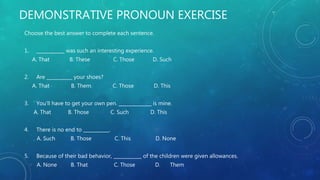
DEMONSTRATIVE PRONOUN EXERCISE
Choose the best answer to complete each sentence.
1. ____________ was such an interesting experience.
A. That B. These C. Those D. Such
2. Are ___________ your shoes?
A. That B. Them C. Those D. This
3. You’ll have to get your own pen. ______________ is mine.
A. That B. Those C. Such D. This
4. There is no end to ___________.
A. Such B. Those C. This D. None
5. Because of their bad behavior, ____________ of the children were given allowances.
A. None B. That C. Those D. Them
INTERROGATIVE PRONOUN
Interrogative Pronouns are pronouns that are used only in
reference to a question (who, what, which, whom, whose). For
example:
• Which one of these pens is yours?
• Who is that girl?
INTERROGATIVE PRONOUN
• who, what, which, whose, whom.
Examples:
1. What time is it?
2. Who is the woman wearing the yellow scarf?
3. Which room is mine?
4. Whose bicycle was stolen?
• Whom is tricky, and is falling into disuse because many people do not know how to
use it correctly. Who is a subject pronoun, while whom is an object pronoun; it
should only be used as the object of a verb – e.g. ‘To whom shall I address the
parcel?’, ‘By whom was the letter sent?’, ‘Whom shall I ask?’
• If you’re not sure which of who and whom to use, choose who.
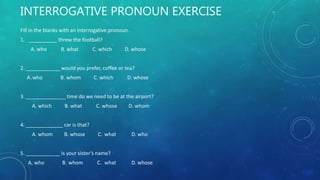
INTERROGATIVE PRONOUN EXERCISE
Fill in the blanks with an interrogative pronoun.
1. __________ threw the football?
A. who B. what C. which D. whose
2. ____________ would you prefer, coffee or tea?
A.who B. whom C. which D. whose
3. ______________ time do we need to be at the airport?
A. which B. what C. whose D. whom
4. _____________ car is that?
A. whom B. whose C. what D. who
5. ____________ is your sister’s name?
A. who B. whom C. what D. whose
RELATIVE PRONOUN
• Relative Pronouns are pronouns that are used to connect
clarifying information to nouns or other pronouns within a
sentence (who, that, which, whom, whose, whoever,
whichever, whomever, whatever).
• Who vs. Whom
- Who is used when referring to a subject. Who went to the
store after work? Who sings this song?
- Whom is used when referring to an object. With whom did
Alex go out? The letter should be addressed to whom?
RELATIVE PRONOUN
Who vs. That
• Who is used to refer to people or animals with names. Liz, who wrote the review, got
in trouble.
• That is used to refer to things. The paper that I wrote last night vanished.
That vs. Which
• That is used in essential clauses (clauses necessary for understanding the subject of a
sentence). The pizza parlor that is down the street from the college is great.
*The subject is unclear without the additional information. Which pizza parlor? The one
that is down the street from the college.
• Which is used in nonessential clauses (clauses unnecessary for understanding the
subject of a sentence). My mom’s jewelry was stolen, which upset her very much.
*The subject is clear without the additional information.
RELATIVE PRONOUN
• That, which, who, whom, whose, whatever, whoever, whomever.
Relative pronouns are used to introduce relative clauses.
Examples:
1. I wish I knew whose shoes had made the carpet so muddy.
2. The suit that she wore to the wedding was ruined by the rain.
3. Newcastle buses, which usually run on time, terminate near the station.
4. We’re going on a picnic to the beach next weekend, whatever the weather is like.
5. The mayor, who had once been a leading business woman, was accused of corruption.
6. The assault victim had nobody to whom to turn for help.
7. Whoever caused the company’s bankruptcy should be held responsible.
8. He should make reparation to whomever his crimes have affected.
* That is used to introduce what we call a definitional relative clause — a clause that provides an
essential piece of information about a noun. For example: I want you to cut down the tree that hangs
over the back fence.
* Which is used to introduce a non-definitional clause — in other words, a clause adding extra
information not essential to understanding the main idea of the sentence. For example: He bought the
Porsche, which everybody knows he can’t afford, last month.
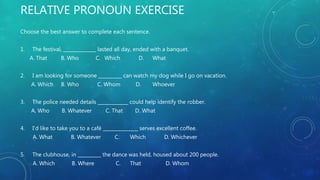
RELATIVE PRONOUN EXERCISE
Choose the best answer to complete each sentence.
1. The festival, ______________ lasted all day, ended with a banquet.
A. That B. Who C. Which D. What
2. I am looking for someone __________ can watch my dog while I go on vacation.
A. Which B. Who C. Whom D. Whoever
3. The police needed details _____________ could help identify the robber.
A. Who B. Whatever C. That D. What
4. I’d like to take you to a café _______________ serves excellent coffee.
A. What B. Whatever C. Which D. Whichever
5. The clubhouse, in __________ the dance was held, housed about 200 people.
A. Which B. Where C. That D. Whom
INDEFINITE PRONOUN
• Indefinite Pronouns are pronouns that are used in reference to a
person or thing that is not specific or not known. Indefinite pronouns
are also used to identify a general group of people or things (i.e.
everyone, everybody, anyone, anybody, somebody, most, all, each
every, some, none, one, few, both, many, several). For example:
1. Everybody has to take the Writing Proficiency Examination in order to
graduate.
2. All of the seniors were excited for graduation.
INDEFINITE PRONOUN
• All, any, every, everything, each, some, one, both, either, neither, few, little, less, least,
many, everyone, someone, no one, something, anybody, nobody, more, most, nothing,
enough, plenty, several. (King, p. 89)
What do they have in common? They all concern number or quantity.
- Some indefinite pronouns should only be applied to uncountable nouns, because they concern
portions rather than numbers of something: a little sugar, much trouble, less fat. (Remember
that when indefinite pronouns precede nouns like this, they are actually called indefinite
determiners.)
- But, we say many cakes, many problems, fewer calories. Many and fewer are used to indicate
number and so are used with countable nouns.
- Make sure that pronouns agree in grammatical number (singular or plural) with any nouns to
which they may refer. For instance, each, one, either, neither, someone, anyone, no one,
nobody and something are all singular.
- Make sure that an indefinite pronoun agrees in number with a verb or personal pronoun in a
sentence – e.g. ‘Each (singular) one of us has (singular) problems’; ‘Neither (sing.) of the
actors could remember her (sing.) lines,’ but ‘Few (plural) of the players are (plural) likely to
turn up on such a cold day.’ (King, p. 89)
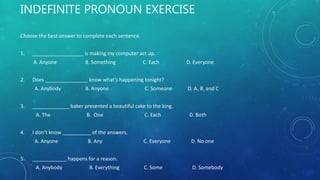
INDEFINITE PRONOUN EXERCISE
Choose the best answer to complete each sentence.
1. __________________ is making my computer act up.
A. Anyone B. Something C. Each D. Everyone
2. Does _______________ know what’s happening tonight?
A. Anybody B. Anyone C. Someone D. A, B, and C
3. _____________ baker presented a beautiful cake to the king.
A. The B. One C. Each D. Both
4. I don’t know __________ of the answers.
A. Anyone B. Any C. Everyone D. No one
5. ____________ happens for a reason.
A. Anybody B. Everything C. Some D. Somebody
RECIPROCAL PRONOUN
• Reciprocal Pronouns are pronouns that are used to refer to a
mutual set of people (each other, each other’s, one another,
one another’s).
• For example:
1. We need to help one another survive.
2. They had remembered each other’s phone numbers.
RECIPROCAL PRONOUN
• There are only two reciprocal pronouns: each other and
one another. As the term ‘reciprocal’ indicates, they express
a mutual, give-and-take relationship.
• Each other refers to two people or things — e.g. ‘The
brothers are no longer talking to each other.’
• One another is usually meant to refer to more than two —
e.g. ‘The people of the small community helped one another
through family crises.’
INTENSIVE PRONOUN
• Intensive Pronouns are pronouns that are used only to
place emphasis on the subject and are not essential to the
meaning of the sentence. Note: These pronouns look the
same as reflexive pronouns, but they act differently in the
sentence and are always placed next to the subject that they
are emphasizing (myself, yourself, himself, herself, itself,
ourselves, themselves).
• For example:
- You yourself must go to the police station.
PREPOSITIONS
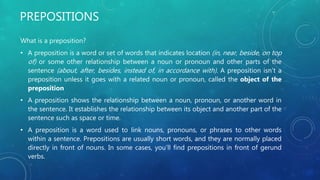
PREPOSITIONS
What is a preposition?
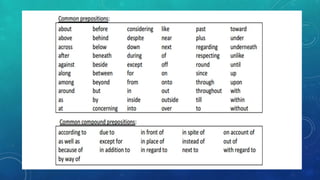
• A preposition is a word or set of words that indicates location (in, near, beside, on top
of) or some other relationship between a noun or pronoun and other parts of the
sentence (about, after, besides, instead of, in accordance with). A preposition isn't a
preposition unless it goes with a related noun or pronoun, called the object of the
preposition
• A preposition shows the relationship between a noun, pronoun, or another word in
the sentence. It establishes the relationship between its object and another part of the
sentence such as space or time.
• A preposition is a word used to link nouns, pronouns, or phrases to other words
within a sentence. Prepositions are usually short words, and they are normally placed
directly in front of nouns. In some cases, you’ll find prepositions in front of gerund
verbs.
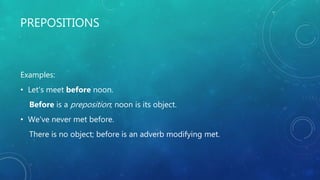
PREPOSITIONS
Examples:
• Let's meet before noon.
Before is a preposition; noon is its object.
• We've never met before.
There is no object; before is an adverb modifying met.
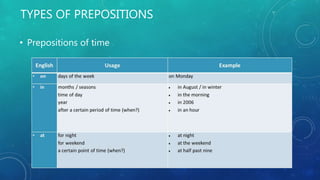
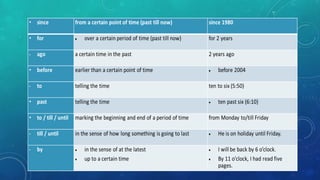
TYPES OF PREPOSITIONS
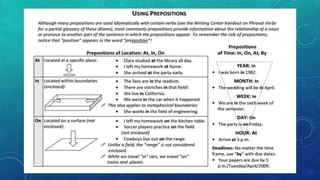
• Prepositions of time
TYPES OF PREPOSITIONS
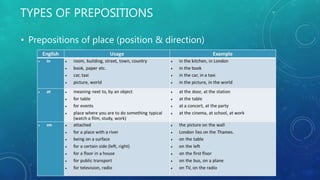
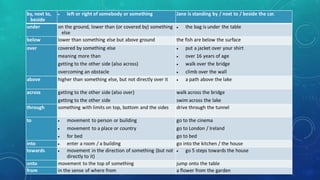
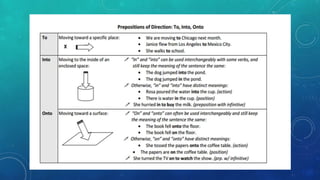
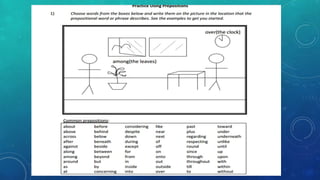
• Prepositions of place (position & direction)
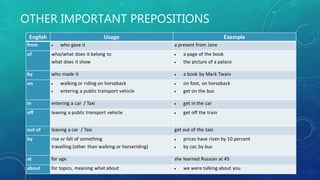
OTHER IMPORTANT PREPOSITIONS
EXERCISES
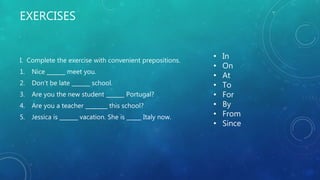
I. Complete the exercise with convenient prepositions.
1. Nice meet you.
2. Don’t be late school.
3. Are you the new student Portugal?
4. Are you a teacher this school?
5. Jessica is vacation. She is Italy now.
• In
• On
• At
• To
• For
• By
• From
• Since
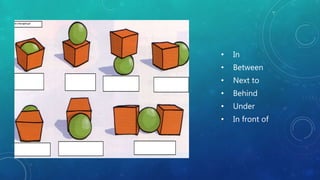
• In
• Between
• Next to
• Behind
• Under
• In front of
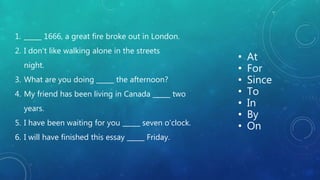
1. 1666, a great fire broke out in London.
2. I don't like walking alone in the streets
night.
3. What are you doing the afternoon?
4. My friend has been living in Canada two
years.
5. I have been waiting for you seven o'clock.
6. I will have finished this essay Friday.
• At
• For
• Since
• To
• In
• By
• On
THE END.
DETERMINERS
DETERMINERS
Determiners are used to identify things in further detail.
• They are used in front of nouns to indicate whether you are referring to
something specific or something of a particular type.
• The definite and indefinite articles a/an/the are all determiners.
• You use a specific determiner when people know exactly which thing(s)
or person/people you are talking about.
DETERMINERS
Types of determiners:
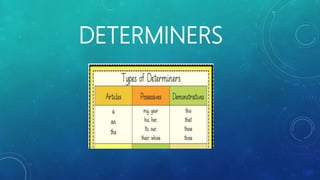
• the articles : a / an / the
• demonstratives : this / that / these / those
• possessives (possessive adjectives): my / your /his / her / its / our / your
/ their
DETERMINERS
Examples:
- "The (article) dog barked at the boy."
- "These (demonstratives) apples are rotten."
- "Their (possessive) bus was late."
- "Have you seen my (possessive) keys?"
• You use general determiners to talk about how much stuff or
how many people or things you are talking about.
DETERMINERS
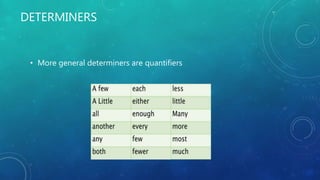
• More general determiners are quantifiers
DETERMINERS
Examples:
• "Have you got any English books I could borrow?"
• "There is enough food to feed everyone."
• "I don't teach online every day."
DETERMINERS
Number as determiners
• Numbers act as determiners too, they show how many things
or people there are: 1, 2, 3...
For example:
• "I teach online for 3 days a week."
DETERMINERS
Either and neither
Either and neither are used in sentences concerning a possible choice between
two items.
• Either can mean one or the other (of two) or each of two.
For example:
• I've got tea and coffee, so you can have either. (One or the other)
The room has a door at either end. (Both)
Neither means not the first one and not the second one.
For example:
• Neither of the students were listening.
CONJUNCTIONS
CONJUNCTIONS
What is a conjunction?
• A conjunction is the glue that holds words, phrases and clauses (both
dependent and independent) together. There are three different kinds
of conjunctions––coordinating, subordinating, and correlative––each
serving its own, distinct purpose, but all working to bring words
together.
Another definition…
• The conjunction is the part of speech used as a “joiner” for words,
phrases, or clauses in a particular sentence. It links these words or
groups of words together, in such a way that certain relationships
among these different parts of the sentence will be established, and the
thoughts that all of these convey will be connected.
CONJUNCTIONS
What are the Different Types of Conjunctions?
In the English language, conjunctions come in three basic types:
• The coordinating conjunctions: used to connect two independent
clauses.
• The subordinating conjunctions: used to establish the relationship
between the dependent clause and the rest of the sentence.
• The correlative conjunctions: used to join various sentence elements
which are grammatically equal.
CONJUNCTIONS
What Is a Coordinating Conjunction?
Coordinating conjunctions are what come to most people’s minds when they hear the word “conjunction.”
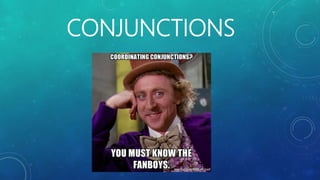
They can join together words, phrases and independent clauses. There are seven of them, and they’re easy to
remember if you can just remember FANBOYS:
• For - Explains reason or purpose (just like “because”): I go to the park every Sunday, for I love to watch the
ducks on the lake.
• And - Adds one thing to another: I go to the park every Sunday to watch the ducks on the lake and the
shirtless men playing soccer.
• Nor - Used to present an alternative negative idea to an already stated negative idea: I don’t go for the
fresh air nor really for the ducks. Honestly, I just like the soccer.
• But - Shows contrast: The soccer in the park is entertaining in the winter, but it’s better in the heat of
summer.
• Or - Presents an alternative or a choice: The men play on teams: shirts or skins.
• Yet - Introduces a contrasting idea that follows the preceding idea logically (similar to “but”): I always take a
book to read, yet I never seem to turn a single page.
• So - Indicates effect, result or consequence: I’ve started dating one of the soccer players, so now I have an
excuse to watch the game each week.
CONJUNCTIONS
Among the coordinating conjunctions, the most common, of course, are and, but, and or. It might
be helpful to explore the uses of these three little words.
AND
• To suggest that one idea is chronologically sequential to another: "Tashonda sent in her
applications and waited by the phone for a response."
• To suggest that one idea is the result of another: "Willie heard the weather report and promptly
boarded up his house."
• To suggest that one idea is in contrast to another (frequently replaced by but in this usage):
"Juanita is brilliant and Shalimar has a pleasant personality.
• To suggest an element of surprise (sometimes replaced by yet in this usage): "Hartford is a rich
city and suffers from many symptoms of urban blight."
• To suggest that one clause is dependent upon another, conditionally (usually the first clause is
an imperative): "Use your credit cards frequently and you'll soon find yourself deep in debt." top
• To suggest a kind of "comment" on the first clause: "Charlie became addicted to gambling —
and that surprised no one who knew him."
CONJUNCTIONS
BUT
• To suggest a contrast that is unexpected in light of the first clause: "Joey lost a
fortune in the stock market, but he still seems able to live quite comfortably."
• To suggest in an affirmative sense what the first part of the sentence implied in a
negative way (sometimes replaced by on the contrary): "The club never invested
foolishly, but used the services of a sage investment counselor."
• To connect two ideas with the meaning of "with the exception of" (and then the
second word takes over as subject): "Everybody but Golden breath is trying out for
the team."
CONJUNCTIONS
OR
• To suggest that only one possibility can be realized, excluding one or the other: "You can study
hard for this exam or you can fail."
• To suggest the inclusive combination of alternatives: "We can broil chicken on the grill tonight,
or we can just eat leftovers.
• To suggest a refinement of the first clause: "Smith College is the premier all-women's college in
the country, or so it seems to most Smith College alumnae."
• To suggest a restatement or "correction" of the first part of the sentence: "There are no
rattlesnakes in this canyon, or so our guide tells us."
• To suggest a negative condition: "The New Hampshire state motto is the rather grim "Live free
or die." top
• To suggest a negative alternative without the use of an imperative (see use of and above): "They
must approve his political style or they wouldn't keep electing him mayor."
CONJUNCTIONS
• The Others . . .
The conjunction NOR is not extinct, but it is not used nearly as often as the other conjunctions, so it might feel a bit
odd when nor does come up in conversation or writing. Its most common use is as the little brother in the correlative
pair, neither-nor (see below):
• He is neither sane nor brilliant.
• That is neither what I said nor what I meant.
It can be used with other negative expressions:
• That is not what I meant to say, nor should you interpret my statement as an admission of guilt.
The word YET functions sometimes as an adverb and has several meanings: in addition ("yet another cause of trouble"
or "a simple yet noble woman"), even ("yet more expensive"), still ("he is yet a novice"), eventually ("they may yet win"),
and so soon as now ("he's not here yet"). It also functions as a coordinating conjunction meaning something like
"nevertheless" or "but." The word yet seems to carry an element of distinctiveness that but can seldom register.
• John plays basketball well, yet his favorite sport is badminton.
• The visitors complained loudly about the heat, yet they continued to play golf every day.
In sentences such as the second one, above, the pronoun subject of the second clause ("they," in this case) is often left
out. When that happens, the comma preceding the conjunction might also disappear: "The visitors complained loudly
yet continued to play golf every day."
• Yet is sometimes combined with other conjunctions, but or and. It would not be unusual to see and yet in
sentences like the ones above. This usage is acceptable.
CONJUNCTIONS
The word FOR is most often used as a preposition, of course, but it does serve, on rare occasions, as a coordinating
conjunction. Some people regard the conjunction for as rather highfalutin and literary, and it does tend to add a bit of
weightiness to the text. Beginning a sentence with the conjunction "for" is probably not a good idea, except when
you're singing "For he's a jolly good fellow. "For" has serious sequential implications and in its use the order of
thoughts is more important than it is, say, with because or since. Its function is to introduce the reason for the
preceding clause:
• John thought he had a good chance to get the job, for his father was on the company's board of trustees.
• Most of the visitors were happy just sitting around in the shade, for it had been a long, dusty journey on the train.
Be careful of the conjunction SO. Sometimes it can connect two independent clauses along with a comma, but
sometimes it can't. For instance, in this sentence,
• Soto is not the only Olympic athlete in his family, so are his brother, sister, and his Uncle Chet.
Where the word so means "as well" or "in addition," most careful writers would use a semicolon between the two
independent clauses. In the following sentence, where so is acting like a minor-league "therefore," the conjunction
and the comma are adequate to the task:
• Soto has always been nervous in large gatherings, so it is no surprise that he avoids crowds of his adoring fans.
Sometimes, at the beginning of a sentence, so will act as a kind of summing up device or transition, and when it does,
it is often set off from the rest of the sentence with a comma:
• So, the sheriff peremptorily removed the child from the custody of his parents.
COORDINATING CONJUNCTION EXERCISES
Complete each sentence using the correct coordinating conjunction from the parenthesis:
1. My car has a radio _________ a CD player. (but, or, and)
2. Sharon hates to listen to rap music, _________ will she tolerate heavy metal. (but, nor, or)
3. Carol wanted to drive to Colorado, _________ Bill insisted that they fly. (and, or, but)
4. I’m afraid of heights, _________ I appreciate the view from the top of this building. (and, yet, nor)
5. I have to be on time, _________ my boss will be annoyed if I’m late. (and, nor, for)
6. Do you like chocolate _________ vanilla ice cream better? (or, nor, and)
7. I have to go to work at six, _________ I’m waking up at four. (but, so, yet)
8. I was on time, _________ everyone else was late. (so, but, for)
9. Nadia doesn’t like to drive, _________ she takes the bus everywhere. (but, yet, so)
10. Our trip to the museum was interesting, _________ there were several new artifacts on display. (but,
for, yet)
CONJUNCTIONS
What Is a Subordinating Conjunction?
A subordinating conjunction always introduces a dependent clause, tying it to an
independent clause. In contrast to coordinating conjunctions, a subordinate conjunction can
often come first in a sentence. This is due simply to the nature of the relationship between
the dependent and the independent clause. In English, there are lots of subordinating
conjunctions, but the most common ones are "after," "although," "as," "because," "before,"
"how," "if," "once," "since," "than," "that," "though," "until," "when," "where," "whether," and
"while."
CONJUNCTIONS
Here are a few examples of how subordinating conjunctions are used:
• after – later than the time that : later than when.
“Your heart will break like mine, and you’ll want only me after you’ve gone” (Ella Fitzgerald).
• although – despite the fact that : used to introduce a fact that makes another fact unusual or
surprising.
“Although I’ve been here before, he’s just too hard to ignore” (Amy Winehouse).
• as – used to introduce a statement which indicates that something being mentioned was
known, expected, etc.
“As I walk through the valley of the shadow of death, I take a look at my life and realize there’s
nothing left” (Coolio).
• as long as – We use as long as to refer to the intended duration of a plan or idea, most
commonly referring to the future.
“I don’t care who you are, where you’re from or what you did as long as you love me” (Backstreet
Boys).
CONJUNCTIONS
• because – for the reason that.
“Because of you, I never stray too far from the sidewalk” (Kelly Clarkson).
• before – earlier than the time that : earlier than when.
“Just call me angel of the morning, angel. Just touch my cheek before you leave me, baby” (Juice
Newton).
• even if – to express condition.
“Even if the sky is falling down, you’ll be my only” (Jay Sean).
• if – used to talk about the result or effect of something that may happen or be true.
“If you leave me now, you’ll take away the biggest part of me” (Peter Cetera/Chicago).
• once – at the moment when : as soon as.
“Once you pop, you can’t stop” (Pringles commercials).
• since – used to introduce a statement that explains the reason for another statement.
“I guess I’ll never be the same since I fell for you” (B.B. King).
CONJUNCTIONS
• that – used to introduce a clause that states a reason or purpose.
“Baby, now that I’ve found you, I won’t let you go” (Tony Macaulay/John MacLeod).
• than - used to introduce the second or last of two or more things or people that are being
compared — used with the comparative form of an adjective or adverb.
“My sister is older than I am”
• though – to express contrast or concession.
“Walk on through the wind, walk on through the rain though your dreams be tossed and blown”
(Rodgers and Hammerstein).
• unless – to express condition.
“We’re never going to survive unless we get a little crazy” (Seal).
• until – up to the time or point that something happened.
• “[You] don’t know what you’ve got ‘til it’s gone” (Cinderella).
CONJUNCTIONS
• when – at or during the time that something happened.
“When I see you smile, I can face the world” (Bad English).
• where – at or in the place that something happened.
“There’s a light burning bright, showing me the way, but I know where I’ve been” (Scott Wittman).
• Whether - used to indicate choices or possibilities.
“Bruno wasn’t sure whether to go to India or Thailand”
• while – during the time that something happened.
“I look at the world, and I notice it’s turning while my guitar gently weeps” (The Beatles).
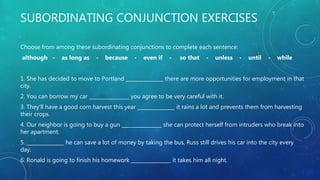
SUBORDINATING CONJUNCTION EXERCISES
Choose from among these subordinating conjunctions to complete each sentence:
although - as long as - because - even if - so that - unless - until - while
1. She has decided to move to Portland _______________ there are more opportunities for employment in that
city.
2. You can borrow my car ________________ you agree to be very careful with it.
3. They'll have a good corn harvest this year _______________ it rains a lot and prevents them from harvesting
their crops.
4. Our neighbor is going to buy a gun ________________ she can protect herself from intruders who break into
her apartment.
5. _______________ he can save a lot of money by taking the bus, Russ still drives his car into the city every
day.
6. Ronald is going to finish his homework ________________ it takes him all night.
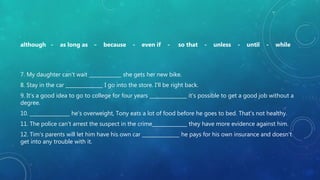
although - as long as - because - even if - so that - unless - until - while
7. My daughter can't wait _____________ she gets her new bike.
8. Stay in the car _______________ I go into the store. I'll be right back.
9. It's a good idea to go to college for four years _______________ it's possible to get a good job without a
degree.
10. ________________ he's overweight, Tony eats a lot of food before he goes to bed. That's not healthy.
11. The police can't arrest the suspect in the crime______________ they have more evidence against him.
12. Tim's parents will let him have his own car _______________ he pays for his own insurance and doesn't
get into any trouble with it.
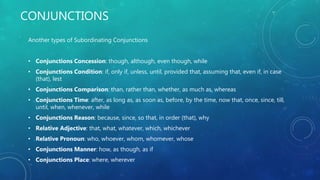
CONJUNCTIONS
Another types of Subordinating Conjunctions
• Conjunctions Concession: though, although, even though, while
• Conjunctions Condition: if, only if, unless, until, provided that, assuming that, even if, in case
(that), lest
• Conjunctions Comparison: than, rather than, whether, as much as, whereas
• Conjunctions Time: after, as long as, as soon as, before, by the time, now that, once, since, till,
until, when, whenever, while
• Conjunctions Reason: because, since, so that, in order (that), why
• Relative Adjective: that, what, whatever, which, whichever
• Relative Pronoun: who, whoever, whom, whomever, whose
• Conjunctions Manner: how, as though, as if
• Conjunctions Place: where, wherever
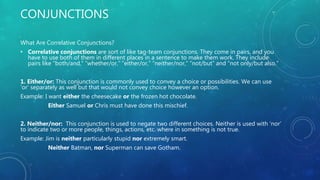
CONJUNCTIONS
What Are Correlative Conjunctions?
• Correlative conjunctions are sort of like tag-team conjunctions. They come in pairs, and you
have to use both of them in different places in a sentence to make them work. They include
pairs like “both/and,” “whether/or,” “either/or,” “neither/nor,” “not/but” and “not only/but also.”
1. Either/or: This conjunction is commonly used to convey a choice or possibilities. We can use
‘or’ separately as well but that would not convey choice however an option.
Example: I want either the cheesecake or the frozen hot chocolate.
Either Samuel or Chris must have done this mischief.
2. Neither/nor: This conjunction is used to negate two different choices. Neither is used with ‘nor’
to indicate two or more people, things, actions, etc. where in something is not true.
Example: Jim is neither particularly stupid nor extremely smart.
Neither Batman, nor Superman can save Gotham.
CONJUNCTIONS
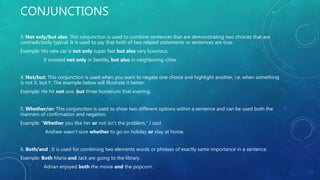
3. Not only/but also: This conjunction is used to combine sentences that are demonstrating two choices that are
contradictorily typical. It is used to say that both of two related statements or sentences are true.
Example: His new car is not only super fast but also very luxurious.
It snowed not only in Seattle, but also in neighboring cities.
4. Not/but: This conjunction is used when you want to negate one choice and highlight another, i.e. when something
is not X, but Y. The example below will illustrate it better:
Example: He hit not one, but three homeruns that evening.
5. Whether/or: This conjunction is used to show two different options within a sentence and can be used both the
manners of confirmation and negation.
Example: "Whether you like her or not isn't the problem," I said.
Andrew wasn’t sure whether to go on holiday or stay at home.
6. Both/and : It is used for combining two elements words or phrases of exactly same importance in a sentence.
Example: Both Maria and Jack are going to the library.
Adrian enjoyed both the movie and the popcorn.
CONJUNCTIONS
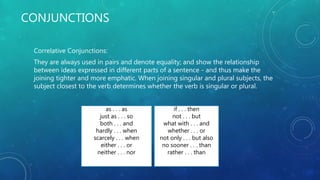
Correlative Conjunctions:
They are always used in pairs and denote equality; and show the relationship
between ideas expressed in different parts of a sentence - and thus make the
joining tighter and more emphatic. When joining singular and plural subjects, the
subject closest to the verb determines whether the verb is singular or plural.
as . . . as
just as . . . so
both . . . and
hardly . . . when
scarcely . . . when
either . . . or
neither . . . nor
if . . . then
not . . . but
what with . . . and
whether . . . or
not only . . . but also
no sooner . . . than
rather . . . than
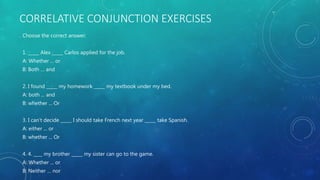
CORRELATIVE CONJUNCTION EXERCISES
Choose the correct answer:
1. _____ Alex _____ Carlos applied for the job.
A: Whether ... or
B: Both … and
2. I found _____ my homework _____ my textbook under my bed.
A: both ... and
B: whether ... Or
3. I can’t decide _____ I should take French next year _____ take Spanish.
A: either ... or
B: whether ... Or
4. 4. ____ my brother _____ my sister can go to the game.
A: Whether ... or
B: Neither … nor
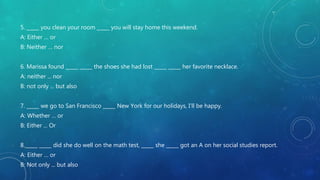
5. _____ you clean your room _____ you will stay home this weekend.
A: Either … or
B: Neither … nor
6. Marissa found _____ _____ the shoes she had lost _____ _____ her favorite necklace.
A: neither ... nor
B: not only ... but also
7. _____ we go to San Francisco _____ New York for our holidays, I’ll be happy.
A: Whether … or
B: Either ... Or
8._____ _____ did she do well on the math test, _____ she _____ got an A on her social studies report.
A: Either … or
B: Not only ... but also
CONJUNCTIONS
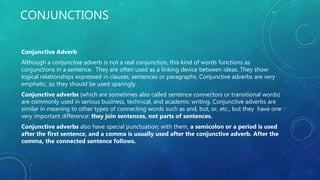
Conjunctive Adverb
Although a conjunctive adverb is not a real conjunction, this kind of words functions as
conjunctions in a sentence. They are often used as a linking device between ideas. They show
logical relationships expressed in clauses, sentences or paragraphs. Conjunctive adverbs are very
emphatic, so they should be used sparingly.
Conjunctive adverbs (which are sometimes also called sentence connectors or transitional words)
are commonly used in serious business, technical, and academic writing. Conjunctive adverbs are
similar in meaning to other types of connecting words such as and, but, or, etc., but they have one
very important difference: they join sentences, not parts of sentences.
Conjunctive adverbs also have special punctuation: with them, a semicolon or a period is used
after the first sentence, and a comma is usually used after the conjunctive adverb. After the
comma, the connected sentence follows.
CONJUNCTIONS
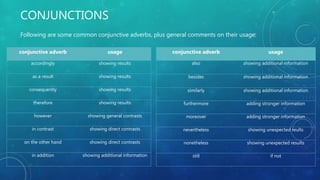
Following are some common conjunctive adverbs, plus general comments on their usage:
conjunctive adverb usage
accordingly showing results
as a result showing results
consequently showing results
therefore showing results
however showing general contrasts
in contrast showing direct contrasts
on the other hand showing direct contrasts
in addition showing additional information
conjunctive adverb usage
also showing additional information
besides showing additional information
similarly showing additional information
furthermore adding stronger information
moreover adding stronger information
nevertheless showing unexpected reults
nonetheless showing unexpected results
still if not
CONJUNCTIONS
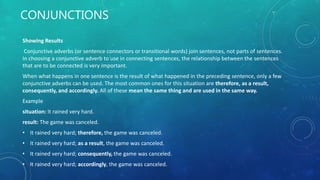
Showing Results
Conjunctive adverbs (or sentence connectors or transitional words) join sentences, not parts of sentences.
In choosing a conjunctive adverb to use in connecting sentences, the relationship between the sentences
that are to be connected is very important.
When what happens in one sentence is the result of what happened in the preceding sentence, only a few
conjunctive adverbs can be used. The most common ones for this situation are therefore, as a result,
consequently, and accordingly. All of these mean the same thing and are used in the same way.
Example
situation: It rained very hard.
result: The game was canceled.
• It rained very hard; therefore, the game was canceled.
• It rained very hard; as a result, the game was canceled.
• It rained very hard; consequently, the game was canceled.
• It rained very hard; accordingly, the game was canceled.
CONJUNCTIONS
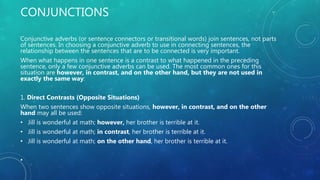
Conjunctive adverbs (or sentence connectors or transitional words) join sentences, not parts
of sentences. In choosing a conjunctive adverb to use in connecting sentences, the
relationship between the sentences that are to be connected is very important.
When what happens in one sentence is a contrast to what happened in the preceding
sentence, only a few conjunctive adverbs can be used. The most common ones for this
situation are however, in contrast, and on the other hand, but they are not used in
exactly the same way:
1. Direct Contrasts (Opposite Situations)
When two sentences show opposite situations, however, in contrast, and on the other
hand may all be used:
• Jill is wonderful at math; however, her brother is terrible at it.
• Jill is wonderful at math; in contrast, her brother is terrible at it.
• Jill is wonderful at math; on the other hand, her brother is terrible at it.
•
CONJUNCTIONS
2. Weak Contrasts
When two sentences show weak contrasts (for example, when one sentence is
affirmative and the other is negative, or when the sentences show ideas that contrast
but are not opposite), however can be used, but in contrast and on the other hand
can't:
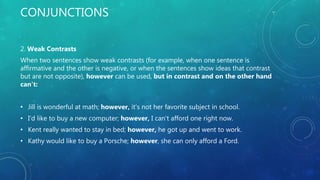
• Jill is wonderful at math; however, it's not her favorite subject in school.
• I'd like to buy a new computer; however, I can't afford one right now.
• Kent really wanted to stay in bed; however, he got up and went to work.
• Kathy would like to buy a Porsche; however, she can only afford a Ford.
CONJUNCTIONS
Showing Added Information
Conjunctive adverbs (which are sometimes also called sentence connectors or transitional words) are
commonly used in serious business, technical, and academic writing. Conjunctive adverbs are similar in
meaning to other types of connecting words such as and, but, or, etc., but they have one very important
difference: they join sentences, not parts of sentences.
In choosing which conjunctive adverb(s) to use in connecting sentences, the meanings of the sentences that
will be joined (or, more precisely, the relationship that exists between them) is very important. When a second
sentences adds information to the sentence which precedes it, only a few conjunctive adverbs can be used.
1. When the added information is of approximately equal "strength," use in addition or also:
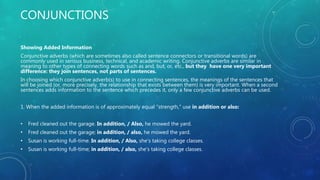
• Fred cleaned out the garage. In addition, / Also, he mowed the yard.
• Fred cleaned out the garage; in addition, / also, he mowed the yard.
• Susan is working full-time. In addition, / Also, she's taking college classes.
• Susan is working full-time; in addition, / also, she's taking college classes.
CONJUNCTIONS
2. When the added information is stronger than the information preceding it, use moreover or
furthermore:
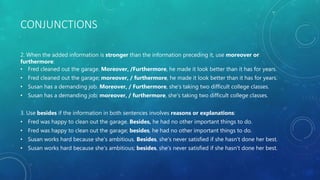
• Fred cleaned out the garage. Moreover, /Furthermore, he made it look better than it has for years.
• Fred cleaned out the garage; moreover, / furthermore, he made it look better than it has for years.
• Susan has a demanding job. Moreover, / Furthermore, she's taking two difficult college classes.
• Susan has a demanding job; moreover, / furthermore, she's taking two difficult college classes.
3. Use besides if the information in both sentences involves reasons or explanations:
• Fred was happy to clean out the garage. Besides, he had no other important things to do.
• Fred was happy to clean out the garage; besides, he had no other important things to do.
• Susan works hard because she's ambitious. Besides, she's never satisfied if she hasn't done her best.
• Susan works hard because she's ambitious; besides, she's never satisfied if she hasn't done her best.
CONJUNCTIONS
Showing Unexpected Results
Conjunctive adverbs join sentences, not parts of sentences. In choosing a conjunctive adverb, the
relationship between the sentences to be connected is very important.
When a sentence shows an unexpected result of another sentence, only a few conjunctive adverbs
be used. The most common ones are probably nevertheless, nonetheless, and still:
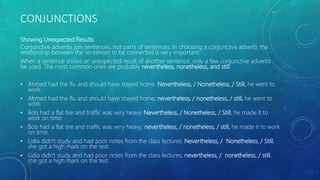
• Ahmed had the flu and should have stayed home. Nevertheless, / Nonetheless, / Still, he went to
work.
• Ahmed had the flu and should have stayed home; nevertheless, / nonetheless, / still, he went to
work.
• Bob had a flat tire and traffic was very heavy. Nevertheless, / Nonetheless, / Still, he made it to
work on time.
• Bob had a flat tire and traffic was very heavy; nevertheless, / nonetheless, / still, he made it to work
on time.
• Lidia didn't study and had poor notes from the class lectures. Nevertheless, / Nonetheless, / Still,
she got a high mark on the test.
• Lidia didn't study and had poor notes from the class lectures; nevertheless, / nonetheless, / still,
she got a high mark on the test.
CONJUNCTIVE ADVERB EXERCISE
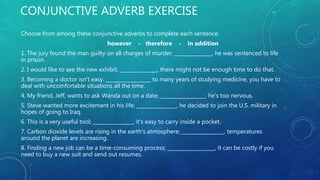
Choose from among these conjunctive adverbs to complete each sentence:
however - therefore - in addition
1. The jury found the man guilty on all charges of murder; _______________, he was sentenced to life
in prison.
2. I would like to see the new exhibit; _______________, there might not be enough time to do that.
3. Becoming a doctor isn't easy. __________________ to many years of studying medicine, you have to
deal with uncomfortable situations all the time.
4. My friend, Jeff, wants to ask Wanda out on a date; __________________, he's too nervous.
5. Steve wanted more excitement in his life; ________________, he decided to join the U.S. military in
hopes of going to Iraq.
6. This is a very useful tool; ________________, it's easy to carry inside a pocket.
7. Carbon dioxide levels are rising in the earth's atmosphere; _________________, temperatures
around the planet are increasing.
8. Finding a new job can be a time-consuming process; ___________________, it can be costly if you
need to buy a new suit and send out resumes.
INTERJECTIONS
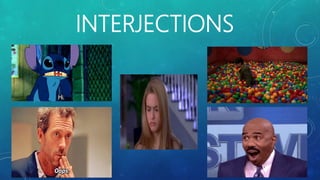
INTERJECTIONS
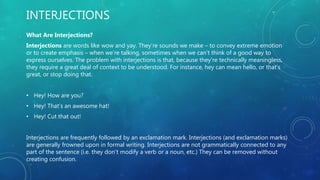
What Are Interjections?
Interjections are words like wow and yay. They’re sounds we make – to convey extreme emotion
or to create emphasis – when we’re talking, sometimes when we can’t think of a good way to
express ourselves. The problem with interjections is that, because they’re technically meaningless,
they require a great deal of context to be understood. For instance, hey can mean hello, or that’s
great, or stop doing that.
• Hey! How are you?
• Hey! That’s an awesome hat!
• Hey! Cut that out!
Interjections are frequently followed by an exclamation mark. Interjections (and exclamation marks)
are generally frowned upon in formal writing. Interjections are not grammatically connected to any
part of the sentence (i.e. they don’t modify a verb or a noun, etc.) They can be removed without
creating confusion.
INTERJECTIONS
Uses of Interjections
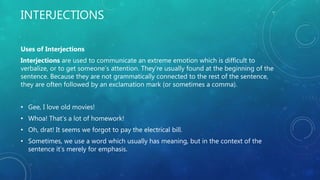
Interjections are used to communicate an extreme emotion which is difficult to
verbalize, or to get someone’s attention. They’re usually found at the beginning of the
sentence. Because they are not grammatically connected to the rest of the sentence,
they are often followed by an exclamation mark (or sometimes a comma).
• Gee, I love old movies!
• Whoa! That’s a lot of homework!
• Oh, drat! It seems we forgot to pay the electrical bill.
• Sometimes, we use a word which usually has meaning, but in the context of the
sentence it’s merely for emphasis.
INTERJECTIONS
Beginning of Sentences
When people think of interjections, they commonly think of them being used at the
beginning of the sentence. Many also associate interjections with a punctuation mark
designed to convey emotion: the exclamation point.
This is often true. Interjections can and do appear in the beginning of sentences. For
example:
• • “Yikes, I didn’t realize that there was a test on grammar today!”
• • “Oh no, I can’t believe that it is snowing here again!”
In both of these sentences the interjection - “yikes” and “oh no” appear at the
beginning of the sentence. In addition, in both of the sentences, the emotion is a strong
emotion and the sentence itself ends with an exclamation point.
INTERJECTIONS
Middle or End of Sentences
Interjections do not always have to be at the beginning of a sentence. They can appear
in the middle, at the end, or anyplace else where the author wants to interject a bit of
feeling and emotion.
• For example, in the sentence “So, it’s snowing again, huh?” the interjection is found at
the end. Here, the interjection is designed to express confusion (or perhaps dismay) at
the continued snow falling. In this sentence, the emotion wasn’t an emotion that
necessitated an exclamation point--instead, the interjection ‘huh’ turned the sentence
into a question.
The sentence “In my opinion, my gosh, this is just the smartest thing you have ever said”
the interjection is found in the middle. It designed to express or convey the author’s
emphasis on his opinion that the statement was smart. Again, no exclamation point is
required.
INTERJECTIONS
Stand-alone Sentence
An interjection can also be used by itself as a stand-alone sentence. For
example, look at the two sentences: “Oh gosh! I can’t believe how late it
is.” The interjection “oh gosh” is a stand-alone sentence. This is
grammatically correct, although “Oh Gosh” does not contain a subject
and action that is normally required for a complete thought to be
expressed. The interjection--or the emotion felt--is the entire point of the
sentence.
INTERJECTIONS
Interjections in Writing
• Interjections are not commonly used in formal or academic writing. Because of the
function that interjections serve, there is virtually no place for them in an academic
paper that is designed to convey facts. By definition, facts should be devoid of
emotion or opinion such as the emotions conveyed by interjections.
• Interjections are used most often in speech. While people don’t necessarily pause to
think about it, they use interjections all the time. This is even more true when you
consider the fact that common words used in pauses, such as “uh,” and “um” are
interjections.
• Interjections can find their way into fictional pieces, most often in the form of
dialogue. They can also be used in informal written communication between two
people, such as letters or emails.
INTERJECTIONS
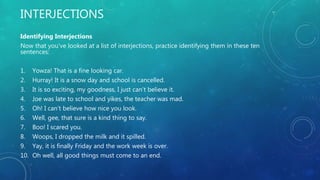
Identifying Interjections
Now that you’ve looked at a list of interjections, practice identifying them in these ten
sentences:
1. Yowza! That is a fine looking car.
2. Hurray! It is a snow day and school is cancelled.
3. It is so exciting, my goodness, I just can’t believe it.
4. Joe was late to school and yikes, the teacher was mad.
5. Oh! I can’t believe how nice you look.
6. Well, gee, that sure is a kind thing to say.
7. Boo! I scared you.
8. Woops, I dropped the milk and it spilled.
9. Yay, it is finally Friday and the work week is over.
10. Oh well, all good things must come to an end.
INTERJECTIONS
How to punctuate interjections.
Punctuation for an interjection will depend on the emotion and body language you hope to capture. Strong emotions,
such as anger, excitement, or surprise, need an exclamation point [!] to communicate the intensity.
• Ugh! I cannot believe we are eating leftover vegan burritos for a third night.
• Yowza! That's an astrophysicist dancing in the hallway!
An interjection meant to illustrate confusion, uncertainty, or disbelief will require a question mark [?] to help capture
the open mouth, shrug, blank look, or rolled eyes.
• Huh? You want me—the person with a D average—to help with your calculus homework?
• Oh, really? You killed a rattlesnake with a salad fork?
A comma [,] or period [.] will indicate weaker emotions, like indifference, doubt, or disdain. These two marks of
punctuation dial down the volume on the sentence.
• Meh, I don't really care that Pluto is no longer a planet.
• Pssst. Do you have the answer for number 7?
• Here comes Prof. Phillips. Uh-oh, did he catch sight of your cheat sheet?
• It looks like George is skipping class even though our group presentation is due today. Typical.
INTERJECTIONS
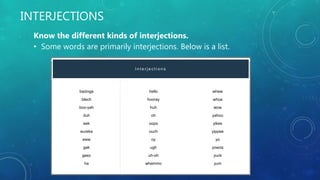
Know the different kinds of interjections.
• Some words are primarily interjections. Below is a list.
I n t e r j e c t i o n s
bazinga
blech
boo-yah
duh
eek
eureka
eww
gak
geez
ha
hello
hooray
huh
oh
oops
ouch
oy
ugh
uh-oh
whammo
whew
whoa
wow
yahoo
yikes
yippee
yo
yowza
yuck
yum
INTERJECTIONS
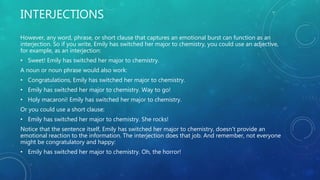
However, any word, phrase, or short clause that captures an emotional burst can function as an
interjection. So if you write, Emily has switched her major to chemistry, you could use an adjective,
for example, as an interjection:
• Sweet! Emily has switched her major to chemistry.
A noun or noun phrase would also work:
• Congratulations, Emily has switched her major to chemistry.
• Emily has switched her major to chemistry. Way to go!
• Holy macaroni! Emily has switched her major to chemistry.
Or you could use a short clause:
• Emily has switched her major to chemistry. She rocks!
Notice that the sentence itself, Emily has switched her major to chemistry, doesn't provide an
emotional reaction to the information. The interjection does that job. And remember, not everyone
might be congratulatory and happy:
• Emily has switched her major to chemistry. Oh, the horror!
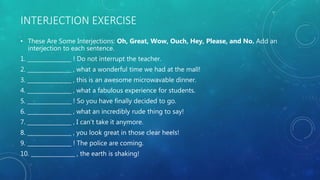
INTERJECTION EXERCISE
• These Are Some Interjections: Oh, Great, Wow, Ouch, Hey, Please, and No. Add an
interjection to each sentence.
1. ________________ ! Do not interrupt the teacher.
2. ________________ , what a wonderful time we had at the mall!
3. ________________ , this is an awesome microwavable dinner.
4. ________________ , what a fabulous experience for students.
5. ________________ ! So you have finally decided to go.
6. ________________ , what an incredibly rude thing to say!
7. ________________ , I can’t take it anymore.
8. ________________ , you look great in those clear heels!
9. ________________ ! The police are coming.
10. ________________ , the earth is shaking!
Oh, Great, Wow, Ouch, Hey, Please, and No.
11. ________________ , get out of here!
12. ________________ , I love this class.
13. ________________ , stop that Chris Brown record.
14. ________________ ! Come help me.
15. ________________ , I need more time!
REFERENCES
• http://www.grammarbook.com/grammar/pronoun.asp
• https://www.ego4u.com/en/cram-up/grammar/pronouns
• http://www.gingersoftware.com/content/grammar-rules/pronouns-2/
• http://www.myenglishpages.com/site_php_files/grammar-lesson
conjunctions.phphttp://partofspeech.org/conjunction/
• http://grammar.yourdictionary.com/parts-of-speech/conjunctions/what-is-a-conjunction.html
• http://www.smart-words.org/linking-words/conjunctions.html
• http://www.eslcafe.com/grammar.html
• King, G. (2009). Improve Your Grammar. Glasgow, UK: Collins.
• Lester, M. (2008). ESL Grammar. New York, USA: McGraw-Hill.
• Practice resource: Murphy, R. (2004). English Grammar in Use (3rd ed.). Cambridge, UK: CUP. Units 82-91

Closed class words

  • 1.
    UNIT 4 CLOSED CLASSWORDS HERNÁNDEZ DAHIRA IBARRA DEYANIRA ILLESCAS BRYAN JIMÉNEZ ANDREA LEÓN SALVADOR
  • 2.
    DEFINITION  In englishgramar, closed class words refers to the category of function words – that is, part of the speech (or word clases) that dont accept new members. Contrast with open class words.
  • 3.
    CLOSS CLASS WORDS Inenglish, include: • Pronouns • Prepositions • Determiners • Conjuctions • Interjections
  • 4.
    CLOSED CLASS WORDS •Closed class words are those belonging to the gramatical or function classes. Function words in english include: • Conjuctions (and, or, but, because, if) • Articles (the, a, an) • Demonstratives (this, that, these, those) • Prepositions (to, from, at, between, over) • To take one specific case, consider the word “and”
  • 5.
    CLOSED CLASS WORDS Closed-classwords or 'function words' are limited in number and act as markers or guides to the structure of a sentence. The role of articles is to signal nouns. For example: • The dog, a test, the fruit, an egg, etc.
  • 6.
    !! EXERCISE !! wordan a / Bed Fish Investigation computers Expensive purse Hard lessons Internet conference
  • 7.
    CLOSED CLASS WORDS Prepositionsmark special relationships between persons, objects, and locations. For example: • She is inside the house • The man is getting into the car • The bridge is over the river.
  • 8.
    !!EXERCISE…AGAIN!! 1. El gatoesta debajo de la mesa. * The cat is __________ the table. 2. La pelota esta encima del mueble. * The ball is _________ the furniture. 3. Hay un florero al lado del reloj. *There is a vase of flowers __________ the clock 4. La motocicleta está parqueada entre los autos. * The motorcycle is parked ___________ the cars.
  • 9.
    Conjunctions are connectorsthat link actors or objects, and specify relationships between clauses in the sentence. For example: Carolina loves to eat and sleep in class Should I take the Japanese or French class? I need to study more because Sylvia knows everything Closed Class Words
  • 10.
    GUESS WHAT….MORE EXERCISES!!! Sentences Use: Altough,or, then, so, and, where, since, but I don't know _______ I can buy a pair of jeans. She went to the shops _______ couldn't find anything that could fit her needs. Everybody likes him because he is nice ____ helpful ____ he was angry with her, he didn't utter a word. Keep quiet ______ go out.
  • 11.
    CLOSED CLASS WORDS Demonstrative wordsindicate out the thing referred to, for example: That kid (distance) Those bananas (distance) This notebook These keys
  • 12.
    A WILD EXERCISEIS APPROACHING
  • 13.
    CLOSED CLASS WORDS •The closed classes include pronouns (you, them), modal verbs (could, must), determiners (a, the), prepositions (of, in), and conjunctions (and, but). • New members of these classes are not added to the language very often. Instead they tend to gradually evolve from lexical words in a process called grammaticalization. • For example, the lexical verb go means 'to move (toward a goal).' But its progressive form be going (to) has evolved into a grammaticalized prospective (future) marker, as in She's going to love her gift. • The 'movement' meaning of go has been bleached out of the grammaticalized version and so the going in be going to can be considered to be a function word, rather than a content word.
  • 14.
    CLOSED CLASS WORDS •The closed classes represent a more restricted range of meanings, and the meanings of closed-class words tend to be less detailed and less referential than open-class words." • (M. Lynne Murphy, Lexical Meaning. Cambridge University Press, 2010)
  • 15.
  • 16.
    PRONOUNS Definition • A pronoun(I, me, he, she, herself, you, it, that, they, each, few, many, who, whoever, whose, someone, everybody, etc.) is a word that takes the place of a noun. • In the sentence Joe saw Jill, and he waved at her, the pronouns he and her take the place of Joe and Jill, respectively. There are three types of pronouns: subject (for example, he); object (him); or possessive (his).
  • 17.
    PRONOUNS - Another definition: Apronoun is a word that refers to or takes the place of a noun. The noun being referred to is called the antecedent. The identity of the pronoun is made clear by the antecedent. For example: • The boy said that he was tired. In this example, the pronoun “he” is referring back to the noun (antecedent) “boy.”
  • 18.
    PRONOUNS Personal Pronouns Possessive Adjectives andPronouns Reflexive Pronounssubject form object form possessive adjective possessive pronoun I me my mine myself you you your yours yourself he him his his himself she her her hers herself it it its its itself we us our ours ourselves you you your yours yourselves they them their theirs themselves Pronouns are words like I, me (personal pronouns) or my, mine (possessive pronouns).
  • 19.
    PRONOUN RULES There area few important rules for using pronouns. As you read through these rules and the examples in the next section, notice how the pronoun rules are followed. Soon you’ll see that pronouns are easy to work with. • Subject pronouns may be used to begin sentences. For example: We did a great job. • Subject pronouns may also be used to rename the subject. For example: It was she who decided we should go to Hawaii. • Indefinite pronouns don’t have antecedents. They are capable of standing on their own. For example: No one likes the sound of fingernails on a chalkboard. • Object pronouns are used as direct objects, indirect objects, and objects of prepositions. These include: you, me, him, her, us, them, and it. For example: David talked to her about the mistake. • Possessive pronouns show ownership. They do not need apostrophes. For example: The cat washed its whiskers.
  • 20.
    EXAMPLES OF PRONOUNS Inthe following examples, the pronouns are italicized. • We are going on vacation. • Don’t tell me that you can’t go with us. • Anybody who says it won’t be fun has no clue what they are talking about. • These are terribly steep stairs. • We ran into each other at the mall. • I’m not sure which is worse: rain or snow. • It is one of the nicest Italian restaurants in town. • Richard stared at himself in the mirror. • The laundry isn’t going to do itself. • Someone spilled orange juice all over the countertop!
  • 21.
    EXERCISE The following exerciseswill help you gain greater understanding about how pronouns work. Choose the best answer to complete each sentence. 1. This is __________ speaking. a)John b)He c)He john d)Am 2. Greg is as smart as __________ is. a)I b(me c)she d)we
  • 22.
    3. The dogchewed on __________ favorite toy. a)it’s b)it is c)its’ d)its 4. It could have been __________ . a)Jerry b)anyone c)better d)more difficult 5. Terry is taller than __________ am. a)I b)me c)she d)we
  • 23.
    PRONOUNS There are 8kinds of pronouns • Personal pronouns - I, me, you, she • Possessive pronouns – her, their, ours • Reflexive pronouns – myself, yourselves • Demonstrative pronouns – these, that • Interrogative pronouns – who?, which? • Relative pronouns – that, which, whose, what • Indefinite pronouns – all, any, someone • Reciprocal pronouns – one another, each other
  • 25.
    PERSONAL PRONOUN Personal Pronounsare pronouns that refer to a specific person or thing in a sentence and can be divided into two groups: nominative and objective. • Nominative personal pronouns can act as the subject of a sentence (I, you, he, she, it, we, they). For example: 1. I went to the store after work. You should not go to class if you are sick. • Objective personal pronouns, on the other hand, act as objects of a sentence (me, you, him, her, it, us, them). For example: 2. Alex came out with Joe and me. Melissa really likes him.
  • 26.
    PERSONAL PRONOUN • Personalpronouns have different forms depending on their person (first, second or third) and, usually, number (singular and plural). Sometimes, in the third person singular, they take different forms according to gender (he, she). They also take different forms depending on whether they stand for the subject or the object of the sentence.
  • 27.
    PERSONAL PRONOUN • Firstperson pronouns are I, me, we, us. These pronouns refer to the person doing the speaking or writing. • The second person pronoun, whether singular or plural, is always you, meaning the person or persons being spoken to or addressed. • Third person pronouns refer to those being spoken or written about: he, him, she, her, it, they, them. (Most third person pronouns refer to people, although they and them can refer to things and it is sometimes used about babies and animals. There are, as always in English, odd exceptions, such as the customary use of she or her for a ship.) (King, p. 80) • Academic writing generally requires the use of the third person.
  • 28.
    PERSONAL PRONOUN • Thesubject of a sentence (or clause) is the person or thing doing something — in other words, the subject of the verb. Subject pronouns are as follows: I, you, he, she, it, we, they, who, whoever. • The object of the sentence is whoever or whatever is having something done to it; it is the object of the verb: me, you, him, her, it, us, them, whom, whomever.
  • 29.
    PERSONAL PRONOUNS • Exercises Completewith the subject personal pronoun. 1. My name is Sue. (Sue) _________ am English. And this is my family. 2. My mum´s name is Angie. (Angie) _________ is from Germany. 3. Bob is my dad. (My dad) _________ is a waiter. 4. On the left you can see Simon. (Simon) _________ is my brother. 5. (Sue and Simon) _________ are twins.
  • 30.
    6. Our dogis a girl, Judy. (Judy) _________ is two years old. 7. (Sue, Simon, Angie and Bob) _________ live in Canterbury. 8. (Canterbury) _________ is not far from London. 9. My grandparents live in London. (My grandparents) _________ often come and see us. 10. What can _________ tell me about your family?
  • 31.
    POSSESIVE PRONOUN Possessive Pronounsare pronouns that show ownership; in other words, something belongs to someone else (my/mine, your/yours, his, her/hers, its, our/ours, their/theirs). For example: 1. That book is mine . 2. Their shoes are under the bed.
  • 32.
    POSSESIVE PRONOUN There aretwo main types of possessive pronouns: • Adjectival possessive pronouns (also a kind of determiner, because they tell us more about following nouns): my lecture notes, his jacket, our motor car, your house, their party. • Pronominal possessive pronouns which are used on their own: that textbook is mine; yours is over there; his is under the table; hers is lying on the bottom stair; this land is ours; theirs is down the road.
  • 33.
    POSSESIVE PRONOUN EXERCISE Choosethe best answer to complete each sentence. 1. The mother cat and __________ kittens napped in the sunshine. A. His B.Your C. Hers D. Her 2. I like cream cheese on _________ bagels. A. My B. Mine C. Your D. Our 3. ________ grandfather used to take us fishing. A. Mine B. My C. Our D. Ours 4. Elaine bought ________ dress at the mall. A. Yours B. Mine C. Her 5. The car lost _________ rear bumper in an accident. A. It’s B. Its C. His D. Her
  • 34.
    REFLEXIVE PRONOUN • ReflexivePronouns are pronouns that are used to show that the subject of the sentence is receiving the action of the verb (myself, yourself, himself, herself, itself, ourselves, themselves). • For example: 1. She can handle the situation herself. 2. We can write the paper ourselves.
  • 35.
    REFLEXIVE PRONOUN Another definition •Reflexive pronouns ‘reflect’ the action back to the self or subject: myself, yourself, herself, himself, itself, ourselves, yourselves, themselves — for example, we often say ‘Look after yourself’ to people we care about. • Sometimes, reflexive pronouns are used in an intensifying or clarifying way. For instance: ‘The funeral, featuring hymns the dead man himself had selected, took too long’; ‘Although the house itself was in good condition, its outbuildings were falling down.’
  • 36.
    REFLEXIVE PRONOUN EXERCISE Choosethe best answer to complete each sentence. 1. Each morning, I brush my teeth and stare at ______________ in the mirror. A. Himself B. Herself C. Myself D. Itself 2. Dad and I painted the trailer _______________. A. Myself B. Himself C. Itself D. Ourselves 3. The children made holiday decorations by ________________. A. Itself B. Ourselves C. Themselves D. Their selves 4. Paul copies his friend’s homework instead of doing it _______________. A. Itself B. Himself C. Myself D. Yourself 5. Please make ________________ at home while you wait. A. Themselves B. Himself C. Yourselves D. Herself
  • 37.
    Personal (Nominative) Personal (Objective) Possessive Reflexive I memy/mine myself you you your/yours yourself he him his himself she her her/hers herself it it its itself we us our/ours ourselves they them their/theirs themselves
  • 38.
    DEMONSTRATIVE PRONOUN • DemonstrativePronouns are pronouns that are used to identify nouns and answer the question “which one?” (this, that, these, those) • For example: 1. These are the books that John was talking about. *Here, the pronoun “these” identifies which books John was talking about.
  • 39.
    DEMONSTRATIVE PRONOUN These pronounshelp us ‘to demonstrate something or to point out things’ (King, p.85). Examples: 1. ‘This chicken dish looks delicious’; ‘Those rocks look too dangerous for fishing’; ‘These clothes are too warm for a sunny day.’ When demonstrative pronouns are used on their own, as in ‘That is not fair!’ it is very important that the listener or reader knows what is being referred to.
  • 40.
    DEMONSTRATIVE PRONOUN EXERCISE Choosethe best answer to complete each sentence. 1. ____________ was such an interesting experience. A. That B. These C. Those D. Such 2. Are ___________ your shoes? A. That B. Them C. Those D. This 3. You’ll have to get your own pen. ______________ is mine. A. That B. Those C. Such D. This 4. There is no end to ___________. A. Such B. Those C. This D. None 5. Because of their bad behavior, ____________ of the children were given allowances. A. None B. That C. Those D. Them
  • 41.
    INTERROGATIVE PRONOUN Interrogative Pronounsare pronouns that are used only in reference to a question (who, what, which, whom, whose). For example: • Which one of these pens is yours? • Who is that girl?
  • 42.
    INTERROGATIVE PRONOUN • who,what, which, whose, whom. Examples: 1. What time is it? 2. Who is the woman wearing the yellow scarf? 3. Which room is mine? 4. Whose bicycle was stolen? • Whom is tricky, and is falling into disuse because many people do not know how to use it correctly. Who is a subject pronoun, while whom is an object pronoun; it should only be used as the object of a verb – e.g. ‘To whom shall I address the parcel?’, ‘By whom was the letter sent?’, ‘Whom shall I ask?’ • If you’re not sure which of who and whom to use, choose who.
  • 43.
    INTERROGATIVE PRONOUN EXERCISE Fillin the blanks with an interrogative pronoun. 1. __________ threw the football? A. who B. what C. which D. whose 2. ____________ would you prefer, coffee or tea? A.who B. whom C. which D. whose 3. ______________ time do we need to be at the airport? A. which B. what C. whose D. whom 4. _____________ car is that? A. whom B. whose C. what D. who 5. ____________ is your sister’s name? A. who B. whom C. what D. whose
  • 44.
    RELATIVE PRONOUN • RelativePronouns are pronouns that are used to connect clarifying information to nouns or other pronouns within a sentence (who, that, which, whom, whose, whoever, whichever, whomever, whatever). • Who vs. Whom - Who is used when referring to a subject. Who went to the store after work? Who sings this song? - Whom is used when referring to an object. With whom did Alex go out? The letter should be addressed to whom?
  • 45.
    RELATIVE PRONOUN Who vs.That • Who is used to refer to people or animals with names. Liz, who wrote the review, got in trouble. • That is used to refer to things. The paper that I wrote last night vanished. That vs. Which • That is used in essential clauses (clauses necessary for understanding the subject of a sentence). The pizza parlor that is down the street from the college is great. *The subject is unclear without the additional information. Which pizza parlor? The one that is down the street from the college. • Which is used in nonessential clauses (clauses unnecessary for understanding the subject of a sentence). My mom’s jewelry was stolen, which upset her very much. *The subject is clear without the additional information.
  • 46.
    RELATIVE PRONOUN • That,which, who, whom, whose, whatever, whoever, whomever. Relative pronouns are used to introduce relative clauses. Examples: 1. I wish I knew whose shoes had made the carpet so muddy. 2. The suit that she wore to the wedding was ruined by the rain. 3. Newcastle buses, which usually run on time, terminate near the station. 4. We’re going on a picnic to the beach next weekend, whatever the weather is like. 5. The mayor, who had once been a leading business woman, was accused of corruption. 6. The assault victim had nobody to whom to turn for help. 7. Whoever caused the company’s bankruptcy should be held responsible. 8. He should make reparation to whomever his crimes have affected. * That is used to introduce what we call a definitional relative clause — a clause that provides an essential piece of information about a noun. For example: I want you to cut down the tree that hangs over the back fence. * Which is used to introduce a non-definitional clause — in other words, a clause adding extra information not essential to understanding the main idea of the sentence. For example: He bought the Porsche, which everybody knows he can’t afford, last month.
  • 47.
    RELATIVE PRONOUN EXERCISE Choosethe best answer to complete each sentence. 1. The festival, ______________ lasted all day, ended with a banquet. A. That B. Who C. Which D. What 2. I am looking for someone __________ can watch my dog while I go on vacation. A. Which B. Who C. Whom D. Whoever 3. The police needed details _____________ could help identify the robber. A. Who B. Whatever C. That D. What 4. I’d like to take you to a café _______________ serves excellent coffee. A. What B. Whatever C. Which D. Whichever 5. The clubhouse, in __________ the dance was held, housed about 200 people. A. Which B. Where C. That D. Whom
  • 48.
    INDEFINITE PRONOUN • IndefinitePronouns are pronouns that are used in reference to a person or thing that is not specific or not known. Indefinite pronouns are also used to identify a general group of people or things (i.e. everyone, everybody, anyone, anybody, somebody, most, all, each every, some, none, one, few, both, many, several). For example: 1. Everybody has to take the Writing Proficiency Examination in order to graduate. 2. All of the seniors were excited for graduation.
  • 49.
    INDEFINITE PRONOUN • All,any, every, everything, each, some, one, both, either, neither, few, little, less, least, many, everyone, someone, no one, something, anybody, nobody, more, most, nothing, enough, plenty, several. (King, p. 89) What do they have in common? They all concern number or quantity. - Some indefinite pronouns should only be applied to uncountable nouns, because they concern portions rather than numbers of something: a little sugar, much trouble, less fat. (Remember that when indefinite pronouns precede nouns like this, they are actually called indefinite determiners.) - But, we say many cakes, many problems, fewer calories. Many and fewer are used to indicate number and so are used with countable nouns. - Make sure that pronouns agree in grammatical number (singular or plural) with any nouns to which they may refer. For instance, each, one, either, neither, someone, anyone, no one, nobody and something are all singular. - Make sure that an indefinite pronoun agrees in number with a verb or personal pronoun in a sentence – e.g. ‘Each (singular) one of us has (singular) problems’; ‘Neither (sing.) of the actors could remember her (sing.) lines,’ but ‘Few (plural) of the players are (plural) likely to turn up on such a cold day.’ (King, p. 89)
  • 50.
    INDEFINITE PRONOUN EXERCISE Choosethe best answer to complete each sentence. 1. __________________ is making my computer act up. A. Anyone B. Something C. Each D. Everyone 2. Does _______________ know what’s happening tonight? A. Anybody B. Anyone C. Someone D. A, B, and C 3. _____________ baker presented a beautiful cake to the king. A. The B. One C. Each D. Both 4. I don’t know __________ of the answers. A. Anyone B. Any C. Everyone D. No one 5. ____________ happens for a reason. A. Anybody B. Everything C. Some D. Somebody
  • 51.
    RECIPROCAL PRONOUN • ReciprocalPronouns are pronouns that are used to refer to a mutual set of people (each other, each other’s, one another, one another’s). • For example: 1. We need to help one another survive. 2. They had remembered each other’s phone numbers.
  • 52.
    RECIPROCAL PRONOUN • Thereare only two reciprocal pronouns: each other and one another. As the term ‘reciprocal’ indicates, they express a mutual, give-and-take relationship. • Each other refers to two people or things — e.g. ‘The brothers are no longer talking to each other.’ • One another is usually meant to refer to more than two — e.g. ‘The people of the small community helped one another through family crises.’
  • 53.
    INTENSIVE PRONOUN • IntensivePronouns are pronouns that are used only to place emphasis on the subject and are not essential to the meaning of the sentence. Note: These pronouns look the same as reflexive pronouns, but they act differently in the sentence and are always placed next to the subject that they are emphasizing (myself, yourself, himself, herself, itself, ourselves, themselves). • For example: - You yourself must go to the police station.
  • 54.
  • 55.
    PREPOSITIONS What is apreposition? • A preposition is a word or set of words that indicates location (in, near, beside, on top of) or some other relationship between a noun or pronoun and other parts of the sentence (about, after, besides, instead of, in accordance with). A preposition isn't a preposition unless it goes with a related noun or pronoun, called the object of the preposition • A preposition shows the relationship between a noun, pronoun, or another word in the sentence. It establishes the relationship between its object and another part of the sentence such as space or time. • A preposition is a word used to link nouns, pronouns, or phrases to other words within a sentence. Prepositions are usually short words, and they are normally placed directly in front of nouns. In some cases, you’ll find prepositions in front of gerund verbs.
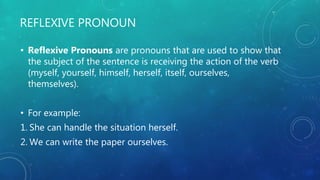
  • 56.
    PREPOSITIONS Examples: • Let's meetbefore noon. Before is a preposition; noon is its object. • We've never met before. There is no object; before is an adverb modifying met.
  • 57.
    TYPES OF PREPOSITIONS •Prepositions of time
  • 59.
    TYPES OF PREPOSITIONS •Prepositions of place (position & direction)
  • 61.
  • 62.
    EXERCISES I. Complete theexercise with convenient prepositions. 1. Nice meet you. 2. Don’t be late school. 3. Are you the new student Portugal? 4. Are you a teacher this school? 5. Jessica is vacation. She is Italy now. • In • On • At • To • For • By • From • Since
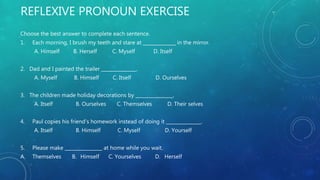
  • 63.
    • In • Between •Next to • Behind • Under • In front of
  • 64.
    1. 1666, agreat fire broke out in London. 2. I don't like walking alone in the streets night. 3. What are you doing the afternoon? 4. My friend has been living in Canada two years. 5. I have been waiting for you seven o'clock. 6. I will have finished this essay Friday. • At • For • Since • To • In • By • On
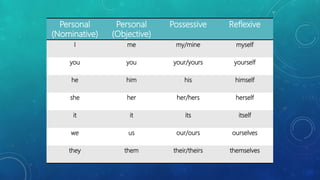
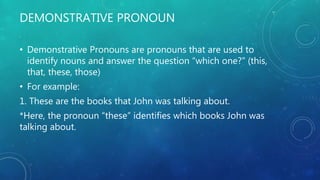
  • 65.
  • 71.
  • 72.
    DETERMINERS Determiners are usedto identify things in further detail. • They are used in front of nouns to indicate whether you are referring to something specific or something of a particular type. • The definite and indefinite articles a/an/the are all determiners. • You use a specific determiner when people know exactly which thing(s) or person/people you are talking about.
  • 73.
    DETERMINERS Types of determiners: •the articles : a / an / the • demonstratives : this / that / these / those • possessives (possessive adjectives): my / your /his / her / its / our / your / their
  • 74.
    DETERMINERS Examples: - "The (article)dog barked at the boy." - "These (demonstratives) apples are rotten." - "Their (possessive) bus was late." - "Have you seen my (possessive) keys?" • You use general determiners to talk about how much stuff or how many people or things you are talking about.
  • 75.
    DETERMINERS • More generaldeterminers are quantifiers
  • 76.
    DETERMINERS Examples: • "Have yougot any English books I could borrow?" • "There is enough food to feed everyone." • "I don't teach online every day."
  • 77.
    DETERMINERS Number as determiners •Numbers act as determiners too, they show how many things or people there are: 1, 2, 3... For example: • "I teach online for 3 days a week."
  • 78.
    DETERMINERS Either and neither Eitherand neither are used in sentences concerning a possible choice between two items. • Either can mean one or the other (of two) or each of two. For example: • I've got tea and coffee, so you can have either. (One or the other) The room has a door at either end. (Both) Neither means not the first one and not the second one. For example: • Neither of the students were listening.
  • 79.
  • 80.
    CONJUNCTIONS What is aconjunction? • A conjunction is the glue that holds words, phrases and clauses (both dependent and independent) together. There are three different kinds of conjunctions––coordinating, subordinating, and correlative––each serving its own, distinct purpose, but all working to bring words together. Another definition… • The conjunction is the part of speech used as a “joiner” for words, phrases, or clauses in a particular sentence. It links these words or groups of words together, in such a way that certain relationships among these different parts of the sentence will be established, and the thoughts that all of these convey will be connected.
  • 81.
    CONJUNCTIONS What are theDifferent Types of Conjunctions? In the English language, conjunctions come in three basic types: • The coordinating conjunctions: used to connect two independent clauses. • The subordinating conjunctions: used to establish the relationship between the dependent clause and the rest of the sentence. • The correlative conjunctions: used to join various sentence elements which are grammatically equal.
  • 82.
    CONJUNCTIONS What Is aCoordinating Conjunction? Coordinating conjunctions are what come to most people’s minds when they hear the word “conjunction.” They can join together words, phrases and independent clauses. There are seven of them, and they’re easy to remember if you can just remember FANBOYS: • For - Explains reason or purpose (just like “because”): I go to the park every Sunday, for I love to watch the ducks on the lake. • And - Adds one thing to another: I go to the park every Sunday to watch the ducks on the lake and the shirtless men playing soccer. • Nor - Used to present an alternative negative idea to an already stated negative idea: I don’t go for the fresh air nor really for the ducks. Honestly, I just like the soccer. • But - Shows contrast: The soccer in the park is entertaining in the winter, but it’s better in the heat of summer. • Or - Presents an alternative or a choice: The men play on teams: shirts or skins. • Yet - Introduces a contrasting idea that follows the preceding idea logically (similar to “but”): I always take a book to read, yet I never seem to turn a single page. • So - Indicates effect, result or consequence: I’ve started dating one of the soccer players, so now I have an excuse to watch the game each week.
  • 83.
    CONJUNCTIONS Among the coordinatingconjunctions, the most common, of course, are and, but, and or. It might be helpful to explore the uses of these three little words. AND • To suggest that one idea is chronologically sequential to another: "Tashonda sent in her applications and waited by the phone for a response." • To suggest that one idea is the result of another: "Willie heard the weather report and promptly boarded up his house." • To suggest that one idea is in contrast to another (frequently replaced by but in this usage): "Juanita is brilliant and Shalimar has a pleasant personality. • To suggest an element of surprise (sometimes replaced by yet in this usage): "Hartford is a rich city and suffers from many symptoms of urban blight." • To suggest that one clause is dependent upon another, conditionally (usually the first clause is an imperative): "Use your credit cards frequently and you'll soon find yourself deep in debt." top • To suggest a kind of "comment" on the first clause: "Charlie became addicted to gambling — and that surprised no one who knew him."
  • 84.
    CONJUNCTIONS BUT • To suggesta contrast that is unexpected in light of the first clause: "Joey lost a fortune in the stock market, but he still seems able to live quite comfortably." • To suggest in an affirmative sense what the first part of the sentence implied in a negative way (sometimes replaced by on the contrary): "The club never invested foolishly, but used the services of a sage investment counselor." • To connect two ideas with the meaning of "with the exception of" (and then the second word takes over as subject): "Everybody but Golden breath is trying out for the team."
  • 85.
    CONJUNCTIONS OR • To suggestthat only one possibility can be realized, excluding one or the other: "You can study hard for this exam or you can fail." • To suggest the inclusive combination of alternatives: "We can broil chicken on the grill tonight, or we can just eat leftovers. • To suggest a refinement of the first clause: "Smith College is the premier all-women's college in the country, or so it seems to most Smith College alumnae." • To suggest a restatement or "correction" of the first part of the sentence: "There are no rattlesnakes in this canyon, or so our guide tells us." • To suggest a negative condition: "The New Hampshire state motto is the rather grim "Live free or die." top • To suggest a negative alternative without the use of an imperative (see use of and above): "They must approve his political style or they wouldn't keep electing him mayor."
  • 86.
    CONJUNCTIONS • The Others. . . The conjunction NOR is not extinct, but it is not used nearly as often as the other conjunctions, so it might feel a bit odd when nor does come up in conversation or writing. Its most common use is as the little brother in the correlative pair, neither-nor (see below): • He is neither sane nor brilliant. • That is neither what I said nor what I meant. It can be used with other negative expressions: • That is not what I meant to say, nor should you interpret my statement as an admission of guilt. The word YET functions sometimes as an adverb and has several meanings: in addition ("yet another cause of trouble" or "a simple yet noble woman"), even ("yet more expensive"), still ("he is yet a novice"), eventually ("they may yet win"), and so soon as now ("he's not here yet"). It also functions as a coordinating conjunction meaning something like "nevertheless" or "but." The word yet seems to carry an element of distinctiveness that but can seldom register. • John plays basketball well, yet his favorite sport is badminton. • The visitors complained loudly about the heat, yet they continued to play golf every day. In sentences such as the second one, above, the pronoun subject of the second clause ("they," in this case) is often left out. When that happens, the comma preceding the conjunction might also disappear: "The visitors complained loudly yet continued to play golf every day." • Yet is sometimes combined with other conjunctions, but or and. It would not be unusual to see and yet in sentences like the ones above. This usage is acceptable.
  • 87.
    CONJUNCTIONS The word FORis most often used as a preposition, of course, but it does serve, on rare occasions, as a coordinating conjunction. Some people regard the conjunction for as rather highfalutin and literary, and it does tend to add a bit of weightiness to the text. Beginning a sentence with the conjunction "for" is probably not a good idea, except when you're singing "For he's a jolly good fellow. "For" has serious sequential implications and in its use the order of thoughts is more important than it is, say, with because or since. Its function is to introduce the reason for the preceding clause: • John thought he had a good chance to get the job, for his father was on the company's board of trustees. • Most of the visitors were happy just sitting around in the shade, for it had been a long, dusty journey on the train. Be careful of the conjunction SO. Sometimes it can connect two independent clauses along with a comma, but sometimes it can't. For instance, in this sentence, • Soto is not the only Olympic athlete in his family, so are his brother, sister, and his Uncle Chet. Where the word so means "as well" or "in addition," most careful writers would use a semicolon between the two independent clauses. In the following sentence, where so is acting like a minor-league "therefore," the conjunction and the comma are adequate to the task: • Soto has always been nervous in large gatherings, so it is no surprise that he avoids crowds of his adoring fans. Sometimes, at the beginning of a sentence, so will act as a kind of summing up device or transition, and when it does, it is often set off from the rest of the sentence with a comma: • So, the sheriff peremptorily removed the child from the custody of his parents.
  • 88.
    COORDINATING CONJUNCTION EXERCISES Completeeach sentence using the correct coordinating conjunction from the parenthesis: 1. My car has a radio _________ a CD player. (but, or, and) 2. Sharon hates to listen to rap music, _________ will she tolerate heavy metal. (but, nor, or) 3. Carol wanted to drive to Colorado, _________ Bill insisted that they fly. (and, or, but) 4. I’m afraid of heights, _________ I appreciate the view from the top of this building. (and, yet, nor) 5. I have to be on time, _________ my boss will be annoyed if I’m late. (and, nor, for) 6. Do you like chocolate _________ vanilla ice cream better? (or, nor, and) 7. I have to go to work at six, _________ I’m waking up at four. (but, so, yet) 8. I was on time, _________ everyone else was late. (so, but, for) 9. Nadia doesn’t like to drive, _________ she takes the bus everywhere. (but, yet, so) 10. Our trip to the museum was interesting, _________ there were several new artifacts on display. (but, for, yet)
  • 89.
    CONJUNCTIONS What Is aSubordinating Conjunction? A subordinating conjunction always introduces a dependent clause, tying it to an independent clause. In contrast to coordinating conjunctions, a subordinate conjunction can often come first in a sentence. This is due simply to the nature of the relationship between the dependent and the independent clause. In English, there are lots of subordinating conjunctions, but the most common ones are "after," "although," "as," "because," "before," "how," "if," "once," "since," "than," "that," "though," "until," "when," "where," "whether," and "while."
  • 90.
    CONJUNCTIONS Here are afew examples of how subordinating conjunctions are used: • after – later than the time that : later than when. “Your heart will break like mine, and you’ll want only me after you’ve gone” (Ella Fitzgerald). • although – despite the fact that : used to introduce a fact that makes another fact unusual or surprising. “Although I’ve been here before, he’s just too hard to ignore” (Amy Winehouse). • as – used to introduce a statement which indicates that something being mentioned was known, expected, etc. “As I walk through the valley of the shadow of death, I take a look at my life and realize there’s nothing left” (Coolio). • as long as – We use as long as to refer to the intended duration of a plan or idea, most commonly referring to the future. “I don’t care who you are, where you’re from or what you did as long as you love me” (Backstreet Boys).
  • 91.
    CONJUNCTIONS • because –for the reason that. “Because of you, I never stray too far from the sidewalk” (Kelly Clarkson). • before – earlier than the time that : earlier than when. “Just call me angel of the morning, angel. Just touch my cheek before you leave me, baby” (Juice Newton). • even if – to express condition. “Even if the sky is falling down, you’ll be my only” (Jay Sean). • if – used to talk about the result or effect of something that may happen or be true. “If you leave me now, you’ll take away the biggest part of me” (Peter Cetera/Chicago). • once – at the moment when : as soon as. “Once you pop, you can’t stop” (Pringles commercials). • since – used to introduce a statement that explains the reason for another statement. “I guess I’ll never be the same since I fell for you” (B.B. King).
  • 92.
    CONJUNCTIONS • that –used to introduce a clause that states a reason or purpose. “Baby, now that I’ve found you, I won’t let you go” (Tony Macaulay/John MacLeod). • than - used to introduce the second or last of two or more things or people that are being compared — used with the comparative form of an adjective or adverb. “My sister is older than I am” • though – to express contrast or concession. “Walk on through the wind, walk on through the rain though your dreams be tossed and blown” (Rodgers and Hammerstein). • unless – to express condition. “We’re never going to survive unless we get a little crazy” (Seal). • until – up to the time or point that something happened. • “[You] don’t know what you’ve got ‘til it’s gone” (Cinderella).
  • 93.
    CONJUNCTIONS • when –at or during the time that something happened. “When I see you smile, I can face the world” (Bad English). • where – at or in the place that something happened. “There’s a light burning bright, showing me the way, but I know where I’ve been” (Scott Wittman). • Whether - used to indicate choices or possibilities. “Bruno wasn’t sure whether to go to India or Thailand” • while – during the time that something happened. “I look at the world, and I notice it’s turning while my guitar gently weeps” (The Beatles).
  • 94.
    SUBORDINATING CONJUNCTION EXERCISES Choosefrom among these subordinating conjunctions to complete each sentence: although - as long as - because - even if - so that - unless - until - while 1. She has decided to move to Portland _______________ there are more opportunities for employment in that city. 2. You can borrow my car ________________ you agree to be very careful with it. 3. They'll have a good corn harvest this year _______________ it rains a lot and prevents them from harvesting their crops. 4. Our neighbor is going to buy a gun ________________ she can protect herself from intruders who break into her apartment. 5. _______________ he can save a lot of money by taking the bus, Russ still drives his car into the city every day. 6. Ronald is going to finish his homework ________________ it takes him all night.
  • 95.
    although - aslong as - because - even if - so that - unless - until - while 7. My daughter can't wait _____________ she gets her new bike. 8. Stay in the car _______________ I go into the store. I'll be right back. 9. It's a good idea to go to college for four years _______________ it's possible to get a good job without a degree. 10. ________________ he's overweight, Tony eats a lot of food before he goes to bed. That's not healthy. 11. The police can't arrest the suspect in the crime______________ they have more evidence against him. 12. Tim's parents will let him have his own car _______________ he pays for his own insurance and doesn't get into any trouble with it.
  • 96.
    CONJUNCTIONS Another types ofSubordinating Conjunctions • Conjunctions Concession: though, although, even though, while • Conjunctions Condition: if, only if, unless, until, provided that, assuming that, even if, in case (that), lest • Conjunctions Comparison: than, rather than, whether, as much as, whereas • Conjunctions Time: after, as long as, as soon as, before, by the time, now that, once, since, till, until, when, whenever, while • Conjunctions Reason: because, since, so that, in order (that), why • Relative Adjective: that, what, whatever, which, whichever • Relative Pronoun: who, whoever, whom, whomever, whose • Conjunctions Manner: how, as though, as if • Conjunctions Place: where, wherever
  • 97.
    CONJUNCTIONS What Are CorrelativeConjunctions? • Correlative conjunctions are sort of like tag-team conjunctions. They come in pairs, and you have to use both of them in different places in a sentence to make them work. They include pairs like “both/and,” “whether/or,” “either/or,” “neither/nor,” “not/but” and “not only/but also.” 1. Either/or: This conjunction is commonly used to convey a choice or possibilities. We can use ‘or’ separately as well but that would not convey choice however an option. Example: I want either the cheesecake or the frozen hot chocolate. Either Samuel or Chris must have done this mischief. 2. Neither/nor: This conjunction is used to negate two different choices. Neither is used with ‘nor’ to indicate two or more people, things, actions, etc. where in something is not true. Example: Jim is neither particularly stupid nor extremely smart. Neither Batman, nor Superman can save Gotham.
  • 98.
    CONJUNCTIONS 3. Not only/butalso: This conjunction is used to combine sentences that are demonstrating two choices that are contradictorily typical. It is used to say that both of two related statements or sentences are true. Example: His new car is not only super fast but also very luxurious. It snowed not only in Seattle, but also in neighboring cities. 4. Not/but: This conjunction is used when you want to negate one choice and highlight another, i.e. when something is not X, but Y. The example below will illustrate it better: Example: He hit not one, but three homeruns that evening. 5. Whether/or: This conjunction is used to show two different options within a sentence and can be used both the manners of confirmation and negation. Example: "Whether you like her or not isn't the problem," I said. Andrew wasn’t sure whether to go on holiday or stay at home. 6. Both/and : It is used for combining two elements words or phrases of exactly same importance in a sentence. Example: Both Maria and Jack are going to the library. Adrian enjoyed both the movie and the popcorn.
  • 99.
    CONJUNCTIONS Correlative Conjunctions: They arealways used in pairs and denote equality; and show the relationship between ideas expressed in different parts of a sentence - and thus make the joining tighter and more emphatic. When joining singular and plural subjects, the subject closest to the verb determines whether the verb is singular or plural. as . . . as just as . . . so both . . . and hardly . . . when scarcely . . . when either . . . or neither . . . nor if . . . then not . . . but what with . . . and whether . . . or not only . . . but also no sooner . . . than rather . . . than
  • 100.
    CORRELATIVE CONJUNCTION EXERCISES Choosethe correct answer: 1. _____ Alex _____ Carlos applied for the job. A: Whether ... or B: Both … and 2. I found _____ my homework _____ my textbook under my bed. A: both ... and B: whether ... Or 3. I can’t decide _____ I should take French next year _____ take Spanish. A: either ... or B: whether ... Or 4. 4. ____ my brother _____ my sister can go to the game. A: Whether ... or B: Neither … nor
  • 101.
    5. _____ youclean your room _____ you will stay home this weekend. A: Either … or B: Neither … nor 6. Marissa found _____ _____ the shoes she had lost _____ _____ her favorite necklace. A: neither ... nor B: not only ... but also 7. _____ we go to San Francisco _____ New York for our holidays, I’ll be happy. A: Whether … or B: Either ... Or 8._____ _____ did she do well on the math test, _____ she _____ got an A on her social studies report. A: Either … or B: Not only ... but also
  • 102.
    CONJUNCTIONS Conjunctive Adverb Although aconjunctive adverb is not a real conjunction, this kind of words functions as conjunctions in a sentence. They are often used as a linking device between ideas. They show logical relationships expressed in clauses, sentences or paragraphs. Conjunctive adverbs are very emphatic, so they should be used sparingly. Conjunctive adverbs (which are sometimes also called sentence connectors or transitional words) are commonly used in serious business, technical, and academic writing. Conjunctive adverbs are similar in meaning to other types of connecting words such as and, but, or, etc., but they have one very important difference: they join sentences, not parts of sentences. Conjunctive adverbs also have special punctuation: with them, a semicolon or a period is used after the first sentence, and a comma is usually used after the conjunctive adverb. After the comma, the connected sentence follows.
  • 103.
    CONJUNCTIONS Following are somecommon conjunctive adverbs, plus general comments on their usage: conjunctive adverb usage accordingly showing results as a result showing results consequently showing results therefore showing results however showing general contrasts in contrast showing direct contrasts on the other hand showing direct contrasts in addition showing additional information conjunctive adverb usage also showing additional information besides showing additional information similarly showing additional information furthermore adding stronger information moreover adding stronger information nevertheless showing unexpected reults nonetheless showing unexpected results still if not
  • 104.
    CONJUNCTIONS Showing Results Conjunctive adverbs(or sentence connectors or transitional words) join sentences, not parts of sentences. In choosing a conjunctive adverb to use in connecting sentences, the relationship between the sentences that are to be connected is very important. When what happens in one sentence is the result of what happened in the preceding sentence, only a few conjunctive adverbs can be used. The most common ones for this situation are therefore, as a result, consequently, and accordingly. All of these mean the same thing and are used in the same way. Example situation: It rained very hard. result: The game was canceled. • It rained very hard; therefore, the game was canceled. • It rained very hard; as a result, the game was canceled. • It rained very hard; consequently, the game was canceled. • It rained very hard; accordingly, the game was canceled.
  • 105.
    CONJUNCTIONS Conjunctive adverbs (orsentence connectors or transitional words) join sentences, not parts of sentences. In choosing a conjunctive adverb to use in connecting sentences, the relationship between the sentences that are to be connected is very important. When what happens in one sentence is a contrast to what happened in the preceding sentence, only a few conjunctive adverbs can be used. The most common ones for this situation are however, in contrast, and on the other hand, but they are not used in exactly the same way: 1. Direct Contrasts (Opposite Situations) When two sentences show opposite situations, however, in contrast, and on the other hand may all be used: • Jill is wonderful at math; however, her brother is terrible at it. • Jill is wonderful at math; in contrast, her brother is terrible at it. • Jill is wonderful at math; on the other hand, her brother is terrible at it. •
  • 106.
    CONJUNCTIONS 2. Weak Contrasts Whentwo sentences show weak contrasts (for example, when one sentence is affirmative and the other is negative, or when the sentences show ideas that contrast but are not opposite), however can be used, but in contrast and on the other hand can't: • Jill is wonderful at math; however, it's not her favorite subject in school. • I'd like to buy a new computer; however, I can't afford one right now. • Kent really wanted to stay in bed; however, he got up and went to work. • Kathy would like to buy a Porsche; however, she can only afford a Ford.
  • 107.
    CONJUNCTIONS Showing Added Information Conjunctiveadverbs (which are sometimes also called sentence connectors or transitional words) are commonly used in serious business, technical, and academic writing. Conjunctive adverbs are similar in meaning to other types of connecting words such as and, but, or, etc., but they have one very important difference: they join sentences, not parts of sentences. In choosing which conjunctive adverb(s) to use in connecting sentences, the meanings of the sentences that will be joined (or, more precisely, the relationship that exists between them) is very important. When a second sentences adds information to the sentence which precedes it, only a few conjunctive adverbs can be used. 1. When the added information is of approximately equal "strength," use in addition or also: • Fred cleaned out the garage. In addition, / Also, he mowed the yard. • Fred cleaned out the garage; in addition, / also, he mowed the yard. • Susan is working full-time. In addition, / Also, she's taking college classes. • Susan is working full-time; in addition, / also, she's taking college classes.
  • 108.
    CONJUNCTIONS 2. When theadded information is stronger than the information preceding it, use moreover or furthermore: • Fred cleaned out the garage. Moreover, /Furthermore, he made it look better than it has for years. • Fred cleaned out the garage; moreover, / furthermore, he made it look better than it has for years. • Susan has a demanding job. Moreover, / Furthermore, she's taking two difficult college classes. • Susan has a demanding job; moreover, / furthermore, she's taking two difficult college classes. 3. Use besides if the information in both sentences involves reasons or explanations: • Fred was happy to clean out the garage. Besides, he had no other important things to do. • Fred was happy to clean out the garage; besides, he had no other important things to do. • Susan works hard because she's ambitious. Besides, she's never satisfied if she hasn't done her best. • Susan works hard because she's ambitious; besides, she's never satisfied if she hasn't done her best.
  • 109.
    CONJUNCTIONS Showing Unexpected Results Conjunctiveadverbs join sentences, not parts of sentences. In choosing a conjunctive adverb, the relationship between the sentences to be connected is very important. When a sentence shows an unexpected result of another sentence, only a few conjunctive adverbs be used. The most common ones are probably nevertheless, nonetheless, and still: • Ahmed had the flu and should have stayed home. Nevertheless, / Nonetheless, / Still, he went to work. • Ahmed had the flu and should have stayed home; nevertheless, / nonetheless, / still, he went to work. • Bob had a flat tire and traffic was very heavy. Nevertheless, / Nonetheless, / Still, he made it to work on time. • Bob had a flat tire and traffic was very heavy; nevertheless, / nonetheless, / still, he made it to work on time. • Lidia didn't study and had poor notes from the class lectures. Nevertheless, / Nonetheless, / Still, she got a high mark on the test. • Lidia didn't study and had poor notes from the class lectures; nevertheless, / nonetheless, / still, she got a high mark on the test.
  • 110.
    CONJUNCTIVE ADVERB EXERCISE Choosefrom among these conjunctive adverbs to complete each sentence: however - therefore - in addition 1. The jury found the man guilty on all charges of murder; _______________, he was sentenced to life in prison. 2. I would like to see the new exhibit; _______________, there might not be enough time to do that. 3. Becoming a doctor isn't easy. __________________ to many years of studying medicine, you have to deal with uncomfortable situations all the time. 4. My friend, Jeff, wants to ask Wanda out on a date; __________________, he's too nervous. 5. Steve wanted more excitement in his life; ________________, he decided to join the U.S. military in hopes of going to Iraq. 6. This is a very useful tool; ________________, it's easy to carry inside a pocket. 7. Carbon dioxide levels are rising in the earth's atmosphere; _________________, temperatures around the planet are increasing. 8. Finding a new job can be a time-consuming process; ___________________, it can be costly if you need to buy a new suit and send out resumes.
  • 111.
  • 112.
    INTERJECTIONS What Are Interjections? Interjectionsare words like wow and yay. They’re sounds we make – to convey extreme emotion or to create emphasis – when we’re talking, sometimes when we can’t think of a good way to express ourselves. The problem with interjections is that, because they’re technically meaningless, they require a great deal of context to be understood. For instance, hey can mean hello, or that’s great, or stop doing that. • Hey! How are you? • Hey! That’s an awesome hat! • Hey! Cut that out! Interjections are frequently followed by an exclamation mark. Interjections (and exclamation marks) are generally frowned upon in formal writing. Interjections are not grammatically connected to any part of the sentence (i.e. they don’t modify a verb or a noun, etc.) They can be removed without creating confusion.
  • 113.
    INTERJECTIONS Uses of Interjections Interjectionsare used to communicate an extreme emotion which is difficult to verbalize, or to get someone’s attention. They’re usually found at the beginning of the sentence. Because they are not grammatically connected to the rest of the sentence, they are often followed by an exclamation mark (or sometimes a comma). • Gee, I love old movies! • Whoa! That’s a lot of homework! • Oh, drat! It seems we forgot to pay the electrical bill. • Sometimes, we use a word which usually has meaning, but in the context of the sentence it’s merely for emphasis.
  • 114.
    INTERJECTIONS Beginning of Sentences Whenpeople think of interjections, they commonly think of them being used at the beginning of the sentence. Many also associate interjections with a punctuation mark designed to convey emotion: the exclamation point. This is often true. Interjections can and do appear in the beginning of sentences. For example: • • “Yikes, I didn’t realize that there was a test on grammar today!” • • “Oh no, I can’t believe that it is snowing here again!” In both of these sentences the interjection - “yikes” and “oh no” appear at the beginning of the sentence. In addition, in both of the sentences, the emotion is a strong emotion and the sentence itself ends with an exclamation point.
  • 115.
    INTERJECTIONS Middle or Endof Sentences Interjections do not always have to be at the beginning of a sentence. They can appear in the middle, at the end, or anyplace else where the author wants to interject a bit of feeling and emotion. • For example, in the sentence “So, it’s snowing again, huh?” the interjection is found at the end. Here, the interjection is designed to express confusion (or perhaps dismay) at the continued snow falling. In this sentence, the emotion wasn’t an emotion that necessitated an exclamation point--instead, the interjection ‘huh’ turned the sentence into a question. The sentence “In my opinion, my gosh, this is just the smartest thing you have ever said” the interjection is found in the middle. It designed to express or convey the author’s emphasis on his opinion that the statement was smart. Again, no exclamation point is required.
  • 116.
    INTERJECTIONS Stand-alone Sentence An interjectioncan also be used by itself as a stand-alone sentence. For example, look at the two sentences: “Oh gosh! I can’t believe how late it is.” The interjection “oh gosh” is a stand-alone sentence. This is grammatically correct, although “Oh Gosh” does not contain a subject and action that is normally required for a complete thought to be expressed. The interjection--or the emotion felt--is the entire point of the sentence.
  • 117.
    INTERJECTIONS Interjections in Writing •Interjections are not commonly used in formal or academic writing. Because of the function that interjections serve, there is virtually no place for them in an academic paper that is designed to convey facts. By definition, facts should be devoid of emotion or opinion such as the emotions conveyed by interjections. • Interjections are used most often in speech. While people don’t necessarily pause to think about it, they use interjections all the time. This is even more true when you consider the fact that common words used in pauses, such as “uh,” and “um” are interjections. • Interjections can find their way into fictional pieces, most often in the form of dialogue. They can also be used in informal written communication between two people, such as letters or emails.
  • 118.
    INTERJECTIONS Identifying Interjections Now thatyou’ve looked at a list of interjections, practice identifying them in these ten sentences: 1. Yowza! That is a fine looking car. 2. Hurray! It is a snow day and school is cancelled. 3. It is so exciting, my goodness, I just can’t believe it. 4. Joe was late to school and yikes, the teacher was mad. 5. Oh! I can’t believe how nice you look. 6. Well, gee, that sure is a kind thing to say. 7. Boo! I scared you. 8. Woops, I dropped the milk and it spilled. 9. Yay, it is finally Friday and the work week is over. 10. Oh well, all good things must come to an end.
  • 119.
    INTERJECTIONS How to punctuateinterjections. Punctuation for an interjection will depend on the emotion and body language you hope to capture. Strong emotions, such as anger, excitement, or surprise, need an exclamation point [!] to communicate the intensity. • Ugh! I cannot believe we are eating leftover vegan burritos for a third night. • Yowza! That's an astrophysicist dancing in the hallway! An interjection meant to illustrate confusion, uncertainty, or disbelief will require a question mark [?] to help capture the open mouth, shrug, blank look, or rolled eyes. • Huh? You want me—the person with a D average—to help with your calculus homework? • Oh, really? You killed a rattlesnake with a salad fork? A comma [,] or period [.] will indicate weaker emotions, like indifference, doubt, or disdain. These two marks of punctuation dial down the volume on the sentence. • Meh, I don't really care that Pluto is no longer a planet. • Pssst. Do you have the answer for number 7? • Here comes Prof. Phillips. Uh-oh, did he catch sight of your cheat sheet? • It looks like George is skipping class even though our group presentation is due today. Typical.
  • 120.
    INTERJECTIONS Know the differentkinds of interjections. • Some words are primarily interjections. Below is a list. I n t e r j e c t i o n s bazinga blech boo-yah duh eek eureka eww gak geez ha hello hooray huh oh oops ouch oy ugh uh-oh whammo whew whoa wow yahoo yikes yippee yo yowza yuck yum
  • 121.
    INTERJECTIONS However, any word,phrase, or short clause that captures an emotional burst can function as an interjection. So if you write, Emily has switched her major to chemistry, you could use an adjective, for example, as an interjection: • Sweet! Emily has switched her major to chemistry. A noun or noun phrase would also work: • Congratulations, Emily has switched her major to chemistry. • Emily has switched her major to chemistry. Way to go! • Holy macaroni! Emily has switched her major to chemistry. Or you could use a short clause: • Emily has switched her major to chemistry. She rocks! Notice that the sentence itself, Emily has switched her major to chemistry, doesn't provide an emotional reaction to the information. The interjection does that job. And remember, not everyone might be congratulatory and happy: • Emily has switched her major to chemistry. Oh, the horror!
  • 122.
    INTERJECTION EXERCISE • TheseAre Some Interjections: Oh, Great, Wow, Ouch, Hey, Please, and No. Add an interjection to each sentence. 1. ________________ ! Do not interrupt the teacher. 2. ________________ , what a wonderful time we had at the mall! 3. ________________ , this is an awesome microwavable dinner. 4. ________________ , what a fabulous experience for students. 5. ________________ ! So you have finally decided to go. 6. ________________ , what an incredibly rude thing to say! 7. ________________ , I can’t take it anymore. 8. ________________ , you look great in those clear heels! 9. ________________ ! The police are coming. 10. ________________ , the earth is shaking!
  • 123.
    Oh, Great, Wow,Ouch, Hey, Please, and No. 11. ________________ , get out of here! 12. ________________ , I love this class. 13. ________________ , stop that Chris Brown record. 14. ________________ ! Come help me. 15. ________________ , I need more time!
  • 124.
    REFERENCES • http://www.grammarbook.com/grammar/pronoun.asp • https://www.ego4u.com/en/cram-up/grammar/pronouns •http://www.gingersoftware.com/content/grammar-rules/pronouns-2/ • http://www.myenglishpages.com/site_php_files/grammar-lesson conjunctions.phphttp://partofspeech.org/conjunction/ • http://grammar.yourdictionary.com/parts-of-speech/conjunctions/what-is-a-conjunction.html • http://www.smart-words.org/linking-words/conjunctions.html • http://www.eslcafe.com/grammar.html • King, G. (2009). Improve Your Grammar. Glasgow, UK: Collins. • Lester, M. (2008). ESL Grammar. New York, USA: McGraw-Hill. • Practice resource: Murphy, R. (2004). English Grammar in Use (3rd ed.). Cambridge, UK: CUP. Units 82-91