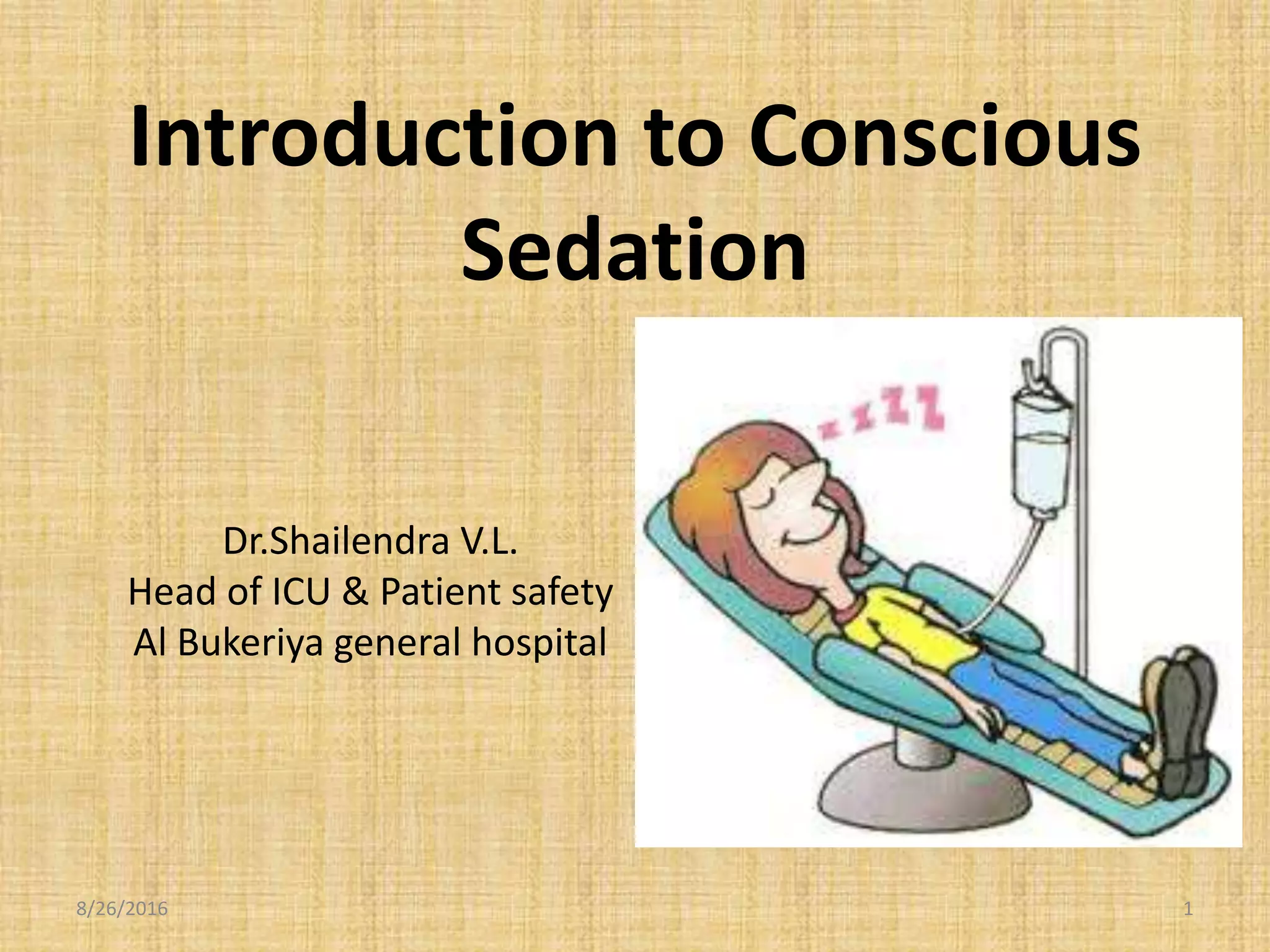
Introduction to Conscious
Sedation
Dr.Shailendra V.L.
Head of ICU & Patient safety
Al Bukeriya general hospital
8/26/2016 1
Primun non nocere
“First, Do No Harm”
The guiding principle for health care
workers is that, whatever the intervention
or procedure, the patient’s well being is
the primary consideration
8/26/2016 2
8/26/2016 3
Why this course on Conscious
sedation?
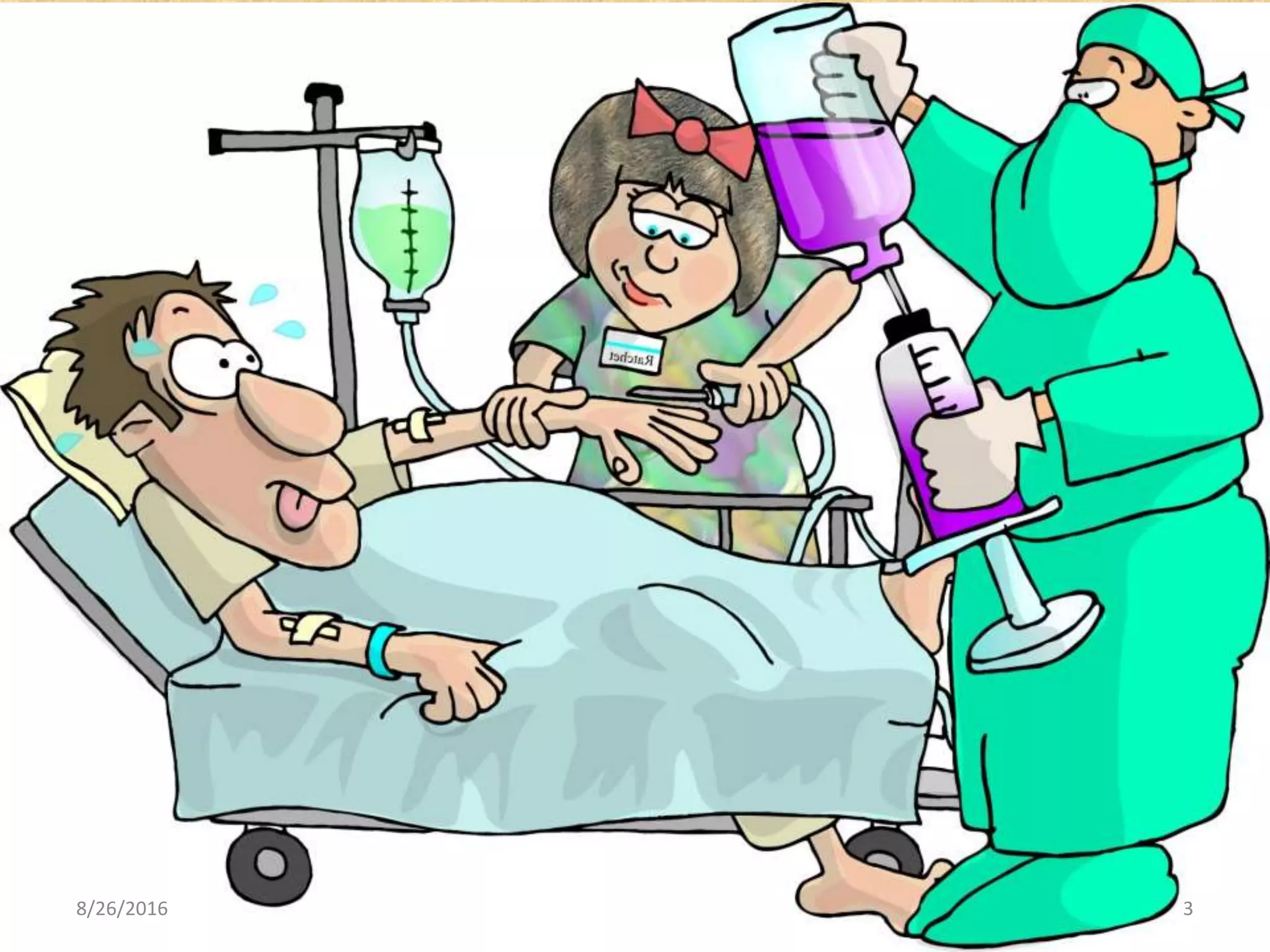
• Sedation is a continuum and a patient can
easily sleep into a deeper level of sedation
• Therefore, the person administering sedation
should know how to rescue the patient who
slips into a deeper level
8/26/2016 4
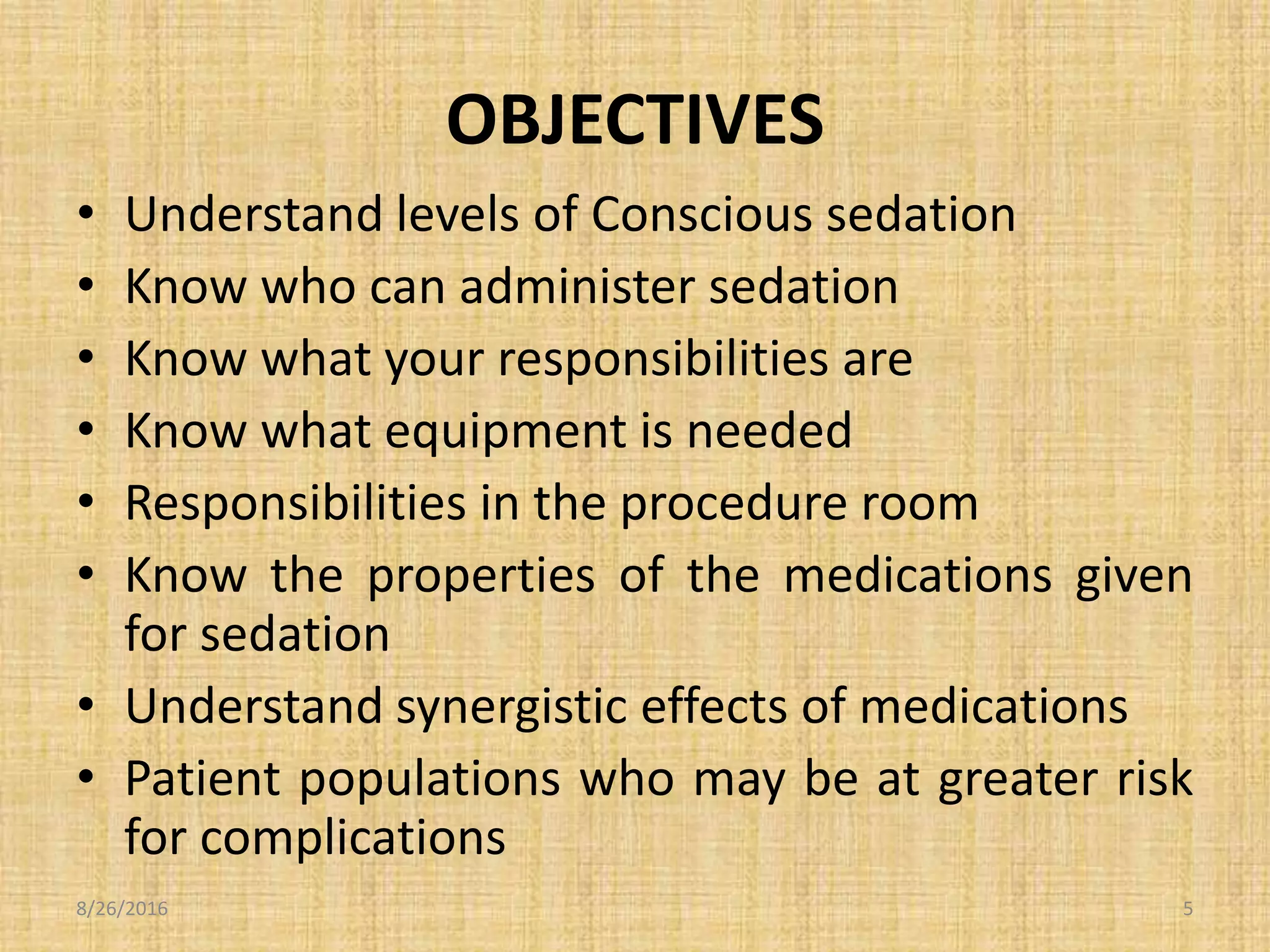
OBJECTIVES
• Understand levels of Conscious sedation
• Know who can administer sedation
• Know what your responsibilities are
• Know what equipment is needed
• Responsibilities in the procedure room
• Know the properties of the medications given
for sedation
• Understand synergistic effects of medications
• Patient populations who may be at greater risk
for complications
8/26/2016 5
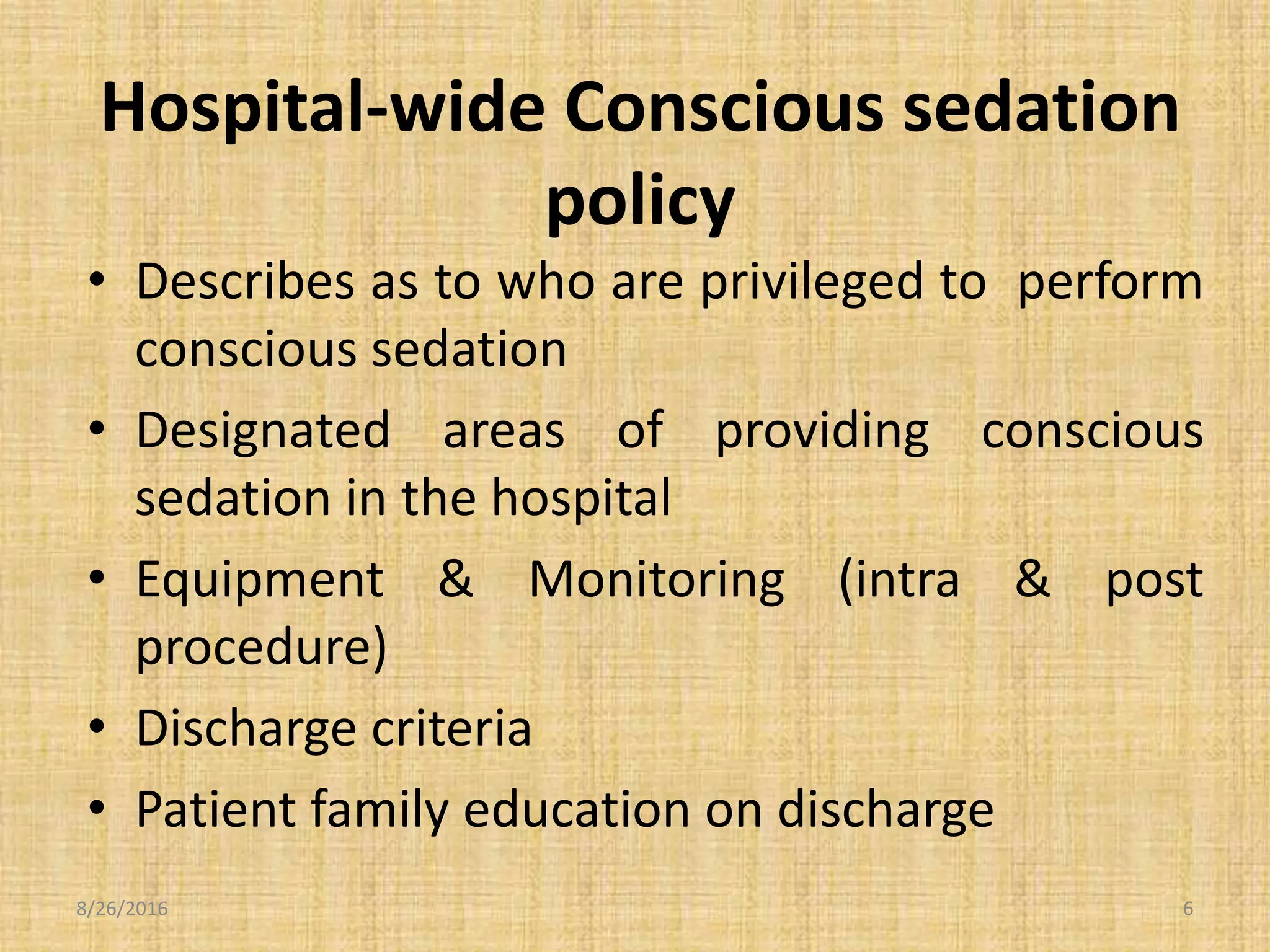
Hospital-wide Conscious sedation
policy
• Describes as to who are privileged to perform
conscious sedation
• Designated areas of providing conscious
sedation in the hospital
• Equipment & Monitoring (intra & post
procedure)
• Discharge criteria
• Patient family education on discharge
8/26/2016 6
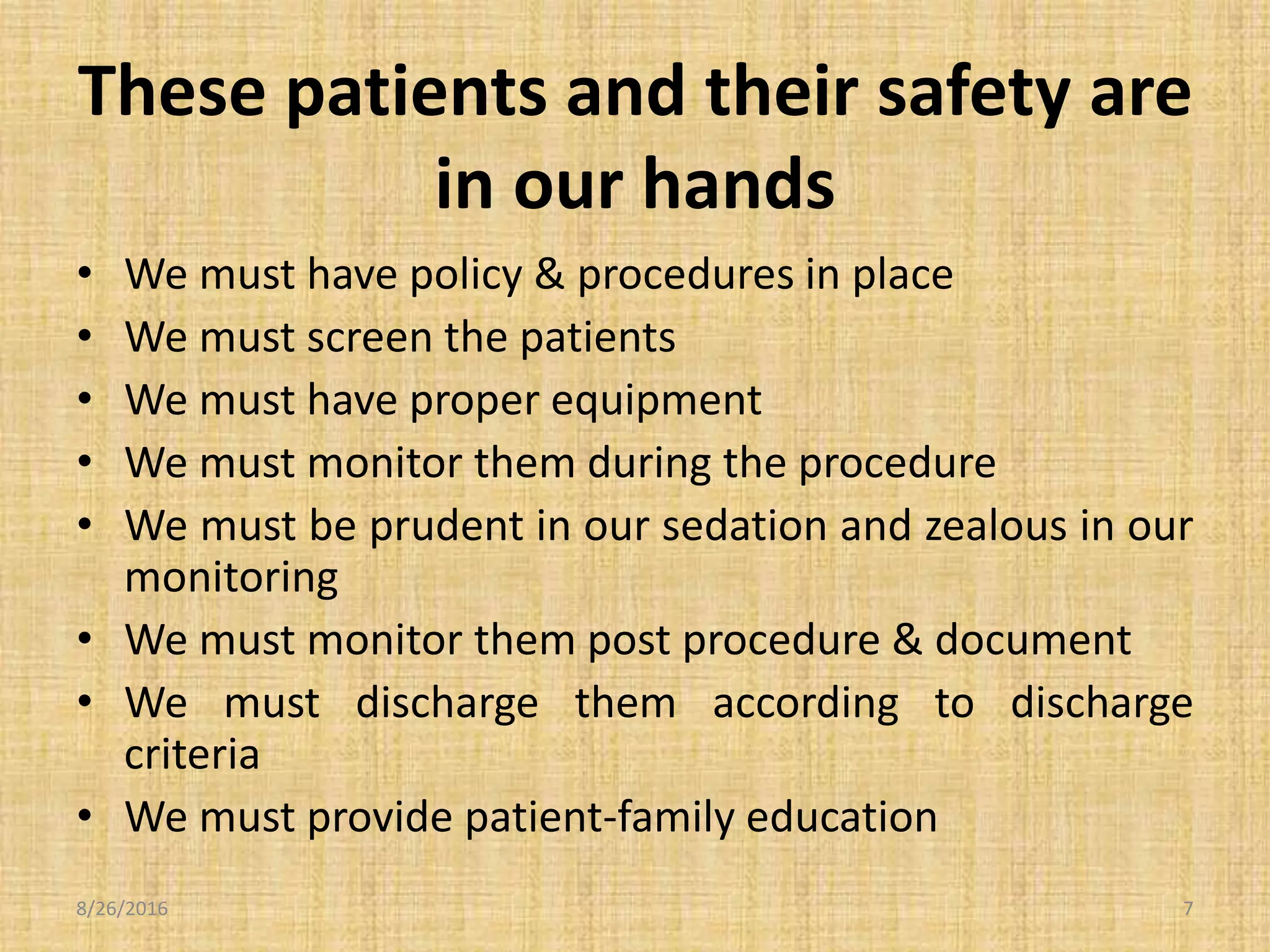
These patients and their safety are
in our hands
• We must have policy & procedures in place
• We must screen the patients
• We must have proper equipment
• We must monitor them during the procedure
• We must be prudent in our sedation and zealous in our
monitoring
• We must monitor them post procedure & document
• We must discharge them according to discharge
criteria
• We must provide patient-family education
8/26/2016 7
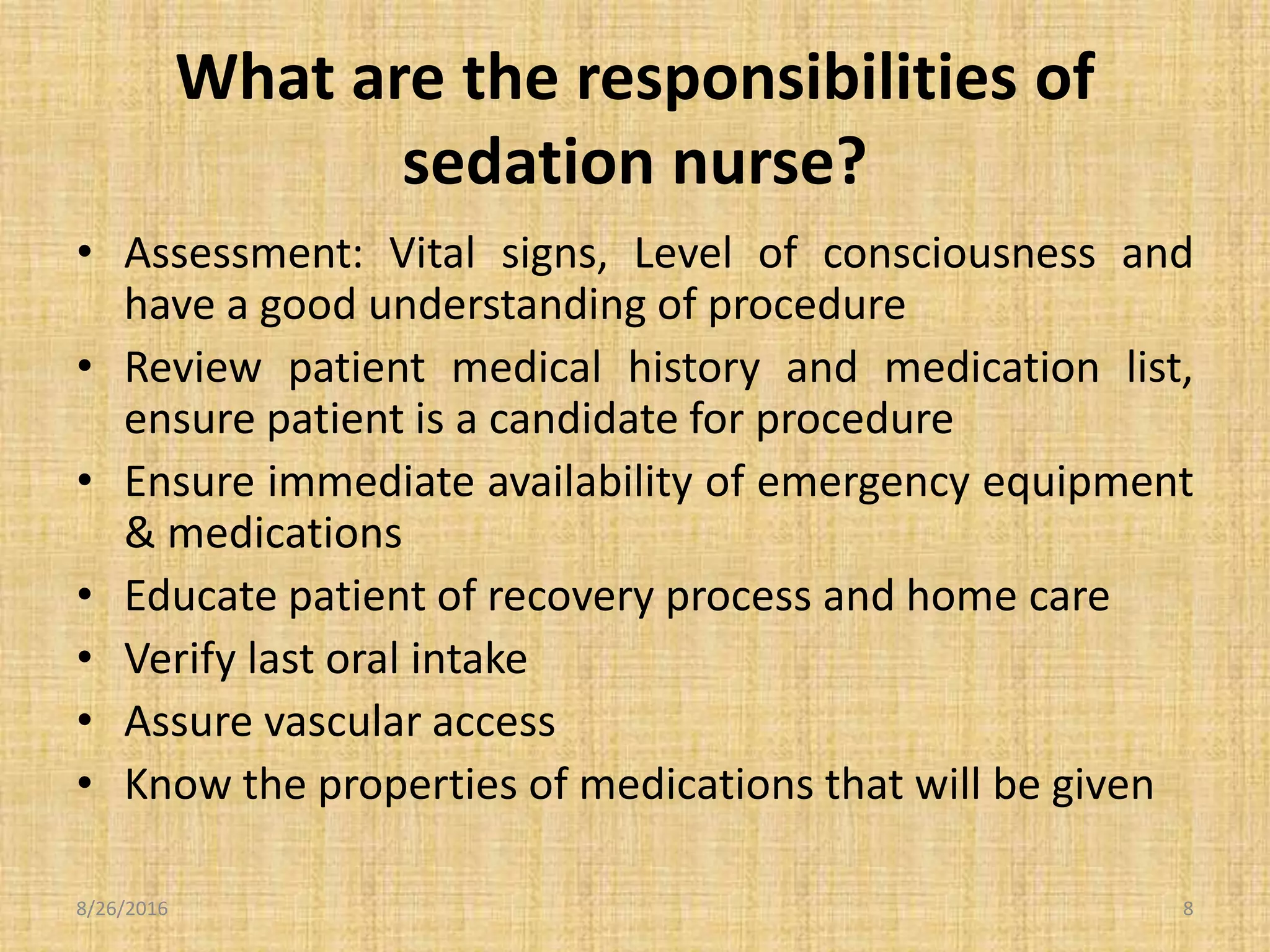
What are the responsibilities of
sedation nurse?
• Assessment: Vital signs, Level of consciousness and
have a good understanding of procedure
• Review patient medical history and medication list,
ensure patient is a candidate for procedure
• Ensure immediate availability of emergency equipment
& medications
• Educate patient of recovery process and home care
• Verify last oral intake
• Assure vascular access
• Know the properties of medications that will be given
8/26/2016 8
Pre-procedure sedation nurse
responsibilities
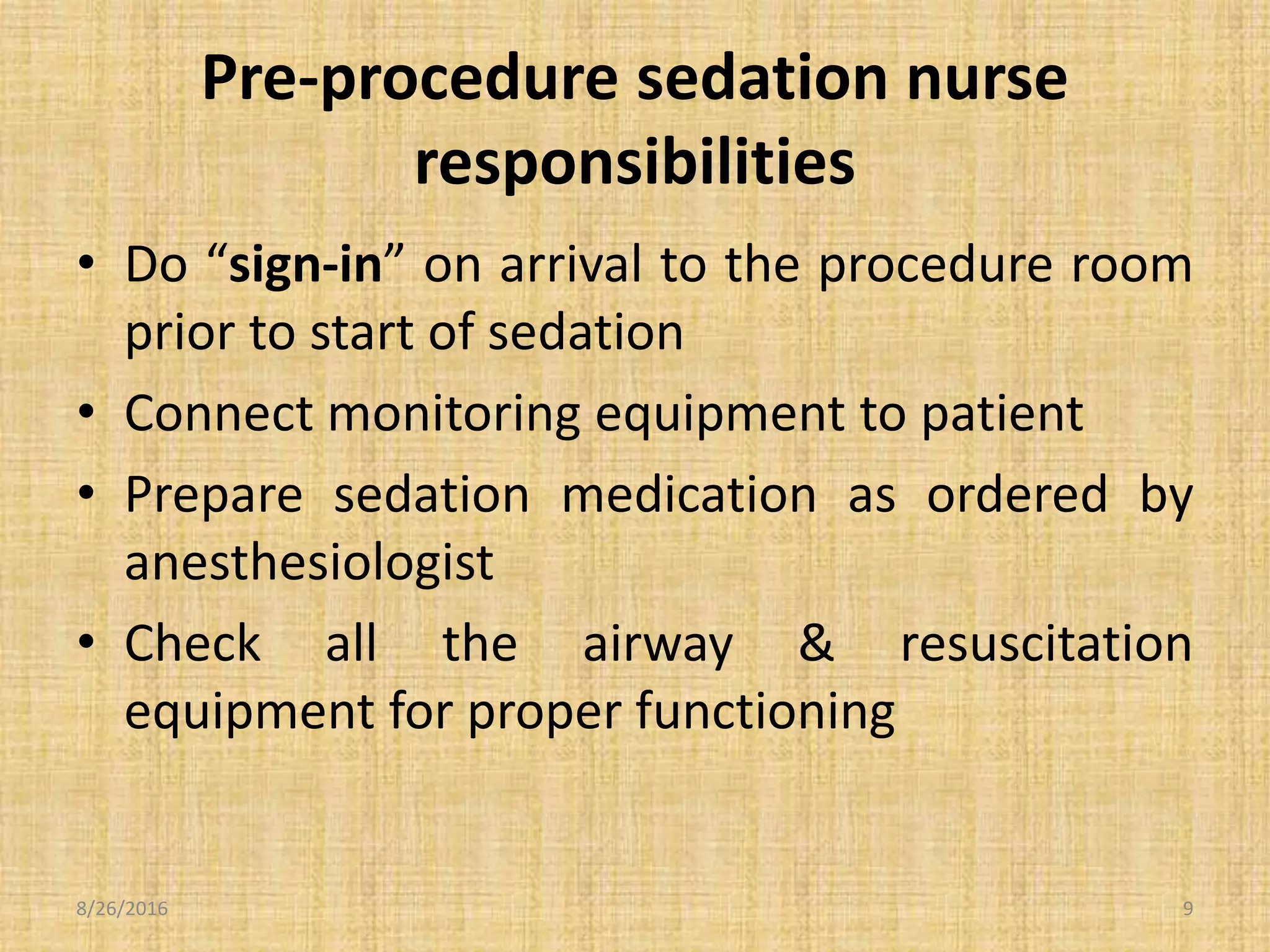
• Do “sign-in” on arrival to the procedure room
prior to start of sedation
• Connect monitoring equipment to patient
• Prepare sedation medication as ordered by
anesthesiologist
• Check all the airway & resuscitation
equipment for proper functioning
8/26/2016 9
Intra-Procedure Sedation Nurse
Responsibilities
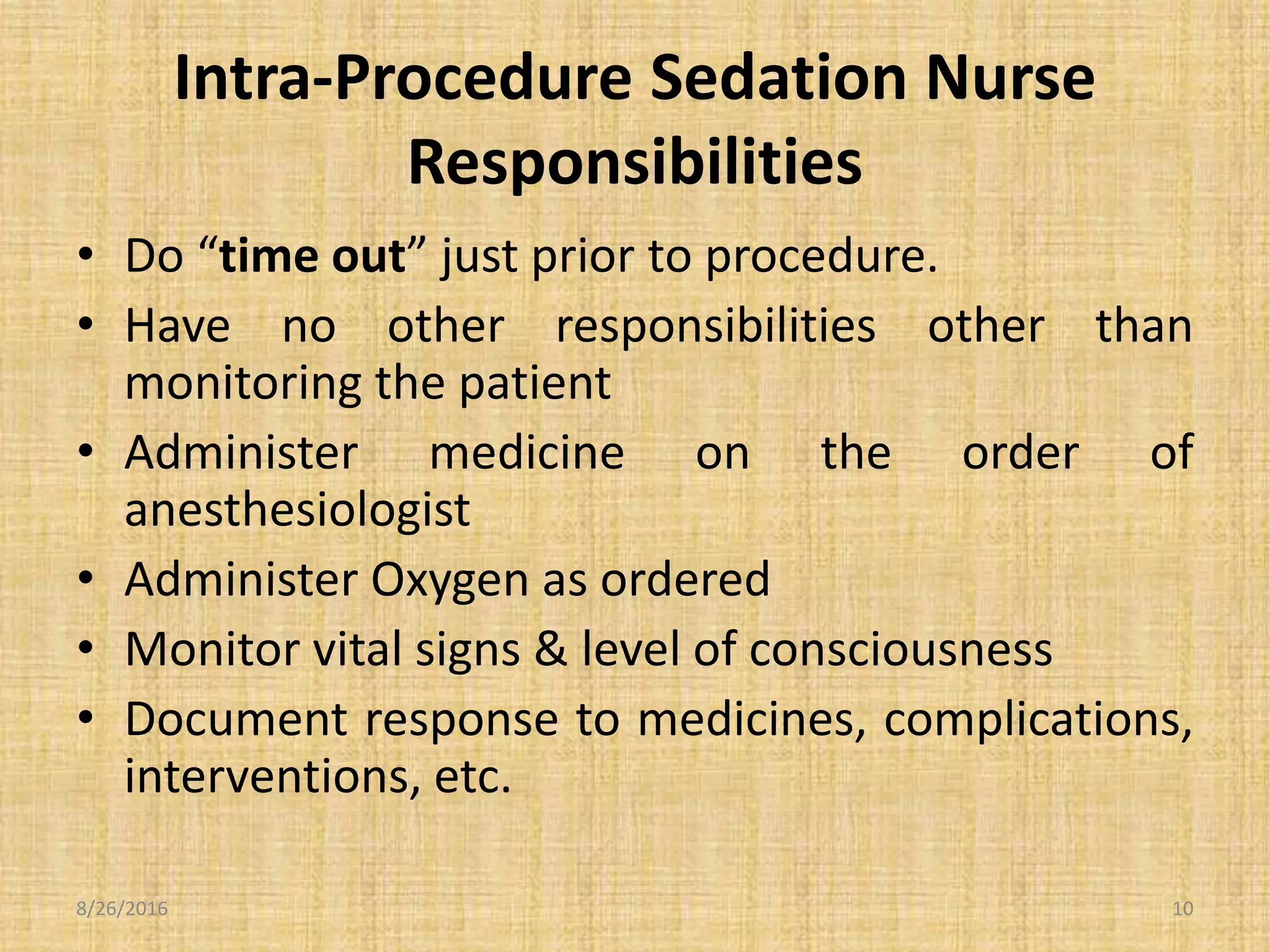
• Do “time out” just prior to procedure.
• Have no other responsibilities other than
monitoring the patient
• Administer medicine on the order of
anesthesiologist
• Administer Oxygen as ordered
• Monitor vital signs & level of consciousness
• Document response to medicines, complications,
interventions, etc.
8/26/2016 10
Post-procedure Sedation Nurse
Responsibilities
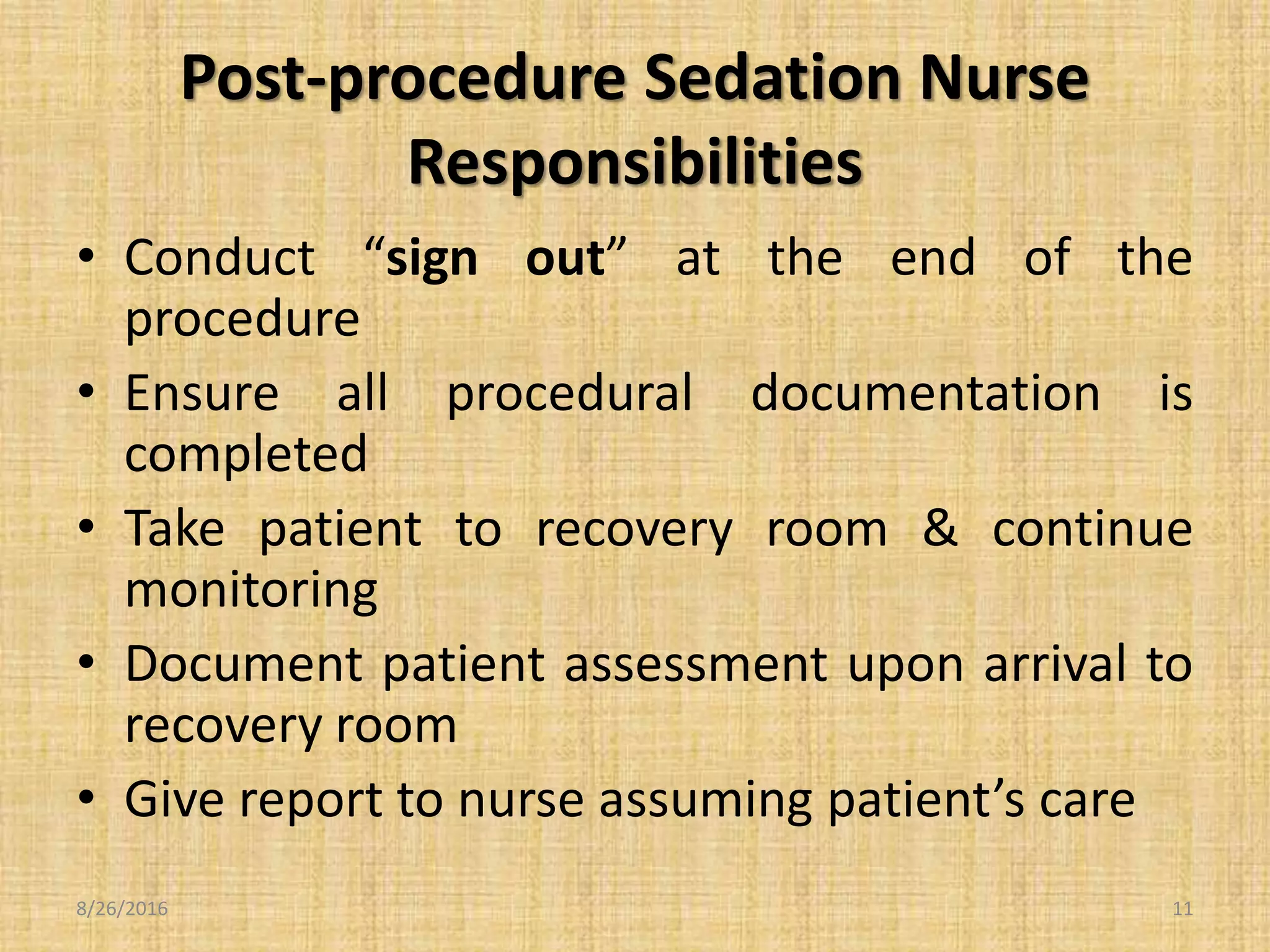
• Conduct “sign out” at the end of the
procedure
• Ensure all procedural documentation is
completed
• Take patient to recovery room & continue
monitoring
• Document patient assessment upon arrival to
recovery room
• Give report to nurse assuming patient’s care
8/26/2016 11
Post-procedure Sedation Nurse
Responsibilities
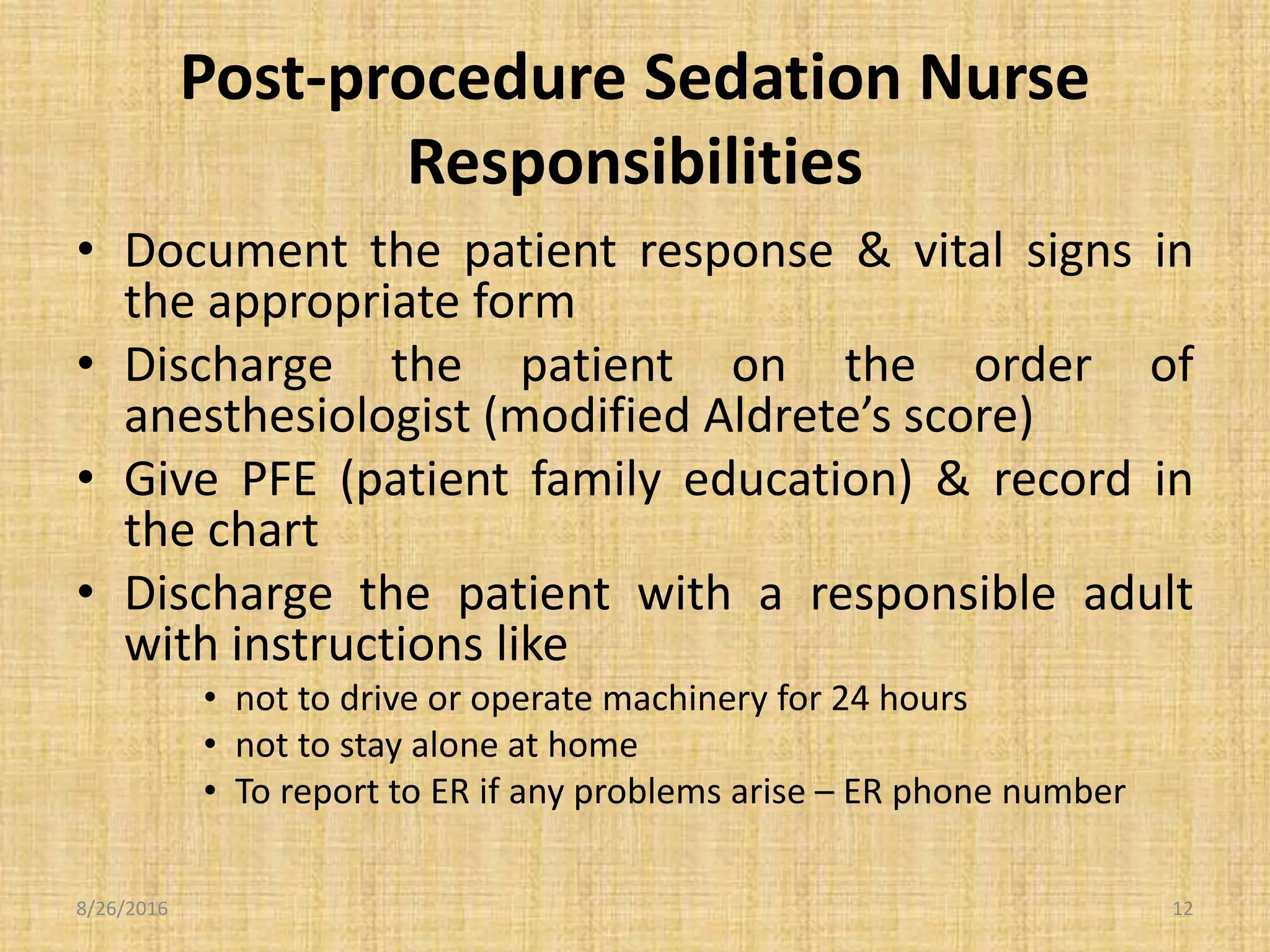
• Document the patient response & vital signs in
the appropriate form
• Discharge the patient on the order of
anesthesiologist (modified Aldrete’s score)
• Give PFE (patient family education) & record in
the chart
• Discharge the patient with a responsible adult
with instructions like
• not to drive or operate machinery for 24 hours
• not to stay alone at home
• To report to ER if any problems arise – ER phone number
8/26/2016 12
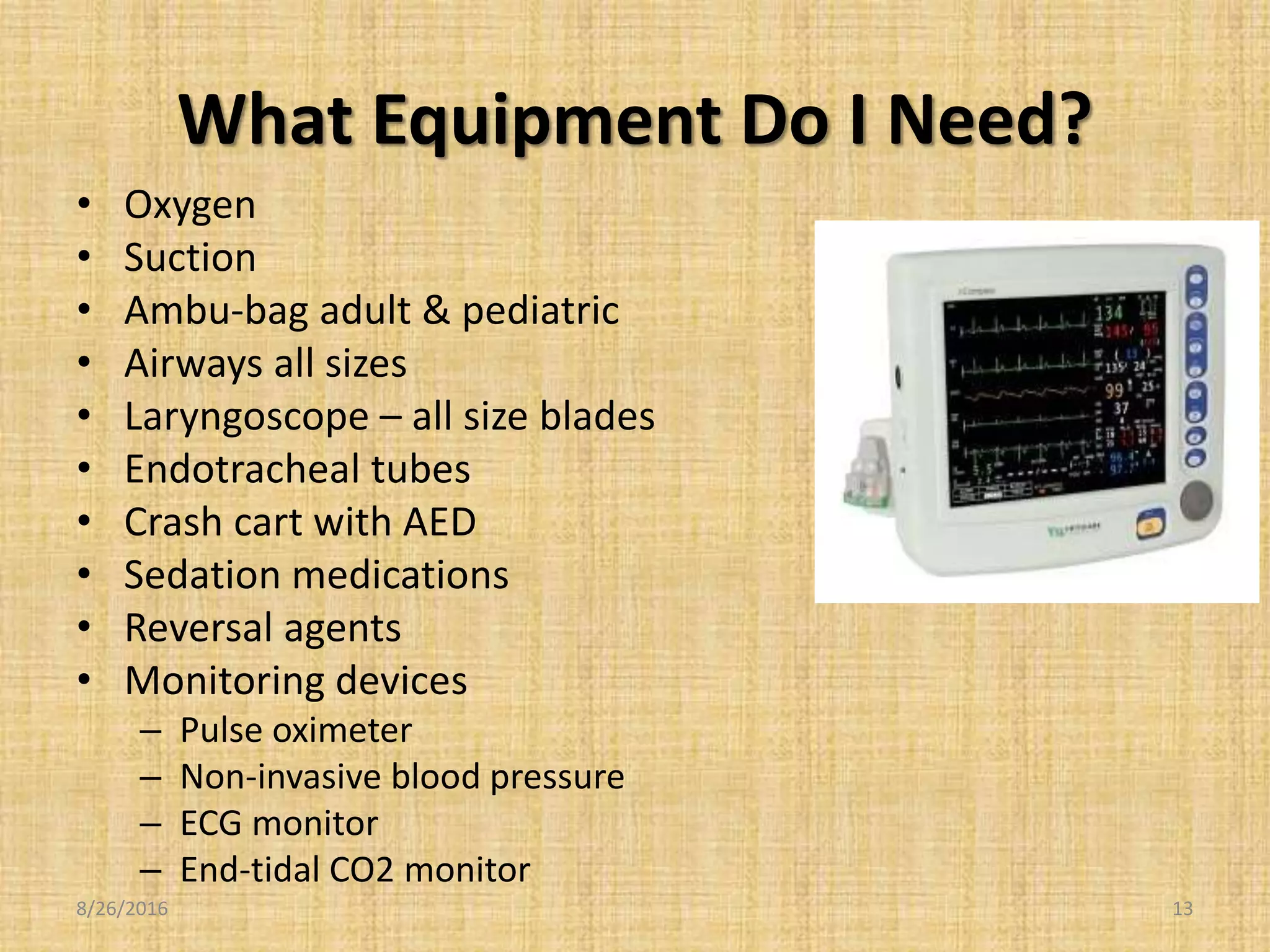
What Equipment Do I Need?
• Oxygen
• Suction
• Ambu-bag adult & pediatric
• Airways all sizes
• Laryngoscope – all size blades
• Endotracheal tubes
• Crash cart with AED
• Sedation medications
• Reversal agents
• Monitoring devices
– Pulse oximeter
– Non-invasive blood pressure
– ECG monitor
– End-tidal CO2 monitor
8/26/2016 13
Medications used for Sedation
• Midazolam
• Fentanyl
• Pethidine
• Propofol
• Ketamine
• Thiopentone
• Reversal agents:
– Flumazenil (benzodiazepin reverasal)
– Naloxone (opiate reversal)
8/26/2016 14
Synergistic effects
• When Midazolam is given along with Fentanyl
there is synergistic effect noted
– Excessive respiratory depression
– Resulting in hypoxemia
• Great care should be exercised when 2 drugs
are used in combination
8/26/2016 15
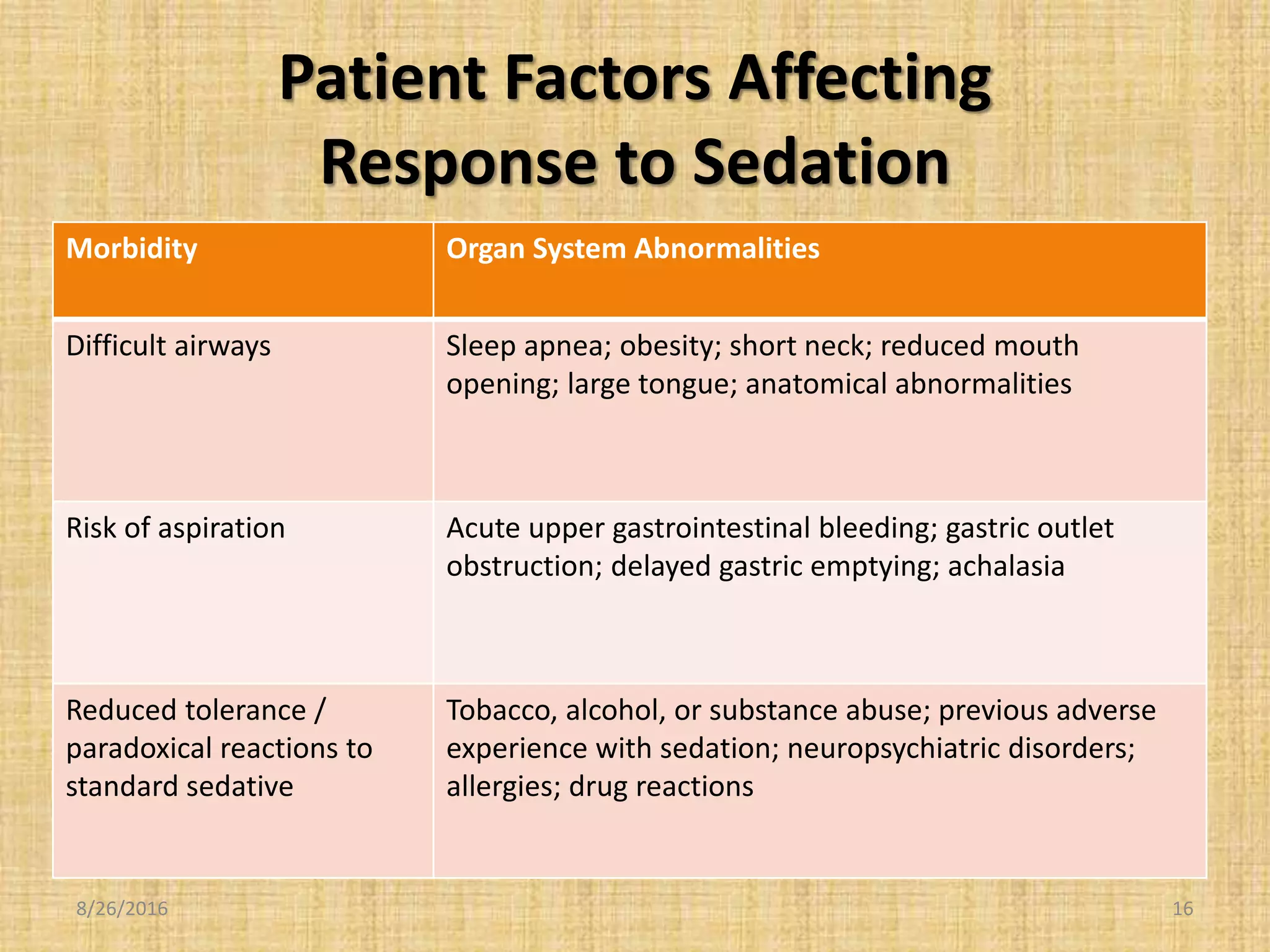
Patient Factors Affecting
Response to Sedation
Morbidity Organ System Abnormalities
Difficult airways Sleep apnea; obesity; short neck; reduced mouth
opening; large tongue; anatomical abnormalities
Risk of aspiration Acute upper gastrointestinal bleeding; gastric outlet
obstruction; delayed gastric emptying; achalasia
Reduced tolerance /
paradoxical reactions to
standard sedative
Tobacco, alcohol, or substance abuse; previous adverse
experience with sedation; neuropsychiatric disorders;
allergies; drug reactions
8/26/2016 16
Sedation can be risky with certain
patient populations
8/26/2016 17
Thank you
8/26/2016 18
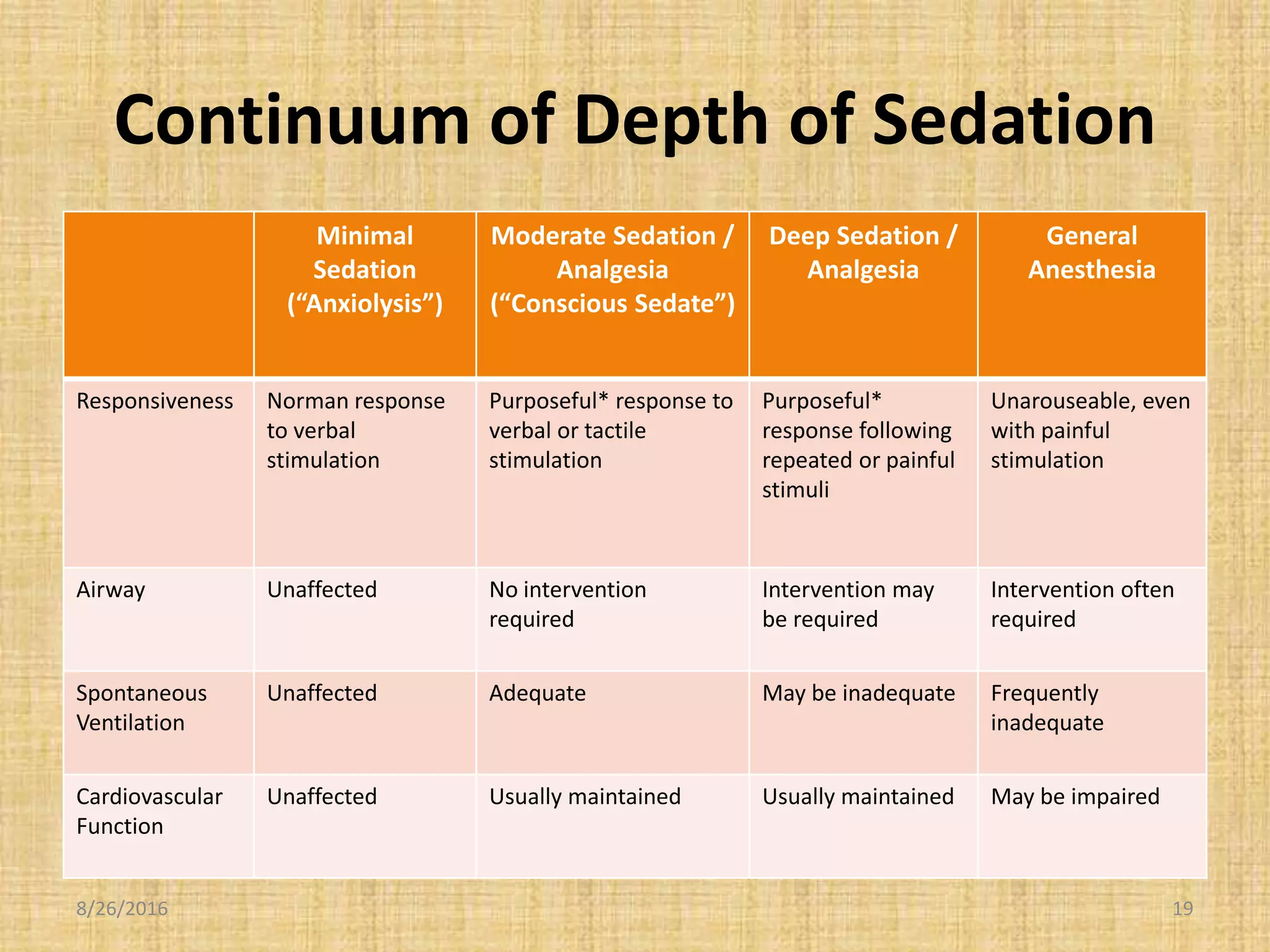
Continuum of Depth of Sedation
Minimal
Sedation
(“Anxiolysis”)
Moderate Sedation /
Analgesia
(“Conscious Sedate”)
Deep Sedation /
Analgesia
General
Anesthesia
Responsiveness Norman response
to verbal
stimulation
Purposeful* response to
verbal or tactile
stimulation
Purposeful*
response following
repeated or painful
stimuli
Unarouseable, even
with painful
stimulation
Airway Unaffected No intervention
required
Intervention may
be required
Intervention often
required
Spontaneous
Ventilation
Unaffected Adequate May be inadequate Frequently
inadequate
Cardiovascular
Function
Unaffected Usually maintained Usually maintained May be impaired
8/26/2016 19

Conscious sedation - Introduction

  • 1.
    Introduction to Conscious Sedation Dr.ShailendraV.L. Head of ICU & Patient safety Al Bukeriya general hospital 8/26/2016 1
  • 2.
    Primun non nocere “First,Do No Harm” The guiding principle for health care workers is that, whatever the intervention or procedure, the patient’s well being is the primary consideration 8/26/2016 2
  • 3.
  • 4.
    Why this courseon Conscious sedation? • Sedation is a continuum and a patient can easily sleep into a deeper level of sedation • Therefore, the person administering sedation should know how to rescue the patient who slips into a deeper level 8/26/2016 4
  • 5.
    OBJECTIVES • Understand levelsof Conscious sedation • Know who can administer sedation • Know what your responsibilities are • Know what equipment is needed • Responsibilities in the procedure room • Know the properties of the medications given for sedation • Understand synergistic effects of medications • Patient populations who may be at greater risk for complications 8/26/2016 5
  • 6.
    Hospital-wide Conscious sedation policy •Describes as to who are privileged to perform conscious sedation • Designated areas of providing conscious sedation in the hospital • Equipment & Monitoring (intra & post procedure) • Discharge criteria • Patient family education on discharge 8/26/2016 6
  • 7.
    These patients andtheir safety are in our hands • We must have policy & procedures in place • We must screen the patients • We must have proper equipment • We must monitor them during the procedure • We must be prudent in our sedation and zealous in our monitoring • We must monitor them post procedure & document • We must discharge them according to discharge criteria • We must provide patient-family education 8/26/2016 7
  • 8.
    What are theresponsibilities of sedation nurse? • Assessment: Vital signs, Level of consciousness and have a good understanding of procedure • Review patient medical history and medication list, ensure patient is a candidate for procedure • Ensure immediate availability of emergency equipment & medications • Educate patient of recovery process and home care • Verify last oral intake • Assure vascular access • Know the properties of medications that will be given 8/26/2016 8
  • 9.
    Pre-procedure sedation nurse responsibilities •Do “sign-in” on arrival to the procedure room prior to start of sedation • Connect monitoring equipment to patient • Prepare sedation medication as ordered by anesthesiologist • Check all the airway & resuscitation equipment for proper functioning 8/26/2016 9
  • 10.
    Intra-Procedure Sedation Nurse Responsibilities •Do “time out” just prior to procedure. • Have no other responsibilities other than monitoring the patient • Administer medicine on the order of anesthesiologist • Administer Oxygen as ordered • Monitor vital signs & level of consciousness • Document response to medicines, complications, interventions, etc. 8/26/2016 10
  • 11.
    Post-procedure Sedation Nurse Responsibilities •Conduct “sign out” at the end of the procedure • Ensure all procedural documentation is completed • Take patient to recovery room & continue monitoring • Document patient assessment upon arrival to recovery room • Give report to nurse assuming patient’s care 8/26/2016 11
  • 12.
    Post-procedure Sedation Nurse Responsibilities •Document the patient response & vital signs in the appropriate form • Discharge the patient on the order of anesthesiologist (modified Aldrete’s score) • Give PFE (patient family education) & record in the chart • Discharge the patient with a responsible adult with instructions like • not to drive or operate machinery for 24 hours • not to stay alone at home • To report to ER if any problems arise – ER phone number 8/26/2016 12
  • 13.
    What Equipment DoI Need? • Oxygen • Suction • Ambu-bag adult & pediatric • Airways all sizes • Laryngoscope – all size blades • Endotracheal tubes • Crash cart with AED • Sedation medications • Reversal agents • Monitoring devices – Pulse oximeter – Non-invasive blood pressure – ECG monitor – End-tidal CO2 monitor 8/26/2016 13
  • 14.
    Medications used forSedation • Midazolam • Fentanyl • Pethidine • Propofol • Ketamine • Thiopentone • Reversal agents: – Flumazenil (benzodiazepin reverasal) – Naloxone (opiate reversal) 8/26/2016 14
  • 15.
    Synergistic effects • WhenMidazolam is given along with Fentanyl there is synergistic effect noted – Excessive respiratory depression – Resulting in hypoxemia • Great care should be exercised when 2 drugs are used in combination 8/26/2016 15
  • 16.
    Patient Factors Affecting Responseto Sedation Morbidity Organ System Abnormalities Difficult airways Sleep apnea; obesity; short neck; reduced mouth opening; large tongue; anatomical abnormalities Risk of aspiration Acute upper gastrointestinal bleeding; gastric outlet obstruction; delayed gastric emptying; achalasia Reduced tolerance / paradoxical reactions to standard sedative Tobacco, alcohol, or substance abuse; previous adverse experience with sedation; neuropsychiatric disorders; allergies; drug reactions 8/26/2016 16
  • 17.
    Sedation can berisky with certain patient populations 8/26/2016 17
  • 18.
  • 19.
    Continuum of Depthof Sedation Minimal Sedation (“Anxiolysis”) Moderate Sedation / Analgesia (“Conscious Sedate”) Deep Sedation / Analgesia General Anesthesia Responsiveness Norman response to verbal stimulation Purposeful* response to verbal or tactile stimulation Purposeful* response following repeated or painful stimuli Unarouseable, even with painful stimulation Airway Unaffected No intervention required Intervention may be required Intervention often required Spontaneous Ventilation Unaffected Adequate May be inadequate Frequently inadequate Cardiovascular Function Unaffected Usually maintained Usually maintained May be impaired 8/26/2016 19