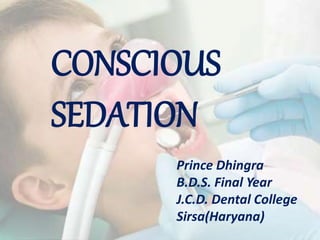
CONSCIOUS
SEDATION
Prince Dhingra
B.D.S. Final Year
J.C.D. Dental College
Sirsa(Haryana)
CONTENTS
• INTRODUCTION
• What is Conscious Sedation
• Objectives of Conscious sedation
• Indications
• Routes used for conscious sedation
• Drugs used for conscious sedation
• Monitoring
• Nitrous Oxide and phases of its administration
• Fasting Guidelines
• Contraindications
• Adverse Effects
• A minimally depressed level of
consciousness, that retains
patient’s ability to maintain an
airway independently and
respond appropriately to
physical stimulation and verbal
command.
{ADA(1993)}
Definition of Conscious Sedation
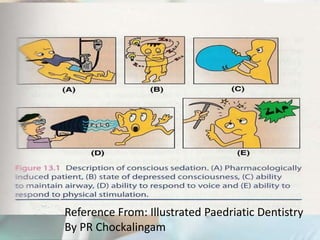
Reference From: Illustrated Paedriatic Dentistry
By PR Chockalingam
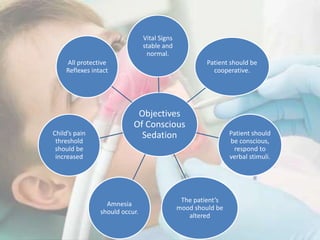
Objectives
Of Conscious
Sedation
Vital Signs
stable and
normal.
Patient should be
cooperative.
Patient should
be conscious,
respond to
verbal stimuli.
The patient’s
mood should be
altered
Amnesia
should occur.
Child’s pain
threshold
should be
increased
All protective
Reflexes intact
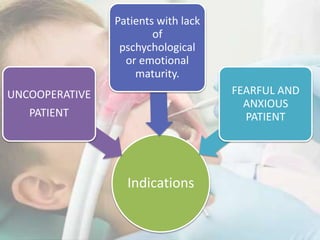
Indications
UNCOOPERATIVE
PATIENT
Patients with lack
of
pschychological
or emotional
maturity.
FEARFUL AND
ANXIOUS
PATIENT
Routes used for conscious
sedation
Enteral
Parenteral
Transdermal
Transmucosal
Inhalation
Drugs used for conscious
Sedation
• Nitrous oxide and oxygen mixture
• Fentanyl
• Diazepam
• Propofol
• Midazolam
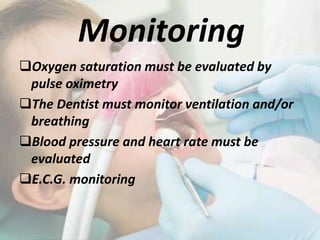
Monitoring
Oxygen saturation must be evaluated by
pulse oximetry
The Dentist must monitor ventilation and/or
breathing
Blood pressure and heart rate must be
evaluated
E.C.G. monitoring
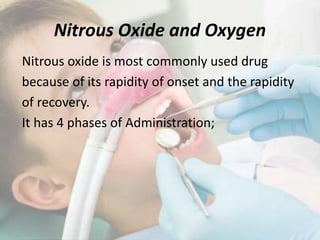
Nitrous Oxide and Oxygen
Nitrous oxide is most commonly used drug
because of its rapidity of onset and the rapidity
of recovery.
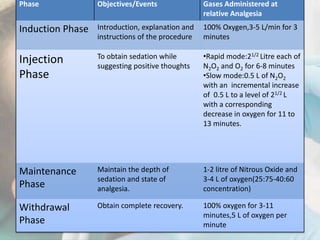
It has 4 phases of Administration;
Phase Objectives/Events Gases Administered at
relative Analgesia
Induction Phase Introduction, explanation and
instructions of the procedure
100% Oxygen,3-5 L/min for 3
minutes
Injection
Phase
To obtain sedation while
suggesting positive thoughts
•Rapid mode:21/2 Litre each of
N2O2 and O2 for 6-8 minutes
•Slow mode:0.5 L of N2O2
with an incremental increase
of 0.5 L to a level of 21/2 L
with a corresponding
decrease in oxygen for 11 to
13 minutes.
Maintenance
Phase
Maintain the depth of
sedation and state of
analgesia.
1-2 litre of Nitrous Oxide and
3-4 L of oxygen(25:75-40:60
concentration)
Withdrawal
Phase
Obtain complete recovery. 100% oxygen for 3-11
minutes,5 L of oxygen per
minute
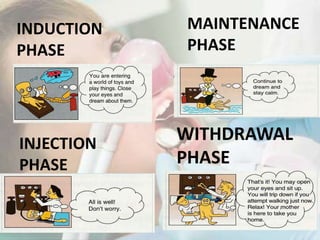
INDUCTION
PHASE
INJECTION
PHASE
MAINTENANCE
PHASE
WITHDRAWAL
PHASE
Fasting Guidelines given by American
Society Anaesthesiologists
INGESTED MATERIAL MINIMUM FASTING
PERIOD
Clear Liquids 2 hours
Breast Milk 4 hours
Infant Formula 6 hours
Nonhuman milk 6 hours
Light Meal 6 hours
Fatty Meal 8 hours
Contraindications
Dental
difficulties,
prolonged
surgery,
inadequate
personnel.
Unwilling,
unaccompanied
patients.
Chronic obstructive
pulmonary
disorder(COPD),
pregnancy,
myasthenia,
epilepsy, obesity,
bleeding disorders.
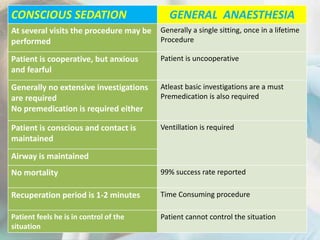
CONSCIOUS SEDATION GENERAL ANAESTHESIA
At several visits the procedure may be
performed
Generally a single sitting, once in a lifetime
Procedure
Patient is cooperative, but anxious
and fearful
Patient is uncooperative
Generally no extensive investigations
are required
No premedication is required either
Atleast basic investigations are a must
Premedication is also required
Patient is conscious and contact is
maintained
Ventillation is required
Airway is maintained
No mortality 99% success rate reported
Recuperation period is 1-2 minutes Time Consuming procedure
Patient feels he is in control of the
situation
Patient cannot control the situation
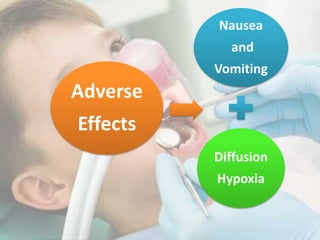
Nausea
and
Vomiting
Diffusion
Hypoxia
Adverse
Effects
Conclusion
Nitrous oxide and oxygen is a safe and effective
technique to reduce anxiety, produce analgesia
and enhance effective communication between
Patient and operator. It increases patient’s pain
threshold. It must be used in pediatric patient
and uncooperative patient.
REFERENCES
• Dentistry for the Child and Adolescent by
McDonald,Avery,Dean
• Textbook of Oral and Maxillofacial Surgery
by Daniel M. Laskin
• Essentials of Pharmacology for Dentistry By
KD Tripathi
• Illustrated Paedriatic Dentistry By
PR Chockalingam
Conscious sedation

Conscious sedation

  • 1.
    CONSCIOUS SEDATION Prince Dhingra B.D.S. FinalYear J.C.D. Dental College Sirsa(Haryana)
  • 2.
    CONTENTS • INTRODUCTION • Whatis Conscious Sedation • Objectives of Conscious sedation • Indications • Routes used for conscious sedation • Drugs used for conscious sedation • Monitoring • Nitrous Oxide and phases of its administration • Fasting Guidelines • Contraindications • Adverse Effects
  • 3.
    • A minimallydepressed level of consciousness, that retains patient’s ability to maintain an airway independently and respond appropriately to physical stimulation and verbal command. {ADA(1993)} Definition of Conscious Sedation
  • 4.
    Reference From: IllustratedPaedriatic Dentistry By PR Chockalingam
  • 5.
    Objectives Of Conscious Sedation Vital Signs stableand normal. Patient should be cooperative. Patient should be conscious, respond to verbal stimuli. The patient’s mood should be altered Amnesia should occur. Child’s pain threshold should be increased All protective Reflexes intact
  • 6.
  • 7.
    Routes used forconscious sedation Enteral Parenteral Transdermal Transmucosal Inhalation
  • 8.
    Drugs used forconscious Sedation • Nitrous oxide and oxygen mixture • Fentanyl • Diazepam • Propofol • Midazolam
  • 9.
    Monitoring Oxygen saturation mustbe evaluated by pulse oximetry The Dentist must monitor ventilation and/or breathing Blood pressure and heart rate must be evaluated E.C.G. monitoring
  • 10.
    Nitrous Oxide andOxygen Nitrous oxide is most commonly used drug because of its rapidity of onset and the rapidity of recovery. It has 4 phases of Administration;
  • 11.
    Phase Objectives/Events GasesAdministered at relative Analgesia Induction Phase Introduction, explanation and instructions of the procedure 100% Oxygen,3-5 L/min for 3 minutes Injection Phase To obtain sedation while suggesting positive thoughts •Rapid mode:21/2 Litre each of N2O2 and O2 for 6-8 minutes •Slow mode:0.5 L of N2O2 with an incremental increase of 0.5 L to a level of 21/2 L with a corresponding decrease in oxygen for 11 to 13 minutes. Maintenance Phase Maintain the depth of sedation and state of analgesia. 1-2 litre of Nitrous Oxide and 3-4 L of oxygen(25:75-40:60 concentration) Withdrawal Phase Obtain complete recovery. 100% oxygen for 3-11 minutes,5 L of oxygen per minute
  • 12.
  • 13.
    Fasting Guidelines givenby American Society Anaesthesiologists INGESTED MATERIAL MINIMUM FASTING PERIOD Clear Liquids 2 hours Breast Milk 4 hours Infant Formula 6 hours Nonhuman milk 6 hours Light Meal 6 hours Fatty Meal 8 hours
  • 14.
  • 15.
    CONSCIOUS SEDATION GENERALANAESTHESIA At several visits the procedure may be performed Generally a single sitting, once in a lifetime Procedure Patient is cooperative, but anxious and fearful Patient is uncooperative Generally no extensive investigations are required No premedication is required either Atleast basic investigations are a must Premedication is also required Patient is conscious and contact is maintained Ventillation is required Airway is maintained No mortality 99% success rate reported Recuperation period is 1-2 minutes Time Consuming procedure Patient feels he is in control of the situation Patient cannot control the situation
  • 16.
  • 17.
    Conclusion Nitrous oxide andoxygen is a safe and effective technique to reduce anxiety, produce analgesia and enhance effective communication between Patient and operator. It increases patient’s pain threshold. It must be used in pediatric patient and uncooperative patient.
  • 18.
    REFERENCES • Dentistry forthe Child and Adolescent by McDonald,Avery,Dean • Textbook of Oral and Maxillofacial Surgery by Daniel M. Laskin • Essentials of Pharmacology for Dentistry By KD Tripathi • Illustrated Paedriatic Dentistry By PR Chockalingam