Conscious (IV) Sedation

 Intravenous sedation is defined as a medically controlled state
  of depressed consciousness with or without analgesia that:
   • allows protective reflexes to be maintained,
   • retains patient’s ability to maintain a continuously
      independent patent airway, and
   • permits appropriate response by the patient to verbal
      command or physical stimulation
 Intravenous sedation and analgesic agents are to be given in
  small incremental doses that are titrated to the desired end-
  points of sedation and analgesia
Conscious Sedation (continued)

 Groups of drugs used for this purpose include:
    Sedatives          • Benzodiazepines
    Hypnotics          • Antihistamines
    Anti-anxiety       • Narcotics
 The pharmacologic agents’ intended uses are for short-term
  therapeutic, diagnostic, or surgical procedures
 Sufficient time must elapse between doses to allow the effect
  of each dose to be assessed before subsequent drug
  administration
 IV Fentanyl is not administered by nurses at WCMC
Conscious Sedation (Competency)

 Physicians and CRNA’s managing the care of patients
  receiving intravenous sedation for a procedure must be
  competent to manage complications related to the
  administration of Intravenous sedation
 Anesthesiology credentials physicians and CRNA’s
 Patients receiving sedation and analgesia for a procedure
  (such as endoscopy, cardioversion, heart cath, placement of
  chest tube, etc.) are given the medication and monitored by
  a registered nurse (RN) who has demonstrated current
  competency in the administration of Intravenous sedation
Conscious Sedation (Competency)
Current competency for RNs includes:
 Knowledge of anatomy and physiology
 Successful completion of ACLS and BLS courses
 Knowledge and skills to assess, diagnose, and intervene in the
  event of complications or undesired outcomes, and ability to
  institute intervention in compliance with orders (including
  standing orders);
 Administration of sedation and analgesic agents: to include
  physiological and desired effects, medication
  uses, dosages, routes and speed of
  administration, contraindications, recognition and
  management of adverse or side effects, and use of drug
  antagonists
Conscious Sedation (Competency)

The RN must:
    Understand the principles of oxygen delivery, respiratory
      physiology, oxygen transport and uptake, & demonstrate
      ability to use oxygen delivery devices;
    Demonstrate the knowledge of legal ramifications of
      intravenous sedation and analgesia and/or monitoring
      patients receiving sedation and analgesia, including the RN’s
      responsibility and liability in the event of an untoward reaction
      or life-threatening complication;
    Assess total patient care requirements during sedation and
      analgesia and recovery
Conscious Sedation (Staffing)

 Staffing during intravenous and deep sedation for
  procedures always includes one RN and one MD at a
  minimum
 Additional staff is obtained as indicated according to the
  acuity of the patient procedure and potential response to
  the medications administered
 The RN monitoring the patient does not engage in any
  other tasks that would compromise the ability to assess and
  monitor, care for patient, intervene as needed, and be in
  constant attendance
Conscious Sedation (continued)
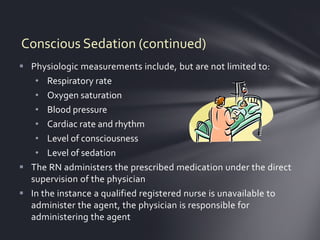
 Physiologic measurements include, but are not limited to:
   • Respiratory rate
   • Oxygen saturation
   • Blood pressure
   • Cardiac rate and rhythm
   • Level of consciousness
   • Level of sedation
 The RN administers the prescribed medication under the direct
  supervision of the physician
 In the instance a qualified registered nurse is unavailable to
  administer the agent, the physician is responsible for
  administering the agent
Conscious Sedation (Medications)

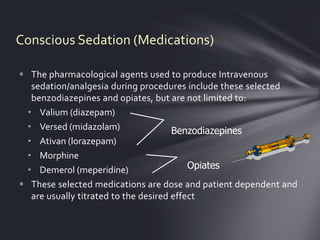
 The pharmacological agents used to produce Intravenous
   sedation/analgesia during procedures include these selected
   benzodiazepines and opiates, but are not limited to:
  • Valium (diazepam)
  • Versed (midazolam)                 Benzodiazepines
  • Ativan (lorazepam)
  • Morphine
  • Demerol (meperidine)                   Opiates
 These selected medications are dose and patient dependent and
   are usually titrated to the desired effect
Conscious Sedation (Equipment)

The following equipment is readily available when
administering conscious sedation.
 Supplemental oxygen and accessibility of delivery
  devices (nasal cannula, venturi mask, non-rebreather
  mask, bag-valve-mask-device, intubation equipment )
 Crash cart with available defibrillator, emergency
  medications, airway adjuncts, and the ability to provide
  100% oxygen
 Benzodiazepine Antagonist (Romazicon) and Opiate
  Antagonists (Narcan) readily available
 Monitors for noninvasive or invasive blood pressure;
  continuous cardiac rhythm and pulse oximetry
Conscious Sedation (Pre-procedure)
Before the procedure there is a history and physical completed
by the physician.
 Exception: in emergent situations, an acceptable history and
   physical for the procedural purpose may be limited to major
   significant conditions requiring intervention
 Patients should be NPO 6 hours prior to administration of
   sedation if procedure is elective
 Medications may be given with 30ml of water or less if ordered
 The patient will have continuous intravenous access prior to
   the administration of any sedation/analgesia agent and until
   the patient meets discharge criteria
Conscious Sedation (Pre-procedure)
Nursing assessment is to include, but is not limited to
 Procedure to be performed
 Complete vital signs
 Pulse oximetry
 Level of consciousness
 General physical assessment
 Allergies with reaction
 Current medication
 Time of last PO intake (should be fasting at least 6 hours is elective)
 Past medical history
Conscious Sedation (Intra-procedure)

Assessment and documentation is to include:
 Time procedure began and completed
 Medications along with assessment of
  effects of medication
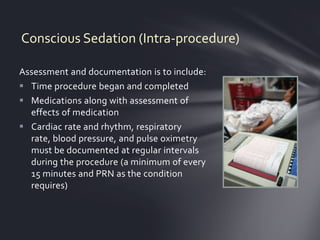
 Cardiac rate and rhythm, respiratory
  rate, blood pressure, and pulse oximetry
  must be documented at regular intervals
  during the procedure (a minimum of every
  15 minutes and PRN as the condition
  requires)
Conscious Sedation (Intra-procedure)

Monitoring continuously throughout the procedure:
 Continuous pulse oximetry with visual and auditory displays
 Level of consciousness (LOC) documented every 15 minutes
 Use of supplemental oxygen
 Hypersensitivity reactions
* Documentation is required for intervention needed to support
  any of the above parameters - the physician must be notified of
  significant deviations, including adverse effects of medication
Conscious Sedation (Post-procedure)
Assessment and documentation is to include:
 Activity, oxygenation (to include pulse
  oximetry), circulatory, and LOC, every 15 minutes until
  sedation/analgesia score = 9 or above
 When the sedation/analgesia score is 9 or above, patient
  may be transferred to another unit unless the patient is to be
  discharged from the hospital
 Hence, the patient must be monitored for at least one hour
  and have a responsible party to drive patient home
 When an antagonist is administered, the patient must be
  monitored for two hours from the last dose of the antagonist
Conscious Sedation (continued)
 Additional and more frequent monitoring is dictated by
  patient condition or at the discretion of the physician, and
  may be unit-specific
 Assess and document safety precautions with side rails up
  and in place
 Prior to discontinuing post-operative monitoring, the
  patient’s vital signs must be stable as compared to baseline
  pre-procedure readings
 If the patient is to be discharged post procedure written
  discharge instructions pertaining to post sedation home care
  are provided

Conscious (iv) sedation

  • 1.
    Conscious (IV) Sedation Intravenous sedation is defined as a medically controlled state of depressed consciousness with or without analgesia that: • allows protective reflexes to be maintained, • retains patient’s ability to maintain a continuously independent patent airway, and • permits appropriate response by the patient to verbal command or physical stimulation  Intravenous sedation and analgesic agents are to be given in small incremental doses that are titrated to the desired end- points of sedation and analgesia
  • 2.
    Conscious Sedation (continued) Groups of drugs used for this purpose include:  Sedatives • Benzodiazepines  Hypnotics • Antihistamines  Anti-anxiety • Narcotics  The pharmacologic agents’ intended uses are for short-term therapeutic, diagnostic, or surgical procedures  Sufficient time must elapse between doses to allow the effect of each dose to be assessed before subsequent drug administration  IV Fentanyl is not administered by nurses at WCMC
  • 3.
    Conscious Sedation (Competency) Physicians and CRNA’s managing the care of patients receiving intravenous sedation for a procedure must be competent to manage complications related to the administration of Intravenous sedation  Anesthesiology credentials physicians and CRNA’s  Patients receiving sedation and analgesia for a procedure (such as endoscopy, cardioversion, heart cath, placement of chest tube, etc.) are given the medication and monitored by a registered nurse (RN) who has demonstrated current competency in the administration of Intravenous sedation
  • 4.
    Conscious Sedation (Competency) Currentcompetency for RNs includes:  Knowledge of anatomy and physiology  Successful completion of ACLS and BLS courses  Knowledge and skills to assess, diagnose, and intervene in the event of complications or undesired outcomes, and ability to institute intervention in compliance with orders (including standing orders);  Administration of sedation and analgesic agents: to include physiological and desired effects, medication uses, dosages, routes and speed of administration, contraindications, recognition and management of adverse or side effects, and use of drug antagonists
  • 5.
    Conscious Sedation (Competency) TheRN must:  Understand the principles of oxygen delivery, respiratory physiology, oxygen transport and uptake, & demonstrate ability to use oxygen delivery devices;  Demonstrate the knowledge of legal ramifications of intravenous sedation and analgesia and/or monitoring patients receiving sedation and analgesia, including the RN’s responsibility and liability in the event of an untoward reaction or life-threatening complication;  Assess total patient care requirements during sedation and analgesia and recovery
  • 6.
    Conscious Sedation (Staffing) Staffing during intravenous and deep sedation for procedures always includes one RN and one MD at a minimum  Additional staff is obtained as indicated according to the acuity of the patient procedure and potential response to the medications administered  The RN monitoring the patient does not engage in any other tasks that would compromise the ability to assess and monitor, care for patient, intervene as needed, and be in constant attendance
  • 7.
    Conscious Sedation (continued) Physiologic measurements include, but are not limited to: • Respiratory rate • Oxygen saturation • Blood pressure • Cardiac rate and rhythm • Level of consciousness • Level of sedation  The RN administers the prescribed medication under the direct supervision of the physician  In the instance a qualified registered nurse is unavailable to administer the agent, the physician is responsible for administering the agent
  • 8.
    Conscious Sedation (Medications) The pharmacological agents used to produce Intravenous sedation/analgesia during procedures include these selected benzodiazepines and opiates, but are not limited to: • Valium (diazepam) • Versed (midazolam) Benzodiazepines • Ativan (lorazepam) • Morphine • Demerol (meperidine) Opiates  These selected medications are dose and patient dependent and are usually titrated to the desired effect
  • 9.
    Conscious Sedation (Equipment) Thefollowing equipment is readily available when administering conscious sedation.  Supplemental oxygen and accessibility of delivery devices (nasal cannula, venturi mask, non-rebreather mask, bag-valve-mask-device, intubation equipment )  Crash cart with available defibrillator, emergency medications, airway adjuncts, and the ability to provide 100% oxygen  Benzodiazepine Antagonist (Romazicon) and Opiate Antagonists (Narcan) readily available  Monitors for noninvasive or invasive blood pressure; continuous cardiac rhythm and pulse oximetry
  • 10.
    Conscious Sedation (Pre-procedure) Beforethe procedure there is a history and physical completed by the physician.  Exception: in emergent situations, an acceptable history and physical for the procedural purpose may be limited to major significant conditions requiring intervention  Patients should be NPO 6 hours prior to administration of sedation if procedure is elective  Medications may be given with 30ml of water or less if ordered  The patient will have continuous intravenous access prior to the administration of any sedation/analgesia agent and until the patient meets discharge criteria
  • 11.
    Conscious Sedation (Pre-procedure) Nursingassessment is to include, but is not limited to  Procedure to be performed  Complete vital signs  Pulse oximetry  Level of consciousness  General physical assessment  Allergies with reaction  Current medication  Time of last PO intake (should be fasting at least 6 hours is elective)  Past medical history
  • 12.
    Conscious Sedation (Intra-procedure) Assessmentand documentation is to include:  Time procedure began and completed  Medications along with assessment of effects of medication  Cardiac rate and rhythm, respiratory rate, blood pressure, and pulse oximetry must be documented at regular intervals during the procedure (a minimum of every 15 minutes and PRN as the condition requires)
  • 13.
    Conscious Sedation (Intra-procedure) Monitoringcontinuously throughout the procedure:  Continuous pulse oximetry with visual and auditory displays  Level of consciousness (LOC) documented every 15 minutes  Use of supplemental oxygen  Hypersensitivity reactions * Documentation is required for intervention needed to support any of the above parameters - the physician must be notified of significant deviations, including adverse effects of medication
  • 14.
    Conscious Sedation (Post-procedure) Assessmentand documentation is to include:  Activity, oxygenation (to include pulse oximetry), circulatory, and LOC, every 15 minutes until sedation/analgesia score = 9 or above  When the sedation/analgesia score is 9 or above, patient may be transferred to another unit unless the patient is to be discharged from the hospital  Hence, the patient must be monitored for at least one hour and have a responsible party to drive patient home  When an antagonist is administered, the patient must be monitored for two hours from the last dose of the antagonist
  • 15.
    Conscious Sedation (continued) Additional and more frequent monitoring is dictated by patient condition or at the discretion of the physician, and may be unit-specific  Assess and document safety precautions with side rails up and in place  Prior to discontinuing post-operative monitoring, the patient’s vital signs must be stable as compared to baseline pre-procedure readings  If the patient is to be discharged post procedure written discharge instructions pertaining to post sedation home care are provided