www.eera-avatar.eu
This project has received funding from the European Union’s Seventh Programme for research, technological development and
demonstration under grand agreement No FP7-ENERGY-2013-1/n° 608396 .
AVATAR project
Advanced Aerodynamic Tools for lArge Rotors
Gerard Schepers
2016 Wind Turbine Blade Workshop
Sandia National Laboratories, USA
August 31st, 2016
FP7-ENERGY-2013-1/ n° 608396 2
List of Contents
q Introduction	into	the	project
q Design	of	AVATAR	Reference	Wind	Turbine	1)
q Aerodynamics at	high	Reynoldsnumbers
• Airfoil measurements in	pressurized DNW-HDG	tunnel	2)
q Aero-elasticity of	large	turbines	at	yaw
• BEM	versus	free	vortex	wake	aerodynamic modelling3)
19-09-16
1) Acknowledgement G.	Sieros,	M.	Stettner
2) Acknowledgement O.	Ceyhan,	O.	Pires
3) Acknowledgement	K.	Boorsma,	S.	Voutsinas
And	all	other	project	partners!
FP7-ENERGY-2013-1/ n° 608396 3
EU FP7 Project initiated by EERA
1. Energy Research Centre of the Netherlands,ECN (Coordinator)
2. Delft University of Technology,TUDelft
3. Technical University ofDenmark, DTU
4. Fraunhofer IWES
5. University of Oldenburg,Forwind
6. University of Stuttgart, USTUTT
7. National Renewable Energy Centre,CENER
8. University of Liverpool/University ofGlasgow, ULIV/UoG
9. Centre for Renewable Energy Sources and Saving,CRES
10.National Technical University ofGreece, NTUA
11.Politecnico di Milano,Polimi
12.GE Global Research,Zweigniederlassung der General Electric Deutschland Holding GmbH,GE
13.LM Wind Power, LM
19-09-16
FP7-ENERGY-2013-1/ n° 608396 4
Period
• Project period:
November 1st 2013- November 1st 2017
FP7-ENERGY-2013-1/ n° 608396 5
Main motivation for AVATAR:
Aerodynamics of large wind turbines (10-20MW)
• We simply don’t know if present aerodynamic models are good
enough to design 10MW+ turbines
• 10MW+ rotors violate assumptions in current aerodynamic tools,
e.g.:
– Reynolds	number	effects,
– Compressibility	effects
– Thick(er)	airfoils
– Flow	transition	and	separation,
– (More)	flexible	blades
– Flow	devices
• Hence 10MW+ designs fall outside the validated range of
current state of the art tools.
19-09-16
FP7-ENERGY-2013-1/ n° 608396 6
Avatar: Main objective
To bring the aerodynamic and fluid-structure models to a
next level and calibrate them for all relevant aspects of
large (10MW+) wind turbines
19-09-16
FP7-ENERGY-2013-1/ n° 608396 7
Avatar: Work procedure
– Problem:	No	10	MW	turbines	are	on	the	market	yet	for	validation
– Hence:	Validate	submodels against	experiments
• Pressurized	HDG	tunnel	of	German	Dutch	Wind	Tunnel	facilities	(DNW)	
• Airfoil	measurements	at	Reynolds	numbers	up	to	RE	=	15	M and	
low	Mach	(<	0.2)
• LM:	Wind	tunnel	airfoil	measurements
• Forwind:	Wind	tunnel	airfoil	measurements	at	representative		turbulence
• TUDelft:	Wind	tunnel	experiments	on	airfoils	with	vortex	generators,	flaps
• NTUA:	Wind	tunnel	experiments on	airfoils with/without	vortex generators
• DTU	:	Danaero:	Aerodynamic	field	experiments		on	a	2.3	MW	turbine	and	
supporting	2D	wind	tunnel	measurements
19-09-16
FP7-ENERGY-2013-1/ n° 608396 8
Avatar: Work procedure
Use	the	different	models	from	partners	in	the	project
o It	is	a	cooperation project!
o In	the	project	we	have	many	models	which	range	from	computational	
efficient	‘engineering’	tools	to	high	fidelity	but	computationally	expensive	
tools
o Engineering	tools	are	needed in	industrial design	codes	1)
o High	fidelity	models	(and	intermediate	models)	feed	information	towards	
engineering models
19-09-16
1
)		J.G.	Schepers	‘Engineering	models	in	wind	energy	aerodynamics,’		(2012).	
http://repository.tudelft.nl/islandora/object/uuid:92123c07-cc12-4945-973f-103bd744ec87/?collection=research
FP7-ENERGY-2013-1/ n° 608396 9
Avatar: Work procedure
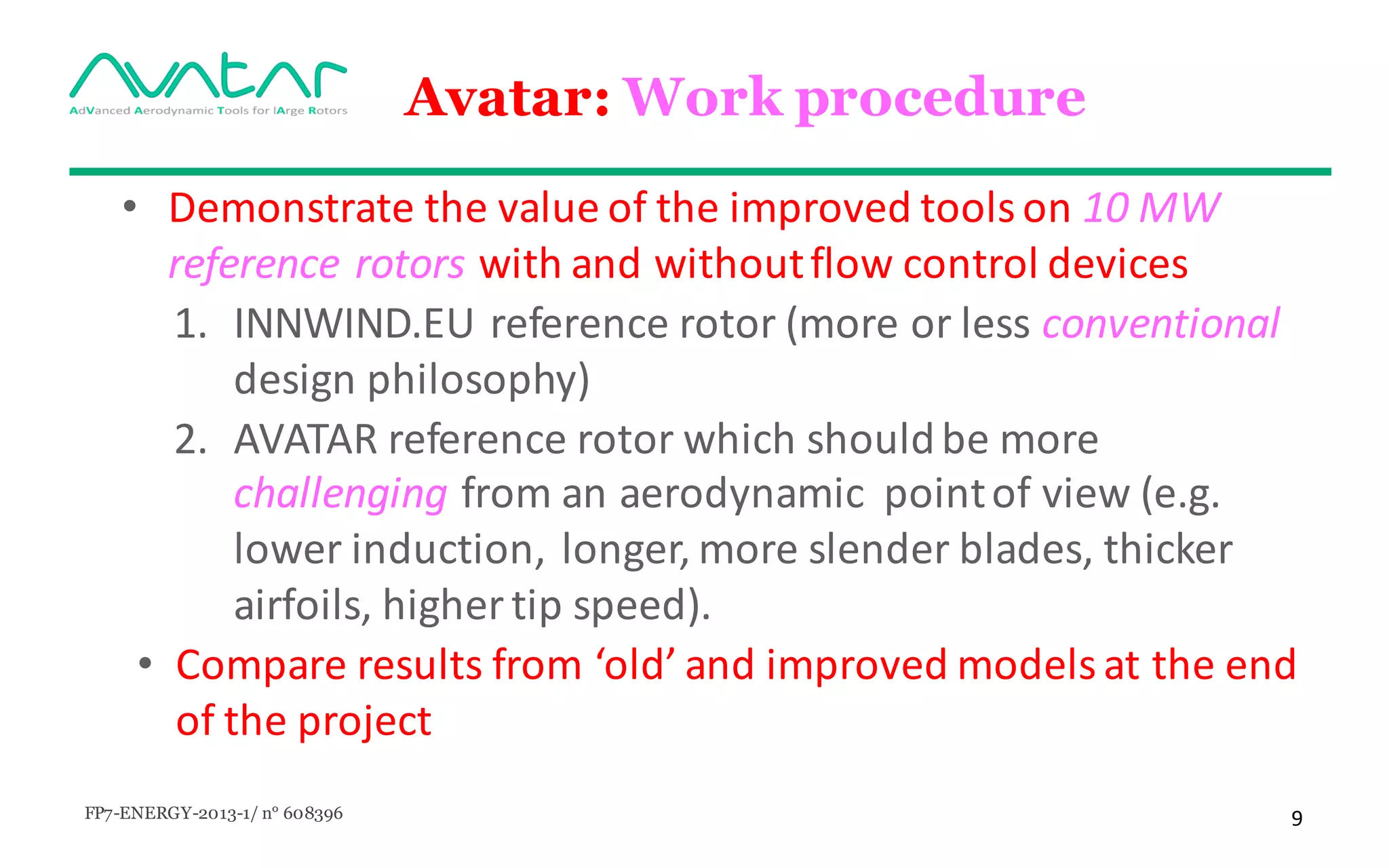
• Demonstrate	the	value	of	the	improved	tools	on	10	MW	
reference	rotors with	and	without	flow	control	devices	
1. INNWIND.EU	reference	rotor	(more	or	less	conventional	
design	philosophy)	
2. AVATAR	reference	rotor	which	should	be	more	
challenging	from	an	aerodynamic		point	of	view	(e.g.	
lower	induction,		longer,	more	slender	blades,	thicker	
airfoils,	higher	tip	speed).
• Compare	results	from	‘old’	and	improved	models	at	the	end	
of	the	project
FP7-ENERGY-2013-1/ n° 608396 10
List of Contents
q Introduction	into	the	project
q Design	of	AVATAR	Reference	Wind	Turbine	1)
q Aerodynamics at	high	Reynoldsnumbers
• Airfoil measurements in	pressurized DNW-HDG	tunnel
q Aero-elasticity of	large	turbines	at	yaw
• BEM	versus	free	vortex	wake	aerodynamic modelling
19-09-16
1) Acknowledgement G.	Sieros,	M.	Stettner
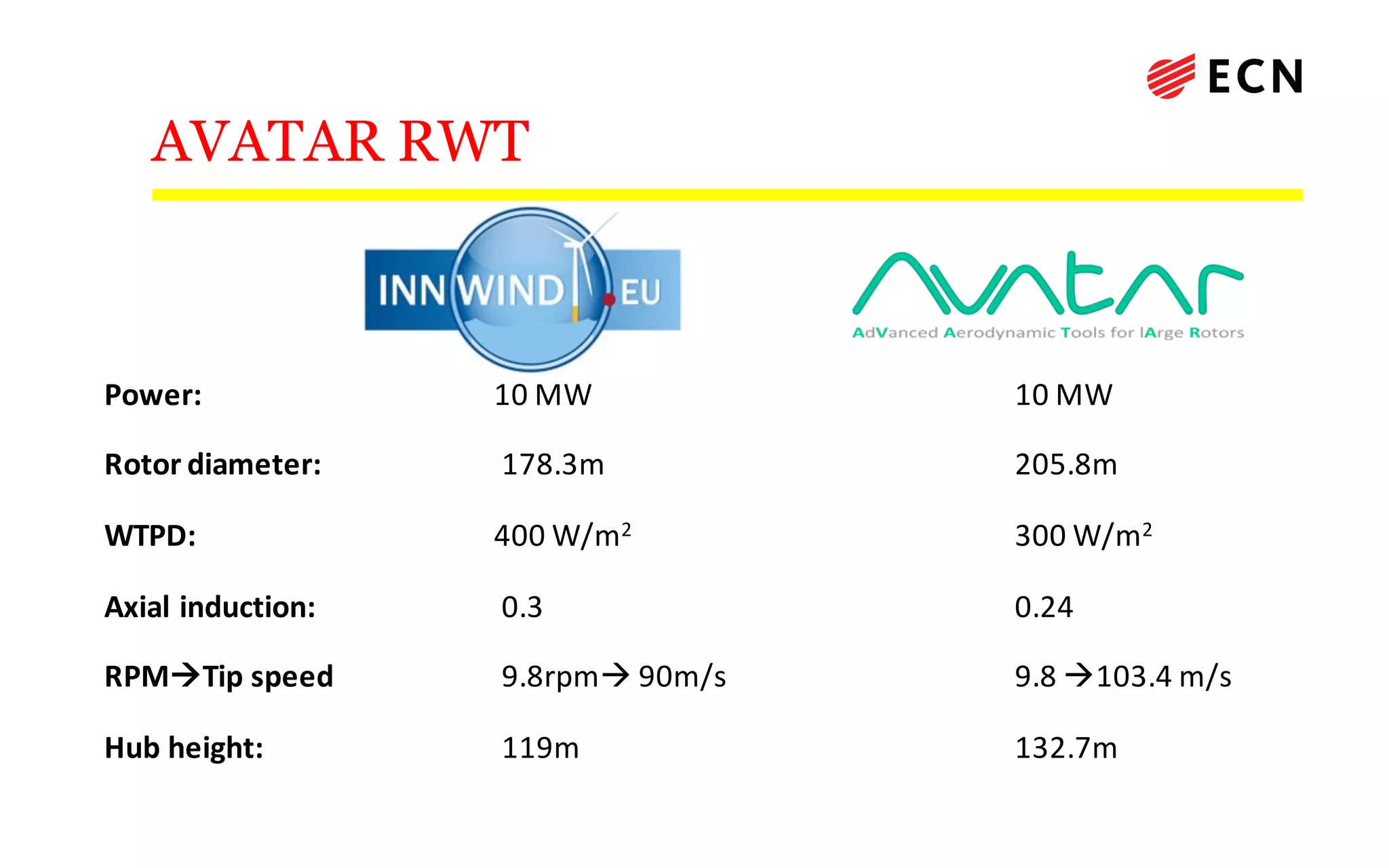
AVATAR RWT
Power:	 10	MW 10	MW
Rotor	diameter: 178.3m 205.8m
WTPD: 400	W/m2									 300	W/m2	
Axial	induction:	 0.3 0.24
RPMàTip speed 9.8rpmà 90m/s 9.8	à103.4	m/s
Hub	height: 119m 132.7m
FP7-ENERGY-2013-1/ n° 608396
Classical Approach versus Low Induction
• Power	Coefficient flat	around	Betz	
maximum	(a	=	1/3)
• Aerodynamic	load	coefficient	strongly	
dependant	on	a
• Increase	diameterà maintain	
aerodynamic	loadsà increase	power
2
3
)1(4
2
1
aa
AU
P
CP ==
0
0.2
0.4
0.6
0.8
1
1.2
0 0.1 0.2 0.3 0.4 0.5 0.6
Cdax
Cp
)1(4
2
1
.
2
. aa
AU
axD
C axD ==
a[-]
FP7-ENERGY-2013-1/ n° 608396 13
Design of AVATAR RWT
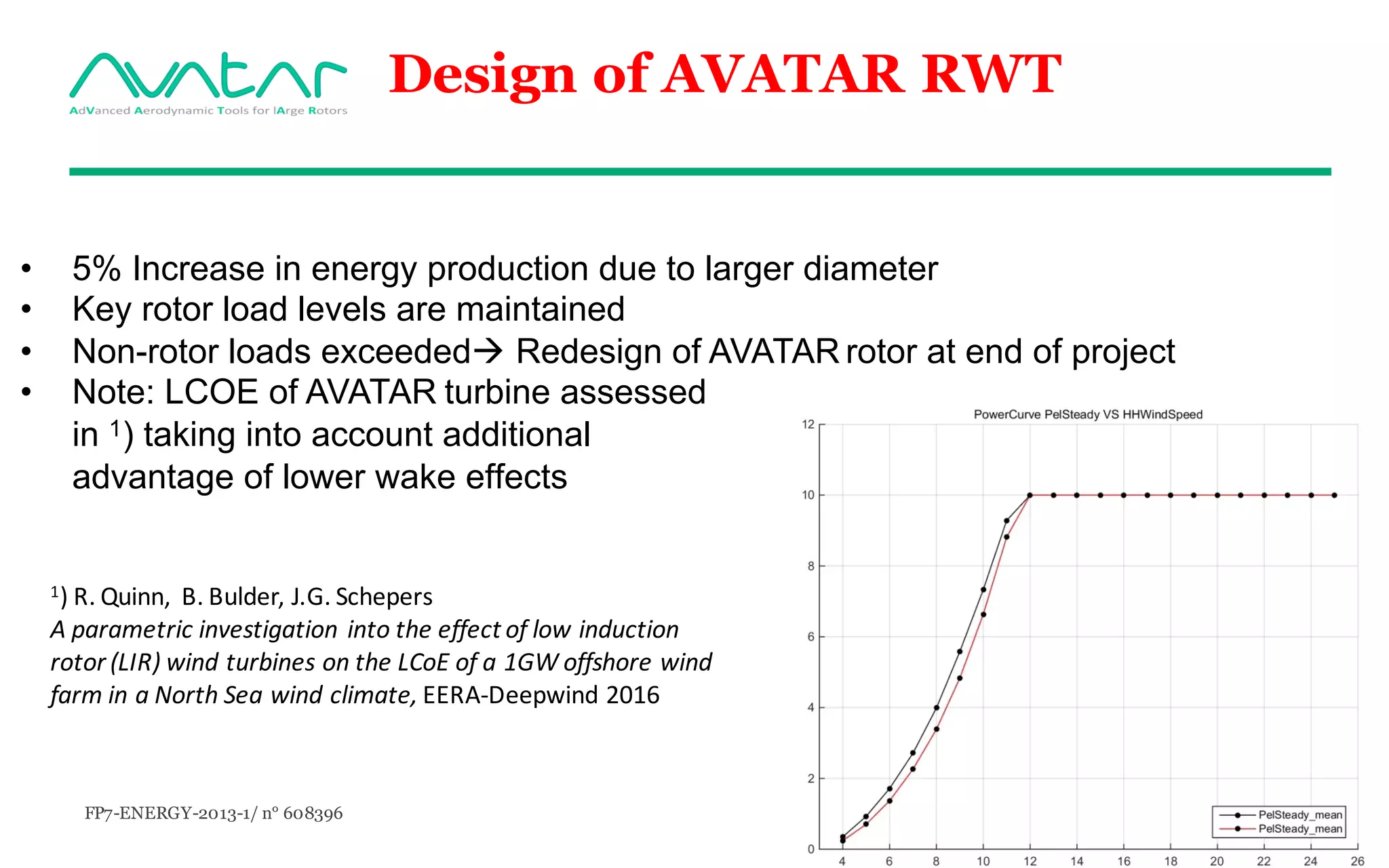
• 5% Increase in energy production due to larger diameter
• Key rotor load levels are maintained
• Non-rotor loads exceededà Redesign of AVATAR rotor at end of project
• Note: LCOE of AVATAR turbine assessed
in 1) taking into account additional
advantage of lower wake effects
1)	R.	Quinn,	 B.	Bulder,	J.G.	Schepers
A	parametric	investigation	into	the	effect	of	low	induction	
rotor	(LIR)	wind	turbines	on	the	LCoE of	a	1GW	offshore	wind	
farm	in	a	North	Sea	wind	climate,	EERA-Deepwind 2016
FP7-ENERGY-2013-1/ n° 608396
Design of AVATAR RWT
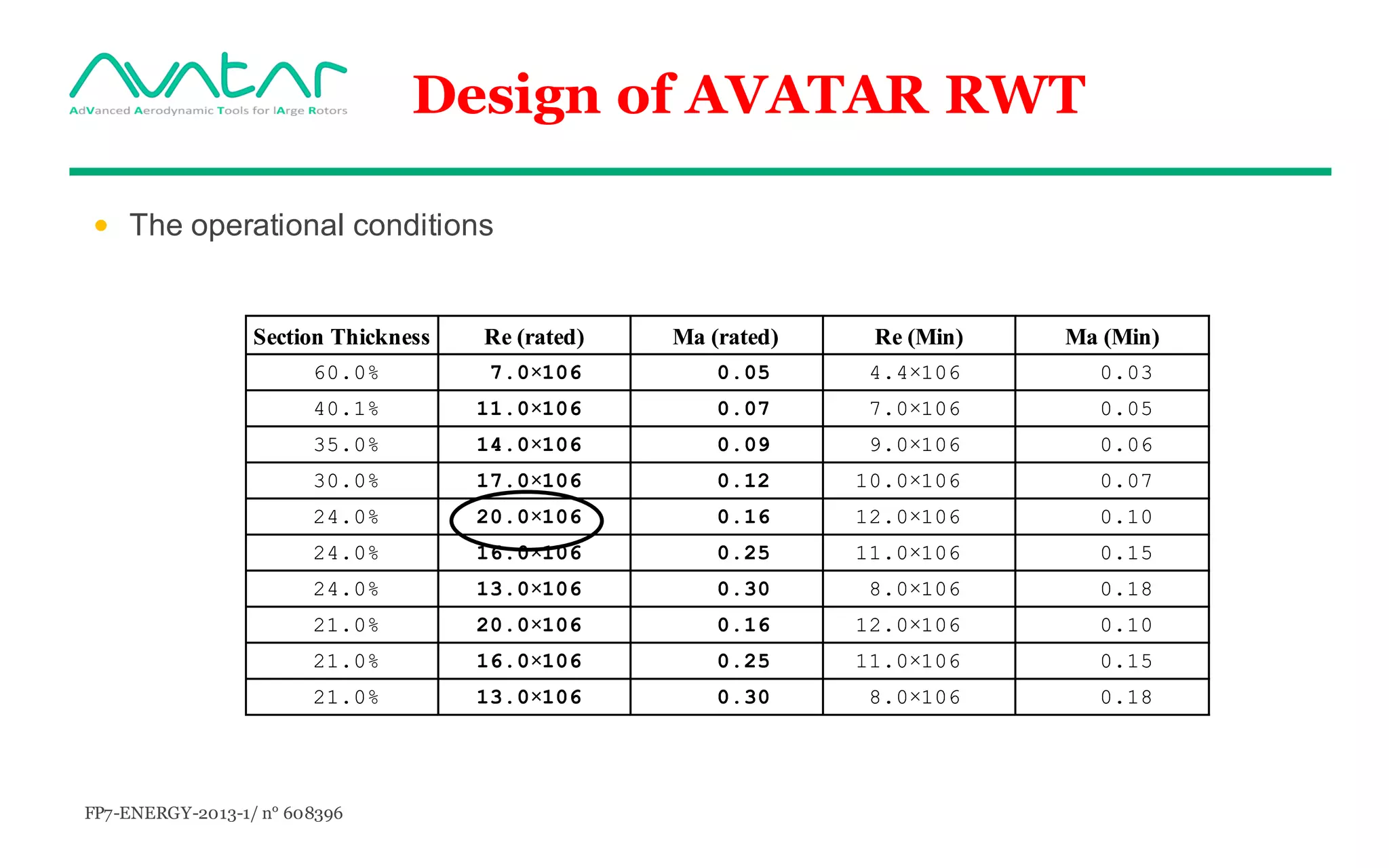
• The operational conditions
Section Thickness Re (rated) Ma (rated) Re (Min) Ma (Min)
60.0% 7.0×10⁶ 0.05 4.4×10⁶ 0.03
40.1% 11.0×10⁶ 0.07 7.0×10⁶ 0.05
35.0% 14.0×10⁶ 0.09 9.0×10⁶ 0.06
30.0% 17.0×10⁶ 0.12 10.0×10⁶ 0.07
24.0% 20.0×10⁶ 0.16 12.0×10⁶ 0.10
24.0% 16.0×10⁶ 0.25 11.0×10⁶ 0.15
24.0% 13.0×10⁶ 0.30 8.0×10⁶ 0.18
21.0% 20.0×10⁶ 0.16 12.0×10⁶ 0.10
21.0% 16.0×10⁶ 0.25 11.0×10⁶ 0.15
21.0% 13.0×10⁶ 0.30 8.0×10⁶ 0.18
Section Thickness Re (rated) Ma (rated) Re (Min) Ma (Min)
60.0% 7.0×10⁶ 0.05 4.4×10⁶ 0.03
40.1% 11.0×10⁶ 0.07 7.0×10⁶ 0.05
35.0% 14.0×10⁶ 0.09 9.0×10⁶ 0.06
30.0% 17.0×10⁶ 0.12 10.0×10⁶ 0.07
24.0% 20.0×10⁶ 0.16 12.0×10⁶ 0.10
24.0% 16.0×10⁶ 0.25 11.0×10⁶ 0.15
24.0% 13.0×10⁶ 0.30 8.0×10⁶ 0.18
21.0% 20.0×10⁶ 0.16 12.0×10⁶ 0.10
21.0% 16.0×10⁶ 0.25 11.0×10⁶ 0.15
21.0% 13.0×10⁶ 0.30 8.0×10⁶ 0.18
FP7-ENERGY-2013-1/ n° 608396 15
List of Contents
q Introduction	into	the	project
q Design	of	AVATAR	Reference	Wind	Turbine
q Aerodynamics at	high	Reynolds numbers
• Airfoil measurements in	pressurized DNW-HDG	tunnel	1)
q Aero-elasticity of	large	turbines	at	yaw
• BEM	versus	free	vortex	wake	aerodynamic modelling
19-09-16
1) Acknowledgement O.	Ceyhan,	O.	Pires
FP7-ENERGY-2013-1/ n° 608396
Measurements in DNW-HDG
pressurized tunnel
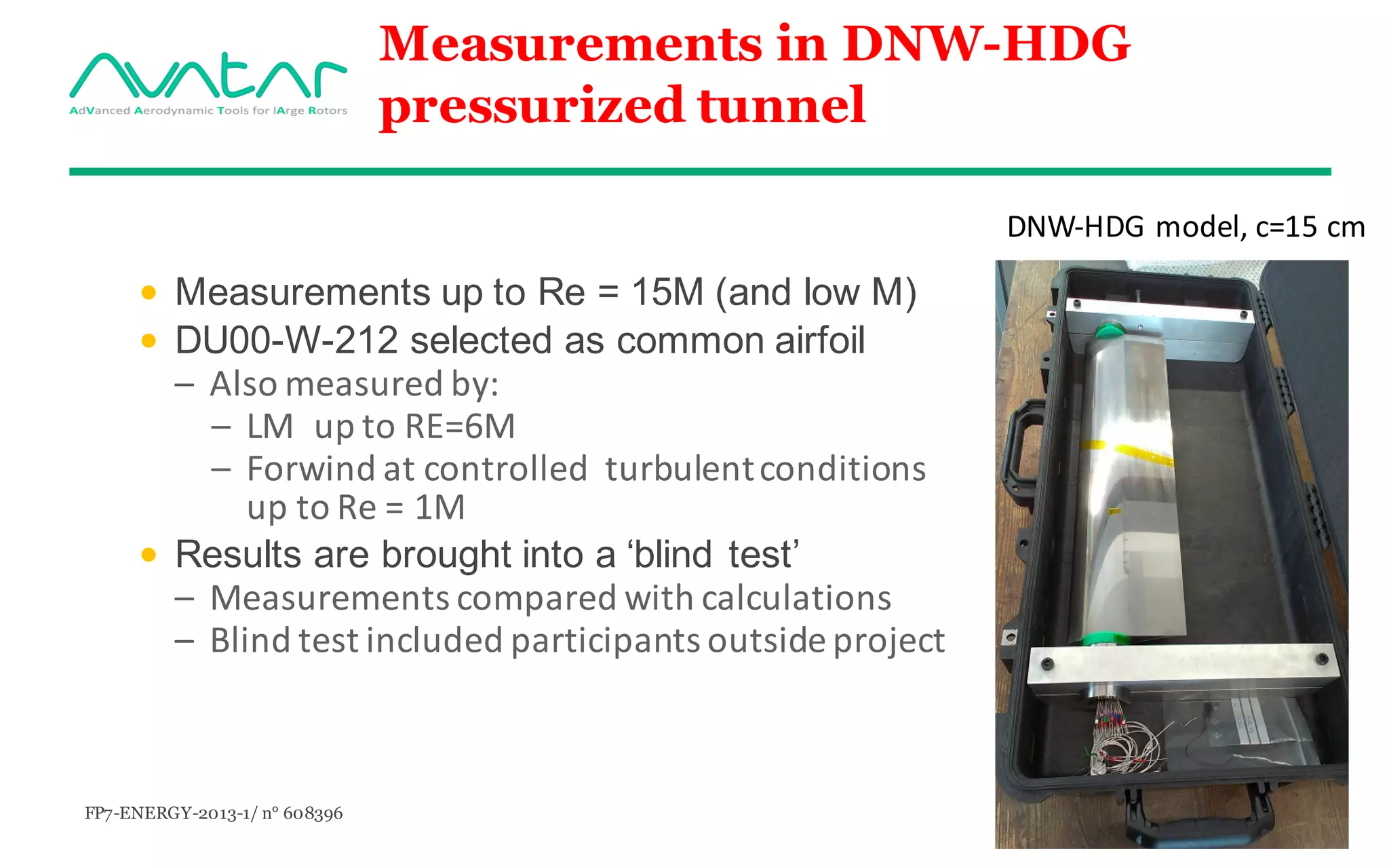
• Measurements up to Re = 15M (and low M)
• DU00-W-212 selected as common airfoil
– Also	measured	by:
– LM		up	to	RE=6M
– Forwind at	controlled		turbulent	conditions	
up	to	Re	=	1M
• Results are brought into a ‘blind test’
– Measurements	compared	with	calculations
– Blind	test	included	participants	outside	project
DNW-HDG	model,	c=15	cm
FP7-ENERGY-2013-1/ n° 608396
DNW-HDG Wind Tunnel
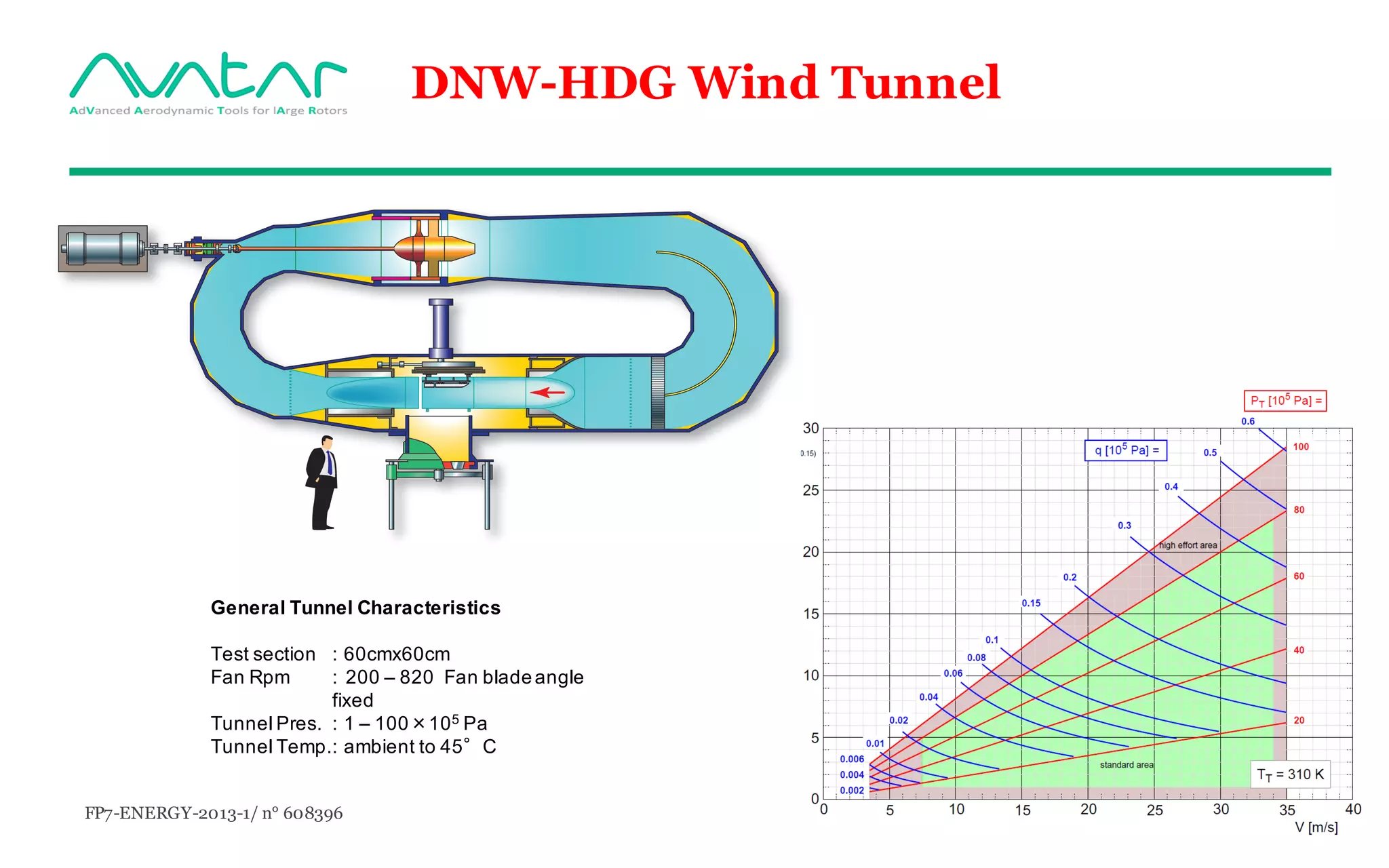
General Tunnel Characteristics
Test section : 60cmx60cm
Fan Rpm : 200 – 820 Fan bladeangle
fixed
Tunnel Pres. : 1 – 100×105 Pa
Tunnel Temp.: ambient to 45°C
FP7-ENERGY-2013-1/ n° 608396
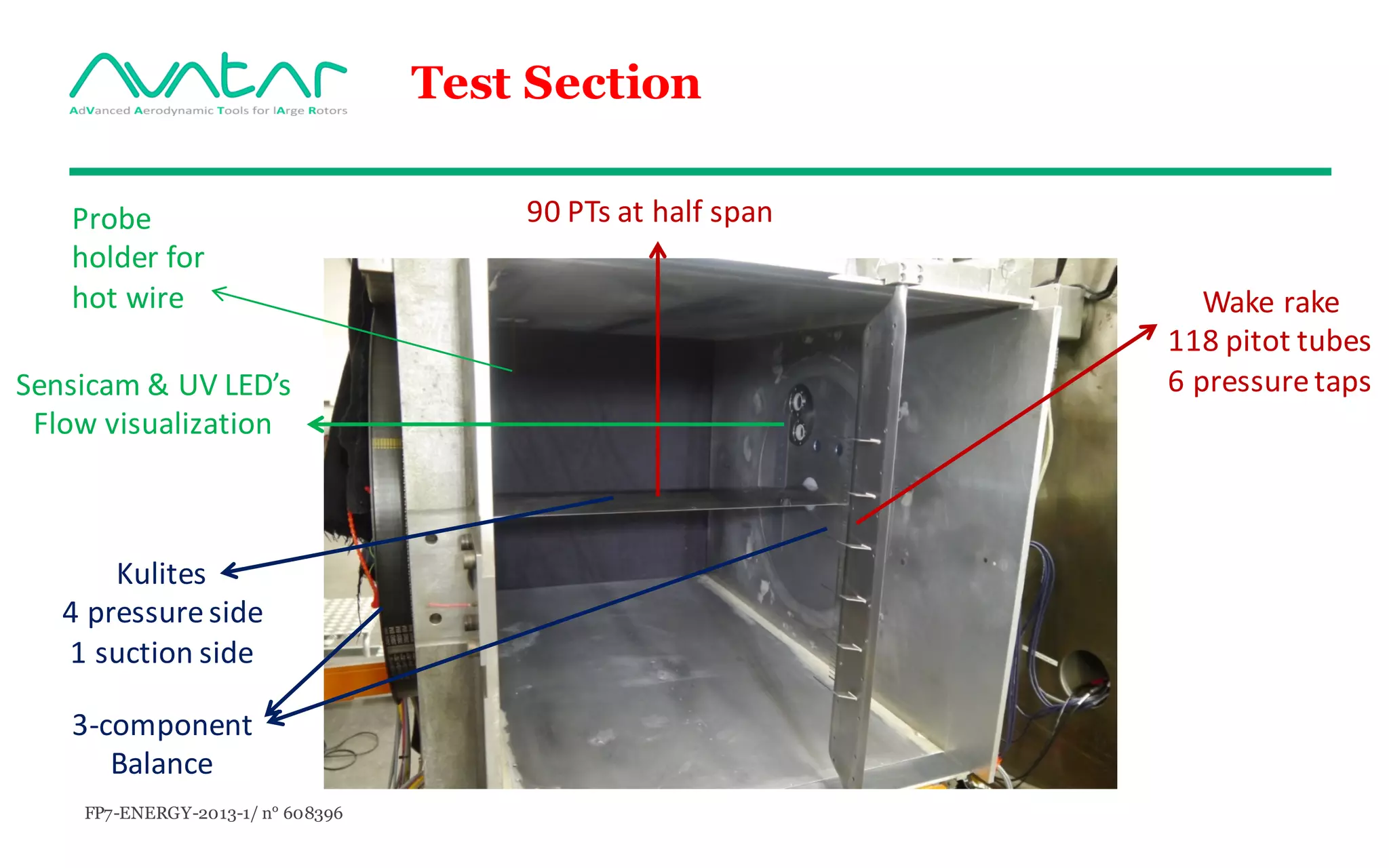
Test Section
Probe	
holder	for	
hot	wire
90	PTs	at	half	span
Wake	rake
118	pitot	tubes
6	pressure	taps
Kulites
4	pressure	side
1	suction	side
3-component	
Balance
Sensicam &	UV	LED’s
Flow	visualization
FP7-ENERGY-2013-1/ n° 608396
Participants/Codes
Test	1.	
Re=3mil
Test	2.	
Re=6mil-1
Test	3.	
Re=6mil-2
Test	4.	
Re=9mil-1
Test	5.	
Re=9mil-2
Test	6. Test	7.
Re=12mil Re=15mil
Pt [bars] 12 34 67 34 67 67 60
Vtunnel [m/s] 25.6 19 10 28.6 15 20 28.4
Full	CFD
DTU/EllipSys
Fully	turbulent
Transition Yes Yes Yes Yes Yes Yes Yes
KIEL/TAU
Fully	turbulent
Transition Yes Yes Yes Yes Yes Yes Yes
NTUA/Mapflow
Fully	turbulent
Transition Yes Yes Yes Yes Yes Yes Yes
UoG/HMB
Fully	turbulent Yes Yes
Transition Yes Yes
Forwind-IWES/OpenFOAM
Fully	turbulent Yes Yes Yes Yes Yes Yes Yes
Transition
Panel	
Methods
USTUTT/XFOILvUSTUTT
Fully	turbulent
Transition Yes Yes Yes Yes Yes Yes Yes
ORE	Catapult/XFOILv6.96
Fully	turbulent
Transition Yes Yes Yes Yes Yes Yes Yes
FP7-ENERGY-2013-1/ n° 608396
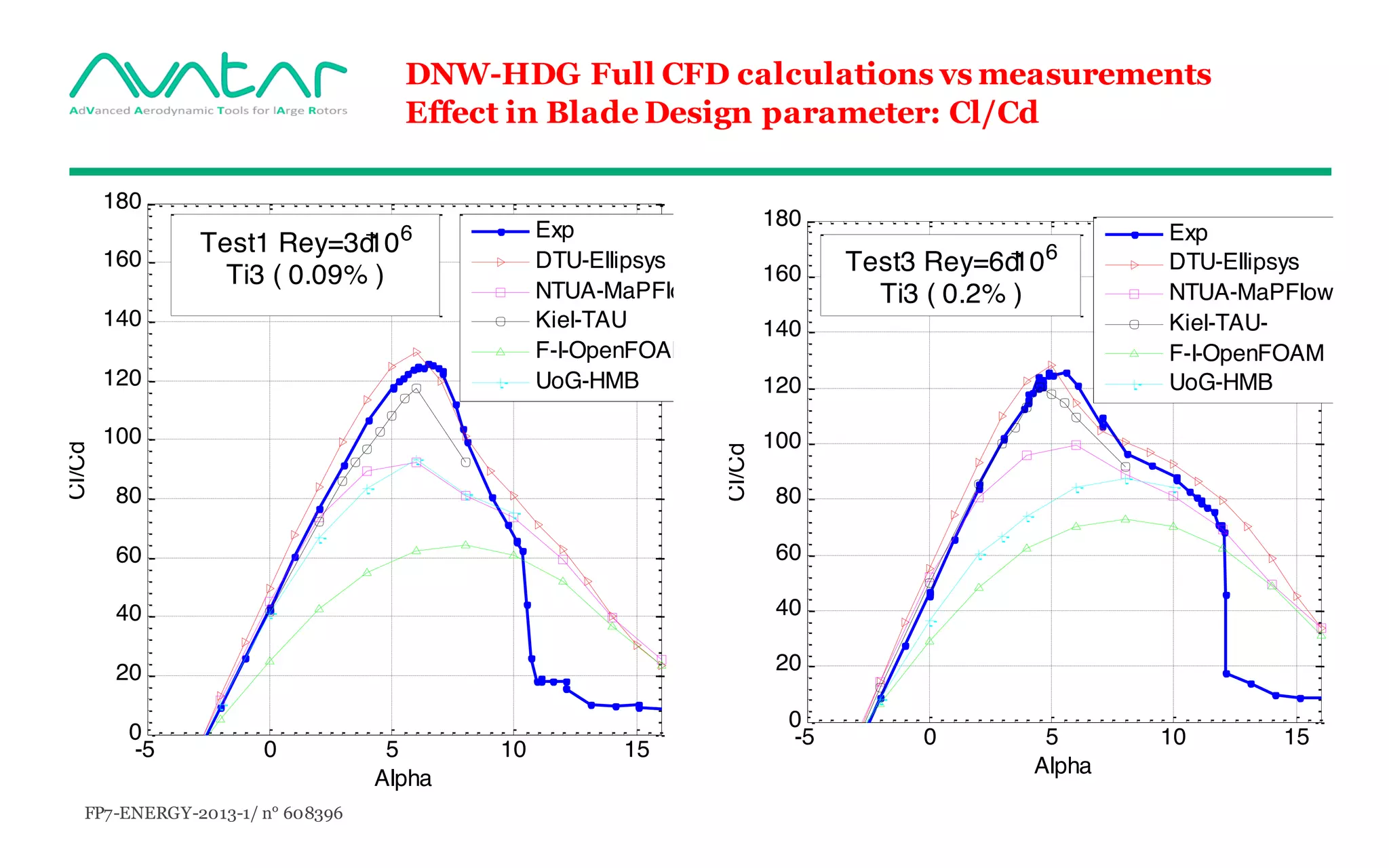
DNW-HDG Full CFD calculations vs measurements
Effect in Blade Design parameter: Cl/Cd
-5 0 5 10 15
0
20
40
60
80
100
120
140
160
180
Alpha
Cl/Cd
Exp
DTU-Ellipsys
NTUA-MaPFlow
Kiel-TAU
F-I-OpenFOAM
UoG-HMB
Test1 Rey=3đ106
Ti3 ( 0.09% )
-5 0 5 10 15
0
20
40
60
80
100
120
140
160
180
Alpha
Cl/Cd
Exp
DTU-Ellipsys
NTUA-MaPFlow
Kiel-TAU-
F-I-OpenFOAM
UoG-HMB
Test3 Rey=6đ106
Ti3 ( 0.2% )
FP7-ENERGY-2013-1/ n° 608396
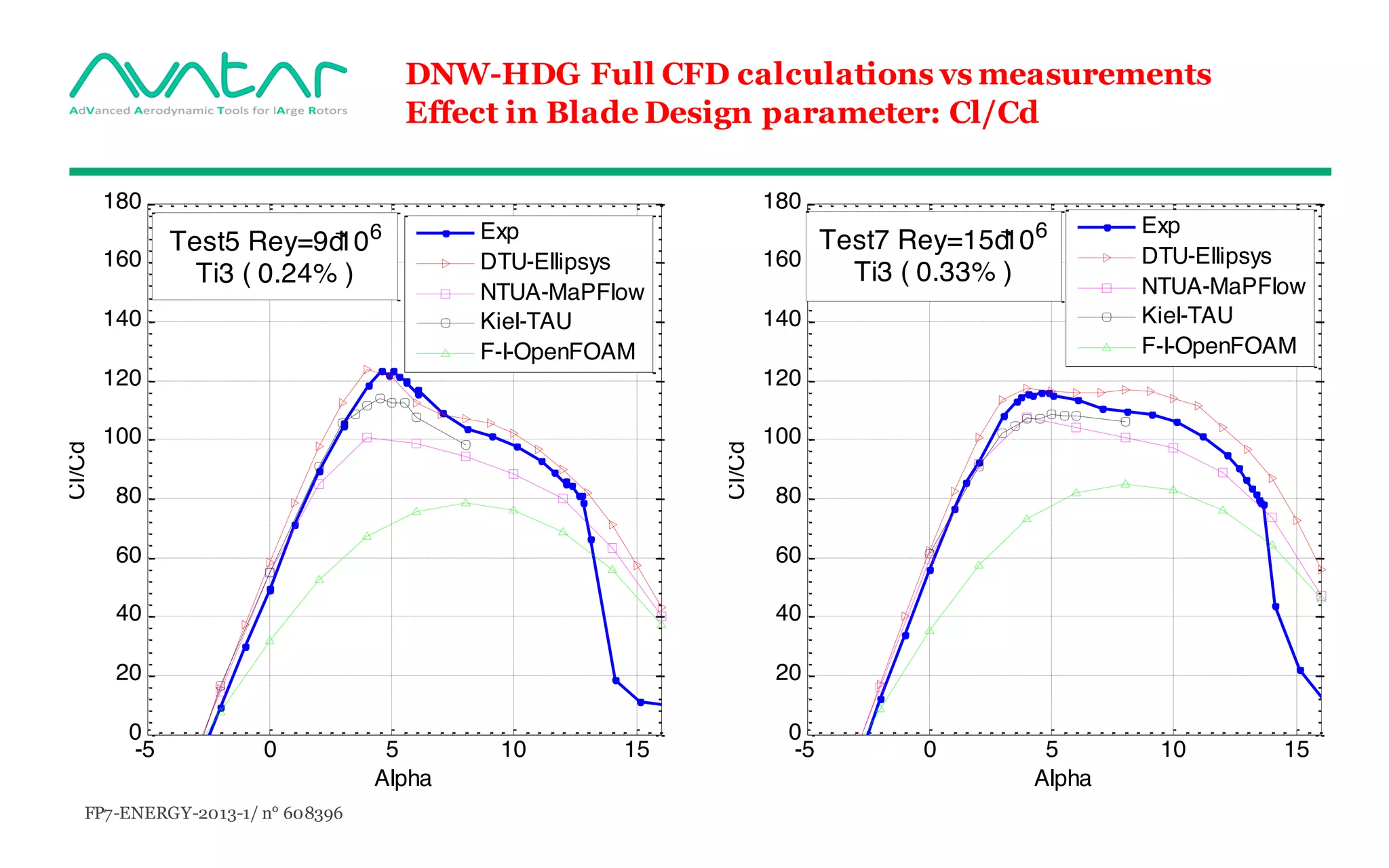
DNW-HDG Full CFD calculations vs measurements
Effect in Blade Design parameter: Cl/Cd
-5 0 5 10 15
0
20
40
60
80
100
120
140
160
180
Alpha
Cl/Cd
Exp
DTU-Ellipsys
NTUA-MaPFlow
Kiel-TAU
F-I-OpenFOAM
Test5 Rey=9đ106
Ti3 ( 0.24% )
-5 0 5 10 15
0
20
40
60
80
100
120
140
160
180
Alpha
Cl/Cd
Exp
DTU-Ellipsys
NTUA-MaPFlow
Kiel-TAU
F-I-OpenFOAM
Test7 Rey=15đ106
Ti3 ( 0.33% )
FP7-ENERGY-2013-1/ n° 608396
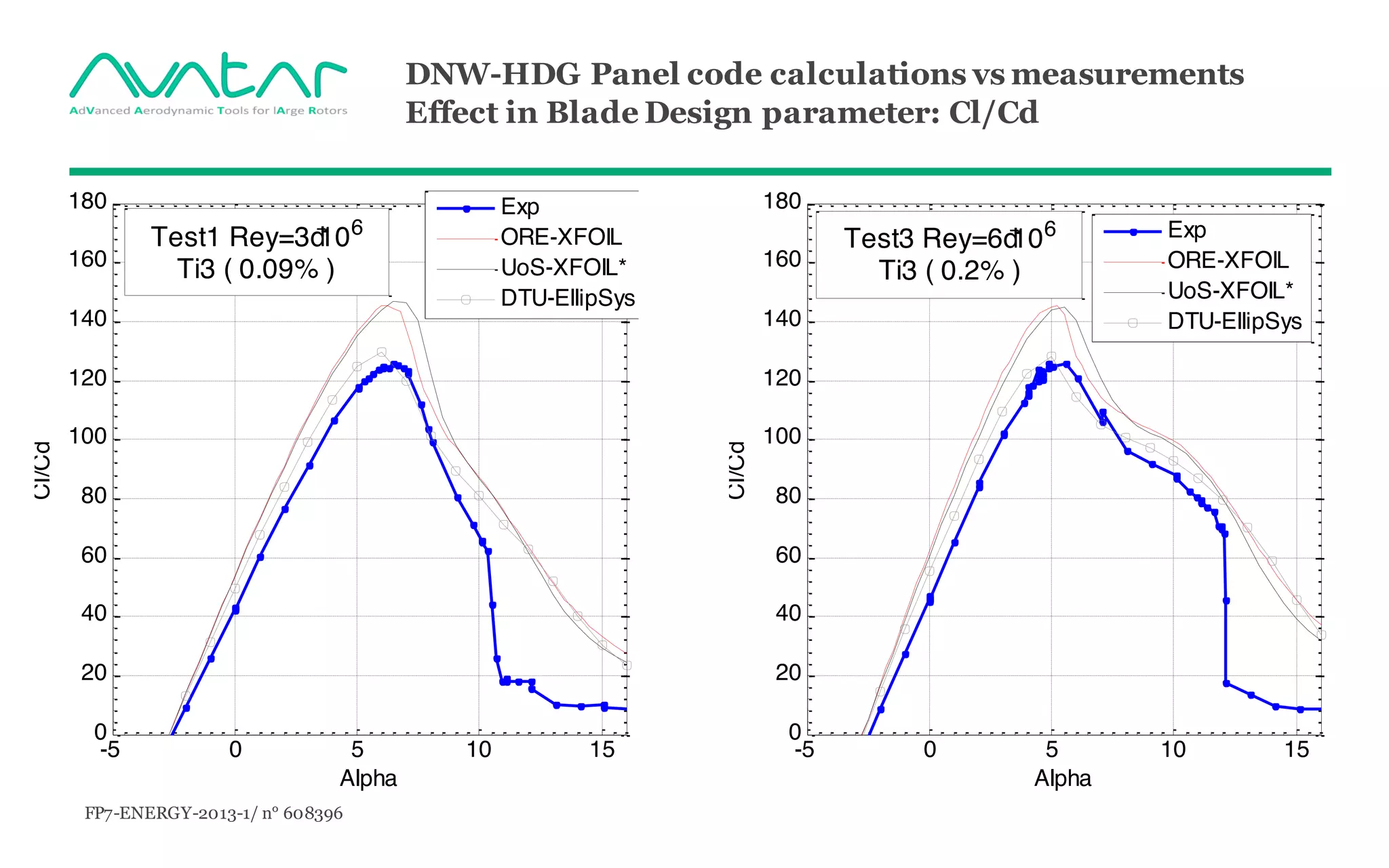
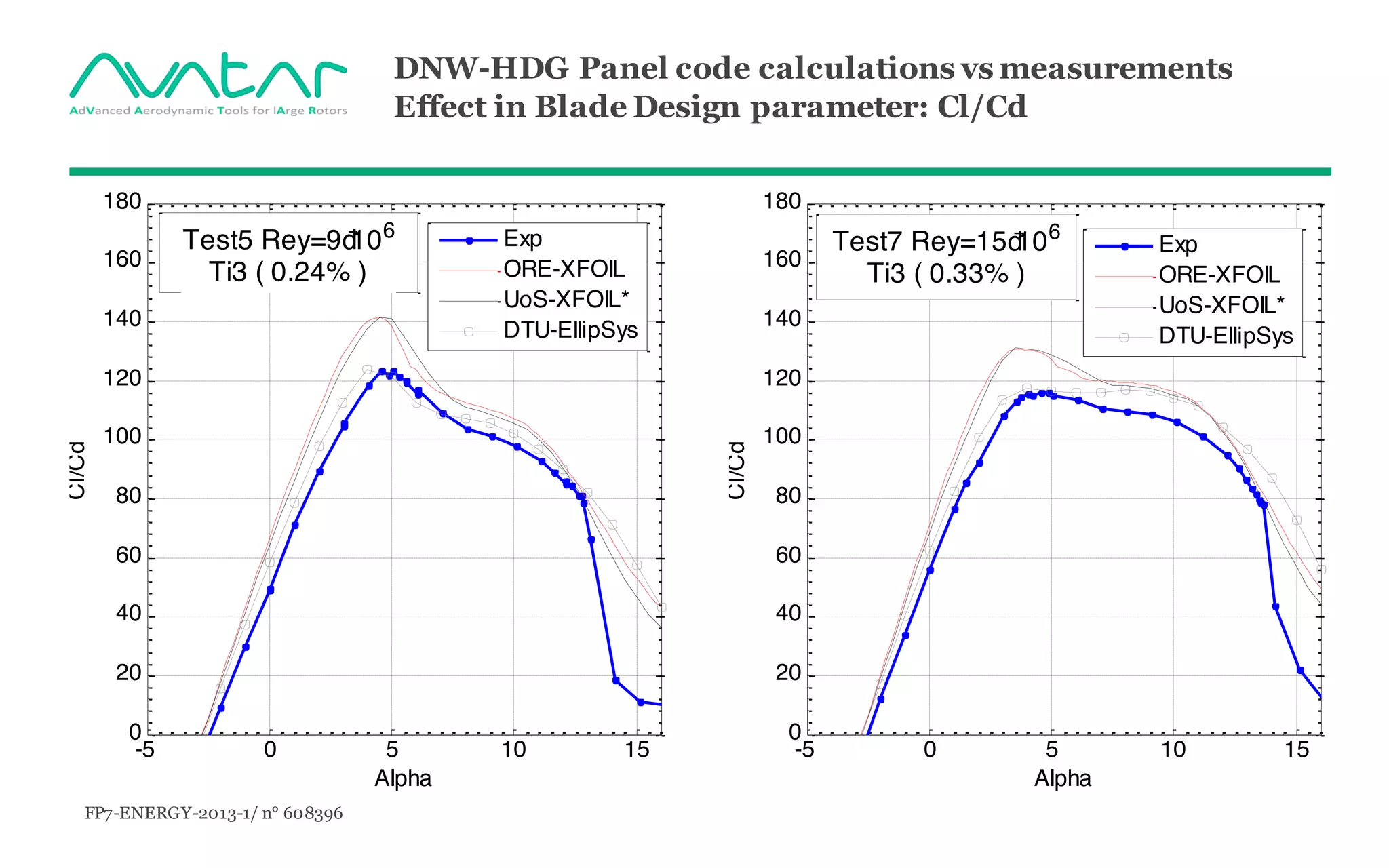
DNW-HDG Panel code calculations vs measurements
Effect in Blade Design parameter: Cl/Cd
-5 0 5 10 15
0
20
40
60
80
100
120
140
160
180
Alpha
Cl/Cd
Exp
ORE-XFOIL
UoS-XFOIL*
DTU-EllipSys
Test1 Rey=3đ106
Ti3 ( 0.09% )
-5 0 5 10 15
0
20
40
60
80
100
120
140
160
180
Alpha
Cl/Cd
Exp
ORE-XFOIL
UoS-XFOIL*
DTU-EllipSys
Test3 Rey=6đ106
Ti3 ( 0.2% )
FP7-ENERGY-2013-1/ n° 608396
DNW-HDG Panel code calculations vs measurements
Effect in Blade Design parameter: Cl/Cd
-5 0 5 10 15
0
20
40
60
80
100
120
140
160
180
Alpha
Cl/Cd
Exp
ORE-XFOIL
UoS-XFOIL*
DTU-EllipSys
Test5 Rey=9đ106
Ti3 ( 0.24% )
-5 0 5 10 15
0
20
40
60
80
100
120
140
160
180
Alpha
Cl/Cd
Exp
ORE-XFOIL
UoS-XFOIL*
DTU-EllipSys
Test7 Rey=15đ106
Ti3 ( 0.33% )
FP7-ENERGY-2013-1/ n° 608396
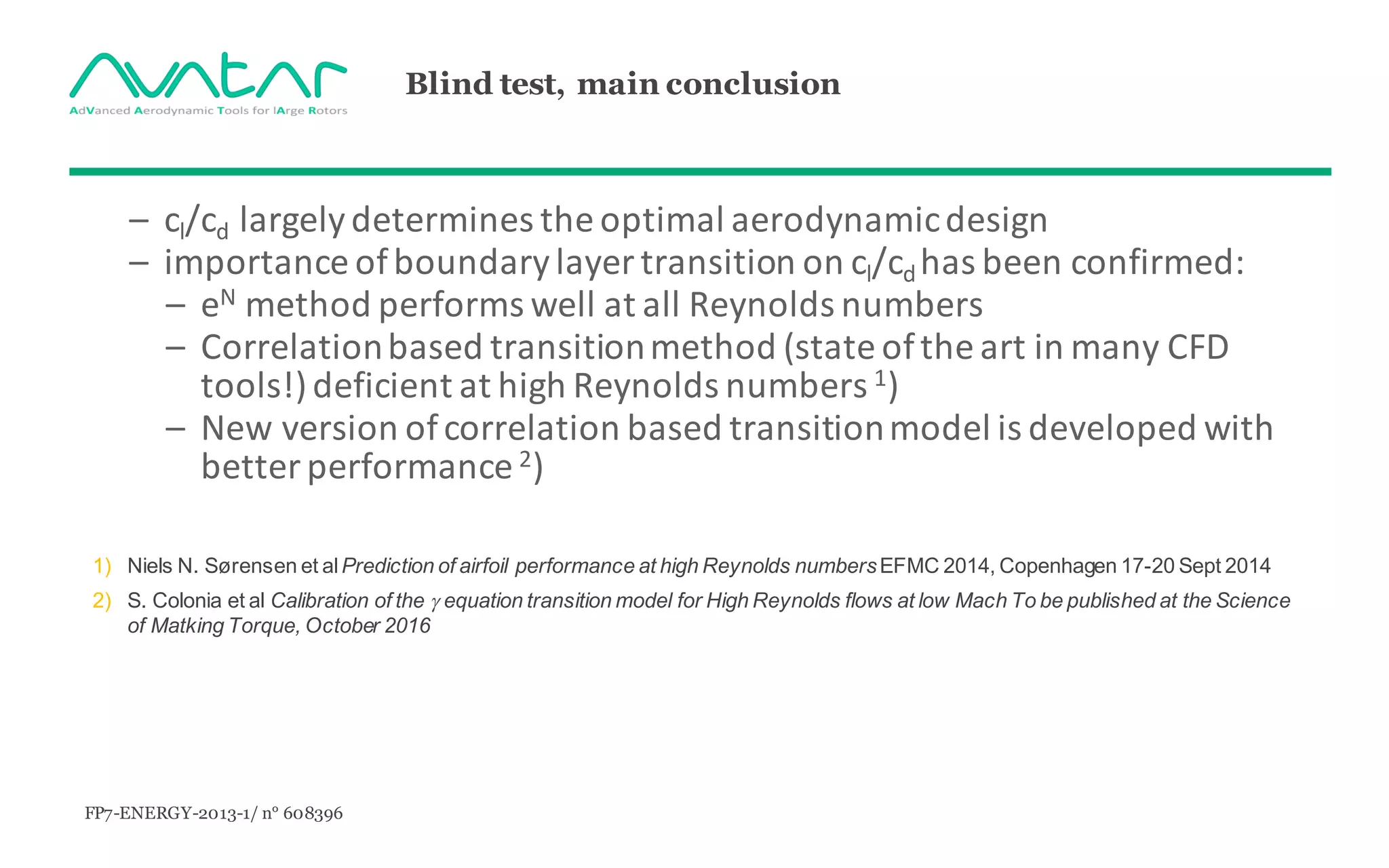
Blind test, main conclusion
– cl/cd largelydetermines the	optimal aerodynamicdesign
– importance of	boundarylayer transition on	cl/cd	has	been	confirmed:
– eN method performs well	at	all Reynolds	numbers
– Correlationbased transitionmethod (state	of	the art	in	many CFD	
tools!)	deficient at	high	Reynolds	numbers 1)
– New	version of	correlation based transitionmodel	is	developed with
better performance	2)
1) Niels N. Sørensen et alPrediction of airfoil performance at high Reynolds numbersEFMC 2014, Copenhagen 17-20 Sept 2014
2) S. Colonia et al Calibration of the g equation transition model for High Reynolds flows at low Mach To be published at the Science
of Matking Torque, October 2016
FP7-ENERGY-2013-1/ n° 608396 25
List of Contents
q Introduction	into	the	project
q Design	of	AVATAR	Reference	Wind	Turbine
q Aerodynamics at	high	Reynoldsnumbers
• Airfoil measurements in	pressurized DNW-HDG	tunnel
q Aero-elasticity of	large	turbines	at	yaw
• BEM	versus	free	vortex	wake	aerodynamic modelling1)
19-09-16
1) Acknowledgement	K.	Boorsma,	S.	Voutsinas
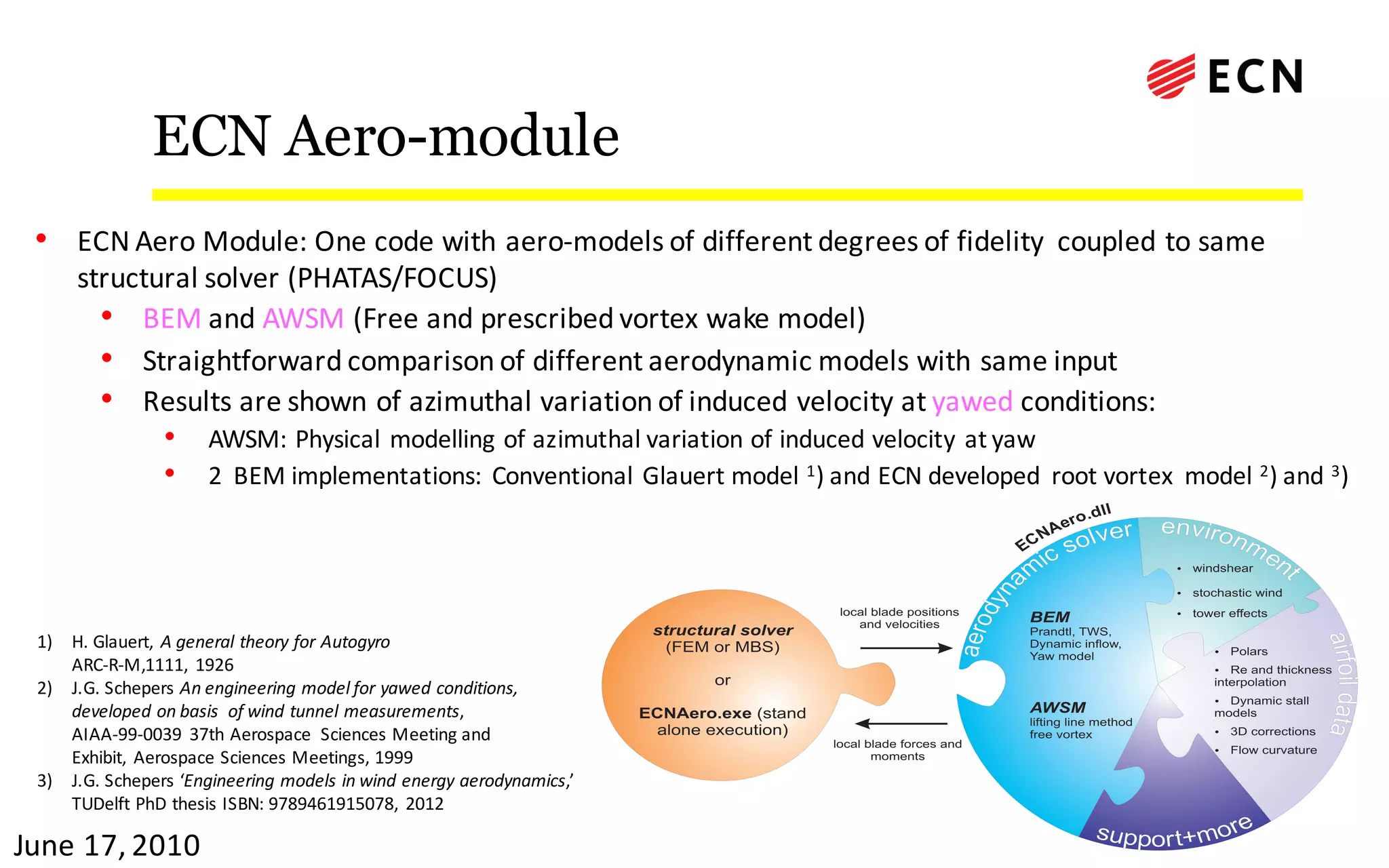
ECN Aero-module
26
June	17,	2010
• ECN	Aero	Module:	One	code	with	aero-models	of	different	degrees	of	fidelity	 coupled	to	same	
structural	solver	(PHATAS/FOCUS)
• BEM and	AWSM (Free	and	prescribed	vortex	wake	model)
• Straightforward	comparison	of	different	aerodynamic	models	with	same	input
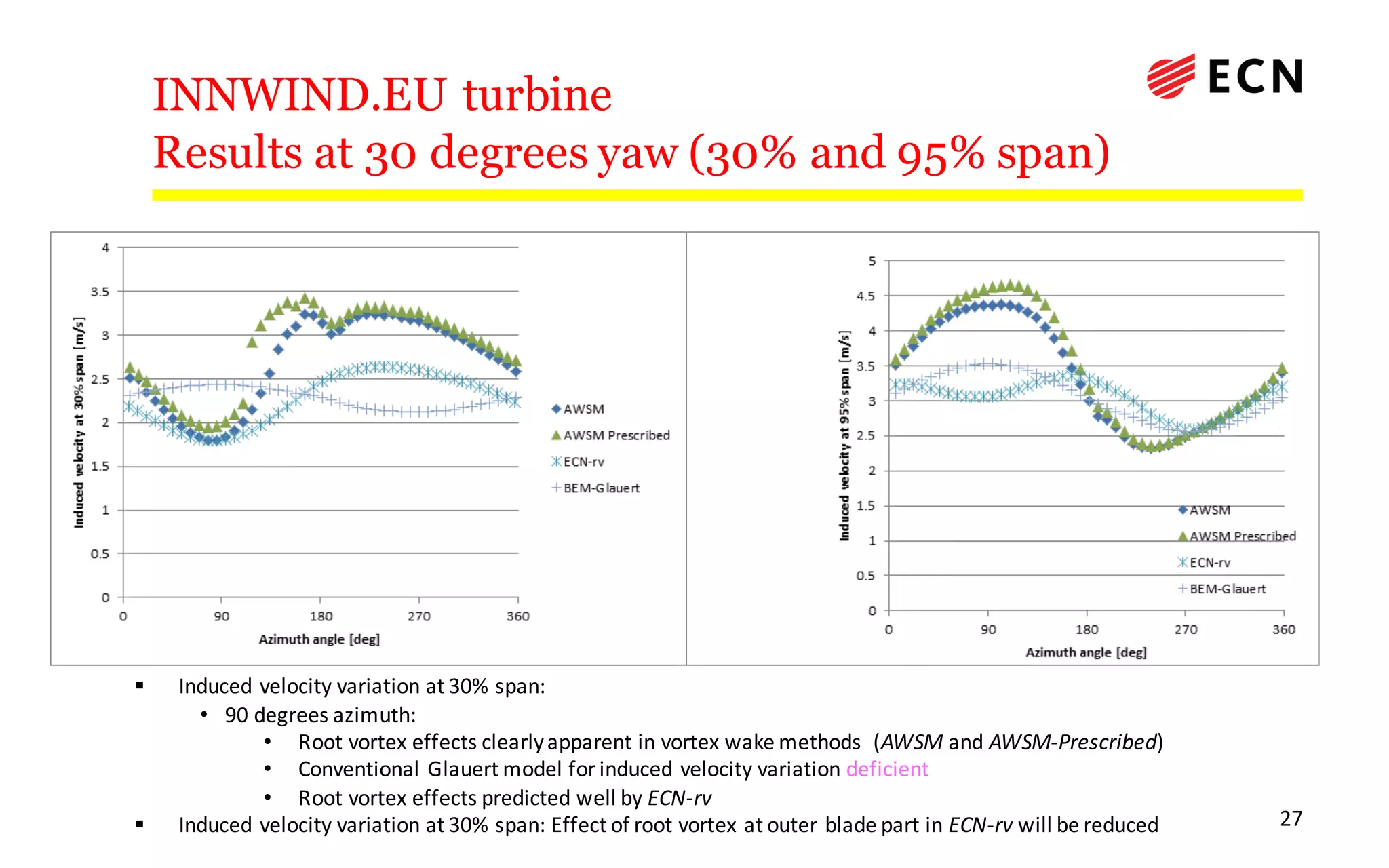
• Results	are	shown	of	azimuthal	variation	of	induced	velocity	at	yawed conditions:
• AWSM:	Physical modelling of	azimuthal	variation of	induced velocity at	yaw
• 2		BEM	implementations:	Conventional Glauert model	1)	and ECN	developed root	vortex		model	2)	and 3)
1) H.	Glauert,	 A	general	theory	for	Autogyro
ARC-R-M,1111,	 1926
2) J.G.	Schepers	An	engineering	model	for	yawed	conditions,	
developed	on	basis		of	wind	tunnel	measurements,	
AIAA-99-0039		37th	Aerospace		Sciences	Meeting	and	
Exhibit,	 Aerospace	Sciences	Meetings,	1999
3) J.G.	Schepers	‘Engineering	models	in	wind	energy	aerodynamics,’	
TUDelft PhD	thesis	ISBN:	9789461915078,	 2012
INNWIND.EU turbine
Results at 30 degrees yaw (30% and 95% span)
27
§ Induced velocity variation at	30%	span:
• 90	degrees azimuth:	
• Root	vortex	effects clearlyapparent	in	vortex	wake	methods (AWSM and AWSM-Prescribed)
• Conventional Glauert model	for induced velocity variation deficient
• Root	vortex	effects predicted well	by ECN-rv
§ Induced velocity variation at	30%	span:	Effect	of	root	vortex	at	outer blade part	in	ECN-rv will be reduced
FP7-ENERGY-2013-1/ n° 608396 28
Summary
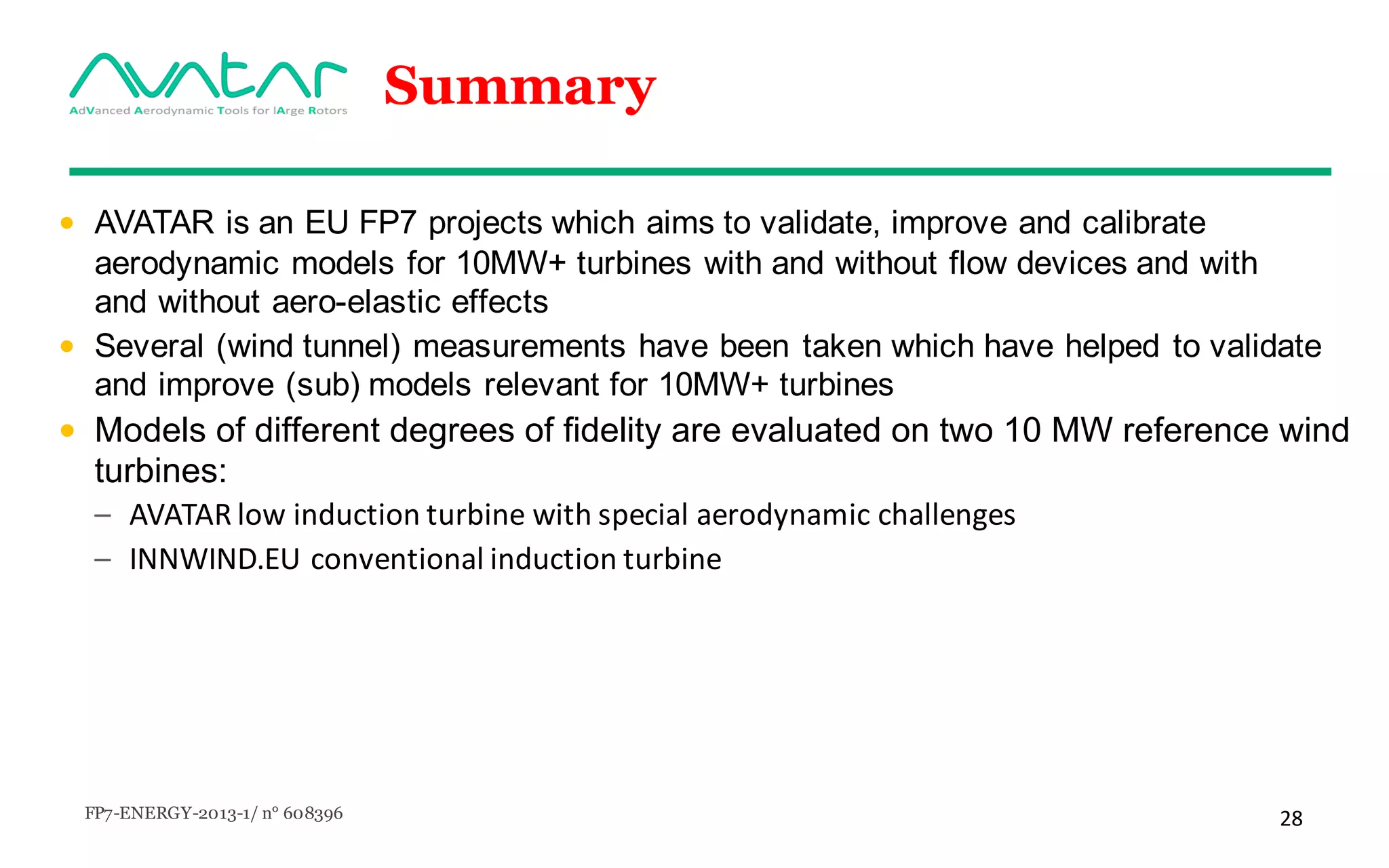
• AVATAR is an EU FP7 projects which aims to validate, improve and calibrate
aerodynamic models for 10MW+ turbines with and without flow devices and with
and without aero-elastic effects
• Several (wind tunnel) measurements have been taken which have helped to validate
and improve (sub) models relevant for 10MW+ turbines
• Models of different degrees of fidelity are evaluated on two 10 MW reference wind
turbines:
– AVATAR	low	induction turbine	with special	aerodynamic challenges
– INNWIND.EU	conventional induction turbine
FP7-ENERGY-2013-1/ n° 608396 29
Summary
• The amount of results from the AVATAR project is far too much to present in 15-20 minutes
• AVATAR led to several model improvements and lessons learned e.g:
– Transition modelling
• Original	correlation based transitionmodels deficient at	high	Reynolds	numbers
• Updated version of	correlation basedtransition models has	become available
• Guidelines	on	the	employment	of	transition	(and	turbulence)	models	formulated	
– Improved predictions for low	Mach	conditions in	compressible codes
– Improved models for thick airfoils
– Improved models	for flow	devices (flaps,	vortex	generators,	root	spoilers)
– First	possibilities for rotor	model	improvements identified (many more	will follow…)
– Improved calculational efficiency	and reduced time	to set-up	calculation
– Expansion/integration of	codes	(e.g.	coupling of	aero-elastic models to free	vortex	wake	methods)
– Best	practice	guidelines	 on	grid	resolutions	and	temporal	resolution
• Need	for	vortex	corrections	at	some	grid	topologies	with	limited	domain	size
– Calibration	of	engineering	methods	from	CFD	not	straightforward
• Techniques	are	developed	and	tested	to	derive	lifting	line	variables	from	CFD	
– Many	more	improvements	and	lessons	 learned	will	follow!
FP7-ENERGY-2013-1/ n° 608396 30
Dissemination of results
– All technical deliverables	are	public:	
http://www.eera-avatar.eu/publications-results-and-links/
– Web	based validation platform	is	under development	
(http://windbench.net/avatar)
– AVATAR	session	at	IRPWIND-EERA	Joint	Wind	R&D	conference,	
September	19,	Amsterdam,	the	Netherlands
– Introduction	(Gerard	Schepers,	ECN)
– Advanced	Aerodynamic	Modelling	(Niels	Sørensen,	DTU)
– Flow	device	aerodynamics	(Alvaro	Gonzalez,	CENER)
– Roadmap	for	further	engineering	modelling	improvements	(Gerard	Schepers,	ECN)
– AVATAR	session	at	Science of	Making	Torque,	October 7,	Munich	Germany
– 5	Oral	presentations
– Latest	results	from	the	EU	project	AVATAR:	Aerodynamic	modelling	of	10	MW	wind	turbines	(Gerard	Schepers	(ECN) et	al)	
– CFD	code	comparison	for	2D	airfoil	flows (Niels	Sørensen (DTU)	et	al)
– Experimental	benchmark	and	code	validation	for	airfoils	equipped	with	passive	vortex	generators (Daniel	Baldacchino (TUDelft)	et	al)
– Computing	the	flow	past	Vortex	Generators:	Comparison between	RANS	Simulations	and	Experiments	(M.	Manolesos	(NTUA) et	al)
– Results	of	the	AVATAR	project	for	the	validation	of	2D	aerodynamic	models	with	experimental	data	of	the	DU95W180	airfoil	with	unsteady	flap	(Carlos	Fereira (TUDelft) et	al)
– Introduction to 7	posters
Consortium
FP7-ENERGY-2013-1/ n° 608396
Coordinator:
Partners in alphabetical order:
This project has received funding from the European Union’s Seventh Programme for research, technological development and
demonstration under grand agreement No FP7-ENERGY-2013-1/n° 608396 .
Thank you for your attention

Gerard Schepers - Advanced Aerodynamic Tools for Large Rotors (AVATAR) Project

  • 1.
    www.eera-avatar.eu This project hasreceived funding from the European Union’s Seventh Programme for research, technological development and demonstration under grand agreement No FP7-ENERGY-2013-1/n° 608396 . AVATAR project Advanced Aerodynamic Tools for lArge Rotors Gerard Schepers 2016 Wind Turbine Blade Workshop Sandia National Laboratories, USA August 31st, 2016
  • 2.
    FP7-ENERGY-2013-1/ n° 6083962 List of Contents q Introduction into the project q Design of AVATAR Reference Wind Turbine 1) q Aerodynamics at high Reynoldsnumbers • Airfoil measurements in pressurized DNW-HDG tunnel 2) q Aero-elasticity of large turbines at yaw • BEM versus free vortex wake aerodynamic modelling3) 19-09-16 1) Acknowledgement G. Sieros, M. Stettner 2) Acknowledgement O. Ceyhan, O. Pires 3) Acknowledgement K. Boorsma, S. Voutsinas And all other project partners!
  • 3.
    FP7-ENERGY-2013-1/ n° 6083963 EU FP7 Project initiated by EERA 1. Energy Research Centre of the Netherlands,ECN (Coordinator) 2. Delft University of Technology,TUDelft 3. Technical University ofDenmark, DTU 4. Fraunhofer IWES 5. University of Oldenburg,Forwind 6. University of Stuttgart, USTUTT 7. National Renewable Energy Centre,CENER 8. University of Liverpool/University ofGlasgow, ULIV/UoG 9. Centre for Renewable Energy Sources and Saving,CRES 10.National Technical University ofGreece, NTUA 11.Politecnico di Milano,Polimi 12.GE Global Research,Zweigniederlassung der General Electric Deutschland Holding GmbH,GE 13.LM Wind Power, LM 19-09-16
  • 4.
    FP7-ENERGY-2013-1/ n° 6083964 Period • Project period: November 1st 2013- November 1st 2017
  • 5.
    FP7-ENERGY-2013-1/ n° 6083965 Main motivation for AVATAR: Aerodynamics of large wind turbines (10-20MW) • We simply don’t know if present aerodynamic models are good enough to design 10MW+ turbines • 10MW+ rotors violate assumptions in current aerodynamic tools, e.g.: – Reynolds number effects, – Compressibility effects – Thick(er) airfoils – Flow transition and separation, – (More) flexible blades – Flow devices • Hence 10MW+ designs fall outside the validated range of current state of the art tools. 19-09-16
  • 6.
    FP7-ENERGY-2013-1/ n° 6083966 Avatar: Main objective To bring the aerodynamic and fluid-structure models to a next level and calibrate them for all relevant aspects of large (10MW+) wind turbines 19-09-16
  • 7.
    FP7-ENERGY-2013-1/ n° 6083967 Avatar: Work procedure – Problem: No 10 MW turbines are on the market yet for validation – Hence: Validate submodels against experiments • Pressurized HDG tunnel of German Dutch Wind Tunnel facilities (DNW) • Airfoil measurements at Reynolds numbers up to RE = 15 M and low Mach (< 0.2) • LM: Wind tunnel airfoil measurements • Forwind: Wind tunnel airfoil measurements at representative turbulence • TUDelft: Wind tunnel experiments on airfoils with vortex generators, flaps • NTUA: Wind tunnel experiments on airfoils with/without vortex generators • DTU : Danaero: Aerodynamic field experiments on a 2.3 MW turbine and supporting 2D wind tunnel measurements 19-09-16
  • 8.
    FP7-ENERGY-2013-1/ n° 6083968 Avatar: Work procedure Use the different models from partners in the project o It is a cooperation project! o In the project we have many models which range from computational efficient ‘engineering’ tools to high fidelity but computationally expensive tools o Engineering tools are needed in industrial design codes 1) o High fidelity models (and intermediate models) feed information towards engineering models 19-09-16 1 ) J.G. Schepers ‘Engineering models in wind energy aerodynamics,’ (2012). http://repository.tudelft.nl/islandora/object/uuid:92123c07-cc12-4945-973f-103bd744ec87/?collection=research
  • 9.
    FP7-ENERGY-2013-1/ n° 6083969 Avatar: Work procedure • Demonstrate the value of the improved tools on 10 MW reference rotors with and without flow control devices 1. INNWIND.EU reference rotor (more or less conventional design philosophy) 2. AVATAR reference rotor which should be more challenging from an aerodynamic point of view (e.g. lower induction, longer, more slender blades, thicker airfoils, higher tip speed). • Compare results from ‘old’ and improved models at the end of the project
  • 10.
    FP7-ENERGY-2013-1/ n° 60839610 List of Contents q Introduction into the project q Design of AVATAR Reference Wind Turbine 1) q Aerodynamics at high Reynoldsnumbers • Airfoil measurements in pressurized DNW-HDG tunnel q Aero-elasticity of large turbines at yaw • BEM versus free vortex wake aerodynamic modelling 19-09-16 1) Acknowledgement G. Sieros, M. Stettner
  • 11.
    AVATAR RWT Power: 10 MW10 MW Rotor diameter: 178.3m 205.8m WTPD: 400 W/m2 300 W/m2 Axial induction: 0.3 0.24 RPMàTip speed 9.8rpmà 90m/s 9.8 à103.4 m/s Hub height: 119m 132.7m
  • 12.
    FP7-ENERGY-2013-1/ n° 608396 ClassicalApproach versus Low Induction • Power Coefficient flat around Betz maximum (a = 1/3) • Aerodynamic load coefficient strongly dependant on a • Increase diameterà maintain aerodynamic loadsà increase power 2 3 )1(4 2 1 aa AU P CP == 0 0.2 0.4 0.6 0.8 1 1.2 0 0.1 0.2 0.3 0.4 0.5 0.6 Cdax Cp )1(4 2 1 . 2 . aa AU axD C axD == a[-]
  • 13.
    FP7-ENERGY-2013-1/ n° 60839613 Design of AVATAR RWT • 5% Increase in energy production due to larger diameter • Key rotor load levels are maintained • Non-rotor loads exceededà Redesign of AVATAR rotor at end of project • Note: LCOE of AVATAR turbine assessed in 1) taking into account additional advantage of lower wake effects 1) R. Quinn, B. Bulder, J.G. Schepers A parametric investigation into the effect of low induction rotor (LIR) wind turbines on the LCoE of a 1GW offshore wind farm in a North Sea wind climate, EERA-Deepwind 2016
  • 14.
    FP7-ENERGY-2013-1/ n° 608396 Designof AVATAR RWT • The operational conditions Section Thickness Re (rated) Ma (rated) Re (Min) Ma (Min) 60.0% 7.0×10⁶ 0.05 4.4×10⁶ 0.03 40.1% 11.0×10⁶ 0.07 7.0×10⁶ 0.05 35.0% 14.0×10⁶ 0.09 9.0×10⁶ 0.06 30.0% 17.0×10⁶ 0.12 10.0×10⁶ 0.07 24.0% 20.0×10⁶ 0.16 12.0×10⁶ 0.10 24.0% 16.0×10⁶ 0.25 11.0×10⁶ 0.15 24.0% 13.0×10⁶ 0.30 8.0×10⁶ 0.18 21.0% 20.0×10⁶ 0.16 12.0×10⁶ 0.10 21.0% 16.0×10⁶ 0.25 11.0×10⁶ 0.15 21.0% 13.0×10⁶ 0.30 8.0×10⁶ 0.18 Section Thickness Re (rated) Ma (rated) Re (Min) Ma (Min) 60.0% 7.0×10⁶ 0.05 4.4×10⁶ 0.03 40.1% 11.0×10⁶ 0.07 7.0×10⁶ 0.05 35.0% 14.0×10⁶ 0.09 9.0×10⁶ 0.06 30.0% 17.0×10⁶ 0.12 10.0×10⁶ 0.07 24.0% 20.0×10⁶ 0.16 12.0×10⁶ 0.10 24.0% 16.0×10⁶ 0.25 11.0×10⁶ 0.15 24.0% 13.0×10⁶ 0.30 8.0×10⁶ 0.18 21.0% 20.0×10⁶ 0.16 12.0×10⁶ 0.10 21.0% 16.0×10⁶ 0.25 11.0×10⁶ 0.15 21.0% 13.0×10⁶ 0.30 8.0×10⁶ 0.18
  • 15.
    FP7-ENERGY-2013-1/ n° 60839615 List of Contents q Introduction into the project q Design of AVATAR Reference Wind Turbine q Aerodynamics at high Reynolds numbers • Airfoil measurements in pressurized DNW-HDG tunnel 1) q Aero-elasticity of large turbines at yaw • BEM versus free vortex wake aerodynamic modelling 19-09-16 1) Acknowledgement O. Ceyhan, O. Pires
  • 16.
    FP7-ENERGY-2013-1/ n° 608396 Measurementsin DNW-HDG pressurized tunnel • Measurements up to Re = 15M (and low M) • DU00-W-212 selected as common airfoil – Also measured by: – LM up to RE=6M – Forwind at controlled turbulent conditions up to Re = 1M • Results are brought into a ‘blind test’ – Measurements compared with calculations – Blind test included participants outside project DNW-HDG model, c=15 cm
  • 17.
    FP7-ENERGY-2013-1/ n° 608396 DNW-HDGWind Tunnel General Tunnel Characteristics Test section : 60cmx60cm Fan Rpm : 200 – 820 Fan bladeangle fixed Tunnel Pres. : 1 – 100×105 Pa Tunnel Temp.: ambient to 45°C
  • 18.
    FP7-ENERGY-2013-1/ n° 608396 TestSection Probe holder for hot wire 90 PTs at half span Wake rake 118 pitot tubes 6 pressure taps Kulites 4 pressure side 1 suction side 3-component Balance Sensicam & UV LED’s Flow visualization
  • 19.
    FP7-ENERGY-2013-1/ n° 608396 Participants/Codes Test 1. Re=3mil Test 2. Re=6mil-1 Test 3. Re=6mil-2 Test 4. Re=9mil-1 Test 5. Re=9mil-2 Test 6.Test 7. Re=12mil Re=15mil Pt [bars] 12 34 67 34 67 67 60 Vtunnel [m/s] 25.6 19 10 28.6 15 20 28.4 Full CFD DTU/EllipSys Fully turbulent Transition Yes Yes Yes Yes Yes Yes Yes KIEL/TAU Fully turbulent Transition Yes Yes Yes Yes Yes Yes Yes NTUA/Mapflow Fully turbulent Transition Yes Yes Yes Yes Yes Yes Yes UoG/HMB Fully turbulent Yes Yes Transition Yes Yes Forwind-IWES/OpenFOAM Fully turbulent Yes Yes Yes Yes Yes Yes Yes Transition Panel Methods USTUTT/XFOILvUSTUTT Fully turbulent Transition Yes Yes Yes Yes Yes Yes Yes ORE Catapult/XFOILv6.96 Fully turbulent Transition Yes Yes Yes Yes Yes Yes Yes
  • 20.
    FP7-ENERGY-2013-1/ n° 608396 DNW-HDGFull CFD calculations vs measurements Effect in Blade Design parameter: Cl/Cd -5 0 5 10 15 0 20 40 60 80 100 120 140 160 180 Alpha Cl/Cd Exp DTU-Ellipsys NTUA-MaPFlow Kiel-TAU F-I-OpenFOAM UoG-HMB Test1 Rey=3đ106 Ti3 ( 0.09% ) -5 0 5 10 15 0 20 40 60 80 100 120 140 160 180 Alpha Cl/Cd Exp DTU-Ellipsys NTUA-MaPFlow Kiel-TAU- F-I-OpenFOAM UoG-HMB Test3 Rey=6đ106 Ti3 ( 0.2% )
  • 21.
    FP7-ENERGY-2013-1/ n° 608396 DNW-HDGFull CFD calculations vs measurements Effect in Blade Design parameter: Cl/Cd -5 0 5 10 15 0 20 40 60 80 100 120 140 160 180 Alpha Cl/Cd Exp DTU-Ellipsys NTUA-MaPFlow Kiel-TAU F-I-OpenFOAM Test5 Rey=9đ106 Ti3 ( 0.24% ) -5 0 5 10 15 0 20 40 60 80 100 120 140 160 180 Alpha Cl/Cd Exp DTU-Ellipsys NTUA-MaPFlow Kiel-TAU F-I-OpenFOAM Test7 Rey=15đ106 Ti3 ( 0.33% )
  • 22.
    FP7-ENERGY-2013-1/ n° 608396 DNW-HDGPanel code calculations vs measurements Effect in Blade Design parameter: Cl/Cd -5 0 5 10 15 0 20 40 60 80 100 120 140 160 180 Alpha Cl/Cd Exp ORE-XFOIL UoS-XFOIL* DTU-EllipSys Test1 Rey=3đ106 Ti3 ( 0.09% ) -5 0 5 10 15 0 20 40 60 80 100 120 140 160 180 Alpha Cl/Cd Exp ORE-XFOIL UoS-XFOIL* DTU-EllipSys Test3 Rey=6đ106 Ti3 ( 0.2% )
  • 23.
    FP7-ENERGY-2013-1/ n° 608396 DNW-HDGPanel code calculations vs measurements Effect in Blade Design parameter: Cl/Cd -5 0 5 10 15 0 20 40 60 80 100 120 140 160 180 Alpha Cl/Cd Exp ORE-XFOIL UoS-XFOIL* DTU-EllipSys Test5 Rey=9đ106 Ti3 ( 0.24% ) -5 0 5 10 15 0 20 40 60 80 100 120 140 160 180 Alpha Cl/Cd Exp ORE-XFOIL UoS-XFOIL* DTU-EllipSys Test7 Rey=15đ106 Ti3 ( 0.33% )
  • 24.
    FP7-ENERGY-2013-1/ n° 608396 Blindtest, main conclusion – cl/cd largelydetermines the optimal aerodynamicdesign – importance of boundarylayer transition on cl/cd has been confirmed: – eN method performs well at all Reynolds numbers – Correlationbased transitionmethod (state of the art in many CFD tools!) deficient at high Reynolds numbers 1) – New version of correlation based transitionmodel is developed with better performance 2) 1) Niels N. Sørensen et alPrediction of airfoil performance at high Reynolds numbersEFMC 2014, Copenhagen 17-20 Sept 2014 2) S. Colonia et al Calibration of the g equation transition model for High Reynolds flows at low Mach To be published at the Science of Matking Torque, October 2016
  • 25.
    FP7-ENERGY-2013-1/ n° 60839625 List of Contents q Introduction into the project q Design of AVATAR Reference Wind Turbine q Aerodynamics at high Reynoldsnumbers • Airfoil measurements in pressurized DNW-HDG tunnel q Aero-elasticity of large turbines at yaw • BEM versus free vortex wake aerodynamic modelling1) 19-09-16 1) Acknowledgement K. Boorsma, S. Voutsinas
  • 26.
    ECN Aero-module 26 June 17, 2010 • ECN Aero Module: One code with aero-models of different degrees of fidelity coupled to same structural solver (PHATAS/FOCUS) • BEM and AWSM (Free and prescribed vortex wake model) • Straightforward comparison of different aerodynamic models with same input • Results are shown of azimuthal variation of induced velocity at yawed conditions: • AWSM: Physical modelling of azimuthal variation of induced velocity at yaw • 2 BEM implementations: Conventional Glauert model 1) and ECN developed root vortex model 2) and 3) 1) H. Glauert, A general theory for Autogyro ARC-R-M,1111, 1926 2) J.G. Schepers An engineering model for yawed conditions, developed on basis of wind tunnel measurements, AIAA-99-0039 37th Aerospace Sciences Meeting and Exhibit, Aerospace Sciences Meetings, 1999 3) J.G. Schepers ‘Engineering models in wind energy aerodynamics,’ TUDelft PhD thesis ISBN: 9789461915078, 2012
  • 27.
    INNWIND.EU turbine Results at30 degrees yaw (30% and 95% span) 27 § Induced velocity variation at 30% span: • 90 degrees azimuth: • Root vortex effects clearlyapparent in vortex wake methods (AWSM and AWSM-Prescribed) • Conventional Glauert model for induced velocity variation deficient • Root vortex effects predicted well by ECN-rv § Induced velocity variation at 30% span: Effect of root vortex at outer blade part in ECN-rv will be reduced
  • 28.
    FP7-ENERGY-2013-1/ n° 60839628 Summary • AVATAR is an EU FP7 projects which aims to validate, improve and calibrate aerodynamic models for 10MW+ turbines with and without flow devices and with and without aero-elastic effects • Several (wind tunnel) measurements have been taken which have helped to validate and improve (sub) models relevant for 10MW+ turbines • Models of different degrees of fidelity are evaluated on two 10 MW reference wind turbines: – AVATAR low induction turbine with special aerodynamic challenges – INNWIND.EU conventional induction turbine
  • 29.
    FP7-ENERGY-2013-1/ n° 60839629 Summary • The amount of results from the AVATAR project is far too much to present in 15-20 minutes • AVATAR led to several model improvements and lessons learned e.g: – Transition modelling • Original correlation based transitionmodels deficient at high Reynolds numbers • Updated version of correlation basedtransition models has become available • Guidelines on the employment of transition (and turbulence) models formulated – Improved predictions for low Mach conditions in compressible codes – Improved models for thick airfoils – Improved models for flow devices (flaps, vortex generators, root spoilers) – First possibilities for rotor model improvements identified (many more will follow…) – Improved calculational efficiency and reduced time to set-up calculation – Expansion/integration of codes (e.g. coupling of aero-elastic models to free vortex wake methods) – Best practice guidelines on grid resolutions and temporal resolution • Need for vortex corrections at some grid topologies with limited domain size – Calibration of engineering methods from CFD not straightforward • Techniques are developed and tested to derive lifting line variables from CFD – Many more improvements and lessons learned will follow!
  • 30.
    FP7-ENERGY-2013-1/ n° 60839630 Dissemination of results – All technical deliverables are public: http://www.eera-avatar.eu/publications-results-and-links/ – Web based validation platform is under development (http://windbench.net/avatar) – AVATAR session at IRPWIND-EERA Joint Wind R&D conference, September 19, Amsterdam, the Netherlands – Introduction (Gerard Schepers, ECN) – Advanced Aerodynamic Modelling (Niels Sørensen, DTU) – Flow device aerodynamics (Alvaro Gonzalez, CENER) – Roadmap for further engineering modelling improvements (Gerard Schepers, ECN) – AVATAR session at Science of Making Torque, October 7, Munich Germany – 5 Oral presentations – Latest results from the EU project AVATAR: Aerodynamic modelling of 10 MW wind turbines (Gerard Schepers (ECN) et al) – CFD code comparison for 2D airfoil flows (Niels Sørensen (DTU) et al) – Experimental benchmark and code validation for airfoils equipped with passive vortex generators (Daniel Baldacchino (TUDelft) et al) – Computing the flow past Vortex Generators: Comparison between RANS Simulations and Experiments (M. Manolesos (NTUA) et al) – Results of the AVATAR project for the validation of 2D aerodynamic models with experimental data of the DU95W180 airfoil with unsteady flap (Carlos Fereira (TUDelft) et al) – Introduction to 7 posters
  • 31.
  • 32.
    This project hasreceived funding from the European Union’s Seventh Programme for research, technological development and demonstration under grand agreement No FP7-ENERGY-2013-1/n° 608396 . Thank you for your attention