PRECIS WRITING
PRECIS WRITING Precis writing is an art, since you need to extract the  maximum information and then convey the information  in the minimum of words. The goal is to preserve the core essence of the original report in a manner which is both clear and concise.
WRITING A PRECIS A precis is a condensed restatement of an article, roughly ¼ the length of the original or less. In contrast to a summary, a precis should preserve the article’s logic and emphases, and include main examples where relevant. A precis of a primary-literature scientific paper should follow the standard format: background/hypothesis, methods, results, conclusion. The precis should be written from the original author’s point of view, without editorializing.
WRITING A PRECIS Why?  (other than for course credit) A precis demonstrates that you have  assimilated   the key information provided in an article. Precis can be used as ‘ briefs ’, but are also very similar to the first section of manuscript reviews for peer-reviewed journals. Writing a precis (or any summary) of an article is an excellent way of  learning material   for the long term, and gives you a record to ‘jog your memory’.
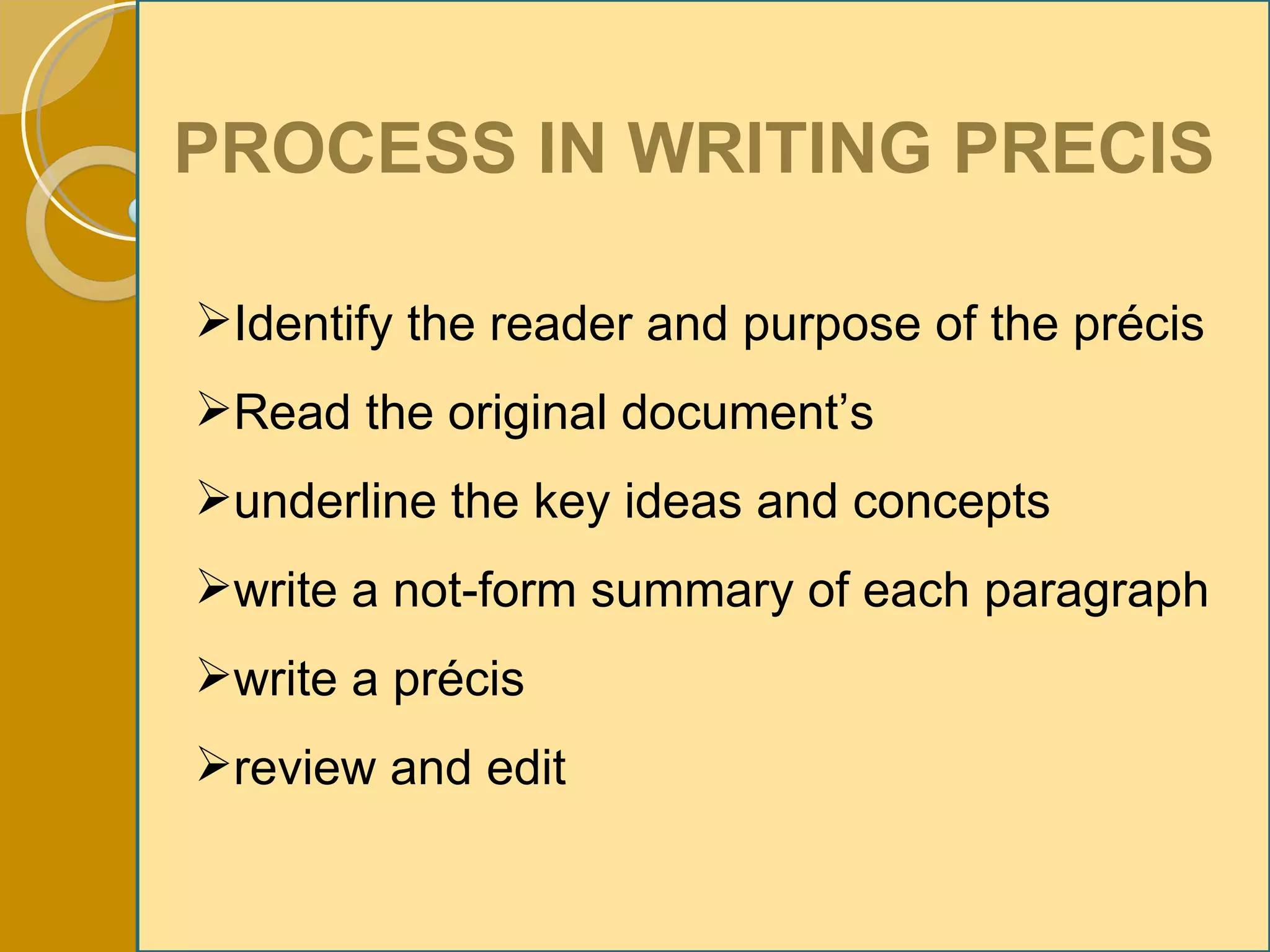
PROCESS IN WRITING PRECIS Identify the reader and purpose of the précis Read the original document’s underline the key ideas and concepts write a not-form summary of each paragraph write a précis review and edit
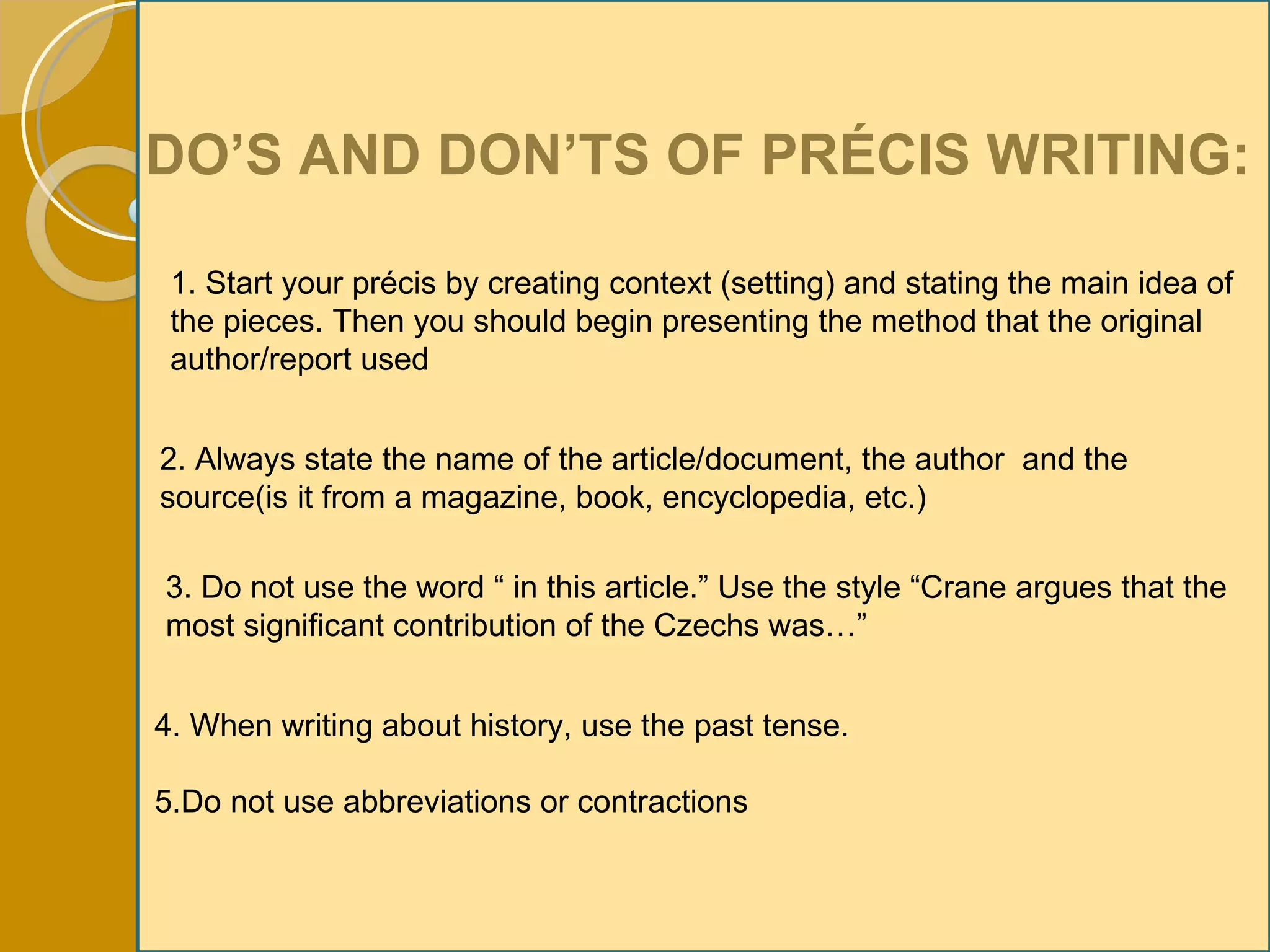
DO’S AND DON’TS OF PRÉCIS WRITING: 1. Start your précis by creating context (setting) and stating the main idea of the pieces. Then you should begin presenting the method that the original author/report used 2. Always state the name of the article/document, the author  and the source(is it from a magazine, book, encyclopedia, etc.) 3. Do not use the word “ in this article.” Use the style “Crane argues that the  most significant contribution of the Czechs was…” 4. When writing about history, use the past tense. 5.Do not use abbreviations or contractions
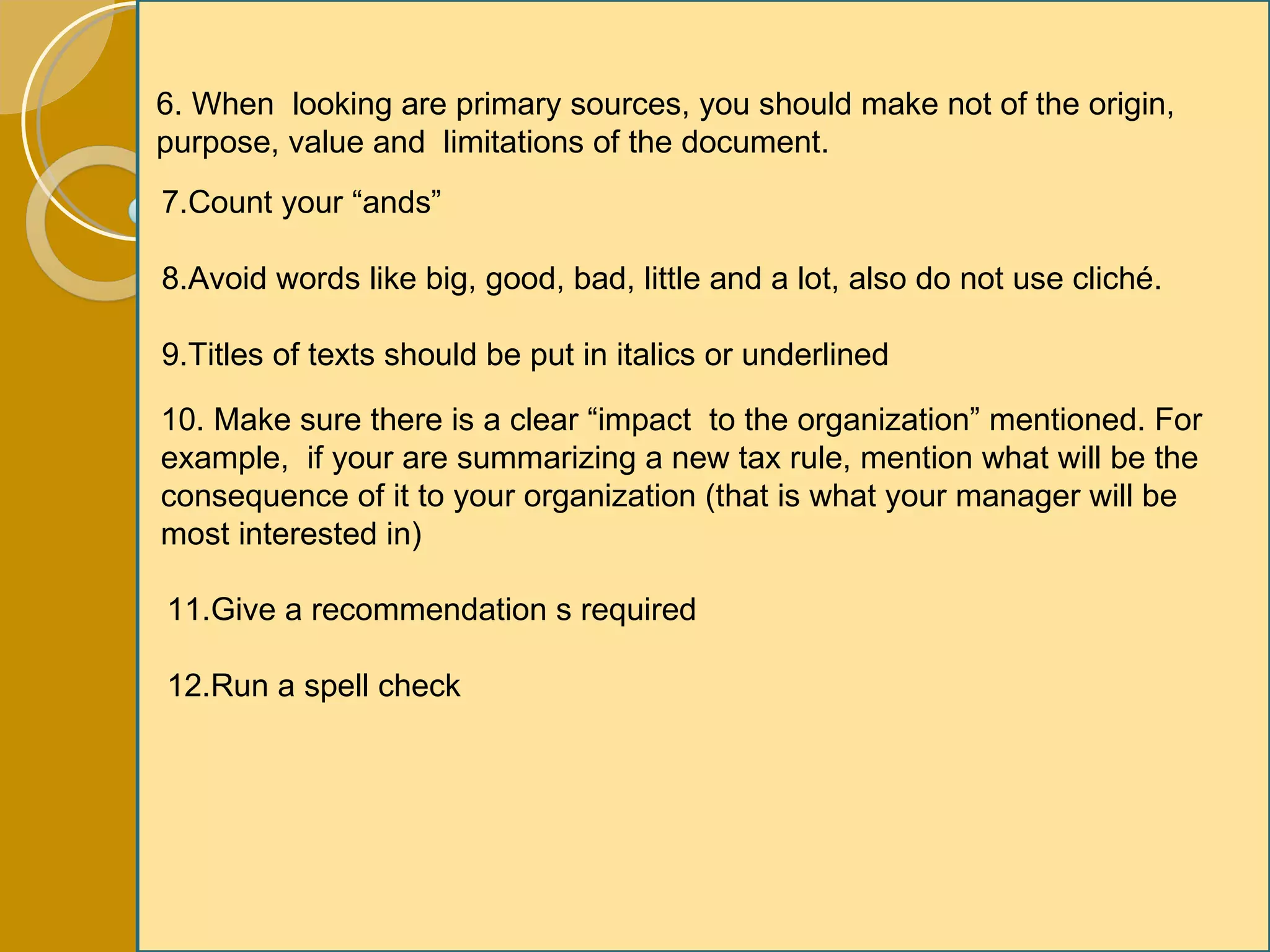
6. When  looking are primary sources, you should make not of the origin, purpose, value and  limitations of the document. 7.Count your “ands” 8.Avoid words like big, good, bad, little and a lot, also do not use cliché. 9.Titles of texts should be put in italics or underlined 10. Make sure there is a clear “impact  to the organization” mentioned. For example,  if your are summarizing a new tax rule, mention what will be the consequence of it to your organization (that is what your manager will be most interested in) 11.Give a recommendation s required 12.Run a spell check
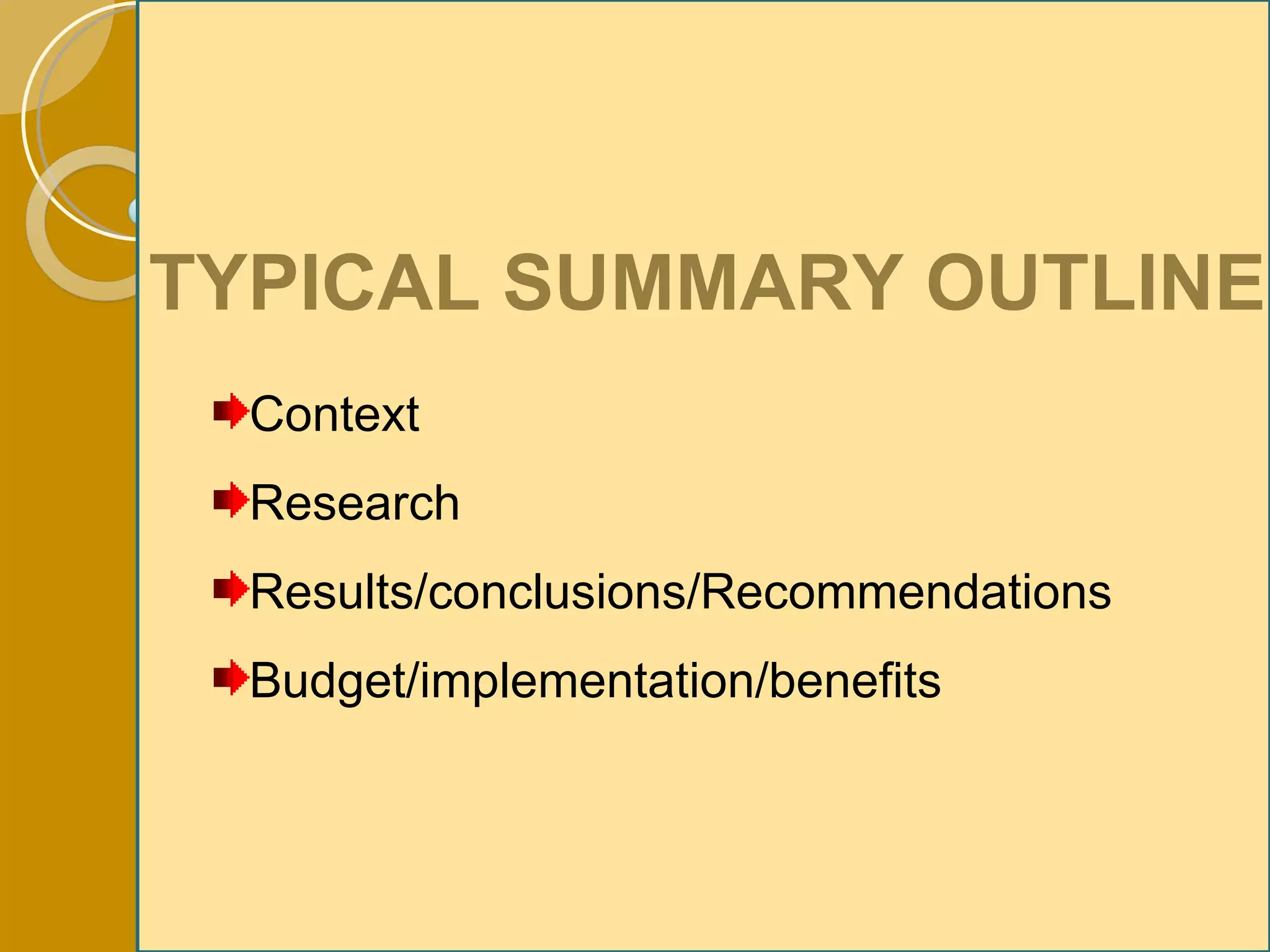
TYPICAL SUMMARY OUTLINE Context Research Results/conclusions/Recommendations Budget/implementation/benefits
THANK YOU DESIGNED BY:  D. SAMUEL MANIRAJ. MBA.,M.Com.,M.Phil.,MA.,PGDCA.,ADCHN.,  CHENNAI, TAMIL NADU,  INDIA.

Precis writing

  • 1.
  • 2.
    PRECIS WRITING Preciswriting is an art, since you need to extract the maximum information and then convey the information in the minimum of words. The goal is to preserve the core essence of the original report in a manner which is both clear and concise.
  • 3.
    WRITING A PRECISA precis is a condensed restatement of an article, roughly ¼ the length of the original or less. In contrast to a summary, a precis should preserve the article’s logic and emphases, and include main examples where relevant. A precis of a primary-literature scientific paper should follow the standard format: background/hypothesis, methods, results, conclusion. The precis should be written from the original author’s point of view, without editorializing.
  • 4.
    WRITING A PRECISWhy? (other than for course credit) A precis demonstrates that you have assimilated the key information provided in an article. Precis can be used as ‘ briefs ’, but are also very similar to the first section of manuscript reviews for peer-reviewed journals. Writing a precis (or any summary) of an article is an excellent way of learning material for the long term, and gives you a record to ‘jog your memory’.
  • 5.
    PROCESS IN WRITINGPRECIS Identify the reader and purpose of the précis Read the original document’s underline the key ideas and concepts write a not-form summary of each paragraph write a précis review and edit
  • 6.
    DO’S AND DON’TSOF PRÉCIS WRITING: 1. Start your précis by creating context (setting) and stating the main idea of the pieces. Then you should begin presenting the method that the original author/report used 2. Always state the name of the article/document, the author and the source(is it from a magazine, book, encyclopedia, etc.) 3. Do not use the word “ in this article.” Use the style “Crane argues that the most significant contribution of the Czechs was…” 4. When writing about history, use the past tense. 5.Do not use abbreviations or contractions
  • 7.
    6. When looking are primary sources, you should make not of the origin, purpose, value and limitations of the document. 7.Count your “ands” 8.Avoid words like big, good, bad, little and a lot, also do not use cliché. 9.Titles of texts should be put in italics or underlined 10. Make sure there is a clear “impact to the organization” mentioned. For example, if your are summarizing a new tax rule, mention what will be the consequence of it to your organization (that is what your manager will be most interested in) 11.Give a recommendation s required 12.Run a spell check
  • 8.
    TYPICAL SUMMARY OUTLINEContext Research Results/conclusions/Recommendations Budget/implementation/benefits
  • 9.
    THANK YOU DESIGNEDBY: D. SAMUEL MANIRAJ. MBA.,M.Com.,M.Phil.,MA.,PGDCA.,ADCHN., CHENNAI, TAMIL NADU, INDIA.