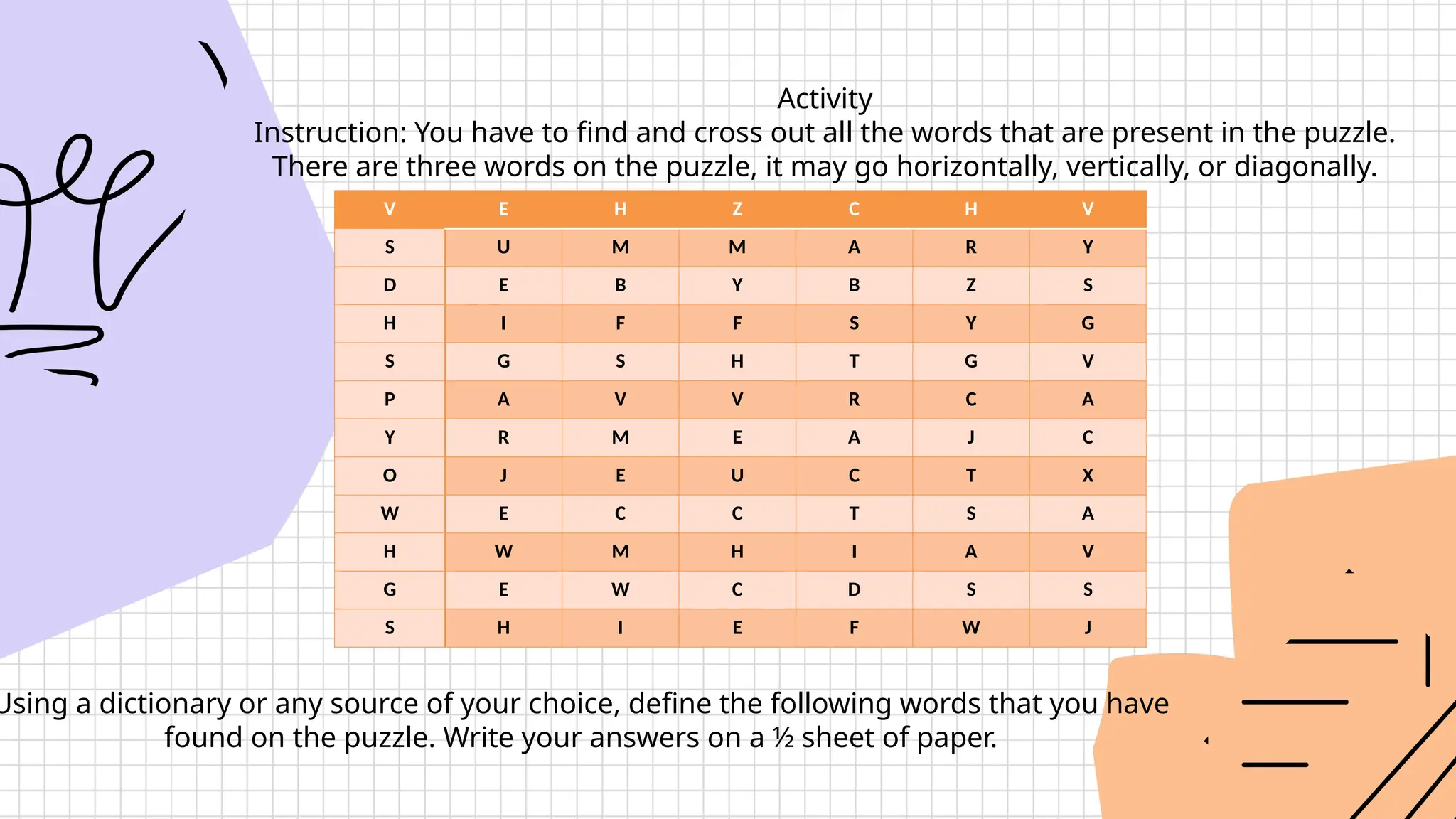
V E HZ C H V
S U M M A R Y
D E B Y B Z S
H I F F S Y G
S G S H T G V
P A V V R C A
Y R M E A J C
O J E U C T X
W E C C T S A
H W M H I A V
G E W C D S S
S H I E F W J
Activity
Instruction: You have to find and cross out all the words that are present in the puzzle.
There are three words on the puzzle, it may go horizontally, vertically, or diagonally.
Using a dictionary or any source of your choice, define the following words that you have
found on the puzzle. Write your answers on a ½ sheet of paper.
PRÉCI
S
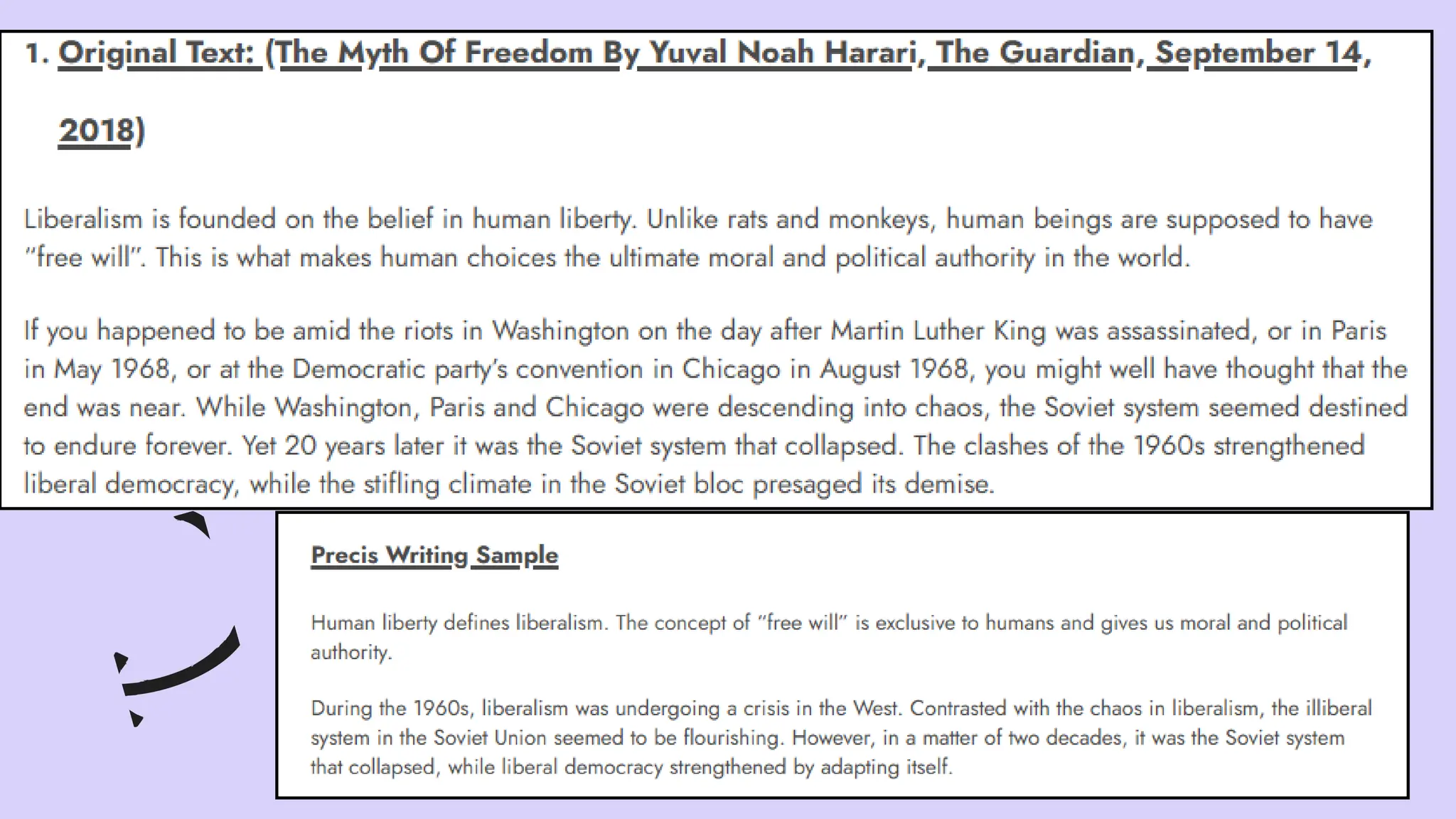
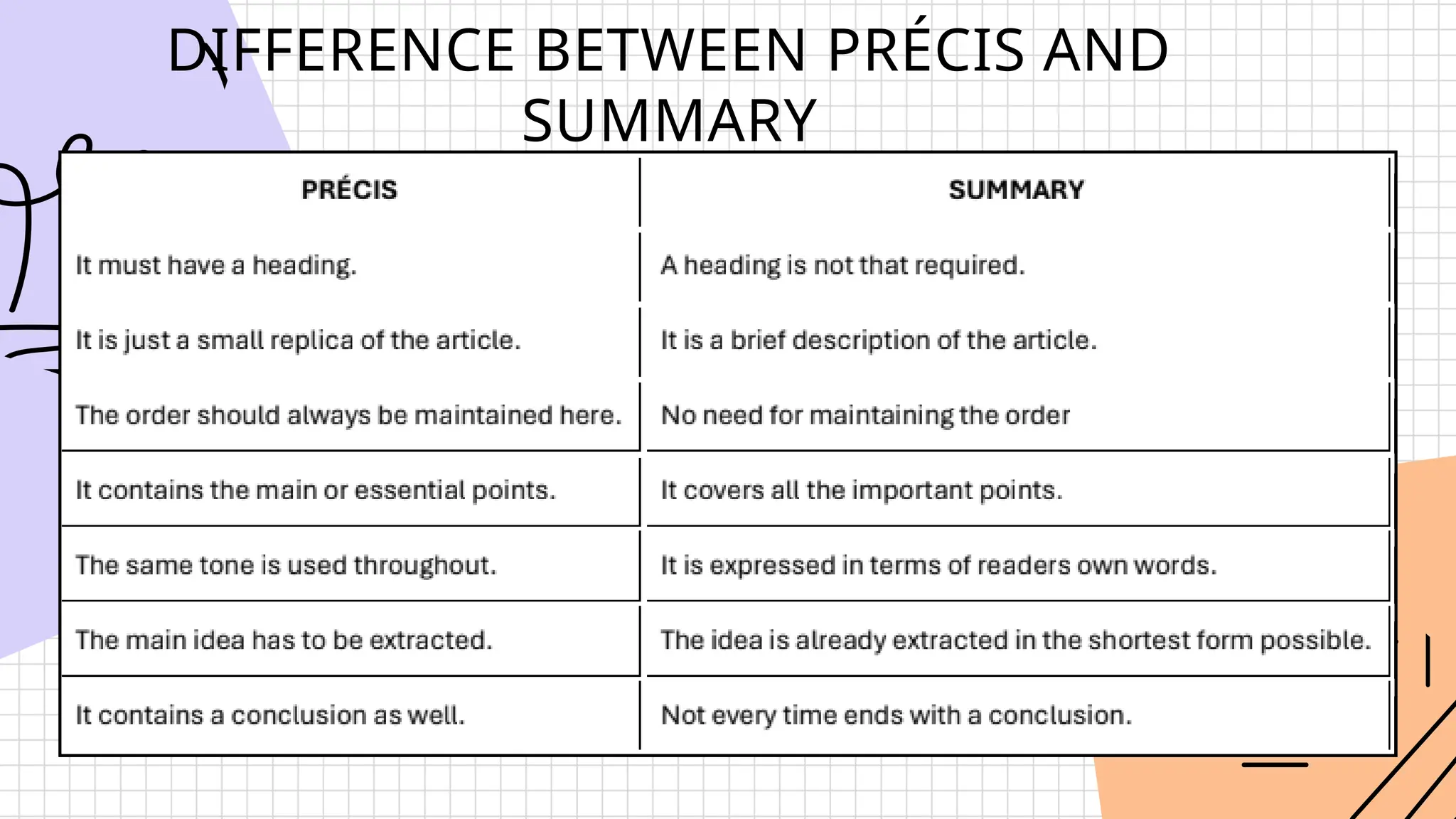
A small miniatureof any piece of writing which
provides the absolute main point of that writing or
article can be defined as PRÉCIS. It must consist of an
appropriate heading and also maintains the order of
the original piece written. The essential points are
usually mentioned here in PRÉCIS. The tone of the
speech used is the same throughout the read. In
PRÉCIS, the conclusion is a must at the end, which will
justify the other main points described.
6.
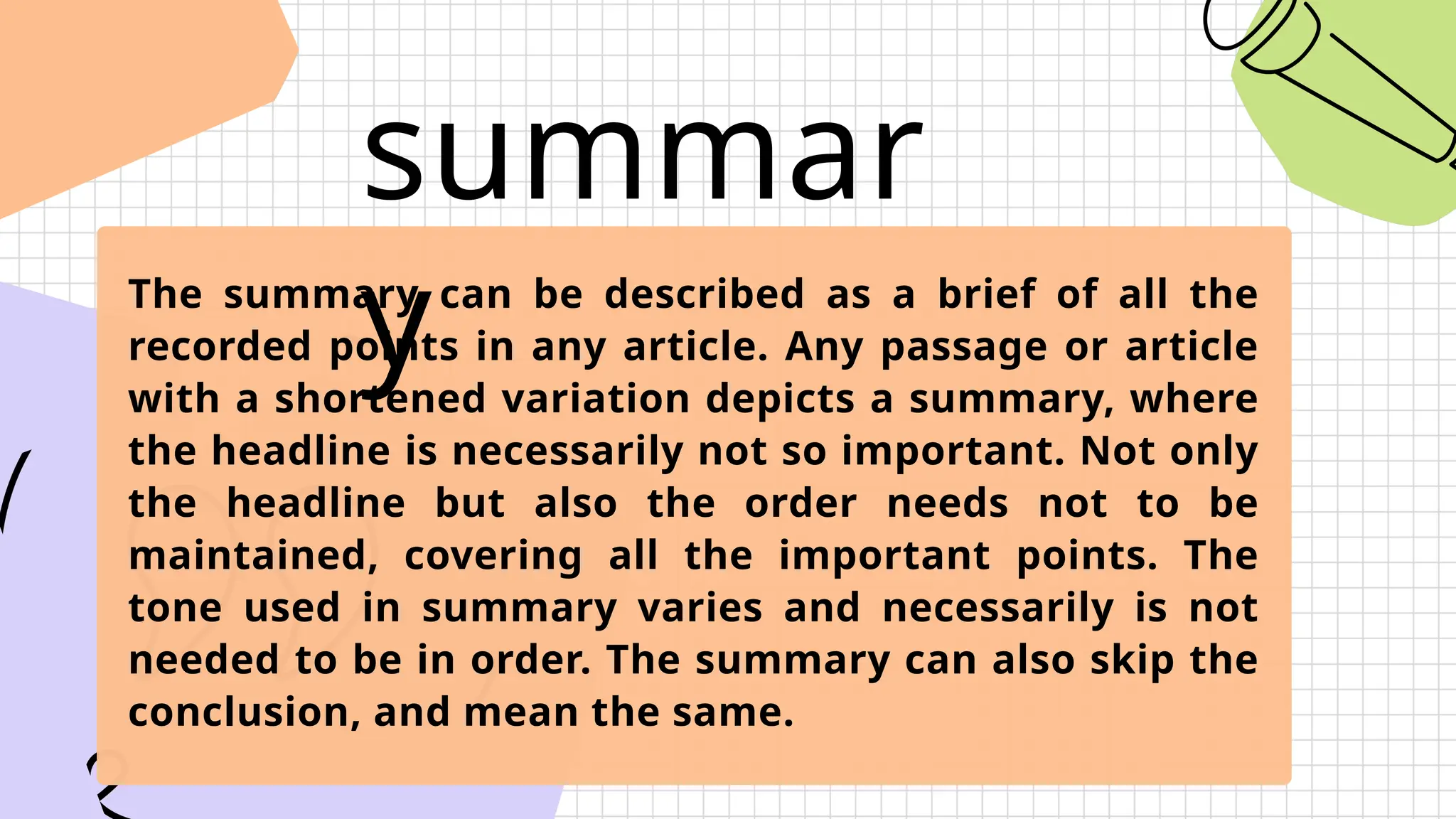
summar
y
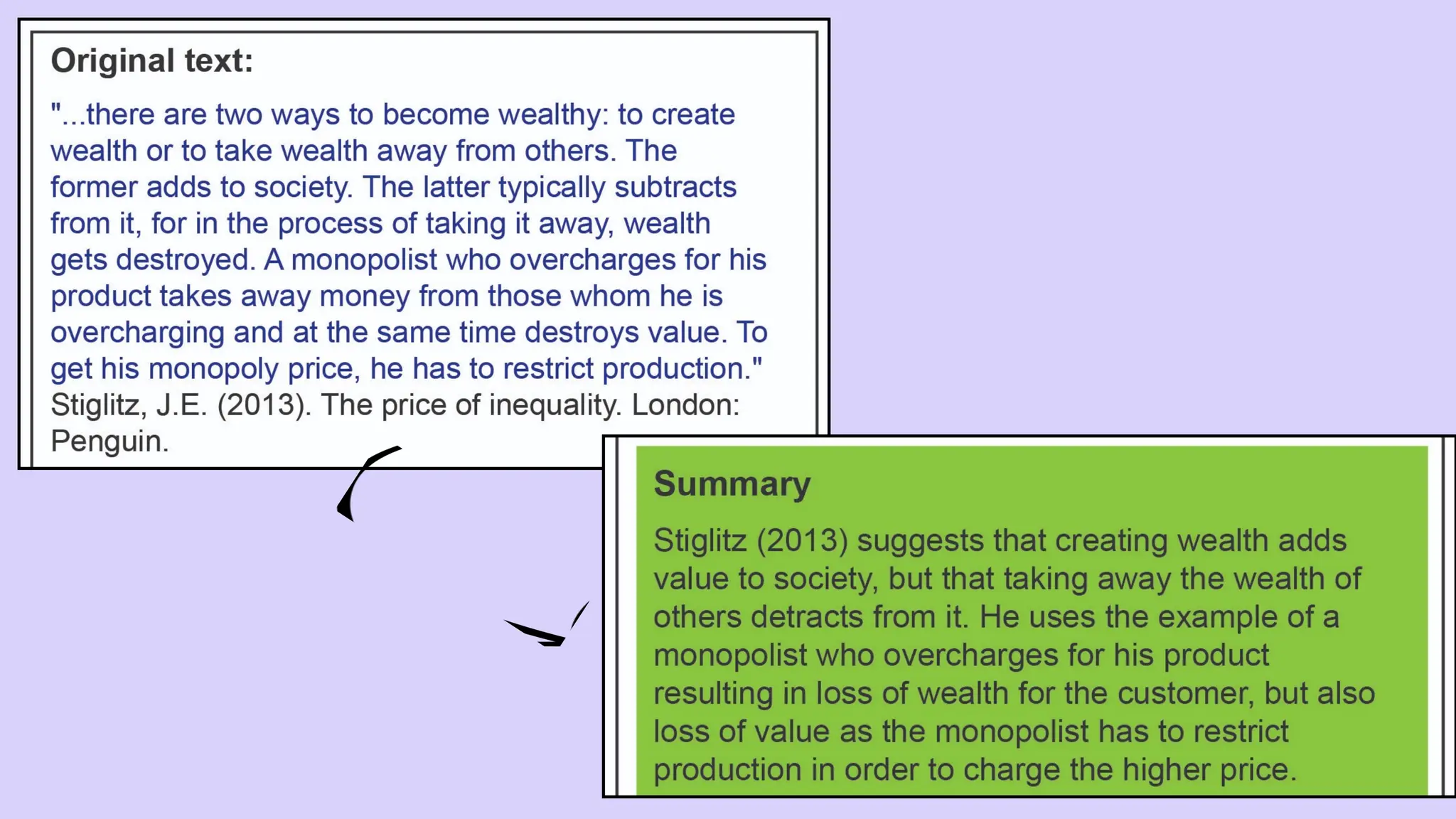
The summary canbe described as a brief of all the
recorded points in any article. Any passage or article
with a shortened variation depicts a summary, where
the headline is necessarily not so important. Not only
the headline but also the order needs not to be
maintained, covering all the important points. The
tone used in summary varies and necessarily is not
needed to be in order. The summary can also skip the
conclusion, and mean the same.
SIMILARITIES BETWEEN PRÉCISAND
SUMMARY
• Both the PRÉCIS and the summary provide the rest of the original
work in a shortened form. One may not contain the headings or the
conclusions, but the point remains the same.
• No addition of idea occurs. The facts remain the same all without
changing. No factual ideas slide into the article.
• If we see in a structured way, we can mark that one-third of both the
original texts, in PRÉCIS and summary, maintain the order and
complete the sentences’ meaning.
10.
STRUCTURE OF AN
ABSTRACT,A
PRÉCIS OR
SUMMARY
RESEARCH
ABSTRACT
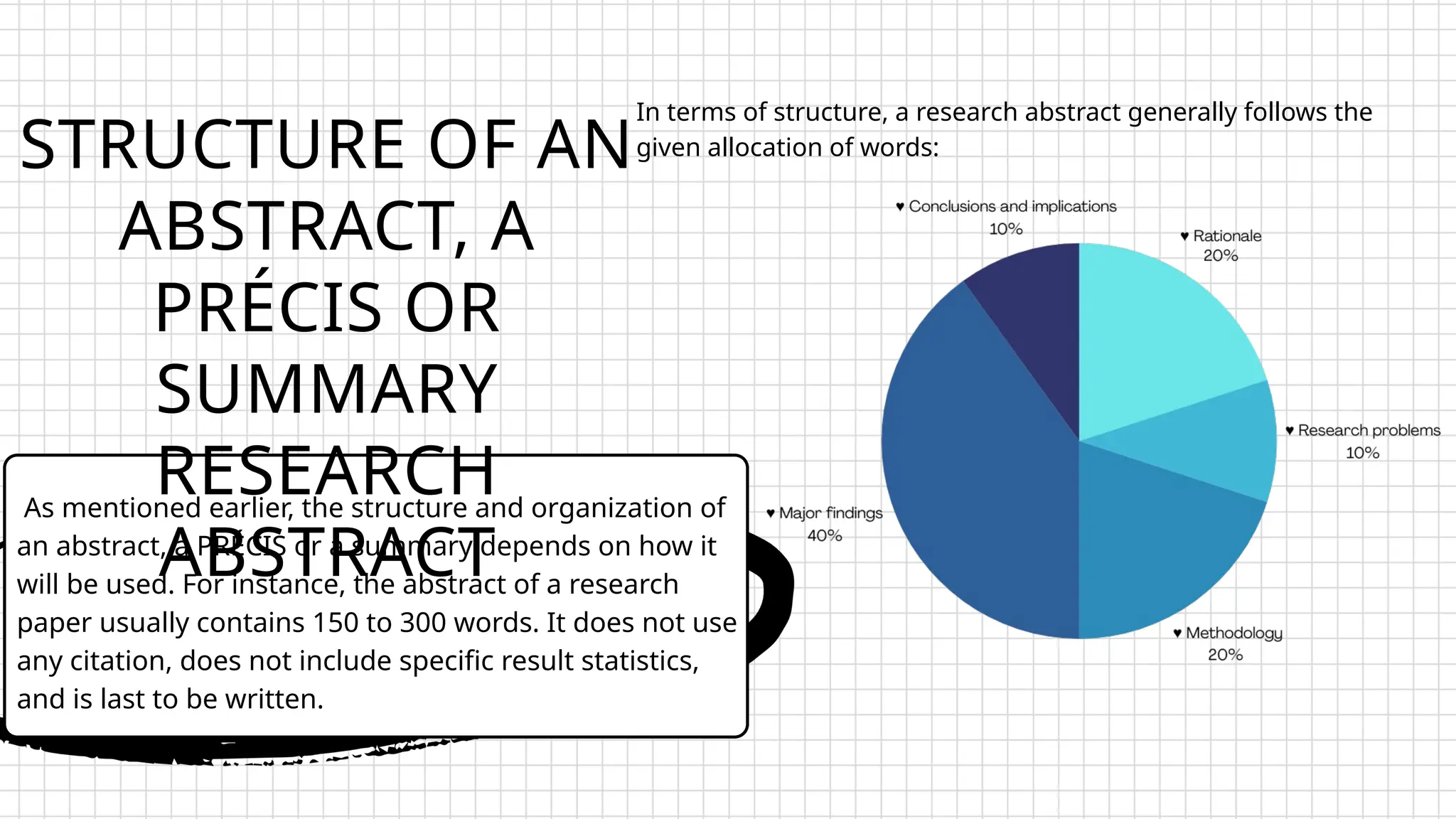
In terms of structure, a research abstract generally follows the
given allocation of words:
As mentioned earlier, the structure and organization of
an abstract, a PRÉCIS or a summary depends on how it
will be used. For instance, the abstract of a research
paper usually contains 150 to 300 words. It does not use
any citation, does not include specific result statistics,
and is last to be written.
12.
GUIDELINES IN WRITINGAN ABSTRACT,
PRÉCIS, OR SUMMARY
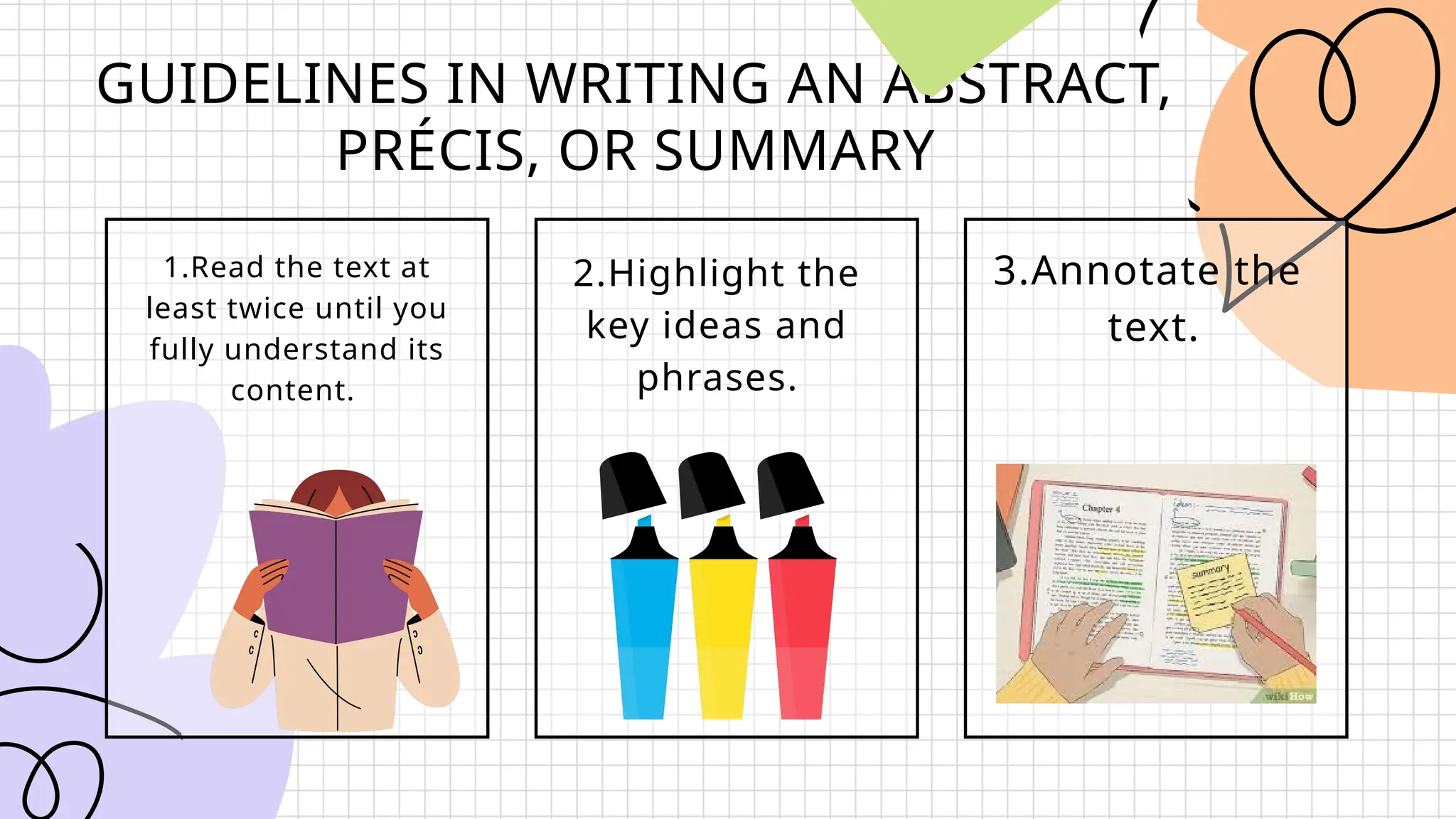
1.Read the text at
least twice until you
fully understand its
content.
2.Highlight the
key ideas and
phrases.
3.Annotate the
text.
13.
GUIDELINES IN WRITINGAN ABSTRACT,
PRÉCIS, OR SUMMARY
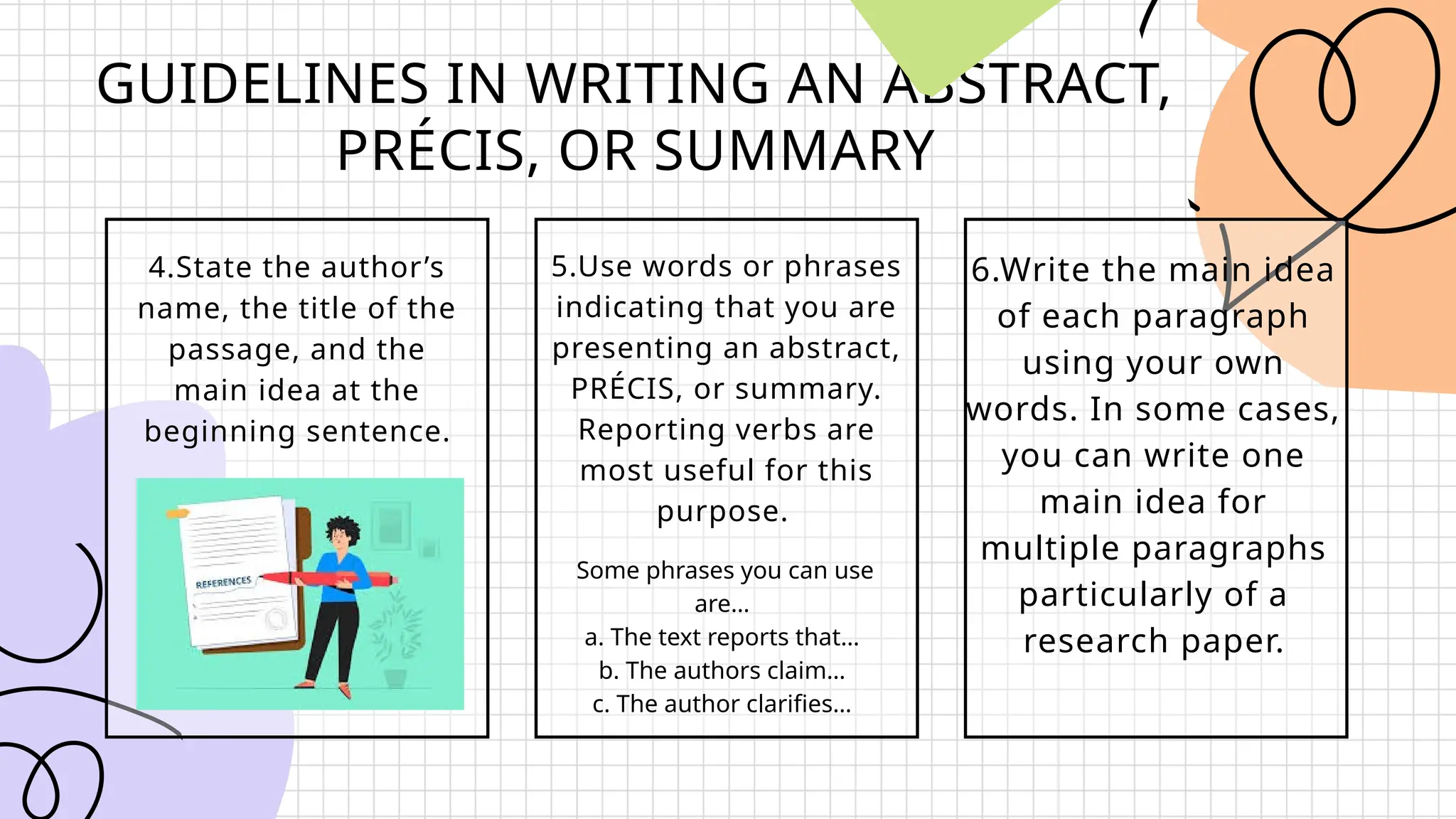
4.State the author’s
name, the title of the
passage, and the
main idea at the
beginning sentence.
5.Use words or phrases
indicating that you are
presenting an abstract,
PRÉCIS, or summary.
Reporting verbs are
most useful for this
purpose.
6.Write the main idea
of each paragraph
using your own
words. In some cases,
you can write one
main idea for
multiple paragraphs
particularly of a
research paper.
Some phrases you can use
are…
a. The text reports that…
b. The authors claim…
c. The author clarifies…
14.
GUIDELINES IN WRITINGAN ABSTRACT,
PRÉCIS, OR SUMMARY
7.Never copy in
verbatim a single
sentence from the
original text.
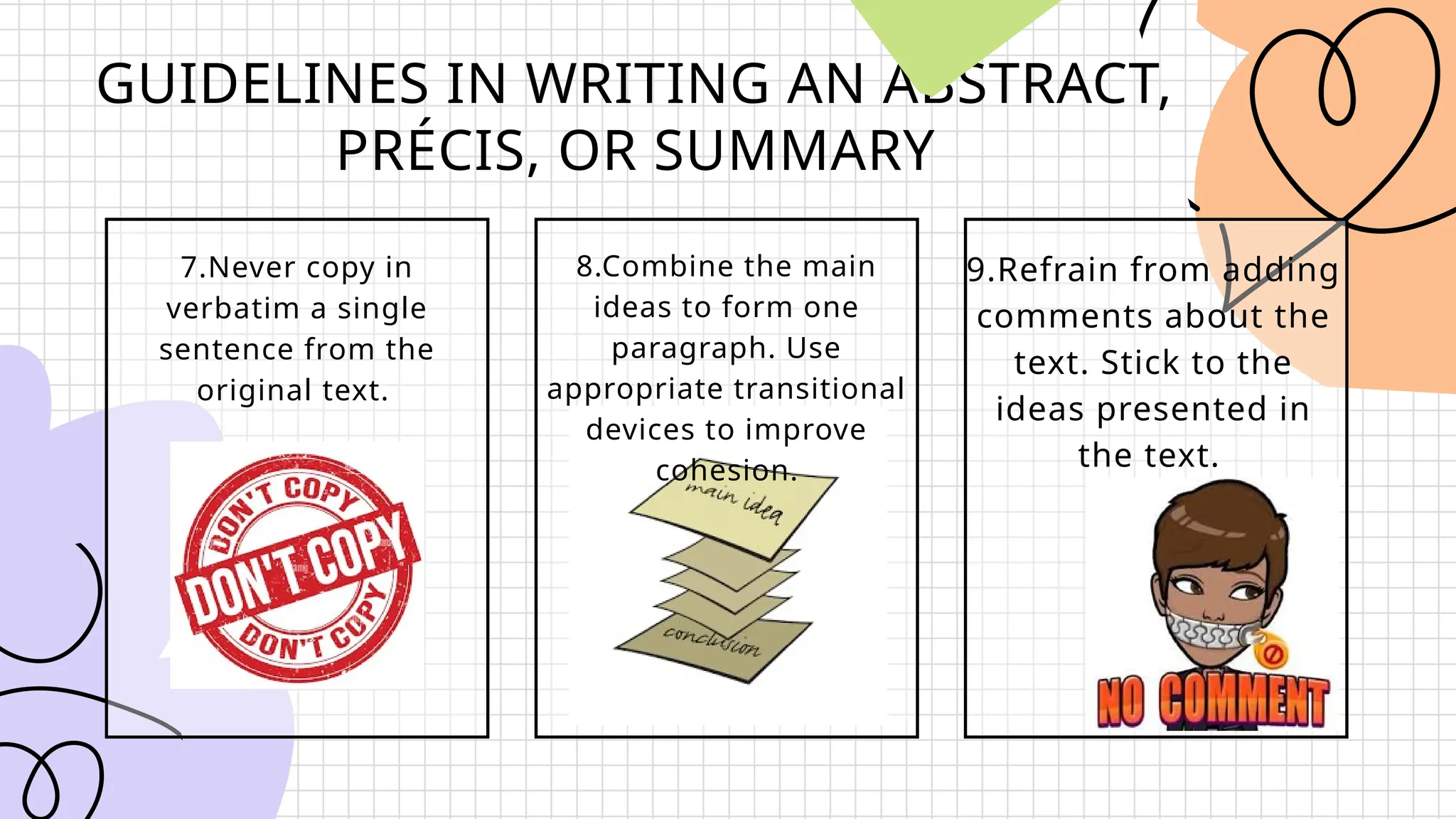
8.Combine the main
ideas to form one
paragraph. Use
appropriate transitional
devices to improve
cohesion.
9.Refrain from adding
comments about the
text. Stick to the
ideas presented in
the text.
15.
GUIDELINES IN WRITINGAN ABSTRACT,
PRÉCIS, OR SUMMARY
10. Edit your draft abstract,
PRÉCIS, or summary by
eliminating redundant ideas and
making sure it contains the
properties of a well-written text.
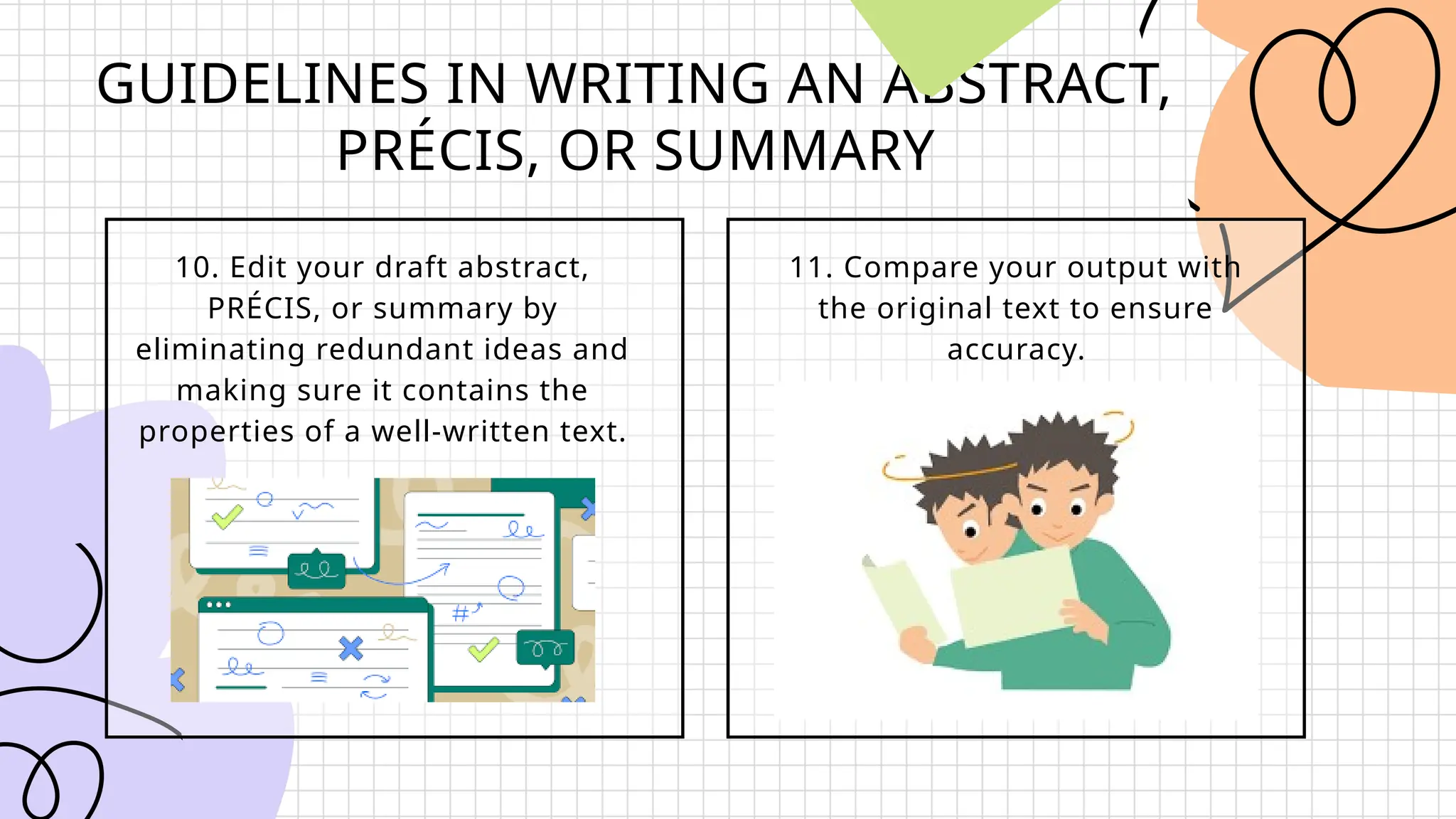
11. Compare your output with
the original text to ensure
accuracy.
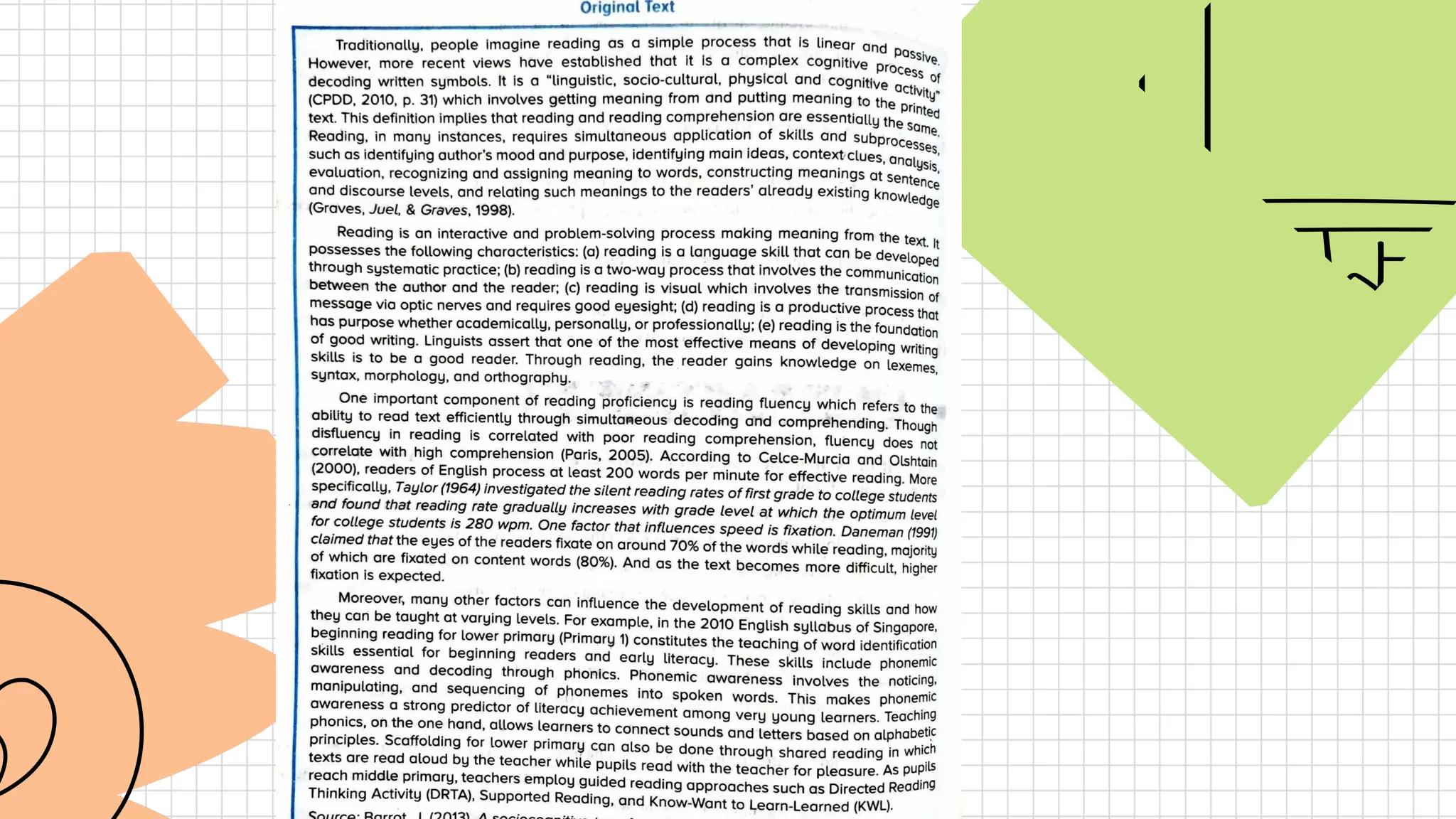
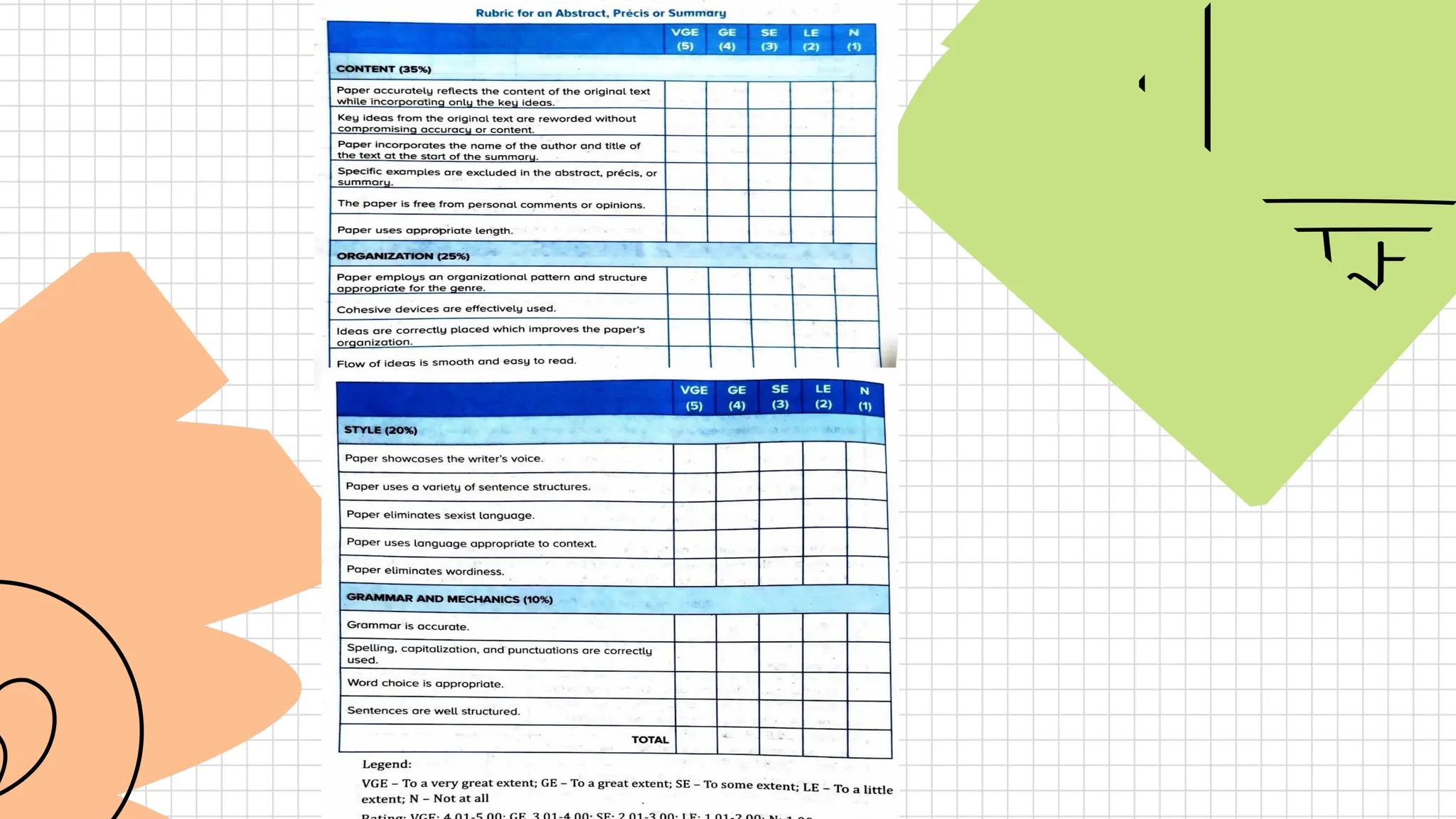
Write an abstract,précis, or summary on the
following original text. Write your answer on
one-half crosswise sheet of paper.
instruction
LESSON 7 (PAGE 5)


![ENGLISH_FOR_ACADEMIC_PURPOSES_-_introduction[1].ppt](https://cdn.slidesharecdn.com/ss_thumbnails/englishforacademicpurposes-introduction1-240723153835-770776c5-thumbnail.jpg?width=640&height=640&fit=bounds)


