TOPICS
 READING SKILLS
 WRITING SKILLS
 PRECISE WRITING SKILLLS
READING SKILLS(RECEPTIVE OR PASSIVE SKILL)
It requires us to use our eyes and our brains to comprehend the written equivalent of spoken language.
Types of reading techniques
Skimming.
Scanning.
Intensive.
 Extensive.
SKIMMING
Skimming is reading rapidly in order to get a general overview of the material.
It may involve:
 previewing (reading before you read)
 reviewing (reading after you read)
 Determining the main idea.
 Determination of general idea and tone of the material.
• Reviewing is any process helps you to
make use of personal experience for
your learning and development.
• It calls reader to again scan the text
after reading, looking for features and
information that will help you to get
more knowledge.
• Previewing is a strategy that readers
use to recall prior knowledge and set a
purpose for reading.
• It calls for readers to skim a text
before reading, looking for various
features and information that will help
as they return to read it in detail later.
PREVIEWING AND REVIEWING
PREVIEWING REVIEWING
THE BASIC METHOD OF SKIMMING:
We can skim a paragraph or any written material by reading:
• Title
• Table of contents or chapter overview
• Headings, subheadings
• First paragraph (introduction).
• First and last sentence of each paragraph.
• The keywords (italicized or boldface words or phrases).
• Introductory paragraph
• Last paragraph (conclusion).
SCANNING
Scanning is reading a text quickly in order to find specific information.
The goal of skimming is:
 A bird's-eye view of the material.
 To locate and swoop down on particular facts.
 To answer questions.
NOTE: Don't forget to scan tables of contents, summaries, indexes, headings, and
typographical cues.
SCANNING TO ANSWER QUESTIONS
If you are scanning for facts to answer a specific question. Follow these steps:
• Read each question completely before starting to scan.
• Choose your keywords from the question itself.
• Look for answers to only one question at a time
• . Scan separately for each question.
• When you locate a keyword, read the surrounding text carefully to see if it is relevant.
• Re-read the question to determine if the answer you found answers this question.
DIFFERENCE BETWEEN SKIMMING AND SCANNING
The difference between skimming and scanning consists of purpose and technique.
 Purpose
• Skimming is a reading technique meant to give you an idea of what the full text is
about.
• Scanning is meant to help you find specific information in a text.
 Technique
• Skimming techniques include reading the introduction, the headlines, or the first
phrase of the paragraph.
• On the other hand, scanning means looking over the whole text quickly in search of
specific information.
INTENSIVE READING
Intensive reading:
“The readers carefully and closely read a short text with
the intention of gaining an understanding of as much as
detail as possible"
THE LIMITS OF INTENSIVE READING
However, if learners only use reading passages like these:
• The reading is difficult, so learners have few chances to build reading speed and
fluency.
• The reading is short and because it is difficult, the learners read slowly and they
cannot meet a lot of language.
• The whole class reads the same material, which is too easy for some and too
difficult for others.
• All the students have to read at the same pace as they do the tasks together.
• The reading is interesting to some learners but not others.
EXTENSIVE READING
Extensive reading involves learners reading texts for enjoyment
and to develop general reading skills. It can be compared with
intensive reading, which means reading in detail with specific
learning aims and tasks.
THE BENEFITS OF EXTENSIVE READING
Extensive Reading gives students chances to read longer pieces of
reading, which they choose, which they can read at their own
speed and at their own ability level. This can be done with Graded
readers.
WRITING SKILLS
 DEFINITION:
Writing is a form of communication that allows students to put their feelings and ideas on
paper, to organize their knowledge and beliefs into convincing arguments, and to
convey meaning through well-constructed text.
Writing may have two categories:
• FORMAL WRITING(ACADEMIC WRITING)
• INFORMAL WRITING
• Informal writing is one which is used
for personal or casual purpose.
• a personal and emotional tone can be
found in informal writing
• May include him-/herself(using First
person)
• Voice varies depending on the purpose
for writing
• Formal writing is that form
of writing which is used for the
business, legal, academic or
professional purpose.
• Formal writing must use a
professional tone.
• Writers remove him-/herself(no first
and second person pronoun).
• Contain a formal voice(like a textbook)
FORMAL WRITING AND INFORMAL WRITING
FORMAL WRITING INFORMAL WRITING
• Poems
• Drama writing
• Play writing
• Personal novel writing
• Letter to famous person
• Writing for Exam purpose
• Essay writing
• Paragraph writing
• Thesis for professional
• Report for business purpose
FORMAL WRITING AND INFORMAL WRITING
EXAMPLES OF FORMAL WRITING EXAMPLES OF INFORMAL WRITING
DIFFICULTIES FACED BY ENGLISH LEARNERS WHILE
WRITING
• Spellings
 Due to correspondence between the sound of a word and the way it is spelt is not
always obvious.
• Coherence (order)
• Cohesion (Sequence)
• Logical development of an idea.
• punctuation>.
HOW TO IMPROVE WRITING SKILLS?
• Create an Outline. ...
• Read What You Want to Write About. ...
• Choose Simple Words. ...
• Convey Your Message Easily. ...
• Avoid Filler Words. ...
• Keep Sentences and Paragraphs Short. ...
• Invest in an Editing Tool.
PRECISE WRITING SKILLLS
• A précis is a clear, compact logical summary of a passage. It preserves only
the essential or important ideas of the original.
• A precis should give all essential points so that anyone reading it will be able
to understand the idea expressed in the original passage.
QUALITIES OF A GOOD PRÉCIS.
• Clarity.
• Correctness.
• Objectivity.
• Coherence.
• Completeness.
• Conciseness
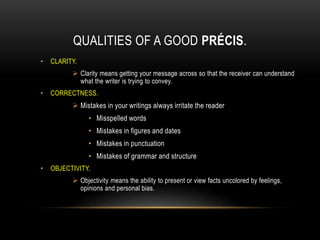
QUALITIES OF A GOOD PRÉCIS.
• CLARITY.
 Clarity means getting your message across so that the receiver can understand
what the writer is trying to convey.
• CORRECTNESS.
 Mistakes in your writings always irritate the reader
• Misspelled words
• Mistakes in figures and dates
• Mistakes in punctuation
• Mistakes of grammar and structure
• OBJECTIVITY.
 Objectivity means the ability to present or view facts uncolored by feelings,
opinions and personal bias.
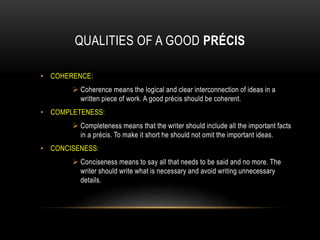
QUALITIES OF A GOOD PRÉCIS
• COHERENCE:
 Coherence means the logical and clear interconnection of ideas in a
written piece of work. A good précis should be coherent.
• COMPLETENESS:
 Completeness means that the writer should include all the important facts
in a précis. To make it short he should not omit the important ideas.
• CONCISENESS:
 Conciseness means to say all that needs to be said and no more. The
writer should write what is necessary and avoid writing unnecessary
details.
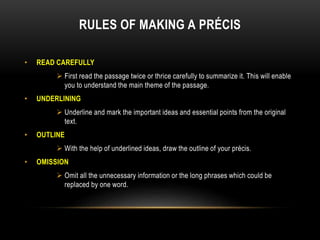
RULES OF MAKING A PRÉCIS
• READ CAREFULLY
 First read the passage twice or thrice carefully to summarize it. This will enable
you to understand the main theme of the passage.
• UNDERLINING
 Underline and mark the important ideas and essential points from the original
text.
• OUTLINE
 With the help of underlined ideas, draw the outline of your précis.
• OMISSION
 Omit all the unnecessary information or the long phrases which could be
replaced by one word.
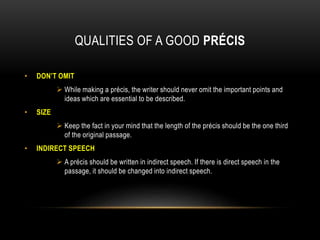
QUALITIES OF A GOOD PRÉCIS
• DON’T OMIT
 While making a précis, the writer should never omit the important points and
ideas which are essential to be described.
• SIZE
 Keep the fact in your mind that the length of the précis should be the one third
of the original passage.
• INDIRECT SPEECH
 A précis should be written in indirect speech. If there is direct speech in the
passage, it should be changed into indirect speech.
QUALITIES OF A GOOD PRÉCIS
• TENSE AND PERSON
 It should be written in the third person and past tense. In the case of universal
truth the present tense should be used.
• OWN WORDS
 A précis should be written in your own words and the writer should abstain from
borrowing words from the original passage.
• PRÉCIS OF A DIALOGUE
 The précis of a dialogue or conversation should always be expressed in form of
narrative.
QUALITIES OF A GOOD PRÉCIS
• OBJECTIVE APPROACH
 A précis writer should adopt an objective approach. He should not add his
personal ideas to a précis. Put all the important points and ideas in a logical
order.
• ONE PARAGRAPH
 There could be two or more paragraphs in the original text. While making the
précis, try to write all the ideas in one paragraph.
QUALITIES OF A GOOD PRÉCIS
• ROUGH DRAFT
 After omitting all the unnecessary ideas, the writer should prepare a rough draft
to finalize it.
• FINAL DRAFT
 Having read the rough draft and pointed out some mistakes which may be found
in the rough draft, the writer can prepare the final draft.
WHAT ARE THE STEPS IN PRECIS WRITING?
• Atentively read the source text. ...
• Highlight its main features, arguments and points. ...
• Make a list of the used evidence. ...
• Research any information you find unfamiliar. ...
• Make an evaluation of how the writer showed key points of his work.
SUMMARY IN PRECIS WRITING
 Summary writing (Precis Writing) can be of two types.
TYPE – 1 : You could be asked to condense the number of words of
the whole passage to about one-third its length.
TYPE – 2 : You could be given a specific question and given a
specific number of words in which to limit your answer.
Readin, writing, precise

Readin, writing, precise

  • 2.
    TOPICS  READING SKILLS WRITING SKILLS  PRECISE WRITING SKILLLS
  • 3.
    READING SKILLS(RECEPTIVE ORPASSIVE SKILL) It requires us to use our eyes and our brains to comprehend the written equivalent of spoken language. Types of reading techniques Skimming. Scanning. Intensive.  Extensive.
  • 4.
    SKIMMING Skimming is readingrapidly in order to get a general overview of the material. It may involve:  previewing (reading before you read)  reviewing (reading after you read)  Determining the main idea.  Determination of general idea and tone of the material.
  • 5.
    • Reviewing isany process helps you to make use of personal experience for your learning and development. • It calls reader to again scan the text after reading, looking for features and information that will help you to get more knowledge. • Previewing is a strategy that readers use to recall prior knowledge and set a purpose for reading. • It calls for readers to skim a text before reading, looking for various features and information that will help as they return to read it in detail later. PREVIEWING AND REVIEWING PREVIEWING REVIEWING
  • 6.
    THE BASIC METHODOF SKIMMING: We can skim a paragraph or any written material by reading: • Title • Table of contents or chapter overview • Headings, subheadings • First paragraph (introduction). • First and last sentence of each paragraph. • The keywords (italicized or boldface words or phrases). • Introductory paragraph • Last paragraph (conclusion).
  • 7.
    SCANNING Scanning is readinga text quickly in order to find specific information. The goal of skimming is:  A bird's-eye view of the material.  To locate and swoop down on particular facts.  To answer questions. NOTE: Don't forget to scan tables of contents, summaries, indexes, headings, and typographical cues.
  • 8.
    SCANNING TO ANSWERQUESTIONS If you are scanning for facts to answer a specific question. Follow these steps: • Read each question completely before starting to scan. • Choose your keywords from the question itself. • Look for answers to only one question at a time • . Scan separately for each question. • When you locate a keyword, read the surrounding text carefully to see if it is relevant. • Re-read the question to determine if the answer you found answers this question.
  • 9.
    DIFFERENCE BETWEEN SKIMMINGAND SCANNING The difference between skimming and scanning consists of purpose and technique.  Purpose • Skimming is a reading technique meant to give you an idea of what the full text is about. • Scanning is meant to help you find specific information in a text.  Technique • Skimming techniques include reading the introduction, the headlines, or the first phrase of the paragraph. • On the other hand, scanning means looking over the whole text quickly in search of specific information.
  • 10.
    INTENSIVE READING Intensive reading: “Thereaders carefully and closely read a short text with the intention of gaining an understanding of as much as detail as possible"
  • 11.
    THE LIMITS OFINTENSIVE READING However, if learners only use reading passages like these: • The reading is difficult, so learners have few chances to build reading speed and fluency. • The reading is short and because it is difficult, the learners read slowly and they cannot meet a lot of language. • The whole class reads the same material, which is too easy for some and too difficult for others. • All the students have to read at the same pace as they do the tasks together. • The reading is interesting to some learners but not others.
  • 12.
    EXTENSIVE READING Extensive readinginvolves learners reading texts for enjoyment and to develop general reading skills. It can be compared with intensive reading, which means reading in detail with specific learning aims and tasks.
  • 13.
    THE BENEFITS OFEXTENSIVE READING Extensive Reading gives students chances to read longer pieces of reading, which they choose, which they can read at their own speed and at their own ability level. This can be done with Graded readers.
  • 14.
    WRITING SKILLS  DEFINITION: Writingis a form of communication that allows students to put their feelings and ideas on paper, to organize their knowledge and beliefs into convincing arguments, and to convey meaning through well-constructed text. Writing may have two categories: • FORMAL WRITING(ACADEMIC WRITING) • INFORMAL WRITING
  • 15.
    • Informal writingis one which is used for personal or casual purpose. • a personal and emotional tone can be found in informal writing • May include him-/herself(using First person) • Voice varies depending on the purpose for writing • Formal writing is that form of writing which is used for the business, legal, academic or professional purpose. • Formal writing must use a professional tone. • Writers remove him-/herself(no first and second person pronoun). • Contain a formal voice(like a textbook) FORMAL WRITING AND INFORMAL WRITING FORMAL WRITING INFORMAL WRITING
  • 16.
    • Poems • Dramawriting • Play writing • Personal novel writing • Letter to famous person • Writing for Exam purpose • Essay writing • Paragraph writing • Thesis for professional • Report for business purpose FORMAL WRITING AND INFORMAL WRITING EXAMPLES OF FORMAL WRITING EXAMPLES OF INFORMAL WRITING
  • 17.
    DIFFICULTIES FACED BYENGLISH LEARNERS WHILE WRITING • Spellings  Due to correspondence between the sound of a word and the way it is spelt is not always obvious. • Coherence (order) • Cohesion (Sequence) • Logical development of an idea. • punctuation>.
  • 18.
    HOW TO IMPROVEWRITING SKILLS? • Create an Outline. ... • Read What You Want to Write About. ... • Choose Simple Words. ... • Convey Your Message Easily. ... • Avoid Filler Words. ... • Keep Sentences and Paragraphs Short. ... • Invest in an Editing Tool.
  • 19.
    PRECISE WRITING SKILLLS •A précis is a clear, compact logical summary of a passage. It preserves only the essential or important ideas of the original. • A precis should give all essential points so that anyone reading it will be able to understand the idea expressed in the original passage.
  • 20.
    QUALITIES OF AGOOD PRÉCIS. • Clarity. • Correctness. • Objectivity. • Coherence. • Completeness. • Conciseness
  • 21.
    QUALITIES OF AGOOD PRÉCIS. • CLARITY.  Clarity means getting your message across so that the receiver can understand what the writer is trying to convey. • CORRECTNESS.  Mistakes in your writings always irritate the reader • Misspelled words • Mistakes in figures and dates • Mistakes in punctuation • Mistakes of grammar and structure • OBJECTIVITY.  Objectivity means the ability to present or view facts uncolored by feelings, opinions and personal bias.
  • 22.
    QUALITIES OF AGOOD PRÉCIS • COHERENCE:  Coherence means the logical and clear interconnection of ideas in a written piece of work. A good précis should be coherent. • COMPLETENESS:  Completeness means that the writer should include all the important facts in a précis. To make it short he should not omit the important ideas. • CONCISENESS:  Conciseness means to say all that needs to be said and no more. The writer should write what is necessary and avoid writing unnecessary details.
  • 23.
    RULES OF MAKINGA PRÉCIS • READ CAREFULLY  First read the passage twice or thrice carefully to summarize it. This will enable you to understand the main theme of the passage. • UNDERLINING  Underline and mark the important ideas and essential points from the original text. • OUTLINE  With the help of underlined ideas, draw the outline of your précis. • OMISSION  Omit all the unnecessary information or the long phrases which could be replaced by one word.
  • 24.
    QUALITIES OF AGOOD PRÉCIS • DON’T OMIT  While making a précis, the writer should never omit the important points and ideas which are essential to be described. • SIZE  Keep the fact in your mind that the length of the précis should be the one third of the original passage. • INDIRECT SPEECH  A précis should be written in indirect speech. If there is direct speech in the passage, it should be changed into indirect speech.
  • 25.
    QUALITIES OF AGOOD PRÉCIS • TENSE AND PERSON  It should be written in the third person and past tense. In the case of universal truth the present tense should be used. • OWN WORDS  A précis should be written in your own words and the writer should abstain from borrowing words from the original passage. • PRÉCIS OF A DIALOGUE  The précis of a dialogue or conversation should always be expressed in form of narrative.
  • 26.
    QUALITIES OF AGOOD PRÉCIS • OBJECTIVE APPROACH  A précis writer should adopt an objective approach. He should not add his personal ideas to a précis. Put all the important points and ideas in a logical order. • ONE PARAGRAPH  There could be two or more paragraphs in the original text. While making the précis, try to write all the ideas in one paragraph.
  • 27.
    QUALITIES OF AGOOD PRÉCIS • ROUGH DRAFT  After omitting all the unnecessary ideas, the writer should prepare a rough draft to finalize it. • FINAL DRAFT  Having read the rough draft and pointed out some mistakes which may be found in the rough draft, the writer can prepare the final draft.
  • 28.
    WHAT ARE THESTEPS IN PRECIS WRITING? • Atentively read the source text. ... • Highlight its main features, arguments and points. ... • Make a list of the used evidence. ... • Research any information you find unfamiliar. ... • Make an evaluation of how the writer showed key points of his work.
  • 29.
    SUMMARY IN PRECISWRITING  Summary writing (Precis Writing) can be of two types. TYPE – 1 : You could be asked to condense the number of words of the whole passage to about one-third its length. TYPE – 2 : You could be given a specific question and given a specific number of words in which to limit your answer.