Writing of Summarising, Precis , Citation
 A summary is a short and concise representation of the main points, ideas, concepts,
facts or statements of a text written in your own words.
 When either summarising or paraphrasing, you should not alter:
the author's original idea(s) the degree of certainty with which the ideas are expressed.
 How to summarise?
To create / write a good summary, you should read the article or text a number of times to
develop a clear understanding of:
the author's ideas and intentions ,the meaning and details ,the force with which the ideas
are expressed.
 Referencing
Summaries need to be referenced. Whether you have summarised or paraphrased an
author's words, thoughts, ideas etc, a citation to the original source of the words, thoughts,
ideas etc must be provided.
Steps of Writing a summary
 Step 1 Write notes in point form using keywords; this will make it easier to
express the ideas in your own words.
 Step 2 Write the summary directly from your notes without re-reading the
passage.
 Step 3 Refer back to the original to ensure that your summary is a true reflection
of the writer's ideas.
 Tips
Topic sentences provide a quick outline of the main idea(s) presented in a
paragraph.
When summarising a chapter or article, the introduction and conclusion should
provide a good overview of the content.
Precis writing
 Introduction
 ‘precis’ is derived from French and it means ‘precise’.
 Precis-writing is an exercise in compression.
Forms of condensation
 Précis is lengthier than the abstract and follows the exact order of points of the original passage.
Skills required
Precis writing demands power of judgement and evaluation as the passage usually contains important ideas
and a number of unnecessary words.
 Methodof procedure
1.Reading
(a)First read the passage through carefully, but not too slowly, to get a general idea of its
meaning.
(b) Usually you are required to supply a title for your precis.
(c) Further reading is now necessary to ensure that you understand the details of the passage as
well as its main purpose.
(d) to decide what parts of the passage are essential
 2. Writing.
(a) Rough Drafts
(b) Important Points
1. The precis should be all in your own words.
2. The precis must be a connected whole.
3. The precis must be complete and self-contained
Guidelines
1. Read the passage at least two times to familiarise yourself with the theme and the main ideas
contained in the passage.
2. Give the passage a little, a suitable title would help you to identify the name of the passage.
3. Write down important points and arrange them in the same sequence as the original passage.
4. Make a rough draft. A précis should not be more than 1/3 of the original unless otherwise directed.
Cont.….
5. Write the precise in the indirect form of narration using only the third person
6. Scrupulously avoid all examples figures of speech, illustrations and comments.
7. Retain all those facts and ideas which are related to the main ideas, reject those which
have minor importance.
8. Drop all redundant words and expressions.
Citation
 All literature cited in the text should: be included in the list of references giving complete
details.
 Standard style of literature citation should be followed.
 Citation in text
Citation style of references in the text varies from journal to journal and therefore consult the
guidelines of the journal and go to references cited for noting style.
 In case of one author, give last name/surname first, year of publication within parentheses, e.g.
Singh (2002).
 In case of two authors, give first the last name of first author followed by last name of second
author, year of publication e.g. Singh and Grover (2002).
 In case of more than two authors give last name of first author followed by et al. and year of
publication e.g. Singh et al. (2002).
In case the author is referred at more than one place in the same year, number
references as 'a' and 'b' e.g. Singh (2002Sa )........Singh (2002b).
Citation in Journal
This must include the name of author(s), followed by year of publication within parentheses or
stops, title of the paper/article, name of the journal/periodical, volume and number in brackets,
and page number. In case of male authors, initials are used and in case female authors give full
name e.g. Singh, J. and Grover, Indlj. 2002.
Academic achievement and entrepreneurial performance of undergraduate students of CCS
Haryana Agricultural University, CCSHAU J. Research. 88(3), 416-421.
Note: In some journals the name of journal is written in italics.
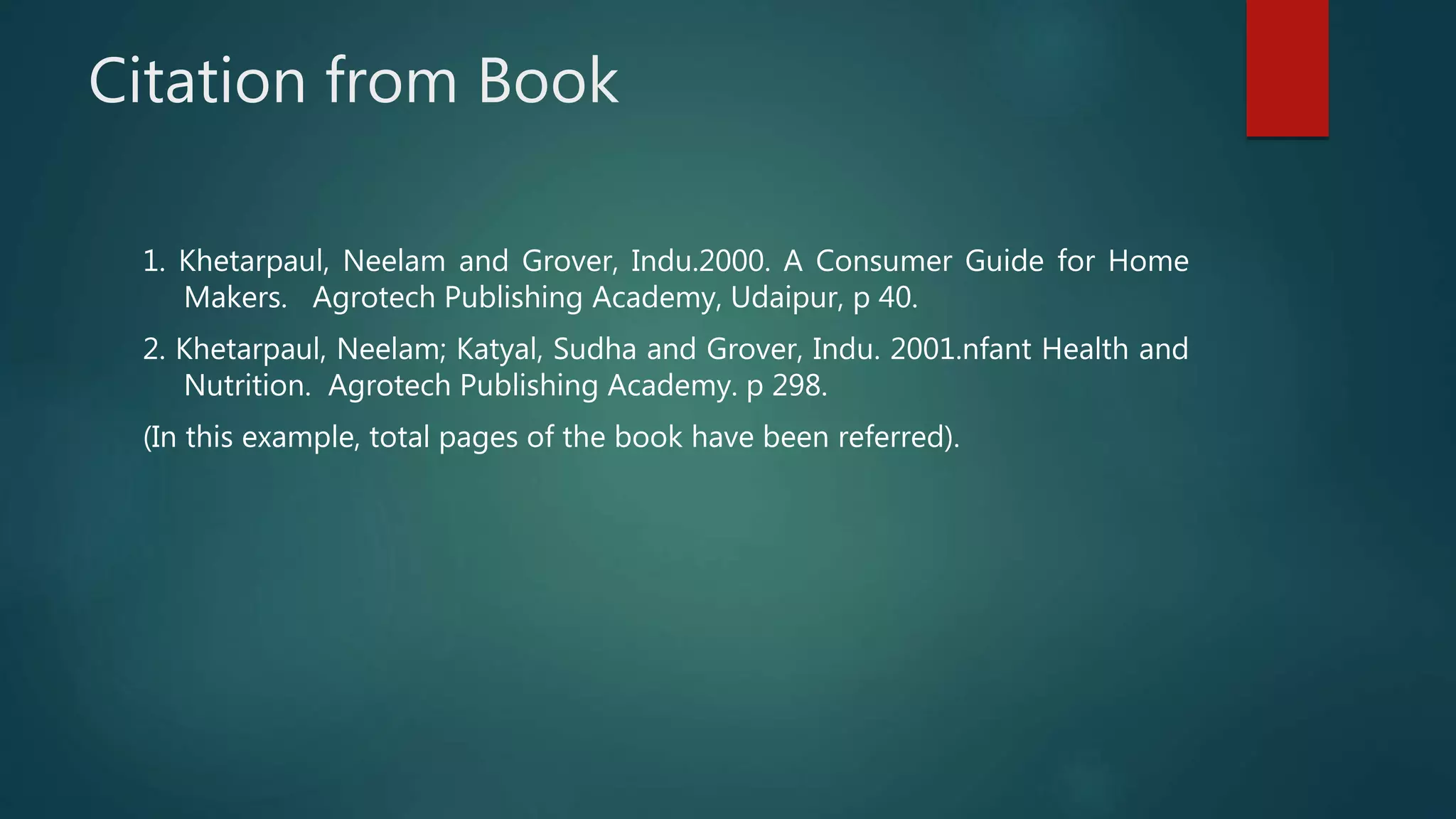
Citation from Book
1. Khetarpaul, Neelam and Grover, Indu.2000. A Consumer Guide for Home
Makers. Agrotech Publishing Academy, Udaipur, p 40.
2. Khetarpaul, Neelam; Katyal, Sudha and Grover, Indu. 2001.nfant Health and
Nutrition. Agrotech Publishing Academy. p 298.
(In this example, total pages of the book have been referred).
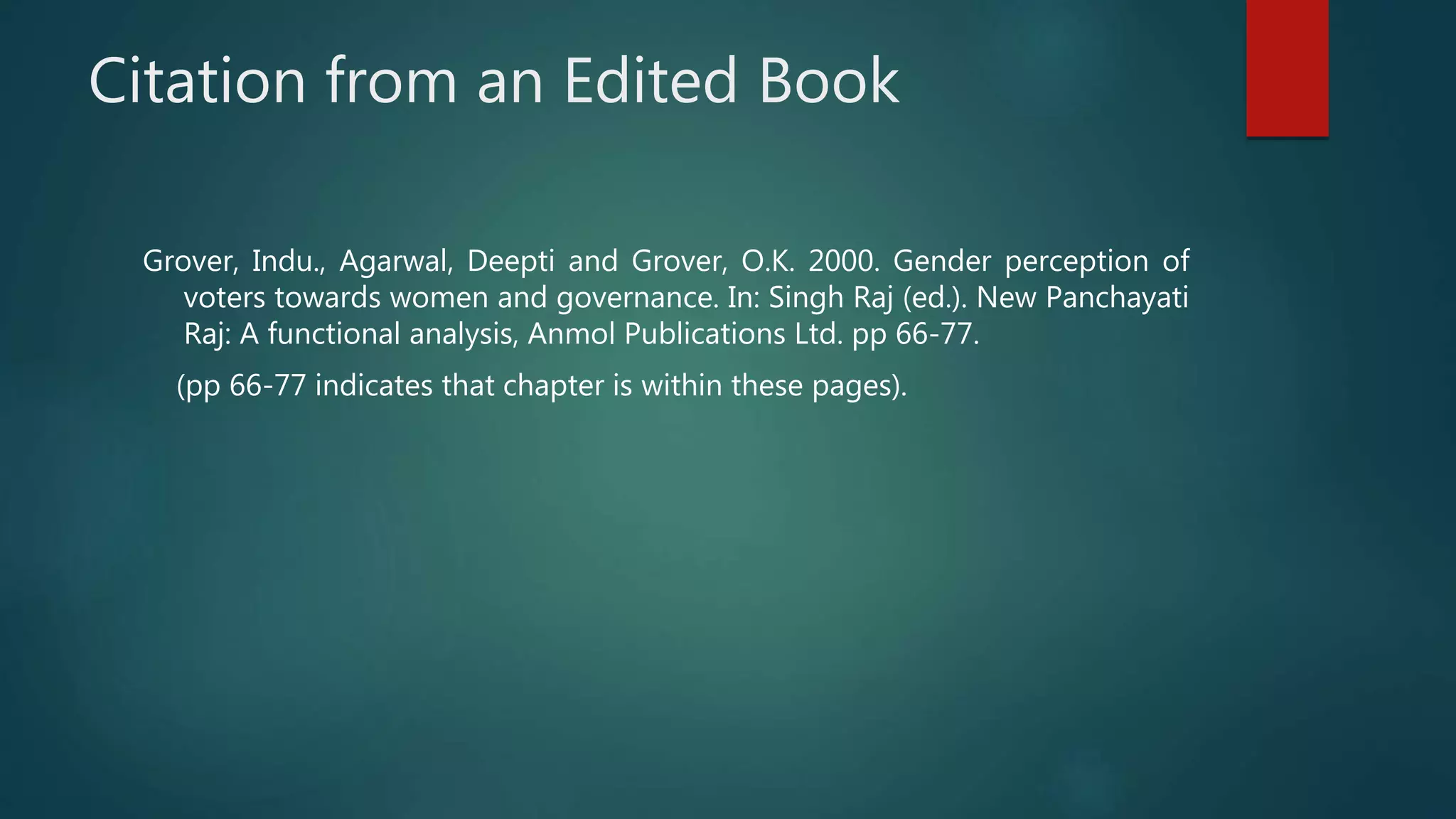
Citation from an Edited Book
Grover, Indu., Agarwal, Deepti and Grover, O.K. 2000. Gender perception of
voters towards women and governance. In: Singh Raj (ed.). New Panchayati
Raj: A functional analysis, Anmol Publications Ltd. pp 66-77.
(pp 66-77 indicates that chapter is within these pages).
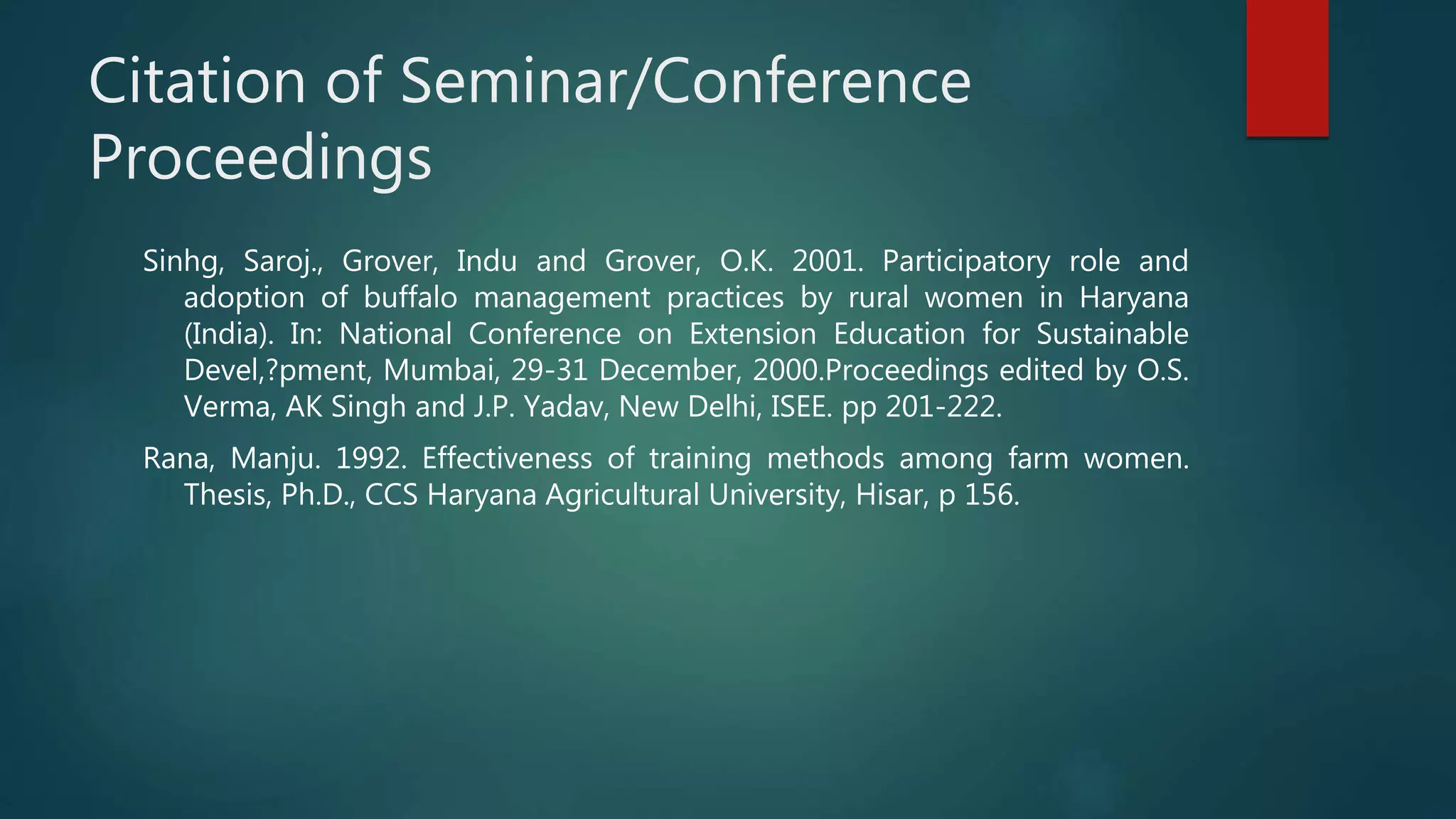
Citation of Seminar/Conference
Proceedings
Sinhg, Saroj., Grover, Indu and Grover, O.K. 2001. Participatory role and
adoption of buffalo management practices by rural women in Haryana
(India). In: National Conference on Extension Education for Sustainable
Devel,?pment, Mumbai, 29-31 December, 2000.Proceedings edited by O.S.
Verma, AK Singh and J.P. Yadav, New Delhi, ISEE. pp 201-222.
Rana, Manju. 1992. Effectiveness of training methods among farm women.
Thesis, Ph.D., CCS Haryana Agricultural University, Hisar, p 156.
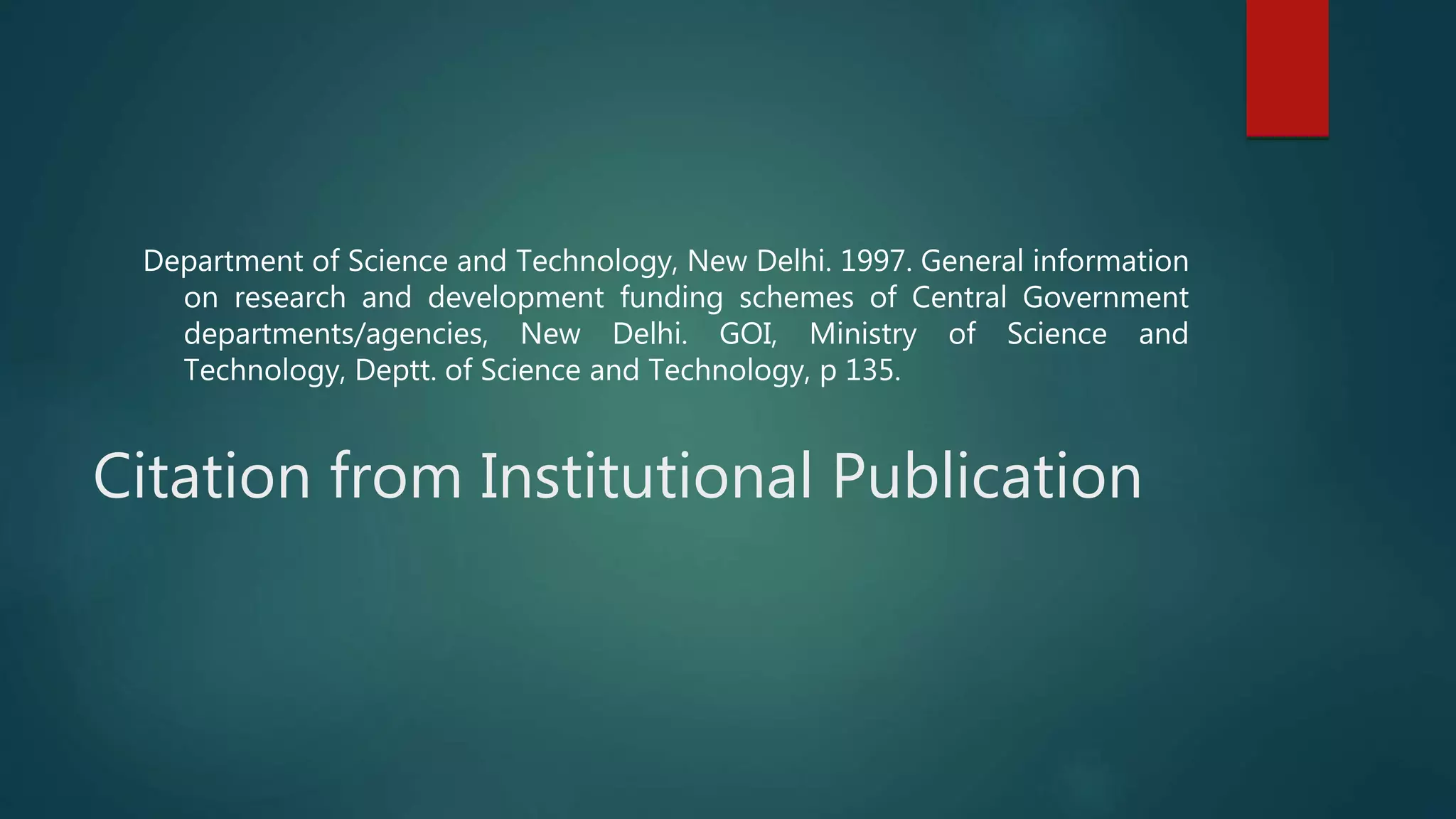
Citation from Institutional Publication
Department of Science and Technology, New Delhi. 1997. General information
on research and development funding schemes of Central Government
departments/agencies, New Delhi. GOI, Ministry of Science and
Technology, Deptt. of Science and Technology, p 135.
Citing Government Publications
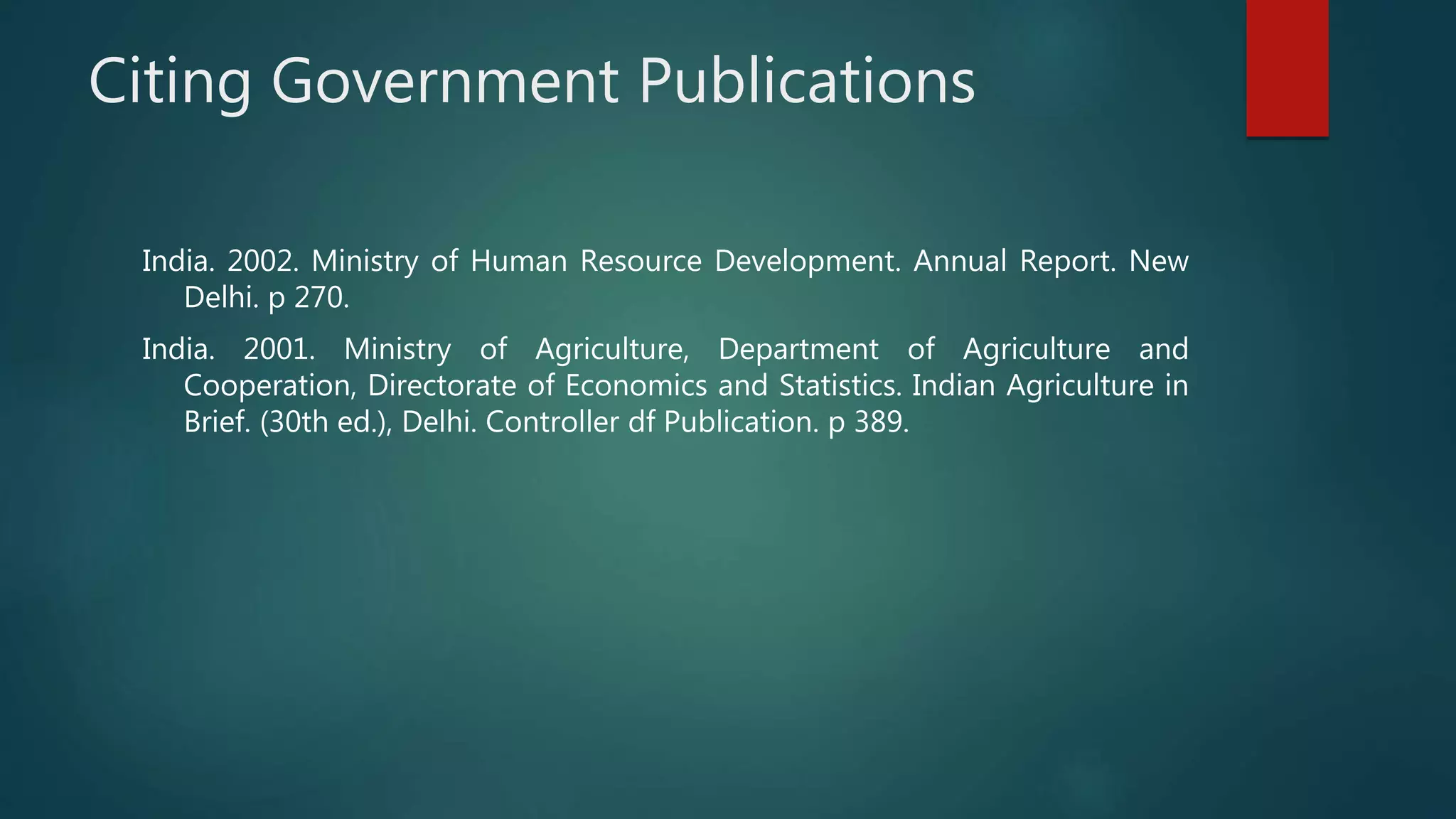
India. 2002. Ministry of Human Resource Development. Annual Report. New
Delhi. p 270.
India. 2001. Ministry of Agriculture, Department of Agriculture and
Cooperation, Directorate of Economics and Statistics. Indian Agriculture in
Brief. (30th ed.), Delhi. Controller df Publication. p 389.
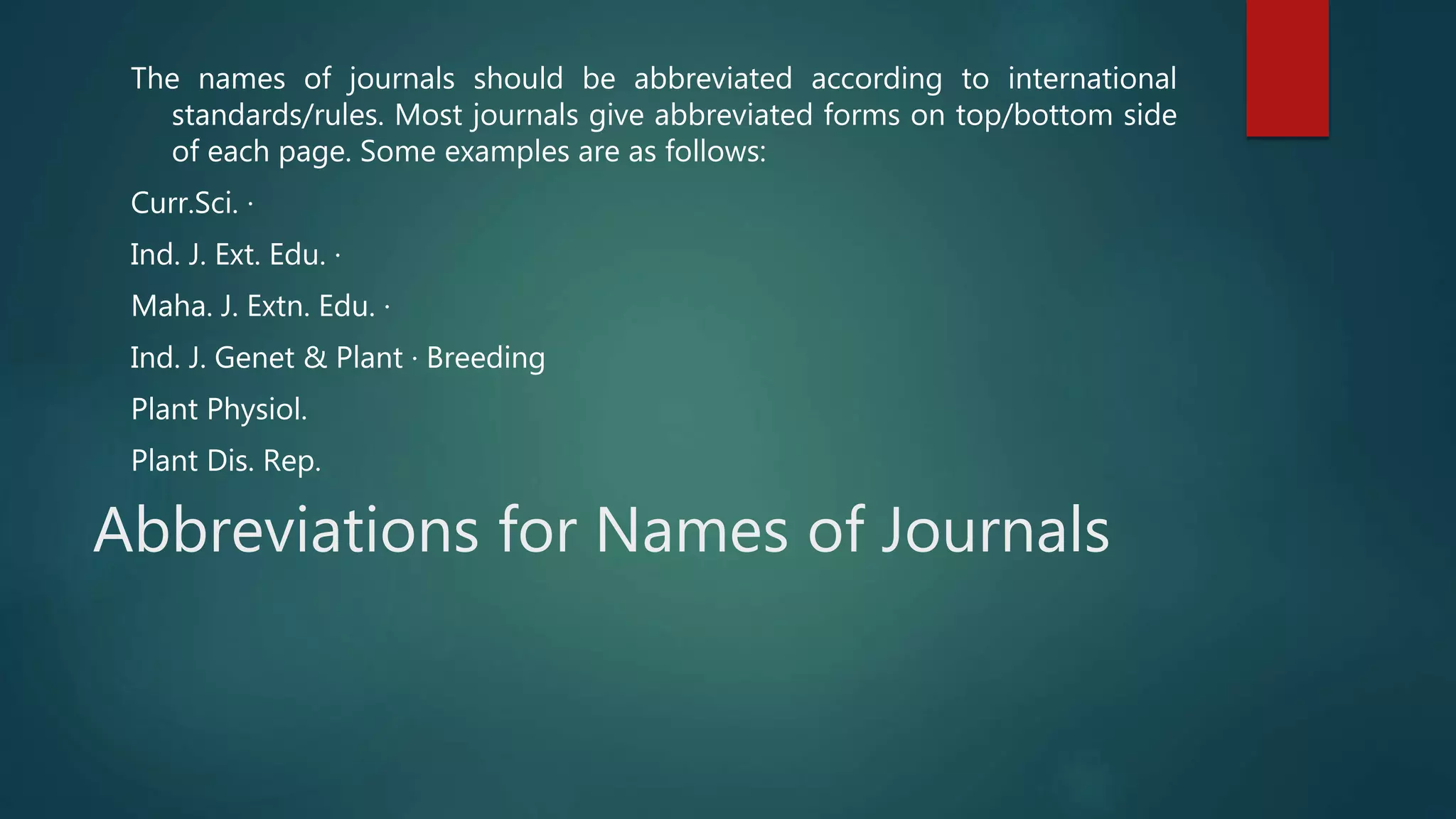
Abbreviations for Names of Journals
The names of journals should be abbreviated according to international
standards/rules. Most journals give abbreviated forms on top/bottom side
of each page. Some examples are as follows:
Curr.Sci. ·
Ind. J. Ext. Edu. ·
Maha. J. Extn. Edu. ·
Ind. J. Genet & Plant · Breeding
Plant Physiol.
Plant Dis. Rep.
Writing of summarising, precis , citation

Writing of summarising, precis , citation

  • 1.
    Writing of Summarising,Precis , Citation
  • 2.
     A summaryis a short and concise representation of the main points, ideas, concepts, facts or statements of a text written in your own words.  When either summarising or paraphrasing, you should not alter: the author's original idea(s) the degree of certainty with which the ideas are expressed.  How to summarise? To create / write a good summary, you should read the article or text a number of times to develop a clear understanding of: the author's ideas and intentions ,the meaning and details ,the force with which the ideas are expressed.  Referencing Summaries need to be referenced. Whether you have summarised or paraphrased an author's words, thoughts, ideas etc, a citation to the original source of the words, thoughts, ideas etc must be provided.
  • 3.
    Steps of Writinga summary  Step 1 Write notes in point form using keywords; this will make it easier to express the ideas in your own words.  Step 2 Write the summary directly from your notes without re-reading the passage.  Step 3 Refer back to the original to ensure that your summary is a true reflection of the writer's ideas.  Tips Topic sentences provide a quick outline of the main idea(s) presented in a paragraph. When summarising a chapter or article, the introduction and conclusion should provide a good overview of the content.
  • 4.
    Precis writing  Introduction ‘precis’ is derived from French and it means ‘precise’.  Precis-writing is an exercise in compression. Forms of condensation  Précis is lengthier than the abstract and follows the exact order of points of the original passage. Skills required Precis writing demands power of judgement and evaluation as the passage usually contains important ideas and a number of unnecessary words.  Methodof procedure 1.Reading (a)First read the passage through carefully, but not too slowly, to get a general idea of its meaning. (b) Usually you are required to supply a title for your precis. (c) Further reading is now necessary to ensure that you understand the details of the passage as well as its main purpose. (d) to decide what parts of the passage are essential
  • 5.
     2. Writing. (a)Rough Drafts (b) Important Points 1. The precis should be all in your own words. 2. The precis must be a connected whole. 3. The precis must be complete and self-contained Guidelines 1. Read the passage at least two times to familiarise yourself with the theme and the main ideas contained in the passage. 2. Give the passage a little, a suitable title would help you to identify the name of the passage. 3. Write down important points and arrange them in the same sequence as the original passage. 4. Make a rough draft. A précis should not be more than 1/3 of the original unless otherwise directed.
  • 6.
    Cont.…. 5. Write theprecise in the indirect form of narration using only the third person 6. Scrupulously avoid all examples figures of speech, illustrations and comments. 7. Retain all those facts and ideas which are related to the main ideas, reject those which have minor importance. 8. Drop all redundant words and expressions.
  • 7.
    Citation  All literaturecited in the text should: be included in the list of references giving complete details.  Standard style of literature citation should be followed.  Citation in text Citation style of references in the text varies from journal to journal and therefore consult the guidelines of the journal and go to references cited for noting style.  In case of one author, give last name/surname first, year of publication within parentheses, e.g. Singh (2002).  In case of two authors, give first the last name of first author followed by last name of second author, year of publication e.g. Singh and Grover (2002).  In case of more than two authors give last name of first author followed by et al. and year of publication e.g. Singh et al. (2002). In case the author is referred at more than one place in the same year, number references as 'a' and 'b' e.g. Singh (2002Sa )........Singh (2002b).
  • 8.
    Citation in Journal Thismust include the name of author(s), followed by year of publication within parentheses or stops, title of the paper/article, name of the journal/periodical, volume and number in brackets, and page number. In case of male authors, initials are used and in case female authors give full name e.g. Singh, J. and Grover, Indlj. 2002. Academic achievement and entrepreneurial performance of undergraduate students of CCS Haryana Agricultural University, CCSHAU J. Research. 88(3), 416-421. Note: In some journals the name of journal is written in italics.
  • 9.
    Citation from Book 1.Khetarpaul, Neelam and Grover, Indu.2000. A Consumer Guide for Home Makers. Agrotech Publishing Academy, Udaipur, p 40. 2. Khetarpaul, Neelam; Katyal, Sudha and Grover, Indu. 2001.nfant Health and Nutrition. Agrotech Publishing Academy. p 298. (In this example, total pages of the book have been referred).
  • 10.
    Citation from anEdited Book Grover, Indu., Agarwal, Deepti and Grover, O.K. 2000. Gender perception of voters towards women and governance. In: Singh Raj (ed.). New Panchayati Raj: A functional analysis, Anmol Publications Ltd. pp 66-77. (pp 66-77 indicates that chapter is within these pages).
  • 11.
    Citation of Seminar/Conference Proceedings Sinhg,Saroj., Grover, Indu and Grover, O.K. 2001. Participatory role and adoption of buffalo management practices by rural women in Haryana (India). In: National Conference on Extension Education for Sustainable Devel,?pment, Mumbai, 29-31 December, 2000.Proceedings edited by O.S. Verma, AK Singh and J.P. Yadav, New Delhi, ISEE. pp 201-222. Rana, Manju. 1992. Effectiveness of training methods among farm women. Thesis, Ph.D., CCS Haryana Agricultural University, Hisar, p 156.
  • 12.
    Citation from InstitutionalPublication Department of Science and Technology, New Delhi. 1997. General information on research and development funding schemes of Central Government departments/agencies, New Delhi. GOI, Ministry of Science and Technology, Deptt. of Science and Technology, p 135.
  • 13.
    Citing Government Publications India.2002. Ministry of Human Resource Development. Annual Report. New Delhi. p 270. India. 2001. Ministry of Agriculture, Department of Agriculture and Cooperation, Directorate of Economics and Statistics. Indian Agriculture in Brief. (30th ed.), Delhi. Controller df Publication. p 389.
  • 14.
    Abbreviations for Namesof Journals The names of journals should be abbreviated according to international standards/rules. Most journals give abbreviated forms on top/bottom side of each page. Some examples are as follows: Curr.Sci. · Ind. J. Ext. Edu. · Maha. J. Extn. Edu. · Ind. J. Genet & Plant · Breeding Plant Physiol. Plant Dis. Rep.