
Predatory publishing
ANU Library
What is predatory publishing?
…predatory publishers…publish counterfeit
journals to exploit the open-access model in
which the author pays. These predatory
publishers are dishonest and lack
transparency. They aim to dupe
researchers, especially those inexperienced
in scholarly communication.
2
Beall, J. (2012) “Predatory publishers are corrupting open access”, Nature, vol. 489 iss. 7415.
http://www.nature.com/news/predatory-publishers-are-corrupting-open-access-1.11385
What should an academic or
researcher expect from publishing?
• Contribution to your reputation
• Visibility to a professional community
• Record of research
• Recognition of quality work
• Peer review
3
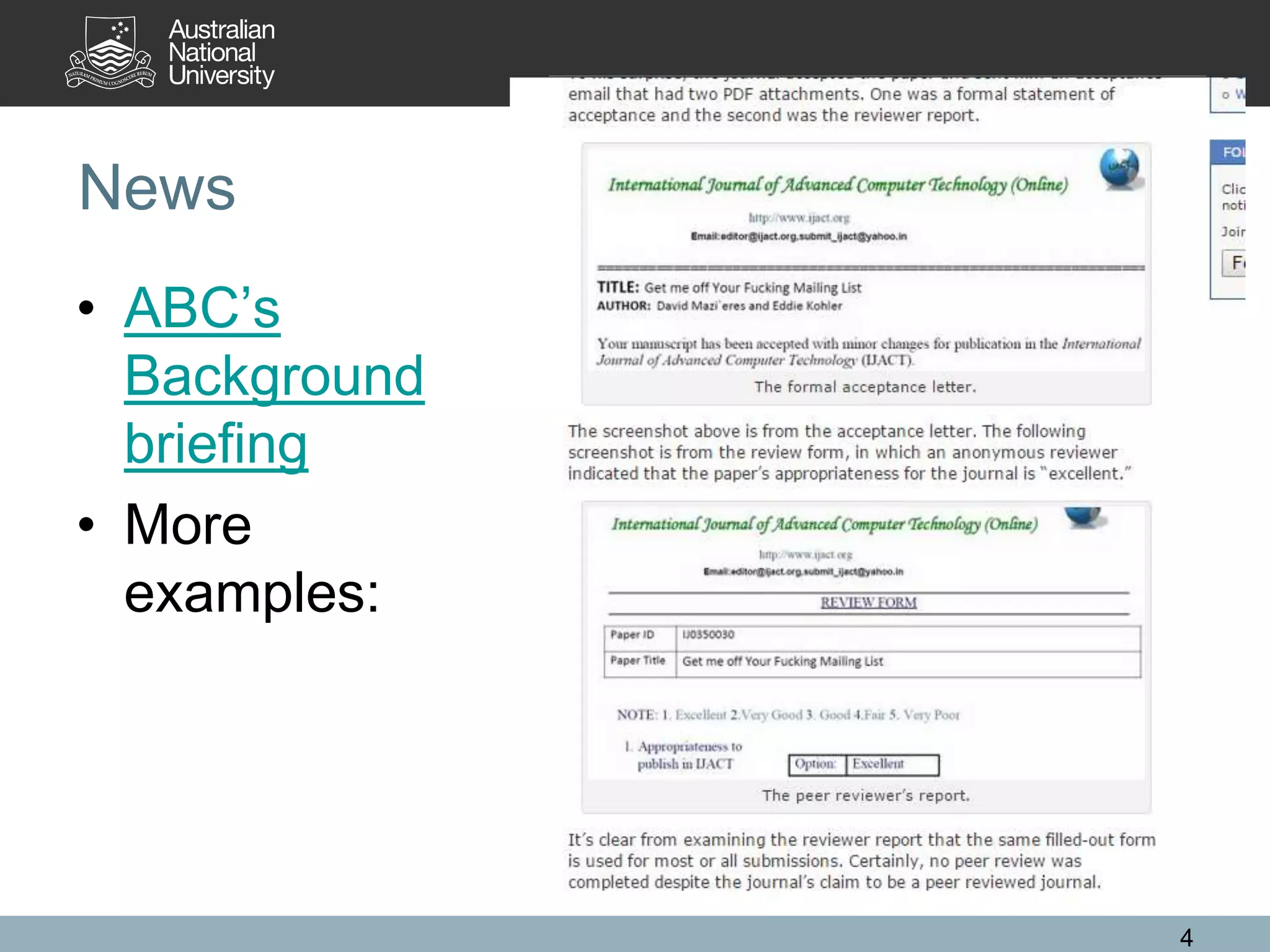
News
• ABC’s
Background
briefing
• More
examples:
4
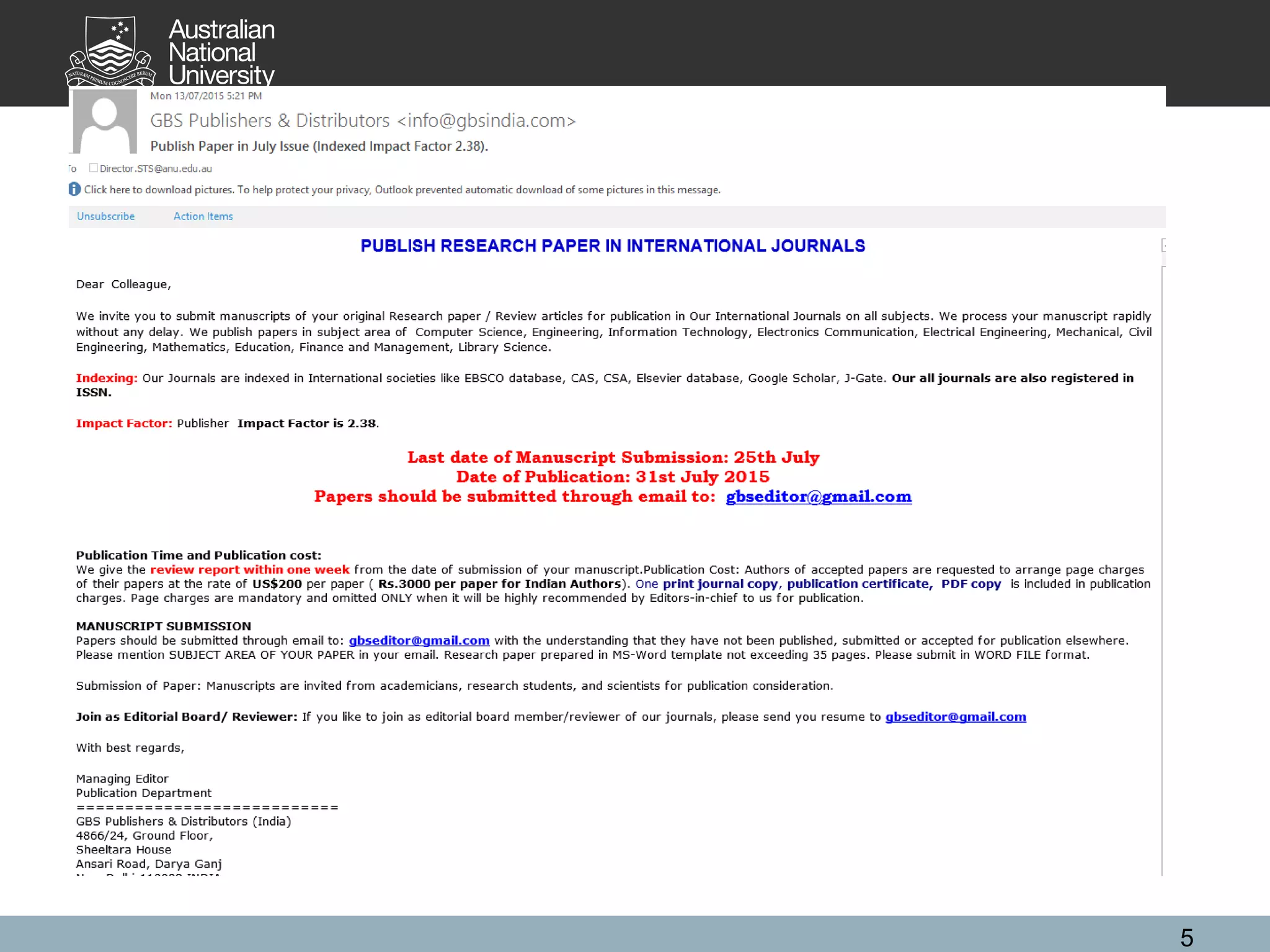
5
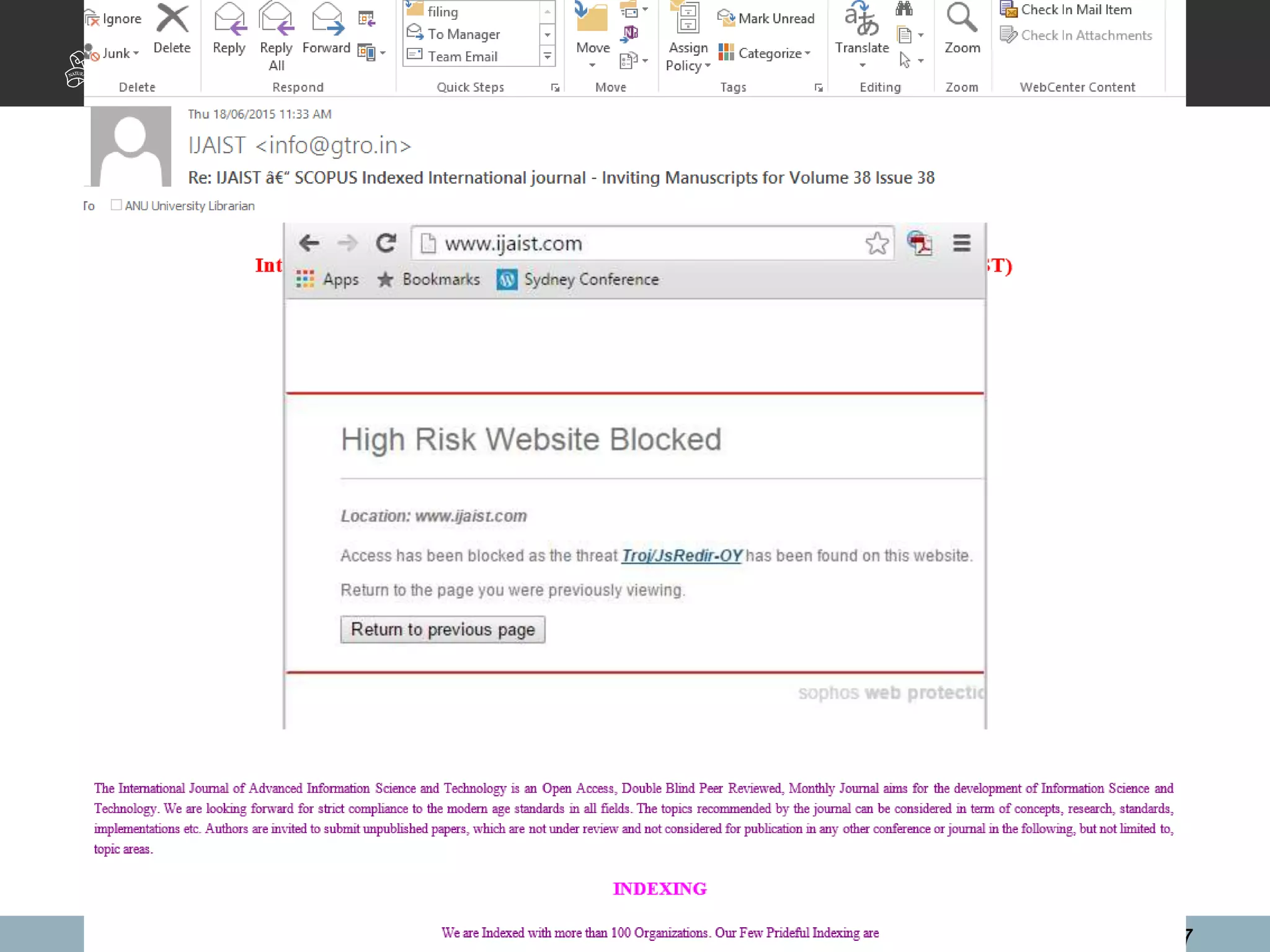
3 top tips
• If you haven’t heard of the journal or
conference check tools such as Incites,
Beall’s list or ask your local librarian
• Don’t believe the web site – ask your
colleagues and look at indicators of journal
impact. Our guide Journal measures and
tools can help you
• Don’t respond to unsolicited emails –
choose the journals you wish to submit to.
6
7
Varieties of predatory publishing
• Phony Journals (e.g. Australasian Journal
of Bone and Joint Medicine, which was
published by Elsevier)
• Pseudo-scholarly Journals (claim peer
review and impact factors)
• False-flag Journals (sneaky)
• Masqueraders
8
Anderson, R. (2015) “Deceptive Publishing: Why We Need a Blacklist, and Some Suggestions on How to Do It Right”
http://scholarlykitchen.sspnet.org/2015/08/17/deceptive-publishing-why-we-need-a-blacklist-and-some-suggestions-on-how-to-do-it-right/
On line tools
Incites
9
Criteria
• Beall’s Criteria for Determining Predatory
Open-Access Publishers
• Committee on Publishing Ethics:
– Code of Conduct for Journal Publishers
– Principles of Transparency and Best Practice
in Scholarly Publishing
• Quality editorial board (note this can be
circumvented by predatory publishers)
10
Not just open access publishers
• In early 2014 Springer and IEEE removed
more than 120 papers after Cyril Labbé of
Joseph Fourier University in Grenoble,
France, discovered computer-generated
papers published in their journals.
11
12
Predatory publishers
• Can devalue your publishing record
• Can restrict you from publishing in good
quality journals (because of the licence
you agree to)
13
Keeping up to date
• Follow Australasian Open Access
Support Group
14
• Your feedback/comments
15

Predatory publishing

  • 1.
  • 2.
    What is predatorypublishing? …predatory publishers…publish counterfeit journals to exploit the open-access model in which the author pays. These predatory publishers are dishonest and lack transparency. They aim to dupe researchers, especially those inexperienced in scholarly communication. 2 Beall, J. (2012) “Predatory publishers are corrupting open access”, Nature, vol. 489 iss. 7415. http://www.nature.com/news/predatory-publishers-are-corrupting-open-access-1.11385
  • 3.
    What should anacademic or researcher expect from publishing? • Contribution to your reputation • Visibility to a professional community • Record of research • Recognition of quality work • Peer review 3
  • 4.
  • 5.
  • 6.
    3 top tips •If you haven’t heard of the journal or conference check tools such as Incites, Beall’s list or ask your local librarian • Don’t believe the web site – ask your colleagues and look at indicators of journal impact. Our guide Journal measures and tools can help you • Don’t respond to unsolicited emails – choose the journals you wish to submit to. 6
  • 7.
  • 8.
    Varieties of predatorypublishing • Phony Journals (e.g. Australasian Journal of Bone and Joint Medicine, which was published by Elsevier) • Pseudo-scholarly Journals (claim peer review and impact factors) • False-flag Journals (sneaky) • Masqueraders 8 Anderson, R. (2015) “Deceptive Publishing: Why We Need a Blacklist, and Some Suggestions on How to Do It Right” http://scholarlykitchen.sspnet.org/2015/08/17/deceptive-publishing-why-we-need-a-blacklist-and-some-suggestions-on-how-to-do-it-right/
  • 9.
  • 10.
    Criteria • Beall’s Criteriafor Determining Predatory Open-Access Publishers • Committee on Publishing Ethics: – Code of Conduct for Journal Publishers – Principles of Transparency and Best Practice in Scholarly Publishing • Quality editorial board (note this can be circumvented by predatory publishers) 10
  • 11.
    Not just openaccess publishers • In early 2014 Springer and IEEE removed more than 120 papers after Cyril Labbé of Joseph Fourier University in Grenoble, France, discovered computer-generated papers published in their journals. 11
  • 12.
  • 13.
    Predatory publishers • Candevalue your publishing record • Can restrict you from publishing in good quality journals (because of the licence you agree to) 13
  • 14.
    Keeping up todate • Follow Australasian Open Access Support Group 14
  • 15.

Editor's Notes

  • #15 http://www.nature.com/news/the-top-100-papers-1.16224