A message from libraries: we need
you!
Roxanne Missingham
Parliament of Australia Librarian – shortly to be
University Librarian, ANU
Past president, ALIA
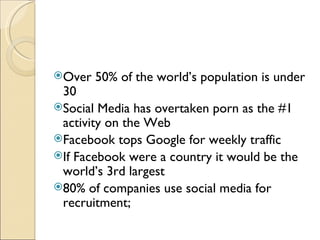
Over   50% of the world’s population is under
 30
Social Media has overtaken porn as the #1
 activity on the Web
Facebook tops Google for weekly traffic
If Facebook were a country it would be the
 world’s 3rd largest
80% of companies use social media for
 recruitment;
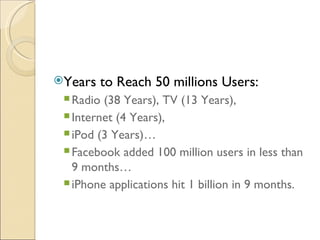
Years   to Reach 50 millions Users: 
  Radio (38 Years), TV (13 Years),
  Internet (4 Years),
  iPod (3 Years)…
  Facebook added 100 million users in less than
   9 months…
  iPhone applications hit 1 billion in 9 months.
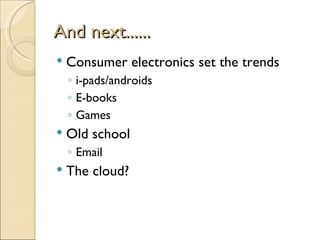
And next......
   Consumer electronics set the trends
    ◦ i-pads/androids
    ◦ E-books
    ◦ Games
   Old school
    ◦ Email
   The cloud?
What is a library in this new world?


 1.   Users everywhere online
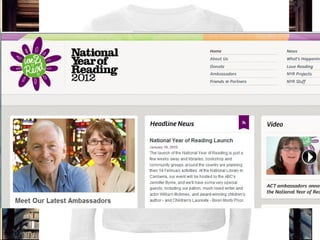
 2.   Many channels
 3.   Many diverse offerings
 4.   Competition for time and as
      information access services
 5.   So what are libraries doing?
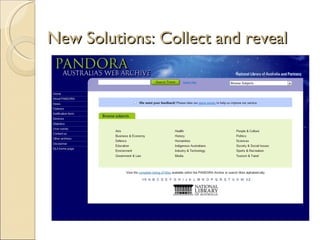
New Solutions: Collect and reveal
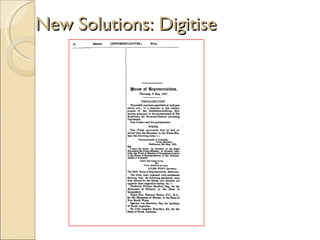
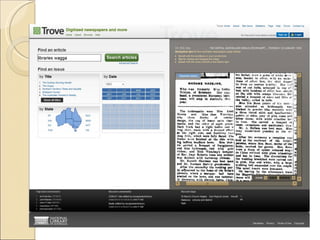
New Solutions: Digitise
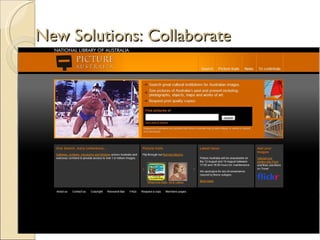
New Solutions: Collaborate
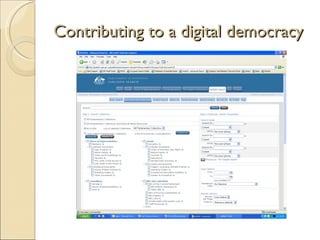
Contributing to a digital democracy
Digtial democracy
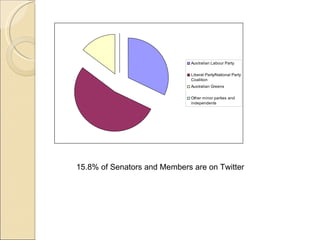
                                Australian Labour Party

                                Liberal Party/National Party
                                Coalition
                                Australian Greens

                                Other minor parties and
                                independents


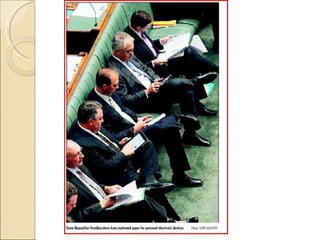
  15.8% of Senators and Members are on Twitter
ALIA : linking people with ideas
   Professional association for workers,
    students and others

   Key areas of work
    ◦   Education & professional development
    ◦   Advocacy (e.g. copyright)
    ◦   Activities – events, group opportunities
    ◦   Research including a research fund
    ◦   Awards
    ◦   Financial management & governance
ALIA : linking people with ideas
   Contacts

   Networks

   Employment – helping your career

   Attend all the event you can!

   Awards – student awards
Online
   23 million Australians

   12 million public library users

   Public libraries have 4,638 Internet
    workstations for Australians to use
Employment
 Australian Bureau of Statistics 2006
  census:
 Library workforce is
    ◦ 10,085 librarians;
    ◦ 6,510 library technicians; and
    ◦ 8,254 library technicians
Employment
   Librarians are older than the average age
    for Australian occupations:
    ◦ 65% are 45 or older (compared to 36% of the
      average total workforce);
    ◦ 88% are 35 or older (compared to 58% of the
      total workforce)
    ◦ Only 12% are under 35 (compared to 42% of
      the total workforce)
Inquiry into school libraries and
teacher librarians
   29 per cent of schools in general (and 54 per cent
    of government schools) have an annual budget of
    less than $5 000 to provide curriculum support,
    reading materials and electronic resources.

   According to the Children’s Book Council of
    Australia (CBCA), many school libraries receive
    budgets below 1975 levels. (in 2010) the average
    school library budget of respondent schools today
    equates to just $25 per child.
   A vicious cycle has resulted from under-
    resourcing school libraries and having insufficient
    numbers of appropriately qualified staff in them,
    leading to a poorer quality service, which reduces
    the demand for teacher librarians ...

   The Committee has been struck by the breadth
    of anecdotal evidence that it received
    demonstrating the significant contribution to
    learning outcomes in primary and secondary
    schools that a fully resourced school library,
    when staffed by a fully qualified and active teacher
    librarian, can make.
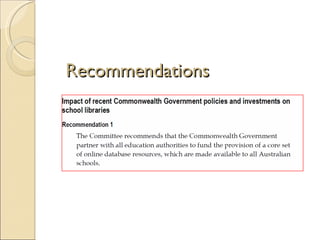
Recommendations
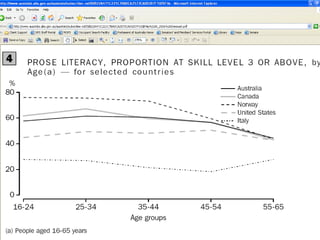
Literacy
   Over 6 million Australian adults (47%)
    don't have adequate literacy skills to cope
    with the demands of everyday life and
    work (level 1/2).
   Only 17% of adult Australians had literacy
    skills at levels 4/5.
   ABS 1996
Where to from here?

Csu 2012

  • 1.
    A message fromlibraries: we need you! Roxanne Missingham Parliament of Australia Librarian – shortly to be University Librarian, ANU Past president, ALIA
  • 5.
    Over 50% of the world’s population is under 30 Social Media has overtaken porn as the #1 activity on the Web Facebook tops Google for weekly traffic If Facebook were a country it would be the world’s 3rd largest 80% of companies use social media for recruitment;
  • 6.
    Years to Reach 50 millions Users:   Radio (38 Years), TV (13 Years),  Internet (4 Years),  iPod (3 Years)…  Facebook added 100 million users in less than 9 months…  iPhone applications hit 1 billion in 9 months.
  • 7.
    And next......  Consumer electronics set the trends ◦ i-pads/androids ◦ E-books ◦ Games  Old school ◦ Email  The cloud?
  • 9.
    What is alibrary in this new world? 1. Users everywhere online 2. Many channels 3. Many diverse offerings 4. Competition for time and as information access services 5. So what are libraries doing?
  • 10.
  • 11.
  • 13.
  • 17.
    Contributing to adigital democracy
  • 18.
    Digtial democracy Australian Labour Party Liberal Party/National Party Coalition Australian Greens Other minor parties and independents 15.8% of Senators and Members are on Twitter
  • 23.
    ALIA : linkingpeople with ideas  Professional association for workers, students and others  Key areas of work ◦ Education & professional development ◦ Advocacy (e.g. copyright) ◦ Activities – events, group opportunities ◦ Research including a research fund ◦ Awards ◦ Financial management & governance
  • 24.
    ALIA : linkingpeople with ideas  Contacts  Networks  Employment – helping your career  Attend all the event you can!  Awards – student awards
  • 26.
    Online  23 million Australians  12 million public library users  Public libraries have 4,638 Internet workstations for Australians to use
  • 27.
    Employment  Australian Bureauof Statistics 2006 census:  Library workforce is ◦ 10,085 librarians; ◦ 6,510 library technicians; and ◦ 8,254 library technicians
  • 28.
    Employment  Librarians are older than the average age for Australian occupations: ◦ 65% are 45 or older (compared to 36% of the average total workforce); ◦ 88% are 35 or older (compared to 58% of the total workforce) ◦ Only 12% are under 35 (compared to 42% of the total workforce)
  • 29.
    Inquiry into schoollibraries and teacher librarians
  • 30.
    29 per cent of schools in general (and 54 per cent of government schools) have an annual budget of less than $5 000 to provide curriculum support, reading materials and electronic resources.  According to the Children’s Book Council of Australia (CBCA), many school libraries receive budgets below 1975 levels. (in 2010) the average school library budget of respondent schools today equates to just $25 per child.
  • 31.
    A vicious cycle has resulted from under- resourcing school libraries and having insufficient numbers of appropriately qualified staff in them, leading to a poorer quality service, which reduces the demand for teacher librarians ...  The Committee has been struck by the breadth of anecdotal evidence that it received demonstrating the significant contribution to learning outcomes in primary and secondary schools that a fully resourced school library, when staffed by a fully qualified and active teacher librarian, can make.
  • 32.
  • 33.
    Literacy  Over 6 million Australian adults (47%) don't have adequate literacy skills to cope with the demands of everyday life and work (level 1/2).  Only 17% of adult Australians had literacy skills at levels 4/5.  ABS 1996
  • 35.

Editor's Notes

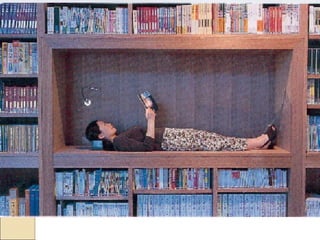
  • #3 Jun Takagi, 2002, for JAL What do you think about libraries? Some thought provokers: When was the first online library catalogue in Australia? Weapons Research Establishment, SA mid 1950s First collaborative purchase of a dataset loaded to a computer 1968 Chemical Abstracts CSIRO and Melbourne Universities When did the national union catalogue go online? 1981
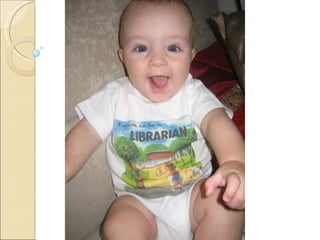
  • #4 So we are now born digital – or are we born information professionals? (Ronan, daughter of a CSU Graduate Jill Stephens)
  • #5 http://www.youtube.com/watch?v=fpMZbT1tx2o&list=UULC9cX5GntaQmTSF6hTqrzA&index=7&feature=plcp http://www.socialnomics.net/?p=5443 – for 2012 one http://www.youtube.com/watch?v=lFZ0z5Fm-Ng – older version
  • #10 In the twenty first century the expectations of librarians and users have radically changed. The development of the Internet, in particular the World Wide Web, has resulted in a radical change in access to information and services. Australians have been rapid adopters of communications technologies, in particular the Internet. The December 18 2008 release of the ABS publication Household Use of Information Technology , Australia, 2007-08  (http://www.abs.gov.au/ausstats/abs@.nsf/Latestproducts/8146.0Main%20Features12007-08?opendocument&tabname=Summary&prodno=8146.0&issue=2007-08&num=&view=) found: As of June 30 2008 the total Broadband connections were at 4.3 million (52% of all households), an increase of 22% on last years total. The Australian Capital Territory has the highest proportion of Broadband connections, at 68% of households while Tasmania (39%) and South Australia (42%) were the lowest. Other states ranged from 51 to 55%. 67% of Australian households had home Internet access and 75% of households had access to a computer. This is more than a five-fold increase in the number of household Internet connections over the last ten years. Socio-economic characteristics of households continue to influence the rate of computer, Internet and Broadband connections across Australia. For example, in relation to Broadband access: Metropolitan areas had considerably higher proportion of Broadband connections (57%) than other areas (43%). Households with children under 15 had higher Broadband access (67%) compared to households without (46%). Those households with an income of $120,000 had substantially higher rates of access (81%) than households incomes of less than $40,000 (38%). Getting to places remains a key challenge – (also see http://www.abs.gov.au/AUSSTATS/abs@.nsf/Lookup/4102.0Chapter10002008)
  • #11 Pandora: commenced in 1996 This month Number of archived titles 29,688 Number of archived instances* 70,752 Number of files 132,322,397 Data size 5.9 TB Table 1 – Size of the Australian domain harvest data sets Domain Harvest Date 2005 2006 2007 Unique documents (files) crawled 185,549,662 596,238,990 516,064,820 Total documents (files) crawled 189,824,119 621,664,876 523,510,945 Hosts 811,523 1,260,553 1,247,614 Raw data size 6.69 TB 19.04 TB 18.47 TB Compressed ARC file size 4.52 TB 10.48 TB 10.18 TB
  • #12 State Library of Victoria
  • #13 Current work counts by zone [20120122] Zone Work Count Journals, articles and research 132,665,680 Books 16,783,453 Maps 367121 Diaries, letters, archives 524,909 Lists 17,883 Music, sound and video 2,140,935 Digitised Newspapers and more 6,0234,673 People and organisation 888,566 Pictures, photos, objects 43,85,557 Archived websites (1996 - now) 35,987,202 Total 25,3995,979 Statistic 4 Nov 2009 (15 months after release) Number of pages in service 832,665 Number of articles in service 8.4 million Unique visitors to site 787,000 Number of registered users 6,006 Lines of text corrected 7 million Number of articles corrected 318,169 Number of comments added 4,618 Number of tags added 197,597 Total keyword searches since 4 August 2008 release 3.9 million 102,929 tags added Top 10 Tags By number of times assigned Light Railway Research Society for Australia 2,312 Murder 846 Bendigo 620 Lady Jane Franklin 515 Maryborough Qld BDMs 491 Gold mining 425 Suicide 400 Sir John Franklin 365 Cane 347 Sawmilling 331 Top 10 Tags By number of different registered users who assigned the same term (+ unknown amount of anonymous users) Murder 39 + anonymous Death 27 + anonymous Cricket 23 + anonymous Suicide 22 + anonymous Marriage 22 + anonymous Melbourne 23 + anonymous Canberra 20 + anonymous Accident 20 + anonymous Adelaide 17 + anonymous Drowning 17 + anonymous   There was an expectation from users that since this was a library service offering tagging, there would be some 'strict library rules' for creating tags, and users were surprised there were none. The users quickly developed their own unwritten guidelines. (http://www.dlib.org/dlib/january10/holley/01holley.html)
  • #14 http://www.pictureaustralia.org/ Around 1.8 images million images from 78 institutions around the globe – focused on access and overcoming silos. Also supply records to Google and Yahoo, usage. Reach – family historians, children, general researchers MENTION FLICKR for contributors – over 42, 000 images contributed
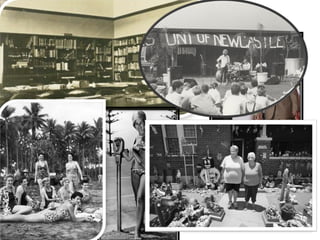
  • #15 National Archives of Australia: Title : Australian Forestry School, Canberra - School Library 1927 R.A.A.F. FLYING SISTERS AT WORK AND RELAXING IN CAMP AT MOROTAI 520 Date(s) of creation: ca. 1945 Geri Engledon Surfer's Paradise Meter Maid in Hamilton, Victoria, for the Hamilton Show [picture] Date(s) of creation: [1967] Power, Greg, 1974- [The Royal couple waving at the public at the National Museum of Australia, 8-9 March 2005] [picture] / Greg Power. University of Newcastle no fees campaign 1987 & 88 no place like gnome
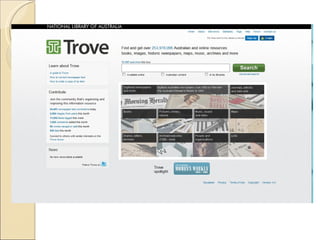
  • #16 http://trove.nla.gov.au/
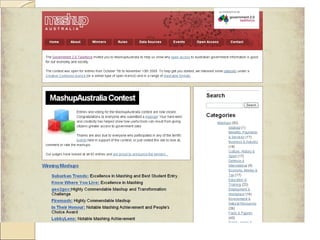
  • #20 http://mashupaustralia.org/category/mashups/tourism-travel/
  • #22 Back to the role of libraries
  • #23 And a bit of fun
  • #24 Example of recent challenges
  • #25 the highest achieving graduating student in CSU ALIA-recognised librarianship and library technician courses as a means of recognising students for excellence in their studies. The award comprises: one financial year's membership - which includes a subscription to the Association's monthly news magazine inCite; in addition to inCite, a subscription to one of the Association's journals of the students choice - Australian Library Journal (ALJ) - ALIA's premier journal; or - Australian Academic & Research Libraries (AARL) - ALIA's research journal) award certificate
  • #26 http://www.alia.org.au/
  • #27 http://www.abs.gov.au/ausstats/abs@.nsf/Latestproducts/8146.0Main%20Features12007-08?opendocument&tabname=Summary&prodno=8146.0&issue=2007-08&num=&view=) Who uses libraries online? Government services example: Increasing demand. Most librarians report increasing client use of individual Government websites, for both content information and process or transaction based purposes. An invisible draw on resources. While libraries were aware of some high-demand government online services, librarians rarely had an overview of all government services accessed by their clients. As a result, government online services created a largely invisible demand on public library resources. Unintended impacts. Government agencies put services online in order to provide better access to their users to and streamline their own operations. Most agencies do not understand that their actions place extra burdens on public libraries.” (State Library of New South Wales 2004, p. 1)
  • #29 ABS Labour force survey, Australia 2005 http://www.alia.org.au/emplocyment/labour.market
  • #31 A 2008 joint project between Edith Cowan University, the Australian School Library Association (ASLA) and the Australian Libraries Information Association (ALIA) found that 29 per cent of schools in general (and 54 per cent of government schools) have an annual budget of less than $5 000 to provide curriculum support, reading materials and electronic resources.3 According to the Children’s Book Council of Australia (CBCA), many school libraries receive budgets below 1975 levels. The CBCA Library Survey (2010) found that the average school library budget of respondent schools today equates to just $25 per child.
  • #32 A 2008 joint project between Edith Cowan University, the Australian School Library Association (ASLA) and the Australian Libraries Information Association (ALIA) found that 29 per cent of schools in general (and 54 per cent of government schools) have an annual budget of less than $5 000 to provide curriculum support, reading materials and electronic resources.3 According to the Children’s Book Council of Australia (CBCA), many school libraries receive budgets below 1975 levels. The CBCA Library Survey (2010) found that the average school library budget of respondent schools today equates to just $25 per child.
  • #34 HALF of all Australians lack the minimum reading, writing and problem-solving skills to cope with life in the modern world. A new survey on life skills by the Australian Bureau of Statistics reveals 46 per cent of the population, or seven million people, would struggle to understand the meaning of newspaper and magazine articles or documentation such as maps and payslips. And 53 per cent reached just the second of five levels in a practical numeracy test, while 70 per cent, the equivalent of 10.6 million people, only managed to progress to level 2 in a series of problem-solving exercises. "Level 3 is regarded by the survey developers as the minimum required for individuals to meet the complex demands of everyday life and work in the emerging knowledge-based economy,“ said the ABS report, Adult Literacy and Life Skills. http://www.ausstats.abs.gov.au/ausstats/subscriber.nsf/0/B22A471C221C7BADCA2573CA00207F10/$File/42280_2006%20(reissue).pdf
  • #35 Serious issues Net filtering Advocacy Funding Outcomes
  • #36 Trinity college library YALLOURN POWER STATION - CONTROL ROOM Museum Victoria