 Predatory Publishers publish counterfeit
journals to exploit the open-access model in
which the author pays. These predatory
publishers are dishonest and lack
transparency .
 They aim to dupe researchers ,especially
those inexperienced in scholarly
communication.
 It is an exploitive publishing business model
that involves charging publication fees to
authors without providing the editorial and
publishing services associated with
legitimate journals.
 It is also one of the consequences of Gold
Open Access.
 “Predatory publishers use deception to
appear legitimate , entrapping researchers
into submitting their work and then charging
them to publish it.”
_Jeffrey Beall
 He coined the term “Predatory open access
publishing.
 He is a critic of the open access publishing
movement and especially known for his
Blog (Scholarly Open Access) that monitors
Predatory publishing.
 He is a librarian and associated professor at
Auraria Library at the University of Colorado,
Denver.
 According to Beall, the Predatory publishers
names are often sound grand – adjectives
such as ‘world’, ‘global’ , and ‘international’ –
some sites looked amateurish or gave little
information about the organization behind
them.
 These publishers, typically displayed “an
intention to deceive authors and readers
,and a lack of transparency in their
operations and processes.” _Beall
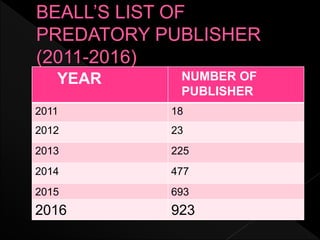
 2012 was basically the year of the predatory
publisher ; that was when they really
exploded. (Beall)
YEAR NUMBER OF
PUBLISHER
2011 18
2012 23
2013 225
2014 477
2015 693
2016 923
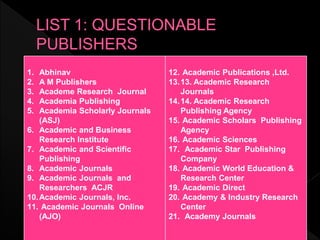
1. Abhinav
2. A M Publishers
3. Academe Research Journal
4. Academia Publishing
5. Academia Scholarly Journals
(ASJ)
6. Academic and Business
Research Institute
7. Academic and Scientific
Publishing
8. Academic Journals
9. Academic Journals and
Researchers ACJR
10.Academic Journals, Inc.
11. Academic Journals Online
(AJO)
12. Academic Publications ,Ltd.
13.13. Academic Research
Journals
14.14. Academic Research
Publishing Agency
15. Academic Scholars Publishing
Agency
16. Academic Sciences
17. Academic Star Publishing
Company
18. Academic World Education &
Research Center
19. Academic Direct
20. Academy & Industry Research
Center
21. Academy Journals
HOW TO PERFORM DUE DILIGENCE
BEFORE SUBMITTING TO A JOURNAL OR
PUBLISHER ?
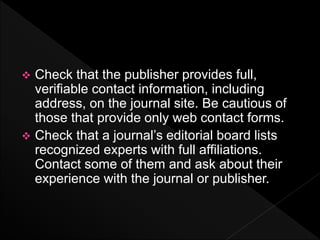
 Check that the publisher provides full,
verifiable contact information, including
address, on the journal site. Be cautious of
those that provide only web contact forms.
 Check that a journal’s editorial board lists
recognized experts with full affiliations.
Contact some of them and ask about their
experience with the journal or publisher.
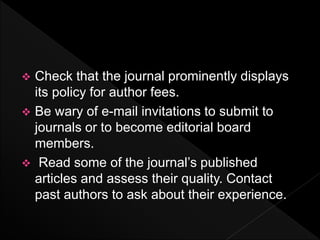
 Check that the journal prominently displays
its policy for author fees.
 Be wary of e-mail invitations to submit to
journals or to become editorial board
members.
 Read some of the journal’s published
articles and assess their quality. Contact
past authors to ask about their experience.
 Use common sense , as you go shopping
online: if something looks fishy, proceed with
caution.
 Check that a journal’s peer-review process is
clearly described and try to confirm that a
claimed impact factor is correct.
 Find out whether the journal is a member of an
industry association that vets its members, such
as the Directory of Open Access Journals
(www.doaj.org) or the Open Access Scholarly
Publishers Association (www.oaspa.org).
 Open access enhance visibility and impact of one’s
own work as Open access articles are downloaded and
cited more frequently than articles from non-Open
Access journals.
 Free access to scientific knowledge , information and
data strengthens the basis for transfer (education)
development (research) and valorization of knowledge.
 Developing countries and small or specialized research
institutions and corporations have access to all open
access articles.
 Open Access articles are published sooner
than articles in non-Open Access journals.
 Open Access articles reach broader
audiences than articles in non-Open Access
journals.
 Quality Open Access journals do not yet
have the same established reputation as
traditional journals.
 Open Access publishing is as yet not
cheaper than the current costs of licences,
and therefore maybe a costly affair.
 Predatory Open Access Journals try to
mislead authors.
THE END
THANK YOU !!!!!

SCOUTING PREDATORY PUBLISHER

  • 2.
     Predatory Publisherspublish counterfeit journals to exploit the open-access model in which the author pays. These predatory publishers are dishonest and lack transparency .  They aim to dupe researchers ,especially those inexperienced in scholarly communication.
  • 3.
     It isan exploitive publishing business model that involves charging publication fees to authors without providing the editorial and publishing services associated with legitimate journals.  It is also one of the consequences of Gold Open Access.
  • 4.
     “Predatory publishersuse deception to appear legitimate , entrapping researchers into submitting their work and then charging them to publish it.” _Jeffrey Beall
  • 5.
     He coinedthe term “Predatory open access publishing.  He is a critic of the open access publishing movement and especially known for his Blog (Scholarly Open Access) that monitors Predatory publishing.  He is a librarian and associated professor at Auraria Library at the University of Colorado, Denver.
  • 7.
     According toBeall, the Predatory publishers names are often sound grand – adjectives such as ‘world’, ‘global’ , and ‘international’ – some sites looked amateurish or gave little information about the organization behind them.
  • 8.
     These publishers,typically displayed “an intention to deceive authors and readers ,and a lack of transparency in their operations and processes.” _Beall  2012 was basically the year of the predatory publisher ; that was when they really exploded. (Beall)
  • 9.
    YEAR NUMBER OF PUBLISHER 201118 2012 23 2013 225 2014 477 2015 693 2016 923
  • 10.
    1. Abhinav 2. AM Publishers 3. Academe Research Journal 4. Academia Publishing 5. Academia Scholarly Journals (ASJ) 6. Academic and Business Research Institute 7. Academic and Scientific Publishing 8. Academic Journals 9. Academic Journals and Researchers ACJR 10.Academic Journals, Inc. 11. Academic Journals Online (AJO) 12. Academic Publications ,Ltd. 13.13. Academic Research Journals 14.14. Academic Research Publishing Agency 15. Academic Scholars Publishing Agency 16. Academic Sciences 17. Academic Star Publishing Company 18. Academic World Education & Research Center 19. Academic Direct 20. Academy & Industry Research Center 21. Academy Journals
  • 11.
    HOW TO PERFORMDUE DILIGENCE BEFORE SUBMITTING TO A JOURNAL OR PUBLISHER ?
  • 12.
     Check thatthe publisher provides full, verifiable contact information, including address, on the journal site. Be cautious of those that provide only web contact forms.  Check that a journal’s editorial board lists recognized experts with full affiliations. Contact some of them and ask about their experience with the journal or publisher.
  • 13.
     Check thatthe journal prominently displays its policy for author fees.  Be wary of e-mail invitations to submit to journals or to become editorial board members.  Read some of the journal’s published articles and assess their quality. Contact past authors to ask about their experience.
  • 14.
     Use commonsense , as you go shopping online: if something looks fishy, proceed with caution.
  • 15.
     Check thata journal’s peer-review process is clearly described and try to confirm that a claimed impact factor is correct.  Find out whether the journal is a member of an industry association that vets its members, such as the Directory of Open Access Journals (www.doaj.org) or the Open Access Scholarly Publishers Association (www.oaspa.org).
  • 16.
     Open accessenhance visibility and impact of one’s own work as Open access articles are downloaded and cited more frequently than articles from non-Open Access journals.  Free access to scientific knowledge , information and data strengthens the basis for transfer (education) development (research) and valorization of knowledge.  Developing countries and small or specialized research institutions and corporations have access to all open access articles.
  • 17.
     Open Accessarticles are published sooner than articles in non-Open Access journals.  Open Access articles reach broader audiences than articles in non-Open Access journals.
  • 18.
     Quality OpenAccess journals do not yet have the same established reputation as traditional journals.  Open Access publishing is as yet not cheaper than the current costs of licences, and therefore maybe a costly affair.  Predatory Open Access Journals try to mislead authors.
  • 19.