Volumes of solids with known cross
sections
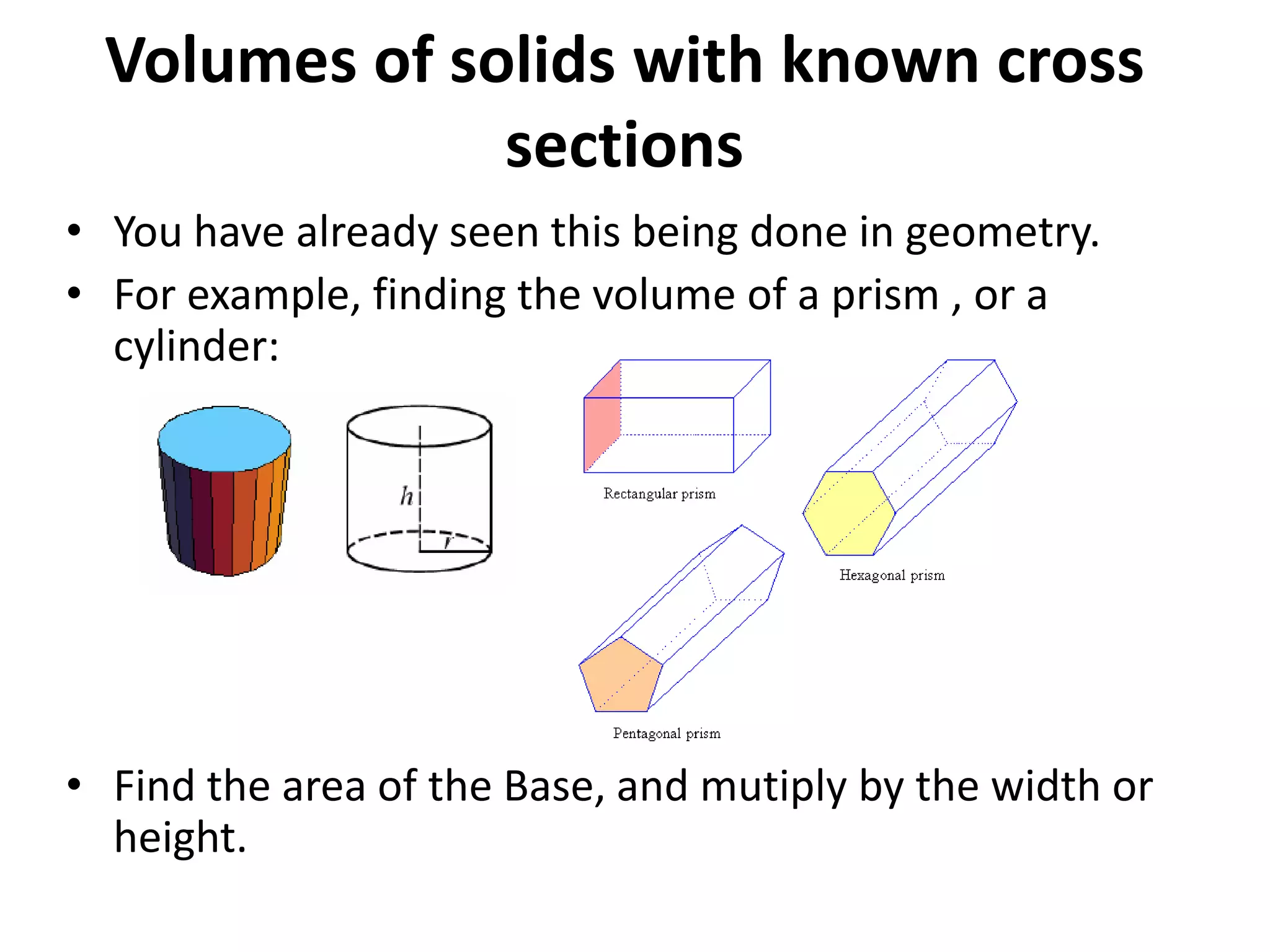
• You have already seen this being done in geometry.
• For example, finding the volume of a prism , or a
cylinder:

• Find the area of the Base, and mutiply by the width or
height.
The disk and washer method
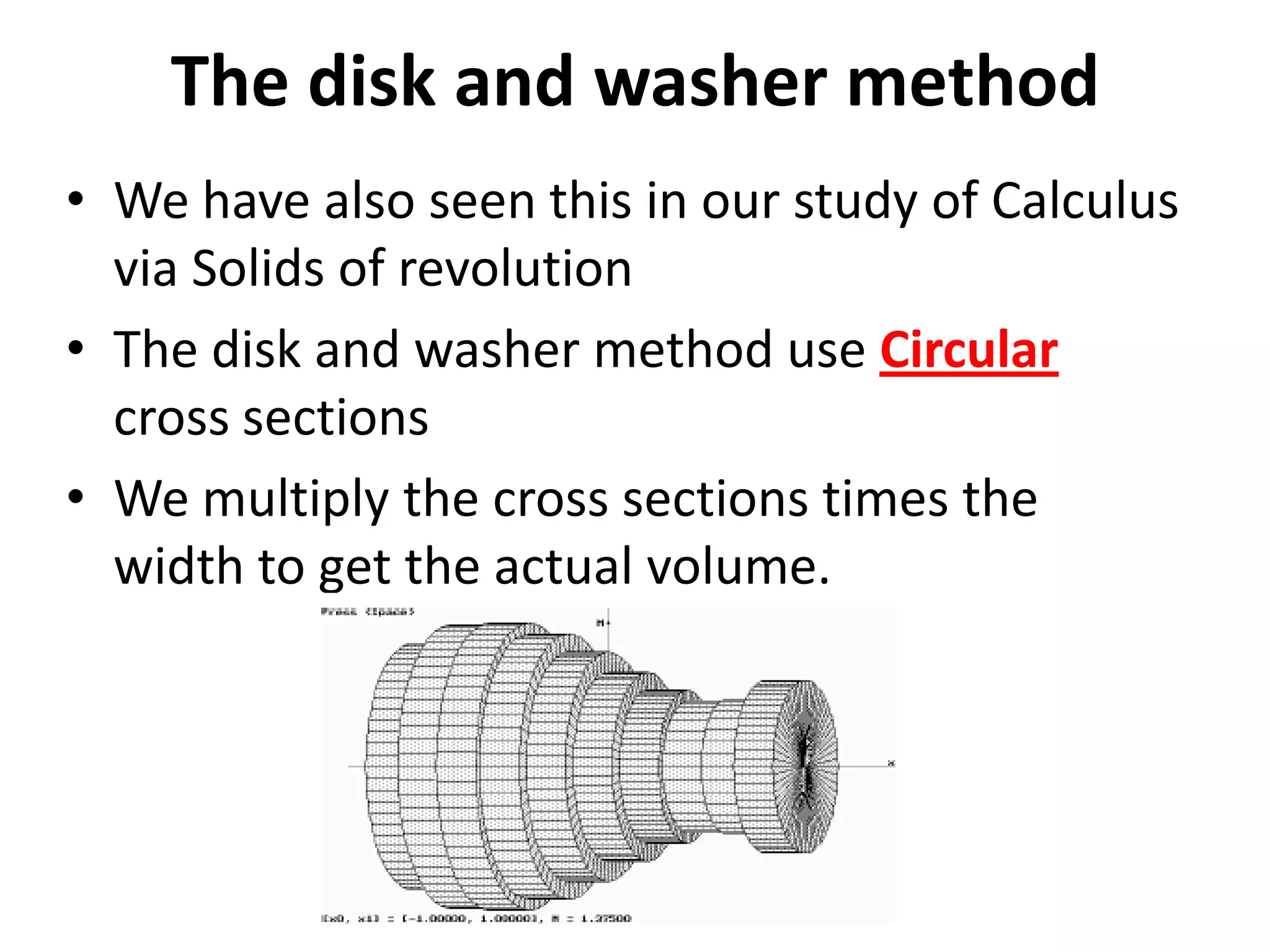
• We have also seen this in our study of Calculus
via Solids of revolution
• The disk and washer method use Circular
cross sections
• We multiply the cross sections times the
width to get the actual volume.
It can really be ANY cross section
• It doesn’t necessarily have to be circular.
• It can be a square, triangle, ellipse, etc..
• If we can find the Area of the cross
section, then we can multiple it times the
width (just like before) to get the entire
volume.
• ANIMATION
Formulas
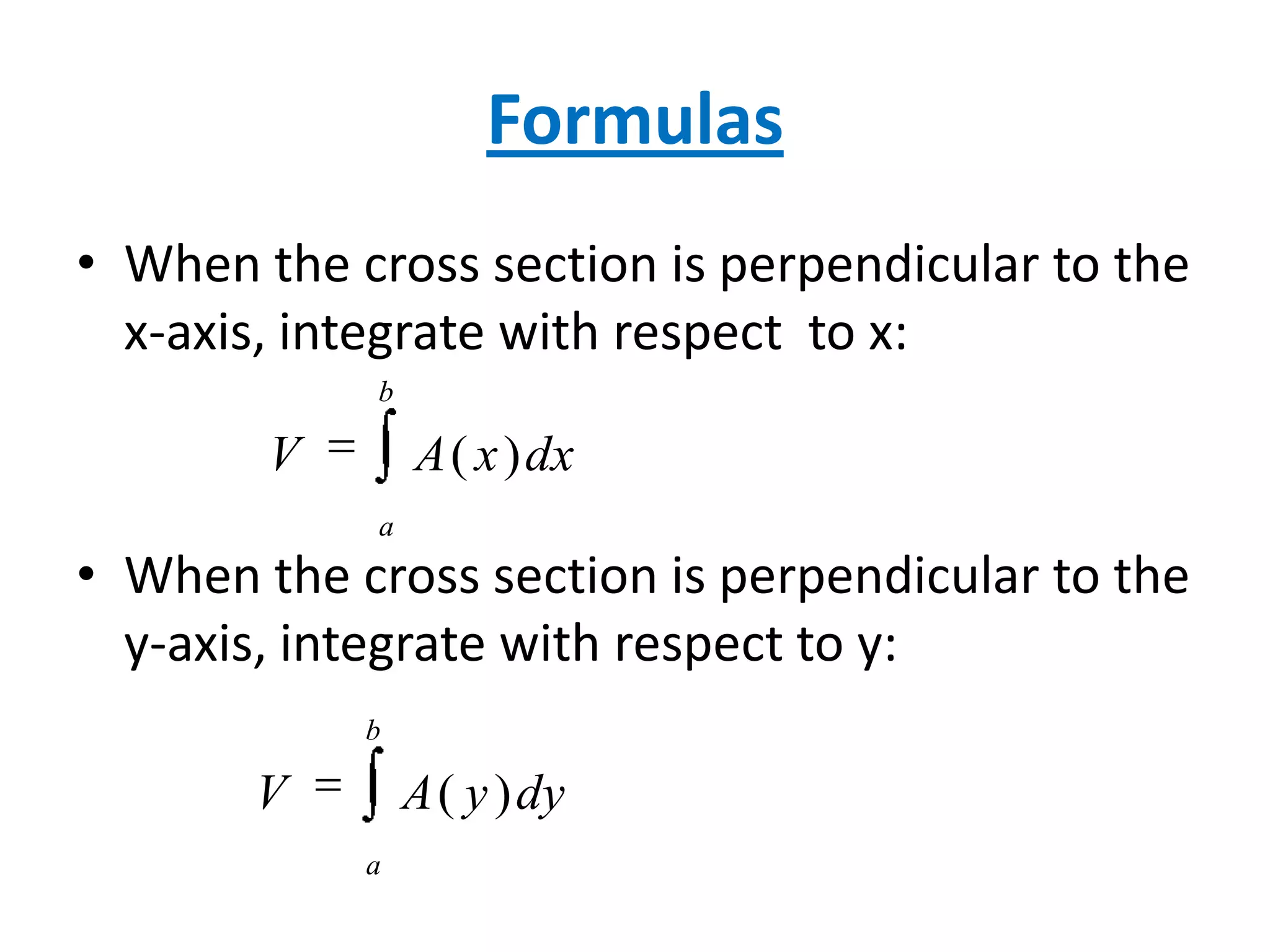
• When the cross section is perpendicular to the
x-axis, integrate with respect to x:
b

V

A ( x ) dx
a

• When the cross section is perpendicular to the
y-axis, integrate with respect to y:
b

V

A ( y ) dy
a
Example:
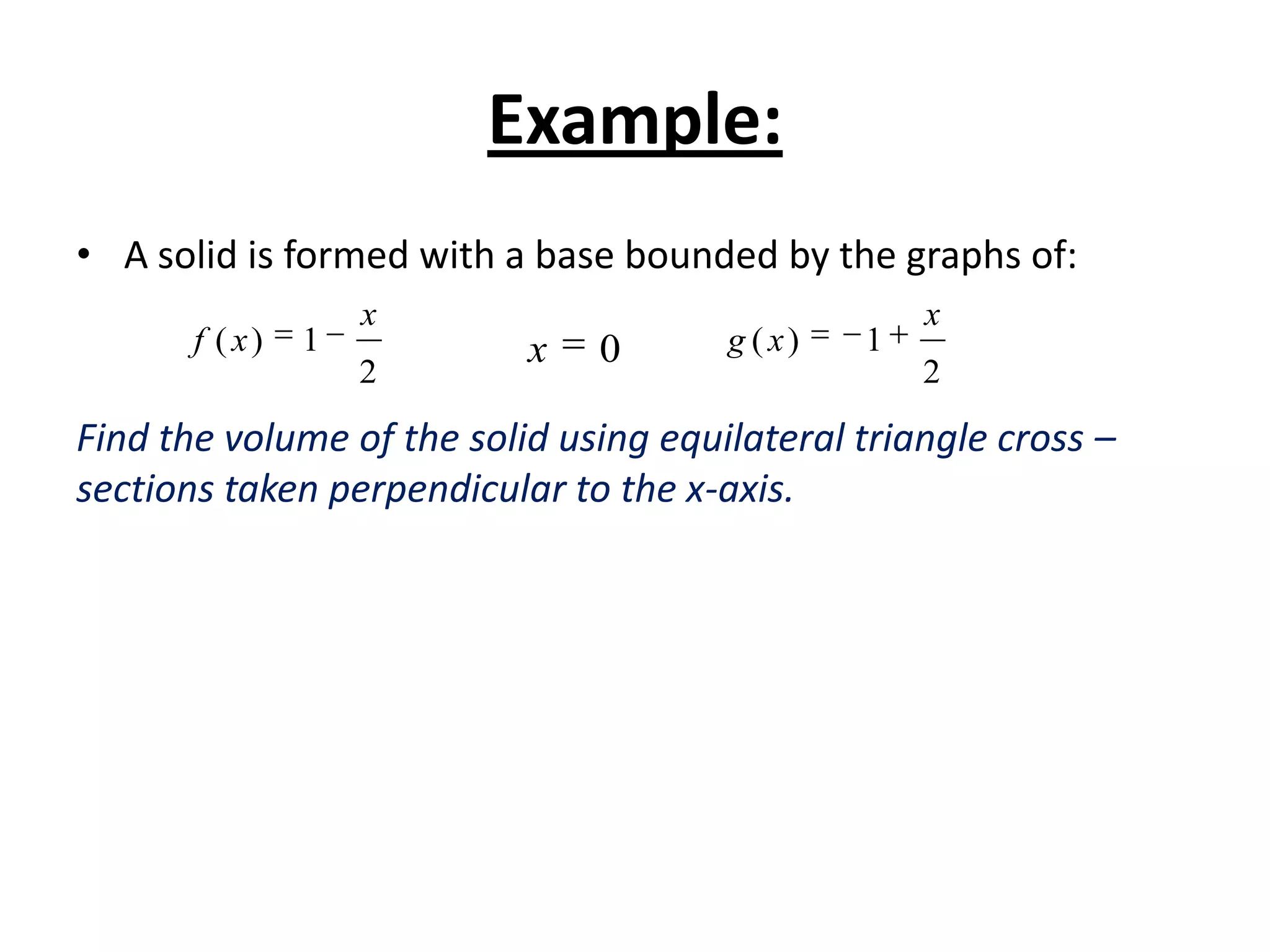
• A solid is formed with a base bounded by the graphs of:
f ( x)

1

x
2

x

0

g ( x)

1

x
2

Find the volume of the solid using equilateral triangle cross –
sections taken perpendicular to the x-axis.
Practice

Solids cross section

  • 1.
    Volumes of solidswith known cross sections • You have already seen this being done in geometry. • For example, finding the volume of a prism , or a cylinder: • Find the area of the Base, and mutiply by the width or height.
  • 2.
    The disk andwasher method • We have also seen this in our study of Calculus via Solids of revolution • The disk and washer method use Circular cross sections • We multiply the cross sections times the width to get the actual volume.
  • 3.
    It can reallybe ANY cross section • It doesn’t necessarily have to be circular. • It can be a square, triangle, ellipse, etc.. • If we can find the Area of the cross section, then we can multiple it times the width (just like before) to get the entire volume. • ANIMATION
  • 4.
    Formulas • When thecross section is perpendicular to the x-axis, integrate with respect to x: b V A ( x ) dx a • When the cross section is perpendicular to the y-axis, integrate with respect to y: b V A ( y ) dy a
  • 5.
    Example: • A solidis formed with a base bounded by the graphs of: f ( x) 1 x 2 x 0 g ( x) 1 x 2 Find the volume of the solid using equilateral triangle cross – sections taken perpendicular to the x-axis.
  • 6.