CUBOID
Presented By:-
Subhajit Manna
AIMS & OBJECTIVES
 Students can get a brief concept about Cuboid.
 After the lesson Students can easily evaluate the Area, Volume of
a Cuboid .
 Students can find the length of diagonals of not only a Cuboid
but also a Cube.
 Students can overcome the Real-Life problems including the
objects similar to Cuboid.
CONCEPT
FORMING A CUBOID
At first we know how to form a
RECTANGULAR PARALLELOPIPED
Or,
CUBOID.
FORMATION
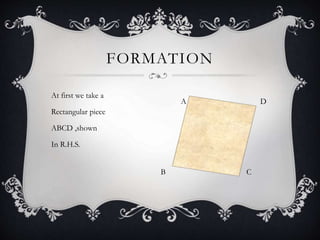
At first we take a
Rectangular piece
ABCD ,shown
In R.H.S.
A D
B C
FORMATION
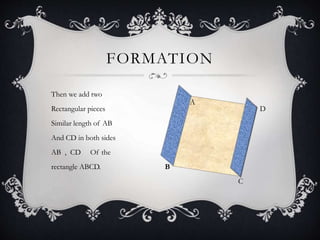
Then we add two
Rectangular pieces D
Similar length of AB
And CD in both sides
AB , CD Of the
rectangle ABCD. B
C
A
FORMATION
A
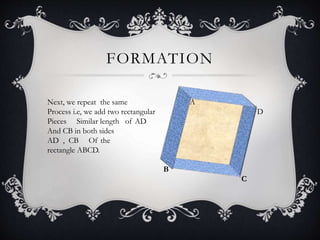
Next, we repeat the same
Process i.e, we add two rectangular D
Pieces Similar length of AD
And CB in both sides
AD , CB Of the
rectangle ABCD.
B
C
FORMATION
A
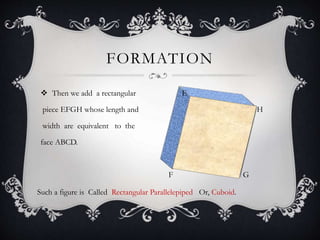
 Then we add a rectangular E
piece EFGH whose length and D H
width are equivalent to the
face ABCD.
B C
F G
Such a figure is Called Rectangular Parallelepiped Or, Cuboid.
DEFINITIONS
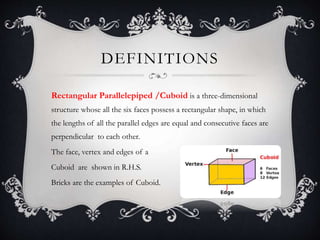
Rectangular Parallelepiped /Cuboid is a three-dimensional
structure whose all the six faces possess a rectangular shape, in which
the lengths of all the parallel edges are equal and consecutive faces are
perpendicular to each other.
The face, vertex and edges of a
Cuboid are shown in R.H.S.
Bricks are the examples of Cuboid.
CUBE
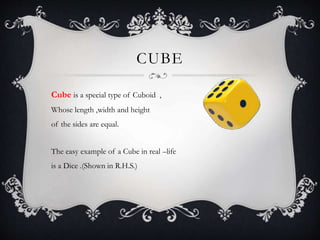
Cube is a special type of Cuboid ,
Whose length ,width and height
of the sides are equal.
The easy example of a Cube in real –life
is a Dice .(Shown in R.H.S.)
SURFACE AREA & VOLUME
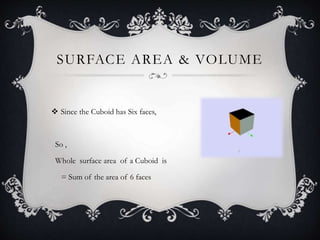
 Since the Cuboid has Six faces,
So ,
Whole surface area of a Cuboid is
= Sum of the area of 6 faces
SURFACE AREA & VOLUME
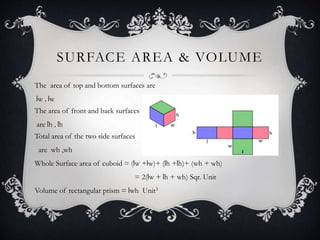
The area of top and bottom surfaces are
lw , lw
The area of front and back surfaces
are lh , lh
Total area of the two side surfaces
are wh ,wh
Whole Surface area of cuboid = (lw +lw)+ (lh +lh)+ (wh + wh)
= 2(lw + lh + wh) Sqr. Unit
Volume of rectangular prism = lwh Unit3
SURFACE AREA & VOLUME
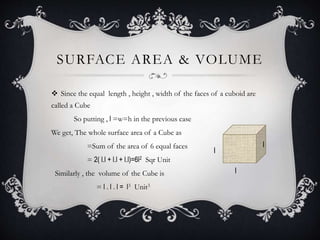
 Since the equal length , height , width of the faces of a cuboid are
called a Cube
So putting , l =w=h in the previous case
We get, The whole surface area of a Cube as
=Sum of the area of 6 equal faces
= 2( l.l + l.l + l.l)=6l2 Sqr Unit
Similarly , the volume of the Cube is
= l . l . l = l3 Unit3
l
l
l
DIAGONAL OF A CUBOID
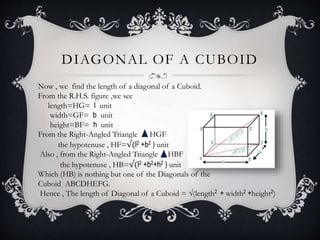
Now , we find the length of a diagonal of a Cuboid.
From the R.H.S. figure ,we see
length=HG= l unit
width=GF= b unit
height=BF= h unit
From the Right-Angled Triangle HGF
the hypotenuse , HF=√(l2 +b2 ) unit
Also , from the Right-Angled Triangle HBF
the hypotenuse , HB=√(l2 +b2+h2 ) unit
Which (HB) is nothing but one of the Diagonals of the
Cuboid ABCDHEFG.
Hence , The length of Diagonal of a Cuboid = √(length2 + width2 +height2)
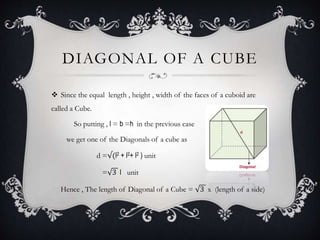
DIAGONAL OF A CUBE
 Since the equal length , height , width of the faces of a cuboid are
called a Cube.
So putting , l = b =h in the previous case
we get one of the Diagonals of a cube as
d =√(l2 + l2+ l2 ) unit
= 3 l unit
Hence , The length of Diagonal of a Cube = 3 x (length of a side)
Cuboid or, Rectangular Parallelopiped

Cuboid or, Rectangular Parallelopiped

  • 1.
  • 2.
    AIMS & OBJECTIVES Students can get a brief concept about Cuboid.  After the lesson Students can easily evaluate the Area, Volume of a Cuboid .  Students can find the length of diagonals of not only a Cuboid but also a Cube.  Students can overcome the Real-Life problems including the objects similar to Cuboid.
  • 3.
    CONCEPT FORMING A CUBOID Atfirst we know how to form a RECTANGULAR PARALLELOPIPED Or, CUBOID.
  • 4.
    FORMATION At first wetake a Rectangular piece ABCD ,shown In R.H.S. A D B C
  • 5.
    FORMATION Then we addtwo Rectangular pieces D Similar length of AB And CD in both sides AB , CD Of the rectangle ABCD. B C A
  • 6.
    FORMATION A Next, we repeatthe same Process i.e, we add two rectangular D Pieces Similar length of AD And CB in both sides AD , CB Of the rectangle ABCD. B C
  • 7.
    FORMATION A  Then weadd a rectangular E piece EFGH whose length and D H width are equivalent to the face ABCD. B C F G Such a figure is Called Rectangular Parallelepiped Or, Cuboid.
  • 8.
    DEFINITIONS Rectangular Parallelepiped /Cuboidis a three-dimensional structure whose all the six faces possess a rectangular shape, in which the lengths of all the parallel edges are equal and consecutive faces are perpendicular to each other. The face, vertex and edges of a Cuboid are shown in R.H.S. Bricks are the examples of Cuboid.
  • 9.
    CUBE Cube is aspecial type of Cuboid , Whose length ,width and height of the sides are equal. The easy example of a Cube in real –life is a Dice .(Shown in R.H.S.)
  • 10.
    SURFACE AREA &VOLUME  Since the Cuboid has Six faces, So , Whole surface area of a Cuboid is = Sum of the area of 6 faces
  • 11.
    SURFACE AREA &VOLUME The area of top and bottom surfaces are lw , lw The area of front and back surfaces are lh , lh Total area of the two side surfaces are wh ,wh Whole Surface area of cuboid = (lw +lw)+ (lh +lh)+ (wh + wh) = 2(lw + lh + wh) Sqr. Unit Volume of rectangular prism = lwh Unit3
  • 12.
    SURFACE AREA &VOLUME  Since the equal length , height , width of the faces of a cuboid are called a Cube So putting , l =w=h in the previous case We get, The whole surface area of a Cube as =Sum of the area of 6 equal faces = 2( l.l + l.l + l.l)=6l2 Sqr Unit Similarly , the volume of the Cube is = l . l . l = l3 Unit3 l l l
  • 13.
    DIAGONAL OF ACUBOID Now , we find the length of a diagonal of a Cuboid. From the R.H.S. figure ,we see length=HG= l unit width=GF= b unit height=BF= h unit From the Right-Angled Triangle HGF the hypotenuse , HF=√(l2 +b2 ) unit Also , from the Right-Angled Triangle HBF the hypotenuse , HB=√(l2 +b2+h2 ) unit Which (HB) is nothing but one of the Diagonals of the Cuboid ABCDHEFG. Hence , The length of Diagonal of a Cuboid = √(length2 + width2 +height2)
  • 14.
    DIAGONAL OF ACUBE  Since the equal length , height , width of the faces of a cuboid are called a Cube. So putting , l = b =h in the previous case we get one of the Diagonals of a cube as d =√(l2 + l2+ l2 ) unit = 3 l unit Hence , The length of Diagonal of a Cube = 3 x (length of a side)