ANTIMICROBIAL
SUSCEPTIBILITY TESTING –
DISK DIFFUSION METHODS
INTRODUCTION
Antimicrobial Susceptibility Test is very important
for treating infectious diseases and monitoring
antimicrobial resistance in various pathogens.
It is essential that the reports are
relevant,
timely
interpreted correctly
to ensure Quality Control.
 To guide the clinician- selection of antibiotics
 To accumulate epidemiological information
on the resistance of microorganisms of
public health
 importance within the community.
DEFINITION
AST :
It is a determination of least amount of an
antimicrobial chemotherapeutic agent that will
inhibit the growth of microorganism invitro.
Quality control :
A process in the laboratory designed to monitor the
analytical phase of testing procedure to ensure
that tests are working properly.
AST methods
a. Disk diffusion method:
1. Kirby Bauer method
2. Stokes method
b. MIC:
1. Broth dilution method
2. Agar dilution method
c. E-test
Diffusion-Kirby Bauer method
 Principle
Paper disks impregnated with antimicrobial agent are
placed on agar medium uniformly seeded with the test
organism.
A concentration gradient of the antibiotic is formed by
diffusion from the disk and the growth of the test
organism is inhibited at a distance form the disk (that
is related among other factor) to the susceptibility of
the organism
Medium
 According to CLSI (clinical laboratory standard institute)
Muller Hinton Agar - Non fastidious organism
 Temperature - 45°C to 50°C
 Thickness 4mm
 PH 7.2 – 7.4
 Moisture
 Storage: 5 days at 2-8°C
 Prolonged storage causes – dehydration of the media
 MHA Plates wrapped in air tight plastic bags and
refrigerated – 2 weeks
Media used
Muller Hinton Agar
 It is best for non fastidious organism
 It shows acceptable batch to batch
reproducibility
 It has low thymidine content.
(Increased thymidine antagonise the activity of
sulphonamides)
 Reverse the inhibitory effect of SXT – lesser or
no zone-falls resistant report
 To check QC – ATCC 29212
E.faecalis – SXT ->20mm
MHBA ( 5% sheep blood agar )
Strept. Pneumoniae
Beta strept, alpha strept, non haemolytic strept
MHCA & HTM
Haemophilus spp
GC agar
Gonococci
Media used contd
Antibiotics
Commercial disk
Whenever we receive the antibiotics check the label,
Mfg date, Exp date and Lot no.
It should be checked with ATCC strains
Stored at -20°C or -70°C and at 4°C – 8°C
Routine use keep at 4°C – 8°C
Paper disk (In-house)
Whatmann filter paper No. 2 is used
Diameter 6mm with regular edges
Sterilize by hot air oven at 160°C for 1hour
Do not use irregular edged and charred disk
Antibiotic solution preparation
 It is always prepared from pure substance
 Stock made concentrations depending on disk strength
 Some antibiotics dissolved in organic solvent and others
in sterile distilled water
 Use only minimum volume of organic solvent to stabilize
the antimicrobial powder
 After preparing the solution should checked with ATCC
strains
 Prepared antibiotics are aliquote into 6-7 ml in tubes
 Lesser amount – improper delivery of antibiotic
Antibiotic solution preparation
 Eg; Ampicillin – Needed concentration-2000µg/ml(DD
strength 10µg/ml)
 1mg=1000µg/ml
 2mg=2000µg/ml
 20mg=2000µg/10ml
 200mg=2000µg/100ml
 Volume stock (in ml) =weight(mg) x potency of
antibiotic(µg) /needed concentration(µg)
 Obtaining satisfactory results, dispense 10ml into 20ml
sterile tube
 Store it at -20°C for six months
Inoculum
 Turbidity standard for inoculum preparation
 McFarland Standard – BaSO4
0.5 - 2 x 10⁸ - for GNB and fast growing organism
1.0 - 3 x 10⁸ - for Gram positive cocci
PREPARATION OF CULTURE
Select 10 morphologically identical well isolated
colonies
Inoculate in 1.5ml NB
Incubate for 2hrs
Adjust opacity – McFarland's standard
0.5 for Gram Negative bacilli
1 for Gram Positive cocci
INOCULATION
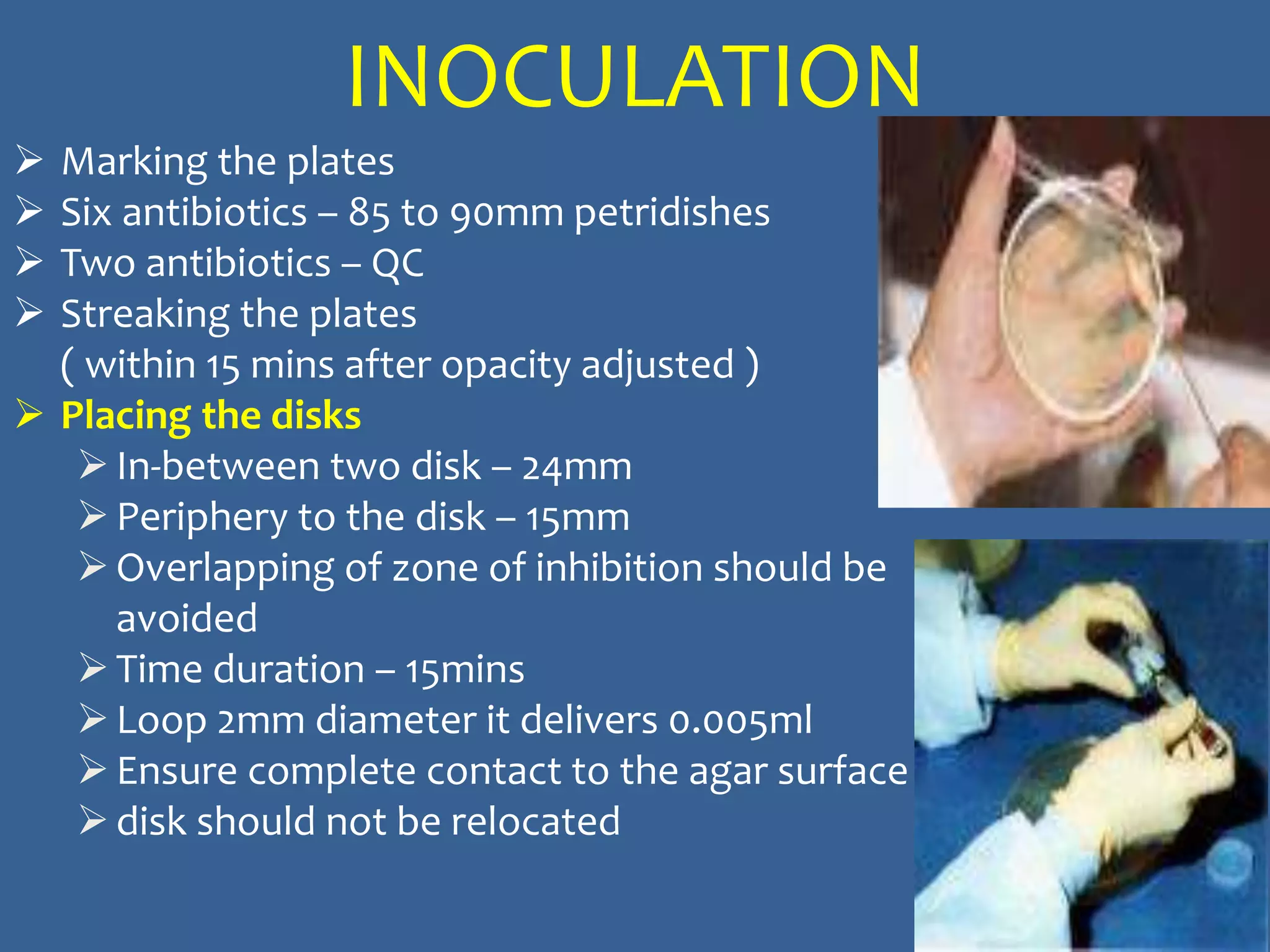
 Marking the plates
 Six antibiotics – 85 to 90mm petridishes
 Two antibiotics – QC
 Streaking the plates
( within 15 mins after opacity adjusted )
 Placing the disks
In-between two disk – 24mm
Periphery to the disk – 15mm
Overlapping of zone of inhibition should be
avoided
Time duration – 15mins
Loop 2mm diameter it delivers 0.005ml
Ensure complete contact to the agar surface
disk should not be relocated
INCUBATION & ATMOSPHERE
MHA plates are incubated at 37°C for 16-18hrs
MHBA, HTM are incubated at 37°C with 5% CO2
incubator
ATCC control strains for AST
QUALITY CONTROL
To check the quality of the medium
Potency of the antibiotic
Technical error
When ever we receive new drug or media
Quality control (QC)
 QC - A procedure which ensures that the
performance of a test/procedure is reliable
 QC in AST - Testing a standard strain of known susceptibility
to the antimicrobial agent tested
 Goal of QC - Accuracy and reproducibility
ATCC control strains for AST
 Eg: ATCC 25923 Staph aureus (beta lactamase negative,
oxacillin - susceptible)
 ATCC 27853 Pseudomonas aeruginosa (for
aminoglycosides)
 ATCC 25922 E.coli (beta lactamase negative)
 ATCC 35218 E.coli (beta lactamase positive)
 ATCC 29212 E.faecalis (for checking of Thymidine level of
MHA)
 ATCC 700603 Kleb. Pneumoniae (ESBL-positive)
 ATCC 49619 Strept. Pneumoniae (oxa – R)
 ATCC 49247 H.influenzae
 ATCC 49766 H.influenzae
Procedure for performing QC
READING
Each zone size is interpreted according to the
organism by reference in the CLSI guidelines
RESISTANCE :resistant , to indicate that the
bacteria can not be inhibited by the antibiotics.
INTERMEDIATE : intermediate , to indicate that
the bacteria can be inhibited by the high dose of
antibiotics.
SUSCEPTIBLE :susceptible, to indicate that the
bacteria can be inhibited by the normal dose of
antibiotics
READING AND INTERPRETATION
Only pure growth is considered for reading
Inoculum should be adequate
There should not be any misplacing of antibiotics
 Quality control strains should be in expected
ranges (guided by CLSI)
 Acidic p H of medium
 Alkaline p H of medium
 Addition of thymidine to
medium
 Low content of thymidine
Less action
aminoglycoside,
quinolones and macrolides,
excess activity of tetra
More activity of
Aminoglycosides,
quinolones and macrolides
Lesser activity of tetra
Decrease activity of SXT –
resistant zone
ATCC 29212 E.faecalis – SXT
more than – 20mm
satisfactory
Magnesium + Calcium (cation)
Excess : reduce zone size for aminoglycoside
Low : increase zone size for aminoglycoside
Zinc
Excess : reduce zone size for carbapenems
Lesser : increase zone size in carbapenems
Larger zone of inhibition
Light inoculum
Error in inoculum preparation
Depth of the medium is thin
MHA is nutritionally unacceptable
Smaller zone of inhibition
heavy inoculum
Error in inoculum preparation
Depth of the medium is thick
One or more zone too small or too large zone
Measurement error
Transcription error
Random defective disk
Disk not pressed firmly to the agar surface
One QC strain is out of range but other QC strain are within
range for the same antibiotic
One may be the better indicator of QC problem
Two QC strain is out of for the same antibiotic
Problem with the disk
Cont..
 Reading……
 Zone of inhibition measured in diameter or radius with transparent
ruler
 Cont…
 Colonies within the zones
of inhibition
 Zones overlap
 Zones indistinct
 Mixed culture
 Resistant mutants within
the zone.
 disks too close together
 Poorly streaked plate
• Cont….
Double zone
Proteus swarming – ignore
Fastidious organism – eg, beta Strept,
S.pneumoniae – zone of inhibition
not by haemolysis
Co-trimoxazole reading
Precautions
Ampicillin is always R to Klebsiella and Aeromonas
spp
Nitrofurantoin S to E.coli R to Proteus and
Klebsiella
Cefoxitin R – MRSA
Cefpodoxime R – ESBL in GNB
Imipenem and meropenem R – CRO
 Cont….
Vancomycin and teicoplanin resistant – VRE
Alert forms – HICC, MS office, respective
units/wards
S.typhi and S. paratyphi A newer guideline for
ciprofloxacin – >31 is S and MIC by E.test
Oxacillin R S.pneumoniae do penicillin MIC
ADVANTAGES
Technically simple to perform
Reproducible reagents are inexpensive
Does not require any special equipments
Easily understood by clinicians
Flexible regarding the selection of antibiotics
STOKES METHOD
Procedure
Stokes method
Susceptible – zone size of the test strain is larger
than or equal to control strain
Resistant – zone size of the test strain is smaller
than 2mm
Intermediate – zone size of the test strain is 2-
3mm smaller than that of the control strain
Advantages
Both control and test organism is same environment
Disadvantages
 2 to 4 antibiotics in one plate is tested
Laborious
Things need to
be known
Organisms requiring special considerations
• Emergence of resistance:
• Staphylococci:
• Methicillin resistant S.aureus:
• Oxacillin and other penicilinase resistant penicillin such as
methicillin, cloxacillin constitute the drug of choice for
Staphylococcal infections.
• Methicillin is no longer the agent of choice for testing
and treatment.
• The penicillin binding protein which has low affinity for
binding all beta-lactam drugs is encoded by the gene
mec A
Contd....
• mec A is responsible for resistance to methicillin
and other beta lactam antibiotics
• mec A encodes penicillin binding proteins 2a,
which differs from other penicillin binding protein
as its active site does not bind methicillin or other
beta lactam antibiotics
• Penicillin binding protein 2a can continue to
catalyze the transpeptidation reaction required
for peptidoglycan, enabling the cell wall synthesis
in the presence of antibiotics
Contd....
• Consequence of the inability of PBP2a to interact
with beta lactams
• Acquition of mecA confers resistance to all beta
lactam antibiotics in addition to methicillin
• MRSA is significant in hospital acquired and
community associated infections
• Drug of choice – vancomycin and teicoplanin –
injectable
• Rifampacin and linezolid – oral drug
• Topical application – bacitracin, chlorohexidine,
mupirocin
Detection methods for MRSA
• Cefoxitin DD – surrogate marker
• Because cefoxitin serves to induce greater
expression of PBP2a in mec A containing strains of
Staphylococci and also function as test reagent to
detect resistant.
• Oxacillin screen plate
– MHA with 4%Nacl + 6mg per ml
– Spot inoculate – incubate at 350C
– More than one colony indicates oxacillin resistant
 Molecular detection by PCR can be performed
• CLSI recommends cefoxitin for specific break
points interpretative criteria for S.aureus and
Coagulase neg Staph.
• Cefoxitin – zone of inhibition can be easily read
than oxacillin DD.
Break points for DD interpretation
Cefoxitin Oxacillin
Resistance Susceptible Resistance Intermediate Susceptible
S.aureus 21 22 10 11-12 13
CONS 24 25 17 - 18
Cefoxitin vs Oxacillin
• Cefoxitin
• Stable drug
• Requires 16-18hrs
incubation at 370C
• No supplement is
necessary
• Clear zone of inhibition
and wider range of
interpretative criteria
• Oxacillin
• Degradation on storage
• Requires 24hrs incubation
at 350 C
• 2-5% Nacl is added
• Narrow range of
interpretative criteria
hence zone of inhibition is
measured using
transmitted light
Vancomycin resistance or diminished
susceptibility in S.aureus
• Strains with reduce susceptibility to vancomycin have been
called vanco intermediate S.aureus (VISA) or glycopeptide
intermediate (GISA)
• Between 2002-2005 five different strain of MRSA were
detected for the first time with vancomycin resistant.
• The first MRSA isolate with more subtle diminished
susceptibility to vancomycin with MIC value 8mg per ml
(intermediate)
• Although still uncommon both vanco(R) S.aureus and VISA
are of great concern because vanco is the drug of choice for
MRSA
DETECTION METHODS
• Vancomycin DD
• Vancomycin MIC
• Vancomycin agar screen test
– Brain heart infusion agar with vancomycin 6mg per ml
Inducible clindamycin resistant in
Staphylococci:
• Two different resistant mechanisms confers
macrolide resistance (e.g. erythromycin)
• The erm gene codes for methylation of 23S r RNA
which results in resistant to erythromycin and
either inducible or constitutive resistant to
clindamycin.
• The msrA gene codes for an efflux mechanisms
which results in resistance to erythromycin but
susceptible to clindamycin.
D-Zone positive Negative
• D zone test for inducible clinda resistance to be
performed before reporting clindamycin
• For the D zone test erythromycin and clindamycin
disk to be placed 15-26 mm edge to edge on MHA
by usual DD test.
• Incubation-16-18hrs at 37c.
• Flatening of the clinda zone between the 2 disk –
indicates the isolate has inducible clindamycin
resistant because of erm gene
• No flatening the isolate is erythromycin resistant
(due to msrA).
• D zone positive- clindamycin resistant
• D zone negative- clindamycin susceptible
• Both erythromycin and clindamycin resistant- clindamycin
resistant.
Vancomycin resistant Enterococci:
• E. faecium and the E.faecalis are most common resistant to
vancomycin and teicoplanin
• Six different types of vancomycin resistance
• Van A and B are most commonly encountered
• Van A – resistance to both vancomycin and teicoplanin
• Van B - resistance to vancomycin and susceptible to
teicoplanin
VRE mechanism
• Alteration to the terminal amino acid residues of
the NAM/NAG-peptide subunits
• The D-alanyl-D-lactate variation results in the loss
of one hydrogen-bonding interaction
• This loss of just one point of interaction results in
a decrease in affinity between vancomycin and
peptide
VRE detection
• Disk diffusion
• MIC by broth dilution, agar dilution and E-test
• Vancomycin agar screen plate
• BHIA with 6mg vancomycin can be used for
Enterococci and Staphylococci
• Drugs – daptomycin, linezolid, quinipristin
dalfopristin
High level aminoglycoside resistance
• Enterococci are inherently resistant to the
concentration of aminoglycoside producing their use
as single agent for treatment of enterococcal
infections
• This low level resistance is due to the poor drug
uptake by the enterococcal cells.
• However enterococci develop high level
aminoglycoside resistance in which the particular
aminoglycoside does not demonstrate synergism
with the cell wall active agent penicillin or ampicillin.
• High level aminoglycoside resistant in
enterococci is usually the result of enzyamtic
inactivation of the drugs.
• Detection by
DD – Gentamicin 120µg
MIC - Gentamicin 500µg
ESBL
• The major mechanism of resistant to β-lactam antimicrobial
agent in Gram negative bacilli is production of β-lactamase
enzyme because of their increased spectrum activity.
• ESBL are a group of plasmid mediated diverse complex and
rapidly evolving enzymes that are posing a major therapeutic
challenge in the treatment of hospitalized and community
based patients.
• Infections caused by ESBL strains from UTI to life threatening
sepsis.
• Β-lactamase these enzymes share the ability to hydrolyse
These cephalosporins include cefotaxime,ceftriaxone,
and ceftazidime, as well as monobactam aztreonam.
• ESBL – producing organsims exhibit co-resistance to many
other class of antibiotics.
• Because of inoculum effect and substrate specificity –their
detection is also major challenge.
• But now CLSI gives the guideline for detection of ESBL in
Klebsiella pneumoniae, K.oxytoca, E.coli and Pr.mirabilis.
• ESBL are β-lactamase capable of confering bacterial
resistance to the penicillin, I, II and III generation of
cephalosporins and aztreonam
β lactamases
Restricted
spectrum
β lactamases
ESBL
AmpC β
lactamases
CTX-M OXA
Serine MBL
Class B
Class A OXA
Class D
OthersClassical
TEM-1 & 2,
SHV-1
TEM-3,
SHV-2
Over
65
types
11, 14,
15, 16,
17
CMY, LAT,
FOX
KPC,
SME,
IMI
23, 24,
40, 51,
58
Carbapenemases
IMP,
VIM,
NDM
ESBL detection tests - Phenotypic
Screening Confirmatory
1) Disk diffusion method
2) Dilution method – MIC
1) Diffusion methods
- Double disc
- Combination disc
- E-test
2) Dilution method – MIC
Icil
Confirmatory
tests
Double disc approximation test
Qualitative only
CLSI combination disc test
Qualitative and quantitative
CTX CTX + CL
CZD CZD + CL
cefotaxime ceftazidime
Amox + clav
CLSI ESBL confirmatory tests
interpretation
For E. coli, Klebsiella, and P. mirabilis
MIC test ≥3 two-fold concentration decrease in MIC of
cefotaxime/ceftazidime +/- clavulanate 4 μg/ml
Disk test ≥5-mm increase in zone diameter for
cefotaxime/ceftazidime +/- clavulanate 10 μg
Icil
AmpC Beta lactamases
• Chromosomal mediated in Enterobacter, Serratia,
Citrobacter, Morganella, Providencia
• Plasmid-mediated in E. coli and Klebsiella
Emergence predominantly in community-acquired
infections
• Co-resistance to aminoglycosides, SXT, quinolones
TEM, SHV CTX-M OXA AmpC
Cefpodoxime R R R R
Clavulanate S S R R
Cephamycins S S S R
Cefepime R R R S
Drug of Choice
• Carbapenems (Impenem, meropenem)
• Colistin, polymyxin, tigecycline for serious
infections
• Co-trimoxazole, nitrofurantoin, fosfomycin,
gentamycin, amikacin and inhibitor combinations
for uncomplicated infections.
Carbapenemase
• Carbapenems – Highest class of beta lactam agent
current available, eg, imipenem, meropenem,
ertapenem
• Carbapenem resistance to all beta lactam antibiotics
such as penicillin, cephalosporins, monobactams and
carbapenems
• Carbapenem resistance due to
Production of carbapenemases
Excess production of ESBL, porin loss, increased
efflux pumps
• Carbapenemases are beta lactamase enzyme coded
by plasmids
• In GNB most commonly encountered are
• Klebsiella pneumoniae carabapenemase (KPC) -
Serine in their active site
• Metallo beta lactamases – Zinc in their active site
• Metallo beta lcatamases – R to all beta lactams
but S to monobactam
• KPC – R to all beta lactam / beta lactamase
inhibitor
Detection methods
• DD – imipenem, meropenem
• MIC – broth, agar dilutions
• E-test
Modified Hodge test
• Lawn culture of E. coli ATCC 25922 - 1/10 of 0.5
McFarland
• ERT10 μg
• Inoculate cultures as shown in figure
• edge of disk to periphery
CONCLUSION
• AST is very important for the clinician to treat the
patient with appropriate antibiotics.
• Formulation of antibiotic policy
• Surveillance of resistance
– In community
– Hospital out breaks
• Lab to upgrade its own good standard
• Ensures accuracy, reliability reproducibility of the
test performed.

Antimicrobial susceptibility testing – disk diffusion methods

  • 1.
  • 2.
    INTRODUCTION Antimicrobial Susceptibility Testis very important for treating infectious diseases and monitoring antimicrobial resistance in various pathogens. It is essential that the reports are relevant, timely interpreted correctly to ensure Quality Control.
  • 3.
     To guidethe clinician- selection of antibiotics  To accumulate epidemiological information on the resistance of microorganisms of public health  importance within the community.
  • 4.
    DEFINITION AST : It isa determination of least amount of an antimicrobial chemotherapeutic agent that will inhibit the growth of microorganism invitro. Quality control : A process in the laboratory designed to monitor the analytical phase of testing procedure to ensure that tests are working properly.
  • 5.
    AST methods a. Diskdiffusion method: 1. Kirby Bauer method 2. Stokes method b. MIC: 1. Broth dilution method 2. Agar dilution method c. E-test
  • 6.
    Diffusion-Kirby Bauer method Principle Paper disks impregnated with antimicrobial agent are placed on agar medium uniformly seeded with the test organism. A concentration gradient of the antibiotic is formed by diffusion from the disk and the growth of the test organism is inhibited at a distance form the disk (that is related among other factor) to the susceptibility of the organism
  • 7.
    Medium  According toCLSI (clinical laboratory standard institute) Muller Hinton Agar - Non fastidious organism  Temperature - 45°C to 50°C  Thickness 4mm  PH 7.2 – 7.4  Moisture  Storage: 5 days at 2-8°C  Prolonged storage causes – dehydration of the media  MHA Plates wrapped in air tight plastic bags and refrigerated – 2 weeks
  • 8.
    Media used Muller HintonAgar  It is best for non fastidious organism  It shows acceptable batch to batch reproducibility  It has low thymidine content. (Increased thymidine antagonise the activity of sulphonamides)  Reverse the inhibitory effect of SXT – lesser or no zone-falls resistant report  To check QC – ATCC 29212 E.faecalis – SXT ->20mm
  • 9.
    MHBA ( 5%sheep blood agar ) Strept. Pneumoniae Beta strept, alpha strept, non haemolytic strept MHCA & HTM Haemophilus spp GC agar Gonococci Media used contd
  • 10.
    Antibiotics Commercial disk Whenever wereceive the antibiotics check the label, Mfg date, Exp date and Lot no. It should be checked with ATCC strains Stored at -20°C or -70°C and at 4°C – 8°C Routine use keep at 4°C – 8°C Paper disk (In-house) Whatmann filter paper No. 2 is used Diameter 6mm with regular edges Sterilize by hot air oven at 160°C for 1hour Do not use irregular edged and charred disk
  • 11.
    Antibiotic solution preparation It is always prepared from pure substance  Stock made concentrations depending on disk strength  Some antibiotics dissolved in organic solvent and others in sterile distilled water  Use only minimum volume of organic solvent to stabilize the antimicrobial powder  After preparing the solution should checked with ATCC strains  Prepared antibiotics are aliquote into 6-7 ml in tubes  Lesser amount – improper delivery of antibiotic
  • 12.
    Antibiotic solution preparation Eg; Ampicillin – Needed concentration-2000µg/ml(DD strength 10µg/ml)  1mg=1000µg/ml  2mg=2000µg/ml  20mg=2000µg/10ml  200mg=2000µg/100ml  Volume stock (in ml) =weight(mg) x potency of antibiotic(µg) /needed concentration(µg)  Obtaining satisfactory results, dispense 10ml into 20ml sterile tube  Store it at -20°C for six months
  • 13.
    Inoculum  Turbidity standardfor inoculum preparation  McFarland Standard – BaSO4 0.5 - 2 x 10⁸ - for GNB and fast growing organism 1.0 - 3 x 10⁸ - for Gram positive cocci
  • 14.
    PREPARATION OF CULTURE Select10 morphologically identical well isolated colonies Inoculate in 1.5ml NB Incubate for 2hrs
  • 15.
    Adjust opacity –McFarland's standard 0.5 for Gram Negative bacilli 1 for Gram Positive cocci
  • 16.
    INOCULATION  Marking theplates  Six antibiotics – 85 to 90mm petridishes  Two antibiotics – QC  Streaking the plates ( within 15 mins after opacity adjusted )  Placing the disks In-between two disk – 24mm Periphery to the disk – 15mm Overlapping of zone of inhibition should be avoided Time duration – 15mins Loop 2mm diameter it delivers 0.005ml Ensure complete contact to the agar surface disk should not be relocated
  • 17.
    INCUBATION & ATMOSPHERE MHAplates are incubated at 37°C for 16-18hrs MHBA, HTM are incubated at 37°C with 5% CO2 incubator
  • 18.
    ATCC control strainsfor AST QUALITY CONTROL To check the quality of the medium Potency of the antibiotic Technical error When ever we receive new drug or media
  • 19.
    Quality control (QC) QC - A procedure which ensures that the performance of a test/procedure is reliable  QC in AST - Testing a standard strain of known susceptibility to the antimicrobial agent tested  Goal of QC - Accuracy and reproducibility
  • 20.
    ATCC control strainsfor AST  Eg: ATCC 25923 Staph aureus (beta lactamase negative, oxacillin - susceptible)  ATCC 27853 Pseudomonas aeruginosa (for aminoglycosides)  ATCC 25922 E.coli (beta lactamase negative)  ATCC 35218 E.coli (beta lactamase positive)  ATCC 29212 E.faecalis (for checking of Thymidine level of MHA)  ATCC 700603 Kleb. Pneumoniae (ESBL-positive)  ATCC 49619 Strept. Pneumoniae (oxa – R)  ATCC 49247 H.influenzae  ATCC 49766 H.influenzae Procedure for performing QC
  • 21.
    READING Each zone sizeis interpreted according to the organism by reference in the CLSI guidelines RESISTANCE :resistant , to indicate that the bacteria can not be inhibited by the antibiotics. INTERMEDIATE : intermediate , to indicate that the bacteria can be inhibited by the high dose of antibiotics. SUSCEPTIBLE :susceptible, to indicate that the bacteria can be inhibited by the normal dose of antibiotics
  • 23.
    READING AND INTERPRETATION Onlypure growth is considered for reading Inoculum should be adequate There should not be any misplacing of antibiotics  Quality control strains should be in expected ranges (guided by CLSI)
  • 24.
     Acidic pH of medium  Alkaline p H of medium  Addition of thymidine to medium  Low content of thymidine Less action aminoglycoside, quinolones and macrolides, excess activity of tetra More activity of Aminoglycosides, quinolones and macrolides Lesser activity of tetra Decrease activity of SXT – resistant zone ATCC 29212 E.faecalis – SXT more than – 20mm satisfactory
  • 25.
    Magnesium + Calcium(cation) Excess : reduce zone size for aminoglycoside Low : increase zone size for aminoglycoside Zinc Excess : reduce zone size for carbapenems Lesser : increase zone size in carbapenems
  • 26.
    Larger zone ofinhibition Light inoculum Error in inoculum preparation Depth of the medium is thin MHA is nutritionally unacceptable Smaller zone of inhibition heavy inoculum Error in inoculum preparation Depth of the medium is thick
  • 27.
    One or morezone too small or too large zone Measurement error Transcription error Random defective disk Disk not pressed firmly to the agar surface One QC strain is out of range but other QC strain are within range for the same antibiotic One may be the better indicator of QC problem Two QC strain is out of for the same antibiotic Problem with the disk
  • 28.
    Cont..  Reading……  Zoneof inhibition measured in diameter or radius with transparent ruler
  • 29.
     Cont…  Colonieswithin the zones of inhibition  Zones overlap  Zones indistinct  Mixed culture  Resistant mutants within the zone.  disks too close together  Poorly streaked plate
  • 30.
    • Cont…. Double zone Proteusswarming – ignore Fastidious organism – eg, beta Strept, S.pneumoniae – zone of inhibition not by haemolysis Co-trimoxazole reading
  • 31.
    Precautions Ampicillin is alwaysR to Klebsiella and Aeromonas spp Nitrofurantoin S to E.coli R to Proteus and Klebsiella Cefoxitin R – MRSA Cefpodoxime R – ESBL in GNB Imipenem and meropenem R – CRO
  • 32.
     Cont…. Vancomycin andteicoplanin resistant – VRE Alert forms – HICC, MS office, respective units/wards S.typhi and S. paratyphi A newer guideline for ciprofloxacin – >31 is S and MIC by E.test Oxacillin R S.pneumoniae do penicillin MIC
  • 33.
    ADVANTAGES Technically simple toperform Reproducible reagents are inexpensive Does not require any special equipments Easily understood by clinicians Flexible regarding the selection of antibiotics
  • 34.
  • 35.
    Stokes method Susceptible –zone size of the test strain is larger than or equal to control strain Resistant – zone size of the test strain is smaller than 2mm Intermediate – zone size of the test strain is 2- 3mm smaller than that of the control strain Advantages Both control and test organism is same environment Disadvantages  2 to 4 antibiotics in one plate is tested Laborious
  • 36.
  • 37.
    Organisms requiring specialconsiderations • Emergence of resistance: • Staphylococci: • Methicillin resistant S.aureus: • Oxacillin and other penicilinase resistant penicillin such as methicillin, cloxacillin constitute the drug of choice for Staphylococcal infections. • Methicillin is no longer the agent of choice for testing and treatment. • The penicillin binding protein which has low affinity for binding all beta-lactam drugs is encoded by the gene mec A
  • 38.
    Contd.... • mec Ais responsible for resistance to methicillin and other beta lactam antibiotics • mec A encodes penicillin binding proteins 2a, which differs from other penicillin binding protein as its active site does not bind methicillin or other beta lactam antibiotics • Penicillin binding protein 2a can continue to catalyze the transpeptidation reaction required for peptidoglycan, enabling the cell wall synthesis in the presence of antibiotics
  • 39.
    Contd.... • Consequence ofthe inability of PBP2a to interact with beta lactams • Acquition of mecA confers resistance to all beta lactam antibiotics in addition to methicillin • MRSA is significant in hospital acquired and community associated infections • Drug of choice – vancomycin and teicoplanin – injectable • Rifampacin and linezolid – oral drug • Topical application – bacitracin, chlorohexidine, mupirocin
  • 40.
    Detection methods forMRSA • Cefoxitin DD – surrogate marker • Because cefoxitin serves to induce greater expression of PBP2a in mec A containing strains of Staphylococci and also function as test reagent to detect resistant. • Oxacillin screen plate – MHA with 4%Nacl + 6mg per ml – Spot inoculate – incubate at 350C – More than one colony indicates oxacillin resistant  Molecular detection by PCR can be performed
  • 41.
    • CLSI recommendscefoxitin for specific break points interpretative criteria for S.aureus and Coagulase neg Staph. • Cefoxitin – zone of inhibition can be easily read than oxacillin DD. Break points for DD interpretation Cefoxitin Oxacillin Resistance Susceptible Resistance Intermediate Susceptible S.aureus 21 22 10 11-12 13 CONS 24 25 17 - 18
  • 42.
    Cefoxitin vs Oxacillin •Cefoxitin • Stable drug • Requires 16-18hrs incubation at 370C • No supplement is necessary • Clear zone of inhibition and wider range of interpretative criteria • Oxacillin • Degradation on storage • Requires 24hrs incubation at 350 C • 2-5% Nacl is added • Narrow range of interpretative criteria hence zone of inhibition is measured using transmitted light
  • 43.
    Vancomycin resistance ordiminished susceptibility in S.aureus • Strains with reduce susceptibility to vancomycin have been called vanco intermediate S.aureus (VISA) or glycopeptide intermediate (GISA) • Between 2002-2005 five different strain of MRSA were detected for the first time with vancomycin resistant. • The first MRSA isolate with more subtle diminished susceptibility to vancomycin with MIC value 8mg per ml (intermediate) • Although still uncommon both vanco(R) S.aureus and VISA are of great concern because vanco is the drug of choice for MRSA
  • 44.
    DETECTION METHODS • VancomycinDD • Vancomycin MIC • Vancomycin agar screen test – Brain heart infusion agar with vancomycin 6mg per ml
  • 45.
    Inducible clindamycin resistantin Staphylococci: • Two different resistant mechanisms confers macrolide resistance (e.g. erythromycin) • The erm gene codes for methylation of 23S r RNA which results in resistant to erythromycin and either inducible or constitutive resistant to clindamycin. • The msrA gene codes for an efflux mechanisms which results in resistance to erythromycin but susceptible to clindamycin.
  • 46.
  • 47.
    • D zonetest for inducible clinda resistance to be performed before reporting clindamycin • For the D zone test erythromycin and clindamycin disk to be placed 15-26 mm edge to edge on MHA by usual DD test. • Incubation-16-18hrs at 37c. • Flatening of the clinda zone between the 2 disk – indicates the isolate has inducible clindamycin resistant because of erm gene • No flatening the isolate is erythromycin resistant (due to msrA).
  • 48.
    • D zonepositive- clindamycin resistant • D zone negative- clindamycin susceptible • Both erythromycin and clindamycin resistant- clindamycin resistant. Vancomycin resistant Enterococci: • E. faecium and the E.faecalis are most common resistant to vancomycin and teicoplanin • Six different types of vancomycin resistance • Van A and B are most commonly encountered • Van A – resistance to both vancomycin and teicoplanin • Van B - resistance to vancomycin and susceptible to teicoplanin
  • 49.
    VRE mechanism • Alterationto the terminal amino acid residues of the NAM/NAG-peptide subunits • The D-alanyl-D-lactate variation results in the loss of one hydrogen-bonding interaction • This loss of just one point of interaction results in a decrease in affinity between vancomycin and peptide
  • 50.
    VRE detection • Diskdiffusion • MIC by broth dilution, agar dilution and E-test • Vancomycin agar screen plate • BHIA with 6mg vancomycin can be used for Enterococci and Staphylococci • Drugs – daptomycin, linezolid, quinipristin dalfopristin
  • 51.
    High level aminoglycosideresistance • Enterococci are inherently resistant to the concentration of aminoglycoside producing their use as single agent for treatment of enterococcal infections • This low level resistance is due to the poor drug uptake by the enterococcal cells. • However enterococci develop high level aminoglycoside resistance in which the particular aminoglycoside does not demonstrate synergism with the cell wall active agent penicillin or ampicillin.
  • 52.
    • High levelaminoglycoside resistant in enterococci is usually the result of enzyamtic inactivation of the drugs. • Detection by DD – Gentamicin 120µg MIC - Gentamicin 500µg
  • 53.
    ESBL • The majormechanism of resistant to β-lactam antimicrobial agent in Gram negative bacilli is production of β-lactamase enzyme because of their increased spectrum activity. • ESBL are a group of plasmid mediated diverse complex and rapidly evolving enzymes that are posing a major therapeutic challenge in the treatment of hospitalized and community based patients. • Infections caused by ESBL strains from UTI to life threatening sepsis.
  • 54.
    • Β-lactamase theseenzymes share the ability to hydrolyse These cephalosporins include cefotaxime,ceftriaxone, and ceftazidime, as well as monobactam aztreonam. • ESBL – producing organsims exhibit co-resistance to many other class of antibiotics. • Because of inoculum effect and substrate specificity –their detection is also major challenge. • But now CLSI gives the guideline for detection of ESBL in Klebsiella pneumoniae, K.oxytoca, E.coli and Pr.mirabilis. • ESBL are β-lactamase capable of confering bacterial resistance to the penicillin, I, II and III generation of cephalosporins and aztreonam
  • 55.
    β lactamases Restricted spectrum β lactamases ESBL AmpCβ lactamases CTX-M OXA Serine MBL Class B Class A OXA Class D OthersClassical TEM-1 & 2, SHV-1 TEM-3, SHV-2 Over 65 types 11, 14, 15, 16, 17 CMY, LAT, FOX KPC, SME, IMI 23, 24, 40, 51, 58 Carbapenemases IMP, VIM, NDM
  • 56.
    ESBL detection tests- Phenotypic Screening Confirmatory 1) Disk diffusion method 2) Dilution method – MIC 1) Diffusion methods - Double disc - Combination disc - E-test 2) Dilution method – MIC
  • 57.
    Icil Confirmatory tests Double disc approximationtest Qualitative only CLSI combination disc test Qualitative and quantitative CTX CTX + CL CZD CZD + CL cefotaxime ceftazidime Amox + clav
  • 58.
    CLSI ESBL confirmatorytests interpretation For E. coli, Klebsiella, and P. mirabilis MIC test ≥3 two-fold concentration decrease in MIC of cefotaxime/ceftazidime +/- clavulanate 4 μg/ml Disk test ≥5-mm increase in zone diameter for cefotaxime/ceftazidime +/- clavulanate 10 μg
  • 59.
    Icil AmpC Beta lactamases •Chromosomal mediated in Enterobacter, Serratia, Citrobacter, Morganella, Providencia • Plasmid-mediated in E. coli and Klebsiella Emergence predominantly in community-acquired infections • Co-resistance to aminoglycosides, SXT, quinolones TEM, SHV CTX-M OXA AmpC Cefpodoxime R R R R Clavulanate S S R R Cephamycins S S S R Cefepime R R R S
  • 60.
    Drug of Choice •Carbapenems (Impenem, meropenem) • Colistin, polymyxin, tigecycline for serious infections • Co-trimoxazole, nitrofurantoin, fosfomycin, gentamycin, amikacin and inhibitor combinations for uncomplicated infections.
  • 61.
    Carbapenemase • Carbapenems –Highest class of beta lactam agent current available, eg, imipenem, meropenem, ertapenem • Carbapenem resistance to all beta lactam antibiotics such as penicillin, cephalosporins, monobactams and carbapenems • Carbapenem resistance due to Production of carbapenemases Excess production of ESBL, porin loss, increased efflux pumps • Carbapenemases are beta lactamase enzyme coded by plasmids
  • 62.
    • In GNBmost commonly encountered are • Klebsiella pneumoniae carabapenemase (KPC) - Serine in their active site • Metallo beta lactamases – Zinc in their active site • Metallo beta lcatamases – R to all beta lactams but S to monobactam • KPC – R to all beta lactam / beta lactamase inhibitor
  • 63.
    Detection methods • DD– imipenem, meropenem • MIC – broth, agar dilutions • E-test Modified Hodge test • Lawn culture of E. coli ATCC 25922 - 1/10 of 0.5 McFarland • ERT10 μg • Inoculate cultures as shown in figure • edge of disk to periphery
  • 64.
    CONCLUSION • AST isvery important for the clinician to treat the patient with appropriate antibiotics. • Formulation of antibiotic policy • Surveillance of resistance – In community – Hospital out breaks • Lab to upgrade its own good standard • Ensures accuracy, reliability reproducibility of the test performed.