Introduction to 
Machine Learning 
September 2014 Meetup 
Rahul Jain 
@rahuldausa 
Join us @ For Solr, Lucene, Elasticsearch, Machine Learning, IR 
http://www.meetup.com/Hyderabad-Apache-Solr-Lucene-Group/ 
http://www.meetup.com/DataAnalyticsGroup/ 
Join us @ For Hadoop, Spark, Cascading, Scala, NoSQL, Crawlers and all cutting edge technologies. 
http://www.meetup.com/Hyderabad-Programming-Geeks-Group/
Agenda 
• Introduction 
• Basics 
• Classification 
• Clustering 
• Regression 
• Use-Cases 
2
Quick Questionnaire 
How many people have heard about Machine Learning 
How many people know about Machine Learning 
How many people are using Machine Learning
About 
• subfield of Artificial Intelligence (AI) 
• name is derived from the concept that it deals with 
“construction and study of systems that can learn from data” 
• can be seen as building blocks to make computers learn to 
behave more intelligently 
• It is a theoretical concept. There are various techniques with 
various implementations. 
• http://en.wikipedia.org/wiki/Machine_learning
In other words… 
“A computer program is said to learn from 
experience (E) with some class of tasks (T) and a 
performance measure (P) if its performance at tasks 
in T as measured by P improves with E”
Terminology 
• Features 
– The number of features or distinct traits that can be used to describe 
each item in a quantitative manner. 
• Samples 
– A sample is an item to process (e.g. classify). It can be a document, a 
picture, a sound, a video, a row in database or CSV file, or whatever 
you can describe with a fixed set of quantitative traits. 
• Feature vector 
– is an n-dimensional vector of numerical features that represent some 
object. 
• Feature extraction 
– Preparation of feature vector 
– transforms the data in the high-dimensional space to a space of 
fewer dimensions. 
• Training/Evolution set 
– Set of data to discover potentially predictive relationships.
Let’s dig deep into it… 
What do you mean by 
Apple
Learning (Training) 
Features: 
1. Color: Radish/Red 
2. Type : Fruit 
3. Shape 
etc… 
Features: 
1. Sky Blue 
2. Logo 
3. Shape 
etc… 
Features: 
1. Yellow 
2. Fruit 
3. Shape 
etc…
Workflow
Categories 
• Supervised Learning 
• Unsupervised Learning 
• Semi-Supervised Learning 
• Reinforcement Learning
Supervised Learning 
• the correct classes of the training data are 
known 
Credit: http://us.hudson.com/legal/blog/postid/513/predictive-analytics-artificial-intelligence-science-fiction-e-discovery-truth
Unsupervised Learning 
• the correct classes of the training data are not 
known 
Credit: http://us.hudson.com/legal/blog/postid/513/predictive-analytics-artificial-intelligence-science-fiction-e-discovery-truth
Semi-Supervised Learning 
• A Mix of Supervised and Unsupervised learning 
Credit: http://us.hudson.com/legal/blog/postid/513/predictive-analytics-artificial-intelligence-science-fiction-e-discovery-truth
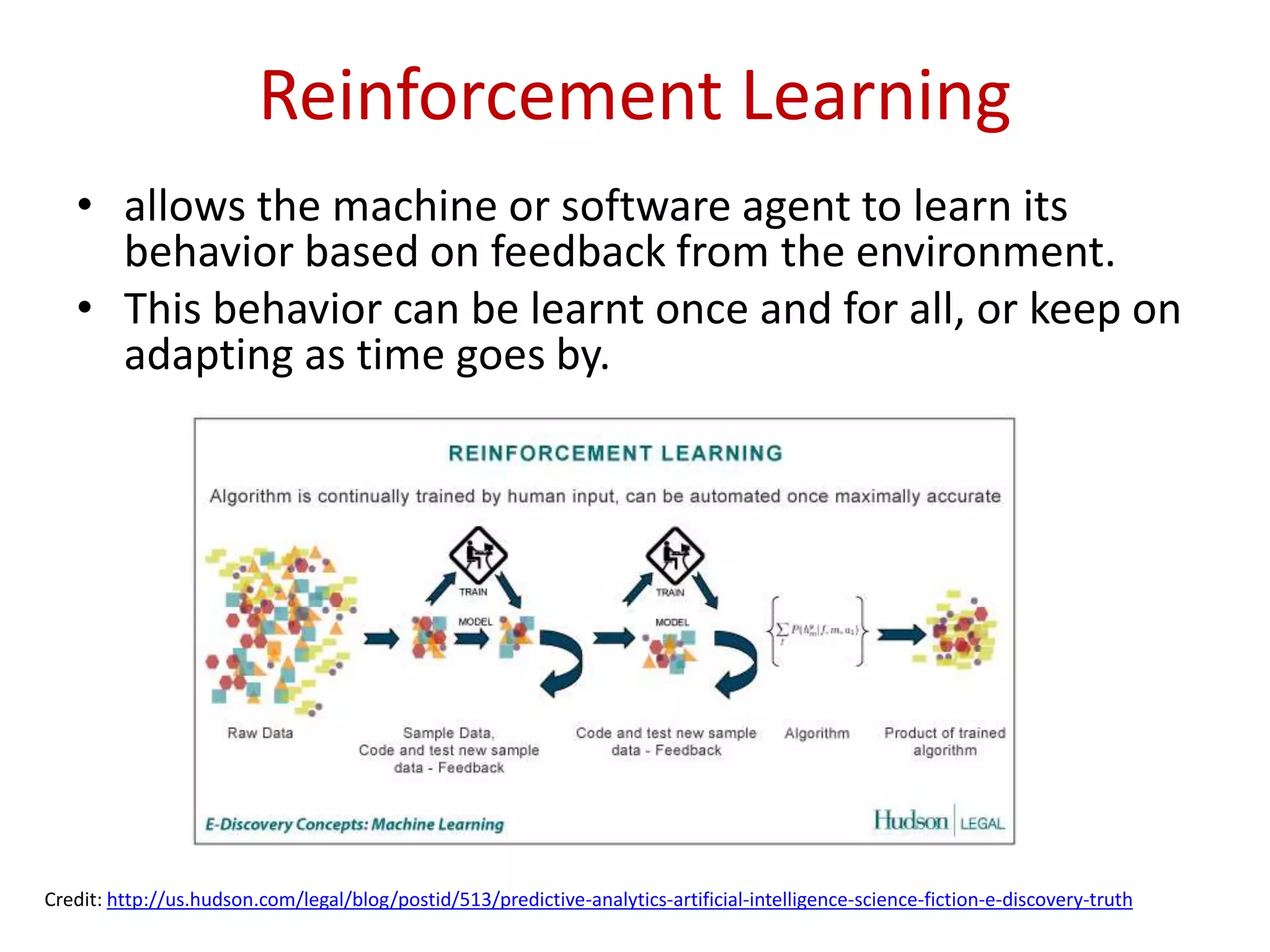
Reinforcement Learning 
• allows the machine or software agent to learn its 
behavior based on feedback from the environment. 
• This behavior can be learnt once and for all, or keep on 
adapting as time goes by. 
Credit: http://us.hudson.com/legal/blog/postid/513/predictive-analytics-artificial-intelligence-science-fiction-e-discovery-truth
Machine Learning Techniques
Techniques 
• classification: predict class from observations 
• clustering: group observations into 
“meaningful” groups 
• regression (prediction): predict value from 
observations
Classification 
• classify a document into a predefined category. 
• documents can be text, images 
• Popular one is Naive Bayes Classifier. 
• Steps: 
– Step1 : Train the program (Building a Model) using a 
training set with a category for e.g. sports, cricket, news, 
– Classifier will compute probability for each word, the 
probability that it makes a document belong to each of 
considered categories 
– Step2 : Test with a test data set against this Model 
• http://en.wikipedia.org/wiki/Naive_Bayes_classifier
Clustering 
• clustering is the task of grouping a set of objects in 
such a way that objects in the same group (called 
a cluster) are more similar to each other 
• objects are not predefined 
• For e.g. these keywords 
– “man’s shoe” 
– “women’s shoe” 
– “women’s t-shirt” 
– “man’s t-shirt” 
– can be cluster into 2 categories “shoe” and “t-shirt” or 
“man” and “women” 
• Popular ones are K-means clustering and Hierarchical 
clustering
K-means Clustering 
• partition n observations into k clusters in which each observation belongs 
to the cluster with the nearest mean, serving as a prototype of the cluster. 
• http://en.wikipedia.org/wiki/K-means_clustering 
http://pypr.sourceforge.net/kmeans.html
Hierarchical clustering 
• method of cluster analysis which seeks to build 
a hierarchy of clusters. 
• There can be two strategies 
– Agglomerative: 
• This is a "bottom up" approach: each observation starts in its own 
cluster, and pairs of clusters are merged as one moves up the 
hierarchy. 
• Time complexity is O(n^3) 
– Divisive: 
• This is a "top down" approach: all observations start in one cluster, 
and splits are performed recursively as one moves down the 
hierarchy. 
• Time complexity is O(2^n) 
• http://en.wikipedia.org/wiki/Hierarchical_clustering
Regression 
• is a measure of the relation between 
the mean value of one variable (e.g. 
output) and corresponding values of 
other variables (e.g. time and cost). 
• regression analysis is a statistical 
process for estimating the 
relationships among variables. 
• Regression means to predict the 
output value using training data. 
• Popular one is Logistic regression 
(binary regression) 
• http://en.wikipedia.org/wiki/Logistic_regression
Classification vs Regression 
• Classification means to 
group the output into 
a class. 
• classification to predict 
the type of tumor i.e. 
harmful or not harmful 
using training data 
• if it is 
discrete/categorical 
variable, then it is 
classification problem 
• Regression means to 
predict the output 
value using training 
data. 
• regression to predict 
the house price from 
training data 
• if it is a real 
number/continuous, 
then it is regression 
problem.
Let’s see the usage in Real life
Use-Cases 
• Spam Email Detection 
• Machine Translation (Language Translation) 
• Image Search (Similarity) 
• Clustering (KMeans) : Amazon 
Recommendations 
• Classification : Google News 
continued…
Use-Cases (contd.) 
• Text Summarization - Google News 
• Rating a Review/Comment: Yelp 
• Fraud detection : Credit card Providers 
• Decision Making : e.g. Bank/Insurance sector 
• Sentiment Analysis 
• Speech Understanding – iPhone with Siri 
• Face Detection – Facebook’s Photo tagging
Classification in Action 
isn’t it easy?
it’s not (Snapshot of Spam folder) 
Not a 
Spam 
Not a 
Spam
NER (Named Entity Recognition) 
http://nlp.stanford.edu:8080/ner/process
Similar/Duplicate Images 
Remember 
Features ? 
(Feature Extraction) 
Can be : 
• Width 
• Height 
• Contrast 
• Brightness 
• Position 
• Hue 
• Colors 
Credit: https://www.google.co.in/ 
Check this : 
LIRE (Lucene Image REtrieval) 
library - 
https://code.google.com/p/lire/
Recommendations 
http://www.webdesignerdepot.com/2009/10/an-analysis-of-the-amazon-shopping-experience/
Popular Frameworks/Tools 
• Weka 
• Carrot2 
• Gate 
• OpenNLP 
• LingPipe 
• Stanford NLP 
• Mallet – Topic Modelling 
• Gensim – Topic Modelling (Python) 
• Apache Mahout 
• MLib – Apache Spark 
• scikit-learn - Python 
• LIBSVM : Support Vector Machines 
• and many more…
Advanced concepts (related to IR) 
• Topic Modelling 
• Latent Dirichlet allocation (LDA) 
• Latent semantic analysis (LSA/LSI) - Semantic 
Search 
• Singular Value Decomposition (SVD) 
• Summarization (without Training)
Solr/Lucene Meetup 
• Case study of Rujhaan.com 
(A social news app ) 
• Saturday, Sep 27, 2014 10:00 AM 
• IIIT Hyderabad 
• URL: http://www.meetup.com/Hyderabad- 
Apache-Solr-Lucene-Group/events/203434032/ 
OR 
• Search on Google … 
Topics of Talk 
 Crawler(Crawler4j) 
 MongoDB 
 Solr 
 Nginx, ApacheTomcat 
 Redis 
 Machine Learning 
1. Classification - Classification 
of News, Tweets - Lingpipe 
2. Clustering, - Similar Items - 
carrot2 (Near Future: Hadoop 
and Apache Spark ) 
3. Summarization - Extracting 
the main text with Automatic 
Summary of article 
4. Topics Extraction from text
Questions ? 
34
Thanks! 
@rahuldausa on twitter and slideshare 
http://www.linkedin.com/in/rahuldausa 
Interested in Search/Information Retrieval ? 
Join us @ http://www.meetup.com/Hyderabad-Apache-Solr-Lucene-Group/ 
35

Introduction to Machine Learning

  • 1.
    Introduction to MachineLearning September 2014 Meetup Rahul Jain @rahuldausa Join us @ For Solr, Lucene, Elasticsearch, Machine Learning, IR http://www.meetup.com/Hyderabad-Apache-Solr-Lucene-Group/ http://www.meetup.com/DataAnalyticsGroup/ Join us @ For Hadoop, Spark, Cascading, Scala, NoSQL, Crawlers and all cutting edge technologies. http://www.meetup.com/Hyderabad-Programming-Geeks-Group/
  • 2.
    Agenda • Introduction • Basics • Classification • Clustering • Regression • Use-Cases 2
  • 3.
    Quick Questionnaire Howmany people have heard about Machine Learning How many people know about Machine Learning How many people are using Machine Learning
  • 4.
    About • subfieldof Artificial Intelligence (AI) • name is derived from the concept that it deals with “construction and study of systems that can learn from data” • can be seen as building blocks to make computers learn to behave more intelligently • It is a theoretical concept. There are various techniques with various implementations. • http://en.wikipedia.org/wiki/Machine_learning
  • 5.
    In other words… “A computer program is said to learn from experience (E) with some class of tasks (T) and a performance measure (P) if its performance at tasks in T as measured by P improves with E”
  • 6.
    Terminology • Features – The number of features or distinct traits that can be used to describe each item in a quantitative manner. • Samples – A sample is an item to process (e.g. classify). It can be a document, a picture, a sound, a video, a row in database or CSV file, or whatever you can describe with a fixed set of quantitative traits. • Feature vector – is an n-dimensional vector of numerical features that represent some object. • Feature extraction – Preparation of feature vector – transforms the data in the high-dimensional space to a space of fewer dimensions. • Training/Evolution set – Set of data to discover potentially predictive relationships.
  • 7.
    Let’s dig deepinto it… What do you mean by Apple
  • 8.
    Learning (Training) Features: 1. Color: Radish/Red 2. Type : Fruit 3. Shape etc… Features: 1. Sky Blue 2. Logo 3. Shape etc… Features: 1. Yellow 2. Fruit 3. Shape etc…
  • 9.
  • 10.
    Categories • SupervisedLearning • Unsupervised Learning • Semi-Supervised Learning • Reinforcement Learning
  • 11.
    Supervised Learning •the correct classes of the training data are known Credit: http://us.hudson.com/legal/blog/postid/513/predictive-analytics-artificial-intelligence-science-fiction-e-discovery-truth
  • 12.
    Unsupervised Learning •the correct classes of the training data are not known Credit: http://us.hudson.com/legal/blog/postid/513/predictive-analytics-artificial-intelligence-science-fiction-e-discovery-truth
  • 13.
    Semi-Supervised Learning •A Mix of Supervised and Unsupervised learning Credit: http://us.hudson.com/legal/blog/postid/513/predictive-analytics-artificial-intelligence-science-fiction-e-discovery-truth
  • 14.
    Reinforcement Learning •allows the machine or software agent to learn its behavior based on feedback from the environment. • This behavior can be learnt once and for all, or keep on adapting as time goes by. Credit: http://us.hudson.com/legal/blog/postid/513/predictive-analytics-artificial-intelligence-science-fiction-e-discovery-truth
  • 15.
  • 16.
    Techniques • classification:predict class from observations • clustering: group observations into “meaningful” groups • regression (prediction): predict value from observations
  • 17.
    Classification • classifya document into a predefined category. • documents can be text, images • Popular one is Naive Bayes Classifier. • Steps: – Step1 : Train the program (Building a Model) using a training set with a category for e.g. sports, cricket, news, – Classifier will compute probability for each word, the probability that it makes a document belong to each of considered categories – Step2 : Test with a test data set against this Model • http://en.wikipedia.org/wiki/Naive_Bayes_classifier
  • 18.
    Clustering • clusteringis the task of grouping a set of objects in such a way that objects in the same group (called a cluster) are more similar to each other • objects are not predefined • For e.g. these keywords – “man’s shoe” – “women’s shoe” – “women’s t-shirt” – “man’s t-shirt” – can be cluster into 2 categories “shoe” and “t-shirt” or “man” and “women” • Popular ones are K-means clustering and Hierarchical clustering
  • 19.
    K-means Clustering •partition n observations into k clusters in which each observation belongs to the cluster with the nearest mean, serving as a prototype of the cluster. • http://en.wikipedia.org/wiki/K-means_clustering http://pypr.sourceforge.net/kmeans.html
  • 20.
    Hierarchical clustering •method of cluster analysis which seeks to build a hierarchy of clusters. • There can be two strategies – Agglomerative: • This is a "bottom up" approach: each observation starts in its own cluster, and pairs of clusters are merged as one moves up the hierarchy. • Time complexity is O(n^3) – Divisive: • This is a "top down" approach: all observations start in one cluster, and splits are performed recursively as one moves down the hierarchy. • Time complexity is O(2^n) • http://en.wikipedia.org/wiki/Hierarchical_clustering
  • 21.
    Regression • isa measure of the relation between the mean value of one variable (e.g. output) and corresponding values of other variables (e.g. time and cost). • regression analysis is a statistical process for estimating the relationships among variables. • Regression means to predict the output value using training data. • Popular one is Logistic regression (binary regression) • http://en.wikipedia.org/wiki/Logistic_regression
  • 22.
    Classification vs Regression • Classification means to group the output into a class. • classification to predict the type of tumor i.e. harmful or not harmful using training data • if it is discrete/categorical variable, then it is classification problem • Regression means to predict the output value using training data. • regression to predict the house price from training data • if it is a real number/continuous, then it is regression problem.
  • 23.
    Let’s see theusage in Real life
  • 24.
    Use-Cases • SpamEmail Detection • Machine Translation (Language Translation) • Image Search (Similarity) • Clustering (KMeans) : Amazon Recommendations • Classification : Google News continued…
  • 25.
    Use-Cases (contd.) •Text Summarization - Google News • Rating a Review/Comment: Yelp • Fraud detection : Credit card Providers • Decision Making : e.g. Bank/Insurance sector • Sentiment Analysis • Speech Understanding – iPhone with Siri • Face Detection – Facebook’s Photo tagging
  • 26.
    Classification in Action isn’t it easy?
  • 27.
    it’s not (Snapshotof Spam folder) Not a Spam Not a Spam
  • 28.
    NER (Named EntityRecognition) http://nlp.stanford.edu:8080/ner/process
  • 29.
    Similar/Duplicate Images Remember Features ? (Feature Extraction) Can be : • Width • Height • Contrast • Brightness • Position • Hue • Colors Credit: https://www.google.co.in/ Check this : LIRE (Lucene Image REtrieval) library - https://code.google.com/p/lire/
  • 30.
  • 31.
    Popular Frameworks/Tools •Weka • Carrot2 • Gate • OpenNLP • LingPipe • Stanford NLP • Mallet – Topic Modelling • Gensim – Topic Modelling (Python) • Apache Mahout • MLib – Apache Spark • scikit-learn - Python • LIBSVM : Support Vector Machines • and many more…
  • 32.
    Advanced concepts (relatedto IR) • Topic Modelling • Latent Dirichlet allocation (LDA) • Latent semantic analysis (LSA/LSI) - Semantic Search • Singular Value Decomposition (SVD) • Summarization (without Training)
  • 33.
    Solr/Lucene Meetup •Case study of Rujhaan.com (A social news app ) • Saturday, Sep 27, 2014 10:00 AM • IIIT Hyderabad • URL: http://www.meetup.com/Hyderabad- Apache-Solr-Lucene-Group/events/203434032/ OR • Search on Google … Topics of Talk  Crawler(Crawler4j)  MongoDB  Solr  Nginx, ApacheTomcat  Redis  Machine Learning 1. Classification - Classification of News, Tweets - Lingpipe 2. Clustering, - Similar Items - carrot2 (Near Future: Hadoop and Apache Spark ) 3. Summarization - Extracting the main text with Automatic Summary of article 4. Topics Extraction from text
  • 34.
  • 35.
    Thanks! @rahuldausa ontwitter and slideshare http://www.linkedin.com/in/rahuldausa Interested in Search/Information Retrieval ? Join us @ http://www.meetup.com/Hyderabad-Apache-Solr-Lucene-Group/ 35