Crafting the Service Environment
Learning Objectives
 Study the purpose of service environments
 Understand consumer responses to service
environments
 Uncover the dimensions of the service
environment
 Determine design elements of effective
servicescapes
What Is the Purpose of Service
Environments?
Purpose of Service
Environments
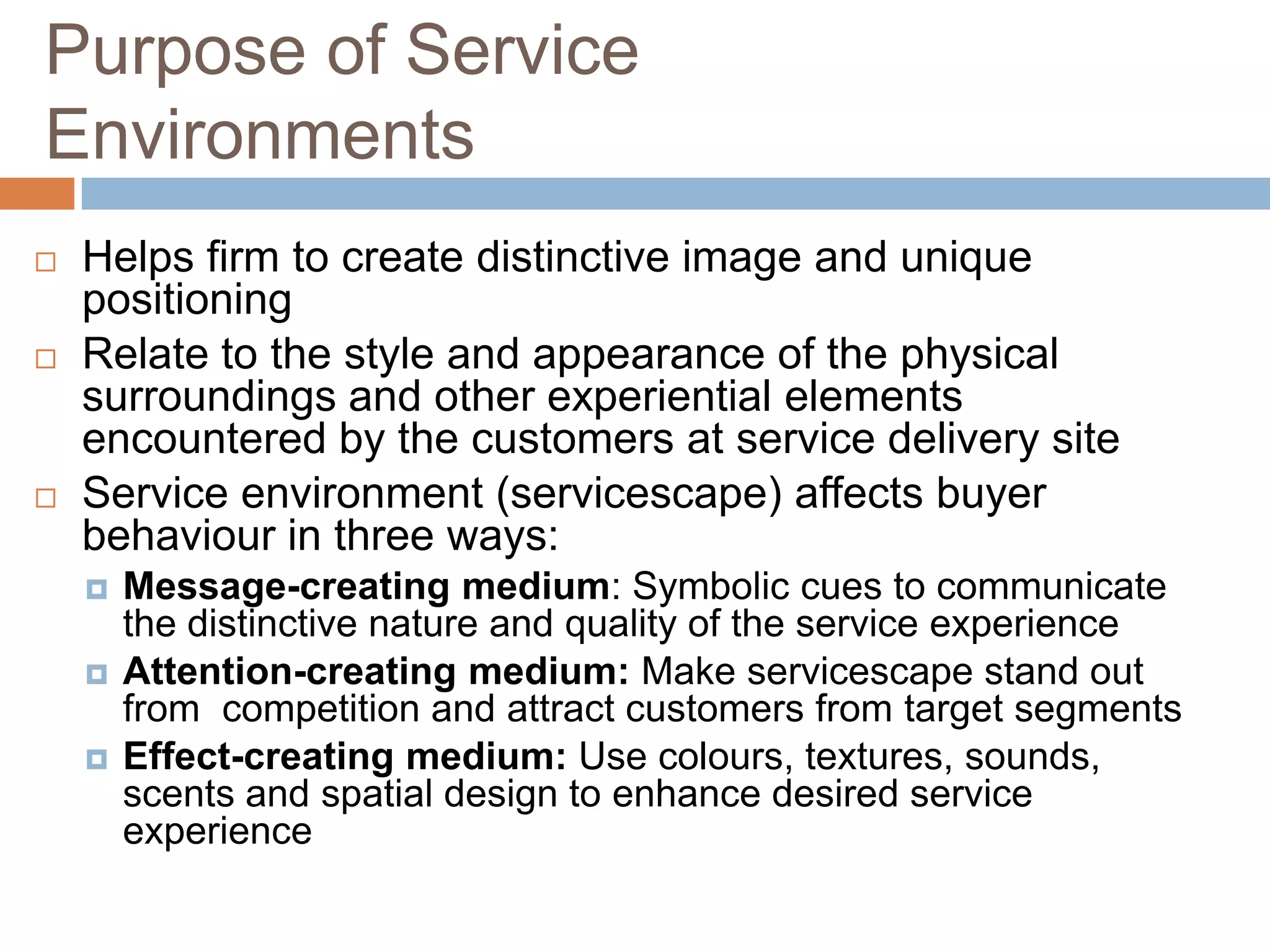
 Helps firm to create distinctive image and unique
positioning
 Relate to the style and appearance of the physical
surroundings and other experiential elements
encountered by the customers at service delivery site
 Service environment (servicescape) affects buyer
behaviour in three ways:
 Message-creating medium: Symbolic cues to communicate
the distinctive nature and quality of the service experience
 Attention-creating medium: Make servicescape stand out
from competition and attract customers from target segments
 Effect-creating medium: Use colours, textures, sounds,
scents and spatial design to enhance desired service
experience
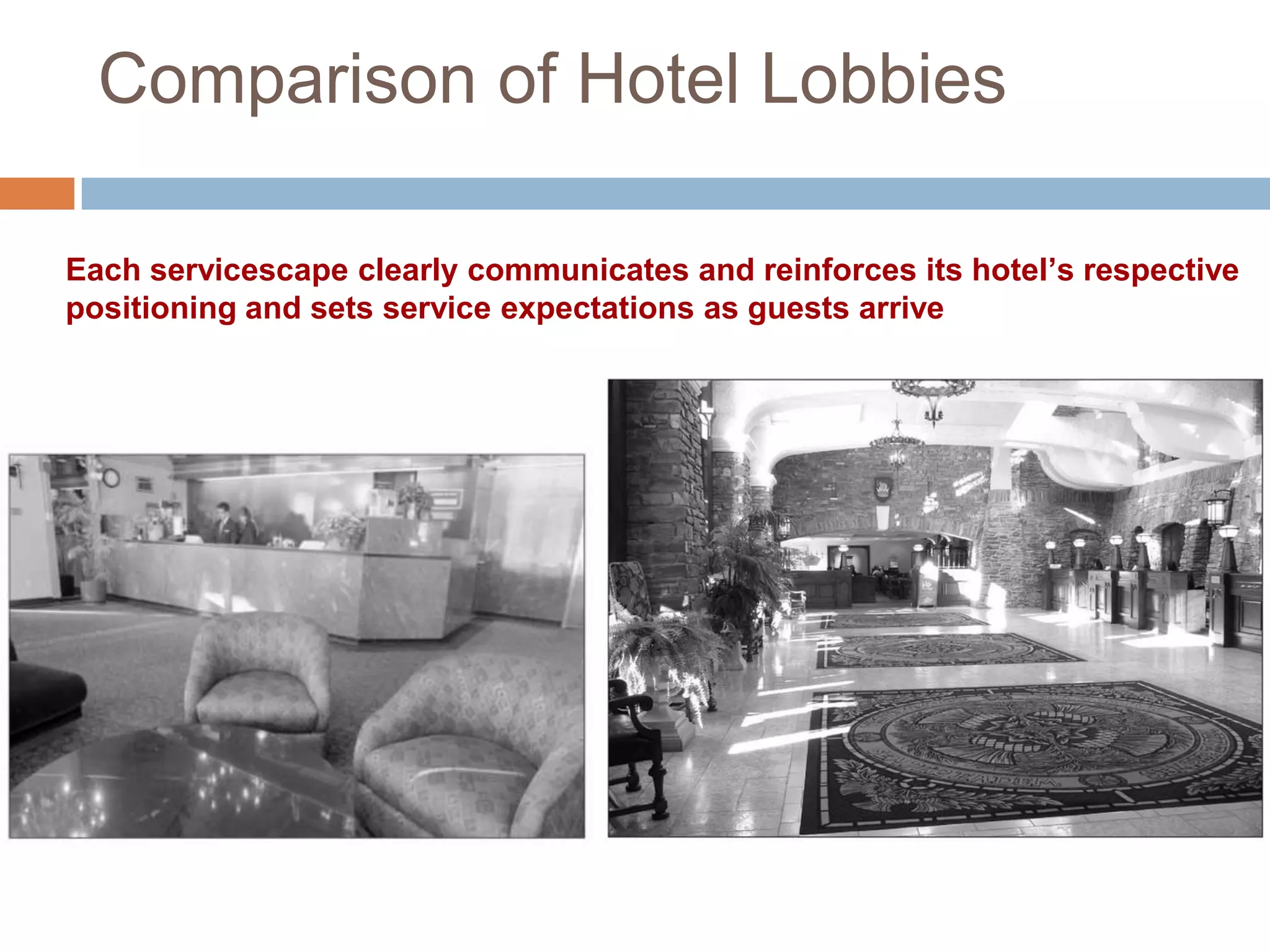
Comparison of Hotel Lobbies
Each servicescape clearly communicates and reinforces its hotel’s respective
positioning and sets service expectations as guests arrive
Image, Positioning and
Differentiation
 Intangible, customers cannot check quality
well
 Use service environment as a proxy, and
hence firms make quality environment and
desired image
 Reception areas of big companies
 In retail store environment portrays the quality
of the merchandise
 Some servicescape are functional
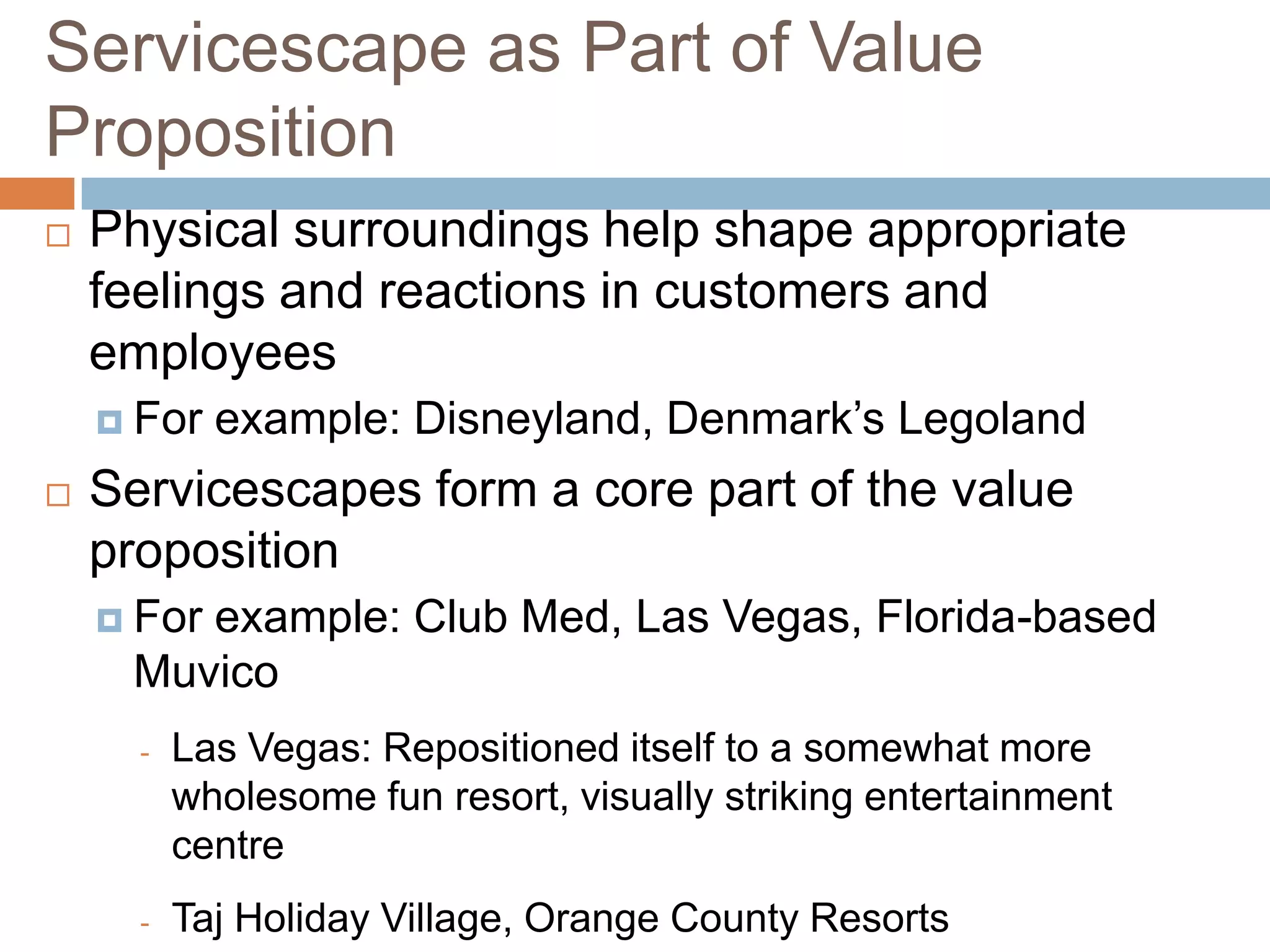
Servicescape as Part of Value
Proposition
 Physical surroundings help shape appropriate
feelings and reactions in customers and
employees
 For example: Disneyland, Denmark’s Legoland
 Servicescapes form a core part of the value
proposition
 For example: Club Med, Las Vegas, Florida-based
Muvico
- Las Vegas: Repositioned itself to a somewhat more
wholesome fun resort, visually striking entertainment
centre
- Taj Holiday Village, Orange County Resorts
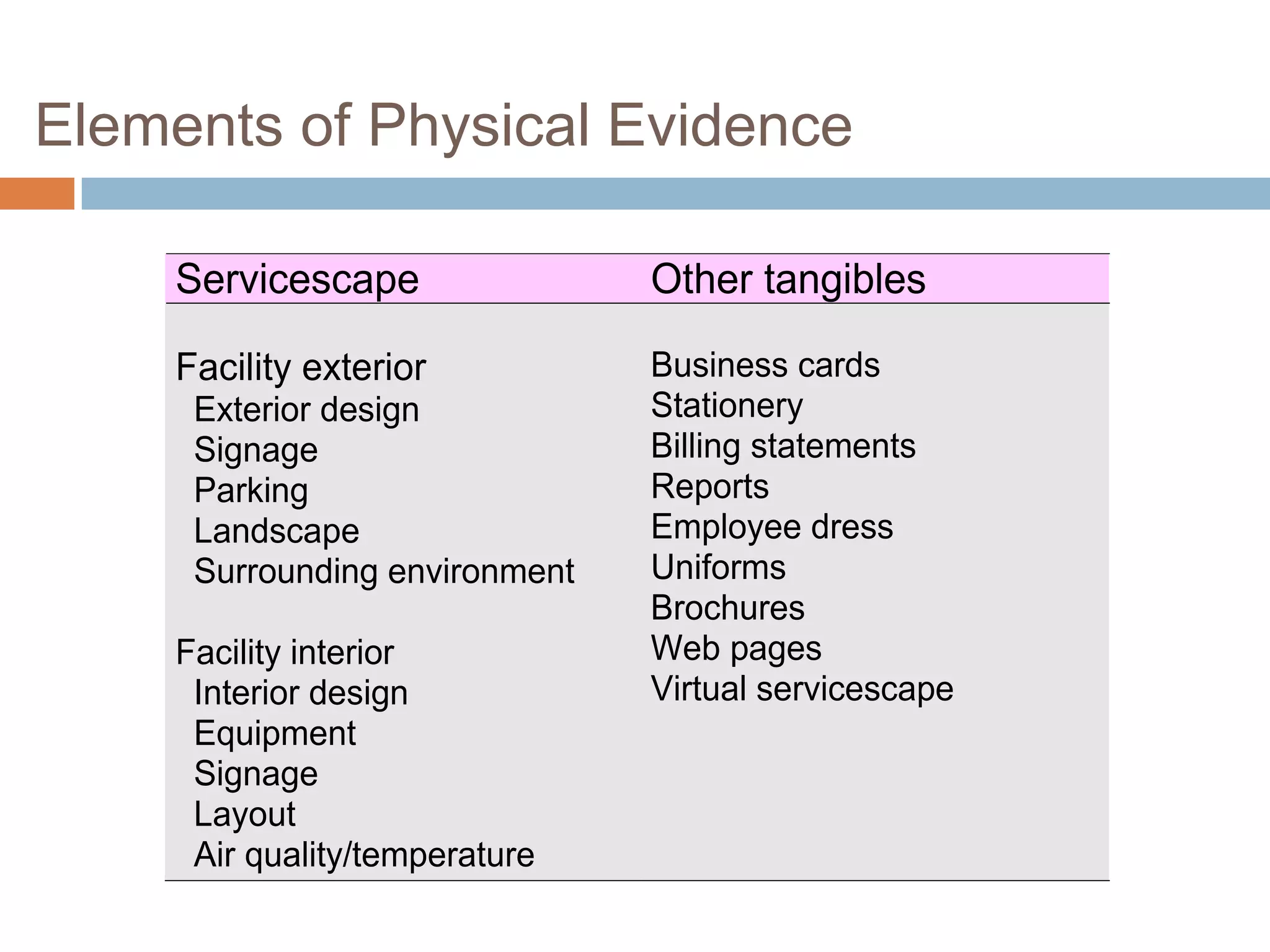
Elements of Physical Evidence
Servicescape Other tangibles
Facility exterior
Exterior design
Signage
Parking
Landscape
Surrounding environment
Facility interior
Interior design
Equipment
Signage
Layout
Air quality/temperature
Business cards
Stationery
Billing statements
Reports
Employee dress
Uniforms
Brochures
Web pages
Virtual servicescape
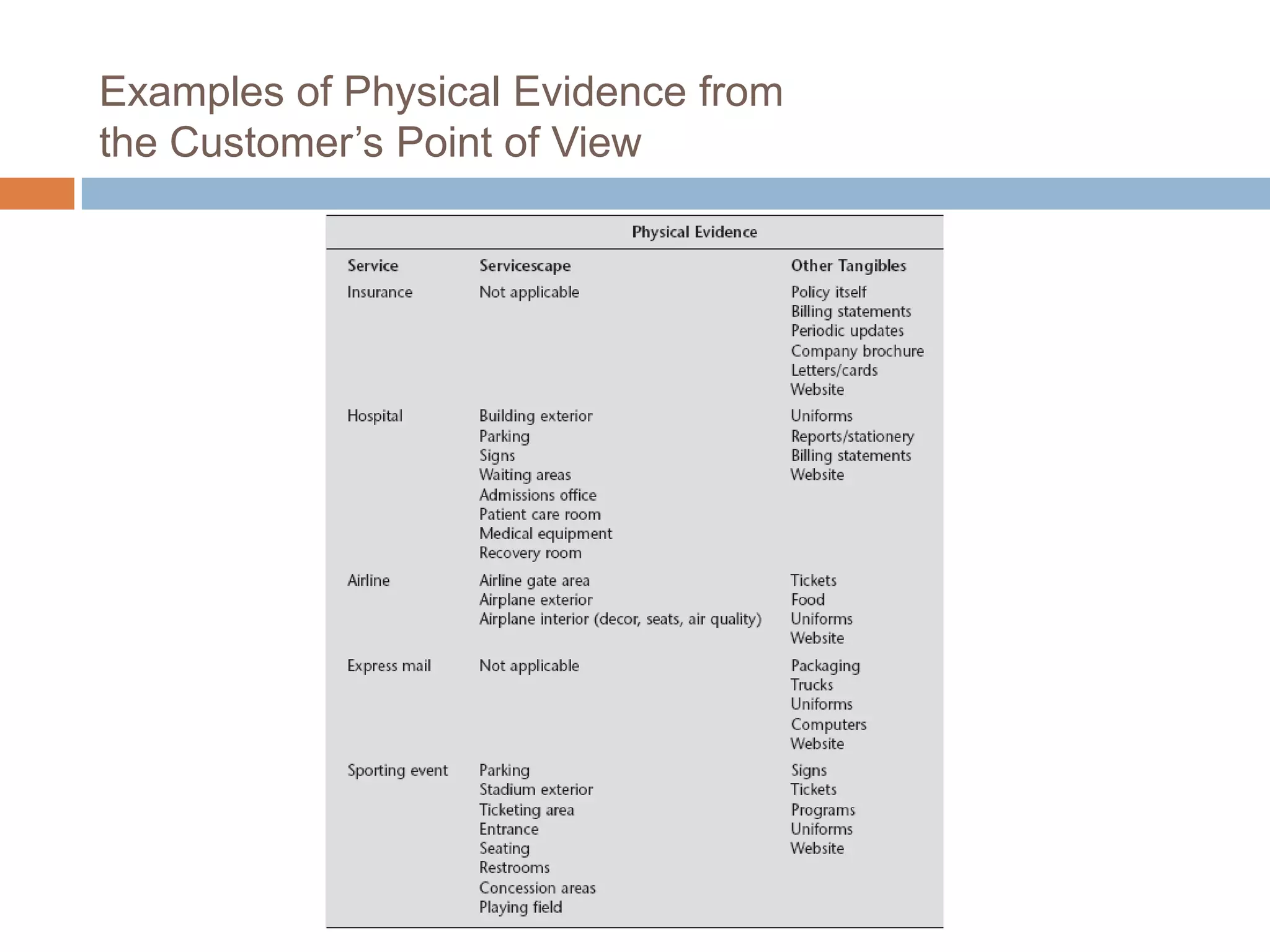
Examples of Physical Evidence from
the Customer’s Point of View
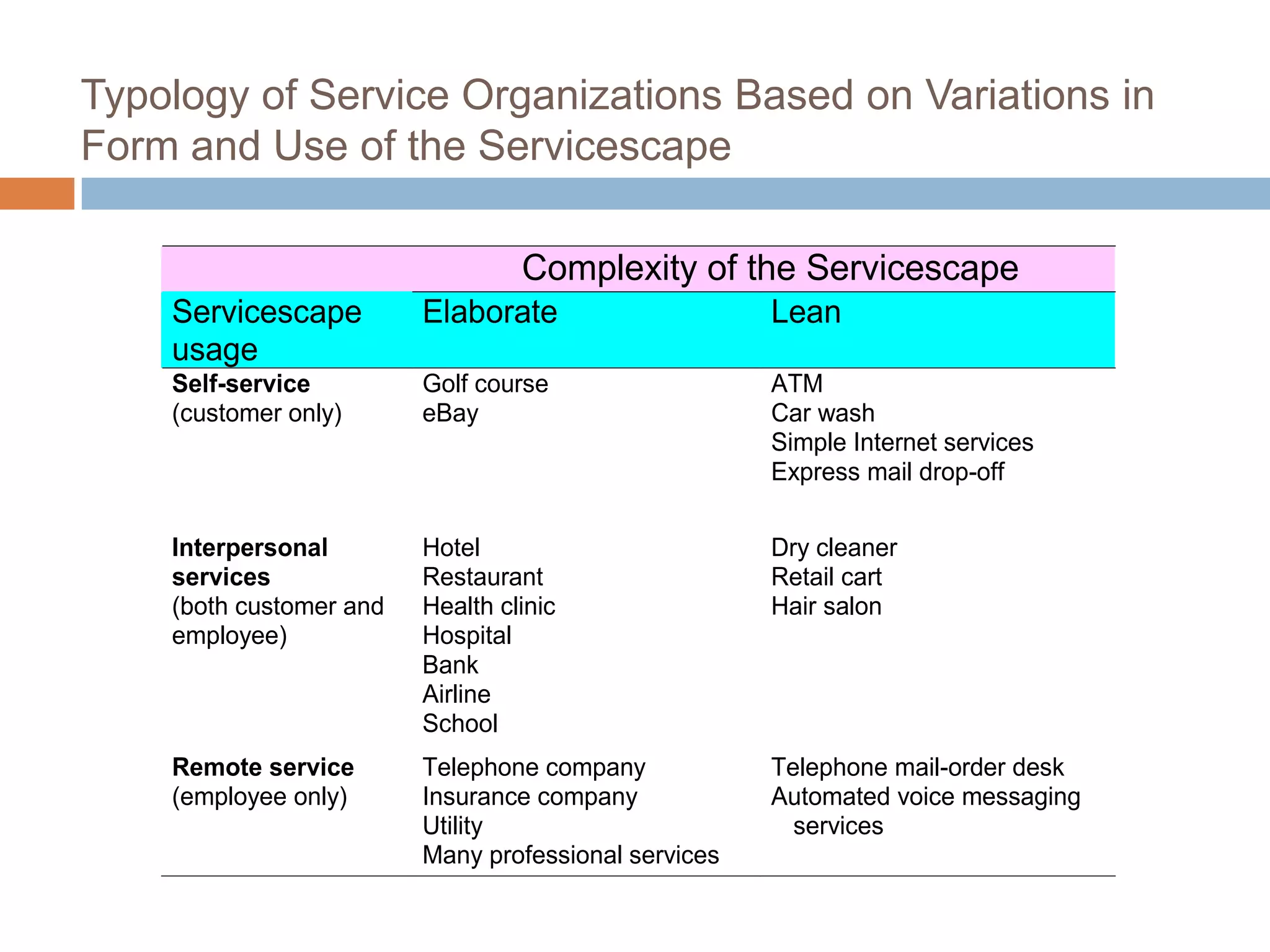
Typology of Service Organizations Based on Variations in
Form and Use of the Servicescape
Complexity of the Servicescape
Servicescape
usage
Elaborate Lean
Self-service
(customer only)
Golf course
eBay
ATM
Car wash
Simple Internet services
Express mail drop-off
Interpersonal
services
(both customer and
employee)
Hotel
Restaurant
Health clinic
Hospital
Bank
Airline
School
Dry cleaner
Retail cart
Hair salon
Remote service
(employee only)
Telephone company
Insurance company
Utility
Many professional services
Telephone mail-order desk
Automated voice messaging
services
Roles of the Servicescape
 Package
 conveys expectations
 influences perceptions
 Facilitator
 facilitates the flow of the service delivery process
 provides information (how am I to act?)
 facilitates the ordering process (how does this work?)
 facilitates service delivery
 Socializer
 facilitates interaction between:
 customers and employees
 customers and fellow customers
 Differentiator
 sets provider apart from competition in the mind of the consumer
Understanding Consumer
Responses to Service
Environments
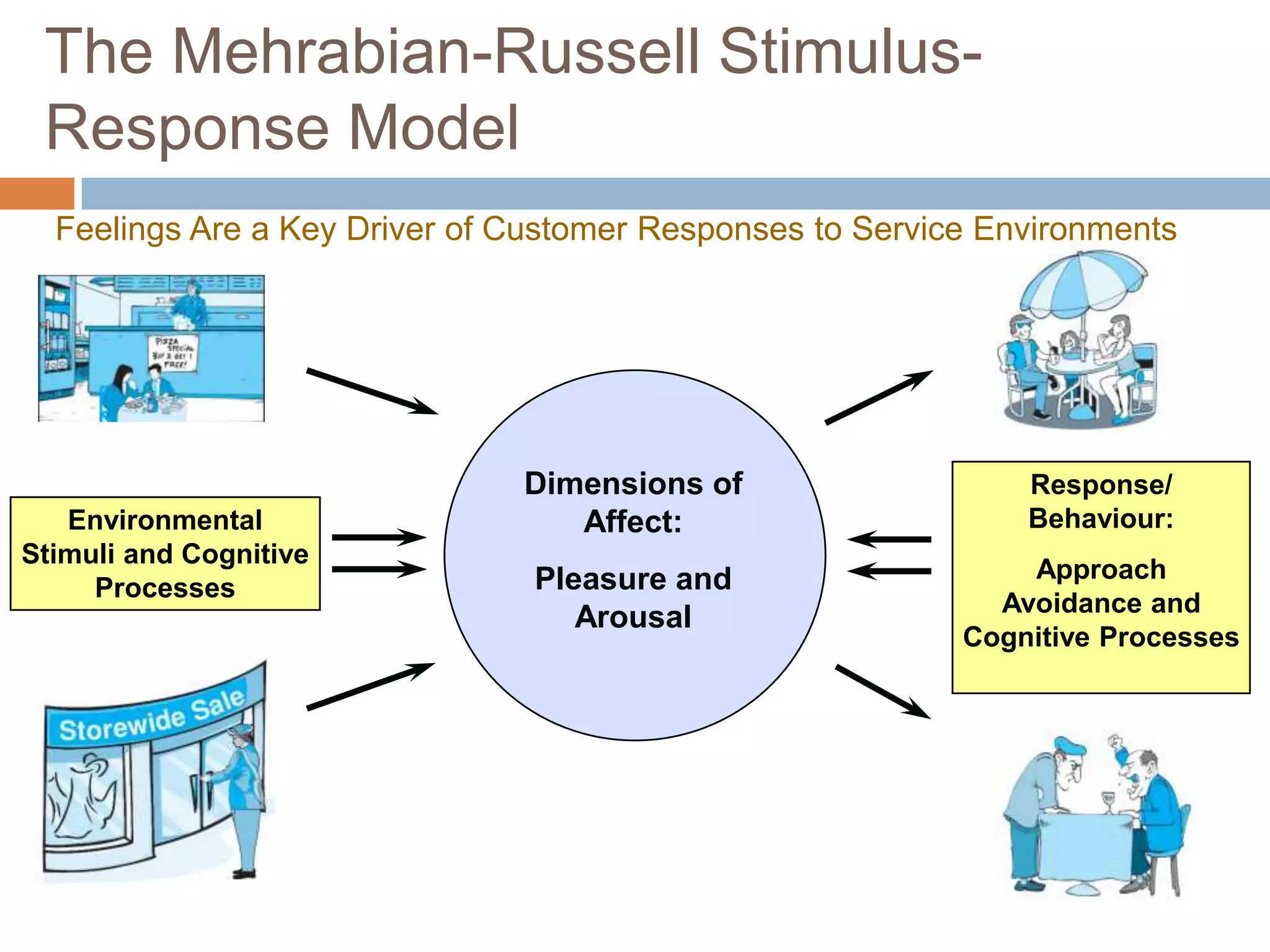
The Mehrabian-Russell Stimulus-
Response Model
Response/
Behaviour:
Approach
Avoidance and
Cognitive Processes
Environmental
Stimuli and Cognitive
Processes
Dimensions of
Affect:
Pleasure and
Arousal
Feelings Are a Key Driver of Customer Responses to Service Environments
Insights from Mehrabian-Russell
Stimulus-Response Model
 Simple yet fundamental model of how people respond to
environments
 The environment, its conscious and unconscious perceptions, and
interpretation influence how people feel in that environment
 Feelings, rather than perceptions/thoughts drive behavior
 Typical outcome variable is “approach” or “avoidance” of an
environment, but other possible outcomes can be added to model
 Eg crowded environment vs deterred by feeling of crowd
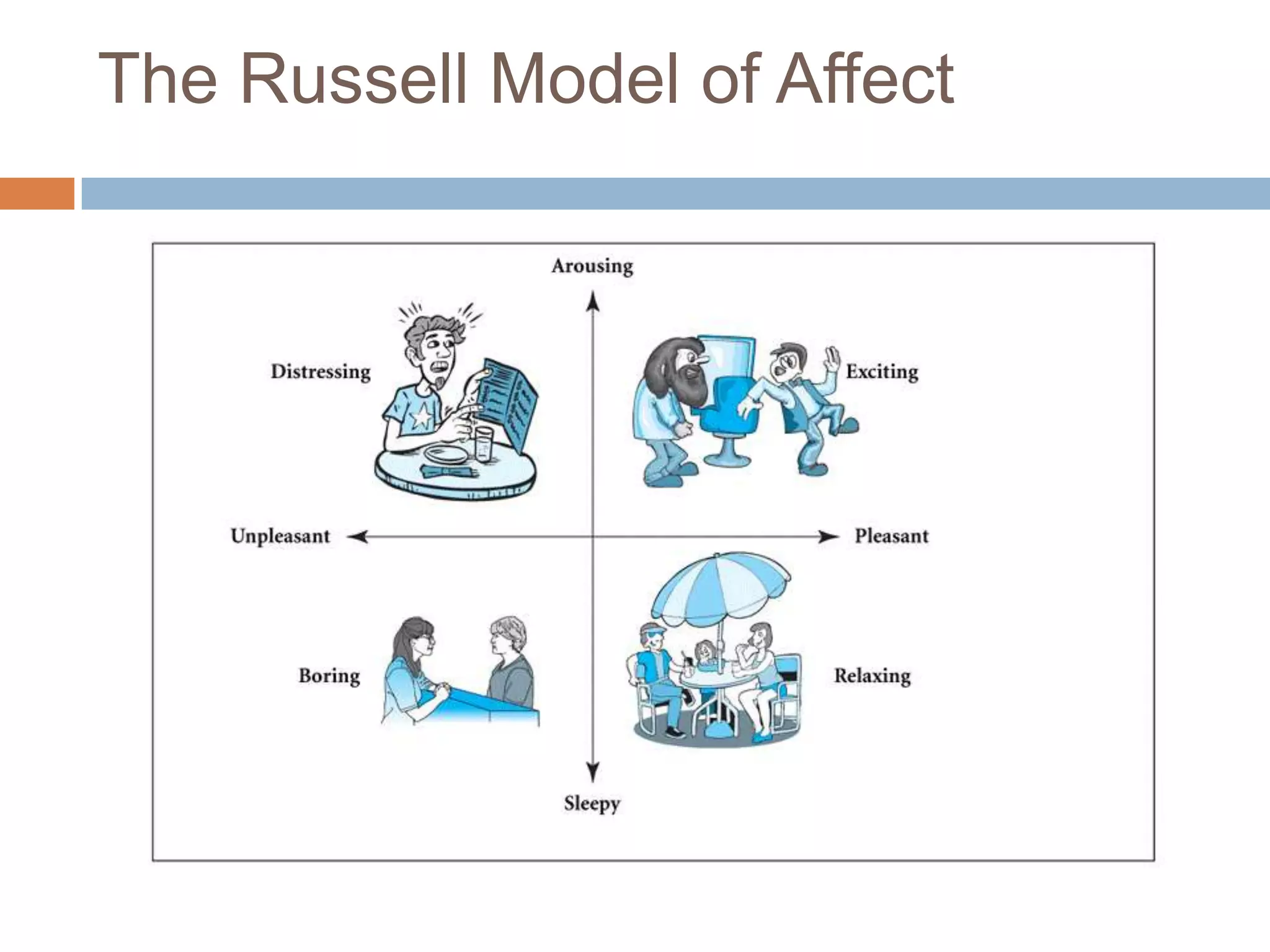
The Russell Model of Affect
Insights from Russell Model of
Affect
 Emotional responses to environments can be
described along two main dimensions:
 Pleasure: Direct, subjective, depending on how much
individual likes or dislikes environment
 Arousal: How stimulated individual feels, depends largely
on information rate or load of an environment Eg deep
sleep to bungee jumping eg. Stimulating- have high info
rate /novel/surprise
 Russell separated cognitive part of emotions from
these two emotional dimensions
 Advantage: simplicity, allows a direct assessment of
how customers feel
 Firms can set targets for affective states
Drivers of Affect
 Affect can be caused by perceptions and cognitive processes of
any degree of complexity
 It’s the simple cognitive processes that determine how people
feel in a service setting
 If higher levels of cognitive processes are triggered, the
interpretation of this process determines people’s feelings
 The more complex a cognitive process becomes, the more
powerful its potential impact on affect.
 However, most service encounters are routine and simple
processes can determine affect.
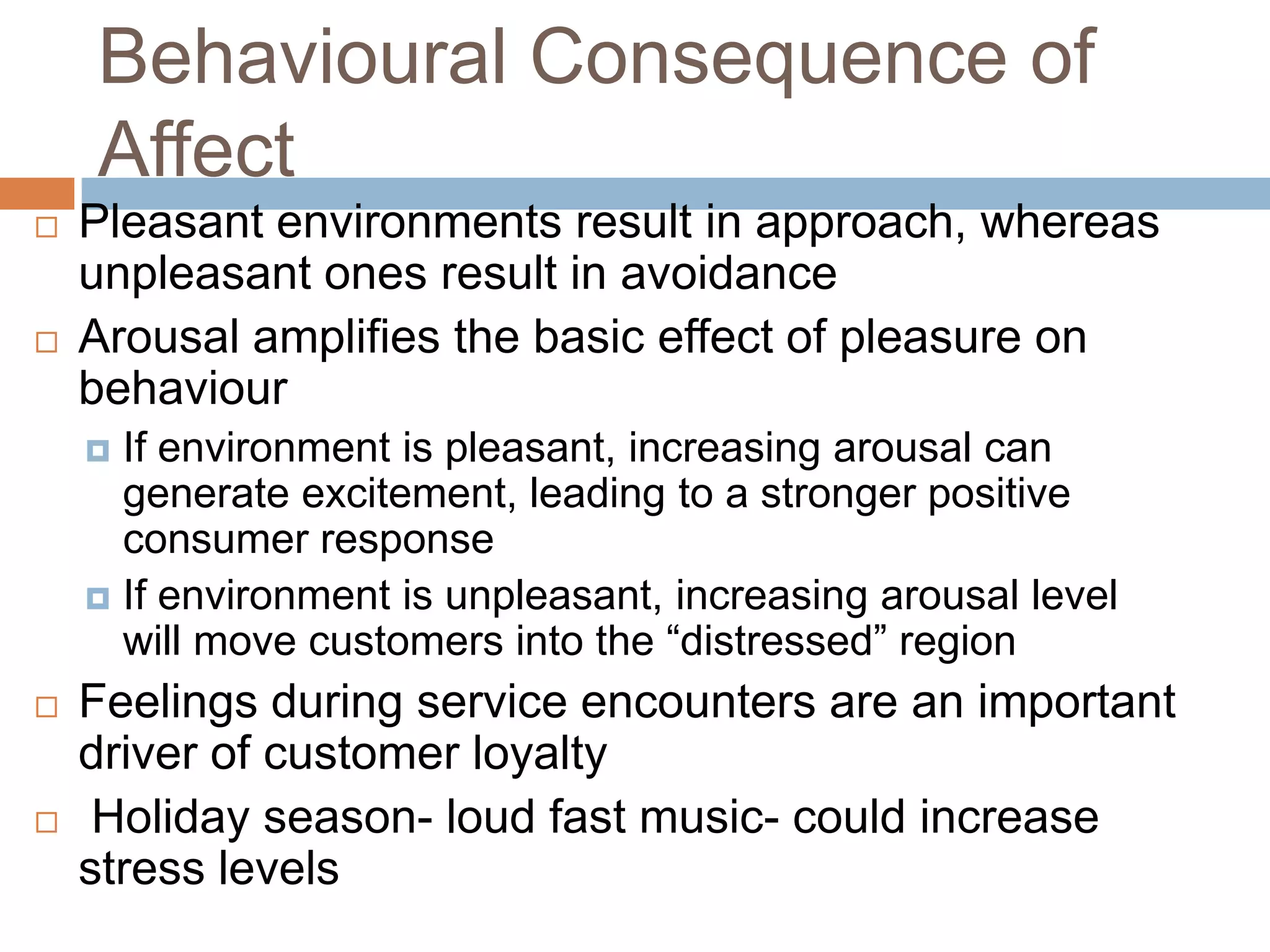
Behavioural Consequence of
Affect
 Pleasant environments result in approach, whereas
unpleasant ones result in avoidance
 Arousal amplifies the basic effect of pleasure on
behaviour
 If environment is pleasant, increasing arousal can
generate excitement, leading to a stronger positive
consumer response
 If environment is unpleasant, increasing arousal level
will move customers into the ―distressed‖ region
 Feelings during service encounters are an important
driver of customer loyalty
 Holiday season- loud fast music- could increase
stress levels
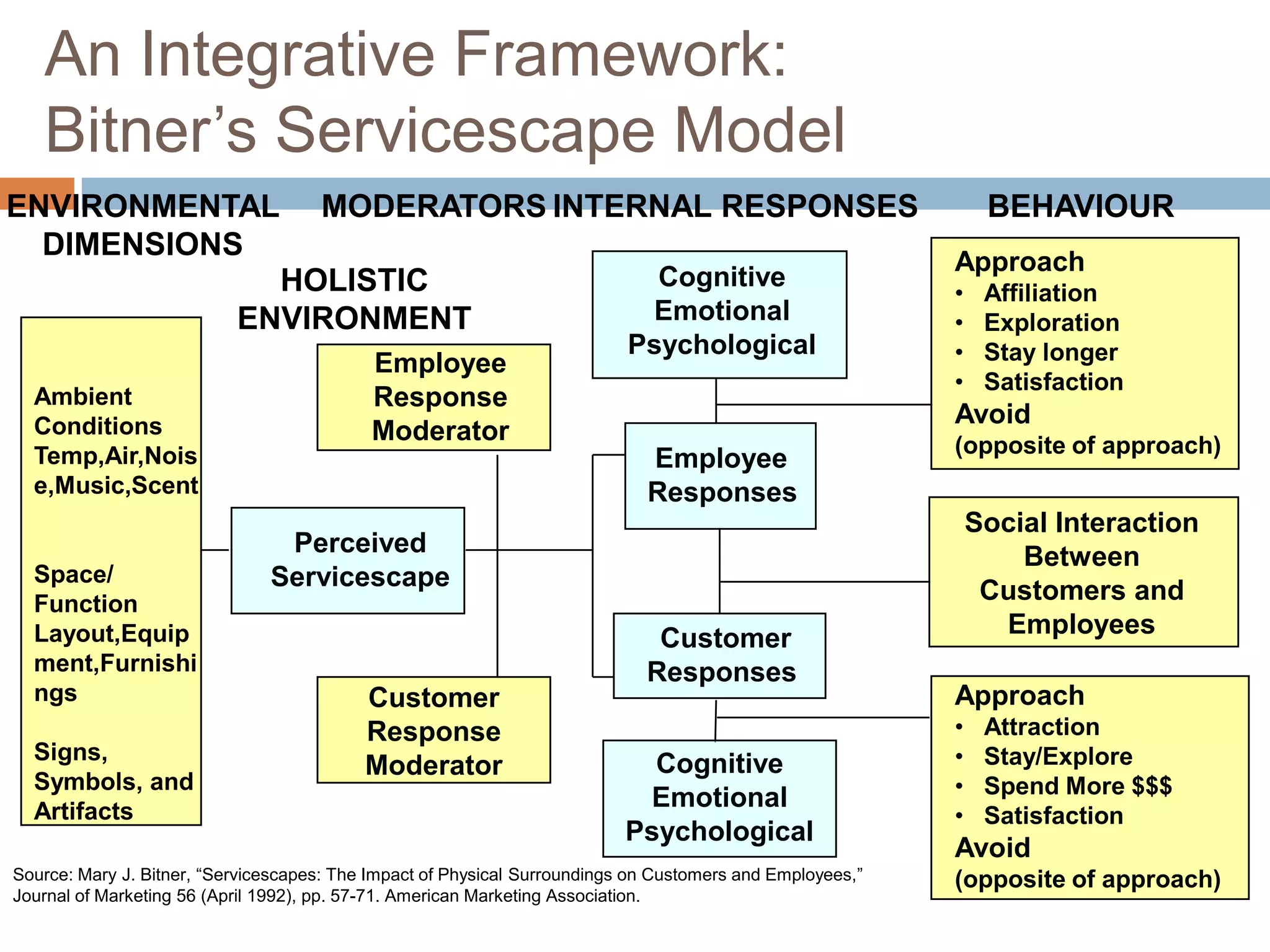
Ambient
Conditions
Temp,Air,Nois
e,Music,Scent
Space/
Function
Layout,Equip
ment,Furnishi
ngs
Signs,
Symbols, and
Artifacts
Cognitive
Emotional
Psychological
An Integrative Framework:
Bitner’s Servicescape Model
ENVIRONMENTAL
DIMENSIONS
HOLISTIC
ENVIRONMENT
MODERATORS INTERNAL RESPONSES BEHAVIOUR
Source: Mary J. Bitner, ―Servicescapes: The Impact of Physical Surroundings on Customers and Employees,‖
Journal of Marketing 56 (April 1992), pp. 57-71. American Marketing Association.
Perceived
Servicescape
Employee
Response
Moderator
Customer
Response
Moderator
Employee
Responses
Customer
Responses
Cognitive
Emotional
Psychological
Approach
• Affiliation
• Exploration
• Stay longer
• Satisfaction
Avoid
(opposite of approach)
Approach
• Attraction
• Stay/Explore
• Spend More $$$
• Satisfaction
Avoid
(opposite of approach)
Social Interaction
Between
Customers and
Employees
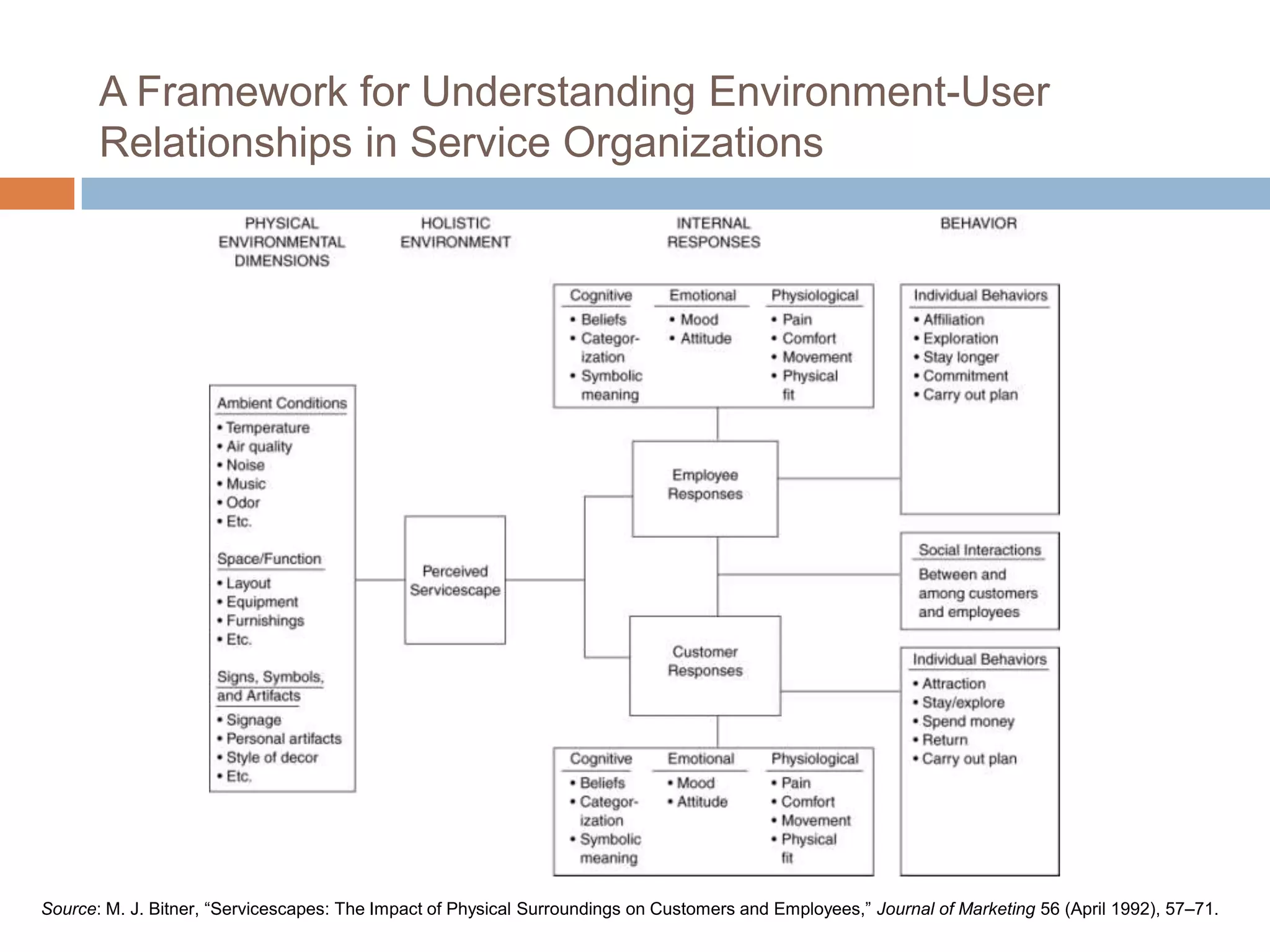
A Framework for Understanding Environment-User
Relationships in Service Organizations
Source: M. J. Bitner, ―Servicescapes: The Impact of Physical Surroundings on Customers and Employees,‖ Journal of Marketing 56 (April 1992), 57–71.
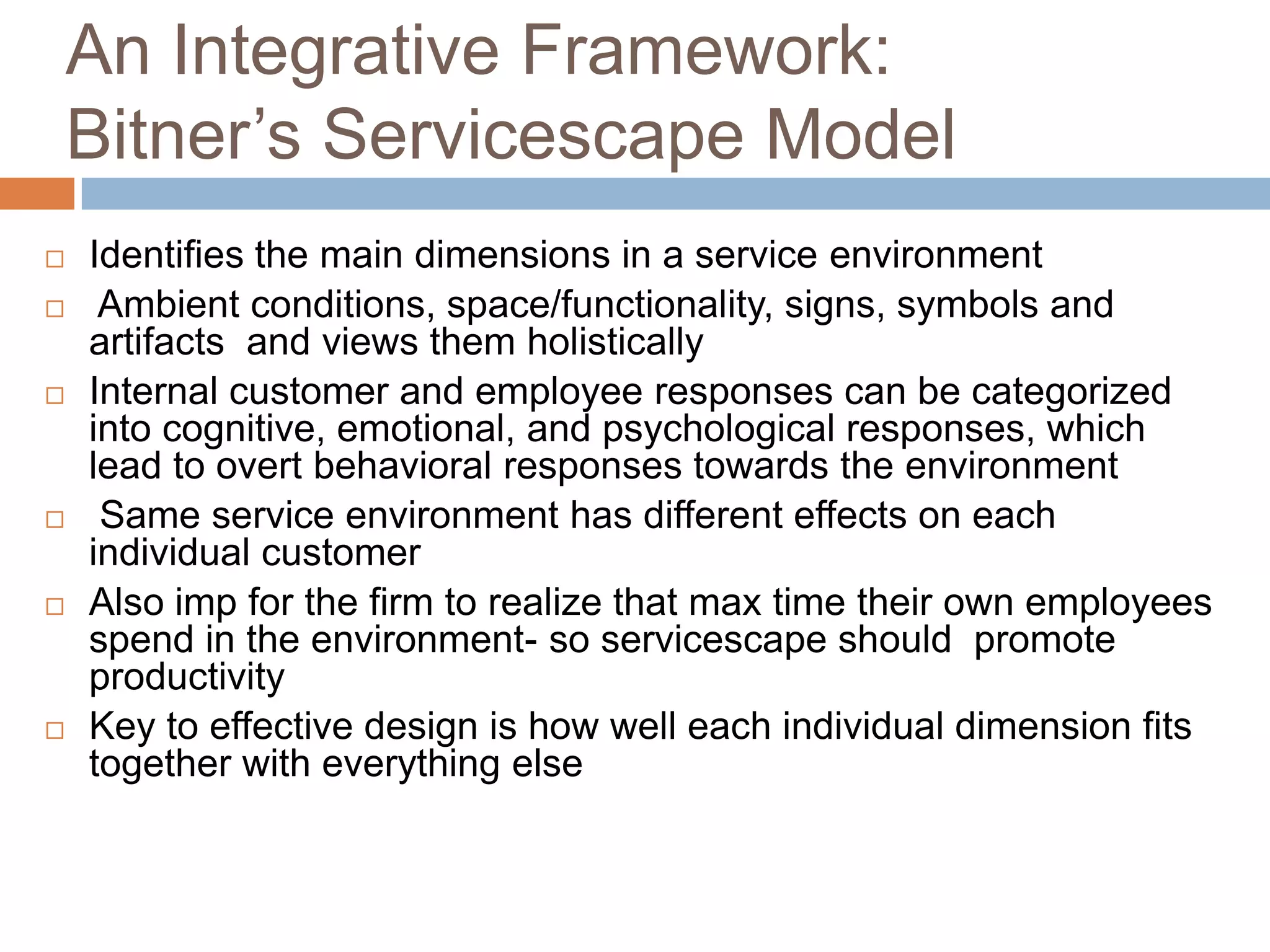
An Integrative Framework:
Bitner’s Servicescape Model
 Identifies the main dimensions in a service environment
 Ambient conditions, space/functionality, signs, symbols and
artifacts and views them holistically
 Internal customer and employee responses can be categorized
into cognitive, emotional, and psychological responses, which
lead to overt behavioral responses towards the environment
 Same service environment has different effects on each
individual customer
 Also imp for the firm to realize that max time their own employees
spend in the environment- so servicescape should promote
productivity
 Key to effective design is how well each individual dimension fits
together with everything else
Dimensions of the Service
Environment
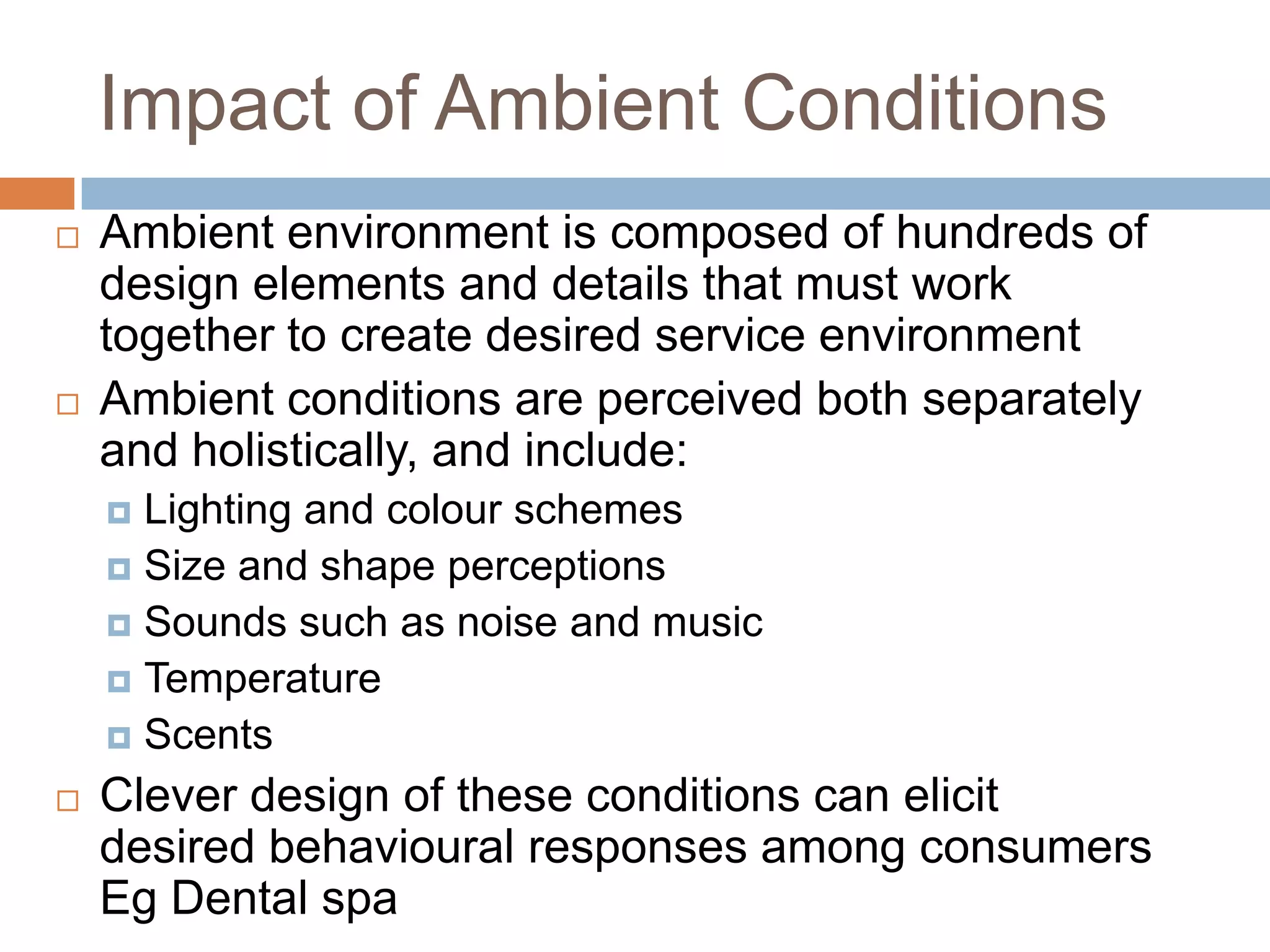
Main Dimensions in
Servicescape Model
 Ambient Conditions
 Characteristics of environment pertaining to our five
senses
 Spatial Layout and Functionality
 Spatial layout:
- Floorplan
- Size and shape of furnishings, counters, machinery,equipment,
and how they are arranged
 Functionality: Ability of those items to facilitate
performance
 Signs, Symbols, and Artifacts
 Explicit or implicit signals to:
- Communicate firm’s image
- Help consumers find their way
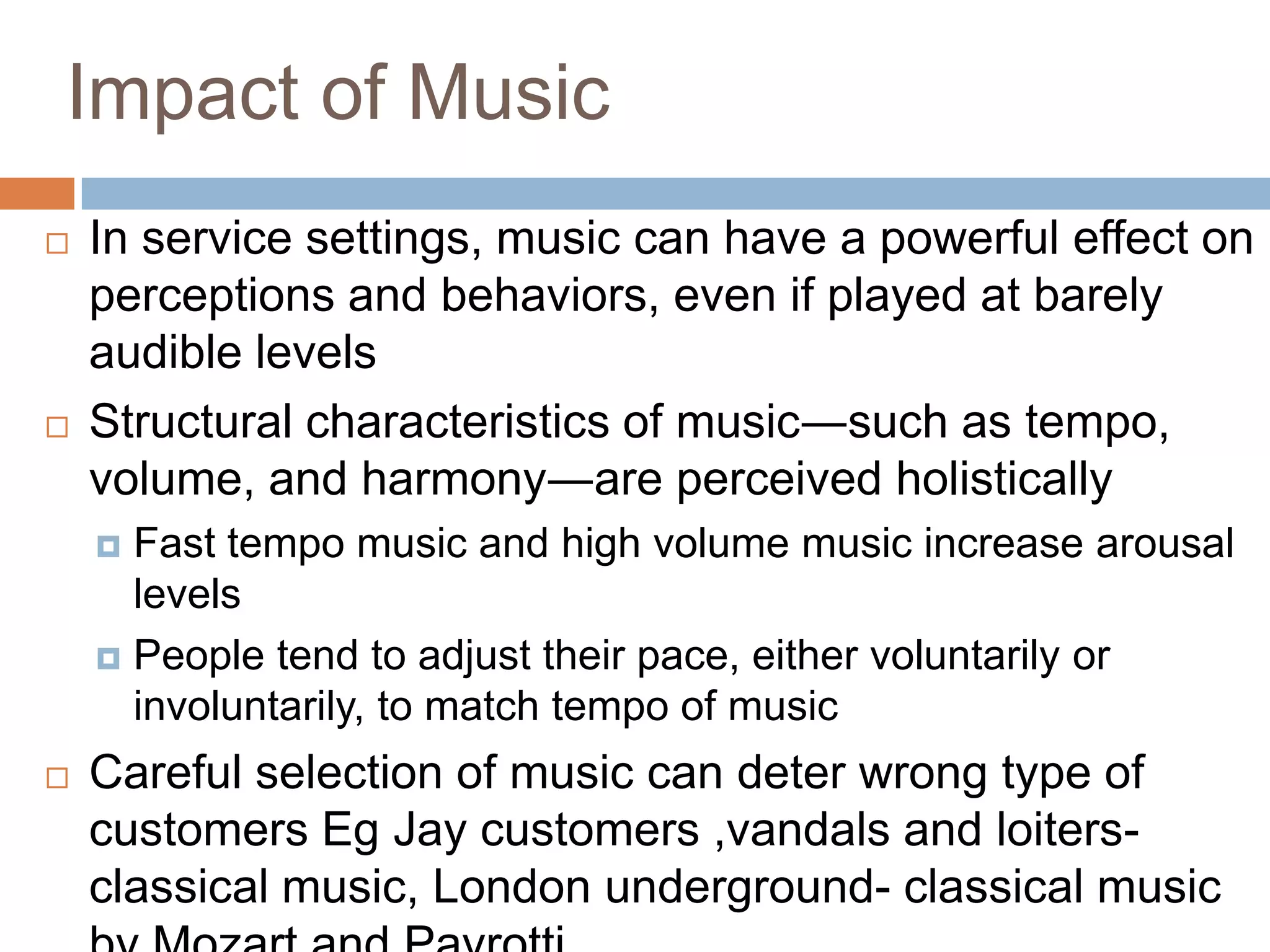
Impact of Ambient Conditions
 Ambient environment is composed of hundreds of
design elements and details that must work
together to create desired service environment
 Ambient conditions are perceived both separately
and holistically, and include:
 Lighting and colour schemes
 Size and shape perceptions
 Sounds such as noise and music
 Temperature
 Scents
 Clever design of these conditions can elicit
desired behavioural responses among consumers
Eg Dental spa
Impact of Music
 In service settings, music can have a powerful effect on
perceptions and behaviors, even if played at barely
audible levels
 Structural characteristics of music―such as tempo,
volume, and harmony―are perceived holistically
 Fast tempo music and high volume music increase arousal
levels
 People tend to adjust their pace, either voluntarily or
involuntarily, to match tempo of music
 Careful selection of music can deter wrong type of
customers Eg Jay customers ,vandals and loiters-
classical music, London underground- classical music
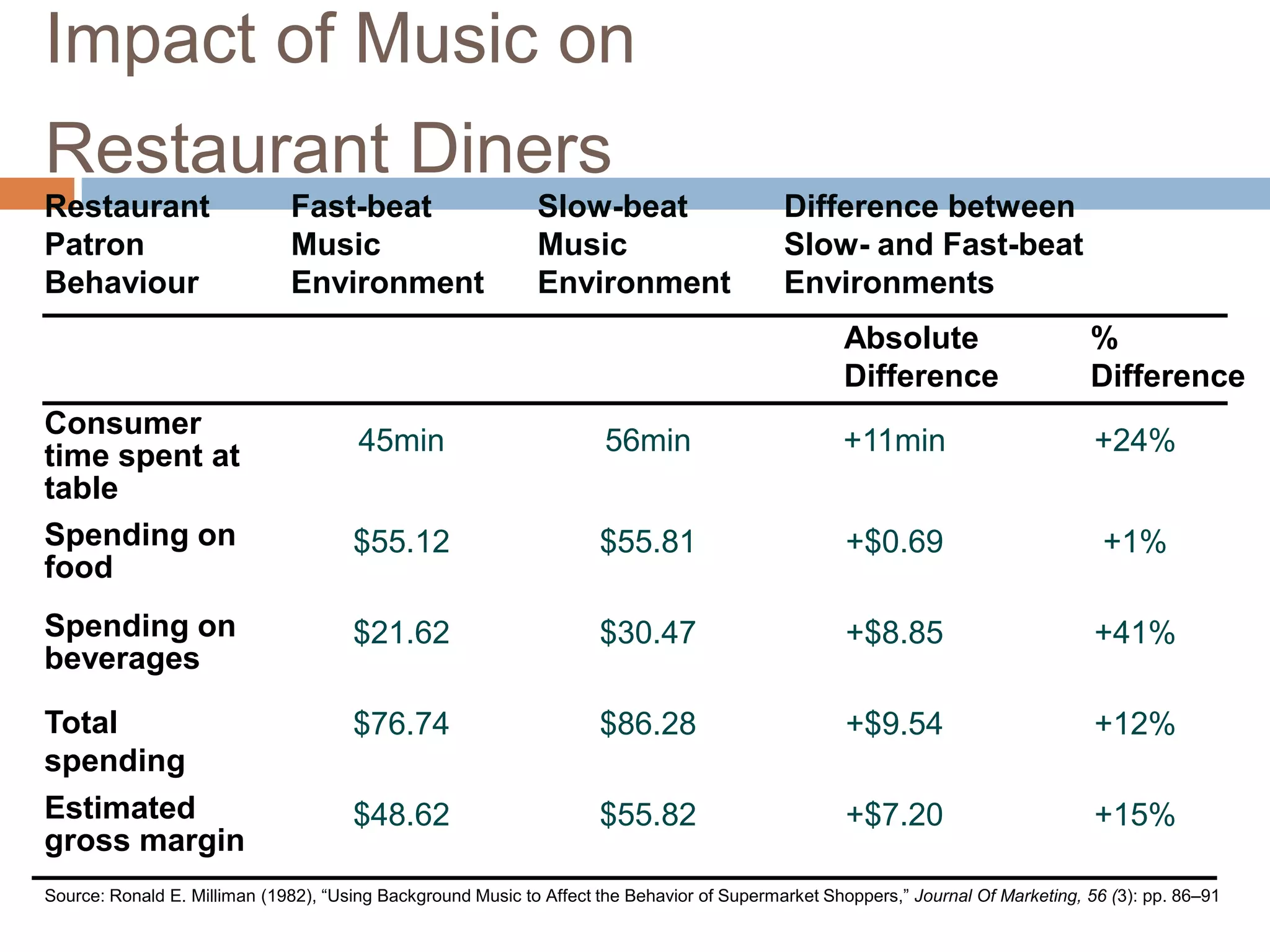
Impact of Music on
Restaurant Diners
Restaurant
Patron
Behaviour
Fast-beat
Music
Environment
Slow-beat
Music
Environment
Difference between
Slow- and Fast-beat
Environments
Absolute
Difference
%
Difference
Consumer
time spent at
table
45min 56min +11min +24%
Spending on
food
$55.12 $55.81 +$0.69 +1%
Spending on
beverages
$21.62 $30.47 +$8.85 +41%
Total
spending
$76.74 $86.28 +$9.54 +12%
Estimated
gross margin
$48.62 $55.82 +$7.20 +15%
Source: Ronald E. Milliman (1982), ―Using Background Music to Affect the Behavior of Supermarket Shoppers,‖ Journal Of Marketing, 56 (3): pp. 86–91
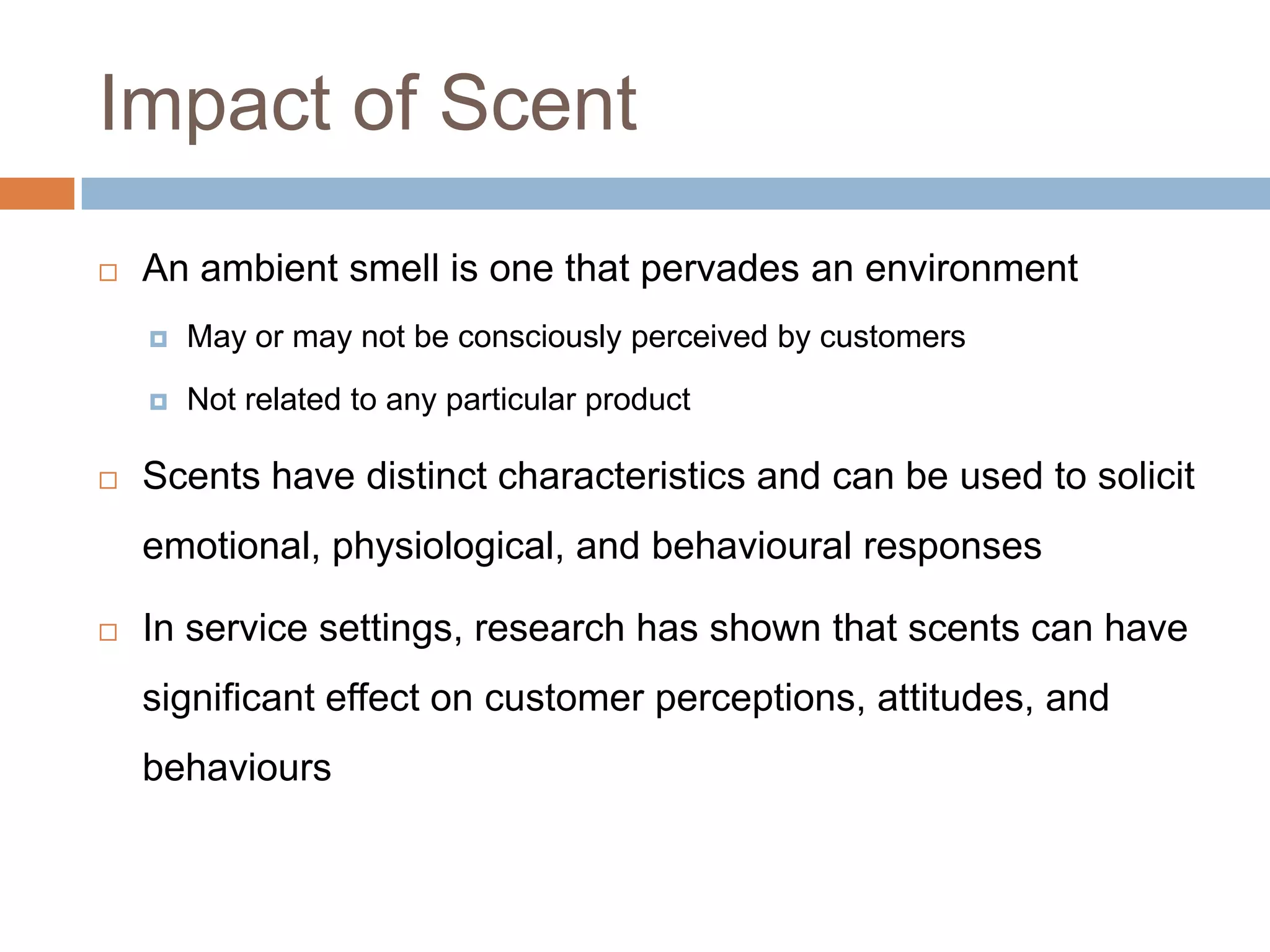
Impact of Scent
 An ambient smell is one that pervades an environment
 May or may not be consciously perceived by customers
 Not related to any particular product
 Scents have distinct characteristics and can be used to solicit
emotional, physiological, and behavioural responses
 In service settings, research has shown that scents can have
significant effect on customer perceptions, attitudes, and
behaviours
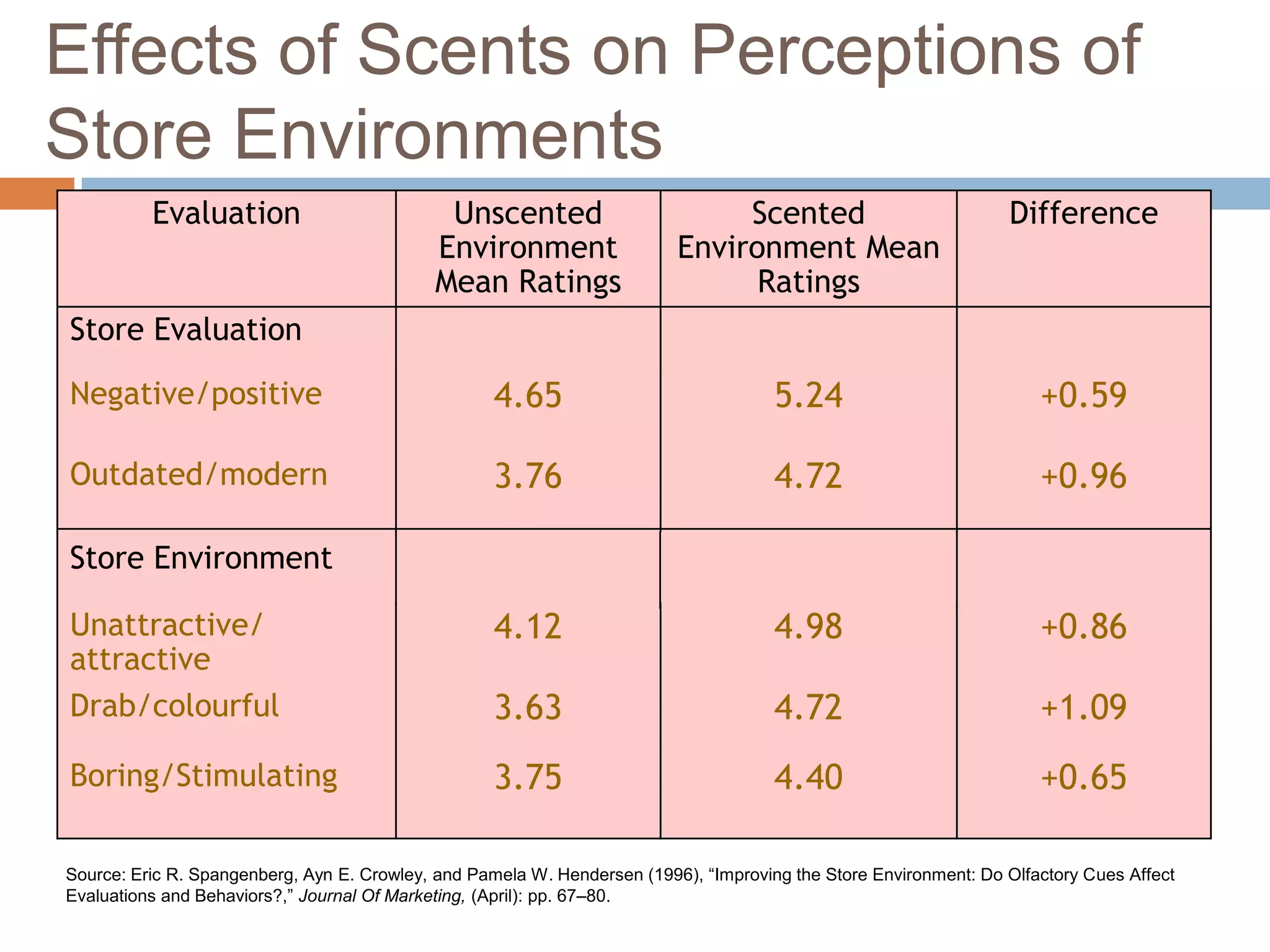
Effects of Scents on Perceptions of
Store Environments
Evaluation Unscented
Environment
Mean Ratings
Scented
Environment Mean
Ratings
Difference
Store Evaluation
Negative/positive 4.65 5.24 +0.59
Outdated/modern 3.76 4.72 +0.96
Store Environment
Unattractive/
attractive
4.12 4.98 +0.86
Drab/colourful 3.63 4.72 +1.09
Boring/Stimulating 3.75 4.40 +0.65
Source: Eric R. Spangenberg, Ayn E. Crowley, and Pamela W. Hendersen (1996), ―Improving the Store Environment: Do Olfactory Cues Affect
Evaluations and Behaviors?,‖ Journal Of Marketing, (April): pp. 67–80.
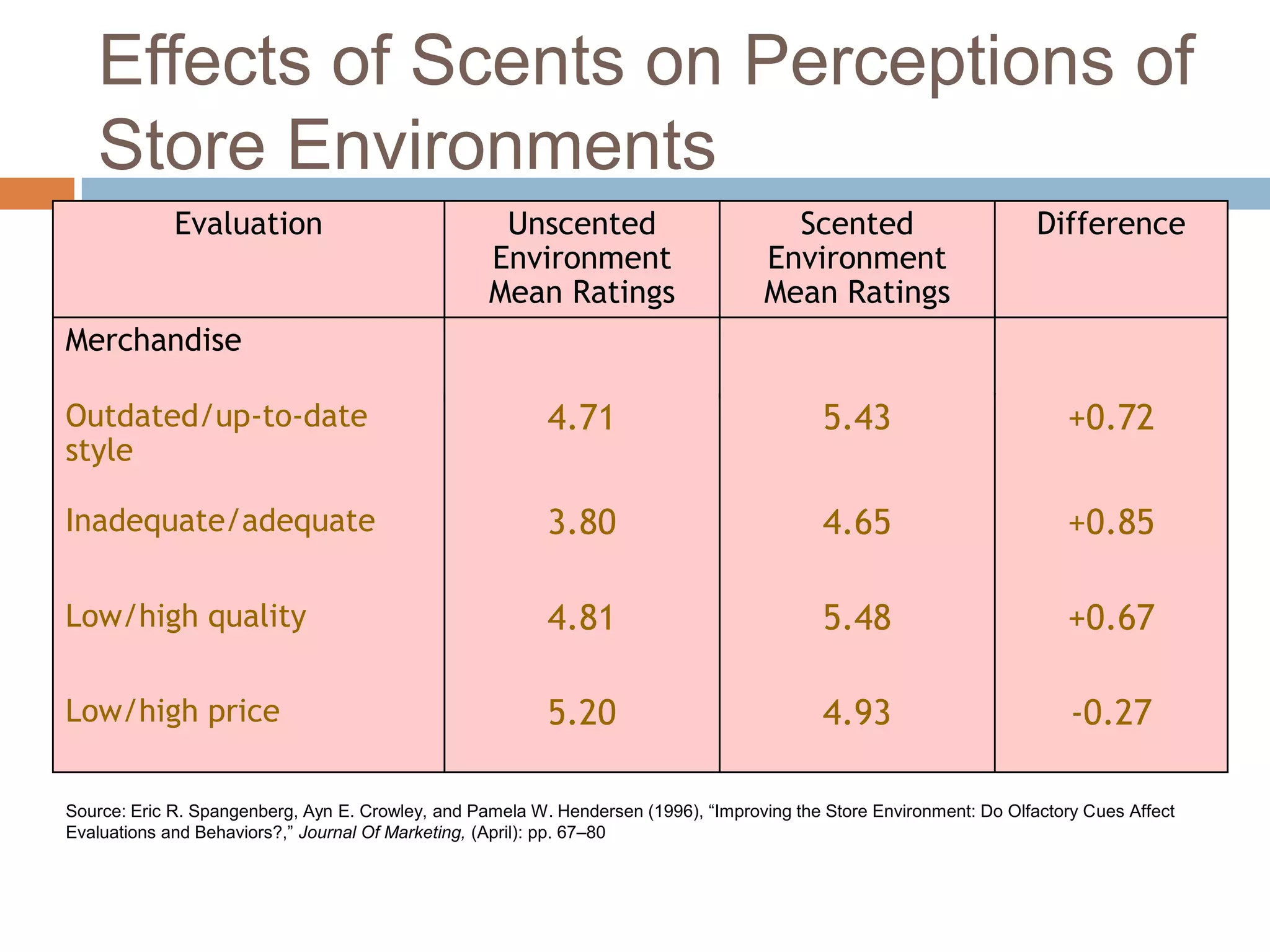
Effects of Scents on Perceptions of
Store Environments
Evaluation Unscented
Environment
Mean Ratings
Scented
Environment
Mean Ratings
Difference
Merchandise
Outdated/up-to-date
style
4.71 5.43 +0.72
Inadequate/adequate 3.80 4.65 +0.85
Low/high quality 4.81 5.48 +0.67
Low/high price 5.20 4.93 -0.27
Source: Eric R. Spangenberg, Ayn E. Crowley, and Pamela W. Hendersen (1996), ―Improving the Store Environment: Do Olfactory Cues Affect
Evaluations and Behaviors?,‖ Journal Of Marketing, (April): pp. 67–80
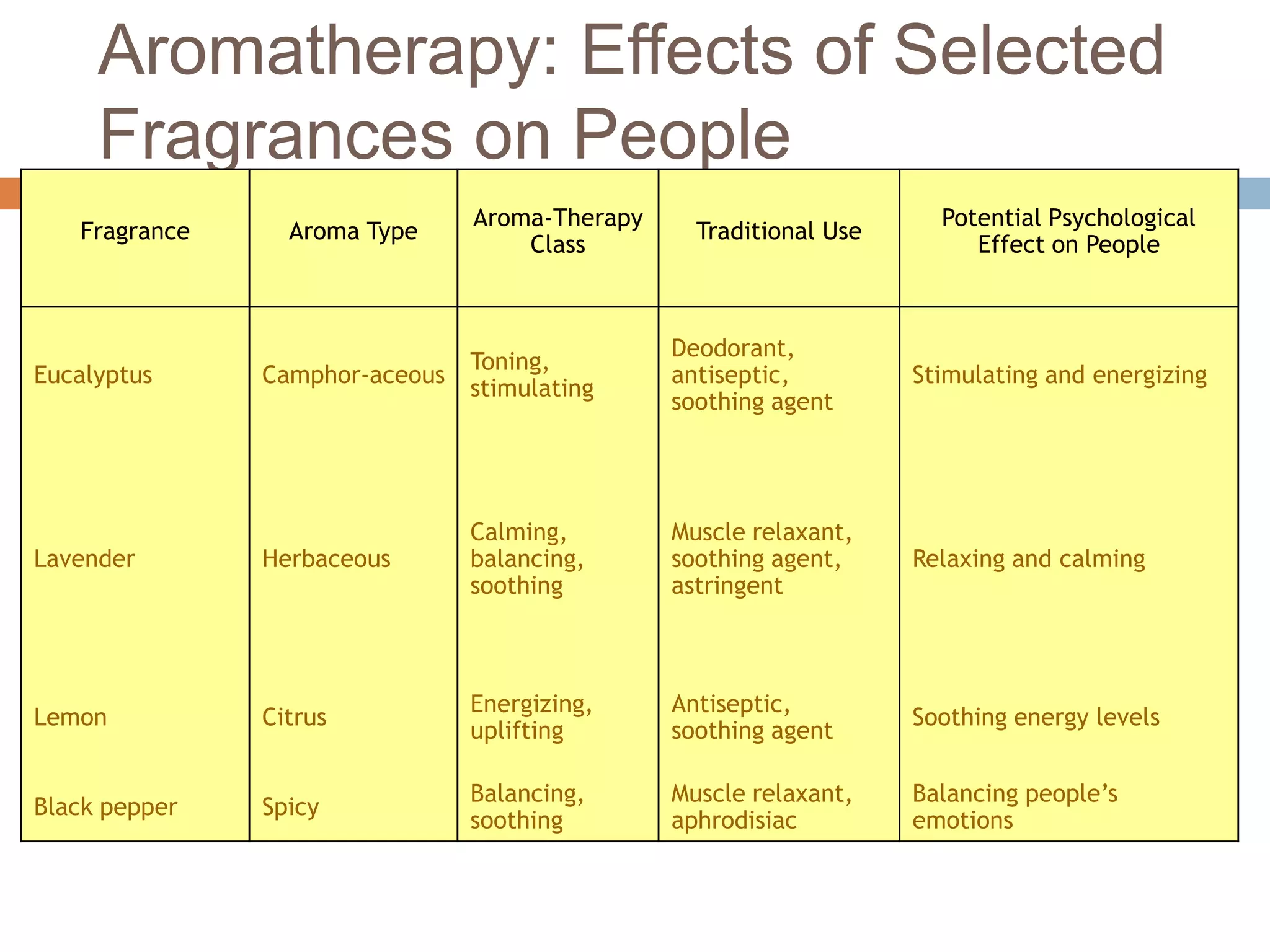
Aromatherapy: Effects of Selected
Fragrances on People
Fragrance Aroma Type
Aroma-Therapy
Class
Traditional Use
Potential Psychological
Effect on People
Eucalyptus Camphor-aceous
Toning,
stimulating
Deodorant,
antiseptic,
soothing agent
Stimulating and energizing
Lavender Herbaceous
Calming,
balancing,
soothing
Muscle relaxant,
soothing agent,
astringent
Relaxing and calming
Lemon Citrus
Energizing,
uplifting
Antiseptic,
soothing agent
Soothing energy levels
Black pepper Spicy
Balancing,
soothing
Muscle relaxant,
aphrodisiac
Balancing people’s
emotions
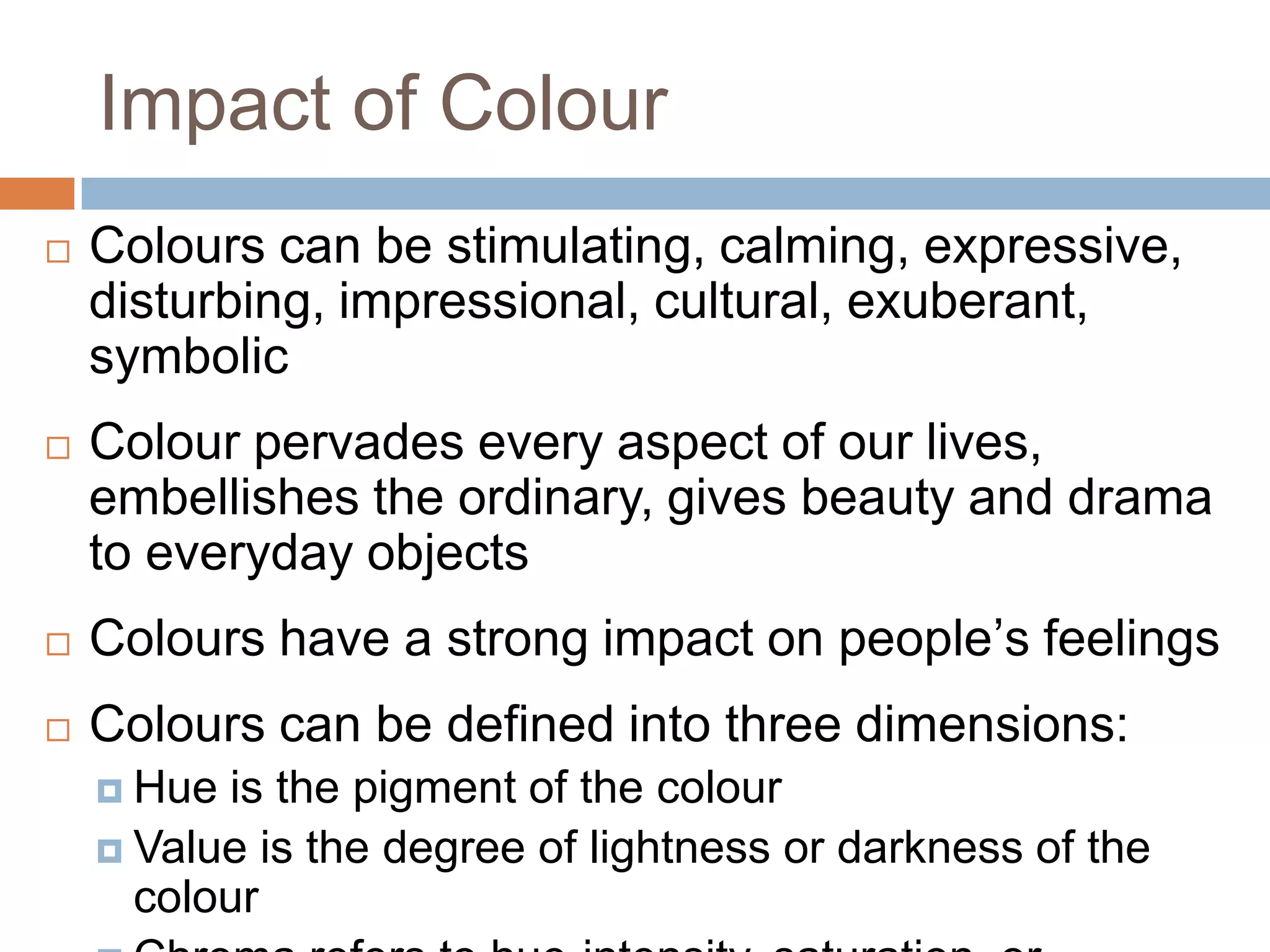
Impact of Colour
 Colours can be stimulating, calming, expressive,
disturbing, impressional, cultural, exuberant,
symbolic
 Colour pervades every aspect of our lives,
embellishes the ordinary, gives beauty and drama
to everyday objects
 Colours have a strong impact on people’s feelings
 Colours can be defined into three dimensions:
 Hue is the pigment of the colour
 Value is the degree of lightness or darkness of the
colour
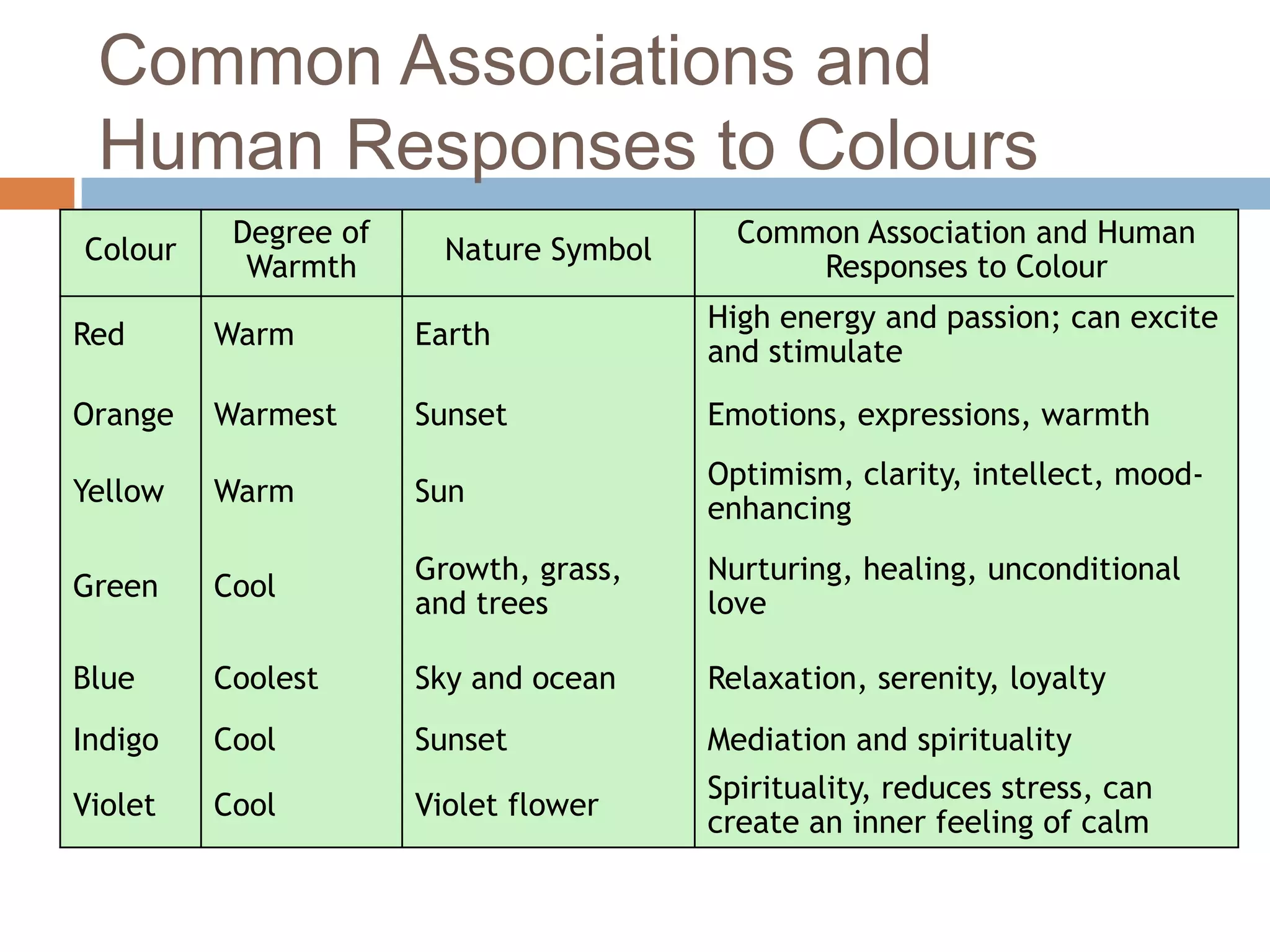
Common Associations and
Human Responses to Colours
Colour
Degree of
Warmth
Nature Symbol
Common Association and Human
Responses to Colour
Red Warm Earth
High energy and passion; can excite
and stimulate
Orange Warmest Sunset Emotions, expressions, warmth
Yellow Warm Sun
Optimism, clarity, intellect, mood-
enhancing
Green Cool
Growth, grass,
and trees
Nurturing, healing, unconditional
love
Blue Coolest Sky and ocean Relaxation, serenity, loyalty
Indigo Cool Sunset Mediation and spirituality
Violet Cool Violet flower
Spirituality, reduces stress, can
create an inner feeling of calm
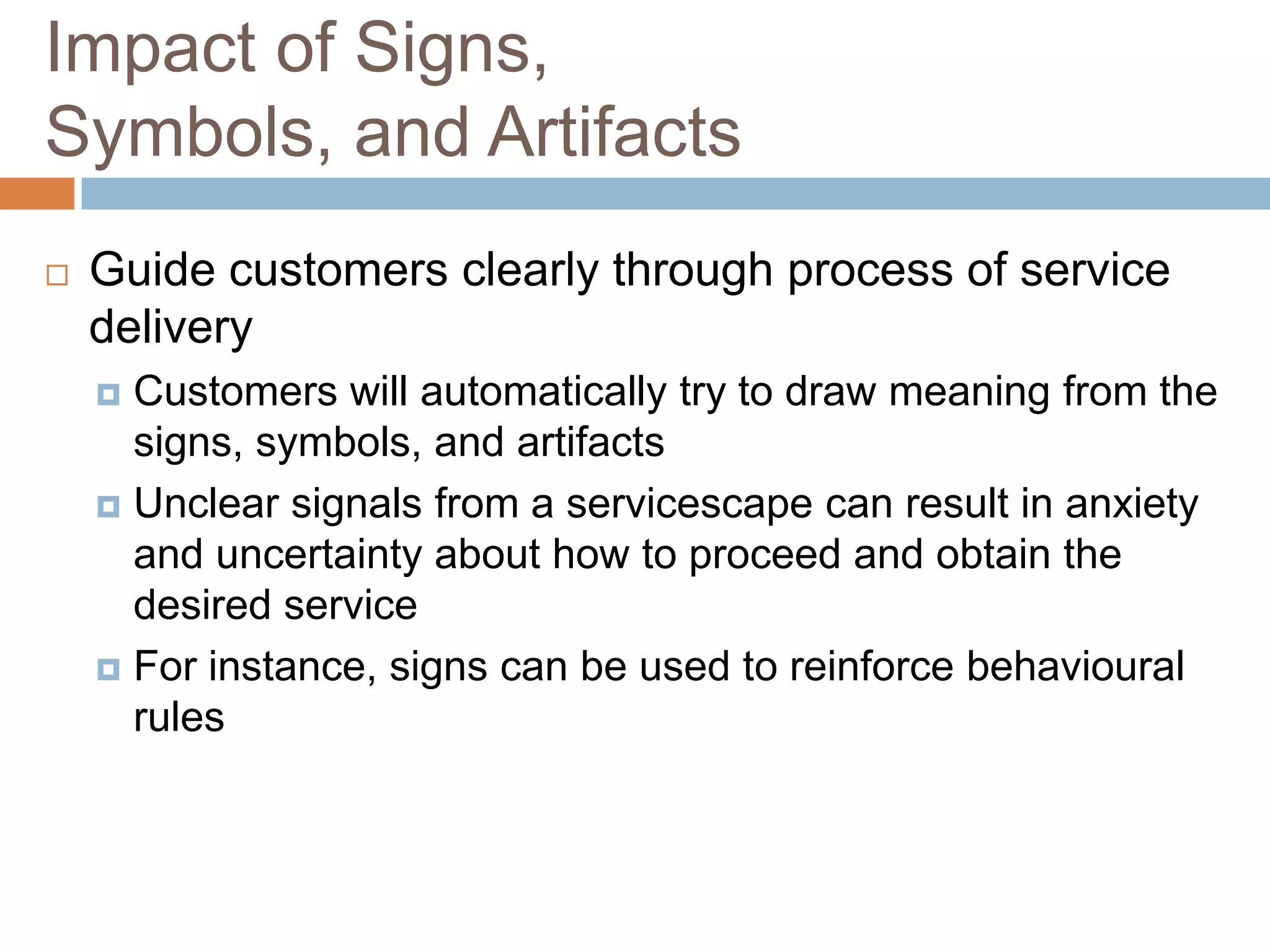
Impact of Signs,
Symbols, and Artifacts
 Guide customers clearly through process of service
delivery
 Customers will automatically try to draw meaning from the
signs, symbols, and artifacts
 Unclear signals from a servicescape can result in anxiety
and uncertainty about how to proceed and obtain the
desired service
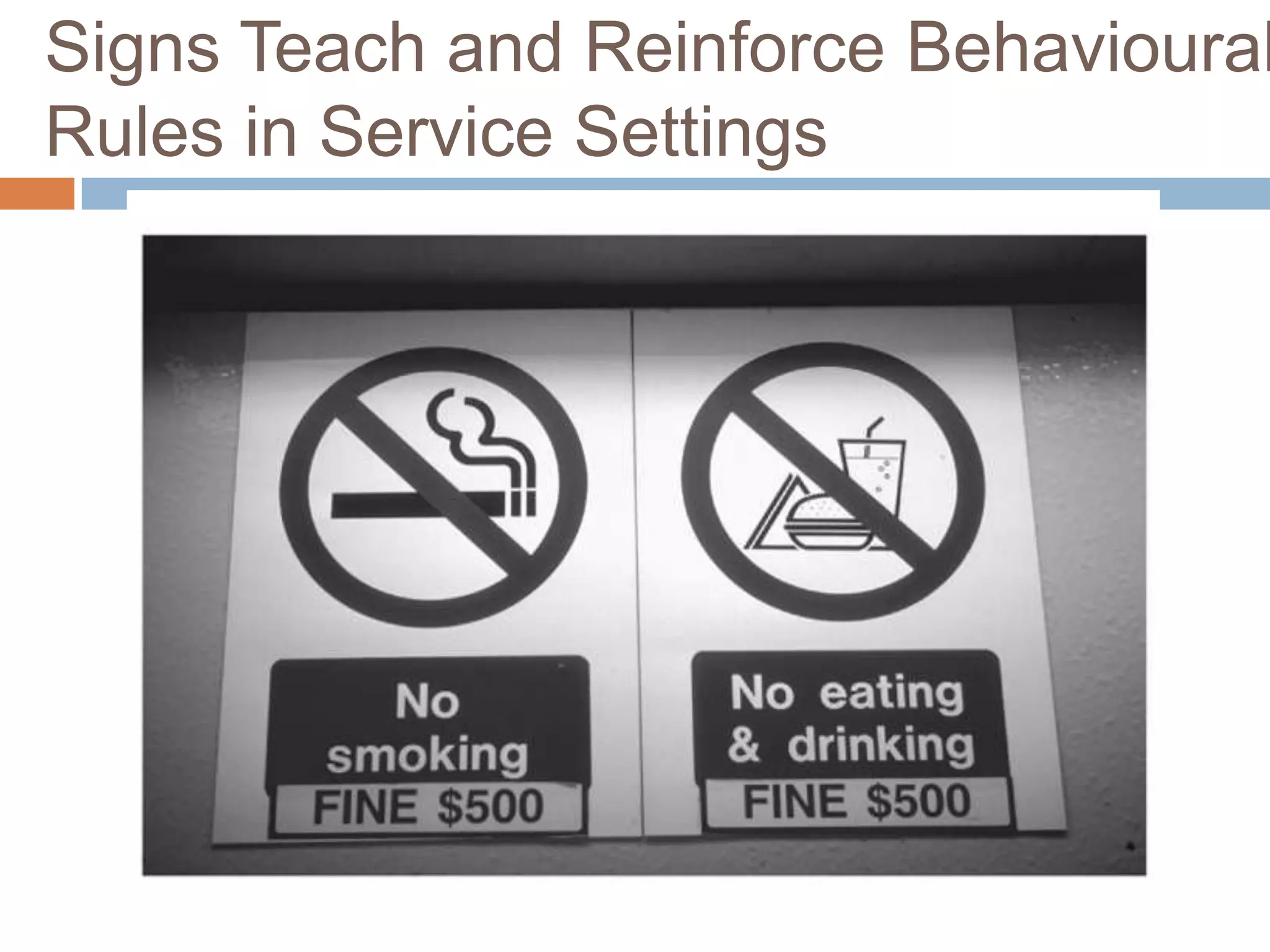
 For instance, signs can be used to reinforce behavioural
rules
Signs Teach and Reinforce Behavioural
Rules in Service Settings
Note: Fines are in Singapore dollars (equivalent to roughly US $300)
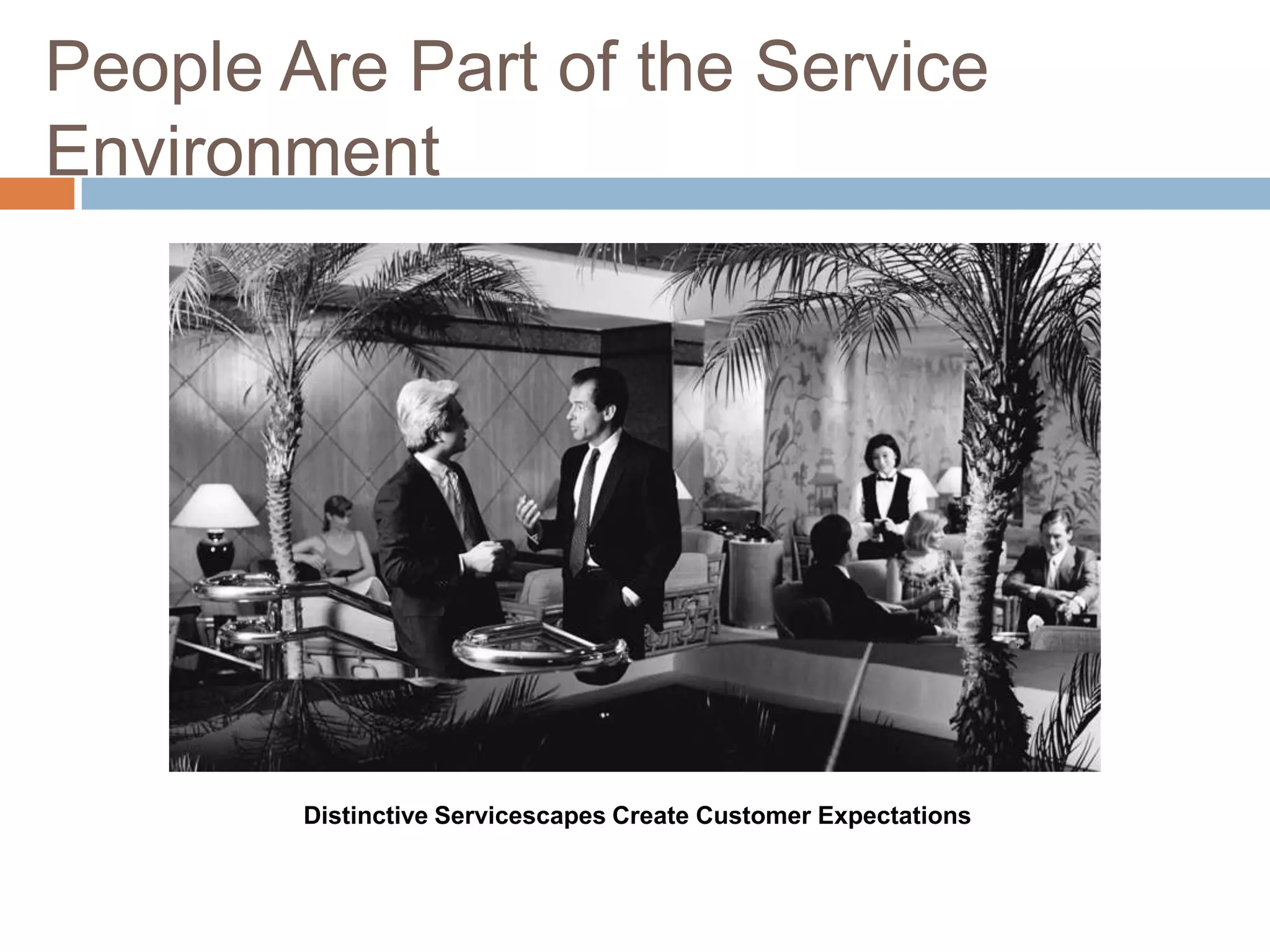
People Are Part of the Service
Environment
Distinctive Servicescapes Create Customer Expectations
Putting It All Together
Selection of Environmental Design
Elements
 Consumers perceive service environments
holistically
 Design with a holistic view
 Servicescapes have to be seen holistically: No
dimension of design can be optimized in isolation,
because everything depends on everything else
 Holistic characteristic of environments makes
designing service environment an art
 Must design from a customer’s perspective
Tools to Guide Servicescape
Design
 Keen observation of customers’ behaviour and responses to the
service environment by management, supervisors, branch
managers, and frontline staff
 Feedback and ideas from frontline staff and customers, using a
broad array of research tools from suggestion boxes to focus
groups and surveys.
 Field experiments can be used to manipulate specific dimensions
in an environment and the effects observed.
 Blueprinting or service mapping—extended to include physical
evidence in the environment.
Summary
 Service environments are very important to
service marketers
 Communicate the positioning strategy
 Key part of delivery system
 Shape employee and customer productivity
 There are a number of key models that describe
customer responses to service environments
 Customers perceive the servicescape holistically
 Designing service environments is an art needing
professional designers who are customer centric

Service environment

  • 1.
  • 2.
    Learning Objectives  Studythe purpose of service environments  Understand consumer responses to service environments  Uncover the dimensions of the service environment  Determine design elements of effective servicescapes
  • 3.
    What Is thePurpose of Service Environments?
  • 4.
    Purpose of Service Environments Helps firm to create distinctive image and unique positioning  Relate to the style and appearance of the physical surroundings and other experiential elements encountered by the customers at service delivery site  Service environment (servicescape) affects buyer behaviour in three ways:  Message-creating medium: Symbolic cues to communicate the distinctive nature and quality of the service experience  Attention-creating medium: Make servicescape stand out from competition and attract customers from target segments  Effect-creating medium: Use colours, textures, sounds, scents and spatial design to enhance desired service experience
  • 5.
    Comparison of HotelLobbies Each servicescape clearly communicates and reinforces its hotel’s respective positioning and sets service expectations as guests arrive
  • 6.
    Image, Positioning and Differentiation Intangible, customers cannot check quality well  Use service environment as a proxy, and hence firms make quality environment and desired image  Reception areas of big companies  In retail store environment portrays the quality of the merchandise  Some servicescape are functional
  • 7.
    Servicescape as Partof Value Proposition  Physical surroundings help shape appropriate feelings and reactions in customers and employees  For example: Disneyland, Denmark’s Legoland  Servicescapes form a core part of the value proposition  For example: Club Med, Las Vegas, Florida-based Muvico - Las Vegas: Repositioned itself to a somewhat more wholesome fun resort, visually striking entertainment centre - Taj Holiday Village, Orange County Resorts
  • 8.
    Elements of PhysicalEvidence Servicescape Other tangibles Facility exterior Exterior design Signage Parking Landscape Surrounding environment Facility interior Interior design Equipment Signage Layout Air quality/temperature Business cards Stationery Billing statements Reports Employee dress Uniforms Brochures Web pages Virtual servicescape
  • 9.
    Examples of PhysicalEvidence from the Customer’s Point of View
  • 10.
    Typology of ServiceOrganizations Based on Variations in Form and Use of the Servicescape Complexity of the Servicescape Servicescape usage Elaborate Lean Self-service (customer only) Golf course eBay ATM Car wash Simple Internet services Express mail drop-off Interpersonal services (both customer and employee) Hotel Restaurant Health clinic Hospital Bank Airline School Dry cleaner Retail cart Hair salon Remote service (employee only) Telephone company Insurance company Utility Many professional services Telephone mail-order desk Automated voice messaging services
  • 11.
    Roles of theServicescape  Package  conveys expectations  influences perceptions  Facilitator  facilitates the flow of the service delivery process  provides information (how am I to act?)  facilitates the ordering process (how does this work?)  facilitates service delivery  Socializer  facilitates interaction between:  customers and employees  customers and fellow customers  Differentiator  sets provider apart from competition in the mind of the consumer
  • 12.
  • 13.
    The Mehrabian-Russell Stimulus- ResponseModel Response/ Behaviour: Approach Avoidance and Cognitive Processes Environmental Stimuli and Cognitive Processes Dimensions of Affect: Pleasure and Arousal Feelings Are a Key Driver of Customer Responses to Service Environments
  • 14.
    Insights from Mehrabian-Russell Stimulus-ResponseModel  Simple yet fundamental model of how people respond to environments  The environment, its conscious and unconscious perceptions, and interpretation influence how people feel in that environment  Feelings, rather than perceptions/thoughts drive behavior  Typical outcome variable is “approach” or “avoidance” of an environment, but other possible outcomes can be added to model  Eg crowded environment vs deterred by feeling of crowd
  • 15.
  • 16.
    Insights from RussellModel of Affect  Emotional responses to environments can be described along two main dimensions:  Pleasure: Direct, subjective, depending on how much individual likes or dislikes environment  Arousal: How stimulated individual feels, depends largely on information rate or load of an environment Eg deep sleep to bungee jumping eg. Stimulating- have high info rate /novel/surprise  Russell separated cognitive part of emotions from these two emotional dimensions  Advantage: simplicity, allows a direct assessment of how customers feel  Firms can set targets for affective states
  • 17.
    Drivers of Affect Affect can be caused by perceptions and cognitive processes of any degree of complexity  It’s the simple cognitive processes that determine how people feel in a service setting  If higher levels of cognitive processes are triggered, the interpretation of this process determines people’s feelings  The more complex a cognitive process becomes, the more powerful its potential impact on affect.  However, most service encounters are routine and simple processes can determine affect.
  • 18.
    Behavioural Consequence of Affect Pleasant environments result in approach, whereas unpleasant ones result in avoidance  Arousal amplifies the basic effect of pleasure on behaviour  If environment is pleasant, increasing arousal can generate excitement, leading to a stronger positive consumer response  If environment is unpleasant, increasing arousal level will move customers into the ―distressed‖ region  Feelings during service encounters are an important driver of customer loyalty  Holiday season- loud fast music- could increase stress levels
  • 19.
    Ambient Conditions Temp,Air,Nois e,Music,Scent Space/ Function Layout,Equip ment,Furnishi ngs Signs, Symbols, and Artifacts Cognitive Emotional Psychological An IntegrativeFramework: Bitner’s Servicescape Model ENVIRONMENTAL DIMENSIONS HOLISTIC ENVIRONMENT MODERATORS INTERNAL RESPONSES BEHAVIOUR Source: Mary J. Bitner, ―Servicescapes: The Impact of Physical Surroundings on Customers and Employees,‖ Journal of Marketing 56 (April 1992), pp. 57-71. American Marketing Association. Perceived Servicescape Employee Response Moderator Customer Response Moderator Employee Responses Customer Responses Cognitive Emotional Psychological Approach • Affiliation • Exploration • Stay longer • Satisfaction Avoid (opposite of approach) Approach • Attraction • Stay/Explore • Spend More $$$ • Satisfaction Avoid (opposite of approach) Social Interaction Between Customers and Employees
  • 20.
    A Framework forUnderstanding Environment-User Relationships in Service Organizations Source: M. J. Bitner, ―Servicescapes: The Impact of Physical Surroundings on Customers and Employees,‖ Journal of Marketing 56 (April 1992), 57–71.
  • 21.
    An Integrative Framework: Bitner’sServicescape Model  Identifies the main dimensions in a service environment  Ambient conditions, space/functionality, signs, symbols and artifacts and views them holistically  Internal customer and employee responses can be categorized into cognitive, emotional, and psychological responses, which lead to overt behavioral responses towards the environment  Same service environment has different effects on each individual customer  Also imp for the firm to realize that max time their own employees spend in the environment- so servicescape should promote productivity  Key to effective design is how well each individual dimension fits together with everything else
  • 22.
    Dimensions of theService Environment
  • 23.
    Main Dimensions in ServicescapeModel  Ambient Conditions  Characteristics of environment pertaining to our five senses  Spatial Layout and Functionality  Spatial layout: - Floorplan - Size and shape of furnishings, counters, machinery,equipment, and how they are arranged  Functionality: Ability of those items to facilitate performance  Signs, Symbols, and Artifacts  Explicit or implicit signals to: - Communicate firm’s image - Help consumers find their way
  • 24.
    Impact of AmbientConditions  Ambient environment is composed of hundreds of design elements and details that must work together to create desired service environment  Ambient conditions are perceived both separately and holistically, and include:  Lighting and colour schemes  Size and shape perceptions  Sounds such as noise and music  Temperature  Scents  Clever design of these conditions can elicit desired behavioural responses among consumers Eg Dental spa
  • 25.
    Impact of Music In service settings, music can have a powerful effect on perceptions and behaviors, even if played at barely audible levels  Structural characteristics of music―such as tempo, volume, and harmony―are perceived holistically  Fast tempo music and high volume music increase arousal levels  People tend to adjust their pace, either voluntarily or involuntarily, to match tempo of music  Careful selection of music can deter wrong type of customers Eg Jay customers ,vandals and loiters- classical music, London underground- classical music
  • 26.
    Impact of Musicon Restaurant Diners Restaurant Patron Behaviour Fast-beat Music Environment Slow-beat Music Environment Difference between Slow- and Fast-beat Environments Absolute Difference % Difference Consumer time spent at table 45min 56min +11min +24% Spending on food $55.12 $55.81 +$0.69 +1% Spending on beverages $21.62 $30.47 +$8.85 +41% Total spending $76.74 $86.28 +$9.54 +12% Estimated gross margin $48.62 $55.82 +$7.20 +15% Source: Ronald E. Milliman (1982), ―Using Background Music to Affect the Behavior of Supermarket Shoppers,‖ Journal Of Marketing, 56 (3): pp. 86–91
  • 27.
    Impact of Scent An ambient smell is one that pervades an environment  May or may not be consciously perceived by customers  Not related to any particular product  Scents have distinct characteristics and can be used to solicit emotional, physiological, and behavioural responses  In service settings, research has shown that scents can have significant effect on customer perceptions, attitudes, and behaviours
  • 28.
    Effects of Scentson Perceptions of Store Environments Evaluation Unscented Environment Mean Ratings Scented Environment Mean Ratings Difference Store Evaluation Negative/positive 4.65 5.24 +0.59 Outdated/modern 3.76 4.72 +0.96 Store Environment Unattractive/ attractive 4.12 4.98 +0.86 Drab/colourful 3.63 4.72 +1.09 Boring/Stimulating 3.75 4.40 +0.65 Source: Eric R. Spangenberg, Ayn E. Crowley, and Pamela W. Hendersen (1996), ―Improving the Store Environment: Do Olfactory Cues Affect Evaluations and Behaviors?,‖ Journal Of Marketing, (April): pp. 67–80.
  • 29.
    Effects of Scentson Perceptions of Store Environments Evaluation Unscented Environment Mean Ratings Scented Environment Mean Ratings Difference Merchandise Outdated/up-to-date style 4.71 5.43 +0.72 Inadequate/adequate 3.80 4.65 +0.85 Low/high quality 4.81 5.48 +0.67 Low/high price 5.20 4.93 -0.27 Source: Eric R. Spangenberg, Ayn E. Crowley, and Pamela W. Hendersen (1996), ―Improving the Store Environment: Do Olfactory Cues Affect Evaluations and Behaviors?,‖ Journal Of Marketing, (April): pp. 67–80
  • 30.
    Aromatherapy: Effects ofSelected Fragrances on People Fragrance Aroma Type Aroma-Therapy Class Traditional Use Potential Psychological Effect on People Eucalyptus Camphor-aceous Toning, stimulating Deodorant, antiseptic, soothing agent Stimulating and energizing Lavender Herbaceous Calming, balancing, soothing Muscle relaxant, soothing agent, astringent Relaxing and calming Lemon Citrus Energizing, uplifting Antiseptic, soothing agent Soothing energy levels Black pepper Spicy Balancing, soothing Muscle relaxant, aphrodisiac Balancing people’s emotions
  • 31.
    Impact of Colour Colours can be stimulating, calming, expressive, disturbing, impressional, cultural, exuberant, symbolic  Colour pervades every aspect of our lives, embellishes the ordinary, gives beauty and drama to everyday objects  Colours have a strong impact on people’s feelings  Colours can be defined into three dimensions:  Hue is the pigment of the colour  Value is the degree of lightness or darkness of the colour
  • 32.
    Common Associations and HumanResponses to Colours Colour Degree of Warmth Nature Symbol Common Association and Human Responses to Colour Red Warm Earth High energy and passion; can excite and stimulate Orange Warmest Sunset Emotions, expressions, warmth Yellow Warm Sun Optimism, clarity, intellect, mood- enhancing Green Cool Growth, grass, and trees Nurturing, healing, unconditional love Blue Coolest Sky and ocean Relaxation, serenity, loyalty Indigo Cool Sunset Mediation and spirituality Violet Cool Violet flower Spirituality, reduces stress, can create an inner feeling of calm
  • 33.
    Impact of Signs, Symbols,and Artifacts  Guide customers clearly through process of service delivery  Customers will automatically try to draw meaning from the signs, symbols, and artifacts  Unclear signals from a servicescape can result in anxiety and uncertainty about how to proceed and obtain the desired service  For instance, signs can be used to reinforce behavioural rules
  • 34.
    Signs Teach andReinforce Behavioural Rules in Service Settings Note: Fines are in Singapore dollars (equivalent to roughly US $300)
  • 35.
    People Are Partof the Service Environment Distinctive Servicescapes Create Customer Expectations
  • 36.
  • 37.
    Selection of EnvironmentalDesign Elements  Consumers perceive service environments holistically  Design with a holistic view  Servicescapes have to be seen holistically: No dimension of design can be optimized in isolation, because everything depends on everything else  Holistic characteristic of environments makes designing service environment an art  Must design from a customer’s perspective
  • 38.
    Tools to GuideServicescape Design  Keen observation of customers’ behaviour and responses to the service environment by management, supervisors, branch managers, and frontline staff  Feedback and ideas from frontline staff and customers, using a broad array of research tools from suggestion boxes to focus groups and surveys.  Field experiments can be used to manipulate specific dimensions in an environment and the effects observed.  Blueprinting or service mapping—extended to include physical evidence in the environment.
  • 39.
    Summary  Service environmentsare very important to service marketers  Communicate the positioning strategy  Key part of delivery system  Shape employee and customer productivity  There are a number of key models that describe customer responses to service environments  Customers perceive the servicescape holistically  Designing service environments is an art needing professional designers who are customer centric