Chapter 5
Product Strategy
Prepared by:
Nor Izzuddin Bin Norrahman
Lecturer of Management, Banking & Islamic Finance
Astin College
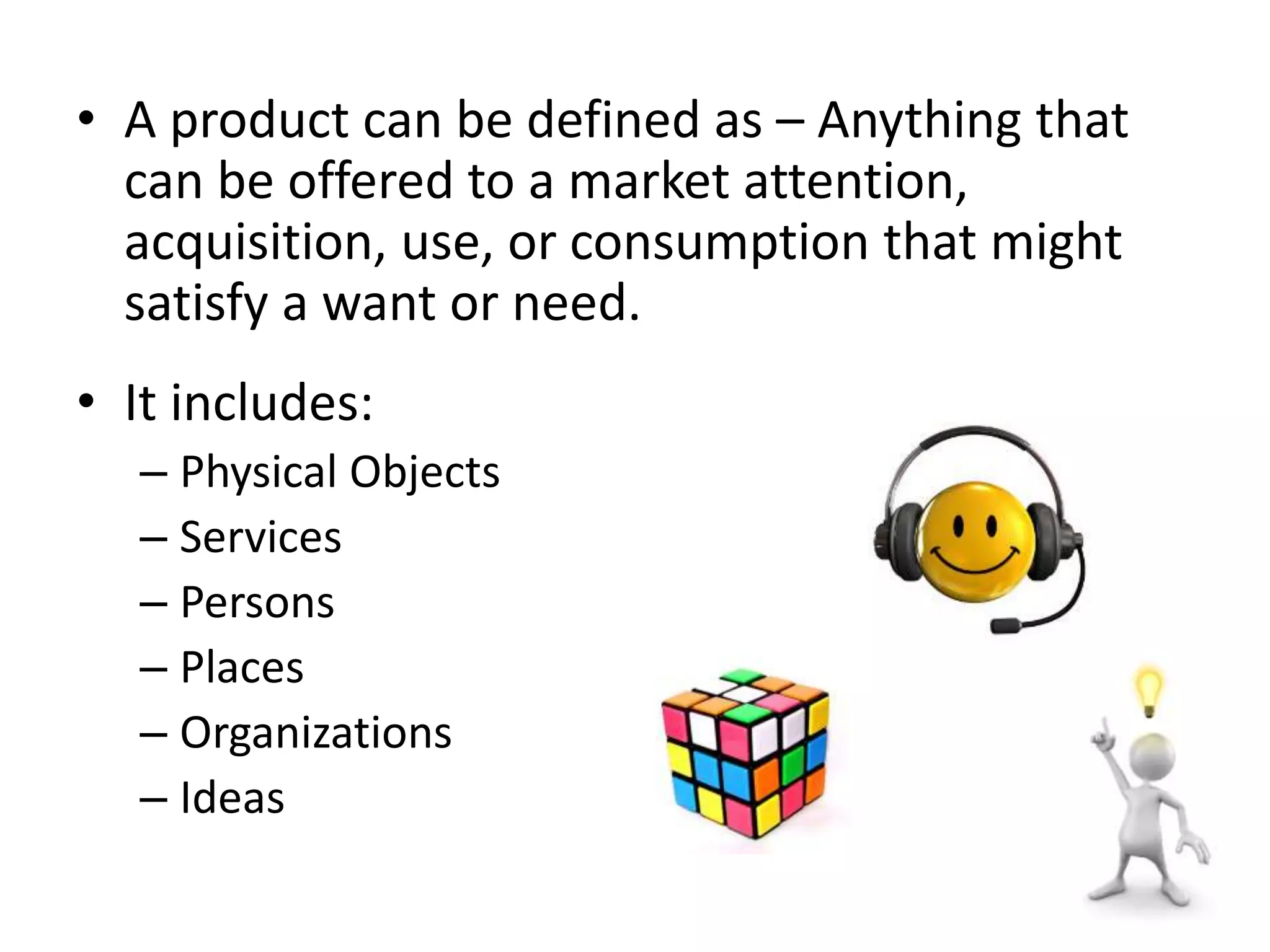
• A product can be defined as – Anything that
can be offered to a market attention,
acquisition, use, or consumption that might
satisfy a want or need.
• It includes:
– Physical Objects
– Services
– Persons
– Places
– Organizations
– Ideas
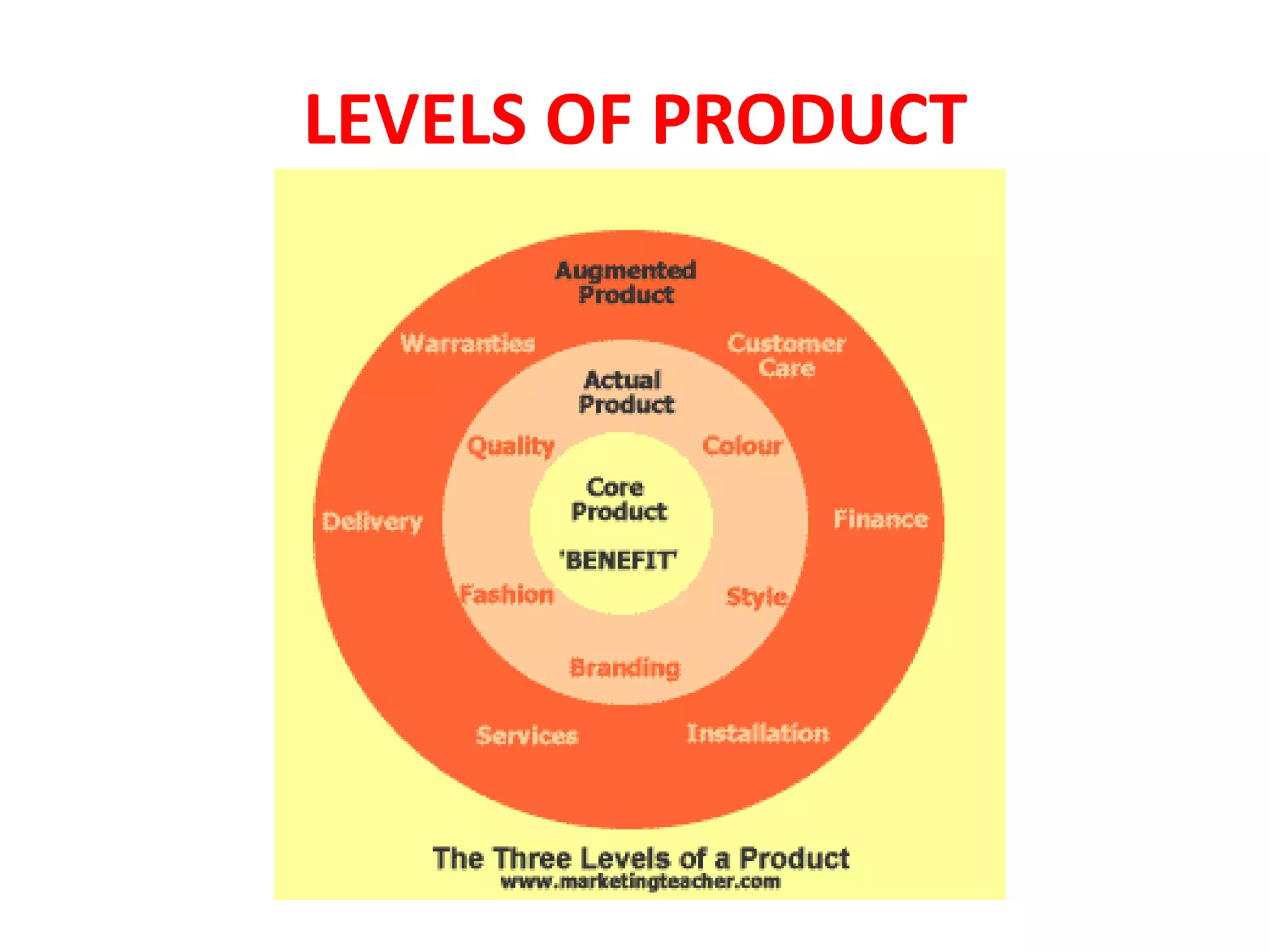
LEVELS OF PRODUCT
Core Product
• The most basic level
• Address the question: what is the buyer really
buying?
• Problem-solving benefits
• The benefit that the consumers will receive
• Example?
Actual Product
• Build around the core products
• Basically have 5 Characteristics:
– Quality level
– Features
– Design
– Brand name
– Packaging
Augmented Product
• Built around both core and actual product
• By offering additional consumer services and
benefits
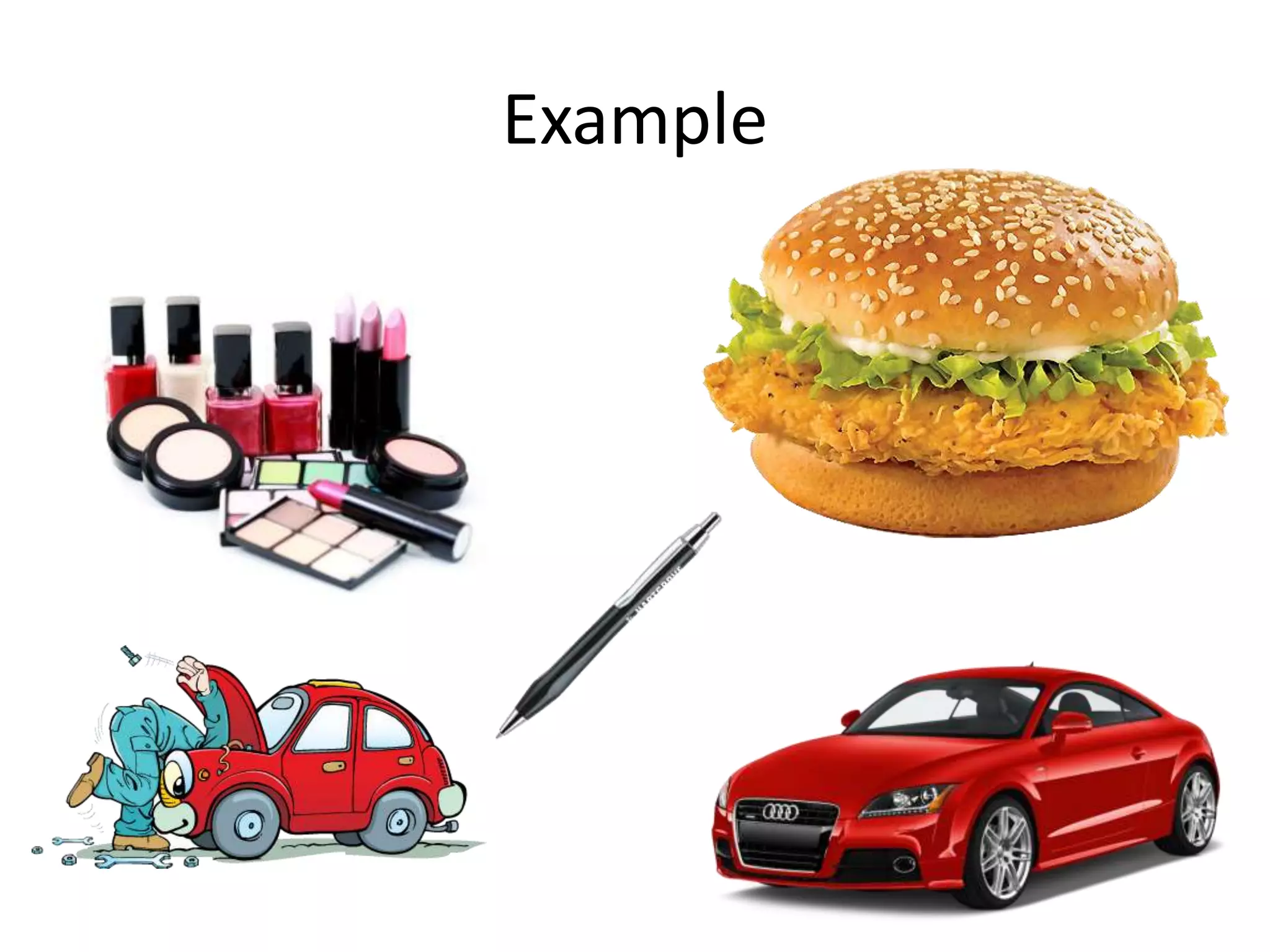
• Examples?
Example
PRODUCT CLASSIFICATION
• Products and services fall into two broad
classes based on the types of consumers that
use them:
– Consumer Products
– Industrial Products
Consumers Product
• Are those brought by final consumers for
personal consumption.
• Marketers usually classify these goods
– Convenience Goods
– Shopping Goods
– Specialty Goods
– Unsought Goods
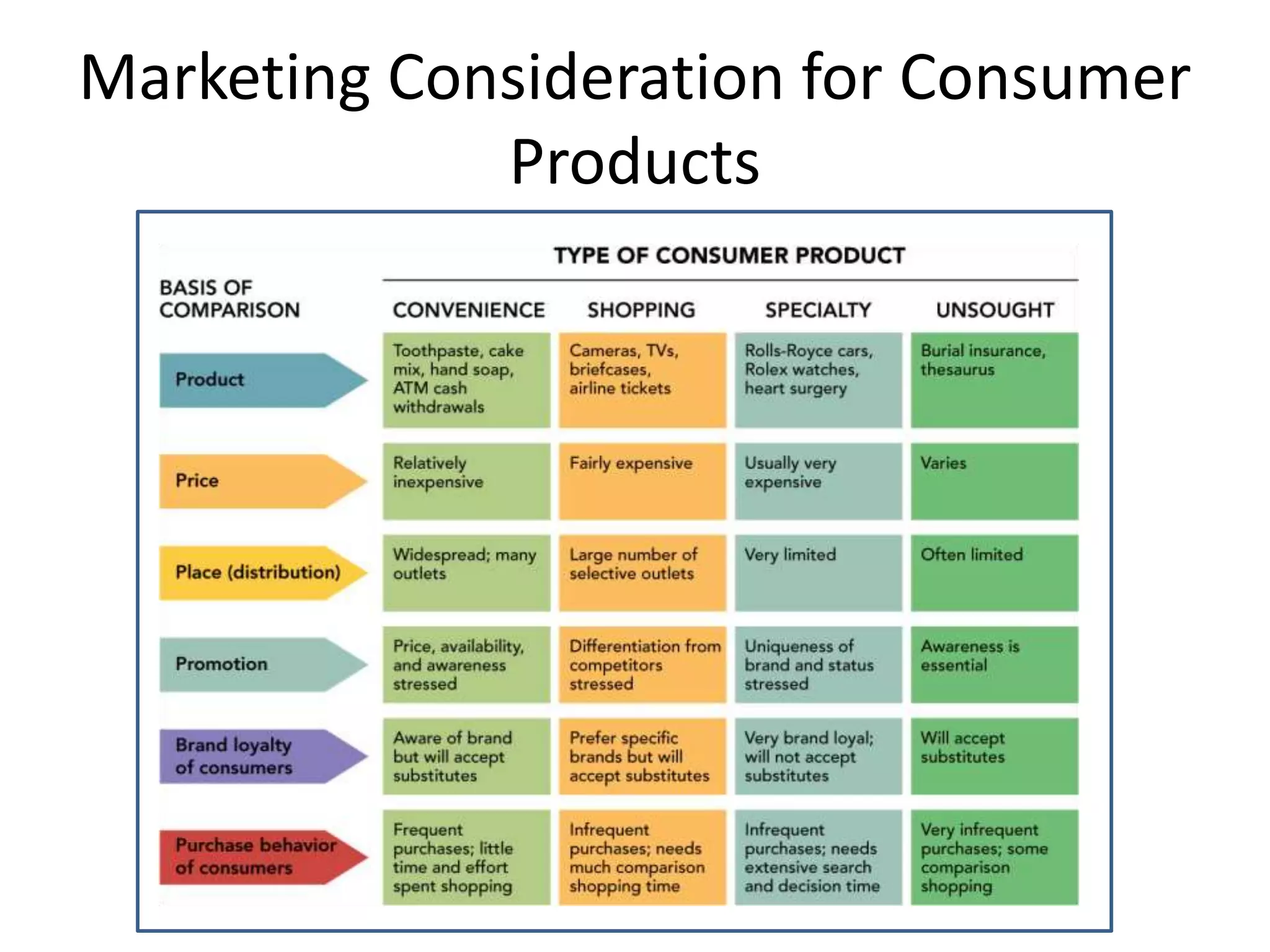
Marketing Consideration for Consumer
Products
Convenience Products
• Consumer products and services that the
consumer usually buys:
• FREQUENTLY,
• Immediately,
• And with a minimum of comparison and
buying effort.
• Examples?
Shopping Products
• Less frequently purchased.
• Customer will COMPARE carefully on:
– Suitability
– Quality
– Price
– Style
• Much time and effort needed to:
– Gather info
– Compare
Specialty Products
• Consumer products & services that have
UNIQUE characteristics.
• Which significant group is WILLING to buy
• Example?
Unsought Products
• Either:
– Consumer does not know about the products
– Consumer does not think to buy the products
• Example?
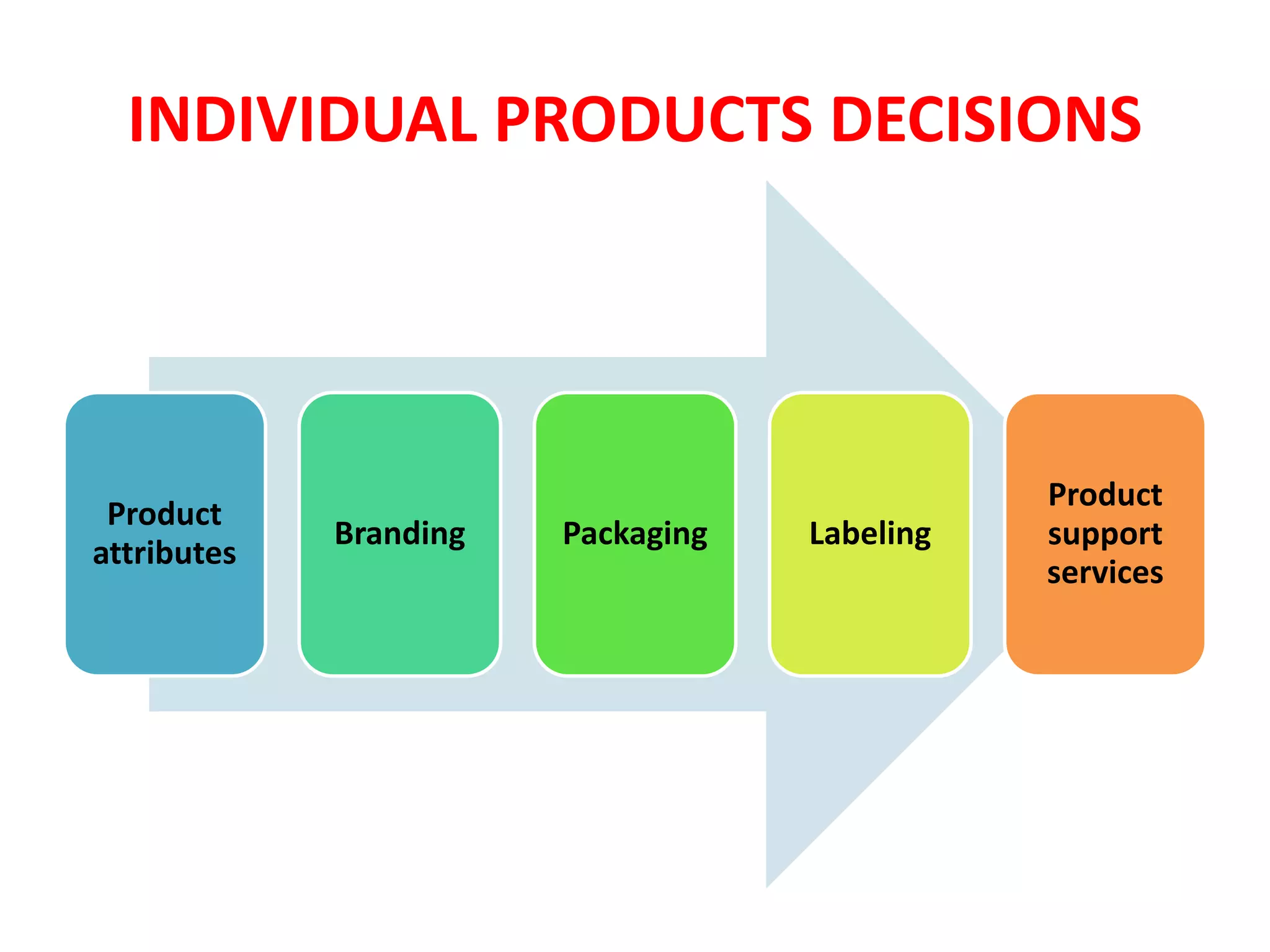
INDIVIDUAL PRODUCTS DECISIONS
Product
attributes
Branding Packaging Labeling
Product
support
services
Product Attributes
• Developing a product or services involves
defining the BENEFITS that it will offer.
• These benefits measured by:
– Quality
– Features
– Design
Product Attributes
• Product Quality
– Two dimensions:
• Level
– In developing product, the marketer must choose quality level
– To support the product position in market
– Examples?
• Consistencies
– Conformance quality
– Freedom from defects and consistency in delivering a targeted
level of performance
– Examples?
Product Attributes
• Product Features
– A product can be offered by varying features.
– Should ask question:
• How do you like the product?
• Which specific features do you like the most?
• Which features that you want us to add in the
products?
Product Attributes
• Product Designs
– Design is a larger concept than style
– Style – simply describe appearance of a product,
but it doesn’t necessarily make the product
perform better.
– Good design contributes to a product’s
USEFULNESS as well as it’s looks.
– Good design can attract attention, improve
product performance, cut production costs and
give strong competitive advantage.
Branding
• A brand is a name, symbol, term, sign, or
design, or combination of these, that
identifies the maker or seller of a product or
services.
• It help consumers identify the products.
• It also tell the buyer something about the
product
Branding
• Brand Equity
– Brands vary in the amount of power and value
– A powerful brand has high brand equity.
– High brand equity provides competitive
advantages.
– It also will affected the consumer brand
awareness and loyalty.
Branding
• Brand Name Selection
– A good name can add greatly to a product’s
success.
– Desirable qualities for a brand name includes:
• Suggest benefits and qualities (examples?)
• Easy to pronounce, recognize and remember
(examples?)
• Distinctive (Examples?)
• Translate easily to foreign language
• Should be capable of registration and legal protection
Branding
• Brand Sponsor
– Four sponsorship options:
• Manufacturer’s brand
• Private brand
– Hard to establish / costly
– Yield high profit – cannot be bought at other competitors
• Licensing
– Use well-known celebrity
• Co-Branding
– Mix the company resources with another company to create a
product
Brand Strategies
Brand Strategies
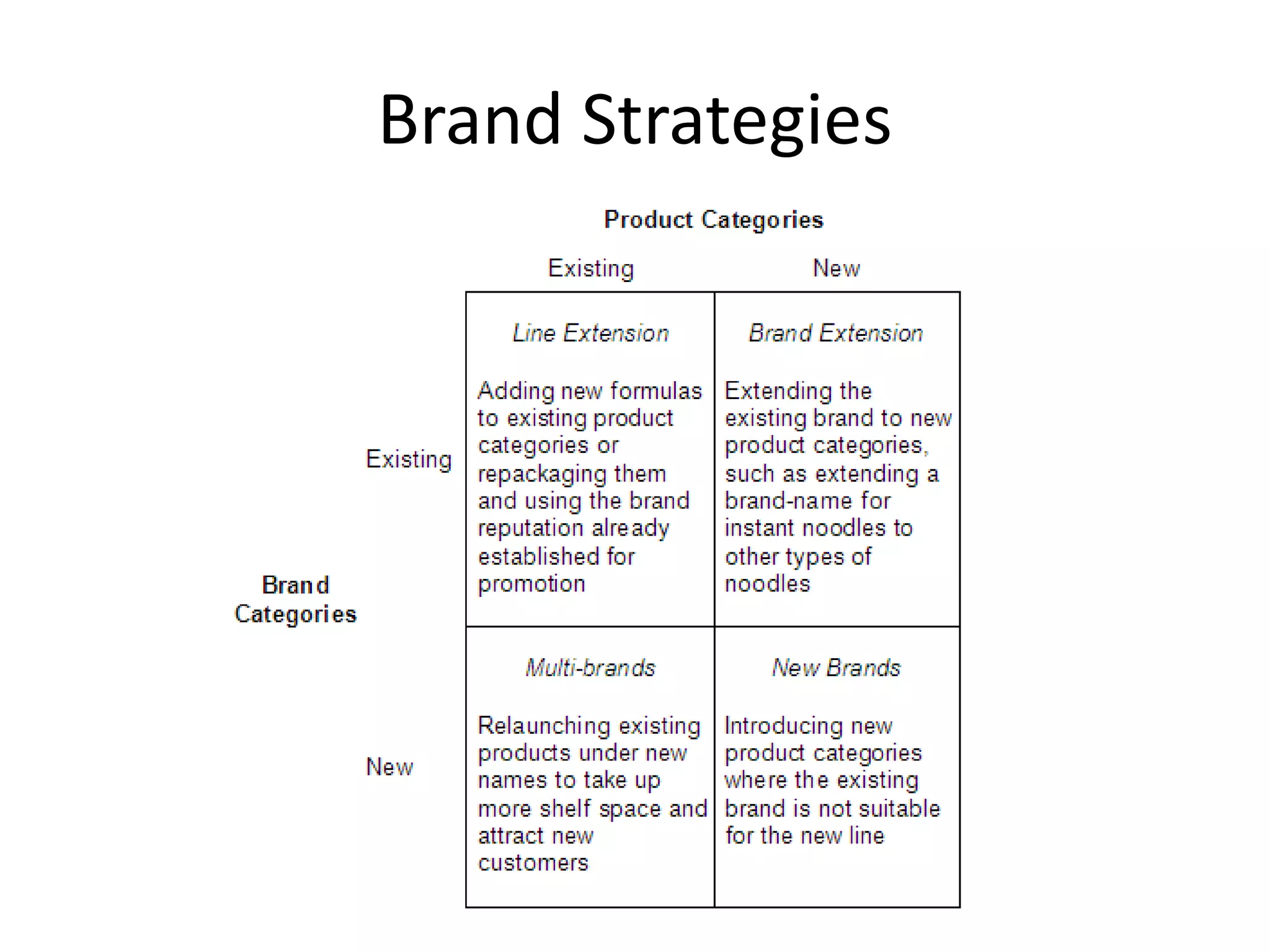
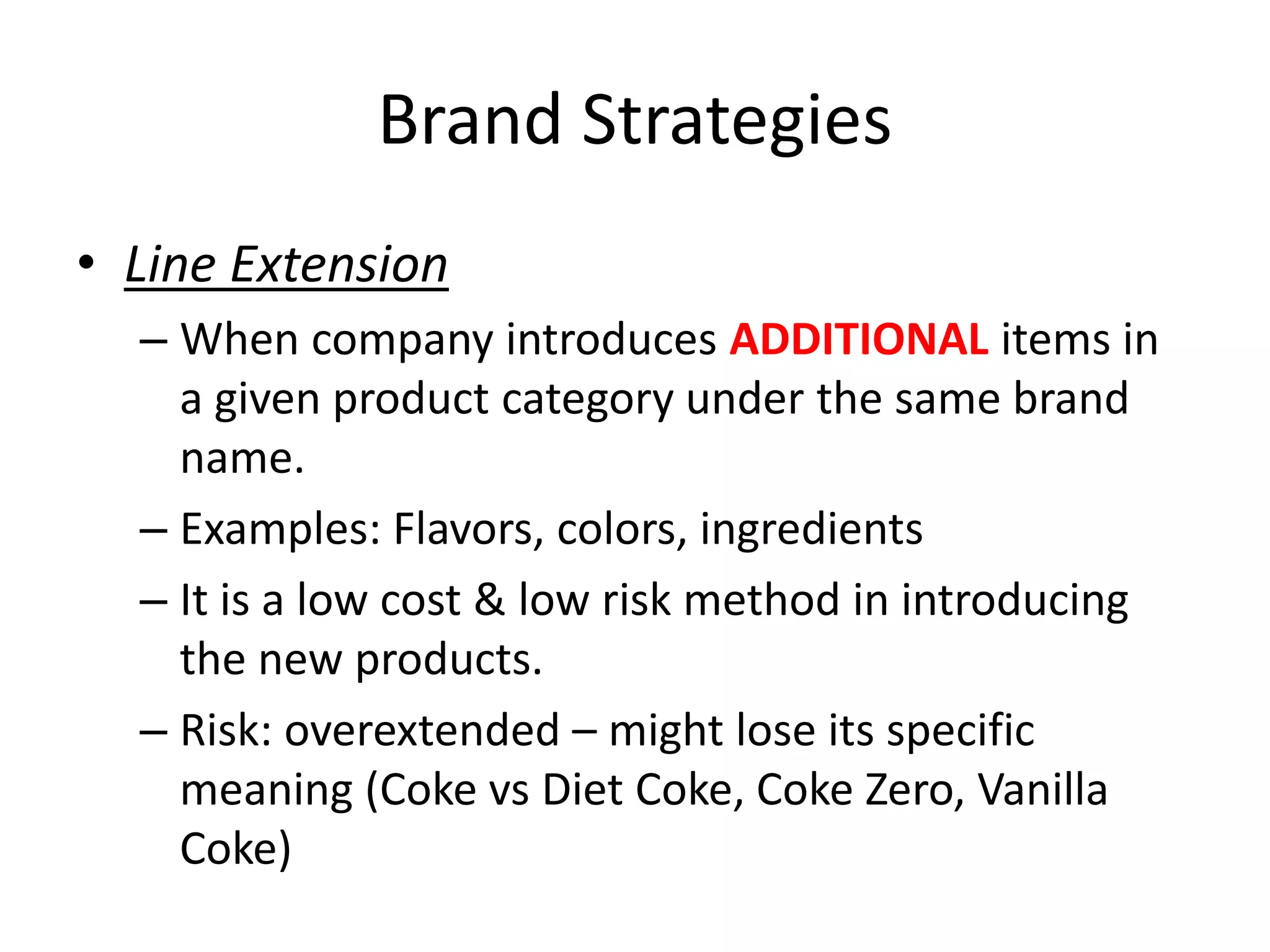
• Line Extension
– When company introduces ADDITIONAL items in
a given product category under the same brand
name.
– Examples: Flavors, colors, ingredients
– It is a low cost & low risk method in introducing
the new products.
– Risk: overextended – might lose its specific
meaning (Coke vs Diet Coke, Coke Zero, Vanilla
Coke)
Brand Strategies
• Brand Extensions
– Involves the use of a successful brand name to
launch a NEW or MODIFIED PRODUCTS in a NEW
CATEGORY]
– Example: Honda (Motorcycles, Cars, etc.)
– Pro: Instant recognition & faster acceptance
– Cons: if the brand extension fails, it may harm the
consumer attitude towards the brand name.
Brand Strategies
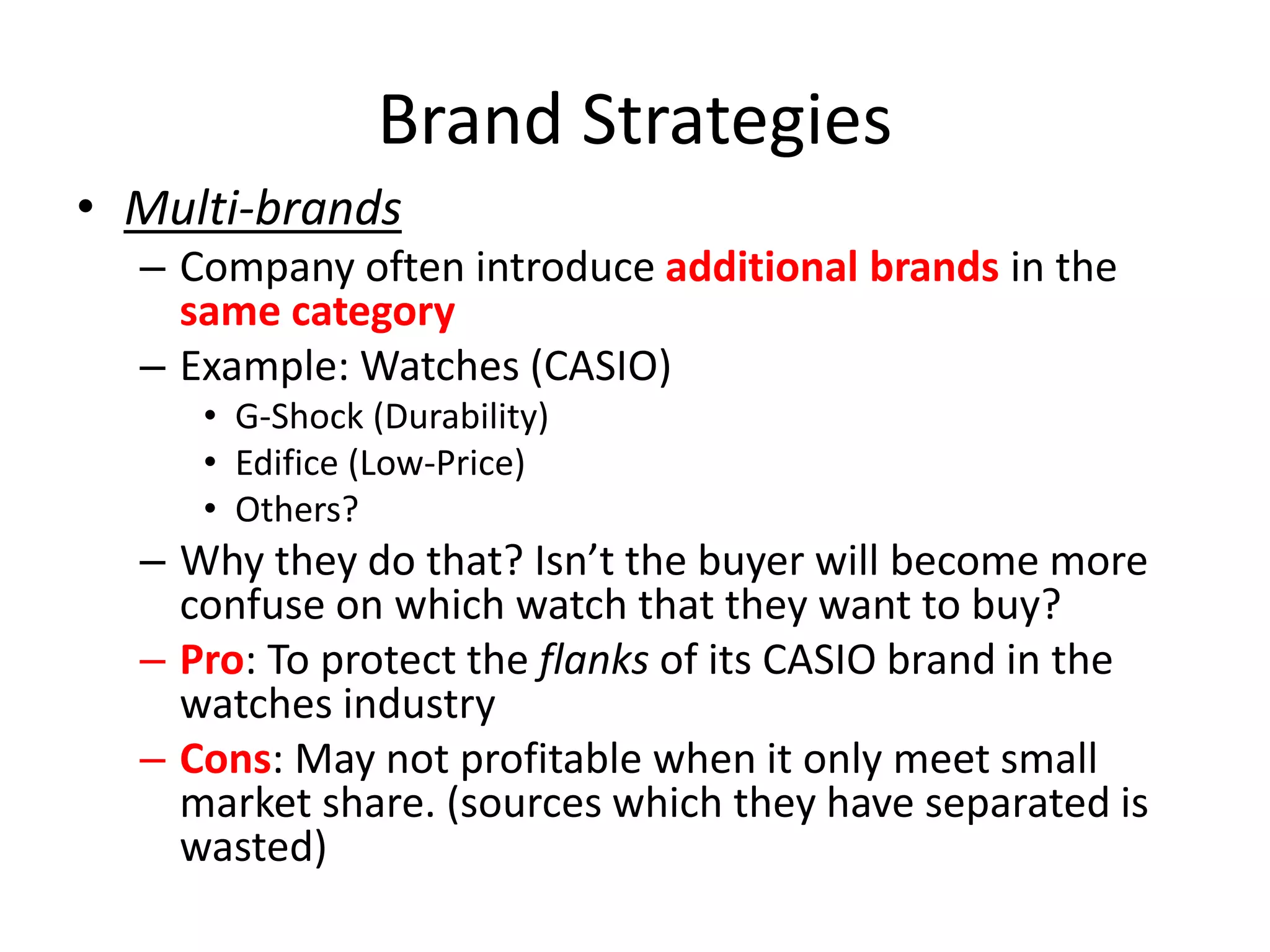
• Multi-brands
– Company often introduce additional brands in the
same category
– Example: Watches (CASIO)
• G-Shock (Durability)
• Edifice (Low-Price)
• Others?
– Why they do that? Isn’t the buyer will become more
confuse on which watch that they want to buy?
– Pro: To protect the flanks of its CASIO brand in the
watches industry
– Cons: May not profitable when it only meet small
market share. (sources which they have separated is
wasted)
Brand Strategies
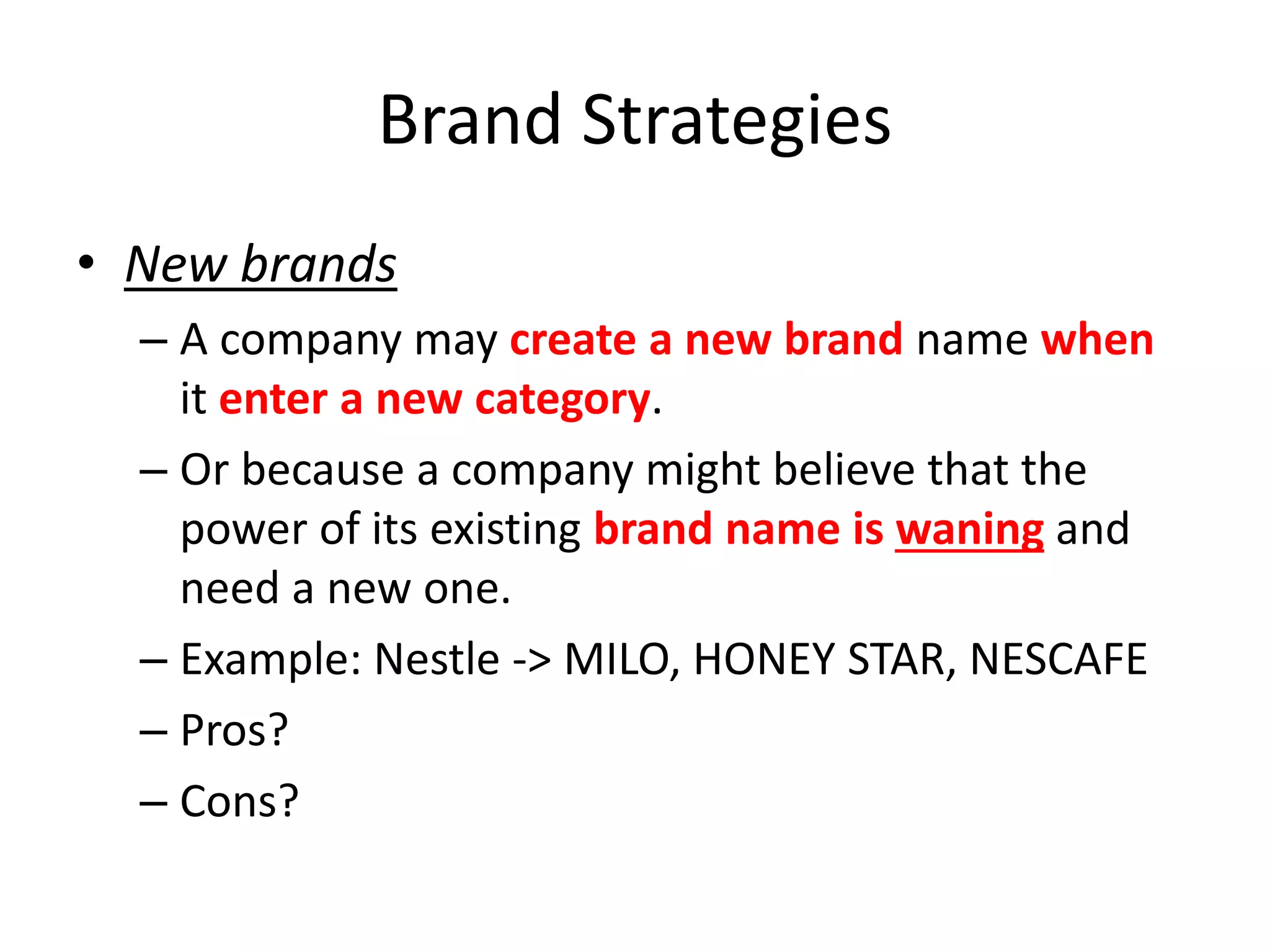
• New brands
– A company may create a new brand name when
it enter a new category.
– Or because a company might believe that the
power of its existing brand name is waning and
need a new one.
– Example: Nestle -> MILO, HONEY STAR, NESCAFE
– Pros?
– Cons?
Brand Strategies
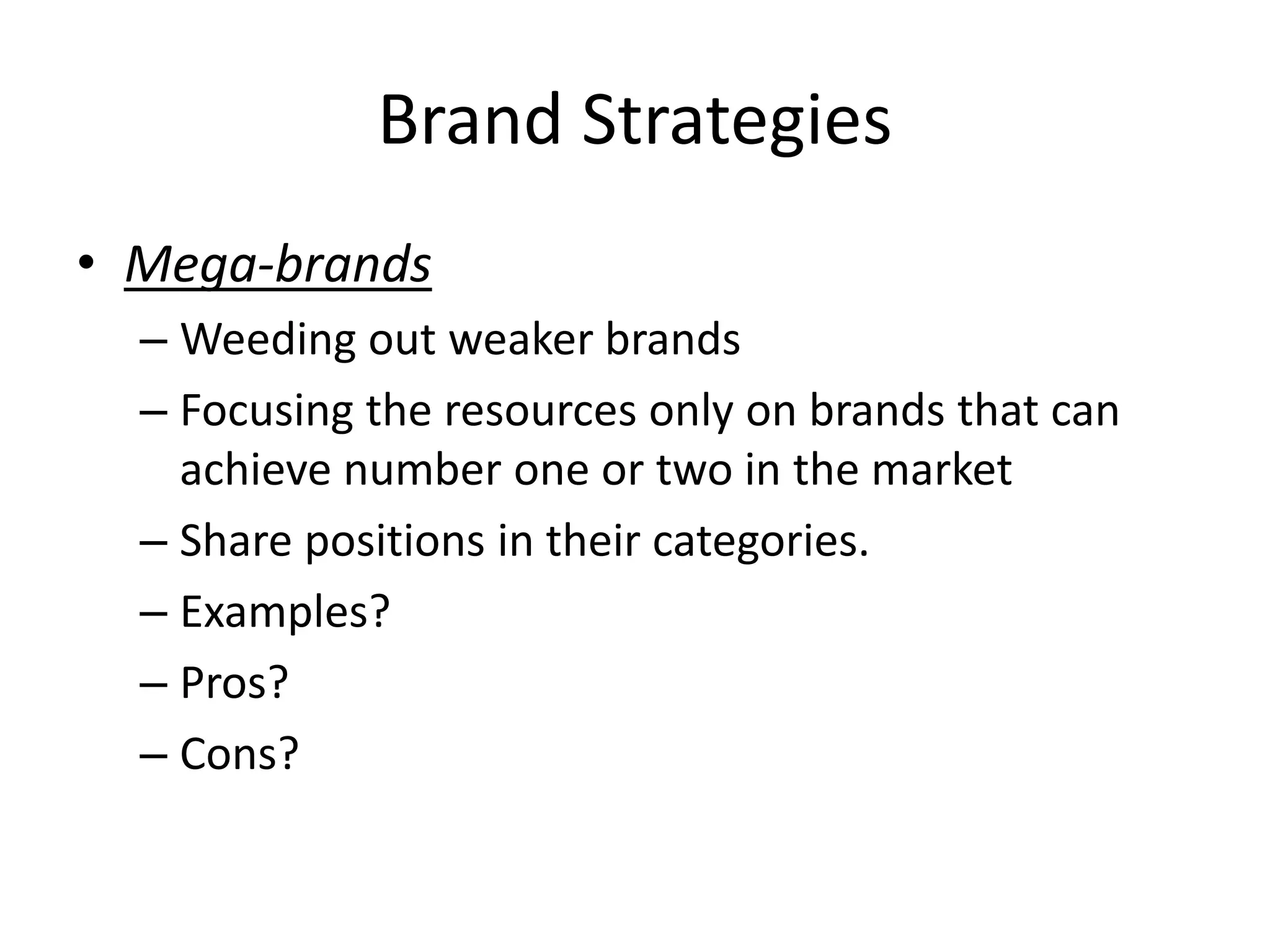
• Mega-brands
– Weeding out weaker brands
– Focusing the resources only on brands that can
achieve number one or two in the market
– Share positions in their categories.
– Examples?
– Pros?
– Cons?
Packaging
• Packaging involve designing and producing the
container or wrapper for a product.
• The package may include:
– The Brands name
– The instruction manual
– Ingredients
– Others?
• Why we need it?
Labeling
• Labels may range from simple tags to complex
graphic attached with the package.
• It perform several function:
– Identifies brand or product
• Sunkist -> print on an orange picture
– Describe several thing about the product
• Who made it? Where are they from? Expired Date
– Promote the product
• NEW PRODUCT! NEW FORMULA!
The End….any question? 

Chapter 5 Product Strategy

  • 1.
    Chapter 5 Product Strategy Preparedby: Nor Izzuddin Bin Norrahman Lecturer of Management, Banking & Islamic Finance Astin College
  • 2.
    • A productcan be defined as – Anything that can be offered to a market attention, acquisition, use, or consumption that might satisfy a want or need. • It includes: – Physical Objects – Services – Persons – Places – Organizations – Ideas
  • 3.
  • 4.
    Core Product • Themost basic level • Address the question: what is the buyer really buying? • Problem-solving benefits • The benefit that the consumers will receive • Example?
  • 5.
    Actual Product • Buildaround the core products • Basically have 5 Characteristics: – Quality level – Features – Design – Brand name – Packaging
  • 6.
    Augmented Product • Builtaround both core and actual product • By offering additional consumer services and benefits • Examples?
  • 7.
  • 8.
    PRODUCT CLASSIFICATION • Productsand services fall into two broad classes based on the types of consumers that use them: – Consumer Products – Industrial Products
  • 9.
    Consumers Product • Arethose brought by final consumers for personal consumption. • Marketers usually classify these goods – Convenience Goods – Shopping Goods – Specialty Goods – Unsought Goods
  • 10.
    Marketing Consideration forConsumer Products
  • 11.
    Convenience Products • Consumerproducts and services that the consumer usually buys: • FREQUENTLY, • Immediately, • And with a minimum of comparison and buying effort. • Examples?
  • 12.
    Shopping Products • Lessfrequently purchased. • Customer will COMPARE carefully on: – Suitability – Quality – Price – Style • Much time and effort needed to: – Gather info – Compare
  • 13.
    Specialty Products • Consumerproducts & services that have UNIQUE characteristics. • Which significant group is WILLING to buy • Example?
  • 14.
    Unsought Products • Either: –Consumer does not know about the products – Consumer does not think to buy the products • Example?
  • 15.
    INDIVIDUAL PRODUCTS DECISIONS Product attributes BrandingPackaging Labeling Product support services
  • 16.
    Product Attributes • Developinga product or services involves defining the BENEFITS that it will offer. • These benefits measured by: – Quality – Features – Design
  • 17.
    Product Attributes • ProductQuality – Two dimensions: • Level – In developing product, the marketer must choose quality level – To support the product position in market – Examples? • Consistencies – Conformance quality – Freedom from defects and consistency in delivering a targeted level of performance – Examples?
  • 18.
    Product Attributes • ProductFeatures – A product can be offered by varying features. – Should ask question: • How do you like the product? • Which specific features do you like the most? • Which features that you want us to add in the products?
  • 19.
    Product Attributes • ProductDesigns – Design is a larger concept than style – Style – simply describe appearance of a product, but it doesn’t necessarily make the product perform better. – Good design contributes to a product’s USEFULNESS as well as it’s looks. – Good design can attract attention, improve product performance, cut production costs and give strong competitive advantage.
  • 20.
    Branding • A brandis a name, symbol, term, sign, or design, or combination of these, that identifies the maker or seller of a product or services. • It help consumers identify the products. • It also tell the buyer something about the product
  • 21.
    Branding • Brand Equity –Brands vary in the amount of power and value – A powerful brand has high brand equity. – High brand equity provides competitive advantages. – It also will affected the consumer brand awareness and loyalty.
  • 22.
    Branding • Brand NameSelection – A good name can add greatly to a product’s success. – Desirable qualities for a brand name includes: • Suggest benefits and qualities (examples?) • Easy to pronounce, recognize and remember (examples?) • Distinctive (Examples?) • Translate easily to foreign language • Should be capable of registration and legal protection
  • 23.
    Branding • Brand Sponsor –Four sponsorship options: • Manufacturer’s brand • Private brand – Hard to establish / costly – Yield high profit – cannot be bought at other competitors • Licensing – Use well-known celebrity • Co-Branding – Mix the company resources with another company to create a product
  • 24.
  • 25.
    Brand Strategies • LineExtension – When company introduces ADDITIONAL items in a given product category under the same brand name. – Examples: Flavors, colors, ingredients – It is a low cost & low risk method in introducing the new products. – Risk: overextended – might lose its specific meaning (Coke vs Diet Coke, Coke Zero, Vanilla Coke)
  • 26.
    Brand Strategies • BrandExtensions – Involves the use of a successful brand name to launch a NEW or MODIFIED PRODUCTS in a NEW CATEGORY] – Example: Honda (Motorcycles, Cars, etc.) – Pro: Instant recognition & faster acceptance – Cons: if the brand extension fails, it may harm the consumer attitude towards the brand name.
  • 27.
    Brand Strategies • Multi-brands –Company often introduce additional brands in the same category – Example: Watches (CASIO) • G-Shock (Durability) • Edifice (Low-Price) • Others? – Why they do that? Isn’t the buyer will become more confuse on which watch that they want to buy? – Pro: To protect the flanks of its CASIO brand in the watches industry – Cons: May not profitable when it only meet small market share. (sources which they have separated is wasted)
  • 28.
    Brand Strategies • Newbrands – A company may create a new brand name when it enter a new category. – Or because a company might believe that the power of its existing brand name is waning and need a new one. – Example: Nestle -> MILO, HONEY STAR, NESCAFE – Pros? – Cons?
  • 29.
    Brand Strategies • Mega-brands –Weeding out weaker brands – Focusing the resources only on brands that can achieve number one or two in the market – Share positions in their categories. – Examples? – Pros? – Cons?
  • 30.
    Packaging • Packaging involvedesigning and producing the container or wrapper for a product. • The package may include: – The Brands name – The instruction manual – Ingredients – Others? • Why we need it?
  • 31.
    Labeling • Labels mayrange from simple tags to complex graphic attached with the package. • It perform several function: – Identifies brand or product • Sunkist -> print on an orange picture – Describe several thing about the product • Who made it? Where are they from? Expired Date – Promote the product • NEW PRODUCT! NEW FORMULA!
  • 32.