Configuring Catalyst Switch Operations 
Introducing Spanning Tree Protocol 
Lecture 6 
© 2006 Cisco Systems, Inc. All rights reserved. ICND v2.3—1-1
Outline 
• Overview 
• Spanning Tree Protocol 
• Spanning-Tree Operation 
• Root Bridge Selection 
• Spanning-Tree Port States 
• Spanning-Tree Path Costs 
• Spanning-Tree Recalculation 
• Rapid Spanning Tree Protocol 
• Summary 
© 2006 Cisco Systems, Inc. All rights reserved. ICND v2.3—1-2
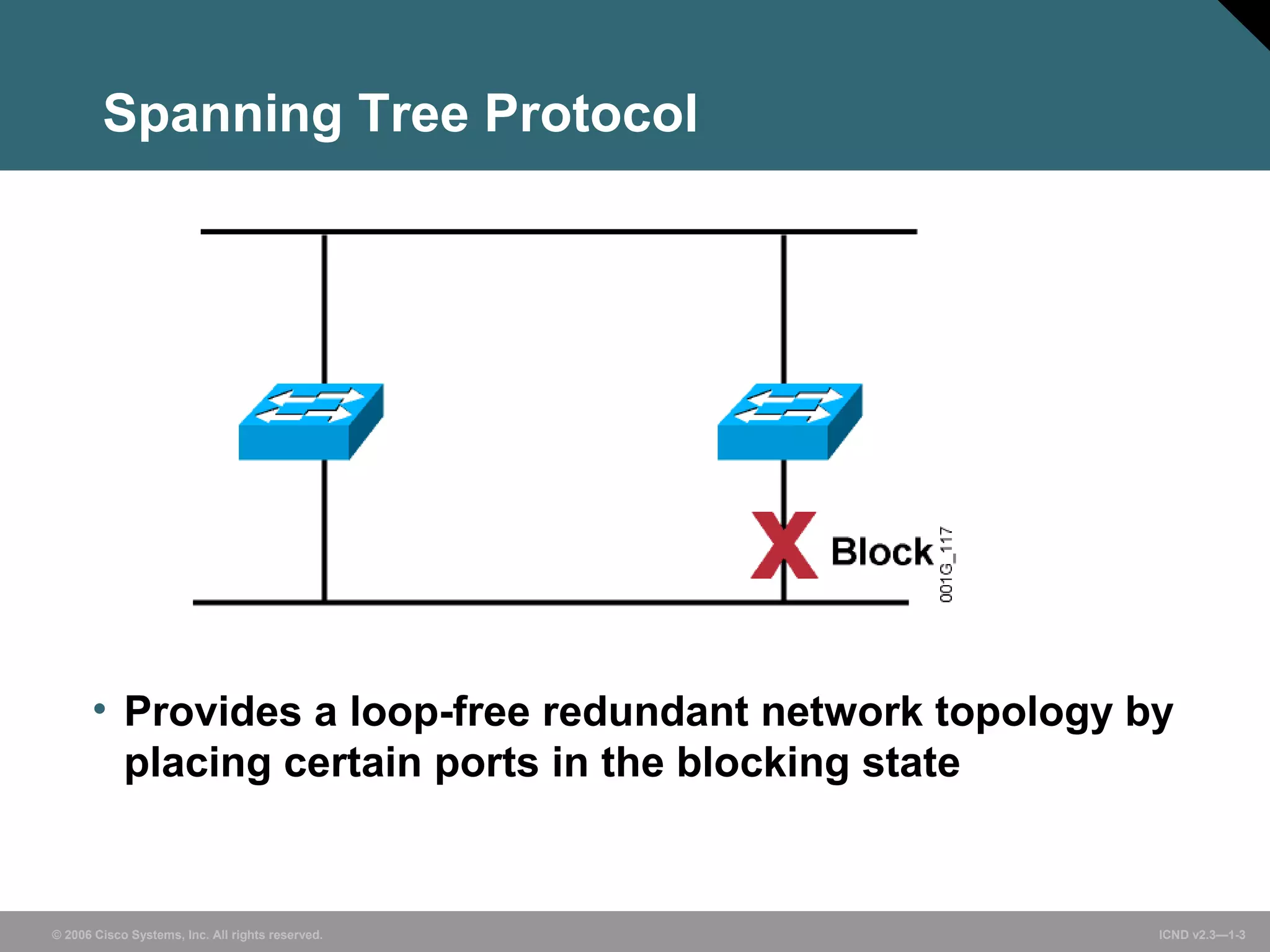
Spanning Tree Protocol 
• Provides a loop-free redundant network topology by 
placing certain ports in the blocking state 
© 2006 Cisco Systems, Inc. All rights reserved. ICND v2.3—1-3
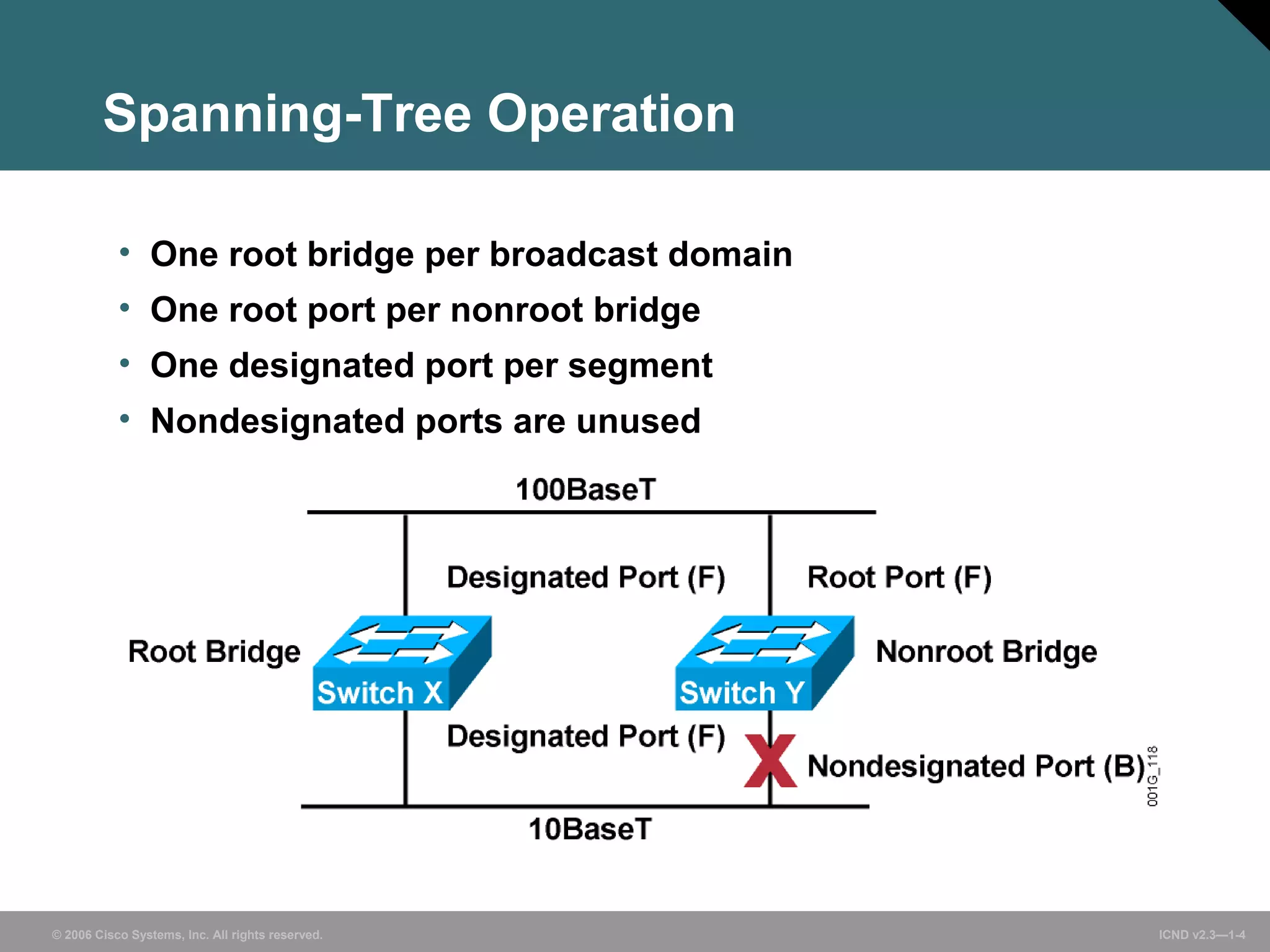
Spanning-Tree Operation 
• One root bridge per broadcast domain 
• One root port per nonroot bridge 
• One designated port per segment 
• Nondesignated ports are unused 
© 2006 Cisco Systems, Inc. All rights reserved. ICND v2.3—1-4
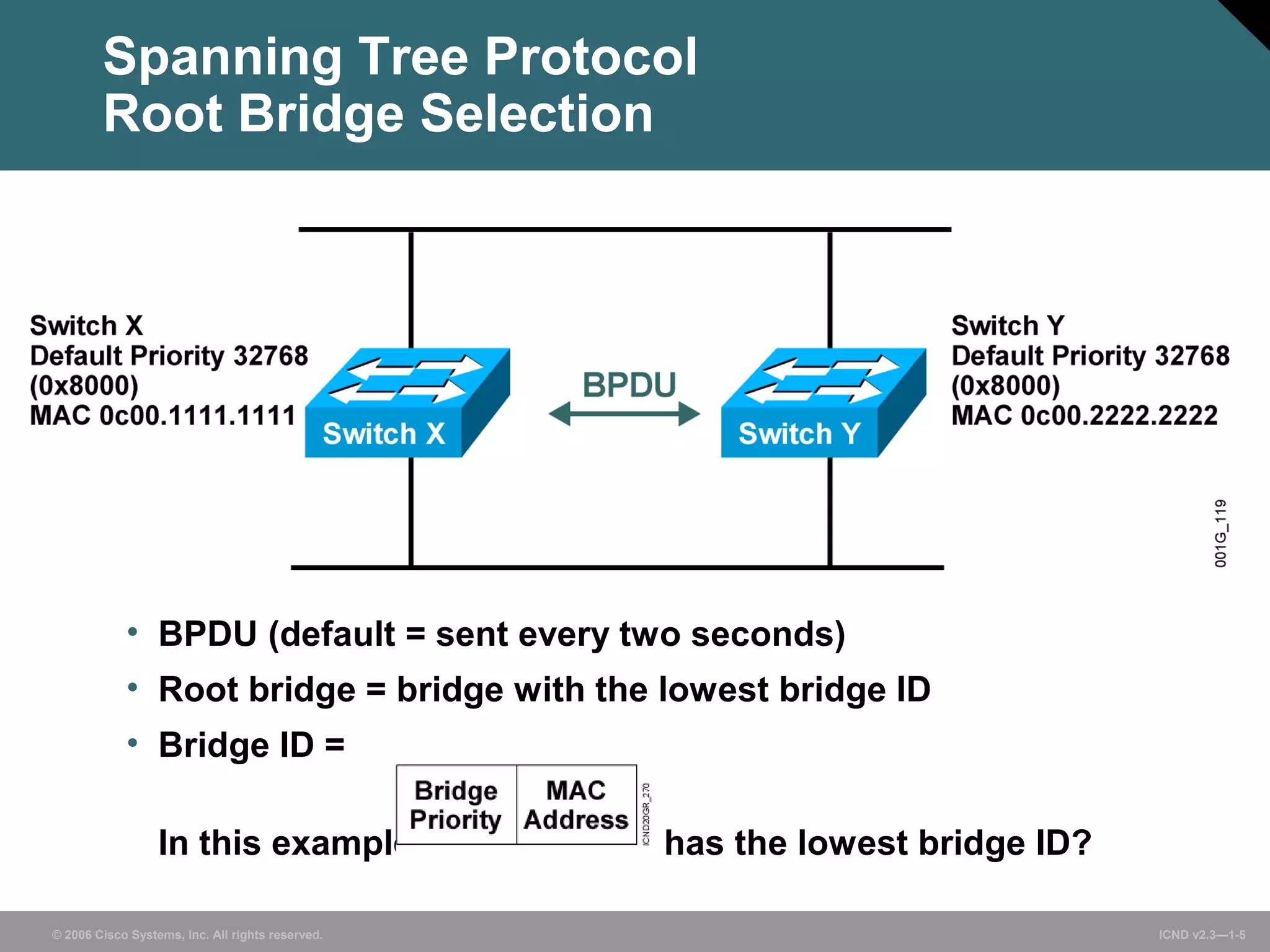
Spanning Tree Protocol 
Root Bridge Selection 
• BPDU (default = sent every two seconds) 
• Root bridge = bridge with the lowest bridge ID 
• Bridge ID = 
In this example, which switch has the lowest bridge ID? 
© 2006 Cisco Systems, Inc. All rights reserved. ICND v2.3—1-5
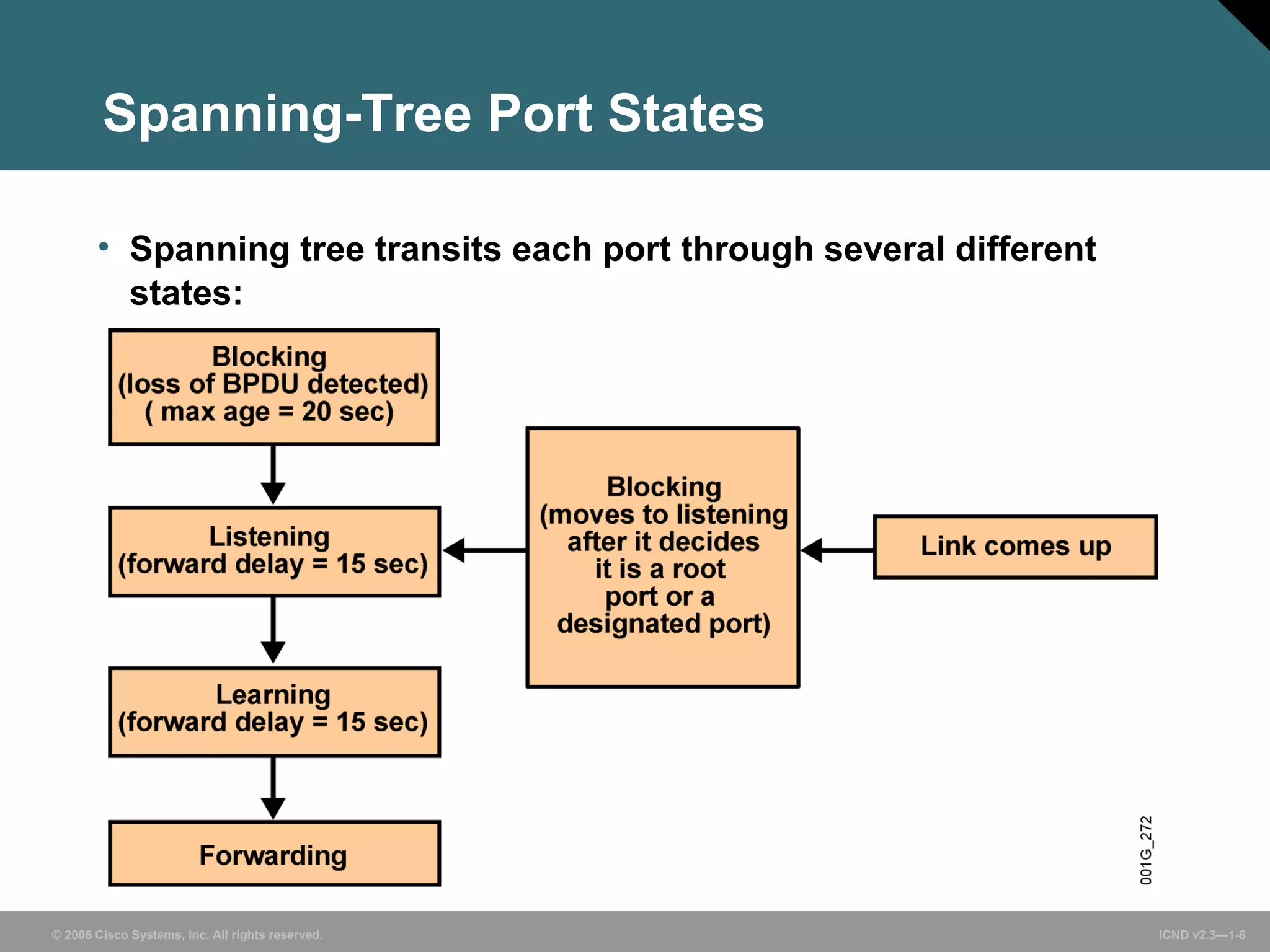
Spanning-Tree Port States 
• Spanning tree transits each port through several different 
states: 
© 2006 Cisco Systems, Inc. All rights reserved. ICND v2.3—1-6
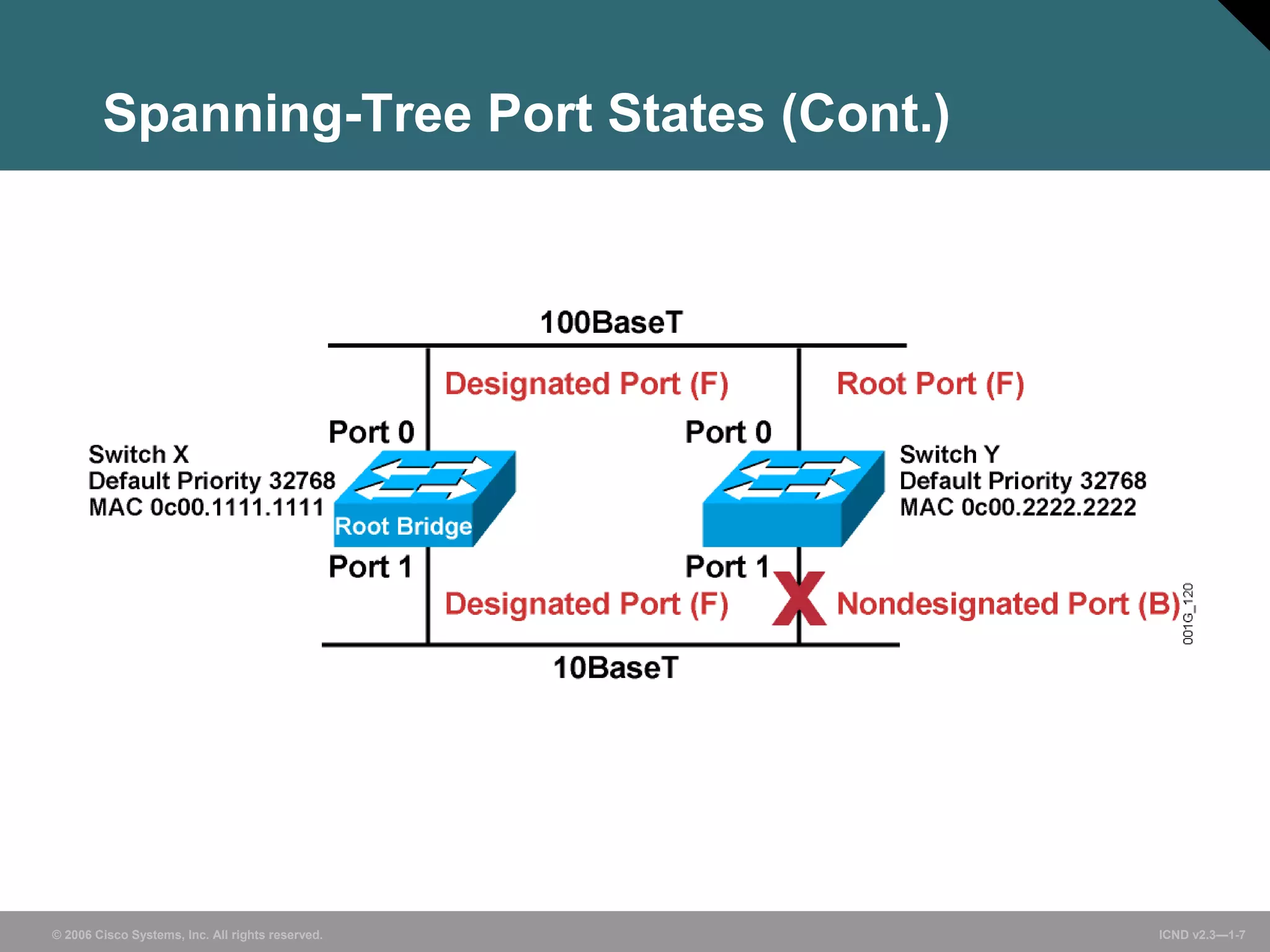
Spanning-Tree Port States (Cont.) 
© 2006 Cisco Systems, Inc. All rights reserved. ICND v2.3—1-7
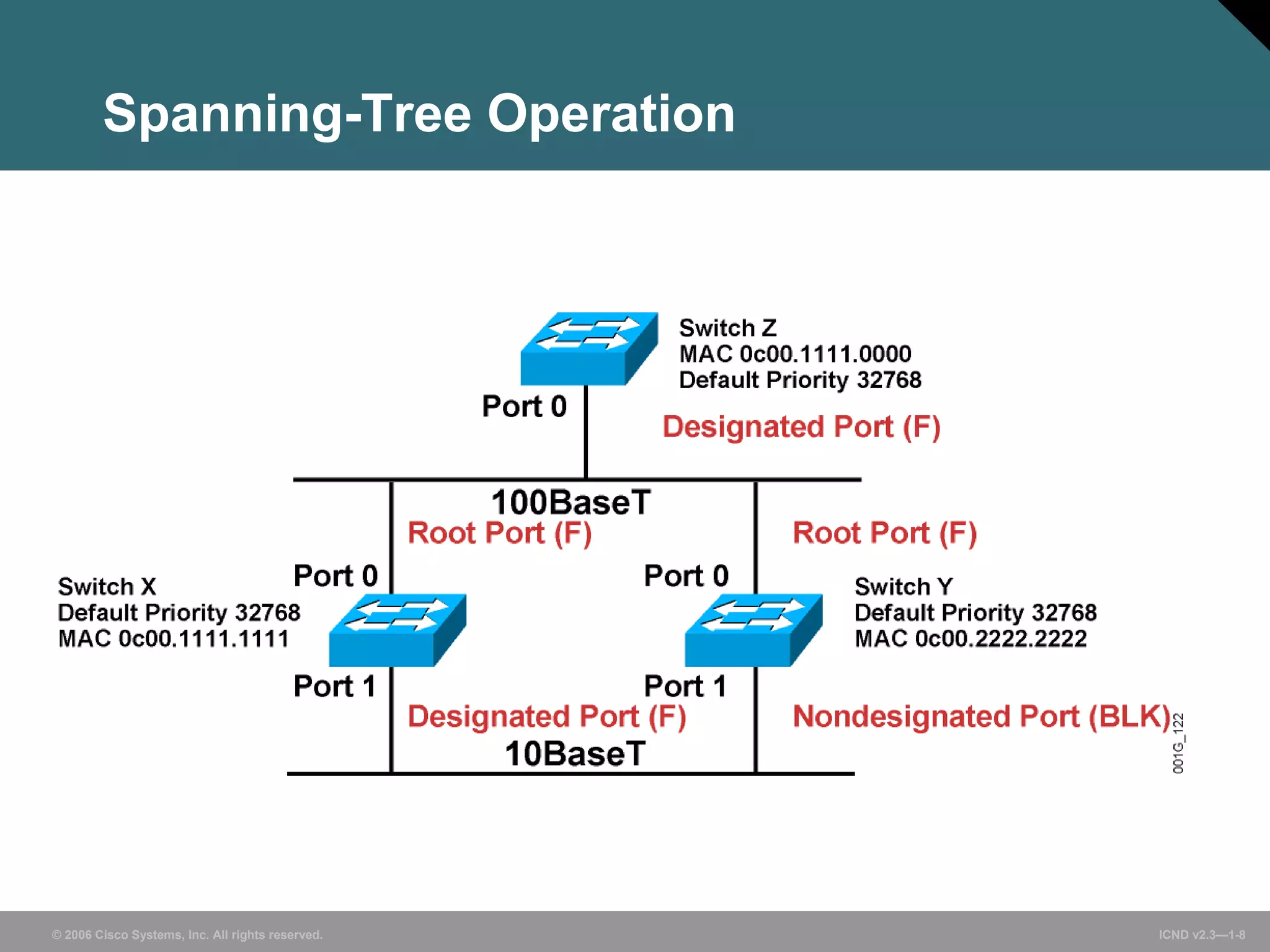
Spanning-Tree Operation 
© 2006 Cisco Systems, Inc. All rights reserved. ICND v2.3—1-8
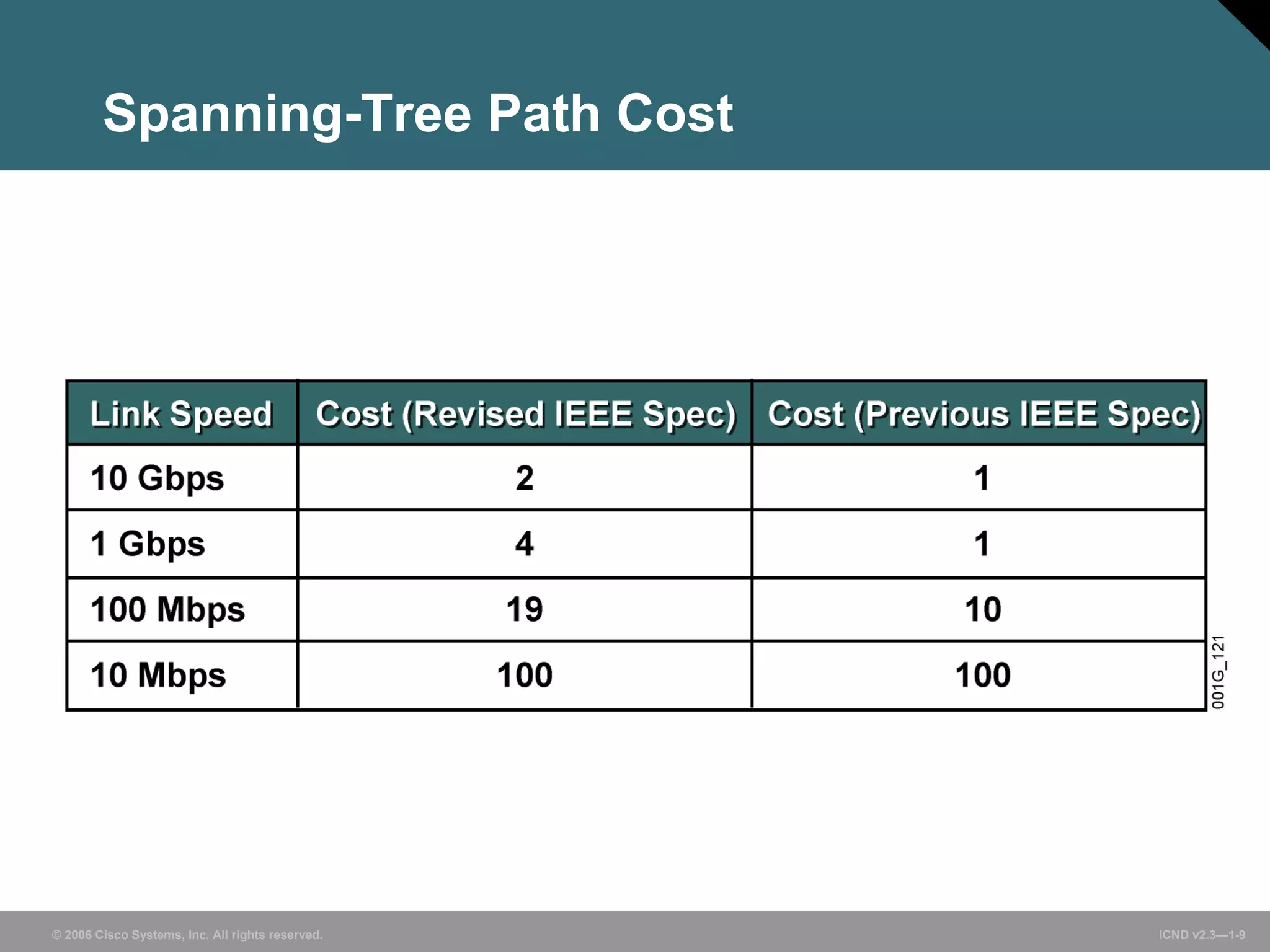
Spanning-Tree Path Cost 
© 2006 Cisco Systems, Inc. All rights reserved. ICND v2.3—1-9
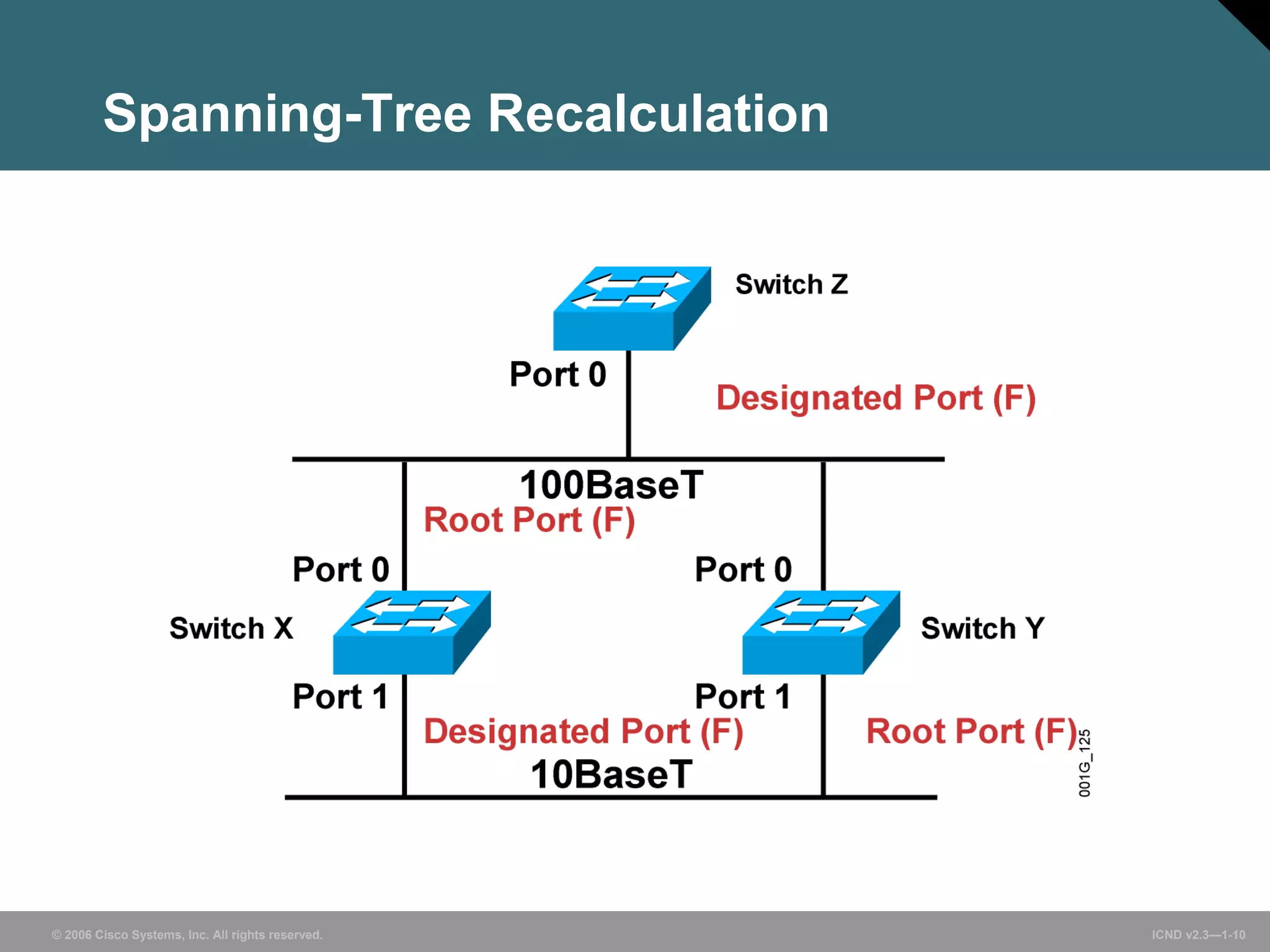
Spanning-Tree Recalculation 
© 2006 Cisco Systems, Inc. All rights reserved. ICND v2.3—1-10
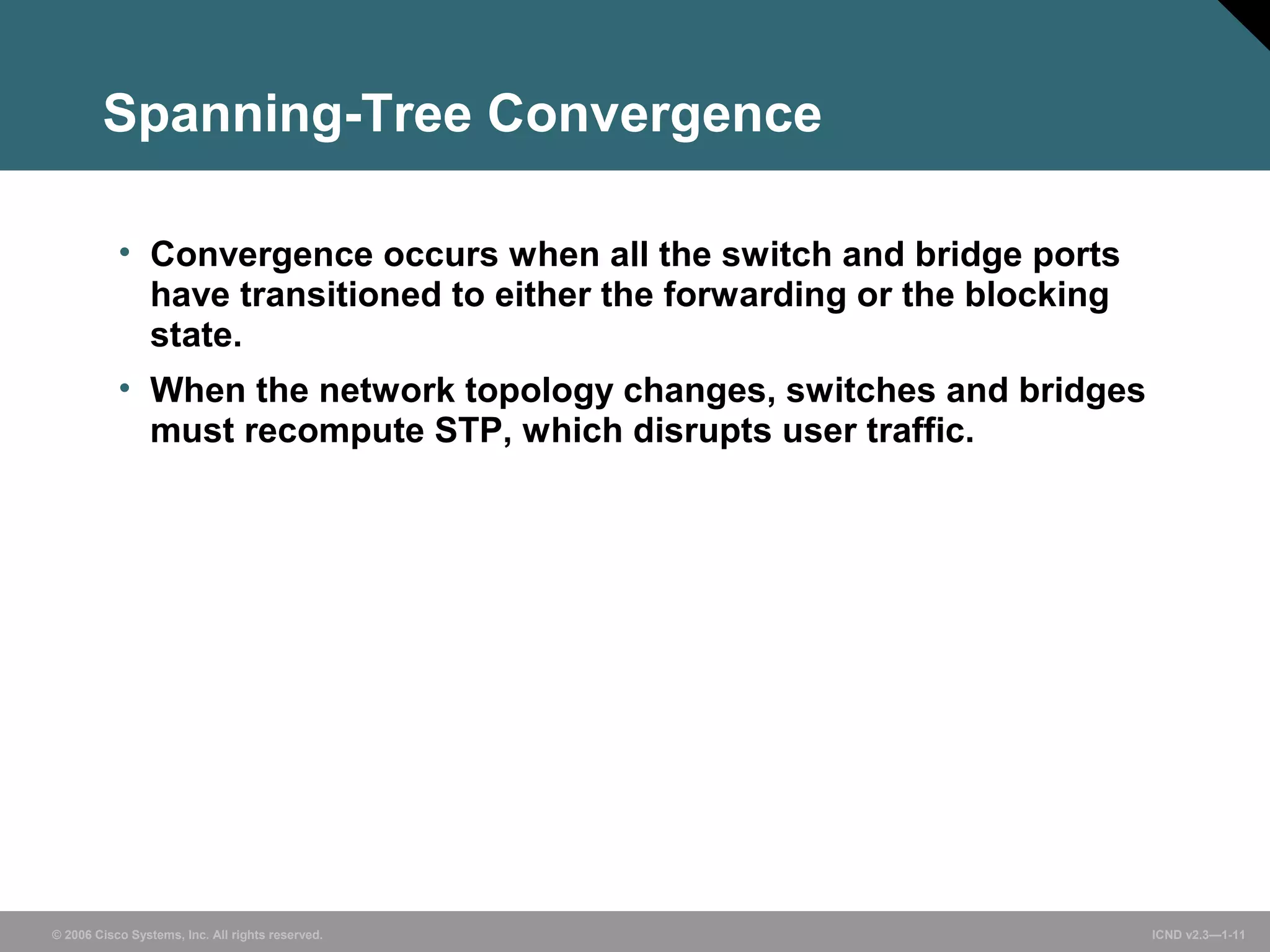
Spanning-Tree Convergence 
• Convergence occurs when all the switch and bridge ports 
have transitioned to either the forwarding or the blocking 
state. 
• When the network topology changes, switches and bridges 
must recompute STP, which disrupts user traffic. 
© 2006 Cisco Systems, Inc. All rights reserved. ICND v2.3—1-11
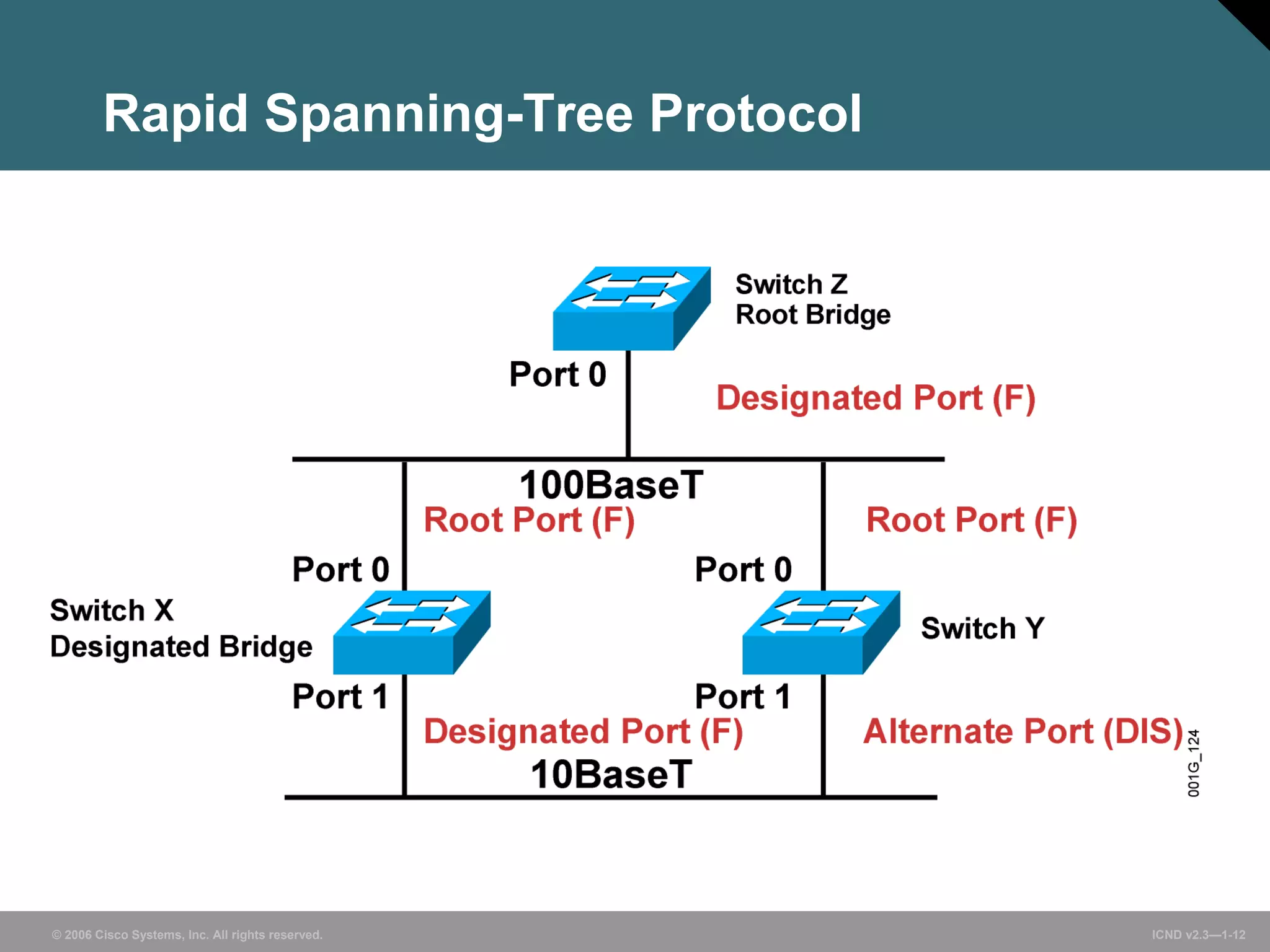
Rapid Spanning-Tree Protocol 
© 2006 Cisco Systems, Inc. All rights reserved. ICND v2.3—1-12
Rapid Transition to Forwarding 
© 2006 Cisco Systems, Inc. All rights reserved. ICND v2.3—1-13
Summary 
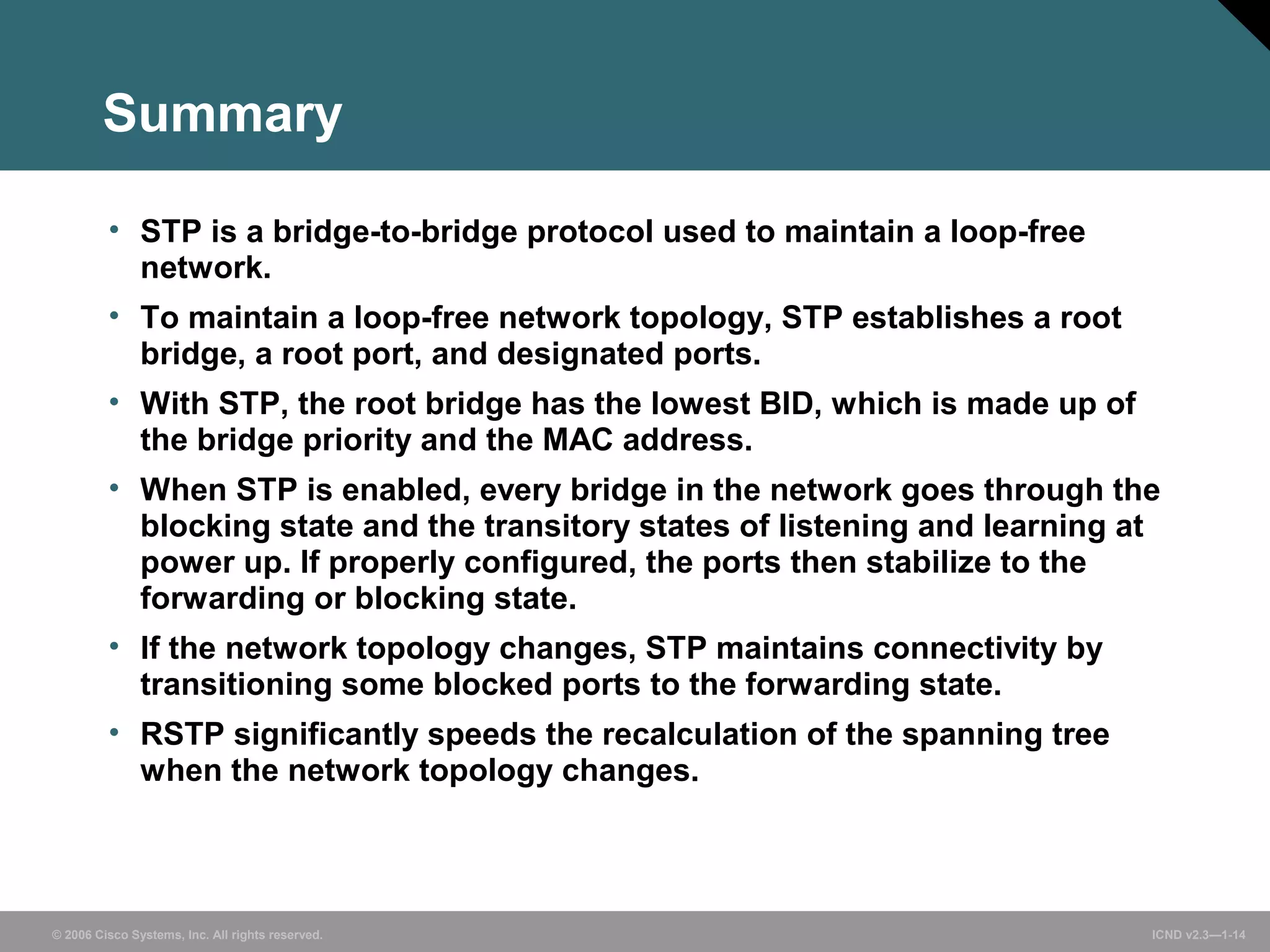
• STP is a bridge-to-bridge protocol used to maintain a loop-free 
network. 
• To maintain a loop-free network topology, STP establishes a root 
bridge, a root port, and designated ports. 
• With STP, the root bridge has the lowest BID, which is made up of 
the bridge priority and the MAC address. 
• When STP is enabled, every bridge in the network goes through the 
blocking state and the transitory states of listening and learning at 
power up. If properly configured, the ports then stabilize to the 
forwarding or blocking state. 
• If the network topology changes, STP maintains connectivity by 
transitioning some blocked ports to the forwarding state. 
• RSTP significantly speeds the recalculation of the spanning tree 
when the network topology changes. 
© 2006 Cisco Systems, Inc. All rights reserved. ICND v2.3—1-14

Spanning tree protocol

  • 1.
    Configuring Catalyst SwitchOperations Introducing Spanning Tree Protocol Lecture 6 © 2006 Cisco Systems, Inc. All rights reserved. ICND v2.3—1-1
  • 2.
    Outline • Overview • Spanning Tree Protocol • Spanning-Tree Operation • Root Bridge Selection • Spanning-Tree Port States • Spanning-Tree Path Costs • Spanning-Tree Recalculation • Rapid Spanning Tree Protocol • Summary © 2006 Cisco Systems, Inc. All rights reserved. ICND v2.3—1-2
  • 3.
    Spanning Tree Protocol • Provides a loop-free redundant network topology by placing certain ports in the blocking state © 2006 Cisco Systems, Inc. All rights reserved. ICND v2.3—1-3
  • 4.
    Spanning-Tree Operation •One root bridge per broadcast domain • One root port per nonroot bridge • One designated port per segment • Nondesignated ports are unused © 2006 Cisco Systems, Inc. All rights reserved. ICND v2.3—1-4
  • 5.
    Spanning Tree Protocol Root Bridge Selection • BPDU (default = sent every two seconds) • Root bridge = bridge with the lowest bridge ID • Bridge ID = In this example, which switch has the lowest bridge ID? © 2006 Cisco Systems, Inc. All rights reserved. ICND v2.3—1-5
  • 6.
    Spanning-Tree Port States • Spanning tree transits each port through several different states: © 2006 Cisco Systems, Inc. All rights reserved. ICND v2.3—1-6
  • 7.
    Spanning-Tree Port States(Cont.) © 2006 Cisco Systems, Inc. All rights reserved. ICND v2.3—1-7
  • 8.
    Spanning-Tree Operation ©2006 Cisco Systems, Inc. All rights reserved. ICND v2.3—1-8
  • 9.
    Spanning-Tree Path Cost © 2006 Cisco Systems, Inc. All rights reserved. ICND v2.3—1-9
  • 10.
    Spanning-Tree Recalculation ©2006 Cisco Systems, Inc. All rights reserved. ICND v2.3—1-10
  • 11.
    Spanning-Tree Convergence •Convergence occurs when all the switch and bridge ports have transitioned to either the forwarding or the blocking state. • When the network topology changes, switches and bridges must recompute STP, which disrupts user traffic. © 2006 Cisco Systems, Inc. All rights reserved. ICND v2.3—1-11
  • 12.
    Rapid Spanning-Tree Protocol © 2006 Cisco Systems, Inc. All rights reserved. ICND v2.3—1-12
  • 13.
    Rapid Transition toForwarding © 2006 Cisco Systems, Inc. All rights reserved. ICND v2.3—1-13
  • 14.
    Summary • STPis a bridge-to-bridge protocol used to maintain a loop-free network. • To maintain a loop-free network topology, STP establishes a root bridge, a root port, and designated ports. • With STP, the root bridge has the lowest BID, which is made up of the bridge priority and the MAC address. • When STP is enabled, every bridge in the network goes through the blocking state and the transitory states of listening and learning at power up. If properly configured, the ports then stabilize to the forwarding or blocking state. • If the network topology changes, STP maintains connectivity by transitioning some blocked ports to the forwarding state. • RSTP significantly speeds the recalculation of the spanning tree when the network topology changes. © 2006 Cisco Systems, Inc. All rights reserved. ICND v2.3—1-14