The document discusses different types of morphemes and their functions in English word formation. It defines morphemes as the minimal units of meaning that combine to form words. There are different types of morphemes including bound morphemes (prefixes, suffixes), free morphemes, root morphemes, derivational morphemes, and inflectional morphemes. The document also discusses how words are formed by combining morphemes and provides examples to illustrate the different types of morpheme combinations.
The slides introduce the analysis of English word and sentence structure, highlighting the importance of morphology and personal reflection on the topic.
Introduction to morphology, the science of word forms, and the rules governing the formation of words.
Definition and examples of morphemes, emphasizing their roles and classifications within words.
Explanation of how language units combine to form larger structures and the human ability to create new words.
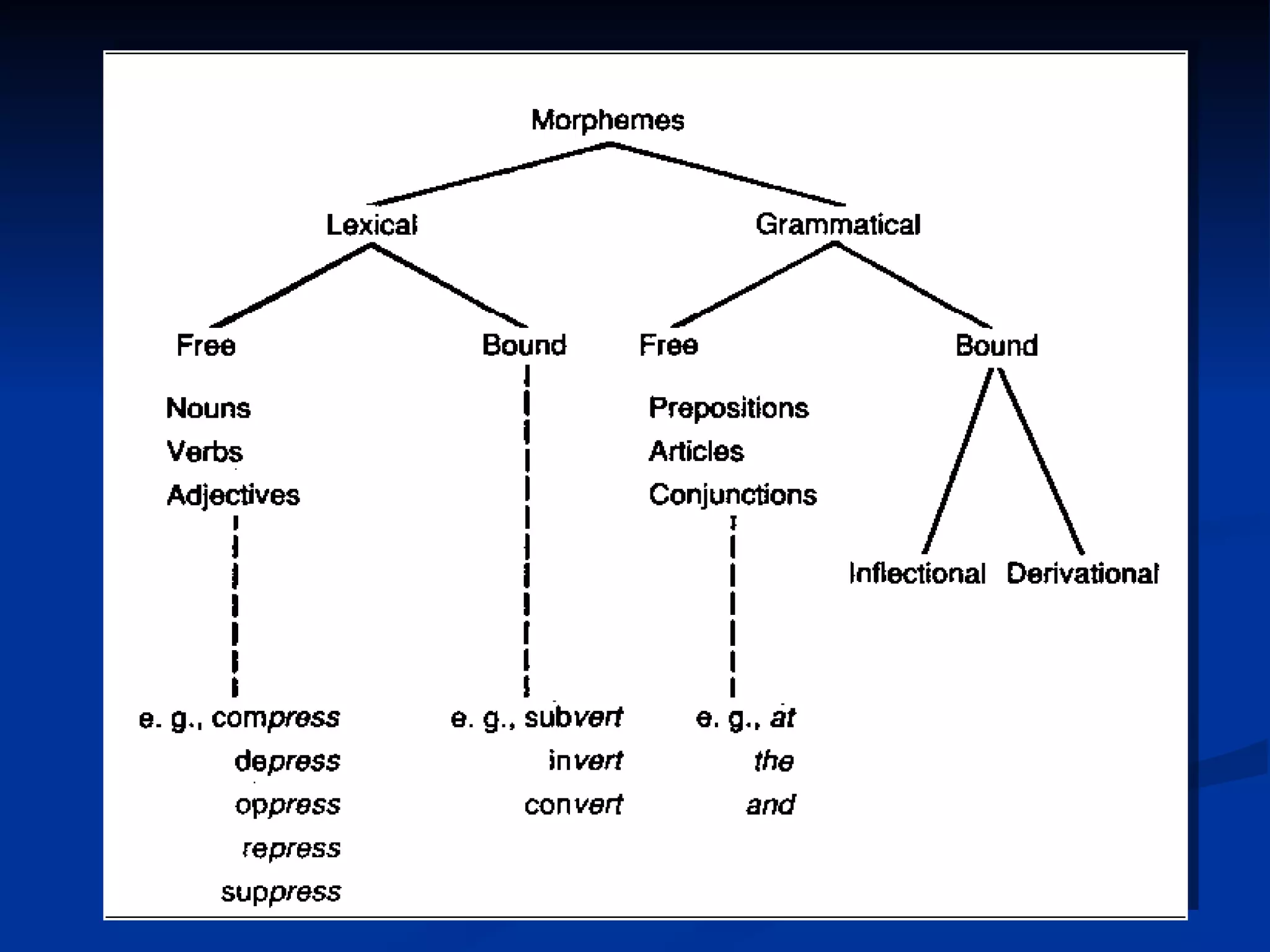
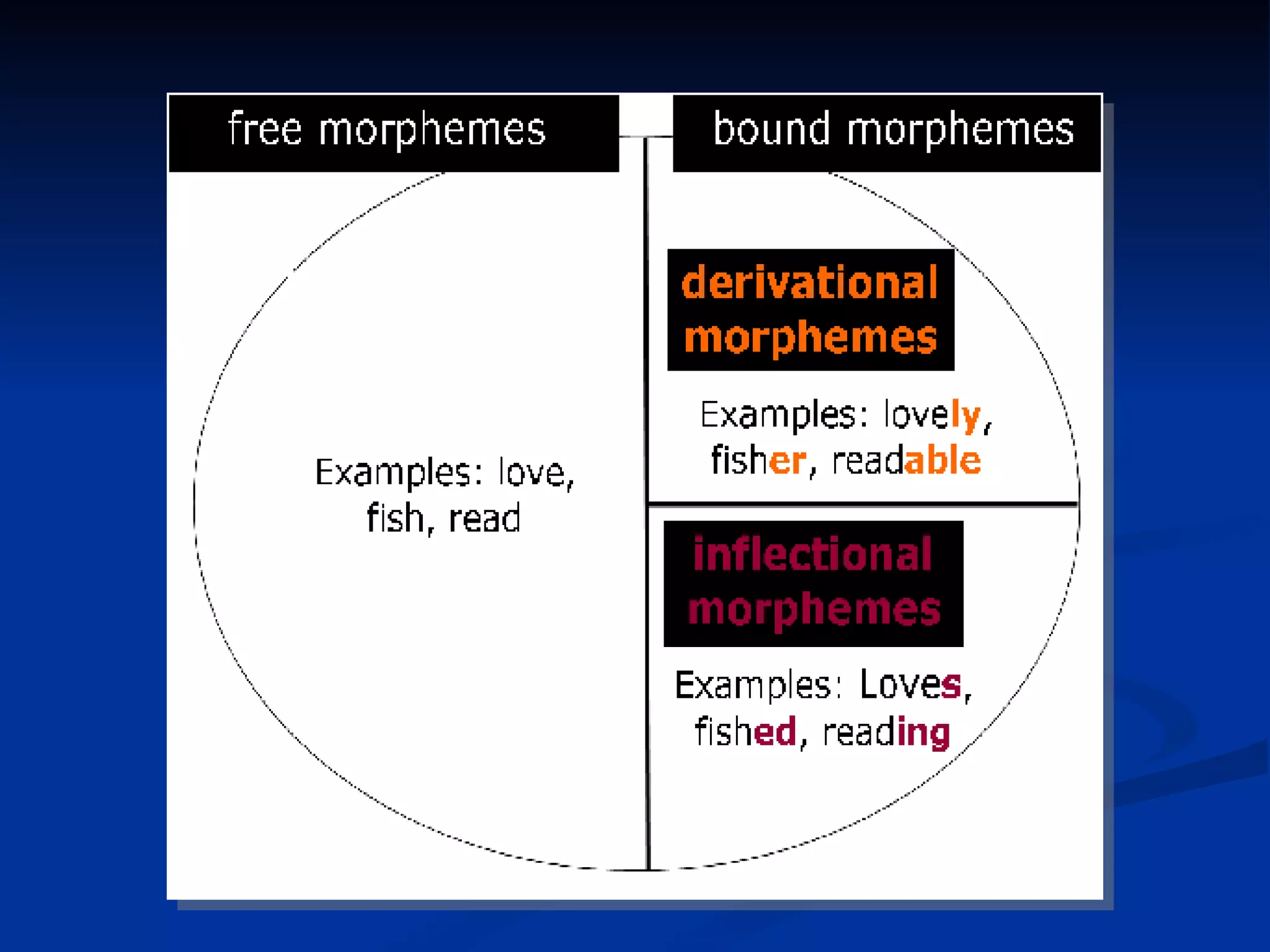
Classification of morphemes into bound and free types, including root and stem morphemes with examples.
Examples of word formation using roots, stems, affixes, and the entire morphological structure of words.
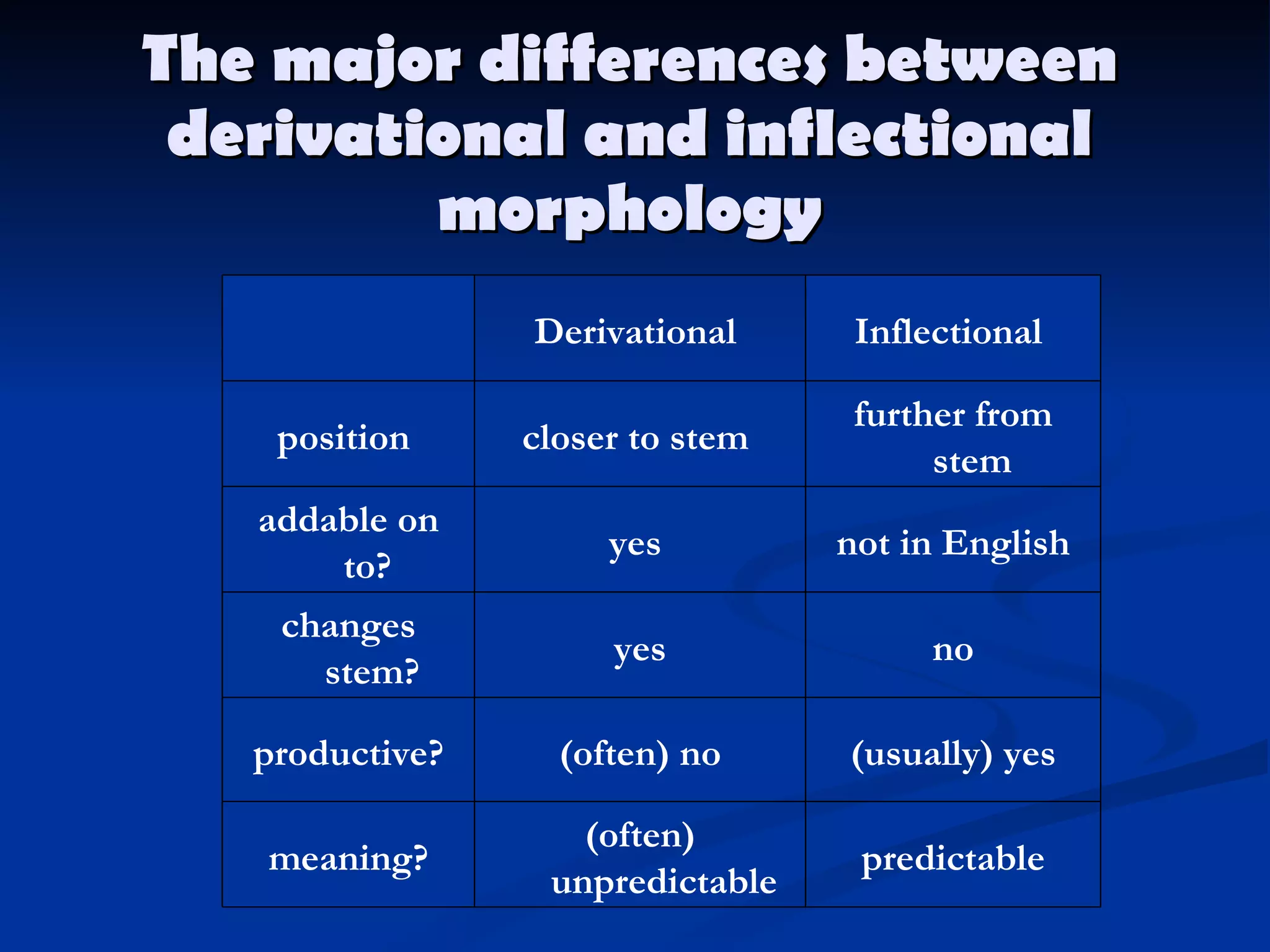
Differences between derivational and inflectional morphemes regarding meaning, change of part of speech, and grammatical functions.
Discussion on affixes (prefixes, suffixes) with examples and the role they play in word formation.
The significance of grammatical morphemes in word structure, including examples showcasing their usage.
Differences between content words which denote concepts and function words that express grammatical functions.
Various processes of word formation including derived words, compounds, acronyms, blends, and eponyms.
Hierarchical structure of words visualized using tree diagrams, explaining morphological rules and exceptions.
Explores phenomena in morphology including homophonous morphemes, reduplication, and their examples.
Concluding thoughts on the discussion of morphology along with references for further reading and exploration.
Objectives 1.Recognize different types of morphemes and their functions 2. State the form, meaning and rule of combination for the morphemes 3. Analyze the internal structure of the English words in order to know their formations and meanings. 4. Specify each unit within words correctly.
Morphology Morph (form)+ ology (science of) -- > Morphology (the science of word forms) The study of the internal structure of words, and The rules by which words are formed
8.
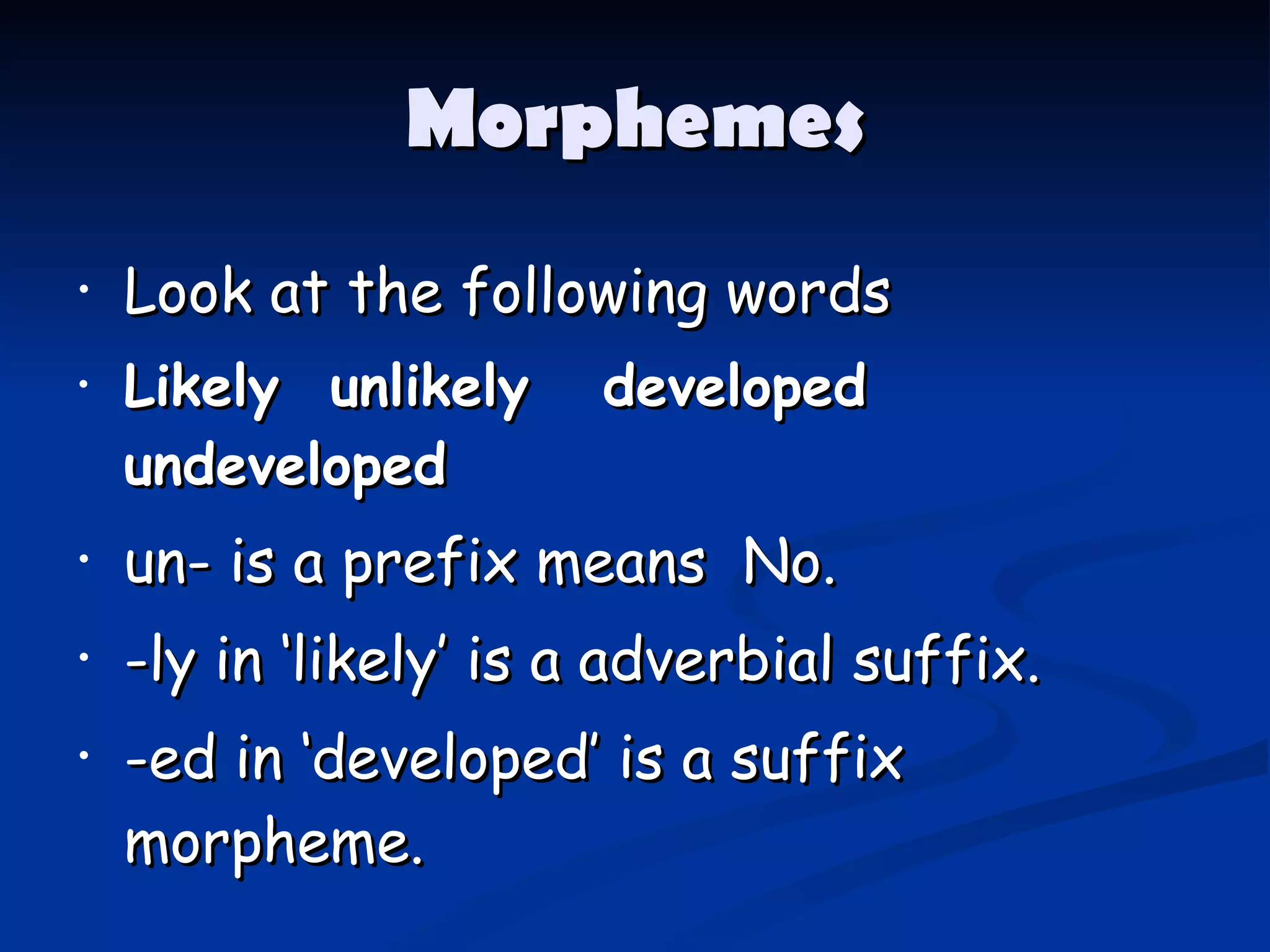
Morphemes Look atthe following words Likely unlikely developed undeveloped un- is a prefix means No. -ly in ‘likely’ is a adverbial suffix. -ed in ‘developed’ is a suffix morpheme.
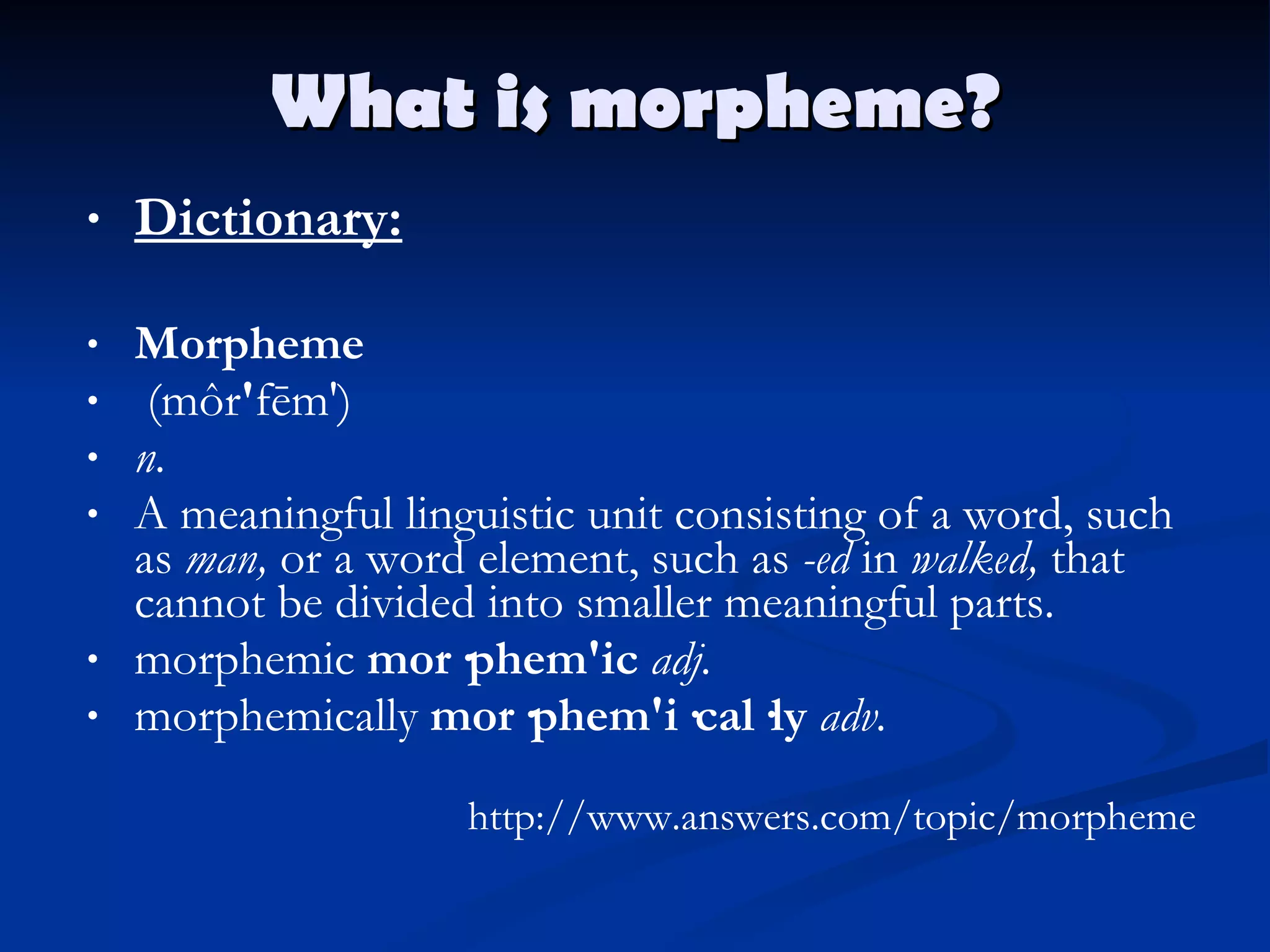
What is morpheme?Dictionary: Morpheme (môr ' fēm') n. A meaningful linguistic unit consisting of a word, such as man, or a word element, such as -ed in walked, that cannot be divided into smaller meaningful parts. morphemic mor·phem'ic adj. morphemically mor·phem'i·cal·ly adv. http://www.answers.com/topic/morpheme
11.
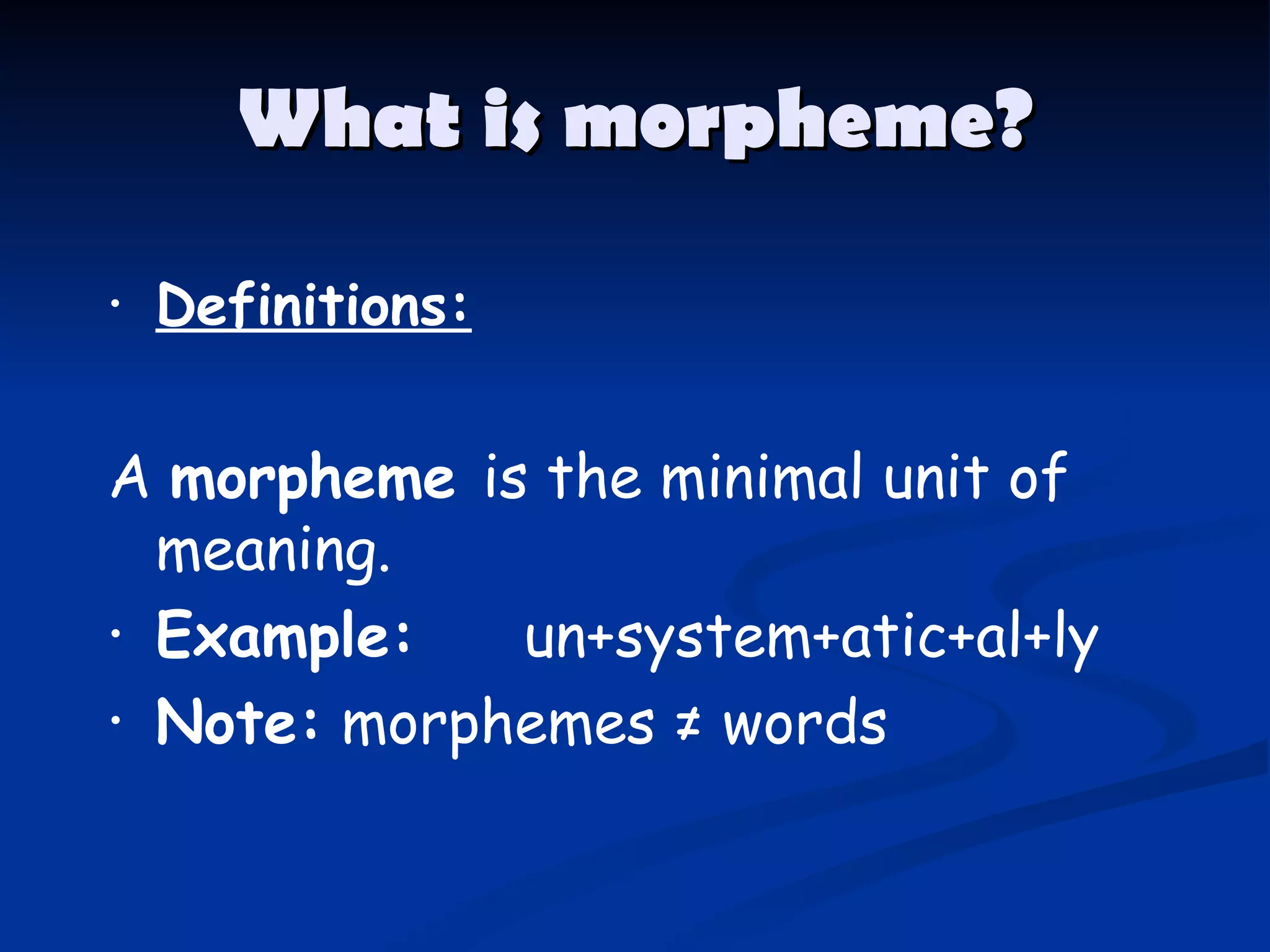
What is morpheme?Definitions: A morpheme is the minimal unit of meaning. Example: un+system+atic+al+ly Note: morphemes ≠ words
12.
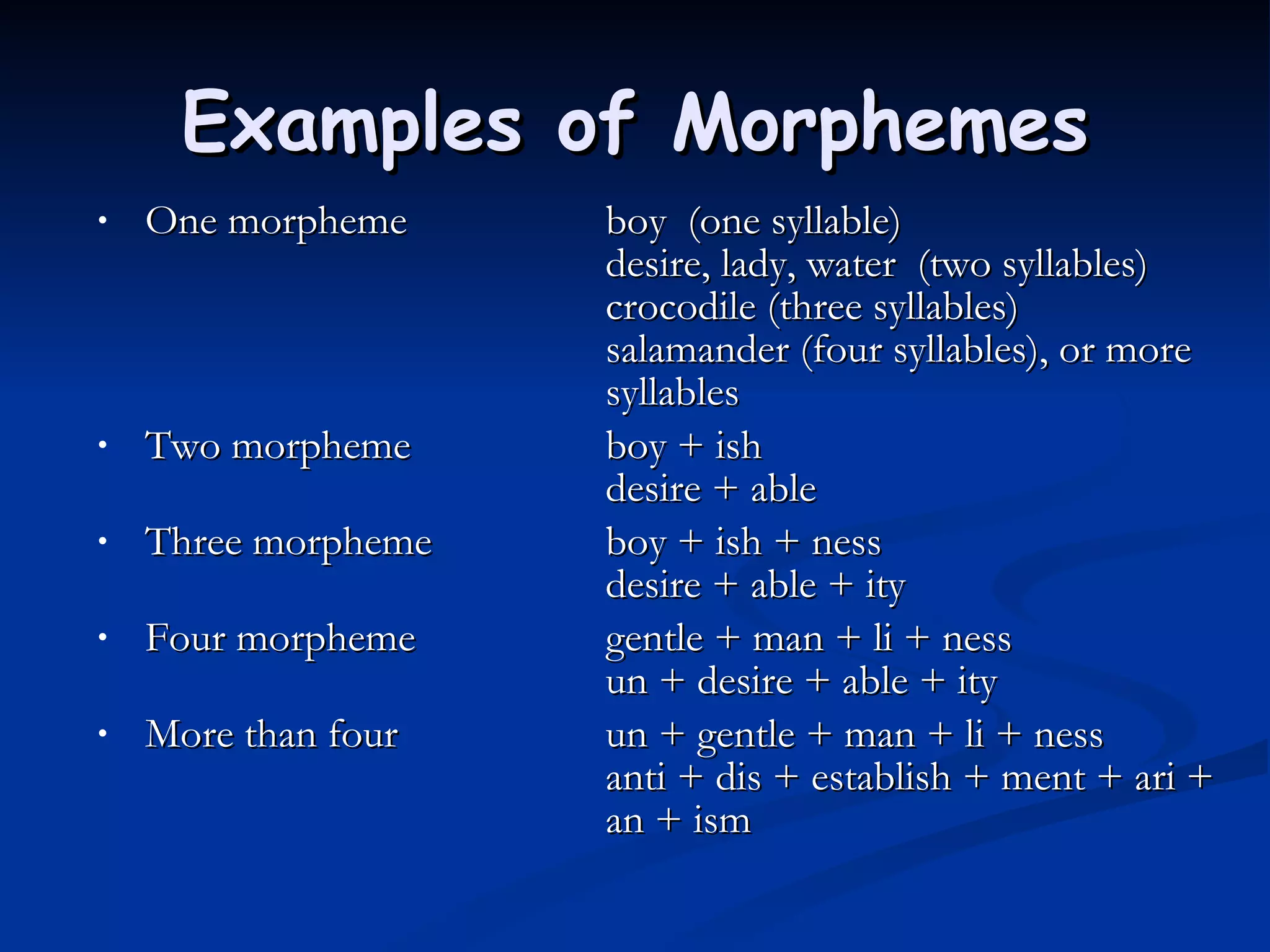
Examples of MorphemesOne morpheme boy (one syllable) desire, lady, water (two syllables) crocodile (three syllables) salamander (four syllables), or more syllables Two morpheme boy + ish desire + able Three morpheme boy + ish + ness desire + able + ity Four morpheme gentle + man + li + ness un + desire + able + ity More than four un + gentle + man + li + ness anti + dis + establish + ment + ari + an + ism
13.
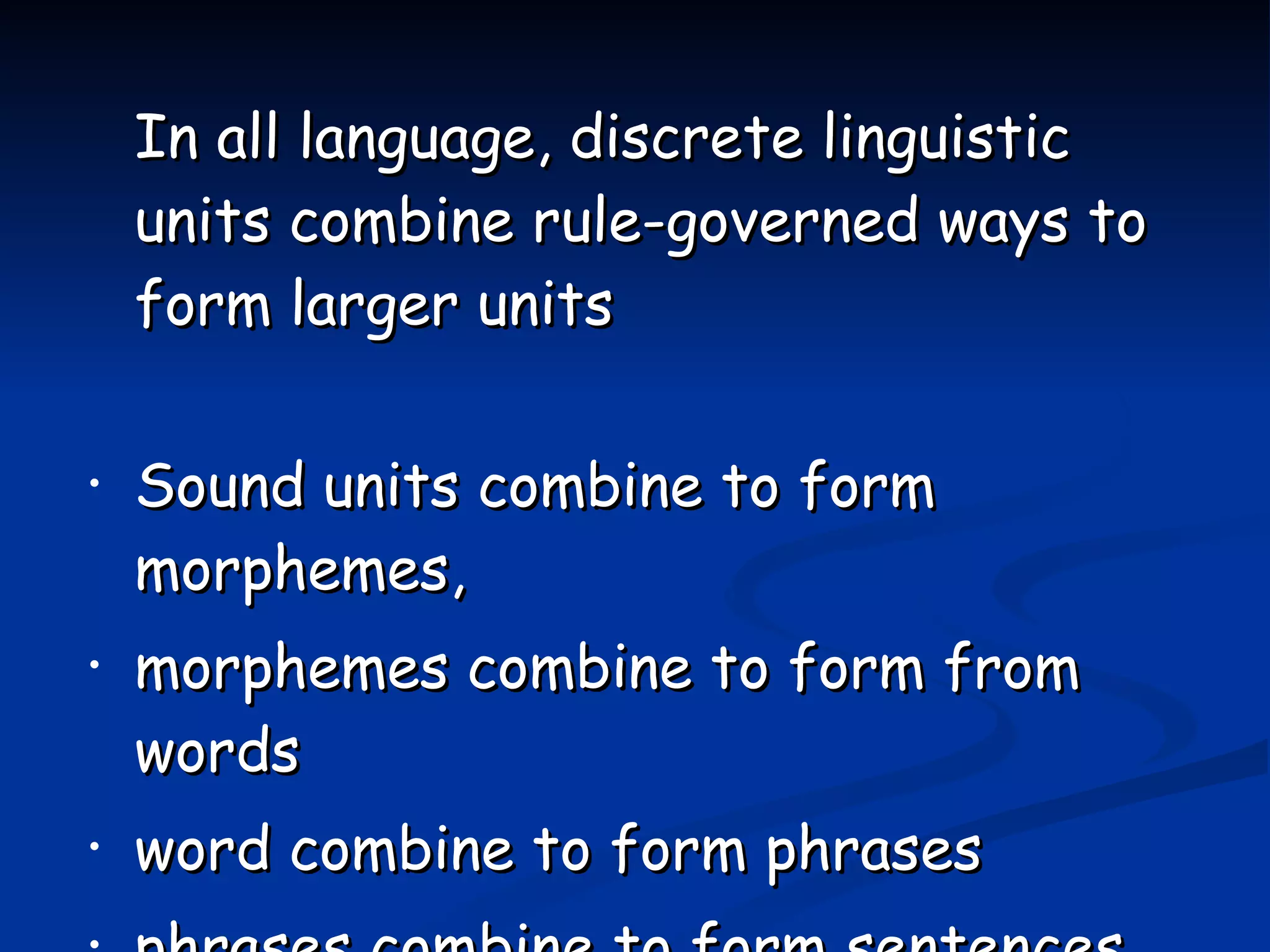
In all language,discrete linguistic units combine rule-governed ways to form larger units Sound units combine to form morphemes, morphemes combine to form from words word combine to form phrases phrases combine to form sentences
14.
What is therelationship between morphemes and words?
15.
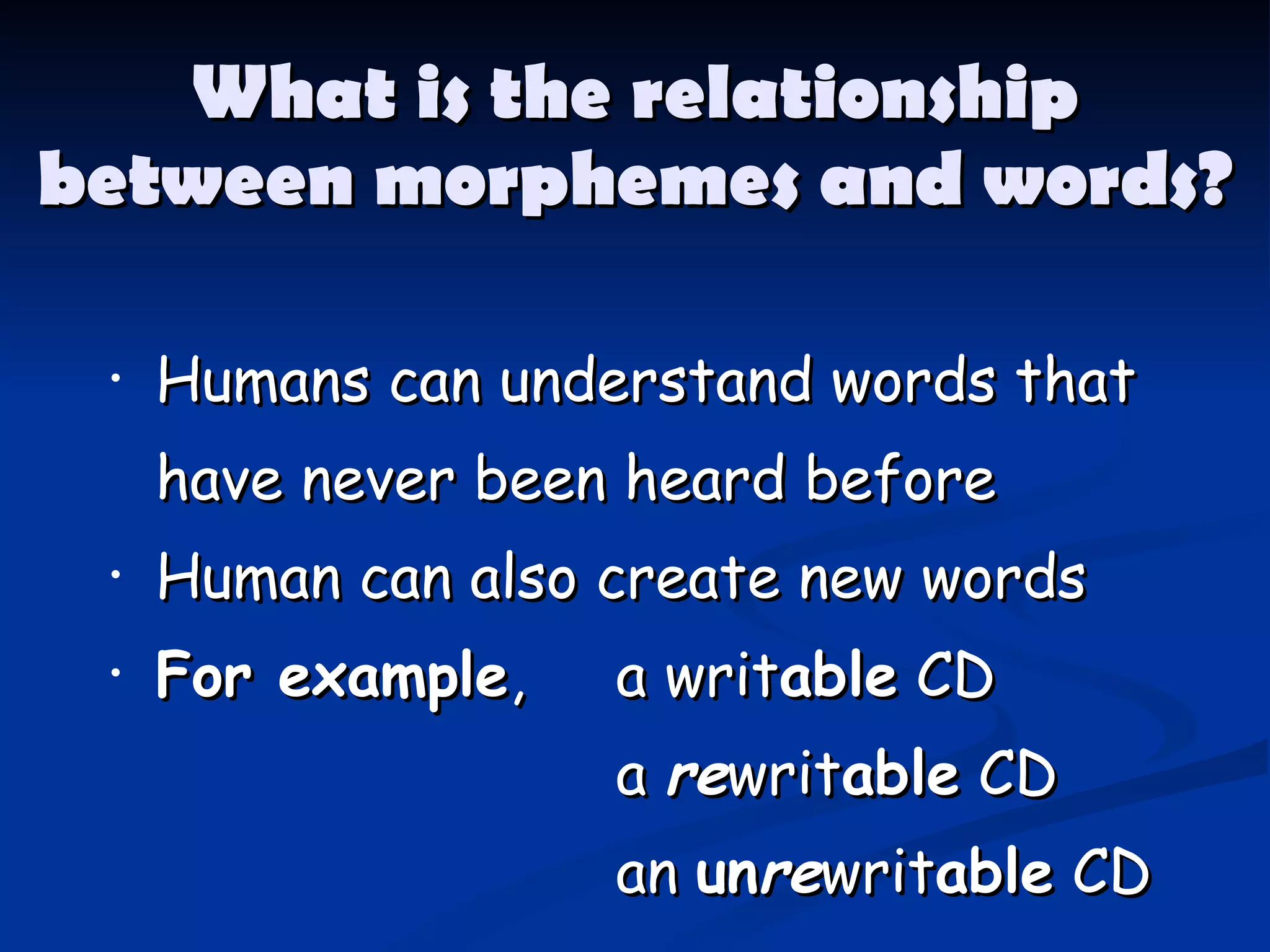
Humans can understandwords that have never been heard before Human can also create new words For example , a writ able CD a re writ able CD an un re writ able CD What is the relationship between morphemes and words?
16.
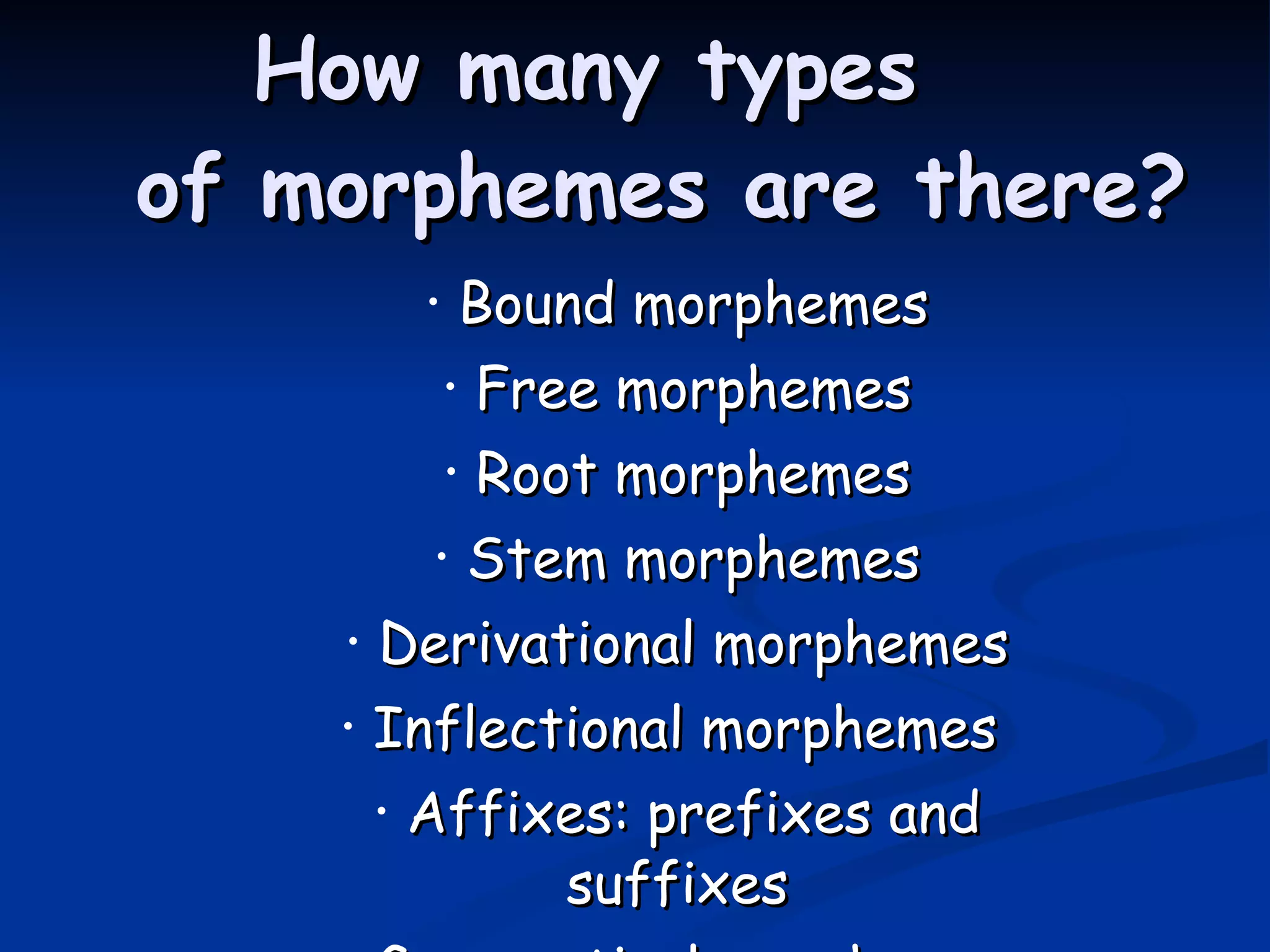
How many types of morphemes are there? Bound morphemes Free morphemes Root morphemes Stem morphemes Derivational morphemes Inflectional morphemes Affixes: prefixes and suffixes Grammatical morphemes
17.
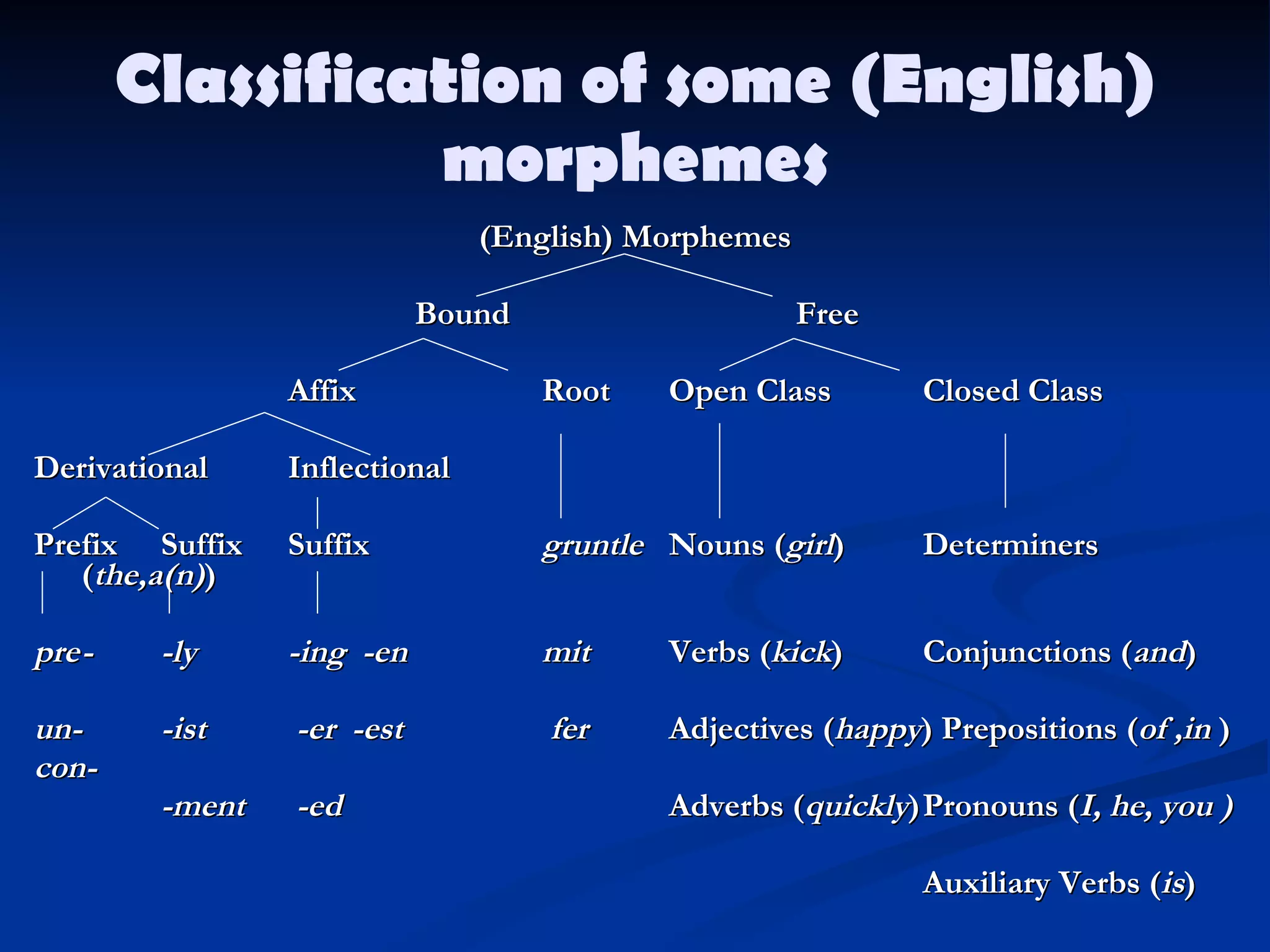
Classification of some(English) morphemes (English) Morphemes Bound Free Affix Root Open Class Closed Class Derivational Inflectional Prefix Suffix Suffix gruntle Nouns ( girl ) Determiners ( the , a(n) ) pre - -ly -ing -en mit Verbs ( kick ) Conjunctions ( and ) un- -ist -er -est fer Adjectives ( happy ) Prepositions ( of , in ) con- -ment -ed Adverbs ( quickly ) Pronouns ( I , he , you ) Auxiliary Verbs ( is )
18.
19.
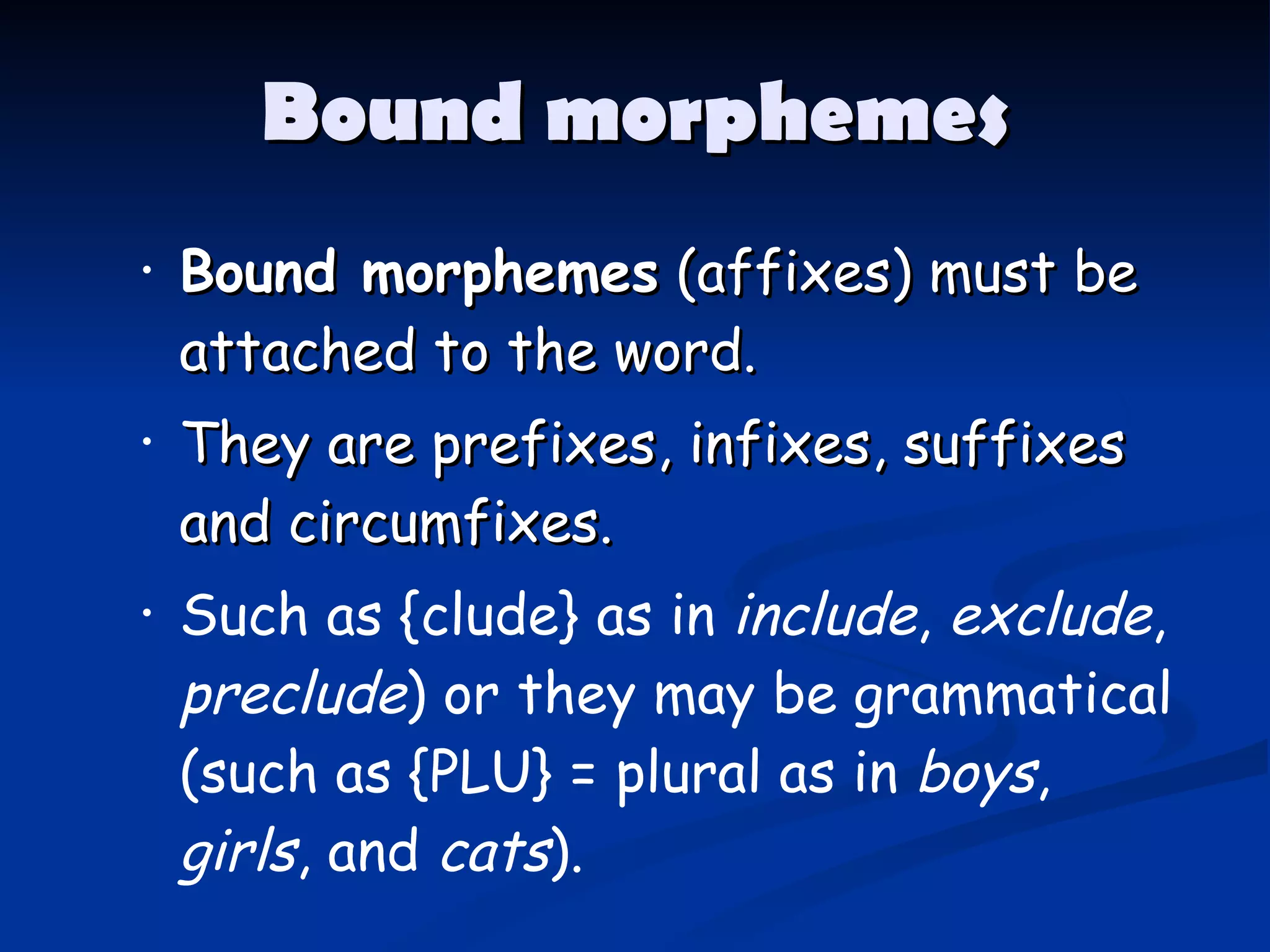
Bound morphemes Boundmorphemes (affixes) must be attached to the word. They are prefixes, infixes, suffixes and circumfixes. Such as {clude} as in include , exclude , preclude ) or they may be grammatical (such as {PLU} = plural as in boys , girls , and cats ).
20.
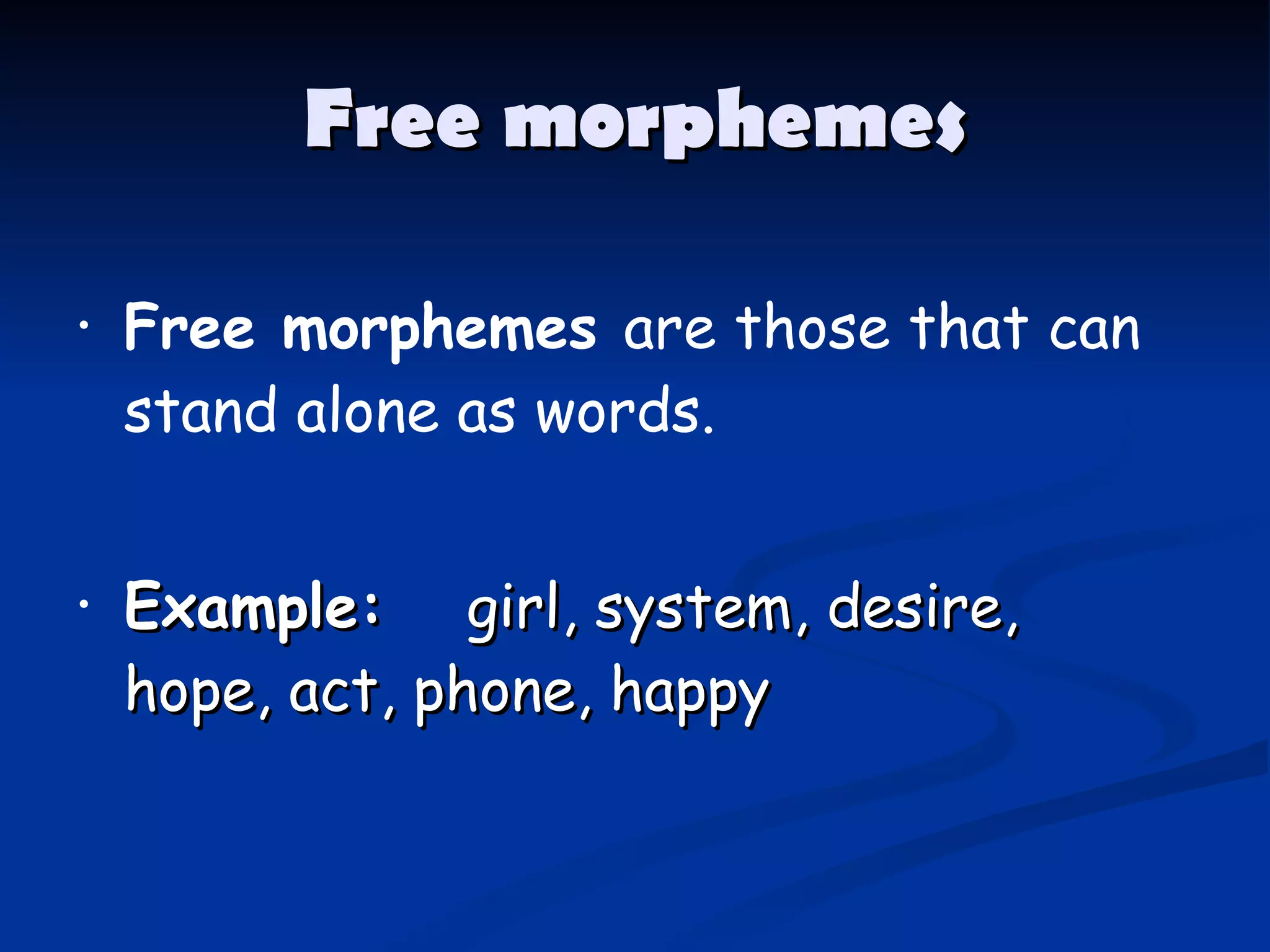
Free morphemes Freemorphemes are those that can stand alone as words. Example: girl, system, desire, hope, act, phone, happy
21.
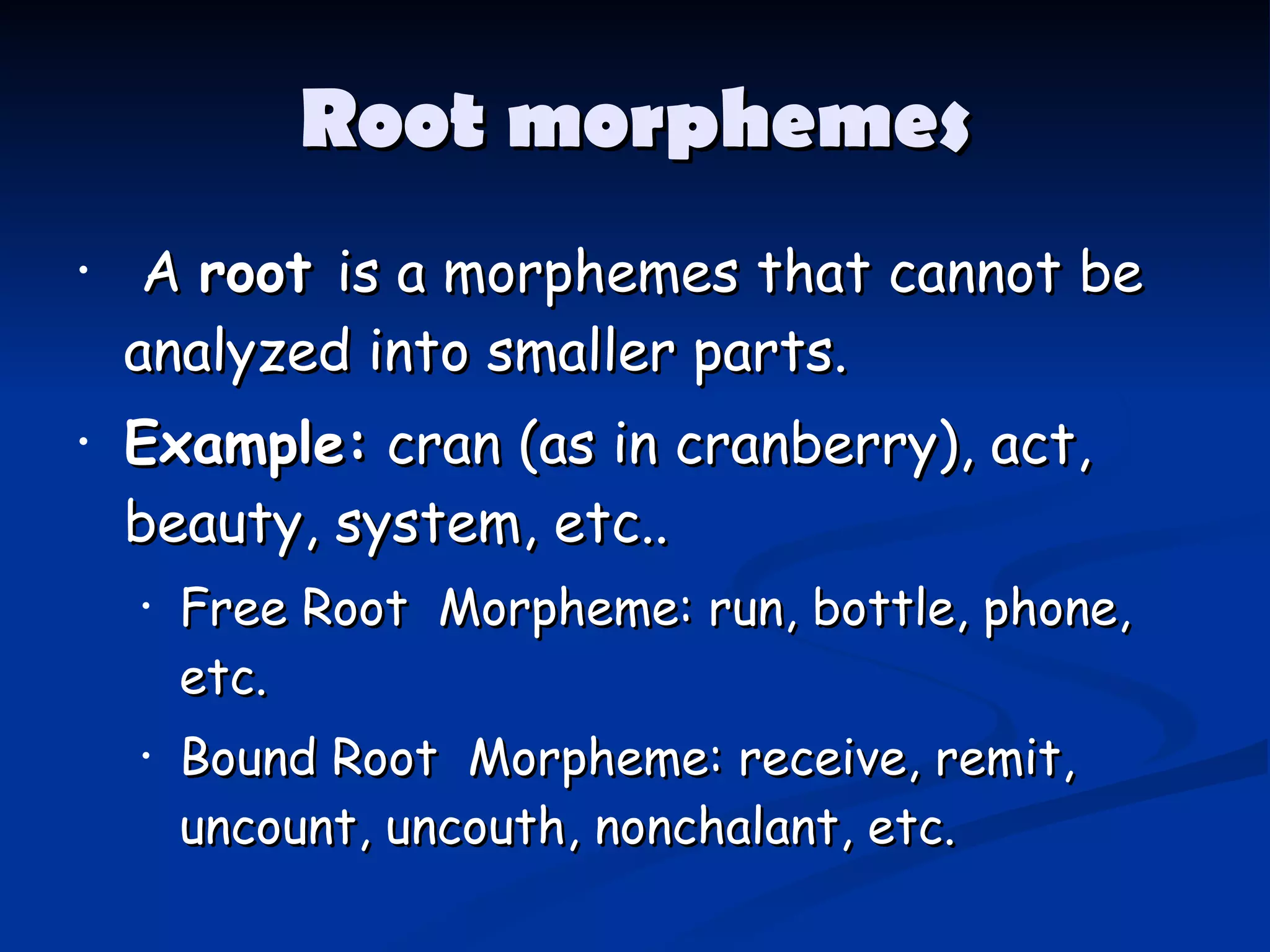
Root morphemes A root is a morphemes that cannot be analyzed into smaller parts. Example: cran (as in cranberry), act, beauty, system, etc.. Free Root Morpheme: run, bottle, phone, etc. Bound Root Morpheme: receive, remit, uncount, uncouth, nonchalant, etc.
22.
A stem is formed when a root morphemes is combined with an affix. Other affixes can be added to a stem to form a more complex stem. Stem morphemes
23.
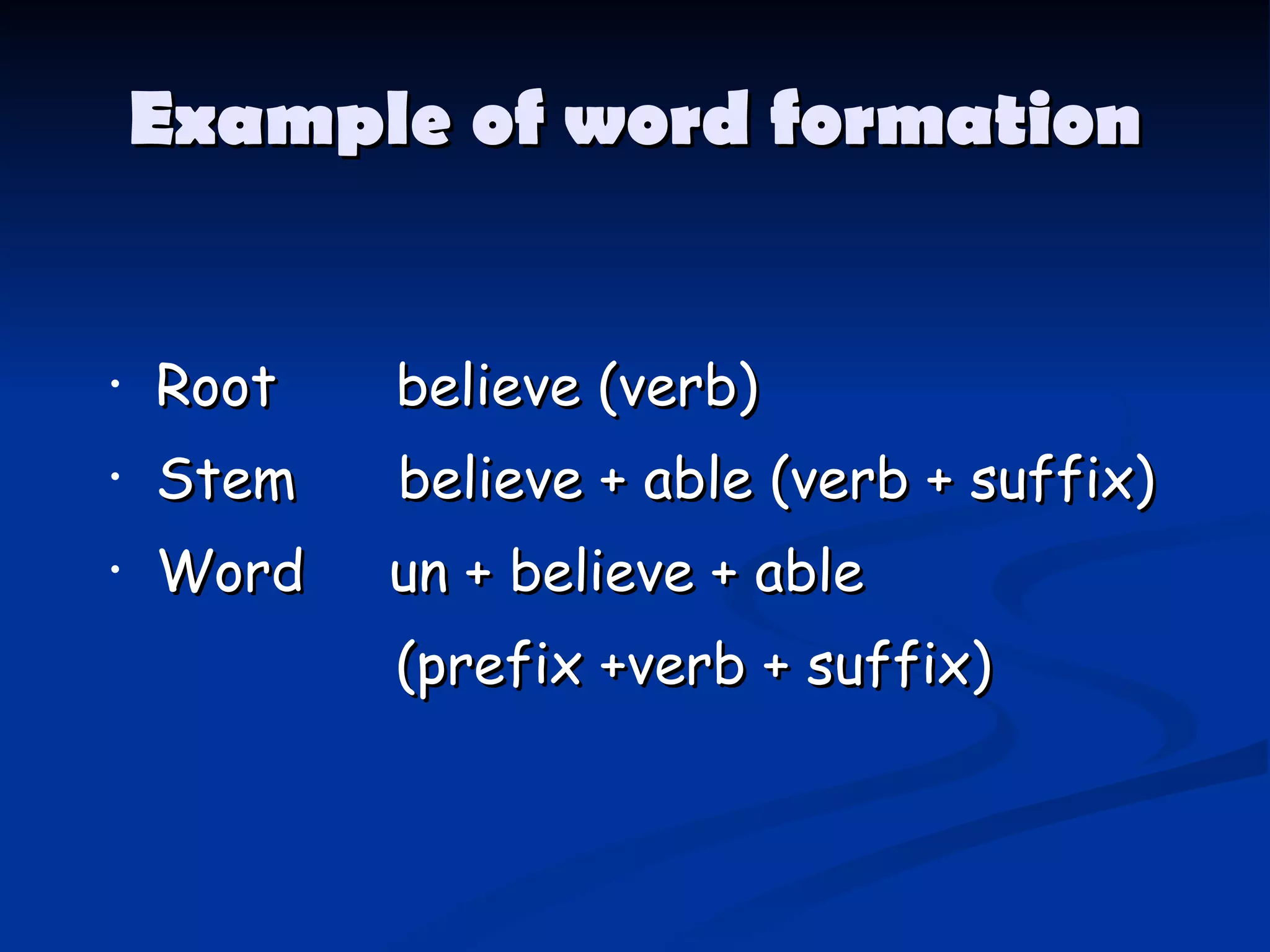
Example of wordformation Root believe (verb) Stem believe + able (verb + suffix) Word un + believe + able (prefix +verb + suffix)
24.
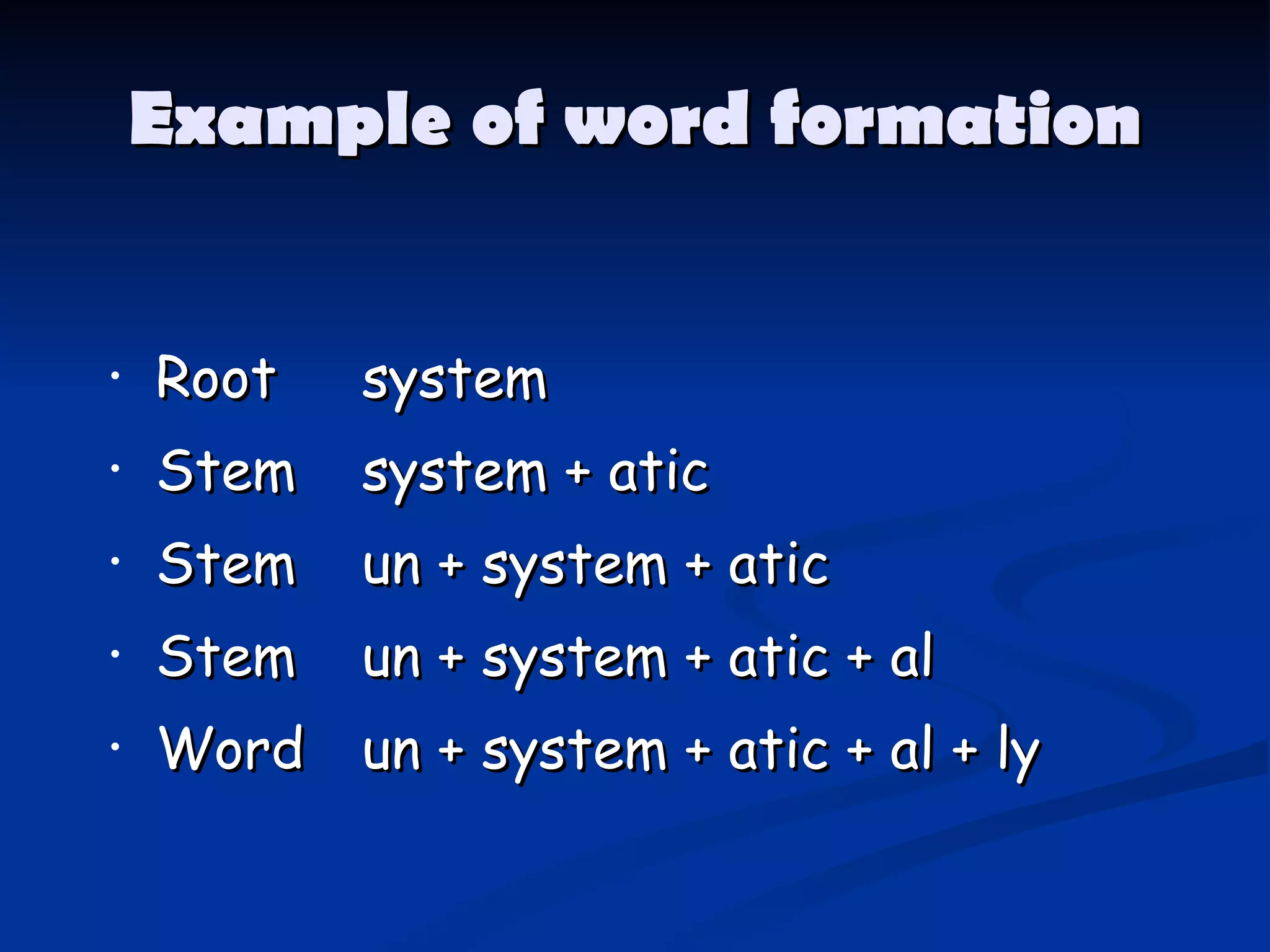
Example of wordformation Root system Stem system + atic Stem un + system + atic Stem un + system + atic + al Word un + system + atic + al + ly
25.
It’s time torelax Are you tried? Let’s listen to the song
26.
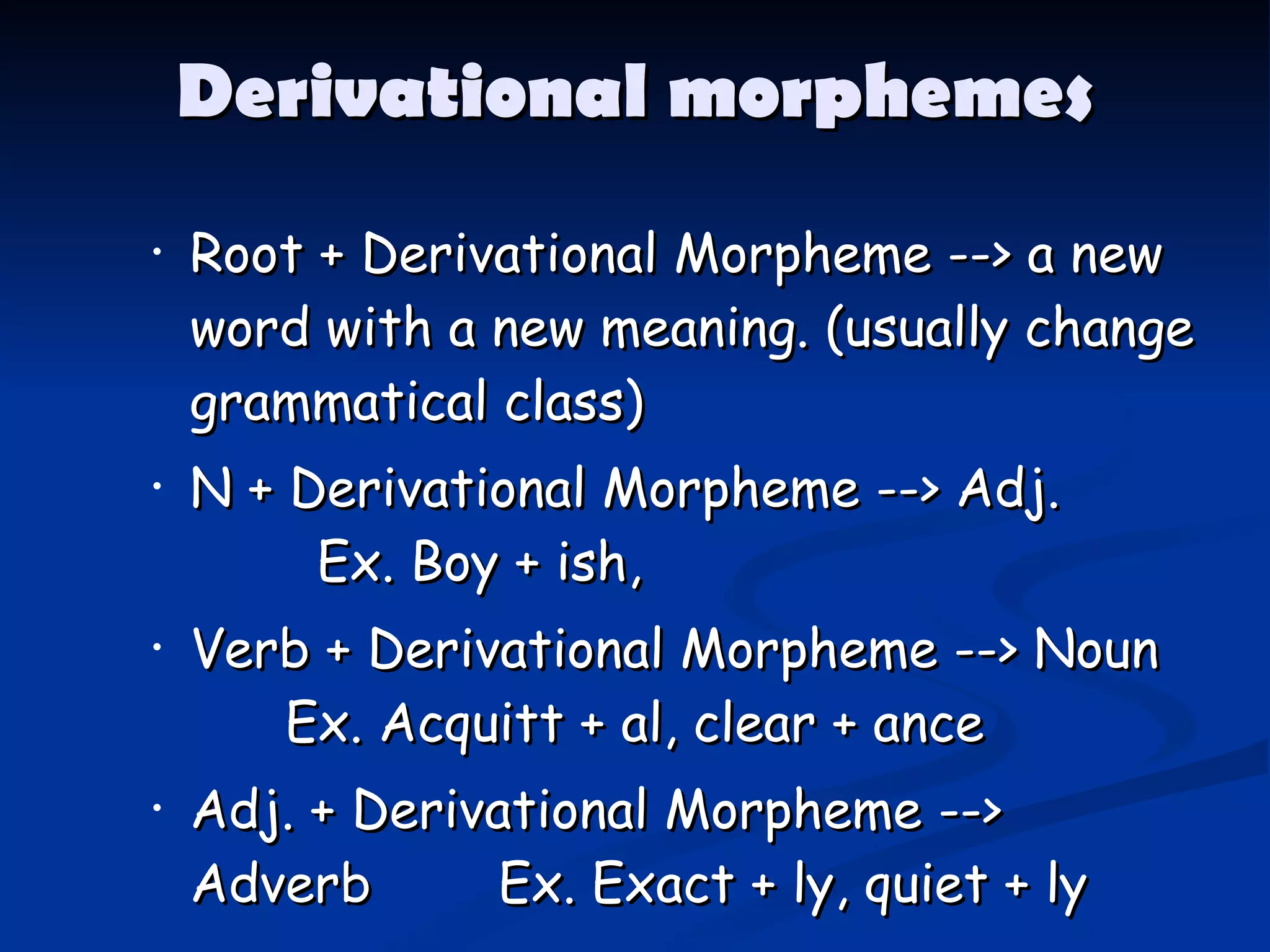
Derivational morphemes Root+ Derivational Morpheme --> a new word with a new meaning. (usually change grammatical class) N + Derivational Morpheme --> Adj. Ex. Boy + ish, Verb + Derivational Morpheme --> Noun Ex. Acquitt + al, clear + ance Adj. + Derivational Morpheme --> Adverb Ex. Exact + ly, quiet + ly
27.
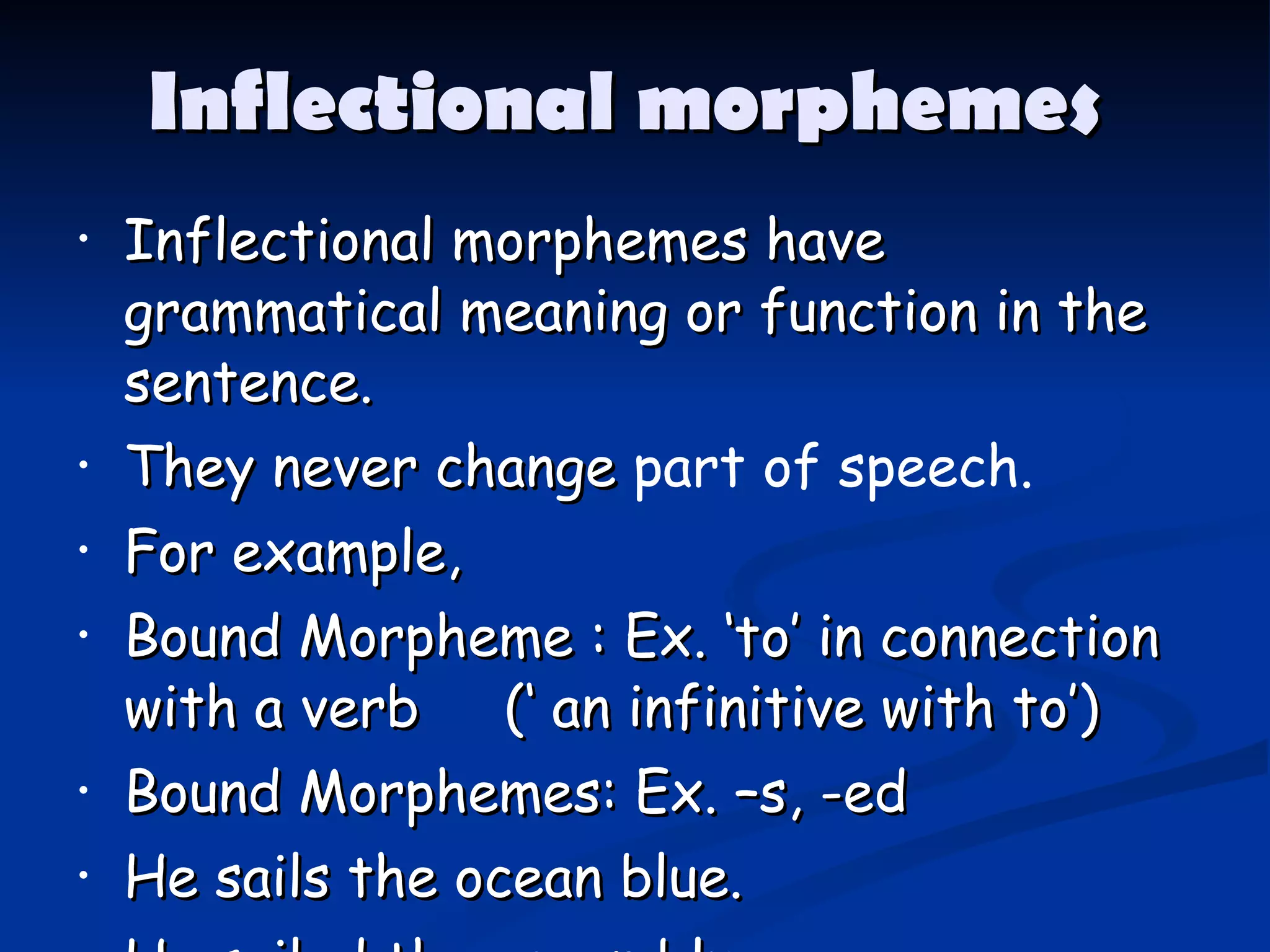
Inflectional morphemes Inflectional morphemes have grammatical meaning or function in the sentence. They never change part of speech. For example, Bound Morpheme : Ex. ‘to’ in connection with a verb (‘ an infinitive with to’) Bound Morphemes: Ex. –s, -ed He sails the ocean blue. He sailed the ocean blue.
28.
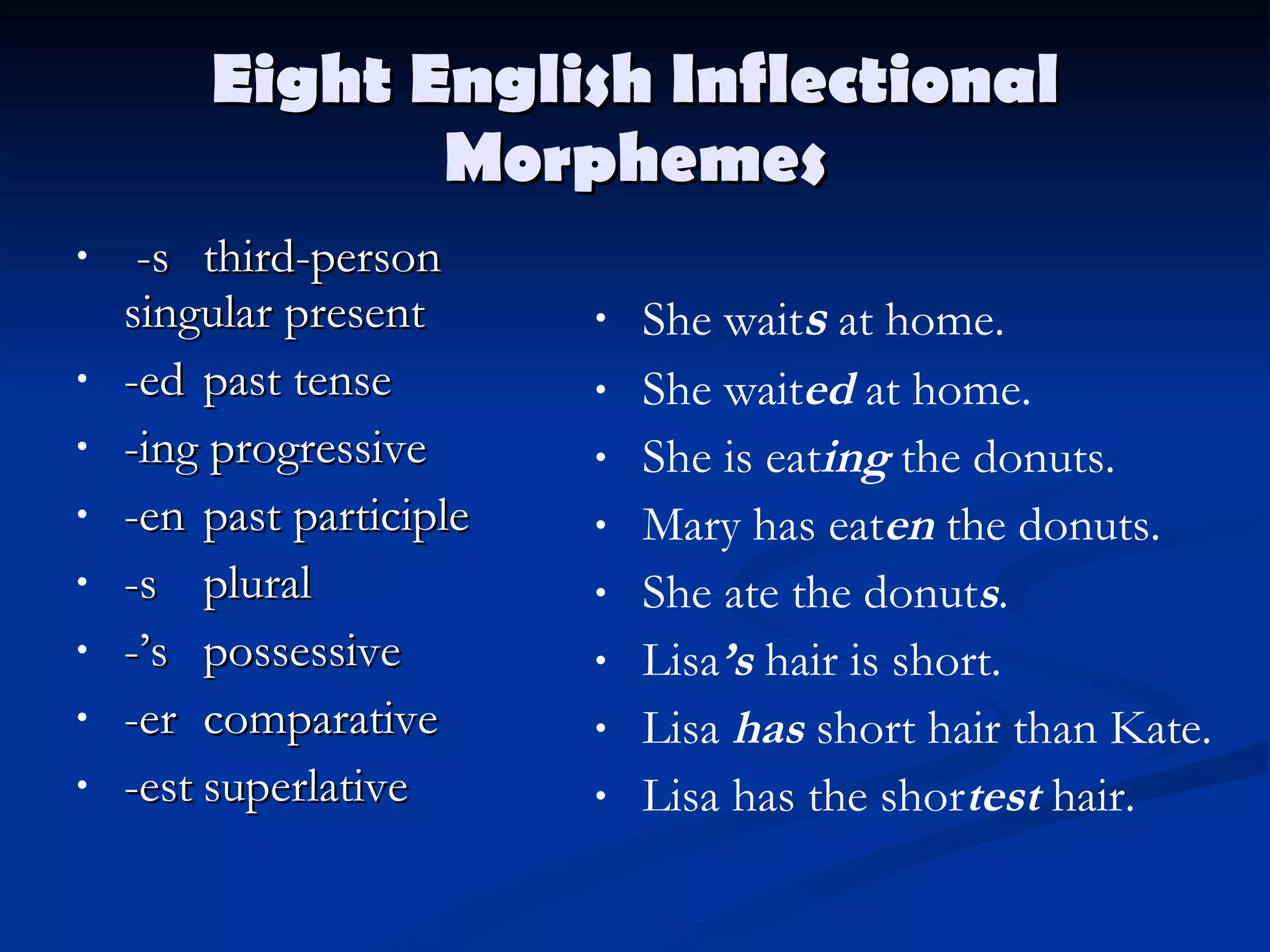
Eight English InflectionalMorphemes -s third-person singular present - ed past tense -ing progressive -en past participle -s plural -’s possessive - er comparative -est superlative She wait s at home. She wait ed at home. She is eat ing the donuts. Mary has eat en the donuts. She ate the donut s . Lisa ’s hair is short. Lisa has short hair than Kate. Lisa has the shor test hair.
29.
The major differencesbetween derivational and inflectional morphology predictable (often) unpredictable meaning? (usually) yes (often) no productive? no yes changes stem? not in English yes addable on to? further from stem closer to stem position Inflectional Derivational
30.
31.
Affixes: prefixes andsuffixes Affix : a morpheme that comes at the beginning (prefix) or the ending (suffix) of a base morpheme. Note : An affix usually is a morpheme that cannot stand alone. Examples : -ful , -ly , -it y, -nes s. A few exceptions are able , like , and less .
32.
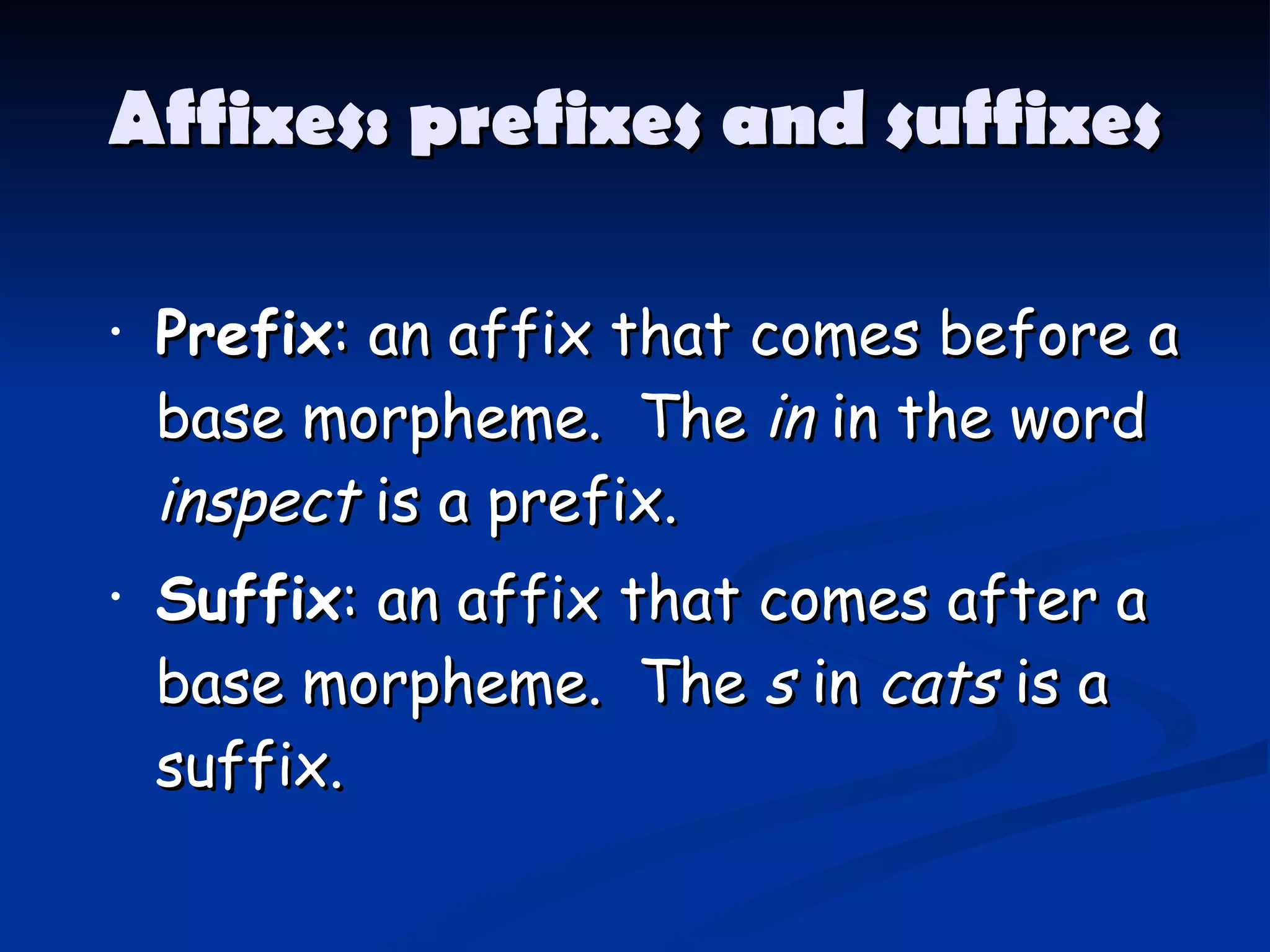
Affixes: prefixes andsuffixes Prefix : an affix that comes before a base morpheme. The in in the word inspect is a prefix. Suffix : an affix that comes after a base morpheme. The s in cats is a suffix.
33.
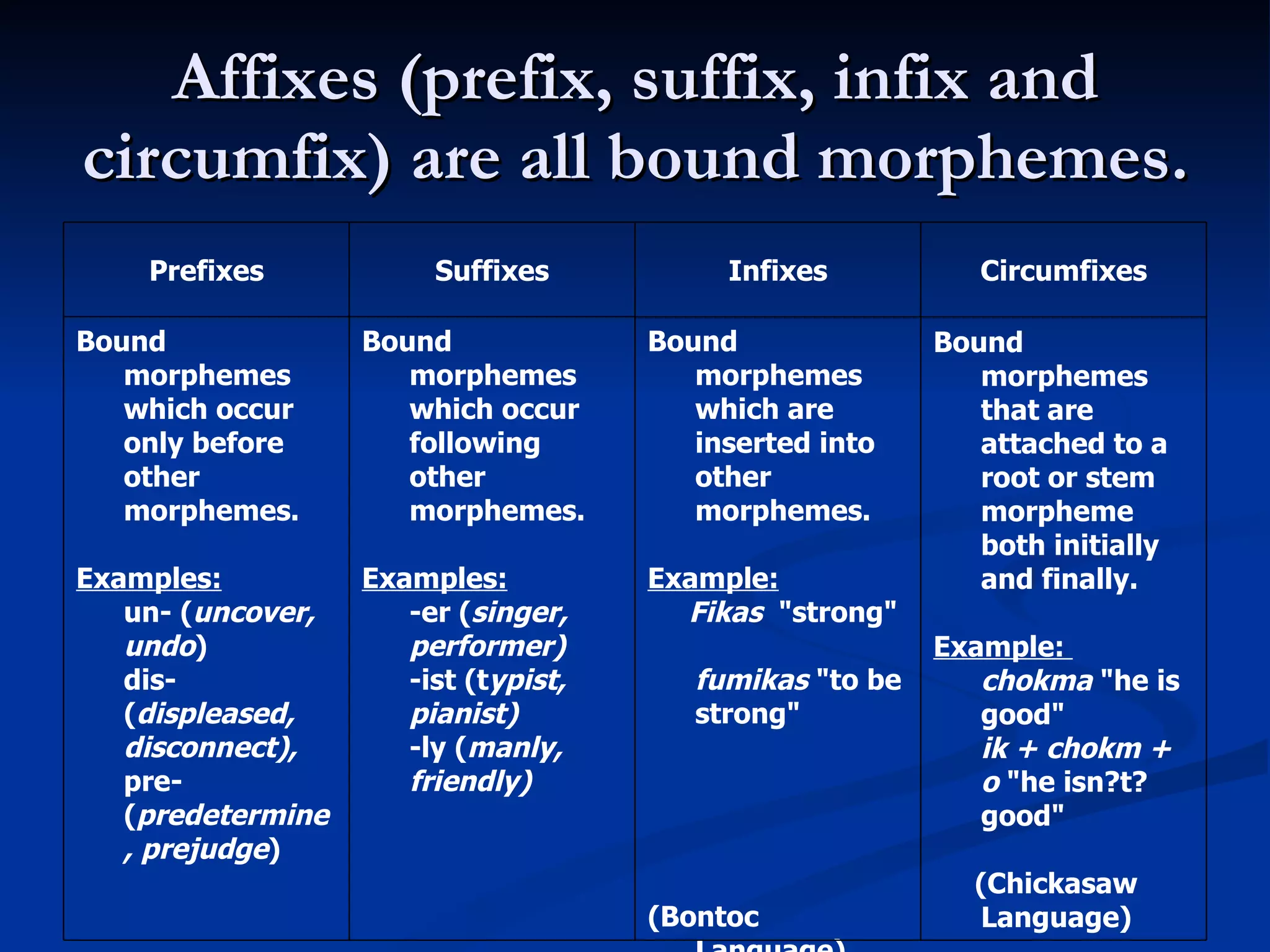
Affixes (prefix, suffix,infix and circumfix) are all bound morphemes. Bound morphemes that are attached to a root or stem morpheme both initially and finally. Example: chokma "he is good" ik + chokm + o "he isn?t? good" (Chickasaw Language) Bound morphemes which are inserted into other morphemes. Example: Fikas "strong" fumikas "to be strong" (Bontoc Language) Bound morphemes which occur following other morphemes. Examples: -er ( singer, performer) -ist (t ypist, pianist) -ly ( manly, friendly) Bound morphemes which occur only before other morphemes. Examples: un- ( uncover, undo ) dis- ( displeased, disconnect), pre- ( predetermine, prejudge ) Circumfixes Infixes Suffixes Prefixes
34.
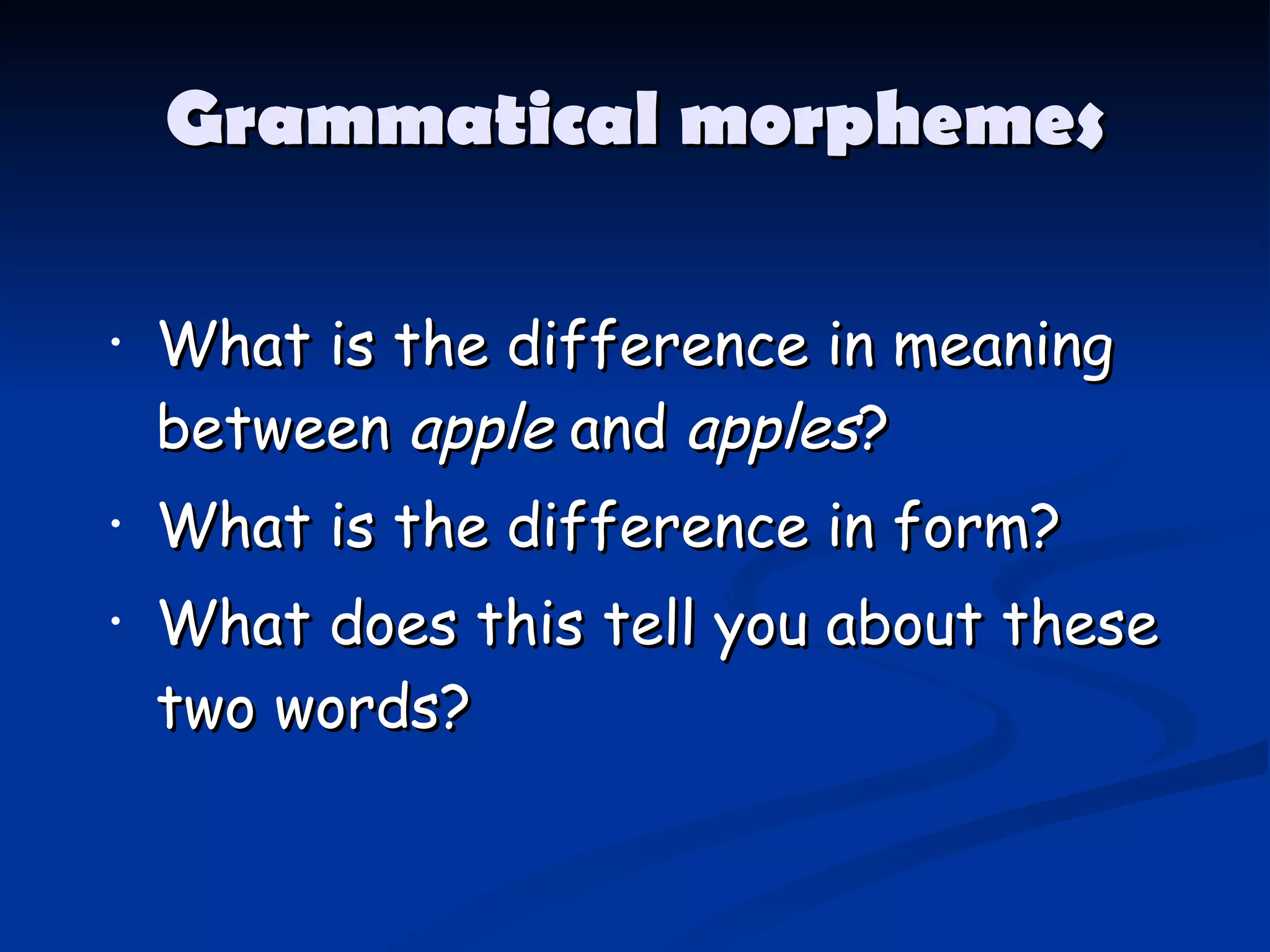
Grammatical morphemes Whatis the difference in meaning between apple and apples ? What is the difference in form? What does this tell you about these two words?
35.
Grammatical morphemes Wordscan have an internal structure much like the syntax of phrases. Morphemes such as the , -s , and re- near the grammatical end of the continuum are called grammatical morphemes . Note that grammatical morphemes include forms that we can consider to be words like the , a , and , and of and others that make up parts of words like –s and -ed . Examples. pencil s walk ed
36.
What are thedifferences between each type of morphemes?
What is therelationship among each type of morphemes?
39.
What is thedifference between content/lexical words and function/grammatical words?
40.
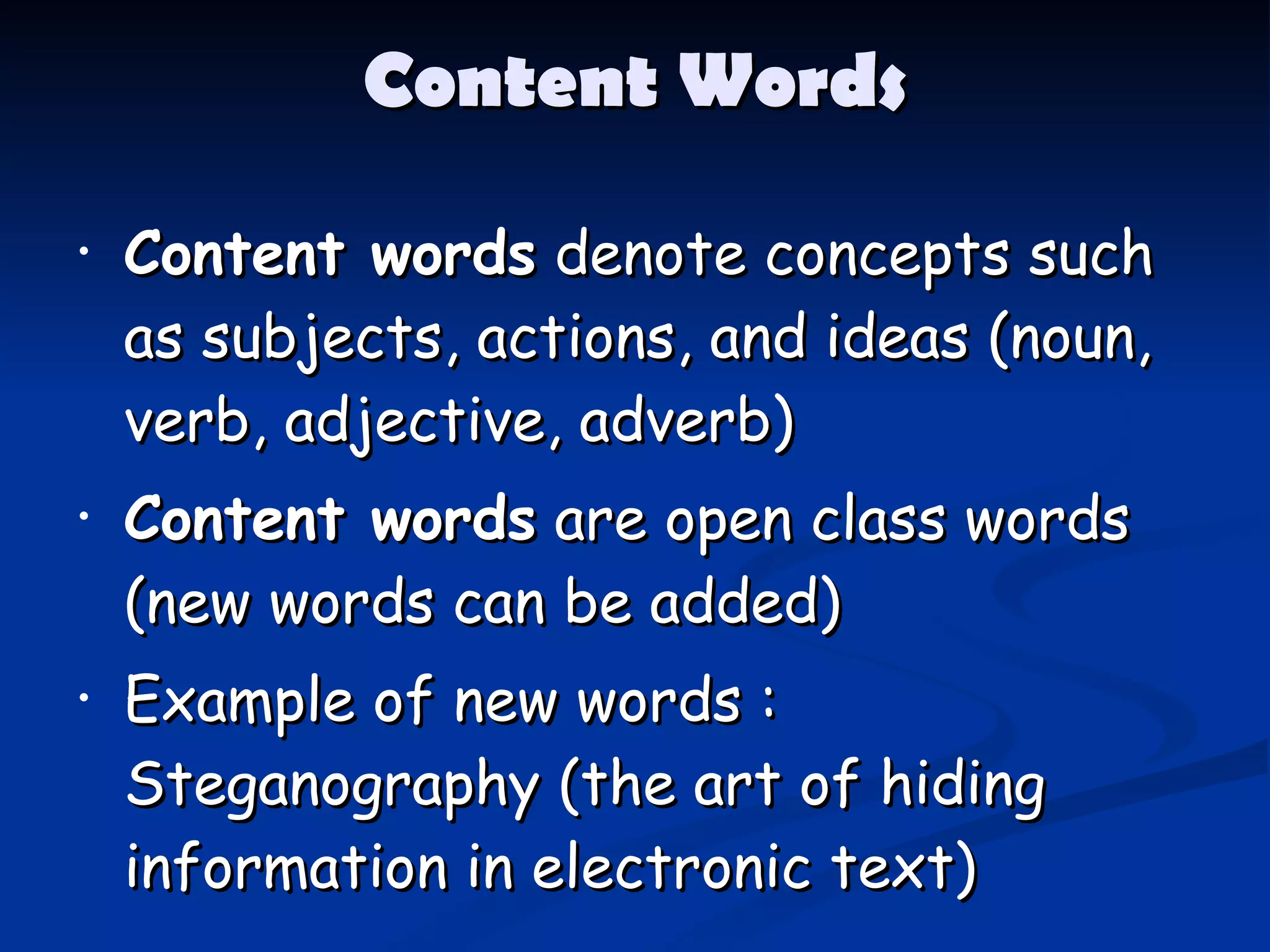
Content Words Contentwords denote concepts such as subjects, actions, and ideas ( noun, verb, adjective, adverb ) Content words are open class words ( new words can be added ) Example of new words : Steganography ( the art of hiding information in electronic text )
41.
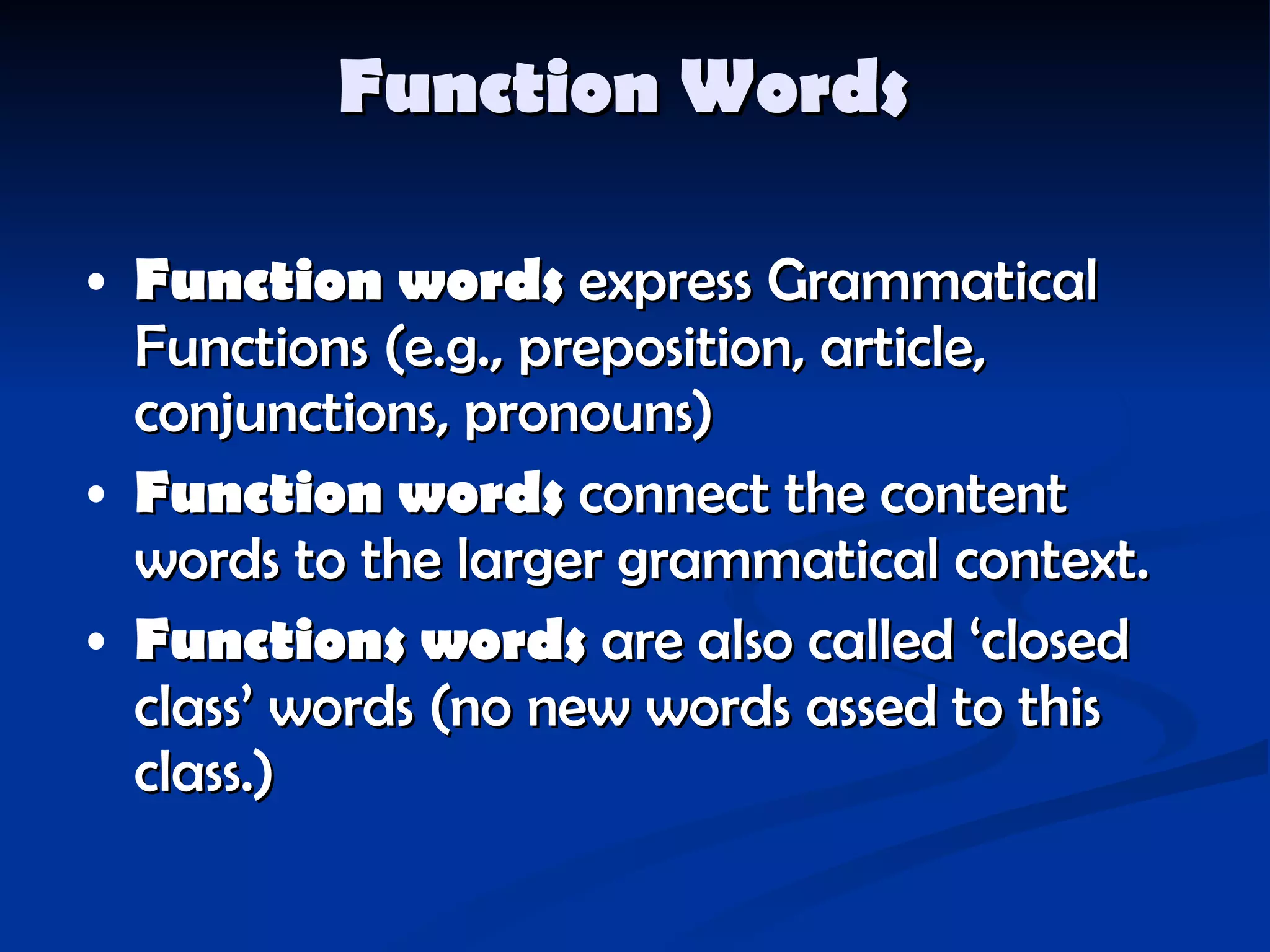
Function Words Function words express Grammatical Functions ( e.g., preposition, article, conjunctions, pronouns ) Function words connect the content words to the larger grammatical context. Functions words are also called ‘closed class’ words ( no new words assed to this class. )
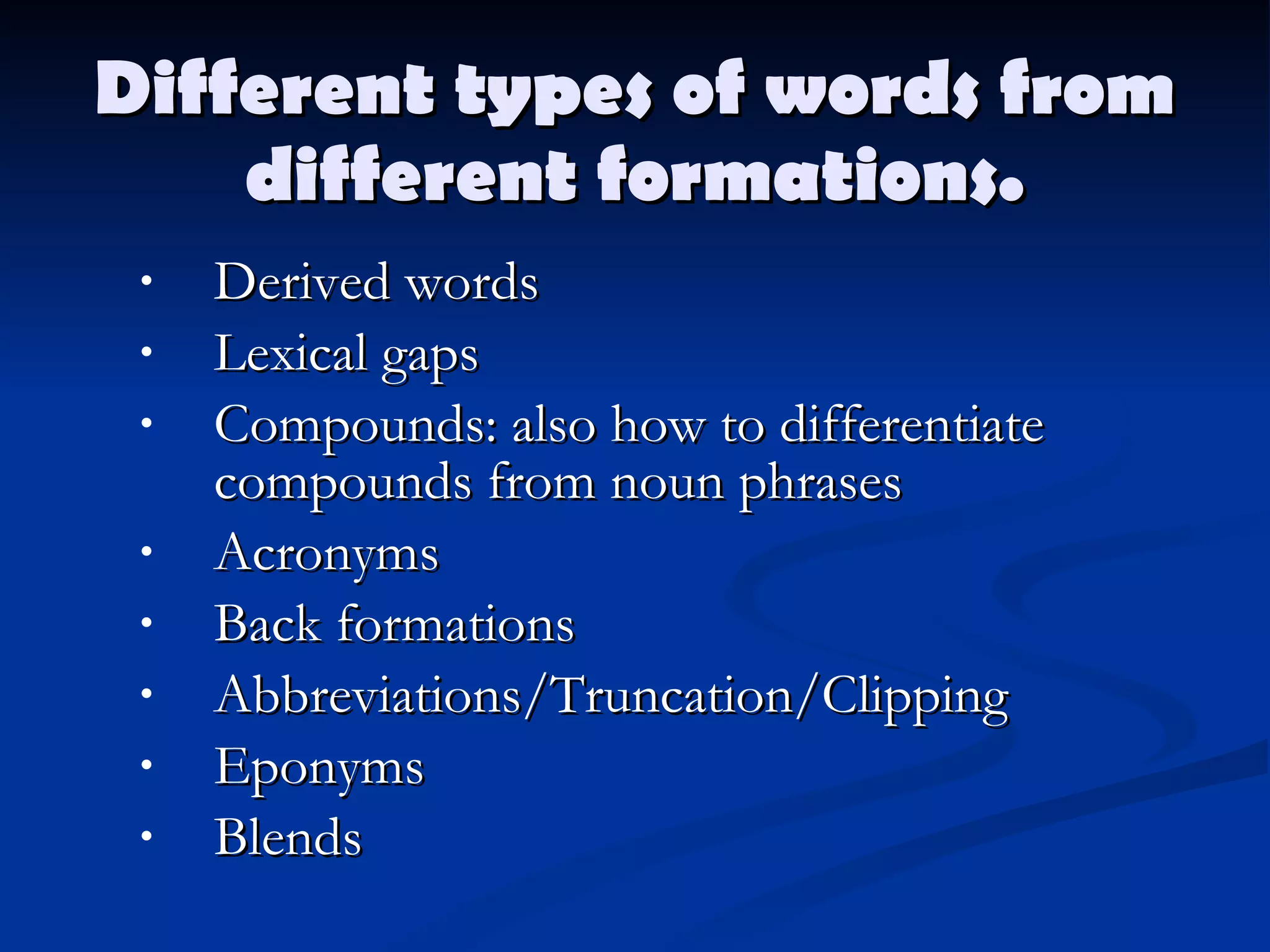
Different types ofwords from different formations. Derived words Lexical gaps Compounds: also how to differentiate compounds from noun phrases Acronyms Back formations Abbreviations/Truncation/Clipping Eponyms Blends
46.
Derived words = new words with new meanings formed from root + derivational morpheme e.g. ir+regular = irrigular
47.
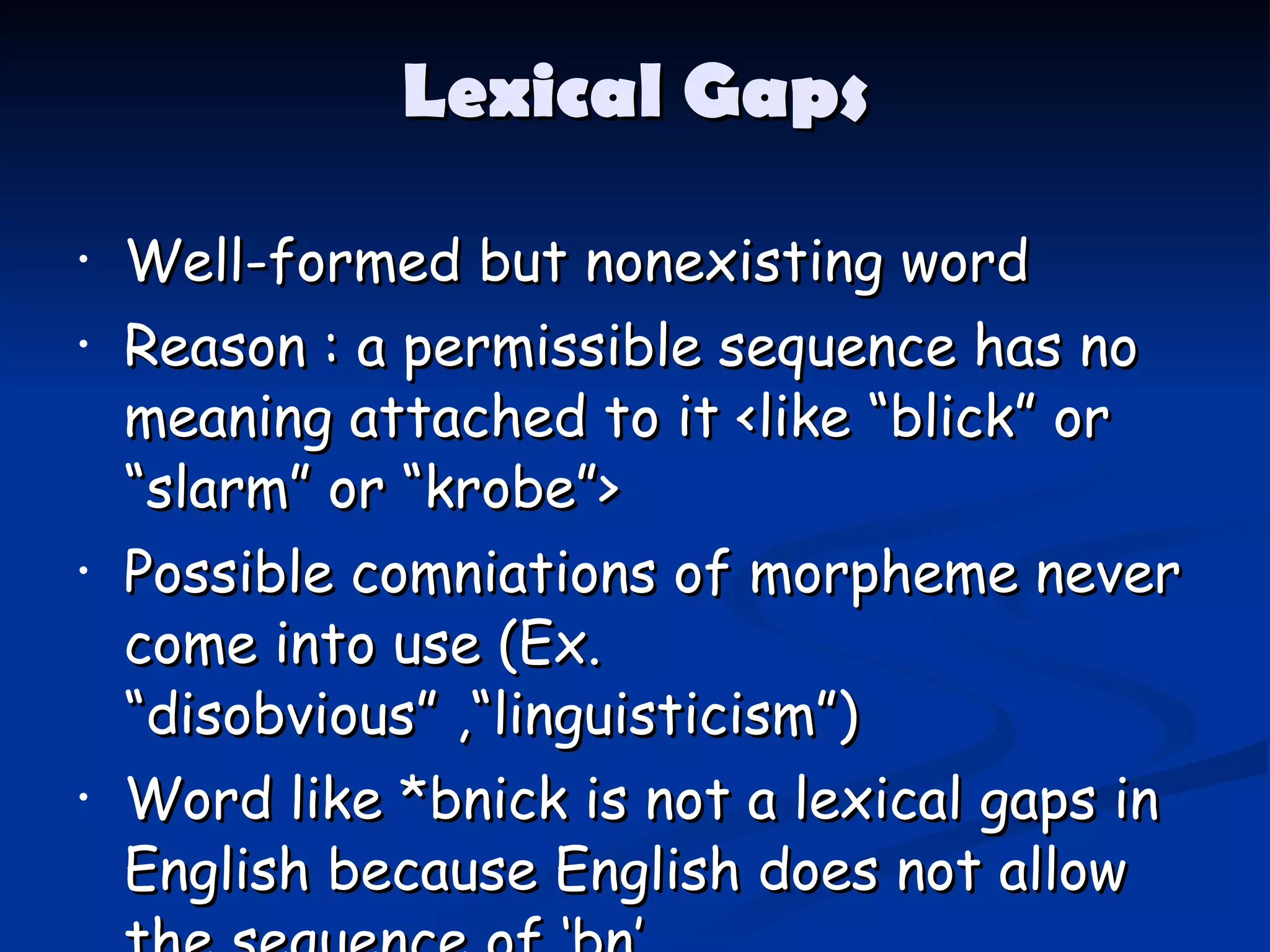
Lexical Gaps Well-formedbut nonexisting word Reason : a permissible sequence has no meaning attached to it <like “blick” or “slarm” or “krobe”> Possible comniations of morpheme never come into use ( Ex. “disobvious” ,“linguisticism” ) Word like *bnick is not a lexical gaps in English because English does not allow the sequence of ‘bn’
48.
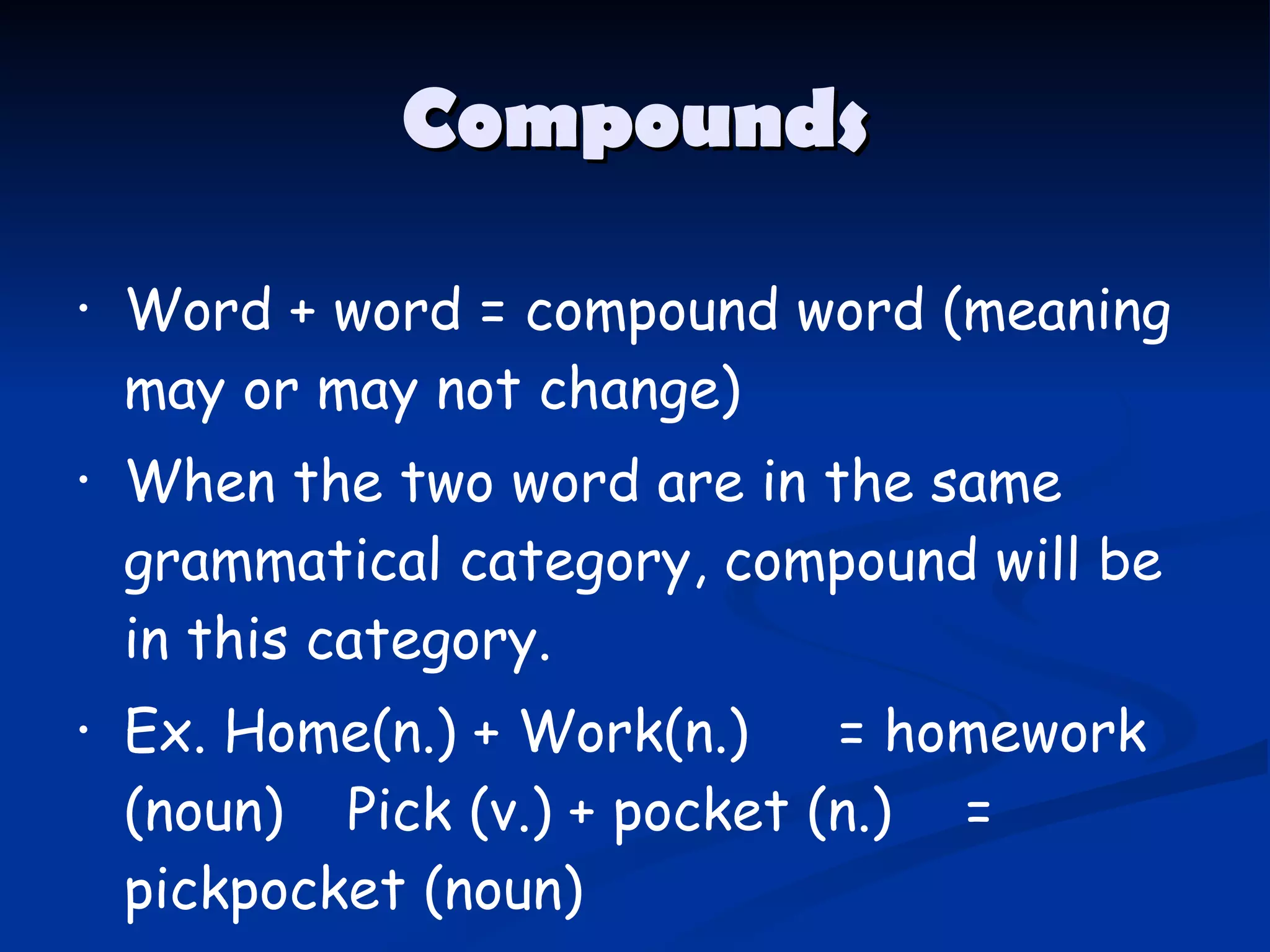
Compounds Word +word = compound word ( meaning may or may not change ) When the two word are in the same grammatical category, compound will be in this category. Ex. Home ( n. ) + Work ( n. ) = homework ( noun ) Pick ( v. ) + pocket ( n. ) = pickpocket ( noun )
49.
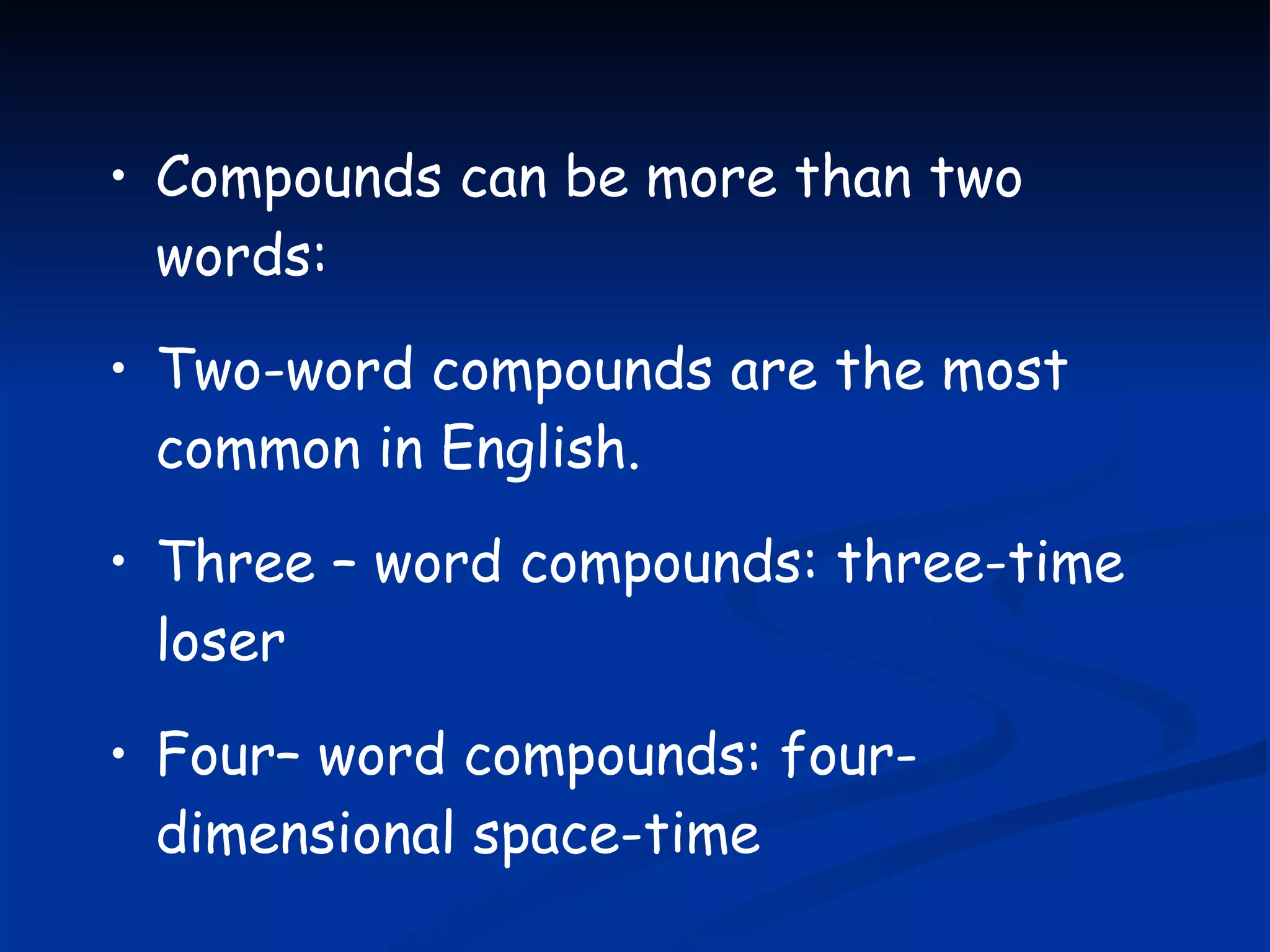
Compounds can bemore than two words: Two-word compounds are the most common in English. Three – word compounds: three-time loser Four– word compounds: four-dimensional space-time
50.
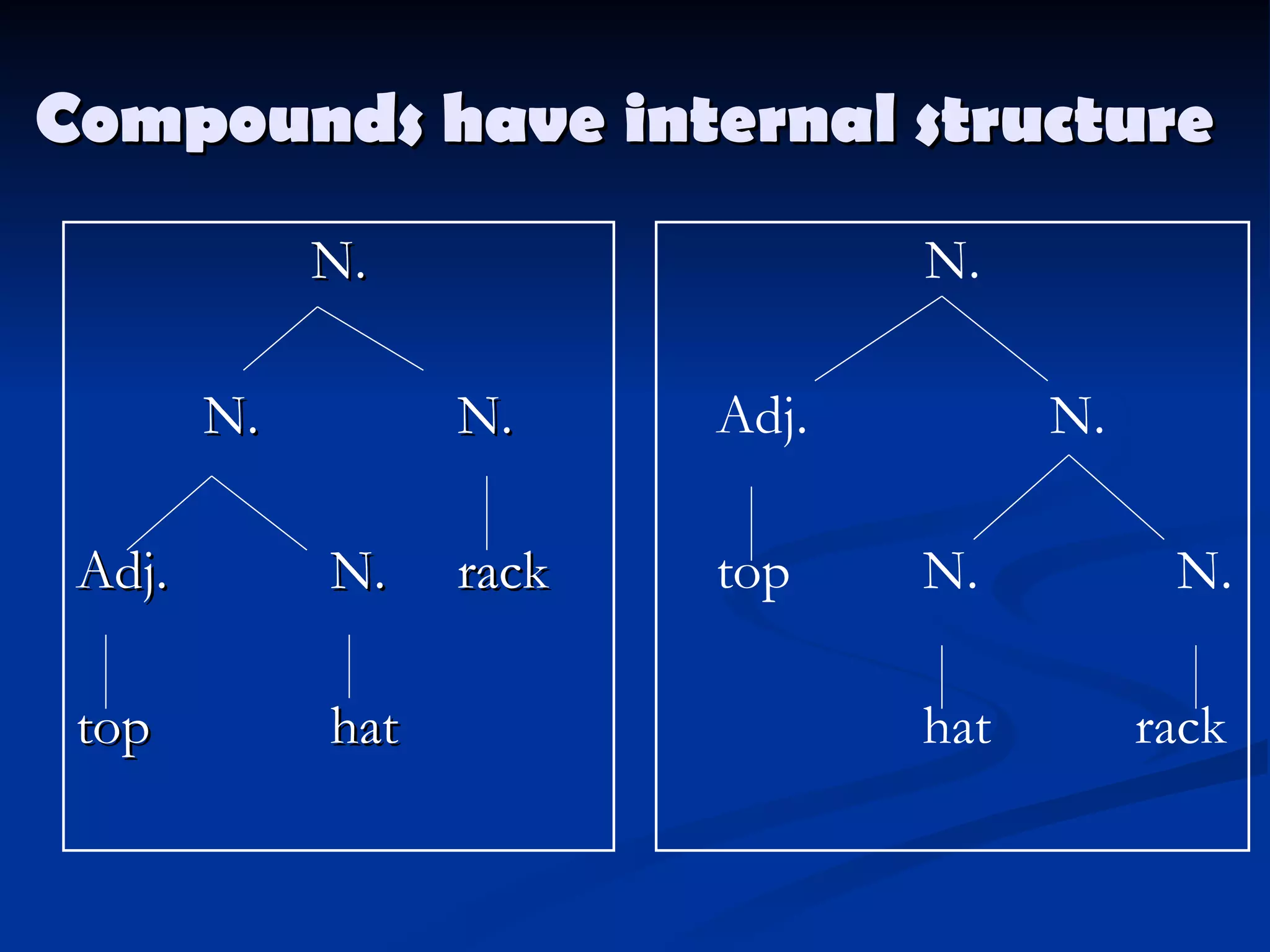
Compounds have internalstructure N. N. N. Adj. N. rack top hat N. Adj. N. top N. N. hat rack
Meaning of compoundsSame meaning as the parts : a boathouse = ( a house for boats ) New meaning but relate to the meaning of the individual parts : a blackboard ( can be in other colors, not just black ) a Redcoat ( slang for British soldier during American Revolutionary War )
Acronyms Acronyms are word derived from he initials of several word NASA <National Aeronautics and Space Agency> UNESCO <United Nations Educational, Scientific, and Cultural Organization>
57.
Back formations Anew word may entry the language because of an incorrect morphological analysis. Example, peddle was derived from peddler on the mistaken assumption that the – er was suffix. stoke --> stoker edit --> editor
58.
Abbreviations Abbreviations of longer words or phrases can become lexicalized Fax <facsimile> Telly ( The British word for ‘television’ )
59.
Eponyms areword form proper names. Example: sandwich, robot, jumbo Eponyms
60.
Blends Similar tocompounds but parts of the words that are combined are deleted. Example: smog <from ‘smok + fog’>, motel <from ‘motor + hotel’>
61.
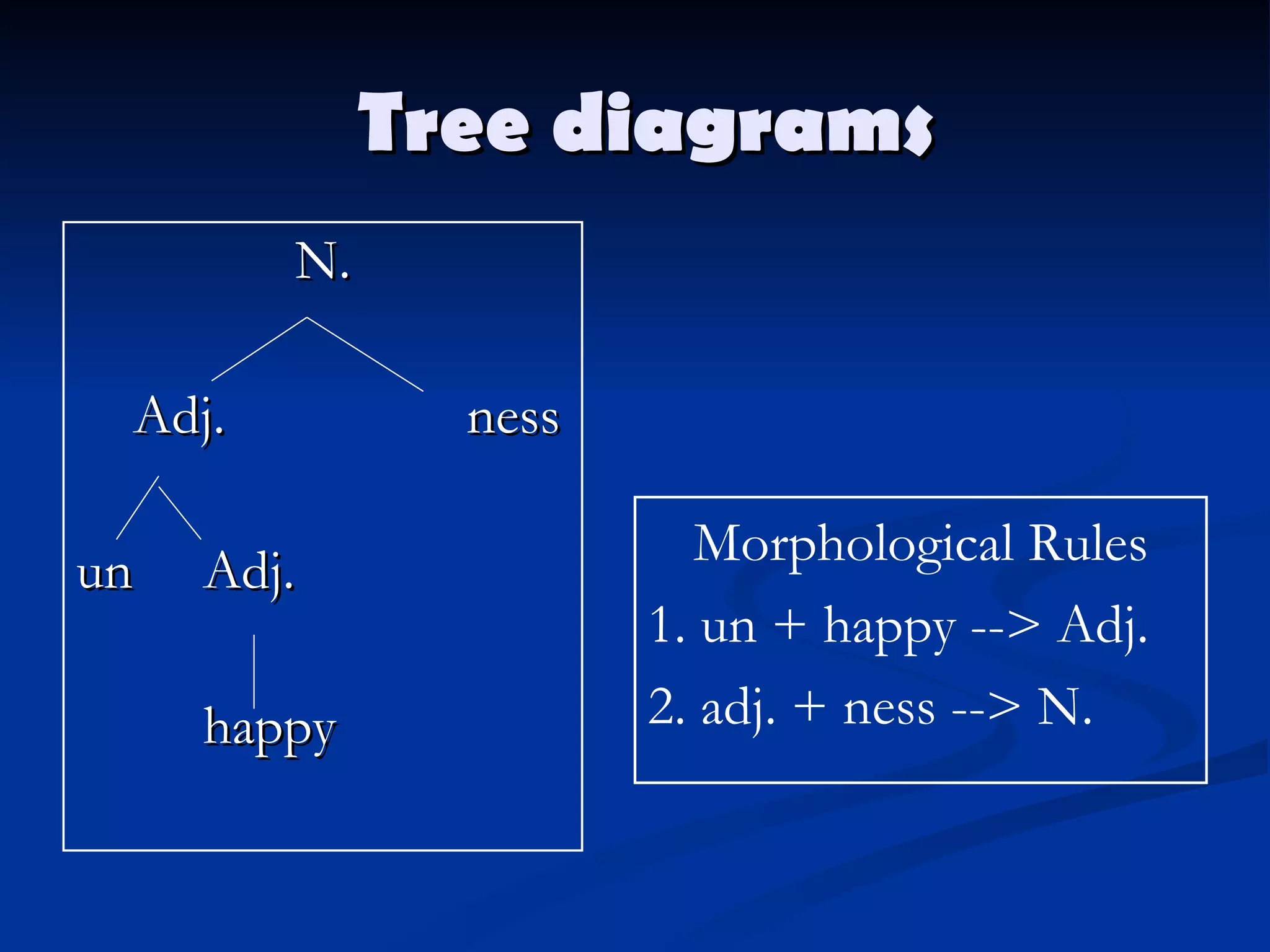
The hierarchical structureof words represented by the tree diagram A word is not a simple sequence of morphemes. It has an internal structure as shown in the following tree diagram:
62.
T ree diagramsN. Adj. ness un Adj. happy Morphological Rules 1. un + happy --> Adj. 2. adj. + ness --> N.
63.
Other terms accordingto word formation: Rule productivity Universality of compounding Suppletive Exception Expletive Allomorphs Default/elsewhere Homophonous morphemes Reduplication
64.
Rule productivity MorphologicalRules are Productive because: They can be used freely to form new words from the list of free and bound morpheme. Some morphemes are more productive than others. Productive morphemes: Ex. -able or -er Not Productive morphemes: Ex. –let (piglet)
65.
Universality of compoundingUniversality compounding is a common and frequent process for enlarging the vocabulary of all language. Ex . In Thai, the word ‘cat’ is m єє w, ‘watch’ is fân, and ‘house’ is bâan. The word for ‘watch cat’ is the compound m єє wfânbâan – literally, ‘catwatchhouse’
66.
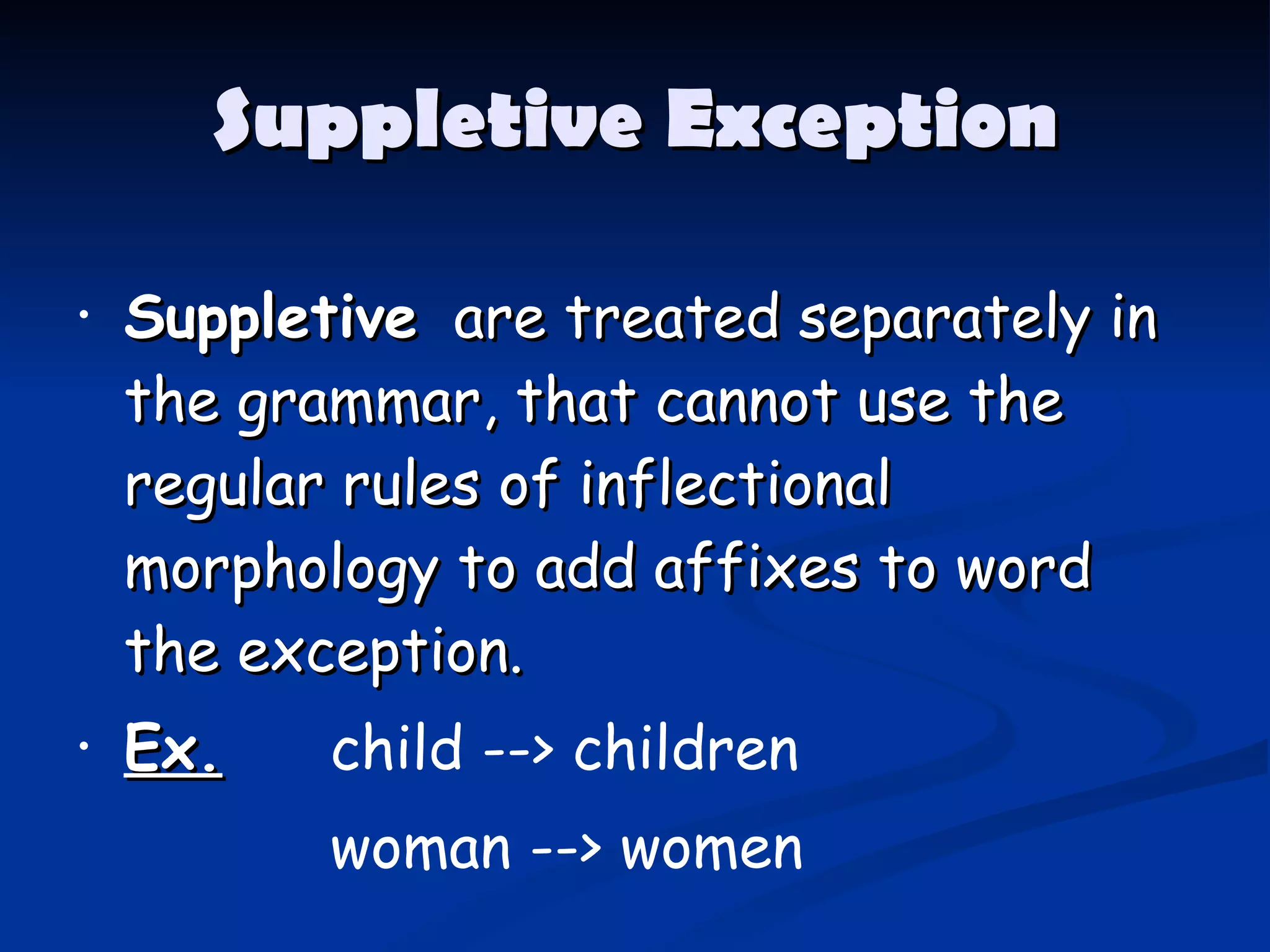
Suppletive Exception Suppletive are treated separately in the grammar, that cannot use the regular rules of inflectional morphology to add affixes to word the exception. Ex. child --> children woman --> women
67.
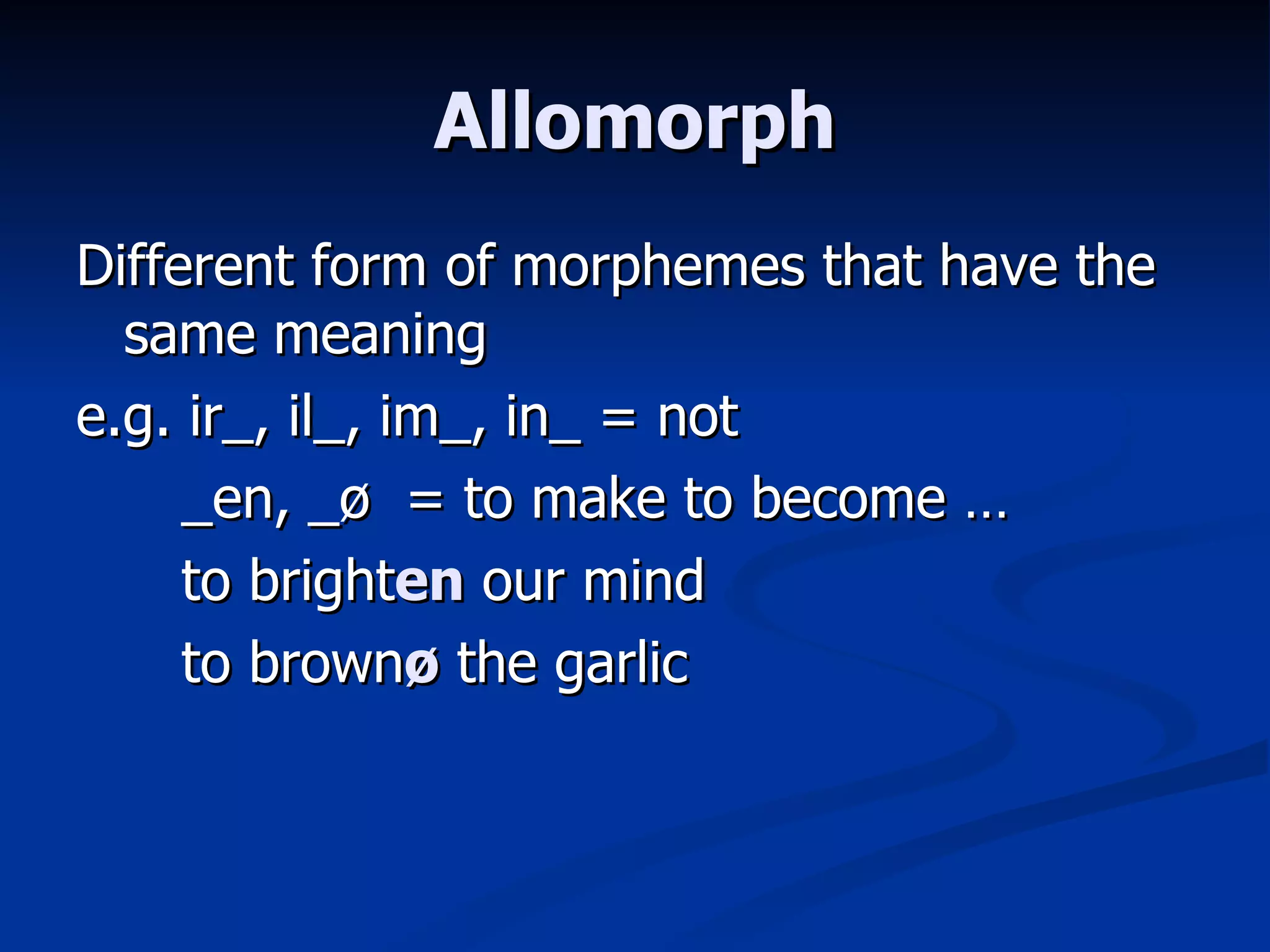
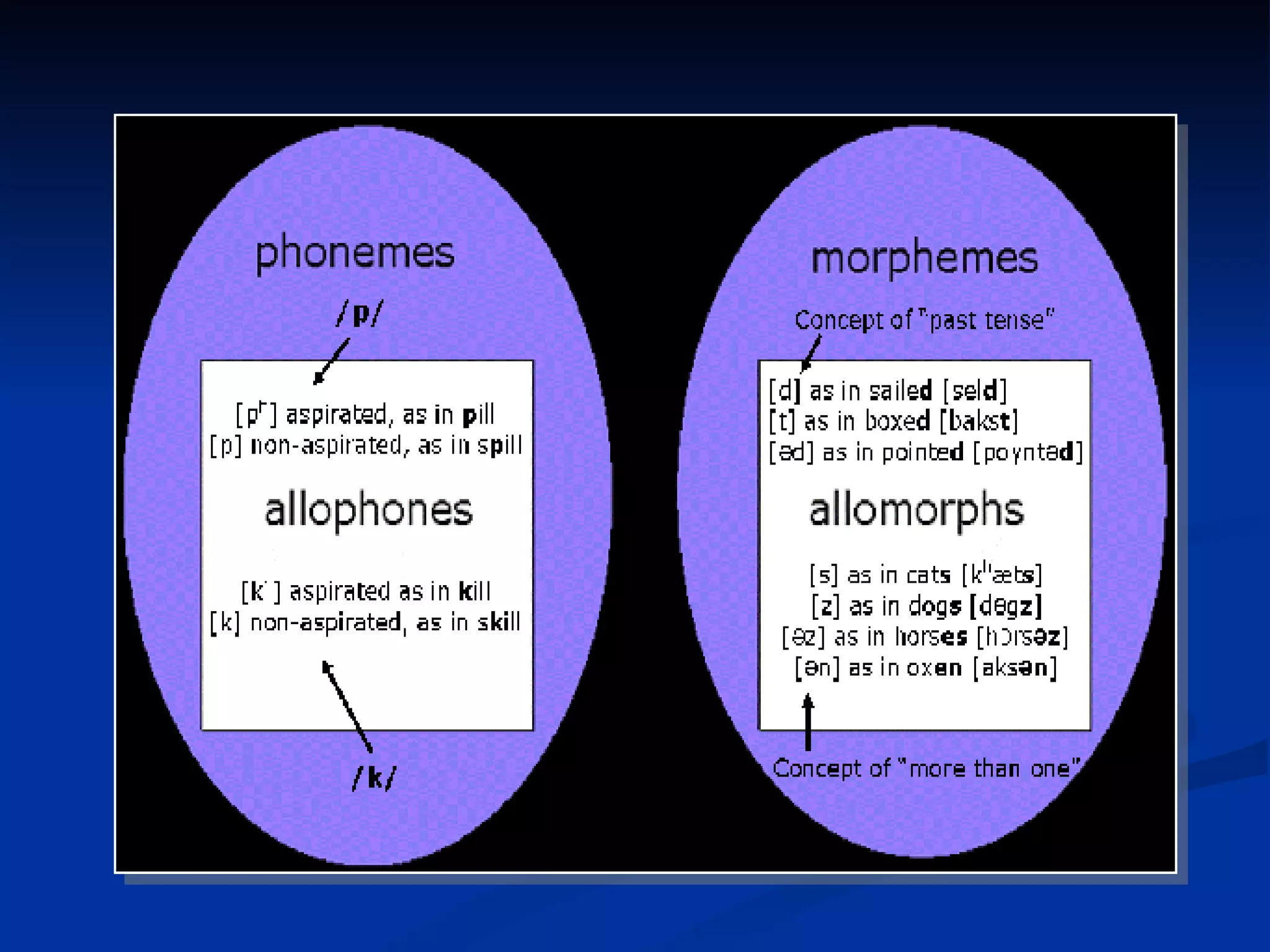
Allomorph Different formof morphemes that have the same meaning e.g. ir_, il_, im_, in_ = not _en, _ø = to make to become … to bright en our mind to brown ø the garlic
68.
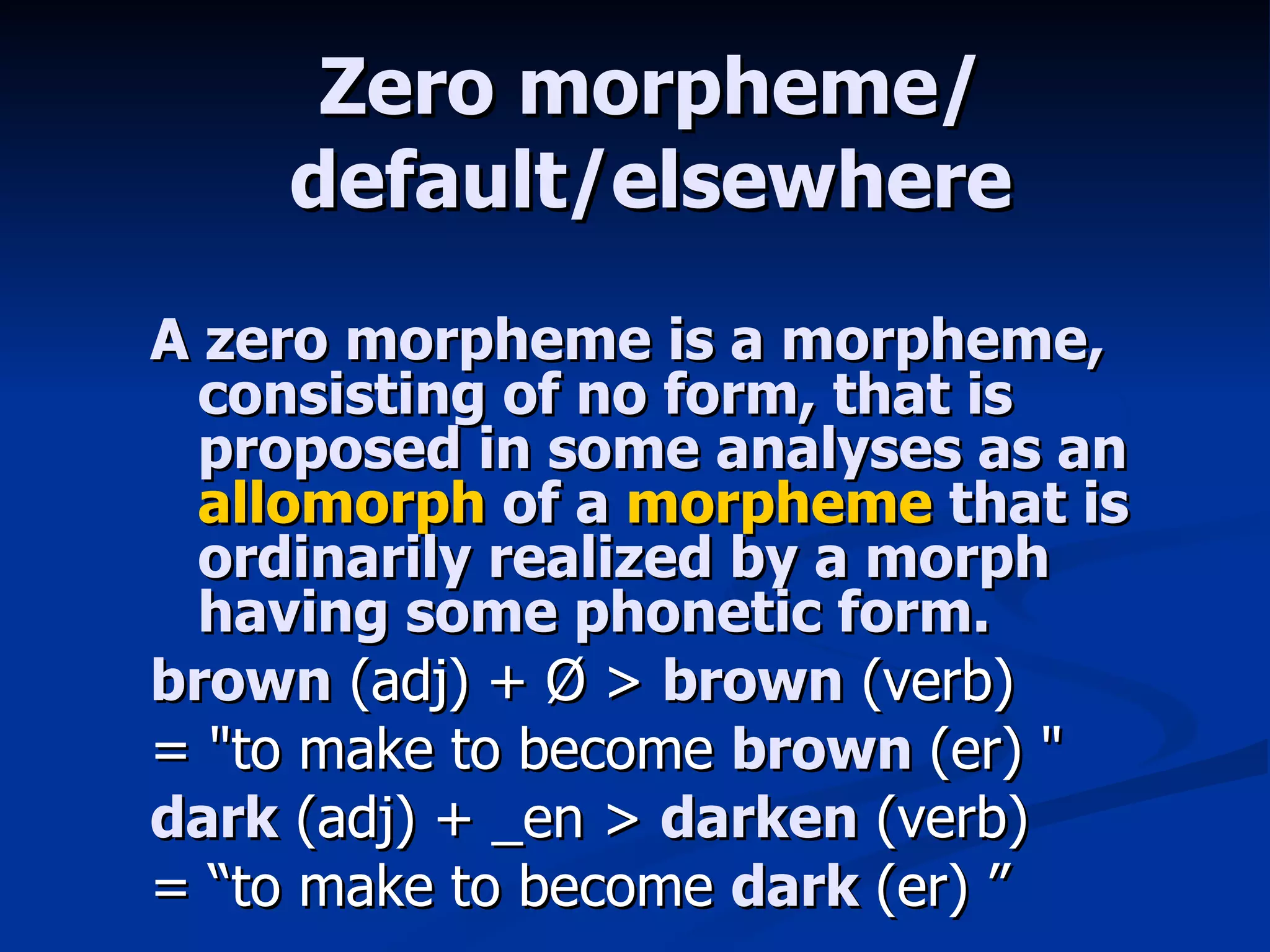
Zero morpheme/ default/elsewhereA zero morpheme is a morpheme, consisting of no form, that is proposed in some analyses as an allomorph of a morpheme that is ordinarily realized by a morph having some phonetic form. brown (adj) + Ø > brown (verb) = "to make to become brown (er) " dark (adj) + _en > darken (verb) = “to make to become dark (er) ”
69.
70.
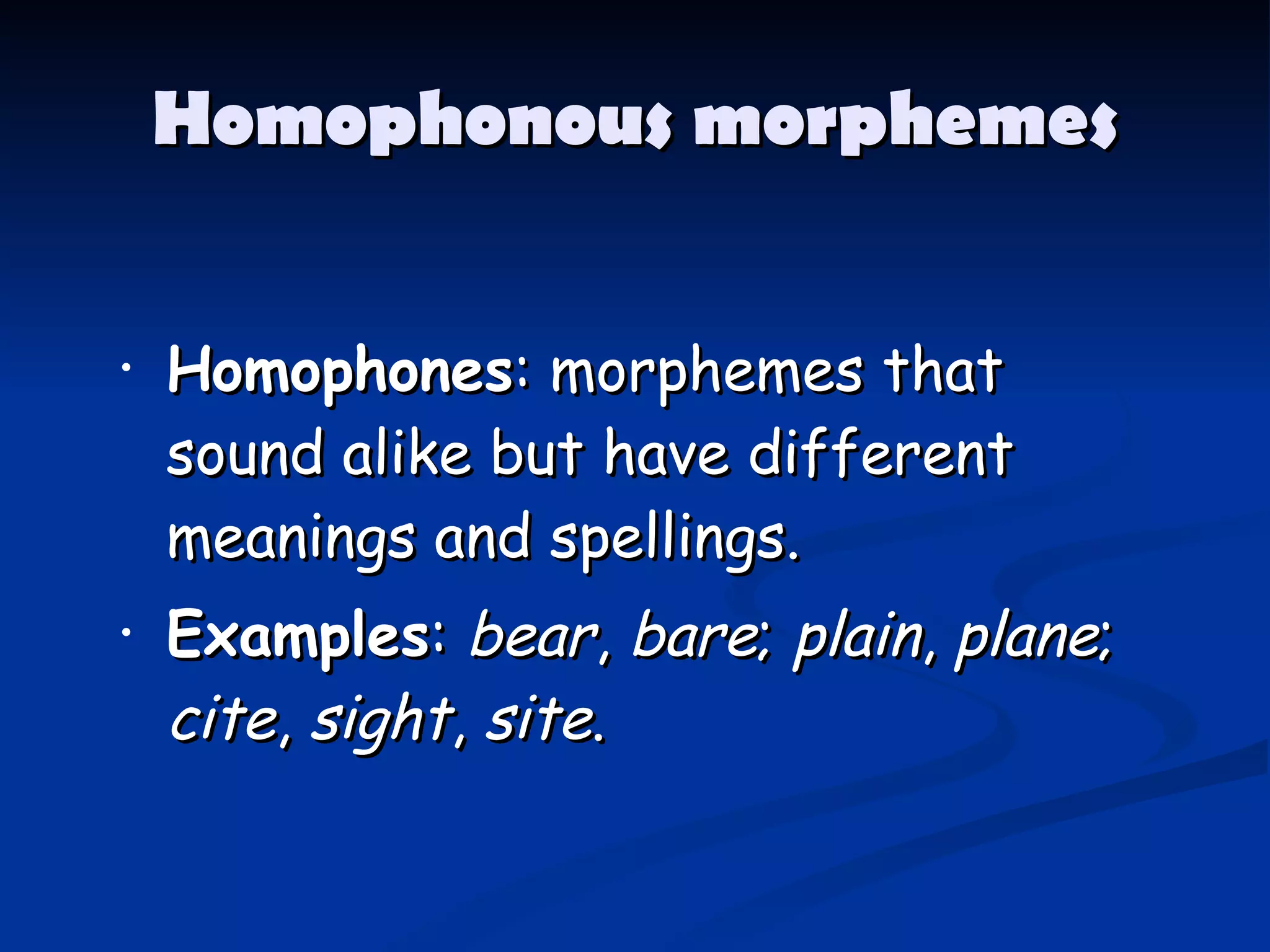
Homophonous morphemes Homophones: morphemes that sound alike but have different meanings and spellings. Examples : bear , bare ; plain , plane ; cite , sight , site .
71.
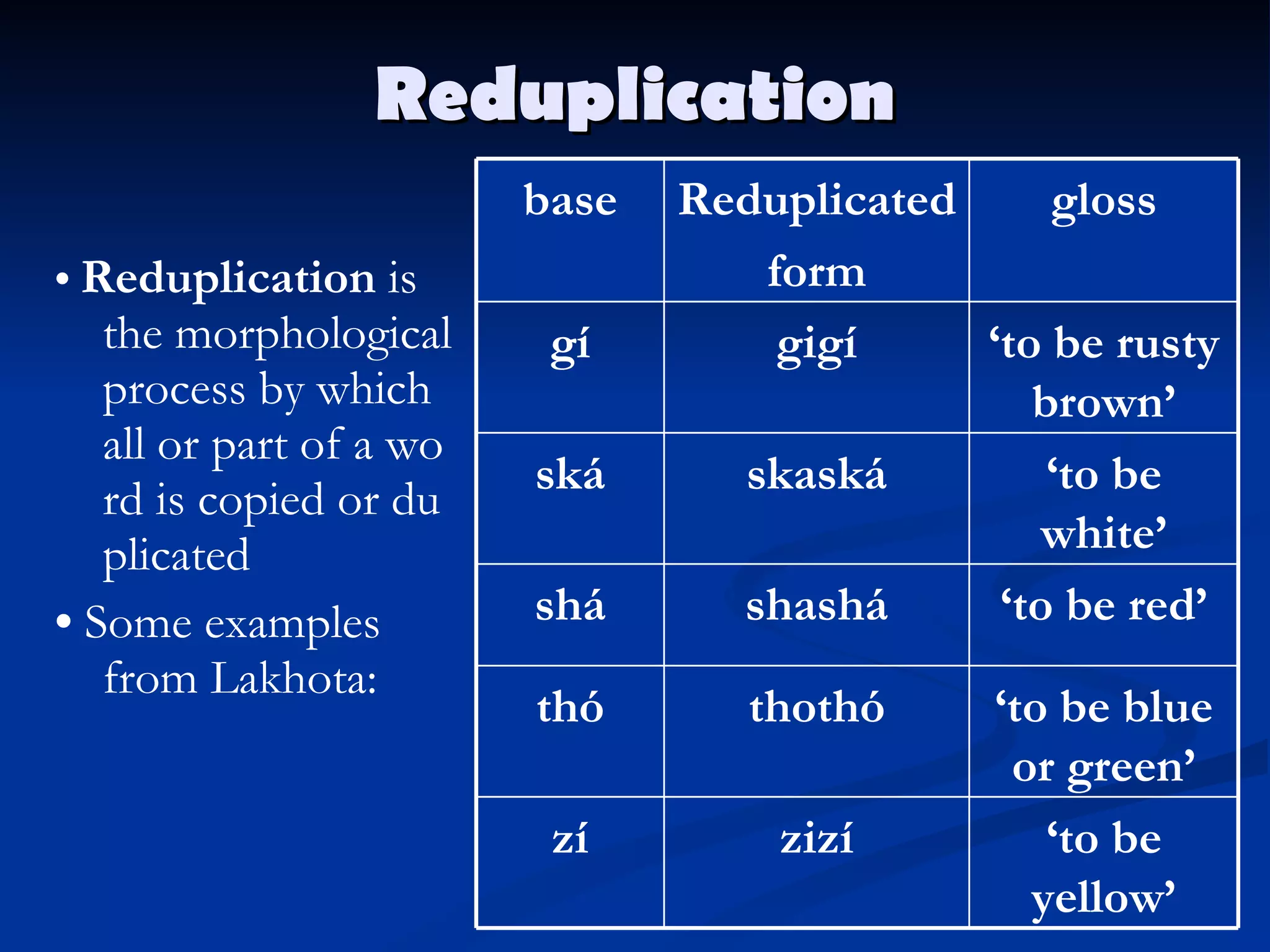
Reduplication • R eduplication is the morphological process by which all or part of a word is copied or duplicated • S ome examples from Lakhota: ‘ to be yellow’ zizí zí ‘ to be blue or green’ thothó thó ‘ to be red’ shashá shá ‘ to be white’ skaská ská ‘ to be rusty brown’ gigí gí gloss Reduplicated form base