Sedimentary Structures
Click to edit Master subtitle style

6/14/12
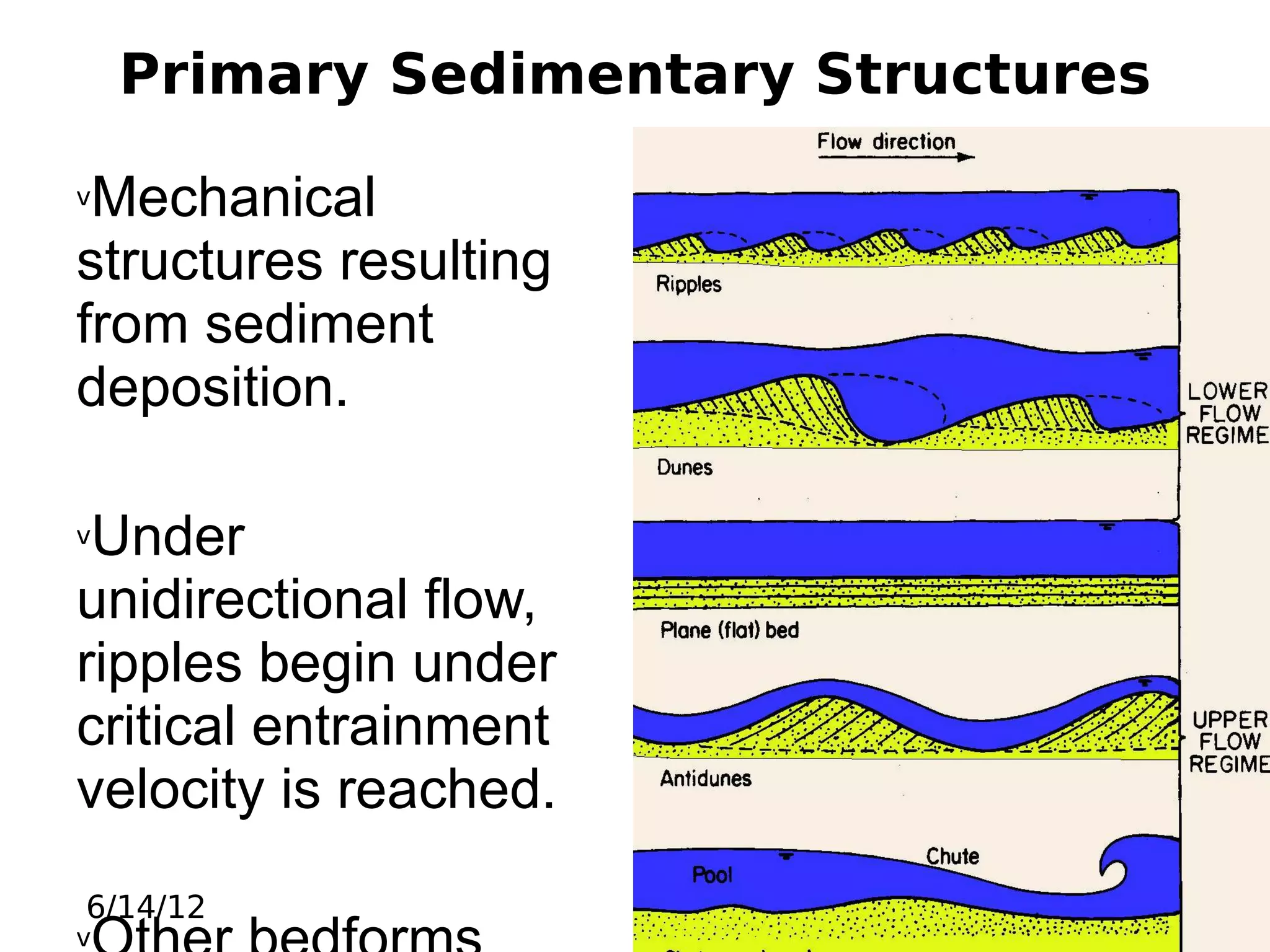
Primary Sedimentary Structures
Mechanical
structures resulting
from sediment
deposition.

v

Under
unidirectional flow,
ripples begin under
critical entrainment
velocity is reached.

v

6/14/12

v
Stratification & Bedforms

•

•

•

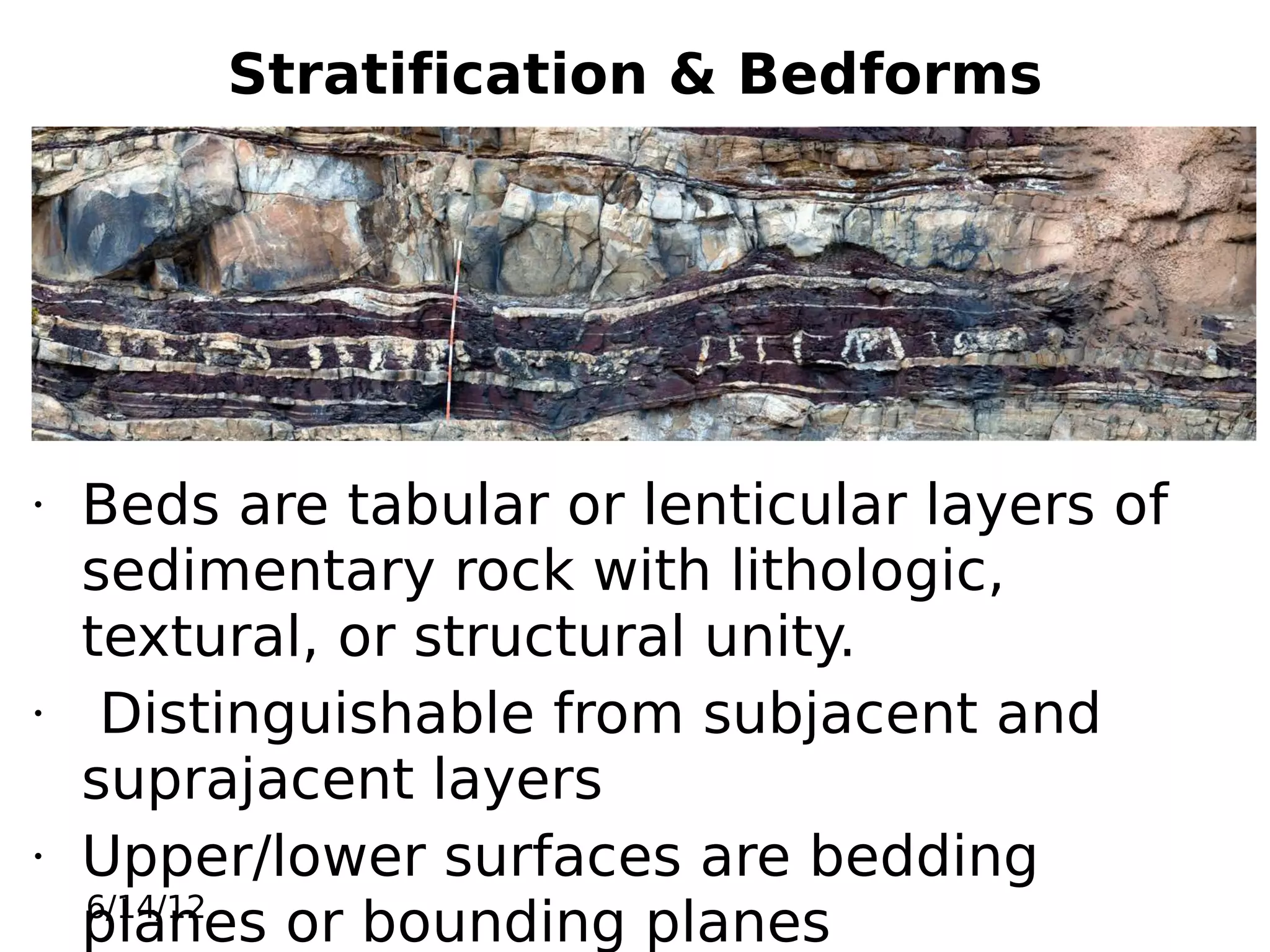
Beds are tabular or lenticular layers of
sedimentary rock with lithologic,
textural, or structural unity.
Distinguishable from subjacent and
suprajacent layers
Upper/lower surfaces are bedding
6/14/12
planes or bounding planes
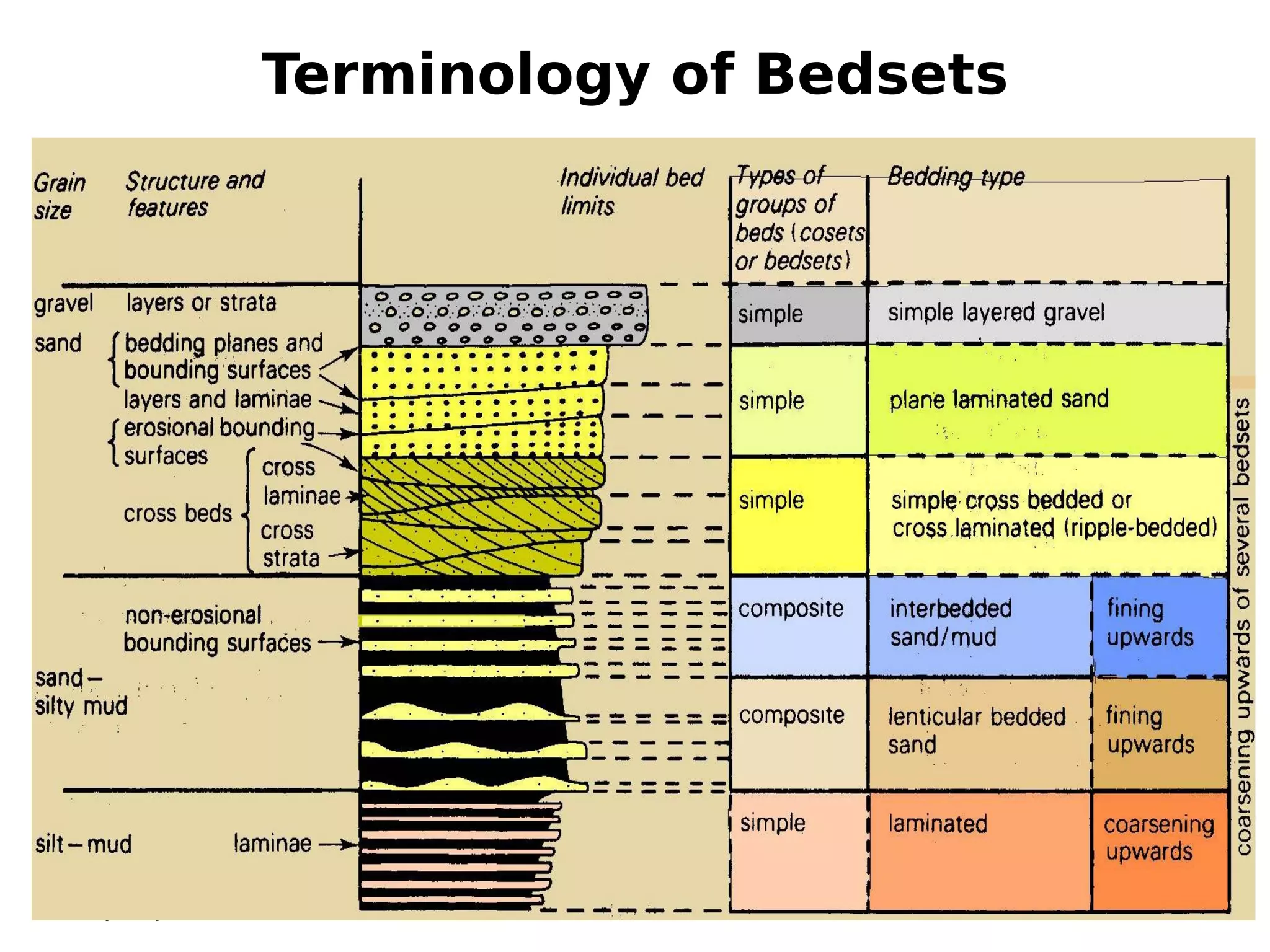
Terminology of Bedsets

6/14/12
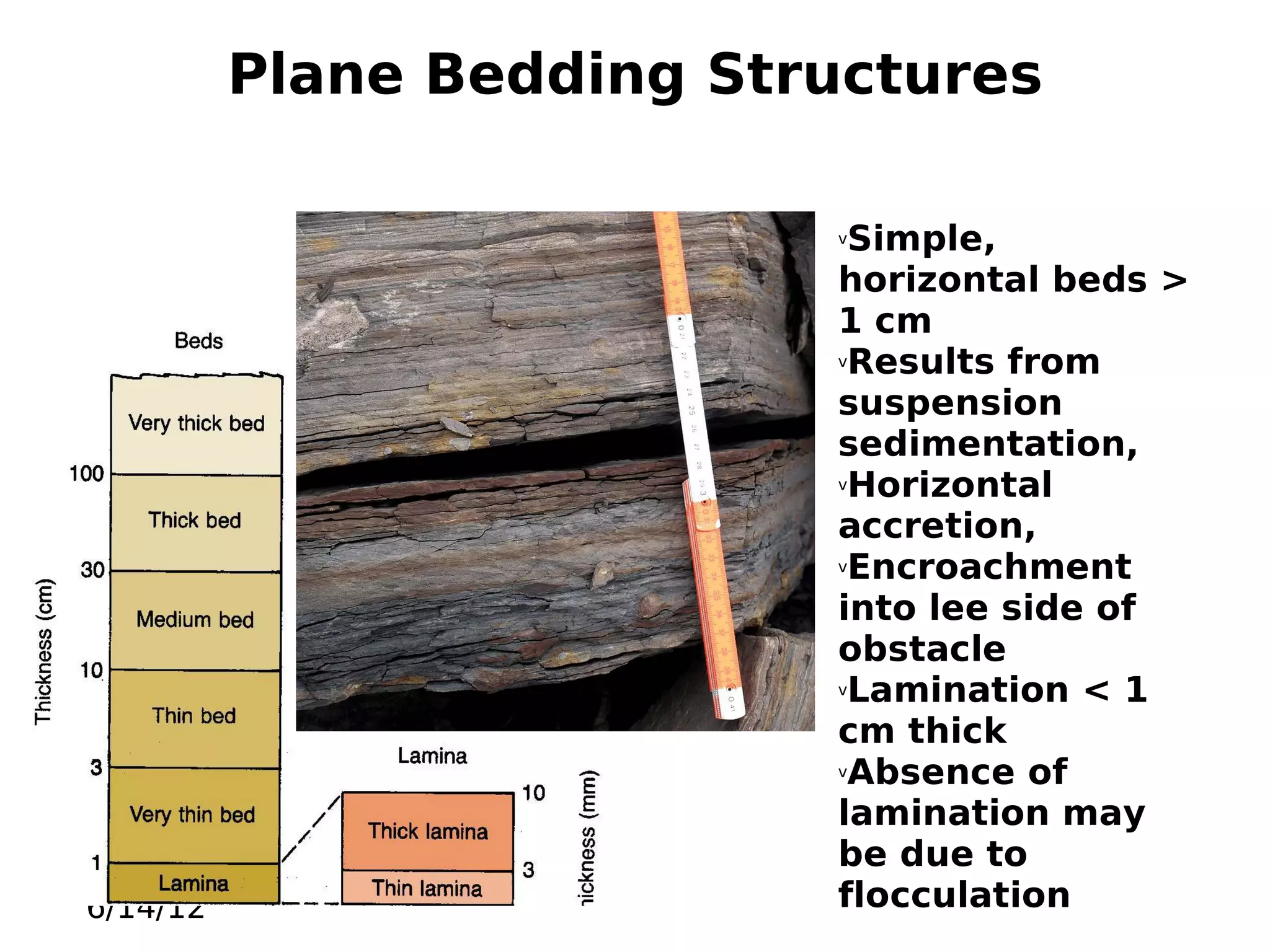
Plane Bedding Structures
Simple,
horizontal beds >
1 cm
vResults from
suspension
sedimentation,
vHorizontal
accretion,
vEncroachment
into lee side of
obstacle
vLamination < 1
cm thick
vAbsence of
lamination may
be due to
flocculation
v

6/14/12
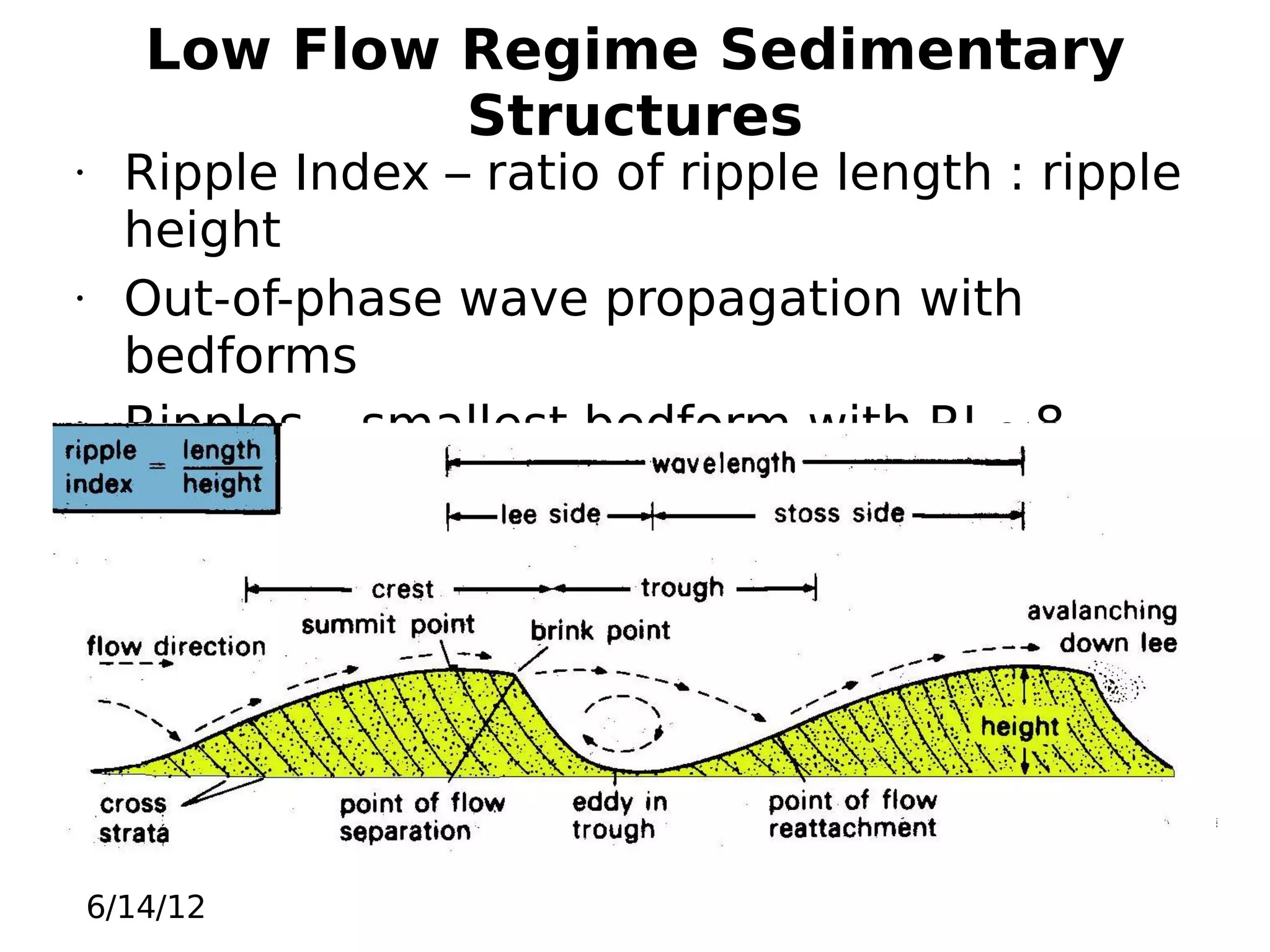
Low Flow Regime Sedimentary
Structures

•

•

•

Ripple Index – ratio of ripple length : ripple
height
Out-of-phase wave propagation with
bedforms
Ripples – smallest bedform with RI ~8
(coarse) to 20 (fine sand), forming in sand
and silt.

6/14/12
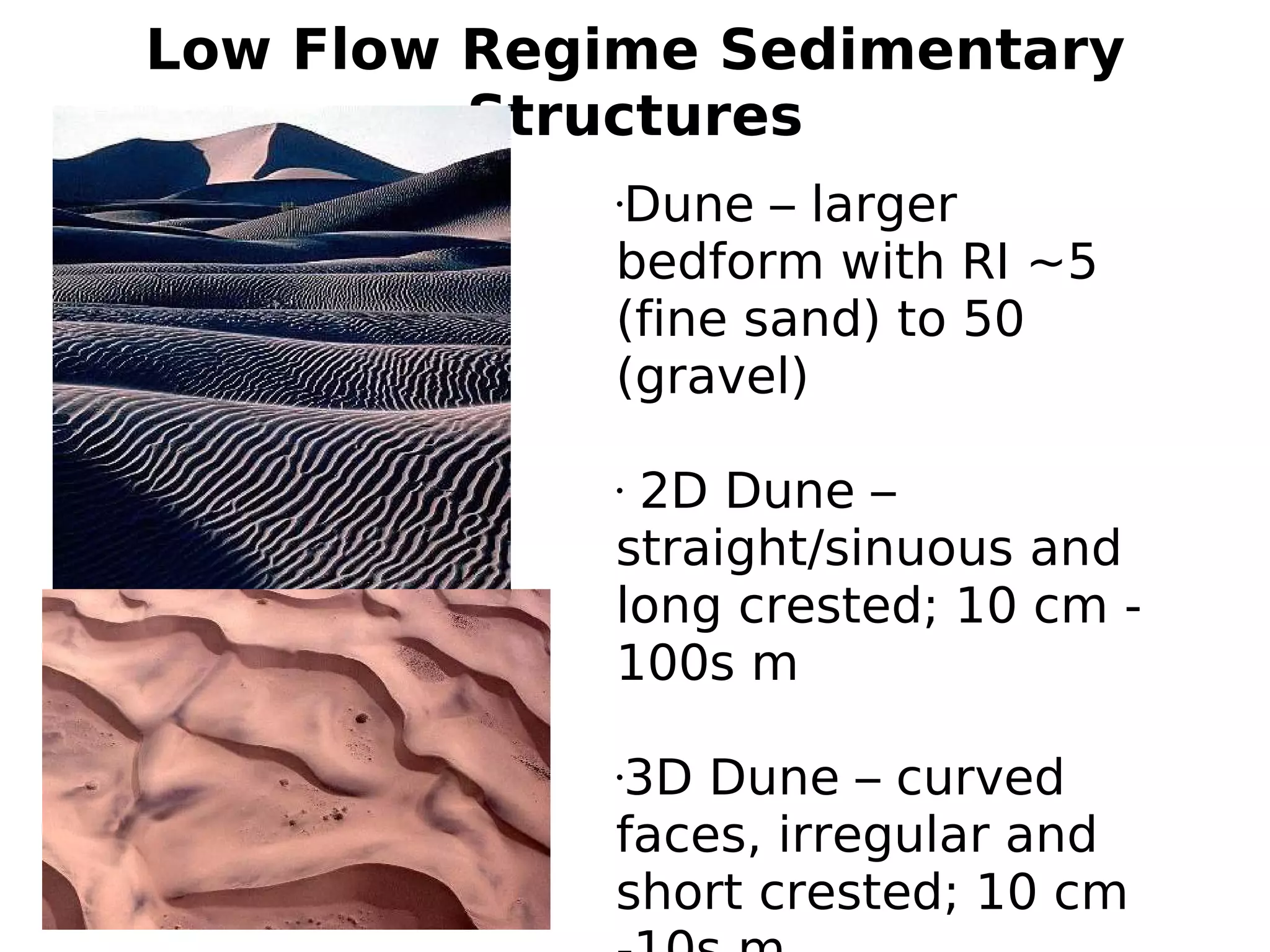
Low Flow Regime Sedimentary
Structures
Dune – larger
bedform with RI ~5
(fine sand) to 50
(gravel)
•

2D Dune –
straight/sinuous and
long crested; 10 cm 100s m
•

3D Dune – curved
faces, irregular and
short crested; 10 cm
•

6/14/12
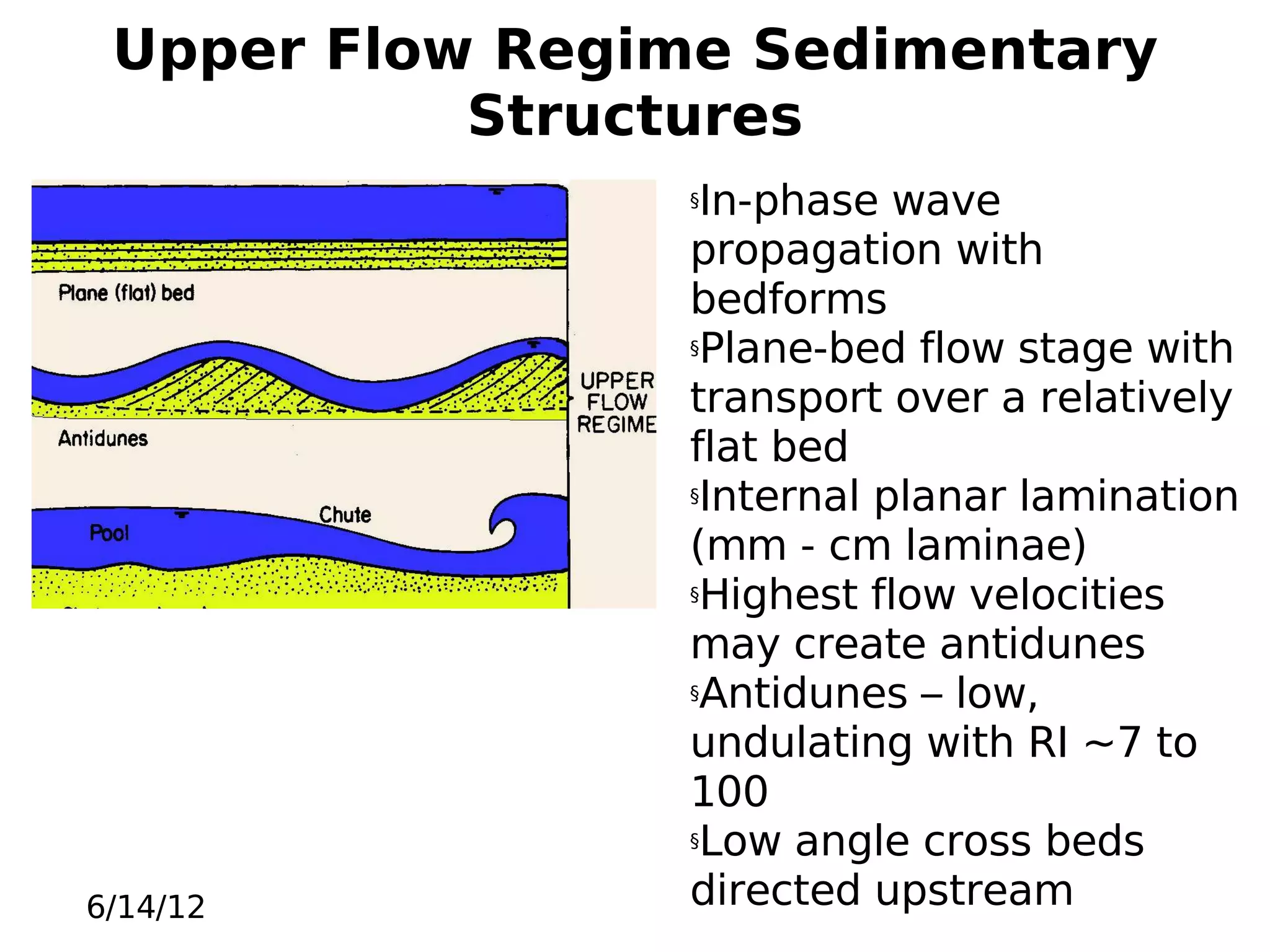
Upper Flow Regime Sedimentary
Structures
In-phase wave
propagation with
bedforms
§Plane-bed flow stage with
transport over a relatively
flat bed
§Internal planar lamination
(mm - cm laminae)
§Highest flow velocities
may create antidunes
§Antidunes – low,
undulating with RI ~7 to
100
§Low angle cross beds
directed upstream
§

6/14/12
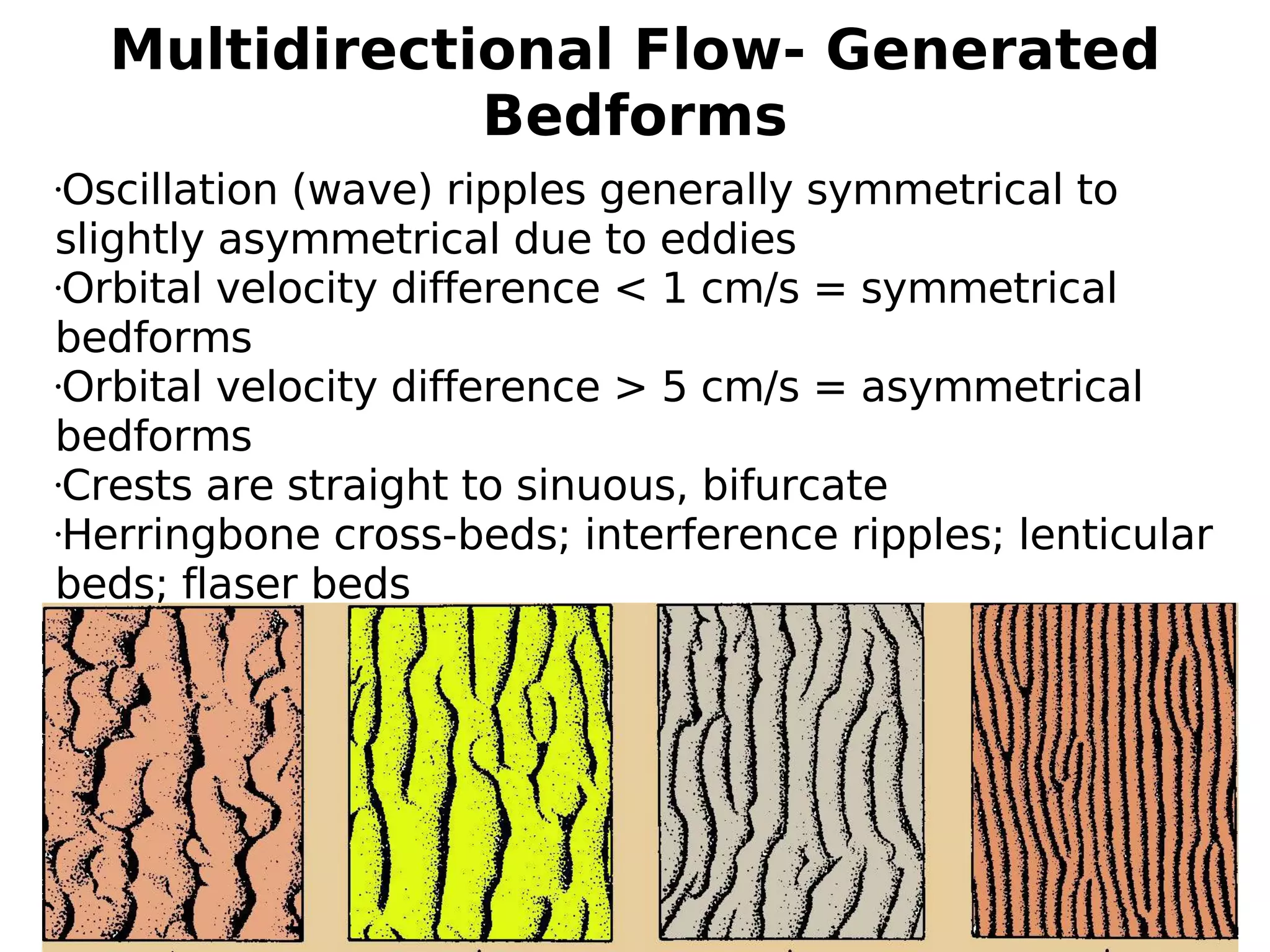
Multidirectional Flow- Generated
Bedforms
Oscillation (wave) ripples generally symmetrical to
slightly asymmetrical due to eddies
•Orbital velocity difference < 1 cm/s = symmetrical
bedforms
•Orbital velocity difference > 5 cm/s = asymmetrical
bedforms
•Crests are straight to sinuous, bifurcate
•Herringbone cross-beds; interference ripples; lenticular
beds; flaser beds
•

CURRENT RIPPLES
CURRENT-DOMINATED
OSCILLATION RIPPLES

6/14/12

WAVE-DOMINATED
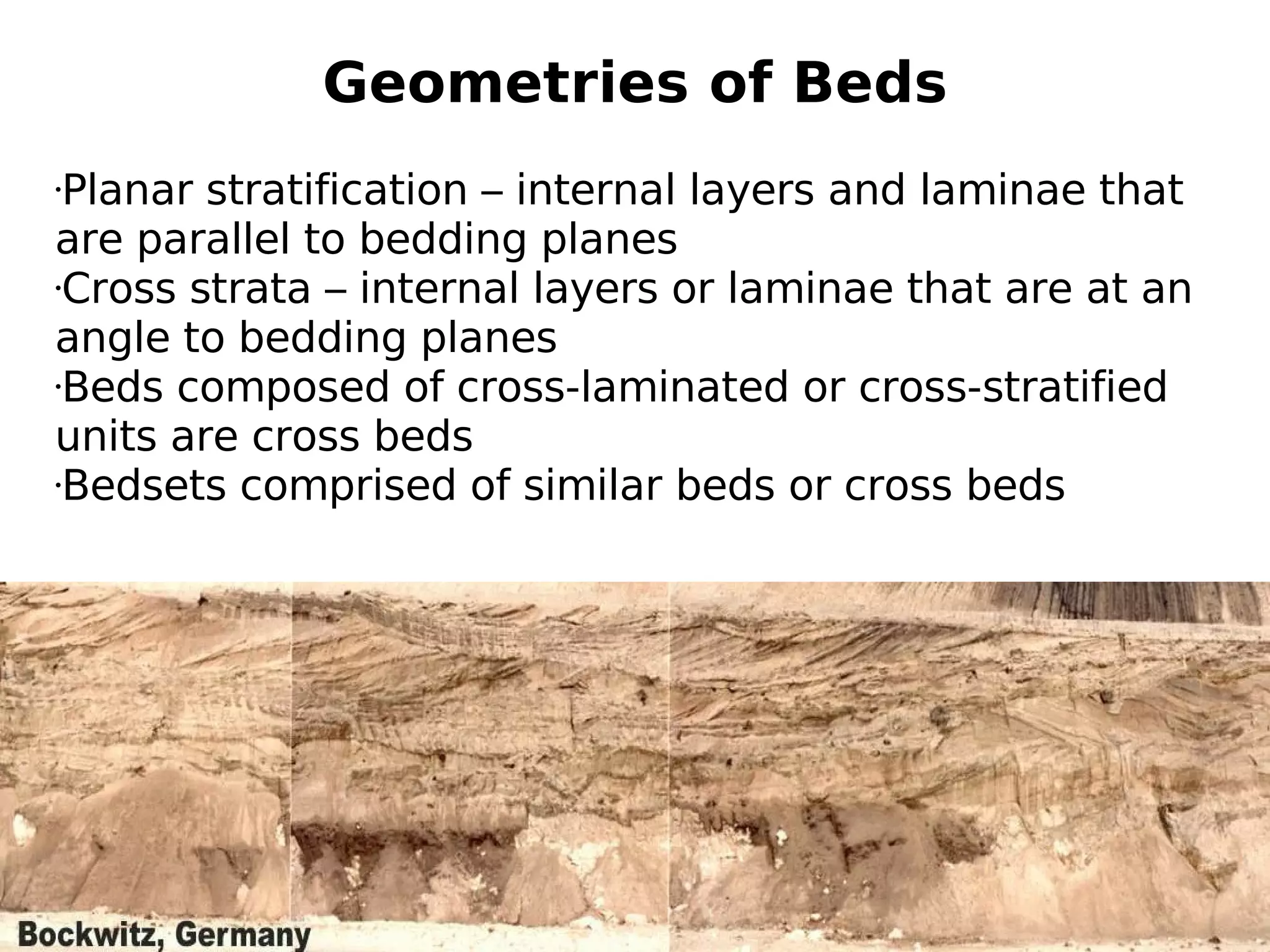
Geometries of Beds
Planar stratification – internal layers and laminae that
are parallel to bedding planes
•Cross strata – internal layers or laminae that are at an
angle to bedding planes
•Beds composed of cross-laminated or cross-stratified
units are cross beds
•Bedsets comprised of similar beds or cross beds
•

6/14/12
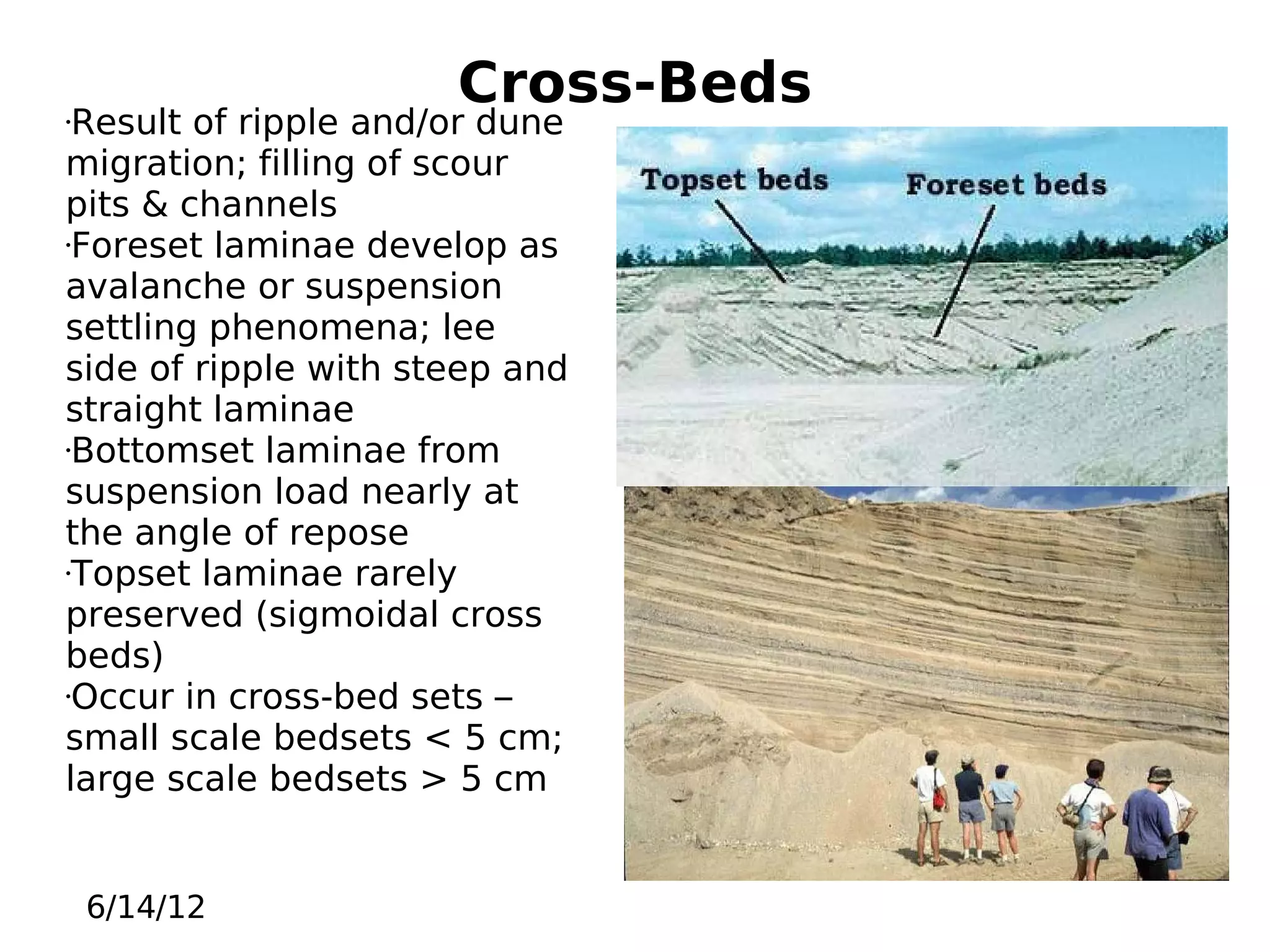
Cross-Beds

Result of ripple and/or dune
migration; filling of scour
pits & channels
•Foreset laminae develop as
avalanche or suspension
settling phenomena; lee
side of ripple with steep and
straight laminae
•Bottomset laminae from
suspension load nearly at
the angle of repose
•Topset laminae rarely
preserved (sigmoidal cross
beds)
•Occur in cross-bed sets –
small scale bedsets < 5 cm;
large scale bedsets > 5 cm
•

6/14/12
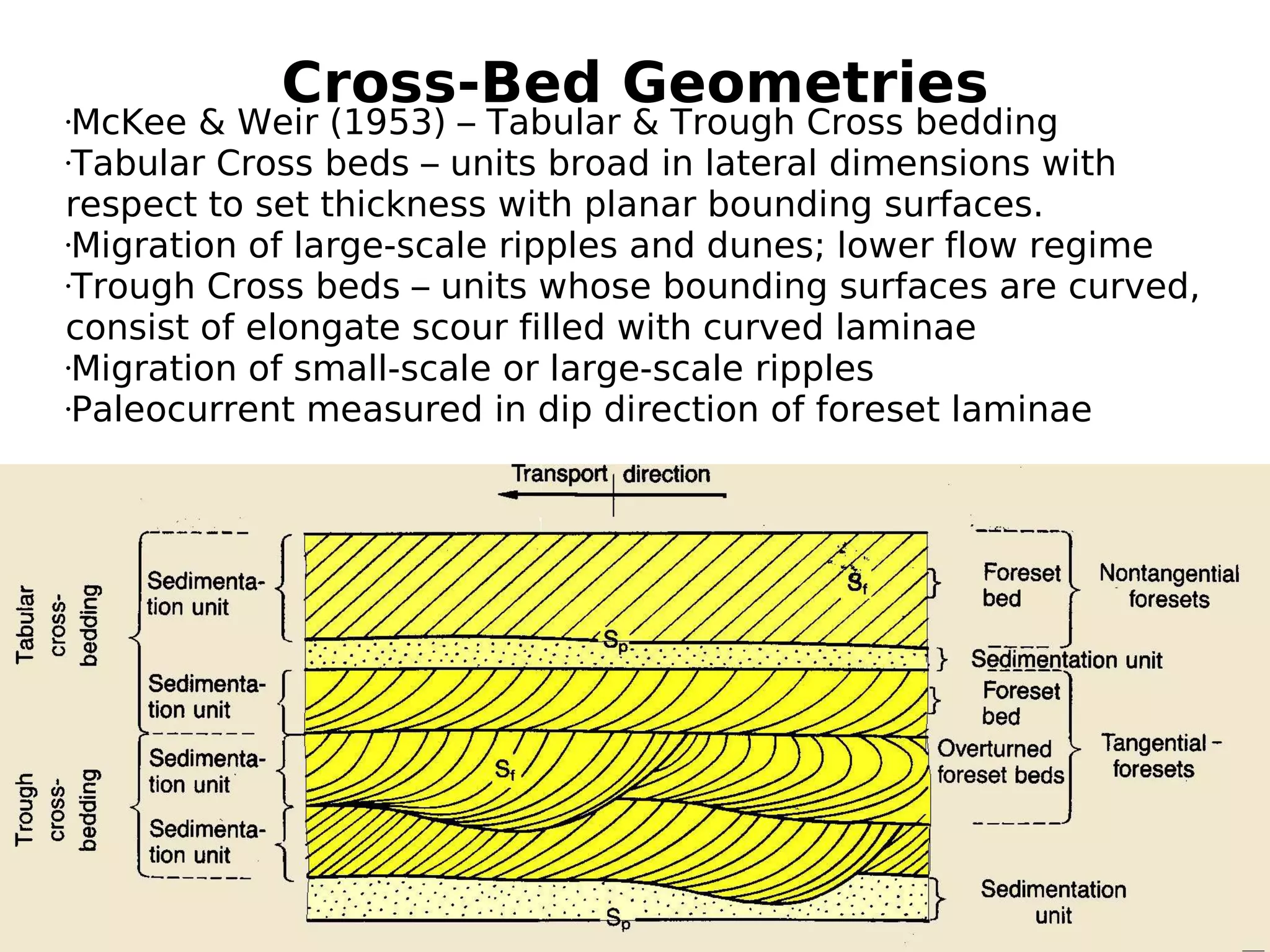
Cross-Bed Geometries

McKee & Weir (1953) – Tabular & Trough Cross bedding
•Tabular Cross beds – units broad in lateral dimensions with
respect to set thickness with planar bounding surfaces.
•Migration of large-scale ripples and dunes; lower flow regime
•Trough Cross beds – units whose bounding surfaces are curved,
consist of elongate scour filled with curved laminae
•Migration of small-scale or large-scale ripples
•Paleocurrent measured in dip direction of foreset laminae
•

6/14/12
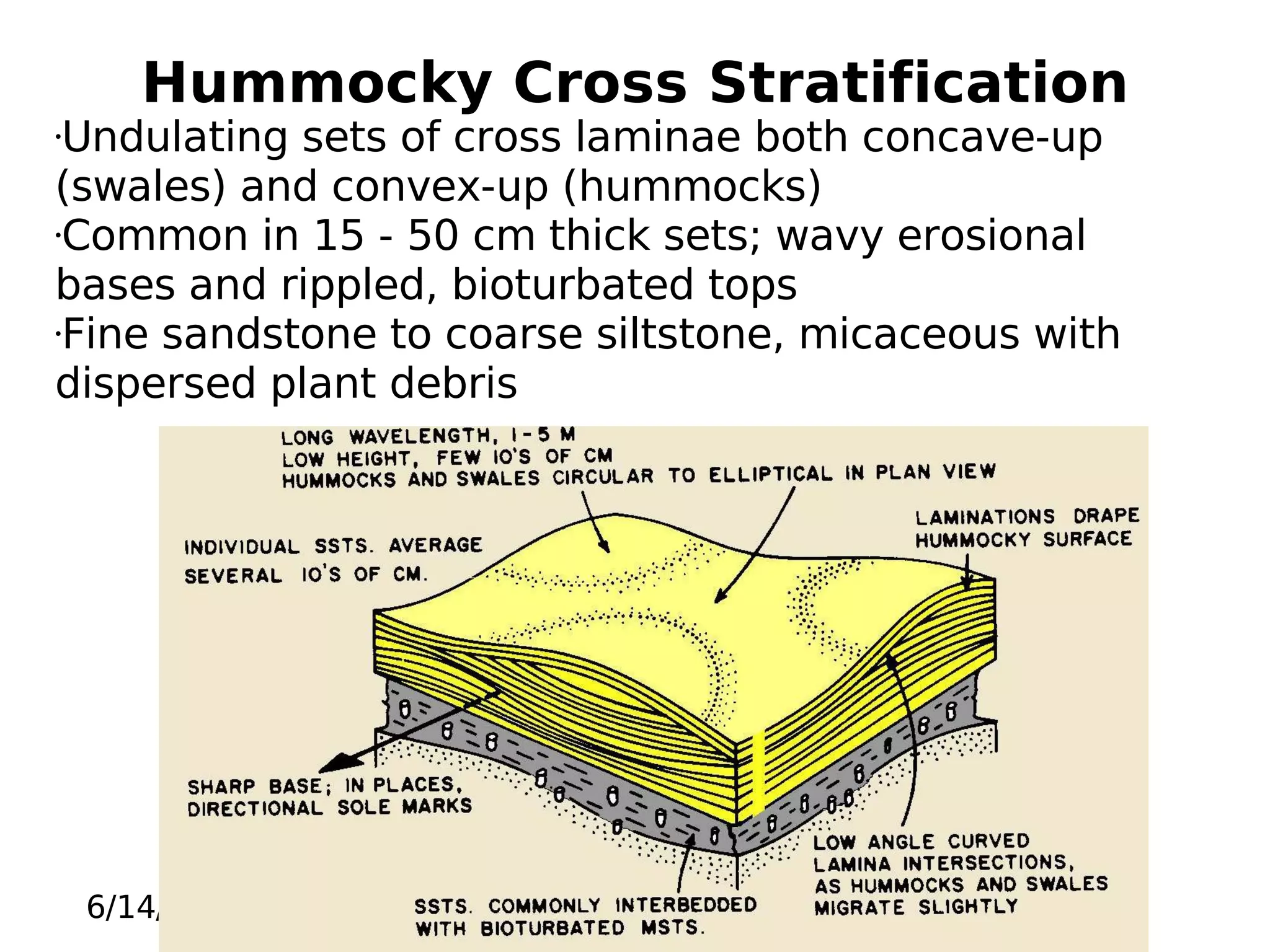
Hummocky Cross Stratification

Undulating sets of cross laminae both concave-up
(swales) and convex-up (hummocks)
•Common in 15 - 50 cm thick sets; wavy erosional
bases and rippled, bioturbated tops
•Fine sandstone to coarse siltstone, micaceous with
dispersed plant debris
•

6/14/12
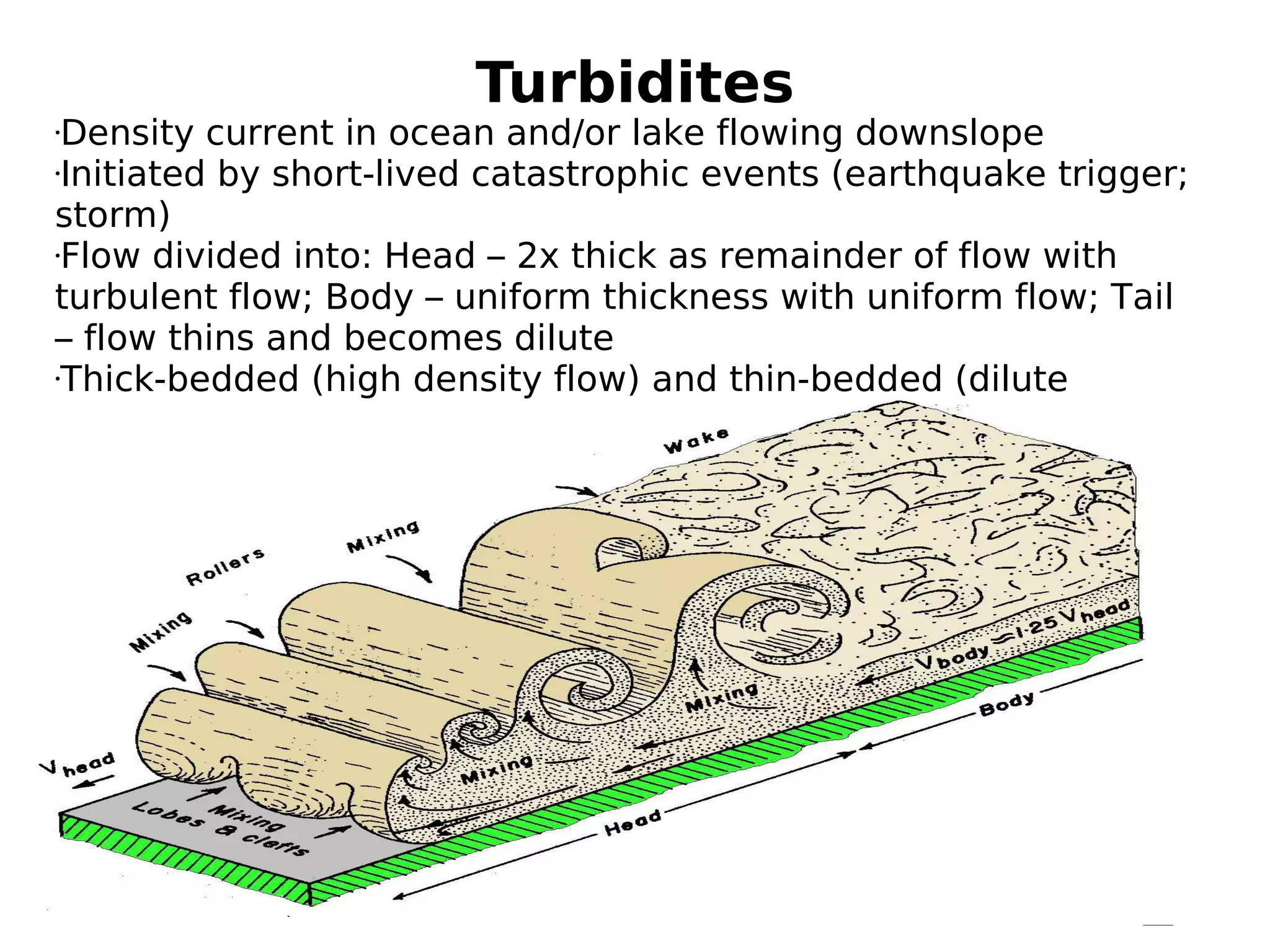
Turbidites

Density current in ocean and/or lake flowing downslope
•Initiated by short-lived catastrophic events (earthquake trigger;
storm)
•Flow divided into: Head – 2x thick as remainder of flow with
turbulent flow; Body – uniform thickness with uniform flow; Tail
– flow thins and becomes dilute
•Thick-bedded (high density flow) and thin-bedded (dilute
•density flow) turbidites
•

6/14/12
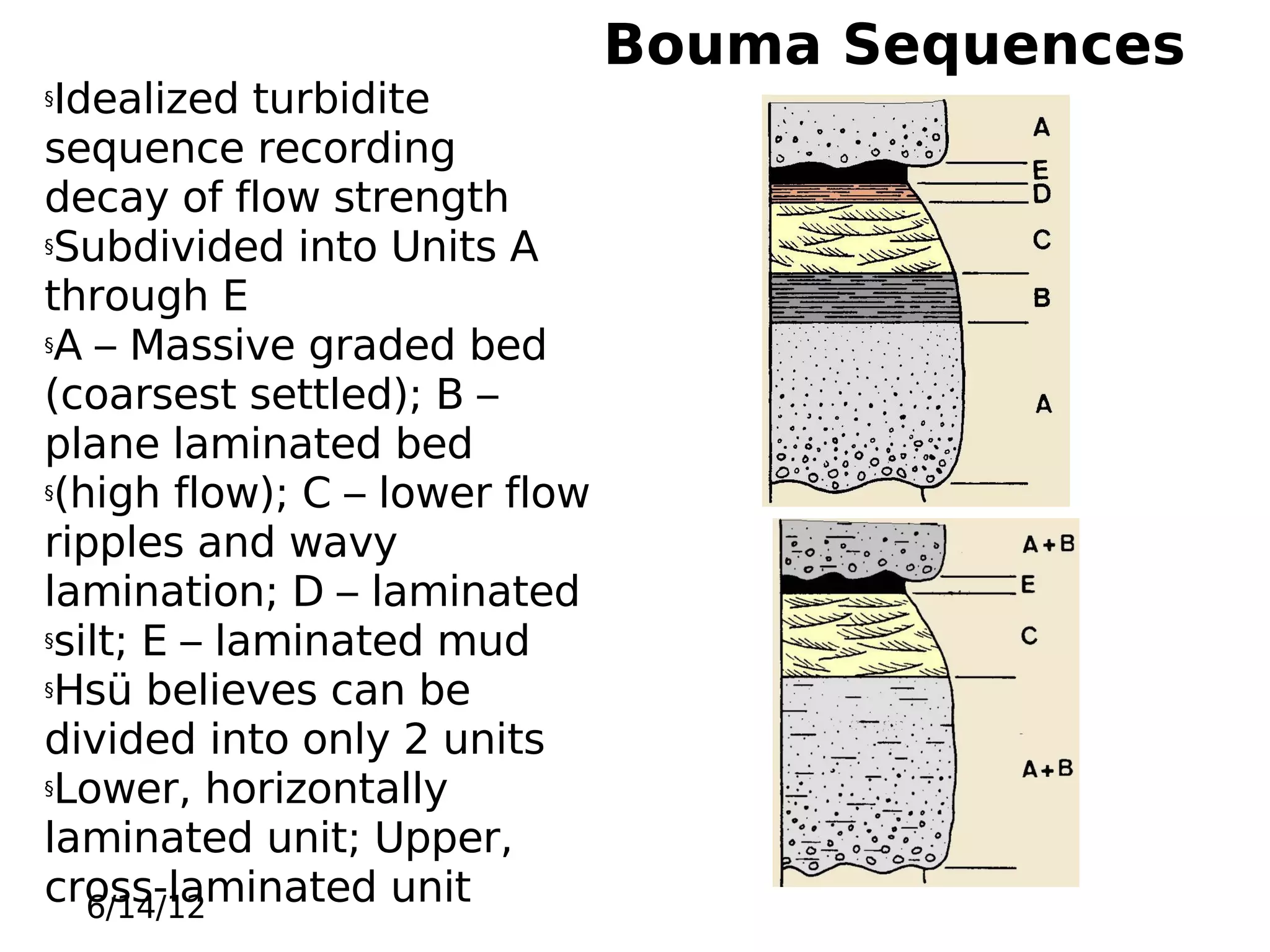
Idealized turbidite
sequence recording
decay of flow strength
§Subdivided into Units A
through E
§A – Massive graded bed
(coarsest settled); B –
plane laminated bed
§(high flow); C – lower flow
ripples and wavy
lamination; D – laminated
§silt; E – laminated mud
§Hsü believes can be
divided into only 2 units
§Lower, horizontally
laminated unit; Upper,
cross-laminated unit
6/14/12
§

Bouma Sequences
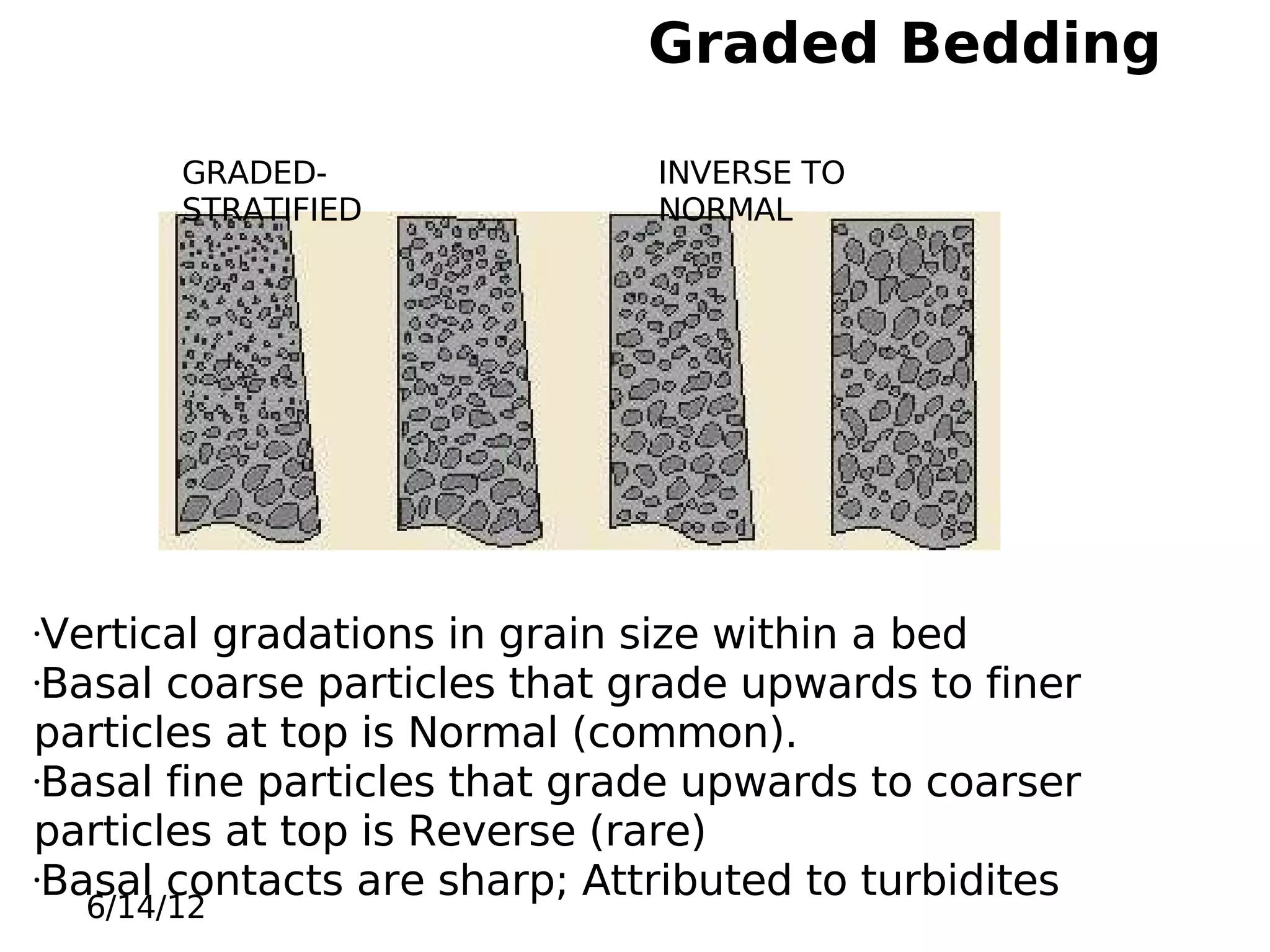
Graded Bedding
GRADEDSTRATIFIED

INVERSE TO
NORMAL

Vertical gradations in grain size within a bed
•Basal coarse particles that grade upwards to finer
particles at top is Normal (common).
•Basal fine particles that grade upwards to coarser
particles at top is Reverse (rare)
•Basal contacts are sharp; Attributed to turbidites
•

6/14/12
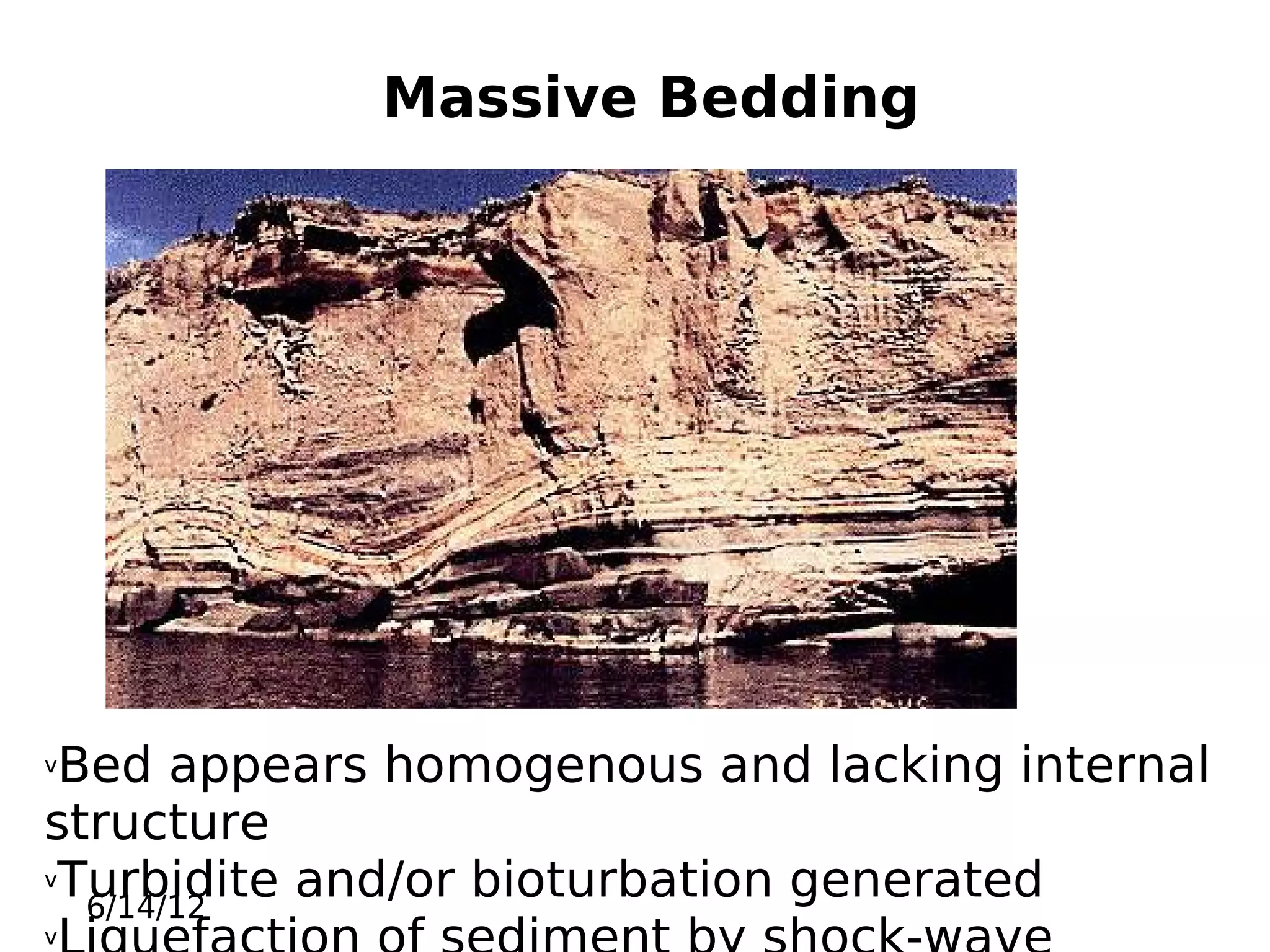
Massive Bedding

Bed appears homogenous and lacking internal
structure
vTurbidite and/or bioturbation generated
6/14/12
v

v
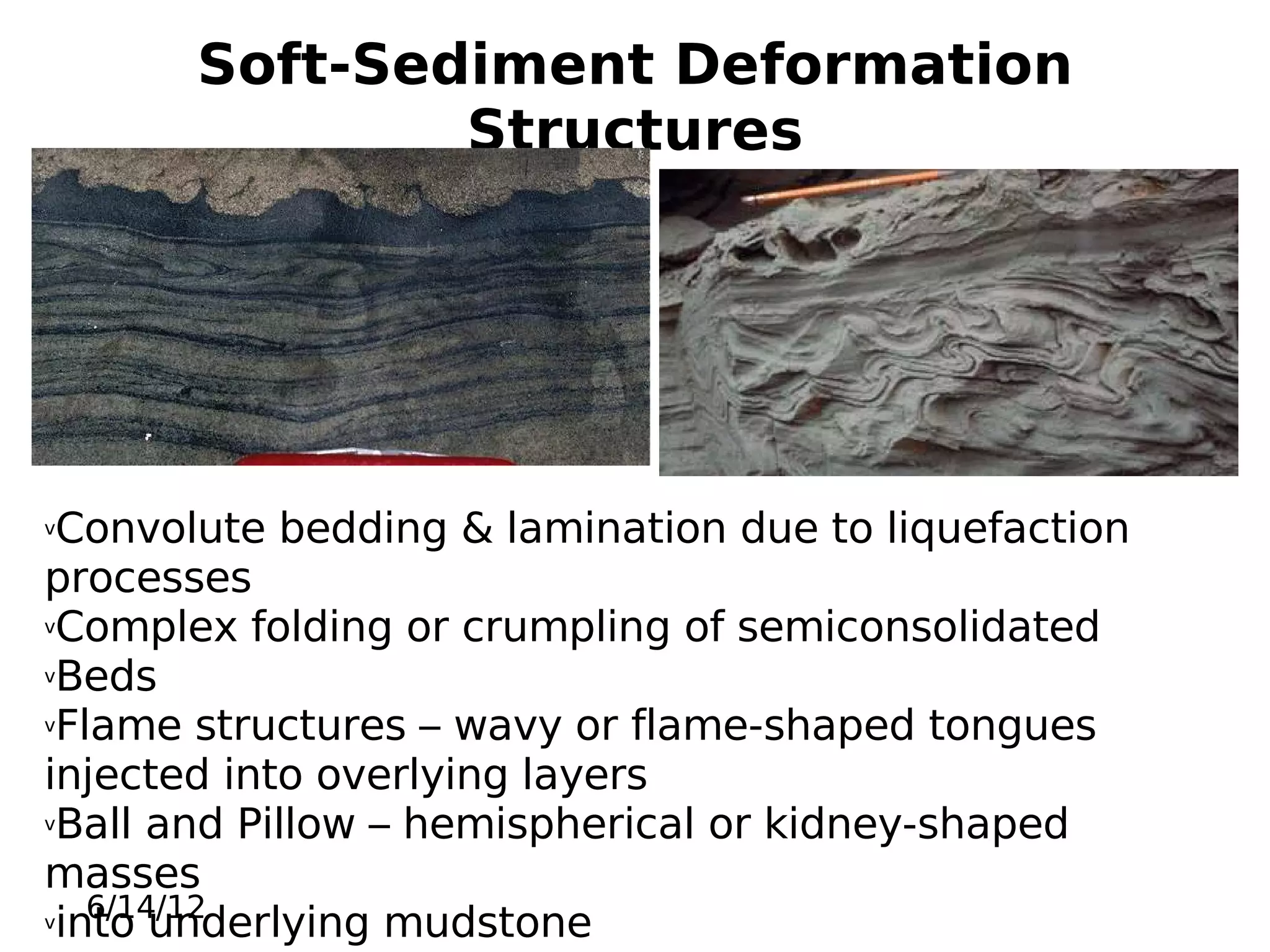
Soft-Sediment Deformation
Structures

Convolute bedding & lamination due to liquefaction
processes
vComplex folding or crumpling of semiconsolidated
vBeds
vFlame structures – wavy or flame-shaped tongues
injected into overlying layers
vBall and Pillow – hemispherical or kidney-shaped
masses
6/14/12
vinto underlying mudstone
v
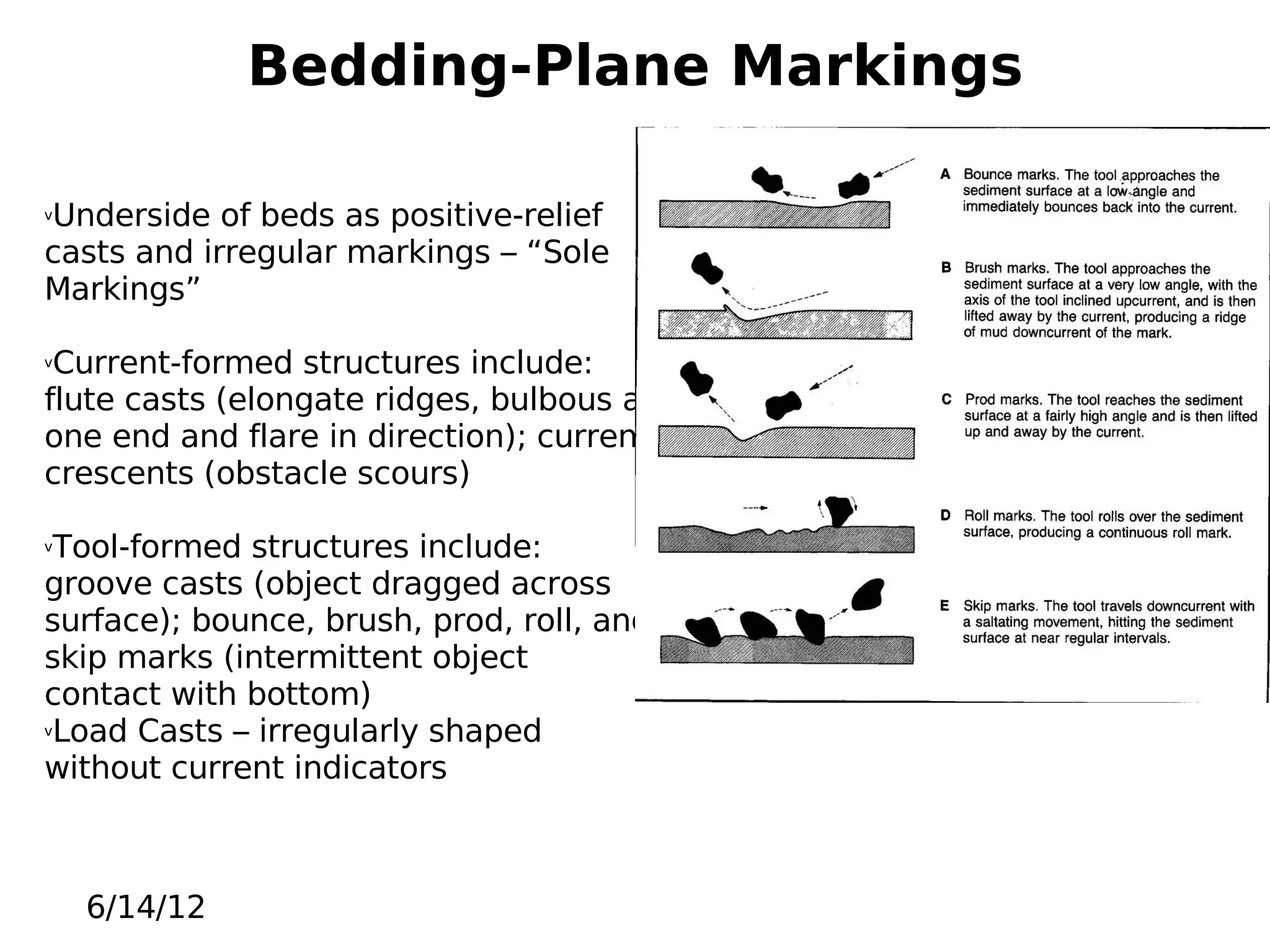
Bedding-Plane Markings
Underside of beds as positive-relief
casts and irregular markings – “Sole
Markings”
v

Current-formed structures include:
flute casts (elongate ridges, bulbous at
one end and flare in direction); current
crescents (obstacle scours)
v

Tool-formed structures include:
groove casts (object dragged across
surface); bounce, brush, prod, roll, and
skip marks (intermittent object
contact with bottom)
vLoad Casts – irregularly shaped
without current indicators
v

6/14/12

Sedimentary structures

  • 1.
    Sedimentary Structures Click toedit Master subtitle style 6/14/12
  • 2.
    Primary Sedimentary Structures Mechanical structuresresulting from sediment deposition. v Under unidirectional flow, ripples begin under critical entrainment velocity is reached. v 6/14/12 v
  • 3.
    Stratification & Bedforms • • • Bedsare tabular or lenticular layers of sedimentary rock with lithologic, textural, or structural unity. Distinguishable from subjacent and suprajacent layers Upper/lower surfaces are bedding 6/14/12 planes or bounding planes
  • 4.
  • 5.
    Plane Bedding Structures Simple, horizontalbeds > 1 cm vResults from suspension sedimentation, vHorizontal accretion, vEncroachment into lee side of obstacle vLamination < 1 cm thick vAbsence of lamination may be due to flocculation v 6/14/12
  • 6.
    Low Flow RegimeSedimentary Structures • • • Ripple Index – ratio of ripple length : ripple height Out-of-phase wave propagation with bedforms Ripples – smallest bedform with RI ~8 (coarse) to 20 (fine sand), forming in sand and silt. 6/14/12
  • 7.
    Low Flow RegimeSedimentary Structures Dune – larger bedform with RI ~5 (fine sand) to 50 (gravel) • 2D Dune – straight/sinuous and long crested; 10 cm 100s m • 3D Dune – curved faces, irregular and short crested; 10 cm • 6/14/12
  • 8.
    Upper Flow RegimeSedimentary Structures In-phase wave propagation with bedforms §Plane-bed flow stage with transport over a relatively flat bed §Internal planar lamination (mm - cm laminae) §Highest flow velocities may create antidunes §Antidunes – low, undulating with RI ~7 to 100 §Low angle cross beds directed upstream § 6/14/12
  • 9.
    Multidirectional Flow- Generated Bedforms Oscillation(wave) ripples generally symmetrical to slightly asymmetrical due to eddies •Orbital velocity difference < 1 cm/s = symmetrical bedforms •Orbital velocity difference > 5 cm/s = asymmetrical bedforms •Crests are straight to sinuous, bifurcate •Herringbone cross-beds; interference ripples; lenticular beds; flaser beds • CURRENT RIPPLES CURRENT-DOMINATED OSCILLATION RIPPLES 6/14/12 WAVE-DOMINATED
  • 10.
    Geometries of Beds Planarstratification – internal layers and laminae that are parallel to bedding planes •Cross strata – internal layers or laminae that are at an angle to bedding planes •Beds composed of cross-laminated or cross-stratified units are cross beds •Bedsets comprised of similar beds or cross beds • 6/14/12
  • 11.
    Cross-Beds Result of rippleand/or dune migration; filling of scour pits & channels •Foreset laminae develop as avalanche or suspension settling phenomena; lee side of ripple with steep and straight laminae •Bottomset laminae from suspension load nearly at the angle of repose •Topset laminae rarely preserved (sigmoidal cross beds) •Occur in cross-bed sets – small scale bedsets < 5 cm; large scale bedsets > 5 cm • 6/14/12
  • 12.
    Cross-Bed Geometries McKee &Weir (1953) – Tabular & Trough Cross bedding •Tabular Cross beds – units broad in lateral dimensions with respect to set thickness with planar bounding surfaces. •Migration of large-scale ripples and dunes; lower flow regime •Trough Cross beds – units whose bounding surfaces are curved, consist of elongate scour filled with curved laminae •Migration of small-scale or large-scale ripples •Paleocurrent measured in dip direction of foreset laminae • 6/14/12
  • 13.
    Hummocky Cross Stratification Undulatingsets of cross laminae both concave-up (swales) and convex-up (hummocks) •Common in 15 - 50 cm thick sets; wavy erosional bases and rippled, bioturbated tops •Fine sandstone to coarse siltstone, micaceous with dispersed plant debris • 6/14/12
  • 14.
    Turbidites Density current inocean and/or lake flowing downslope •Initiated by short-lived catastrophic events (earthquake trigger; storm) •Flow divided into: Head – 2x thick as remainder of flow with turbulent flow; Body – uniform thickness with uniform flow; Tail – flow thins and becomes dilute •Thick-bedded (high density flow) and thin-bedded (dilute •density flow) turbidites • 6/14/12
  • 15.
    Idealized turbidite sequence recording decayof flow strength §Subdivided into Units A through E §A – Massive graded bed (coarsest settled); B – plane laminated bed §(high flow); C – lower flow ripples and wavy lamination; D – laminated §silt; E – laminated mud §Hsü believes can be divided into only 2 units §Lower, horizontally laminated unit; Upper, cross-laminated unit 6/14/12 § Bouma Sequences
  • 16.
    Graded Bedding GRADEDSTRATIFIED INVERSE TO NORMAL Verticalgradations in grain size within a bed •Basal coarse particles that grade upwards to finer particles at top is Normal (common). •Basal fine particles that grade upwards to coarser particles at top is Reverse (rare) •Basal contacts are sharp; Attributed to turbidites • 6/14/12
  • 17.
    Massive Bedding Bed appearshomogenous and lacking internal structure vTurbidite and/or bioturbation generated 6/14/12 v v
  • 18.
    Soft-Sediment Deformation Structures Convolute bedding& lamination due to liquefaction processes vComplex folding or crumpling of semiconsolidated vBeds vFlame structures – wavy or flame-shaped tongues injected into overlying layers vBall and Pillow – hemispherical or kidney-shaped masses 6/14/12 vinto underlying mudstone v
  • 19.
    Bedding-Plane Markings Underside ofbeds as positive-relief casts and irregular markings – “Sole Markings” v Current-formed structures include: flute casts (elongate ridges, bulbous at one end and flare in direction); current crescents (obstacle scours) v Tool-formed structures include: groove casts (object dragged across surface); bounce, brush, prod, roll, and skip marks (intermittent object contact with bottom) vLoad Casts – irregularly shaped without current indicators v 6/14/12