Presentation to Innovation Fund; Patent Agent and Commercialisation TraineesMarcel D. MongeonIntellectual Property Coach
OutlineThe TT ProcessHow Patent Agents can work within the TT processThe Licence AgreementPreparing patents for LicencesConsiderations for start-up companiesValuation IssuesThe patent agent’s role
Technology TransferDefinition:Moving research results into practical useNote that money is not requiredBut it helps!Intellectual property a key component of this processSecures advantage to those who will invest in process
Key Steps in TT ProcessDisclosureEarly valuationIncludes market assessmentIP assessmentIP protectionMarketingLicensingMonitoring
IP ProtectionBecause of ‘invention’ aspect of most early-stage results, patent are predominant mode of protectionDon’t forget alternate protections:CopyrightsTrade-marksPlant breeders rights
Patent Process12 month provisional periodFormal application (SA alone or PCT)Paris Convention – 12 month deadlinePCT deadlines – 30 months from priority date (up to 42 mos. in some countries)Grace periods
Back to the TT ProcessEarly assessmentsWhat should be assessed before IP protection?Suggest:Freedom to OperateClear ownership rightsClear inventorship rightsOwnership rights may be tricky with private company involvement
InventorshipThis is area where patent agent will provide crucial adviceInternal person may be better placed to answer tricky questions about contributions to issueWho conceived? Reduced to practice?Need to understand cultural context of each situation
Biggest Challenge Relating to InventorsThey won’t understand the processInitial need to collect information (i.e. Prior and other cited non-patent art)Who is going to do this? Not you!Preparing claimsNeed to explain what the purpose of claims is and how they need to be supportedThe office action processNot a scientific or peer review process
Meeting InventorsNeed to meet inventors directlyDon’t rely on disclosure aloneAlso have commercialisation managers present so they understand process and objectives
Discussion of Prior ArtSearch for prior art and discuss why it would not be obvious to modify it into your claimed inventionHave early discussions with inventors about prior artIf the invention is not a significant advance over prior art, have frank discussion with inventor re obviousness.
How to Draft for Prior ArtExpand your disclosure - include comparative results, unsuccessful experiments, etcTry add some functionality to link claim elements in a manner different from the prior art
The application review processEnsure inventor and commercialisation manager have both read applicationAsk inventor:Have we captured the invention?What have we missed?Ask commercialisation manager:Have you reviewed the claims?Can you licence the claims?
Prosecution of ApplicationEnsure continuous communication of each step with commercialisation managerThey in turn should communicate with inventorGive notice of costly upcoming stepsEnsure you are communicating the total costs and getting agreement to proceed
Office ActionsFrom some offices, office action process may be difficultConsider telephone or in person interviewsConsider taking inventor with you in some cases
The Licence AgreementMany examples of licenses and agreements availableSources:www.10kwizard.comhttp://www.sec.gov/edgar.shtmlActual form of clauses not important, content isClause by clause review doesn’t deal with language but the concepts
Preliminary IssuesBusiness Terms - Use of a term sheet or Memorandum of UnderstandingReviewing the first draftAssociated Documents
RecitalsNot legally bindingStatement of background and intentionsGood place to identify problems such as conflicts of interest
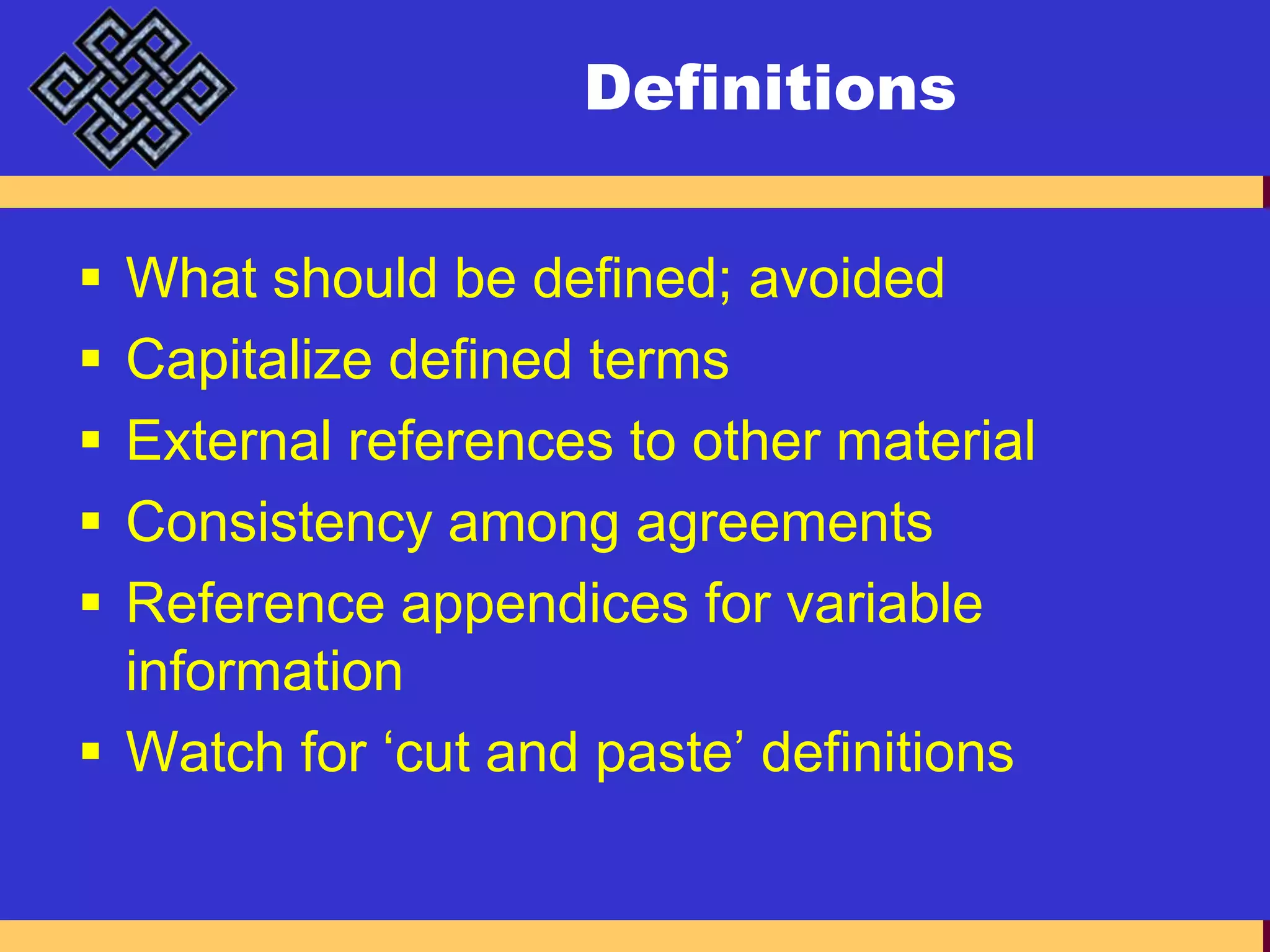
DefinitionsWhat should be defined; avoidedCapitalize defined termsExternal references to other materialConsistency among agreementsReference appendices for variable informationWatch for ‘cut and paste’ definitions
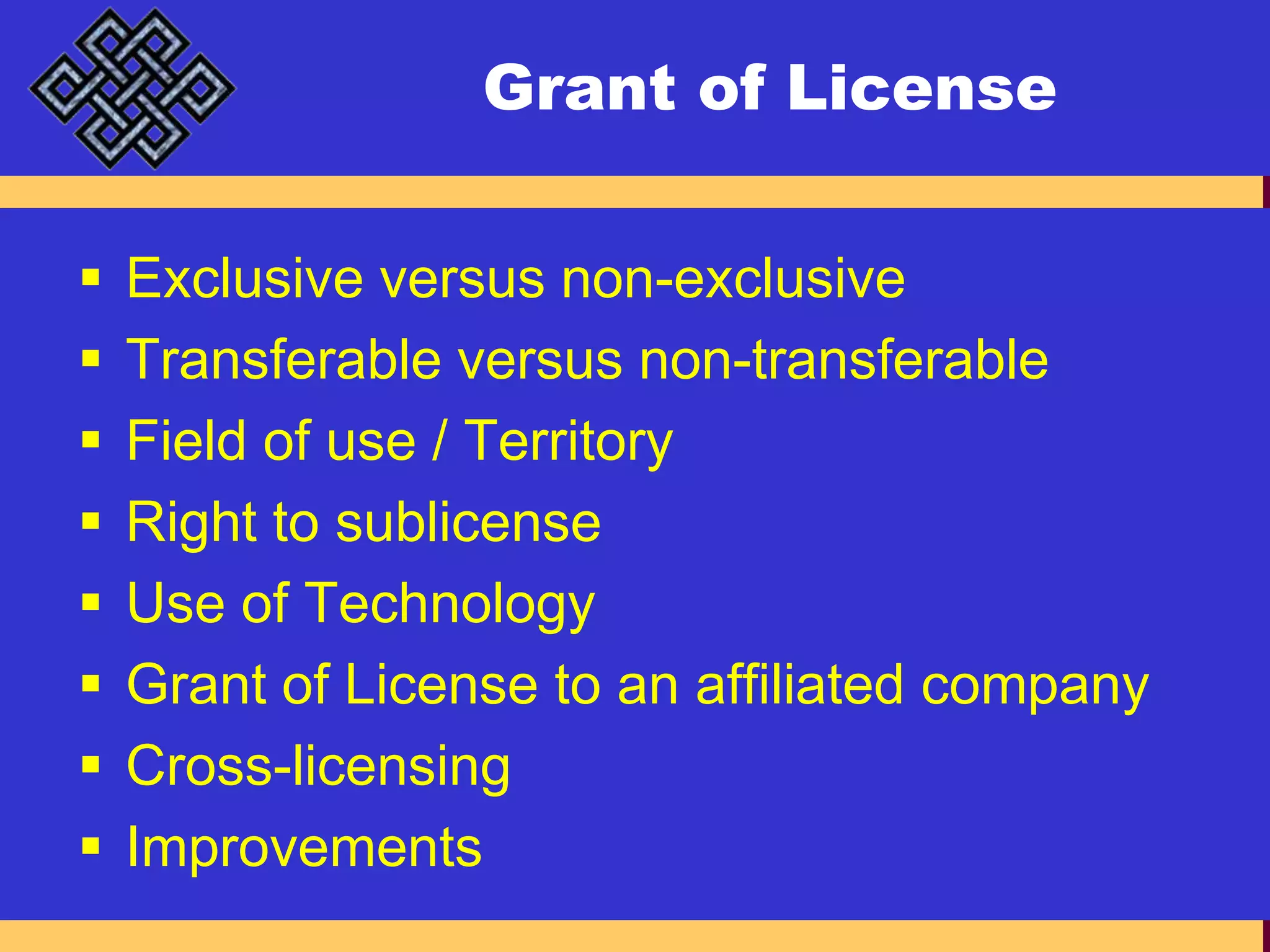
Grant of LicenseExclusive versus non-exclusiveTransferable versus non-transferableField of use / TerritoryRight to sublicenseUse of TechnologyGrant of License to an affiliated companyCross-licensingImprovements
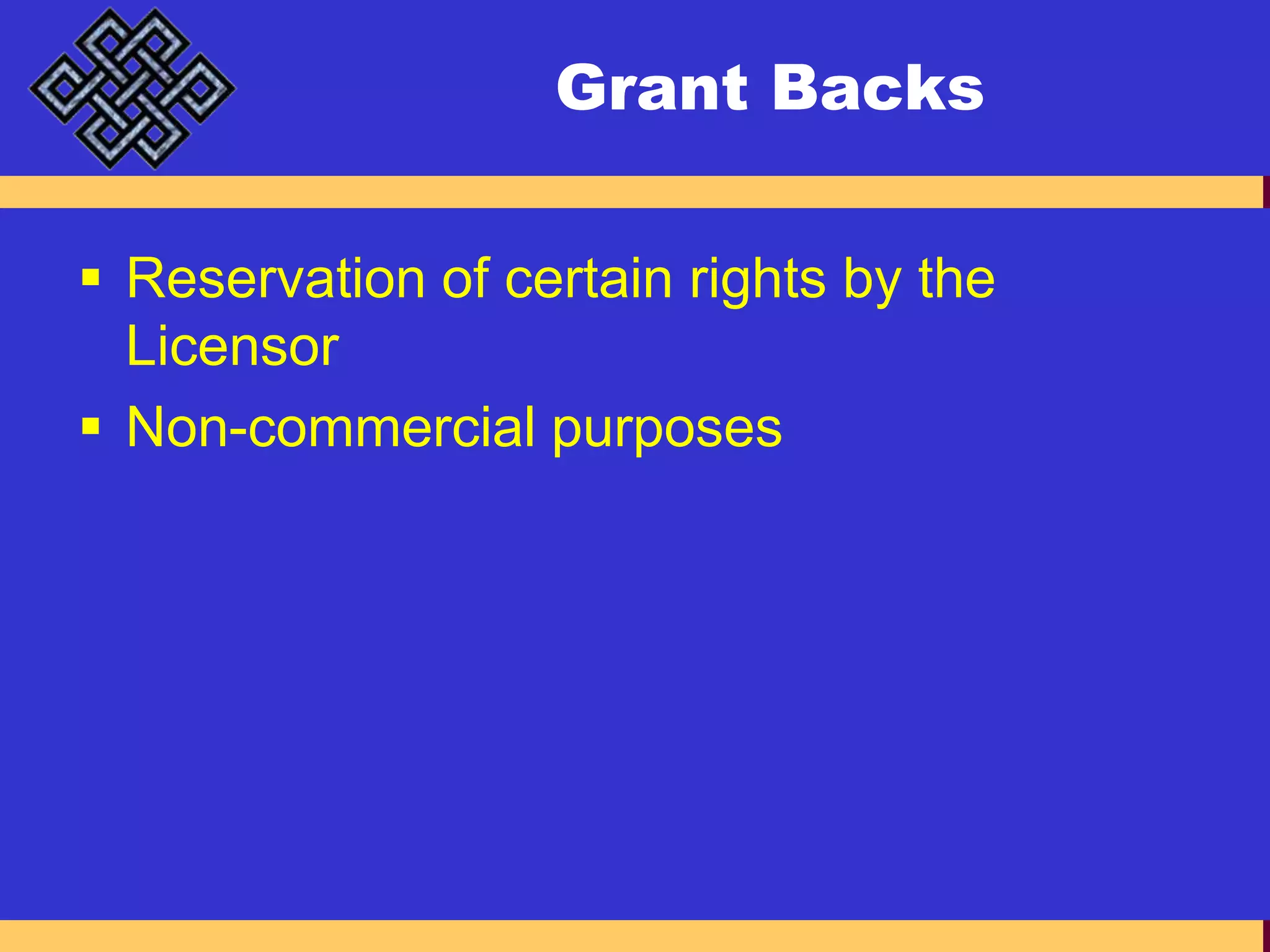
Grant BacksReservation of certain rights by the LicensorNon-commercial purposes
SublicensingRight to SublicenseControl over SublicensingApprovals: consent versus notice, timelinesFlow through provisions: indemnity, royaltiesWhat happens in the event of default of the head licence (comfort letters)End licenses (often attached as an appendix)Obligation to submit copies of licences
RoyaltiesFully paid up LicensesRoyalties based upon gross, net or product salesRoyalty “reach through” on sublicencesMinimum royalties (creditable?)Milestone paymentsInterest on over-due amountsStacking provisionsAbeyance of payment pending results of infringement action
PatentsManagement may pass from licensor to licensee over timeIssues of control, report, consent and abandonmentWho pays?Who is the assignee?Obligation to mark or label licensed products
IndemnityUse and scope of an indemnityLimitation on amount of claim
Representation and WarrantiesWho wants themWho should give themWhat does a Licensor warrant?Different types of licensorsWhat can you actually control?Ownership; non-infringementDisclaim technology “fitness for purpose”
ConfidentialityPermitted circumstances of disclosureWhat constitutes “confidential information”Importance of confidentiality for trade secrets or know-how
Accounting RecordsReport of activities with respect to exploitation of the technologyFrequencyRight to auditAccounting standards
Terms and TerminationTerm of the licenseEvents of terminationAutomatic (insolvency)Curable breachesTermination processConsequences to sub-licensees of terminating the head licence
InsurancePublic liability or product liability insuranceAbsolute need for both in most circumstancesIndemnity vs. Insurance
Proper Law of the ContractProper law of the contractAttornment clause
Assignments of Intellectual PropertyOnce property is transferred, cannot normally get it backWhen might IP be transferred?Does institution continue to use it as part of a research program?Does IP build or improve existing IP?Is there know-how or confidential information involved?
Failure of IP OwnerIf owner of IP fails, how to recoup ownership?Likely not possibleMay be potential of bonds secured by IP assetsCan be very tricky area
Drafting Patents for LicensingEasiest licences are of specific claimsCan you embody licence terms for some fields of use in claims?E.g. of inclusion materialAbility to draft separate claims for separate fields of useAlways ensure a “picture claim” in the patent relating to main product under licence
Start-up Company LicencesUsually little difference in terms except royaltyRoyalty may be paid up and in form of sharesMay also be hybrid models of cash and sharesMay defer cash or have cash convertible into shares
Assessment IssuesTwo most important assessment or valuation questions are:PatentabilityFreedom to OperateBoth can be done early before large patent expenses accrue
Patent Searching SupportYou have tools and skills to conduct patent searchesConsider:State of the ArtFreedom to OperatePatentabilityEach has its place and you can assist
DIY Patent SearchesWith many patent resources online, inventors want to do patent searches themselvesUsual challenges:Not keeping records (US IDS)Limiting to the wrong databasesKey-word vs. classification searching
Providing a ValueFrequently asked:What is my IP worth?Or, you need to explain to someone that their IP is worth something other than their expectationsExamples:Start-Up Companies
Start-up Companiese.g.: VC invests $20M in seed capital in company based on technology; subsequently company generates $50M on an initial public offering (IPO)What is value of technology?
Valuing Start-ups ConclusionDepends on each individual negotiationOnly real determinant is post dilution percentage leftSome suggestion that technology value may be as little as 1 or 2% pre-IPO
Technology for Defensive UsesTechnology will be added to portfolio to enable some other technology or to overcome ‘patent thicket’Good situation is ‘patent pooling’e.g. of MPEG poolFuture of bio: Patenting to permit use; e.g. SARS
Traditional Valuation MeansRules of ThumbUsually based on specific industriesMay be confused with comparable ratesMost used Rule of Thumb:The Razgaitis Rule aka The Rule of QuartersNeed to be able to analyze what is the ‘incremental’ margin before G&ARule suggests that ¼ of that increment should be licensorsIn practice see anywhere from 10 to 50%Best suited to clear commercial products
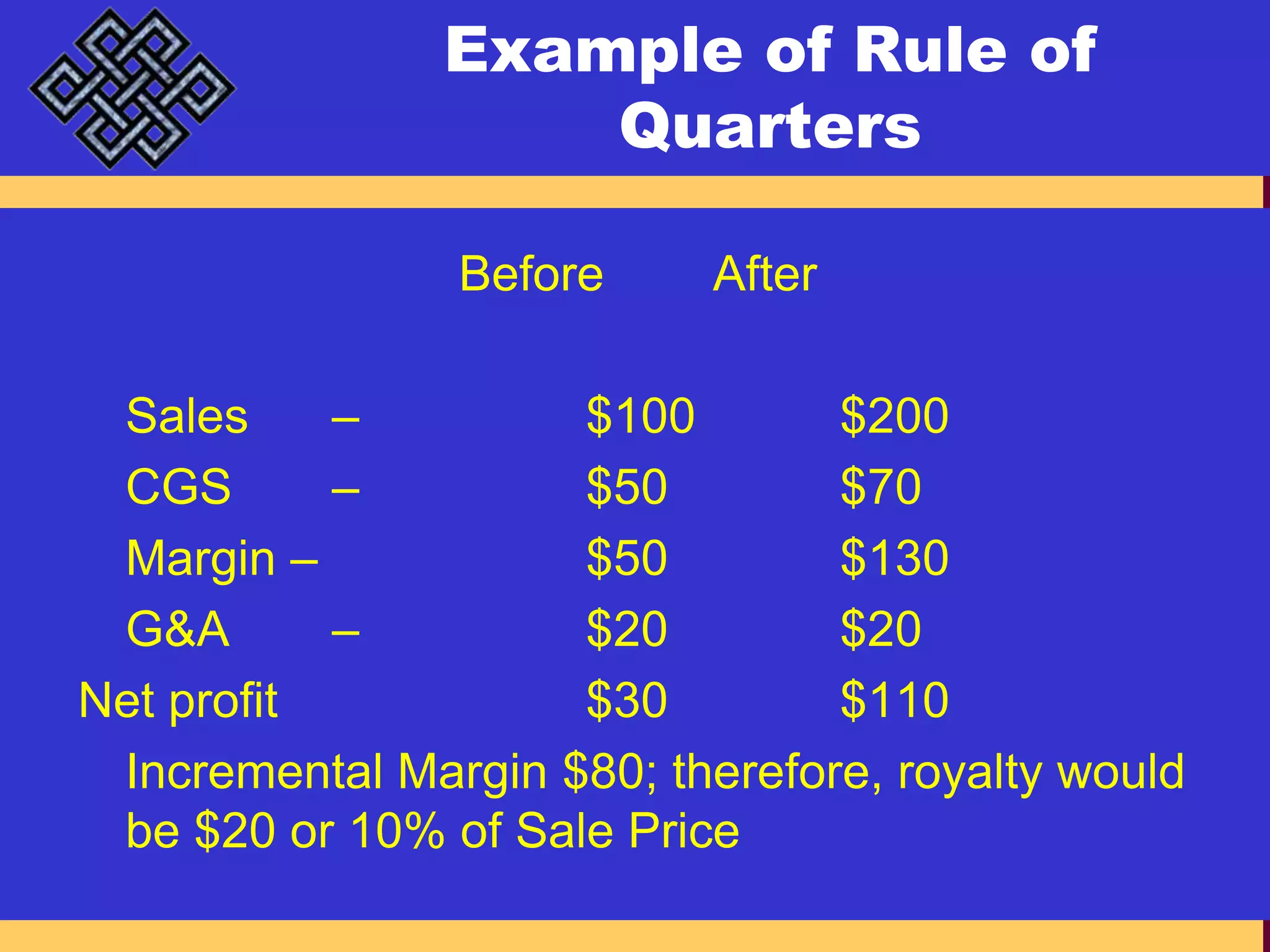
Example of Rule of Quarters				Before	After	Sales	–		$100		$200	CGS 	– 		$50		$70	Margin –			$50		$130	G&A 	–		$20	        	$20Net profit		        	$30	      	$110	Incremental Margin $80; therefore, royalty would be $20 or 10% of Sale Price
Rule of Quarters in PracticeHow to price the royalty?The realities of the target industryMore information on this: LES
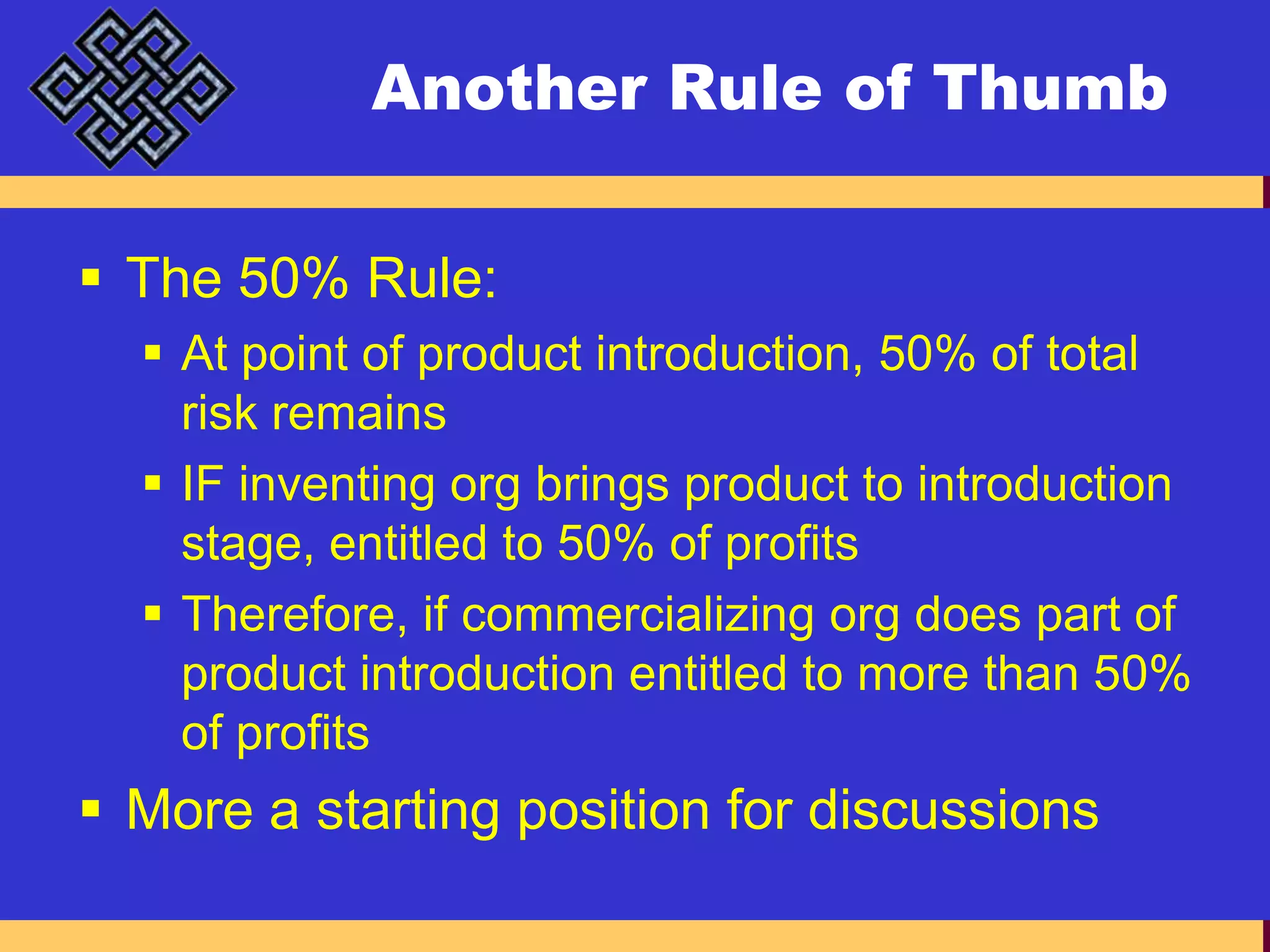
Another Rule of ThumbThe 50% Rule:At point of product introduction, 50% of total risk remainsIF inventing org brings product to introduction stage, entitled to 50% of profitsTherefore, if commercializing org does part of product introduction entitled to more than 50% of profitsMore a starting position for discussions
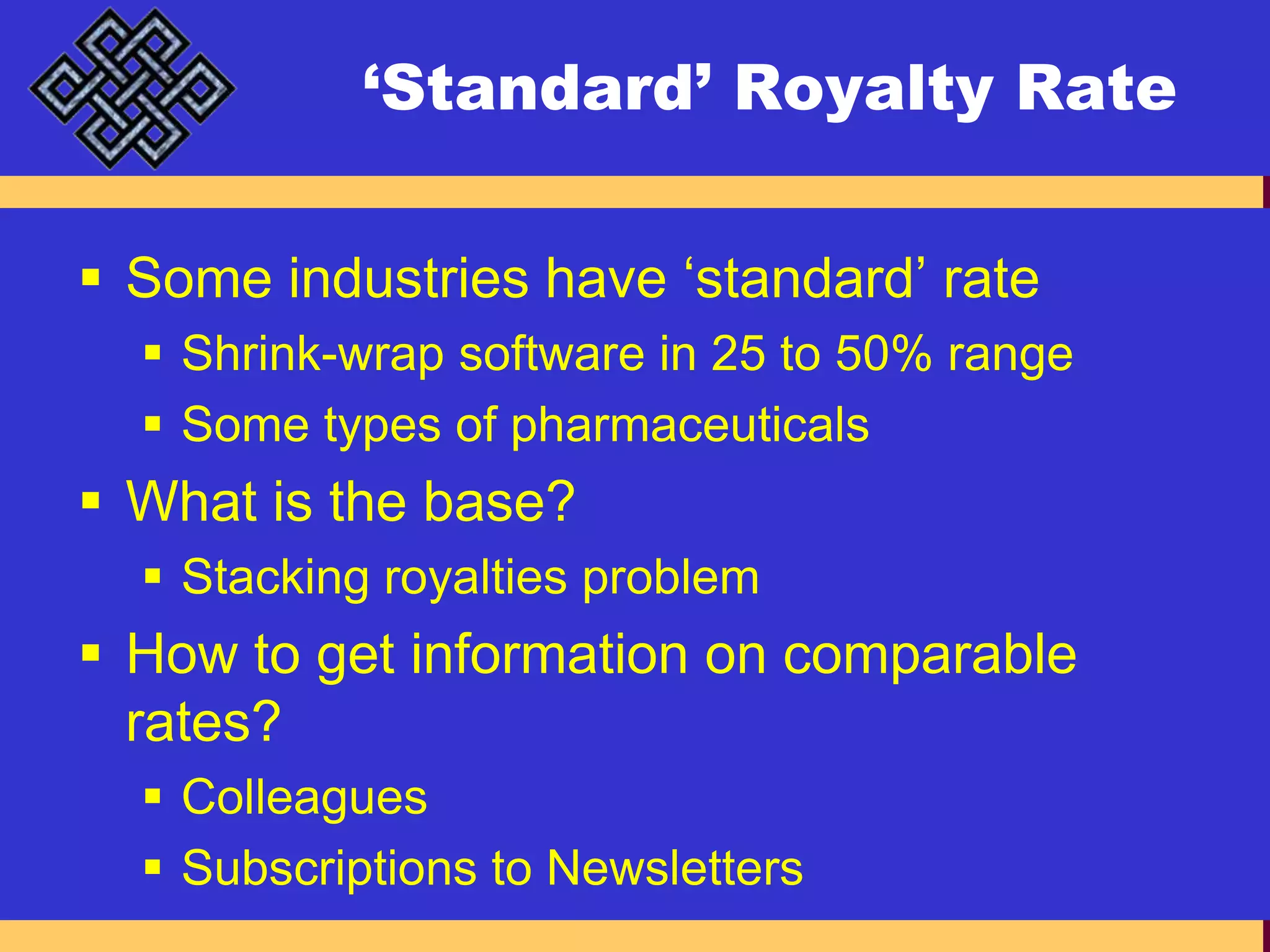
‘Standard’ Royalty RateSome industries have ‘standard’ rateShrink-wrap software in 25 to 50% rangeSome types of pharmaceuticalsWhat is the base?Stacking royalties problemHow to get information on comparable rates?ColleaguesSubscriptions to Newsletters
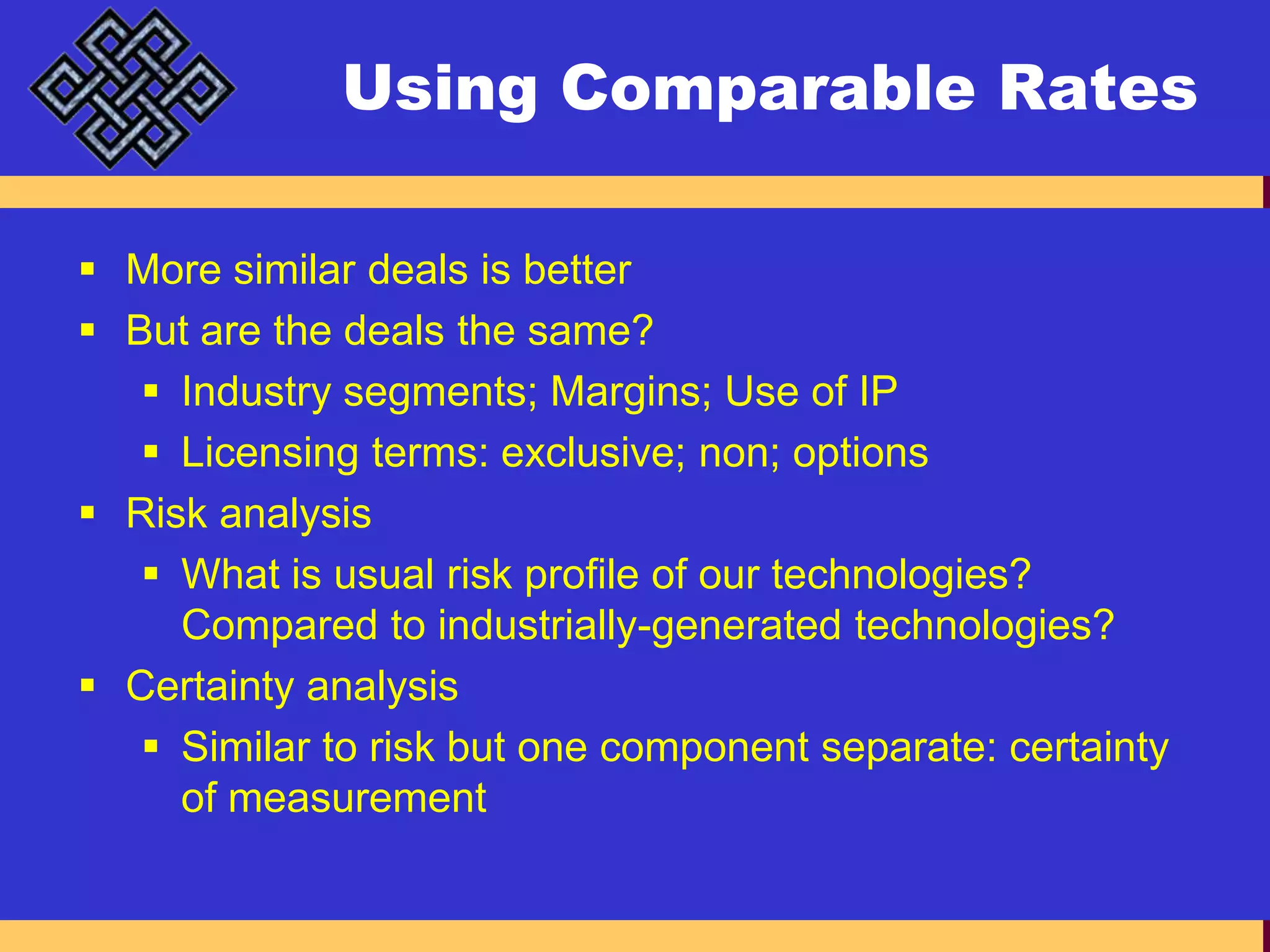
Using Comparable RatesMore similar deals is betterBut are the deals the same?Industry segments; Margins; Use of IPLicensing terms: exclusive; non; optionsRisk analysisWhat is usual risk profile of our technologies? Compared to industrially-generated technologies?Certainty analysisSimilar to risk but one component separate: certainty of measurement
Acquiring Information about ComparablesInternet: Publicly-filed information like SEC and SEDAR informationwww.sec.gov (look for EDGAR)Court and other public recordshttp://pacer.psc.uscourts.gov/Specialty informationwww.10kwizard.comwww.fda.govCompany’s own websites and competitors
The Georgia Pacific1 FactorsLeading Fed Ct decisionCourt established factors to consider in establishing a ‘reasonable’ royalty15 Factors include:Existing royalty rates for licensor and licenseeExclusivity; territory; field of usePractice in licensing; relationship between parties; potential related salesDuration and term of patent1: Georgia-Pacific Corp. v. U.S. Plywood-Champion Papers, 318 F. Supp. 1116, (S.D.N.Y. 1970), modified, 446 F.2d 295 (2d Cir. 1971).
‘Scientific’ and ‘B School’ ApproachesDiscounted Cash Flow (DCF) and Net Present Value (NPV)Real options theoryAuctionsBut first some arithmetic!
Precision and Valuation EstimatesWhat are assumptions that go into a DCF or NPV calculation?Market sizePercentage of marketProduct priceRoyalty RateDiscount (interest rate)How precise is any of these five assumptions?
Rates in RealityDiscount rate is market drivenAUTM TTM (Part X, Ch. 2)Low risk rates (known product): 15 to 20%New product, known manufacturing ability: 25% to 35%New product, new manufacturing, known business: 30% to 40%New business, product ready (no R&D): 40% to 50%New business, product needs R&D: 50% to 70% and upQ: for three examples, what discount rate?
AuctionsTheoretically, the best way to obtain the highest value Depends on exposure to largest number of potential buyersIn patent field:Ocean Tomo – Summer 2009 IP Catalogue onlinePrediction: will become a larger force as business understands IP better
ConclusionWe have covered:The TT ProcessLicensing AgreementsValuations
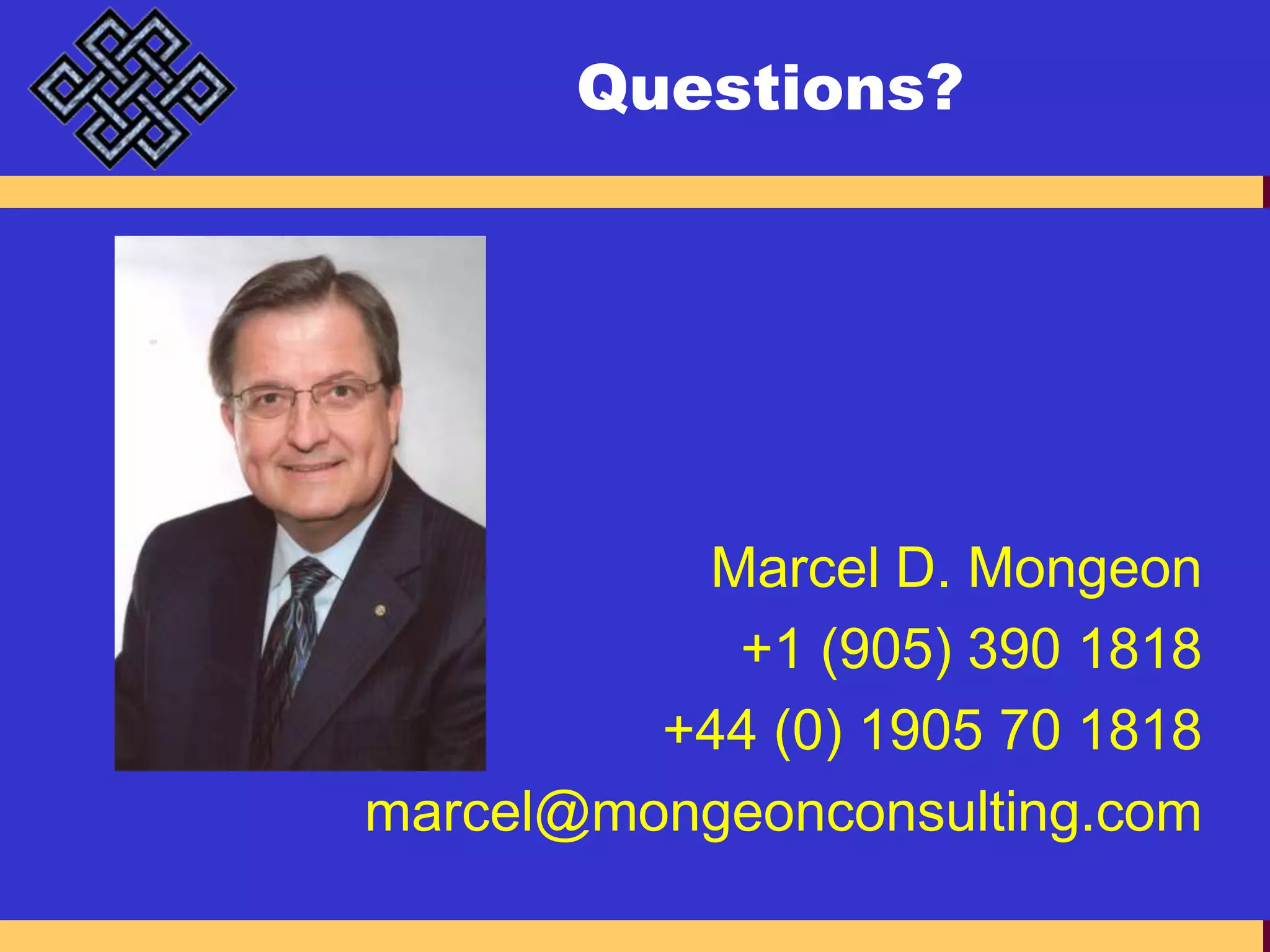
Questions?Marcel D. Mongeon+1 (905) 390 1818+44 (0) 1905 70 1818marcel@mongeonconsulting.com

Technology Transfer and Patent Agents

  • 1.
    Presentation to InnovationFund; Patent Agent and Commercialisation TraineesMarcel D. MongeonIntellectual Property Coach
  • 2.
    OutlineThe TT ProcessHowPatent Agents can work within the TT processThe Licence AgreementPreparing patents for LicencesConsiderations for start-up companiesValuation IssuesThe patent agent’s role
  • 3.
    Technology TransferDefinition:Moving researchresults into practical useNote that money is not requiredBut it helps!Intellectual property a key component of this processSecures advantage to those who will invest in process
  • 4.
    Key Steps inTT ProcessDisclosureEarly valuationIncludes market assessmentIP assessmentIP protectionMarketingLicensingMonitoring
  • 5.
    IP ProtectionBecause of‘invention’ aspect of most early-stage results, patent are predominant mode of protectionDon’t forget alternate protections:CopyrightsTrade-marksPlant breeders rights
  • 6.
    Patent Process12 monthprovisional periodFormal application (SA alone or PCT)Paris Convention – 12 month deadlinePCT deadlines – 30 months from priority date (up to 42 mos. in some countries)Grace periods
  • 7.
    Back to theTT ProcessEarly assessmentsWhat should be assessed before IP protection?Suggest:Freedom to OperateClear ownership rightsClear inventorship rightsOwnership rights may be tricky with private company involvement
  • 8.
    InventorshipThis is areawhere patent agent will provide crucial adviceInternal person may be better placed to answer tricky questions about contributions to issueWho conceived? Reduced to practice?Need to understand cultural context of each situation
  • 9.
    Biggest Challenge Relatingto InventorsThey won’t understand the processInitial need to collect information (i.e. Prior and other cited non-patent art)Who is going to do this? Not you!Preparing claimsNeed to explain what the purpose of claims is and how they need to be supportedThe office action processNot a scientific or peer review process
  • 10.
    Meeting InventorsNeed tomeet inventors directlyDon’t rely on disclosure aloneAlso have commercialisation managers present so they understand process and objectives
  • 11.
    Discussion of PriorArtSearch for prior art and discuss why it would not be obvious to modify it into your claimed inventionHave early discussions with inventors about prior artIf the invention is not a significant advance over prior art, have frank discussion with inventor re obviousness.
  • 12.
    How to Draftfor Prior ArtExpand your disclosure - include comparative results, unsuccessful experiments, etcTry add some functionality to link claim elements in a manner different from the prior art
  • 13.
    The application reviewprocessEnsure inventor and commercialisation manager have both read applicationAsk inventor:Have we captured the invention?What have we missed?Ask commercialisation manager:Have you reviewed the claims?Can you licence the claims?
  • 14.
    Prosecution of ApplicationEnsurecontinuous communication of each step with commercialisation managerThey in turn should communicate with inventorGive notice of costly upcoming stepsEnsure you are communicating the total costs and getting agreement to proceed
  • 15.
    Office ActionsFrom someoffices, office action process may be difficultConsider telephone or in person interviewsConsider taking inventor with you in some cases
  • 16.
    The Licence AgreementManyexamples of licenses and agreements availableSources:www.10kwizard.comhttp://www.sec.gov/edgar.shtmlActual form of clauses not important, content isClause by clause review doesn’t deal with language but the concepts
  • 17.
    Preliminary IssuesBusiness Terms- Use of a term sheet or Memorandum of UnderstandingReviewing the first draftAssociated Documents
  • 18.
    RecitalsNot legally bindingStatementof background and intentionsGood place to identify problems such as conflicts of interest
  • 19.
    DefinitionsWhat should bedefined; avoidedCapitalize defined termsExternal references to other materialConsistency among agreementsReference appendices for variable informationWatch for ‘cut and paste’ definitions
  • 20.
    Grant of LicenseExclusiveversus non-exclusiveTransferable versus non-transferableField of use / TerritoryRight to sublicenseUse of TechnologyGrant of License to an affiliated companyCross-licensingImprovements
  • 21.
    Grant BacksReservation ofcertain rights by the LicensorNon-commercial purposes
  • 22.
    SublicensingRight to SublicenseControlover SublicensingApprovals: consent versus notice, timelinesFlow through provisions: indemnity, royaltiesWhat happens in the event of default of the head licence (comfort letters)End licenses (often attached as an appendix)Obligation to submit copies of licences
  • 23.
    RoyaltiesFully paid upLicensesRoyalties based upon gross, net or product salesRoyalty “reach through” on sublicencesMinimum royalties (creditable?)Milestone paymentsInterest on over-due amountsStacking provisionsAbeyance of payment pending results of infringement action
  • 24.
    PatentsManagement may passfrom licensor to licensee over timeIssues of control, report, consent and abandonmentWho pays?Who is the assignee?Obligation to mark or label licensed products
  • 25.
    IndemnityUse and scopeof an indemnityLimitation on amount of claim
  • 26.
    Representation and WarrantiesWhowants themWho should give themWhat does a Licensor warrant?Different types of licensorsWhat can you actually control?Ownership; non-infringementDisclaim technology “fitness for purpose”
  • 27.
    ConfidentialityPermitted circumstances ofdisclosureWhat constitutes “confidential information”Importance of confidentiality for trade secrets or know-how
  • 28.
    Accounting RecordsReport ofactivities with respect to exploitation of the technologyFrequencyRight to auditAccounting standards
  • 29.
    Terms and TerminationTermof the licenseEvents of terminationAutomatic (insolvency)Curable breachesTermination processConsequences to sub-licensees of terminating the head licence
  • 30.
    InsurancePublic liability orproduct liability insuranceAbsolute need for both in most circumstancesIndemnity vs. Insurance
  • 31.
    Proper Law ofthe ContractProper law of the contractAttornment clause
  • 32.
    Assignments of IntellectualPropertyOnce property is transferred, cannot normally get it backWhen might IP be transferred?Does institution continue to use it as part of a research program?Does IP build or improve existing IP?Is there know-how or confidential information involved?
  • 33.
    Failure of IPOwnerIf owner of IP fails, how to recoup ownership?Likely not possibleMay be potential of bonds secured by IP assetsCan be very tricky area
  • 34.
    Drafting Patents forLicensingEasiest licences are of specific claimsCan you embody licence terms for some fields of use in claims?E.g. of inclusion materialAbility to draft separate claims for separate fields of useAlways ensure a “picture claim” in the patent relating to main product under licence
  • 35.
    Start-up Company LicencesUsuallylittle difference in terms except royaltyRoyalty may be paid up and in form of sharesMay also be hybrid models of cash and sharesMay defer cash or have cash convertible into shares
  • 36.
    Assessment IssuesTwo mostimportant assessment or valuation questions are:PatentabilityFreedom to OperateBoth can be done early before large patent expenses accrue
  • 37.
    Patent Searching SupportYouhave tools and skills to conduct patent searchesConsider:State of the ArtFreedom to OperatePatentabilityEach has its place and you can assist
  • 38.
    DIY Patent SearchesWithmany patent resources online, inventors want to do patent searches themselvesUsual challenges:Not keeping records (US IDS)Limiting to the wrong databasesKey-word vs. classification searching
  • 39.
    Providing a ValueFrequentlyasked:What is my IP worth?Or, you need to explain to someone that their IP is worth something other than their expectationsExamples:Start-Up Companies
  • 40.
    Start-up Companiese.g.: VCinvests $20M in seed capital in company based on technology; subsequently company generates $50M on an initial public offering (IPO)What is value of technology?
  • 41.
    Valuing Start-ups ConclusionDependson each individual negotiationOnly real determinant is post dilution percentage leftSome suggestion that technology value may be as little as 1 or 2% pre-IPO
  • 42.
    Technology for DefensiveUsesTechnology will be added to portfolio to enable some other technology or to overcome ‘patent thicket’Good situation is ‘patent pooling’e.g. of MPEG poolFuture of bio: Patenting to permit use; e.g. SARS
  • 43.
    Traditional Valuation MeansRulesof ThumbUsually based on specific industriesMay be confused with comparable ratesMost used Rule of Thumb:The Razgaitis Rule aka The Rule of QuartersNeed to be able to analyze what is the ‘incremental’ margin before G&ARule suggests that ¼ of that increment should be licensorsIn practice see anywhere from 10 to 50%Best suited to clear commercial products
  • 44.
    Example of Ruleof Quarters Before After Sales – $100 $200 CGS – $50 $70 Margin – $50 $130 G&A – $20 $20Net profit $30 $110 Incremental Margin $80; therefore, royalty would be $20 or 10% of Sale Price
  • 45.
    Rule of Quartersin PracticeHow to price the royalty?The realities of the target industryMore information on this: LES
  • 46.
    Another Rule ofThumbThe 50% Rule:At point of product introduction, 50% of total risk remainsIF inventing org brings product to introduction stage, entitled to 50% of profitsTherefore, if commercializing org does part of product introduction entitled to more than 50% of profitsMore a starting position for discussions
  • 47.
    ‘Standard’ Royalty RateSomeindustries have ‘standard’ rateShrink-wrap software in 25 to 50% rangeSome types of pharmaceuticalsWhat is the base?Stacking royalties problemHow to get information on comparable rates?ColleaguesSubscriptions to Newsletters
  • 48.
    Using Comparable RatesMoresimilar deals is betterBut are the deals the same?Industry segments; Margins; Use of IPLicensing terms: exclusive; non; optionsRisk analysisWhat is usual risk profile of our technologies? Compared to industrially-generated technologies?Certainty analysisSimilar to risk but one component separate: certainty of measurement
  • 49.
    Acquiring Information aboutComparablesInternet: Publicly-filed information like SEC and SEDAR informationwww.sec.gov (look for EDGAR)Court and other public recordshttp://pacer.psc.uscourts.gov/Specialty informationwww.10kwizard.comwww.fda.govCompany’s own websites and competitors
  • 50.
    The Georgia Pacific1FactorsLeading Fed Ct decisionCourt established factors to consider in establishing a ‘reasonable’ royalty15 Factors include:Existing royalty rates for licensor and licenseeExclusivity; territory; field of usePractice in licensing; relationship between parties; potential related salesDuration and term of patent1: Georgia-Pacific Corp. v. U.S. Plywood-Champion Papers, 318 F. Supp. 1116, (S.D.N.Y. 1970), modified, 446 F.2d 295 (2d Cir. 1971).
  • 51.
    ‘Scientific’ and ‘BSchool’ ApproachesDiscounted Cash Flow (DCF) and Net Present Value (NPV)Real options theoryAuctionsBut first some arithmetic!
  • 52.
    Precision and ValuationEstimatesWhat are assumptions that go into a DCF or NPV calculation?Market sizePercentage of marketProduct priceRoyalty RateDiscount (interest rate)How precise is any of these five assumptions?
  • 53.
    Rates in RealityDiscountrate is market drivenAUTM TTM (Part X, Ch. 2)Low risk rates (known product): 15 to 20%New product, known manufacturing ability: 25% to 35%New product, new manufacturing, known business: 30% to 40%New business, product ready (no R&D): 40% to 50%New business, product needs R&D: 50% to 70% and upQ: for three examples, what discount rate?
  • 54.
    AuctionsTheoretically, the bestway to obtain the highest value Depends on exposure to largest number of potential buyersIn patent field:Ocean Tomo – Summer 2009 IP Catalogue onlinePrediction: will become a larger force as business understands IP better
  • 55.
    ConclusionWe have covered:TheTT ProcessLicensing AgreementsValuations
  • 56.
    Questions?Marcel D. Mongeon+1(905) 390 1818+44 (0) 1905 70 1818marcel@mongeonconsulting.com

Editor's Notes