AVOIDING PATENT PITFALLS AND
OBSTACLES OVER THE LIFETIME
OF YOUR INNOVATION
Phil McKay
pmckay@hawleytroxell.com
208.388.4824
INTRO TO PATENT RIGHTS
• A patent is a property right (grant) which
provides the patentee a monopoly for a
limited period of time (20 years from filing
date)
• Negative Right: To exclude others from
making, using, selling, or importing the
patented invention
TYPES OF PATENTS
• Design Patents
– Issued for appearance related features only, not functional
features
– A crossover with copyright and trademark law
– Being used more and more to protect UIs/screen appearance
• Utility Patents
– Issued for functional inventions
• Provisional Patents
– Marker for utility patent to be filed within 1 year
– Must be enabled and complete to obtain filing date
– Can actually be more expensive than a utility
WHAT CAN BE PATENTED?
In short, “anything under the sun made by man” but
not necessarily everything done by man.
• Natural Phenomenon, Laws of Nature, Abstract Ideas, are not
patentable subject matter
– Alice and Mayo – limits on software based on abstract idea
– Now a two part Mayo test for virtually all software patents
• New collections of existing elements/devices
– Used in a different way
– Used for a different purpose
– Used as a new combination
• Must relate to a legal endeavor
• There are over 9 million issued patents (very few light bulb level
inventions)
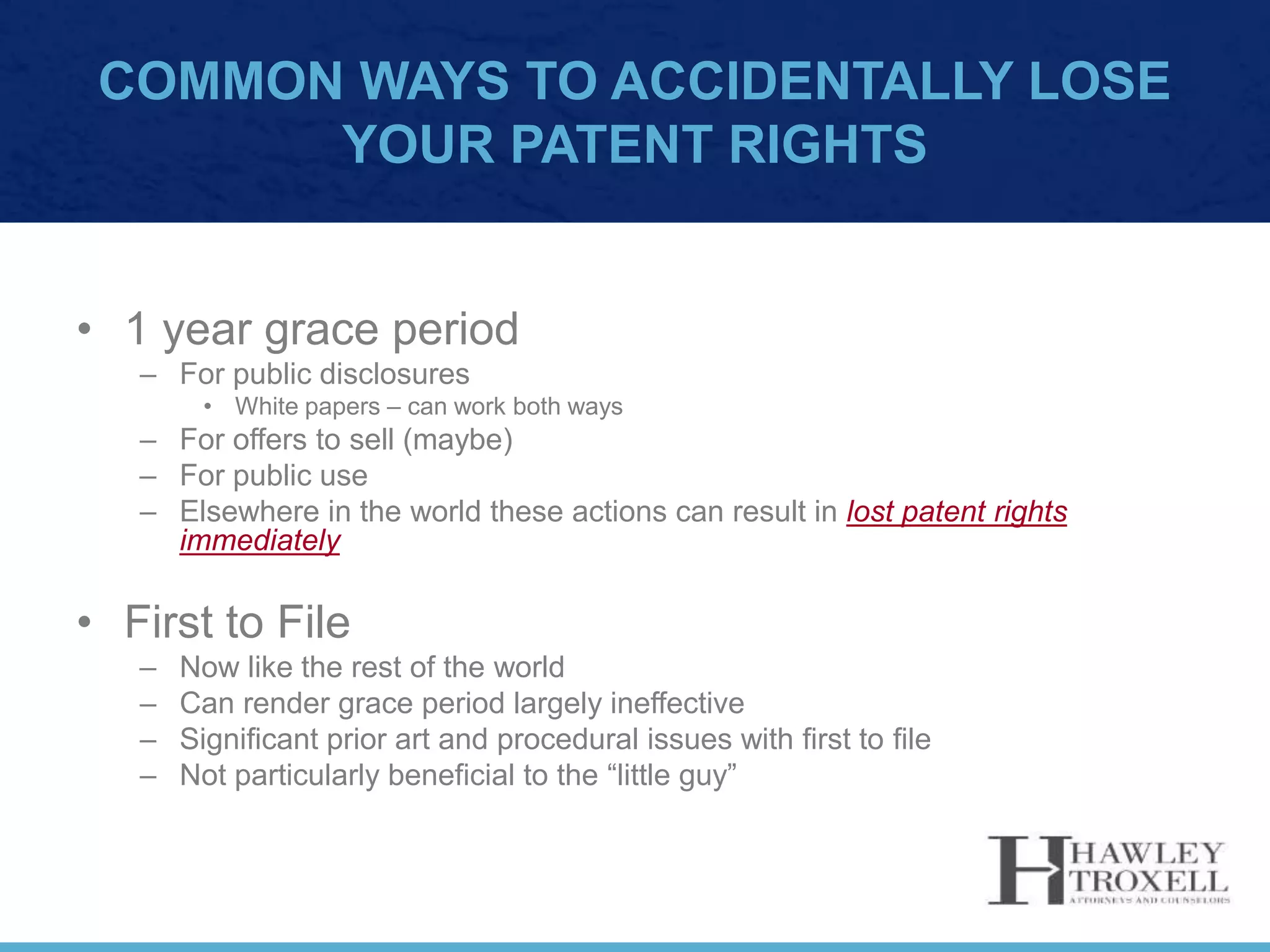
COMMON WAYS TO ACCIDENTALLY LOSE
YOUR PATENT RIGHTS
• 1 year grace period
– For public disclosures
• White papers – can work both ways
– For offers to sell (maybe)
– For public use
– Elsewhere in the world these actions can result in lost patent rights
immediately
• First to File
– Now like the rest of the world
– Can render grace period largely ineffective
– Significant prior art and procedural issues with first to file
– Not particularly beneficial to the “little guy”
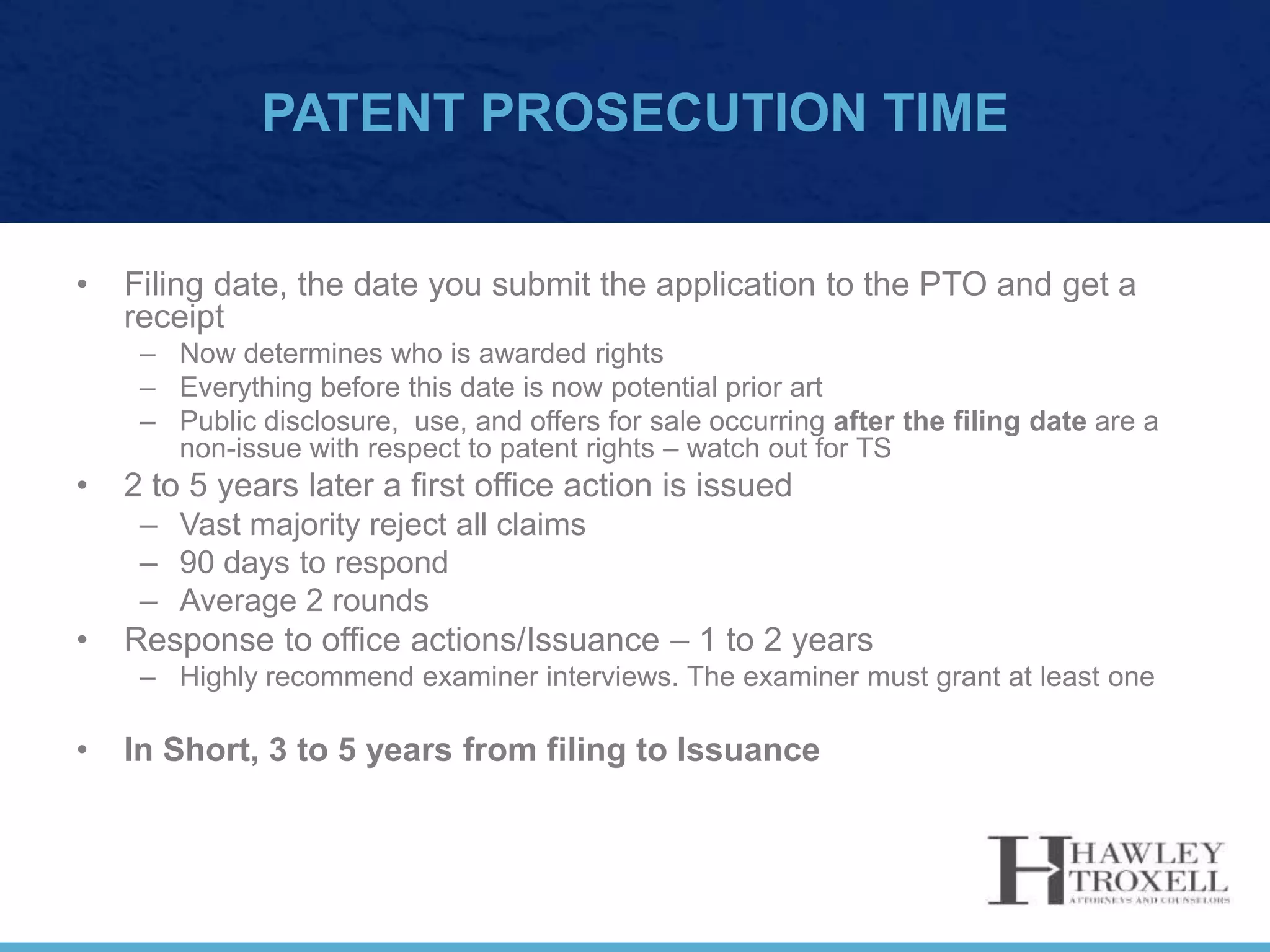
PATENT PROSECUTION TIME
• Filing date, the date you submit the application to the PTO and get a
receipt
– Now determines who is awarded rights
– Everything before this date is now potential prior art
– Public disclosure, use, and offers for sale occurring after the filing date are a
non-issue with respect to patent rights – watch out for TS
• 2 to 5 years later a first office action is issued
– Vast majority reject all claims
– 90 days to respond
– Average 2 rounds
• Response to office actions/Issuance – 1 to 2 years
– Highly recommend examiner interviews. The examiner must grant at least one
• In Short, 3 to 5 years from filing to Issuance
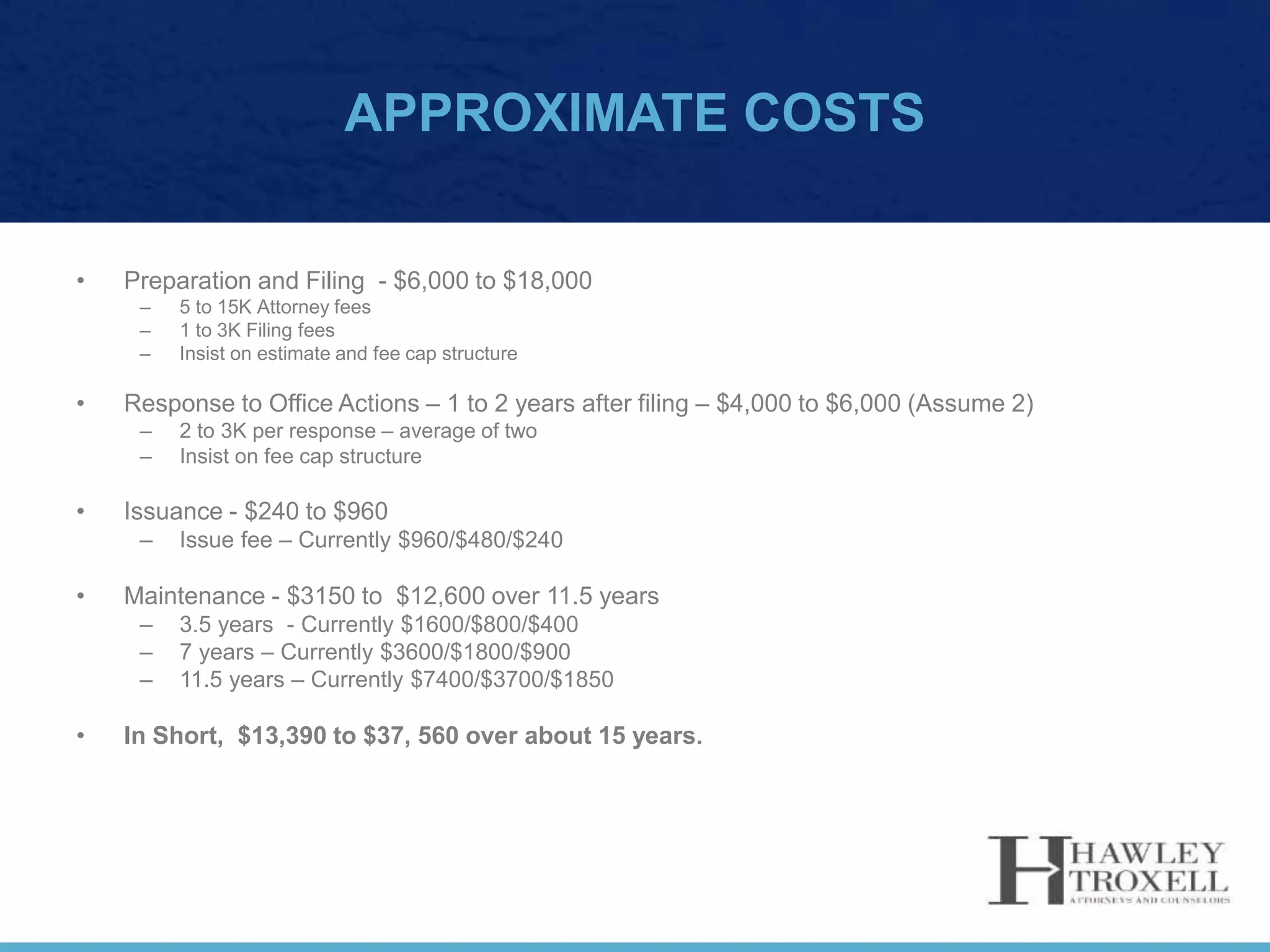
APPROXIMATE COSTS
• Preparation and Filing - $6,000 to $18,000
– 5 to 15K Attorney fees
– 1 to 3K Filing fees
– Insist on estimate and fee cap structure
• Response to Office Actions – 1 to 2 years after filing – $4,000 to $6,000 (Assume 2)
– 2 to 3K per response – average of two
– Insist on fee cap structure
• Issuance - $240 to $960
– Issue fee – Currently $960/$480/$240
• Maintenance - $3150 to $12,600 over 11.5 years
– 3.5 years - Currently $1600/$800/$400
– 7 years – Currently $3600/$1800/$900
– 11.5 years – Currently $7400/$3700/$1850
• In Short, $13,390 to $37, 560 over about 15 years.
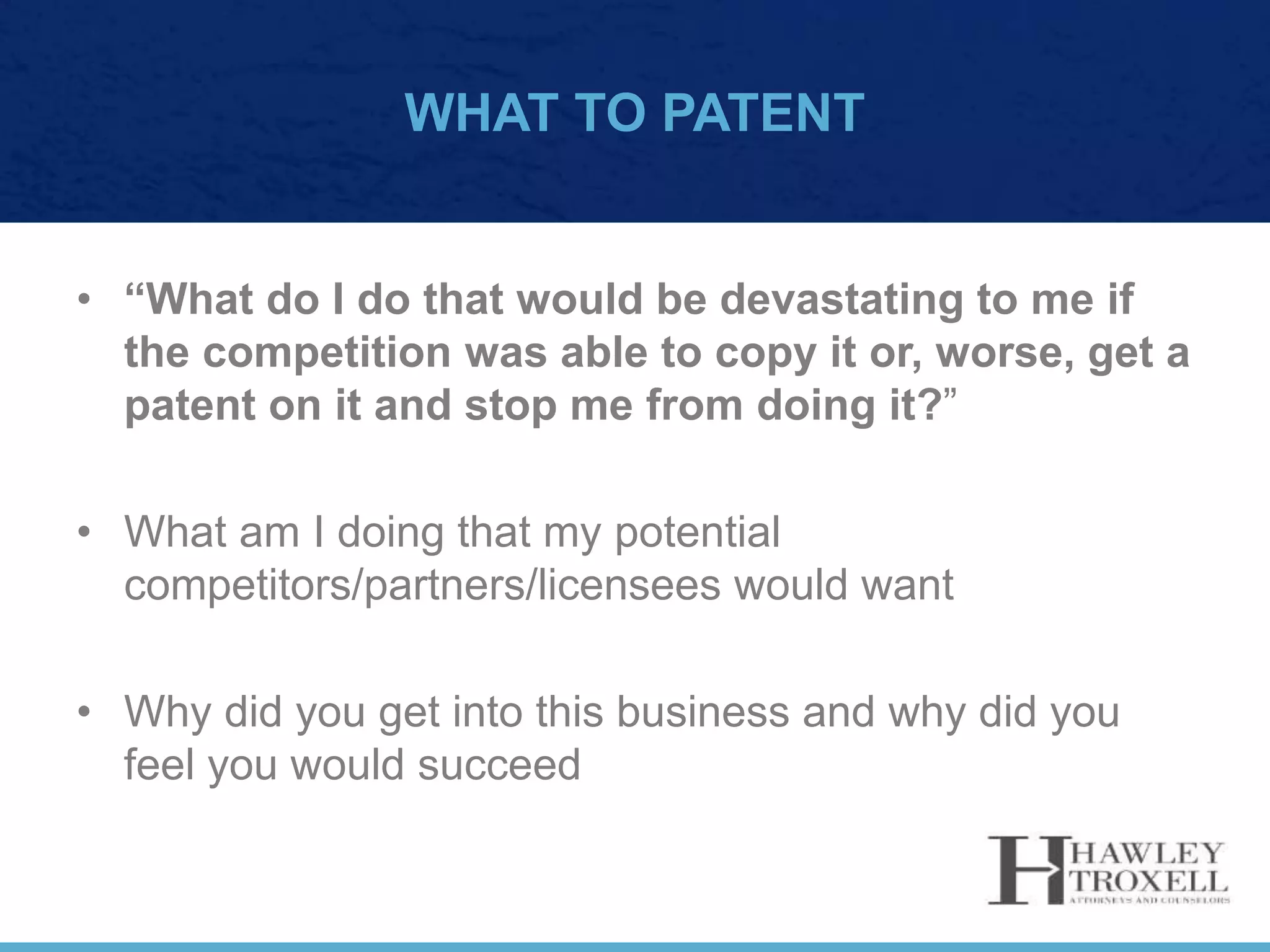
WHAT TO PATENT
• “What do I do that would be devastating to me if
the competition was able to copy it or, worse, get a
patent on it and stop me from doing it?”
• What am I doing that my potential
competitors/partners/licensees would want
• Why did you get into this business and why did you
feel you would succeed
WHY PATENT ? (1)
• FOR DEFENSIVE PURPOSES:
– FREEDOM TO OPERATE AND FREEDOM TO
USE YOUR OWN INVENTION
• Minimizes/negates royalty payments to competition
• Avoids funding competition's R&D
• Makes your company too expensive to
threaten/sue
WHY PATENT ? (2)
• For offensive purposes:
– Prevent competitors from copying your
inventions and products
– Tangible return on R&D
– Places a “rent charge” on each of the
competitor's products and thereby keeps a cost
advantage in your product
– Asset on balance sheet
WHY PATENT ? (3)
• For strategic purposes:
– The more colorable patents you can assert, the more
likely your company will be deemed too expensive to
sue
– The more likely you will get a cross license or reduced
payment deal, even from trolls
– Reasonable royalty is typically a percentage of revenue.
This is good news for the little guy
• The golden BB effect
– Establishes company as a technology leader
– VCs, investors, potential partners, and potential
buyers often want to see patents/applications
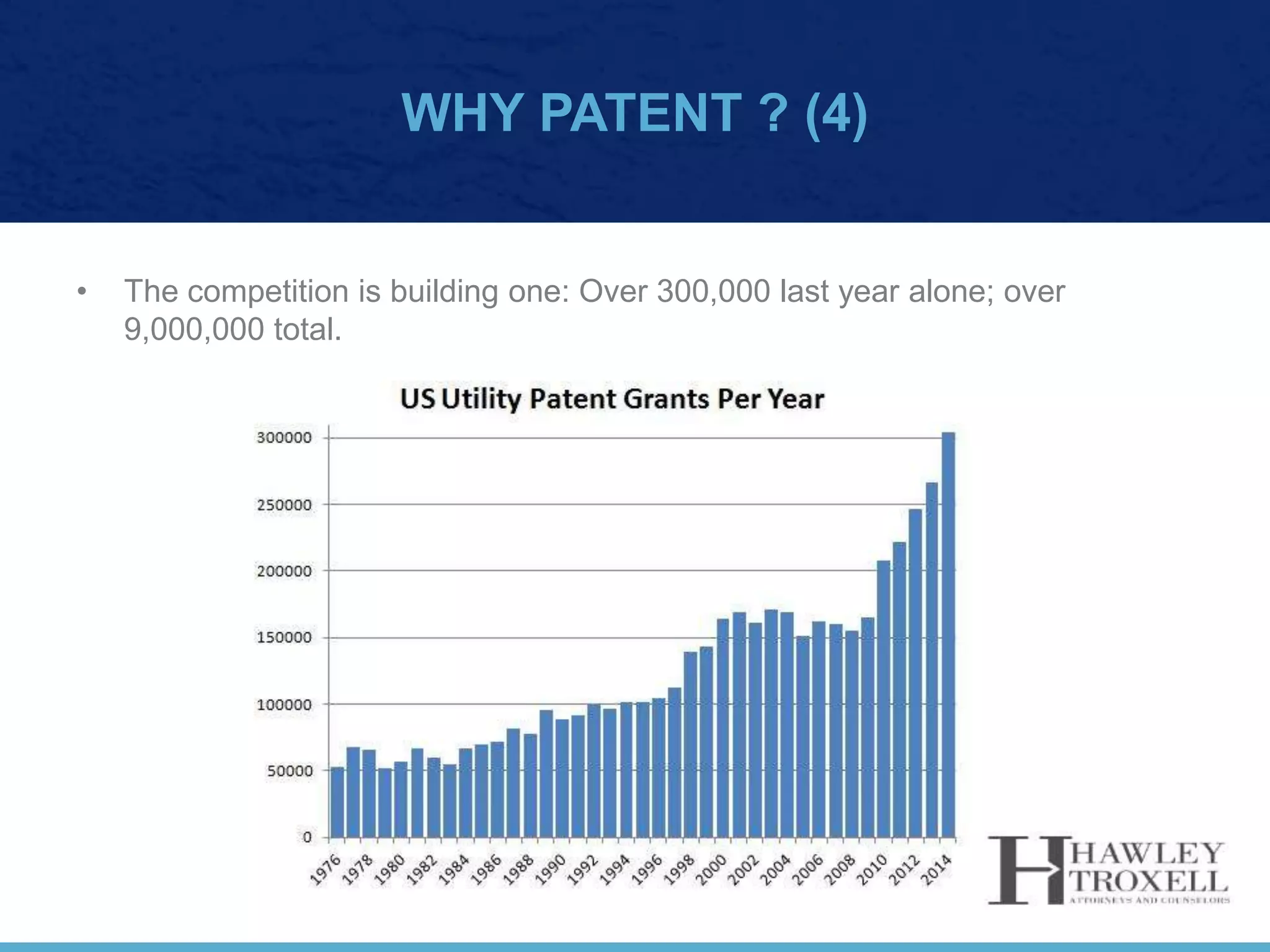
WHY PATENT ? (4)
• The competition is building one: Over 300,000 last year alone; over
9,000,000 total.
WHY PATENT ? (5)
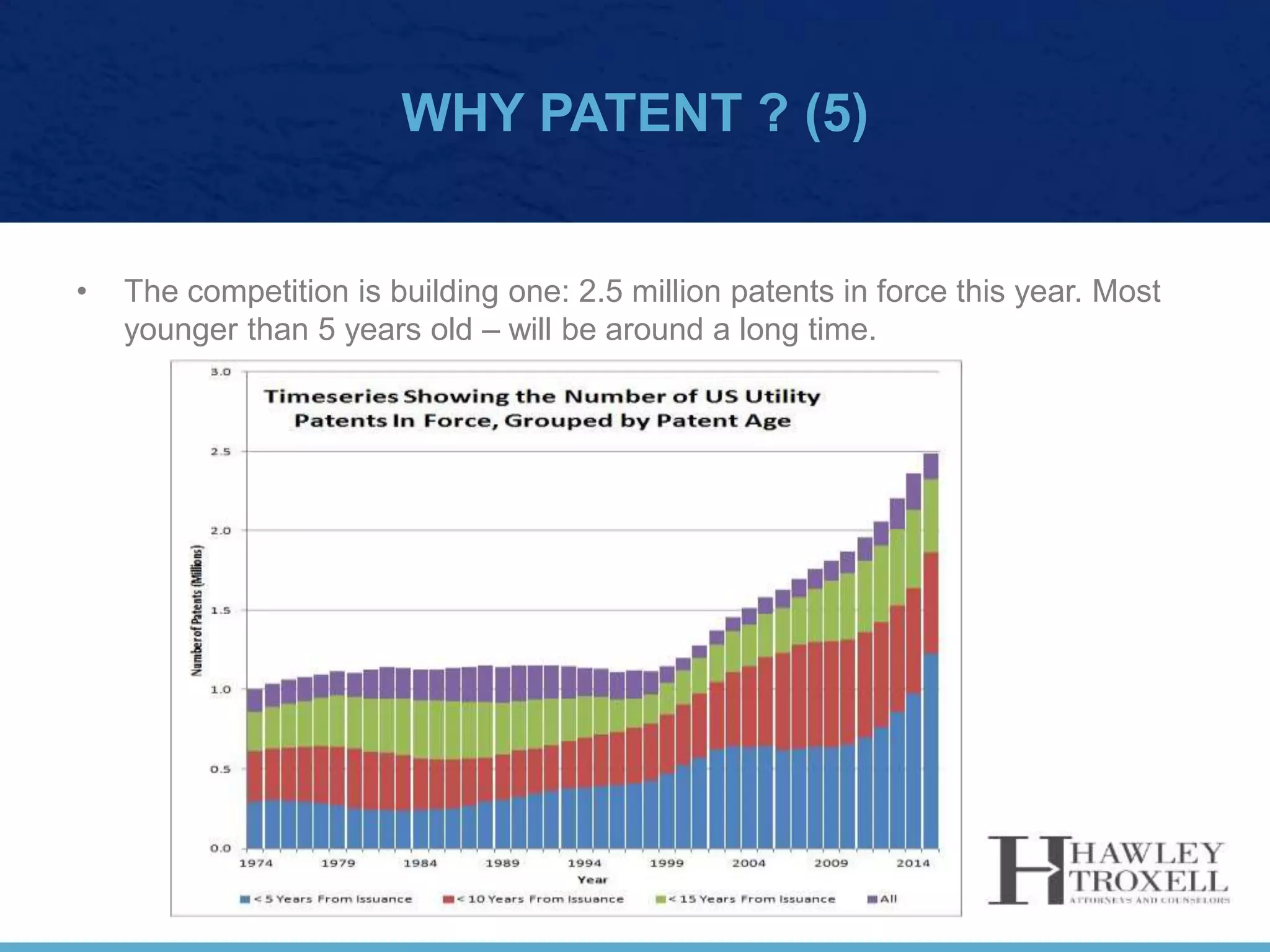
• The competition is building one: 2.5 million patents in force this year. Most
younger than 5 years old – will be around a long time.
LICENSING CONSIDERATIONS
• How it really works
– Over 9,000,000 patents – Are they really all “light bulb” level
inventions?
– Virtually every major Silicon Valley player is infringing someone
else’s patents
– Cost for Opinion letter is a minimum 20 to 40K - PER PATENT
– The more colorable patents you can assert, or “offer the
competition to examine,” the more likely your company will be
deemed too expensive or uncertain to sue and the more likely
you will get a cross license or reduced payment deal
– Good news for the little guy; reasonable royalty is typically a
percentage of revenue
WHERE TO FILE (1)
• Unless there is an identifiable foreign threat,
i.e., a foreign maker selling into a foreign
market, concentrate on U.S. patents
– Most bang for buck
– ITC can be used to stop foreign-made products
from entering U.S.
– No translations
– Can file foreign based on U.S. case as late as a
year later
WHERE TO FILE (2)
• If foreign applications are required:
– Consider the PCT:
• Initial filing fee relatively low
• Allows significant delay (up to 30 months) before
expense of translations is incurred.
– This gives the product time to prove itself before real
costs are incurred
• At National Phase, once again choose carefully
with an eye to the considerable cost
• Note - Not all countries of interest are members of
the PCT, but most are
HOW TO KEEP THE BUDGET UNDER CONTROL
• Keep the patent applications focused on a
single, digestible innovation:
– Easier on engineers
– Lower attorney fees
– Less confusing to judges and jury
– Easier to broaden beyond the scope of a
particular embodiment
– More patents, and faster
A WORD ABOUT PATENT SEARCHING
• Willful versus Non-Willful infringement:
– Non-willful is viewed as an accident. Damages are
based on a reasonable royalty
– Willful is viewed as a bad actor situation with possible
3X damages and attorney fees on the line
• Search sites:
– Best to use only the official PTO site
– Warn engineers to perform searches only with
permission and under in-house attorney direction
A WORD ABOUT COMMUNICATIONS
• Keep Willful versus Non-Willful Infringement in
Mind:
– No detailed e-mails
• Use e-mail only to set up meetings and use very broad
and non-descriptive language
– “Need to discuss patents”
– Keep discussions on a “need-to-know” basis
– Don’t send engineers off on snipe hunts
– Stay off the Internet
– Use your outside counsel
DELAYING COSTS AND ALTERNATIVE
PROTECTION
• Trade Secret
– Must remain secret
• Copyright
– Some software protection with limits
– No protection from independent creation
• Trademark
– Overlap with design patents
– Must use
• Just be first to market and keep doing it better than the
competition
• No “poor man’s patent” anymore
– First to file
PRE-ISSUANCE MARKING AND THE
TOLLING OF DAMAGES
• Must include the word “pending” as in “Patent
Pending”
– Avoid false marking charges
• Even with notice, no damages are incurred until
patent issues, very little legal effect
• May give competition a heads up and cause
complications
• May scare off potential competition
• A business decision and very subject
matter/market dependent
PRE-ISSUANCE DISCLOSURE AND
MARKETING
• A patent application, and the subject matter
of the application, are secret until
disclosed/published (Issued)
– May not want to disclose it and forfeit trade
secret status
– This is a business call balancing marketing with
value of secret status
PROTECTING EVOLVING CONCEPTS AND
PRODUCTS
• Once foundational patent is filed do not forget
to follow up on improvements and changes
– This can often be done using the CIP
mechanism
• Typically less expensive to prepare
• If new related ideas come forward, consider
applications on these as well
WHEN TO LICENSE
• Really a business decision, however, an
issued patent is always worth far more than
an application
– Another reason to file early
POST-ISSUANCE MARKING AND DAMAGES
• Damages are available only if adequate notice is given of the patent(s)
• Actual or constructive notice
– Actual - Alleged infringer is directly informed
– Constructive - by affixing a product with, for example, the word “patent” or abbreviation
“pat.” along with the patent number, i.e., marking.
• Virtual marking
– Satisfied by the word “patent” or abbreviation “pat.” on the product followed by an
internet address at which the patented article is associated to one or more patent
numbers
– Info can be updated on website vs. the product
• Patented products should always be actually or virtually marked
– Sometimes the product
– Sometimes the packaging
• only if marking the product “cannot be done.”
– Sometimes the medium
• Software
LICENSING CONSIDERATIONS
• Always try to give non-exclusive licenses to the
technology
– At a minimum try to keep rights for yourself
• Typically it is more profitable to license on a per-
piece basis than to provide blanket, unlimited
use, rights
– Use as technology-based rent to maintain a cost
advantage
– Must be fairly sure innovation has legs
PROTECTING EVOLVING CONCEPTS AND
PRODUCTS
• Once foundational patent is filed and/or
issues do not forget to follow up on
improvements changes
– Typically still less expensive to prepare
• If new related ideas come forward, consider
applications on these as well
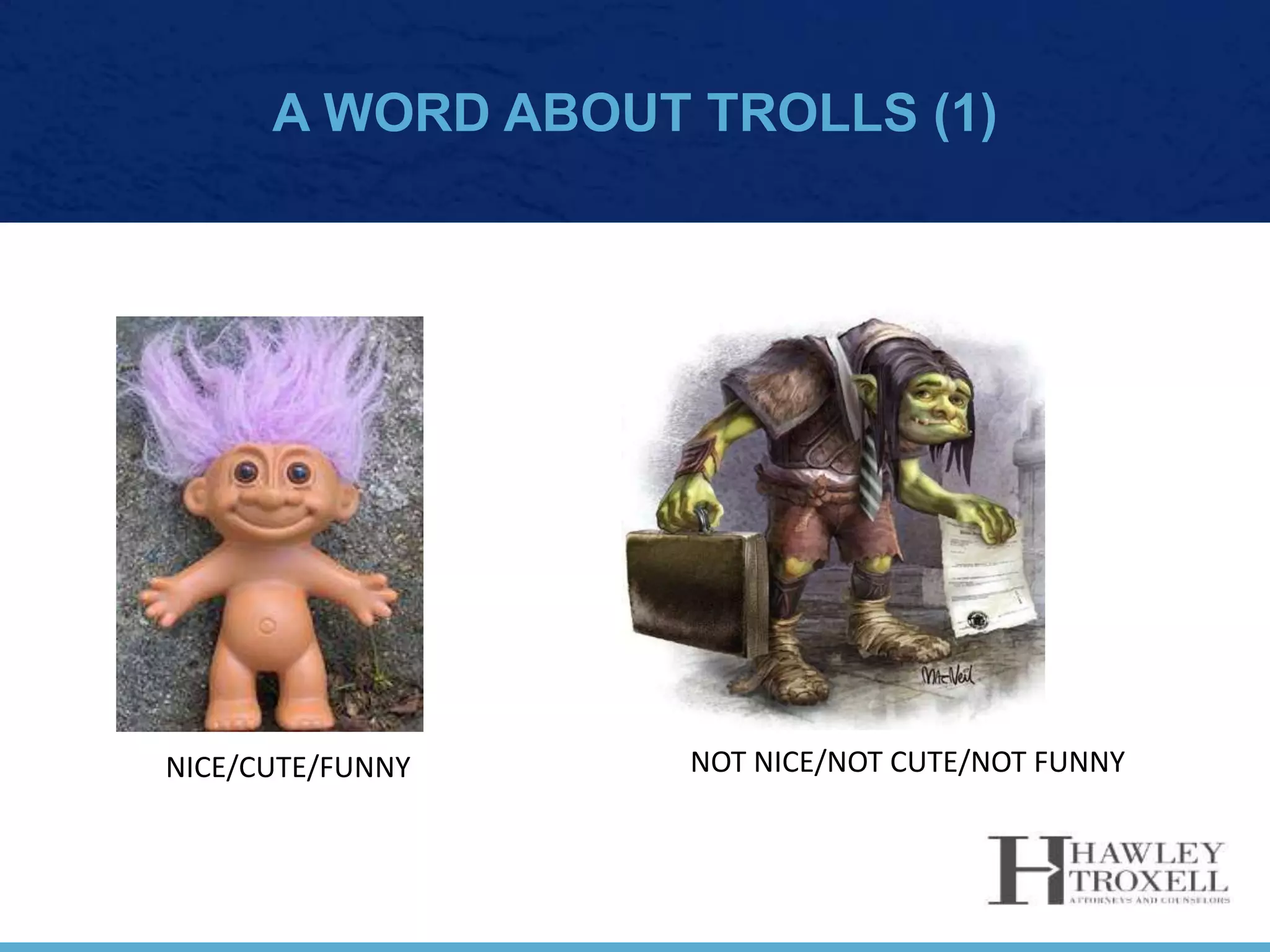
A WORD ABOUT TROLLS (1)
NICE/CUTE/FUNNY NOT NICE/NOT CUTE/NOT FUNNY
A WORD ABOUT TROLLS (2)
• When both parties produce a product and have patents, cross-
licensing is the natural result
– Similar to the Mutual Assured Destruction (MAD) doctrine
• When one party does not produce a product and has patents, there
is often no cost effective counter-threat
• Patents provide the ability to prevent others from making, using, and
selling. If the “others” are NPEs and they do not want to make, use,
or sell, how can you attack them to defend yourself?
– Similar to nationless combatants and asymmetric conflicts
• It is hard to fight trolls, however, even in the case of trolls, a strong
patent portfolio can put you on a more even footing and reduce any
fees extracted
• Car alarm theory
THANK YOU!
Philip McKay
pmckay@hawleytroxell.com
(208) 388-4824
208.344.6000
www.hawleytroxell.com

Avoid Patent Pitfalls and Obstacles Over the Lifetime of Your Innovation by Phil McKay

  • 1.
    AVOIDING PATENT PITFALLSAND OBSTACLES OVER THE LIFETIME OF YOUR INNOVATION Phil McKay pmckay@hawleytroxell.com 208.388.4824
  • 2.
    INTRO TO PATENTRIGHTS • A patent is a property right (grant) which provides the patentee a monopoly for a limited period of time (20 years from filing date) • Negative Right: To exclude others from making, using, selling, or importing the patented invention
  • 3.
    TYPES OF PATENTS •Design Patents – Issued for appearance related features only, not functional features – A crossover with copyright and trademark law – Being used more and more to protect UIs/screen appearance • Utility Patents – Issued for functional inventions • Provisional Patents – Marker for utility patent to be filed within 1 year – Must be enabled and complete to obtain filing date – Can actually be more expensive than a utility
  • 4.
    WHAT CAN BEPATENTED? In short, “anything under the sun made by man” but not necessarily everything done by man. • Natural Phenomenon, Laws of Nature, Abstract Ideas, are not patentable subject matter – Alice and Mayo – limits on software based on abstract idea – Now a two part Mayo test for virtually all software patents • New collections of existing elements/devices – Used in a different way – Used for a different purpose – Used as a new combination • Must relate to a legal endeavor • There are over 9 million issued patents (very few light bulb level inventions)
  • 5.
    COMMON WAYS TOACCIDENTALLY LOSE YOUR PATENT RIGHTS • 1 year grace period – For public disclosures • White papers – can work both ways – For offers to sell (maybe) – For public use – Elsewhere in the world these actions can result in lost patent rights immediately • First to File – Now like the rest of the world – Can render grace period largely ineffective – Significant prior art and procedural issues with first to file – Not particularly beneficial to the “little guy”
  • 6.
    PATENT PROSECUTION TIME •Filing date, the date you submit the application to the PTO and get a receipt – Now determines who is awarded rights – Everything before this date is now potential prior art – Public disclosure, use, and offers for sale occurring after the filing date are a non-issue with respect to patent rights – watch out for TS • 2 to 5 years later a first office action is issued – Vast majority reject all claims – 90 days to respond – Average 2 rounds • Response to office actions/Issuance – 1 to 2 years – Highly recommend examiner interviews. The examiner must grant at least one • In Short, 3 to 5 years from filing to Issuance
  • 7.
    APPROXIMATE COSTS • Preparationand Filing - $6,000 to $18,000 – 5 to 15K Attorney fees – 1 to 3K Filing fees – Insist on estimate and fee cap structure • Response to Office Actions – 1 to 2 years after filing – $4,000 to $6,000 (Assume 2) – 2 to 3K per response – average of two – Insist on fee cap structure • Issuance - $240 to $960 – Issue fee – Currently $960/$480/$240 • Maintenance - $3150 to $12,600 over 11.5 years – 3.5 years - Currently $1600/$800/$400 – 7 years – Currently $3600/$1800/$900 – 11.5 years – Currently $7400/$3700/$1850 • In Short, $13,390 to $37, 560 over about 15 years.
  • 8.
    WHAT TO PATENT •“What do I do that would be devastating to me if the competition was able to copy it or, worse, get a patent on it and stop me from doing it?” • What am I doing that my potential competitors/partners/licensees would want • Why did you get into this business and why did you feel you would succeed
  • 9.
    WHY PATENT ?(1) • FOR DEFENSIVE PURPOSES: – FREEDOM TO OPERATE AND FREEDOM TO USE YOUR OWN INVENTION • Minimizes/negates royalty payments to competition • Avoids funding competition's R&D • Makes your company too expensive to threaten/sue
  • 10.
    WHY PATENT ?(2) • For offensive purposes: – Prevent competitors from copying your inventions and products – Tangible return on R&D – Places a “rent charge” on each of the competitor's products and thereby keeps a cost advantage in your product – Asset on balance sheet
  • 11.
    WHY PATENT ?(3) • For strategic purposes: – The more colorable patents you can assert, the more likely your company will be deemed too expensive to sue – The more likely you will get a cross license or reduced payment deal, even from trolls – Reasonable royalty is typically a percentage of revenue. This is good news for the little guy • The golden BB effect – Establishes company as a technology leader – VCs, investors, potential partners, and potential buyers often want to see patents/applications
  • 12.
    WHY PATENT ?(4) • The competition is building one: Over 300,000 last year alone; over 9,000,000 total.
  • 13.
    WHY PATENT ?(5) • The competition is building one: 2.5 million patents in force this year. Most younger than 5 years old – will be around a long time.
  • 14.
    LICENSING CONSIDERATIONS • Howit really works – Over 9,000,000 patents – Are they really all “light bulb” level inventions? – Virtually every major Silicon Valley player is infringing someone else’s patents – Cost for Opinion letter is a minimum 20 to 40K - PER PATENT – The more colorable patents you can assert, or “offer the competition to examine,” the more likely your company will be deemed too expensive or uncertain to sue and the more likely you will get a cross license or reduced payment deal – Good news for the little guy; reasonable royalty is typically a percentage of revenue
  • 15.
    WHERE TO FILE(1) • Unless there is an identifiable foreign threat, i.e., a foreign maker selling into a foreign market, concentrate on U.S. patents – Most bang for buck – ITC can be used to stop foreign-made products from entering U.S. – No translations – Can file foreign based on U.S. case as late as a year later
  • 16.
    WHERE TO FILE(2) • If foreign applications are required: – Consider the PCT: • Initial filing fee relatively low • Allows significant delay (up to 30 months) before expense of translations is incurred. – This gives the product time to prove itself before real costs are incurred • At National Phase, once again choose carefully with an eye to the considerable cost • Note - Not all countries of interest are members of the PCT, but most are
  • 17.
    HOW TO KEEPTHE BUDGET UNDER CONTROL • Keep the patent applications focused on a single, digestible innovation: – Easier on engineers – Lower attorney fees – Less confusing to judges and jury – Easier to broaden beyond the scope of a particular embodiment – More patents, and faster
  • 18.
    A WORD ABOUTPATENT SEARCHING • Willful versus Non-Willful infringement: – Non-willful is viewed as an accident. Damages are based on a reasonable royalty – Willful is viewed as a bad actor situation with possible 3X damages and attorney fees on the line • Search sites: – Best to use only the official PTO site – Warn engineers to perform searches only with permission and under in-house attorney direction
  • 19.
    A WORD ABOUTCOMMUNICATIONS • Keep Willful versus Non-Willful Infringement in Mind: – No detailed e-mails • Use e-mail only to set up meetings and use very broad and non-descriptive language – “Need to discuss patents” – Keep discussions on a “need-to-know” basis – Don’t send engineers off on snipe hunts – Stay off the Internet – Use your outside counsel
  • 20.
    DELAYING COSTS ANDALTERNATIVE PROTECTION • Trade Secret – Must remain secret • Copyright – Some software protection with limits – No protection from independent creation • Trademark – Overlap with design patents – Must use • Just be first to market and keep doing it better than the competition • No “poor man’s patent” anymore – First to file
  • 21.
    PRE-ISSUANCE MARKING ANDTHE TOLLING OF DAMAGES • Must include the word “pending” as in “Patent Pending” – Avoid false marking charges • Even with notice, no damages are incurred until patent issues, very little legal effect • May give competition a heads up and cause complications • May scare off potential competition • A business decision and very subject matter/market dependent
  • 22.
    PRE-ISSUANCE DISCLOSURE AND MARKETING •A patent application, and the subject matter of the application, are secret until disclosed/published (Issued) – May not want to disclose it and forfeit trade secret status – This is a business call balancing marketing with value of secret status
  • 23.
    PROTECTING EVOLVING CONCEPTSAND PRODUCTS • Once foundational patent is filed do not forget to follow up on improvements and changes – This can often be done using the CIP mechanism • Typically less expensive to prepare • If new related ideas come forward, consider applications on these as well
  • 24.
    WHEN TO LICENSE •Really a business decision, however, an issued patent is always worth far more than an application – Another reason to file early
  • 25.
    POST-ISSUANCE MARKING ANDDAMAGES • Damages are available only if adequate notice is given of the patent(s) • Actual or constructive notice – Actual - Alleged infringer is directly informed – Constructive - by affixing a product with, for example, the word “patent” or abbreviation “pat.” along with the patent number, i.e., marking. • Virtual marking – Satisfied by the word “patent” or abbreviation “pat.” on the product followed by an internet address at which the patented article is associated to one or more patent numbers – Info can be updated on website vs. the product • Patented products should always be actually or virtually marked – Sometimes the product – Sometimes the packaging • only if marking the product “cannot be done.” – Sometimes the medium • Software
  • 26.
    LICENSING CONSIDERATIONS • Alwaystry to give non-exclusive licenses to the technology – At a minimum try to keep rights for yourself • Typically it is more profitable to license on a per- piece basis than to provide blanket, unlimited use, rights – Use as technology-based rent to maintain a cost advantage – Must be fairly sure innovation has legs
  • 27.
    PROTECTING EVOLVING CONCEPTSAND PRODUCTS • Once foundational patent is filed and/or issues do not forget to follow up on improvements changes – Typically still less expensive to prepare • If new related ideas come forward, consider applications on these as well
  • 28.
    A WORD ABOUTTROLLS (1) NICE/CUTE/FUNNY NOT NICE/NOT CUTE/NOT FUNNY
  • 29.
    A WORD ABOUTTROLLS (2) • When both parties produce a product and have patents, cross- licensing is the natural result – Similar to the Mutual Assured Destruction (MAD) doctrine • When one party does not produce a product and has patents, there is often no cost effective counter-threat • Patents provide the ability to prevent others from making, using, and selling. If the “others” are NPEs and they do not want to make, use, or sell, how can you attack them to defend yourself? – Similar to nationless combatants and asymmetric conflicts • It is hard to fight trolls, however, even in the case of trolls, a strong patent portfolio can put you on a more even footing and reduce any fees extracted • Car alarm theory
  • 30.
    THANK YOU! Philip McKay pmckay@hawleytroxell.com (208)388-4824 208.344.6000 www.hawleytroxell.com